

Hernan Huwyler, MBA CPA
Governance, Risk and
Compliance Management
2017
Finance Transformation
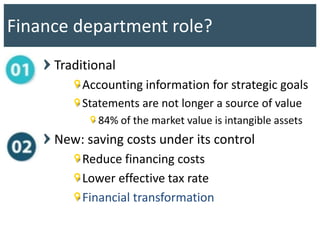
Finance department role?
Traditional
Accounting information for strategic goals
Statements are not longer a source of value
84% of the market value is intangible assets
New: saving costs under its control
Reduce financing costs
Lower effective tax rate
Financial transformation
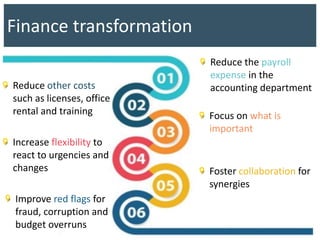
Finance transformation
Reduce the payroll
expense in the
accounting departmentReduce other costs
such as licenses, office
rental and training Focus on what is
important
Increase flexibility to
react to urgencies and
changes Foster collaboration for
synergies
Improve red flags for
fraud, corruption and
budget overruns
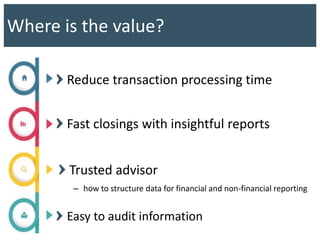
Where is the value?
Reduce transaction processing time
Fast closings with insightful reports
Easy to audit information
Trusted advisor
– how to structure data for financial and non-financial reporting
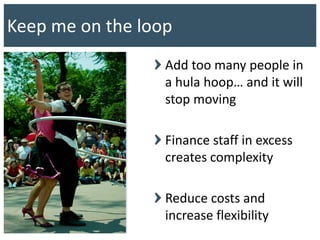
Keep me on the loop
Add too many people in
a hula hoop… and it will
stop moving
Finance staff in excess
creates complexity
Reduce costs and
increase flexibility
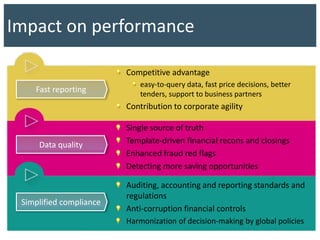
Impact on performance
Fast reporting
Competitive advantage
easy-to-query data, fast price decisions, better
tenders, support to business partners
Contribution to corporate agility
Data quality
Single source of truth
Template-driven financial recons and closings
Enhanced fraud red flags
Detecting more saving opportunities
Simplified compliance
Auditing, accounting and reporting standards and
regulations
Anti-corruption financial controls
Harmonization of decision-making by global policies
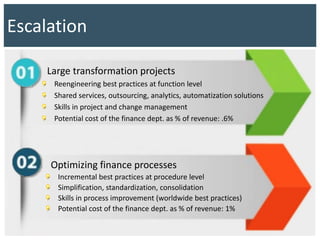
Escalation
Large transformation projects
Reengineering best practices at function level
Shared services, outsourcing, analytics, automatization solutions
Skills in project and change management
Potential cost of the finance dept. as % of revenue: .6%
Optimizing finance processes
Incremental best practices at procedure level
Simplification, standardization, consolidation
Skills in process improvement (worldwide best practices)
Potential cost of the finance dept. as % of revenue: 1%
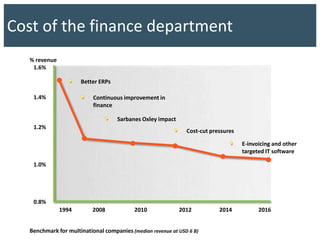
Cost of the finance department
% revenue
1.6%
1.4%
1.2%
1.0%
0.8%
1994 2008 2010 2012 2014 2016
Benchmark for multinational companies (median revenue at USD 6 B)
Sarbanes Oxley impact
Cost-cut pressures
Better ERPs
Continuous improvement in
finance
E-invoicing and other
targeted IT software
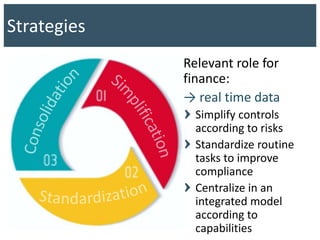
Strategies
Relevant role for
finance:
→ real time data
Simplify controls
according to risks
Standardize routine
tasks to improve
compliance
Centralize in an
integrated model
according to
capabilities
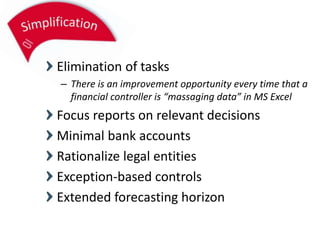
Elimination of tasks
– There is an improvement opportunity every time that a
financial controller is “massaging data” in MS Excel
Focus reports on relevant decisions
Minimal bank accounts
Rationalize legal entities
Exception-based controls
Extended forecasting horizon
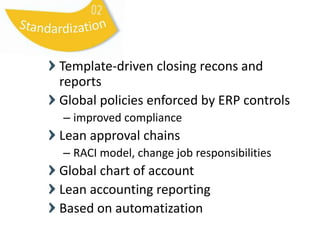
Standardization
Template-driven closing recons and
reports
Global policies enforced by ERP controls
– improved compliance
Lean approval chains
– RACI model, change job responsibilities
Global chart of account
Lean accounting reporting
Based on automatization
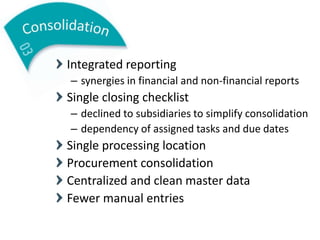
Consolidation
Integrated reporting
– synergies in financial and non-financial reports
Single closing checklist
– declined to subsidiaries to simplify consolidation
– dependency of assigned tasks and due dates
Single processing location
Procurement consolidation
Centralized and clean master data
Fewer manual entries
Inadequate budgeting for time, money or staff
– monitor budgets, have “cushions”
Lack of cooperation by other entities
– get clear project sponsors, formal planning of actions
Lack of communication to prepare for the change
– build credibility from early wins, change liaison managers,
address employee resistance
Failure in customizing ERP functionalities
– acceptance tests by end users and SMEs
Lack of follow up of improvements
– involve supervisors
Implementation risks
Goal: Expedite the production of the statements (fast close)
Use a financial closing checklist assigned to each accounting
employee
– create templates for recons and footnotes (variants in SAP)
– automate recurring journal entries (SAP FBD1+F.14+SM35)
– implement peer reviews on recons and manual journal entries to free
accounting managers
– document detailed tasks, controls, reports inputs and contacts in
closing work papers
– advance bank recons to the 25th (compare balances to the 30th)
Adjust operations to support the cutoff (e.g. billing and I/C transactions before
the 24th)
– reduce complex operations in the closing dates
– refer routine work in the accounting department on closing dates
– automate accruals with reports on purchase orders, good receipts and
invoices (SAP F.13+MR11, MIGO type 501 )
Accounting
Goal: Expedite the production of the statements
(fast close)
Eliminate operational data from financial reports
– balance with the objectives of integrated reporting
– eliminate reports available in the ERP
– separate and delay non-critical operational reports
Solve the causes of long waiting times and delays
– structure activities in parallel (rather than
sequentially)
Accounting
Goal: Reduce the number of tasks in the closing
Eliminate small accruals
– use standard estimates for accruals
– use global and general accruals
Reduce the number of low-value manual entries
– centralize the posting of manual entries
– solve the root causes of manual entries
– study cases for reversals, corrections, discrepancies and open
items
Reduce the investigation level of open items in recons
– for low value or balance percentage
Use cycle counting to avoid month-end inventory counts
Centralize I/C transactions and its documentation
Accounting
Goal: Eliminate most of the account payable dpt. by
dispensing their 3-way match control
The receiving staff checks the delivery slip against
the approved purchase order
– If there are not differences, the ERP automatically
schedules the supplier payment (using the purchase
order price) → voucher on receipt
– If there are differences (ie. +5% at line item > 100 USD),
the shipment is rejected at the receiving dock
It is not a 0-way match!
Accounts Payable
Goal: Expedite payments for lean accounting
Eliminate the manager’s signature on a supplier
invoice (single approval focused on purchase orders)
Only approve invoices
– with differences with purchase orders, or
– from vendors showing discrepancy history
Develop a web portal for vendors to enter invoices
Digitalize vendor invoices to email them to approvers
Automate travel expense reporting
Automate contract- based payments with repetitive
invoicing
Accounts Payable
Goal: Reduce the number of transactions
Implement (annual) blanket purchase orders and
master agreements with key vendors
Get purchasing cards for employees with frequent
low-value purchases
Clean up the master file to inactivate suppliers
– with 180 days without purchases
– unapproved, duplicated, with missing tax info
Eliminate advances for travel and non key suppliers
Group adjustments for claims and returns
Accounts Payable
Goal: Expedite billing for lean accounting
e-Invoicing: more than a PDF invoice via email
– reduce manual data entry to generate the invoice
– automatize shipments to issue packing slips
Issue the invoice by the delivery person
Early billing of contract-based recurring invoices
Early validation of hours to be billed
Approve exceptions between shipped goods and
billed goods
Billing
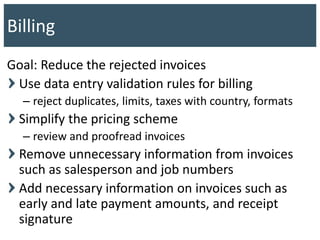
Goal: Reduce the rejected invoices
Use data entry validation rules for billing
– reject duplicates, limits, taxes with country, formats
Simplify the pricing scheme
– review and proofread invoices
Remove unnecessary information from invoices
such as salesperson and job numbers
Add necessary information on invoices such as
early and late payment amounts, and receipt
signature
Billing
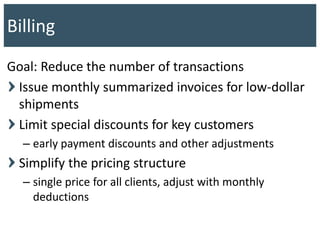
Goal: Reduce the number of transactions
Issue monthly summarized invoices for low-dollar
shipments
Limit special discounts for key customers
– early payment discounts and other adjustments
Simplify the pricing structure
– single price for all clients, adjust with monthly
deductions
Billing
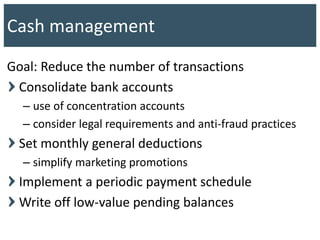
Goal: Reduce the number of transactions
Consolidate bank accounts
– use of concentration accounts
– consider legal requirements and anti-fraud practices
Set monthly general deductions
– simplify marketing promotions
Implement a periodic payment schedule
Write off low-value pending balances
Cash management
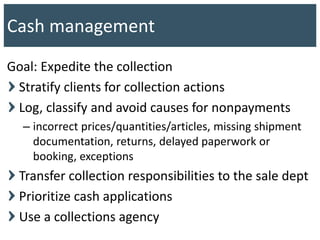
Goal: Expedite the collection
Stratify clients for collection actions
Log, classify and avoid causes for nonpayments
– incorrect prices/quantities/articles, missing shipment
documentation, returns, delayed paperwork or
booking, exceptions
Transfer collection responsibilities to the sale dept
Prioritize cash applications
Use a collections agency
Cash management
Reduce data-entry errors
– scanning with optical scanning recognition OCR, radio
frequency identification tags RFID, bar coding
– digital approvals and signatures, MS Outlool approval
traking
– numeric identifiers reduce errors from alphanumeric
Digitalize documents
– integrate SAP with EMC Documentum
Review the document retention and destruction
policies
Filling and data capture
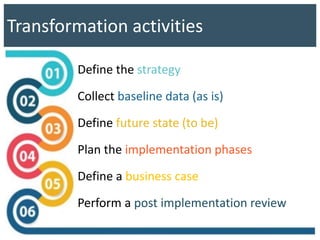
Transformation activities
Define the strategy
Collect baseline data (as is)
Define future state (to be)
Plan the implementation phases
Define a business case
Perform a post implementation review
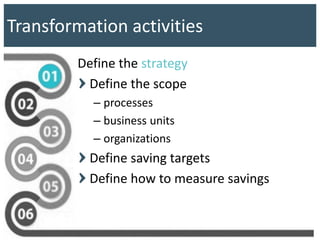
Transformation activities
Define the strategy
Define the scope
– processes
– business units
– organizations
Define saving targets
Define how to measure savings
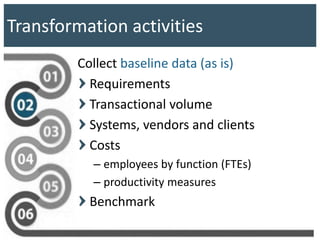
Transformation activities
Collect baseline data (as is)
Requirements
Transactional volume
Systems, vendors and clients
Costs
– employees by function (FTEs)
– productivity measures
Benchmark
Transformation activities
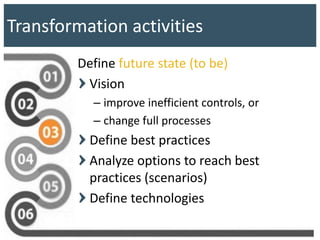
Define future state (to be)
Vision
– improve inefficient controls, or
– change full processes
Define best practices
Analyze options to reach best
practices (scenarios)
Define technologies
Transformation activities
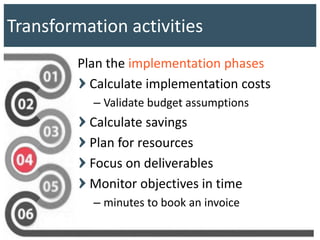
Plan the implementation phases
Calculate implementation costs
– Validate budget assumptions
Calculate savings
Plan for resources
Focus on deliverables
Monitor objectives in time
– minutes to book an invoice
Transformation activities
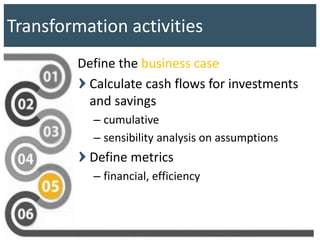
Define the business case
Calculate cash flows for investments
and savings
– cumulative
– sensibility analysis on assumptions
Define metrics
– financial, efficiency
Transformation activities
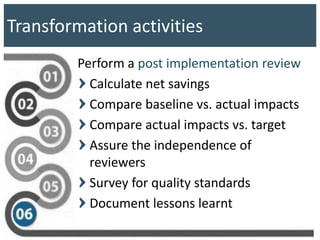
Perform a post implementation review
Calculate net savings
Compare baseline vs. actual impacts
Compare actual impacts vs. target
Assure the independence of
reviewers
Survey for quality standards
Document lessons learnt
Closing
Hernan Huwyler
mydailyexecutive.blogspot.com
at gmail
www.linkedin.com/in/hernanwyler
 + 45

Finance Transformation - Best Practices for Accounting and Control - Hernan Huwyler

  • 1.
    Hernan Huwyler, MBACPA Governance, Risk and Compliance Management 2017 Finance Transformation
  • 2.
    Finance department role? Traditional Accountinginformation for strategic goals Statements are not longer a source of value 84% of the market value is intangible assets New: saving costs under its control Reduce financing costs Lower effective tax rate Financial transformation
  • 3.
    Finance transformation Reduce thepayroll expense in the accounting departmentReduce other costs such as licenses, office rental and training Focus on what is important Increase flexibility to react to urgencies and changes Foster collaboration for synergies Improve red flags for fraud, corruption and budget overruns
  • 4.
    Where is thevalue? Reduce transaction processing time Fast closings with insightful reports Easy to audit information Trusted advisor – how to structure data for financial and non-financial reporting
  • 5.
    Keep me onthe loop Add too many people in a hula hoop… and it will stop moving Finance staff in excess creates complexity Reduce costs and increase flexibility
  • 6.
    Impact on performance Fastreporting Competitive advantage easy-to-query data, fast price decisions, better tenders, support to business partners Contribution to corporate agility Data quality Single source of truth Template-driven financial recons and closings Enhanced fraud red flags Detecting more saving opportunities Simplified compliance Auditing, accounting and reporting standards and regulations Anti-corruption financial controls Harmonization of decision-making by global policies
  • 7.
    Escalation Large transformation projects Reengineeringbest practices at function level Shared services, outsourcing, analytics, automatization solutions Skills in project and change management Potential cost of the finance dept. as % of revenue: .6% Optimizing finance processes Incremental best practices at procedure level Simplification, standardization, consolidation Skills in process improvement (worldwide best practices) Potential cost of the finance dept. as % of revenue: 1%
  • 8.
    Cost of thefinance department % revenue 1.6% 1.4% 1.2% 1.0% 0.8% 1994 2008 2010 2012 2014 2016 Benchmark for multinational companies (median revenue at USD 6 B) Sarbanes Oxley impact Cost-cut pressures Better ERPs Continuous improvement in finance E-invoicing and other targeted IT software
  • 9.
    Strategies Relevant role for finance: →real time data Simplify controls according to risks Standardize routine tasks to improve compliance Centralize in an integrated model according to capabilities
  • 10.
    Elimination of tasks –There is an improvement opportunity every time that a financial controller is “massaging data” in MS Excel Focus reports on relevant decisions Minimal bank accounts Rationalize legal entities Exception-based controls Extended forecasting horizon
  • 11.
    Standardization Template-driven closing reconsand reports Global policies enforced by ERP controls – improved compliance Lean approval chains – RACI model, change job responsibilities Global chart of account Lean accounting reporting Based on automatization
  • 12.
    Consolidation Integrated reporting – synergiesin financial and non-financial reports Single closing checklist – declined to subsidiaries to simplify consolidation – dependency of assigned tasks and due dates Single processing location Procurement consolidation Centralized and clean master data Fewer manual entries
  • 13.
    Inadequate budgeting fortime, money or staff – monitor budgets, have “cushions” Lack of cooperation by other entities – get clear project sponsors, formal planning of actions Lack of communication to prepare for the change – build credibility from early wins, change liaison managers, address employee resistance Failure in customizing ERP functionalities – acceptance tests by end users and SMEs Lack of follow up of improvements – involve supervisors Implementation risks
  • 14.
    Goal: Expedite theproduction of the statements (fast close) Use a financial closing checklist assigned to each accounting employee – create templates for recons and footnotes (variants in SAP) – automate recurring journal entries (SAP FBD1+F.14+SM35) – implement peer reviews on recons and manual journal entries to free accounting managers – document detailed tasks, controls, reports inputs and contacts in closing work papers – advance bank recons to the 25th (compare balances to the 30th) Adjust operations to support the cutoff (e.g. billing and I/C transactions before the 24th) – reduce complex operations in the closing dates – refer routine work in the accounting department on closing dates – automate accruals with reports on purchase orders, good receipts and invoices (SAP F.13+MR11, MIGO type 501 ) Accounting
  • 15.
    Goal: Expedite theproduction of the statements (fast close) Eliminate operational data from financial reports – balance with the objectives of integrated reporting – eliminate reports available in the ERP – separate and delay non-critical operational reports Solve the causes of long waiting times and delays – structure activities in parallel (rather than sequentially) Accounting
  • 16.
    Goal: Reduce thenumber of tasks in the closing Eliminate small accruals – use standard estimates for accruals – use global and general accruals Reduce the number of low-value manual entries – centralize the posting of manual entries – solve the root causes of manual entries – study cases for reversals, corrections, discrepancies and open items Reduce the investigation level of open items in recons – for low value or balance percentage Use cycle counting to avoid month-end inventory counts Centralize I/C transactions and its documentation Accounting
  • 17.
    Goal: Eliminate mostof the account payable dpt. by dispensing their 3-way match control The receiving staff checks the delivery slip against the approved purchase order – If there are not differences, the ERP automatically schedules the supplier payment (using the purchase order price) → voucher on receipt – If there are differences (ie. +5% at line item > 100 USD), the shipment is rejected at the receiving dock It is not a 0-way match! Accounts Payable
  • 18.
    Goal: Expedite paymentsfor lean accounting Eliminate the manager’s signature on a supplier invoice (single approval focused on purchase orders) Only approve invoices – with differences with purchase orders, or – from vendors showing discrepancy history Develop a web portal for vendors to enter invoices Digitalize vendor invoices to email them to approvers Automate travel expense reporting Automate contract- based payments with repetitive invoicing Accounts Payable
  • 19.
    Goal: Reduce thenumber of transactions Implement (annual) blanket purchase orders and master agreements with key vendors Get purchasing cards for employees with frequent low-value purchases Clean up the master file to inactivate suppliers – with 180 days without purchases – unapproved, duplicated, with missing tax info Eliminate advances for travel and non key suppliers Group adjustments for claims and returns Accounts Payable
  • 20.
    Goal: Expedite billingfor lean accounting e-Invoicing: more than a PDF invoice via email – reduce manual data entry to generate the invoice – automatize shipments to issue packing slips Issue the invoice by the delivery person Early billing of contract-based recurring invoices Early validation of hours to be billed Approve exceptions between shipped goods and billed goods Billing
  • 21.
    Goal: Reduce therejected invoices Use data entry validation rules for billing – reject duplicates, limits, taxes with country, formats Simplify the pricing scheme – review and proofread invoices Remove unnecessary information from invoices such as salesperson and job numbers Add necessary information on invoices such as early and late payment amounts, and receipt signature Billing
  • 22.
    Goal: Reduce thenumber of transactions Issue monthly summarized invoices for low-dollar shipments Limit special discounts for key customers – early payment discounts and other adjustments Simplify the pricing structure – single price for all clients, adjust with monthly deductions Billing
  • 23.
    Goal: Reduce thenumber of transactions Consolidate bank accounts – use of concentration accounts – consider legal requirements and anti-fraud practices Set monthly general deductions – simplify marketing promotions Implement a periodic payment schedule Write off low-value pending balances Cash management
  • 24.
    Goal: Expedite thecollection Stratify clients for collection actions Log, classify and avoid causes for nonpayments – incorrect prices/quantities/articles, missing shipment documentation, returns, delayed paperwork or booking, exceptions Transfer collection responsibilities to the sale dept Prioritize cash applications Use a collections agency Cash management
  • 25.
    Reduce data-entry errors –scanning with optical scanning recognition OCR, radio frequency identification tags RFID, bar coding – digital approvals and signatures, MS Outlool approval traking – numeric identifiers reduce errors from alphanumeric Digitalize documents – integrate SAP with EMC Documentum Review the document retention and destruction policies Filling and data capture
  • 26.
    Transformation activities Define thestrategy Collect baseline data (as is) Define future state (to be) Plan the implementation phases Define a business case Perform a post implementation review
  • 27.
    Transformation activities Define thestrategy Define the scope – processes – business units – organizations Define saving targets Define how to measure savings
  • 28.
    Transformation activities Collect baselinedata (as is) Requirements Transactional volume Systems, vendors and clients Costs – employees by function (FTEs) – productivity measures Benchmark
  • 29.
    Transformation activities Define futurestate (to be) Vision – improve inefficient controls, or – change full processes Define best practices Analyze options to reach best practices (scenarios) Define technologies
  • 30.
    Transformation activities Plan theimplementation phases Calculate implementation costs – Validate budget assumptions Calculate savings Plan for resources Focus on deliverables Monitor objectives in time – minutes to book an invoice
  • 31.
    Transformation activities Define thebusiness case Calculate cash flows for investments and savings – cumulative – sensibility analysis on assumptions Define metrics – financial, efficiency
  • 32.
    Transformation activities Perform apost implementation review Calculate net savings Compare baseline vs. actual impacts Compare actual impacts vs. target Assure the independence of reviewers Survey for quality standards Document lessons learnt
  • 33.
  • 34.