ACHAITANYA
180070003
SECTION-
13
FARMER'sSUICIDESIN
INDIA
Content:
About a farmer
Why should we talk about farmer
suicides
Reasons for farmer suicides in India
Drought
Monsoons
Lack of proper irrigation
Ground water
Lack of power supply
Expensive technologies
Crop failure
Impact of suicides
Preventive measures
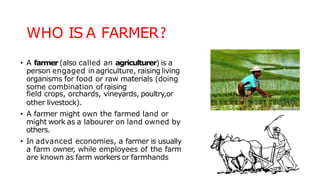
WHO IS A FARMER?
• A farmer (also called an agriculturer) is a
person engaged in agriculture, raising living
organisms for food or raw materials (doing
some combination of raising
field crops, orchards, vineyards, poultry,or
other livestock).
• A farmer might own the farmed land or
might work as a labourer on land owned by
others.
• In advanced economies, a farmer is usually
a farm owner, while employees of the farm
are known as farm workers or farmhands
WHY SHOULD WE TALKABOUTFARMER'S
SUICIDES
• Agriculture sector has a pivotal role in Indian economy.
• The share of agriculture sector in G.D.P
. of India was 44.0%during
1973-74.
• Agriculture provides the principal means of livelihood for over 60
percent of India's population.
• InIndian planning agriculture sector ignored except in a few five years
plan.
REASONS FORFARMER'S
SUICIDEININDIA
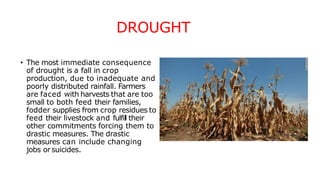
DROUGHT
• The most immediate consequence
of drought is a fall in crop
production, due to inadequate and
poorly distributed rainfall. Farmers
are faced with harvests that are too
small to both feed their families,
fodder supplies from crop residues to
feed their livestock and fulfil their
other commitments forcing them to
drastic measures. The drastic
measures can include changing
jobs orsuicides.
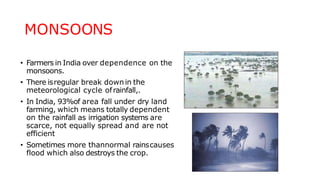
MONSOONS
• Farmers in India over dependence on the
monsoons.
• There isregular break downin the
meteorological cycle ofrainfall,.
• In India, 93%of area fall under dry land
farming, which means totally dependent
on the rainfall as irrigation systems are
scarce, not equally spread and are not
efficient
• Sometimes more thannormal rainscauses
flood which also destroys the crop.
LACK OF PROPER
IRRIGATION
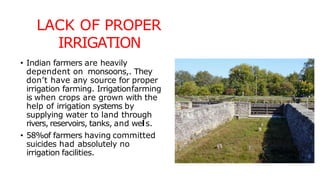
• Indian farmers are heavily
dependent on monsoons,. They
don’t have any source for proper
irrigation farming. Irrigationfarming
is when crops are grown with the
help of irrigation systems by
supplying water to land through
rivers, reservoirs, tanks, and wels.
• 58%of farmers having committed
suicides had absolutely no
irrigation facilities.
GROUNDWATER
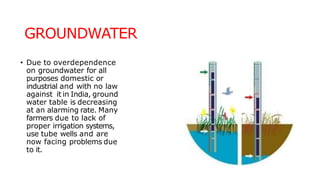
• Due to overdependence
on groundwater for all
purposes domestic or
industrial and with no law
against it in India, ground
water table is decreasing
at an alarming rate. Many
farmers due to lack of
proper irrigation systems,
use tube wells and are
now facing problems due
to it.
LACK OF POWER
SUPPLY
 Many agriculture tasks related to
the power/electric dependent.
 Costly or no electricity supply
proves to a significant problem.
EXPENSIVE
TECHNOLOGIES
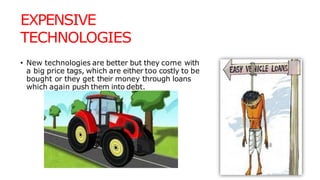
• New technologies are better but they come with
a big price tags, which are either too costly to be
bought or they get their money through loans
which again push them into debt.
CROP
FAILURE
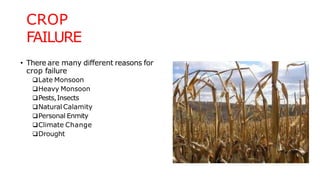
• There are many different reasons for
crop failure
Late Monsoon
Heavy Monsoon
Pests,Insects
Natural Calamity
Personal Enmity
Climate Change
Drought
IMPACT OFSUICIDES
• Suicides leads to loss of sole breadwinner in the family.
• Widows burdened with the new responsibility as the sole breadwinner.
• Itcauses a lot of psychological distress to family.
• There is increased socialstigma.
• Impact on children’s education.
• Other family members attempting suicides.
• Children sometimes lose both parents to suicide, forcing their
education to a halt, especially if they have to work in order to
provide for theirneeds.
• The families moves from farm labor to permanent labor.
• Thisalso leads to child labour and detoriation of physical health
PREVENTIVEMEASURES
 Building social systems & strengthening.
 Focus on creating alternate livelihoods.
 Encourage multiple cropping.
 Generate awareness pesticide usage.
 Provide timely government inputs to the farmers.
 Provide quality of seeds.
 Government inadvance should state the premium price for
the crops.
THANK YOU

Farmer sucides in inda

  • 1.
  • 2.
  • 3.
    Content: About a farmer Whyshould we talk about farmer suicides Reasons for farmer suicides in India Drought Monsoons Lack of proper irrigation Ground water Lack of power supply Expensive technologies Crop failure Impact of suicides Preventive measures
  • 4.
    WHO IS AFARMER? • A farmer (also called an agriculturer) is a person engaged in agriculture, raising living organisms for food or raw materials (doing some combination of raising field crops, orchards, vineyards, poultry,or other livestock). • A farmer might own the farmed land or might work as a labourer on land owned by others. • In advanced economies, a farmer is usually a farm owner, while employees of the farm are known as farm workers or farmhands
  • 5.
    WHY SHOULD WETALKABOUTFARMER'S SUICIDES • Agriculture sector has a pivotal role in Indian economy. • The share of agriculture sector in G.D.P . of India was 44.0%during 1973-74. • Agriculture provides the principal means of livelihood for over 60 percent of India's population. • InIndian planning agriculture sector ignored except in a few five years plan.
  • 6.
  • 7.
    DROUGHT • The mostimmediate consequence of drought is a fall in crop production, due to inadequate and poorly distributed rainfall. Farmers are faced with harvests that are too small to both feed their families, fodder supplies from crop residues to feed their livestock and fulfil their other commitments forcing them to drastic measures. The drastic measures can include changing jobs orsuicides.
  • 8.
    MONSOONS • Farmers inIndia over dependence on the monsoons. • There isregular break downin the meteorological cycle ofrainfall,. • In India, 93%of area fall under dry land farming, which means totally dependent on the rainfall as irrigation systems are scarce, not equally spread and are not efficient • Sometimes more thannormal rainscauses flood which also destroys the crop.
  • 9.
    LACK OF PROPER IRRIGATION •Indian farmers are heavily dependent on monsoons,. They don’t have any source for proper irrigation farming. Irrigationfarming is when crops are grown with the help of irrigation systems by supplying water to land through rivers, reservoirs, tanks, and wels. • 58%of farmers having committed suicides had absolutely no irrigation facilities.
  • 10.
    GROUNDWATER • Due tooverdependence on groundwater for all purposes domestic or industrial and with no law against it in India, ground water table is decreasing at an alarming rate. Many farmers due to lack of proper irrigation systems, use tube wells and are now facing problems due to it.
  • 11.
    LACK OF POWER SUPPLY Many agriculture tasks related to the power/electric dependent.  Costly or no electricity supply proves to a significant problem.
  • 12.
    EXPENSIVE TECHNOLOGIES • New technologiesare better but they come with a big price tags, which are either too costly to be bought or they get their money through loans which again push them into debt.
  • 13.
    CROP FAILURE • There aremany different reasons for crop failure Late Monsoon Heavy Monsoon Pests,Insects Natural Calamity Personal Enmity Climate Change Drought
  • 14.
    IMPACT OFSUICIDES • Suicidesleads to loss of sole breadwinner in the family. • Widows burdened with the new responsibility as the sole breadwinner. • Itcauses a lot of psychological distress to family. • There is increased socialstigma. • Impact on children’s education. • Other family members attempting suicides. • Children sometimes lose both parents to suicide, forcing their education to a halt, especially if they have to work in order to provide for theirneeds. • The families moves from farm labor to permanent labor. • Thisalso leads to child labour and detoriation of physical health
  • 15.
    PREVENTIVEMEASURES  Building socialsystems & strengthening.  Focus on creating alternate livelihoods.  Encourage multiple cropping.  Generate awareness pesticide usage.  Provide timely government inputs to the farmers.  Provide quality of seeds.  Government inadvance should state the premium price for the crops.
  • 16.