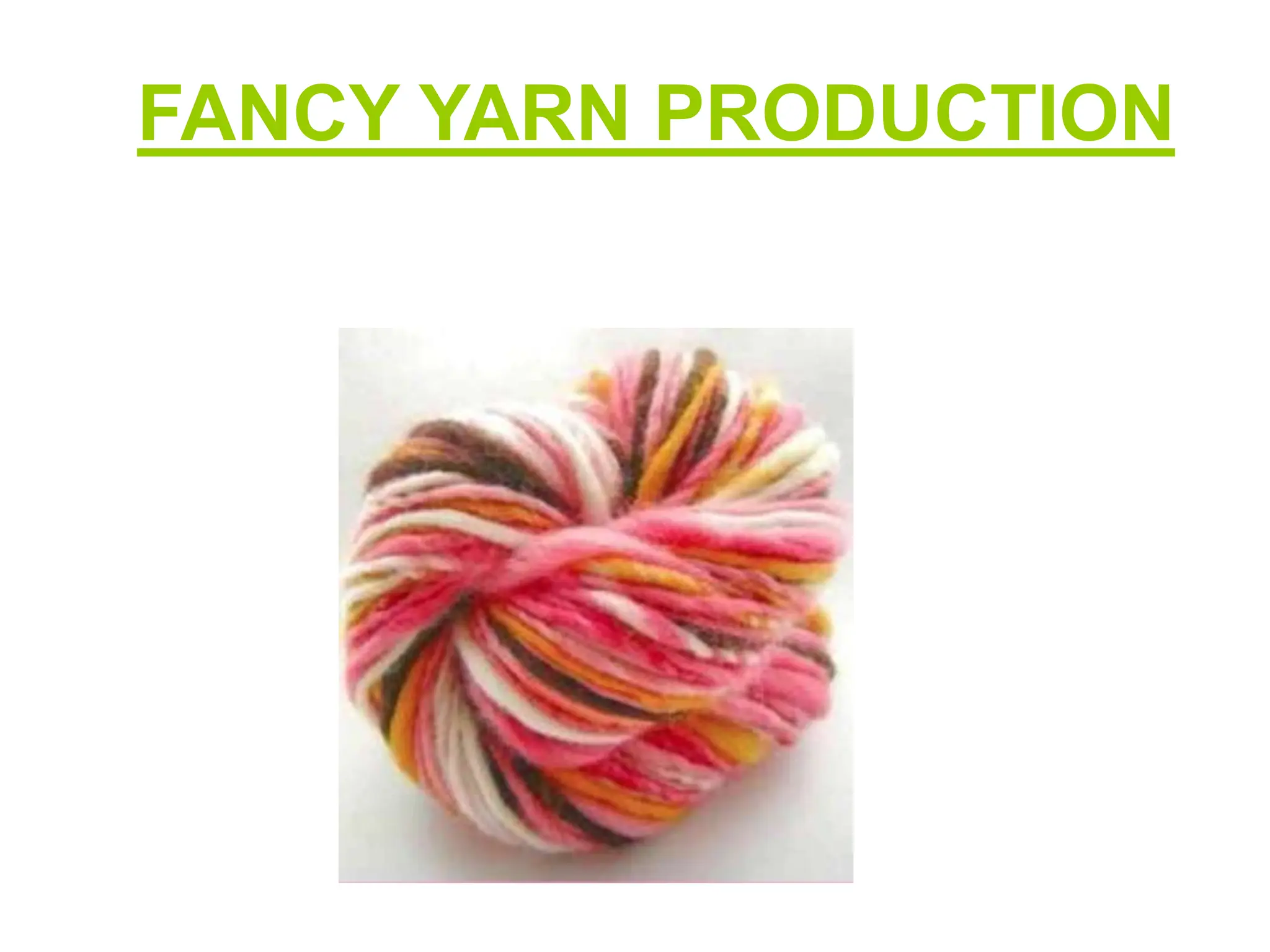
FANCY YARN PRODUCTION
DEFINITION
• A fancy yarn is made with a distinctive irregular
profile or a construction that differs from the
basic single and folded yarns
• The objective is to enhance the aesthetics of the
end product.
BASIC FANCY YARN EFFECTS
 Spiral – mock spiral, mouline, jaspe
 Gimp – Frise, caterpillar, onde
 Slub – Ground slub, injected slub
 Knop – Knot, nep, button, reverse caterpillar
 Loop – Boucle, prong
 Cover – Twisted flame
 Chenille – Woven chenille, Plied chenille
 Snarl
CLASSIFICATION OF FANCY YARNS
Yarn Produced Effects Spun Yarn Effects
Regular Effects Controlled
discontinuous
effects
Regular Effects Controlled
discontinuous
effects
Spiral
Mouline
Loop
Boucle
Frotte
Gimp
Onde
Snarl
Cover
Chenille
Reverse
Caterpillar
Neps
Knots
Knop
Slub
Spiral
Mouline
Loop
Boucle
Gimp
Onde
Chennille
Button
Slub
Caterpillar
Combinations
BASIC PRINICIPLES
• BASIC COMPONENT
OF A FANCY YARN:
• 1. A ground or core
component
• 2. An effect
component
• 3. A binder
a
• To obtain structural effect, longer length of effect
component, relative to ground component must
be present to form the required effect.
• Twisting of the effect component on to the
ground component will produce aesthetic effect.
• The basic principle is therefore to feed the
ground and effect component at different speeds
in to the twisting element.
• The percentage ratio of the effect component to
the ground component is called over feed ratio
The exceptions to the above general
structure for fancy yarns are
1) Spiral yarns
2) Ground Slub
3) Flake & Nep spun yarns
PRODUCTION METHODS
1) Plying or Twisting Process
Fancy Twisting or Doubling Frame; Plying of
Non-effect or of Effective Yarns
2) Spinning Process
 Ring spinning
 Hollow spindle spinning
 DREF friction spinning
 Repco spinning
 Siro spinning
 Continuous felting: Wool and blends
3) Brushing Process
Production of Hairy Yarns by Light
Brushing
PLYING TECHNIQUE
Two stages in the process
1) The profile twisting stage, involving the
ground and effect components
2) The binding stage, where the binder is
introduced to stabilize the profile.
G – Ground component
E – Effect component
 Roller E must not interfere
with the controlled running
of the ground yarns
 Grooves are cut into the
periphery of the top roller
 Length of effect yarn
needed to form a desired
profile is obtained by the
percentage over feed.
Profile Twisting Stage
• First approach is the G roller is
made to stop for a very short
period at irregular intervals while
E rollers are still feeding the
effect yarn into the twisting zone.
• The second approach in forming
the knob yarn is to have both
yarns constantly running over the
small over feed of the effect
component. The spacer bar is
made to oscillate up and down
continuously to alter the distance
of the travel go the effect
component.
Binding Stage
• This is a reverse-twist stage
• If the profile twist is of Z direction, the binding
twist is usually S direction to obtain the Balance
Yarn
• The profile yarn is commonly twisted with a
filament yarn, the latter having a slight overfeed
of 102% to 105%.
Plied Chenille Profile
SPINNING TECHNIQUE
HOLLOW SPINDLE TECHNIQUE
FANCY YARNS
• These are plied yarns where
one yarn wraps around the
other, rather than the yarns
being twisted together
• A spiral yarn has a higher twist
than a corkscrew yarn
• A spiral yarn usually has a
thinner yarn wrapped round a
thicker core
• A corkscrew yarn has a softer
bulkier yarn wrapped round a
thin, firm yarn
GIMP YARN
LOOP YARN
SNARL YARN
• Snarl yarns are made in a
similar way to loop yarns
• Except the effect yarn
has a high, lively twist, so
that the excess bits snarl
and double up on
themselves and twist
together
• (Just like the lengths of
cord we make on a door-
knob!)
KNOP YARN
• These yarns are also
made by feeding the
yarns at different rates
while spinning
• But this time the excess
yarn of one or more of the
components forms
bunches
• These can be at regular
or irregular intervals
COVER YARN
SLUB YARN
• Slub yarn is charactorised
by having,
• alternating short places of
thin, firm twist yarn,
• with places of very thick,
loose twist yarn
• The differnt areas can be
at regular or irregular
intervals
CHENILLE YARN
• chenille yarns have a soft, fuzzy
cut pile which is bound to a core
• These yarns can be spun, but
the machinery required is very
specialised
• For this reason, these yarns are
usually woven on a loom
• The effect yarn forms the warp,
which is bound by a weft thread
• The weft thread is spaced out at
a distance of twice the required
length of pile
• The warp is then cut half way
between each weft thread.

FANCY YARN applications araas and production methods

  • 1.
  • 2.
    DEFINITION • A fancyyarn is made with a distinctive irregular profile or a construction that differs from the basic single and folded yarns • The objective is to enhance the aesthetics of the end product.
  • 3.
    BASIC FANCY YARNEFFECTS  Spiral – mock spiral, mouline, jaspe  Gimp – Frise, caterpillar, onde  Slub – Ground slub, injected slub  Knop – Knot, nep, button, reverse caterpillar  Loop – Boucle, prong  Cover – Twisted flame  Chenille – Woven chenille, Plied chenille  Snarl
  • 5.
    CLASSIFICATION OF FANCYYARNS Yarn Produced Effects Spun Yarn Effects Regular Effects Controlled discontinuous effects Regular Effects Controlled discontinuous effects Spiral Mouline Loop Boucle Frotte Gimp Onde Snarl Cover Chenille Reverse Caterpillar Neps Knots Knop Slub Spiral Mouline Loop Boucle Gimp Onde Chennille Button Slub Caterpillar Combinations
  • 6.
    BASIC PRINICIPLES • BASICCOMPONENT OF A FANCY YARN: • 1. A ground or core component • 2. An effect component • 3. A binder a
  • 7.
    • To obtainstructural effect, longer length of effect component, relative to ground component must be present to form the required effect. • Twisting of the effect component on to the ground component will produce aesthetic effect. • The basic principle is therefore to feed the ground and effect component at different speeds in to the twisting element. • The percentage ratio of the effect component to the ground component is called over feed ratio
  • 8.
    The exceptions tothe above general structure for fancy yarns are 1) Spiral yarns 2) Ground Slub 3) Flake & Nep spun yarns
  • 9.
    PRODUCTION METHODS 1) Plyingor Twisting Process Fancy Twisting or Doubling Frame; Plying of Non-effect or of Effective Yarns 2) Spinning Process  Ring spinning  Hollow spindle spinning  DREF friction spinning  Repco spinning  Siro spinning  Continuous felting: Wool and blends
  • 10.
    3) Brushing Process Productionof Hairy Yarns by Light Brushing
  • 11.
    PLYING TECHNIQUE Two stagesin the process 1) The profile twisting stage, involving the ground and effect components 2) The binding stage, where the binder is introduced to stabilize the profile.
  • 12.
    G – Groundcomponent E – Effect component  Roller E must not interfere with the controlled running of the ground yarns  Grooves are cut into the periphery of the top roller  Length of effect yarn needed to form a desired profile is obtained by the percentage over feed. Profile Twisting Stage
  • 13.
    • First approachis the G roller is made to stop for a very short period at irregular intervals while E rollers are still feeding the effect yarn into the twisting zone. • The second approach in forming the knob yarn is to have both yarns constantly running over the small over feed of the effect component. The spacer bar is made to oscillate up and down continuously to alter the distance of the travel go the effect component.
  • 14.
    Binding Stage • Thisis a reverse-twist stage • If the profile twist is of Z direction, the binding twist is usually S direction to obtain the Balance Yarn • The profile yarn is commonly twisted with a filament yarn, the latter having a slight overfeed of 102% to 105%.
  • 15.
  • 16.
  • 17.
  • 18.
    FANCY YARNS • Theseare plied yarns where one yarn wraps around the other, rather than the yarns being twisted together • A spiral yarn has a higher twist than a corkscrew yarn • A spiral yarn usually has a thinner yarn wrapped round a thicker core • A corkscrew yarn has a softer bulkier yarn wrapped round a thin, firm yarn
  • 19.
  • 20.
  • 21.
    SNARL YARN • Snarlyarns are made in a similar way to loop yarns • Except the effect yarn has a high, lively twist, so that the excess bits snarl and double up on themselves and twist together • (Just like the lengths of cord we make on a door- knob!)
  • 22.
    KNOP YARN • Theseyarns are also made by feeding the yarns at different rates while spinning • But this time the excess yarn of one or more of the components forms bunches • These can be at regular or irregular intervals
  • 23.
  • 24.
    SLUB YARN • Slubyarn is charactorised by having, • alternating short places of thin, firm twist yarn, • with places of very thick, loose twist yarn • The differnt areas can be at regular or irregular intervals
  • 25.
    CHENILLE YARN • chenilleyarns have a soft, fuzzy cut pile which is bound to a core • These yarns can be spun, but the machinery required is very specialised • For this reason, these yarns are usually woven on a loom • The effect yarn forms the warp, which is bound by a weft thread • The weft thread is spaced out at a distance of twice the required length of pile • The warp is then cut half way between each weft thread.