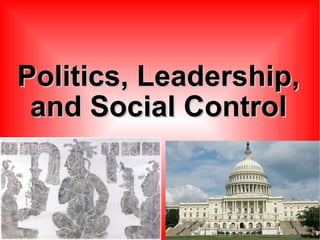
Politics, Leadership, and Social Control
The BIG Questions What does political anthropology cover? What are the major cross-cultural forms of political organization and leadership? How are politics and political organization changing? How do different cultures maintain social control? What are cross-cultural patterns of social conflict and violence? How does cultural anthropology contribute to world peace and order?
Political Anthropology focuses on human behavior and thought as it it relates to power in both stateless and state societies who has power and who does not? how much power do certain people have? how do people obtain and maintain power? how is power abused? how are politics and government organized? what are the relationships between politics and other aspects of culture?
Politics and Culture is politics a human universal? depends on how you define politics the term comes from the Greek word “politikos,” meaning of/relating to citizens similar to the Greek work “polis,” meaning city both having to do with a more complex level of civilization when looked at in more general terms, politics is the process where groups of people make collective decisions which is something we can apply cross-culturally
Politics and Culture all societies have some form of organization and social control involves making and enforcing rules and settling disputes the degree to which these things are institutionalized varies politics from a cross-cultural perspective can be analyzed in terms of the use of: power authority influence
Politics power the ability to bring about results can be done through forceful means authority the right to take certain forms of action based on status differs from power in that power can be wielded without authority influence the ability to achieve a desired end by exerting social or moral pressure on a person or group
Political Organization existence of groups for the purposes of controlling people's behavior and maintaining social order the distribution of power within a group or groups societies differ in their political organization based on three key dimensions: 1) extent to which political institutions are distinct from other aspects of the social structure in small-scale societies, distinctions might not be clear, ex: the family unit might be the only structure or institution 2) extent to which authority is concentrated into specific political roles that is, are political roles ordered hierarchically with more power at the top levels
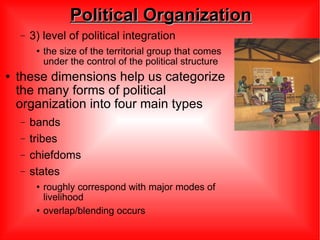
Political Organization 3) level of political integration  the size of the territorial group that comes under the control of the political structure these dimensions help us categorize the many forms of political organization into four main types bands tribes chiefdoms states roughly correspond with major modes of livelihood overlap/blending occurs
Bands basic social unit found in many foraging societies longest-standing form of political organization characterized by being kinship based and having no permanent political structure flexible membership most bands number between 20 and 50 people may make up larger group that congregates from time to time conflicts within bands minimal and are solved informally leave one band and join another
Bands bands are integrated by kinship and marriage and not by politics no political allegiances  political life is embedded within the wider social structure hard to determine what is a political decision and what is a decision based on family dynamics leadership roles in band societies are informal all members are equal, with leaders having authority or influence based on respect, but not coercive power levelling mechanisms often change
The Mbuti indigenous pygmy group from Congo foragers basically egalitarian band as highest form of organization leadership depends on context (ex: those good at hunting, will lead a hunt) decisions made as a group, discussed around campfire disagreements or offenses may result in scorn, beating, or banishment
Simple Bands usually no larger than one's extended family structured in this way as well leadership informal elder male members serving as leaders major decisions through consensus of all adult members allied with other bands through marriage usually have names as identifiers often associated with prominent geographical feature in territory
Composite Bands groupings of families sometimes in the hundreds less cohesive leadership still informal, yet more defined big men whose leadership is based more on influence rather than authority are able to hunt larger herds of animals have to cooperate to maneuver herds into situations of mass slaughter, such as cliffs ex: Comanche of southern Great Plains
Tribes comprises several bands or lineage groups share a similar language and lifestyle occupy distinct territory often connected through clan structure, where people claim descent from a common ancestor more formal than a band kinship still the primary basis for membership 100 to several thousand people associated with horticulture and pastoralism
Tribes more formal leadership than band qualifications include hard worker, generous, and good social skills part-time basis in charge of determining movements of people and herds, planting and harvesting, and times for feasts and celebrations relies on authority rather than power confederacies are tribal formations that meet from time time for things like festivals segmentary model involves gathering of confederacies during times of threat, who break up once threat is gone
Chiefdoms political organization that includes permanently allied tribes and villages under one chief who possesses power large populations integrate a number of local communities in a formal and permanent way centralized and socially complex hereditary systems of social ranking and economic stratification chiefly versus non-chiefly groups; difference in status chiefship is an office that must always be filled if a chief dies or retires, a new one must take their place often a member of previous chief's family
Chiefdoms chief's duties include: regulation of production and redistribution of goods solving disputes planning and leading raids on other groups sometimes decisions are made in conjunction with an advisory council historical chiefs have included both men and women women rulers very prominent in West Africa ex: Ashanti of Ghana and Edo of Nigeria
State Societies a centralized political unit encompassing many communities includes a bureaucratic structure leaders possess coercive power most formal and complex form of political organization have taken various forms; are not just “modern,” examples include: Greek city-states kingdom of Bunyoro in Uganda, dating back to the 16 th  century
Origin of States Neolithic Revolution regulation of production and distribution of goods and labor providing services irrigation, priests, social servants why would people choose to give up some of their autonomy to join state societies? three theories: voluntaristic hydraulic coercive
Voluntaristic Theory of State Formation put forth by archaeologist V. Gordon Childe (1936) introduction of intensive agriculture during Neolithic created food surpluses surpluses freed up segment of population from food production allowed them to engage in new occupational roles increase in specialization necessitated more political integration to mediate and protect special interest groups and provide economic superstructure to enable optimum efficiency
Hydraulic Theory of State Formation put forth by Karl Wittfogel (1957) suggested that farmers using small-scale irrigation in arid or semi-arid areas recognize the economic advantages of surrendering autonomy benefits of merging multiple small communities into larger entities to provide large-scale irrigation archaeological evidence suggests that large states developed before introduction of large-scale irrigation (Mexico and Mesopotamia)
Coercive Theory of State Formation set forth by Robert Carneiro (1970) suggested that the state is a direct result of warfare only operates under certain environmental conditions areas that have limited land for agriculture and need to expand in order to support populations ex: Incas of Peru – Inca state developed in narrow valleys by the ocean land pressure created competition, competition created warfare centralized political units developed to conduct warfare and administer to subjugated peoples
State Societies states have more power over their members and state leaders have more responsibilities: engage in international relations may use force defensively to maintain borders or offensively to expand territory monopolize the use of force and maintenance of order through various mechanisms laws, courts, police maintain armies and other enforcement groups membership is defined by the state, not necessarily by birth sometimes not all citizens are granted equal rights
State Societies states keep track of their citizens through census systems states have the power to tax citizens cash taxes are a new occurrence, in-kind taxation (tribute of goods) previously states manipulate information done in order to “protect the state and its leaders” directly through censorship, restriction of access, or propaganda indirectly through influence on the media
Symbols and the State states and state leaders often utilize symbols to maintain power monumental architecture direct symbol of the ability to use power to organize labor and resources incorporation of religious leaders and institutions inter-relationships between powerful structures ideology as a tool specific kinds of clothing elite versus “one of the people”
Gender and the State contemporary states are generally hierarchical and patriarchal exclude members of lower classes and women from  equal  participation highly patriarchal states maintain male dominance through ideologies the imposition of  purdah  in Muslim theocracies pre-Communist China's beliefs on strength and dependability of women versus men trend in socialist states of attempts of increasing women's roles in politics quotas for parliamentary positions
Gender and the State only 16 percent of the world's parliamentary members are women regional differences range from 40% in Scandinavian states, to 8% in Arab states some notable female politicians: Indira Gandhi in India Golda Meir in Israel Benazir Bhutto in Pakistan Michele Bachelet in Chile Ellen Johnson-Sirleaf in Liberia many come from political families
Changing Politics: The Emergence of the Nation-State nation and state, although used in combination, are two distinct concepts nation a group of people who share a common symbolic identity, culture, history, and often, religion state a particular type of political structure distinct from a band, tribal society, or chiefdom the term nation-state refers to a group of people sharing a common cultural background and unified by a political structure that they all consider legitimate
Changing Politics: The Emergence of the Nation-State important to note that modern nation-states do not really fit this definition populations that live within them are rarely homogeneous encompass a variety of cultural groups some of them really do not like each other and others who would like their own autonomous state for example, Palestinians living on the West Bank and the Gaza Strip in Israel are constantly in conflict with the Israeli state
Imagined Communities Benedict Anderson (1983) suggested that states employ symbolic strategies to create/maintain shared identity: imposition of a national language construction of monuments and museums that emphasize unity use of songs, dress, poetry, and media messages nationalism
Changing Politics transnationalism reaching beyond or transcending national borders the interconnectivity between people, despite national boundaries involves globalization and migration democratization transformation from authoritarian to democratic regimes includes: end of torture, liberation of political prisoners, lifting of censorship, and toleration of opposition relaxation versus true democratization
Statistics according to Freedom House, an organization that tracks political trends: by the end of 2005, 22 of the world’s 192 governments were electoral democracies, up from 66 countries 18 years earlier between 1975 and 2005: number of free countries increased from 40 to 89 number of partially free countries increased from 53 to 58 number of countries deemed not free declined from 65 to 45
Difficulties despite general trend toward democracy, there have been some obstacles change problematic transformation from highly authoritarian to democratic nonfit between Western-style democracy and local political traditions based on aspects such as kinship or tribal allegiance arrests, violence, and sometimes murder of protesters in various countries Iran, Yemen, Syria, Libya
Egypt in Egypt, Hosni Mubarak was ousted after an 18 day demonstration he was in power for 30 years while he claimed to have been fairly elected by the democratic process, many question the validity of these elections influenced by recent events in Tunisia, the people called for his resignation by protesting in Tahrir Square, a major public place in the capitol of Cairo role of social media
Egypt during this revolution, many people suffered violence and death as many as 150 people died during these protests and around 2,000 people were reported to be injured there have, however, been some major steps forward in reforming the political process
Internet and Democracy in order for the Internet to be a democratizing force, it must provide access to all people, not just those who can afford the technology governments and corporations have often been complicit in inhibiting the spread of free information Western technology firms have helped the Chinese government limit free expression by blocking access to political websites and selling filtering equipment
Internet and Democracy in December 2005, at the request of the Chinese government, Microsoft closed down the blog of a Chinese journalist who was critical of the government officials at Yahoo! admitted it had helped the Chinese government sentence a dissident to 10 years in prison by identifying him as the sender of a banned e-mail message
Critical Legal Anthropology legal anthropology looking at the way laws serve to maintain social cohesion functionalist approach critical legal anthropology is a critique of the status quo the study of how law and judicial institutions serve to maintain and expand dominant power interests rather than protecting marginal people focuses on state-level societies where this degree of inequality is most prominent
Systems of Social Control social control mechanisms by which behavior is constrained and directed into acceptable channels, maintaining conformity every society must ensure that most of the people behave themselves most of the time depending on the size and complexity of a given society, these methods of social control will be more or less formal can be as informal as simply learning through socialization what is allowed, or as formal as mandates, sanctions, or laws
Social Control two major instruments/mechanisms: norms accepted standards for how people should behave usually unwritten and learned unconsciously found in all societies laws binding rules created through custom or official enactment defines correct behavior and the punishment for misbehavior more common and more elaborate in state-level societies
Informal Social Controls most often found in small-scale societies, but sometimes used in state-level societies in combination with more formal methods ostracization forcing the offender to leave the group public opinion what the general public thinks about an issue this forms the basis of social pressure to behave
Informal Social Controls degradation ceremonies deliberate societal mechanisms designed to publicly humiliate someone who has broken a social norm corporate lineages kinship groups whose members engage in daily activities together often help socialize people into correct behavior as well as exerting pressure and control over its members ex: making sure that marriages are fairly planned and correctly performed
Formal Social Controls also practiced in a variety of societies some only done in state societies, some only in non-state, some in both song duel (often performed by the Inuit) means of settling disputes over wife stealing involving the use of song and lyrics to determine one’s guilt or innocence the more abusive and cleverly written a song is against other person, the more cheers one gets whoever has the best song is determined the winner
Formal Social Controls oaths the practice of having the supernatural bear witness to the truth of what a person says a formal declaration, usually performed in combination with a ritual act like signing a document or swearing on the Bible ordeals painful and possibly life-threatening test inflicted on someone suspected of wrongdoing some ordeals have nothing to do with the potential guilt of a person for example, some African societies put the accused's hand into boiling water, if that person is not guilty, the god or gods of that society will prevent harm from coming to them
Legal Systems legal systems can be informal or formal, simple or complex self-help legal systems are more like the former found in societies without centralized political systems band or tribe-level societies can be further divided into familial and mediator systems
Self-Help Legal Systems familial if offended, individual or family becomes the authority the community supports the victim and the consequences of the crime are recognized by consensus ex: Comanche wife-stealing mediator slightly more formal offended party still has authority but a third party is called upon to negotiate a solution mediator cannot impose settlement, but is generally agreed upon ex: Nuer leopard-skin chiefs
Court Systems the court holds authority in this system exist only in societies with centralized political leadership chiefdoms or states operate with formal public hearings, including judges separation between criminal law and civil law can be divided into three categories: incipient courts courts of mediation courts of regulation
Court Systems incipient courts sometimes found in tribal societies, but mostly chiefdoms judicial authorities meet, sometimes informally, to privately discuss issues and their solutions evidence not formally collected, nor are the parties consulted courts of mediation judges attempt to reach compromise solutions that will restore social cohesion based on cultural norms and values courts of regulation use codified laws, much like our own
Social Control in States increased specialization of roles related to law police, judges, lawyers policing - exercise of social control through processes of surveillance and the threat of punishment trials and courts court system where lawyers, judges, and juries are used to ensure justice and fairness in determining guilt and punishment power-enforced punishment prisons - forcible detainment, emerged with state capital punishment - requires great deal of power ex: Aztecs
Social Conflict and Violence most, if not all, societies face conflict, despite any mechanisms for social control that are in place vary in scale some only involve two people, others multiple groups include: interpersonal conflict banditry feuding ethnic conflict revolution warfare nonviolent conflict
Interpersonal Conflict usually only involves a couple of people household disputes between family members or roommates between neighbors or residents of the same town over resources or territory between people in a relationship dating, spousal violence can be fairly nonviolent or very violent yelling at your neighbor over their dog murdering your neighbor for stealing your cattle
Banditry aggressive conflict that involves socially patterned theft practiced by a person or group who are socially marginalized and gain status from this illegal activity sometimes a form of creating social ties Crete, Greece: stealing and counter-stealing of sheep until a mediator comes in and resolves the tension by creating loyalty between two parties mythification Robin Hood
Feuding intergroup aggression that involves long-term, retributive violence may be lethal between families, groups of families, or tribes motivated by revenge exacerbated by change or outside stress/pressure ex: Thull village in northern Pakistan Hatfields and the McCoys West Virginia Union versus Confederates
Ethnic Conflict two main reasons: when a dominant group tries to oppress or even eliminate a subordinate group when a subordinate group attempts to gain more autonomy while identity (ethnicity = common language, history) is often at the heart, functional reasons also play a role scarcity of land and resources as pressure ex: Central Asia where many ethnic groups exist and with the effects of the Cold War
Revolution a form of conflict involving illegal and usually violent actions by subordinate groups that seek to change the status quo occurs in a variety of societies monarchies, colonies, developing countries, totalitarian states urban versus rural origins for revolutions cities as origin, ex: Iran, Egypt agrarian revolutions, ex: French, Russian
Warfare definition of war has changed over time is it always officially declared? does one always know who one's enemy is? we can define war loosely: organized conflict involving group action directed against another group using lethal force critical military anthropology study of the military as a power structure views armed forces through critical lens:  how is the military used as an instrument of power or oppression? how has militarization (intensification of labor and resources that are allocated to maintaining militaries) affected society?
Nonviolent Conflict James Scott's (1985) term “weapons of the weak” nonviolence utilizes methods that do not require resources marginalized people do not often have resources to use or the political capital and protection needed for open, organized political activity can include hunger strikes, protests, sit-ins, desertion, feigned ignorance, slander, humor famous figures: Gandhi and Martin Luther King Jr.
Key Themes we can roughly categorize political organizations in terms of aspects like power, authority, and influence the 4 types of political organization also roughly correspond with the modes of livelihood different societies have many different ways of maintaining social control there are also a variety of ways that conflict can occur in societies political organizations and forms of social control have changed over time and will continue to change
Social Inequality and Stratification
The Big Questions How does identity relate to inequality? What are social groups and how do they vary cross-culturally? What is social stratification and inequality? What is the difference between caste and class? What are some of the reasons for inequality?
Identity identity often serves as the basis for the formation of social groups, as well as the origins of social stratification and inequality often based on micrcultural traits like “race,” ethnicity, class, and gender
Race and Ethnicity “ race” refers to the classification of people into groups on the basis of supposedly homogeneous and largely superficial biological traits such as skin color or hair characteristics ethnicity refers to a shared sense of identity among a group based on heritage, language, and culture both often serve as a way for people to identify themselves and others
Race race is one of the main bases for inequality racism often based on notion that different “races” act and think certain ways because of a biological basis (brain size, head shape) Boas set out to de-link allegedly inborn, racial attributes from behavior ex: people with similar head size from different cultures behaved differently, while people with different head sizes within the same culture behaved similarly for Boas and his students, race was not a biological reality we see today that race is, however, a social reality > cultural construct
Class class is a category based on a person's economic position in society usually measured in terms of income or wealth manifested in terms of lifestyle identifying markers such as dress, cars, houses, even type of speech used class also serves as a means for identification of self and other haves vs. have nots rich vs. poor
Social Groups what kinds of groups do people form/belong to that are not on the basis of kin relationships? how are people classified in such groups? do they join them or are they born into them? what holds these groups together? how do groups deal with leadership and participation?
Social Groups a social group is a cluster of people beyond the domestic unit who are usually related on grounds other than kinship common groupings include microcultural distinctions such as race/ethnicity, gender, age, and institutions shape group identity, organizations, and relationships among and between groups the presence and amount of social groups varies from society to society; some cultures group people according to kinship while others emphasize other social relationships more
Social Groups two basic categories of social groups: primary consists of people who interact with each other on a face-to-face basis, knowing each other personally involves more accountability in terms of rights and obligations ex: college clubs secondary consists of people who identify with each other on some common ground but who may never meet with one another or interact with each other personally ex: members of online communities/forums
Social Groups formal vs. informal many groups are formally organized, often including actual membership and recognition ex: members of the American Anthropological Association other groups are informal and are characterized by being smaller and less visible more often know each other personally organization is less hierarchical do not have legal recognition
Social Groups on the continuum ranging from smaller, primary groups to larger and more formal groups friendships clubs and fraternities countercultural groups cooperatives self-help groups
Friendship close social ties between at least two people informal voluntary, people choose their friends primary, personal interaction involving mutual support (financial, emotional) generally non-kin, often between social equals with exceptions depending on rigidity of stratification takes different forms in different cultures and microcultures
Clubs and Fraternities defined in terms of a sense of shared identity and objectives can be homogeneous or heterogeneous in terms of certain microcultural aspects ex: Intervarsity Christian Fellowship (institution and religion vs. ethnicity and age) ex: Abelam men's houses can be inclusive or exclusive free to everyone vs. paying dues ex: books clubs vs. college honor societies
Countercultural Groups sometimes people identify themselves, or are identified by others, as outside of the mainstream culture these people often still group themselves based on similarities in beliefs, backgrounds, and experiences despite variation within and between these groups, a common theme is the importance of bonding and shared initiation
Gangs groups of people, found mainly in urban areas, who are often considered a social problem by law enforcement can be formally (street gangs, organized crime syndicates) or informally (youth gangs) organized include symbolic markers of inclusion (tattoos, colors, clothing) rituals of initiation ex: Masta Liu in the Solomon Islands (youth) or the Yakuza of Japan (syndicate)
Cooperatives economic groups in which surpluses are shared among the members and decision making is based on the democratic principles of one person = one vote most common forms are agricultural and credit, but can also include craft cooperatives organized around groups of people who use their skills to make items like clothes, furniture, or pottery done for economic, political, and social reasons being able to form groups allows people to provide more products and have more power, but also allows for bonding and the sharing of ideas
Case Study: Sugar Farming in Western India state of Maharashtra sugar industry largely owned and operated through farmer cooperatives despite shareholder's only growing one to two acres of sugar cane, sugar industry is huge part of state's economy, rivaling iron and steel industries as a group, they are able to pay for expensive processing machinery due to simple rural stratification practices, cooperatives thrive here, unlike in northern India
Self-Help Groups formed to achieve specific personal goals coping with illness (depression, cancer, PTSD) or bereavement lifestyle changes (weight loss) ex: AA, NA, Weight Watchers with the increase in use of the Internet, self-help and other social groups have been able to form large, virtual communities for people in widespread areas of the world
Social Stratification consists of hierarchical relationships between different groups, as though they were arranged in layers stratified groups may be unequal on a variety of measures material resources, power, education, and status people in dominant groups are usually interested in maintaining social order while people in subordinate, less powerful groups are more interested in change appeared late in human history, most likely with emergence of agriculture
Social Inequality Weber (1946) suggested there are three basic criteria by which one can measure the level of social inequality how much access do people have to: wealth (material objects that have value in a society) power (the capacity to produce intended effects on oneself, other people, social situations, or the environment) prestige (social honor or respect within in a society) these aspects often interrelated, but can also operate independently ex: classical pianists might have prestige, but little wealth
Types of Socities Fried (1967) distinguished three types of societies based on levels of social inequality: egalitarian rank stratified
Egalitarian Societies recognize few differences in status, wealth, and power no person or group has appreciably more of these traits than any other personal differences in skill and/or knowledge, of course, occur high esteem is earned, not able to be transformed into wealth or power, and cannot be transferred to heirs number of high status positions not fixed any person capable can fill these positions commonly found in highly mobile foraging societies ex: !Kung people, Inuit, and Hadza of Tanzania
Rank Societies societies in which people have unequal access to prestige and status but not unequal status to wealth and power fixed number of high status positions ex: position of chief is largely hereditary, but standard of living is not noticeably different from an ordinary person most prominent examples found in Oceania and Native American groups of the Northwest Coast ex: Nootka of British Columbia people ranked within families based on primogeniture (eldest child, usually son, has rights to inherit the family's estate)
Stratified Societies characterized by considerable inequality in power, wealth, and prestige this inequality is both permanent and formally recognized by members of that society (institutionalization) therefore, some people or groups have little or no access to basic resources while others have no or very little barriers to the acquisition of such things the more complex the society, the more complex the system of stratification
Stratified Societies two main forms of stratified societies: class caste connected to the two main forms of status or position: ascribed achieved
Status/Position how does one acquire their status? ascribed status/position a person's standing in society based on qualities that the person has gained through birth achieved status/position a person's standing in society based on qualities that the person has gained through action while achieved status is often associated with the class system (potential for social mobility) and ascribed status is associated with the caste system, there are exceptions
Achieved Status: Class class is closely tied with economics class and status do not always match (getting money in disreputable ways) generally informal one does not sign up to be a member of the middle class groups under specific class headings (labor unions, country clubs) generally thought to be achieved by means of attaining wealth can also be ascribed, ex: heirs and heiresses are born into rich families and generally stay that way while poor people born into poor families generally stay that way as well
Theories of Class class is central to Marxist theory Marx suggested that, in terms of Industrial Europe, one could separate society into the proletariat and the bourgeoisie, the haves and the have nots because the haves have access to the means of production (resources), they are able to exploit the have nots conflict between the classes will eventually lead to the downfall of capitalism
Theories of Class Durkheim (1895) viewed class differences as basis for social solidarity two main forms of solidarity: mechanical cohesion among similar groups  less enduring relationships created due to lack of mutual need organic cohesion among groups with different abilities and resources more enduring relationships created due to need and the provision of complementary resources to different groups suggested that mechanical more associated with less complex society
Ascribed Status ascribed systems of stratification usually based on divisions of people into unequally ranked groups, for ex. on the basis of “race,” ethnicity, and caste “ race” racial stratification results from contact (colonization, slavery, migrations) between two formerly separate groups discrimination often intrinsically linked with class ex: South African policy of apartheid legally sanctioned segregation, white dominance began with migration and settlement of Europeans (Dutch) depictions of Africans as lazy and lustful served as rationale for slavery and domination, despite black majority
Ascribed Status: Ethnicity according to Comaroff (1987), ethnicity is a sense of group membership based on a shared sense of identity because this often comes out of a shared history, it can serve as the basis for the claiming of entitlements to resources (ex: land) can also serve as yet another way to put people into groups ex: the Chinese government has strict definitions for group membership, with the Han ethnic group being the majority minority groups often live on (literal) margins of society, such as Tibet, Yunnan, Xinjiang, and Inner Mongolia
Ascribed Status: Caste rigid form of social stratification in which membership is determined by birth and social mobility is basically nonexistent the  caste system a form of social stratification linked with Hinduism in which a person is born into a particular group found mainly in Hindu India, as well as Nepal, Sri Lanka, and Fiji based on sacred Hindu texts that categorize society into four major categories or  varnas
The Hindu Caste System Madelbaum (1970) according to a Hindu origin myth the four varnas originated from the body of primeval man the highest caste, the Brahmans (priests and scholars), came from his mouth the Kshatriyas (warriors) emanated from his arms the Vaishyas (merchants) came from his thighs and the Shudras (cultivators, laborers, and servants) sprang from his feet therefore, there is a religious/ideological aspect to this system of social stratification based around the notion of purity higher castes = more pure
The Hindu Caste System the first three varnas go through a ritual ceremony of initiation and “rebirth” to symbolize their high status, purity, and “twice-born” nature
The Hindu Caste System beneath the four varnas is a group that is considered to be so low that they are outside of the system itself formerly known in English as “untouchables” based on the idea that higher castes are not allowed to touch them for fear of literal and spiritual contamination have adopted the term  dalit , meaning “oppressed” or “ground down”
The Hindu Caste System within the four main varnas are hundreds, maybe even thousands, of local groups known as  jatis  (birth group) ex: brahmans can be divided into priestly and non-priestly jatis, priestly brahmans can be divided into household priests, temple priests, and funeral priests it is of note that despite the strict rules about interaction between castes, there is a large degree of interdependence because of the complex division of labor based on caste, each jati relies on many others to fulfill their daily needs (Durkheim's organic solidarity)
The Hindu Caste System traditionally caste has been associated with little social mobility maintained through practice of endogamy, spatial separation (neighborhoods), use of wealth by upper castes to sponsor festivals however, “up-casting” exists instance in 4 th  century BCE where Valmiki, writer of the Ramayana, was elevated because of his skill at poetry other strategies exists such as gaining wealth, education, migration, political activism those seeking to elevate status often take on cultural markers of “twice-born” (wearing sacred thread, practicing vegetarianism) in 1949 the Indian Constitution outlawed discrimination on the basis of caste; 20 th  century saw institution of policies, success of which is still debatable
Maintaining Inequality besides physical force, how is inequality maintained? ideologies ideas and beliefs that legitimize and reinforce inequalities in stratified societies can be religious or secular ex: heavenly ordained monarchy in Europe vs. political ideologies concerning the rich and poor can be seen in two main theories for analysis functional stratification is a way to reward individuals who contribute most to a society's well-being conflict stratification benefits mainly the upper stratum and is the cause of most social unrest and conflict in society
Key Themes identity plays a big role in the formation of social groups, as well as being the basis for social stratification and inequality social groups can have a variety of beliefs, values, and goals social stratification and inequality varies depending on the society under study complex societies often have highly complex ways of organizing society one's status within society can be achieved, ascribed, or both inequality find its root in things like ideology

Lecture 12 - Politics

  • 1.
  • 2.
    The BIG QuestionsWhat does political anthropology cover? What are the major cross-cultural forms of political organization and leadership? How are politics and political organization changing? How do different cultures maintain social control? What are cross-cultural patterns of social conflict and violence? How does cultural anthropology contribute to world peace and order?
  • 3.
    Political Anthropology focuseson human behavior and thought as it it relates to power in both stateless and state societies who has power and who does not? how much power do certain people have? how do people obtain and maintain power? how is power abused? how are politics and government organized? what are the relationships between politics and other aspects of culture?
  • 4.
    Politics and Cultureis politics a human universal? depends on how you define politics the term comes from the Greek word “politikos,” meaning of/relating to citizens similar to the Greek work “polis,” meaning city both having to do with a more complex level of civilization when looked at in more general terms, politics is the process where groups of people make collective decisions which is something we can apply cross-culturally
  • 5.
    Politics and Cultureall societies have some form of organization and social control involves making and enforcing rules and settling disputes the degree to which these things are institutionalized varies politics from a cross-cultural perspective can be analyzed in terms of the use of: power authority influence
  • 6.
    Politics power theability to bring about results can be done through forceful means authority the right to take certain forms of action based on status differs from power in that power can be wielded without authority influence the ability to achieve a desired end by exerting social or moral pressure on a person or group
  • 7.
    Political Organization existenceof groups for the purposes of controlling people's behavior and maintaining social order the distribution of power within a group or groups societies differ in their political organization based on three key dimensions: 1) extent to which political institutions are distinct from other aspects of the social structure in small-scale societies, distinctions might not be clear, ex: the family unit might be the only structure or institution 2) extent to which authority is concentrated into specific political roles that is, are political roles ordered hierarchically with more power at the top levels
  • 8.
    Political Organization 3)level of political integration the size of the territorial group that comes under the control of the political structure these dimensions help us categorize the many forms of political organization into four main types bands tribes chiefdoms states roughly correspond with major modes of livelihood overlap/blending occurs
  • 9.
    Bands basic socialunit found in many foraging societies longest-standing form of political organization characterized by being kinship based and having no permanent political structure flexible membership most bands number between 20 and 50 people may make up larger group that congregates from time to time conflicts within bands minimal and are solved informally leave one band and join another
  • 10.
    Bands bands areintegrated by kinship and marriage and not by politics no political allegiances political life is embedded within the wider social structure hard to determine what is a political decision and what is a decision based on family dynamics leadership roles in band societies are informal all members are equal, with leaders having authority or influence based on respect, but not coercive power levelling mechanisms often change
  • 11.
    The Mbuti indigenouspygmy group from Congo foragers basically egalitarian band as highest form of organization leadership depends on context (ex: those good at hunting, will lead a hunt) decisions made as a group, discussed around campfire disagreements or offenses may result in scorn, beating, or banishment
  • 12.
    Simple Bands usuallyno larger than one's extended family structured in this way as well leadership informal elder male members serving as leaders major decisions through consensus of all adult members allied with other bands through marriage usually have names as identifiers often associated with prominent geographical feature in territory
  • 13.
    Composite Bands groupingsof families sometimes in the hundreds less cohesive leadership still informal, yet more defined big men whose leadership is based more on influence rather than authority are able to hunt larger herds of animals have to cooperate to maneuver herds into situations of mass slaughter, such as cliffs ex: Comanche of southern Great Plains
  • 14.
    Tribes comprises severalbands or lineage groups share a similar language and lifestyle occupy distinct territory often connected through clan structure, where people claim descent from a common ancestor more formal than a band kinship still the primary basis for membership 100 to several thousand people associated with horticulture and pastoralism
  • 15.
    Tribes more formalleadership than band qualifications include hard worker, generous, and good social skills part-time basis in charge of determining movements of people and herds, planting and harvesting, and times for feasts and celebrations relies on authority rather than power confederacies are tribal formations that meet from time time for things like festivals segmentary model involves gathering of confederacies during times of threat, who break up once threat is gone
  • 16.
    Chiefdoms political organizationthat includes permanently allied tribes and villages under one chief who possesses power large populations integrate a number of local communities in a formal and permanent way centralized and socially complex hereditary systems of social ranking and economic stratification chiefly versus non-chiefly groups; difference in status chiefship is an office that must always be filled if a chief dies or retires, a new one must take their place often a member of previous chief's family
  • 17.
    Chiefdoms chief's dutiesinclude: regulation of production and redistribution of goods solving disputes planning and leading raids on other groups sometimes decisions are made in conjunction with an advisory council historical chiefs have included both men and women women rulers very prominent in West Africa ex: Ashanti of Ghana and Edo of Nigeria
  • 18.
    State Societies acentralized political unit encompassing many communities includes a bureaucratic structure leaders possess coercive power most formal and complex form of political organization have taken various forms; are not just “modern,” examples include: Greek city-states kingdom of Bunyoro in Uganda, dating back to the 16 th century
  • 19.
    Origin of StatesNeolithic Revolution regulation of production and distribution of goods and labor providing services irrigation, priests, social servants why would people choose to give up some of their autonomy to join state societies? three theories: voluntaristic hydraulic coercive
  • 20.
    Voluntaristic Theory ofState Formation put forth by archaeologist V. Gordon Childe (1936) introduction of intensive agriculture during Neolithic created food surpluses surpluses freed up segment of population from food production allowed them to engage in new occupational roles increase in specialization necessitated more political integration to mediate and protect special interest groups and provide economic superstructure to enable optimum efficiency
  • 21.
    Hydraulic Theory ofState Formation put forth by Karl Wittfogel (1957) suggested that farmers using small-scale irrigation in arid or semi-arid areas recognize the economic advantages of surrendering autonomy benefits of merging multiple small communities into larger entities to provide large-scale irrigation archaeological evidence suggests that large states developed before introduction of large-scale irrigation (Mexico and Mesopotamia)
  • 22.
    Coercive Theory ofState Formation set forth by Robert Carneiro (1970) suggested that the state is a direct result of warfare only operates under certain environmental conditions areas that have limited land for agriculture and need to expand in order to support populations ex: Incas of Peru – Inca state developed in narrow valleys by the ocean land pressure created competition, competition created warfare centralized political units developed to conduct warfare and administer to subjugated peoples
  • 23.
    State Societies stateshave more power over their members and state leaders have more responsibilities: engage in international relations may use force defensively to maintain borders or offensively to expand territory monopolize the use of force and maintenance of order through various mechanisms laws, courts, police maintain armies and other enforcement groups membership is defined by the state, not necessarily by birth sometimes not all citizens are granted equal rights
  • 24.
    State Societies stateskeep track of their citizens through census systems states have the power to tax citizens cash taxes are a new occurrence, in-kind taxation (tribute of goods) previously states manipulate information done in order to “protect the state and its leaders” directly through censorship, restriction of access, or propaganda indirectly through influence on the media
  • 25.
    Symbols and theState states and state leaders often utilize symbols to maintain power monumental architecture direct symbol of the ability to use power to organize labor and resources incorporation of religious leaders and institutions inter-relationships between powerful structures ideology as a tool specific kinds of clothing elite versus “one of the people”
  • 26.
    Gender and theState contemporary states are generally hierarchical and patriarchal exclude members of lower classes and women from equal participation highly patriarchal states maintain male dominance through ideologies the imposition of purdah in Muslim theocracies pre-Communist China's beliefs on strength and dependability of women versus men trend in socialist states of attempts of increasing women's roles in politics quotas for parliamentary positions
  • 27.
    Gender and theState only 16 percent of the world's parliamentary members are women regional differences range from 40% in Scandinavian states, to 8% in Arab states some notable female politicians: Indira Gandhi in India Golda Meir in Israel Benazir Bhutto in Pakistan Michele Bachelet in Chile Ellen Johnson-Sirleaf in Liberia many come from political families
  • 28.
    Changing Politics: TheEmergence of the Nation-State nation and state, although used in combination, are two distinct concepts nation a group of people who share a common symbolic identity, culture, history, and often, religion state a particular type of political structure distinct from a band, tribal society, or chiefdom the term nation-state refers to a group of people sharing a common cultural background and unified by a political structure that they all consider legitimate
  • 29.
    Changing Politics: TheEmergence of the Nation-State important to note that modern nation-states do not really fit this definition populations that live within them are rarely homogeneous encompass a variety of cultural groups some of them really do not like each other and others who would like their own autonomous state for example, Palestinians living on the West Bank and the Gaza Strip in Israel are constantly in conflict with the Israeli state
  • 30.
    Imagined Communities BenedictAnderson (1983) suggested that states employ symbolic strategies to create/maintain shared identity: imposition of a national language construction of monuments and museums that emphasize unity use of songs, dress, poetry, and media messages nationalism
  • 31.
    Changing Politics transnationalismreaching beyond or transcending national borders the interconnectivity between people, despite national boundaries involves globalization and migration democratization transformation from authoritarian to democratic regimes includes: end of torture, liberation of political prisoners, lifting of censorship, and toleration of opposition relaxation versus true democratization
  • 32.
    Statistics according toFreedom House, an organization that tracks political trends: by the end of 2005, 22 of the world’s 192 governments were electoral democracies, up from 66 countries 18 years earlier between 1975 and 2005: number of free countries increased from 40 to 89 number of partially free countries increased from 53 to 58 number of countries deemed not free declined from 65 to 45
  • 33.
    Difficulties despite generaltrend toward democracy, there have been some obstacles change problematic transformation from highly authoritarian to democratic nonfit between Western-style democracy and local political traditions based on aspects such as kinship or tribal allegiance arrests, violence, and sometimes murder of protesters in various countries Iran, Yemen, Syria, Libya
  • 34.
    Egypt in Egypt,Hosni Mubarak was ousted after an 18 day demonstration he was in power for 30 years while he claimed to have been fairly elected by the democratic process, many question the validity of these elections influenced by recent events in Tunisia, the people called for his resignation by protesting in Tahrir Square, a major public place in the capitol of Cairo role of social media
  • 35.
    Egypt during thisrevolution, many people suffered violence and death as many as 150 people died during these protests and around 2,000 people were reported to be injured there have, however, been some major steps forward in reforming the political process
  • 36.
    Internet and Democracyin order for the Internet to be a democratizing force, it must provide access to all people, not just those who can afford the technology governments and corporations have often been complicit in inhibiting the spread of free information Western technology firms have helped the Chinese government limit free expression by blocking access to political websites and selling filtering equipment
  • 37.
    Internet and Democracyin December 2005, at the request of the Chinese government, Microsoft closed down the blog of a Chinese journalist who was critical of the government officials at Yahoo! admitted it had helped the Chinese government sentence a dissident to 10 years in prison by identifying him as the sender of a banned e-mail message
  • 38.
    Critical Legal Anthropologylegal anthropology looking at the way laws serve to maintain social cohesion functionalist approach critical legal anthropology is a critique of the status quo the study of how law and judicial institutions serve to maintain and expand dominant power interests rather than protecting marginal people focuses on state-level societies where this degree of inequality is most prominent
  • 39.
    Systems of SocialControl social control mechanisms by which behavior is constrained and directed into acceptable channels, maintaining conformity every society must ensure that most of the people behave themselves most of the time depending on the size and complexity of a given society, these methods of social control will be more or less formal can be as informal as simply learning through socialization what is allowed, or as formal as mandates, sanctions, or laws
  • 40.
    Social Control twomajor instruments/mechanisms: norms accepted standards for how people should behave usually unwritten and learned unconsciously found in all societies laws binding rules created through custom or official enactment defines correct behavior and the punishment for misbehavior more common and more elaborate in state-level societies
  • 41.
    Informal Social Controlsmost often found in small-scale societies, but sometimes used in state-level societies in combination with more formal methods ostracization forcing the offender to leave the group public opinion what the general public thinks about an issue this forms the basis of social pressure to behave
  • 42.
    Informal Social Controlsdegradation ceremonies deliberate societal mechanisms designed to publicly humiliate someone who has broken a social norm corporate lineages kinship groups whose members engage in daily activities together often help socialize people into correct behavior as well as exerting pressure and control over its members ex: making sure that marriages are fairly planned and correctly performed
  • 43.
    Formal Social Controlsalso practiced in a variety of societies some only done in state societies, some only in non-state, some in both song duel (often performed by the Inuit) means of settling disputes over wife stealing involving the use of song and lyrics to determine one’s guilt or innocence the more abusive and cleverly written a song is against other person, the more cheers one gets whoever has the best song is determined the winner
  • 44.
    Formal Social Controlsoaths the practice of having the supernatural bear witness to the truth of what a person says a formal declaration, usually performed in combination with a ritual act like signing a document or swearing on the Bible ordeals painful and possibly life-threatening test inflicted on someone suspected of wrongdoing some ordeals have nothing to do with the potential guilt of a person for example, some African societies put the accused's hand into boiling water, if that person is not guilty, the god or gods of that society will prevent harm from coming to them
  • 45.
    Legal Systems legalsystems can be informal or formal, simple or complex self-help legal systems are more like the former found in societies without centralized political systems band or tribe-level societies can be further divided into familial and mediator systems
  • 46.
    Self-Help Legal Systemsfamilial if offended, individual or family becomes the authority the community supports the victim and the consequences of the crime are recognized by consensus ex: Comanche wife-stealing mediator slightly more formal offended party still has authority but a third party is called upon to negotiate a solution mediator cannot impose settlement, but is generally agreed upon ex: Nuer leopard-skin chiefs
  • 47.
    Court Systems thecourt holds authority in this system exist only in societies with centralized political leadership chiefdoms or states operate with formal public hearings, including judges separation between criminal law and civil law can be divided into three categories: incipient courts courts of mediation courts of regulation
  • 48.
    Court Systems incipientcourts sometimes found in tribal societies, but mostly chiefdoms judicial authorities meet, sometimes informally, to privately discuss issues and their solutions evidence not formally collected, nor are the parties consulted courts of mediation judges attempt to reach compromise solutions that will restore social cohesion based on cultural norms and values courts of regulation use codified laws, much like our own
  • 49.
    Social Control inStates increased specialization of roles related to law police, judges, lawyers policing - exercise of social control through processes of surveillance and the threat of punishment trials and courts court system where lawyers, judges, and juries are used to ensure justice and fairness in determining guilt and punishment power-enforced punishment prisons - forcible detainment, emerged with state capital punishment - requires great deal of power ex: Aztecs
  • 50.
    Social Conflict andViolence most, if not all, societies face conflict, despite any mechanisms for social control that are in place vary in scale some only involve two people, others multiple groups include: interpersonal conflict banditry feuding ethnic conflict revolution warfare nonviolent conflict
  • 51.
    Interpersonal Conflict usuallyonly involves a couple of people household disputes between family members or roommates between neighbors or residents of the same town over resources or territory between people in a relationship dating, spousal violence can be fairly nonviolent or very violent yelling at your neighbor over their dog murdering your neighbor for stealing your cattle
  • 52.
    Banditry aggressive conflictthat involves socially patterned theft practiced by a person or group who are socially marginalized and gain status from this illegal activity sometimes a form of creating social ties Crete, Greece: stealing and counter-stealing of sheep until a mediator comes in and resolves the tension by creating loyalty between two parties mythification Robin Hood
  • 53.
    Feuding intergroup aggressionthat involves long-term, retributive violence may be lethal between families, groups of families, or tribes motivated by revenge exacerbated by change or outside stress/pressure ex: Thull village in northern Pakistan Hatfields and the McCoys West Virginia Union versus Confederates
  • 54.
    Ethnic Conflict twomain reasons: when a dominant group tries to oppress or even eliminate a subordinate group when a subordinate group attempts to gain more autonomy while identity (ethnicity = common language, history) is often at the heart, functional reasons also play a role scarcity of land and resources as pressure ex: Central Asia where many ethnic groups exist and with the effects of the Cold War
  • 55.
    Revolution a formof conflict involving illegal and usually violent actions by subordinate groups that seek to change the status quo occurs in a variety of societies monarchies, colonies, developing countries, totalitarian states urban versus rural origins for revolutions cities as origin, ex: Iran, Egypt agrarian revolutions, ex: French, Russian
  • 56.
    Warfare definition ofwar has changed over time is it always officially declared? does one always know who one's enemy is? we can define war loosely: organized conflict involving group action directed against another group using lethal force critical military anthropology study of the military as a power structure views armed forces through critical lens: how is the military used as an instrument of power or oppression? how has militarization (intensification of labor and resources that are allocated to maintaining militaries) affected society?
  • 57.
    Nonviolent Conflict JamesScott's (1985) term “weapons of the weak” nonviolence utilizes methods that do not require resources marginalized people do not often have resources to use or the political capital and protection needed for open, organized political activity can include hunger strikes, protests, sit-ins, desertion, feigned ignorance, slander, humor famous figures: Gandhi and Martin Luther King Jr.
  • 58.
    Key Themes wecan roughly categorize political organizations in terms of aspects like power, authority, and influence the 4 types of political organization also roughly correspond with the modes of livelihood different societies have many different ways of maintaining social control there are also a variety of ways that conflict can occur in societies political organizations and forms of social control have changed over time and will continue to change
  • 59.
    Social Inequality andStratification
  • 60.
    The Big QuestionsHow does identity relate to inequality? What are social groups and how do they vary cross-culturally? What is social stratification and inequality? What is the difference between caste and class? What are some of the reasons for inequality?
  • 61.
    Identity identity oftenserves as the basis for the formation of social groups, as well as the origins of social stratification and inequality often based on micrcultural traits like “race,” ethnicity, class, and gender
  • 62.
    Race and Ethnicity“ race” refers to the classification of people into groups on the basis of supposedly homogeneous and largely superficial biological traits such as skin color or hair characteristics ethnicity refers to a shared sense of identity among a group based on heritage, language, and culture both often serve as a way for people to identify themselves and others
  • 63.
    Race race isone of the main bases for inequality racism often based on notion that different “races” act and think certain ways because of a biological basis (brain size, head shape) Boas set out to de-link allegedly inborn, racial attributes from behavior ex: people with similar head size from different cultures behaved differently, while people with different head sizes within the same culture behaved similarly for Boas and his students, race was not a biological reality we see today that race is, however, a social reality > cultural construct
  • 64.
    Class class isa category based on a person's economic position in society usually measured in terms of income or wealth manifested in terms of lifestyle identifying markers such as dress, cars, houses, even type of speech used class also serves as a means for identification of self and other haves vs. have nots rich vs. poor
  • 65.
    Social Groups whatkinds of groups do people form/belong to that are not on the basis of kin relationships? how are people classified in such groups? do they join them or are they born into them? what holds these groups together? how do groups deal with leadership and participation?
  • 66.
    Social Groups asocial group is a cluster of people beyond the domestic unit who are usually related on grounds other than kinship common groupings include microcultural distinctions such as race/ethnicity, gender, age, and institutions shape group identity, organizations, and relationships among and between groups the presence and amount of social groups varies from society to society; some cultures group people according to kinship while others emphasize other social relationships more
  • 67.
    Social Groups twobasic categories of social groups: primary consists of people who interact with each other on a face-to-face basis, knowing each other personally involves more accountability in terms of rights and obligations ex: college clubs secondary consists of people who identify with each other on some common ground but who may never meet with one another or interact with each other personally ex: members of online communities/forums
  • 68.
    Social Groups formalvs. informal many groups are formally organized, often including actual membership and recognition ex: members of the American Anthropological Association other groups are informal and are characterized by being smaller and less visible more often know each other personally organization is less hierarchical do not have legal recognition
  • 69.
    Social Groups onthe continuum ranging from smaller, primary groups to larger and more formal groups friendships clubs and fraternities countercultural groups cooperatives self-help groups
  • 70.
    Friendship close socialties between at least two people informal voluntary, people choose their friends primary, personal interaction involving mutual support (financial, emotional) generally non-kin, often between social equals with exceptions depending on rigidity of stratification takes different forms in different cultures and microcultures
  • 71.
    Clubs and Fraternitiesdefined in terms of a sense of shared identity and objectives can be homogeneous or heterogeneous in terms of certain microcultural aspects ex: Intervarsity Christian Fellowship (institution and religion vs. ethnicity and age) ex: Abelam men's houses can be inclusive or exclusive free to everyone vs. paying dues ex: books clubs vs. college honor societies
  • 72.
    Countercultural Groups sometimespeople identify themselves, or are identified by others, as outside of the mainstream culture these people often still group themselves based on similarities in beliefs, backgrounds, and experiences despite variation within and between these groups, a common theme is the importance of bonding and shared initiation
  • 73.
    Gangs groups ofpeople, found mainly in urban areas, who are often considered a social problem by law enforcement can be formally (street gangs, organized crime syndicates) or informally (youth gangs) organized include symbolic markers of inclusion (tattoos, colors, clothing) rituals of initiation ex: Masta Liu in the Solomon Islands (youth) or the Yakuza of Japan (syndicate)
  • 74.
    Cooperatives economic groupsin which surpluses are shared among the members and decision making is based on the democratic principles of one person = one vote most common forms are agricultural and credit, but can also include craft cooperatives organized around groups of people who use their skills to make items like clothes, furniture, or pottery done for economic, political, and social reasons being able to form groups allows people to provide more products and have more power, but also allows for bonding and the sharing of ideas
  • 75.
    Case Study: SugarFarming in Western India state of Maharashtra sugar industry largely owned and operated through farmer cooperatives despite shareholder's only growing one to two acres of sugar cane, sugar industry is huge part of state's economy, rivaling iron and steel industries as a group, they are able to pay for expensive processing machinery due to simple rural stratification practices, cooperatives thrive here, unlike in northern India
  • 76.
    Self-Help Groups formedto achieve specific personal goals coping with illness (depression, cancer, PTSD) or bereavement lifestyle changes (weight loss) ex: AA, NA, Weight Watchers with the increase in use of the Internet, self-help and other social groups have been able to form large, virtual communities for people in widespread areas of the world
  • 77.
    Social Stratification consistsof hierarchical relationships between different groups, as though they were arranged in layers stratified groups may be unequal on a variety of measures material resources, power, education, and status people in dominant groups are usually interested in maintaining social order while people in subordinate, less powerful groups are more interested in change appeared late in human history, most likely with emergence of agriculture
  • 78.
    Social Inequality Weber(1946) suggested there are three basic criteria by which one can measure the level of social inequality how much access do people have to: wealth (material objects that have value in a society) power (the capacity to produce intended effects on oneself, other people, social situations, or the environment) prestige (social honor or respect within in a society) these aspects often interrelated, but can also operate independently ex: classical pianists might have prestige, but little wealth
  • 79.
    Types of SocitiesFried (1967) distinguished three types of societies based on levels of social inequality: egalitarian rank stratified
  • 80.
    Egalitarian Societies recognizefew differences in status, wealth, and power no person or group has appreciably more of these traits than any other personal differences in skill and/or knowledge, of course, occur high esteem is earned, not able to be transformed into wealth or power, and cannot be transferred to heirs number of high status positions not fixed any person capable can fill these positions commonly found in highly mobile foraging societies ex: !Kung people, Inuit, and Hadza of Tanzania
  • 81.
    Rank Societies societiesin which people have unequal access to prestige and status but not unequal status to wealth and power fixed number of high status positions ex: position of chief is largely hereditary, but standard of living is not noticeably different from an ordinary person most prominent examples found in Oceania and Native American groups of the Northwest Coast ex: Nootka of British Columbia people ranked within families based on primogeniture (eldest child, usually son, has rights to inherit the family's estate)
  • 82.
    Stratified Societies characterizedby considerable inequality in power, wealth, and prestige this inequality is both permanent and formally recognized by members of that society (institutionalization) therefore, some people or groups have little or no access to basic resources while others have no or very little barriers to the acquisition of such things the more complex the society, the more complex the system of stratification
  • 83.
    Stratified Societies twomain forms of stratified societies: class caste connected to the two main forms of status or position: ascribed achieved
  • 84.
    Status/Position how doesone acquire their status? ascribed status/position a person's standing in society based on qualities that the person has gained through birth achieved status/position a person's standing in society based on qualities that the person has gained through action while achieved status is often associated with the class system (potential for social mobility) and ascribed status is associated with the caste system, there are exceptions
  • 85.
    Achieved Status: Classclass is closely tied with economics class and status do not always match (getting money in disreputable ways) generally informal one does not sign up to be a member of the middle class groups under specific class headings (labor unions, country clubs) generally thought to be achieved by means of attaining wealth can also be ascribed, ex: heirs and heiresses are born into rich families and generally stay that way while poor people born into poor families generally stay that way as well
  • 86.
    Theories of Classclass is central to Marxist theory Marx suggested that, in terms of Industrial Europe, one could separate society into the proletariat and the bourgeoisie, the haves and the have nots because the haves have access to the means of production (resources), they are able to exploit the have nots conflict between the classes will eventually lead to the downfall of capitalism
  • 87.
    Theories of ClassDurkheim (1895) viewed class differences as basis for social solidarity two main forms of solidarity: mechanical cohesion among similar groups less enduring relationships created due to lack of mutual need organic cohesion among groups with different abilities and resources more enduring relationships created due to need and the provision of complementary resources to different groups suggested that mechanical more associated with less complex society
  • 88.
    Ascribed Status ascribedsystems of stratification usually based on divisions of people into unequally ranked groups, for ex. on the basis of “race,” ethnicity, and caste “ race” racial stratification results from contact (colonization, slavery, migrations) between two formerly separate groups discrimination often intrinsically linked with class ex: South African policy of apartheid legally sanctioned segregation, white dominance began with migration and settlement of Europeans (Dutch) depictions of Africans as lazy and lustful served as rationale for slavery and domination, despite black majority
  • 89.
    Ascribed Status: Ethnicityaccording to Comaroff (1987), ethnicity is a sense of group membership based on a shared sense of identity because this often comes out of a shared history, it can serve as the basis for the claiming of entitlements to resources (ex: land) can also serve as yet another way to put people into groups ex: the Chinese government has strict definitions for group membership, with the Han ethnic group being the majority minority groups often live on (literal) margins of society, such as Tibet, Yunnan, Xinjiang, and Inner Mongolia
  • 90.
    Ascribed Status: Casterigid form of social stratification in which membership is determined by birth and social mobility is basically nonexistent the caste system a form of social stratification linked with Hinduism in which a person is born into a particular group found mainly in Hindu India, as well as Nepal, Sri Lanka, and Fiji based on sacred Hindu texts that categorize society into four major categories or varnas
  • 91.
    The Hindu CasteSystem Madelbaum (1970) according to a Hindu origin myth the four varnas originated from the body of primeval man the highest caste, the Brahmans (priests and scholars), came from his mouth the Kshatriyas (warriors) emanated from his arms the Vaishyas (merchants) came from his thighs and the Shudras (cultivators, laborers, and servants) sprang from his feet therefore, there is a religious/ideological aspect to this system of social stratification based around the notion of purity higher castes = more pure
  • 92.
    The Hindu CasteSystem the first three varnas go through a ritual ceremony of initiation and “rebirth” to symbolize their high status, purity, and “twice-born” nature
  • 93.
    The Hindu CasteSystem beneath the four varnas is a group that is considered to be so low that they are outside of the system itself formerly known in English as “untouchables” based on the idea that higher castes are not allowed to touch them for fear of literal and spiritual contamination have adopted the term dalit , meaning “oppressed” or “ground down”
  • 94.
    The Hindu CasteSystem within the four main varnas are hundreds, maybe even thousands, of local groups known as jatis (birth group) ex: brahmans can be divided into priestly and non-priestly jatis, priestly brahmans can be divided into household priests, temple priests, and funeral priests it is of note that despite the strict rules about interaction between castes, there is a large degree of interdependence because of the complex division of labor based on caste, each jati relies on many others to fulfill their daily needs (Durkheim's organic solidarity)
  • 95.
    The Hindu CasteSystem traditionally caste has been associated with little social mobility maintained through practice of endogamy, spatial separation (neighborhoods), use of wealth by upper castes to sponsor festivals however, “up-casting” exists instance in 4 th century BCE where Valmiki, writer of the Ramayana, was elevated because of his skill at poetry other strategies exists such as gaining wealth, education, migration, political activism those seeking to elevate status often take on cultural markers of “twice-born” (wearing sacred thread, practicing vegetarianism) in 1949 the Indian Constitution outlawed discrimination on the basis of caste; 20 th century saw institution of policies, success of which is still debatable
  • 96.
    Maintaining Inequality besidesphysical force, how is inequality maintained? ideologies ideas and beliefs that legitimize and reinforce inequalities in stratified societies can be religious or secular ex: heavenly ordained monarchy in Europe vs. political ideologies concerning the rich and poor can be seen in two main theories for analysis functional stratification is a way to reward individuals who contribute most to a society's well-being conflict stratification benefits mainly the upper stratum and is the cause of most social unrest and conflict in society
  • 97.
    Key Themes identityplays a big role in the formation of social groups, as well as being the basis for social stratification and inequality social groups can have a variety of beliefs, values, and goals social stratification and inequality varies depending on the society under study complex societies often have highly complex ways of organizing society one's status within society can be achieved, ascribed, or both inequality find its root in things like ideology