1	


False	Advertising	
By:	Deanna	Nanni
2	
Outline:	
1. Abstract	
a. Describing	the	paper	
2. Body	of	the	Paper	
a. What	is	False	Advertising?	
i. Why	false	advertising	occurs.	
ii. What	the	Federal	Trade	Commission	does	verse	what	Federal	
Communications	Commission	does.	
iii. Why	false	advertising	can	be	considered	deceptive	advertising.	
iv. Advertising	law	verse	consumer	law.	
b. The	Types	of	False	and	Misleading	Advertising		
i. Five	different	business	tactics	that	consumers	need	to	watch	
out	for.		
ii. Bait	and	Switch	
iii. High	Pressure	
iv. 	Deceptive	form	Contracts	
v. 	Artificially	Inflating	Prices	
vi. Failure	to	disclosure	
c. A	Case	Exemplifying	False	Advertising	
i. Lord	and	Taylor	
1. FTC	Charges	It	Deceived	Consumers	Through	Paid	Article	
in	an	Online	Fashion	Magazine	and	Paid	Instagram	Posts	
by	50	“Fashion	Influencers”.
3	
d. Example	of	False	Advertising	
i. Lane	Bryant	Ad	
ii. Exemplifying	the	five	tactics	discussed	earlier.	
3. Conclusion	
i. False	advertising	and	how	it	surrounds	us.	
Abstract:		
	 This	paper	examines	what	false	advertising	is,	what	to	look	for	in	an	
advertisement	if	you	believe	it	is	false,	and	how	you	can	sue	if	you	are	harmed	by	the	
false	advertisement.	This	is	an	important	issue	to	address	in	todays	world	because	
people	are	trying	to	save	money,	and	advertisers	are	getting	good	at	convincing	
people	to	buy	items	they	do	not	need.	I	focus	on	the	consumer	and	how	he/she	can	
look	out	for	false	advertisements.	It	is	possible	to	bring	a	false	advertisement	case	to	
court	if	you	are	directly	affected	by	the	ad.		I	also	share	an	example	of	an	ad	used	by	
“Lane	Bryant”	promoting	one	of	their	sales.	The	theory	of	this	paper	is	supported	by	
primary	sources	such	as	recent	cases,	the	FCC,	and	the	FTC.	I	also	include	secondary	
sources	from	articles	and	Truth	in	Advertising.	This	paper	portrays	the	importance	
of	false	advertising	and	how	it	surrounds	consumer’s	everyday.		
	
Research	Question:		
What	is	false	advertising	and	do	you	know	when	you	are	being	exposed	to	false	
advertisements?		
Text	of	Paper:	
What	is	false	advertising?
4	
	 Advertisements	surround	us	everyday.	When	driving,	billboards	are	on	
major	highways,	when	taking	public	transportations	advertisements	surround	the	
walls	of	the	bus	or	trains,	and	when	waiting	for	a	bus	the	bus	stops	even	have	ads.	
Those	ads	are	supposed	to	give	people	truthful	information	and	inform	customers	
on	new	products.	But	some	ads	are	not	always	truthful	and	that	is	why	false	
advertising	is	such	an	important	issue.	Companies	are	desperate	for	sales,	which	is	
why	they	will	try	extra	hard	for	their	ad	to	attract	the	right	audience.	“Today,	
companies	are	even	more	desperate	for	sales,	as	families	cling	a	little	tighter	to	their	
dollars”.1	Since	families	are	always	trying	to	save	money,	companies	will	do	
whatever	they	can	to	appeal	a	consumer	if	it	even	means	putting	out	a	false	ad.	“By	
federal	law	all	ads	must	be	true	and	when	The	Federal	Trade	Commission	has	full	
control	over	that.	“The	FTC	looks	especially	closely	at	advertising	claims	that	can	
affect	consumers’	health	or	their	pocketbooks	–	claims	about	food,	over-the-counter	
drugs,	dietary	supplements,	alcohol,	and	tobacco	and	on	conduct	related	to	high-
tech	products	and	the	Internet.	The	FTC	also	monitors	and	writes	reports	about	ad	
industry	practices	regarding	the	marketing	of	alcohol	and	tobacco”.2	
		 The	Federal	Communications	Commission	works	hand	in	hand	with	the	
Federal	Trade	Commission.	“Broadcasters	are	responsible	for	selecting	the	
broadcast	material	that	airs	on	their	stations,	including	advertisements”.3	The	FCC	
expects	the	broadcasters	not	to	air	any	misleading	or	false	advertisements.	The	FTC	
is	responsible	for	determining	if	an	ad	is	false.			
False	advertising	can	be	known	as	deceptive	advertising	or	misleading	
advertising.	Deceptive	advertising	“refers	to	a	manufacturer’s	use	of	confusing,
5	
misleading,	or	blatantly	untrue	statements	when	promoting	a	product.	Advertising	
law	will	protect	consumers	from	deceptive	advertising	through	the	enforcement	of	
specific	legislation.	Advertising	law	and	consumer	law	has	basically	the	same	
function:	to	promote	truth	in	labeling”.4	Consumer	law	is	“A	state	or	federal	law	
designed	to	protect	consumers	against	improperly	described,	damaged,	faulty,	and	
dangerous	goods	and	services	as	well	as	from	unfair	trade	and	credit	practices”.5	
“Advertising	generally	refers	to	paid	forms	of	communication	that	are	distributed	at	
the	initiative	of	economic	operators	(radio	&	television)	as	part	of	an	intentional	and	
systematic	effort	to	affect	individual	attitudes	and	choices	in	relation	to	the	
consumption	of	goods	and	services.6	“Misleading	advertising	is	any	published	claim	
that	gives	a	consumer	an	incorrect	understanding	of	the	product	they	are	interested	
in	purchasing	or	using”.7	When	businesses	advertise	they	must	be	truthful.		“No	
business	may	make	false,	misleading,	or	deceptive	claims	about	a	product	regarding	
its:	price,	quality,	and	purpose”.8	If	a	customer	suffers	a	financial	loss,	or	any	other	
kind	of	damage	due	to	misleading	advertising	can	participate	in	a	class	action	
lawsuit	to	recover	compensation.9		
	
The	Types	of	False	and	Misleading	Advertising	Tactics	
Companies	use	tactics	to	lure	customers	into	buying	a	product.	There	are	
quite	a	few	tactics	that	companies	use	but	here	are	five	of	them.	One	is	called	“Bait	&	
Switch	Advertising”.10This	is	commonly	seen	in	a	circular	or	magazine	where	the	
company	advertises	a	product	that	it	does	not	have.	It	usually	is	on	sale,	so	the	
customer	is	more	inclined	to	buy.	But	once	the	customer	enters	the	store,	the	store
6	
normally	does	not	have	it,	so	they	offer	the	customer	a	substitute	brand,	which	is	
more	expensive	than	the	original	item	they	advertised	before.	A	more	commonly	
seen	“Bait	and	Switch”	tactic	is	when	a	car	dealership	runs	an	ad	that	a	luxury	car	
has	dropped	from	$40,000	to	$25,000.	They	post	that	ad	so	they	can	lure	customers	
to	come	in	to	the	dealership	and	check	out	the	different	cars	they	have.	Once	a	
customer	walks	in	an	inquires	about	the	ad	he/she	will	ask	about	the	deal	and	the	
sales	person	will	make	it	sounds	like	the	dealership	only	had	one	or	two	models	
listed	at	that	price	and	they	already	sold	them.	What	can	a	consumer	do	to	protect	
him/herself	in	event	this	happens?	One,	if	you	are	already	at	the	dealership	you	can	
ask	to	see	the	transaction	made	beforehand	to	make	sure	they	were	not	lying.	Truth	
in	advertising	says,	“One	step	you	can	take	is	to	call	ahead	to	any	store	or	showroom	
to	check	that	the	product	in	question	remains	in	stock	and	available	for	sale.	Be	sure	
to	ask	for	the	name	of	the	salesperson	with	whom	you	are	speaking	so	that	you	are	
able	to	report	not	only	the	company	but	also	the	specific	salesperson	to	the	FTC	in	
the	event	a	complaint	is	filed”.11		
The	next	one	is	called,	“High-Pressure	Sales	Tactic”.12	This	normally	gets	a	
consumer	to	purchase	a	product	he/she	does	not	need	or	want.	This	is	usually	seen	
through	telemarketers	or	an	unsolicited	salesperson.	The	best	way	to	avoid	getting	
caught	into	“high	pressure”	is	to	place	your	phone	number	on	a	“Do	Not	Call	List”.	It	
is	also	important	to	make	decisions	beforehand	instead	of	making	them	on	the	spot.	
Give	yourself	time	to	think	of	a	decision	because	you	can	always	go	back	to	the	
place.	Lastly,	do	not	let	unsolicited	salespeople	into	your	home.	Make	sure	to	do	the	
homework-	research	is	very	important	because	it	will	save	the	customer	time	and
7	
be	able	to	make	the	right	decision.	Next,	understand	sales	tactics.	Sales	people	have	
to	reach	deadlines,	be	aware	if	they	mention	this	is	the	last	sofa,	or	prices	will	
double.	Lastly,	stop	the	chatter.	Maintain	relationships	with	the	salesperson	and	
know	when	to	cut	off	the	conversation.	Ultimately	the	consumer	is	in	control	and	
should	be	able	to	steer	away	from	high-pressure	sales	tactics.13		
Next	is,	“Deceptive	form	Contracts”	which	is	contracts	or	agreements	that	
have	fine	print	or	are	too	complicated.14	The	consumer	can	easily	overlook	this	
agreement.	According	to	Truth	in	Advertising	a	consumer	should	always	read	the	
fine	print.	As	a	consumer	it	is	important	to	remember	that	advertisers	are	trying	to	
sell	us	something,	and	they	can	take	advantage	of	us	by	saying	the	fine	print	super	
fast	in	a	radio	commercial,	or	in	an	ad	having	the	font	be	super	tiny	compared	to	the	
headline	and	body	text.15	Disclosures	should	be	clear,	which	means	it	should	not	be	
hidden.	There	is	no	rule	on	how	tiny	font	should	be	or	how	long	it	is	mentioned	for	
on	the	radio	or	television.	“The	FTC	does	use	a	4-	pronged	test	to	determine	if	an	
ad’s	fine	print	passes	muster:	Prominence,	presentation,	placement,	and	
proximity.”16	Prominence	has	to	deal	with	font	size-	can	people	read	and	notice?	
Presentation	refers	to	the	way	it	is	said	and	the	layout	of	the	disclosure.	Next,	the	
placement	refers	to	where	the	disclosure	is	located.	Lastly,	are	proximity	and	the	
fine	print	near	the	claim	it	qualifies	for?	If	the	consumer	can	answer	no	to	any	of	
these	four	rules	then	the	fine	print	does	not	meet	the	standards	of	the	law.17		
There	can	also	be	“Artificially	Inflating	Prices.”18	This	is	when	a	consumer	
sees	an	ad	or	a	commercial	and	the	deal	seems	to	be	great.	But	once	the	consumer	
looks	closely	or	inquires	about	the	deal	hidden	fees	may	be	involved.
8	
Lastly,	“Failure	to	disclosure”	is	when	the	company	forgets	to	tell	the	consumer	a	
deal	has	expired	or	not	available	anymore.19	If	a	consumer	has	experienced	false	or	
misleading	advertising	he/she	may	be	awarded	a	variety	of	remedies.	Remedies	
include:	“Monetary	damages,	injunctions	ordering	the	businesses	to	stop	running	
the	advertisements,	injunctions	ordering	the	businesses	to	stop	engaging	in	
deceptive	practices,	and	injunctions	ordering	the	businesses	to	include	disclosure	
statements	in	their	advertising.”20	“The	Supreme	court	rarely	takes	care	of	false	
advertising	cases.”21	If	a	consumer	wants	to	bring	a	false	advertising	case	he/she	
should	file	a	suit	in	a	civil	or	small	claims	court.22		
Case	exemplifying	False	Advertising		
	
Lord	and	Taylor	Settles	FTC	Charges	It	Deceived	Consumers	Through	Paid	Article	in	an	
Online	Fashion	Magazine	and	Paid	Instagram	Posts	by	50	“Fashion	Influencers”	
Lord	and	Taylor	is	a	national	retailer	and	FTC	charged	the	company	with	
deceiving	consumers	“by	paying	for	native	advertisements,	including	a	seemingly	
objective	article	in	the	online	publication	Nylon	and	a	Nylon	Instagram	post,	without	
disclosing	that	the	posts	actually	were	paid	promotions	for	the	company’s	2015	
Design	Lab	clothing	collection.”23	Lord	and	Taylor	went	ahead	and	paid	50	online	
influencers	to	post	themselves	wearing	the	same	paisley	dress	from	the	new	
collection	on	Instagram.	Lord	and	Taylor	failed	to	reveal	that	each	influencer	was	
paid	thousands	of	dollars	in	exchange	for	the	their	endorsement	as	well	as	given	the	
dress.	What	Lord	and	Taylor	did	wrong	was	they	did	not	have	the	influencers	say	
they	were	compensated	in	exchange	for	their	endorsements.24	The	Director	of	the	
FTC’s	Bureau	of	Consumer	Protection,	Jessica	Rich,	said:	“Lord	&	Taylor	needs	to	be
9	
straight	with	consumers	in	its	online	marketing	campaigns.	Consumers	have	the	
right	to	know	when	they’re	looking	at	paid	advertising.”25	The	Federal	Trade	
Commission	is	to	report	to	consumers	when	an	ad	is	false.	Here	Lord	and	Taylor	did	
not	disclose	important	information	that	these	endorsers	were	paid.	
Example	of	False	advertising	
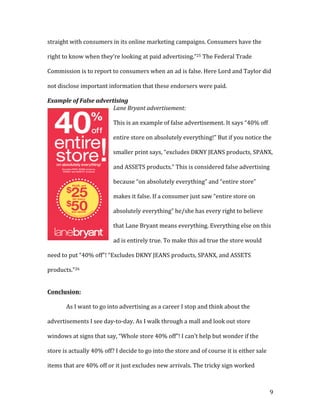
Lane	Bryant	advertisement:	
This	is	an	example	of	false	advertisement.	It	says	“40%	off	
entire	store	on	absolutely	everything!”	But	if	you	notice	the	
smaller	print	says,	“excludes	DKNY	JEANS	products,	SPANX,	
and	ASSETS	products.”	This	is	considered	false	advertising	
because	“on	absolutely	everything”	and	“entire	store”	
makes	it	false.	If	a	consumer	just	saw	“entire	store	on	
absolutely	everything”	he/she	has	every	right	to	believe	
that	Lane	Bryant	means	everything.	Everything	else	on	this	
ad	is	entirely	true.	To	make	this	ad	true	the	store	would	
need	to	put	“40%	off”!	“Excludes	DKNY	JEANS	products,	SPANX,	and	ASSETS	
products.”26	
	
Conclusion:	
	
As	I	want	to	go	into	advertising	as	a	career	I	stop	and	think	about	the	
advertisements	I	see	day-to-day.	As	I	walk	through	a	mall	and	look	out	store	
windows	at	signs	that	say,	“Whole	store	40%	off”!	I	can’t	help	but	wonder	if	the	
store	is	actually	40%	off?	I	decide	to	go	into	the	store	and	of	course	it	is	either	sale	
items	that	are	40%	off	or	it	just	excludes	new	arrivals.	The	tricky	sign	worked
10	
because	it	still	had	me	walk	into	the	store.	That	is	why	advertising	works	even	if	it	is	
false	advertising.	One	topic	I	talked	about	is	fine	print.	It’s	legal,	as	long	as	it	
corresponds	with	the	ad	and	the	naked	eye	can	read	it.	Companies	have	cruel	sales	
tactics	that	work	on	any	consumer.	It	is	our	job	as	consumers	to	not	fall	for	their	
tactics	and	be	a	smart	shopper.	Bait	and	switch,	high	pressure,	deceptive	form	
contracts,	artificially	inflating	prices,	and	failure	to	disclosure	were	the	type	of	facts	
mentioned	in	Jacob	Meyers	article.	His	article	informed	consumers	what	to	do	in	
situations	when	those	tactics	are	used.		
	 Without	the	Federal	Trade	Commission	we	would	not	have	anybody	
regulating	the	advertisements	we	see.	The	Federal	Communications	Commission	
can	then	broadcast	the	ads	after	the	FTC	regulates	them.		These	two	federal	agencies	
are	what	prevent	us	from	being	exposed	to	false	advertisements.	It	is	not	only	
advertisements	they	can	prevent	us	from	seeing,	it’s	also	companies	like	“Lord	and	
Taylor”	who	used	native	advertisements	posted	through	Instagram.	The	general	
public	is	supposed	to	be	informed	when	they	are	being	exposed	to	an	ad.	That	is	
why	Instagram	has	sponsored	posts	because	we	know	we	are	being	informed.	
Paying	people	to	pose	in	a	dress	without	the	general	public	knowing	that	endorsers	
are	getting	paid	for	it	is	just	as	false	as	a	misleading	advertisement.		
	 It	is	important	it	keep	our	eye	out	for	ads	that	are	misleading	or	false.	The	
Federal	Trade	Commission	is	to	protect	us	from	being	harmed	or	exposed	to	false	
advertisements.	Remember	to	use	the	tactics	and	always	think	before	purchasing	a	
product	through	an	advertisement.	As	seen	in	the	Lane	Bryant	ad	as	mentioned,	the	
fine	print	will	tell	the	consumer	what	the	real	sale	is.	Companies	want	to	make
11	
money,	and	the	best	way	to	do	that	is	to	lure	the	consumer	into	buying	a	product	
with	a	good	deal.	Consumers	love	bargains	and	they	love	to	save	money!	Overall,	if	
false	advertising	harms	someone	he/she	may	bring	the	case	to	a	small	claims	court.	
Always	read	the	fine	print	in	any	disclosure	of	an	advertisement.	Lastly,	company’s’	
tactics	are	to	trick	consumers	into	getting	a	good	deal.	Never	be	fooled.
12	
Bibliography	
Primary	Sources:	
"Complaints About Broadcast Advertising." Federal Communications Commission. Web.
22 Mar. 2016.
Katz, Mitchell J. "Lord & Taylor Settles FTC Charges It Deceived Consumers Through
Paid Article in an Online Fashion Magazine and Paid Instagram Posts by 50 "Fashion
Influencers"" Federal Trade Commission. 15 Mar. 2016. Web. 22 Mar. 2016.
	
S.	Doc.	No.	2	Advertising	Trends	and	Consumer	Protection	(2009).	Print.		
"Supreme Court Changes False Advertising Law Across the Country." LexisNexis
Academic. Legal Monitor Worldwide, 26 Mar. 2014. Web. 22 Mar. 2016.
"Truth in Advertising." Federal Trade Commission. Web. 22 Mar. 2016.
Secondary Sources:
"Consumer." Deceptive Advertising Definition -. Web. 23 Mar. 2016.
"The Legal Definition of Advertising." AGCM. Web. 23 Mar. 2016.
"False and Misleading Advertising." Jacob and Meyers. Web. 23 Mar. 2016.
"Bait & Switch Advertising." Truth In Advertising. 2014. Web. 23 Mar. 2016.
Better Business Bureau. Start with Trust®. "High Pressure Sales Tactics." Better
Business Bureau. 7 June 2013. Web. 23 Mar. 2016.
"The Fine Print - Read It." Truth In Advertising. 2012. Web. 23 Mar. 2016.
Meem, Sarah. "How to Sue Someone for False Advertising." EHow. Demand Media.
Web. 23 Mar. 2016.
13	
Foot	Notes	
																																																								
1	Advertising	Trends	pg.	2	
2	Federal	Trade	Commission		
3	Federal	Communications	Commission	
4	“Consumer”	
5	“Consumer”	
6	The	Legal	Definition	
7	False	and	Misleading	Advertising	
8	False	and	Misleading	Advertising	
9	False	and	Misleading	Advertising	
10	False	and	Misleading	Advertising	
11	Bait	and	Switch	
12	False	and	Misleading	Advertising	
13	Better	Business	Bureau	
14	False	and	Misleading	Advertising	
15	The	Fine	Print	
16	The	Fine	Print	
17	The	Fine	Print	
18	False	and	Misleading	Advertising	
19	False	and	Misleading	Advertising	
20	False	and	Misleading	Advertising	
21	Supreme	Court	Changes	False Advertising Law Across the Country	
22	Meem,	Sarah	
23	Federal	Trade	Commission	
24	Federal	Trade	Commission		
25	Federal	Trade	Commission		
26	The	Fine	Print

False Advertising Research Paper