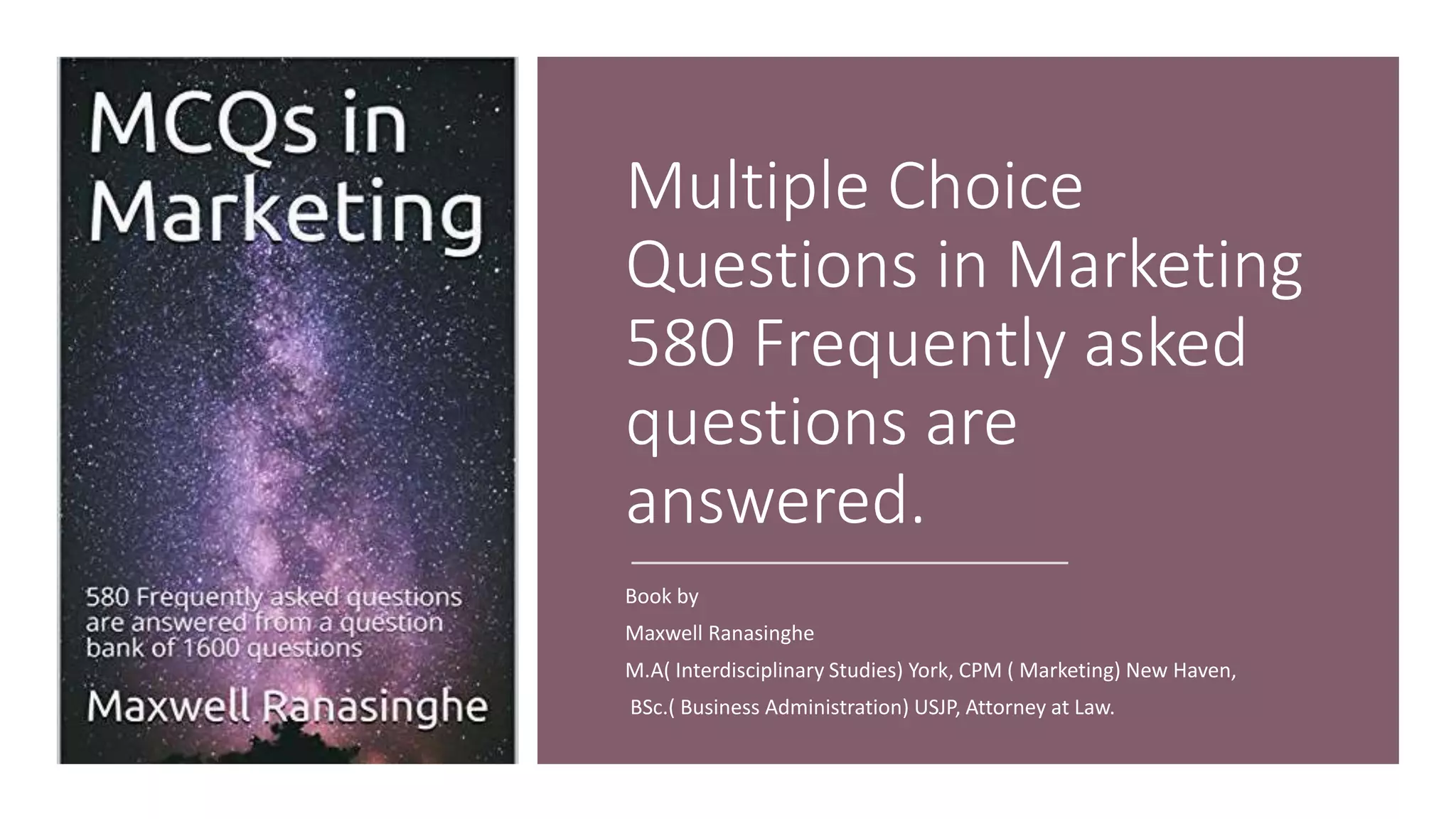
Multiple Choice
Questions in Marketing
580 Frequently asked
questions are
answered.
Book by
Maxwell Ranasinghe
M.A( Interdisciplinary Studies) York, CPM ( Marketing) New Haven,
BSc.( Business Administration) USJP, Attorney at Law.
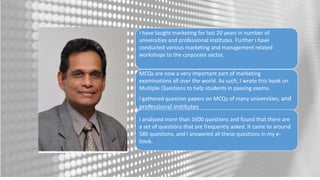
I have taught marketing for last 20 years in number of
universities and professional institutes. Further I have
conducted various marketing and management related
workshops to the corporate sector.
MCQs are now a very important part of marketing
examinations all over the world. As such, I wrote this book on
Multiple Questions to help students in passing exams.
I gathered question papers on MCQs of many universities, and
professional institutes
I analyzed more than 1600 questions and found that there are
a set of questions that are frequently asked. It came to around
580 questions, and I answered all these questions in my e-
book.
• The questions and answers discussed in the book cover a
standard syllabus of marketing in Diploma, Undergraduate
and Graduate level courses
• I have discussed MCQs by categorizing it to 12 categories
namely - Introduction to Marketing, Marketing
Environment, Marketing Mix, Marketing Research,
Consumer Behavior, Segmentation, Targeting and
Positioning, Product , Price, Distribution, Promotion ,
Marketing Planning and Information and Communication
Technology for Marketing. As such there are 12 chapters to
the book.
• I decided to select 20 MCQs from each chapter and make
12 presentations
• As such, you will be able to view 12 presentations in this
series and to learn 240 MCQs out of 580 MCQs in my book
Now take a piece of paper and a pen, get ready for
an MCQ Exam
In this
presentation, I
will discuss 20
MCQs selected
from Chapter 7
of my book
Product
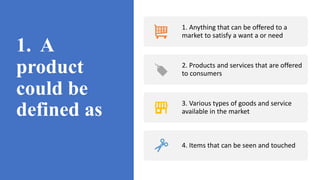
1. A
product
could be
defined as
1. Anything that can be offered to a
market to satisfy a want a or need
2. Products and services that are offered
to consumers
3. Various types of goods and service
available in the market
4. Items that can be seen and touched
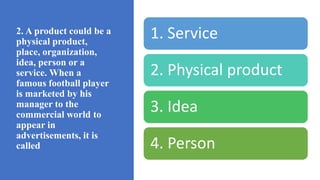
2. A product could be a
physical product,
place, organization,
idea, person or a
service. When a
famous football player
is marketed by his
manager to the
commercial world to
appear in
advertisements, it is
called
1. Service
2. Physical product
3. Idea
4. Person
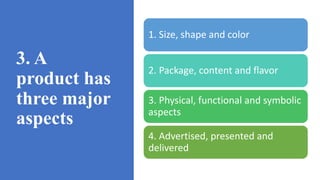
3. A
product has
three major
aspects
1. Size, shape and color
2. Package, content and flavor
3. Physical, functional and symbolic
aspects
4. Advertised, presented and
delivered
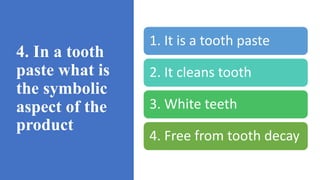
4. In a tooth
paste what is
the symbolic
aspect of the
product
1. It is a tooth paste
2. It cleans tooth
3. White teeth
4. Free from tooth decay
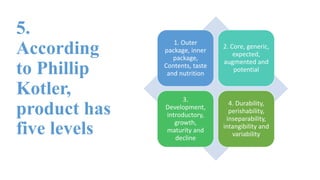
5.
According
to Phillip
Kotler,
product has
five levels
1. Outer
package, inner
package,
Contents, taste
and nutrition
2. Core, generic,
expected,
augmented and
potential
3.
Development,
introductory,
growth,
maturity and
decline
4. Durability,
perishability,
inseparability,
intangibility and
variability
6. In the tangibility
continuum, what
could be identified
as a pure tangible
product
1. Sermon in a church/
temple/ Kovil
2. Service in a salon
3. Service in a hospital
4. Service in a restaurant
7. What could
be identified
as hybrid (
50% to 50%)
tangible and
intangible
goods
1. Airline ticket
2. Ticket to a musical show
3. Service in a restaurant
4. Service in a salon
8. What product
could be
identified as a
major intangible
product with
minor tangible
product
1. Airline service
2. Restaurant service
3. A car
4. Pencil
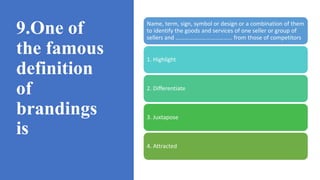
9.One of
the famous
definition
of
brandings
is
Name, term, sign, symbol or design or a combination of them
to identify the goods and services of one seller or group of
sellers and ………………………………… from those of competitors
1. Highlight
2. Differentiate
3. Juxtapose
4. Attracted
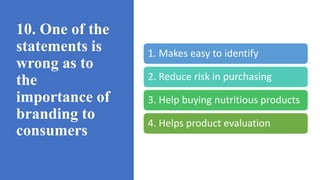
10. One of the
statements is
wrong as to
the
importance of
branding to
consumers
1. Makes easy to identify
2. Reduce risk in purchasing
3. Help buying nutritious products
4. Helps product evaluation
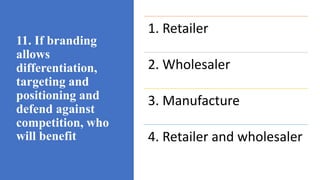
11. If branding
allows
differentiation,
targeting and
positioning and
defend against
competition, who
will benefit
1. Retailer
2. Wholesaler
3. Manufacture
4. Retailer and wholesaler
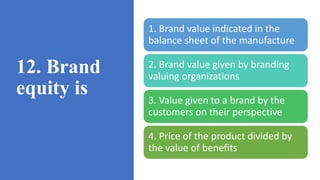
12. Brand
equity is
1. Brand value indicated in the
balance sheet of the manufacture
2. Brand value given by branding
valuing organizations
3. Value given to a brand by the
customers on their perspective
4. Price of the product divided by
the value of benefits
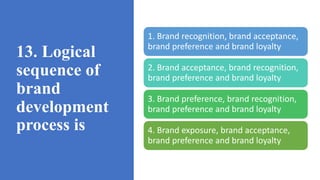
13. Logical
sequence of
brand
development
process is
1. Brand recognition, brand acceptance,
brand preference and brand loyalty
2. Brand acceptance, brand recognition,
brand preference and brand loyalty
3. Brand preference, brand recognition,
brand preference and brand loyalty
4. Brand exposure, brand acceptance,
brand preference and brand loyalty
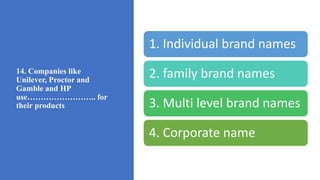
14. Companies like
Unilever, Proctor and
Gamble and HP
use…………………….. for
their products
1. Individual brand names
2. family brand names
3. Multi level brand names
4. Corporate name
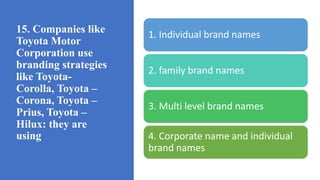
15. Companies like
Toyota Motor
Corporation use
branding strategies
like Toyota-
Corolla, Toyota –
Corona, Toyota –
Prius, Toyota –
Hilux: they are
using
1. Individual brand names
2. family brand names
3. Multi level brand names
4. Corporate name and individual
brand names
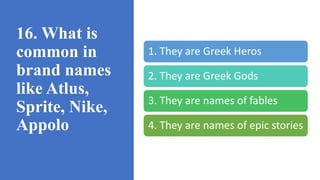
16. What is
common in
brand names
like Atlus,
Sprite, Nike,
Appolo
1. They are Greek Heros
2. They are Greek Gods
3. They are names of fables
4. They are names of epic stories
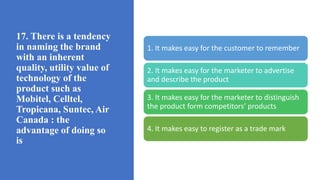
17. There is a tendency
in naming the brand
with an inherent
quality, utility value of
technology of the
product such as
Mobitel, Celltel,
Tropicana, Suntec, Air
Canada : the
advantage of doing so
is
1. It makes easy for the customer to remember
2. It makes easy for the marketer to advertise
and describe the product
3. It makes easy for the marketer to distinguish
the product form competitors’ products
4. It makes easy to register as a trade mark
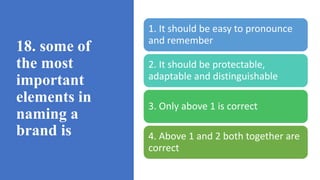
18. some of
the most
important
elements in
naming a
brand is
1. It should be easy to pronounce
and remember
2. It should be protectable,
adaptable and distinguishable
3. Only above 1 is correct
4. Above 1 and 2 both together are
correct
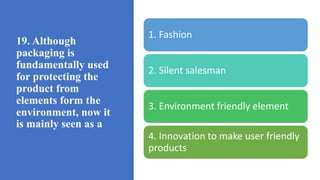
19. Although
packaging is
fundamentally used
for protecting the
product from
elements form the
environment, now it
is mainly seen as a
1. Fashion
2. Silent salesman
3. Environment friendly element
4. Innovation to make user friendly
products
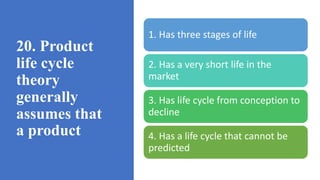
20. Product
life cycle
theory
generally
assumes that
a product
1. Has three stages of life
2. Has a very short life in the
market
3. Has life cycle from conception to
decline
4. Has a life cycle that cannot be
predicted
• If you are interested in viewing the whole book, which has
580 Questions and Answers, please Log on to Amazon.com
and search
• “Marketing MCQs by Maxwell Ranasinghe”
• You can read the digital version free or download it by just
paying USD4.99
• I strongly believe it is a very good investment for you and I
also consider it as an appreciation of my work towards the
student community
• Next slide has the answers to the questions in this
presentation
• Answers to questions in this presentation appears on the
next slide
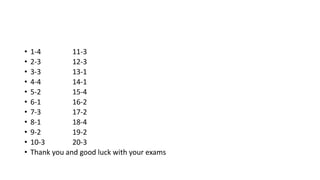
• 1-4 11-3
• 2-3 12-3
• 3-3 13-1
• 4-4 14-1
• 5-2 15-4
• 6-1 16-2
• 7-3 17-2
• 8-1 18-4
• 9-2 19-2
• 10-3 20-3
• Thank you and good luck with your exams

Product-Multiple Choice Questions ( MCQs) on Product

  • 1.
    Multiple Choice Questions inMarketing 580 Frequently asked questions are answered. Book by Maxwell Ranasinghe M.A( Interdisciplinary Studies) York, CPM ( Marketing) New Haven, BSc.( Business Administration) USJP, Attorney at Law.
  • 2.
    I have taughtmarketing for last 20 years in number of universities and professional institutes. Further I have conducted various marketing and management related workshops to the corporate sector. MCQs are now a very important part of marketing examinations all over the world. As such, I wrote this book on Multiple Questions to help students in passing exams. I gathered question papers on MCQs of many universities, and professional institutes I analyzed more than 1600 questions and found that there are a set of questions that are frequently asked. It came to around 580 questions, and I answered all these questions in my e- book.
  • 3.
    • The questionsand answers discussed in the book cover a standard syllabus of marketing in Diploma, Undergraduate and Graduate level courses • I have discussed MCQs by categorizing it to 12 categories namely - Introduction to Marketing, Marketing Environment, Marketing Mix, Marketing Research, Consumer Behavior, Segmentation, Targeting and Positioning, Product , Price, Distribution, Promotion , Marketing Planning and Information and Communication Technology for Marketing. As such there are 12 chapters to the book. • I decided to select 20 MCQs from each chapter and make 12 presentations • As such, you will be able to view 12 presentations in this series and to learn 240 MCQs out of 580 MCQs in my book
  • 4.
    Now take apiece of paper and a pen, get ready for an MCQ Exam In this presentation, I will discuss 20 MCQs selected from Chapter 7 of my book Product
  • 5.
    1. A product could be definedas 1. Anything that can be offered to a market to satisfy a want a or need 2. Products and services that are offered to consumers 3. Various types of goods and service available in the market 4. Items that can be seen and touched
  • 6.
    2. A productcould be a physical product, place, organization, idea, person or a service. When a famous football player is marketed by his manager to the commercial world to appear in advertisements, it is called 1. Service 2. Physical product 3. Idea 4. Person
  • 7.
    3. A product has threemajor aspects 1. Size, shape and color 2. Package, content and flavor 3. Physical, functional and symbolic aspects 4. Advertised, presented and delivered
  • 8.
    4. In atooth paste what is the symbolic aspect of the product 1. It is a tooth paste 2. It cleans tooth 3. White teeth 4. Free from tooth decay
  • 9.
    5. According to Phillip Kotler, product has fivelevels 1. Outer package, inner package, Contents, taste and nutrition 2. Core, generic, expected, augmented and potential 3. Development, introductory, growth, maturity and decline 4. Durability, perishability, inseparability, intangibility and variability
  • 10.
    6. In thetangibility continuum, what could be identified as a pure tangible product 1. Sermon in a church/ temple/ Kovil 2. Service in a salon 3. Service in a hospital 4. Service in a restaurant
  • 11.
    7. What could beidentified as hybrid ( 50% to 50%) tangible and intangible goods 1. Airline ticket 2. Ticket to a musical show 3. Service in a restaurant 4. Service in a salon
  • 12.
    8. What product couldbe identified as a major intangible product with minor tangible product 1. Airline service 2. Restaurant service 3. A car 4. Pencil
  • 13.
    9.One of the famous definition of brandings is Name,term, sign, symbol or design or a combination of them to identify the goods and services of one seller or group of sellers and ………………………………… from those of competitors 1. Highlight 2. Differentiate 3. Juxtapose 4. Attracted
  • 14.
    10. One ofthe statements is wrong as to the importance of branding to consumers 1. Makes easy to identify 2. Reduce risk in purchasing 3. Help buying nutritious products 4. Helps product evaluation
  • 15.
    11. If branding allows differentiation, targetingand positioning and defend against competition, who will benefit 1. Retailer 2. Wholesaler 3. Manufacture 4. Retailer and wholesaler
  • 16.
    12. Brand equity is 1.Brand value indicated in the balance sheet of the manufacture 2. Brand value given by branding valuing organizations 3. Value given to a brand by the customers on their perspective 4. Price of the product divided by the value of benefits
  • 17.
    13. Logical sequence of brand development processis 1. Brand recognition, brand acceptance, brand preference and brand loyalty 2. Brand acceptance, brand recognition, brand preference and brand loyalty 3. Brand preference, brand recognition, brand preference and brand loyalty 4. Brand exposure, brand acceptance, brand preference and brand loyalty
  • 18.
    14. Companies like Unilever,Proctor and Gamble and HP use…………………….. for their products 1. Individual brand names 2. family brand names 3. Multi level brand names 4. Corporate name
  • 19.
    15. Companies like ToyotaMotor Corporation use branding strategies like Toyota- Corolla, Toyota – Corona, Toyota – Prius, Toyota – Hilux: they are using 1. Individual brand names 2. family brand names 3. Multi level brand names 4. Corporate name and individual brand names
  • 20.
    16. What is commonin brand names like Atlus, Sprite, Nike, Appolo 1. They are Greek Heros 2. They are Greek Gods 3. They are names of fables 4. They are names of epic stories
  • 21.
    17. There isa tendency in naming the brand with an inherent quality, utility value of technology of the product such as Mobitel, Celltel, Tropicana, Suntec, Air Canada : the advantage of doing so is 1. It makes easy for the customer to remember 2. It makes easy for the marketer to advertise and describe the product 3. It makes easy for the marketer to distinguish the product form competitors’ products 4. It makes easy to register as a trade mark
  • 22.
    18. some of themost important elements in naming a brand is 1. It should be easy to pronounce and remember 2. It should be protectable, adaptable and distinguishable 3. Only above 1 is correct 4. Above 1 and 2 both together are correct
  • 23.
    19. Although packaging is fundamentallyused for protecting the product from elements form the environment, now it is mainly seen as a 1. Fashion 2. Silent salesman 3. Environment friendly element 4. Innovation to make user friendly products
  • 24.
    20. Product life cycle theory generally assumesthat a product 1. Has three stages of life 2. Has a very short life in the market 3. Has life cycle from conception to decline 4. Has a life cycle that cannot be predicted
  • 25.
    • If youare interested in viewing the whole book, which has 580 Questions and Answers, please Log on to Amazon.com and search • “Marketing MCQs by Maxwell Ranasinghe” • You can read the digital version free or download it by just paying USD4.99 • I strongly believe it is a very good investment for you and I also consider it as an appreciation of my work towards the student community • Next slide has the answers to the questions in this presentation • Answers to questions in this presentation appears on the next slide
  • 26.
    • 1-4 11-3 •2-3 12-3 • 3-3 13-1 • 4-4 14-1 • 5-2 15-4 • 6-1 16-2 • 7-3 17-2 • 8-1 18-4 • 9-2 19-2 • 10-3 20-3 • Thank you and good luck with your exams