Fair Use in Music
Patrick Fulton & Sara Nodine
Warren D. Allen Music Library
Copyright:The Basics
• Grants limited monopoly to the owner of original works
• Must be fixed in a tangible form—ideas cannot be copyrighted!
• Monopoly incentivizes further work from authors, artists, etc.
• Timeframe: Author’s life + 70 years (for works after 1978)
• Copyright is automatic and does not require registration (or notice)
• Remember: The monopoly for authors is LIMITED to protect creative
freedom
Copyright:The Exceptions
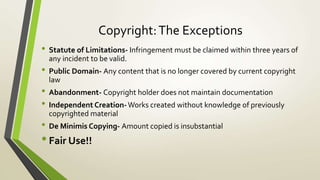
• Statute of Limitations- Infringement must be claimed within three years of
any incident to be valid.
• Public Domain- Any content that is no longer covered by current copyright
law
• Abandonment- Copyright holder does not maintain documentation
• Independent Creation-Works created without knowledge of previously
copyrighted material
• De Minimis Copying- Amount copied is insubstantial
•Fair Use!!
Fair Use Defined
“...a privilege that allows someone other than the copyright owner to use a
copyrighted work in a reasonable manner without the owner’s consent,
notwithstanding the monopoly granted to the owner.” (from David Moser’s
Music Copyright for the New Millennium, 2001)
So, what determines if a use is fair?
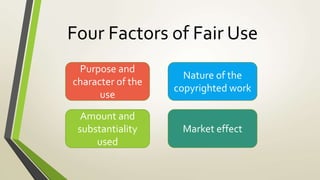
Four Factors of Fair Use
Purpose and
character of the
use
Nature of the
copyrighted work
Amount and
substantiality
used
Market effect
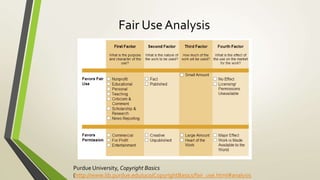
Fair Use Analysis
Purdue University, Copyright Basics
(http://www.lib.purdue.edu/uco/CopyrightBasics/fair_use.html#analysis
So, what does this mean in real
life…?
Let’s look at some common questions to consider!
Remember:This is not official legal advice; we are merely providing general guidelines!
When is it okay to copy a musical
score instead of purchasing it?
If I just scan the musical score
and don’t print it, is this okay?
Am I allowed to burn a library
CD to my computer?
(What if it is no longer available for purchase?)
Can I perform from a library-
owned musical score?
Can I perform from a photocopy of
a musical score that is not available
for purchase?
Can I use a library-owned recording
in a public presentation?
Can I show a library-owned video
in or outside of class for my
students?
What happens in the event of a
copyright violation?
But how do I know for sure if my use is
fair use?
REMEMBER: Fair use is NOT a right; it is only a defense in
litigation. Fair use can ONLY be determined in a court ruling.
The Golden Rules
• If you do not own the item, you cannot make a copy of it (especially for
another person).
• When in doubt, play it safe and DO NOT make copies in any format!
Questions?
Licensed by: Creative Commons
Attribution-NonCommercial-ShareAlike 4.0 International
Created by:
Patrick Fulton & Sara Nodine
Warren D. Allen Music Library

Fair Use

  • 1.
    Fair Use inMusic Patrick Fulton & Sara Nodine Warren D. Allen Music Library
  • 2.
    Copyright:The Basics • Grantslimited monopoly to the owner of original works • Must be fixed in a tangible form—ideas cannot be copyrighted! • Monopoly incentivizes further work from authors, artists, etc. • Timeframe: Author’s life + 70 years (for works after 1978) • Copyright is automatic and does not require registration (or notice) • Remember: The monopoly for authors is LIMITED to protect creative freedom
  • 3.
    Copyright:The Exceptions • Statuteof Limitations- Infringement must be claimed within three years of any incident to be valid. • Public Domain- Any content that is no longer covered by current copyright law • Abandonment- Copyright holder does not maintain documentation • Independent Creation-Works created without knowledge of previously copyrighted material • De Minimis Copying- Amount copied is insubstantial •Fair Use!!
  • 4.
    Fair Use Defined “...aprivilege that allows someone other than the copyright owner to use a copyrighted work in a reasonable manner without the owner’s consent, notwithstanding the monopoly granted to the owner.” (from David Moser’s Music Copyright for the New Millennium, 2001) So, what determines if a use is fair?
  • 5.
    Four Factors ofFair Use Purpose and character of the use Nature of the copyrighted work Amount and substantiality used Market effect
  • 6.
    Fair Use Analysis PurdueUniversity, Copyright Basics (http://www.lib.purdue.edu/uco/CopyrightBasics/fair_use.html#analysis
  • 7.
    So, what doesthis mean in real life…? Let’s look at some common questions to consider! Remember:This is not official legal advice; we are merely providing general guidelines!
  • 8.
    When is itokay to copy a musical score instead of purchasing it?
  • 9.
    If I justscan the musical score and don’t print it, is this okay?
  • 10.
    Am I allowedto burn a library CD to my computer? (What if it is no longer available for purchase?)
  • 11.
    Can I performfrom a library- owned musical score?
  • 12.
    Can I performfrom a photocopy of a musical score that is not available for purchase?
  • 13.
    Can I usea library-owned recording in a public presentation?
  • 14.
    Can I showa library-owned video in or outside of class for my students?
  • 15.
    What happens inthe event of a copyright violation?
  • 16.
    But how doI know for sure if my use is fair use? REMEMBER: Fair use is NOT a right; it is only a defense in litigation. Fair use can ONLY be determined in a court ruling.
  • 17.
    The Golden Rules •If you do not own the item, you cannot make a copy of it (especially for another person). • When in doubt, play it safe and DO NOT make copies in any format!
  • 18.
    Questions? Licensed by: CreativeCommons Attribution-NonCommercial-ShareAlike 4.0 International Created by: Patrick Fulton & Sara Nodine Warren D. Allen Music Library

Editor's Notes

  • #3 -Copyright is granted to an author of an original work fixed in a tangible form (e.g. a book, a piece of music, a photograph). -Ideas alone cannot be copyrighted until they are in a fixed medium. -Copyright grants limited monopoly over the work to the author to protect use of the work and incentivize new artistic work--allows for profitability of artistic works -Author’s life + 70 years for new works -Automatically granted upon creation -Limited monopoly means there are exceptions!
  • #4 -Statute of Limitations -Claims of infringement must be brought within 3 years of the event; anything later is invalid. -Ongoing cases of infringement will result in a moving wall; the most recent act of infringement will indicate the start date. -Deception will also change the start date—there is a reasonable timeline given for discovery to the copyright holder. -Public Domain -Content under public domain is no longer covered under copyright law. -Currently, public domain covers those works published in the US before 1923. -After 1978, works published in the US are cover through the span of the author’s life +70 years. -Cornell Public Domain Chart: http://copyright.cornell.edu/resources/publicdomain.cfm -Abandonment -Copyright holder does not sustain documentation for life of the copyright, for example, distributing a work without copyright information -Independent Creation -Works created independently of the copyrighted material -De Minimis Copying -Copyright exemption exists if the amount copied is insubstantial or inconsequential -No clear legal rules—risky -Most importantly... Fair Use!
  • #5 - Section 107 of the 1978 Copyright Law states...   Notwithstanding the provisions of sections 106 and 106A, the fair use of a copyrighted work, including such use by reproduction in copies or phonorecords or by any other means specified by that section, for purposes such as criticism, comment, news reporting, teaching (including multiple copies for classroom use), scholarship, or research, is not an infringement of copyright. In determining whether the use made of a work in any particular case is a fair use the factors to be considered shall include:   1) the purpose and character of the use, including whether such use is of a commercial nature or is for nonprofit educational purposes, 2) the nature of the copyrighted work; 3) the amount and substantiality of the portion used in relation to the copyrighted work as a whole; and 4) the effect of the use upon the potential market for or value of the copyrighted work. -The problem is that fair use is very broad and confusing—determined in court according to four pillars:
  • #6 Factor 1 -Is the use commercial or noncommercial? Is the purpose educational or socially valuable? -Most uses are actually commercial to some extent. Even if it is not for the monetary gain, but allows the user to profit from not paying the customary price, it becomes commercial. -It doesn’t always have to be non-commercial, however; commercial use can be justified if there is a societal benefit from the use. -Is the use transformative? If the use of the work goes beyond any original intent of the creation, it is considered a transformative use of the work and is therefore possibly fair use. This is a major question—think Google Books case (potentially copyrighted books were made available to the physically disabled).   Factor 2 -Examines the copyrighted work itself instead of the use of the work. -Is the use published or unpublished? (Favoring fair use of published works as opposed to unpublished) -Is the work factual or creative? (Favoring fair use of factual works and protecting creative works)   Factor 3 -Is the portion used of critical importance to the work as a whole? -A small critical portion may still not be fair use (think Beethoven’s 5th- opening four notes if they weren’t public domain) -Most music today, if it is not non-commercial or for criticism, will not be considered fair use   Factor 4 -How will the defendant’s use affect the market value of the copyrighted work? -Generally considered the most important factor! -Using a work no longer available to the public will be likely to be fair since the use will not impair the market for the original work.
  • #7 -Purdue University provides a helpful chart for analysis of copyright questions in everyday life. -Not all factors weigh evenly, however; 1 & 4 typically are weighted most heavily in historic court cases.
  • #8 -With these four factors in mind, consider the following questions:
  • #9 -Copies for private study are acceptable if the item is out of print. -For performance, an original copy must be present (library or personal copy); Copy must be destroyed after performance.
  • #10 -No, this is still considered putting a second copy into existence whether or not it is ever physically printed.
  • #11 -If you don’t own the item, you can’t burn the item. As with the scanning of music, burning the CD creates a second, illegal version. -If the CD was not available commercially, it may be acceptable, but you would be taking a risk.
  • #12 -Yes, this is acceptable. -You can even copy pages for ease of page turns, but they must be destroyed after the performance. -Also, please don’t tape pages into scores or heavily mark any items!
  • #13 -If the edition is out of print and no substitute is available, yes.
  • #14 -So long as it is from the original disc, yes. -If it were embedded in a PowerPoint, no. You would have to buy the track and personally own it.
  • #15 -If you have public performance rights, yes. These do not come with regularly priced DVDs, however. Significantly more expensive. -If not, you must have demonstrable educational purposes and only show with a limited group in a classroom setting.
  • #16 -It all depends on willful intent vs. innocent intent; innocent intent is not a defense, but it certainly will help. -Fines can range from $200-150,000, plus jail time
  • #19 -Thank you for your time!