Market Failure
Write about a time when you failed at something. What caused the failure?
Take out your commentary and the rubric. Grade yourself.
Talk with people in your group and try to come up with a variety of products we consume and what their negative externalities are. Write them down in your notebook.
What would a successful market look like? What would a failed market look like?
What do you think causes markets to fail?
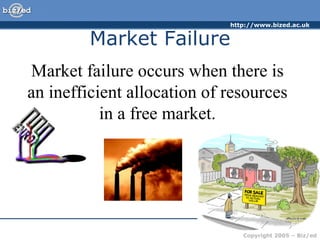
Market Failure Market failure occurs when there is an inefficient allocation of resources in a free market.
Market Failure:  The market has failed when it results in either an over or an under-allocation of resources towards a particular product.  Examples of markets failing:  • The market has failed because too many cigarettes are being produced and consumed in the world today.
Examples of markets failing:  • The market has failed because without state funded public schools, not enough educational institutions would be available for the nation's youth. • The market has failed because without the government providing an Army, Navy and Air Force, not enough national defense would be provided for the country's citizens. • The market has failed because too many people have driven SUVs for too long, resulting in greenhouse gasses to concentrate in the earth's atmosphere, contributing to global warming .
Market Failure Market Failure occurs where: Existence of external costs and benefits Knowledge is not perfect - ignorance Goods are differentiated Resources are immobile Market power is strong Services/goods would or could not be provided in sufficient quantity by the market Inequality exists
Market Failure External Costs and Benefits External or social costs The cost of an economic decision to a third party External benefits   The benefits to a third party as a result of a decision by another party
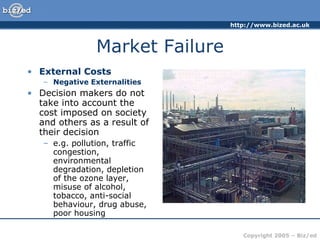
Market Failure External Costs Negative Externalities Decision makers do not take into account the cost imposed on society and others as a result of their decision e.g. pollution, traffic congestion, environmental degradation, depletion of the ozone layer, misuse of alcohol, tobacco, anti-social behaviour, drug abuse, poor housing
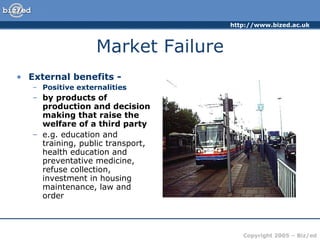
Market Failure External benefits - Positive externalities   by products of production and decision making that raise the welfare of a third party e.g. education and training, public transport, health education and preventative medicine, refuse collection, investment in housing maintenance, law and order
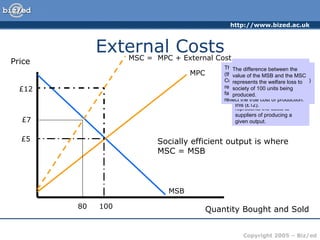
External Costs Price Quantity Bought and Sold MSB MPC £5 100 MSC =  MPC + External Cost £12 £7 80 Socially efficient output is where MSC = MSB The Marginal Social Benefit curve (MSB) represents the sum of the benefits to consumers in society as a whole – the private and social benefits. The Marginal Private Cost (MPC) curve represents the costs to suppliers of producing a given output. The MPC does not take into account the cost to society of production. At an output level of 100, the private cost to the supplier is £5 per unit but the cost to society is higher than this (£12). The true cost therefore is the MSC (the MPC plus the external cost). Current output levels therefore (100) represent some element of market failure – price does not accurately reflect the true cost of production. The difference between the value of the MSB and the MSC represents the welfare loss to society of 100 units being produced.
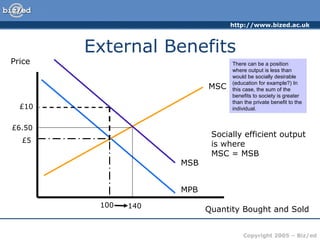
External Benefits Price Quantity Bought and Sold MPB MSC £5 100 Socially efficient output  is where MSC = MSB MSB £10 £6.50 140 There can be a position where output is less than would be socially desirable (education for example?) In this case, the sum of the benefits to society is greater than the private benefit to the individual.
Market Failure Inadequate Provision: Merit Goods and Public Goods Merit Goods  – Could be provided by the market but consumers may not be able to afford or feel the need to purchase – market would not provide them in the quantities society needs Sports facilities?
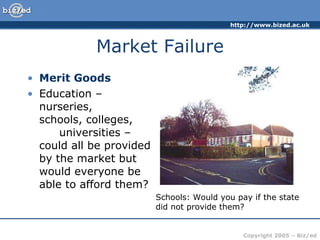
Market Failure Merit Goods Education –  nurseries,  schools, colleges,  universities – could all be provided by the market but would everyone be able to afford them? Schools: Would you pay if the state did not provide them?
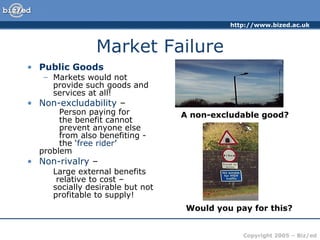
Market Failure Public Goods Markets would not provide such goods and services at all! Non-excludability  –  Person paying for  the benefit cannot  prevent anyone else  from also benefiting -  the ‘ free rider ’  problem Non-rivalry  –  Large external benefits  relative to cost – socially desirable but not profitable to supply! A non-excludable good? Would you pay for this?
Market Failure De-Merit Goods Goods which society over-produces Goods and services provided by the market which are not in our best interests! Tobacco and alcohol Drugs Gambling
Market Failure Imperfect Knowledge: Consumers do not have adequate technical knowledge Advertising can mislead or mis-inform Producers unaware of all opportunities Producers cannot accurately measure productivity Decisions often based on past experience rather than future knowledge
Market Failure Market Power: Existence of monopolies and oligopolies Collusion Price fixing Abnormal profits Rigging of markets Barriers to entry
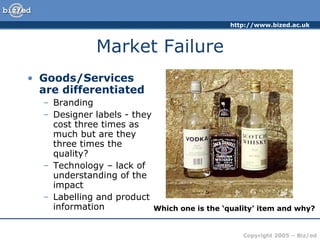
Market Failure Goods/Services are differentiated Branding Designer labels - they cost three times as much but are they three times the quality? Technology – lack of understanding of the impact Labelling and product information Which one is the ‘quality’ item and why?
Market Failure Resource Immobility Factors are not fully mobile Labour immobility – geographical and occupational Capital immobility – what else can we use the Channel Tunnel for? Land – cannot be moved to where it might be needed, e.g. London and South East!
Market Failure Inequality: Poverty – absolute and relative Distribution of factor ownership Distribution of income Wealth distribution Discrimination Housing
Market Failure Measures to correct market failure State provision Extension of property rights Taxation Subsidies Regulation Prohibition Positive discrimination Redistribution of income
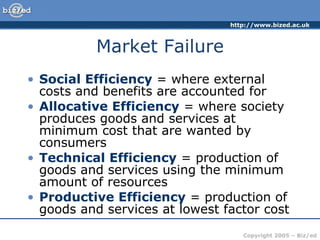
Market Failure Definition: Where the market mechanism fails to allocate resources efficiently Social Efficiency Allocative Efficiency Technical Efficiency Productive Efficiency
Market Failure Social Efficiency  = where external costs and benefits are accounted for Allocative Efficiency  = where society produces goods and services at minimum cost that are wanted by consumers Technical Efficiency  = production of goods and services using the minimum amount of resources Productive Efficiency  = production of goods and services at lowest factor cost
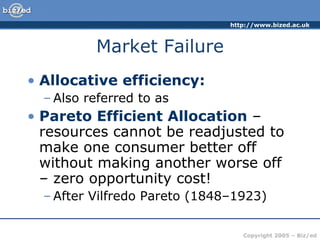
Market Failure Allocative efficiency: Also referred to as  Pareto Efficient Allocation  – resources cannot be readjusted to make one consumer better off without making another worse off – zero opportunity cost! After Vilfredo Pareto (1848–1923)

Failure3

  • 1.
  • 2.
    Write about atime when you failed at something. What caused the failure?
  • 3.
    Take out yourcommentary and the rubric. Grade yourself.
  • 4.
    Talk with peoplein your group and try to come up with a variety of products we consume and what their negative externalities are. Write them down in your notebook.
  • 5.
    What would asuccessful market look like? What would a failed market look like?
  • 6.
    What do youthink causes markets to fail?
  • 7.
    Market Failure Marketfailure occurs when there is an inefficient allocation of resources in a free market.
  • 8.
    Market Failure: The market has failed when it results in either an over or an under-allocation of resources towards a particular product. Examples of markets failing: • The market has failed because too many cigarettes are being produced and consumed in the world today.
  • 9.
    Examples of marketsfailing: • The market has failed because without state funded public schools, not enough educational institutions would be available for the nation's youth. • The market has failed because without the government providing an Army, Navy and Air Force, not enough national defense would be provided for the country's citizens. • The market has failed because too many people have driven SUVs for too long, resulting in greenhouse gasses to concentrate in the earth's atmosphere, contributing to global warming .
  • 10.
    Market Failure MarketFailure occurs where: Existence of external costs and benefits Knowledge is not perfect - ignorance Goods are differentiated Resources are immobile Market power is strong Services/goods would or could not be provided in sufficient quantity by the market Inequality exists
  • 11.
    Market Failure ExternalCosts and Benefits External or social costs The cost of an economic decision to a third party External benefits The benefits to a third party as a result of a decision by another party
  • 12.
    Market Failure ExternalCosts Negative Externalities Decision makers do not take into account the cost imposed on society and others as a result of their decision e.g. pollution, traffic congestion, environmental degradation, depletion of the ozone layer, misuse of alcohol, tobacco, anti-social behaviour, drug abuse, poor housing
  • 13.
    Market Failure Externalbenefits - Positive externalities by products of production and decision making that raise the welfare of a third party e.g. education and training, public transport, health education and preventative medicine, refuse collection, investment in housing maintenance, law and order
  • 14.
    External Costs PriceQuantity Bought and Sold MSB MPC £5 100 MSC = MPC + External Cost £12 £7 80 Socially efficient output is where MSC = MSB The Marginal Social Benefit curve (MSB) represents the sum of the benefits to consumers in society as a whole – the private and social benefits. The Marginal Private Cost (MPC) curve represents the costs to suppliers of producing a given output. The MPC does not take into account the cost to society of production. At an output level of 100, the private cost to the supplier is £5 per unit but the cost to society is higher than this (£12). The true cost therefore is the MSC (the MPC plus the external cost). Current output levels therefore (100) represent some element of market failure – price does not accurately reflect the true cost of production. The difference between the value of the MSB and the MSC represents the welfare loss to society of 100 units being produced.
  • 15.
    External Benefits PriceQuantity Bought and Sold MPB MSC £5 100 Socially efficient output is where MSC = MSB MSB £10 £6.50 140 There can be a position where output is less than would be socially desirable (education for example?) In this case, the sum of the benefits to society is greater than the private benefit to the individual.
  • 16.
    Market Failure InadequateProvision: Merit Goods and Public Goods Merit Goods – Could be provided by the market but consumers may not be able to afford or feel the need to purchase – market would not provide them in the quantities society needs Sports facilities?
  • 17.
    Market Failure MeritGoods Education – nurseries, schools, colleges, universities – could all be provided by the market but would everyone be able to afford them? Schools: Would you pay if the state did not provide them?
  • 18.
    Market Failure PublicGoods Markets would not provide such goods and services at all! Non-excludability – Person paying for the benefit cannot prevent anyone else from also benefiting - the ‘ free rider ’ problem Non-rivalry – Large external benefits relative to cost – socially desirable but not profitable to supply! A non-excludable good? Would you pay for this?
  • 19.
    Market Failure De-MeritGoods Goods which society over-produces Goods and services provided by the market which are not in our best interests! Tobacco and alcohol Drugs Gambling
  • 20.
    Market Failure ImperfectKnowledge: Consumers do not have adequate technical knowledge Advertising can mislead or mis-inform Producers unaware of all opportunities Producers cannot accurately measure productivity Decisions often based on past experience rather than future knowledge
  • 21.
    Market Failure MarketPower: Existence of monopolies and oligopolies Collusion Price fixing Abnormal profits Rigging of markets Barriers to entry
  • 22.
    Market Failure Goods/Servicesare differentiated Branding Designer labels - they cost three times as much but are they three times the quality? Technology – lack of understanding of the impact Labelling and product information Which one is the ‘quality’ item and why?
  • 23.
    Market Failure ResourceImmobility Factors are not fully mobile Labour immobility – geographical and occupational Capital immobility – what else can we use the Channel Tunnel for? Land – cannot be moved to where it might be needed, e.g. London and South East!
  • 24.
    Market Failure Inequality:Poverty – absolute and relative Distribution of factor ownership Distribution of income Wealth distribution Discrimination Housing
  • 25.
    Market Failure Measuresto correct market failure State provision Extension of property rights Taxation Subsidies Regulation Prohibition Positive discrimination Redistribution of income
  • 26.
    Market Failure Definition:Where the market mechanism fails to allocate resources efficiently Social Efficiency Allocative Efficiency Technical Efficiency Productive Efficiency
  • 27.
    Market Failure SocialEfficiency = where external costs and benefits are accounted for Allocative Efficiency = where society produces goods and services at minimum cost that are wanted by consumers Technical Efficiency = production of goods and services using the minimum amount of resources Productive Efficiency = production of goods and services at lowest factor cost
  • 28.
    Market Failure Allocativeefficiency: Also referred to as Pareto Efficient Allocation – resources cannot be readjusted to make one consumer better off without making another worse off – zero opportunity cost! After Vilfredo Pareto (1848–1923)

Editor's Notes

  • #15 The slide has been designed to try to lead students through the distinction between the private costs of production and the social cost. The diagram starts out with a basic supply and demand position with price at £5 and Quantity at 100. The demand curve has been labelled MSB – a brief explanation of the concept here is useful. The supply curve is the marginal private cost – the cost to the producer. To try to link the theory to the practice it is suggested that the item in question is the production of rolls of Clingfilm! The reason is that in producing cellophane products there is an amount of air pollution. If students are told that the cost to the producer of manufacturing 100 rolls of Clingfilm is £5 (don’t forget to remind them that this figure includes the element of profit they make) but, the company do not take into consideration the cost imposed on society of the pollution they cause. This cost is then highlighted by a dashed line moving up from the bottom and is priced at £12 . The supply curve that considers the true cost (the MPC and MSC) is then drawn in and the right brace appears to indicate the extent of the social cost (£7). The welfare loss triangle is then imposed – this may need to be explained and students could be reminded of the work done on consumer surplus to help reinforce the concept of the ‘value’ here. Finally, the socially efficient output is highlighted; students can be told that there would be benefits to society if less were produced but that we would be paying more as a result!
  • #16 This slide looks at