Fagan Inspection


 PHILIPPINES   ::   MALAYSIA   ::   VIETNAM   ::   INDONESIA   ::   INDIA   ::   CHINA
Learning Bites
  • Identify the different types of review process

  • Describe what Fagan Inspection is and why it is needed

  • Learn and understand the inspection process and its characteristics

  • Identify who are involved and their roles in inspection, and

  • Explore why inspections are rarely performed
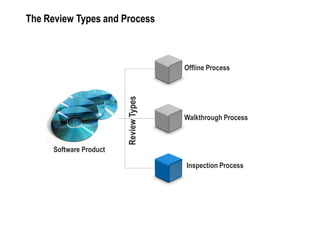
The Review Types and Process


                                        Offline Process


                         Review Types
                                        Walkthrough Process


      Software Product

                                        Inspection Process
What is Fagan Inspection?
  •   Invented in the early ‘70s by Michael Fagan of IBM
       • Inspired by production engineering inspection

  •   A widely applicable, rigorous and formal software engineering QC technique
       • Inspection of any document when it is believed complete and ready for
           use
       • Find defects directly – unlike testing, which happens later, and only
           reveals symptoms

  •   Related to, but distinct from, walkthroughs,
      technical reviews, ‘buddy checking’, email ‘pass
      around’ or ‘postal’ reviews

  •   One of the ‘catalyst’ processes…
What is a Defect?

  • Any occurrence in a work product that is incomplete, incorrect, or
    missing.

  • Any instance which a requirement is not satisfied.

  • Informal synonyms: bug, fault, issue, problem.

  • Non-­conformance in requirements, standards, or exit criteria.

  • Identified by team consensus during inspection meeting based on
    requirements/standards.
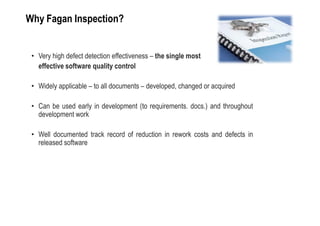
Why Fagan Inspection?


 • Very high defect detection effectiveness – the single most
   effective software quality control

 • Widely applicable – to all documents – developed, changed or acquired

 • Can be used early in development (to requirements. docs.) and throughout
   development work

 • Well documented track record of reduction in rework costs and defects in
   released software
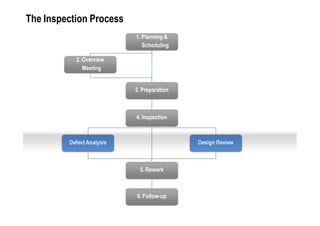
The Inspection Process
                           1. Planning &
                              Scheduling

           2. Overview
              Meeting


                           3. Preparation


                           4. Inspection


         Defect Analysis                    Design Review


                             5. Rework


                           6. Follow-­up
Inspection Characteristics
 •   Budgeted, planned and scheduled

 •   Use a defined process

 •   Use knowledgeable peers…

 •   … trained to perform defined inspection roles

                       •   Have defined entry and exit criteria

                       •   Use checklists and standards

                       •   Primary purpose is to find defects, for removal
Who are involved?


                                                  Author                                       Inspector
           Reader               Moderator         Developer of work   Reader                   Member of inspection
           An inspector who     An inspector      product             An inspector who         team. Often chosen to
           guides the           responsible for                       enters all the defects   represent specific role-­
           examination of the   organizing and                        found on the defect      designer, tester,
           product              reporting on                          list                     technical writer, SQA,
                                inspection                                                     etc.
Why are inspections rarely used?

 • Professional Ignorance
     • Not heard of them (why?)
     • Assumed to be a synonym for ‘review’

 • Organizational Ignorance
     • Culture works against revealing or admitting mistakes (pass around for ‘comment’)
     • Lack of resources and facilities

 • Difficult
   – Inspection is a ‘precision instrument’ – easily broken

 • Disappointment and Frustration
     • With disappointing or apparently disappointing results and outcomes

 • Benefits are intangible
     • Needs analysis of results and outcomes to appreciate time and money saved
How to make Fagan Inspection work
•   Restore balance outputs in originators favor (and add
    value)
     • Not just defects (i.e. ‘mistakes ‘) – formally recognize,
         value and measure design excellence

•   Begin the process as an introduction to real
    inspections
      • Attractive and fashionable?
      • Complex and conflicts with standard advice – pilot the
         real standard process, then tailor when well
         understood

•   Make the benefits tangible
     • Inspection data capture
     • Use this to provide savings predictions as part of
        project planning
     • Wider internal reporting and promotion
Finally…

 • Can you afford not to review your early QC activities?
    – How effective is your current QC practice?
    – How much does it cost you?
       • Why?
       • (Two good metrics – cost per defect, % rework)

 • What is possible in your organization?
Thank you very much!


 facebook.com/eccinternational
 linkedin.com/company/ecc-international
 eccinternational.wordpress.com

Fagan Inspection

  • 1.
    Fagan Inspection PHILIPPINES :: MALAYSIA :: VIETNAM :: INDONESIA :: INDIA :: CHINA
  • 2.
    Learning Bites • Identify the different types of review process • Describe what Fagan Inspection is and why it is needed • Learn and understand the inspection process and its characteristics • Identify who are involved and their roles in inspection, and • Explore why inspections are rarely performed
  • 3.
    The Review Typesand Process Offline Process Review Types Walkthrough Process Software Product Inspection Process
  • 4.
    What is FaganInspection? • Invented in the early ‘70s by Michael Fagan of IBM • Inspired by production engineering inspection • A widely applicable, rigorous and formal software engineering QC technique • Inspection of any document when it is believed complete and ready for use • Find defects directly – unlike testing, which happens later, and only reveals symptoms • Related to, but distinct from, walkthroughs, technical reviews, ‘buddy checking’, email ‘pass around’ or ‘postal’ reviews • One of the ‘catalyst’ processes…
  • 5.
    What is aDefect? • Any occurrence in a work product that is incomplete, incorrect, or missing. • Any instance which a requirement is not satisfied. • Informal synonyms: bug, fault, issue, problem. • Non-­conformance in requirements, standards, or exit criteria. • Identified by team consensus during inspection meeting based on requirements/standards.
  • 6.
    Why Fagan Inspection? • Very high defect detection effectiveness – the single most effective software quality control • Widely applicable – to all documents – developed, changed or acquired • Can be used early in development (to requirements. docs.) and throughout development work • Well documented track record of reduction in rework costs and defects in released software
  • 7.
    The Inspection Process 1. Planning & Scheduling 2. Overview Meeting 3. Preparation 4. Inspection Defect Analysis Design Review 5. Rework 6. Follow-­up
  • 8.
    Inspection Characteristics • Budgeted, planned and scheduled • Use a defined process • Use knowledgeable peers… • … trained to perform defined inspection roles • Have defined entry and exit criteria • Use checklists and standards • Primary purpose is to find defects, for removal
  • 9.
    Who are involved? Author Inspector Reader Moderator Developer of work Reader Member of inspection An inspector who An inspector product An inspector who team. Often chosen to guides the responsible for enters all the defects represent specific role-­ examination of the organizing and found on the defect designer, tester, product reporting on list technical writer, SQA, inspection etc.
  • 10.
    Why are inspectionsrarely used? • Professional Ignorance • Not heard of them (why?) • Assumed to be a synonym for ‘review’ • Organizational Ignorance • Culture works against revealing or admitting mistakes (pass around for ‘comment’) • Lack of resources and facilities • Difficult – Inspection is a ‘precision instrument’ – easily broken • Disappointment and Frustration • With disappointing or apparently disappointing results and outcomes • Benefits are intangible • Needs analysis of results and outcomes to appreciate time and money saved
  • 11.
    How to makeFagan Inspection work • Restore balance outputs in originators favor (and add value) • Not just defects (i.e. ‘mistakes ‘) – formally recognize, value and measure design excellence • Begin the process as an introduction to real inspections • Attractive and fashionable? • Complex and conflicts with standard advice – pilot the real standard process, then tailor when well understood • Make the benefits tangible • Inspection data capture • Use this to provide savings predictions as part of project planning • Wider internal reporting and promotion
  • 12.
    Finally… • Canyou afford not to review your early QC activities? – How effective is your current QC practice? – How much does it cost you? • Why? • (Two good metrics – cost per defect, % rework) • What is possible in your organization?
  • 14.
    Thank you verymuch! facebook.com/eccinternational linkedin.com/company/ecc-international eccinternational.wordpress.com