
Factory Performance Optimization
Methods and tools for continuous significant improvement of
production and operations
SIMANDO is a global management and technology consulting firm with a high
focus on decision support systems and operational excellence. We partner with
client organizations in all industrial sectors to address their most important
challenges and develop complete solutions that will enable them to achieve
their objectives and make significant improvements in their performance. Our
customized approach combines innovative technology, systems thinking and
passion for operational excellence. This ensures that our solutions enable our
clients to achieve sustainable competitive advantage by optimized operations
and responsiveness to the current dynamic business environment.

Founded in 2009, SIMANDO is a private company with its headquarters in
Timisoara, Romania. For more information, please visit:

www.simando.com
Outline

   About SIMANDO

   Services and Products

   Factory Performance Optimization Framework

   Analytical Methods for Performance Analysis & Improvement

   Simulation in Manufacturing

   Lean Six Sigma for Manufacturing

                                  2011                          3/35
About SIMANDO
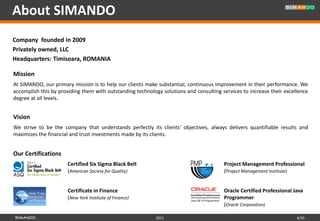
Company founded in 2009
Privately owned, LLC
Headquarters: Timisoara, ROMANIA

Mission
At SIMANDO, our primary mission is to help our clients make substantial, continuous improvement in their performance. We
accomplish this by providing them with outstanding technology solutions and consulting services to increase their excellence
degree at all levels.


Vision
We strive to be the company that understands perfectly its clients' objectives, always delivers quantifiable results and
maximizes the financial and trust investments made by its clients.


Our Certifications
                      Certified Six Sigma Black Belt                                    Project Management Professional
                      (American Society for Quality)                                    (Project Management Institute)


                      Certificate in Finance                                            Oracle Certified Professional Java
                      (New York Institute of Finance)                                   Programmer
                                                                                        (Oracle Corporation)

                                                           2011                                                        4/35
Expertise
Modeling and Simulation                                         Operational Excellence

   Systems modeling, simulation and optimization                   Lean Six Sigma Transformation

   All simulation paradigms - discrete events, agent-              Design for Six Sigma
    based and system dynamics
                                                                    Toyota Production System
   Statistics
                                                                    Theory of Constraints

                                                                    Product Development

Software Applications Development                               Industrial
   Advanced algorithms and design patterns                         Project and product development management
   Software architecture
                                                                    Computer Integrated Manufacturing
   Software development lifecycle methodologies
                                                                    Industrial engineering and factory planning
   Functional and object oriented programming
                                                                    Manufacturing, logistics, supply chain design
   Database Management Systems
                                                                    Transport and distribution systems
   MRP/ERP Systems

                                                         2011                                                        5/35
Services and Products

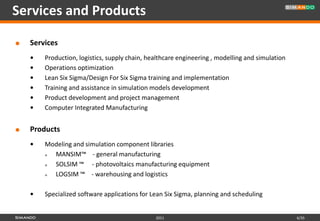
   Services
       Production, logistics, supply chain, healthcare engineering , modelling and simulation
       Operations optimization
       Lean Six Sigma/Design For Six Sigma training and implementation
       Training and assistance in simulation models development
       Product development and project management
       Computer Integrated Manufacturing


   Products
       Modeling and simulation component libraries
         MANSIM™ - general manufacturing
         SOLSIM ™ - photovoltaics manufacturing equipment
         LOGSIM ™ - warehousing and logistics

       Specialized software applications for Lean Six Sigma, planning and scheduling


                                               2011                                              6/35
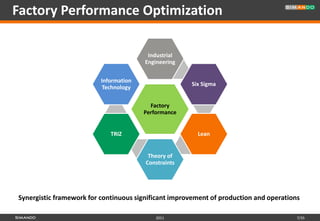
Factory Performance Optimization

                                         Industrial
                                        Engineering


                          Information
                                                      Six Sigma
                           Technology

                                          Factory
                                        Performance


                             TRIZ                       Lean


                                         Theory of
                                        Constraints


Synergistic framework for continuous significant improvement of production and operations

                                            2011                                        7/35
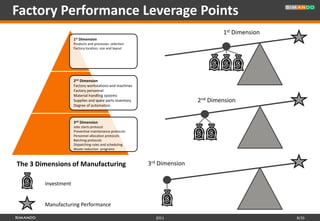
Factory Performance Leverage Points
                                                                                  1st Dimension
                     1st Dimension
                     Products and processes selection
                     Factory location, size and layout


                     2nd Dimension
                     Factory workstations and machines
                     Factory personnel
                     Material handling systems
                     Supplies and spare parts inventory                   2nd Dimension
                     Degree of automation


                     3nd Dimension
                     Jobs starts protocol
                     Preventive maintenance protocols
                     Personnel allocation protocols
                     Batching protocols
                     Dispatching rules and scheduling
                     Waste reduction programs


The 3 Dimensions of Manufacturing                         3rd Dimension


        Investment


        Manufacturing Performance

                                                            2011                                  8/35
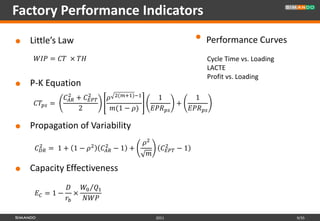
Factory Performance Indicators
   Little’s Law                                                           • Performance Curves
     =  ×                                                      Cycle Time vs. Loading
                                                                             LACTE
                                                                             Profit vs. Loading
   P-K Equation
                    2        2
                  +     2(+1)−1        1            1
     =                                                   +
                        2             (1 − )         

   Propagation of Variability
       2                     2
                                                    2        2
      = 1 + 1 − 2  − 1 +                       − 1
                                                     

   Capacity Effectiveness
                0 1
      = 1 − ×
                

                                                          2011                                        9/35
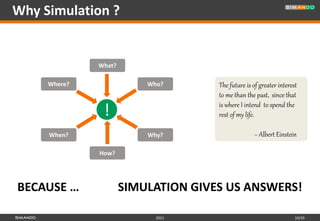
Why Simulation ?


              What?

     Where?               Who?       The future is of greater interest
                                     to me than the past, since that
                                     is where I intend to spend the
               !                     rest of my life.

     When?                Why?                     ~ Albert Einstein

              How?


BECAUSE …             SIMULATION GIVES US ANSWERS!

                            2011                                     10/35
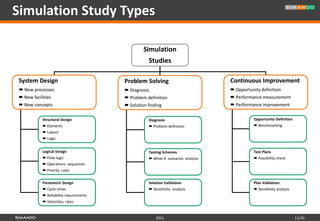
Simulation Study Types

                                                 Simulation
                                                   Studies

System Design                           Problem Solving                           Continuous Improvement
  New processes                         Diagnosis                                Opportunity definition
 New facilities                         Problem definition                       Performance measurement
 New concepts                           Solution finding                         Performance improvement

           Structural Design                       Diagnosis                                 Opportunity Definition
            Elements                               Problem definition                       Benchmarking
            Layout
            Logic


           Logical Design                          Testing Schemes                           Test Plans
            Flow logic                             What-if scenarios analysis               Feasibility check
            Operations sequences
            Priority rules


           Parametric Design                       Solution Validation                       Plan Validation
            Cycle times                            Sensitivity analysis                     Sensitivity analysis
            Reliability requirements
            Velocities, rates


                                                       2011                                                           11/35
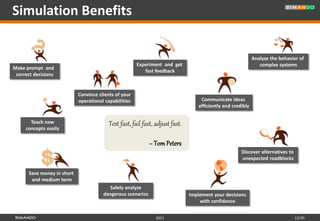
Simulation Benefits


                                                                                                              Analyze the behavior of
                                                       Experiment and get                                        complex systems
Make prompt and
                                                          fast feedback
 correct decisions


                            Convince clients of your
                            operational capabilities                                Communicate ideas
                                                                                   efficiently and credibly


       Teach new                          Test fast, fail fast, adjust fast.
     concepts easily

                                                             ~ Tom Peters
                                                                                                       Discover alternatives to
                                                                                                       unexpected roadblocks

      Save money in short
       and medium term
                                          Safely analyze
                                       dangerous scenarios                     Implement your decisions
                                                                                   with confidence


                                                                2011                                                              12/35
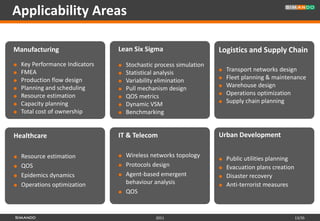
Applicability Areas

Manufacturing                    Lean Six Sigma                      Logistics and Supply Chain
   Key Performance Indicators      Stochastic process simulation
   FMEA                            Statistical analysis               Transport networks design
   Production flow design          Variability elimination            Fleet planning & maintenance
   Planning and scheduling         Pull mechanism design              Warehouse design
   Resource estimation             QOS metrics                        Operations optimization
   Capacity planning               Dynamic VSM                        Supply chain planning
   Total cost of ownership         Benchmarking


Healthcare                       IT & Telecom                        Urban Development

   Resource estimation             Wireless networks topology
                                                                        Public utilities planning
   QOS                             Protocols design                   Evacuation plans creation
   Epidemics dynamics              Agent-based emergent               Disaster recovery
   Operations optimization          behaviour analysis                 Anti-terrorist measures
                                    QOS


                                                2011                                                 13/35
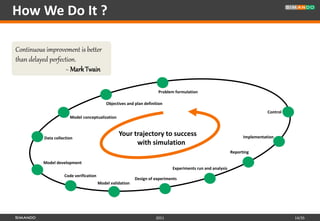
How We Do It ?

Continuous improvement is better
than delayed perfection.
                    ~ Mark Twain

                                                                       Problem formulation

                                            Objectives and plan definition
                                                                                                                             Control
                       Model conceptualization


          Data collection
                                                  Your trajectory to success                                      Implementation
                                                        with simulation
                                                                                                            Reporting

          Model development
                                                                             Experiments run and analysis
                    Code verification
                                                           Design of experiments
                                        Model validation


                                                                      2011                                                             14/35
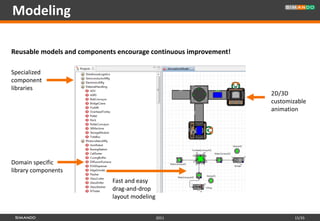
Modeling

Reusable models and components encourage continuous improvement!

Specialized
component
libraries
                                                                   2D/3D
                                                                   customizable
                                                                   animation


Domain specific
library components
                             Fast and easy
                             drag-and-drop
                             layout modeling


                                               2011                        15/35
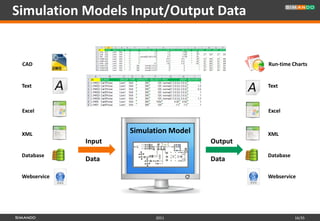
Simulation Models Input/Output Data


 CAD                                              Run-time Charts


 Text                                             Text


 Excel                                            Excel


 XML                  Simulation Model            XML
              Input                      Output
 Database                                         Database
              Data                       Data

 Webservice                                       Webservice


                            2011                             16/35
Simulation in Manufacturing


                                                        Creativity is thinking up new things.
                                                        Innovation is doing new things.
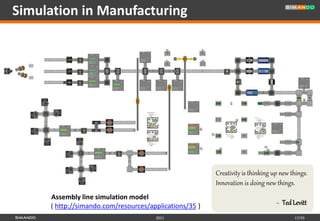
     Assembly line simulation model
     ( http://simando.com/resources/applications/35 )                           ~ Ted Levitt
                                      2011                                             17/35
Simulation in Manufacturing


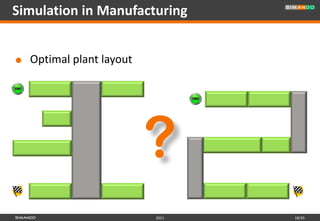
   Optimal plant layout


                           ?
                           2011   18/35
Simulation in Manufacturing


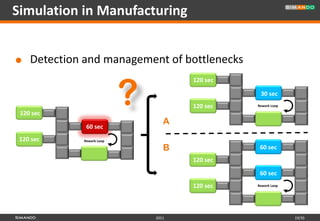
   Detection and management of bottlenecks


                           ?
                                      120 sec

                                                 30 sec
                                      120 sec   Rework Loop

 120 sec
                                  A
              60 sec
 120 sec     Rework Loop

                                  B              60 sec
                                      120 sec

                                                 60 sec
                                      120 sec   Rework Loop


                               2011                           19/35
Simulation in Manufacturing


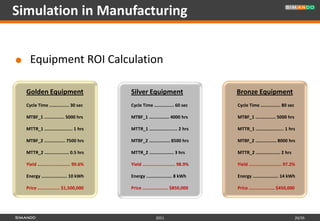
    Equipment ROI Calculation

    Golden Equipment               Silver Equipment               Bronze Equipment
    Cycle Time ………....... 30 sec   Cycle Time ………....... 60 sec   Cycle Time ………....... 80 sec

    MTBF_1 …..………… 5000 hrs        MTBF_1 …..………… 4000 hrs        MTBF_1 …..………… 5000 hrs

    MTTR_1 ……………........ 1 hrs     MTTR_1 ……………........ 2 hrs     MTTR_1 ……………........ 1 hrs

    MTBF_2 ……………… 7500 hrs         MTBF_2 ……………… 8500 hrs         MTBF_2 ……………… 8000 hrs

    MTTR_2 ………………… 0.5 hrs         MTTR_2 ………………… 3 hrs           MTTR_2 ………………… 2 hrs

    Yield ………………………. 99.6%         Yield ………………………. 98.9%         Yield ………………………. 97.2%

    Energy …………………. 10 kWh         Energy …………………. 8 kWh          Energy …………………. 14 kWh

    Price …………….… $1,500,000       Price ……………….… $850,000        Price ……………….… $450,000


                                               2011                                              20/35
Simulation in Manufacturing


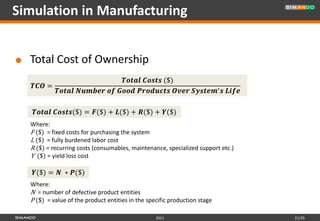
   Total Cost of Ownership
                                                ($)
     =
                     ′  

     ($) = ($) + ($) + ($) + ($)
    Where:
    F ($) = fixed costs for purchasing the system
    L ($) = fully burdened labor cost
    R ($) = recurring costs (consumables, maintenance, specialized support etc.)
    Y ($) = yield loss cost

    ($) =  ∗ ($)
    Where:
    N = number of defective product entities
    P ($) = value of the product entities in the specific production stage

                                                               2011                                        21/35
Simulation in Manufacturing


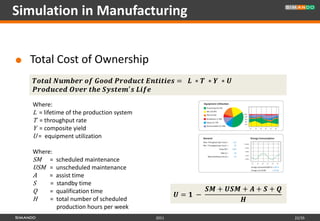
   Total Cost of Ownership
          =  ∗  ∗  ∗ 
       ′  

    Where:
    L = lifetime of the production system
    T = throughput rate
    Y = composite yield
    U = equipment utilization

    Where:
    SM =      scheduled maintenance
    USM =     unscheduled maintenance
    A    =    assist time
    S    =    standby time
    Q    =    qualification time                                             +  +  +  + 
                                                                   =  −
    H    =    total number of scheduled                                                  
              production hours per week
                                                           2011                                            22/35
Simulation in Manufacturing


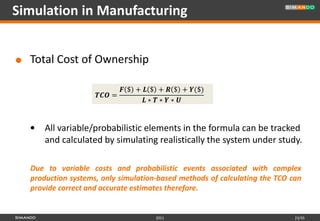
   Total Cost of Ownership

                                  $ +  $ +  $ + ($)
                       =
                                         ∗  ∗  ∗ 


       All variable/probabilistic elements in the formula can be tracked
        and calculated by simulating realistically the system under study.

    Due to variable costs and probabilistic events associated with complex
    production systems, only simulation-based methods of calculating the TCO can
    provide correct and accurate estimates therefore.


                                            2011                              23/35
Simulation in Manufacturing

   Detailed modeling of components and manufacturing scenarios

   Accurate timing and behavior of the modeled systems

   Manual work, worker-machine and fully automated manufacturing modeling possibilities

   Any type of production environment: jobbing, intermittent, mass production

   Resources behavior controlled by highly detailed state machines according to machine specs

   Any type of Key Performance Indicator can be defined and tracked

   Ramp-up scenarios analysis

   Inbound/outbound logistics and supply chain analysis and integration

   Declustering of job starts and maintenance

   Load management scheme design


                                                  2011                                           24/35
Simulation in Manufacturing


   Line balancing and materials handling

       Dispatching rules:
           critical ratio, shortest processing time, FIFO, due date, etc.

       Conveyors vs. Automated Guided Vehicles vs. Humans

       Material flow optimization

       Buffers capacities & policies (FIFO, LIFO, FEFO, custom)


                                         2011                                25/35
Simulation in Manufacturing

   Lean manufacturing speed and quantity control and Six Sigma quality

   Simulation offers support in finding solutions to reduce:

       Transport time

       Inventory and buffers

       Employee motion

       Waiting

       Overproduction

       Defects

                                     2011                             26/35
Simulation in Manufacturing
   Optimization of Key Performance Indicators

       Work in process (WIP)

       Load-adjusted cycle time efficiency

       Manufacturing lead time

       Equipment cycle times

       Queuing, blocking, waiting, transport time

       Throughput

       Equipment and human resources utilization

       Energy, consumables, spare parts, waste

       Spares and supplies inventory levels and variability


                                                  2011         27/35
Simulation in Manufacturing

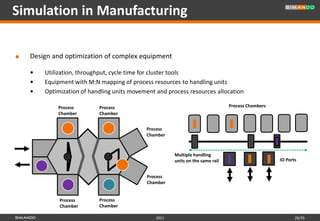
   Design and optimization of complex equipment

       Utilization, throughput, cycle time for cluster tools
       Equipment with M:N mapping of process resources to handling units
       Optimization of handling units movement and process resources allocation

            Process        Process                                              Process Chambers
            Chamber        Chamber


                                            Process
                                            Chamber


                                                       Multiple handling
                                                       units on the same rail                      IO Ports


                                            Process
                                            Chamber


             Process       Process
             Chamber       Chamber

                                                2011                                                      28/35
Simulation in Manufacturing

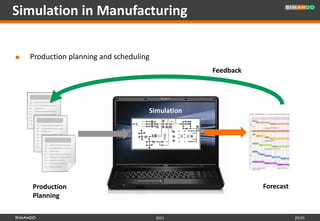
   Production planning and scheduling
                                                  Feedback


                                     Simulation


    Production                                               Forecast
    Planning

                                         2011                           29/35
Simulation in Lean Implementation

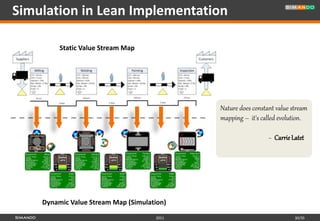
         Static Value Stream Map


                                            Nature does constant value stream
                                            mapping – it's called evolution.

                                                              ~ Carrie Latet


    Dynamic Value Stream Map (Simulation)
                                     2011                               30/35
Simulation in Lean Implementation

   Single piece flow vs. batch processing analysis

   Kanban (pull) mechanism design

   Production leveling (heijunka)

   Cycle, safety and buffer stocks calculation

   Just In Time (JIT), Just in Sequence (JIS) inventory strategy design

   Cellular operations design

   Overall Equipment Effectiveness (OEE) calculation

   Relation between demand and takt time analysis
                                                  2011                     31/35
Simulation in Lean Six Sigma

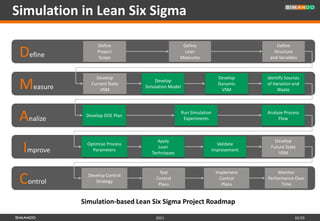
                 Define                         Define                               Define
 Define          Project
                 Scope
                                                 Lean
                                               Measures
                                                                                    Structure
                                                                                  and Variables


                Develop                                              Develop     Identify Sources
 Measure      Current State
                  VSM
                                   Develop
                               Simulation Model
                                                                     Dynamic
                                                                      VSM
                                                                                 of Variation and
                                                                                      Waste


 Analize    Develop DOE Plan
                                                  Run Simulation
                                                   Experiments
                                                                                 Analyze Process
                                                                                      Flow


                                     Apply                                          Develop
 Improve    Optimize Process
              Parameters
                                     Lean
                                  Techniques
                                                                     Validate
                                                                   Improvement
                                                                                  Future State
                                                                                     VSM


                                     Test                           Implement         Monitor
 Control     Develop Control
                Strategy
                                   Control
                                    Plans
                                                                      Control
                                                                       Plans
                                                                                 Performance Over
                                                                                       Time


           Simulation-based Lean Six Sigma Project Roadmap

                                   2011                                                       32/35
Design For Six Sigma

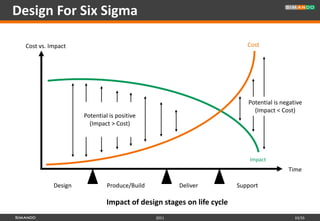
  Cost vs. Impact                                                        Cost


                                                                         Potential is negative
                                                                           (Impact < Cost)
                     Potential is positive
                       (Impact > Cost)


                                                                          Impact
                                                                                        Time

            Design            Produce/Build          Deliver          Support

                              Impact of design stages on life cycle
                                              2011                                         33/35
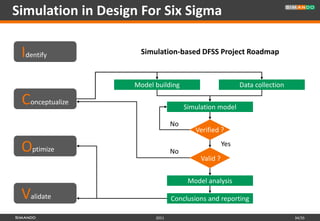
Simulation in Design For Six Sigma

 Identify            Simulation-based DFSS Project Roadmap


                   Model building                         Data collection

 Conceptualize                       Simulation model

                                No
                                        Verified ?

 Optimize                       No
                                                    Yes
                                          Valid ?


                                      Model analysis

 Validate                       Conclusions and reporting

                         2011                                               34/35
Thank you for your attention!
                                      SIMANDO Team
           SIMANDO LLC
           9 Republicii Blvd
           Timisoara, TM 300159
           ROMANIA

           Tel:    +40 356 172 021
           Fax:    +40 356 172 017
           E-mail: info@simando.com
           Web: www.simando.com

Factory performance optimization

  • 1.
    Factory Performance Optimization Methodsand tools for continuous significant improvement of production and operations
  • 2.
    SIMANDO is aglobal management and technology consulting firm with a high focus on decision support systems and operational excellence. We partner with client organizations in all industrial sectors to address their most important challenges and develop complete solutions that will enable them to achieve their objectives and make significant improvements in their performance. Our customized approach combines innovative technology, systems thinking and passion for operational excellence. This ensures that our solutions enable our clients to achieve sustainable competitive advantage by optimized operations and responsiveness to the current dynamic business environment. Founded in 2009, SIMANDO is a private company with its headquarters in Timisoara, Romania. For more information, please visit: www.simando.com
  • 3.
    Outline  About SIMANDO  Services and Products  Factory Performance Optimization Framework  Analytical Methods for Performance Analysis & Improvement  Simulation in Manufacturing  Lean Six Sigma for Manufacturing 2011 3/35
  • 4.
    About SIMANDO Company foundedin 2009 Privately owned, LLC Headquarters: Timisoara, ROMANIA Mission At SIMANDO, our primary mission is to help our clients make substantial, continuous improvement in their performance. We accomplish this by providing them with outstanding technology solutions and consulting services to increase their excellence degree at all levels. Vision We strive to be the company that understands perfectly its clients' objectives, always delivers quantifiable results and maximizes the financial and trust investments made by its clients. Our Certifications Certified Six Sigma Black Belt Project Management Professional (American Society for Quality) (Project Management Institute) Certificate in Finance Oracle Certified Professional Java (New York Institute of Finance) Programmer (Oracle Corporation) 2011 4/35
  • 5.
    Expertise Modeling and Simulation Operational Excellence  Systems modeling, simulation and optimization  Lean Six Sigma Transformation  All simulation paradigms - discrete events, agent-  Design for Six Sigma based and system dynamics  Toyota Production System  Statistics  Theory of Constraints  Product Development Software Applications Development Industrial  Advanced algorithms and design patterns  Project and product development management  Software architecture  Computer Integrated Manufacturing  Software development lifecycle methodologies  Industrial engineering and factory planning  Functional and object oriented programming  Manufacturing, logistics, supply chain design  Database Management Systems  Transport and distribution systems  MRP/ERP Systems 2011 5/35
  • 6.
    Services and Products  Services  Production, logistics, supply chain, healthcare engineering , modelling and simulation  Operations optimization  Lean Six Sigma/Design For Six Sigma training and implementation  Training and assistance in simulation models development  Product development and project management  Computer Integrated Manufacturing  Products  Modeling and simulation component libraries  MANSIM™ - general manufacturing  SOLSIM ™ - photovoltaics manufacturing equipment  LOGSIM ™ - warehousing and logistics  Specialized software applications for Lean Six Sigma, planning and scheduling 2011 6/35
  • 7.
    Factory Performance Optimization Industrial Engineering Information Six Sigma Technology Factory Performance TRIZ Lean Theory of Constraints Synergistic framework for continuous significant improvement of production and operations 2011 7/35
  • 8.
    Factory Performance LeveragePoints 1st Dimension 1st Dimension Products and processes selection Factory location, size and layout 2nd Dimension Factory workstations and machines Factory personnel Material handling systems Supplies and spare parts inventory 2nd Dimension Degree of automation 3nd Dimension Jobs starts protocol Preventive maintenance protocols Personnel allocation protocols Batching protocols Dispatching rules and scheduling Waste reduction programs The 3 Dimensions of Manufacturing 3rd Dimension Investment Manufacturing Performance 2011 8/35
  • 9.
    Factory Performance Indicators  Little’s Law • Performance Curves = × Cycle Time vs. Loading LACTE Profit vs. Loading  P-K Equation 2 2 + 2(+1)−1 1 1 = + 2 (1 − )  Propagation of Variability 2 2 2 2 = 1 + 1 − 2 − 1 + − 1  Capacity Effectiveness 0 1 = 1 − × 2011 9/35
  • 10.
    Why Simulation ? What? Where? Who? The future is of greater interest to me than the past, since that is where I intend to spend the ! rest of my life. When? Why? ~ Albert Einstein How? BECAUSE … SIMULATION GIVES US ANSWERS! 2011 10/35
  • 11.
    Simulation Study Types Simulation Studies System Design Problem Solving Continuous Improvement  New processes  Diagnosis  Opportunity definition  New facilities  Problem definition  Performance measurement  New concepts  Solution finding  Performance improvement Structural Design Diagnosis Opportunity Definition  Elements  Problem definition  Benchmarking  Layout  Logic Logical Design Testing Schemes Test Plans  Flow logic  What-if scenarios analysis  Feasibility check  Operations sequences  Priority rules Parametric Design Solution Validation Plan Validation  Cycle times  Sensitivity analysis  Sensitivity analysis  Reliability requirements  Velocities, rates 2011 11/35
  • 12.
    Simulation Benefits Analyze the behavior of Experiment and get complex systems Make prompt and fast feedback correct decisions Convince clients of your operational capabilities Communicate ideas efficiently and credibly Teach new Test fast, fail fast, adjust fast. concepts easily ~ Tom Peters Discover alternatives to unexpected roadblocks Save money in short and medium term Safely analyze dangerous scenarios Implement your decisions with confidence 2011 12/35
  • 13.
    Applicability Areas Manufacturing Lean Six Sigma Logistics and Supply Chain  Key Performance Indicators  Stochastic process simulation  FMEA  Statistical analysis  Transport networks design  Production flow design  Variability elimination  Fleet planning & maintenance  Planning and scheduling  Pull mechanism design  Warehouse design  Resource estimation  QOS metrics  Operations optimization  Capacity planning  Dynamic VSM  Supply chain planning  Total cost of ownership  Benchmarking Healthcare IT & Telecom Urban Development  Resource estimation  Wireless networks topology  Public utilities planning  QOS  Protocols design  Evacuation plans creation  Epidemics dynamics  Agent-based emergent  Disaster recovery  Operations optimization behaviour analysis  Anti-terrorist measures  QOS 2011 13/35
  • 14.
    How We DoIt ? Continuous improvement is better than delayed perfection. ~ Mark Twain Problem formulation Objectives and plan definition Control Model conceptualization Data collection Your trajectory to success Implementation with simulation Reporting Model development Experiments run and analysis Code verification Design of experiments Model validation 2011 14/35
  • 15.
    Modeling Reusable models andcomponents encourage continuous improvement! Specialized component libraries 2D/3D customizable animation Domain specific library components Fast and easy drag-and-drop layout modeling 2011 15/35
  • 16.
    Simulation Models Input/OutputData CAD Run-time Charts Text Text Excel Excel XML Simulation Model XML Input Output Database Database Data Data Webservice Webservice 2011 16/35
  • 17.
    Simulation in Manufacturing Creativity is thinking up new things. Innovation is doing new things. Assembly line simulation model ( http://simando.com/resources/applications/35 ) ~ Ted Levitt 2011 17/35
  • 18.
    Simulation in Manufacturing  Optimal plant layout ? 2011 18/35
  • 19.
    Simulation in Manufacturing  Detection and management of bottlenecks ? 120 sec 30 sec 120 sec Rework Loop 120 sec A 60 sec 120 sec Rework Loop B 60 sec 120 sec 60 sec 120 sec Rework Loop 2011 19/35
  • 20.
    Simulation in Manufacturing  Equipment ROI Calculation Golden Equipment Silver Equipment Bronze Equipment Cycle Time ………....... 30 sec Cycle Time ………....... 60 sec Cycle Time ………....... 80 sec MTBF_1 …..………… 5000 hrs MTBF_1 …..………… 4000 hrs MTBF_1 …..………… 5000 hrs MTTR_1 ……………........ 1 hrs MTTR_1 ……………........ 2 hrs MTTR_1 ……………........ 1 hrs MTBF_2 ……………… 7500 hrs MTBF_2 ……………… 8500 hrs MTBF_2 ……………… 8000 hrs MTTR_2 ………………… 0.5 hrs MTTR_2 ………………… 3 hrs MTTR_2 ………………… 2 hrs Yield ………………………. 99.6% Yield ………………………. 98.9% Yield ………………………. 97.2% Energy …………………. 10 kWh Energy …………………. 8 kWh Energy …………………. 14 kWh Price …………….… $1,500,000 Price ……………….… $850,000 Price ……………….… $450,000 2011 20/35
  • 21.
    Simulation in Manufacturing  Total Cost of Ownership ($) = ′ ($) = ($) + ($) + ($) + ($) Where: F ($) = fixed costs for purchasing the system L ($) = fully burdened labor cost R ($) = recurring costs (consumables, maintenance, specialized support etc.) Y ($) = yield loss cost ($) = ∗ ($) Where: N = number of defective product entities P ($) = value of the product entities in the specific production stage 2011 21/35
  • 22.
    Simulation in Manufacturing  Total Cost of Ownership = ∗ ∗ ∗ ′ Where: L = lifetime of the production system T = throughput rate Y = composite yield U = equipment utilization Where: SM = scheduled maintenance USM = unscheduled maintenance A = assist time S = standby time Q = qualification time + + + + = − H = total number of scheduled production hours per week 2011 22/35
  • 23.
    Simulation in Manufacturing  Total Cost of Ownership $ + $ + $ + ($) = ∗ ∗ ∗  All variable/probabilistic elements in the formula can be tracked and calculated by simulating realistically the system under study. Due to variable costs and probabilistic events associated with complex production systems, only simulation-based methods of calculating the TCO can provide correct and accurate estimates therefore. 2011 23/35
  • 24.
    Simulation in Manufacturing  Detailed modeling of components and manufacturing scenarios  Accurate timing and behavior of the modeled systems  Manual work, worker-machine and fully automated manufacturing modeling possibilities  Any type of production environment: jobbing, intermittent, mass production  Resources behavior controlled by highly detailed state machines according to machine specs  Any type of Key Performance Indicator can be defined and tracked  Ramp-up scenarios analysis  Inbound/outbound logistics and supply chain analysis and integration  Declustering of job starts and maintenance  Load management scheme design 2011 24/35
  • 25.
    Simulation in Manufacturing  Line balancing and materials handling  Dispatching rules:  critical ratio, shortest processing time, FIFO, due date, etc.  Conveyors vs. Automated Guided Vehicles vs. Humans  Material flow optimization  Buffers capacities & policies (FIFO, LIFO, FEFO, custom) 2011 25/35
  • 26.
    Simulation in Manufacturing  Lean manufacturing speed and quantity control and Six Sigma quality  Simulation offers support in finding solutions to reduce:  Transport time  Inventory and buffers  Employee motion  Waiting  Overproduction  Defects 2011 26/35
  • 27.
    Simulation in Manufacturing  Optimization of Key Performance Indicators  Work in process (WIP)  Load-adjusted cycle time efficiency  Manufacturing lead time  Equipment cycle times  Queuing, blocking, waiting, transport time  Throughput  Equipment and human resources utilization  Energy, consumables, spare parts, waste  Spares and supplies inventory levels and variability 2011 27/35
  • 28.
    Simulation in Manufacturing  Design and optimization of complex equipment  Utilization, throughput, cycle time for cluster tools  Equipment with M:N mapping of process resources to handling units  Optimization of handling units movement and process resources allocation Process Process Process Chambers Chamber Chamber Process Chamber Multiple handling units on the same rail IO Ports Process Chamber Process Process Chamber Chamber 2011 28/35
  • 29.
    Simulation in Manufacturing  Production planning and scheduling Feedback Simulation Production Forecast Planning 2011 29/35
  • 30.
    Simulation in LeanImplementation Static Value Stream Map Nature does constant value stream mapping – it's called evolution. ~ Carrie Latet Dynamic Value Stream Map (Simulation) 2011 30/35
  • 31.
    Simulation in LeanImplementation  Single piece flow vs. batch processing analysis  Kanban (pull) mechanism design  Production leveling (heijunka)  Cycle, safety and buffer stocks calculation  Just In Time (JIT), Just in Sequence (JIS) inventory strategy design  Cellular operations design  Overall Equipment Effectiveness (OEE) calculation  Relation between demand and takt time analysis 2011 31/35
  • 32.
    Simulation in LeanSix Sigma Define Define Define Define Project Scope Lean Measures Structure and Variables Develop Develop Identify Sources Measure Current State VSM Develop Simulation Model Dynamic VSM of Variation and Waste Analize Develop DOE Plan Run Simulation Experiments Analyze Process Flow Apply Develop Improve Optimize Process Parameters Lean Techniques Validate Improvement Future State VSM Test Implement Monitor Control Develop Control Strategy Control Plans Control Plans Performance Over Time Simulation-based Lean Six Sigma Project Roadmap 2011 32/35
  • 33.
    Design For SixSigma Cost vs. Impact Cost Potential is negative (Impact < Cost) Potential is positive (Impact > Cost) Impact Time Design Produce/Build Deliver Support Impact of design stages on life cycle 2011 33/35
  • 34.
    Simulation in DesignFor Six Sigma Identify Simulation-based DFSS Project Roadmap Model building Data collection Conceptualize Simulation model No Verified ? Optimize No Yes Valid ? Model analysis Validate Conclusions and reporting 2011 34/35
  • 35.
    Thank you foryour attention! SIMANDO Team SIMANDO LLC 9 Republicii Blvd Timisoara, TM 300159 ROMANIA Tel: +40 356 172 021 Fax: +40 356 172 017 E-mail: info@simando.com Web: www.simando.com