Chunking by teacherscpd.wordpress.com
Unfortunately most students, and many teachers, have a ”folk psychology” view of learning rather
than a constructivist view, and this is very hard to budge. Folk theory is considered a real obstacle to
effective teaching and learning by renowned theorists such as J. Bruner and Charles Desforges: Folk
psychology assumes:

    •   Knowledge is stuff
    •   The mind is a vessel
    •   Learning is storing stuff
    •   Acquisition only requires listening reasonably attentively, or even just being there.
    •   Assessment is stock taking
    •   Analogies for learning involve transfer rather than constructivism:
    •   The mug is filled by the jug
    •   Teacher as petrol pump attendant filling student’s empty tanks.


The use of jigsaws runs counter to the above by using constructivist principles in the classroom. The
basic premise of the jigsaw idea is modelled on constructivism. Vygotsky developed the term
‘constructivism’ . In a nutshell constructivism comes from the standpoint that individuals create their
own meaning when they learn something new. This literally involves the construction of connections
between neurones. Using jigsaws help students construct their own meanings and make their own
connections so complex ideas can be remembered – learning is about making sense not just
remembering.

Reproductive tasks are those which require lower levels of cognition such as:

Copying a diagram

Recalling a definition             grouping A

Repeating a process


In contrast reasoning requires high levels of cognition. These tasks are those needing:

Analysis

Synthesis             grouping B

Evaluation


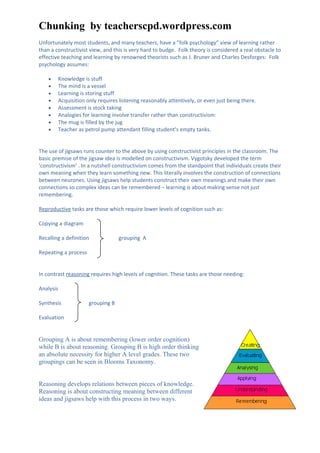
Grouping A is about remembering (lower order cognition)
while B is about reasoning. Grouping B is high order thinking
an absolute necessity for higher A level grades. These two
groupings can be seen in Blooms Taxonomy.


Reasoning develops relations between pieces of knowledge.
Reasoning is about constructing meaning between different
ideas and jigsaws help with this process in two ways.
Chunking by teacherscpd.wordpress.com
   1. Meanings – when we understand something it means we can explain it in terms of
      something else. For example there is no one explanation or interpretation of
      something.

   2. Application or function – is when students have a deeper understanding and can give
      a relational response to something (rational response is where conflicts and
      inconsistencies in different pieces of knowledge are identified by the student allowing
      them to assess the strengths and weaknesses to form a balanced view).


   In order to achieve point 2 above, students need to recognise patterns or relations between
   different pockets of knowledge. Chunking has been identified as a mechanism which
   helps teachers and students as it’s similar to remembering the journey to a destination
   without necessarily remembering the names of the roads you journey on. Chunking is a
   method of breaking up reading material into digestible sections. Chunking helps prevent
   word-by-word reading, which can negatively affect comprehension since the reader may
   have forgotten the beginning of the sentence by the time he makes it to the end of the
   sentence. Studies demonstrate that chunked material, or materials that are separated into
   meaningful related groups of words, improves the comprehension of some readers,
   especially poor or low-ability readers.

   Students now use the chunked knowledge and place them into each jigsaw. For example
   you could have three key areas of knowledge on the three main political parties in the
   UK. The students would display chunks of their knowledge into a single jigsaw piece.
   The next task would be for the students to make a link to the next jigsaw piece by
   summarising the strengths of each political position while using the jigsaw link to find the
   weaknesses in the opposing argument.

   The use of jigsaws helps students use Vygotsky constructivist principles to make their own
   connections between different ideas; in this example comparing different political parties.
   By allowing students to build their own constructs it is far easier for them to move their
   cognition into grouping B. Moreover the skills of evaluation and synthesis become more
   accessible.

Critical Thinking Activity [arranged            Relevant Sample Verbs
lowest to highest]
1. Remembering Retrieving,                      Acquire, Define, Distinguish, Draw,
recognizing, and recalling relevant             Find, Label, List, Match, Read,
knowledge from long-term                        Record
memory, eg. find out, learn terms,
facts, methods, procedures,
concepts
2. Understanding Constructing                   Compare, Demonstrate, Differentiate,
meaning from oral, written, and                 Fill in, Find, Group, Outline, Predict,
graphic messages through                        Represent, Trace
interpreting, exemplifying,
classifying, summarizing, inferring,
comparing, and explaining.
Chunking by teacherscpd.wordpress.com
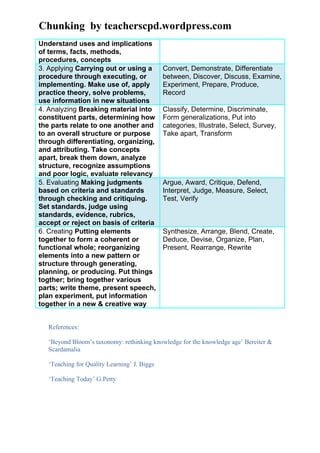
Understand uses and implications
of terms, facts, methods,
procedures, concepts
3. Applying Carrying out or using a           Convert, Demonstrate, Differentiate
procedure through executing, or               between, Discover, Discuss, Examine,
implementing. Make use of, apply              Experiment, Prepare, Produce,
practice theory, solve problems,              Record
use information in new situations
4. Analyzing Breaking material into           Classify, Determine, Discriminate,
constituent parts, determining how            Form generalizations, Put into
the parts relate to one another and           categories, Illustrate, Select, Survey,
to an overall structure or purpose            Take apart, Transform
through differentiating, organizing,
and attributing. Take concepts
apart, break them down, analyze
structure, recognize assumptions
and poor logic, evaluate relevancy
5. Evaluating Making judgments                Argue, Award, Critique, Defend,
based on criteria and standards               Interpret, Judge, Measure, Select,
through checking and critiquing.              Test, Verify
Set standards, judge using
standards, evidence, rubrics,
accept or reject on basis of criteria
6. Creating Putting elements                  Synthesize, Arrange, Blend, Create,
together to form a coherent or                Deduce, Devise, Organize, Plan,
functional whole; reorganizing                Present, Rearrange, Rewrite
elements into a new pattern or
structure through generating,
planning, or producing. Put things
togther; bring together various
parts; write theme, present speech,
plan experiment, put information
together in a new & creative way


   References:

   ‘Beyond Bloom’s taxonomy: rethinking knowledge for the knowledge age’ Bereiter &
   Scardamalia

   ‘Teaching for Quality Learning’ J. Biggs

   ‘Teaching Today’ G.Petty

Chunking

  • 1.
    Chunking by teacherscpd.wordpress.com Unfortunatelymost students, and many teachers, have a ”folk psychology” view of learning rather than a constructivist view, and this is very hard to budge. Folk theory is considered a real obstacle to effective teaching and learning by renowned theorists such as J. Bruner and Charles Desforges: Folk psychology assumes: • Knowledge is stuff • The mind is a vessel • Learning is storing stuff • Acquisition only requires listening reasonably attentively, or even just being there. • Assessment is stock taking • Analogies for learning involve transfer rather than constructivism: • The mug is filled by the jug • Teacher as petrol pump attendant filling student’s empty tanks. The use of jigsaws runs counter to the above by using constructivist principles in the classroom. The basic premise of the jigsaw idea is modelled on constructivism. Vygotsky developed the term ‘constructivism’ . In a nutshell constructivism comes from the standpoint that individuals create their own meaning when they learn something new. This literally involves the construction of connections between neurones. Using jigsaws help students construct their own meanings and make their own connections so complex ideas can be remembered – learning is about making sense not just remembering. Reproductive tasks are those which require lower levels of cognition such as: Copying a diagram Recalling a definition grouping A Repeating a process In contrast reasoning requires high levels of cognition. These tasks are those needing: Analysis Synthesis grouping B Evaluation Grouping A is about remembering (lower order cognition) while B is about reasoning. Grouping B is high order thinking an absolute necessity for higher A level grades. These two groupings can be seen in Blooms Taxonomy. Reasoning develops relations between pieces of knowledge. Reasoning is about constructing meaning between different ideas and jigsaws help with this process in two ways.
  • 2.
    Chunking by teacherscpd.wordpress.com 1. Meanings – when we understand something it means we can explain it in terms of something else. For example there is no one explanation or interpretation of something. 2. Application or function – is when students have a deeper understanding and can give a relational response to something (rational response is where conflicts and inconsistencies in different pieces of knowledge are identified by the student allowing them to assess the strengths and weaknesses to form a balanced view). In order to achieve point 2 above, students need to recognise patterns or relations between different pockets of knowledge. Chunking has been identified as a mechanism which helps teachers and students as it’s similar to remembering the journey to a destination without necessarily remembering the names of the roads you journey on. Chunking is a method of breaking up reading material into digestible sections. Chunking helps prevent word-by-word reading, which can negatively affect comprehension since the reader may have forgotten the beginning of the sentence by the time he makes it to the end of the sentence. Studies demonstrate that chunked material, or materials that are separated into meaningful related groups of words, improves the comprehension of some readers, especially poor or low-ability readers. Students now use the chunked knowledge and place them into each jigsaw. For example you could have three key areas of knowledge on the three main political parties in the UK. The students would display chunks of their knowledge into a single jigsaw piece. The next task would be for the students to make a link to the next jigsaw piece by summarising the strengths of each political position while using the jigsaw link to find the weaknesses in the opposing argument. The use of jigsaws helps students use Vygotsky constructivist principles to make their own connections between different ideas; in this example comparing different political parties. By allowing students to build their own constructs it is far easier for them to move their cognition into grouping B. Moreover the skills of evaluation and synthesis become more accessible. Critical Thinking Activity [arranged Relevant Sample Verbs lowest to highest] 1. Remembering Retrieving, Acquire, Define, Distinguish, Draw, recognizing, and recalling relevant Find, Label, List, Match, Read, knowledge from long-term Record memory, eg. find out, learn terms, facts, methods, procedures, concepts 2. Understanding Constructing Compare, Demonstrate, Differentiate, meaning from oral, written, and Fill in, Find, Group, Outline, Predict, graphic messages through Represent, Trace interpreting, exemplifying, classifying, summarizing, inferring, comparing, and explaining.
  • 3.
    Chunking by teacherscpd.wordpress.com Understanduses and implications of terms, facts, methods, procedures, concepts 3. Applying Carrying out or using a Convert, Demonstrate, Differentiate procedure through executing, or between, Discover, Discuss, Examine, implementing. Make use of, apply Experiment, Prepare, Produce, practice theory, solve problems, Record use information in new situations 4. Analyzing Breaking material into Classify, Determine, Discriminate, constituent parts, determining how Form generalizations, Put into the parts relate to one another and categories, Illustrate, Select, Survey, to an overall structure or purpose Take apart, Transform through differentiating, organizing, and attributing. Take concepts apart, break them down, analyze structure, recognize assumptions and poor logic, evaluate relevancy 5. Evaluating Making judgments Argue, Award, Critique, Defend, based on criteria and standards Interpret, Judge, Measure, Select, through checking and critiquing. Test, Verify Set standards, judge using standards, evidence, rubrics, accept or reject on basis of criteria 6. Creating Putting elements Synthesize, Arrange, Blend, Create, together to form a coherent or Deduce, Devise, Organize, Plan, functional whole; reorganizing Present, Rearrange, Rewrite elements into a new pattern or structure through generating, planning, or producing. Put things togther; bring together various parts; write theme, present speech, plan experiment, put information together in a new & creative way References: ‘Beyond Bloom’s taxonomy: rethinking knowledge for the knowledge age’ Bereiter & Scardamalia ‘Teaching for Quality Learning’ J. Biggs ‘Teaching Today’ G.Petty