Factors, Primes &
Composite Numbers
Definition
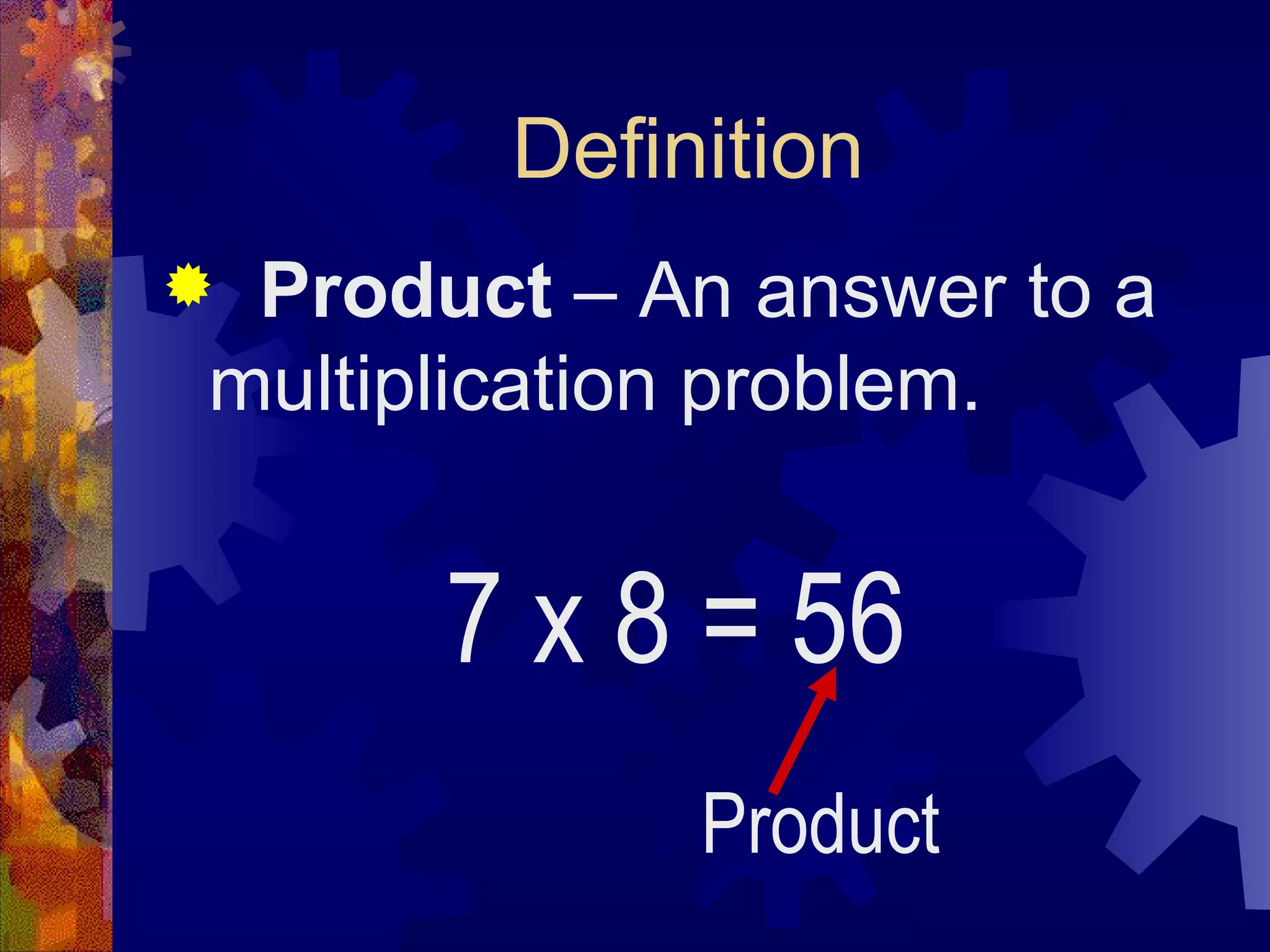
 Product – An answer to a
multiplication problem.
7 x 8 = 56
Product
Definition
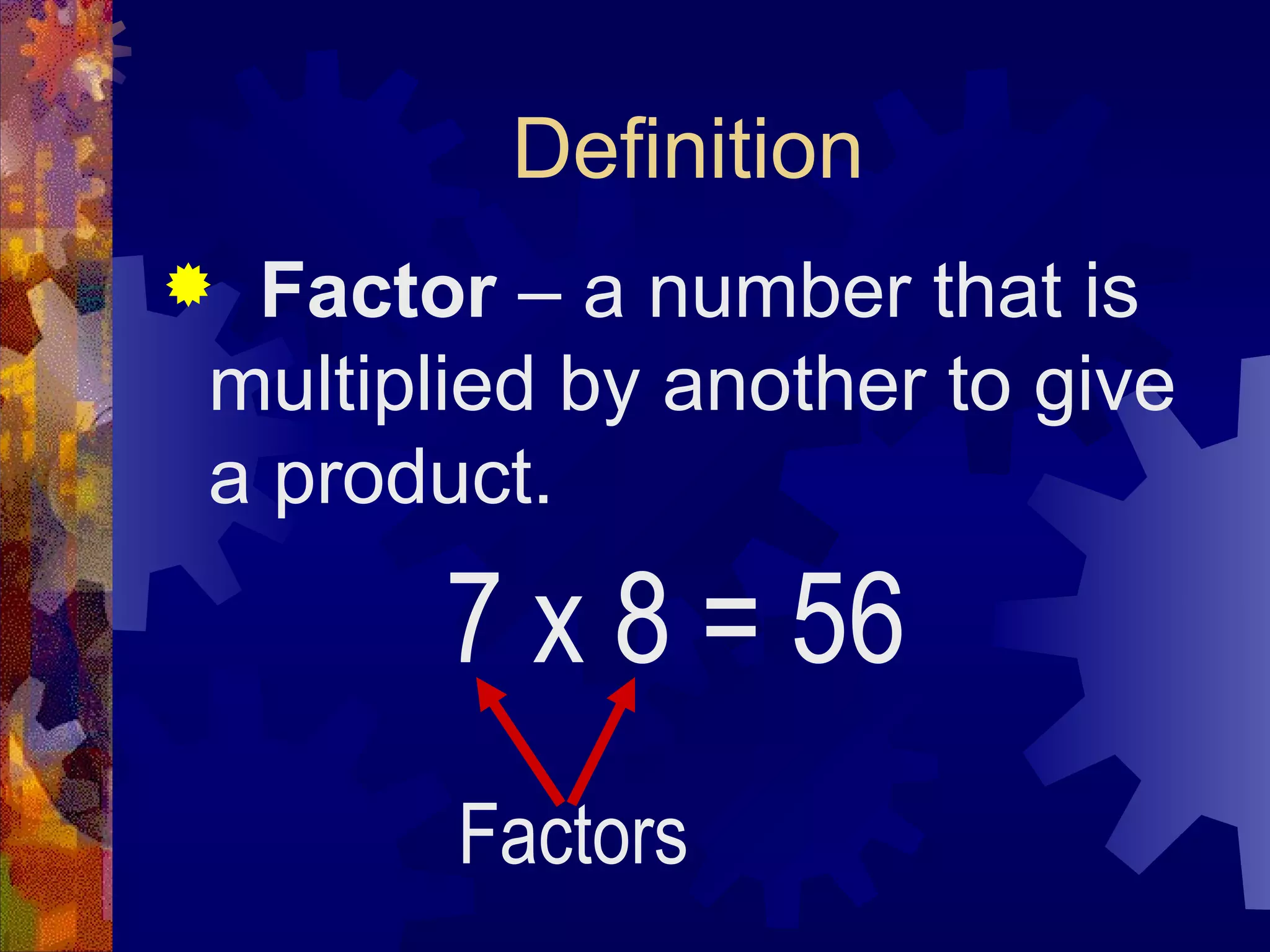
 Factor – a number that is
multiplied by another to give
a product.
7 x 8 = 56
Factors
Definition
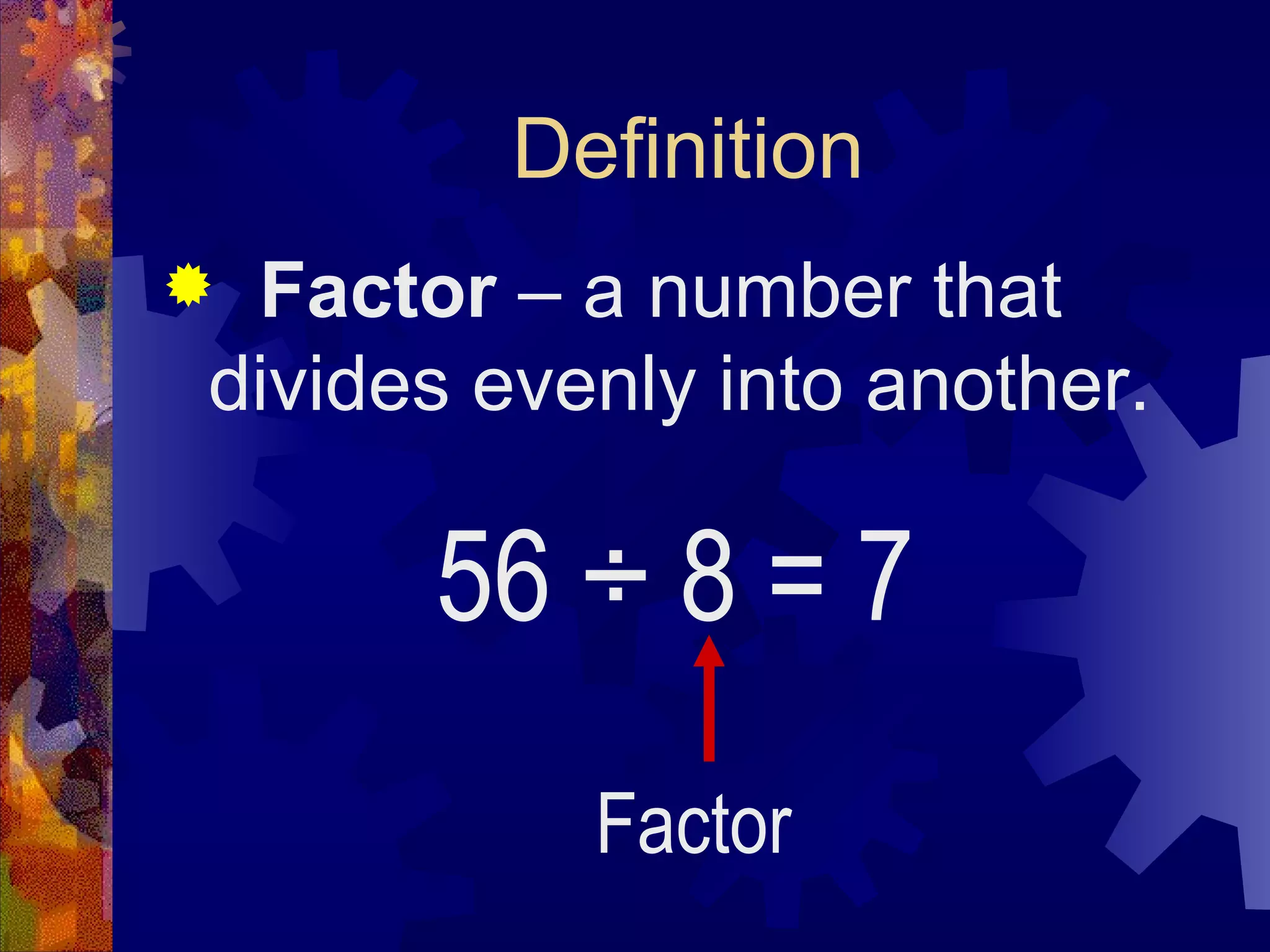
 Factor – a number that
divides evenly into another.
56 ÷ 8 = 7
Factor
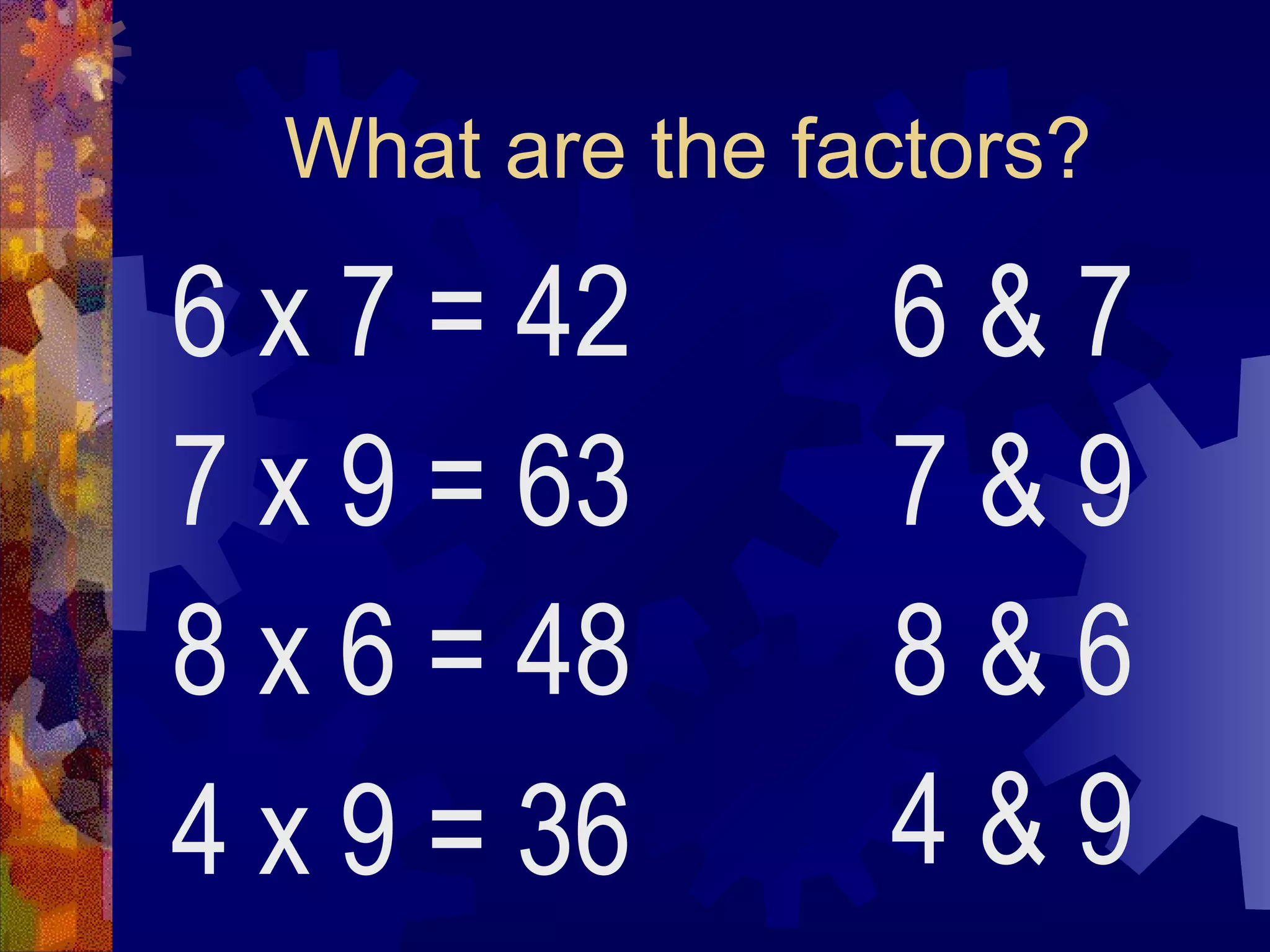
What are the factors?
6 x 7 = 42
7 x 9 = 63
8 x 6 = 48
4 x 9 = 36
6 & 7
7 & 9
8 & 6
4 & 9
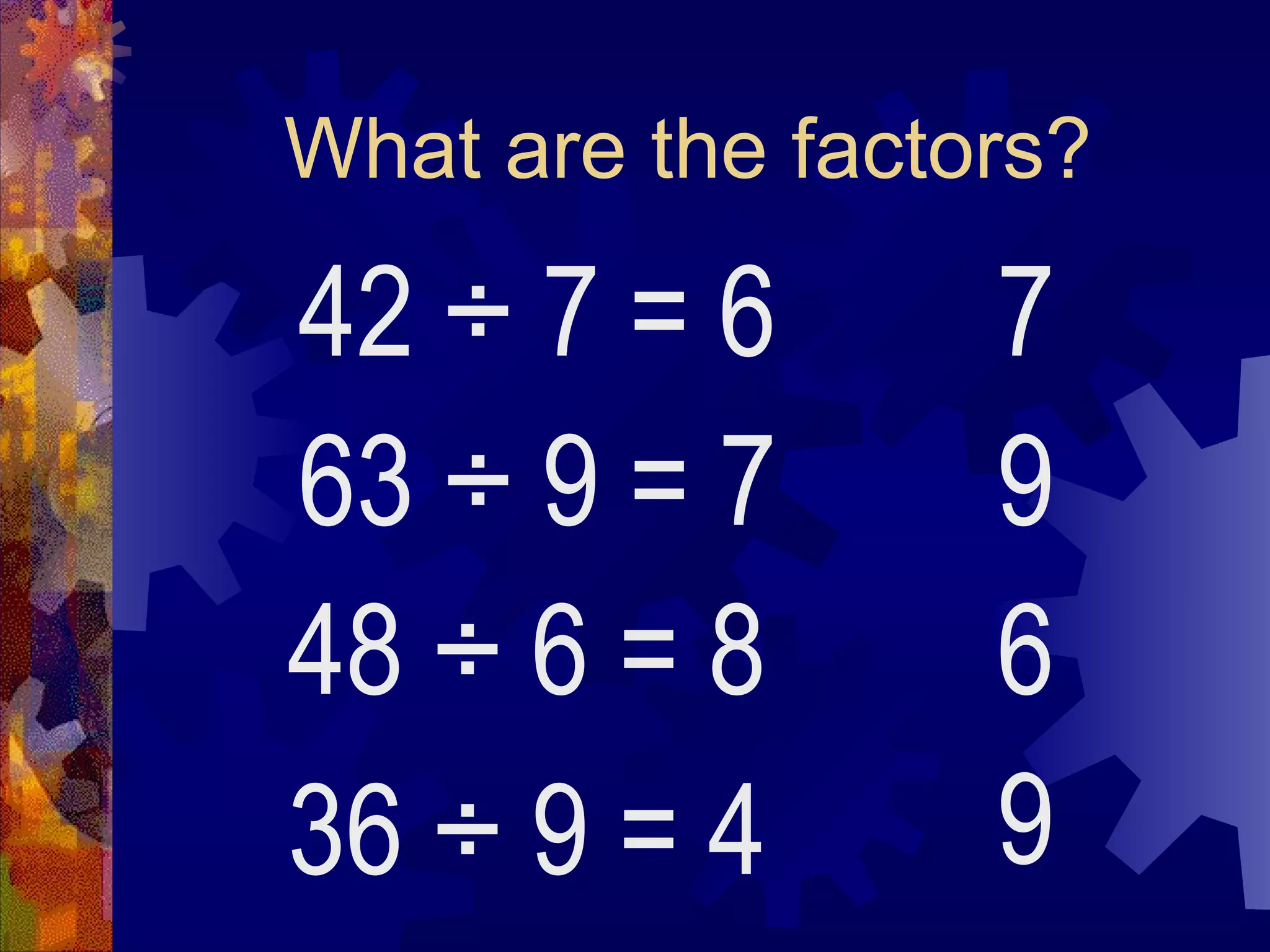
What are the factors?
42 ÷ 7 = 6
63 ÷ 9 = 7
48 ÷ 6 = 8
36 ÷ 9 = 4
7
9
6
9
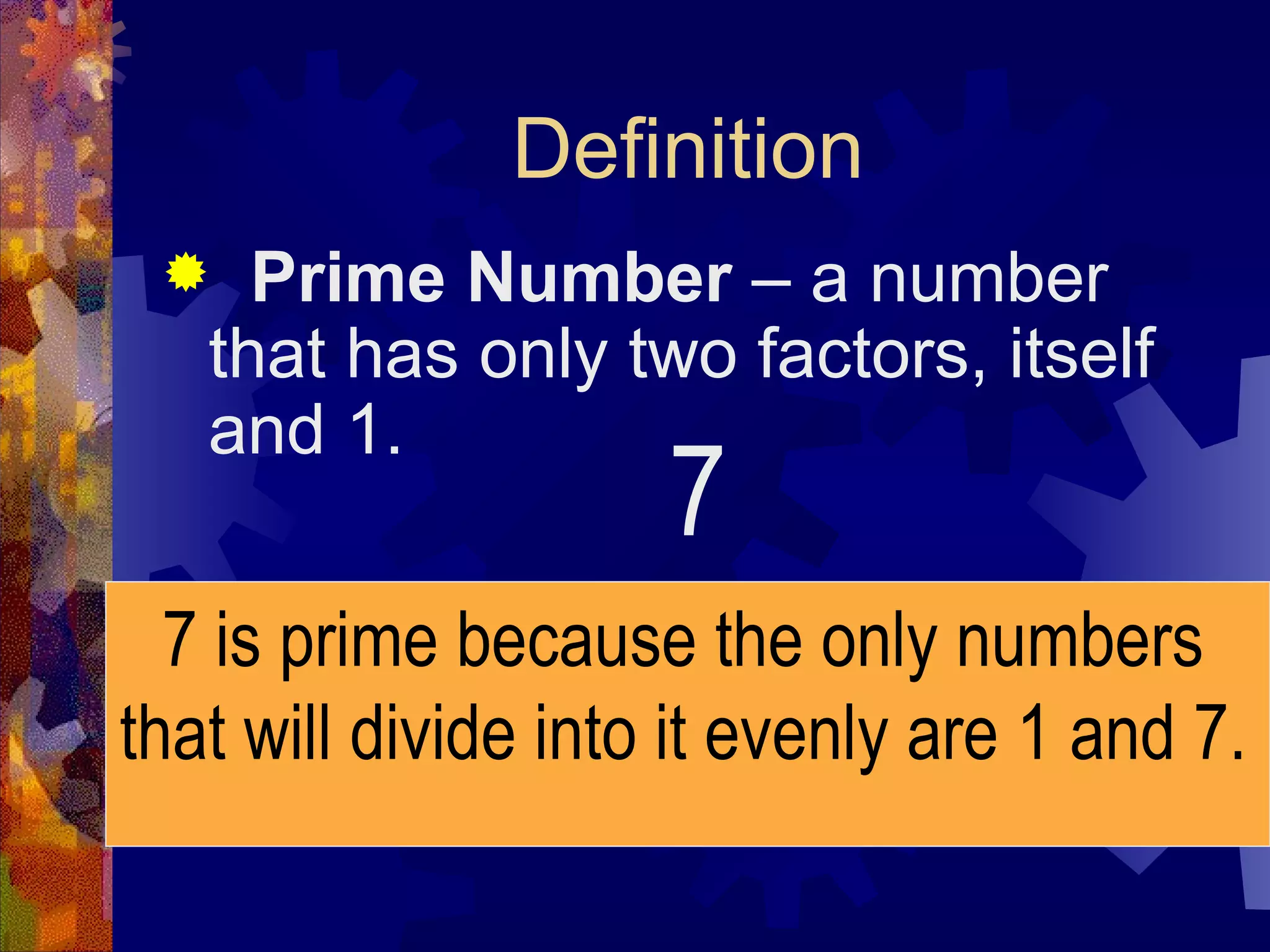
Definition
 Prime Number – a number
that has only two factors, itself
and 1.
7
7 is prime because the only numbers
that will divide into it evenly are 1 and 7.
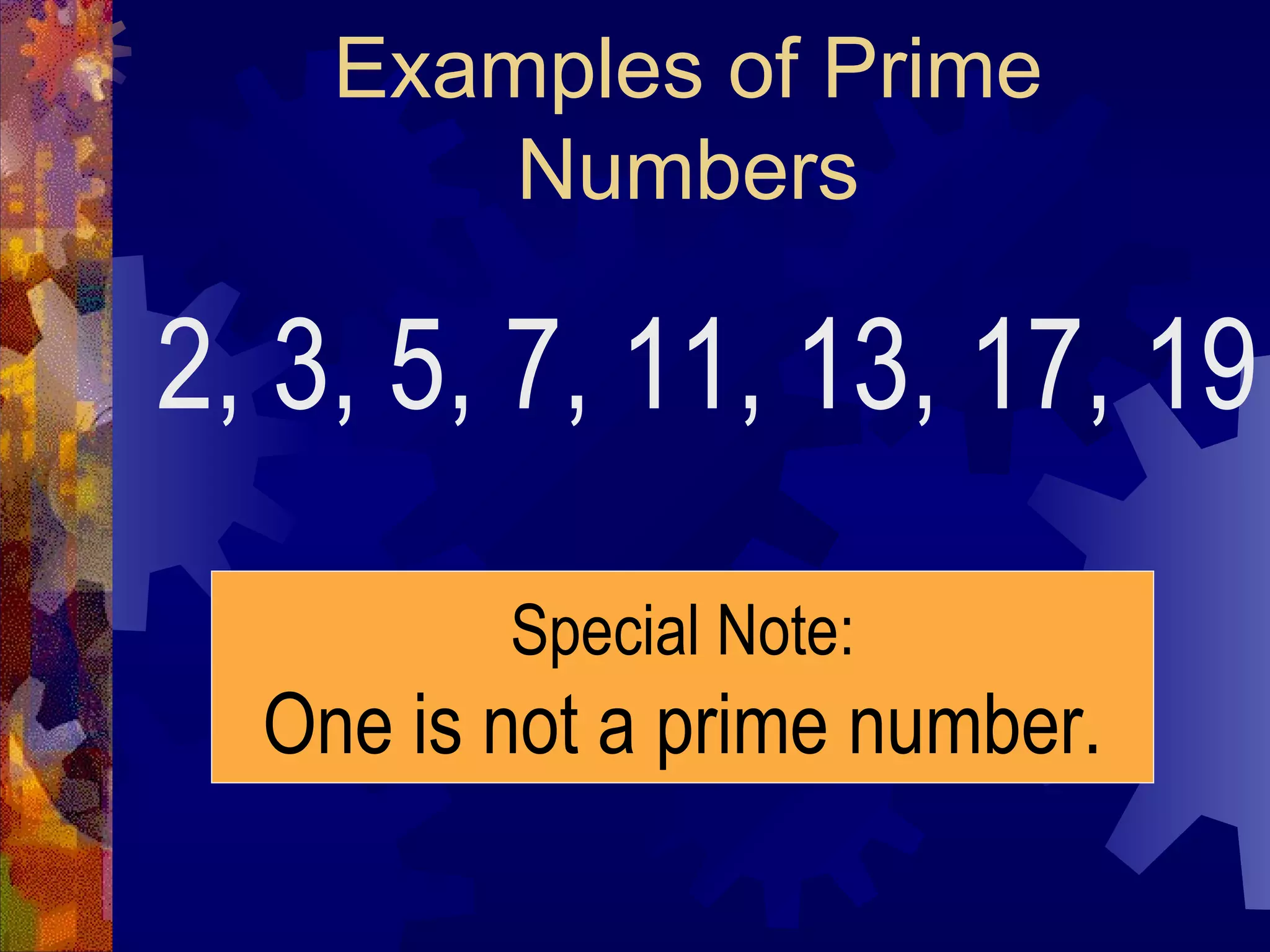
Examples of Prime
Numbers
2, 3, 5, 7, 11, 13, 17, 19
Special Note:
One is not a prime number.
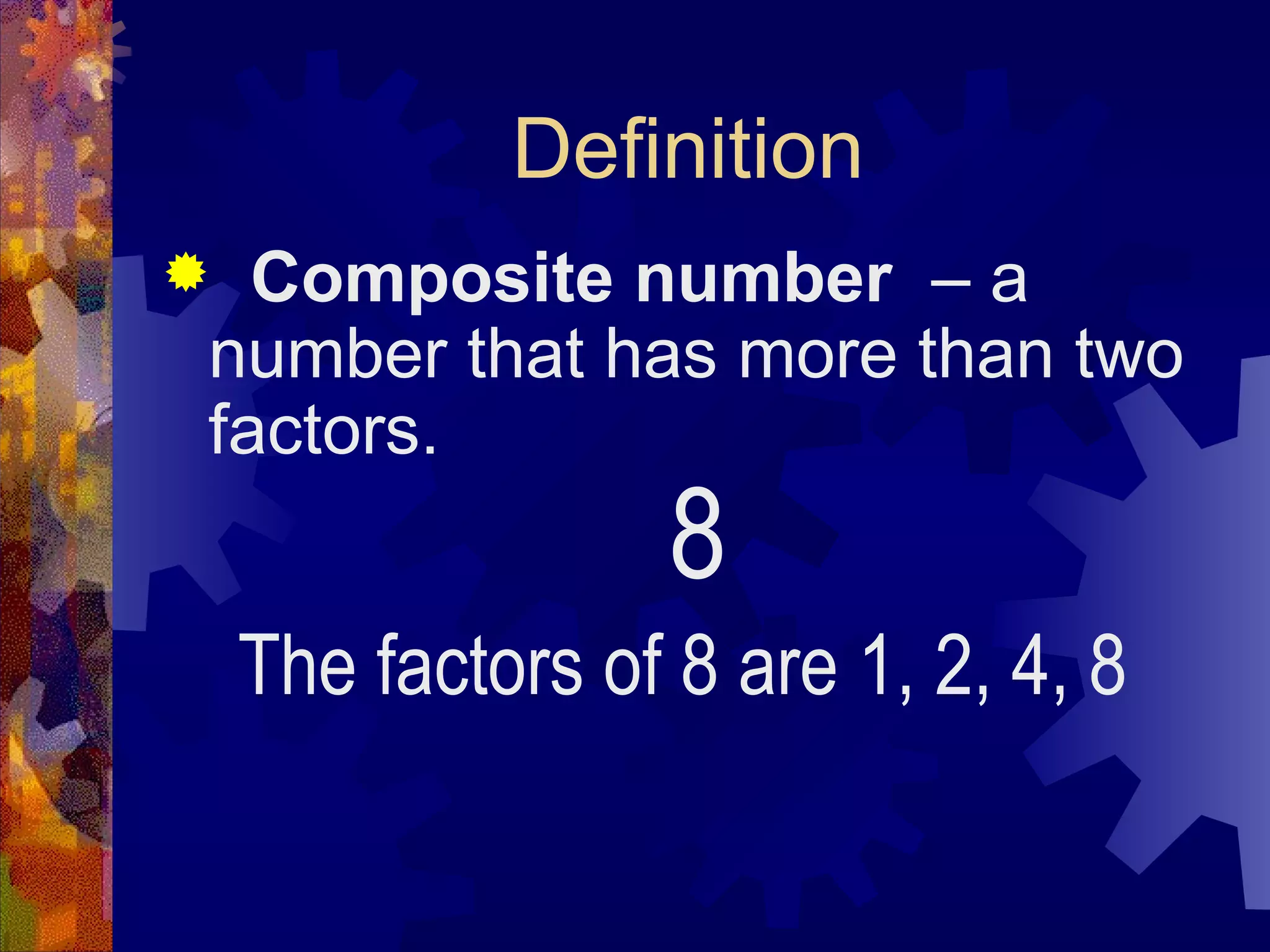
Definition
 Composite number – a
number that has more than two
factors.
8
The factors of 8 are 1, 2, 4, 8
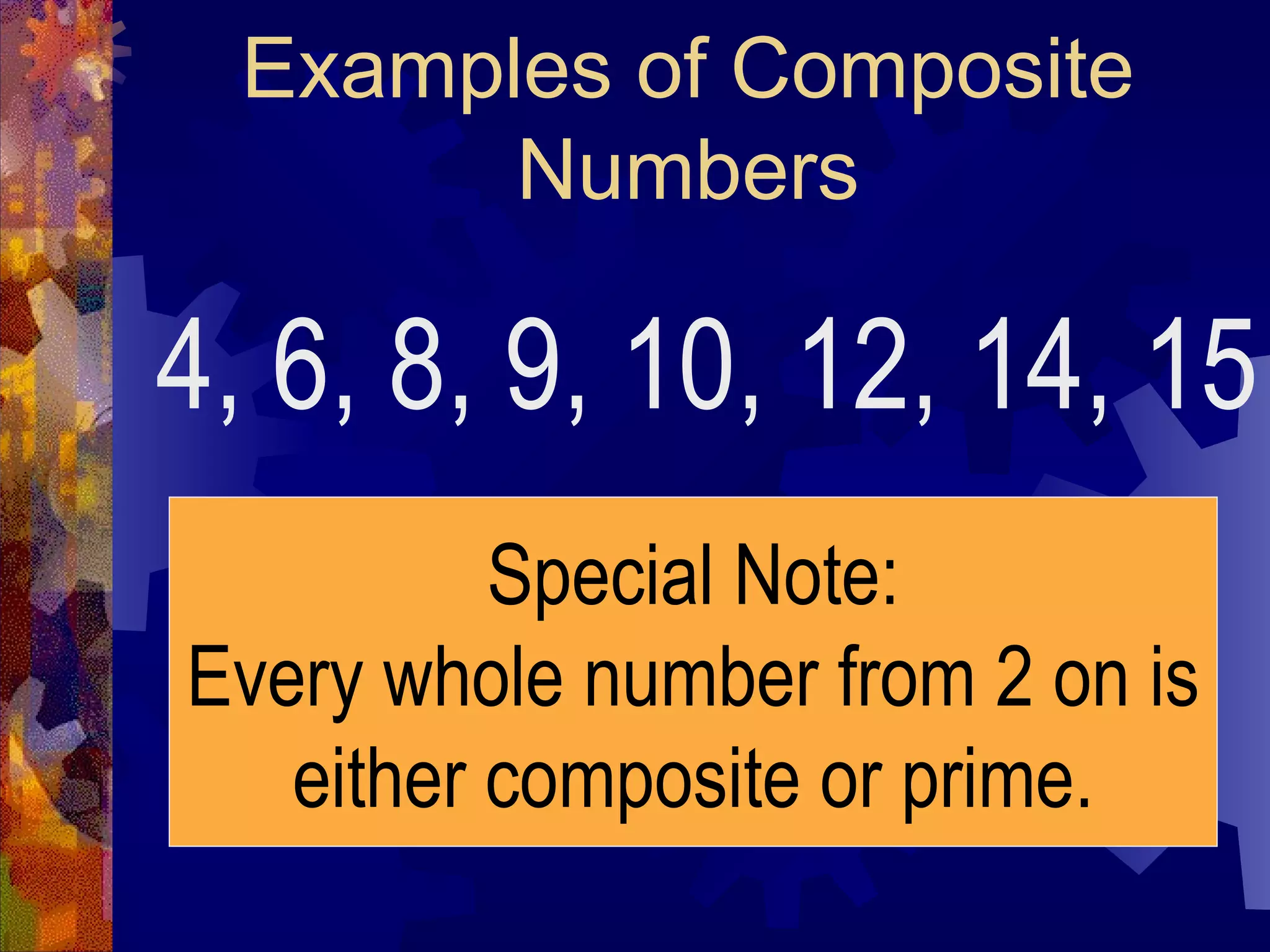
Examples of Composite
Numbers
4, 6, 8, 9, 10, 12, 14, 15
Special Note:
Every whole number from 2 on is
either composite or prime.
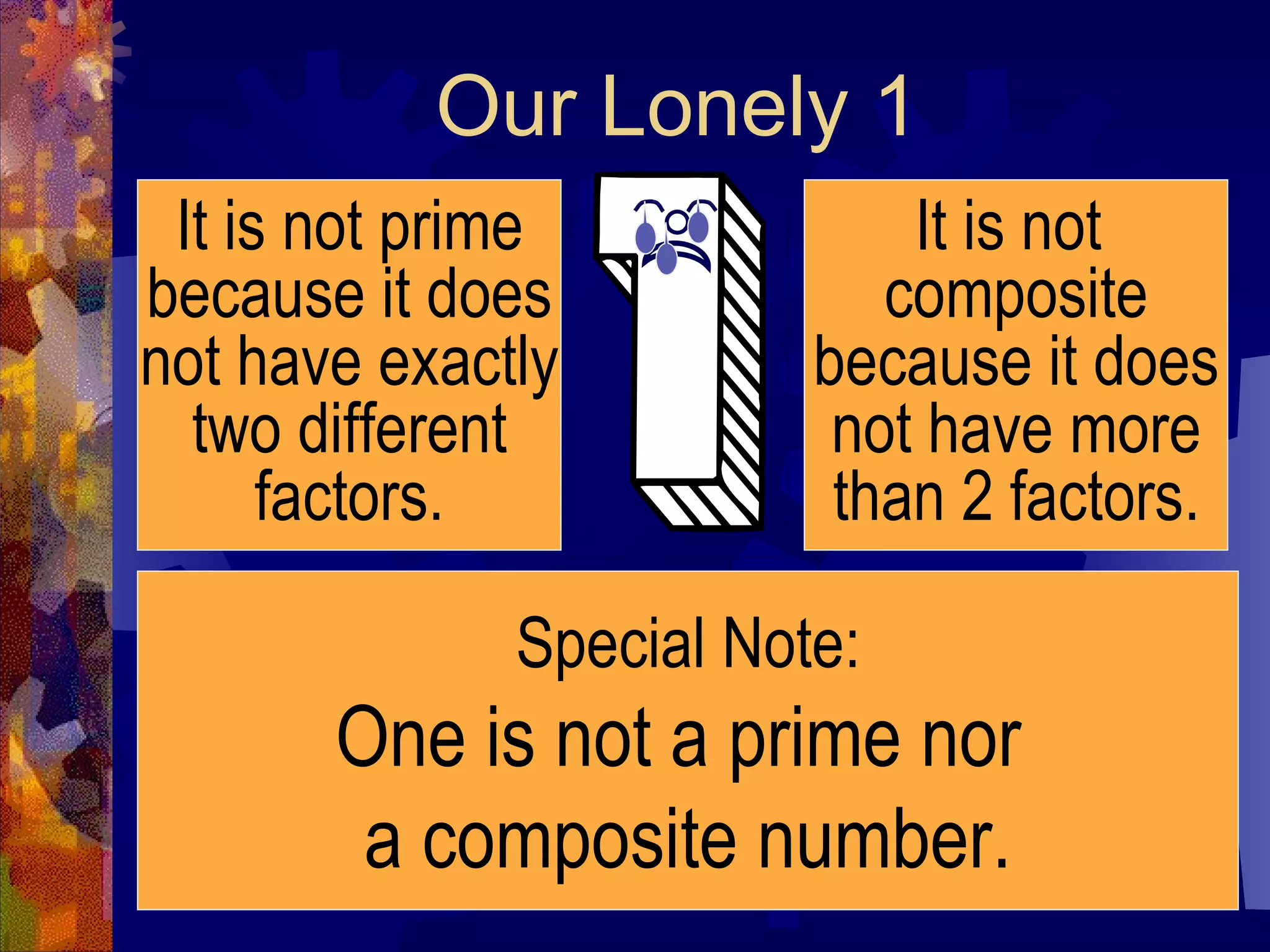
Our Lonely 1
Special Note:
One is not a prime nor
a composite number.
It is not prime
because it does
not have exactly
two different
factors.
It is not
composite
because it does
not have more
than 2 factors.
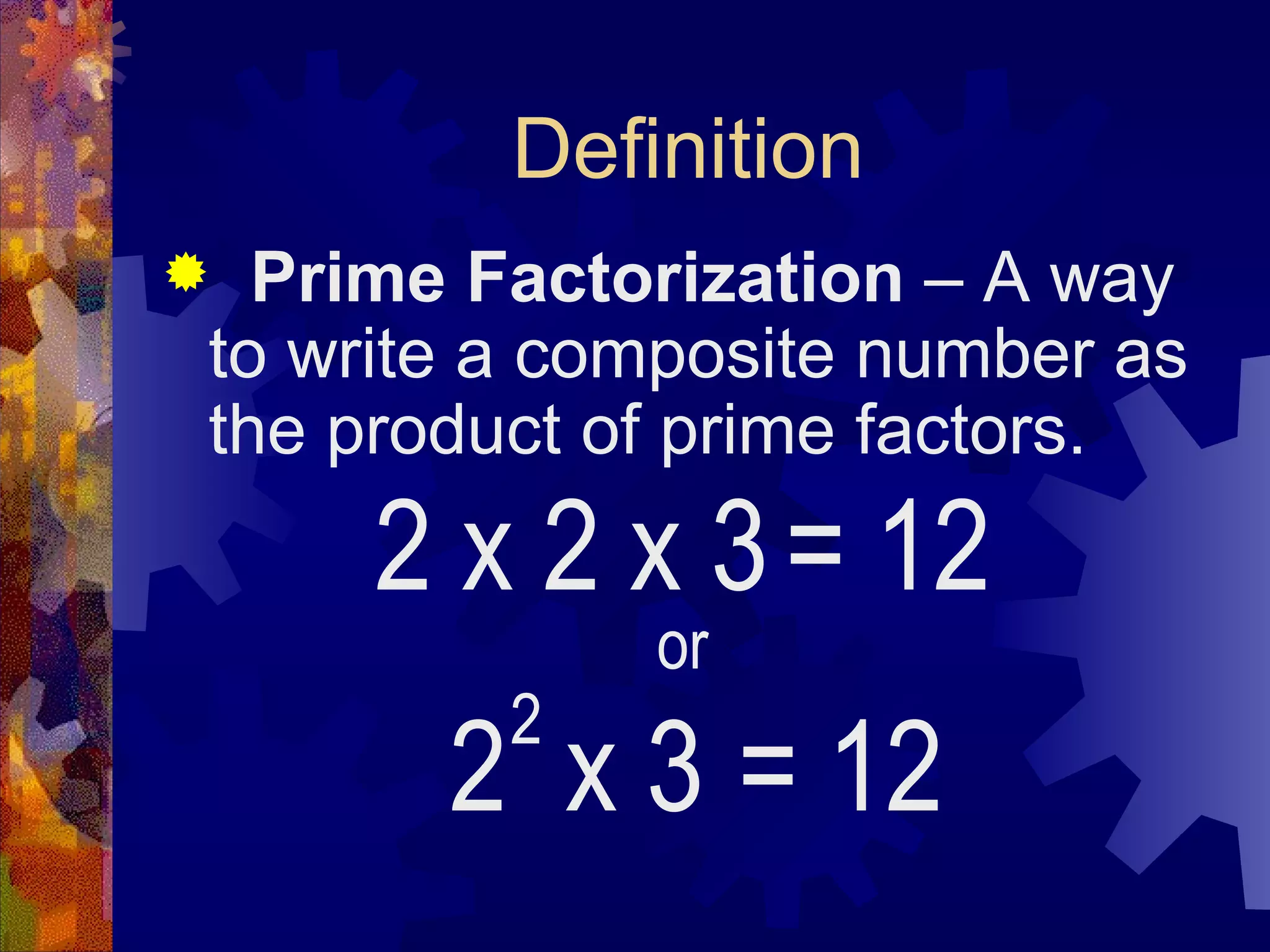
Definition
 Prime Factorization – A way
to write a composite number as
the product of prime factors.
2 x 2 x 3= 12
or
2 x 3 = 12
2
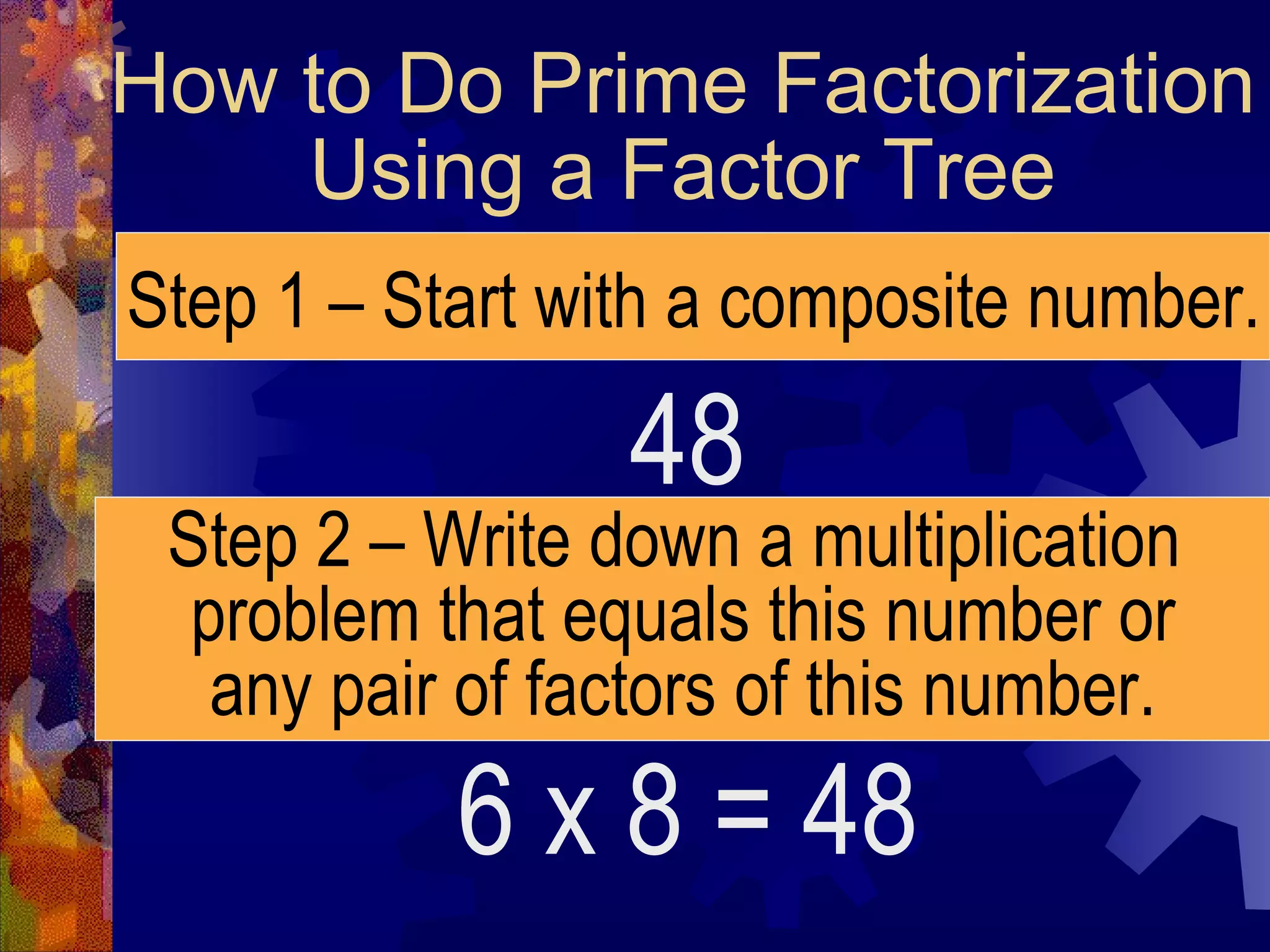
How to Do Prime Factorization
Using a Factor Tree
48
Step 1 – Start with a composite number.
Step 2 – Write down a multiplication
problem that equals this number or
any pair of factors of this number.
6 x 8 = 48
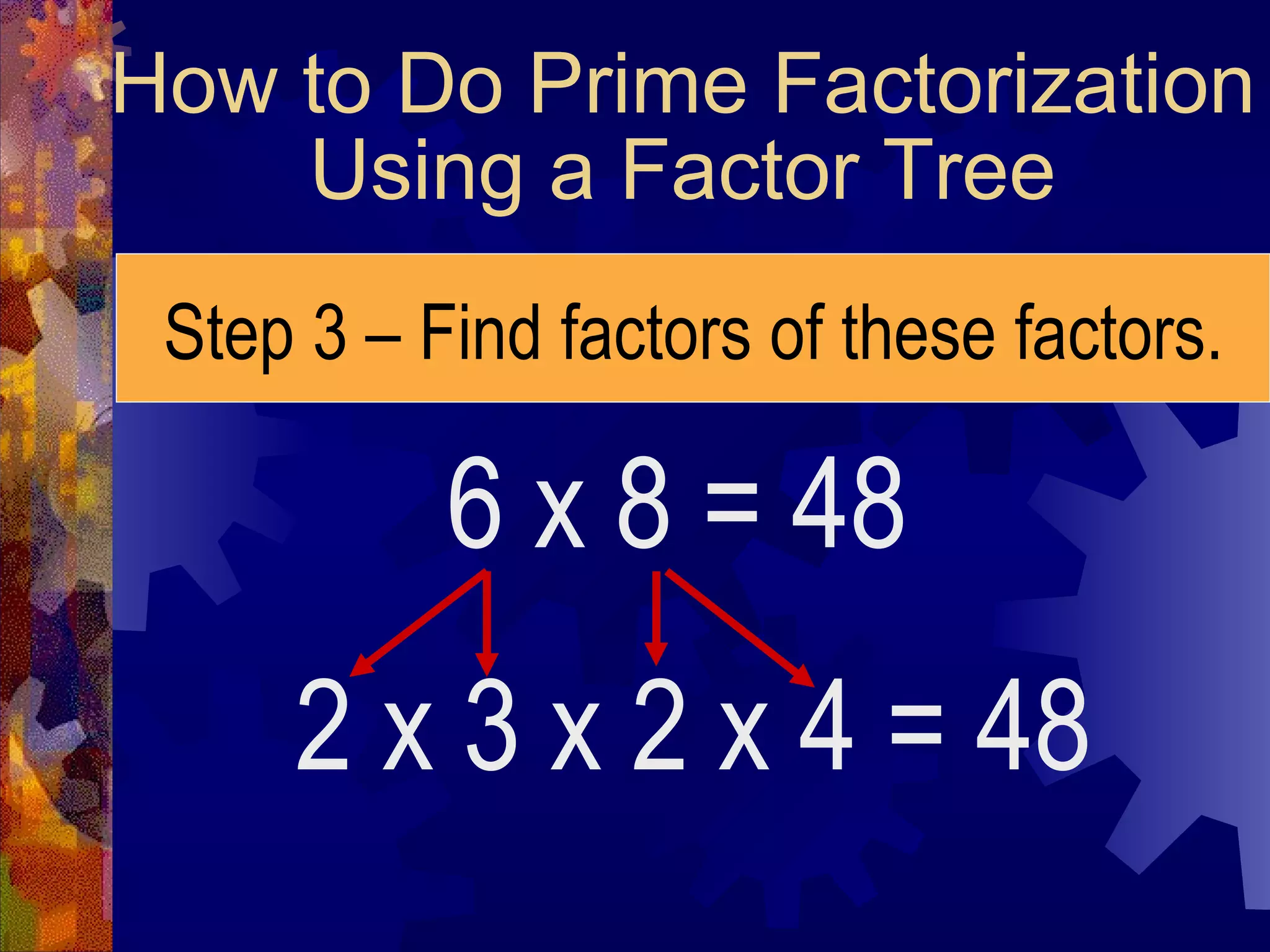
How to Do Prime Factorization
Using a Factor Tree
Step 3 – Find factors of these factors.
6 x 8 = 48
2 x 3 x 2 x 4 = 48
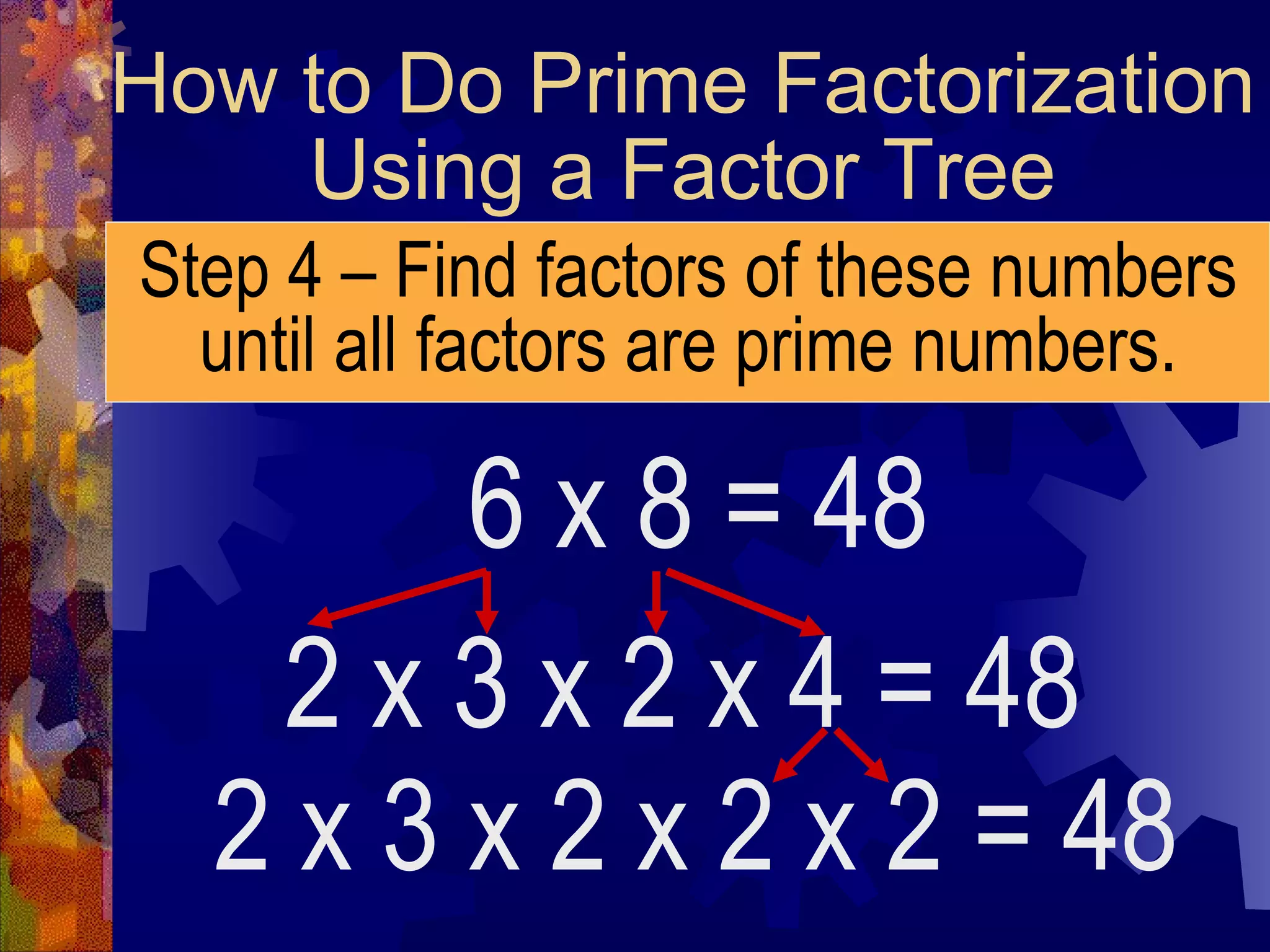
How to Do Prime Factorization
Using a Factor Tree
Step 4 – Find factors of these numbers
until all factors are prime numbers.
6 x 8 = 48
2 x 3 x 2 x 4 = 48
2 x 3 x 2 x 2 x 2 = 48
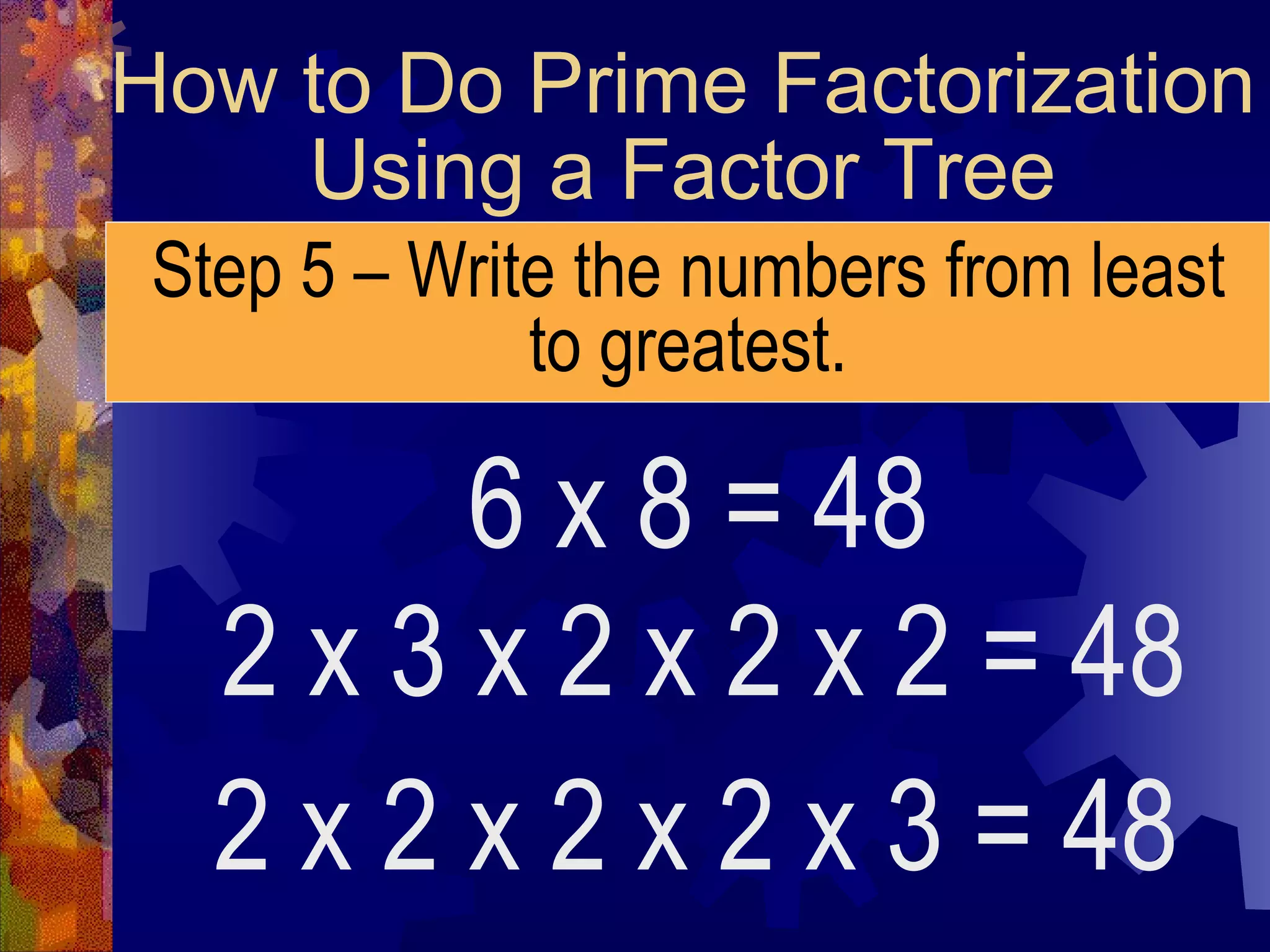
How to Do Prime Factorization
Using a Factor Tree
Step 5 – Write the numbers from least
to greatest.
6 x 8 = 48
2 x 3 x 2 x 2 x 2 = 48
2 x 2 x 2 x 2 x 3 = 48
How to Do Prime Factorization
Using a Factor Tree
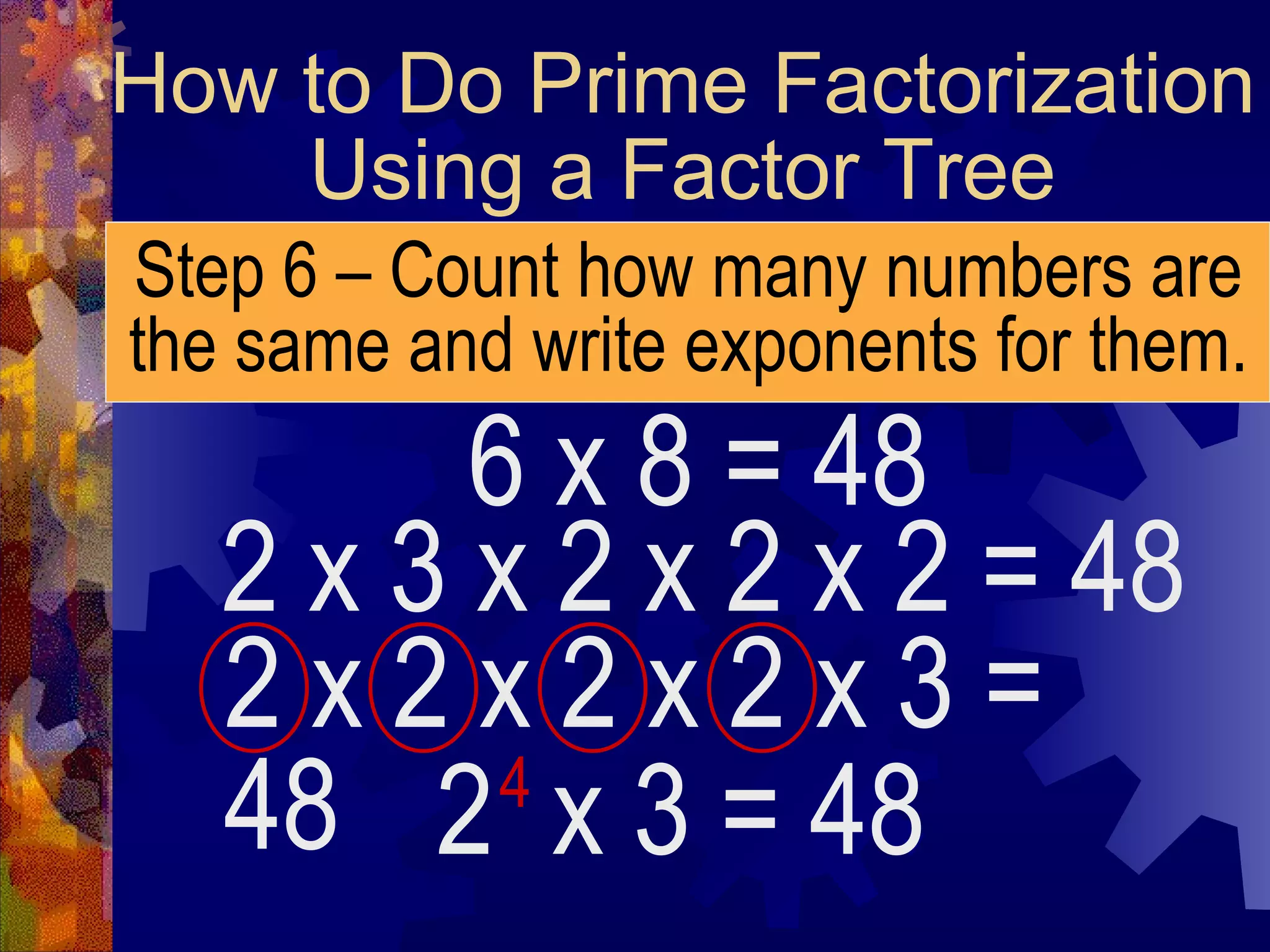
Step 6 – Count how many numbers are
the same and write exponents for them.
6 x 8 = 48
2 x 3 x 2 x 2 x 2 = 48
2 x 2 x 2 x 2 x 3 =
48 2 x 3 = 48
4
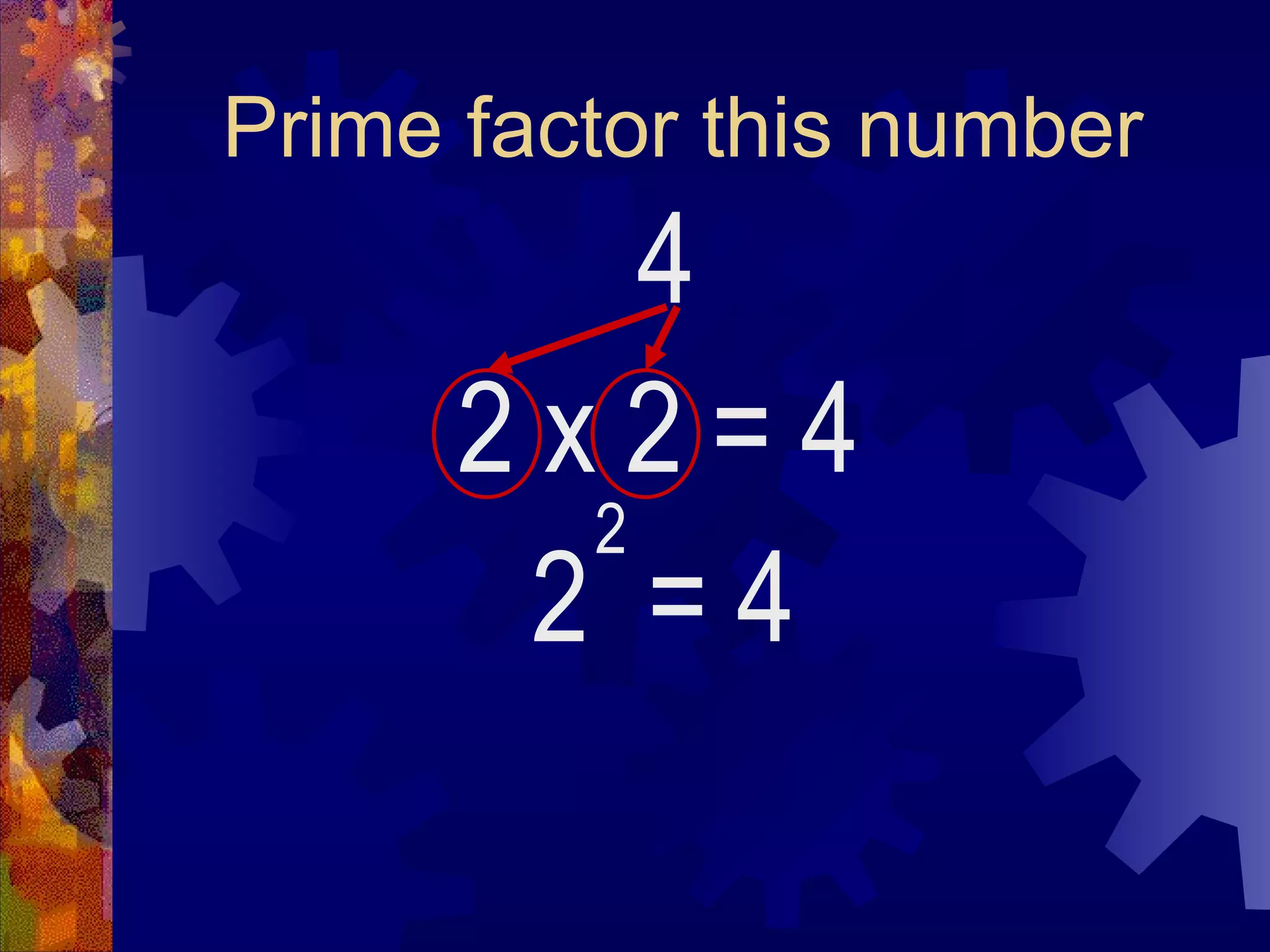
Prime factor this number
4
2 x 2
2 = 4
2
= 4
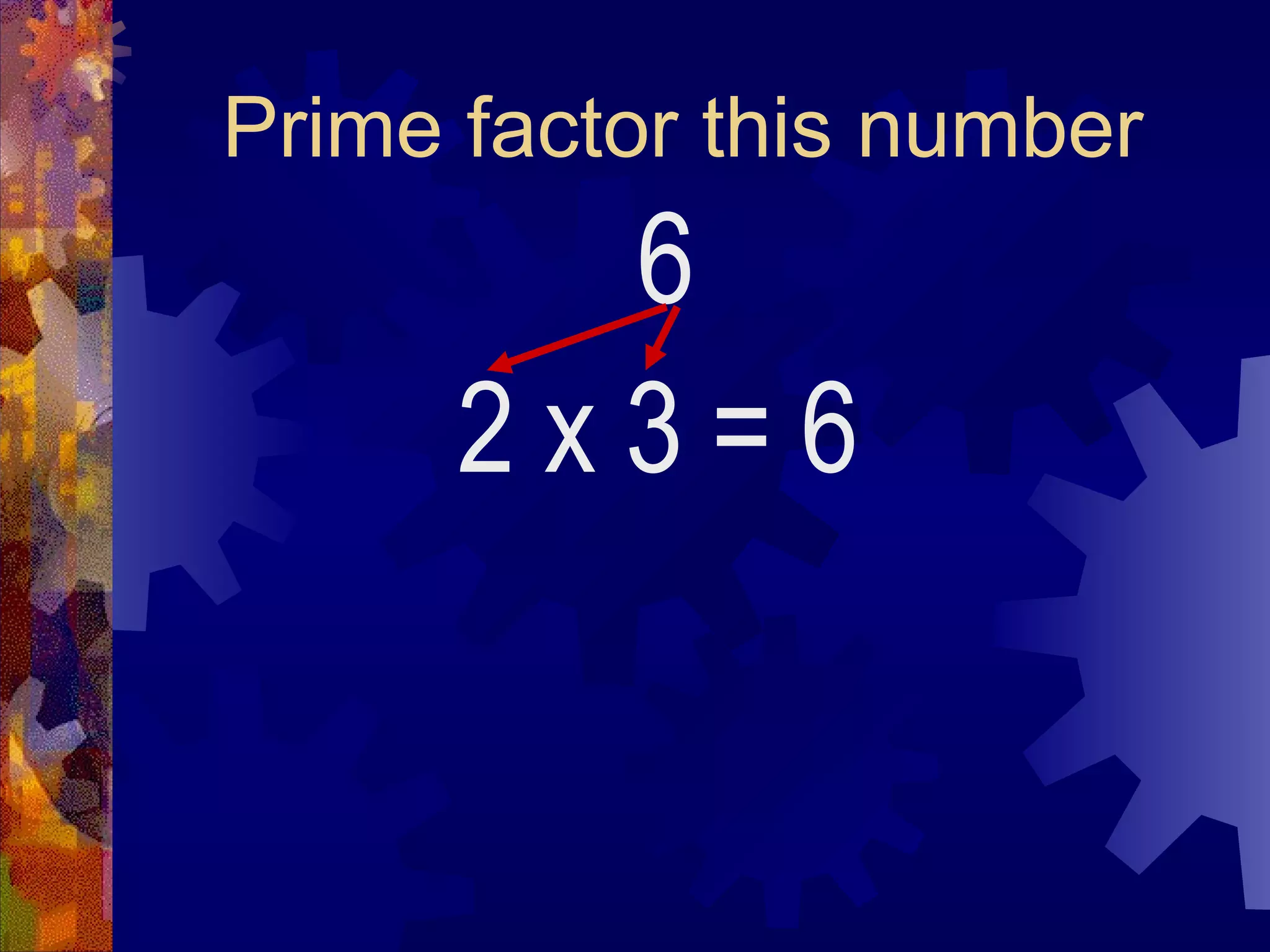
Prime factor this number
6
2 x 3 = 6
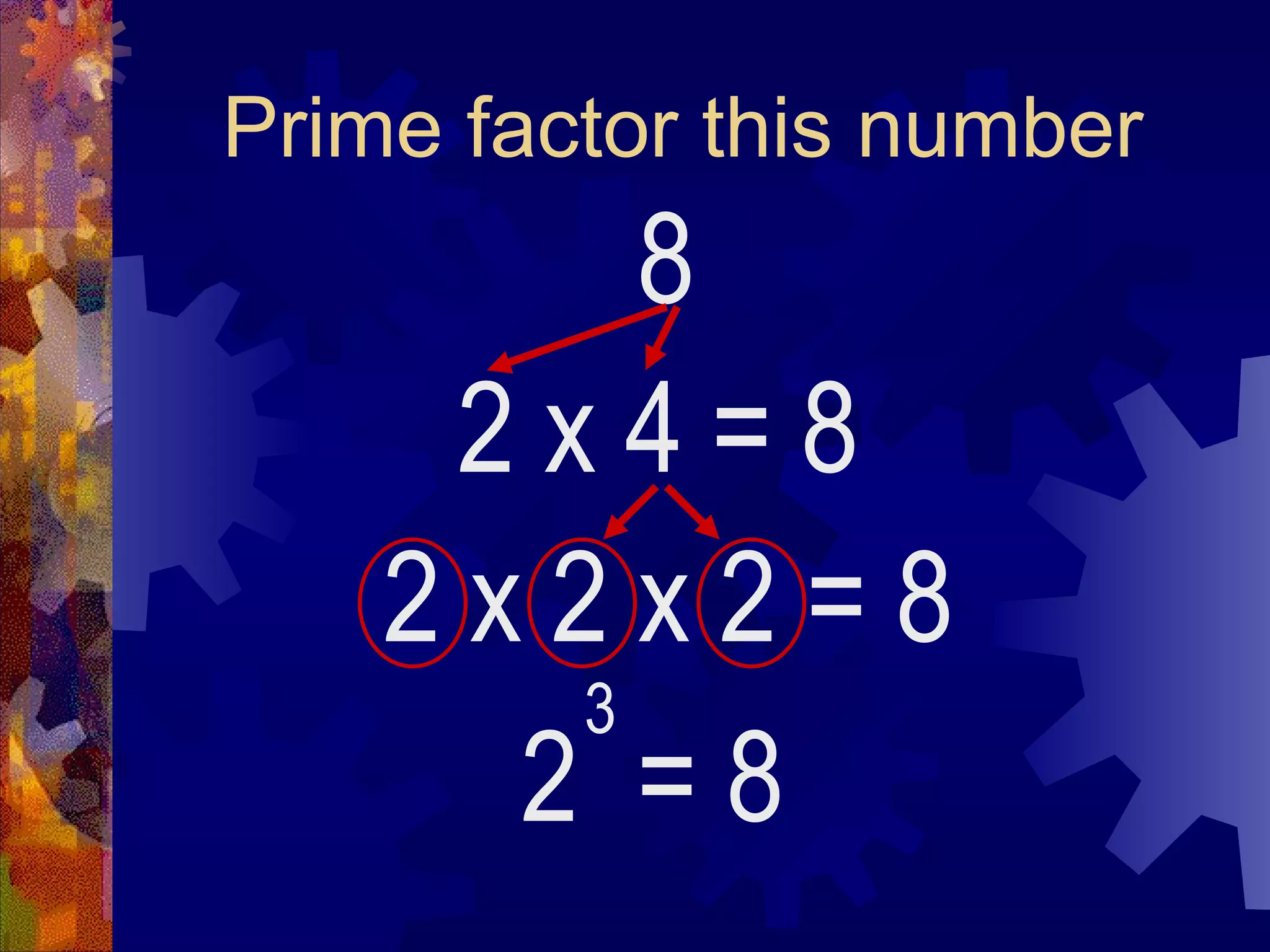
Prime factor this number
8
2 x 4
2 = 8
3
= 8
2 x 2 x 2 = 8
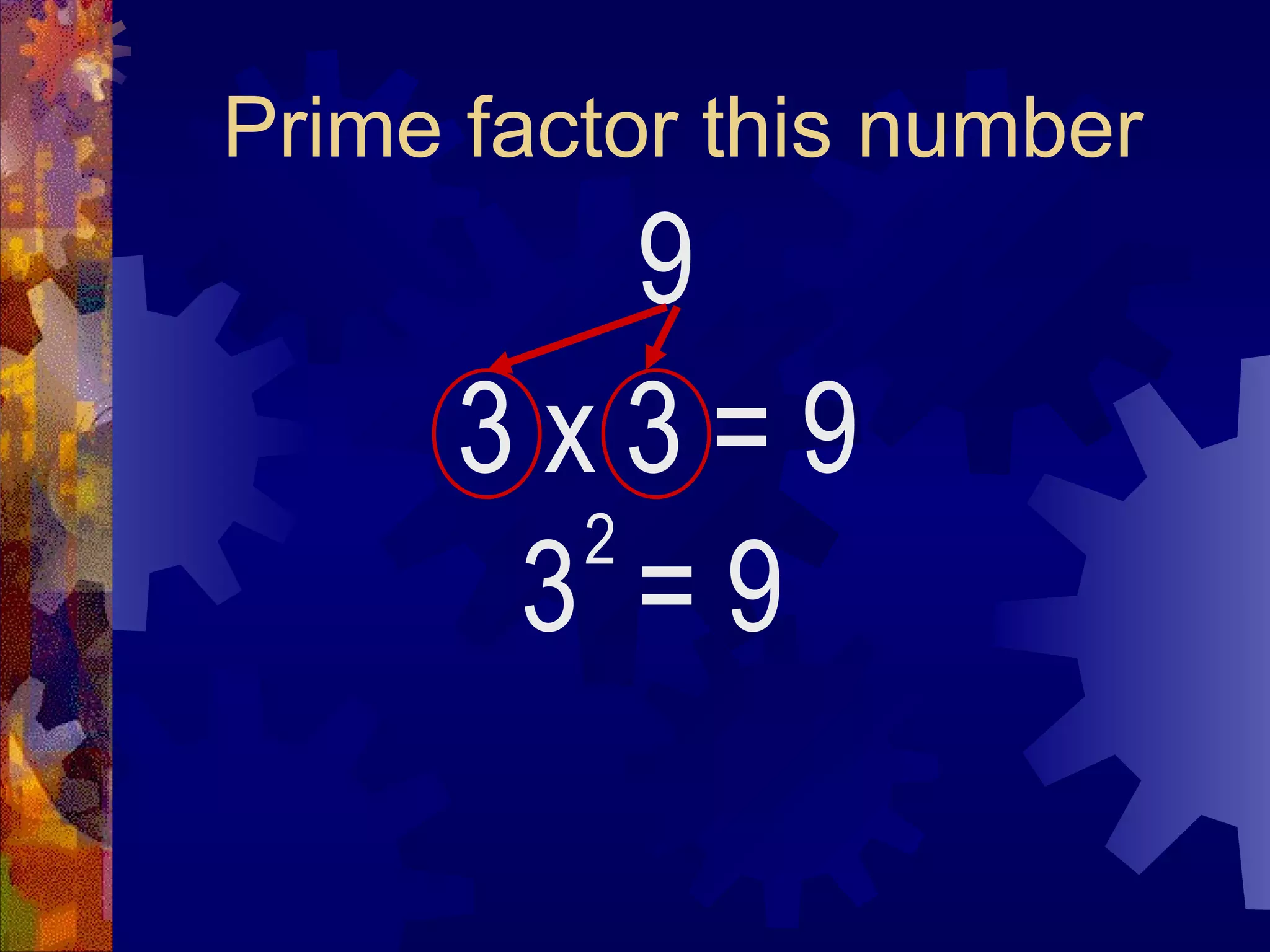
Prime factor this number
9
3 x 3 = 9
3 = 9
2
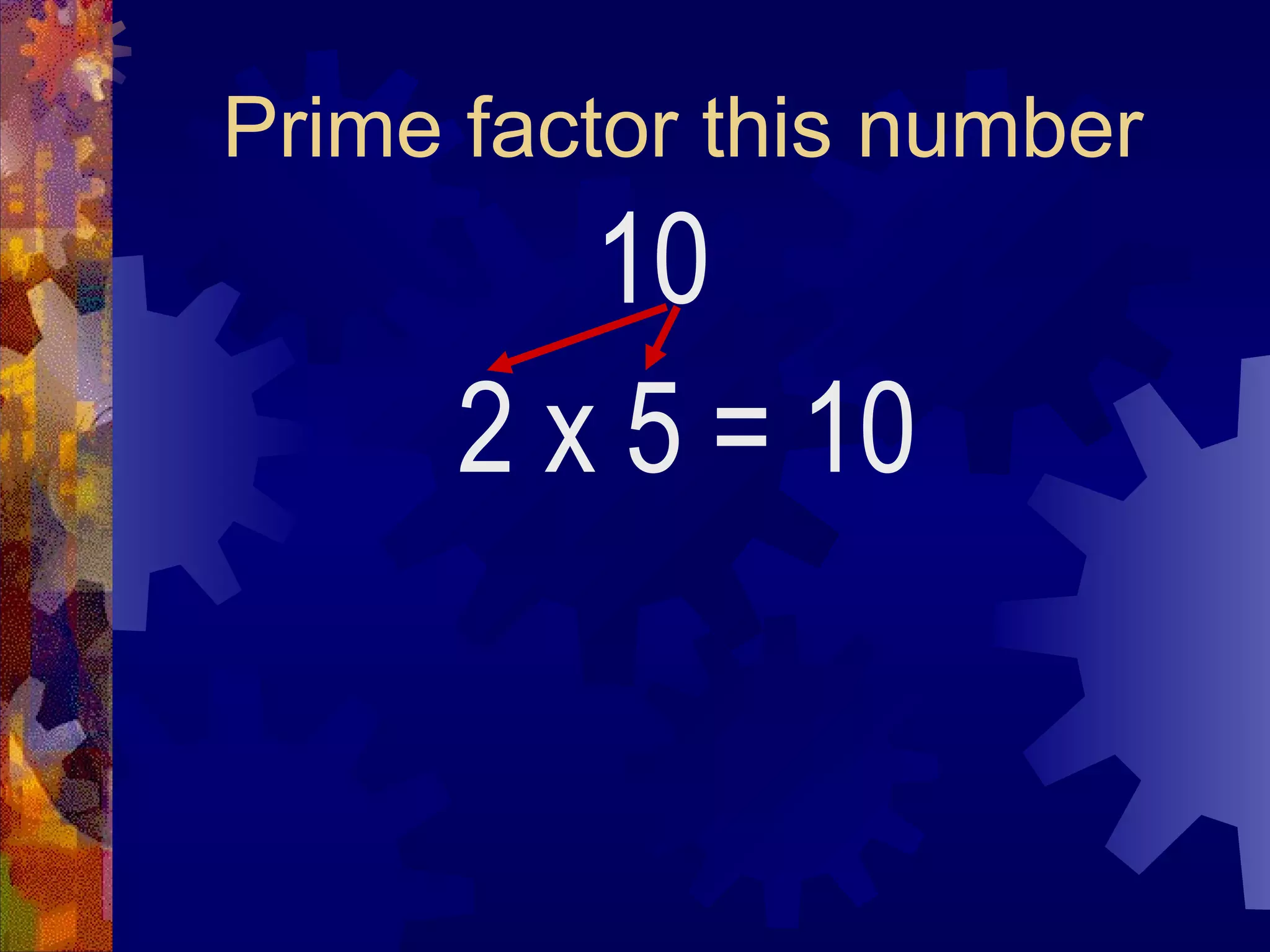
Prime factor this number
10
2 x 5 = 10
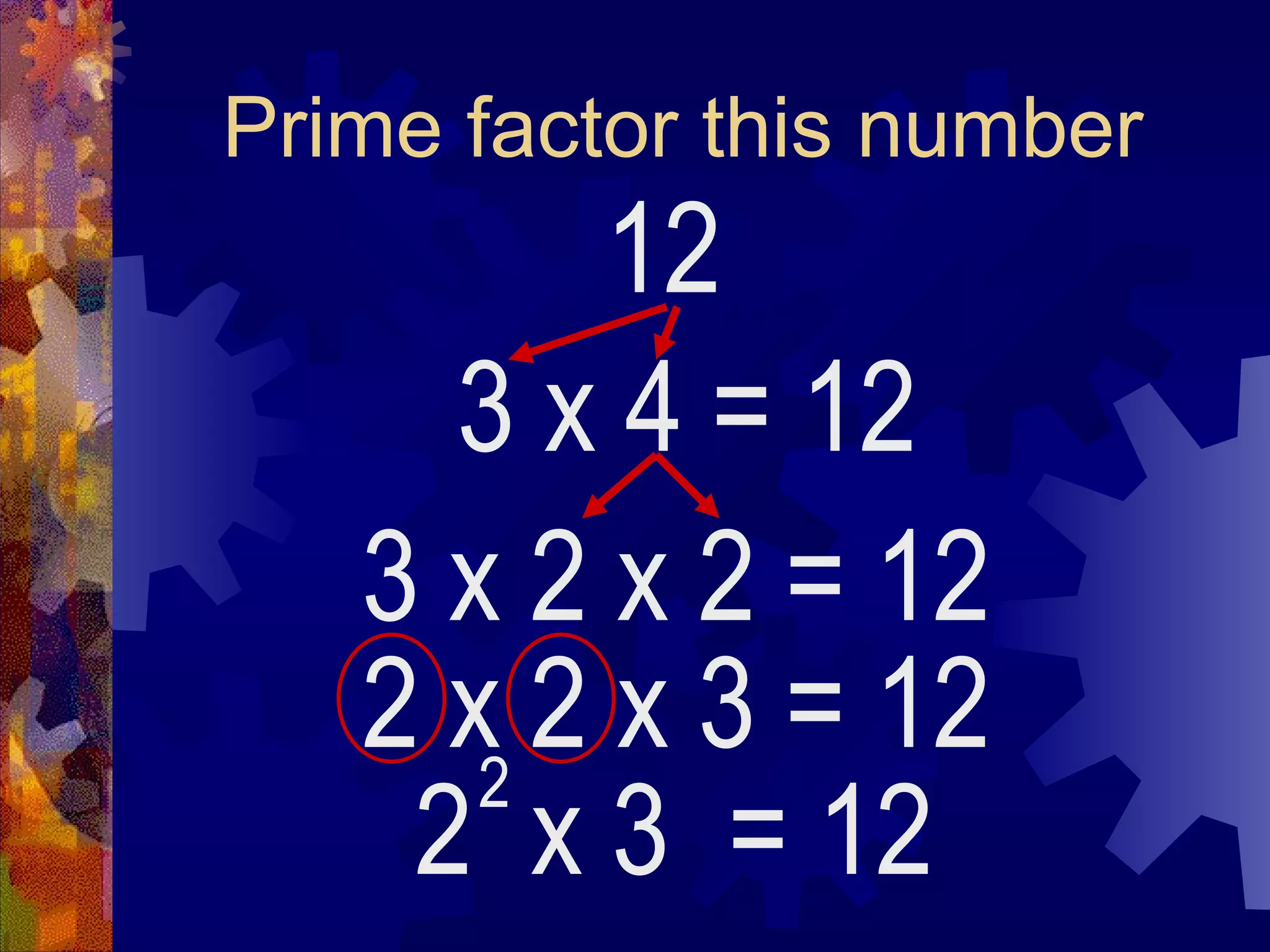
Prime factor this number
12
3 x 4
2 x 3 = 12
2
= 12
3 x 2 x 2 = 12
2 x 2 x 3 = 12
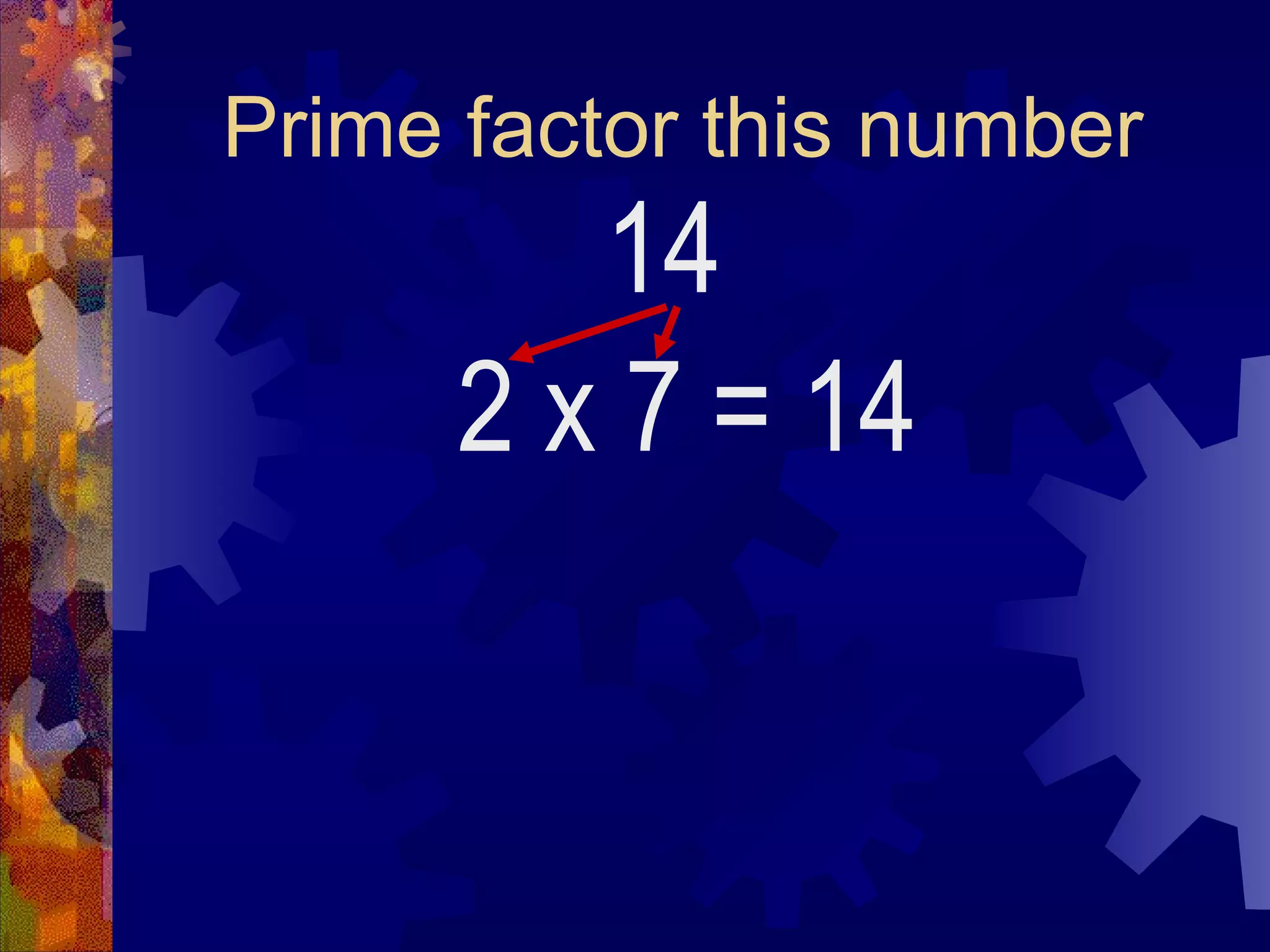
Prime factor this number
14
2 x 7 = 14
Prime factor this number
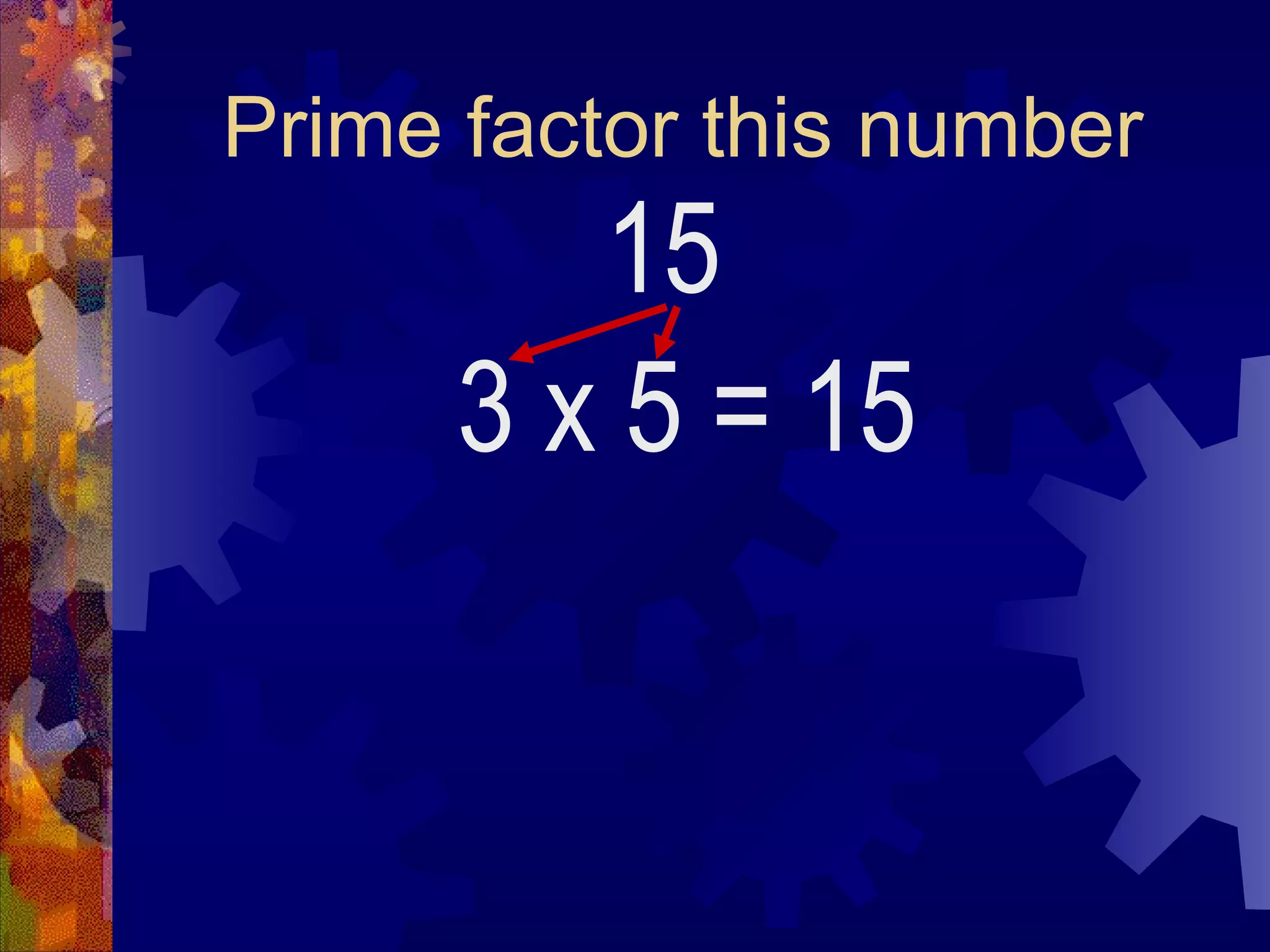
15
3 x 5 = 15
Prime factor this number
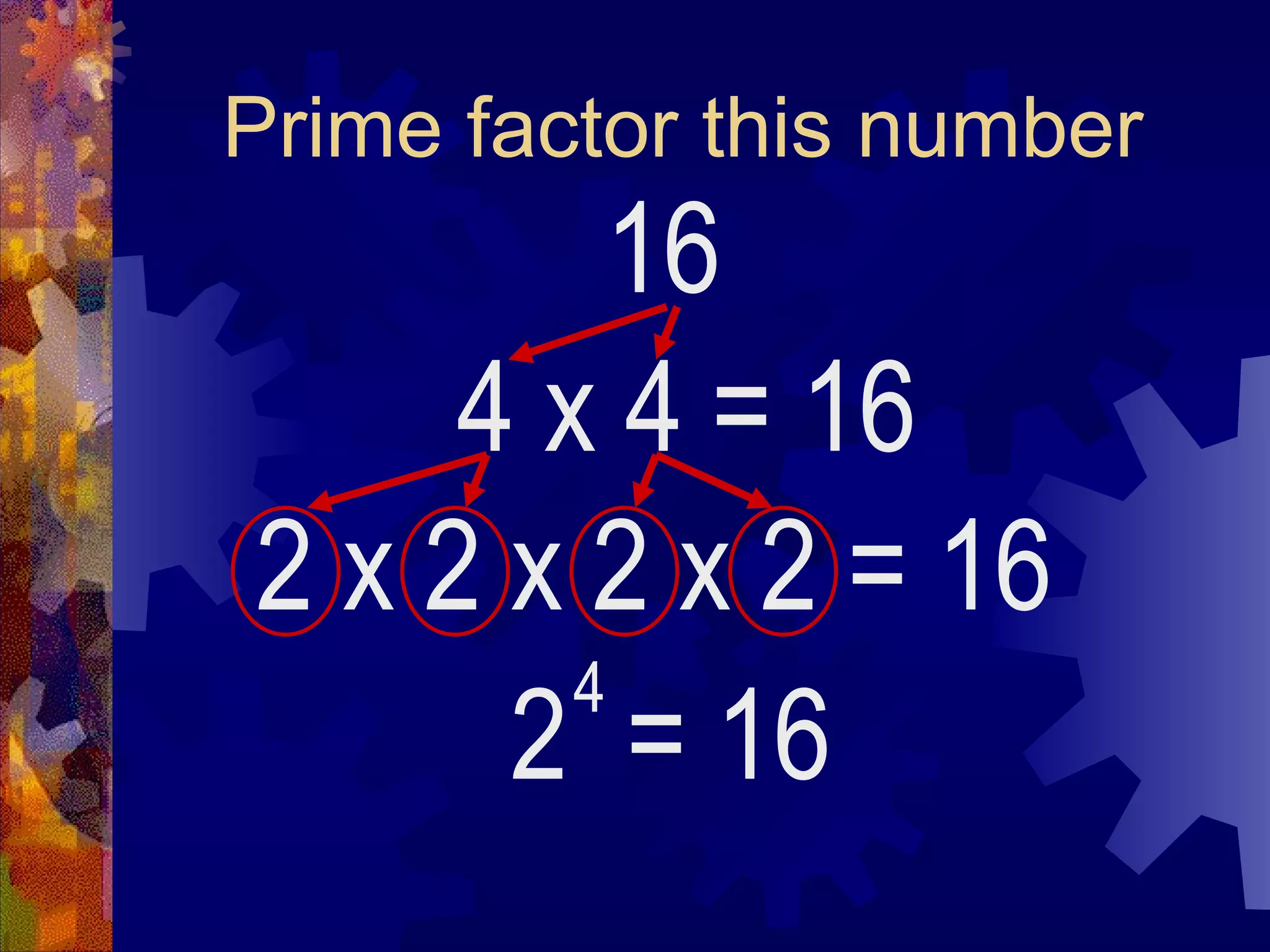
16
4 x 4
2 = 16
4
= 16
2 x 2 x 2 x 2 = 16
Prime factor this number
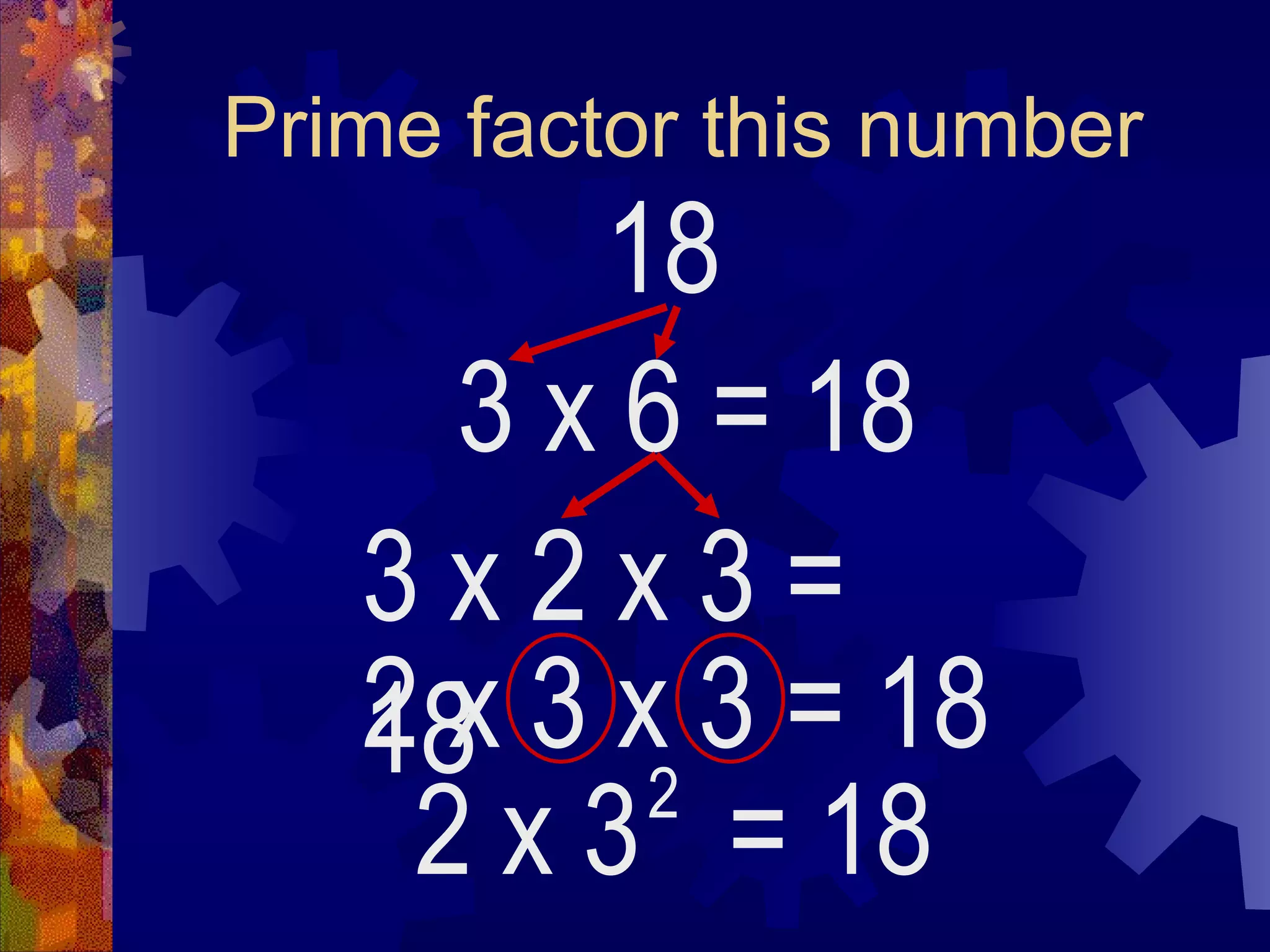
18
3 x 6
2 x 3 = 18
2
= 18
3 x 2 x 3 =
18
2 x 3 x 3 = 18
Prime factor this number
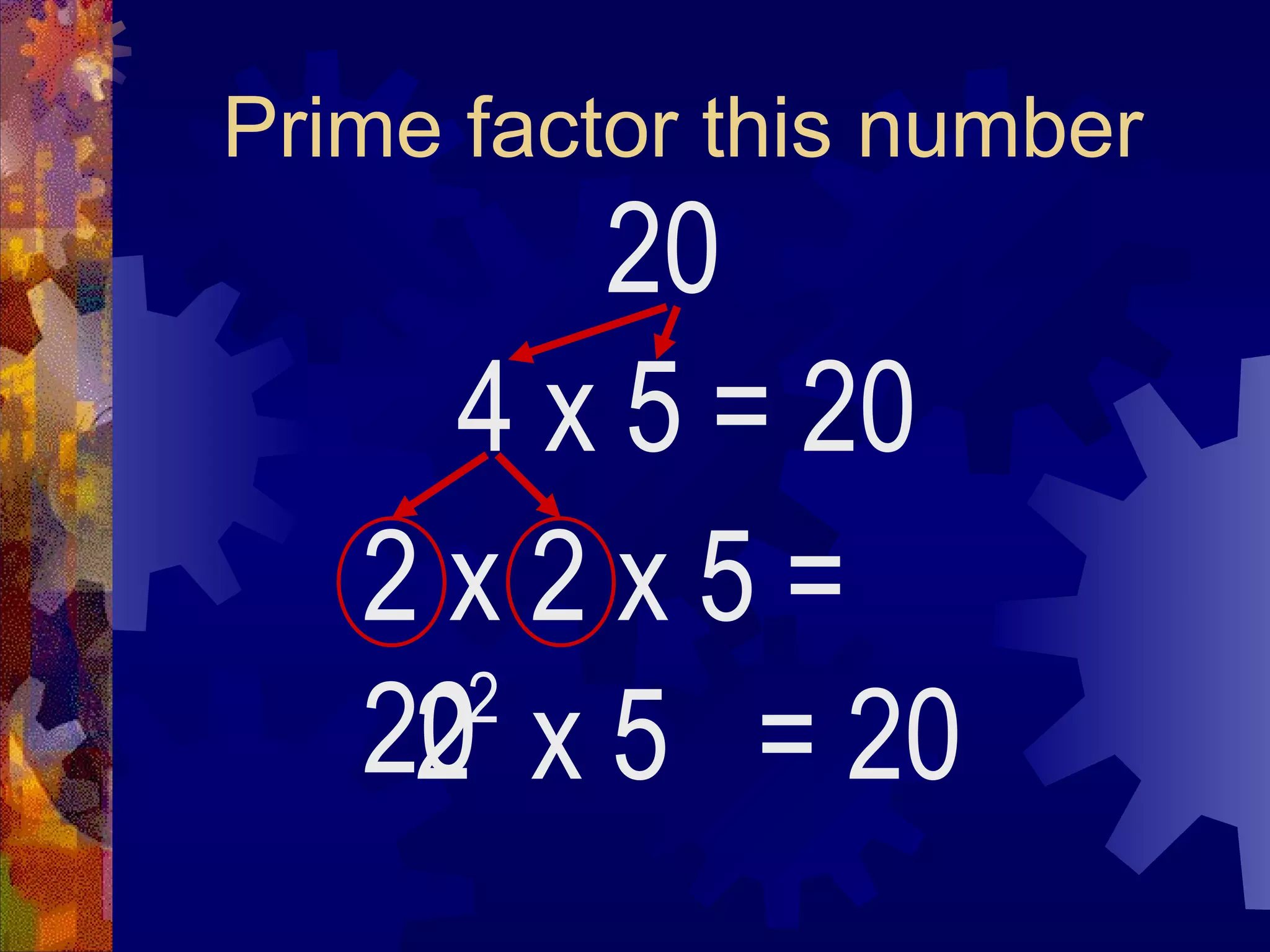
20
4 x 5
2 x 5 = 20
2
= 20
2 x 2 x 5 =
20
Prime factor this number
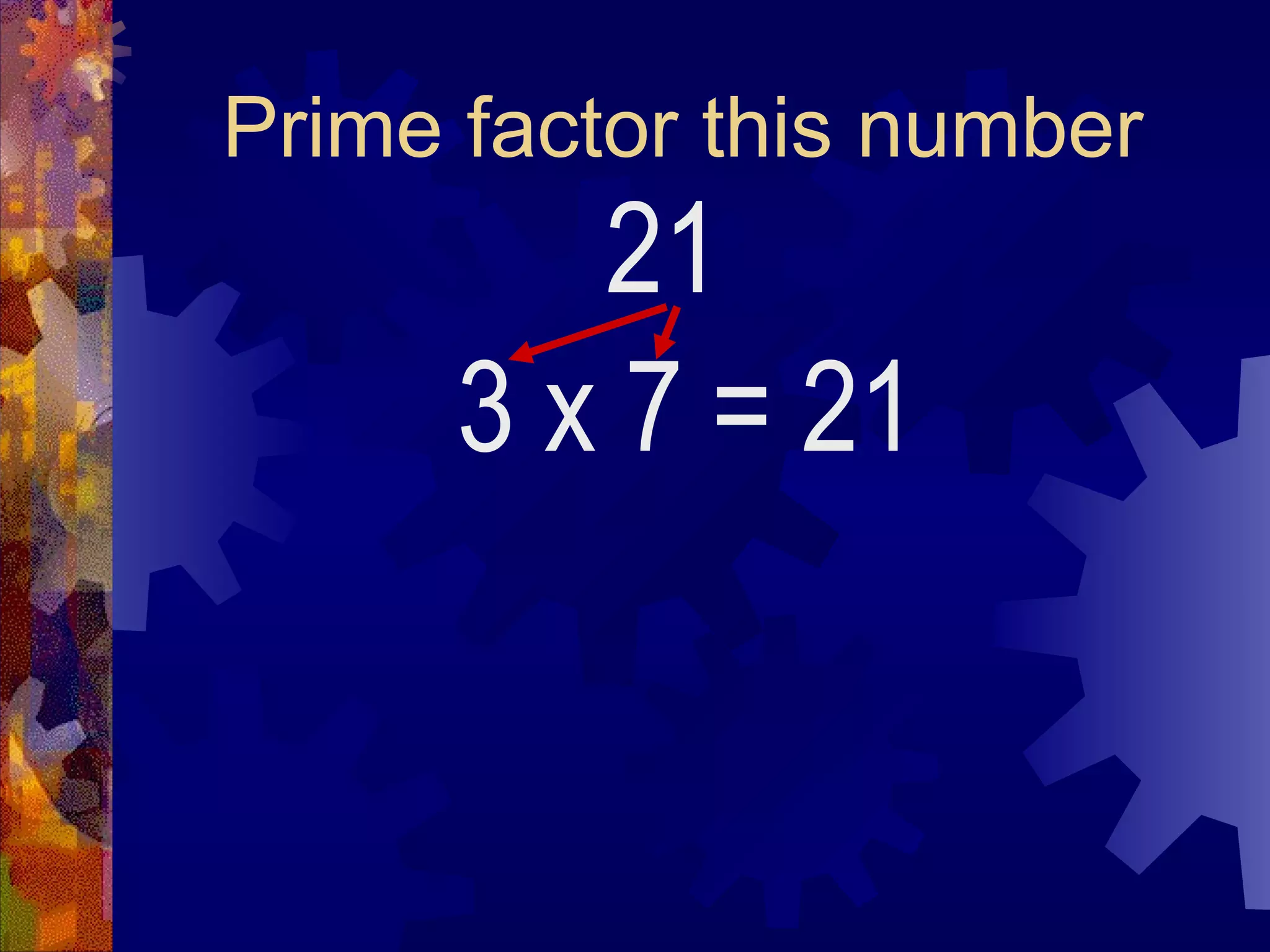
21
3 x 7 = 21
Prime factor this number
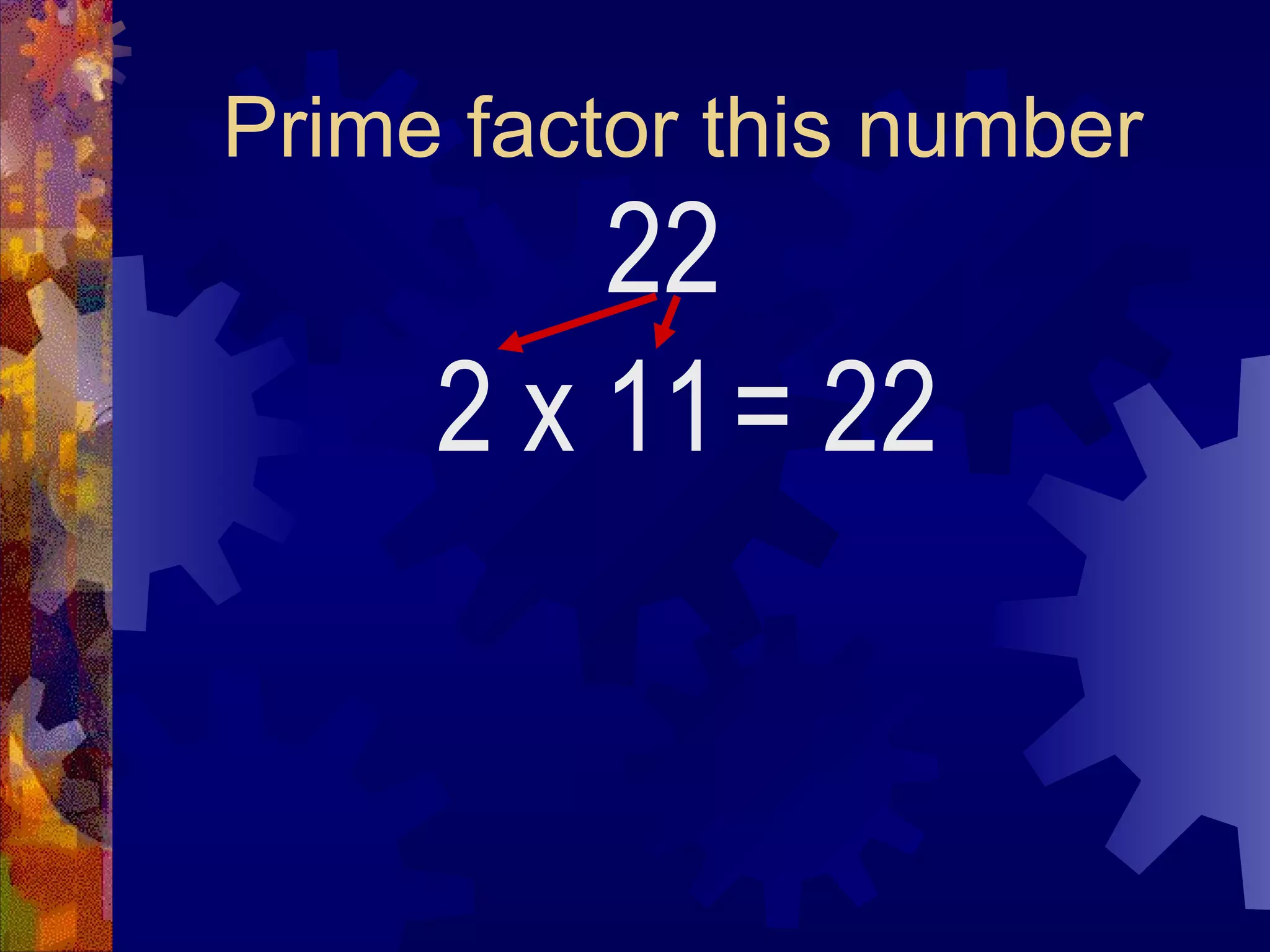
22
2 x 11= 22

Factors, primes and composite

  • 1.
  • 2.
    Definition  Product –An answer to a multiplication problem. 7 x 8 = 56 Product
  • 3.
    Definition  Factor –a number that is multiplied by another to give a product. 7 x 8 = 56 Factors
  • 4.
    Definition  Factor –a number that divides evenly into another. 56 ÷ 8 = 7 Factor
  • 5.
    What are thefactors? 6 x 7 = 42 7 x 9 = 63 8 x 6 = 48 4 x 9 = 36 6 & 7 7 & 9 8 & 6 4 & 9
  • 6.
    What are thefactors? 42 ÷ 7 = 6 63 ÷ 9 = 7 48 ÷ 6 = 8 36 ÷ 9 = 4 7 9 6 9
  • 7.
    Definition  Prime Number– a number that has only two factors, itself and 1. 7 7 is prime because the only numbers that will divide into it evenly are 1 and 7.
  • 8.
    Examples of Prime Numbers 2,3, 5, 7, 11, 13, 17, 19 Special Note: One is not a prime number.
  • 9.
    Definition  Composite number– a number that has more than two factors. 8 The factors of 8 are 1, 2, 4, 8
  • 10.
    Examples of Composite Numbers 4,6, 8, 9, 10, 12, 14, 15 Special Note: Every whole number from 2 on is either composite or prime.
  • 11.
    Our Lonely 1 SpecialNote: One is not a prime nor a composite number. It is not prime because it does not have exactly two different factors. It is not composite because it does not have more than 2 factors.
  • 12.
    Definition  Prime Factorization– A way to write a composite number as the product of prime factors. 2 x 2 x 3= 12 or 2 x 3 = 12 2
  • 13.
    How to DoPrime Factorization Using a Factor Tree 48 Step 1 – Start with a composite number. Step 2 – Write down a multiplication problem that equals this number or any pair of factors of this number. 6 x 8 = 48
  • 14.
    How to DoPrime Factorization Using a Factor Tree Step 3 – Find factors of these factors. 6 x 8 = 48 2 x 3 x 2 x 4 = 48
  • 15.
    How to DoPrime Factorization Using a Factor Tree Step 4 – Find factors of these numbers until all factors are prime numbers. 6 x 8 = 48 2 x 3 x 2 x 4 = 48 2 x 3 x 2 x 2 x 2 = 48
  • 16.
    How to DoPrime Factorization Using a Factor Tree Step 5 – Write the numbers from least to greatest. 6 x 8 = 48 2 x 3 x 2 x 2 x 2 = 48 2 x 2 x 2 x 2 x 3 = 48
  • 17.
    How to DoPrime Factorization Using a Factor Tree Step 6 – Count how many numbers are the same and write exponents for them. 6 x 8 = 48 2 x 3 x 2 x 2 x 2 = 48 2 x 2 x 2 x 2 x 3 = 48 2 x 3 = 48 4
  • 18.
    Prime factor thisnumber 4 2 x 2 2 = 4 2 = 4
  • 19.
    Prime factor thisnumber 6 2 x 3 = 6
  • 20.
    Prime factor thisnumber 8 2 x 4 2 = 8 3 = 8 2 x 2 x 2 = 8
  • 21.
    Prime factor thisnumber 9 3 x 3 = 9 3 = 9 2
  • 22.
    Prime factor thisnumber 10 2 x 5 = 10
  • 23.
    Prime factor thisnumber 12 3 x 4 2 x 3 = 12 2 = 12 3 x 2 x 2 = 12 2 x 2 x 3 = 12
  • 24.
    Prime factor thisnumber 14 2 x 7 = 14
  • 25.
    Prime factor thisnumber 15 3 x 5 = 15
  • 26.
    Prime factor thisnumber 16 4 x 4 2 = 16 4 = 16 2 x 2 x 2 x 2 = 16
  • 27.
    Prime factor thisnumber 18 3 x 6 2 x 3 = 18 2 = 18 3 x 2 x 3 = 18 2 x 3 x 3 = 18
  • 28.
    Prime factor thisnumber 20 4 x 5 2 x 5 = 20 2 = 20 2 x 2 x 5 = 20
  • 29.
    Prime factor thisnumber 21 3 x 7 = 21
  • 30.
    Prime factor thisnumber 22 2 x 11= 22