www.mathstutor4you.com 1
GCSE Maths Revision
Factors and Multiples
Adam Mlynarczyk
www.mathstutor4you.com 2
Factors and Multiples
Key Facts:
Factors of a number divide into it exactly.
Multiples of a number can be divided by it
exactly.
Common factors and multiples 'belong' to two
different numbers.
Every number can be written as the product of
its prime factors.
www.mathstutor4you.com 3
Factors
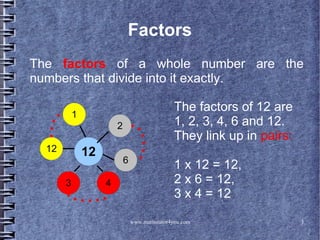
The factors of a whole number are the
numbers that divide into it exactly.
12
2
6
1
12
3 4
The factors of 12 are
1, 2, 3, 4, 6 and 12.
They link up in pairs:
1 x 12 = 12,
2 x 6 = 12,
3 x 4 = 12
www.mathstutor4you.com 4
Factors
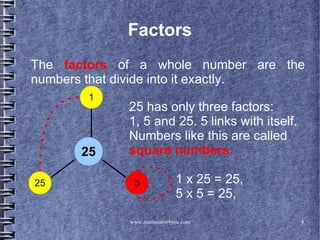
The factors of a whole number are the
numbers that divide into it exactly.
25
1
25 5
25 has only three factors:
1, 5 and 25. 5 links with itself.
Numbers like this are called
square numbers.
1 x 25 = 25,
5 x 5 = 25,
5
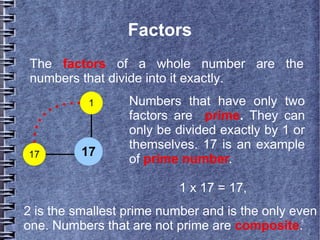
Factors
The factors of a whole number are the
numbers that divide into it exactly.
17
1
17
Numbers that have only two
factors are prime. They can
only be divided exactly by 1 or
themselves. 17 is an example
of prime number.
1 x 17 = 17,
2 is the smallest prime number and is the only even
one. Numbers that are not prime are composite.
6
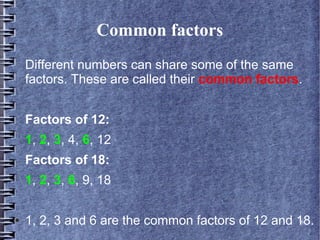
Common factors
Different numbers can share some of the same
factors. These are called their common factors.
Factors of 12:
1, 2, 3, 4, 6, 12
Factors of 18:
1, 2, 3, 6, 9, 18
● 1, 2, 3 and 6 are the common factors of 12 and 18.
www.mathstutor4you.com 7
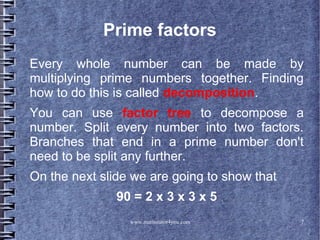
Prime factors
Every whole number can be made by
multiplying prime numbers together. Finding
how to do this is called decomposition.
You can use factor tree to decompose a
number. Split every number into two factors.
Branches that end in a prime number don't
need to be split any further.
On the next slide we are going to show that
90 = 2 x 3 x 3 x 5
8
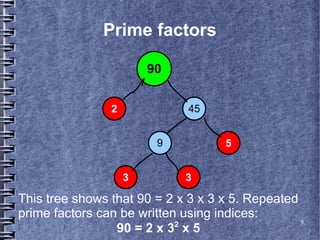
Prime factors
❑
❑
90
2 45
9
3
3
5
This tree shows that 90 = 2 x 3 x 3 x 5. Repeated
prime factors can be written using indices:
90 = 2 x 32
x 5
www.mathstutor4you.com 9
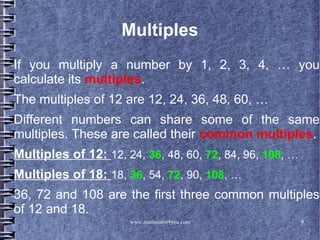
Multiples
If you multiply a number by 1, 2, 3, 4, … you
calculate its multiples.
The multiples of 12 are 12, 24, 36, 48, 60, …
Different numbers can share some of the same
multiples. These are called their common multiples.
Multiples of 12: 12, 24, 36, 48, 60, 72, 84, 96, 108, …
Multiples of 18: 18, 36, 54, 72, 90, 108, …
36, 72 and 108 are the first three common multiples
of 12 and 18.
10
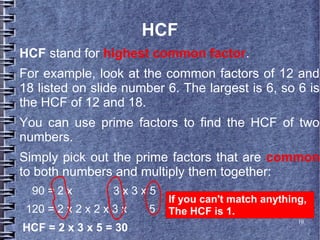
HCF
HCF stand for highest common factor.
For example, look at the common factors of 12 and
18 listed on slide number 6. The largest is 6, so 6 is
the HCF of 12 and 18.
You can use prime factors to find the HCF of two
numbers.
Simply pick out the prime factors that are common
to both numbers and multiply them together:
90 = 2 x 3 x 3 x 5
120 = 2 x 2 x 2 x 3 x 5
HCF = 2 x 3 x 5 = 30
If you can't match anything,
The HCF is 1.
11
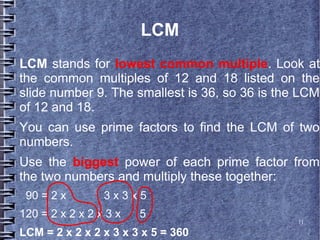
LCM
LCM stands for lowest common multiple. Look at
the common multiples of 12 and 18 listed on the
slide number 9. The smallest is 36, so 36 is the LCM
of 12 and 18.
You can use prime factors to find the LCM of two
numbers.
Use the biggest power of each prime factor from
the two numbers and multiply these together:
90 = 2 x 3 x 3 x 5
120 = 2 x 2 x 2 x 3 x 5
LCM = 2 x 2 x 2 x 3 x 3 x 5 = 360
12
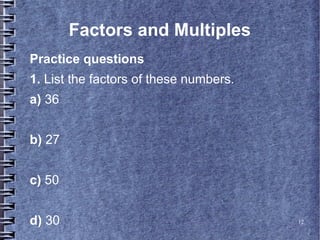
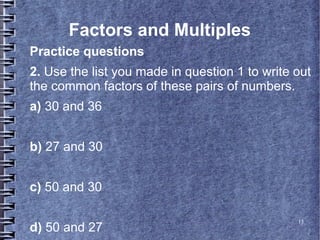
Factors and Multiples
Practice questions
1. List the factors of these numbers.
a) 36
b) 27
c) 50
d) 30
13
Factors and Multiples
Practice questions
2. Use the list you made in question 1 to write out
the common factors of these pairs of numbers.
a) 30 and 36
b) 27 and 30
c) 50 and 30
d) 50 and 27
14
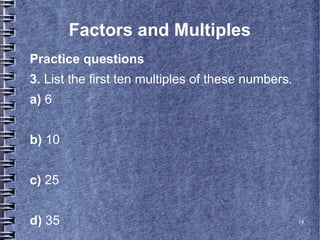
Factors and Multiples
Practice questions
3. List the first ten multiples of these numbers.
a) 6
b) 10
c) 25
d) 35
15
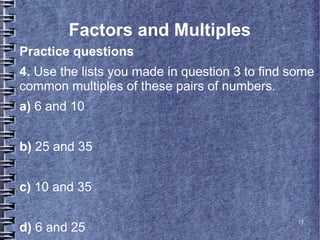
Factors and Multiples
Practice questions
4. Use the lists you made in question 3 to find some
common multiples of these pairs of numbers.
a) 6 and 10
b) 25 and 35
c) 10 and 35
d) 6 and 25
16
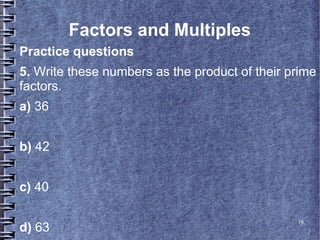
Factors and Multiples
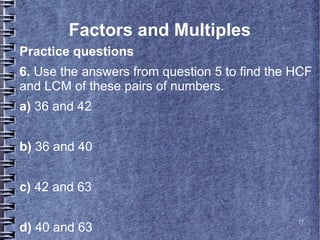
Practice questions
5. Write these numbers as the product of their prime
factors.
a) 36
b) 42
c) 40
d) 63
17
Factors and Multiples
Practice questions
6. Use the answers from question 5 to find the HCF
and LCM of these pairs of numbers.
a) 36 and 42
b) 36 and 40
c) 42 and 63
d) 40 and 63
www.mathstutor4you.com 18
Factors and Multiples
Notes:
www.mathstutor4you.com 19
Factors and Multiples
Notes:
www.mathstutor4you.com 20
Factors and Multiples
Notes:
www.mathstutor4you.com 21
Factors and Multiples
Notes:
www.mathstutor4you.com 22
Thank you
Thank you for joining my online class!
It was my pleasure to teach you!
I hope to see you again soon!
In order to be notified about my new GCSE Revision
classes, please follow me on the WiZiQ website at:
www.wiziq.com/adammlynarczyk
Please do not forget to leave feedback about my free online class!

Factors and multiples

  • 1.
    www.mathstutor4you.com 1 GCSE MathsRevision Factors and Multiples Adam Mlynarczyk
  • 2.
    www.mathstutor4you.com 2 Factors andMultiples Key Facts: Factors of a number divide into it exactly. Multiples of a number can be divided by it exactly. Common factors and multiples 'belong' to two different numbers. Every number can be written as the product of its prime factors.
  • 3.
    www.mathstutor4you.com 3 Factors The factorsof a whole number are the numbers that divide into it exactly. 12 2 6 1 12 3 4 The factors of 12 are 1, 2, 3, 4, 6 and 12. They link up in pairs: 1 x 12 = 12, 2 x 6 = 12, 3 x 4 = 12
  • 4.
    www.mathstutor4you.com 4 Factors The factorsof a whole number are the numbers that divide into it exactly. 25 1 25 5 25 has only three factors: 1, 5 and 25. 5 links with itself. Numbers like this are called square numbers. 1 x 25 = 25, 5 x 5 = 25,
  • 5.
    5 Factors The factors ofa whole number are the numbers that divide into it exactly. 17 1 17 Numbers that have only two factors are prime. They can only be divided exactly by 1 or themselves. 17 is an example of prime number. 1 x 17 = 17, 2 is the smallest prime number and is the only even one. Numbers that are not prime are composite.
  • 6.
    6 Common factors Different numberscan share some of the same factors. These are called their common factors. Factors of 12: 1, 2, 3, 4, 6, 12 Factors of 18: 1, 2, 3, 6, 9, 18 ● 1, 2, 3 and 6 are the common factors of 12 and 18.
  • 7.
    www.mathstutor4you.com 7 Prime factors Everywhole number can be made by multiplying prime numbers together. Finding how to do this is called decomposition. You can use factor tree to decompose a number. Split every number into two factors. Branches that end in a prime number don't need to be split any further. On the next slide we are going to show that 90 = 2 x 3 x 3 x 5
  • 8.
    8 Prime factors ❑ ❑ 90 2 45 9 3 3 5 Thistree shows that 90 = 2 x 3 x 3 x 5. Repeated prime factors can be written using indices: 90 = 2 x 32 x 5
  • 9.
    www.mathstutor4you.com 9 Multiples If youmultiply a number by 1, 2, 3, 4, … you calculate its multiples. The multiples of 12 are 12, 24, 36, 48, 60, … Different numbers can share some of the same multiples. These are called their common multiples. Multiples of 12: 12, 24, 36, 48, 60, 72, 84, 96, 108, … Multiples of 18: 18, 36, 54, 72, 90, 108, … 36, 72 and 108 are the first three common multiples of 12 and 18.
  • 10.
    10 HCF HCF stand forhighest common factor. For example, look at the common factors of 12 and 18 listed on slide number 6. The largest is 6, so 6 is the HCF of 12 and 18. You can use prime factors to find the HCF of two numbers. Simply pick out the prime factors that are common to both numbers and multiply them together: 90 = 2 x 3 x 3 x 5 120 = 2 x 2 x 2 x 3 x 5 HCF = 2 x 3 x 5 = 30 If you can't match anything, The HCF is 1.
  • 11.
    11 LCM LCM stands forlowest common multiple. Look at the common multiples of 12 and 18 listed on the slide number 9. The smallest is 36, so 36 is the LCM of 12 and 18. You can use prime factors to find the LCM of two numbers. Use the biggest power of each prime factor from the two numbers and multiply these together: 90 = 2 x 3 x 3 x 5 120 = 2 x 2 x 2 x 3 x 5 LCM = 2 x 2 x 2 x 3 x 3 x 5 = 360
  • 12.
    12 Factors and Multiples Practicequestions 1. List the factors of these numbers. a) 36 b) 27 c) 50 d) 30
  • 13.
    13 Factors and Multiples Practicequestions 2. Use the list you made in question 1 to write out the common factors of these pairs of numbers. a) 30 and 36 b) 27 and 30 c) 50 and 30 d) 50 and 27
  • 14.
    14 Factors and Multiples Practicequestions 3. List the first ten multiples of these numbers. a) 6 b) 10 c) 25 d) 35
  • 15.
    15 Factors and Multiples Practicequestions 4. Use the lists you made in question 3 to find some common multiples of these pairs of numbers. a) 6 and 10 b) 25 and 35 c) 10 and 35 d) 6 and 25
  • 16.
    16 Factors and Multiples Practicequestions 5. Write these numbers as the product of their prime factors. a) 36 b) 42 c) 40 d) 63
  • 17.
    17 Factors and Multiples Practicequestions 6. Use the answers from question 5 to find the HCF and LCM of these pairs of numbers. a) 36 and 42 b) 36 and 40 c) 42 and 63 d) 40 and 63
  • 18.
  • 19.
  • 20.
  • 21.
  • 22.
    www.mathstutor4you.com 22 Thank you Thankyou for joining my online class! It was my pleasure to teach you! I hope to see you again soon! In order to be notified about my new GCSE Revision classes, please follow me on the WiZiQ website at: www.wiziq.com/adammlynarczyk Please do not forget to leave feedback about my free online class!