SOLANO NORTH ELEMENTARY SCHOOL
AUGUST 3, 2019
EDGAR H. ANOS
DISCUSSANT
MTAP-DepEd Saturday
Program in Mathematics for
Grade VI
SESSION 1
Session 1
Whole Number System
Math Song:
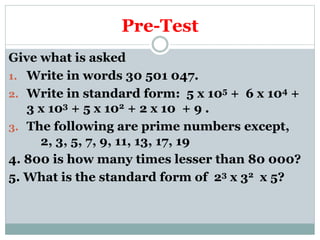
Pre-Test
Give what is asked
1. Write in words 30 501 047.
2. Write in standard form: 5 x 10⁵ + 6 x 10⁴ +
3 x 10³ + 5 x 10² + 2 x 10 + 9 .
3. The following are prime numbers except,
2, 3, 5, 7, 9, 11, 13, 17, 19
4. 800 is how many times lesser than 80 000?
5. What is the standard form of 23 x 32 x 5?
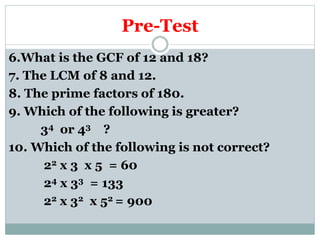
Pre-Test
6.What is the GCF of 12 and 18?
7. The LCM of 8 and 12.
8. The prime factors of 180.
9. Which of the following is greater?
34 or 43 ?
10. Which of the following is not correct?
22 x 3 x 5 = 60
24 x 33 = 133
22 x 32 x 52 = 900
A
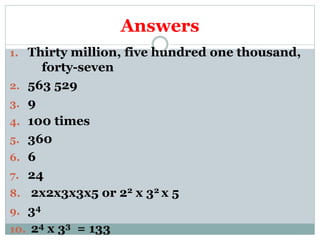
Answers
1. Thirty million, five hundred one thousand,
forty-seven
2. 563 529
3. 9
4. 100 times
5. 360
6. 6
7. 24
8. 2x2x3x3x5 or 22 x 32 x 5
9. 34
10. 24 x 33 = 133
Introduction
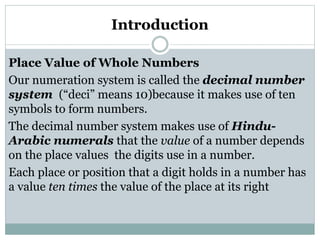
Place Value of Whole Numbers
Our numeration system is called the decimal number
system (“deci” means 10)because it makes use of ten
symbols to form numbers.
The decimal number system makes use of Hindu-
Arabic numerals that the value of a number depends
on the place values the digits use in a number.
Each place or position that a digit holds in a number has
a value ten times the value of the place at its right
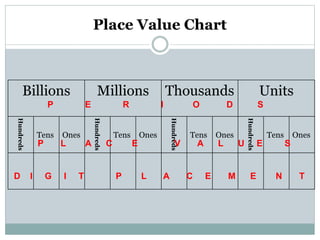
Place Value Chart
Billions Millions Thousands Units
Hundreds
Tens Ones
Hundreds
Tens Ones
Hundreds
Tens Ones
Hundreds
Tens Ones
P E R I O D S
P L A C E V A L U E S
D I G I T P L A C E M E N T
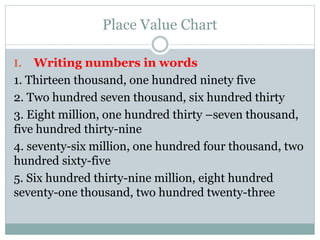
Place Value Chart
I. Writing numbers in words
1. Thirteen thousand, one hundred ninety five
2. Two hundred seven thousand, six hundred thirty
3. Eight million, one hundred thirty –seven thousand,
five hundred thirty-nine
4. seventy-six million, one hundred four thousand, two
hundred sixty-five
5. Six hundred thirty-nine million, eight hundred
seventy-one thousand, two hundred twenty-three
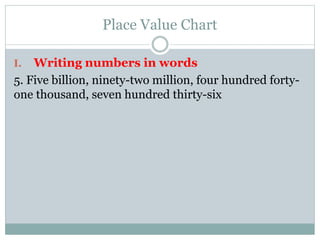
Place Value Chart
I. Writing numbers in words
5. Five billion, ninety-two million, four hundred forty-
one thousand, seven hundred thirty-six
Place Value Chart
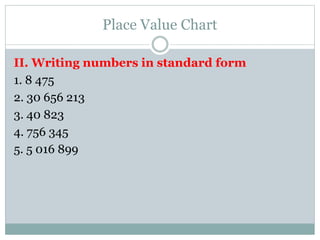
II. Writing numbers in standard form
1. 8 475
2. 30 656 213
3. 40 823
4. 756 345
5. 5 016 899
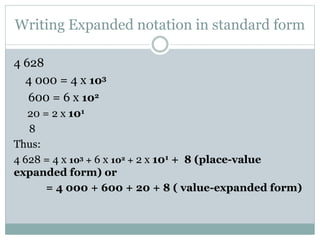
Writing Expanded notation in standard form
4 628
4 000 = 4 x 10³
600 = 6 x 10²
20 = 2 x 101
8
Thus:
4 628 = 4 x 10³ + 6 x 10² + 2 x 101 + 8 (place-value
expanded form) or
= 4 000 + 600 + 20 + 8 ( value-expanded form)
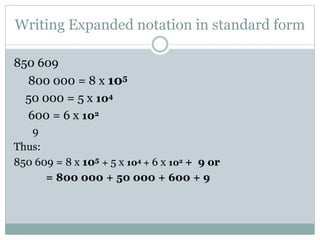
Writing Expanded notation in standard form
850 609
800 000 = 8 x 10⁵
50 000 = 5 x 10⁴
600 = 6 x 10²
9
Thus:
850 609 = 8 x 10⁵ + 5 x 10⁴ + 6 x 10² + 9 or
= 800 000 + 50 000 + 600 + 9
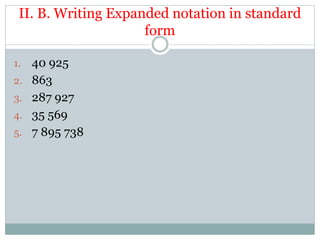
II. B. Writing Expanded notation in standard
form
1. 40 925
2. 863
3. 287 927
4. 35 569
5. 7 895 738
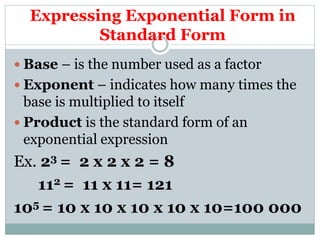
Expressing Exponential Form in
Standard Form
 Base – is the number used as a factor
 Exponent – indicates how many times the
base is multiplied to itself
 Product is the standard form of an
exponential expression
Ex. 23 = 2 x 2 x 2 = 8
112 = 11 x 11= 121
105 = 10 x 10 x 10 x 10 x 10=100 000
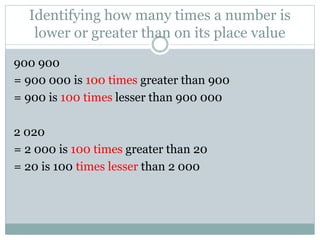
Identifying how many times a number is
lower or greater than on its place value
900 900
= 900 000 is 100 times greater than 900
= 900 is 100 times lesser than 900 000
2 020
= 2 000 is 100 times greater than 20
= 20 is 100 times lesser than 2 000
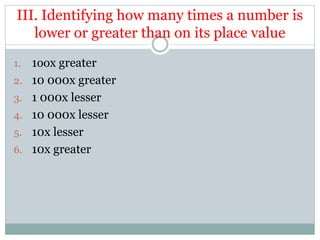
III. Identifying how many times a number is
lower or greater than on its place value
1. 1oox greater
2. 10 000x greater
3. 1 000x lesser
4. 10 000x lesser
5. 10x lesser
6. 10x greater
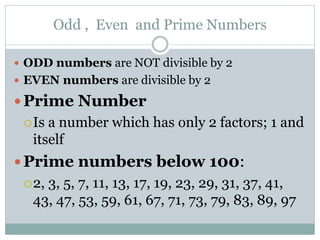
Odd , Even and Prime Numbers
 ODD numbers are NOT divisible by 2
 EVEN numbers are divisible by 2
Prime Number
Is a number which has only 2 factors; 1 and
itself
Prime numbers below 100:
2, 3, 5, 7, 11, 13, 17, 19, 23, 29, 31, 37, 41,
43, 47, 53, 59, 61, 67, 71, 73, 79, 83, 89, 97
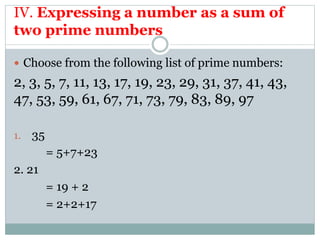
IV. Expressing a number as a sum of
two prime numbers
 Choose from the following list of prime numbers:
2, 3, 5, 7, 11, 13, 17, 19, 23, 29, 31, 37, 41, 43,
47, 53, 59, 61, 67, 71, 73, 79, 83, 89, 97
1. 35
= 5+7+23
2. 21
= 19 + 2
= 2+2+17
Factor
A number that evenly divides
another number
An amount by which another
amount is multiplied or divided
Any of the numbers or symbols in
mathematics that when
multiplied together form a
product
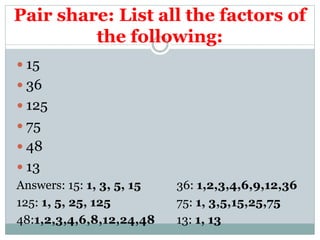
Pair share: List all the factors of
the following:
 15
 36
 125
 75
 48
 13
Answers: 15: 1, 3, 5, 15 36: 1,2,3,4,6,9,12,36
125: 1, 5, 25, 125 75: 1, 3,5,15,25,75
48:1,2,3,4,6,8,12,24,48 13: 1, 13
Prime Factorization
Expressing a composite
number as a product of its
prime factors
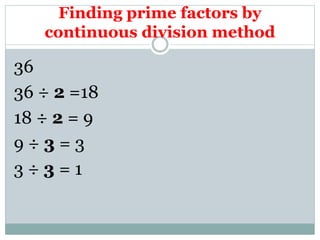
Finding prime factors by
continuous division method
36
36 ÷ 2 =18
18 ÷ 2 = 9
9 ÷ 3 = 3
3 ÷ 3 = 1
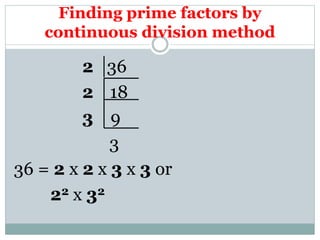
Finding prime factors by
continuous division method
2 36
2 18
3 9
3
36 = 2 x 2 x 3 x 3 or
22 x 32
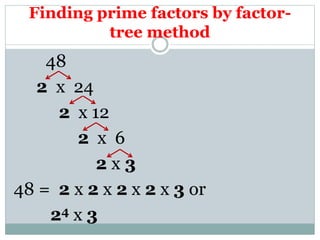
Finding prime factors by factor-
tree method
48
2 x 24
2 x 12
2 x 6
2 x 3
48 = 2 x 2 x 2 x 2 x 3 or
24 x 3
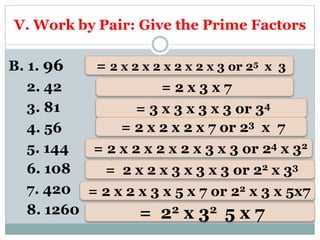
V. Work by Pair: Give the Prime Factors
B. 1. 96
2. 42
3. 81
4. 56
5. 144
6. 108
7. 420
8. 1260
= 2 x 2 x 2 x 2 x 2 x 3 or 25 x 3
= 2 x 3 x 7
= 3 x 3 x 3 x 3 or 34
= 2 x 2 x 2 x 7 or 23 x 7
= 2 x 2 x 3 x 3 x 3 or 22 x 33
= 2 x 2 x 3 x 5 x 7 or 22 x 3 x 5x7
= 22 x 32 5 x 7
= 2 x 2 x 2 x 2 x 3 x 3 or 24 x 32
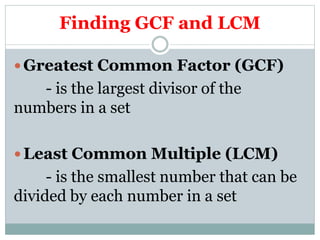
Finding GCF and LCM
Greatest Common Factor (GCF)
- is the largest divisor of the
numbers in a set
Least Common Multiple (LCM)
- is the smallest number that can be
divided by each number in a set
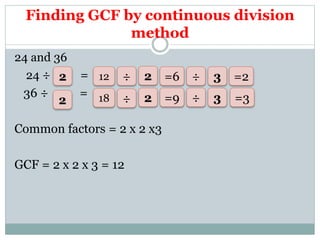
Finding GCF by continuous division
method
24 and 36
24 ÷ =
36 ÷ =
Common factors = 2 x 2 x3
GCF = 2 x 2 x 3 = 12
12
18
÷
÷
2
2
=6
=9
÷
÷
3
3
=2
=3
2
2
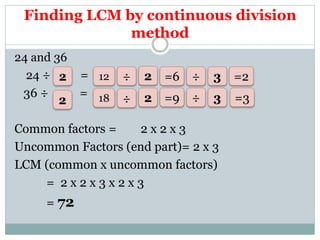
Finding LCM by continuous division
method
24 and 36
24 ÷ =
36 ÷ =
Common factors = 2 x 2 x 3
Uncommon Factors (end part)= 2 x 3
LCM (common x uncommon factors)
= 2 x 2 x 3 x 2 x 3
= 72
12
18
÷
÷
2
2
=6
=9
÷
÷
3
3
=2
=3
2
2
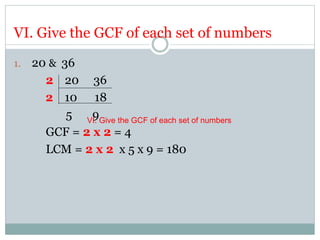
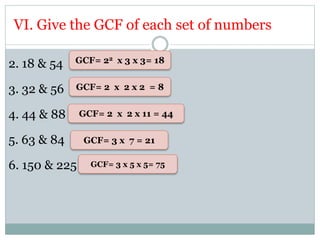
VI. Give the GCF of each set of numbers
1. 20 & 36
2 20 36
2 10 18
5 9
GCF = 2 x 2 = 4
LCM = 2 x 2 x 5 x 9 = 180
VI. Give the GCF of each set of numbers
2. 18 & 54
3. 32 & 56
4. 44 & 88
5. 63 & 84
6. 150 & 225
GCF= 22 x 3 x 3= 18
GCF= 2 x 2 x 2 = 8
GCF= 2 x 2 x 11 = 44
GCF= 3 x 7 = 21
GCF= 3 x 5 x 5= 75
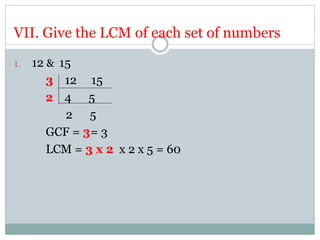
VII. Give the LCM of each set of numbers
1. 12 & 15
3 12 15
2 4 5
2 5
GCF = 3= 3
LCM = 3 x 2 x 2 x 5 = 60
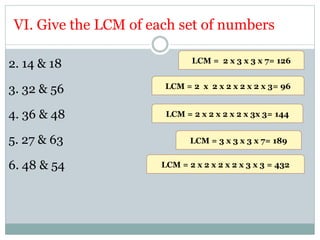
VI. Give the LCM of each set of numbers
2. 14 & 18
3. 32 & 56
4. 36 & 48
5. 27 & 63
6. 48 & 54
LCM = 2 x 3 x 3 x 7= 126
LCM = 2 x 2 x 2 x 2 x 2 x 3= 96
LCM = 2 x 2 x 2 x 2 x 3x 3= 144
LCM = 3 x 3 x 3 x 7= 189
LCM = 2 x 2 x 2 x 2 x 3 x 3 = 432
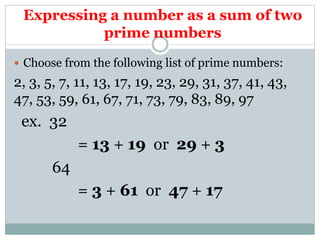
Expressing a number as a sum of two
prime numbers
 Choose from the following list of prime numbers:
2, 3, 5, 7, 11, 13, 17, 19, 23, 29, 31, 37, 41, 43,
47, 53, 59, 61, 67, 71, 73, 79, 83, 89, 97
ex. 32
= 13 + 19 or 29 + 3
64
= 3 + 61 or 47 + 17
Work by Group
Answer problem solving part in
10 minutes( 1-5 )
2019 MTAP -Session 1 Grade 6.ppt

2019 MTAP -Session 1 Grade 6.ppt

  • 1.
    SOLANO NORTH ELEMENTARYSCHOOL AUGUST 3, 2019 EDGAR H. ANOS DISCUSSANT MTAP-DepEd Saturday Program in Mathematics for Grade VI SESSION 1
  • 2.
    Session 1 Whole NumberSystem Math Song:
  • 3.
    Pre-Test Give what isasked 1. Write in words 30 501 047. 2. Write in standard form: 5 x 10⁵ + 6 x 10⁴ + 3 x 10³ + 5 x 10² + 2 x 10 + 9 . 3. The following are prime numbers except, 2, 3, 5, 7, 9, 11, 13, 17, 19 4. 800 is how many times lesser than 80 000? 5. What is the standard form of 23 x 32 x 5?
  • 4.
    Pre-Test 6.What is theGCF of 12 and 18? 7. The LCM of 8 and 12. 8. The prime factors of 180. 9. Which of the following is greater? 34 or 43 ? 10. Which of the following is not correct? 22 x 3 x 5 = 60 24 x 33 = 133 22 x 32 x 52 = 900
  • 5.
  • 6.
    Answers 1. Thirty million,five hundred one thousand, forty-seven 2. 563 529 3. 9 4. 100 times 5. 360 6. 6 7. 24 8. 2x2x3x3x5 or 22 x 32 x 5 9. 34 10. 24 x 33 = 133
  • 7.
    Introduction Place Value ofWhole Numbers Our numeration system is called the decimal number system (“deci” means 10)because it makes use of ten symbols to form numbers. The decimal number system makes use of Hindu- Arabic numerals that the value of a number depends on the place values the digits use in a number. Each place or position that a digit holds in a number has a value ten times the value of the place at its right
  • 8.
    Place Value Chart BillionsMillions Thousands Units Hundreds Tens Ones Hundreds Tens Ones Hundreds Tens Ones Hundreds Tens Ones P E R I O D S P L A C E V A L U E S D I G I T P L A C E M E N T
  • 9.
    Place Value Chart I.Writing numbers in words 1. Thirteen thousand, one hundred ninety five 2. Two hundred seven thousand, six hundred thirty 3. Eight million, one hundred thirty –seven thousand, five hundred thirty-nine 4. seventy-six million, one hundred four thousand, two hundred sixty-five 5. Six hundred thirty-nine million, eight hundred seventy-one thousand, two hundred twenty-three
  • 10.
    Place Value Chart I.Writing numbers in words 5. Five billion, ninety-two million, four hundred forty- one thousand, seven hundred thirty-six
  • 11.
    Place Value Chart II.Writing numbers in standard form 1. 8 475 2. 30 656 213 3. 40 823 4. 756 345 5. 5 016 899
  • 12.
    Writing Expanded notationin standard form 4 628 4 000 = 4 x 10³ 600 = 6 x 10² 20 = 2 x 101 8 Thus: 4 628 = 4 x 10³ + 6 x 10² + 2 x 101 + 8 (place-value expanded form) or = 4 000 + 600 + 20 + 8 ( value-expanded form)
  • 13.
    Writing Expanded notationin standard form 850 609 800 000 = 8 x 10⁵ 50 000 = 5 x 10⁴ 600 = 6 x 10² 9 Thus: 850 609 = 8 x 10⁵ + 5 x 10⁴ + 6 x 10² + 9 or = 800 000 + 50 000 + 600 + 9
  • 14.
    II. B. WritingExpanded notation in standard form 1. 40 925 2. 863 3. 287 927 4. 35 569 5. 7 895 738
  • 15.
    Expressing Exponential Formin Standard Form  Base – is the number used as a factor  Exponent – indicates how many times the base is multiplied to itself  Product is the standard form of an exponential expression Ex. 23 = 2 x 2 x 2 = 8 112 = 11 x 11= 121 105 = 10 x 10 x 10 x 10 x 10=100 000
  • 16.
    Identifying how manytimes a number is lower or greater than on its place value 900 900 = 900 000 is 100 times greater than 900 = 900 is 100 times lesser than 900 000 2 020 = 2 000 is 100 times greater than 20 = 20 is 100 times lesser than 2 000
  • 17.
    III. Identifying howmany times a number is lower or greater than on its place value 1. 1oox greater 2. 10 000x greater 3. 1 000x lesser 4. 10 000x lesser 5. 10x lesser 6. 10x greater
  • 18.
    Odd , Evenand Prime Numbers  ODD numbers are NOT divisible by 2  EVEN numbers are divisible by 2 Prime Number Is a number which has only 2 factors; 1 and itself Prime numbers below 100: 2, 3, 5, 7, 11, 13, 17, 19, 23, 29, 31, 37, 41, 43, 47, 53, 59, 61, 67, 71, 73, 79, 83, 89, 97
  • 19.
    IV. Expressing anumber as a sum of two prime numbers  Choose from the following list of prime numbers: 2, 3, 5, 7, 11, 13, 17, 19, 23, 29, 31, 37, 41, 43, 47, 53, 59, 61, 67, 71, 73, 79, 83, 89, 97 1. 35 = 5+7+23 2. 21 = 19 + 2 = 2+2+17
  • 20.
    Factor A number thatevenly divides another number An amount by which another amount is multiplied or divided Any of the numbers or symbols in mathematics that when multiplied together form a product
  • 21.
    Pair share: Listall the factors of the following:  15  36  125  75  48  13 Answers: 15: 1, 3, 5, 15 36: 1,2,3,4,6,9,12,36 125: 1, 5, 25, 125 75: 1, 3,5,15,25,75 48:1,2,3,4,6,8,12,24,48 13: 1, 13
  • 22.
    Prime Factorization Expressing acomposite number as a product of its prime factors
  • 23.
    Finding prime factorsby continuous division method 36 36 ÷ 2 =18 18 ÷ 2 = 9 9 ÷ 3 = 3 3 ÷ 3 = 1
  • 24.
    Finding prime factorsby continuous division method 2 36 2 18 3 9 3 36 = 2 x 2 x 3 x 3 or 22 x 32
  • 25.
    Finding prime factorsby factor- tree method 48 2 x 24 2 x 12 2 x 6 2 x 3 48 = 2 x 2 x 2 x 2 x 3 or 24 x 3
  • 26.
    V. Work byPair: Give the Prime Factors B. 1. 96 2. 42 3. 81 4. 56 5. 144 6. 108 7. 420 8. 1260 = 2 x 2 x 2 x 2 x 2 x 3 or 25 x 3 = 2 x 3 x 7 = 3 x 3 x 3 x 3 or 34 = 2 x 2 x 2 x 7 or 23 x 7 = 2 x 2 x 3 x 3 x 3 or 22 x 33 = 2 x 2 x 3 x 5 x 7 or 22 x 3 x 5x7 = 22 x 32 5 x 7 = 2 x 2 x 2 x 2 x 3 x 3 or 24 x 32
  • 27.
    Finding GCF andLCM Greatest Common Factor (GCF) - is the largest divisor of the numbers in a set Least Common Multiple (LCM) - is the smallest number that can be divided by each number in a set
  • 28.
    Finding GCF bycontinuous division method 24 and 36 24 ÷ = 36 ÷ = Common factors = 2 x 2 x3 GCF = 2 x 2 x 3 = 12 12 18 ÷ ÷ 2 2 =6 =9 ÷ ÷ 3 3 =2 =3 2 2
  • 29.
    Finding LCM bycontinuous division method 24 and 36 24 ÷ = 36 ÷ = Common factors = 2 x 2 x 3 Uncommon Factors (end part)= 2 x 3 LCM (common x uncommon factors) = 2 x 2 x 3 x 2 x 3 = 72 12 18 ÷ ÷ 2 2 =6 =9 ÷ ÷ 3 3 =2 =3 2 2
  • 30.
    VI. Give theGCF of each set of numbers 1. 20 & 36 2 20 36 2 10 18 5 9 GCF = 2 x 2 = 4 LCM = 2 x 2 x 5 x 9 = 180 VI. Give the GCF of each set of numbers
  • 31.
    VI. Give theGCF of each set of numbers 2. 18 & 54 3. 32 & 56 4. 44 & 88 5. 63 & 84 6. 150 & 225 GCF= 22 x 3 x 3= 18 GCF= 2 x 2 x 2 = 8 GCF= 2 x 2 x 11 = 44 GCF= 3 x 7 = 21 GCF= 3 x 5 x 5= 75
  • 32.
    VII. Give theLCM of each set of numbers 1. 12 & 15 3 12 15 2 4 5 2 5 GCF = 3= 3 LCM = 3 x 2 x 2 x 5 = 60
  • 33.
    VI. Give theLCM of each set of numbers 2. 14 & 18 3. 32 & 56 4. 36 & 48 5. 27 & 63 6. 48 & 54 LCM = 2 x 3 x 3 x 7= 126 LCM = 2 x 2 x 2 x 2 x 2 x 3= 96 LCM = 2 x 2 x 2 x 2 x 3x 3= 144 LCM = 3 x 3 x 3 x 7= 189 LCM = 2 x 2 x 2 x 2 x 3 x 3 = 432
  • 34.
    Expressing a numberas a sum of two prime numbers  Choose from the following list of prime numbers: 2, 3, 5, 7, 11, 13, 17, 19, 23, 29, 31, 37, 41, 43, 47, 53, 59, 61, 67, 71, 73, 79, 83, 89, 97 ex. 32 = 13 + 19 or 29 + 3 64 = 3 + 61 or 47 + 17
  • 35.
    Work by Group Answerproblem solving part in 10 minutes( 1-5 )