Factor affecting
consumer
behavior
Presented by-
Anami Bhagat
DJ BHGT
162017
Consumer buying behavior
• This refers to the buying behavior of final
consumers (individuals & households) who
buy goods and services for personal
consumption.
Cultural social
Psychological
Personal
Cultural
• Culture
• Sub culture
• Social class
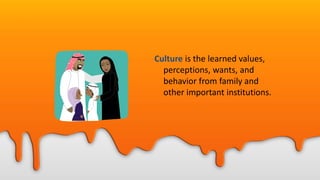
Culture is the learned values,
perceptions, wants, and
behavior from family and
other important institutions.
Subcultures are groups of people within a culture with shared value systems
based on common life experiences and situations.
• Chinese
• Indians
• Malays
• Eurasians
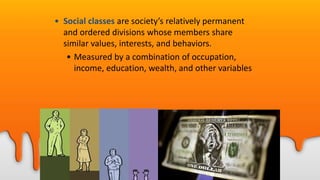
• Social classes are society’s relatively permanent
and ordered divisions whose members share
similar values, interests, and behaviors.
• Measured by a combination of occupation,
income, education, wealth, and other variables
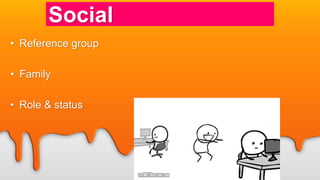
Social
• Reference group
• Family
• Role & status
• Reference Groups
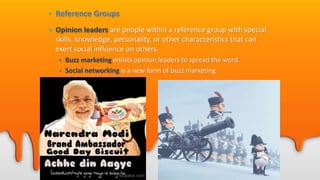
• Opinion leaders are people within a reference group with special
skills, knowledge, personality, or other characteristics that can
exert social influence on others.
• Buzz marketing enlists opinion leaders to spread the word.
• Social networking is a new form of buzz marketing
• MySpace.com
• Facebook.com
5-10
• Family is the most important consumer-buying
organization in society.
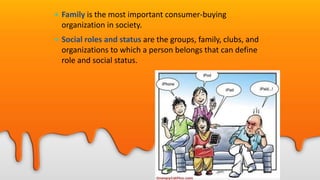
• Social roles and status are the groups, family, clubs, and
organizations to which a person belongs that can define
role and social status.
Personal
• Age & life cycle stage
• Occupation
• Economic situations
• Lifestyle
• Personality and self concept
• Age and life-cycle stage
• RBC (Royal Bank of Canada) Royal Bank has identified five life-stage
segments:
• Youth—younger than 18 years
• Getting started—18-35 years
• Builders—35-50 years
• Accumulators—50-60 years
• Preservers—over 60 years
• Occupation affects the goods and services bought by
consumers.
• Economic situation includes trends in:
• Personal income
• Savings
• Interest rates
• Lifestyle is a person’s pattern of living as expressed in his or
her psychographics.
• Measures a consumer’s AIOs (activities, interests, and
opinions) to capture information about a person’s pattern
of acting and interacting in the environment.
Psychological
• Motivation
• Perception
• Learning
• Beliefs and attitudes
• Motivation
• A motive is a need that is sufficiently pressing to direct the person
to seek satisfaction.
• Motivation research refers to qualitative research designed to
probe consumers’ hidden, subconscious motivations.
• Perception is the process by which people select, organize, and interpret information to
form a meaningful picture of the world from three perceptual processes:
• Selective attention
• Selective distortion
• Selective retention
• Learning is the changes in an individual’s behavior arising from
experience and occurs through interplay of:
• Drives
• Stimuli
• Cues
• Responses
• Reinforcement
• Beliefs and Attitudes
• Belief is a descriptive thought that a person has about something
based on:
• Knowledge
• Opinion
• Faith
– Attitudes describe a person’s relatively consistent evaluations,
feelings, and tendencies toward an object or idea.
Thank
You
Questions……..

Factors affecting consumer behavior

  • 1.
  • 2.
    Consumer buying behavior •This refers to the buying behavior of final consumers (individuals & households) who buy goods and services for personal consumption.
  • 3.
  • 4.
    Cultural • Culture • Subculture • Social class
  • 5.
    Culture is thelearned values, perceptions, wants, and behavior from family and other important institutions.
  • 6.
    Subcultures are groupsof people within a culture with shared value systems based on common life experiences and situations. • Chinese • Indians • Malays • Eurasians
  • 7.
    • Social classesare society’s relatively permanent and ordered divisions whose members share similar values, interests, and behaviors. • Measured by a combination of occupation, income, education, wealth, and other variables
  • 8.
    Social • Reference group •Family • Role & status
  • 9.
    • Reference Groups •Opinion leaders are people within a reference group with special skills, knowledge, personality, or other characteristics that can exert social influence on others. • Buzz marketing enlists opinion leaders to spread the word. • Social networking is a new form of buzz marketing • MySpace.com • Facebook.com
  • 10.
    5-10 • Family isthe most important consumer-buying organization in society. • Social roles and status are the groups, family, clubs, and organizations to which a person belongs that can define role and social status.
  • 11.
    Personal • Age &life cycle stage • Occupation • Economic situations • Lifestyle • Personality and self concept
  • 12.
    • Age andlife-cycle stage • RBC (Royal Bank of Canada) Royal Bank has identified five life-stage segments: • Youth—younger than 18 years • Getting started—18-35 years • Builders—35-50 years • Accumulators—50-60 years • Preservers—over 60 years
  • 13.
    • Occupation affectsthe goods and services bought by consumers. • Economic situation includes trends in: • Personal income • Savings • Interest rates
  • 14.
    • Lifestyle isa person’s pattern of living as expressed in his or her psychographics. • Measures a consumer’s AIOs (activities, interests, and opinions) to capture information about a person’s pattern of acting and interacting in the environment.
  • 15.
    Psychological • Motivation • Perception •Learning • Beliefs and attitudes
  • 16.
    • Motivation • Amotive is a need that is sufficiently pressing to direct the person to seek satisfaction. • Motivation research refers to qualitative research designed to probe consumers’ hidden, subconscious motivations.
  • 17.
    • Perception isthe process by which people select, organize, and interpret information to form a meaningful picture of the world from three perceptual processes: • Selective attention • Selective distortion • Selective retention
  • 18.
    • Learning isthe changes in an individual’s behavior arising from experience and occurs through interplay of: • Drives • Stimuli • Cues • Responses • Reinforcement
  • 19.
    • Beliefs andAttitudes • Belief is a descriptive thought that a person has about something based on: • Knowledge • Opinion • Faith – Attitudes describe a person’s relatively consistent evaluations, feelings, and tendencies toward an object or idea.
  • 20.
  • 21.