Financial Services
Factoring and
Forfaiting
Factoring and Forfaiting
 Factor is a financial intermediary which assumes the
responsibility of collection of receivables arising out of credit
sales of their clients and in return charges commission for its
services
Purpose of this transaction is to facilitate the immediate
 Purpose of this transaction is to facilitate the immediate
payment of an invoice(s) in order to allow a business to
accelerate cash flow and growth
 Other Functions: Administration of Sales ledger; Provision of
Collection Facility, Advisory Services etc.
 Ex.: India factoring and finance solutions, SBI Factors and
Commercial Services Pvt. Ltd., Canbank factors etc.
Factoring Arrangement
Advantages of Factoring:
 Off-balance Sheet Finance
 Reduction of Current Liabilities
 Improvement in Current Ratio
 Higher Credit Standing:
More time for Planning and Production
 More time for Planning and Production
 Reduction of Cost and Expenses
 Additional Source of Finance
Types of Factoring
 Recourse vs. Non-recourse Factoring:
 Under a recourse factoring the Factor purchases
receivables on the condition that loss arising on
account of non-recovery will be borne by the
Client.
Client.
 Credit Risk lies with the client in case of recourse
factoring
 Advance vs. Maturity Factoring
 In maturity factoring the factor agrees to pay an
amount to the client on an agreed date
Types of Factoring
 Disclosed vs. Undisclosed Factoring
 In the disclosed factoring the name of the factor is
disclosed in the invoice by the supplier-
manufacturer of the goods asking the buyer to
make the payment to the factor
 Domestic vs. Export Factoring
 If the parties involved viz. customer, client, and
factor are domiciled in the same country – it is
known as domestic factoring
Illustrations
 Ex.: Following information is available related to
Company X:
 Annual sales of Rs. 3.2 crores with average
collection period of 90 days.
 Bad debt losses – 1.5% on sales.
 Bad debt losses – 1.5% on sales.
 Administrative expenditures towards collection
efforts are Rs. 5,00,000.
If a Factor is prepared to buy the firm’s receivables
by charging 2% commission and will pay advance
on receivables to the firm at an interest rate of 18%
after withholding 10% as reserve calculate the
effective cost of factoring to the firm.
Factoring vs. Forfaiting
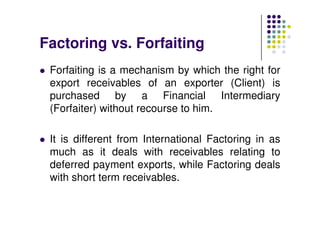
 Forfaiting is a mechanism by which the right for
export receivables of an exporter (Client) is
purchased by a Financial Intermediary
(Forfaiter) without recourse to him.
 It is different from International Factoring in as
much as it deals with receivables relating to
deferred payment exports, while Factoring deals
with short term receivables.
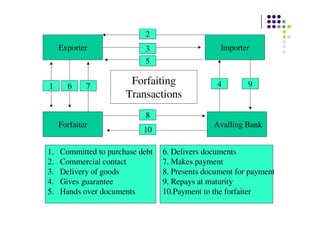
Exporter Importer
1
2
3
4
5
6 7
8
9
Forfaiting
Transactions
Avalling Bank
Forfaiter
8
10
1. Committed to purchase debt
2. Commercial contact
3. Delivery of goods
4. Gives guarantee
5. Hands over documents
6. Delivers documents
7. Makes payment
8. Presents document for payment
9. Repays at maturity
10.Payment to the forfaiter
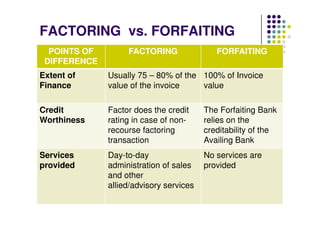
FACTORING vs. FORFAITING
POINTS OF
DIFFERENCE
FACTORING FORFAITING
Extent of
Finance
Usually 75 – 80% of the
value of the invoice
100% of Invoice
value
Credit Factor does the credit The Forfaiting Bank
Credit
Worthiness
Factor does the credit
rating in case of non-
recourse factoring
transaction
The Forfaiting Bank
relies on the
creditability of the
Availing Bank
Services
provided
Day-to-day
administration of sales
and other
allied/advisory services
No services are
provided
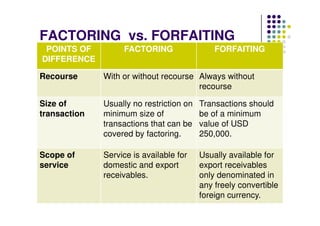
FACTORING vs. FORFAITING
POINTS OF
DIFFERENCE
FACTORING FORFAITING
Recourse With or without recourse Always without
recourse
Size of
transaction
Usually no restriction on
minimum size of
Transactions should
be of a minimum
transaction minimum size of
transactions that can be
covered by factoring.
be of a minimum
value of USD
250,000.
Scope of
service
Service is available for
domestic and export
receivables.
Usually available for
export receivables
only denominated in
any freely convertible
foreign currency.
Thanks

Factoring and Forfating.pdf

  • 1.
  • 2.
  • 3.
    Factoring and Forfaiting Factor is a financial intermediary which assumes the responsibility of collection of receivables arising out of credit sales of their clients and in return charges commission for its services Purpose of this transaction is to facilitate the immediate Purpose of this transaction is to facilitate the immediate payment of an invoice(s) in order to allow a business to accelerate cash flow and growth Other Functions: Administration of Sales ledger; Provision of Collection Facility, Advisory Services etc. Ex.: India factoring and finance solutions, SBI Factors and Commercial Services Pvt. Ltd., Canbank factors etc.
  • 4.
  • 5.
    Advantages of Factoring: Off-balance Sheet Finance Reduction of Current Liabilities Improvement in Current Ratio Higher Credit Standing: More time for Planning and Production More time for Planning and Production Reduction of Cost and Expenses Additional Source of Finance
  • 6.
    Types of Factoring Recourse vs. Non-recourse Factoring: Under a recourse factoring the Factor purchases receivables on the condition that loss arising on account of non-recovery will be borne by the Client. Client. Credit Risk lies with the client in case of recourse factoring Advance vs. Maturity Factoring In maturity factoring the factor agrees to pay an amount to the client on an agreed date
  • 7.
    Types of Factoring Disclosed vs. Undisclosed Factoring In the disclosed factoring the name of the factor is disclosed in the invoice by the supplier- manufacturer of the goods asking the buyer to make the payment to the factor make the payment to the factor Domestic vs. Export Factoring If the parties involved viz. customer, client, and factor are domiciled in the same country – it is known as domestic factoring
  • 8.
    Illustrations Ex.: Followinginformation is available related to Company X: Annual sales of Rs. 3.2 crores with average collection period of 90 days. Bad debt losses – 1.5% on sales. Bad debt losses – 1.5% on sales. Administrative expenditures towards collection efforts are Rs. 5,00,000. If a Factor is prepared to buy the firm’s receivables by charging 2% commission and will pay advance on receivables to the firm at an interest rate of 18% after withholding 10% as reserve calculate the effective cost of factoring to the firm.
  • 9.
    Factoring vs. Forfaiting Forfaiting is a mechanism by which the right for export receivables of an exporter (Client) is purchased by a Financial Intermediary (Forfaiter) without recourse to him. (Forfaiter) without recourse to him. It is different from International Factoring in as much as it deals with receivables relating to deferred payment exports, while Factoring deals with short term receivables.
  • 10.
    Exporter Importer 1 2 3 4 5 6 7 8 9 Forfaiting Transactions AvallingBank Forfaiter 8 10 1. Committed to purchase debt 2. Commercial contact 3. Delivery of goods 4. Gives guarantee 5. Hands over documents 6. Delivers documents 7. Makes payment 8. Presents document for payment 9. Repays at maturity 10.Payment to the forfaiter
  • 11.
    FACTORING vs. FORFAITING POINTSOF DIFFERENCE FACTORING FORFAITING Extent of Finance Usually 75 – 80% of the value of the invoice 100% of Invoice value Credit Factor does the credit The Forfaiting Bank Credit Worthiness Factor does the credit rating in case of non- recourse factoring transaction The Forfaiting Bank relies on the creditability of the Availing Bank Services provided Day-to-day administration of sales and other allied/advisory services No services are provided
  • 12.
    FACTORING vs. FORFAITING POINTSOF DIFFERENCE FACTORING FORFAITING Recourse With or without recourse Always without recourse Size of transaction Usually no restriction on minimum size of Transactions should be of a minimum transaction minimum size of transactions that can be covered by factoring. be of a minimum value of USD 250,000. Scope of service Service is available for domestic and export receivables. Usually available for export receivables only denominated in any freely convertible foreign currency.
  • 13.