
SUBMITTED BY-:
SADANAND MAURYA
MABM II Sem.
PRESENTATION
ON
FACTOR AFFECTING PRICING
AND
PRICING METHOD OF PRODUCT
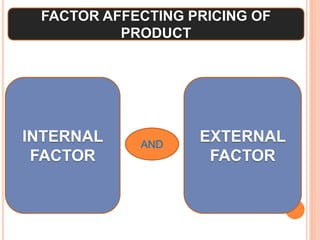
FACTOR AFFECTING PRICING OF
PRODUCT
INTERNAL
FACTOR
EXTERNAL
FACTOR
AND
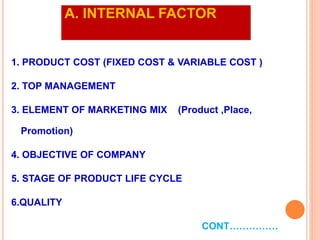
1. PRODUCT COST (FIXED COST & VARIABLE COST )
2. TOP MANAGEMENT
3. ELEMENT OF MARKETING MIX (Product ,Place,
Promotion)
4. OBJECTIVE OF COMPANY
5. STAGE OF PRODUCT LIFE CYCLE
6.QUALITY
CONT……………
A. INTERNAL FACTOR
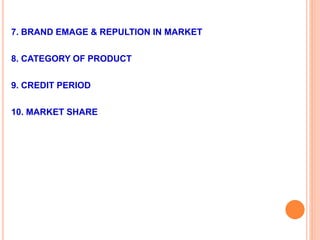
7. BRAND EMAGE & REPULTION IN MARKET
8. CATEGORY OF PRODUCT
9. CREDIT PERIOD
10. MARKET SHARE
B. EXTERNAL FACTOR
1. COMPETITON
2. PRICE OF RAW MATERIAL
3. BUYER BEHAVIOUR
4. ETHICAL CONSIDERATION
5. SEASONAL
6. ECONOMIC CONDITION
7. DEMOND FOR PRODUCT
CONT……….........
8. GOV. RULE AND RESTRICTION
9. TRANSPOTATION COST
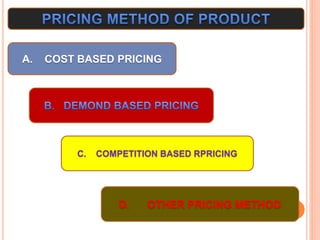
D. OTHER PRICING METHOD
C. COMPETITION BASED RPRICING
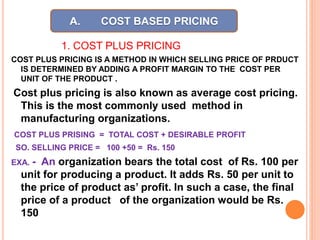
A. COST BASED PRICING
1. COST PLUS PRICING
COST PLUS PRICING IS A METHOD IN WHICH SELLING PRICE OF PRDUCT
IS DETERMINED BY ADDING A PROFIT MARGIN TO THE COST PER
UNIT OF THE PRODUCT .
Cost plus pricing is also known as average cost pricing.
This is the most commonly used method in
manufacturing organizations.
COST PLUS PRISING = TOTAL COST + DESIRABLE PROFIT
SO. SELLING PRICE = 100 +50 = Rs. 150
EXA. - An organization bears the total cost of Rs. 100 per
unit for producing a product. It adds Rs. 50 per unit to
the price of product as’ profit. In such a case, the final
price of a product of the organization would be Rs.
150
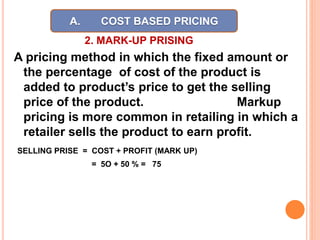
A. COST BASED PRICING
2. MARK-UP PRISING
A pricing method in which the fixed amount or
the percentage of cost of the product is
added to product’s price to get the selling
price of the product. Markup
pricing is more common in retailing in which a
retailer sells the product to earn profit.
SELLING PRISE = COST + PROFIT (MARK UP)
= 5O + 50 % = 75
A. COST BASED PRICING
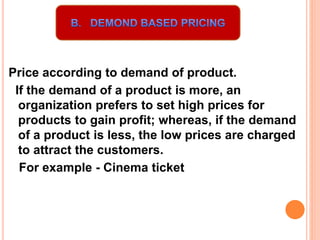
Price according to demand of product.
If the demand of a product is more, an
organization prefers to set high prices for
products to gain profit; whereas, if the demand
of a product is less, the low prices are charged
to attract the customers.
For example - Cinema ticket
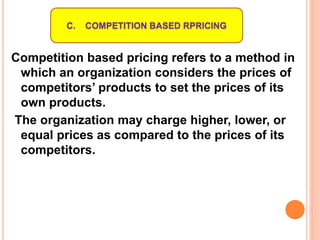
Competition based pricing refers to a method in
which an organization considers the prices of
competitors’ products to set the prices of its
own products.
The organization may charge higher, lower, or
equal prices as compared to the prices of its
competitors.
C. COMPETITION BASED RPRICING
1. VALUE PRICING
Implies a method in which an organization tries
to win loyal customers by charging low prices
for their high quality products.
The organization aims to become a low cost
producer without sacrificing the quality.
It can deliver high quality products at low
prices by improving its research and
development process.
D. OTHER PRICING METHOD
2.TARGET RETURN PRICING
The price of a product is fixed on the basis of
expected profit.
Selling price =
cost of product + expected profit.
D. OTHER PRICING METHOD
3. GOING RATE PRICING
A method in which an organization sets the
price of a product according to the prevailing
price trends in the market.
Thus, the pricing strategy adopted by the
organization can be same or similar to other
organizations.
D. OTHER PRICING METHOD
4. TRANSFER PRICING
The price at which related department transact price b/w
themselves.
It is done to manage the profit and loss ratios of different
departments within the organization.
One department of an organization can sell its
products to other departments at low prices.
Sometimes, transfer pricing is used to show
higher profits in the organization by showing
fake sales of products within departments.
D. OTHER PRICING METHOD
FACTOR AFFECTING PRICING &PRICING METHOD OF PRODUCT

FACTOR AFFECTING PRICING &PRICING METHOD OF PRODUCT

  • 1.
    SUBMITTED BY-: SADANAND MAURYA MABMII Sem. PRESENTATION ON FACTOR AFFECTING PRICING AND PRICING METHOD OF PRODUCT
  • 2.
    FACTOR AFFECTING PRICINGOF PRODUCT INTERNAL FACTOR EXTERNAL FACTOR AND
  • 3.
    1. PRODUCT COST(FIXED COST & VARIABLE COST ) 2. TOP MANAGEMENT 3. ELEMENT OF MARKETING MIX (Product ,Place, Promotion) 4. OBJECTIVE OF COMPANY 5. STAGE OF PRODUCT LIFE CYCLE 6.QUALITY CONT…………… A. INTERNAL FACTOR
  • 4.
    7. BRAND EMAGE& REPULTION IN MARKET 8. CATEGORY OF PRODUCT 9. CREDIT PERIOD 10. MARKET SHARE
  • 5.
    B. EXTERNAL FACTOR 1.COMPETITON 2. PRICE OF RAW MATERIAL 3. BUYER BEHAVIOUR 4. ETHICAL CONSIDERATION 5. SEASONAL 6. ECONOMIC CONDITION 7. DEMOND FOR PRODUCT CONT……….........
  • 6.
    8. GOV. RULEAND RESTRICTION 9. TRANSPOTATION COST
  • 9.
    D. OTHER PRICINGMETHOD C. COMPETITION BASED RPRICING A. COST BASED PRICING
  • 10.
    1. COST PLUSPRICING COST PLUS PRICING IS A METHOD IN WHICH SELLING PRICE OF PRDUCT IS DETERMINED BY ADDING A PROFIT MARGIN TO THE COST PER UNIT OF THE PRODUCT . Cost plus pricing is also known as average cost pricing. This is the most commonly used method in manufacturing organizations. COST PLUS PRISING = TOTAL COST + DESIRABLE PROFIT SO. SELLING PRICE = 100 +50 = Rs. 150 EXA. - An organization bears the total cost of Rs. 100 per unit for producing a product. It adds Rs. 50 per unit to the price of product as’ profit. In such a case, the final price of a product of the organization would be Rs. 150 A. COST BASED PRICING
  • 11.
    2. MARK-UP PRISING Apricing method in which the fixed amount or the percentage of cost of the product is added to product’s price to get the selling price of the product. Markup pricing is more common in retailing in which a retailer sells the product to earn profit. SELLING PRISE = COST + PROFIT (MARK UP) = 5O + 50 % = 75 A. COST BASED PRICING
  • 12.
    Price according todemand of product. If the demand of a product is more, an organization prefers to set high prices for products to gain profit; whereas, if the demand of a product is less, the low prices are charged to attract the customers. For example - Cinema ticket
  • 13.
    Competition based pricingrefers to a method in which an organization considers the prices of competitors’ products to set the prices of its own products. The organization may charge higher, lower, or equal prices as compared to the prices of its competitors. C. COMPETITION BASED RPRICING
  • 14.
    1. VALUE PRICING Impliesa method in which an organization tries to win loyal customers by charging low prices for their high quality products. The organization aims to become a low cost producer without sacrificing the quality. It can deliver high quality products at low prices by improving its research and development process. D. OTHER PRICING METHOD
  • 15.
    2.TARGET RETURN PRICING Theprice of a product is fixed on the basis of expected profit. Selling price = cost of product + expected profit. D. OTHER PRICING METHOD
  • 16.
    3. GOING RATEPRICING A method in which an organization sets the price of a product according to the prevailing price trends in the market. Thus, the pricing strategy adopted by the organization can be same or similar to other organizations. D. OTHER PRICING METHOD
  • 17.
    4. TRANSFER PRICING Theprice at which related department transact price b/w themselves. It is done to manage the profit and loss ratios of different departments within the organization. One department of an organization can sell its products to other departments at low prices. Sometimes, transfer pricing is used to show higher profits in the organization by showing fake sales of products within departments. D. OTHER PRICING METHOD