By: 
Sakar S.Hassan
Facial nerve paralysis is a common problem that 
involves the paralysis of any structures innervated 
by the facial nerve. The pathway of the facial 
nerve is long and relatively convoluted, and so 
there are a number of causes that may result in 
facial nerve paralysis.
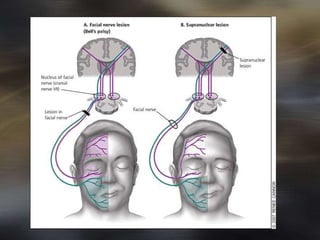
 Supranuclear and nuclear lesions 
 Infranuclear lesions: 
a. Bell’s palsy 
b. Moebius syndrome 
c. Acute and chronic otitis media 
 Multiple 
a. Trauma 
b. Tumors
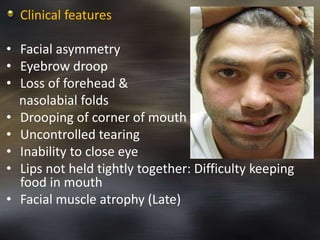
Clinical features 
• Facial asymmetry 
• Eyebrow droop 
• Loss of forehead & 
nasolabial folds 
• Drooping of corner of mouth 
• Uncontrolled tearing 
• Inability to close eye 
• Lips not held tightly together: Difficulty keeping 
food in mouth 
• Facial muscle atrophy (Late)
An idiopathic sudden onset of 
facial paralys,is the most common 
cause of acute facial nerve paralysis 
(>80%).it has been recently linked to 
herpes simplex infection.Other conditions that 
may cause Bell's palsy include: 
 HIV infection 
 Lyme disease 
 Middle ear infection 
 Sarcoidosis
Patients who develop Bell’s palsy fall into three 
groups: 
1. 85% of individuals completely recover from the 
Bell’s palsy. 
2. 10% of individuals have partial facial weakness. 
3. 5% of the patients have complete facial paralysis
Onset 
Paralysis: Progresses to maximal deficit over 3 
to 72 hours 
Pain (50%): Near mastoid process 
Excess tearing (33%) 
Other: Hyperacusis; Dysgeusia
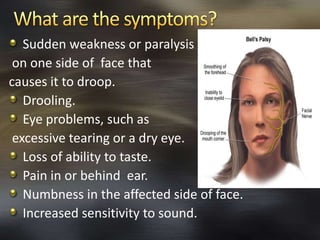
Sudden weakness or paralysis 
on one side of face that 
causes it to droop. 
Drooling. 
Eye problems, such as 
excessive tearing or a dry eye. 
Loss of ability to taste. 
Pain in or behind ear. 
Numbness in the affected side of face. 
Increased sensitivity to sound.
Primary viral infection (herpes)
 Early treatment (within 3 days after the onset) is 
necessary for therapy to be effective. 
 Steroid: Corticosteroid such as prednisone 
 Antiviral :(such as acyclovir) 
 Surgery 
 Physiotherapy
 Facial exercises. 
 Eye care. A dry eye can lead to sores and serious 
vision problems. To help protect the eye and 
keep it moist: 
 Use your finger to close and open your eyelid 
often throughout the day. 
 Use eye drops ("artificial tears") or ointment. 
Wear an eye patch , and wear glasses. 
 Mouth care. Brush and floss your teeth often 
and eat soft foods.
Facial nerve paralysis

Facial nerve paralysis

  • 1.
  • 2.
    Facial nerve paralysisis a common problem that involves the paralysis of any structures innervated by the facial nerve. The pathway of the facial nerve is long and relatively convoluted, and so there are a number of causes that may result in facial nerve paralysis.
  • 3.
     Supranuclear andnuclear lesions  Infranuclear lesions: a. Bell’s palsy b. Moebius syndrome c. Acute and chronic otitis media  Multiple a. Trauma b. Tumors
  • 5.
    Clinical features •Facial asymmetry • Eyebrow droop • Loss of forehead & nasolabial folds • Drooping of corner of mouth • Uncontrolled tearing • Inability to close eye • Lips not held tightly together: Difficulty keeping food in mouth • Facial muscle atrophy (Late)
  • 6.
    An idiopathic suddenonset of facial paralys,is the most common cause of acute facial nerve paralysis (>80%).it has been recently linked to herpes simplex infection.Other conditions that may cause Bell's palsy include:  HIV infection  Lyme disease  Middle ear infection  Sarcoidosis
  • 7.
    Patients who developBell’s palsy fall into three groups: 1. 85% of individuals completely recover from the Bell’s palsy. 2. 10% of individuals have partial facial weakness. 3. 5% of the patients have complete facial paralysis
  • 8.
    Onset Paralysis: Progressesto maximal deficit over 3 to 72 hours Pain (50%): Near mastoid process Excess tearing (33%) Other: Hyperacusis; Dysgeusia
  • 9.
    Sudden weakness orparalysis on one side of face that causes it to droop. Drooling. Eye problems, such as excessive tearing or a dry eye. Loss of ability to taste. Pain in or behind ear. Numbness in the affected side of face. Increased sensitivity to sound.
  • 10.
  • 11.
     Early treatment(within 3 days after the onset) is necessary for therapy to be effective.  Steroid: Corticosteroid such as prednisone  Antiviral :(such as acyclovir)  Surgery  Physiotherapy
  • 12.
     Facial exercises.  Eye care. A dry eye can lead to sores and serious vision problems. To help protect the eye and keep it moist:  Use your finger to close and open your eyelid often throughout the day.  Use eye drops ("artificial tears") or ointment. Wear an eye patch , and wear glasses.  Mouth care. Brush and floss your teeth often and eat soft foods.