Lisa Colton Founder and President Darim Online [email_address]   434.977.1170 101 An Introduction to Social  Networking and Facebook
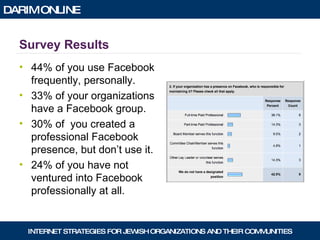
Survey Results 44% of you use Facebook frequently, personally. 33% of your organizations have a Facebook group. 30% of  you created a professional Facebook presence, but don’t use it.  24% of you have not ventured into Facebook professionally at all.
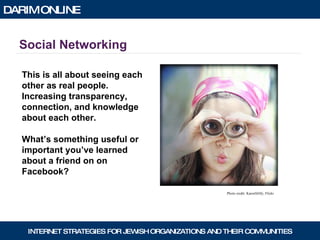
Social Networking This is all about seeing each other as real people. Increasing transparency,  connection, and knowledge  about each other. What’s something useful or  important you’ve learned  about a friend on on  Facebook? Photo credit: KarenSJilly, Flickr
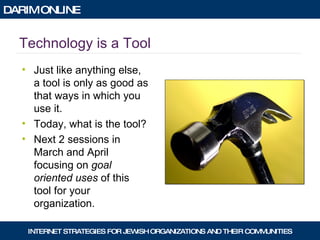
Technology is a Tool Just like anything else, a tool is only as good as that ways in which you use it. Today, what is the tool? Next 2 sessions in March and April focusing on  goal oriented uses  of this tool for your organization.
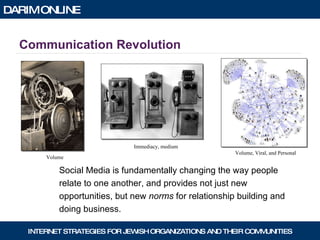
Communication Revolution Social Media is fundamentally changing the way people  relate to one another, and provides not just new  opportunities, but new  norms  for relationship building and  doing business. Volume Immediacy, medium Volume, Viral, and Personal
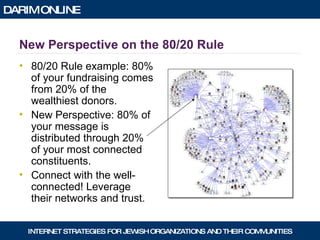
New Perspective on the 80/20 Rule 80/20 Rule example: 80% of your fundraising comes from 20% of the wealthiest donors. New Perspective: 80% of your message is distributed through 20% of your most connected constituents. Connect with the well-connected! Leverage their networks and trust.
What Is Social Media? The Term “Social Media” refers to online tools (web sites) that depend  on user contributions and interactions between people to build shared  meaning and value.  It is: Participatory : It blurs the line between media and audience.  Open and Democratic:  Everyone has a voice.  For this reason content is seen as authentic and trustworthy, coming from a trusted  person . Conversational:  Two (or more) way conversation between  people  rather than one-directional broadcast from an  institution .  Communal:  Supports formation, growth and strength of communities around a particular shared interest. Connected:  Thrives on being connected, making use of links to other sites, resources and people, rather than being territorial and proprietary. Facebook is especially successful because it is so “sticky”, meaning users come back to the site frequently.
More than 170 million active users  (“active” means have been to the site in the last 30 days) More than half outside of college More than 15 million update at least once/day Approx. 45% of active users visit at least once/week Average user has 120 friends Able to write in Hebrew  (& many other languages!) Over 55,000 applications Including hundreds of  Hebrew/Jewish applications Adding 600,000 new users/day And… GROWING
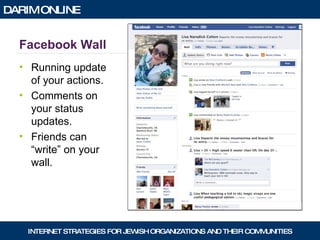
Facebook Wall Running update of your actions. Comments on your status updates. Friends can “write” on your wall.
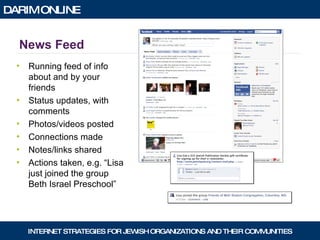
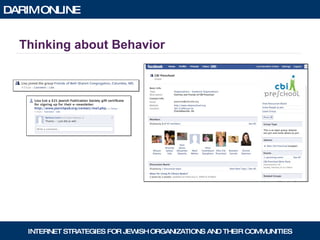
News Feed Running feed of info about and by your friends Status updates, with comments Photos/videos posted Connections made Notes/links shared Actions taken, e.g. “Lisa just joined the group Beth Israel Preschool”
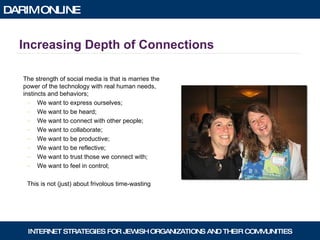
Increasing Depth of Connections The strength of social media is that is marries the power of the technology with real human needs, instincts and behaviors; We want to express ourselves; We want to be heard; We want to connect with other people; We want to collaborate; We want to be productive; We want to be reflective; We want to trust those we connect with; We want to feel in control; This is not (just) about frivolous time-wasting
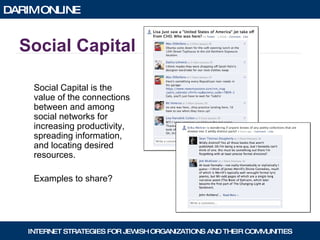
Social Capital Social Capital is the value of the connections between and among social networks for increasing productivity, spreading information, and locating desired resources. Examples to share?
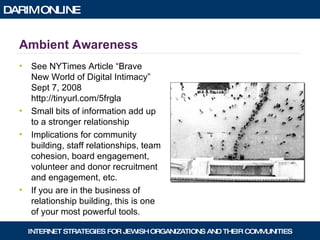
Ambient Awareness See NYTimes Article “Brave New World of Digital Intimacy” Sept 7, 2008  http://tinyurl.com/5frgla Small bits of information add up to a stronger relationship Implications for community building, staff relationships, team cohesion, board engagement, volunteer and donor recruitment and engagement, etc. If you are in the business of relationship building, this is one of your most powerful tools.
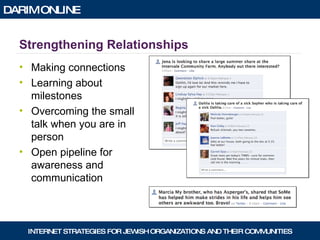
Strengthening Relationships Making connections Learning about milestones Overcoming the small talk when you are in person Open pipeline for awareness and communication
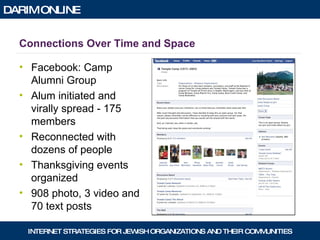
Connections Over Time and Space Facebook: Camp Alumni Group Alum initiated and virally spread - 175 members Reconnected with dozens of people Thanksgiving events organized 908 photo, 3 video and 70 text posts
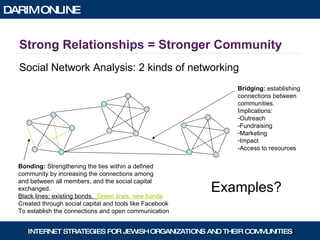
Strong Relationships = Stronger Community Social Network Analysis: 2 kinds of networking Bonding:  Strengthening the ties within a defined  community by increasing the connections among  and between all members, and the social capital  exchanged. Black lines: existing bonds.  Green lines: new bonds   Created through social capital and tools like Facebook  To establish the connections and open communication Bridging:  establishing  connections between  communities.  Implications: Outreach -Fundraising Marketing Impact Access to resources Examples?
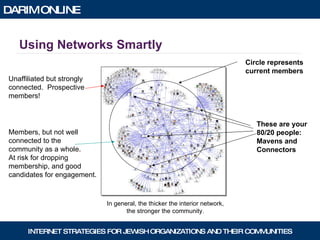
Using Networks Smartly Unaffiliated but strongly connected.  Prospective  members! Members, but not well  connected to the  community as a whole.  At risk for dropping  membership, and good  candidates for engagement. These are your 80/20 people: Mavens and  Connectors Circle represents current members In general, the thicker the interior network, the stronger the community.
Thinking about Behavior
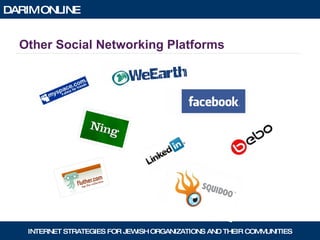
Other Social Networking Platforms
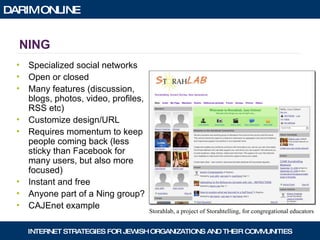
NING Specialized social networks Open or closed Many features (discussion, blogs, photos, video, profiles, RSS etc) Customize design/URL Requires momentum to keep people coming back (less sticky than Facebook for many users, but also more focused) Instant and free Anyone part of a Ning group? CAJEnet example Storahlab, a project of Storahtelling, for congregational educators
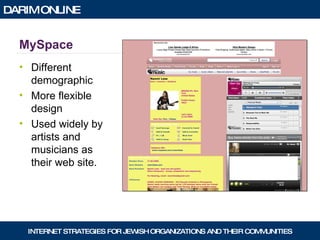
MySpace Different demographic More flexible design Used widely by artists and musicians as their web site.
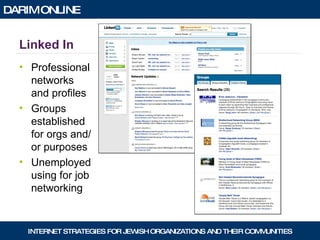
Linked In Professional networks and profiles Groups established for orgs and/or purposes Unemployed using for job networking
Facebook Webinar Series FACEBOOK 101: An intro to social networking and Facebook Tuesday, February 17, 3:00-4:00pm EASTERN or Wednesday, February 18, 1:00-2:00pm EASTERN FACEBOOK PAGES, GROUPS, AND CAUSES, OH MY!: Understanding Community on Facebook Wednesday, March 18, 1:00-2:00pm EASTERN or Thursday, March 19, 3:00-4:00pm EASTERN FACEBOOK POLICIES FOR ORGS & CONGREGATIONAL LEADERSHIP: Guidelines and issues to consider Thursday, April 23, 3:00-4:00 PM EASTERN or Friday, April 24, 1:00-2:00 PM EASTERN Many sessions are already full. We are considering adding additional dates.
Q/A and Discussion Your experiences Successes? Frustrations? Questions?

Facebook101

  • 1.
    Lisa Colton Founderand President Darim Online [email_address] 434.977.1170 101 An Introduction to Social Networking and Facebook
  • 2.
    Survey Results 44%of you use Facebook frequently, personally. 33% of your organizations have a Facebook group. 30% of you created a professional Facebook presence, but don’t use it. 24% of you have not ventured into Facebook professionally at all.
  • 3.
    Social Networking Thisis all about seeing each other as real people. Increasing transparency, connection, and knowledge about each other. What’s something useful or important you’ve learned about a friend on on Facebook? Photo credit: KarenSJilly, Flickr
  • 4.
    Technology is aTool Just like anything else, a tool is only as good as that ways in which you use it. Today, what is the tool? Next 2 sessions in March and April focusing on goal oriented uses of this tool for your organization.
  • 5.
    Communication Revolution SocialMedia is fundamentally changing the way people relate to one another, and provides not just new opportunities, but new norms for relationship building and doing business. Volume Immediacy, medium Volume, Viral, and Personal
  • 6.
    New Perspective onthe 80/20 Rule 80/20 Rule example: 80% of your fundraising comes from 20% of the wealthiest donors. New Perspective: 80% of your message is distributed through 20% of your most connected constituents. Connect with the well-connected! Leverage their networks and trust.
  • 7.
    What Is SocialMedia? The Term “Social Media” refers to online tools (web sites) that depend on user contributions and interactions between people to build shared meaning and value. It is: Participatory : It blurs the line between media and audience. Open and Democratic: Everyone has a voice. For this reason content is seen as authentic and trustworthy, coming from a trusted person . Conversational: Two (or more) way conversation between people rather than one-directional broadcast from an institution . Communal: Supports formation, growth and strength of communities around a particular shared interest. Connected: Thrives on being connected, making use of links to other sites, resources and people, rather than being territorial and proprietary. Facebook is especially successful because it is so “sticky”, meaning users come back to the site frequently.
  • 8.
    More than 170million active users (“active” means have been to the site in the last 30 days) More than half outside of college More than 15 million update at least once/day Approx. 45% of active users visit at least once/week Average user has 120 friends Able to write in Hebrew (& many other languages!) Over 55,000 applications Including hundreds of Hebrew/Jewish applications Adding 600,000 new users/day And… GROWING
  • 9.
    Facebook Wall Runningupdate of your actions. Comments on your status updates. Friends can “write” on your wall.
  • 10.
    News Feed Runningfeed of info about and by your friends Status updates, with comments Photos/videos posted Connections made Notes/links shared Actions taken, e.g. “Lisa just joined the group Beth Israel Preschool”
  • 11.
    Increasing Depth ofConnections The strength of social media is that is marries the power of the technology with real human needs, instincts and behaviors; We want to express ourselves; We want to be heard; We want to connect with other people; We want to collaborate; We want to be productive; We want to be reflective; We want to trust those we connect with; We want to feel in control; This is not (just) about frivolous time-wasting
  • 12.
    Social Capital SocialCapital is the value of the connections between and among social networks for increasing productivity, spreading information, and locating desired resources. Examples to share?
  • 13.
    Ambient Awareness SeeNYTimes Article “Brave New World of Digital Intimacy” Sept 7, 2008 http://tinyurl.com/5frgla Small bits of information add up to a stronger relationship Implications for community building, staff relationships, team cohesion, board engagement, volunteer and donor recruitment and engagement, etc. If you are in the business of relationship building, this is one of your most powerful tools.
  • 14.
    Strengthening Relationships Makingconnections Learning about milestones Overcoming the small talk when you are in person Open pipeline for awareness and communication
  • 15.
    Connections Over Timeand Space Facebook: Camp Alumni Group Alum initiated and virally spread - 175 members Reconnected with dozens of people Thanksgiving events organized 908 photo, 3 video and 70 text posts
  • 16.
    Strong Relationships =Stronger Community Social Network Analysis: 2 kinds of networking Bonding: Strengthening the ties within a defined community by increasing the connections among and between all members, and the social capital exchanged. Black lines: existing bonds. Green lines: new bonds Created through social capital and tools like Facebook To establish the connections and open communication Bridging: establishing connections between communities. Implications: Outreach -Fundraising Marketing Impact Access to resources Examples?
  • 17.
    Using Networks SmartlyUnaffiliated but strongly connected. Prospective members! Members, but not well connected to the community as a whole. At risk for dropping membership, and good candidates for engagement. These are your 80/20 people: Mavens and Connectors Circle represents current members In general, the thicker the interior network, the stronger the community.
  • 18.
  • 19.
  • 20.
    NING Specialized socialnetworks Open or closed Many features (discussion, blogs, photos, video, profiles, RSS etc) Customize design/URL Requires momentum to keep people coming back (less sticky than Facebook for many users, but also more focused) Instant and free Anyone part of a Ning group? CAJEnet example Storahlab, a project of Storahtelling, for congregational educators
  • 21.
    MySpace Different demographicMore flexible design Used widely by artists and musicians as their web site.
  • 22.
    Linked In Professionalnetworks and profiles Groups established for orgs and/or purposes Unemployed using for job networking
  • 23.
    Facebook Webinar SeriesFACEBOOK 101: An intro to social networking and Facebook Tuesday, February 17, 3:00-4:00pm EASTERN or Wednesday, February 18, 1:00-2:00pm EASTERN FACEBOOK PAGES, GROUPS, AND CAUSES, OH MY!: Understanding Community on Facebook Wednesday, March 18, 1:00-2:00pm EASTERN or Thursday, March 19, 3:00-4:00pm EASTERN FACEBOOK POLICIES FOR ORGS & CONGREGATIONAL LEADERSHIP: Guidelines and issues to consider Thursday, April 23, 3:00-4:00 PM EASTERN or Friday, April 24, 1:00-2:00 PM EASTERN Many sessions are already full. We are considering adding additional dates.
  • 24.
    Q/A and DiscussionYour experiences Successes? Frustrations? Questions?