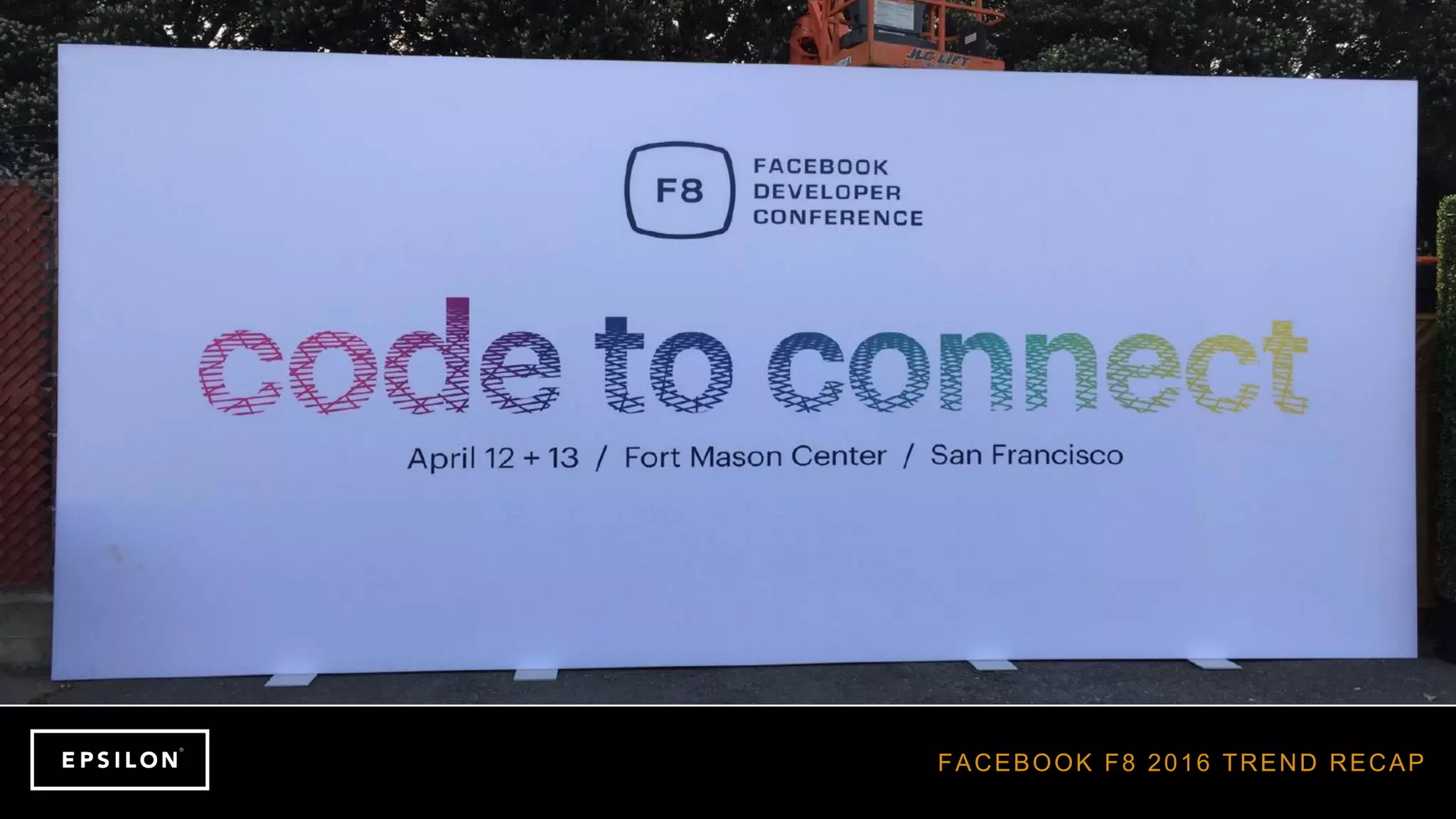
FACEBOOK F8 2016 TREND RECAP
FACEBOOK F8 2016 OVERVIEW
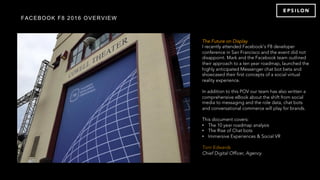
The Future on Display
I recently attended Facebook’s F8 developer
conference in San Francisco and the event did not
disappoint. Mark and the Facebook team outlined
their approach to a ten year roadmap, launched the
highly anticipated Messenger chat bot beta and
showcased their first concepts of a social virtual
reality experience.
In addition to this POV our team has also written a
comprehensive eBook about the shift from social
media to messaging and the role data, chat bots
and conversational commerce will play for brands.
This document covers:
•  The 10 year roadmap analysis
•  The Rise of Chat bots
•  Immersive Experiences & Social VR
 
Tom Edwards
Chief Digital Officer, Agency
 
0301
T H E 1 0 Y E A R
R O A D M A P
I M M E R S I V E
E X P E R I E N C E S
02
M E S S E N G E R B E T A
( C H A T B O T S )
01
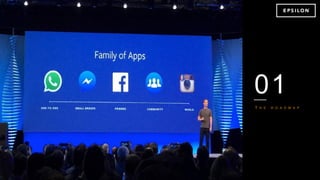
T H E R O A D M A P
APPROACH TO PRODUCT LIFECYCLE
01
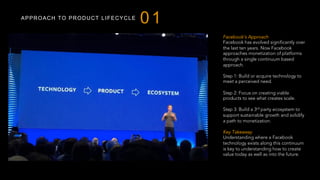
Facebook’s Approach
Facebook has evolved significantly over
the last ten years. Now Facebook
approaches monetization of platforms
through a single continuum based
approach.
Step 1: Build or acquire technology to
meet a perceived need.
Step 2: Focus on creating viable
products to see what creates scale.
Step 3: Build a 3rd party ecosystem to
support sustainable growth and solidify
a path to monetization.
Key Takeaway
Understanding where a Facebook
technology exists along this continuum
is key to understanding how to create
value today as well as into the future.
STAYING POWER
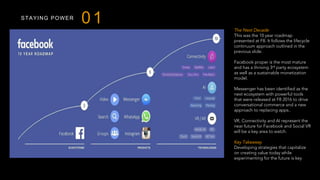
01 The Next Decade
This was the 10 year roadmap
presented at F8. It follows the lifecycle
continuum approach outlined in the
previous slide.
Facebook proper is the most mature
and has a thriving 3rd party ecosystem
as well as a sustainable monetization
model.
Messenger has been identified as the
next ecosystem with powerful tools
that were released at F8 2016 to drive
conversational commerce and a new
approach to replacing apps..
VR, Connectivity and AI represent the
near future for Facebook and Social VR
will be a key area to watch.
Key Takeaway
Developing strategies that capitalize
on creating value today while
experimenting for the future is key
FACEBOOK PROPER
01
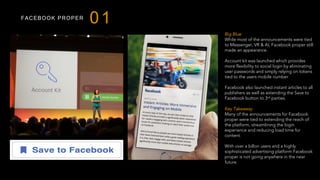
Big Blue
While most of the announcements were tied
to Messenger, VR & AI, Facebook proper still
made an appearance.
Account kit was launched which provides
more flexibility to social login by eliminating
user passwords and simply relying on tokens
tied to the users mobile number
Facebook also launched instant articles to all
publishers as well as extending the Save to
Facebook button to 3rd parties.
Key Takeaway
Many of the announcements for Facebook
proper were tied to extending the reach of
the platform, streamlining the login
experience and reducing load time for
content.
With over a billon users and a highly
sophisticated advertising platform Facebook
proper is not going anywhere in the near
future.
VIDEO
01
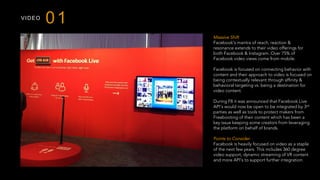
Massive Shift
Facebook’s mantra of reach, reaction &
resonance extends to their video offerings for
both Facebook & Instagram. Over 75% of
Facebook video views come from mobile.
Facebook is focused on connecting behavior with
content and their approach to video is focused on
being contextually relevant through affinity &
behavioral targeting vs. being a destination for
video content.
During F8 it was announced that Facebook Live
API’s would now be open to be integrated by 3rd
parties as well as tools to protect makers from
Freebooting of their content which has been a
key issue keeping some creators from leveraging
the platform on behalf of brands.
Points to Consider
Facebook is heavily focused on video as a staple
of the next few years. This includes 360 degree
video support, dynamic streaming of VR content
and more API’s to support further integration.
MESSENGER
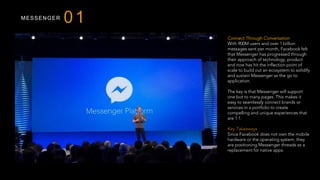
Connect Through Conversation
With 900M users and over 1 billion
messages sent per month, Facebook felt
that Messenger has progressed through
their approach of technology, product
and now has hit the inflection point of
scale to build out an ecosystem to solidify
and sustain Messenger as the go to
application.
The key is that Messenger will support
one bot to many pages. This makes it
easy to seamlessly connect brands or
services in a portfolio to create
compelling and unique experiences that
are 1:1.
 
Key Takeaways
Since Facebook does not own the mobile
hardware or the operating system, they
are positioning Messenger threads as a
replacement for native apps.
01
CONNECTIVITY
01
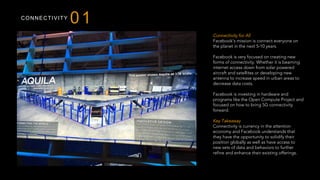
Connectivity for All
Facebook’s mission is connect everyone on
the planet in the next 5-10 years.
Facebook is very focused on creating new
forms of connectivity. Whether it is beaming
internet access down from solar powered
aircraft and satellites or developing new
antenna to increase speed in urban areas to
decrease data costs.
Facebook is investing in hardware and
programs like the Open Compute Project and
focused on how to bring 5G connectivity
forward.
Key Takeaway
Connectivity is currency in the attention
economy and Facebook understands that
they have the opportunity to solidify their
position globally as well as have access to
new sets of data and behaviors to further
refine and enhance their existing offerings.
ARTIFICIAL INTELLIGENCE
01
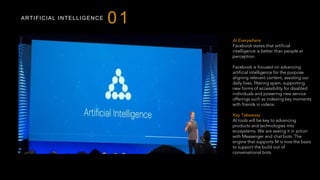
AI Everywhere
Facebook states that artificial
intelligence is better than people at
perception.
Facebook is focused on advancing
artificial intelligence for the purpose
aligning relevant content, assisting our
daily lives, filtering spam, supporting
new forms of accessibility for disabled
individuals and powering new service
offerings such as indexing key moments
with friends in videos.
Key Takeaway
AI tools will be key to advancing
products and technologies into
ecosystems. We are seeing it in action
with Messenger and chat bots. The
engine that supports M is now the basis
to support the build out of
conversational bots.
VIRTUAL & AUGMENTED REALITY
01
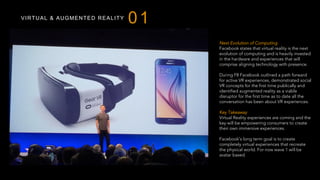
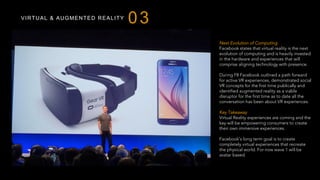
Next Evolution of Computing
Facebook states that virtual reality is the next
evolution of computing and is heavily invested
in the hardware and experiences that will
comprise aligning technology with presence.
During F8 Facebook outlined a path forward
for active VR experiences, demonstrated social
VR concepts for the first time publically and
identified augmented reality as a viable
disruptor for the first time as to date all the
conversation has been about VR experiences.
Key Takeaway
Virtual Reality experiences are coming and the
key will be empowering consumers to create
their own immersive experiences.
Facebook’s long term goal is to create
completely virtual experiences that recreate
the physical world. For now wave 1 will be
avatar based.
HARDWARE & OPEN PLATFORMS
01
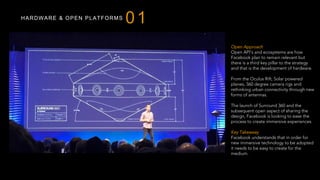
Open Approach
Open API’s and ecosystems are how
Facebook plan to remain relevant but
there is a third key pillar to the strategy
and that is the development of hardware.
From the Oculus Rift, Solar powered
planes, 360 degree camera rigs and
rethinking urban connectivity through new
forms of antennas.
The launch of Surround 360 and the
subsequent open aspect of sharing the
design, Facebook is looking to ease the
process to create immersive experiences.
Key Takeaway
Facebook understands that in order for
new immersive technology to be adopted
it needs to be easy to create for the
medium.
02
R I S E O F
C H A T B O T S
WHY MESSENGER?
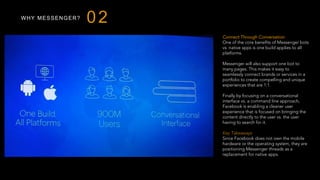
Connect Through Conversation
One of the core benefits of Messenger bots
vs. native apps is one build applies to all
platforms.
Messenger will also support one bot to
many pages. This makes it easy to
seamlessly connect brands or services in a
portfolio to create compelling and unique
experiences that are 1:1.
Finally by focusing on a conversational
interface vs. a command line approach,
Facebook is enabling a cleaner user
experience that is focused on bringing the
content directly to the user vs. the user
having to search for it.
 
Key Takeaways
Since Facebook does not own the mobile
hardware or the operating system, they are
positioning Messenger threads as a
replacement for native apps.
02
CONVERSATIONAL COMMERCE
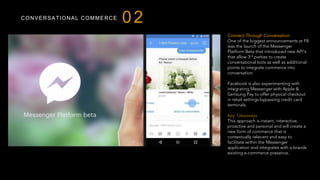
Connect Through Conversation
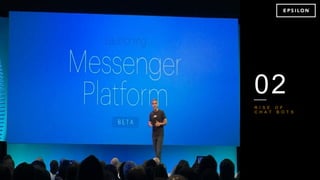
One of the biggest announcements at F8
was the launch of the Messenger
Platform Beta that introduced new API’s
that allow 3rd parties to create
conversational bots as well as additional
points to integrate commerce into
conversation.
Facebook is also experimenting with
integrating Messenger with Apple &
Samsung Pay to offer physical checkout
in retail settings bypassing credit card
terminals.
 
Key Takeaways
This approach is instant, interactive,
proactive and personal and will create a
new form of commerce that is
contextually relevant and easy to
facilitate within the Messenger
application and integrates with a brands
existing e-commerce presence.
02
SEND & RECEIVE API
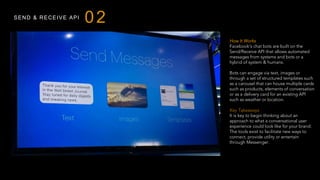
How It Works
Facebook’s chat bots are built on the
Send/Receive API that allows automated
messages from systems and bots or a
hybrid of system & humans.
Bots can engage via text, images or
through a set of structured templates such
as a carousel that can house multiple cards
such as products, elements of conversation
or as a delivery card for an existing API
such as weather or location.
Key Takeaways
It is key to begin thinking about an
approach to what a conversational user
experience could look like for your brand.
The tools exist to facilitate new ways to
connect, provide utility or entertain
through Messenger.
 
02
WIT.AI
Building in Conversation
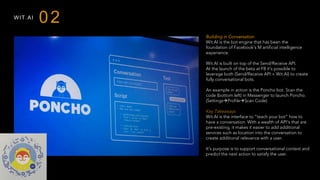
Wit.AI is the bot engine that has been the
foundation of Facebook’s M artificial intelligence
experience.
Wit.AI is built on top of the Send/Receive API.
At the launch of the beta at F8 it’s possible to
leverage both (Send/Receive API + Wit.AI) to create
fully conversational bots.
An example in action is the Poncho bot. Scan the
code (bottom left) in Messenger to launch Poncho.
(SettingsàProfileàScan Code)
 
Key Takeaways
Wit.AI is the interface to “teach your bot” how to
have a conversation. With a wealth of API’s that are
pre-existing, it makes it easier to add additional
services such as location into the conversation to
create additional relevance with a user.
It’s purpose is to support conversational context and
predict the next action to satisfy the user.
02
DISCOVERY
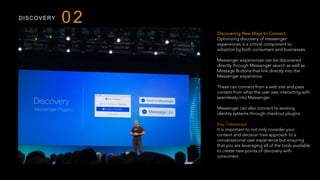
Discovering New Ways to Connect
Optimizing discovery of messenger
experiences is a critical component to
adoption by both consumers and businesses.
Messenger experiences can be discovered
directly through Messenger search as well as
Message Buttons that link directly into the
Messenger experience.
These can connect from a web site and pass
context from what the user was interacting with
seamlessly into Messenger.
Messenger can also connect to existing
identity systems through checkout plugins.
 
Key Takeaways
It is important to not only consider your
content and decision tree approach to a
conversational user experience but ensuring
that you are leveraging all of the tools available
to create new points of discovery with
consumers.
 
02
PROMOTION
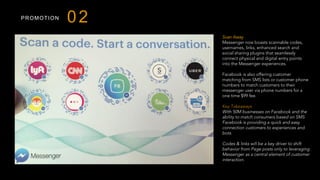
Scan Away
Messenger now boasts scannable codes,
usernames, links, enhanced search and
social sharing plugins that seamlessly
connect physical and digital entry points
into the Messenger experiences.
Facebook is also offering customer
matching from SMS lists or customer phone
numbers to match customers to their
messenger user via phone numbers for a
one time $99 fee.
 
Key Takeaways
With 50M businesses on Facebook and the
ability to match consumers based on SMS
Facebook is providing a quick and easy
connection customers to experiences and
bots.
Codes & links will be a key driver to shift
behavior from Page posts only to leveraging
Messenger as a central element of customer
interaction.
 
02
ADVERTISING
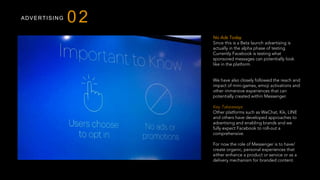
No Ads Today
Since this is a Beta launch advertising is
actually in the alpha phase of testing.
Currently Facebook is testing what
sponsored messages can potentially look
like in the platform.
We have also closely followed the reach and
impact of mini-games, emoji activations and
other immersive experiences that can
potentially created within Messenger.
 
Key Takeaways
Other platforms such as WeChat, Kik, LINE
and others have developed approaches to
advertising and enabling brands and we
fully expect Facebook to roll-out a
comprehensive.
For now the role of Messenger is to have/
create organic, personal experiences that
either enhance a product or service or as a
delivery mechanism for branded content.
 
02
Epsilon eBook
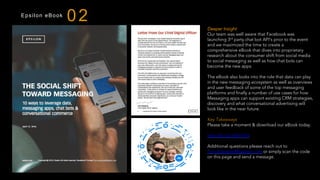
Deeper Insight
Our team was well aware that Facebook was
launching 3rd party chat bot API’s prior to the event
and we maximized the time to create a
comprehensive eBook that dives into proprietary
research about the consumer shift from social media
to social messaging as well as how chat bots can
become the new apps.
The eBook also looks into the role that data can play
in the new messaging ecosystem as well as overviews
and user feedback of some of the top messaging
platforms and finally a number of use cases for how
Messaging apps can support existing CRM strategies,
discovery and what conversational advertising will
look like in the near future.
 
Key Takeaways
Please take a moment & download our eBook today.
http://bit.ly/1MsF14A
Additional questions please reach out to
Tom.Edwards@Epsilon.com or simply scan the code
on this page and send a message.
 
02
03
I M M E R S I V E
E X P E R I E N C E S
VIRTUAL & AUGMENTED REALITY
03
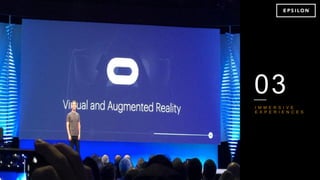
Next Evolution of Computing
Facebook states that virtual reality is the next
evolution of computing and is heavily invested
in the hardware and experiences that will
comprise aligning technology with presence.
During F8 Facebook outlined a path forward
for active VR experiences, demonstrated social
VR concepts for the first time publically and
identified augmented reality as a viable
disruptor for the first time as to date all the
conversation has been about VR experiences.
Key Takeaway
Virtual Reality experiences are coming and the
key will be empowering consumers to create
their own immersive experiences.
Facebook’s long term goal is to create
completely virtual experiences that recreate
the physical world. For now wave 1 will be
avatar based.
PASSIVE TO ACTIVE
03
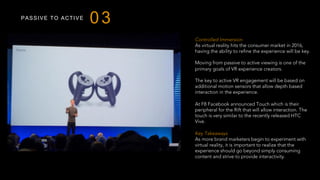
Controlled Immersion
As virtual reality hits the consumer market in 2016,
having the ability to refine the experience will be key.
Moving from passive to active viewing is one of the
primary goals of VR experience creators.
The key to active VR engagement will be based on
additional motion sensors that allow depth based
interaction in the experience.
At F8 Facebook announced Touch which is their
peripheral for the Rift that will allow interaction. The
touch is very similar to the recently released HTC
Vive.
 
Key Takeaways
As more brand marketers begin to experiment with
virtual reality, it is important to realize that the
experience should go beyond simply consuming
content and strive to provide interactivity.
GEAR VR
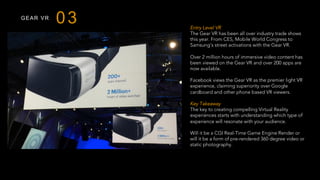
03 Entry Level VR
The Gear VR has been all over industry trade shows
this year. From CES, Mobile World Congress to
Samsung’s street activations with the Gear VR.
Over 2 million hours of immersive video content has
been viewed on the Gear VR and over 200 apps are
now available.
Facebook views the Gear VR as the premier light VR
experience, claiming superiority over Google
cardboard and other phone based VR viewers.
Key Takeaway
The key to creating compelling Virtual Reality
experiences starts with understanding which type of
experience will resonate with your audience.
Will it be a CGI Real-Time Game Engine Render or
will it be a form of pre-rendered 360 degree video or
static photography.
SOCIAL VR – EXPERIMENTS
03
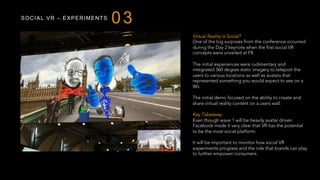
Virtual Reality is Social?
One of the big surprises from the conference occurred
during the Day 2 keynote when the first social VR
concepts were unveiled at F8.
The initial experiences were rudimentary and
integrated 360 degree static imagery to teleport the
users to various locations as well as avatars that
represented something you would expect to see on a
Wii.
The initial demo focused on the ability to create and
share virtual reality content on a users wall.
Key Takeaway
Even though wave 1 will be heavily avatar driven
Facebook made it very clear that VR has the potential
to be the most social platform.
It will be important to monitor how social VR
experiments progress and the role that brands can play
to further empower consumers.
SOCIAL VR – FUTURE
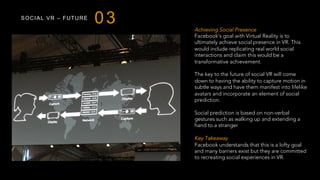
03 Achieving Social Presence
Facebook’s goal with Virtual Reality is to
ultimately achieve social presence in VR. This
would include replicating real world social
interactions and claim this would be a
transformative achievement.
The key to the future of social VR will come
down to having the ability to capture motion in
subtle ways and have them manifest into lifelike
avatars and incorporate an element of social
prediction.
Social prediction is based on non-verbal
gestures such as walking up and extending a
hand to a stranger
Key Takeaway
Facebook understands that this is a lofty goal
and many barriers exist but they are committed
to recreating social experiences in VR.
VIRTUAL & AUGMENTED REALITY
03
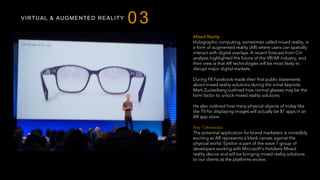
Mixed Reality
Holographic computing, sometimes called mixed reality, is
a form of augmented reality (AR) where users can spatially
interact with digital overlays. A recent forecast from Citi
analysts highlighted the future of the VR/AR industry, and
their view is that AR technologies will be most likely to
disrupt major digital markets.
 
During F8 Facebook made their first public statements
about mixed reality solutions during the initial keynote.
Mark Zuckerberg outlined how normal glasses may be the
form factor to unlock mixed reality solutions.
He also outlined how many physical objects of today like
the TV for displaying images will actually be $1 apps in an
AR app store.
 
Key Takeaways
The potential application for brand marketers is incredibly
exciting as AR represents a blank canvas against the
physical world. Epsilon is part of the wave 1 group of
developers working with Microsoft’s Hololens Mixed
reality device and will be bringing mixed reality solutions
to our clients as the platforms evolve.
T H A N K Y O U . Q U E S T I O N S A B O U T F 8 2 0 1 6 ?
C O N T A C T T O M E D W A R D S , C H I E F D I G I T A L O F F I C E R , A G E N C Y
E - M A I L : T O M . E D W A R D S @ E P S I L O N . C O M

Facebook F8 2016 Trend Recap

  • 1.
    FACEBOOK F8 2016TREND RECAP
  • 2.
    FACEBOOK F8 2016OVERVIEW The Future on Display I recently attended Facebook’s F8 developer conference in San Francisco and the event did not disappoint. Mark and the Facebook team outlined their approach to a ten year roadmap, launched the highly anticipated Messenger chat bot beta and showcased their first concepts of a social virtual reality experience. In addition to this POV our team has also written a comprehensive eBook about the shift from social media to messaging and the role data, chat bots and conversational commerce will play for brands. This document covers: •  The 10 year roadmap analysis •  The Rise of Chat bots •  Immersive Experiences & Social VR   Tom Edwards Chief Digital Officer, Agency  
  • 3.
    0301 T H E1 0 Y E A R R O A D M A P I M M E R S I V E E X P E R I E N C E S 02 M E S S E N G E R B E T A ( C H A T B O T S )
  • 4.
    01 T H ER O A D M A P
  • 5.
    APPROACH TO PRODUCTLIFECYCLE 01 Facebook’s Approach Facebook has evolved significantly over the last ten years. Now Facebook approaches monetization of platforms through a single continuum based approach. Step 1: Build or acquire technology to meet a perceived need. Step 2: Focus on creating viable products to see what creates scale. Step 3: Build a 3rd party ecosystem to support sustainable growth and solidify a path to monetization. Key Takeaway Understanding where a Facebook technology exists along this continuum is key to understanding how to create value today as well as into the future.
  • 6.
    STAYING POWER 01 TheNext Decade This was the 10 year roadmap presented at F8. It follows the lifecycle continuum approach outlined in the previous slide. Facebook proper is the most mature and has a thriving 3rd party ecosystem as well as a sustainable monetization model. Messenger has been identified as the next ecosystem with powerful tools that were released at F8 2016 to drive conversational commerce and a new approach to replacing apps.. VR, Connectivity and AI represent the near future for Facebook and Social VR will be a key area to watch. Key Takeaway Developing strategies that capitalize on creating value today while experimenting for the future is key
  • 7.
    FACEBOOK PROPER 01 Big Blue Whilemost of the announcements were tied to Messenger, VR & AI, Facebook proper still made an appearance. Account kit was launched which provides more flexibility to social login by eliminating user passwords and simply relying on tokens tied to the users mobile number Facebook also launched instant articles to all publishers as well as extending the Save to Facebook button to 3rd parties. Key Takeaway Many of the announcements for Facebook proper were tied to extending the reach of the platform, streamlining the login experience and reducing load time for content. With over a billon users and a highly sophisticated advertising platform Facebook proper is not going anywhere in the near future.
  • 8.
    VIDEO 01 Massive Shift Facebook’s mantraof reach, reaction & resonance extends to their video offerings for both Facebook & Instagram. Over 75% of Facebook video views come from mobile. Facebook is focused on connecting behavior with content and their approach to video is focused on being contextually relevant through affinity & behavioral targeting vs. being a destination for video content. During F8 it was announced that Facebook Live API’s would now be open to be integrated by 3rd parties as well as tools to protect makers from Freebooting of their content which has been a key issue keeping some creators from leveraging the platform on behalf of brands. Points to Consider Facebook is heavily focused on video as a staple of the next few years. This includes 360 degree video support, dynamic streaming of VR content and more API’s to support further integration.
  • 9.
    MESSENGER Connect Through Conversation With900M users and over 1 billion messages sent per month, Facebook felt that Messenger has progressed through their approach of technology, product and now has hit the inflection point of scale to build out an ecosystem to solidify and sustain Messenger as the go to application. The key is that Messenger will support one bot to many pages. This makes it easy to seamlessly connect brands or services in a portfolio to create compelling and unique experiences that are 1:1.   Key Takeaways Since Facebook does not own the mobile hardware or the operating system, they are positioning Messenger threads as a replacement for native apps. 01
  • 10.
    CONNECTIVITY 01 Connectivity for All Facebook’smission is connect everyone on the planet in the next 5-10 years. Facebook is very focused on creating new forms of connectivity. Whether it is beaming internet access down from solar powered aircraft and satellites or developing new antenna to increase speed in urban areas to decrease data costs. Facebook is investing in hardware and programs like the Open Compute Project and focused on how to bring 5G connectivity forward. Key Takeaway Connectivity is currency in the attention economy and Facebook understands that they have the opportunity to solidify their position globally as well as have access to new sets of data and behaviors to further refine and enhance their existing offerings.
  • 11.
    ARTIFICIAL INTELLIGENCE 01 AI Everywhere Facebookstates that artificial intelligence is better than people at perception. Facebook is focused on advancing artificial intelligence for the purpose aligning relevant content, assisting our daily lives, filtering spam, supporting new forms of accessibility for disabled individuals and powering new service offerings such as indexing key moments with friends in videos. Key Takeaway AI tools will be key to advancing products and technologies into ecosystems. We are seeing it in action with Messenger and chat bots. The engine that supports M is now the basis to support the build out of conversational bots.
  • 12.
    VIRTUAL & AUGMENTEDREALITY 01 Next Evolution of Computing Facebook states that virtual reality is the next evolution of computing and is heavily invested in the hardware and experiences that will comprise aligning technology with presence. During F8 Facebook outlined a path forward for active VR experiences, demonstrated social VR concepts for the first time publically and identified augmented reality as a viable disruptor for the first time as to date all the conversation has been about VR experiences. Key Takeaway Virtual Reality experiences are coming and the key will be empowering consumers to create their own immersive experiences. Facebook’s long term goal is to create completely virtual experiences that recreate the physical world. For now wave 1 will be avatar based.
  • 13.
    HARDWARE & OPENPLATFORMS 01 Open Approach Open API’s and ecosystems are how Facebook plan to remain relevant but there is a third key pillar to the strategy and that is the development of hardware. From the Oculus Rift, Solar powered planes, 360 degree camera rigs and rethinking urban connectivity through new forms of antennas. The launch of Surround 360 and the subsequent open aspect of sharing the design, Facebook is looking to ease the process to create immersive experiences. Key Takeaway Facebook understands that in order for new immersive technology to be adopted it needs to be easy to create for the medium.
  • 14.
    02 R I SE O F C H A T B O T S
  • 15.
    WHY MESSENGER? Connect ThroughConversation One of the core benefits of Messenger bots vs. native apps is one build applies to all platforms. Messenger will also support one bot to many pages. This makes it easy to seamlessly connect brands or services in a portfolio to create compelling and unique experiences that are 1:1. Finally by focusing on a conversational interface vs. a command line approach, Facebook is enabling a cleaner user experience that is focused on bringing the content directly to the user vs. the user having to search for it.   Key Takeaways Since Facebook does not own the mobile hardware or the operating system, they are positioning Messenger threads as a replacement for native apps. 02
  • 16.
    CONVERSATIONAL COMMERCE Connect ThroughConversation One of the biggest announcements at F8 was the launch of the Messenger Platform Beta that introduced new API’s that allow 3rd parties to create conversational bots as well as additional points to integrate commerce into conversation. Facebook is also experimenting with integrating Messenger with Apple & Samsung Pay to offer physical checkout in retail settings bypassing credit card terminals.   Key Takeaways This approach is instant, interactive, proactive and personal and will create a new form of commerce that is contextually relevant and easy to facilitate within the Messenger application and integrates with a brands existing e-commerce presence. 02
  • 17.
    SEND & RECEIVEAPI How It Works Facebook’s chat bots are built on the Send/Receive API that allows automated messages from systems and bots or a hybrid of system & humans. Bots can engage via text, images or through a set of structured templates such as a carousel that can house multiple cards such as products, elements of conversation or as a delivery card for an existing API such as weather or location. Key Takeaways It is key to begin thinking about an approach to what a conversational user experience could look like for your brand. The tools exist to facilitate new ways to connect, provide utility or entertain through Messenger.   02
  • 18.
    WIT.AI Building in Conversation Wit.AIis the bot engine that has been the foundation of Facebook’s M artificial intelligence experience. Wit.AI is built on top of the Send/Receive API. At the launch of the beta at F8 it’s possible to leverage both (Send/Receive API + Wit.AI) to create fully conversational bots. An example in action is the Poncho bot. Scan the code (bottom left) in Messenger to launch Poncho. (SettingsàProfileàScan Code)   Key Takeaways Wit.AI is the interface to “teach your bot” how to have a conversation. With a wealth of API’s that are pre-existing, it makes it easier to add additional services such as location into the conversation to create additional relevance with a user. It’s purpose is to support conversational context and predict the next action to satisfy the user. 02
  • 19.
    DISCOVERY Discovering New Waysto Connect Optimizing discovery of messenger experiences is a critical component to adoption by both consumers and businesses. Messenger experiences can be discovered directly through Messenger search as well as Message Buttons that link directly into the Messenger experience. These can connect from a web site and pass context from what the user was interacting with seamlessly into Messenger. Messenger can also connect to existing identity systems through checkout plugins.   Key Takeaways It is important to not only consider your content and decision tree approach to a conversational user experience but ensuring that you are leveraging all of the tools available to create new points of discovery with consumers.   02
  • 20.
    PROMOTION Scan Away Messenger nowboasts scannable codes, usernames, links, enhanced search and social sharing plugins that seamlessly connect physical and digital entry points into the Messenger experiences. Facebook is also offering customer matching from SMS lists or customer phone numbers to match customers to their messenger user via phone numbers for a one time $99 fee.   Key Takeaways With 50M businesses on Facebook and the ability to match consumers based on SMS Facebook is providing a quick and easy connection customers to experiences and bots. Codes & links will be a key driver to shift behavior from Page posts only to leveraging Messenger as a central element of customer interaction.   02
  • 21.
    ADVERTISING No Ads Today Sincethis is a Beta launch advertising is actually in the alpha phase of testing. Currently Facebook is testing what sponsored messages can potentially look like in the platform. We have also closely followed the reach and impact of mini-games, emoji activations and other immersive experiences that can potentially created within Messenger.   Key Takeaways Other platforms such as WeChat, Kik, LINE and others have developed approaches to advertising and enabling brands and we fully expect Facebook to roll-out a comprehensive. For now the role of Messenger is to have/ create organic, personal experiences that either enhance a product or service or as a delivery mechanism for branded content.   02
  • 22.
    Epsilon eBook Deeper Insight Ourteam was well aware that Facebook was launching 3rd party chat bot API’s prior to the event and we maximized the time to create a comprehensive eBook that dives into proprietary research about the consumer shift from social media to social messaging as well as how chat bots can become the new apps. The eBook also looks into the role that data can play in the new messaging ecosystem as well as overviews and user feedback of some of the top messaging platforms and finally a number of use cases for how Messaging apps can support existing CRM strategies, discovery and what conversational advertising will look like in the near future.   Key Takeaways Please take a moment & download our eBook today. http://bit.ly/1MsF14A Additional questions please reach out to Tom.Edwards@Epsilon.com or simply scan the code on this page and send a message.   02
  • 23.
    03 I M ME R S I V E E X P E R I E N C E S
  • 24.
    VIRTUAL & AUGMENTEDREALITY 03 Next Evolution of Computing Facebook states that virtual reality is the next evolution of computing and is heavily invested in the hardware and experiences that will comprise aligning technology with presence. During F8 Facebook outlined a path forward for active VR experiences, demonstrated social VR concepts for the first time publically and identified augmented reality as a viable disruptor for the first time as to date all the conversation has been about VR experiences. Key Takeaway Virtual Reality experiences are coming and the key will be empowering consumers to create their own immersive experiences. Facebook’s long term goal is to create completely virtual experiences that recreate the physical world. For now wave 1 will be avatar based.
  • 25.
    PASSIVE TO ACTIVE 03 ControlledImmersion As virtual reality hits the consumer market in 2016, having the ability to refine the experience will be key. Moving from passive to active viewing is one of the primary goals of VR experience creators. The key to active VR engagement will be based on additional motion sensors that allow depth based interaction in the experience. At F8 Facebook announced Touch which is their peripheral for the Rift that will allow interaction. The touch is very similar to the recently released HTC Vive.   Key Takeaways As more brand marketers begin to experiment with virtual reality, it is important to realize that the experience should go beyond simply consuming content and strive to provide interactivity.
  • 26.
    GEAR VR 03 EntryLevel VR The Gear VR has been all over industry trade shows this year. From CES, Mobile World Congress to Samsung’s street activations with the Gear VR. Over 2 million hours of immersive video content has been viewed on the Gear VR and over 200 apps are now available. Facebook views the Gear VR as the premier light VR experience, claiming superiority over Google cardboard and other phone based VR viewers. Key Takeaway The key to creating compelling Virtual Reality experiences starts with understanding which type of experience will resonate with your audience. Will it be a CGI Real-Time Game Engine Render or will it be a form of pre-rendered 360 degree video or static photography.
  • 27.
    SOCIAL VR –EXPERIMENTS 03 Virtual Reality is Social? One of the big surprises from the conference occurred during the Day 2 keynote when the first social VR concepts were unveiled at F8. The initial experiences were rudimentary and integrated 360 degree static imagery to teleport the users to various locations as well as avatars that represented something you would expect to see on a Wii. The initial demo focused on the ability to create and share virtual reality content on a users wall. Key Takeaway Even though wave 1 will be heavily avatar driven Facebook made it very clear that VR has the potential to be the most social platform. It will be important to monitor how social VR experiments progress and the role that brands can play to further empower consumers.
  • 28.
    SOCIAL VR –FUTURE 03 Achieving Social Presence Facebook’s goal with Virtual Reality is to ultimately achieve social presence in VR. This would include replicating real world social interactions and claim this would be a transformative achievement. The key to the future of social VR will come down to having the ability to capture motion in subtle ways and have them manifest into lifelike avatars and incorporate an element of social prediction. Social prediction is based on non-verbal gestures such as walking up and extending a hand to a stranger Key Takeaway Facebook understands that this is a lofty goal and many barriers exist but they are committed to recreating social experiences in VR.
  • 29.
    VIRTUAL & AUGMENTEDREALITY 03 Mixed Reality Holographic computing, sometimes called mixed reality, is a form of augmented reality (AR) where users can spatially interact with digital overlays. A recent forecast from Citi analysts highlighted the future of the VR/AR industry, and their view is that AR technologies will be most likely to disrupt major digital markets.   During F8 Facebook made their first public statements about mixed reality solutions during the initial keynote. Mark Zuckerberg outlined how normal glasses may be the form factor to unlock mixed reality solutions. He also outlined how many physical objects of today like the TV for displaying images will actually be $1 apps in an AR app store.   Key Takeaways The potential application for brand marketers is incredibly exciting as AR represents a blank canvas against the physical world. Epsilon is part of the wave 1 group of developers working with Microsoft’s Hololens Mixed reality device and will be bringing mixed reality solutions to our clients as the platforms evolve.
  • 30.
    T H AN K Y O U . Q U E S T I O N S A B O U T F 8 2 0 1 6 ? C O N T A C T T O M E D W A R D S , C H I E F D I G I T A L O F F I C E R , A G E N C Y E - M A I L : T O M . E D W A R D S @ E P S I L O N . C O M