Hello, I am Dominic, I talk about mobile strategies.
It used to be an easy call.

Native apps provide a better experience with most
types of content. There is plenty of scope for
beautiful design, funky UI elements, and integrating
location, social, camera, and sensors.

Web apps are thought of as ugly, clunky, and a
vastly inferior experience.

Not for long though..

Chrome for Android is shifting this balance...
If you develop your app to run in Chrome, you can
manage a single code base that can also run
perfectly on iPhone and BlackBerry.

With this you can engage your audience across the
platforms that really have app users and revenue.


Maybe one day Microsoft will actually learn how to
make a decent browser too...
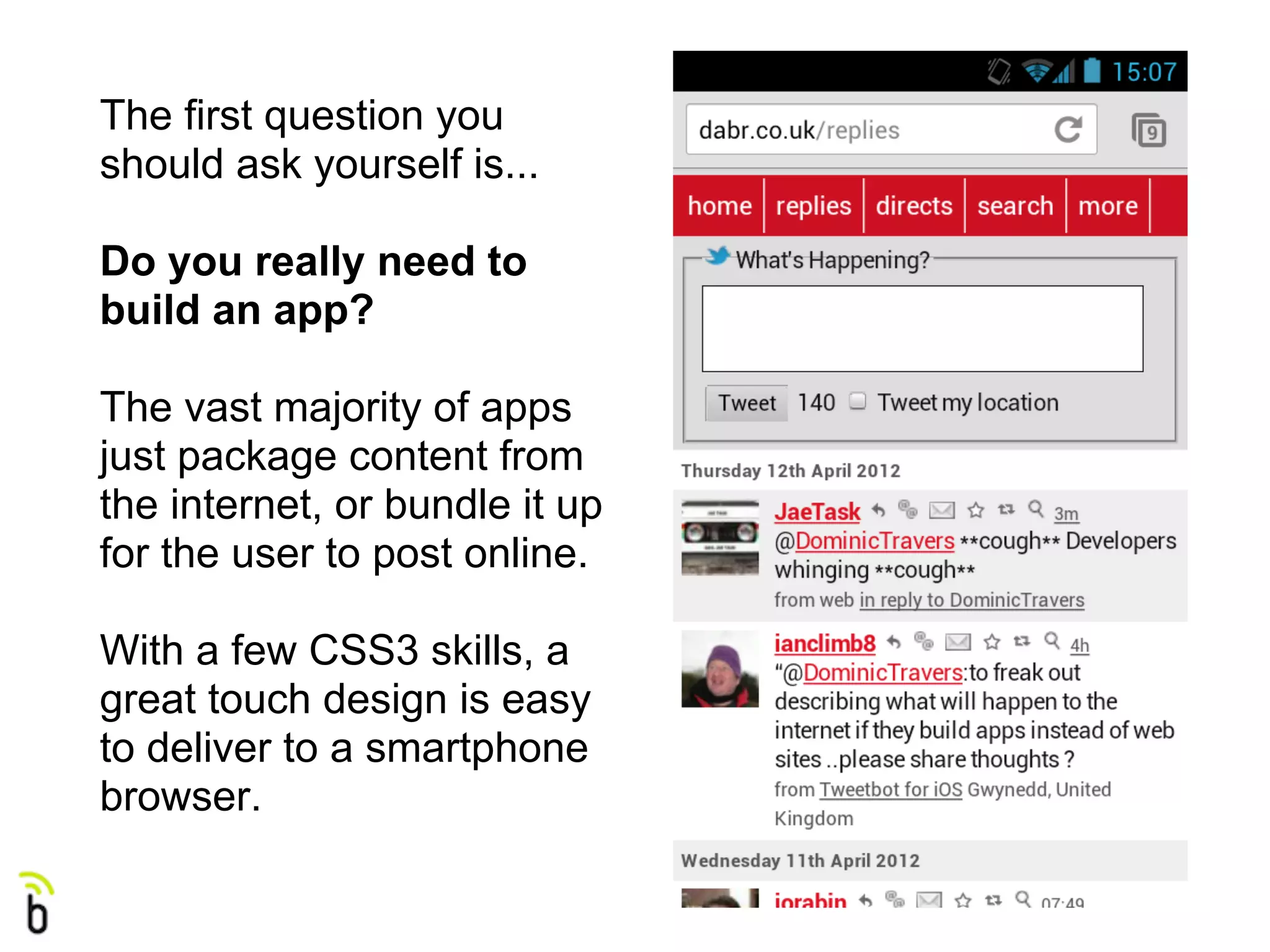
The first question you
should ask yourself is...

Do you really need to
build an app?

The vast majority of apps
just package content from
the internet, or bundle it up
for the user to post online.

With a few CSS3 skills, a
great touch design is easy
to deliver to a smartphone
browser.
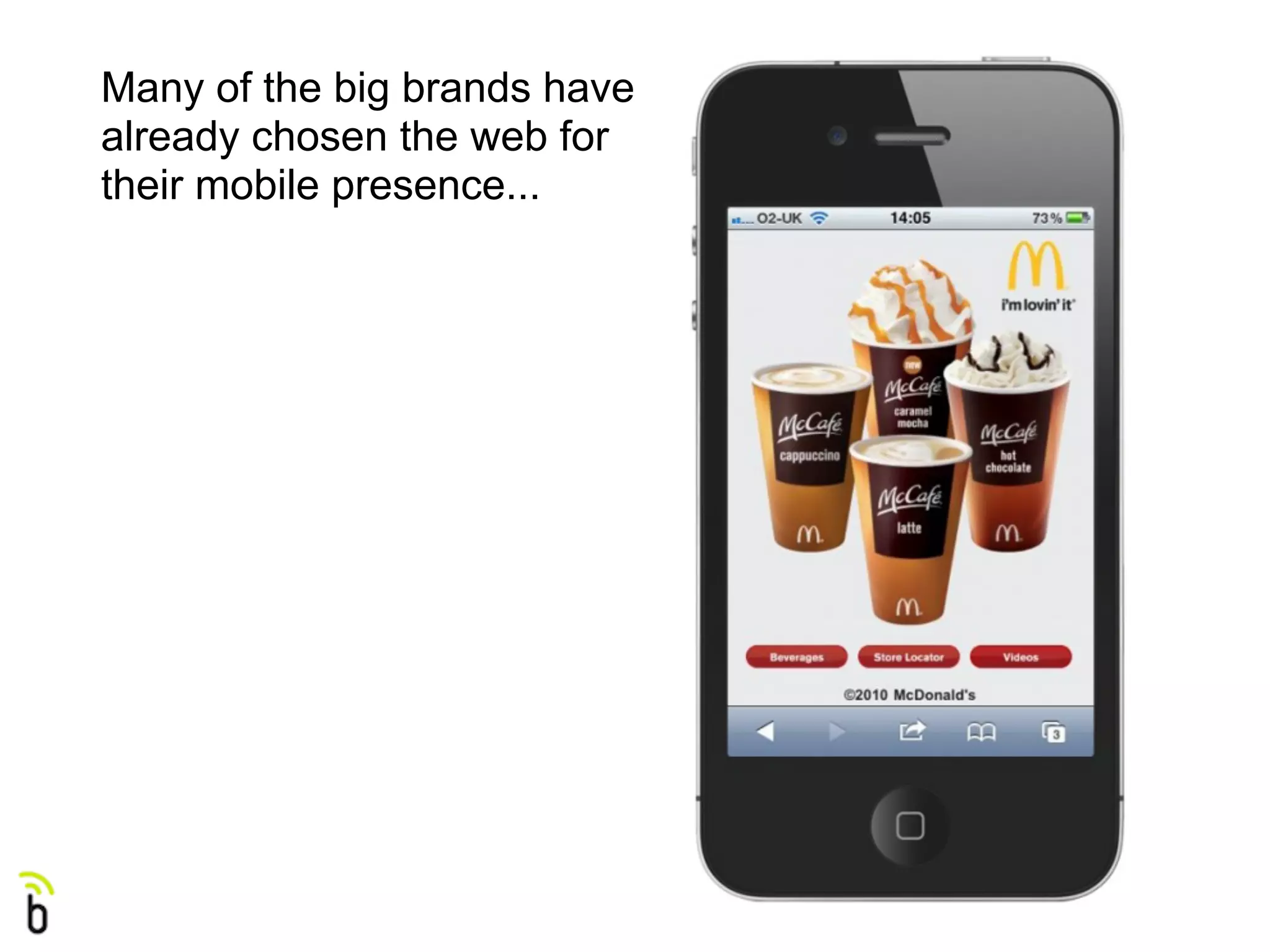
Many of the big brands have
already chosen the web for
their mobile presence...
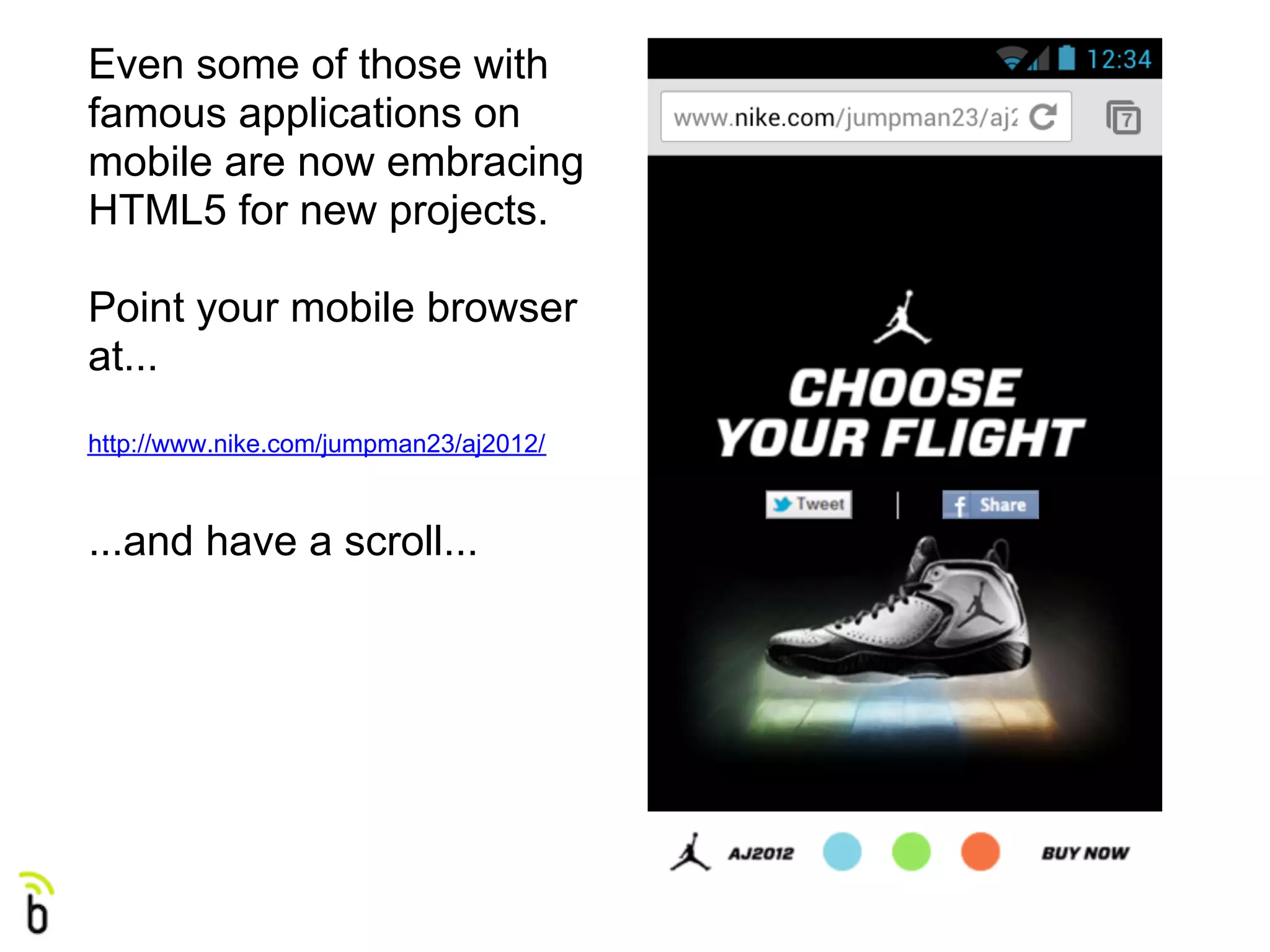
Even some of those with
famous applications on
mobile are now embracing
HTML5 for new projects.

Point your mobile browser
at...
http://www.nike.com/jumpman23/aj2012/


...and have a scroll...
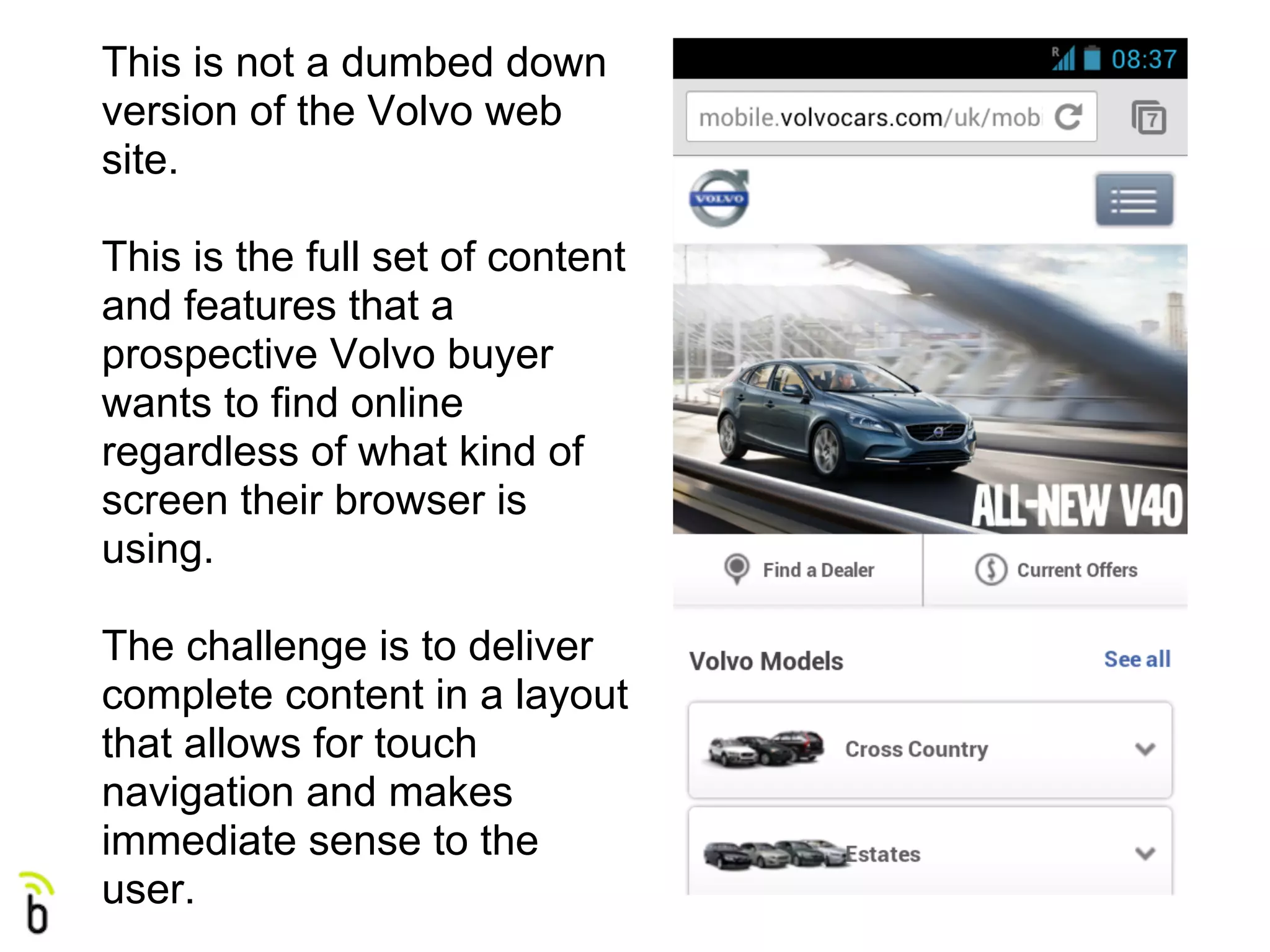
This is not a dumbed down
version of the Volvo web
site.

This is the full set of content
and features that a
prospective Volvo buyer
wants to find online
regardless of what kind of
screen their browser is
using.

The challenge is to deliver
complete content in a layout
that allows for touch
navigation and makes
immediate sense to the
user.
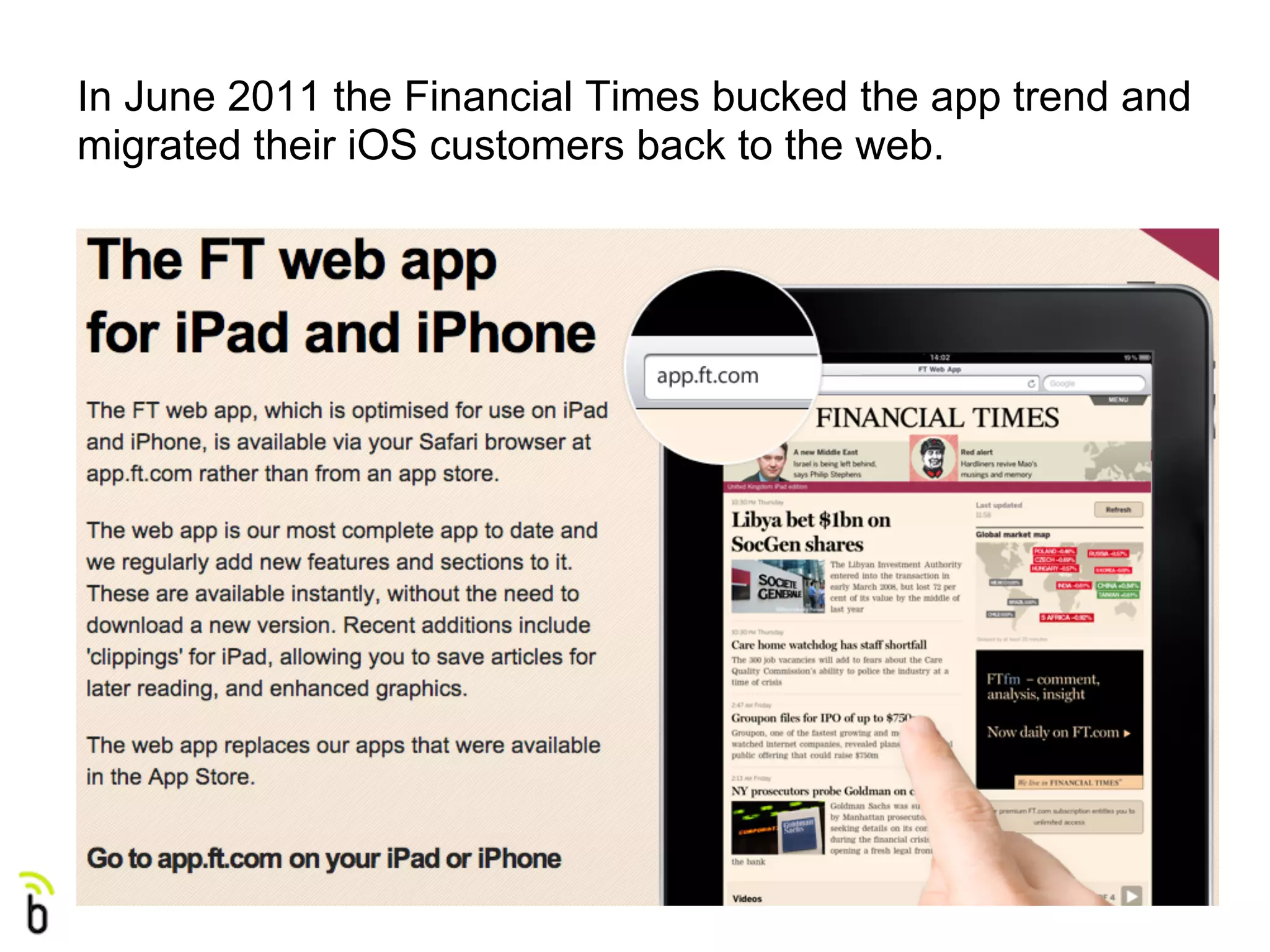
In June 2011 the Financial Times bucked the app trend and
migrated their iOS customers back to the web.
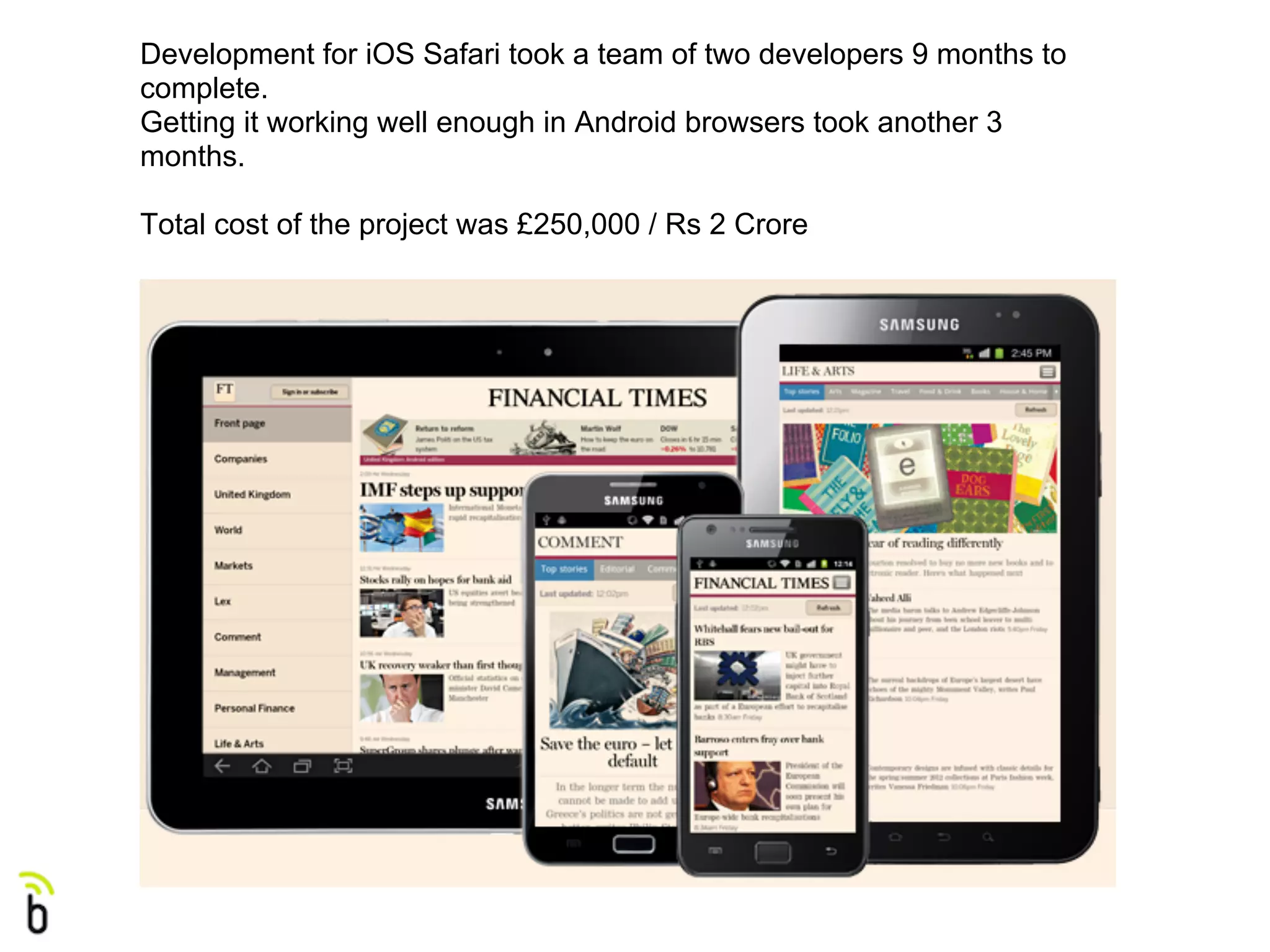
Development for iOS Safari took a team of two developers 9 months to
complete.
Getting it working well enough in Android browsers took another 3
months.

Total cost of the project was £250,000 / Rs 2 Crore
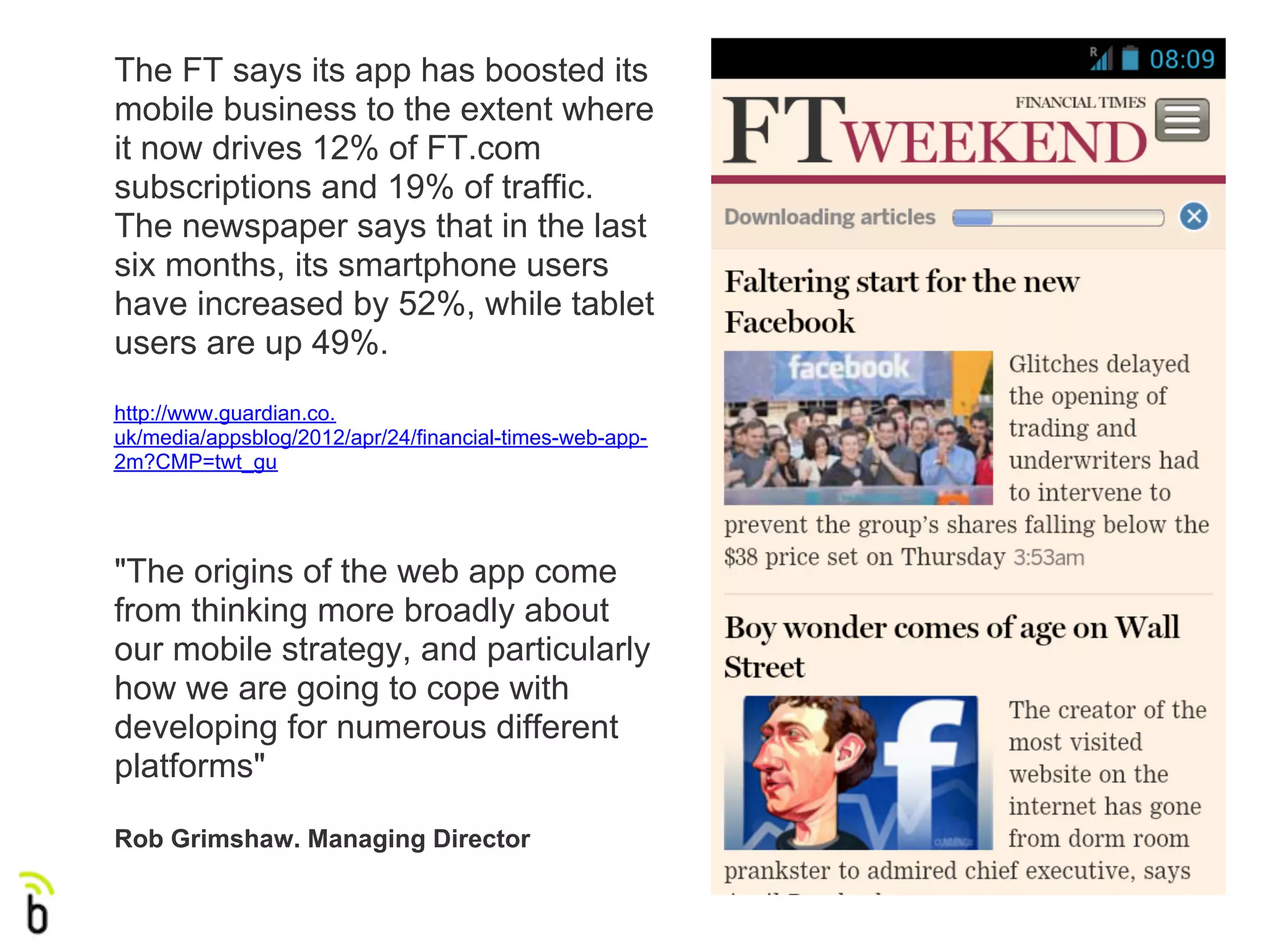
The FT says its app has boosted its
mobile business to the extent where
it now drives 12% of FT.com
subscriptions and 19% of traffic.
The newspaper says that in the last
six months, its smartphone users
have increased by 52%, while tablet
users are up 49%.
http://www.guardian.co.
uk/media/appsblog/2012/apr/24/financial-times-web-app-
2m?CMP=twt_gu


"The origins of the web app come
from thinking more broadly about
our mobile strategy, and particularly
how we are going to cope with
developing for numerous different
platforms"

Rob Grimshaw. Managing Director
"But the real problem with apps was
more profound. When people read
news and features on electronic
media, they expect stories to
possess the linky-ness of the Web,
but stories in apps didn't really link.
The apps were, in the jargon of
information technology, "walled
gardens," and although sometimes
beautiful, they were small, stifling
gardens. For readers, none of that
beauty overcame the weirdness
and frustration of reading digital
media closed off from other digital
media."
http://www.technologyreview.com/business/40319/
The capable web.

There's a lot of talk about the dangerous iPhone
monoculture in mobile web development.
http://www.quirksmode.org/blog/archives/2012/02/the_iphone_mono.html


There is now a chasm between WebKit based browsers
and those on "feature phones". Opera mini et al.

If you're marketing your app or service in India, you'd be
crazy not to have a good looking presence on as much of
the mobile web as you can reach!

  Chrome for Android gives you the tools you need...
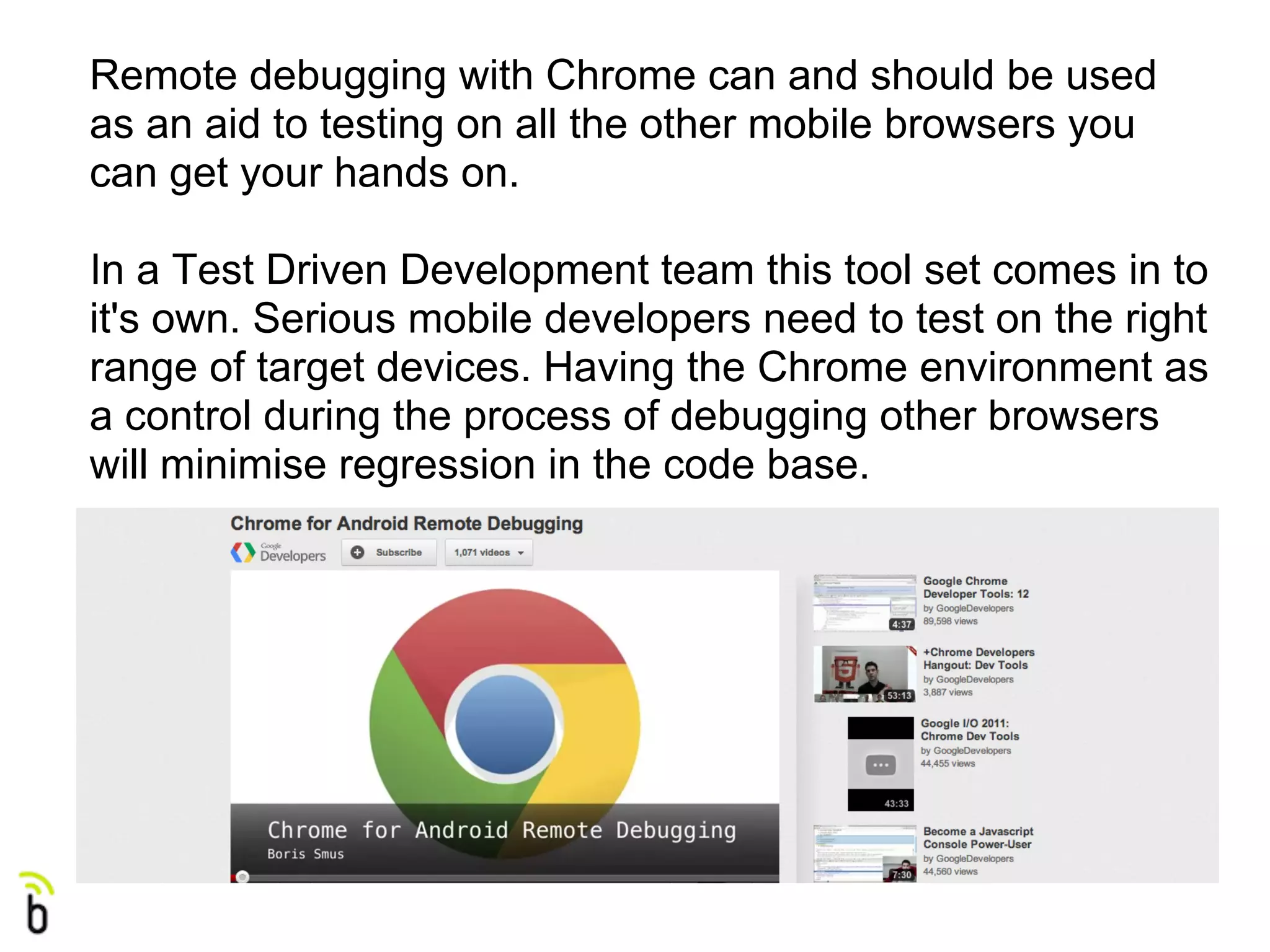
Remote debugging with Chrome can and should be used
as an aid to testing on all the other mobile browsers you
can get your hands on.

In a Test Driven Development team this tool set comes in to
it's own. Serious mobile developers need to test on the right
range of target devices. Having the Chrome environment as
a control during the process of debugging other browsers
will minimise regression in the code base.
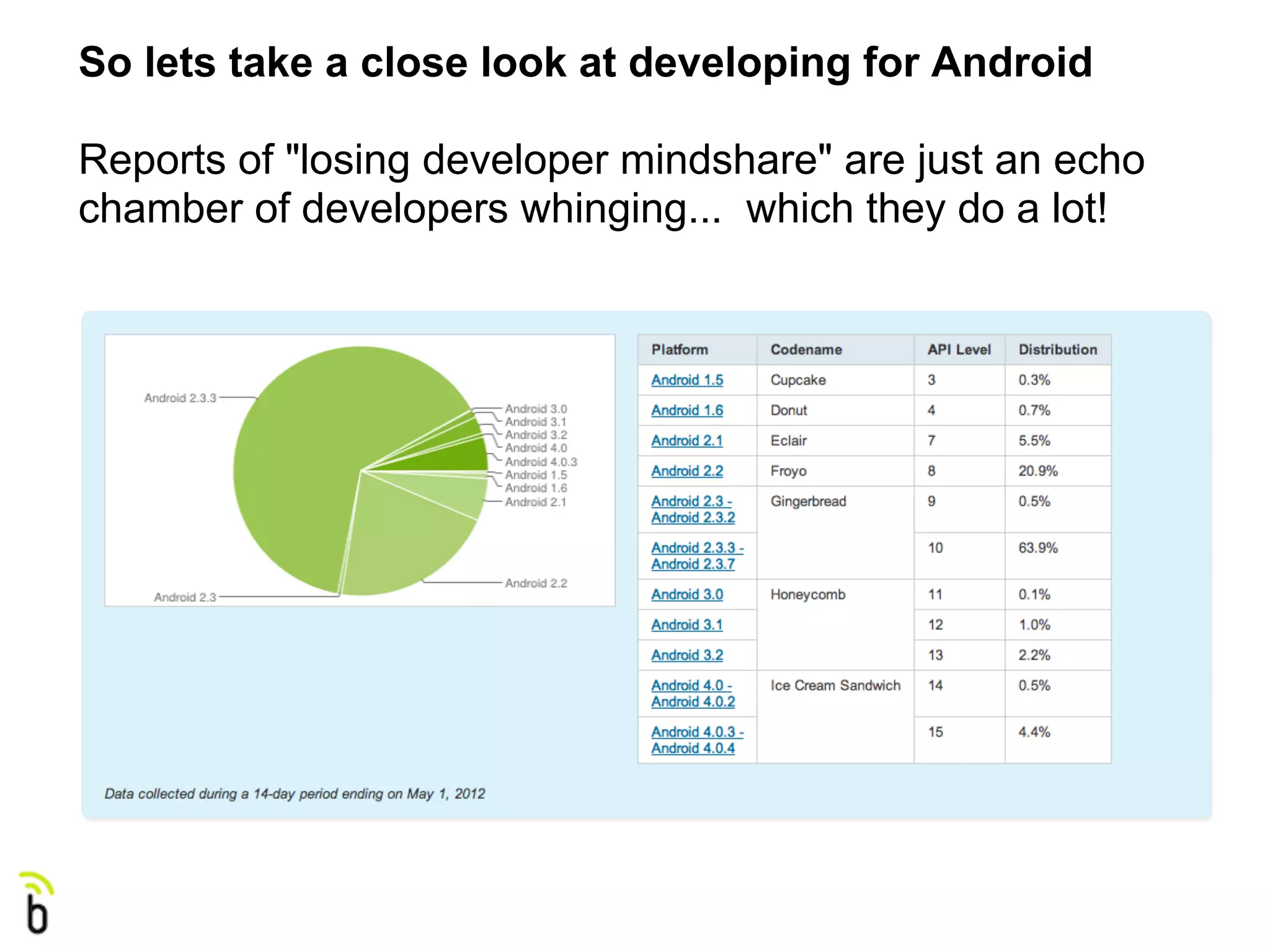
So lets take a close look at developing for Android

Reports of "losing developer mindshare" are just an echo
chamber of developers whinging... which they do a lot!
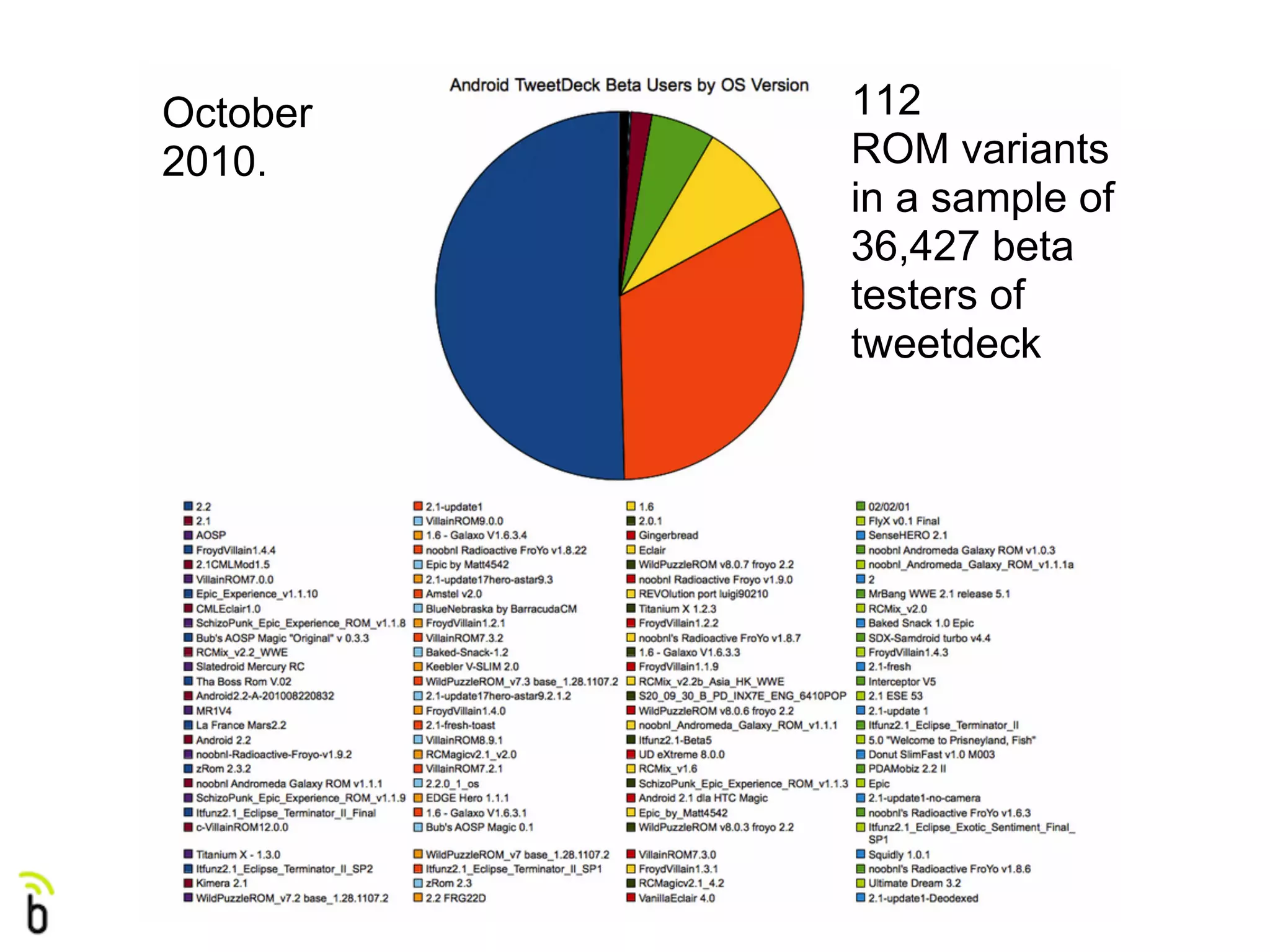
October   112
2010.     ROM variants
          in a sample of
          36,427 beta
          testers of
          tweetdeck
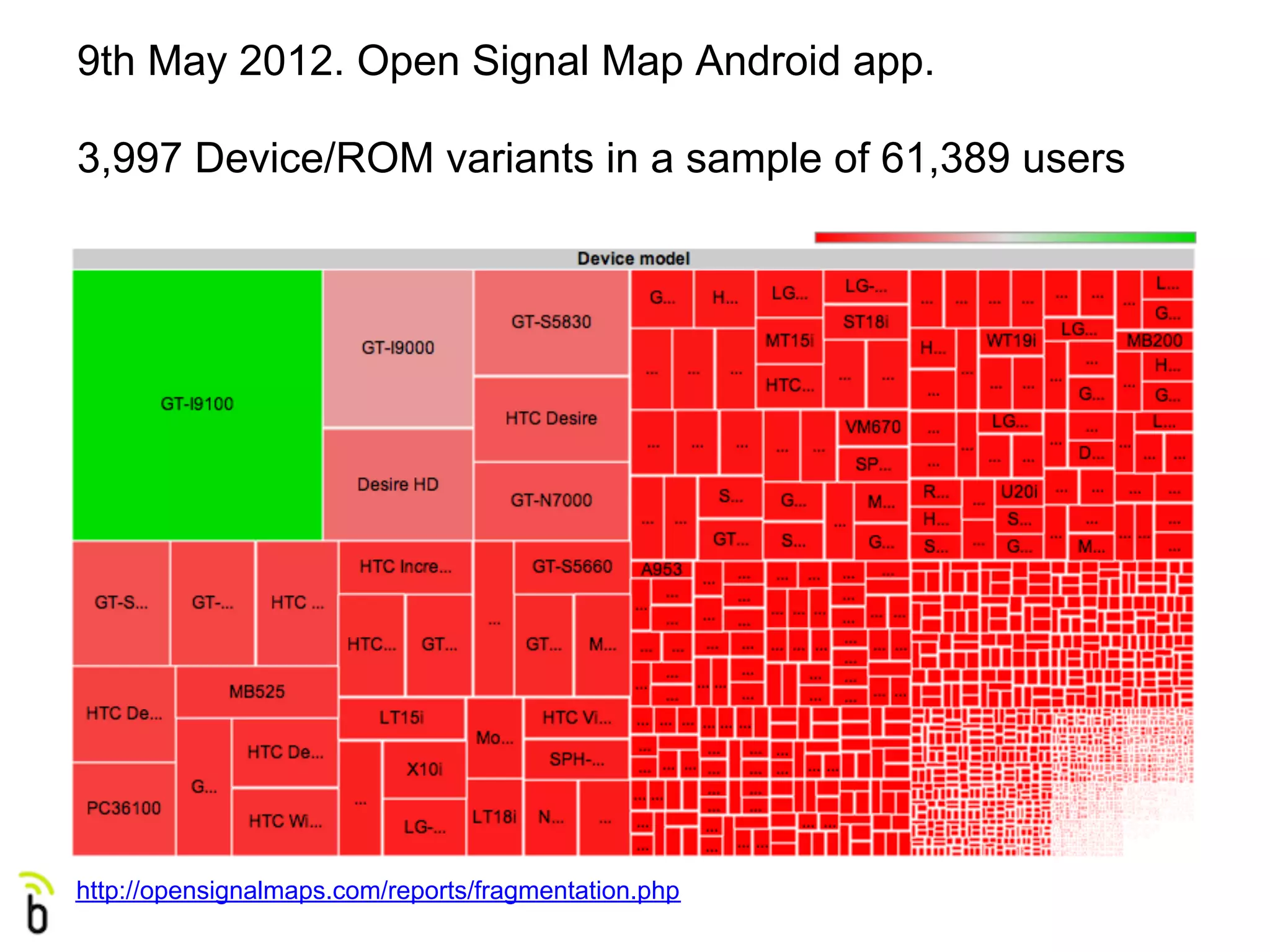
9th May 2012. Open Signal Map Android app.

3,997 Device/ROM variants in a sample of 61,389 users


http://opensignalmaps.com/reports/fragmentation.php
"Custom ROMs can overwrite the android.build.MODEL
variable that we use for the device model.

This partly explains why a staggering 1363 device models appear
only once in our database. That said most of these are indeed
genuine devices, just not popular ones.

Some examples of these solitary devices include: the Concorde
Tab (a hungarian 10.1 inch device), the Lemon P1 (a dual SIM
Indian phone), the Energy Tablet i724 (a Spanish Tablet aimed at
home entertainment), the EBEST E68, the MASTONE W18."
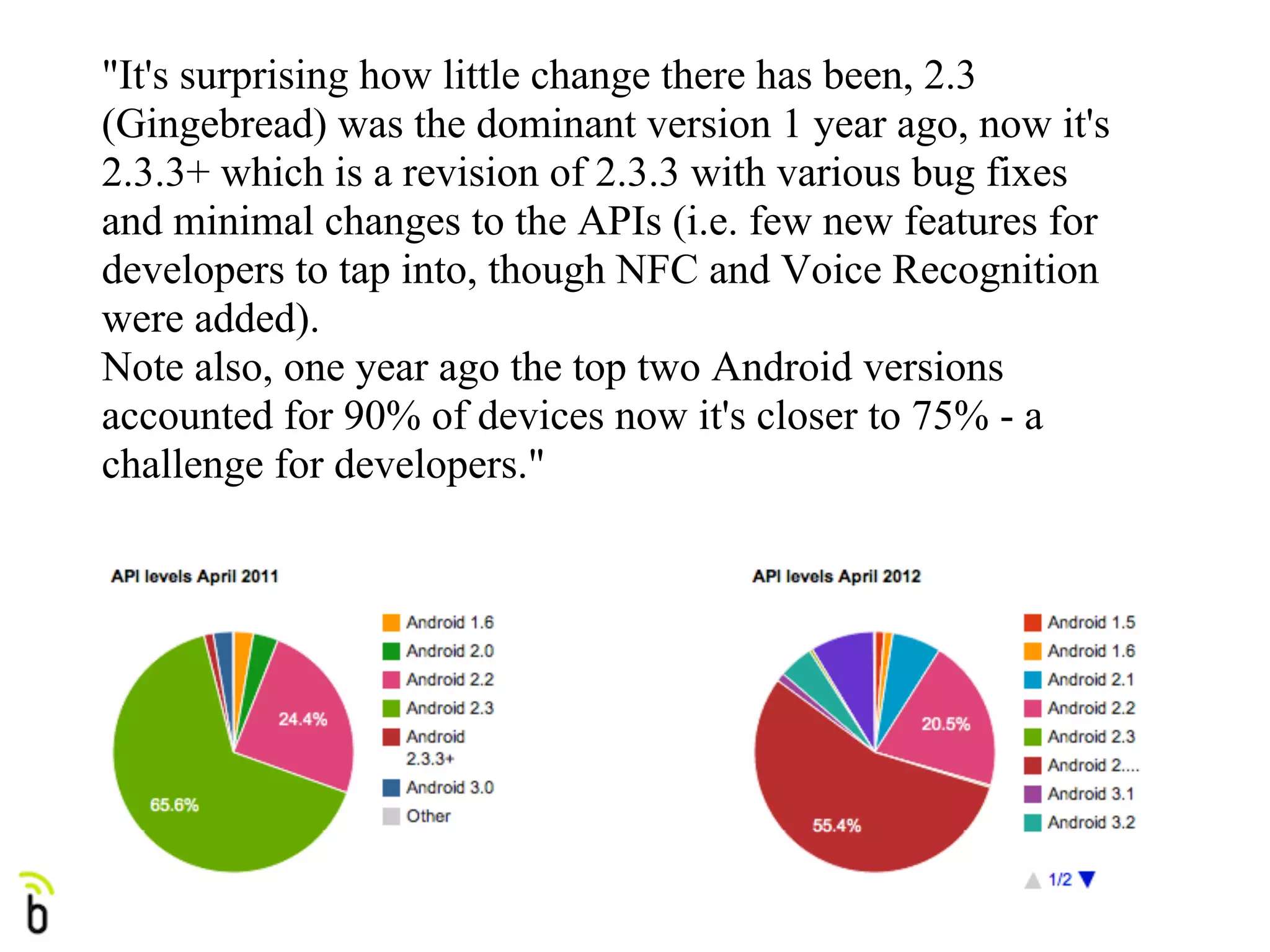
"It's surprising how little change there has been, 2.3
(Gingebread) was the dominant version 1 year ago, now it's
2.3.3+ which is a revision of 2.3.3 with various bug fixes
and minimal changes to the APIs (i.e. few new features for
developers to tap into, though NFC and Voice Recognition
were added).
Note also, one year ago the top two Android versions
accounted for 90% of devices now it's closer to 75% - a
challenge for developers."
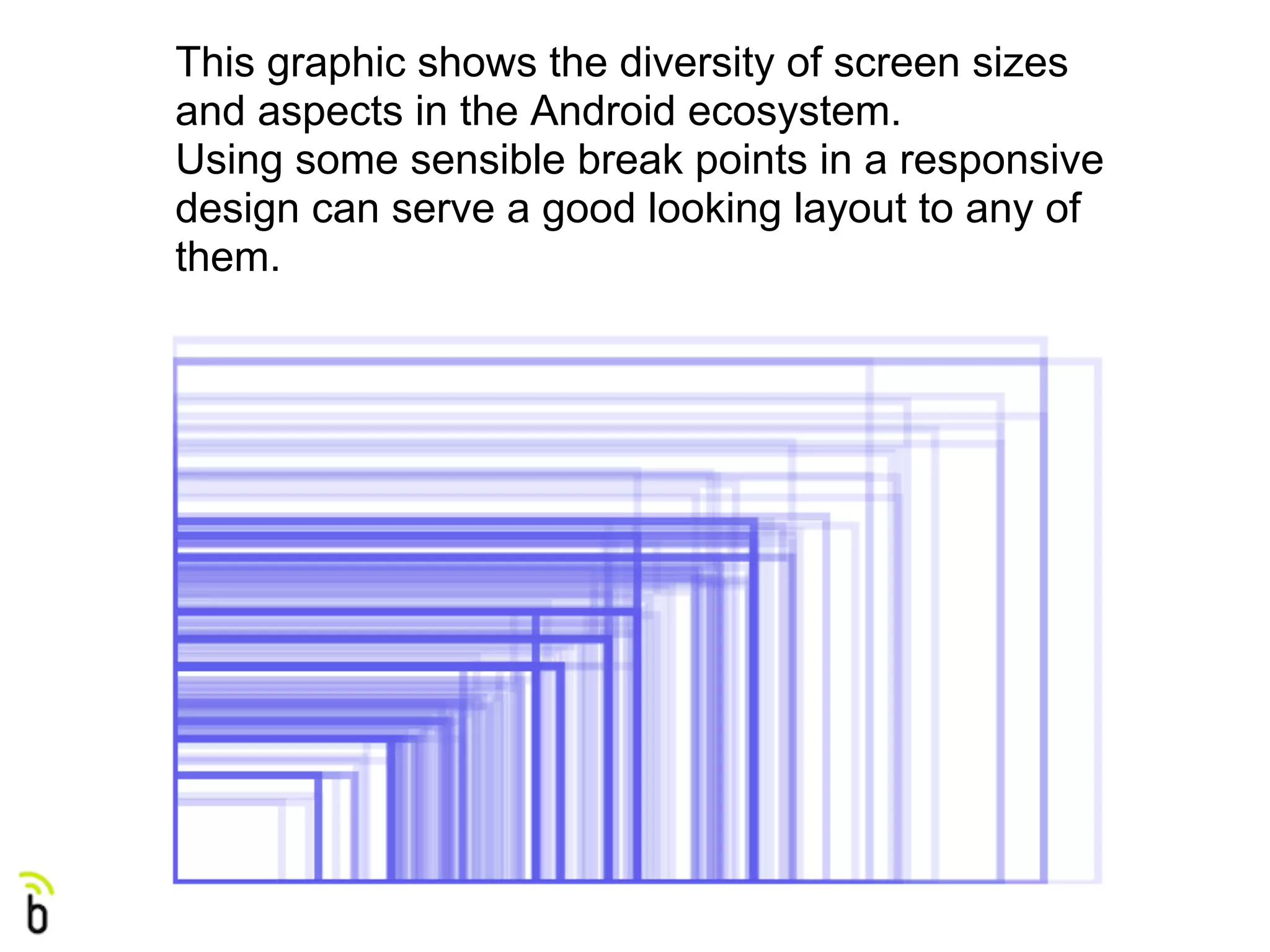
This graphic shows the diversity of screen sizes
and aspects in the Android ecosystem.
Using some sensible break points in a responsive
design can serve a good looking layout to any of
them.
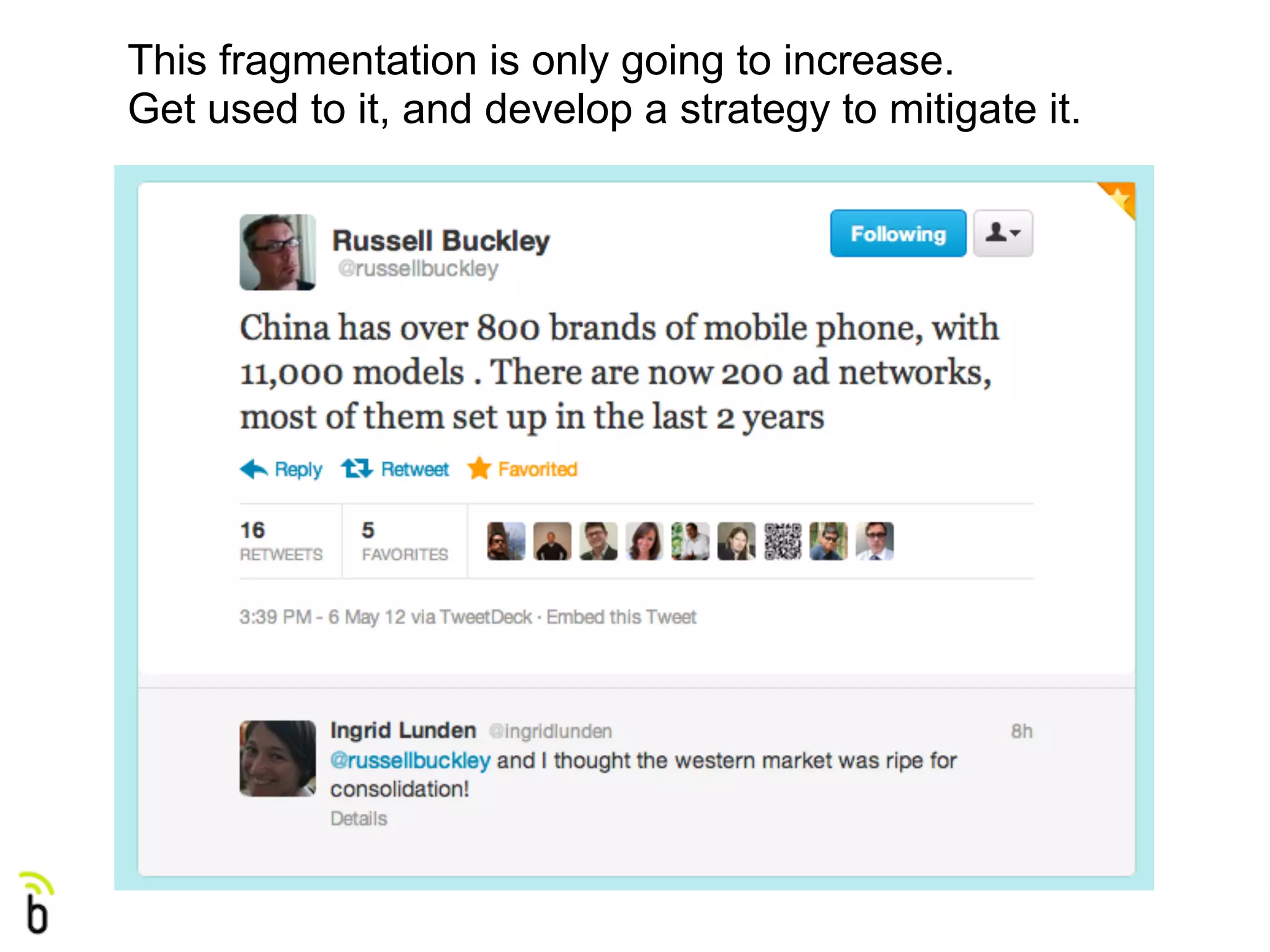
This fragmentation is only going to increase.
Get used to it, and develop a strategy to mitigate it.
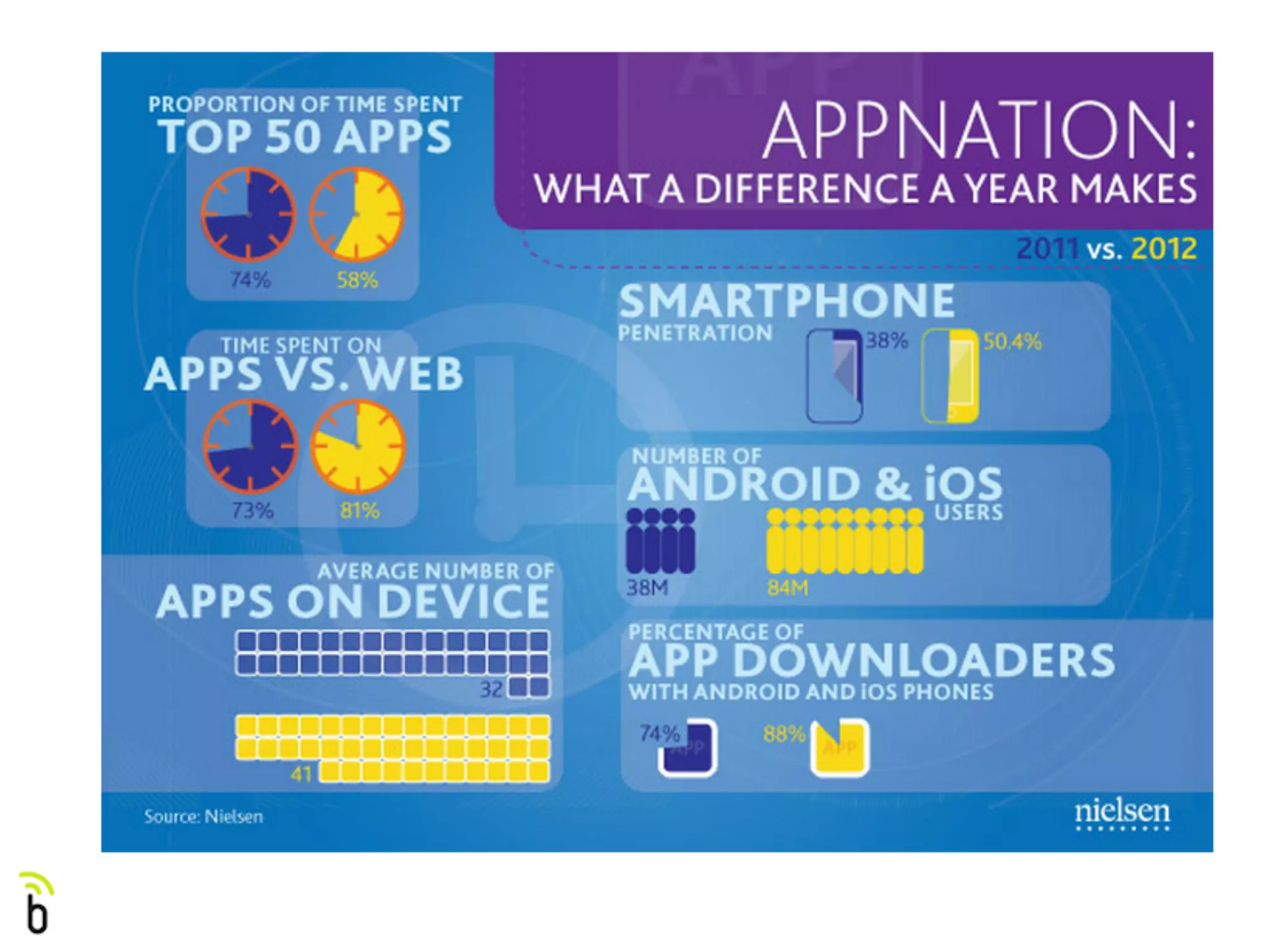
The bigger picture.
Over the last few years internet use has migrated
to proprietary platforms.

Facebook, iPhone, Android...

Traffic is migrating to mobile everywhere.
The vast majority of growth is from mobile devices.

Increasingly, more & more of this traffic is siloed
away from the open internet.
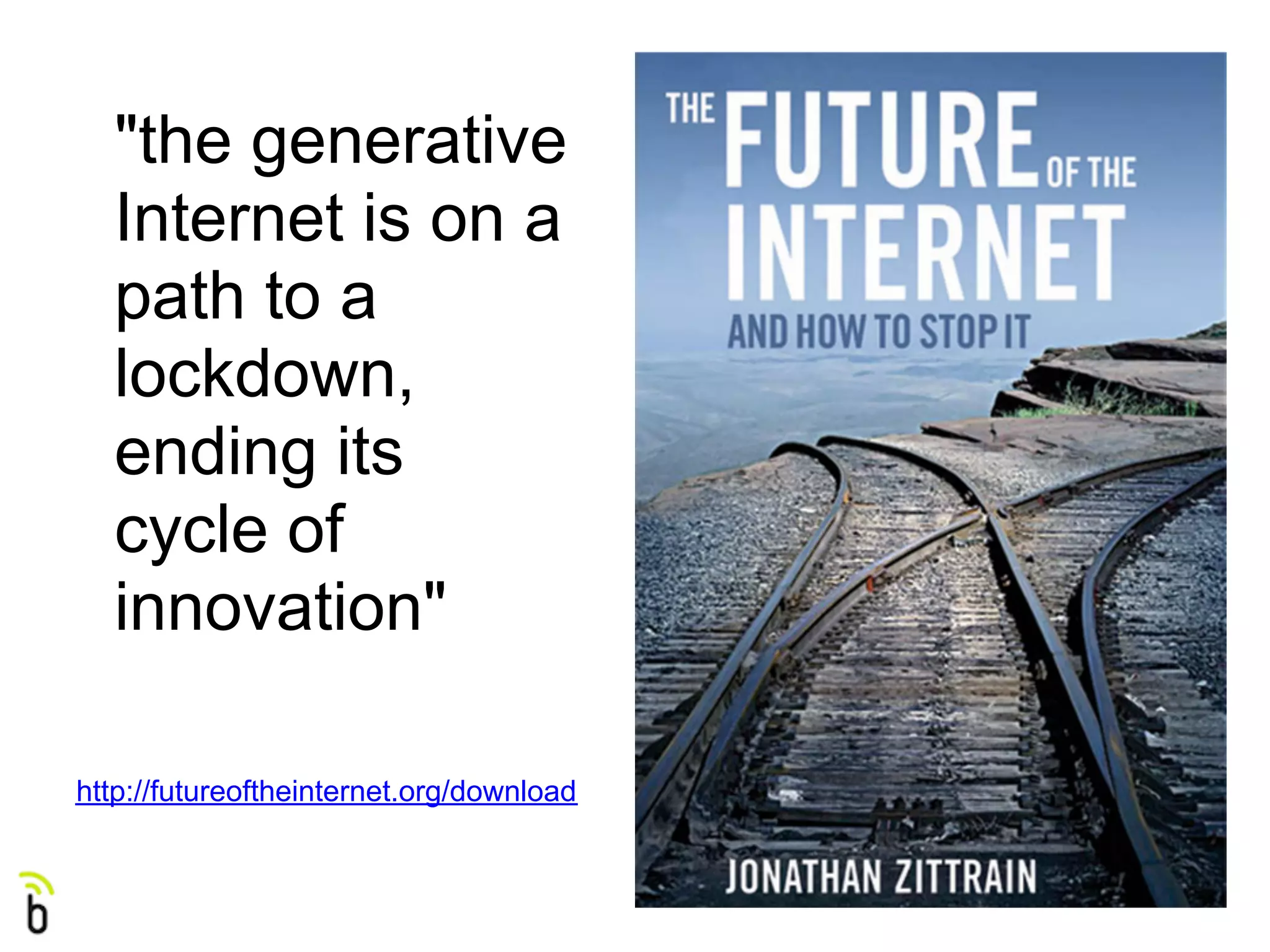
"the generative
  Internet is on a
  path to a
  lockdown,
  ending its
  cycle of
  innovation"

http://futureoftheinternet.org/download
“A year here and he still dreamed of
cyberspace, hope fading nightly. All the
speed he took, all the turns he’d taken
and the corners he’d cut in Night City,
and he’d still see the matrix in his sleep,
bright lattices of logic unfolding across
that colourless void….”


Neuromancer: William Gibson. 1993
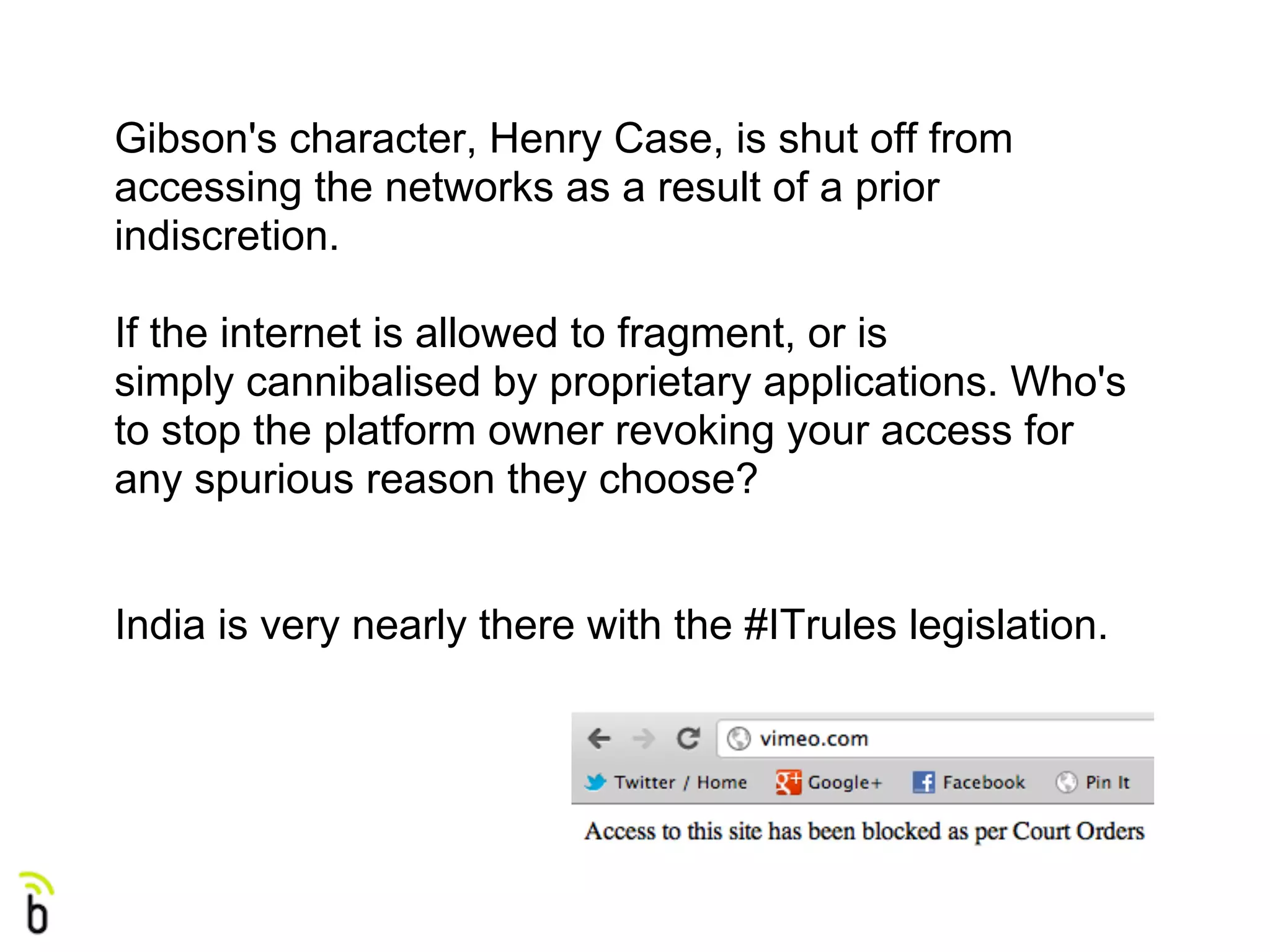
Gibson's character, Henry Case, is shut off from
accessing the networks as a result of a prior
indiscretion.

If the internet is allowed to fragment, or is
simply cannibalised by proprietary applications. Who's
to stop the platform owner revoking your access for
any spurious reason they choose?


India is very nearly there with the #ITrules legislation.
If you want to do your bit to help keep an open internet
available, you need to include a web site or app in your
product plans.

If your product is about content delivery, then consider the
route that the Financial Times have gone down and wrap your
fine tuned web app up and publish it as an .apk.

Alternatively...

Use the web app as a marketing tool for migrating people to an
native Android app. Think freemium!
Allow free access to selected content or features, then use in
app purchasing, or subscription to monetise the product.

Users are clamouring for consistent experiences on
mobile.
All hail the messiah.
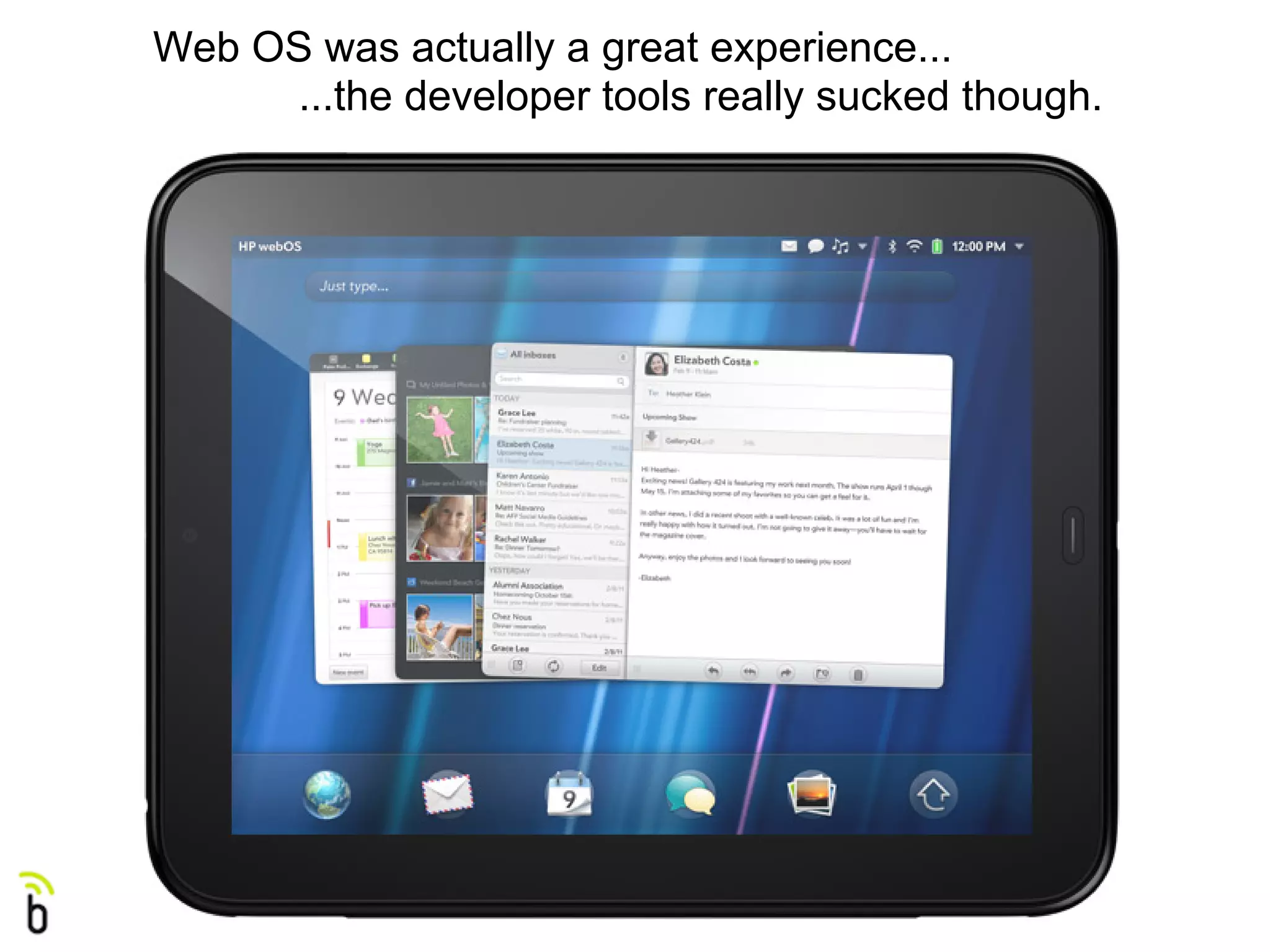
Web OS was actually a great experience...
     ...the developer tools really sucked though.
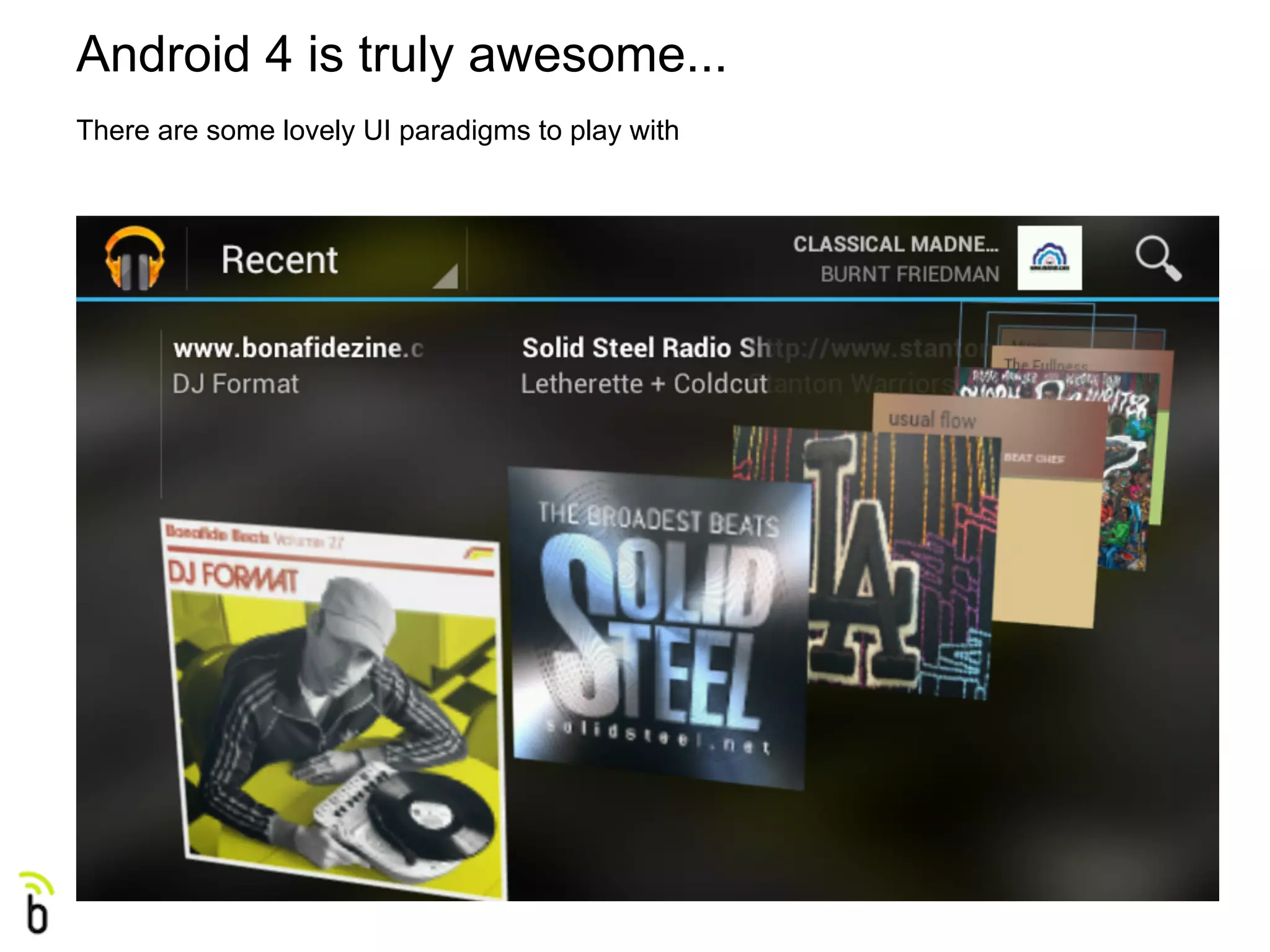
Android 4 is truly awesome...
There are some lovely UI paradigms to play with
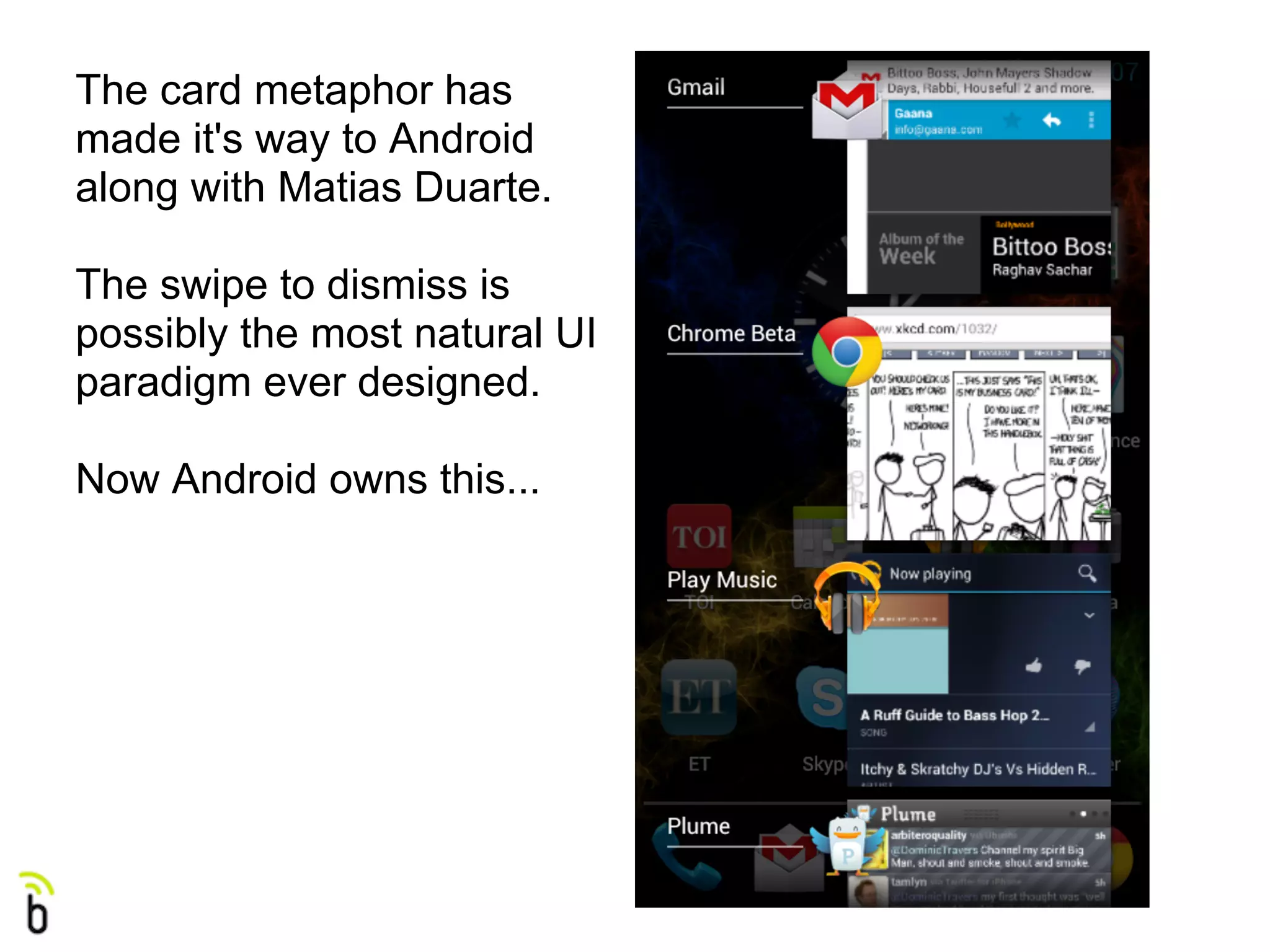
The card metaphor has
made it's way to Android
along with Matias Duarte.

The swipe to dismiss is
possibly the most natural UI
paradigm ever designed.

Now Android owns this...
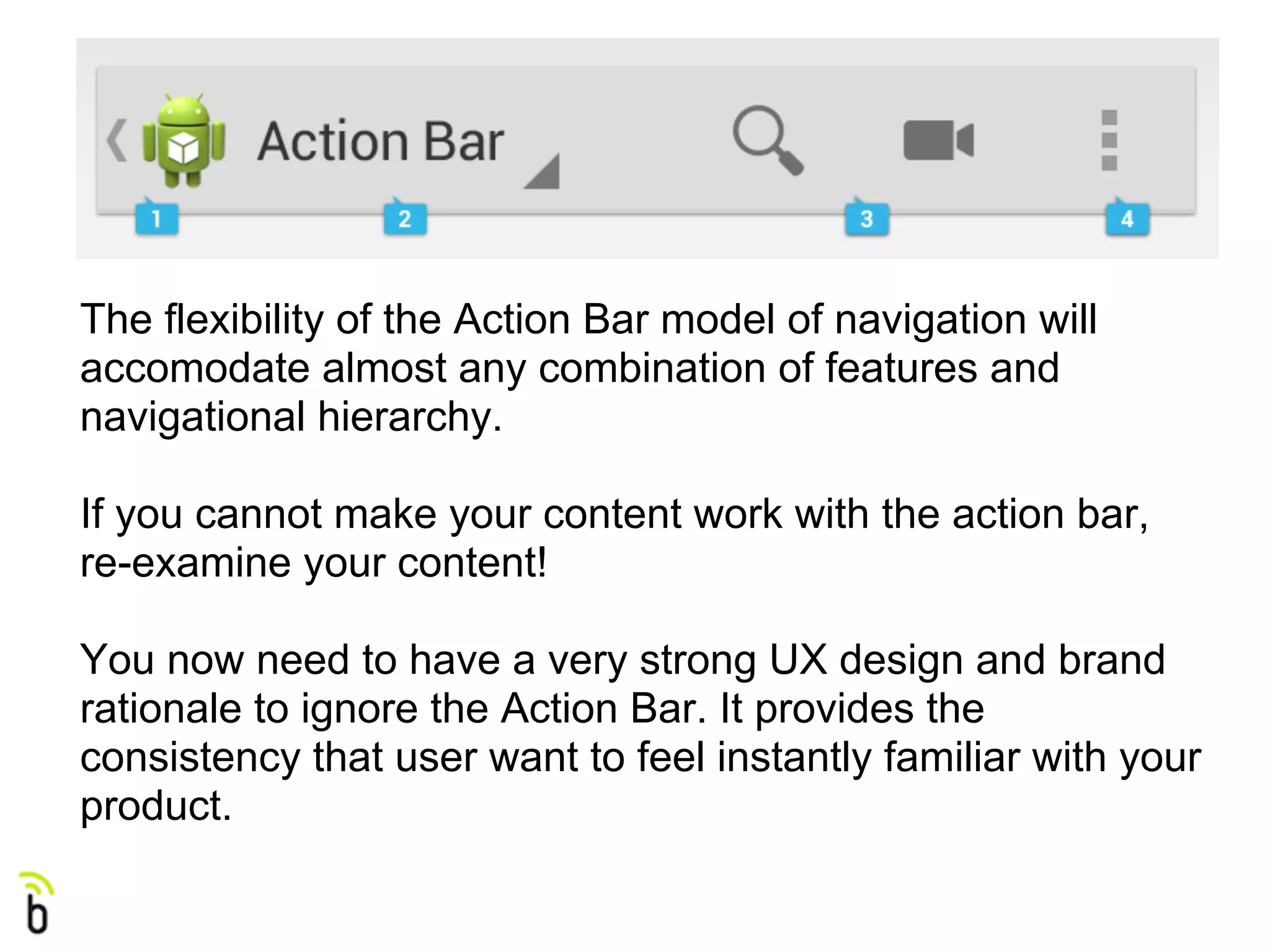
The flexibility of the Action Bar model of navigation will
accomodate almost any combination of features and
navigational hierarchy.

If you cannot make your content work with the action bar,
re-examine your content!

You now need to have a very strong UX design and brand
rationale to ignore the Action Bar. It provides the
consistency that user want to feel instantly familiar with your
product.
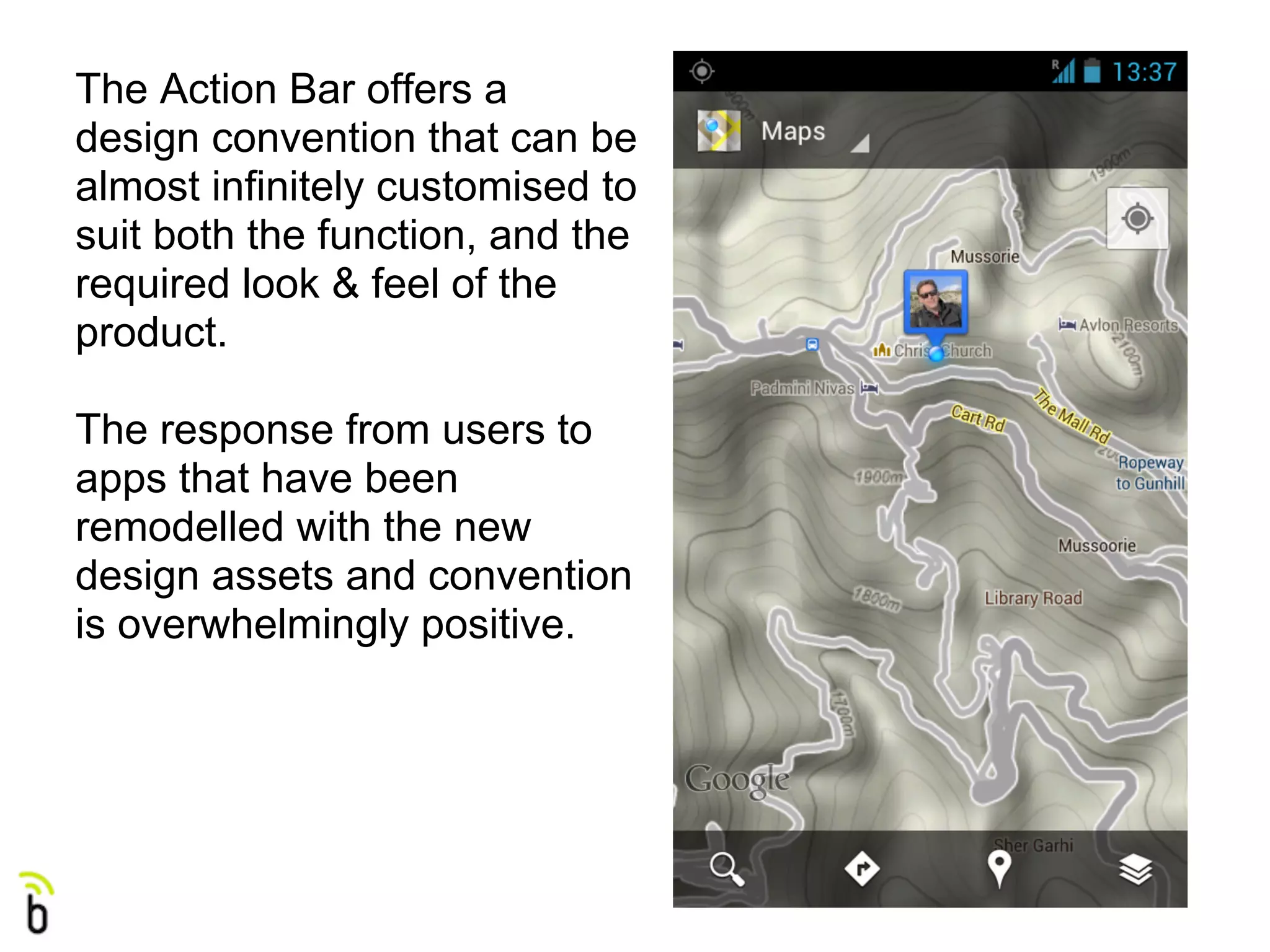
The Action Bar offers a
design convention that can be
almost infinitely customised to
suit both the function, and the
required look & feel of the
product.

The response from users to
apps that have been
remodelled with the new
design assets and convention
is overwhelmingly positive.
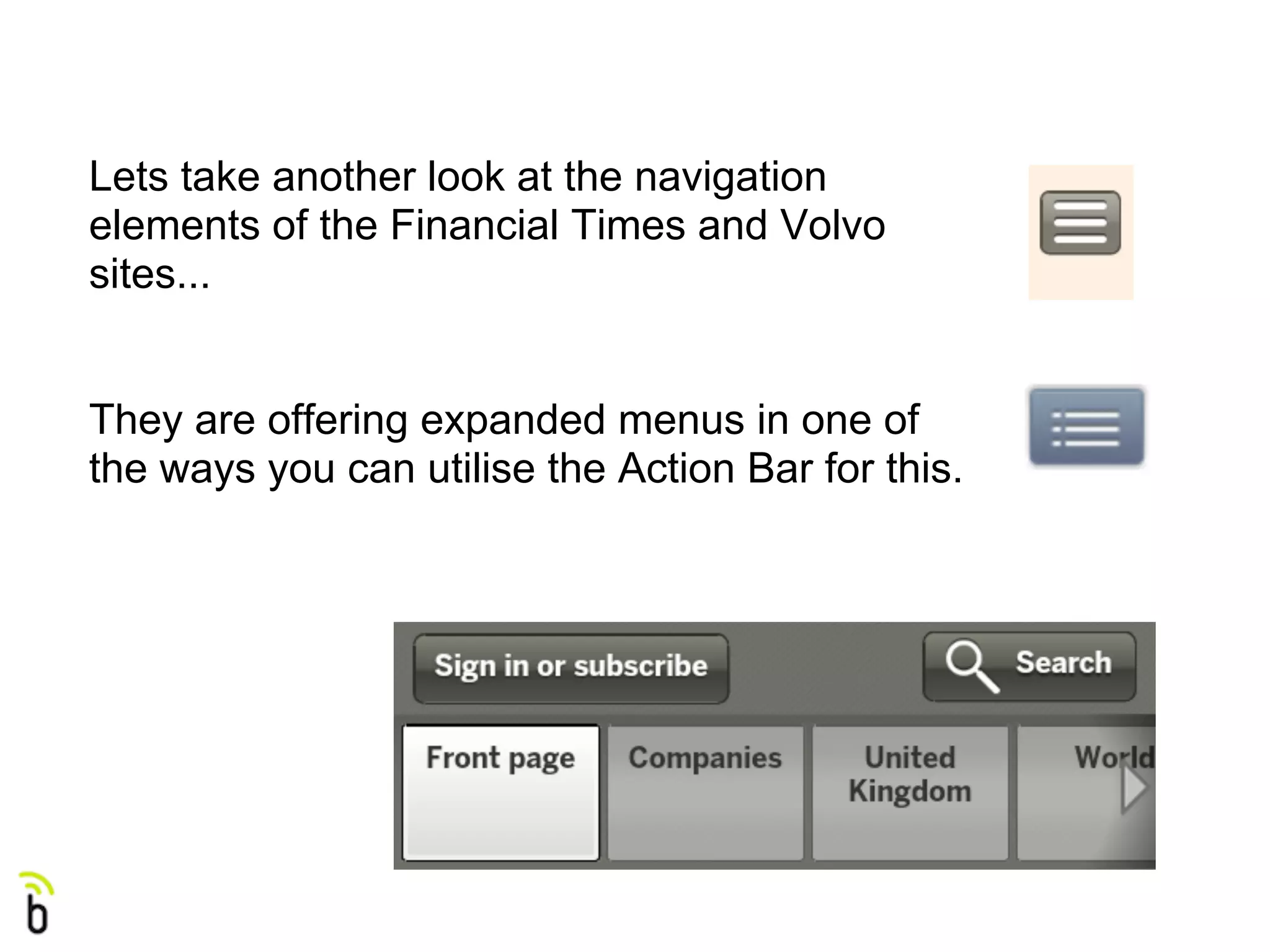
Lets take another look at the navigation
elements of the Financial Times and Volvo
sites...


They are offering expanded menus in one of
the ways you can utilise the Action Bar for this.
The Android Design guidelines
are one of the best resources
every made for the mobile
designer/developer.

Much of the best practise is just
as applicable to building mobile
web as it is for apps.

I would even suggest that you
use the conventions and
iconography for your mobile web
app.
Then migrating users to the
premium Android version will be
totally painless.
Thanks for listening..
           Lets discuss...

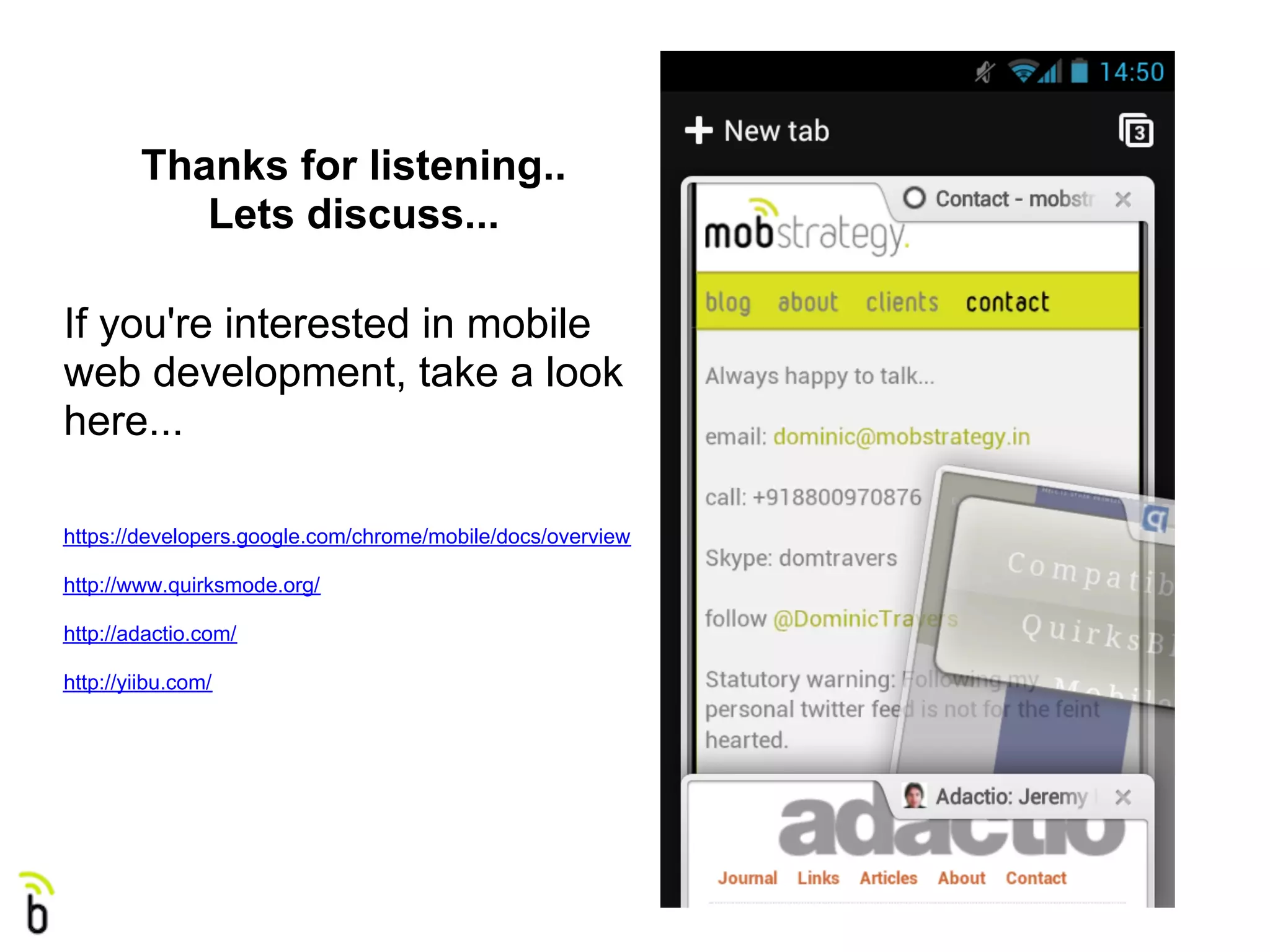
If you're interested in mobile
web development, take a look
here...

https://developers.google.com/chrome/mobile/docs/overview

http://www.quirksmode.org/

http://adactio.com/

http://yiibu.com/
Chrome for android_devfestx

Chrome for android_devfestx

  • 1.
    Hello, I amDominic, I talk about mobile strategies.
  • 3.
    It used tobe an easy call. Native apps provide a better experience with most types of content. There is plenty of scope for beautiful design, funky UI elements, and integrating location, social, camera, and sensors. Web apps are thought of as ugly, clunky, and a vastly inferior experience. Not for long though.. Chrome for Android is shifting this balance...
  • 4.
    If you developyour app to run in Chrome, you can manage a single code base that can also run perfectly on iPhone and BlackBerry. With this you can engage your audience across the platforms that really have app users and revenue. Maybe one day Microsoft will actually learn how to make a decent browser too...
  • 5.
    The first questionyou should ask yourself is... Do you really need to build an app? The vast majority of apps just package content from the internet, or bundle it up for the user to post online. With a few CSS3 skills, a great touch design is easy to deliver to a smartphone browser.
  • 6.
    Many of thebig brands have already chosen the web for their mobile presence...
  • 7.
    Even some ofthose with famous applications on mobile are now embracing HTML5 for new projects. Point your mobile browser at... http://www.nike.com/jumpman23/aj2012/ ...and have a scroll...
  • 8.
    This is nota dumbed down version of the Volvo web site. This is the full set of content and features that a prospective Volvo buyer wants to find online regardless of what kind of screen their browser is using. The challenge is to deliver complete content in a layout that allows for touch navigation and makes immediate sense to the user.
  • 9.
    In June 2011the Financial Times bucked the app trend and migrated their iOS customers back to the web.
  • 10.
    Development for iOSSafari took a team of two developers 9 months to complete. Getting it working well enough in Android browsers took another 3 months. Total cost of the project was £250,000 / Rs 2 Crore
  • 11.
    The FT saysits app has boosted its mobile business to the extent where it now drives 12% of FT.com subscriptions and 19% of traffic. The newspaper says that in the last six months, its smartphone users have increased by 52%, while tablet users are up 49%. http://www.guardian.co. uk/media/appsblog/2012/apr/24/financial-times-web-app- 2m?CMP=twt_gu "The origins of the web app come from thinking more broadly about our mobile strategy, and particularly how we are going to cope with developing for numerous different platforms" Rob Grimshaw. Managing Director
  • 12.
    "But the realproblem with apps was more profound. When people read news and features on electronic media, they expect stories to possess the linky-ness of the Web, but stories in apps didn't really link. The apps were, in the jargon of information technology, "walled gardens," and although sometimes beautiful, they were small, stifling gardens. For readers, none of that beauty overcame the weirdness and frustration of reading digital media closed off from other digital media." http://www.technologyreview.com/business/40319/
  • 13.
    The capable web. There'sa lot of talk about the dangerous iPhone monoculture in mobile web development. http://www.quirksmode.org/blog/archives/2012/02/the_iphone_mono.html There is now a chasm between WebKit based browsers and those on "feature phones". Opera mini et al. If you're marketing your app or service in India, you'd be crazy not to have a good looking presence on as much of the mobile web as you can reach! Chrome for Android gives you the tools you need...
  • 14.
    Remote debugging withChrome can and should be used as an aid to testing on all the other mobile browsers you can get your hands on. In a Test Driven Development team this tool set comes in to it's own. Serious mobile developers need to test on the right range of target devices. Having the Chrome environment as a control during the process of debugging other browsers will minimise regression in the code base.
  • 15.
    So lets takea close look at developing for Android Reports of "losing developer mindshare" are just an echo chamber of developers whinging... which they do a lot!
  • 16.
    October 112 2010. ROM variants in a sample of 36,427 beta testers of tweetdeck
  • 17.
    9th May 2012.Open Signal Map Android app. 3,997 Device/ROM variants in a sample of 61,389 users http://opensignalmaps.com/reports/fragmentation.php
  • 18.
    "Custom ROMs canoverwrite the android.build.MODEL variable that we use for the device model. This partly explains why a staggering 1363 device models appear only once in our database. That said most of these are indeed genuine devices, just not popular ones. Some examples of these solitary devices include: the Concorde Tab (a hungarian 10.1 inch device), the Lemon P1 (a dual SIM Indian phone), the Energy Tablet i724 (a Spanish Tablet aimed at home entertainment), the EBEST E68, the MASTONE W18."
  • 19.
    "It's surprising howlittle change there has been, 2.3 (Gingebread) was the dominant version 1 year ago, now it's 2.3.3+ which is a revision of 2.3.3 with various bug fixes and minimal changes to the APIs (i.e. few new features for developers to tap into, though NFC and Voice Recognition were added). Note also, one year ago the top two Android versions accounted for 90% of devices now it's closer to 75% - a challenge for developers."
  • 20.
    This graphic showsthe diversity of screen sizes and aspects in the Android ecosystem. Using some sensible break points in a responsive design can serve a good looking layout to any of them.
  • 21.
    This fragmentation isonly going to increase. Get used to it, and develop a strategy to mitigate it.
  • 22.
    The bigger picture. Overthe last few years internet use has migrated to proprietary platforms. Facebook, iPhone, Android... Traffic is migrating to mobile everywhere. The vast majority of growth is from mobile devices. Increasingly, more & more of this traffic is siloed away from the open internet.
  • 24.
    "the generative Internet is on a path to a lockdown, ending its cycle of innovation" http://futureoftheinternet.org/download
  • 25.
    “A year hereand he still dreamed of cyberspace, hope fading nightly. All the speed he took, all the turns he’d taken and the corners he’d cut in Night City, and he’d still see the matrix in his sleep, bright lattices of logic unfolding across that colourless void….” Neuromancer: William Gibson. 1993
  • 26.
    Gibson's character, HenryCase, is shut off from accessing the networks as a result of a prior indiscretion. If the internet is allowed to fragment, or is simply cannibalised by proprietary applications. Who's to stop the platform owner revoking your access for any spurious reason they choose? India is very nearly there with the #ITrules legislation.
  • 27.
    If you wantto do your bit to help keep an open internet available, you need to include a web site or app in your product plans. If your product is about content delivery, then consider the route that the Financial Times have gone down and wrap your fine tuned web app up and publish it as an .apk. Alternatively... Use the web app as a marketing tool for migrating people to an native Android app. Think freemium! Allow free access to selected content or features, then use in app purchasing, or subscription to monetise the product. Users are clamouring for consistent experiences on mobile.
  • 28.
    All hail themessiah.
  • 29.
    Web OS wasactually a great experience... ...the developer tools really sucked though.
  • 30.
    Android 4 istruly awesome... There are some lovely UI paradigms to play with
  • 31.
    The card metaphorhas made it's way to Android along with Matias Duarte. The swipe to dismiss is possibly the most natural UI paradigm ever designed. Now Android owns this...
  • 32.
    The flexibility ofthe Action Bar model of navigation will accomodate almost any combination of features and navigational hierarchy. If you cannot make your content work with the action bar, re-examine your content! You now need to have a very strong UX design and brand rationale to ignore the Action Bar. It provides the consistency that user want to feel instantly familiar with your product.
  • 33.
    The Action Baroffers a design convention that can be almost infinitely customised to suit both the function, and the required look & feel of the product. The response from users to apps that have been remodelled with the new design assets and convention is overwhelmingly positive.
  • 34.
    Lets take anotherlook at the navigation elements of the Financial Times and Volvo sites... They are offering expanded menus in one of the ways you can utilise the Action Bar for this.
  • 35.
    The Android Designguidelines are one of the best resources every made for the mobile designer/developer. Much of the best practise is just as applicable to building mobile web as it is for apps. I would even suggest that you use the conventions and iconography for your mobile web app. Then migrating users to the premium Android version will be totally painless.
  • 36.
    Thanks for listening.. Lets discuss... If you're interested in mobile web development, take a look here... https://developers.google.com/chrome/mobile/docs/overview http://www.quirksmode.org/ http://adactio.com/ http://yiibu.com/