Guided By- Mrs. Shrabani Medhi
Asst. Professor (Dept. of CSE)
Group member’s-
Chandraleena Ahmed (1303107070)
Chiranjeev Neog(1303107071)
Rabi Gayan(1303107094)
Bibek Deka(1303107069)
AIM
 This project includes two face recognition systems
implemented with the help of Principal Component
Analysis (PCA) and Morphological Shared-Weight
Neural Network(MSNN).
 From these systems we will evaluate the
performance of both the techniques and based on
the accuracy achieved we determine which
technique will be better for the face recognition.
INTRODUCTION
Biometrics-
 To identify a human by its unique physical and
behavioral nature is called biometrics.
 Biometric technology is the foundation of providing
highly secure solutions for personal identification and
authentication.
 Types of biometrics
 Physiological based biometric technology
 Behavior based biometric technology
 Why we choose face recognition over other biometric ?
INTRODUCTION CONTD.
 We are applying Principal Component Analysis to the
face detected area & the resulting features are fed as
an input to neural network for classification.
 The system we are describing in this work uses a
morphological shared-weight neural network(MSNN) in
its face detection phase.
 We have used PCA for feature extraction and MSNN
for classification
DATABASE
The database is divided into two categories:
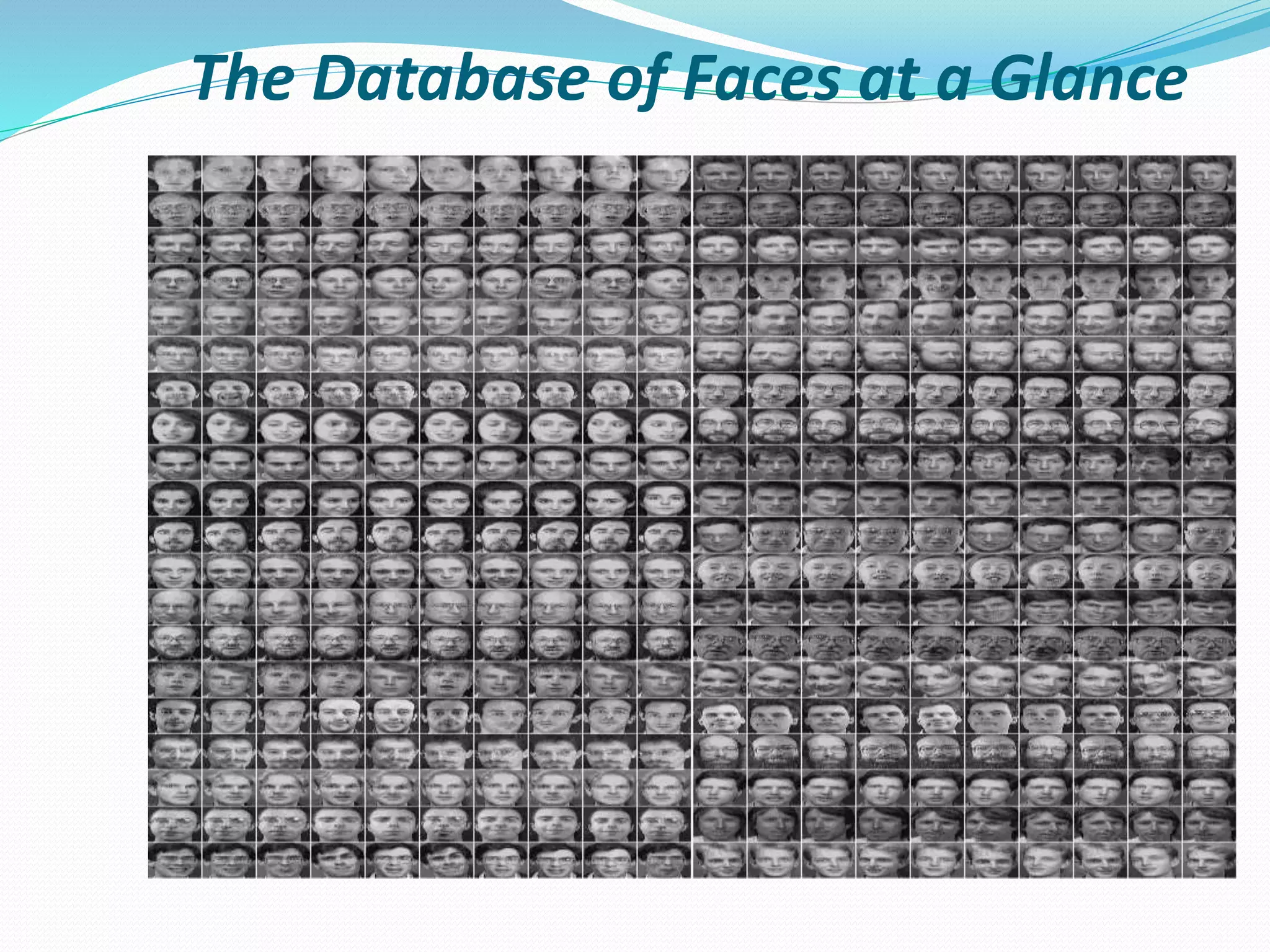
 The database we used contains 400 images taken between April 1992
and April 1994 at the AT&T Laboratories Cambridge. of 40 persons
(10 images per person) of size 92 x 112 and have all frontal and slight
tilt of the head.
 The second training database contains 576 images of 10 persons of
size 640 x 480 and have 9 poses x 64 illumination conditions.
The Database of Faces at a Glance
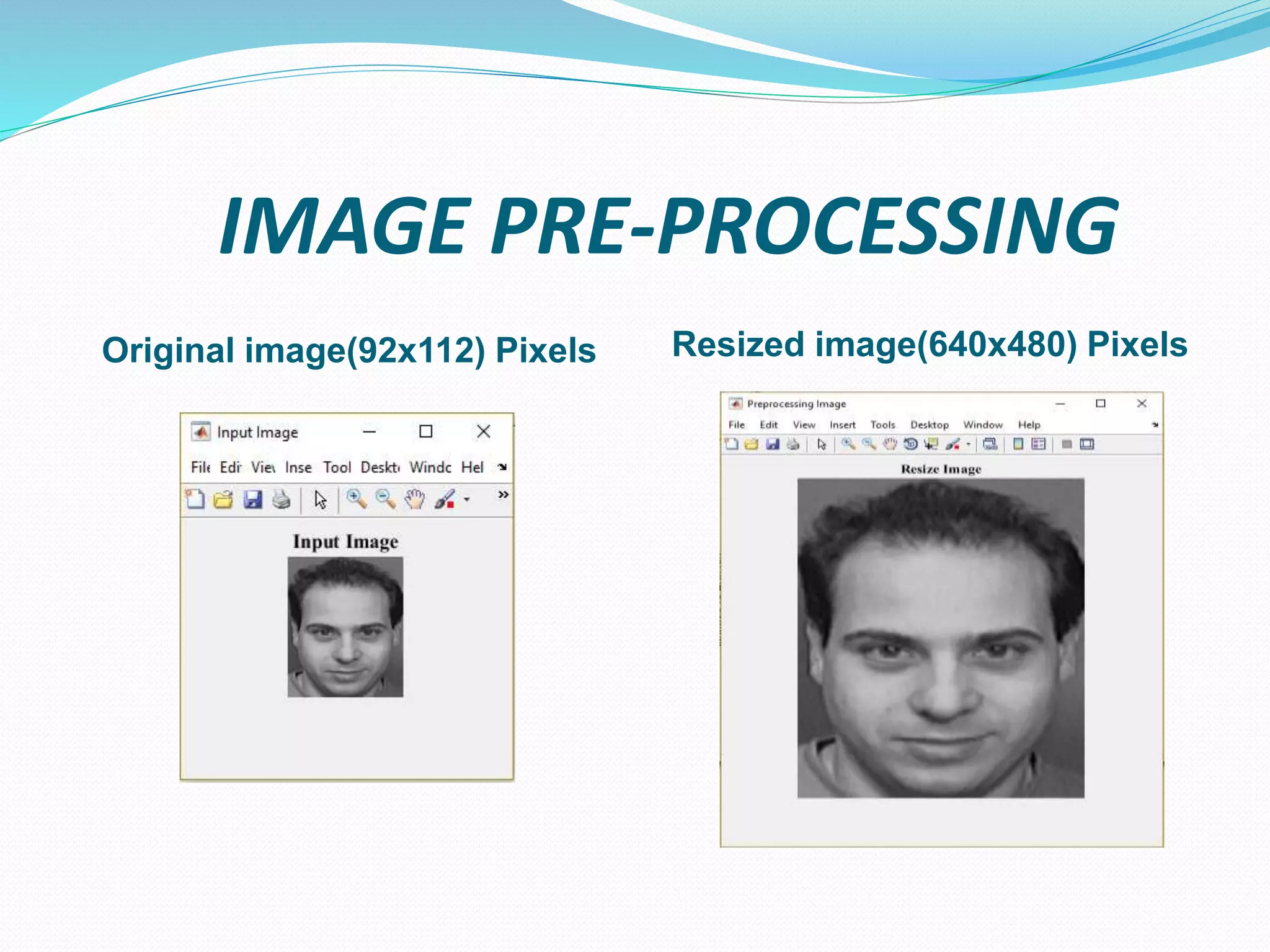
IMAGE PRE-PROCESSING
Original image(92x112) Pixels Resized image(640x480) Pixels
MORPHOLOGICAL METHODS
 There are various morphological methods such as
erode,dilate,opening,closing and hit-miss
transform.
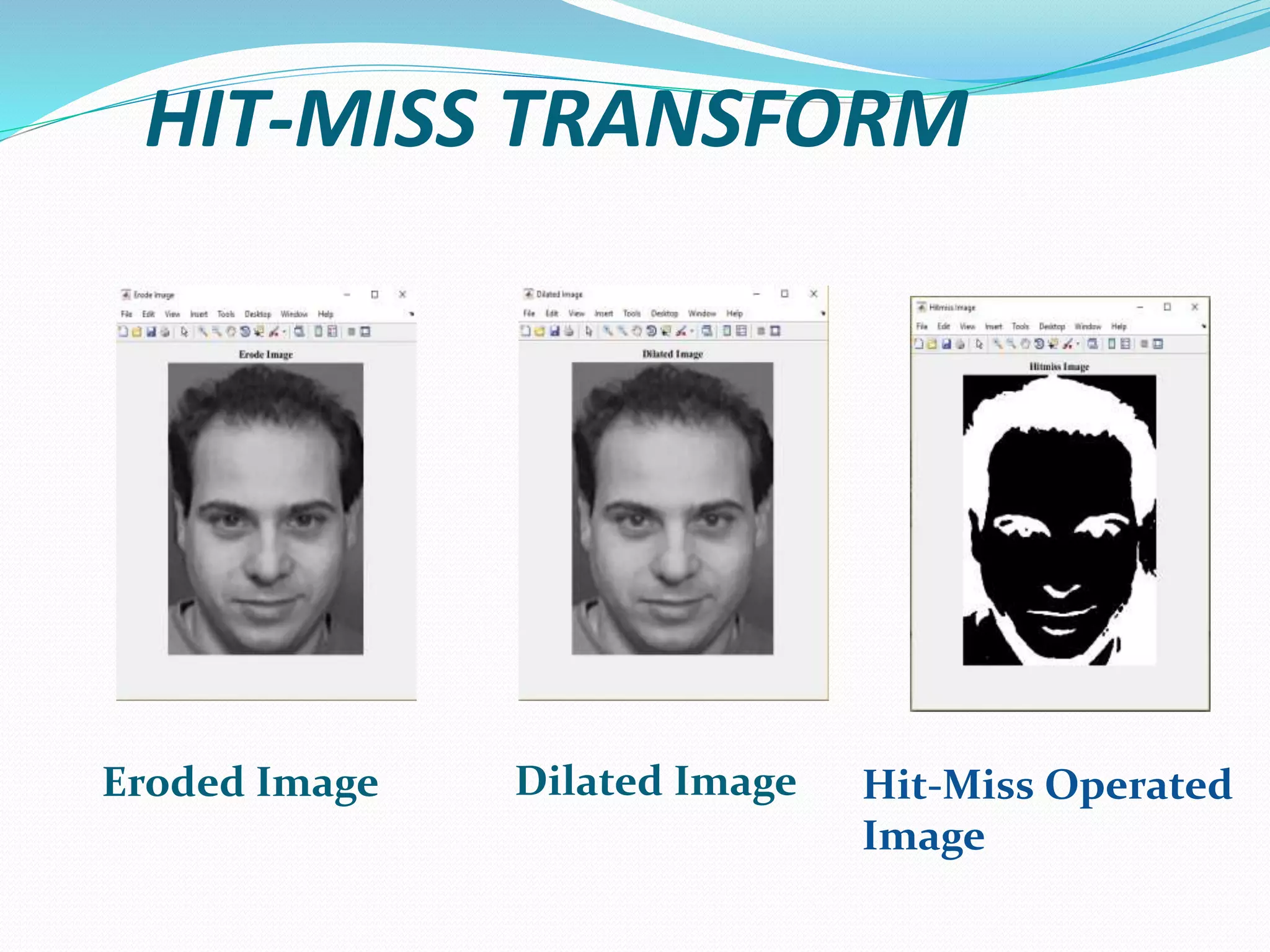
 From various methods Morphological Hit-Miss
transformation is performed on the image.
 The hit miss operation is another form of dilation-
erosion-based convolution. It is nothing but
difference between erosion and dilation.
HIT-MISS TRANSFORM
Eroded Image Dilated Image Hit-Miss Operated
Image
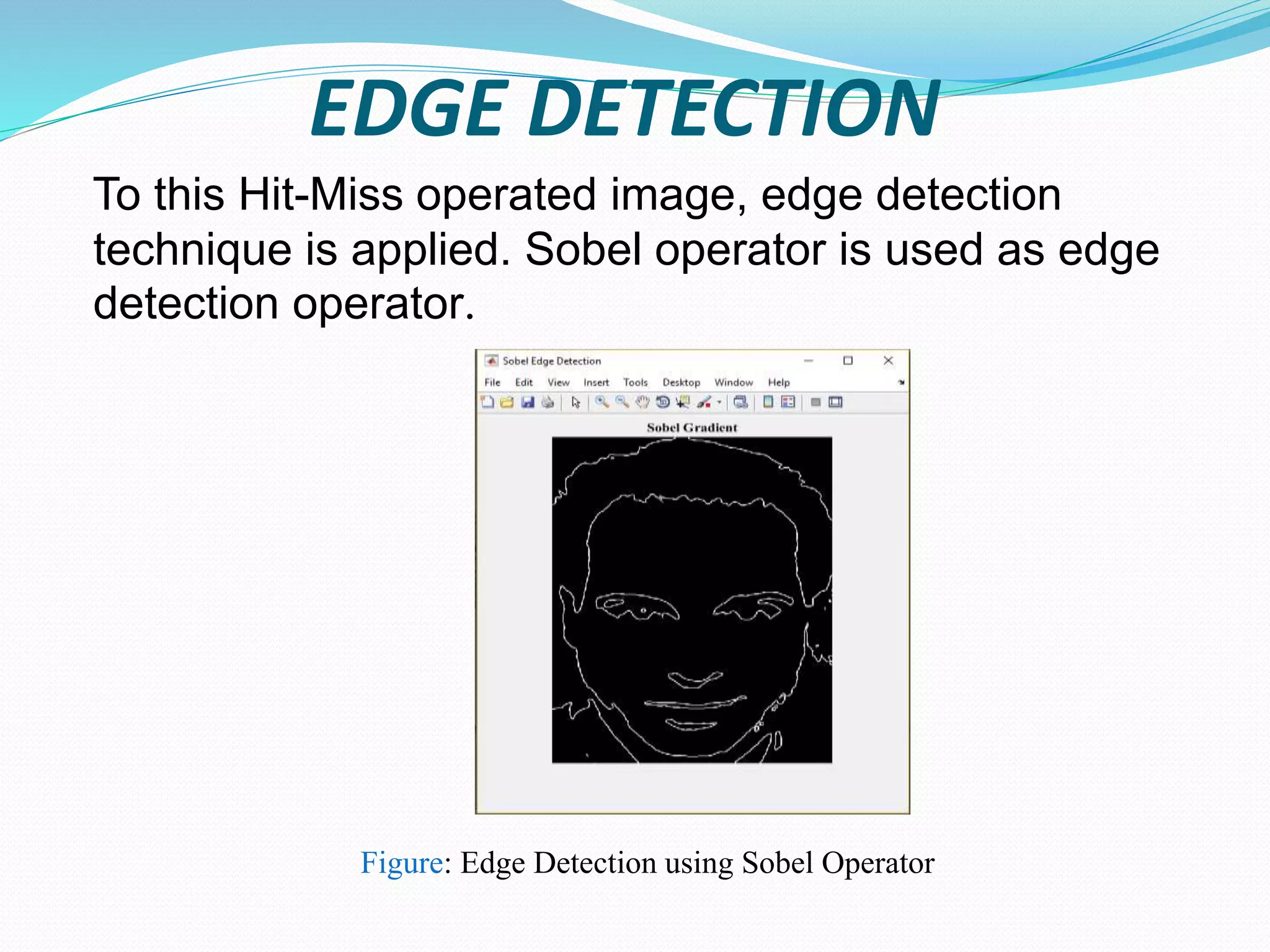
EDGE DETECTION
To this Hit-Miss operated image, edge detection
technique is applied. Sobel operator is used as edge
detection operator.
Figure: Edge Detection using Sobel Operator
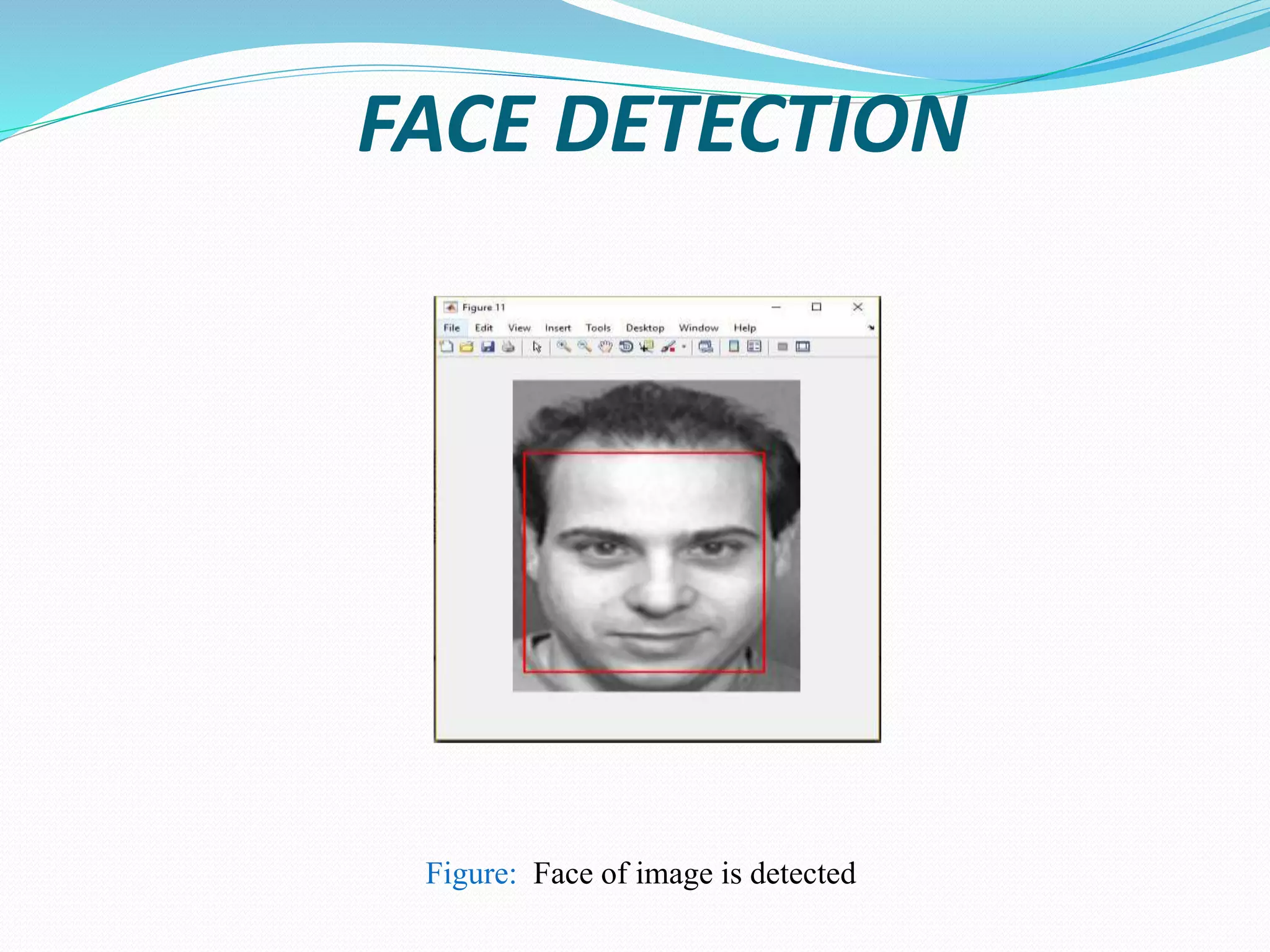
FACE DETECTION
Figure: Face of image is detected
FEATURE EXTRACTION USING
PCA
 What is PCA?
 Why we used PCA?
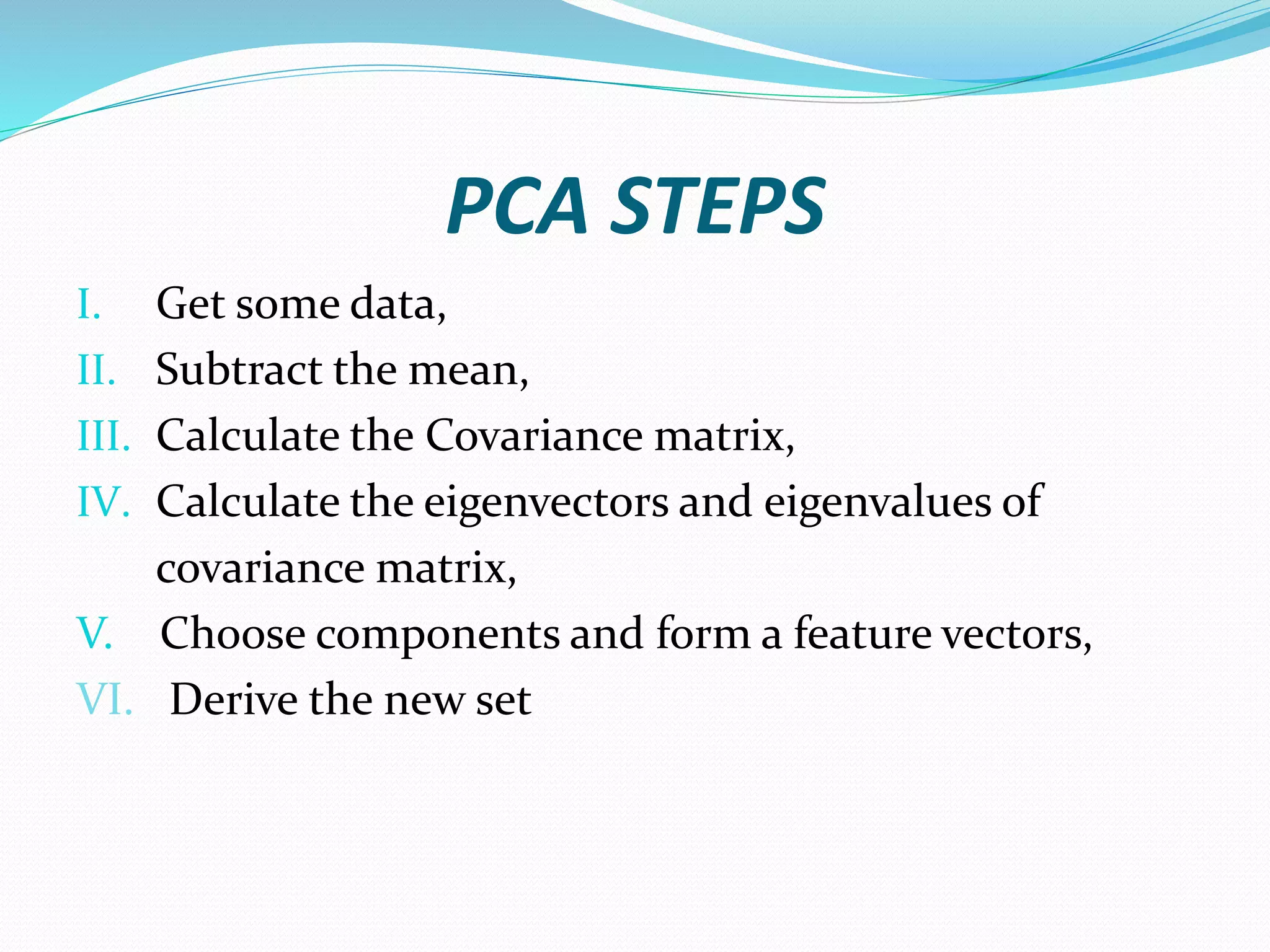
PCA STEPS
I. Get some data,
II. Subtract the mean,
III. Calculate the Covariance matrix,
IV. Calculate the eigenvectors and eigenvalues of
covariance matrix,
V. Choose components and form a feature vectors,
VI. Derive the new set
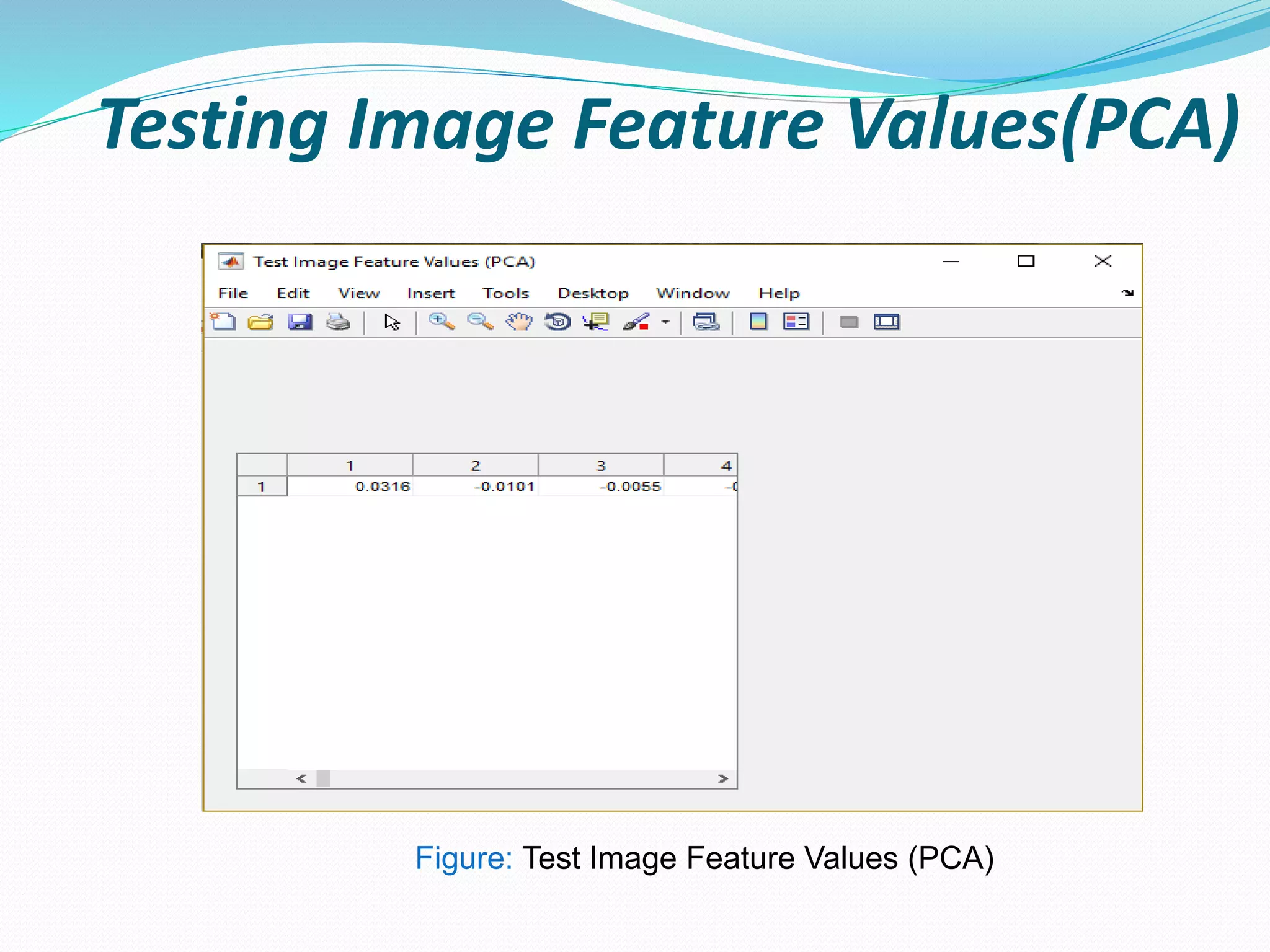
Testing Image Feature Values(PCA)
Figure: Test Image Feature Values (PCA)
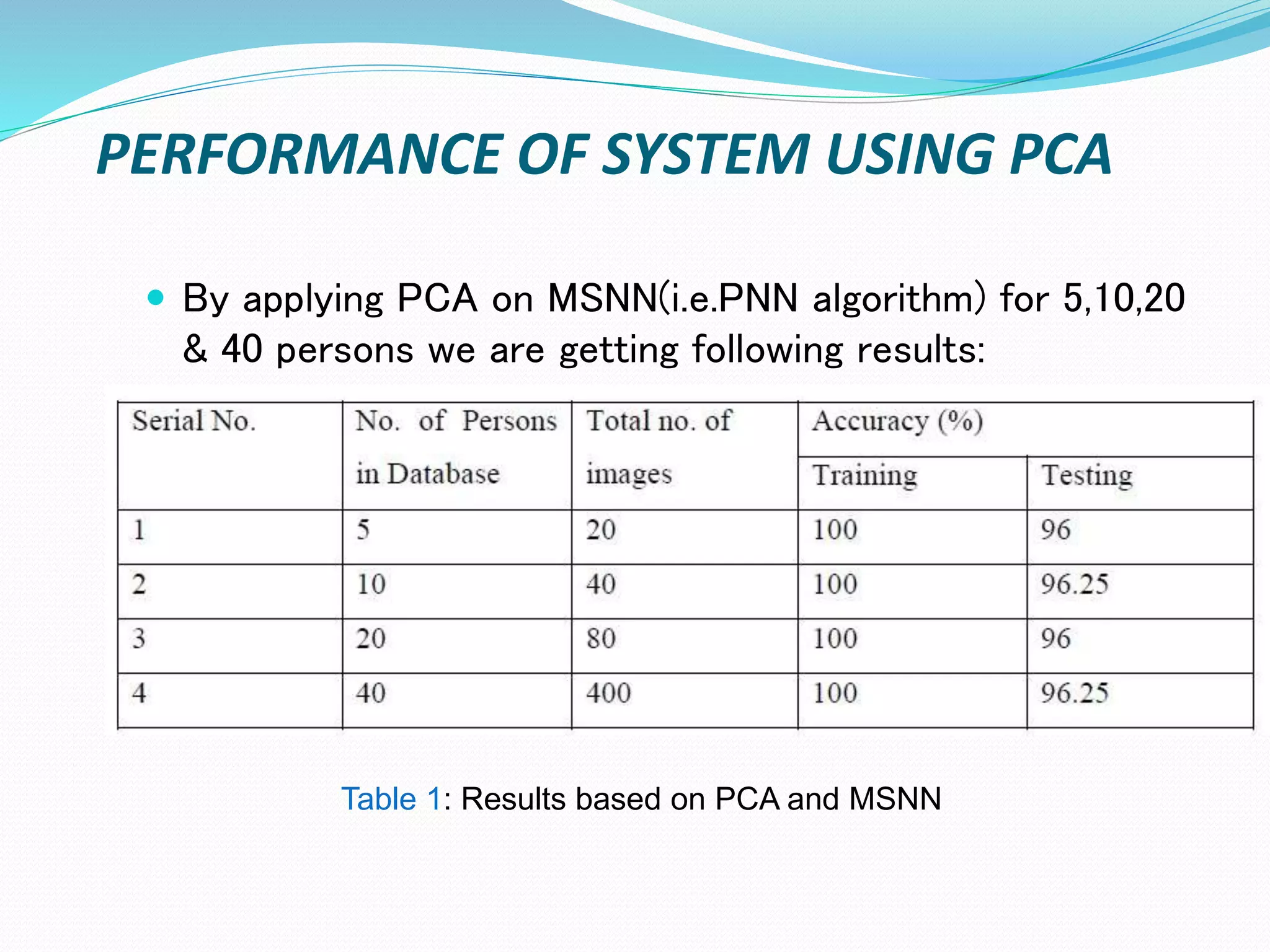
PERFORMANCE OF SYSTEM USING PCA
 By applying PCA on MSNN(i.e.PNN algorithm) for 5,10,20
& 40 persons we are getting following results:
Table 1: Results based on PCA and MSNN
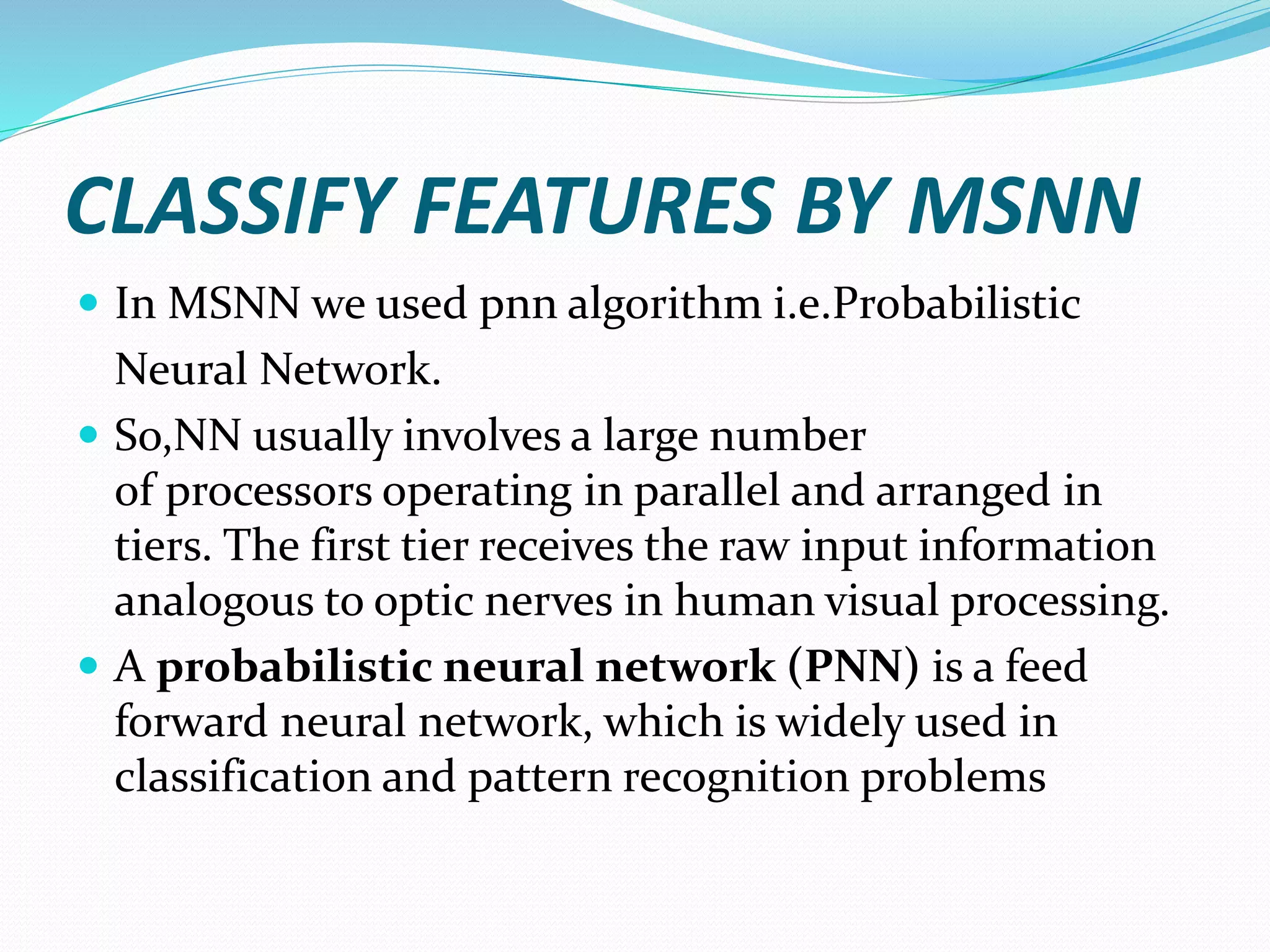
CLASSIFY FEATURES BY MSNN
 In MSNN we used pnn algorithm i.e.Probabilistic
Neural Network.
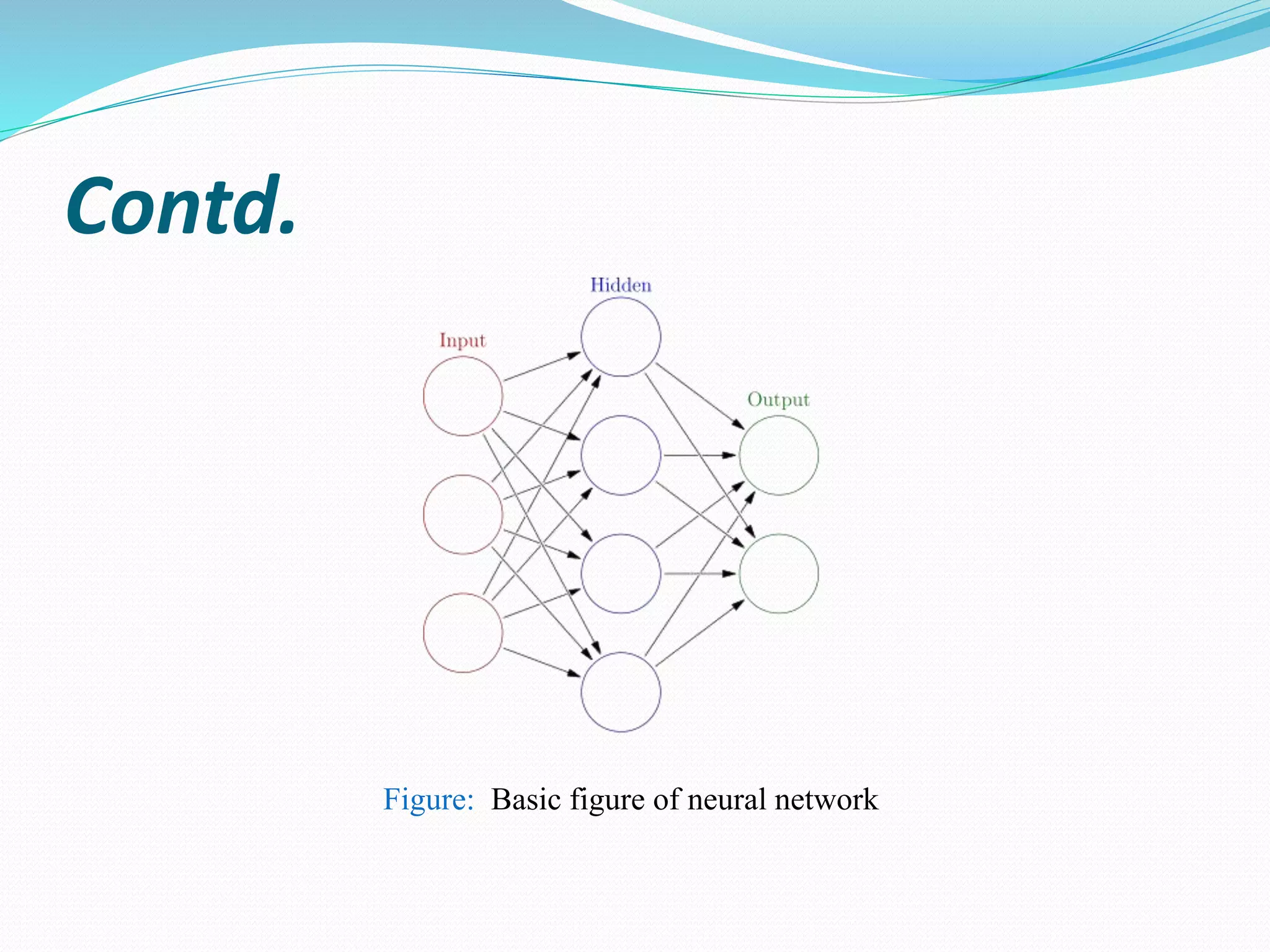
 So,NN usually involves a large number
of processors operating in parallel and arranged in
tiers. The first tier receives the raw input information
analogous to optic nerves in human visual processing.
 A probabilistic neural network (PNN) is a feed
forward neural network, which is widely used in
classification and pattern recognition problems
Contd.
Figure: Basic figure of neural network
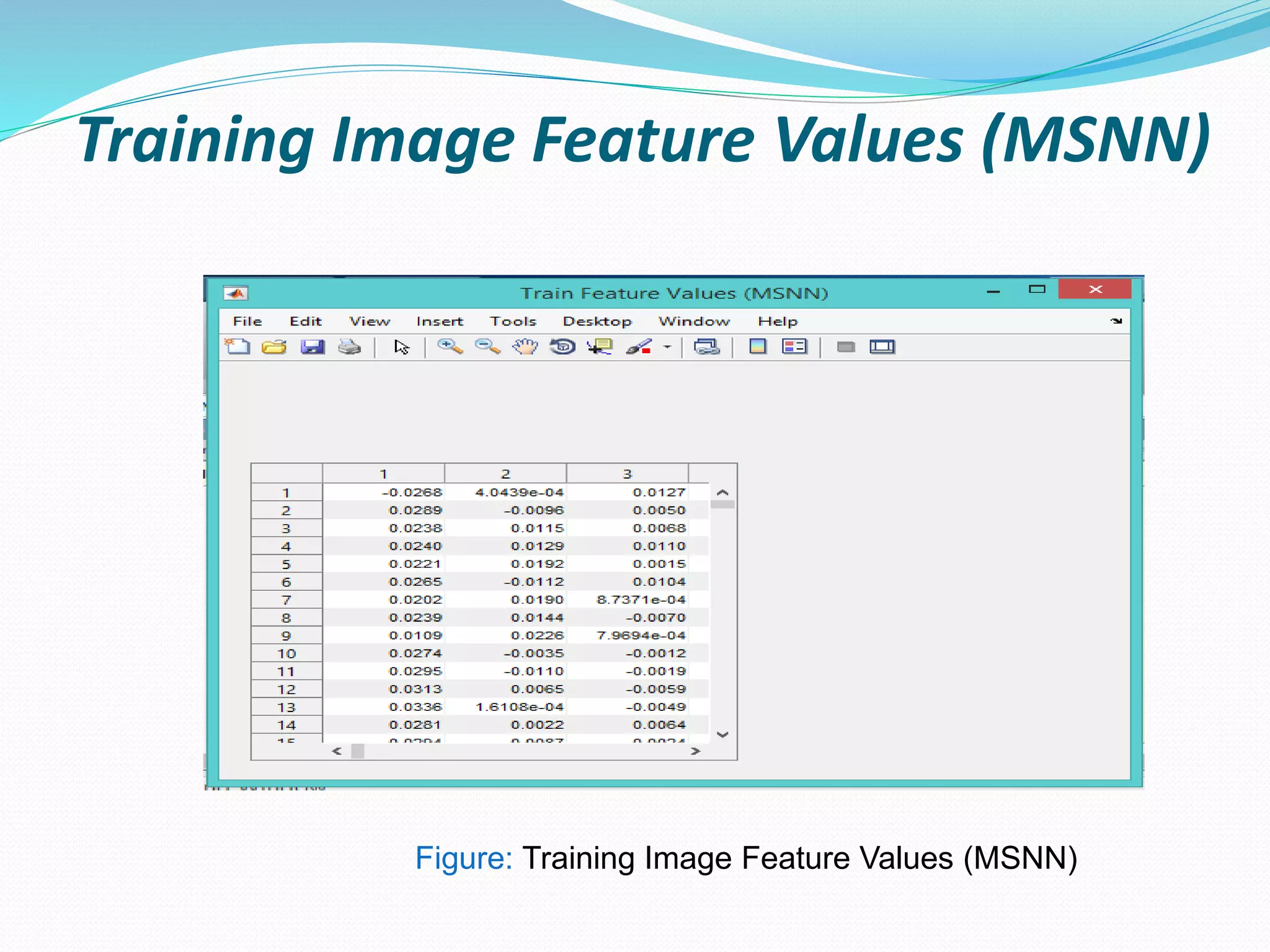
Training Image Feature Values (MSNN)
Figure: Training Image Feature Values (MSNN)
Recognition
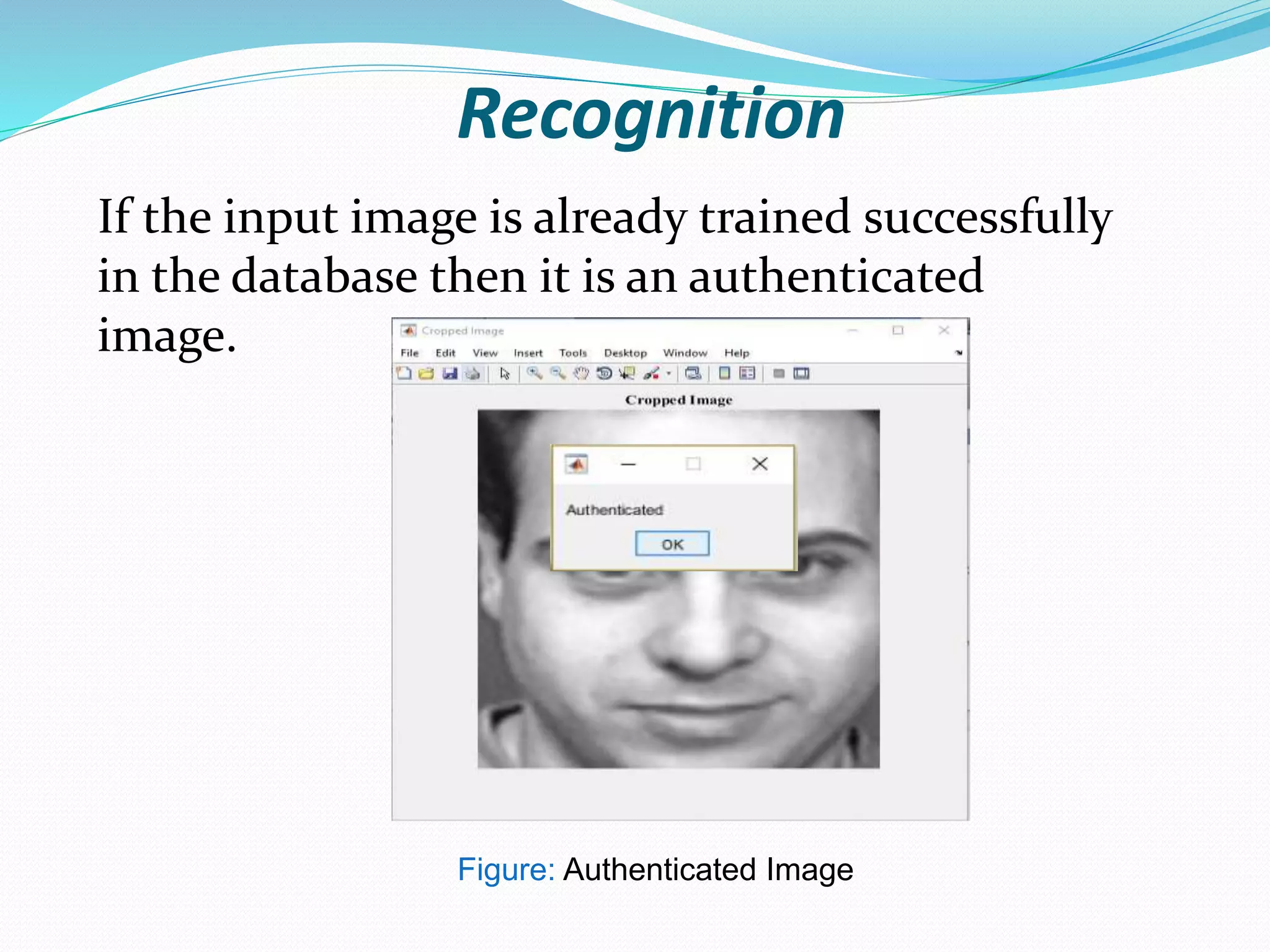
If the input image is already trained successfully
in the database then it is an authenticated
image.
Figure: Authenticated Image
Contd.
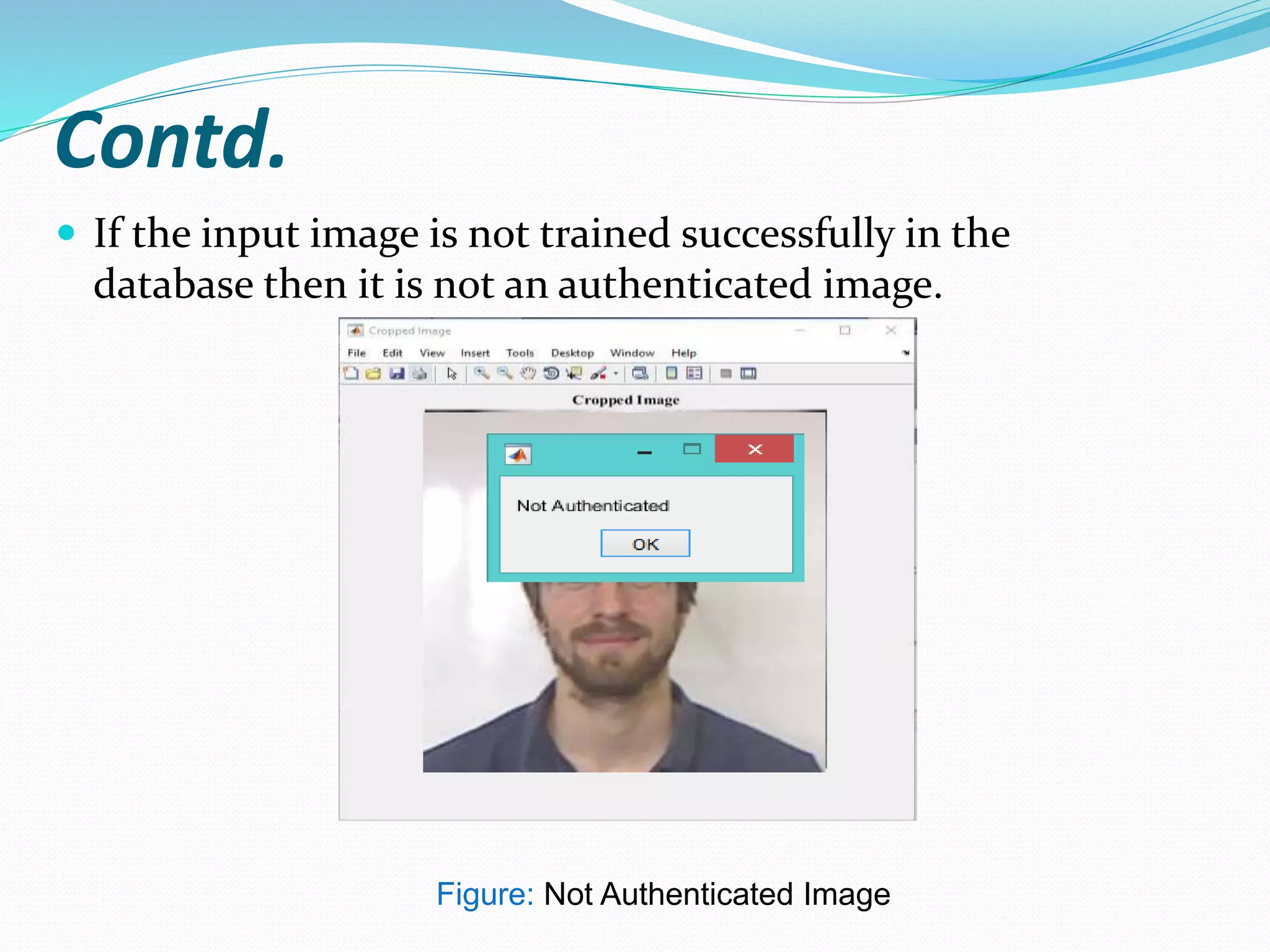
 If the input image is not trained successfully in the
database then it is not an authenticated image.
Figure: Not Authenticated Image
PERFORMANCE OF SYSTEM WITHOUT PCA
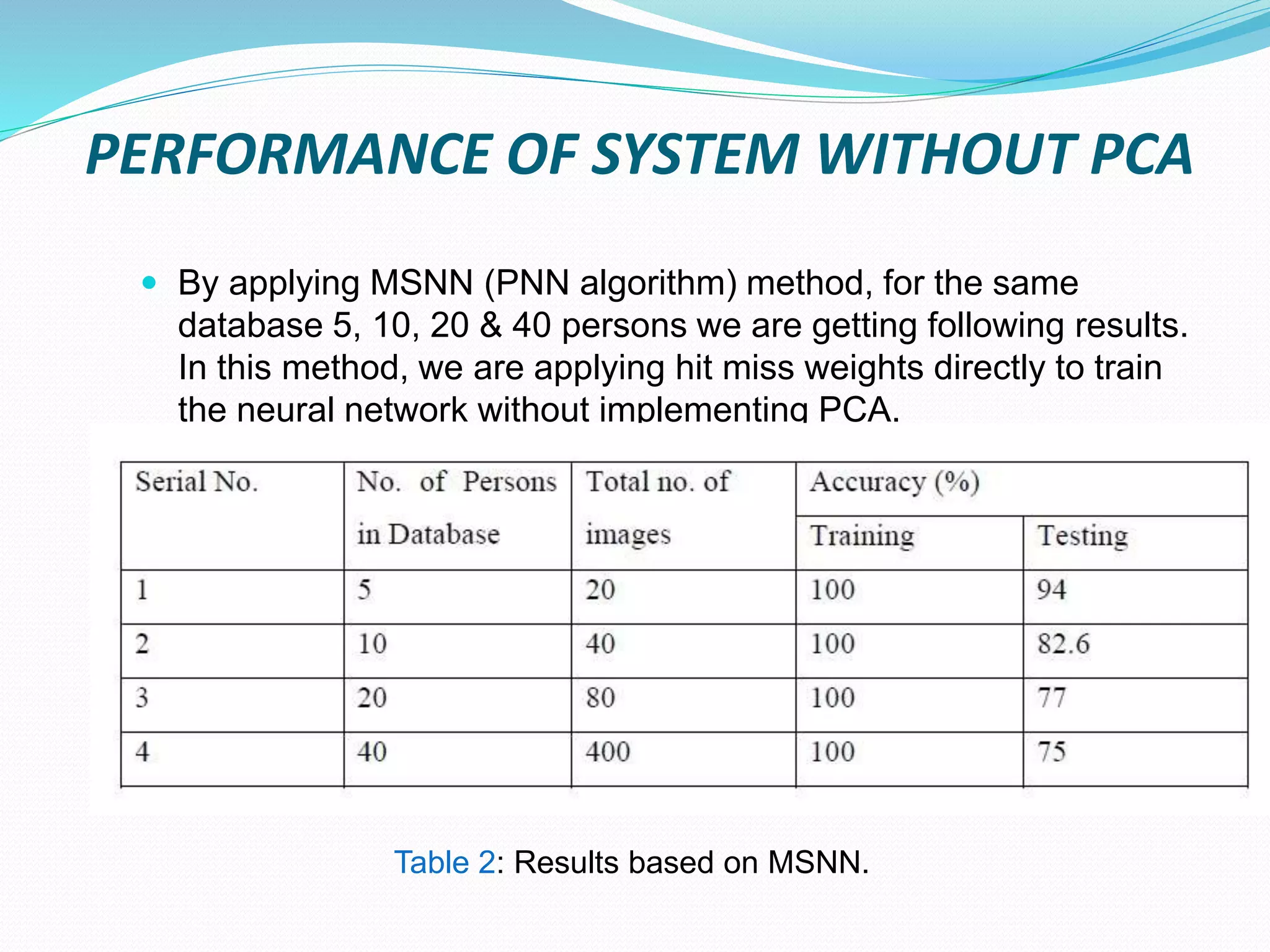
 By applying MSNN (PNN algorithm) method, for the same
database 5, 10, 20 & 40 persons we are getting following results.
In this method, we are applying hit miss weights directly to train
the neural network without implementing PCA.
Table 2: Results based on MSNN.
Contd…
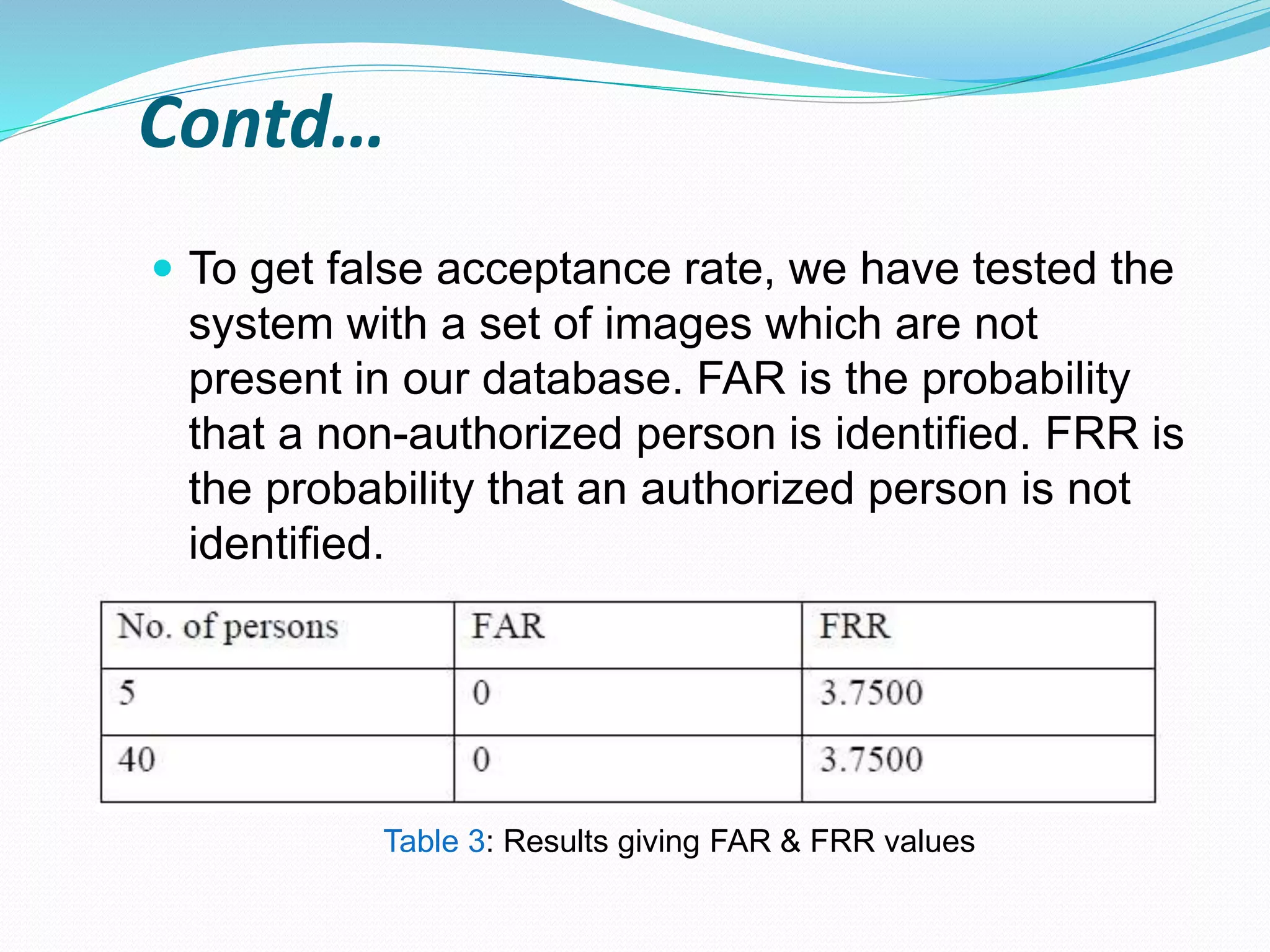
 To get false acceptance rate, we have tested the
system with a set of images which are not
present in our database. FAR is the probability
that a non-authorized person is identified. FRR is
the probability that an authorized person is not
identified.
Table 3: Results giving FAR & FRR values
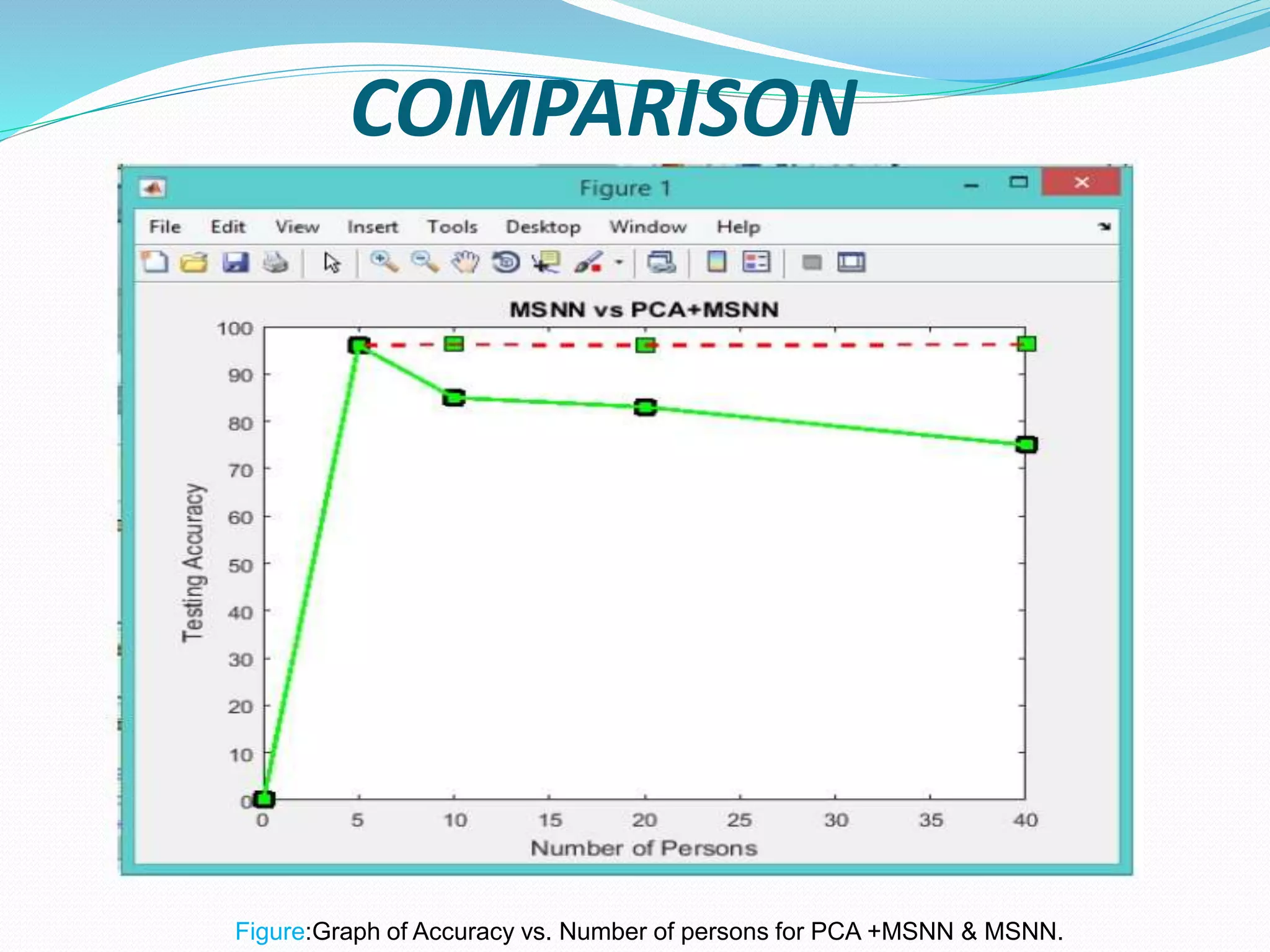
COMPARISON
Figure:Graph of Accuracy vs. Number of persons for PCA +MSNN & MSNN.
Conclusion
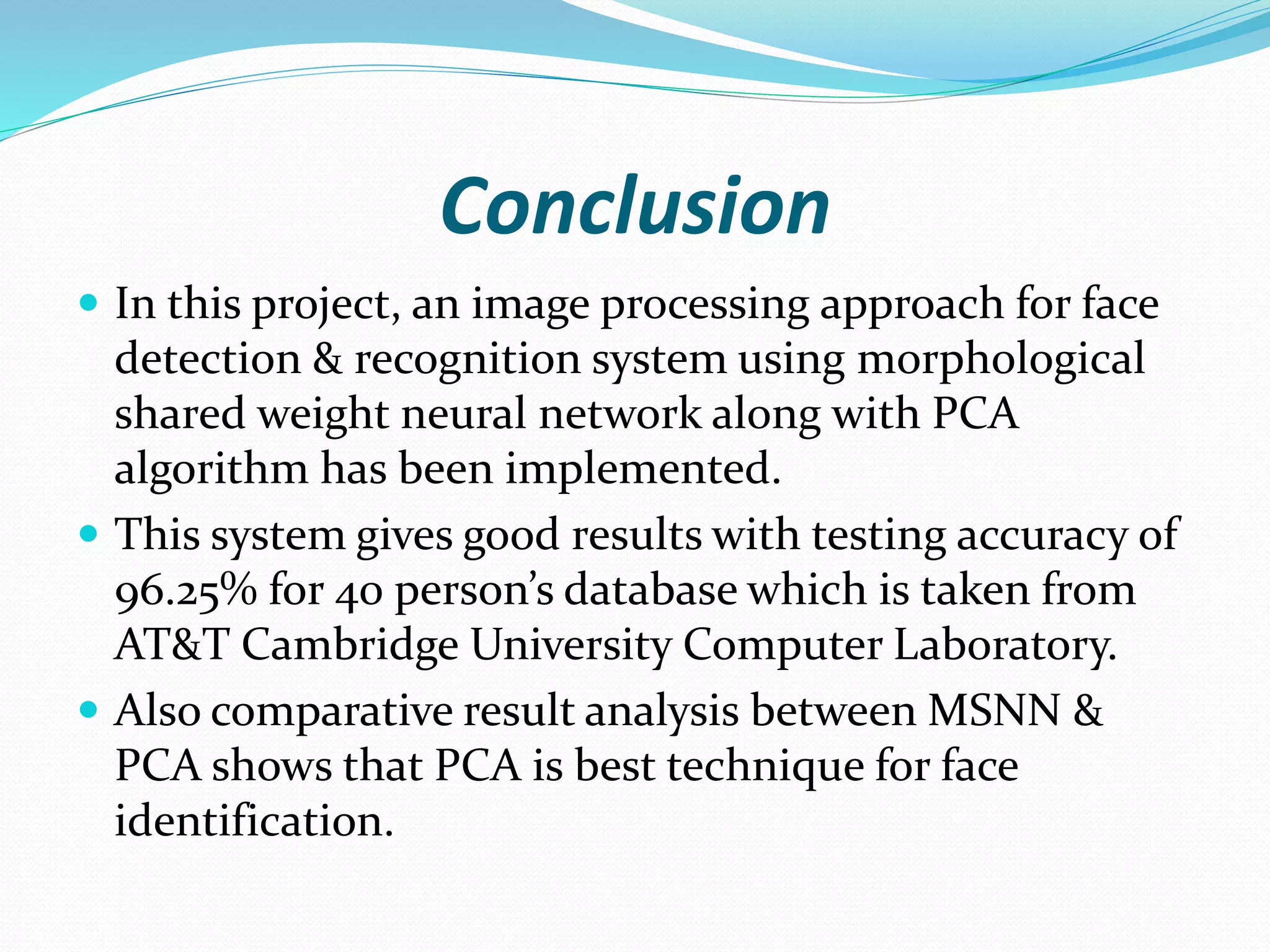
 In this project, an image processing approach for face
detection & recognition system using morphological
shared weight neural network along with PCA
algorithm has been implemented.
 This system gives good results with testing accuracy of
96.25% for 40 person’s database which is taken from
AT&T Cambridge University Computer Laboratory.
 Also comparative result analysis between MSNN &
PCA shows that PCA is best technique for face
identification.
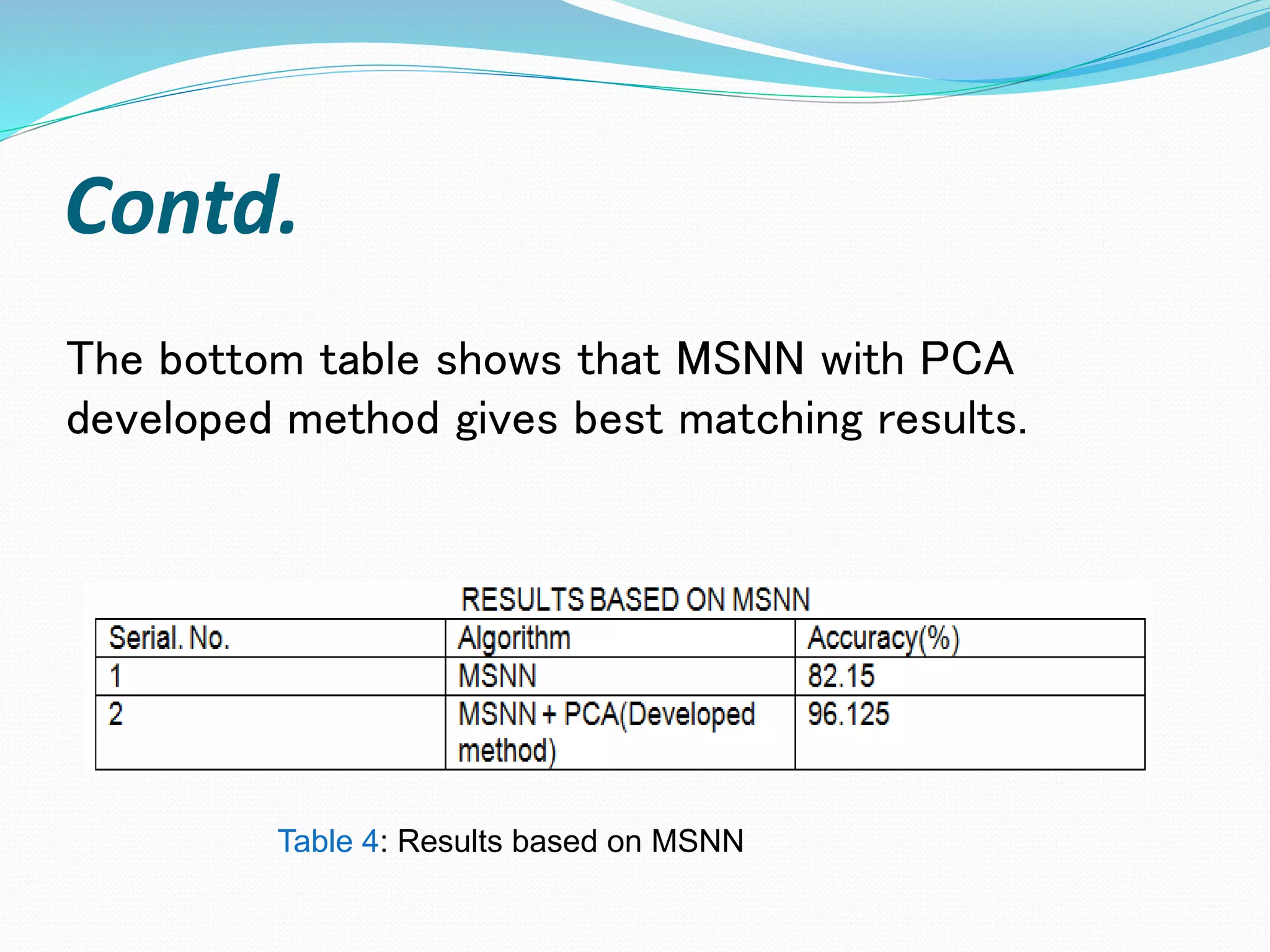
Contd.
The bottom table shows that MSNN with PCA
developed method gives best matching results.
Table 4: Results based on MSNN
Future work
I. We can use video streaming for input images for
testing as well as training.
II. Gait recognition can be performed.
Bibliography
 1..Mayank Agarwal, Nikunj Jain, Mr. Manish Kumar and Himanshu
Agrawal, ”Eigen Faces and Artificial Neural Network”.
 2.M.S.R.S. Prasad, S.S.Panda, G.Deepthi and V.Anish ,” Face
Recognition Using PCA and Feed Forward Neural Networks”.
 3. P.Latha, Dr.L.Ganesan , Dr.S.Annadurai,” Face Recognition using
Neural Network”.
 4. A.R Senjani , Prof . R.C Butani , Prof. Y.J. Parmar,” Design of
efficient face recognition based on Principal Component Analysis
using Eigen faces method”.
 5. S. Adabayo Daramola and O.Sandra Odeghe, ”Face recognition
using Haar wavelet transform”.
 6. Adjoudj Redaand and Dr. BoukelifAoued,” Artificial Neural
Network-Based Face Recognition”.
 7. Vinay Hiremath , Ashwini Mayakar, “ Face recognition using
Eigen face approach”, Malardalen University, Vasteras, Sweden ,
August, 2003.
Contd.
 8. Sanjay Kr Singh, Ashutosh Tripathi, Ankur Mahajan, Dr. S Prabhakaran,
International, “ Analysis of Face Recognition in MATLAB”, Journal of Scientific
& Engineering Research, Volume 3, Issue 2, Febuary 2012.
 9. CC.Tsai , W.C Cheng, J.S Taur and C.W. Tao,” Face Detection Using Eigen
face and Neural Network “, 2006 IEEE International Conference on System ,
Man, and Cybernetics October 8,2006,Taipei,Taiwan.
 10. Lindsay I Smith,” A tutorial on Principal Component Analysis”. February 26,
2002.
 11. Jawad Nagi, Syed Khaleel Ahmed Farrukh Nagi,”A MATLAB based Face
Recognition System using Image Processing and Neural Networks”. Department
of Electrical and Electronics Engineering and Department of Mechanical
Engineering, University Tenaga Nasional, 4th International Colloquium on
Signal Processing and its Application, March 7-9, 2008.
 12. Christophe Garcia and Manolis Delakis, “Neural Architecture for Fast and
Robust Face Detection”, Department of Computer Science , University of
Crete,2002 IEEE.
Contd.
 13.M.Turk and A. Pentland, “ Eigen faces for Recognition”, Journal for Cognitive
Neuroscience, vol.3,1991.
 14.Anil k.Jain, Jianchang Mao, K.Mohiuddin,” Artificial Neural Networks: A
Tutorial “, IEEE Computer Special issue on Neural Computing, March 1996.
 15 “An Approach to Detect the Region of Interest of Expressive Face Images”,
Dept. of CSE, Tripura University.
 16. G.H Dunteman,”Principal component analysis”, Sage publication (1989).
 17.Ales Hladnik, “Image Compression and Face Recognition: Two Image
Processing Application of Principal Component Analysis”.
 18..A.S.Syed Navaz, Periyar University, “Face recognition using Principal
Component Analysis”.
 19.Muthukrishnan.R, M.Radha, “EDGE DETECTION TECHNIQUES FOR
IMAGE SEGMENTATION”, (IJCSIT) Vol 3, No 6, Dec 2011.
 20. “Mathematical Morphological Techniques for Image Processing”, Dept. of
CSE, Tripura University.
 21. Mandar Kiran Kulkarni, Prof. S. S. Lokhande, “Morphological based Face
Detection & Recognition with Principal Component Analysis”, ISSN: 0975-9646
Thank You
Have a Good Day!
If u need the complete project
contact me at (9678384007-
Rabi).

Face Recognition using PCA and MSNN

  • 1.
    Guided By- Mrs.Shrabani Medhi Asst. Professor (Dept. of CSE) Group member’s- Chandraleena Ahmed (1303107070) Chiranjeev Neog(1303107071) Rabi Gayan(1303107094) Bibek Deka(1303107069)
  • 2.
    AIM  This projectincludes two face recognition systems implemented with the help of Principal Component Analysis (PCA) and Morphological Shared-Weight Neural Network(MSNN).  From these systems we will evaluate the performance of both the techniques and based on the accuracy achieved we determine which technique will be better for the face recognition.
  • 3.
    INTRODUCTION Biometrics-  To identifya human by its unique physical and behavioral nature is called biometrics.  Biometric technology is the foundation of providing highly secure solutions for personal identification and authentication.  Types of biometrics  Physiological based biometric technology  Behavior based biometric technology  Why we choose face recognition over other biometric ?
  • 4.
    INTRODUCTION CONTD.  Weare applying Principal Component Analysis to the face detected area & the resulting features are fed as an input to neural network for classification.  The system we are describing in this work uses a morphological shared-weight neural network(MSNN) in its face detection phase.  We have used PCA for feature extraction and MSNN for classification
  • 5.
    DATABASE The database isdivided into two categories:  The database we used contains 400 images taken between April 1992 and April 1994 at the AT&T Laboratories Cambridge. of 40 persons (10 images per person) of size 92 x 112 and have all frontal and slight tilt of the head.  The second training database contains 576 images of 10 persons of size 640 x 480 and have 9 poses x 64 illumination conditions.
  • 6.
    The Database ofFaces at a Glance
  • 7.
    IMAGE PRE-PROCESSING Original image(92x112)Pixels Resized image(640x480) Pixels
  • 8.
    MORPHOLOGICAL METHODS  Thereare various morphological methods such as erode,dilate,opening,closing and hit-miss transform.  From various methods Morphological Hit-Miss transformation is performed on the image.  The hit miss operation is another form of dilation- erosion-based convolution. It is nothing but difference between erosion and dilation.
  • 9.
    HIT-MISS TRANSFORM Eroded ImageDilated Image Hit-Miss Operated Image
  • 10.
    EDGE DETECTION To thisHit-Miss operated image, edge detection technique is applied. Sobel operator is used as edge detection operator. Figure: Edge Detection using Sobel Operator
  • 11.
    FACE DETECTION Figure: Faceof image is detected
  • 12.
    FEATURE EXTRACTION USING PCA What is PCA?  Why we used PCA?
  • 13.
    PCA STEPS I. Getsome data, II. Subtract the mean, III. Calculate the Covariance matrix, IV. Calculate the eigenvectors and eigenvalues of covariance matrix, V. Choose components and form a feature vectors, VI. Derive the new set
  • 14.
    Testing Image FeatureValues(PCA) Figure: Test Image Feature Values (PCA)
  • 15.
    PERFORMANCE OF SYSTEMUSING PCA  By applying PCA on MSNN(i.e.PNN algorithm) for 5,10,20 & 40 persons we are getting following results: Table 1: Results based on PCA and MSNN
  • 16.
    CLASSIFY FEATURES BYMSNN  In MSNN we used pnn algorithm i.e.Probabilistic Neural Network.  So,NN usually involves a large number of processors operating in parallel and arranged in tiers. The first tier receives the raw input information analogous to optic nerves in human visual processing.  A probabilistic neural network (PNN) is a feed forward neural network, which is widely used in classification and pattern recognition problems
  • 17.
    Contd. Figure: Basic figureof neural network
  • 18.
    Training Image FeatureValues (MSNN) Figure: Training Image Feature Values (MSNN)
  • 19.
    Recognition If the inputimage is already trained successfully in the database then it is an authenticated image. Figure: Authenticated Image
  • 20.
    Contd.  If theinput image is not trained successfully in the database then it is not an authenticated image. Figure: Not Authenticated Image
  • 21.
    PERFORMANCE OF SYSTEMWITHOUT PCA  By applying MSNN (PNN algorithm) method, for the same database 5, 10, 20 & 40 persons we are getting following results. In this method, we are applying hit miss weights directly to train the neural network without implementing PCA. Table 2: Results based on MSNN.
  • 22.
    Contd…  To getfalse acceptance rate, we have tested the system with a set of images which are not present in our database. FAR is the probability that a non-authorized person is identified. FRR is the probability that an authorized person is not identified. Table 3: Results giving FAR & FRR values
  • 23.
    COMPARISON Figure:Graph of Accuracyvs. Number of persons for PCA +MSNN & MSNN.
  • 24.
    Conclusion  In thisproject, an image processing approach for face detection & recognition system using morphological shared weight neural network along with PCA algorithm has been implemented.  This system gives good results with testing accuracy of 96.25% for 40 person’s database which is taken from AT&T Cambridge University Computer Laboratory.  Also comparative result analysis between MSNN & PCA shows that PCA is best technique for face identification.
  • 25.
    Contd. The bottom tableshows that MSNN with PCA developed method gives best matching results. Table 4: Results based on MSNN
  • 26.
    Future work I. Wecan use video streaming for input images for testing as well as training. II. Gait recognition can be performed.
  • 27.
    Bibliography  1..Mayank Agarwal,Nikunj Jain, Mr. Manish Kumar and Himanshu Agrawal, ”Eigen Faces and Artificial Neural Network”.  2.M.S.R.S. Prasad, S.S.Panda, G.Deepthi and V.Anish ,” Face Recognition Using PCA and Feed Forward Neural Networks”.  3. P.Latha, Dr.L.Ganesan , Dr.S.Annadurai,” Face Recognition using Neural Network”.  4. A.R Senjani , Prof . R.C Butani , Prof. Y.J. Parmar,” Design of efficient face recognition based on Principal Component Analysis using Eigen faces method”.  5. S. Adabayo Daramola and O.Sandra Odeghe, ”Face recognition using Haar wavelet transform”.  6. Adjoudj Redaand and Dr. BoukelifAoued,” Artificial Neural Network-Based Face Recognition”.  7. Vinay Hiremath , Ashwini Mayakar, “ Face recognition using Eigen face approach”, Malardalen University, Vasteras, Sweden , August, 2003.
  • 28.
    Contd.  8. SanjayKr Singh, Ashutosh Tripathi, Ankur Mahajan, Dr. S Prabhakaran, International, “ Analysis of Face Recognition in MATLAB”, Journal of Scientific & Engineering Research, Volume 3, Issue 2, Febuary 2012.  9. CC.Tsai , W.C Cheng, J.S Taur and C.W. Tao,” Face Detection Using Eigen face and Neural Network “, 2006 IEEE International Conference on System , Man, and Cybernetics October 8,2006,Taipei,Taiwan.  10. Lindsay I Smith,” A tutorial on Principal Component Analysis”. February 26, 2002.  11. Jawad Nagi, Syed Khaleel Ahmed Farrukh Nagi,”A MATLAB based Face Recognition System using Image Processing and Neural Networks”. Department of Electrical and Electronics Engineering and Department of Mechanical Engineering, University Tenaga Nasional, 4th International Colloquium on Signal Processing and its Application, March 7-9, 2008.  12. Christophe Garcia and Manolis Delakis, “Neural Architecture for Fast and Robust Face Detection”, Department of Computer Science , University of Crete,2002 IEEE.
  • 29.
    Contd.  13.M.Turk andA. Pentland, “ Eigen faces for Recognition”, Journal for Cognitive Neuroscience, vol.3,1991.  14.Anil k.Jain, Jianchang Mao, K.Mohiuddin,” Artificial Neural Networks: A Tutorial “, IEEE Computer Special issue on Neural Computing, March 1996.  15 “An Approach to Detect the Region of Interest of Expressive Face Images”, Dept. of CSE, Tripura University.  16. G.H Dunteman,”Principal component analysis”, Sage publication (1989).  17.Ales Hladnik, “Image Compression and Face Recognition: Two Image Processing Application of Principal Component Analysis”.  18..A.S.Syed Navaz, Periyar University, “Face recognition using Principal Component Analysis”.  19.Muthukrishnan.R, M.Radha, “EDGE DETECTION TECHNIQUES FOR IMAGE SEGMENTATION”, (IJCSIT) Vol 3, No 6, Dec 2011.  20. “Mathematical Morphological Techniques for Image Processing”, Dept. of CSE, Tripura University.  21. Mandar Kiran Kulkarni, Prof. S. S. Lokhande, “Morphological based Face Detection & Recognition with Principal Component Analysis”, ISSN: 0975-9646
  • 30.
    Thank You Have aGood Day! If u need the complete project contact me at (9678384007- Rabi).

Editor's Notes

  • #4 rfdgfdgfdgfdgfdgfd
  • #5 rfdgfdgfdgfdgfdgfd