By Steven Duong
Facebook Campaigns
 Company needs to be transparent
 Have more conversations
 Have more interactions
 Build deeper relationships – can leverage people in
 your Facebook to “talk amongst themselves”
 If there is an issue/problem it should best be
  resolved quickly and accepted rather than being
  hidden or worst lied about
 Trust and honesty is important; an un-transparent
  company can end up failing through social media
 Upload videos/photos
 Integrating all the marketing into a single message
  (website, email campaigns, Facebook, Twitter,
  tradeshows, LinkedIn)
 Add Twitter, LinkedIn and Facebook link to ALL
  marketing pieces
 Consider Facebook Ads – can be target to be display
  to specific demographics, although there is a fee
  involved
 Get more Facebook page fans
 Encourage more “Likes” on Facebook site
 Facebook posts shouldn’t be aggressive as other
  marketing arenas such as email campaigns
Getting more “Likes”
 Need to do cool and new things to get people
  “Like”ing and becoming fans
1. Video clips/photos
2. Weekly tips
3. Contests
4. Links to other videos and/or inspirational
    articles/information
Strategies with Facebook
 What is the goal with Facebook marketing?
 What are the steps to reach it?
 How to incorporate with other marketing tools?
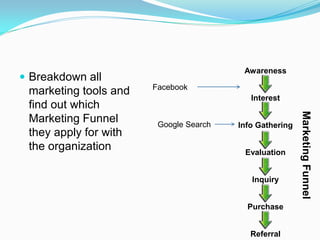
Awareness
 Breakdown all
                       Facebook
 marketing tools and
                                           Interest
 find out which


                                                         Marketing Funnel
 Marketing Funnel       Google Search   Info Gathering
 they apply for with
 the organization                        Evaluation


                                           Inquiry


                                          Purchase


                                           Referral
Reaching Potential Clients
 Reach the right people - who are your
  clients/customers?
 With the right message – strategize on just what
  message your company wants to communicate to
  clients/customers
 At the right time
 With the right offer – what are you offering?
  Remember you are NOT directly selling on
  Facebook
 What makes your organization unique? And how do
  you leverage that?
 When users type in keywords in their search, does
  your organization come up in the first five spots?
 Your Facebook site needs to show your expertise,
  uniqueness, speciality and dedication
 Think about doing Facebook Ads to target specific
  groups – understand that you would need to do
  various experimentation and tweaking with your ads
Fan Marketing in Facebook
 When ad viewers click “Like” on your ad, they
  immediately become fans and will start seeing your
  page posts on their news feed
 Engage your readers with your page post. Make
  them want to “Like” and comment on it
 Acceptable cost per click = profit per sale x
                         Conversion rate
NOTE:
Only 1% of people will do what you ask them to do online
If you get at least 1% you are doing OK. Greater, then you
are doing great, lesser, then something is wrong.

FYI: only 1% of people on the internet create content, 9%
edit/modify content and 90% read/view without contribution
5 Steps of Optimization
 Clarify what your goal is
 Find a way to measure your goal
 Look at your starting point
 Test tactics that move you towards the goal
 Check to see what works/what didn’t, then adapt
Quantify the Goal with a Key
Metrics
 Define the goal
 Define which metric will measure your progress
  towards that goal
 Set a target number you want to achieve
Facebook Marketing Metrics
 Facebook Ad Metrics
1. Cost per click
2. Click through rate (CTR)
3. Cost per impressions
4. Total number of impressions
5. Amount spend
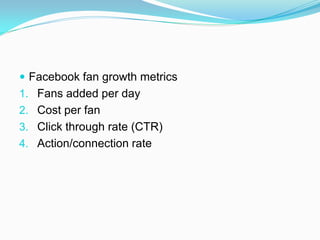
 Facebook fan growth metrics
1. Fans added per day
2. Cost per fan
3. Click through rate (CTR)
4. Action/connection rate
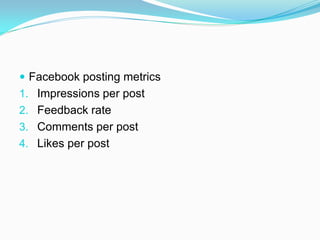
 Facebook posting metrics
1. Impressions per post
2. Feedback rate
3. Comments per post
4. Likes per post
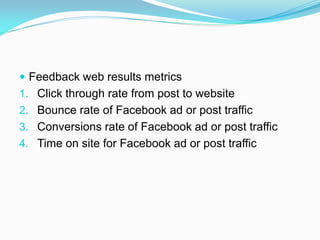
 Feedback web results metrics
1. Click through rate from post to website
2. Bounce rate of Facebook ad or post traffic
3. Conversions rate of Facebook ad or post traffic
4. Time on site for Facebook ad or post traffic
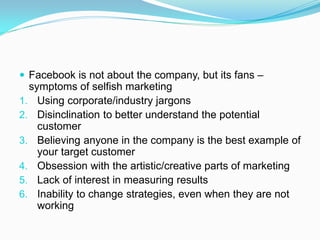
 Facebook is not about the company, but its fans –
  symptoms of selfish marketing
1. Using corporate/industry jargons
2. Disinclination to better understand the potential
    customer
3. Believing anyone in the company is the best example of
    your target customer
4. Obsession with the artistic/creative parts of marketing
5. Lack of interest in measuring results
6. Inability to change strategies, even when they are not
    working
 Facebook users want to be interrupted and this is a
 huge opportunity for the marketer
A.I.D.A
 Attention, Interest, Desire, Action
 The desire phase is critical in Fan Marketing of
  Facebook. You use Facebook posts to turn your fans
  into fanatics. And you create raving fans by selling
  the dream
 People buy with their emotions and justify the
  purchase with logic
1. Make sure you are having an emotional impact!
2. What “benefits” are you offering? Better yet, what
    “dream” are your providing?
12 Things People Dream About
1. Awe
                        7. Fun
2. Belonging            8. Love
3. Choices              9. Luxury
4. Connection           10. Relaxation
5. Free time            11. Security
                        12. Simplicity
6. Freedom

Find which are your customers’ dream and connect it to your
offering and you’ve connected with them on the deepest level
– this is a competitive advantage
Where is Facebook in the
Marketing Funnel?
 One of the biggest objection for Facebook marketing
 is the assumption that social users are not looking to
 buy. While its true that they might not be ready to do
 the purchase, Facebook marketing brings them
 aware of the product and helps to establish branding
 and familiarity of the users to the company or
 product. So when they are ready to make the
 purchase, the company will not require as much time
 and money to get the customer because of the
 relationship that already has been establish
Facebook Ads
 Anatomy
1. Destination – where the user will go when click
2. Body – the text of your ad
3. Image – 110x80 pixels
4. Target
  1. Location
  2. Demographics
  3. Interests/categories
  4. Connections
  5. Advanced demographics
  6. Education & work
5. Campaign Name and Budget
6. Schedule
7. pricing
Fans on Facebook
 Always look for quality and not quantity # of fans
 Wrong fans = bad ROI
 Target right people in order to achieve profitability
 Too many wrong fans can
   1. Conversion of fans will be much lower
   2. Produce inaccurate statistic results
Getting more “Likes” and
Comments
 Most fans never return to a page after they like it
 Most posts by pages are seen by less than 10% of
  their fans
 Many fans will never see your welcome tab
 When fans create new posts on your Facebook
  page, other fans don’t see them
Newsfeed Page
 Most fans experience Facebook through their News Feed
 The News Feed is set by default to Top Posts, which
  means Facebook uses its Edge Rank and Graph Rank
  algorithms to show people the stories it thinks they will be
  interested in
 It knows people’s interest by keeping track of what posts
  people like and comment on
 When fans no longer sees your post, its hard to get them
  back
 Always engage your fans!!!
1. Asking polls and questions
2. Placing interesting comments for them to view and like
 If you don’t get fans to “Like” and comment your
  posts; in the end they will stop seeing them
 New friends and newly liked pages are shown to
  your fans for a while, but if you don’t interact with
  them, you will stop seeing posts from them
Post Metrics and Benchmarks
 Administrators see extra data about each post that
  fans don’t. These are:
1. Impressions – how many times the post was
    shown
2. Feedback – how engaging was the post. Generally
    you want 1% or higher. However, it can be skewed.
    For example you can have a really high feedback
    rate, but that’s only due to an extremely low
    impression
Formulas for Posts
 To get likes, say “Click Like if…” and keep the
  second part simple
1. This is very simple formula. Its all about whether
   people agree with you. So choose something that
   is 70%-90% agreeable, such as “Click like if you
   believe in love”
 To get comments, ask a question or say “Tell me in
  the comments below…” followed by whatever you
  want to know
1. Best questions to use are open-ended ones
 To get clicks to your website or blog post put the
  URL in the update and say, “Click this link…” and tell
  them why
1. Remember to make the titles attention grabbing
    and interesting
 These are all Call-to-Actions
Qualities of a Successful Posts
are:
 Has 1% feedback rate or more
 Has 50% or more impressions compared to fans
 Is attention grabbing
 Is something 90% of your audience cares about
 Asks for likes or asks a question
 Fits the demographics and geographic location of
  your fan base
 Contains no-brainer texts
 Sells the dream
 Based on what your learn from ad testing
Bad Posts are
 Feedback below 50%
 Impressions are less than 30% of fan base
 Not understanding audience
 Posts that 95% of the audience don’t care about
 Promote things that very few people cares about
 Photos without captions or call to action
Learning From Previous Posts
 Administrators can access Insights of their last 10
  posts to review how many impressions they got and
  the feedback rate.
 Use these information to view patterns and analyze
  behaviour
Engagement Milestones
 Getting 1% feedback regularly
 People posting spontaneously on your page
 Fans seeing and posting on fan page posts
By Steven Duong

Face Book Best Practice

  • 1.
  • 2.
    Facebook Campaigns  Companyneeds to be transparent  Have more conversations  Have more interactions  Build deeper relationships – can leverage people in your Facebook to “talk amongst themselves”
  • 3.
     If thereis an issue/problem it should best be resolved quickly and accepted rather than being hidden or worst lied about  Trust and honesty is important; an un-transparent company can end up failing through social media  Upload videos/photos
  • 4.
     Integrating allthe marketing into a single message (website, email campaigns, Facebook, Twitter, tradeshows, LinkedIn)  Add Twitter, LinkedIn and Facebook link to ALL marketing pieces
  • 5.
     Consider FacebookAds – can be target to be display to specific demographics, although there is a fee involved  Get more Facebook page fans  Encourage more “Likes” on Facebook site  Facebook posts shouldn’t be aggressive as other marketing arenas such as email campaigns
  • 6.
    Getting more “Likes” Need to do cool and new things to get people “Like”ing and becoming fans 1. Video clips/photos 2. Weekly tips 3. Contests 4. Links to other videos and/or inspirational articles/information
  • 7.
    Strategies with Facebook What is the goal with Facebook marketing?  What are the steps to reach it?  How to incorporate with other marketing tools?
  • 8.
    Awareness  Breakdown all Facebook marketing tools and Interest find out which Marketing Funnel Marketing Funnel Google Search Info Gathering they apply for with the organization Evaluation Inquiry Purchase Referral
  • 9.
    Reaching Potential Clients Reach the right people - who are your clients/customers?  With the right message – strategize on just what message your company wants to communicate to clients/customers  At the right time  With the right offer – what are you offering? Remember you are NOT directly selling on Facebook
  • 10.
     What makesyour organization unique? And how do you leverage that?  When users type in keywords in their search, does your organization come up in the first five spots?  Your Facebook site needs to show your expertise, uniqueness, speciality and dedication  Think about doing Facebook Ads to target specific groups – understand that you would need to do various experimentation and tweaking with your ads
  • 11.
    Fan Marketing inFacebook  When ad viewers click “Like” on your ad, they immediately become fans and will start seeing your page posts on their news feed  Engage your readers with your page post. Make them want to “Like” and comment on it
  • 12.
     Acceptable costper click = profit per sale x Conversion rate NOTE: Only 1% of people will do what you ask them to do online If you get at least 1% you are doing OK. Greater, then you are doing great, lesser, then something is wrong. FYI: only 1% of people on the internet create content, 9% edit/modify content and 90% read/view without contribution
  • 13.
    5 Steps ofOptimization  Clarify what your goal is  Find a way to measure your goal  Look at your starting point  Test tactics that move you towards the goal  Check to see what works/what didn’t, then adapt
  • 14.
    Quantify the Goalwith a Key Metrics  Define the goal  Define which metric will measure your progress towards that goal  Set a target number you want to achieve
  • 15.
    Facebook Marketing Metrics Facebook Ad Metrics 1. Cost per click 2. Click through rate (CTR) 3. Cost per impressions 4. Total number of impressions 5. Amount spend
  • 16.
     Facebook fangrowth metrics 1. Fans added per day 2. Cost per fan 3. Click through rate (CTR) 4. Action/connection rate
  • 17.
     Facebook postingmetrics 1. Impressions per post 2. Feedback rate 3. Comments per post 4. Likes per post
  • 18.
     Feedback webresults metrics 1. Click through rate from post to website 2. Bounce rate of Facebook ad or post traffic 3. Conversions rate of Facebook ad or post traffic 4. Time on site for Facebook ad or post traffic
  • 19.
     Facebook isnot about the company, but its fans – symptoms of selfish marketing 1. Using corporate/industry jargons 2. Disinclination to better understand the potential customer 3. Believing anyone in the company is the best example of your target customer 4. Obsession with the artistic/creative parts of marketing 5. Lack of interest in measuring results 6. Inability to change strategies, even when they are not working
  • 20.
     Facebook userswant to be interrupted and this is a huge opportunity for the marketer
  • 21.
    A.I.D.A  Attention, Interest,Desire, Action  The desire phase is critical in Fan Marketing of Facebook. You use Facebook posts to turn your fans into fanatics. And you create raving fans by selling the dream  People buy with their emotions and justify the purchase with logic 1. Make sure you are having an emotional impact! 2. What “benefits” are you offering? Better yet, what “dream” are your providing?
  • 22.
    12 Things PeopleDream About 1. Awe 7. Fun 2. Belonging 8. Love 3. Choices 9. Luxury 4. Connection 10. Relaxation 5. Free time 11. Security 12. Simplicity 6. Freedom Find which are your customers’ dream and connect it to your offering and you’ve connected with them on the deepest level – this is a competitive advantage
  • 23.
    Where is Facebookin the Marketing Funnel?  One of the biggest objection for Facebook marketing is the assumption that social users are not looking to buy. While its true that they might not be ready to do the purchase, Facebook marketing brings them aware of the product and helps to establish branding and familiarity of the users to the company or product. So when they are ready to make the purchase, the company will not require as much time and money to get the customer because of the relationship that already has been establish
  • 24.
    Facebook Ads  Anatomy 1.Destination – where the user will go when click 2. Body – the text of your ad 3. Image – 110x80 pixels 4. Target 1. Location 2. Demographics 3. Interests/categories 4. Connections 5. Advanced demographics 6. Education & work
  • 25.
    5. Campaign Nameand Budget 6. Schedule 7. pricing
  • 26.
    Fans on Facebook Always look for quality and not quantity # of fans  Wrong fans = bad ROI  Target right people in order to achieve profitability  Too many wrong fans can 1. Conversion of fans will be much lower 2. Produce inaccurate statistic results
  • 27.
    Getting more “Likes”and Comments  Most fans never return to a page after they like it  Most posts by pages are seen by less than 10% of their fans  Many fans will never see your welcome tab  When fans create new posts on your Facebook page, other fans don’t see them
  • 28.
    Newsfeed Page  Mostfans experience Facebook through their News Feed  The News Feed is set by default to Top Posts, which means Facebook uses its Edge Rank and Graph Rank algorithms to show people the stories it thinks they will be interested in  It knows people’s interest by keeping track of what posts people like and comment on  When fans no longer sees your post, its hard to get them back  Always engage your fans!!! 1. Asking polls and questions 2. Placing interesting comments for them to view and like
  • 29.
     If youdon’t get fans to “Like” and comment your posts; in the end they will stop seeing them  New friends and newly liked pages are shown to your fans for a while, but if you don’t interact with them, you will stop seeing posts from them
  • 30.
    Post Metrics andBenchmarks  Administrators see extra data about each post that fans don’t. These are: 1. Impressions – how many times the post was shown 2. Feedback – how engaging was the post. Generally you want 1% or higher. However, it can be skewed. For example you can have a really high feedback rate, but that’s only due to an extremely low impression
  • 31.
    Formulas for Posts To get likes, say “Click Like if…” and keep the second part simple 1. This is very simple formula. Its all about whether people agree with you. So choose something that is 70%-90% agreeable, such as “Click like if you believe in love”
  • 32.
     To getcomments, ask a question or say “Tell me in the comments below…” followed by whatever you want to know 1. Best questions to use are open-ended ones  To get clicks to your website or blog post put the URL in the update and say, “Click this link…” and tell them why 1. Remember to make the titles attention grabbing and interesting  These are all Call-to-Actions
  • 33.
    Qualities of aSuccessful Posts are:  Has 1% feedback rate or more  Has 50% or more impressions compared to fans  Is attention grabbing  Is something 90% of your audience cares about  Asks for likes or asks a question  Fits the demographics and geographic location of your fan base  Contains no-brainer texts  Sells the dream  Based on what your learn from ad testing
  • 34.
    Bad Posts are Feedback below 50%  Impressions are less than 30% of fan base  Not understanding audience  Posts that 95% of the audience don’t care about  Promote things that very few people cares about  Photos without captions or call to action
  • 35.
    Learning From PreviousPosts  Administrators can access Insights of their last 10 posts to review how many impressions they got and the feedback rate.  Use these information to view patterns and analyze behaviour
  • 36.
    Engagement Milestones  Getting1% feedback regularly  People posting spontaneously on your page  Fans seeing and posting on fan page posts
  • 37.