1
Lecture 8: Chapter 8
 Design Concepts
For non-profit educational use only
May be reproduced ONLY for student use at the university level when used in conjunction
with Software Engineering: A Practitioner's Approach, 7/e. Any other reproduction or use is
prohibited without the express written permission of the author.
All copyright information MUST appear if these slides are posted on a website for student
use.
2
Design
 Good software design should exhibit:
 Firmness: A program should not have any bugs that inhibit
its function.
 Commodity: A program should be suitable for the purposes
for which it was intended.
 Delight: The experience of using the program should be
pleasurable one.
3
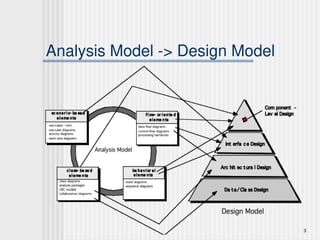
Analysis Model -> Design Model
4
Design and Quality Goals
 The design must implement all of the explicit
requirements contained in the analysis model, and it
must accommodate all of the implicit requirements
desired by the customer.
 The design must be a readable, understandable
guide for those who generate code and for those
who test and subsequently support the software.
 The design should provide a complete picture of the
software, addressing the data, functional, and
behavioral domains from an implementation
perspective.
5
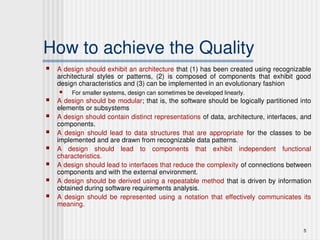
How to achieve the Quality
 A design should exhibit an architecture that (1) has been created using recognizable
architectural styles or patterns, (2) is composed of components that exhibit good
design characteristics and (3) can be implemented in an evolutionary fashion
 For smaller systems, design can sometimes be developed linearly.
 A design should be modular; that is, the software should be logically partitioned into
elements or subsystems
 A design should contain distinct representations of data, architecture, interfaces, and
components.
 A design should lead to data structures that are appropriate for the classes to be
implemented and are drawn from recognizable data patterns.
 A design should lead to components that exhibit independent functional
characteristics.
 A design should lead to interfaces that reduce the complexity of connections between
components and with the external environment.
 A design should be derived using a repeatable method that is driven by information
obtained during software requirements analysis.
 A design should be represented using a notation that effectively communicates its
meaning.
6
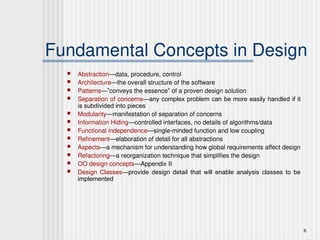
Fundamental Concepts in Design
 Abstraction—data, procedure, control
 Architecture—the overall structure of the software
 Patterns—”conveys the essence” of a proven design solution
 Separation of concerns—any complex problem can be more easily handled if it
is subdivided into pieces
 Modularity—manifestation of separation of concerns
 Information Hiding—controlled interfaces, no details of algorithms/data
 Functional independence—single-minded function and low coupling
 Refinement—elaboration of detail for all abstractions
 Aspects—a mechanism for understanding how global requirements affect design
 Refactoring—a reorganization technique that simplifies the design
 OO design concepts—Appendix II
 Design Classes—provide design detail that will enable analysis classes to be
implemented
7
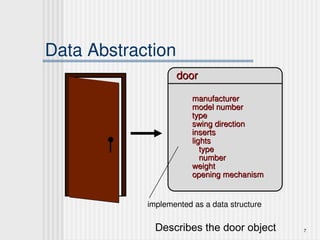
Data Abstraction
door
door
implemented as a data structure
manufacturer
manufacturer
model number
model number
type
type
swing direction
swing direction
inserts
inserts
lights
lights
type
type
number
number
weight
weight
opening mechanism
opening mechanism
Describes the door object
8
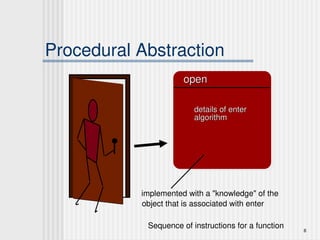
Procedural Abstraction
open
open
implemented with a "knowledge" of the
object that is associated with enter
details of enter
details of enter
algorithm
algorithm
Sequence of instructions for a function
9
Software Architecture
“
“The overall structure of the software and the ways in
The overall structure of the software and the ways in
which that structure provides conceptual integrity for a
system.
system.”
” [SHA95a]
[SHA95a]
Structural properties. This aspect of the architectural design
This aspect of the architectural design
representation defines the components of a system (e.g., modules,
objects, filters) and the manner in which those components are packaged
and interact with one another. For example, objects are packaged to
encapsulate both data and the processing that manipulates the data and
interact via the invocation of methods
Extra-functional properties. The architectural design description should
The architectural design description should
address how the design architecture achieves requirements for
performance, capacity, reliability, security, adaptability, and other
system characteristics.
Families of related systems. The architectural design should draw upon
The architectural design should draw upon
repeatable patterns that are commonly encountered in the design of
families of similar systems. In essence, the design should have the ability
to reuse architectural building blocks.
10
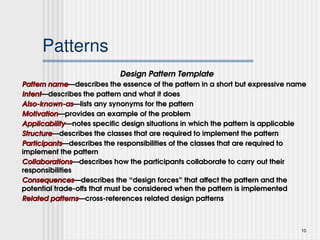
Patterns
Design Pattern Template
Pattern name
Pattern name—describes the essence of the pattern in a short but expressive name
—describes the essence of the pattern in a short but expressive name
Intent
Intent—describes the pattern and what it does
—describes the pattern and what it does
Also-known-as
Also-known-as—lists any synonyms for the pattern
—lists any synonyms for the pattern
Motivation
Motivation—provides an example of the problem
—provides an example of the problem
Applicability
Applicability—notes specific design situations in which the pattern is applicable
—notes specific design situations in which the pattern is applicable
Structure
Structure—describes the classes that are required to implement the pattern
—describes the classes that are required to implement the pattern
Participants
Participants—describes the responsibilities of the classes that are required to
—describes the responsibilities of the classes that are required to
implement the pattern
Collaborations
Collaborations—describes how the participants collaborate to carry out their
—describes how the participants collaborate to carry out their
responsibilities
responsibilities
Consequences
Consequences—describes the
—describes the “
“design forces
design forces”
” that affect the pattern and the
that affect the pattern and the
potential trade-offs that must be considered when the pattern is implemented
Related patterns
Related patterns—cross-references related design patterns
—cross-references related design patterns
11
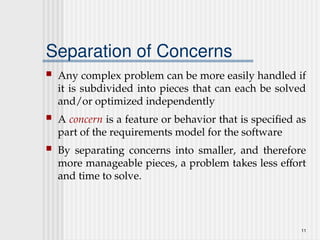
Separation of Concerns
 Any complex problem can be more easily handled if
it is subdivided into pieces that can each be solved
and/or optimized independently
 A concern is a feature or behavior that is specified as
part of the requirements model for the software
 By separating concerns into smaller, and therefore
more manageable pieces, a problem takes less effort
and time to solve.
12
Modularity
 "modularity is the single attribute of software that allows a
program to be intellectually manageable" [Mye78].
 Monolithic software (i.e., a large program composed of a
single module) cannot be easily grasped by a software
engineer.
 The number of control paths, span of reference, number of
variables, and overall complexity would make understanding
close to impossible.
 In almost all instances, you should break the design into many
modules, hoping to make understanding easier and as a
consequence, reduce the cost required to build the software.
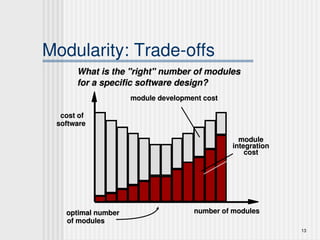
 BUT: Pay attention to integration costs too.
13
Modularity: Trade-offs
What is the "right" number of modules
for a specific software design?
optimal number
optimal number
of modules
of modules
cost of
cost of
software
software
number of modules
number of modules
module
module
integration
integration
cost
cost
module development cost
14
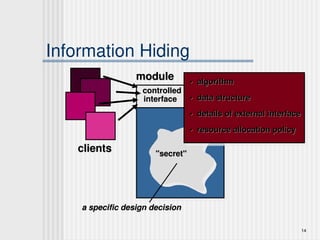
Information Hiding
module
module
controlled
controlled
interface
interface
"secret"
"secret"
•
• algorithm
algorithm
•
• data structure
data structure
•
• details of external interface
details of external interface
•
• resource allocation policy
resource allocation policy
clients
clients
a specific design decision
15
Why Information Hiding?
 reduces the likelihood of “side effects”
 limits the global impact of local design
decisions
 emphasizes communication through
controlled interfaces
 discourages the use of global data
 leads to encapsulation—an attribute of
high quality design
 results in higher quality software
16
Functional Independence
 Functional independence is achieved by developing
modules with "single-minded" function and an "aversion" to
excessive interaction with other modules.
 Cohesion is an indication of the relative functional strength
of a module.
 A cohesive module performs a single task, requiring little
interaction with other components in other parts of a program.
Stated simply, a cohesive module should (ideally) do just one
thing.
 Coupling is an indication of the relative interdependence
among modules.
 Coupling depends on the interface complexity between
modules, the point at which entry or reference is made to a
module, and what data pass across the interface.
17
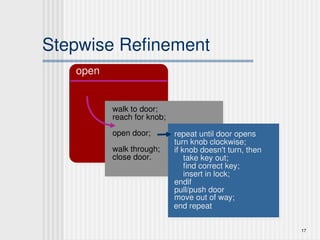
Stepwise Refinement
open
walk to door;
reach for knob;
open door;
walk through;
close door.
repeat until door opens
turn knob clockwise;
if knob doesn't turn, then
take key out;
find correct key;
insert in lock;
endif
pull/push door
move out of way;
end repeat
18
Aspects
 From the requirements analysis
 Use case, feature, data structure, etc.
 Consider two requirements, A and B. Requirement
A crosscuts requirement B “if a software
decomposition [refinement] has been chosen in
which B cannot be satisfied without taking A into
account. [Ros04]
 An aspect is a representation of a cross-cutting
concern.
19
Aspects—An Example
 Consider two requirements for the SafeHomeAssured.com WebApp.
 Requirement A is described via the use-case Access camera
surveillance via the Internet. A design refinement would focus on
those modules that would enable a registered user to access video from
cameras placed throughout a space.
 Requirement B is a generic security requirement that states that a
registered user must be validated prior to using SafeHomeAssured.com.
This requirement is applicable for all functions that are available to
registered SafeHome users.
 As design refinement occurs, A* is a design representation for
requirement A and B* is a design representation for requirement B.
Therefore, A* and B* are representations of concerns, and B* cross-cuts A*.
 An aspect is a representation of a cross-cutting concern. Therefore, the
design representation, B*, of the requirement, a registered user must be
validated prior to using SafeHomeAssured.com, is an aspect of the
SafeHome WebApp.
20
Refactoring
 Fowler [FOW99] defines refactoring in the following manner:
 "Refactoring is the process of changing a software system in such a
way that it does not alter the external behavior of the code [design]
yet improves its internal structure.”
 When software is refactored, the existing design is
examined for
 redundancy
 unused design elements
 inefficient or unnecessary algorithms
 poorly constructed or inappropriate data structures
 or any other design failure that can be corrected to yield a better
design.
21
OO Design Concepts
 Design classes
 Entity classes
 Boundary classes
 Controller classes
 Inheritance—all responsibilities of a superclass is
immediately inherited by all subclasses
 Messages—stimulate some behavior to occur in the
receiving object
 Polymorphism—a characteristic that greatly reduces the
effort required to extend the design
22
Design Classes
 Analysis classes are refined during design to become entity
classes
 Boundary classes are developed during design to create the
interface (e.g., interactive screen or printed reports) that the
user sees and interacts with as the software is used.
 Boundary classes are designed with the responsibility of
managing the way entity objects are represented to users.
 Controller classes are designed to manage
 the creation or update of entity objects;
 the instantiation of boundary objects as they obtain information
from entity objects;
 complex communication between sets of objects;
 validation of data communicated between objects or between the
user and the application.
23
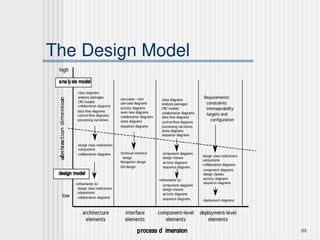
The Design Model
24
Design Model Elements
 Data elements
 Data model --> data structures
 Data model --> database architecture
 Architectural elements
 Like floor plan of a house
 Analysis classes, their relationships, collaborations and
behaviors are transformed into design realizations
 Patterns and “styles” (Chapters 9 and 12)
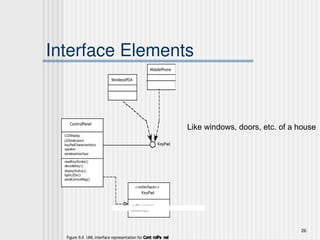
 Interface elements
 the user interface (UI)
 external interfaces to other systems, devices, networks or other
producers or consumers of information
 internal interfaces between various design components.
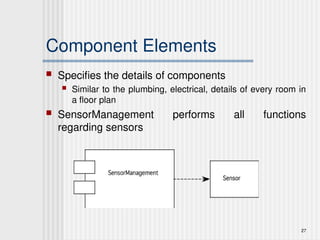
 Component elements
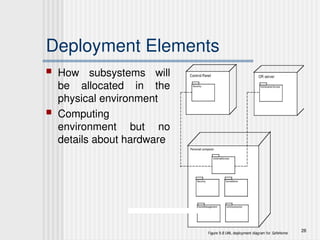
 Deployment elements
25
Architectural Elements
 The architectural model [Sha96] is derived
from three sources:
 information about the application domain for the
software to be built;
 specific requirements model elements such as data
flow diagrams or analysis classes, their relationships
and collaborations for the problem at hand, and
 the availability of architectural patterns (Chapter 12)
and styles (Chapter 9).
26
Interface Elements
Like windows, doors, etc. of a house
Component Elements
 Specifies the details of components
 Similar to the plumbing, electrical, details of every room in
a floor plan
 SensorManagement performs all functions
regarding sensors
27
Deployment Elements
 How subsystems will
be allocated in the
physical environment
 Computing
environment but no
details about hardware
28

Design Concepts software engineering.ppt

  • 1.
    1 Lecture 8: Chapter8  Design Concepts For non-profit educational use only May be reproduced ONLY for student use at the university level when used in conjunction with Software Engineering: A Practitioner's Approach, 7/e. Any other reproduction or use is prohibited without the express written permission of the author. All copyright information MUST appear if these slides are posted on a website for student use.
  • 2.
    2 Design  Good softwaredesign should exhibit:  Firmness: A program should not have any bugs that inhibit its function.  Commodity: A program should be suitable for the purposes for which it was intended.  Delight: The experience of using the program should be pleasurable one.
  • 3.
    3 Analysis Model ->Design Model
  • 4.
    4 Design and QualityGoals  The design must implement all of the explicit requirements contained in the analysis model, and it must accommodate all of the implicit requirements desired by the customer.  The design must be a readable, understandable guide for those who generate code and for those who test and subsequently support the software.  The design should provide a complete picture of the software, addressing the data, functional, and behavioral domains from an implementation perspective.
  • 5.
    5 How to achievethe Quality  A design should exhibit an architecture that (1) has been created using recognizable architectural styles or patterns, (2) is composed of components that exhibit good design characteristics and (3) can be implemented in an evolutionary fashion  For smaller systems, design can sometimes be developed linearly.  A design should be modular; that is, the software should be logically partitioned into elements or subsystems  A design should contain distinct representations of data, architecture, interfaces, and components.  A design should lead to data structures that are appropriate for the classes to be implemented and are drawn from recognizable data patterns.  A design should lead to components that exhibit independent functional characteristics.  A design should lead to interfaces that reduce the complexity of connections between components and with the external environment.  A design should be derived using a repeatable method that is driven by information obtained during software requirements analysis.  A design should be represented using a notation that effectively communicates its meaning.
  • 6.
    6 Fundamental Concepts inDesign  Abstraction—data, procedure, control  Architecture—the overall structure of the software  Patterns—”conveys the essence” of a proven design solution  Separation of concerns—any complex problem can be more easily handled if it is subdivided into pieces  Modularity—manifestation of separation of concerns  Information Hiding—controlled interfaces, no details of algorithms/data  Functional independence—single-minded function and low coupling  Refinement—elaboration of detail for all abstractions  Aspects—a mechanism for understanding how global requirements affect design  Refactoring—a reorganization technique that simplifies the design  OO design concepts—Appendix II  Design Classes—provide design detail that will enable analysis classes to be implemented
  • 7.
    7 Data Abstraction door door implemented asa data structure manufacturer manufacturer model number model number type type swing direction swing direction inserts inserts lights lights type type number number weight weight opening mechanism opening mechanism Describes the door object
  • 8.
    8 Procedural Abstraction open open implemented witha "knowledge" of the object that is associated with enter details of enter details of enter algorithm algorithm Sequence of instructions for a function
  • 9.
    9 Software Architecture “ “The overallstructure of the software and the ways in The overall structure of the software and the ways in which that structure provides conceptual integrity for a which that structure provides conceptual integrity for a system. system.” ” [SHA95a] [SHA95a] Structural properties. This aspect of the architectural design This aspect of the architectural design representation defines the components of a system (e.g., modules, representation defines the components of a system (e.g., modules, objects, filters) and the manner in which those components are packaged objects, filters) and the manner in which those components are packaged and interact with one another. For example, objects are packaged to and interact with one another. For example, objects are packaged to encapsulate both data and the processing that manipulates the data and encapsulate both data and the processing that manipulates the data and interact via the invocation of methods interact via the invocation of methods Extra-functional properties. The architectural design description should The architectural design description should address how the design architecture achieves requirements for address how the design architecture achieves requirements for performance, capacity, reliability, security, adaptability, and other performance, capacity, reliability, security, adaptability, and other system characteristics. system characteristics. Families of related systems. The architectural design should draw upon The architectural design should draw upon repeatable patterns that are commonly encountered in the design of repeatable patterns that are commonly encountered in the design of families of similar systems. In essence, the design should have the ability families of similar systems. In essence, the design should have the ability to reuse architectural building blocks. to reuse architectural building blocks.
  • 10.
    10 Patterns Design Pattern Template DesignPattern Template Pattern name Pattern name—describes the essence of the pattern in a short but expressive name —describes the essence of the pattern in a short but expressive name Intent Intent—describes the pattern and what it does —describes the pattern and what it does Also-known-as Also-known-as—lists any synonyms for the pattern —lists any synonyms for the pattern Motivation Motivation—provides an example of the problem —provides an example of the problem Applicability Applicability—notes specific design situations in which the pattern is applicable —notes specific design situations in which the pattern is applicable Structure Structure—describes the classes that are required to implement the pattern —describes the classes that are required to implement the pattern Participants Participants—describes the responsibilities of the classes that are required to —describes the responsibilities of the classes that are required to implement the pattern implement the pattern Collaborations Collaborations—describes how the participants collaborate to carry out their —describes how the participants collaborate to carry out their responsibilities responsibilities Consequences Consequences—describes the —describes the “ “design forces design forces” ” that affect the pattern and the that affect the pattern and the potential trade-offs that must be considered when the pattern is implemented potential trade-offs that must be considered when the pattern is implemented Related patterns Related patterns—cross-references related design patterns —cross-references related design patterns
  • 11.
    11 Separation of Concerns Any complex problem can be more easily handled if it is subdivided into pieces that can each be solved and/or optimized independently  A concern is a feature or behavior that is specified as part of the requirements model for the software  By separating concerns into smaller, and therefore more manageable pieces, a problem takes less effort and time to solve.
  • 12.
    12 Modularity  "modularity isthe single attribute of software that allows a program to be intellectually manageable" [Mye78].  Monolithic software (i.e., a large program composed of a single module) cannot be easily grasped by a software engineer.  The number of control paths, span of reference, number of variables, and overall complexity would make understanding close to impossible.  In almost all instances, you should break the design into many modules, hoping to make understanding easier and as a consequence, reduce the cost required to build the software.  BUT: Pay attention to integration costs too.
  • 13.
    13 Modularity: Trade-offs What isthe "right" number of modules What is the "right" number of modules for a specific software design? for a specific software design? optimal number optimal number of modules of modules cost of cost of software software number of modules number of modules module module integration integration cost cost module development cost module development cost
  • 14.
    14 Information Hiding module module controlled controlled interface interface "secret" "secret" • • algorithm algorithm • •data structure data structure • • details of external interface details of external interface • • resource allocation policy resource allocation policy clients clients a specific design decision a specific design decision
  • 15.
    15 Why Information Hiding? reduces the likelihood of “side effects”  limits the global impact of local design decisions  emphasizes communication through controlled interfaces  discourages the use of global data  leads to encapsulation—an attribute of high quality design  results in higher quality software
  • 16.
    16 Functional Independence  Functionalindependence is achieved by developing modules with "single-minded" function and an "aversion" to excessive interaction with other modules.  Cohesion is an indication of the relative functional strength of a module.  A cohesive module performs a single task, requiring little interaction with other components in other parts of a program. Stated simply, a cohesive module should (ideally) do just one thing.  Coupling is an indication of the relative interdependence among modules.  Coupling depends on the interface complexity between modules, the point at which entry or reference is made to a module, and what data pass across the interface.
  • 17.
    17 Stepwise Refinement open walk todoor; reach for knob; open door; walk through; close door. repeat until door opens turn knob clockwise; if knob doesn't turn, then take key out; find correct key; insert in lock; endif pull/push door move out of way; end repeat
  • 18.
    18 Aspects  From therequirements analysis  Use case, feature, data structure, etc.  Consider two requirements, A and B. Requirement A crosscuts requirement B “if a software decomposition [refinement] has been chosen in which B cannot be satisfied without taking A into account. [Ros04]  An aspect is a representation of a cross-cutting concern.
  • 19.
    19 Aspects—An Example  Considertwo requirements for the SafeHomeAssured.com WebApp.  Requirement A is described via the use-case Access camera surveillance via the Internet. A design refinement would focus on those modules that would enable a registered user to access video from cameras placed throughout a space.  Requirement B is a generic security requirement that states that a registered user must be validated prior to using SafeHomeAssured.com. This requirement is applicable for all functions that are available to registered SafeHome users.  As design refinement occurs, A* is a design representation for requirement A and B* is a design representation for requirement B. Therefore, A* and B* are representations of concerns, and B* cross-cuts A*.  An aspect is a representation of a cross-cutting concern. Therefore, the design representation, B*, of the requirement, a registered user must be validated prior to using SafeHomeAssured.com, is an aspect of the SafeHome WebApp.
  • 20.
    20 Refactoring  Fowler [FOW99]defines refactoring in the following manner:  "Refactoring is the process of changing a software system in such a way that it does not alter the external behavior of the code [design] yet improves its internal structure.”  When software is refactored, the existing design is examined for  redundancy  unused design elements  inefficient or unnecessary algorithms  poorly constructed or inappropriate data structures  or any other design failure that can be corrected to yield a better design.
  • 21.
    21 OO Design Concepts Design classes  Entity classes  Boundary classes  Controller classes  Inheritance—all responsibilities of a superclass is immediately inherited by all subclasses  Messages—stimulate some behavior to occur in the receiving object  Polymorphism—a characteristic that greatly reduces the effort required to extend the design
  • 22.
    22 Design Classes  Analysisclasses are refined during design to become entity classes  Boundary classes are developed during design to create the interface (e.g., interactive screen or printed reports) that the user sees and interacts with as the software is used.  Boundary classes are designed with the responsibility of managing the way entity objects are represented to users.  Controller classes are designed to manage  the creation or update of entity objects;  the instantiation of boundary objects as they obtain information from entity objects;  complex communication between sets of objects;  validation of data communicated between objects or between the user and the application.
  • 23.
  • 24.
    24 Design Model Elements Data elements  Data model --> data structures  Data model --> database architecture  Architectural elements  Like floor plan of a house  Analysis classes, their relationships, collaborations and behaviors are transformed into design realizations  Patterns and “styles” (Chapters 9 and 12)  Interface elements  the user interface (UI)  external interfaces to other systems, devices, networks or other producers or consumers of information  internal interfaces between various design components.  Component elements  Deployment elements
  • 25.
    25 Architectural Elements  Thearchitectural model [Sha96] is derived from three sources:  information about the application domain for the software to be built;  specific requirements model elements such as data flow diagrams or analysis classes, their relationships and collaborations for the problem at hand, and  the availability of architectural patterns (Chapter 12) and styles (Chapter 9).
  • 26.
  • 27.
    Component Elements  Specifiesthe details of components  Similar to the plumbing, electrical, details of every room in a floor plan  SensorManagement performs all functions regarding sensors 27
  • 28.
    Deployment Elements  Howsubsystems will be allocated in the physical environment  Computing environment but no details about hardware 28

Editor's Notes

  • #13 Pay attention to integration costs too.
  • #23 Dashed line separates analysis and design. UML classes can be used with more elaboration.
  • #26 WirelessPDA and MobilePhone can access the system via an interface.