Fables and Morals
What are fables?
Are they the same as fairytales?
What’s their purpose?
Are they found in every culture?
Some things you should
y
know about Fables…

Early form of story telling
Believed to be originated in India
Aesop – Most famous fable teller –
a Greek Slave who lived about 620
B.C.
AESOP
Credited for most of the known
fables heard today.
His fables include “The Ant and the
Grasshopper,” and “The Lion and the
Wolf.”
What are some
characteristics of
fables?

Short stories
Features animals, plants & forces
of nature with human qualities
Handed down generation after
generation
Fables teach a lesson
that everyone can
understand. They
connect us with other
cultures.
Which of these are characteristics
of fables?
A) Human Gods
B) Animals with human characteristics
C) Happy endings
D) All of the above
So what are fairy tales?
Start with “Once upon a time”
Setting in a castle, forest or town
Story has good/evil characters
Fairy Tales cont.
Have many characters are animals or
royalty
Have magic
Have the numbers 3 or 7 in it
A Fairy Tale also….
Has a story with a problem
The problem in story is solved
Good wins over evil
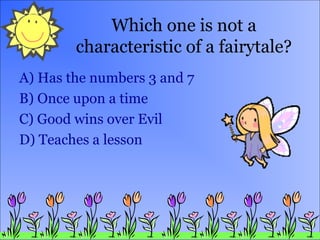
Which one is not a
characteristic of a fairytale?
A) Has the numbers 3 and 7
B) Once upon a time
C) Good wins over Evil
D) Teaches a lesson
How are fables and fairy tales
the same?
Handed down from generation to
generation
Fictional stories – not true
Similarities: Fables &Fairy Tales
• Connect us with different cultures
• For all ages
Differences
Fables
Characters: Animals
that act like humans

Fairy Tales
Characters: Royalty

Teaches a lesson

Good vs. Evil
Fables of Different cultures
Involve animals found in that culture
Reflects cultural beliefs
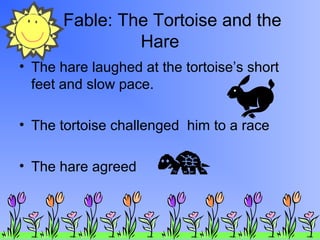
Fable: The Tortoise and the
Hare
• The hare laughed at the tortoise’s short
feet and slow pace.
• The tortoise challenged him to a race
• The hare agreed
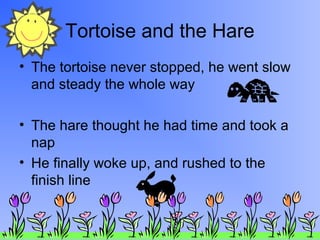
Tortoise and the Hare
• The tortoise never stopped, he went slow
and steady the whole way
• The hare thought he had time and took a
nap
• He finally woke up, and rushed to the
finish line
Tortoise and the Hare

MORAL:
Don’t rush
into things
Fables can have more than
one lesson.
Another lesson for the
tortoise and the Hare is
“Slow and Steady wins the
race”
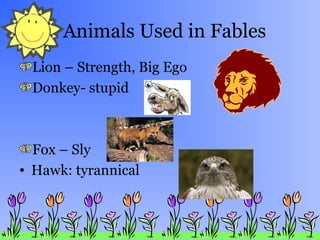
Animals Used in Fables
Lion – Strength, Big Ego
Donkey- stupid

Fox – Sly
• Hawk: tyrannical
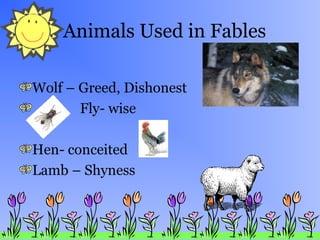
Animals Used in Fables
Wolf – Greed, Dishonest
Fly- wise
Hen- conceited
Lamb – Shyness
Using Fables and their Morals
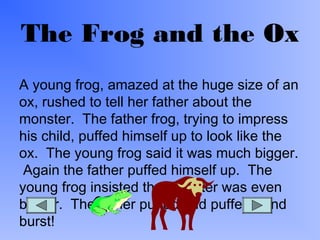
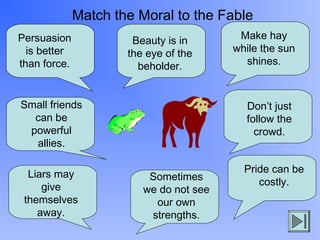
The Frog and the Ox
A young frog, amazed at the huge size of an
ox, rushed to tell her father about the
monster. The father frog, trying to impress
his child, puffed himself up to look like the
ox. The young frog said it was much bigger.
Again the father puffed himself up. The
young frog insisted the monster was even
bigger. The father puffed and puffed - and
burst!
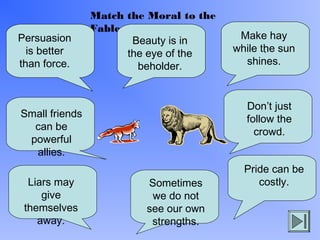
Match the Moral to the Fable
Persuasion
is better
than force.

Beauty is in
the eye of the
beholder.

Small friends
can be
powerful
allies.
Liars may
give
themselves
away.

Make hay
while the sun
.
shines.

Don’t just
follow the
crowd.

Sometimes
we do not see
our own
strengths.

Pride can be
costly.
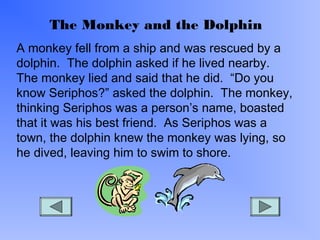
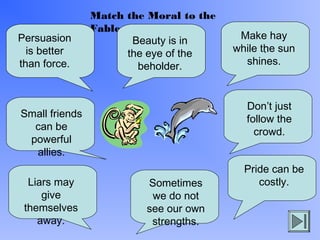
The Monkey and the Dolphin
A monkey fell from a ship and was rescued by a
dolphin. The dolphin asked if he lived nearby.
The monkey lied and said that he did. “Do you
know Seriphos?” asked the dolphin. The monkey,
thinking Seriphos was a person’s name, boasted
that it was his best friend. As Seriphos was a
town, the dolphin knew the monkey was lying, so
he dived, leaving him to swim to shore.
Persuasion
is better
than force.

Match the Moral to the
Fable
Beauty is in
the eye of the
beholder.

Don’t just
follow the
crowd.

Small friends
can be
powerful
allies.
Liars may
give
themselves
away.

Make hay
while the sun
.
shines.

Sometimes
we do not
see our own
strengths.

Pride can be
costly.
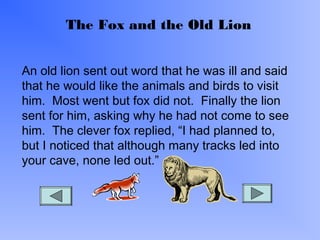
The Fox and the Old Lion
An old lion sent out word that he was ill and said
that he would like the animals and birds to visit
him. Most went but fox did not. Finally the lion
sent for him, asking why he had not come to see
him. The clever fox replied, “I had planned to,
but I noticed that although many tracks led into
your cave, none led out.”
Persuasion
is better
than force.

Match the Moral to the
Fable
Beauty is in
the eye of the
beholder.

Don’t just
follow the
crowd.

Small friends
can be
powerful
allies.
Liars may
give
themselves
away.

Make hay
while the sun
.
shines.

Sometimes
we do not
see our own
strengths.

Pride can be
costly.
The End…
but not the end of fables….
Click here for more examples.
*The Boy Who Cried “Wolf”
*The Fox and the Grapes
*The Tortoise and the Hare

Fables and morals

  • 1.
  • 2.
    What are fables? Arethey the same as fairytales? What’s their purpose? Are they found in every culture?
  • 3.
    Some things youshould y know about Fables… Early form of story telling Believed to be originated in India Aesop – Most famous fable teller – a Greek Slave who lived about 620 B.C.
  • 4.
    AESOP Credited for mostof the known fables heard today. His fables include “The Ant and the Grasshopper,” and “The Lion and the Wolf.”
  • 5.
    What are some characteristicsof fables? Short stories Features animals, plants & forces of nature with human qualities Handed down generation after generation
  • 6.
    Fables teach alesson that everyone can understand. They connect us with other cultures.
  • 7.
    Which of theseare characteristics of fables? A) Human Gods B) Animals with human characteristics C) Happy endings D) All of the above
  • 8.
    So what arefairy tales? Start with “Once upon a time” Setting in a castle, forest or town Story has good/evil characters
  • 9.
    Fairy Tales cont. Havemany characters are animals or royalty Have magic Have the numbers 3 or 7 in it
  • 10.
    A Fairy Talealso…. Has a story with a problem The problem in story is solved Good wins over evil
  • 11.
    Which one isnot a characteristic of a fairytale? A) Has the numbers 3 and 7 B) Once upon a time C) Good wins over Evil D) Teaches a lesson
  • 12.
    How are fablesand fairy tales the same? Handed down from generation to generation Fictional stories – not true
  • 13.
    Similarities: Fables &FairyTales • Connect us with different cultures • For all ages
  • 14.
    Differences Fables Characters: Animals that actlike humans Fairy Tales Characters: Royalty Teaches a lesson Good vs. Evil
  • 15.
    Fables of Differentcultures Involve animals found in that culture Reflects cultural beliefs
  • 16.
    Fable: The Tortoiseand the Hare • The hare laughed at the tortoise’s short feet and slow pace. • The tortoise challenged him to a race • The hare agreed
  • 17.
    Tortoise and theHare • The tortoise never stopped, he went slow and steady the whole way • The hare thought he had time and took a nap • He finally woke up, and rushed to the finish line
  • 18.
    Tortoise and theHare MORAL: Don’t rush into things
  • 19.
    Fables can havemore than one lesson. Another lesson for the tortoise and the Hare is “Slow and Steady wins the race”
  • 20.
    Animals Used inFables Lion – Strength, Big Ego Donkey- stupid Fox – Sly • Hawk: tyrannical
  • 21.
    Animals Used inFables Wolf – Greed, Dishonest Fly- wise Hen- conceited Lamb – Shyness
  • 22.
    Using Fables andtheir Morals
  • 23.
    The Frog andthe Ox A young frog, amazed at the huge size of an ox, rushed to tell her father about the monster. The father frog, trying to impress his child, puffed himself up to look like the ox. The young frog said it was much bigger. Again the father puffed himself up. The young frog insisted the monster was even bigger. The father puffed and puffed - and burst!
  • 24.
    Match the Moralto the Fable Persuasion is better than force. Beauty is in the eye of the beholder. Small friends can be powerful allies. Liars may give themselves away. Make hay while the sun . shines. Don’t just follow the crowd. Sometimes we do not see our own strengths. Pride can be costly.
  • 25.
    The Monkey andthe Dolphin A monkey fell from a ship and was rescued by a dolphin. The dolphin asked if he lived nearby. The monkey lied and said that he did. “Do you know Seriphos?” asked the dolphin. The monkey, thinking Seriphos was a person’s name, boasted that it was his best friend. As Seriphos was a town, the dolphin knew the monkey was lying, so he dived, leaving him to swim to shore.
  • 26.
    Persuasion is better than force. Matchthe Moral to the Fable Beauty is in the eye of the beholder. Don’t just follow the crowd. Small friends can be powerful allies. Liars may give themselves away. Make hay while the sun . shines. Sometimes we do not see our own strengths. Pride can be costly.
  • 27.
    The Fox andthe Old Lion An old lion sent out word that he was ill and said that he would like the animals and birds to visit him. Most went but fox did not. Finally the lion sent for him, asking why he had not come to see him. The clever fox replied, “I had planned to, but I noticed that although many tracks led into your cave, none led out.”
  • 28.
    Persuasion is better than force. Matchthe Moral to the Fable Beauty is in the eye of the beholder. Don’t just follow the crowd. Small friends can be powerful allies. Liars may give themselves away. Make hay while the sun . shines. Sometimes we do not see our own strengths. Pride can be costly.
  • 29.
    The End… but notthe end of fables…. Click here for more examples. *The Boy Who Cried “Wolf” *The Fox and the Grapes *The Tortoise and the Hare