Download to read offline
![J. Venkata Madhu et al Int. Journal of Engineering Research and Applications www.ijera.com
ISSN : 2248-9622, Vol. 4, Issue 11(Version 3), November 2014, pp.45-51
www.ijera.com 45 | P a g e
MHD Effects And Heat Transfer On A Boundary Layer Flow Past A Stretching Plate With Heat Source/Sink In The Presence Of Viscous Dissipation J. Venkata Madhu1, M. N. Rajasekhar2, B. Shashidar Reddy3 1. Department of Science and Humanities, Sreenidhi Institute of Science and Technology, Ghatkesar, Hyderabad-501301, A.P., INDIA. 2. Department of Mathematics, JNTU College of Engineering, Jagityala, Karimnagar, A.P., INDIA. 3. Department of Mathematics and Humanities, Mahatma Gandhi Institute of Technology, Gandipet, Hyderabad-500075, A.P., INDIA. Abstract The boundary layer flow of incompressible electrically conducting fluid past a stretching plate in the presence of transverse magnetic field with heat transfer taking into the account the viscous dissipation effects is considered in this present study. The non-linear momentum boundary layer and heat transfer equations are converted into non-linear ordinary differential equations using similarity transformations. The resulting boundary value problem is solved numerically by an implicit finite difference scheme. The solution is found to be dependent on magnetic field parameter M, Source term S, Prandtl number Pr and Eckert number Ec . The results are shown graphically to illustrate the effects of these parameters on the fluid velocity and temperature distribution in the boundary layer. Keywords: Magnetic field effects, boundary layer flow, heat transfer, stretching plate and Viscous Dissipation.
I. INTRODUCTION
The study of flow over a stretching sheet has generated much interest in recent years due to its important contribution especially in many engineering processes and industries. The applications in industries involved such as the aerodynamic extrusion of plastic sheets, glass-fiber production, condensation process of metallic plate in a cooling bath and glass and also in polymer industries. Crane [1] was the first who reported the analytical solution for the laminar boundary layer flow past a stretching sheet. After this pioneering work, the study of fluid flow over a stretching sheet has received wide attention among researchers. Gupta and Gupta [2] added new dimension to the study with suction and injection. In recent years, MHD flow problems have become more important industrially. Indeed, MHD laminar boundary layer behaviour over a stretching surface is a significant type of flow having considerable practical applications in chemical engineering, electrochemistry and polymer processing. In his pioneering work, Sakiadis [3] developed the flow field due to a flat surface, which is moving with a constant velocity in a quiescent fluid.
Further investigations on boundary layer flow and heat transfer of viscous fluids over a flat sheet are very important for development in many manufacturing processes, such as polymer extrusion, drawing of copper wires, continuous stretching of plastic films and artificial fibers, hot rolling, wire drawing, glass-fiber, metal extrusion, and metal spinning. Both the kinematics of stretching and the simultaneous heating or cooling during such processes has a decisive influence on the quality of the final products (Magyari & Keller [4]). Among these studies, Sakiadis [5] initiated the study of the boundary layer flow over a stretched surface moving with a constant velocity and formulated a boundary- layer equation for two-dimensional and axisymmetric flows. Bujurke et. al. [6] made an investigation on the heat transfer analysis in a second order fluid flow past a stretching surface with heat transfer. Datta et. al. [7] have studied the distribution of temperature in a continuous stretching sheet with uniform wall heat flux. Further flow and heat transfer from a linearly stretching sheet gained more importance due to practical applications in industrial processes. Abel and Veena [8] have analyzed visco-elastic fluid flow and heat transfer in a porous medium over a stretching sheet.
There are several other researchers who investigated various aspects of heat transfer characteristics over linearly stretching sheets Dandapat and Gupta [9], Rollins and Vajravelu [10], Lawrence and Rao [11] and Char [12]. Khan and Sanjayanand [13] studied viscoelastic boundary layer fluid flow over a quadratically stretched boundary
RESEARCH ARTICLE OPEN ACCESS](https://image.slidesharecdn.com/f0411034551-141212221243-conversion-gate02/85/MHD-Effects-And-Heat-Transfer-On-A-Boundary-Layer-Flow-Past-A-Stretching-Plate-With-Heat-Source-Sink-In-The-Presence-Of-Viscous-Dissipation-1-320.jpg)
![J. Venkata Madhu et al Int. Journal of Engineering Research and Applications www.ijera.com
ISSN : 2248-9622, Vol. 4, Issue 11(Version 3), November 2014, pp.45-51
www.ijera.com 45 | P a g e
MHD Effects And Heat Transfer On A Boundary Layer Flow Past A Stretching Plate With Heat Source/Sink In The Presence Of Viscous Dissipation J. Venkata Madhu1, M. N. Rajasekhar2, B. Shashidar Reddy3 1. Department of Science and Humanities, Sreenidhi Institute of Science and Technology, Ghatkesar, Hyderabad-501301, A.P., INDIA. 2. Department of Mathematics, JNTU College of Engineering, Jagityala, Karimnagar, A.P., INDIA. 3. Department of Mathematics and Humanities, Mahatma Gandhi Institute of Technology, Gandipet, Hyderabad-500075, A.P., INDIA. Abstract The boundary layer flow of incompressible electrically conducting fluid past a stretching plate in the presence of transverse magnetic field with heat transfer taking into the account the viscous dissipation effects is considered in this present study. The non-linear momentum boundary layer and heat transfer equations are converted into non-linear ordinary differential equations using similarity transformations. The resulting boundary value problem is solved numerically by an implicit finite difference scheme. The solution is found to be dependent on magnetic field parameter M, Source term S, Prandtl number Pr and Eckert number Ec . The results are shown graphically to illustrate the effects of these parameters on the fluid velocity and temperature distribution in the boundary layer. Keywords: Magnetic field effects, boundary layer flow, heat transfer, stretching plate and Viscous Dissipation.
I. INTRODUCTION
The study of flow over a stretching sheet has generated much interest in recent years due to its important contribution especially in many engineering processes and industries. The applications in industries involved such as the aerodynamic extrusion of plastic sheets, glass-fiber production, condensation process of metallic plate in a cooling bath and glass and also in polymer industries. Crane [1] was the first who reported the analytical solution for the laminar boundary layer flow past a stretching sheet. After this pioneering work, the study of fluid flow over a stretching sheet has received wide attention among researchers. Gupta and Gupta [2] added new dimension to the study with suction and injection. In recent years, MHD flow problems have become more important industrially. Indeed, MHD laminar boundary layer behaviour over a stretching surface is a significant type of flow having considerable practical applications in chemical engineering, electrochemistry and polymer processing. In his pioneering work, Sakiadis [3] developed the flow field due to a flat surface, which is moving with a constant velocity in a quiescent fluid.
Further investigations on boundary layer flow and heat transfer of viscous fluids over a flat sheet are very important for development in many manufacturing processes, such as polymer extrusion, drawing of copper wires, continuous stretching of plastic films and artificial fibers, hot rolling, wire drawing, glass-fiber, metal extrusion, and metal spinning. Both the kinematics of stretching and the simultaneous heating or cooling during such processes has a decisive influence on the quality of the final products (Magyari & Keller [4]). Among these studies, Sakiadis [5] initiated the study of the boundary layer flow over a stretched surface moving with a constant velocity and formulated a boundary- layer equation for two-dimensional and axisymmetric flows. Bujurke et. al. [6] made an investigation on the heat transfer analysis in a second order fluid flow past a stretching surface with heat transfer. Datta et. al. [7] have studied the distribution of temperature in a continuous stretching sheet with uniform wall heat flux. Further flow and heat transfer from a linearly stretching sheet gained more importance due to practical applications in industrial processes. Abel and Veena [8] have analyzed visco-elastic fluid flow and heat transfer in a porous medium over a stretching sheet.
There are several other researchers who investigated various aspects of heat transfer characteristics over linearly stretching sheets Dandapat and Gupta [9], Rollins and Vajravelu [10], Lawrence and Rao [11] and Char [12]. Khan and Sanjayanand [13] studied viscoelastic boundary layer fluid flow over a quadratically stretched boundary
RESEARCH ARTICLE OPEN ACCESS](https://image.slidesharecdn.com/f0411034551-141212221243-conversion-gate02/75/MHD-Effects-And-Heat-Transfer-On-A-Boundary-Layer-Flow-Past-A-Stretching-Plate-With-Heat-Source-Sink-In-The-Presence-Of-Viscous-Dissipation-1-2048.jpg)
![J. Venkata Madhu et al Int. Journal of Engineering Research and Applications www.ijera.com
ISSN : 2248-9622, Vol. 4, Issue 11(Version 3), November 2014, pp.45-51
www.ijera.com 46 | P a g e
sheet. However, heat transfer analysis was excluded
from their study. Elbashbeshy [14] examined the
flow and heat transfer characteristics by considering
exponentially stretching sheet. Gebhart [15] has
shown that the viscous dissipation effect plays an
important role in natural convection in various
devices processes on large scales(or large planets).
Also, he pointed out that when the temperature is
small or when the gravitational field is of high
intensity, viscous dissipation heat should be taken
into account. Therefore, the effect of viscous
dissipation is more predominant in vigorous natural
convection processes.
MHD flow and heat transfer of a non-Newtonian
power-law fluid past a stretching sheet with
suction/injection and viscous dissipation was studied
by Kishan and Shashidar [16]
.
Kishan and kavitha
[17] studied the MHD heat transfer to non-Newtonian
power-law fluids over a wedge with heat source/sink
in the presence of viscous dissipation. Recently Anuj
kumar and Manoj kumar [18] has studied MHD
boundary layer flow past a stretching plate with heat
transfer. The aim of the present study is to investigate
the MHD and heat transfer effects of a laminar
electrically conducting fluid as a boundary layer flow
over a stretching plate with heat source/sink in the
presence of viscous dissipation.
II. MATHEMATICAL
FORMULATION
Let us consider two dimensional laminar
boundary layer flows over a stretching plate in an
incompressible electrically conducting fluid, where
the x-axis is along the stretching plate and y-axis
perpendicular to it, the applied magnetic field 퐵0 is
transversely to x-axis. The magnetic Reynolds
number of the flow is taken to be small enough so
that the induced magnetic field can be neglected.
Under the usual boundary layer approximations, the
governing equations of continuity, momentum and
energy under the influence of externally imposed
transverse magnetic field are:
-------------------------------(1)
---------------------------(2)
--------------------------------(3)
Along with the boundary conditions :
y=0: 푢=푥,휈=0, 푇=푇푝 푚>0 y→∞∶ u=0 , T=T∞ --------------------(4)
Here since temperature field varies with regard to y only, so 0
t
x
. Also we introduce the following non-dimensional
quantities.
, , , , ( )
p
x y uh vh T T
x y u v y
h h v v T T
-------------------(5)
Where 푇푝 is the plate temperature and 푇∞ is the temperature of surrounding. Substituting equation (5) in to (1)
to (3) , these equations are reduced to](https://image.slidesharecdn.com/f0411034551-141212221243-conversion-gate02/85/MHD-Effects-And-Heat-Transfer-On-A-Boundary-Layer-Flow-Past-A-Stretching-Plate-With-Heat-Source-Sink-In-The-Presence-Of-Viscous-Dissipation-2-320.jpg)
![J. Venkata Madhu et al Int. Journal of Engineering Research and Applications www.ijera.com
ISSN : 2248-9622, Vol. 4, Issue 11(Version 3), November 2014, pp.45-51
www.ijera.com 51 | P a g e
IV. RESULTS AND DISCUSSIONS:
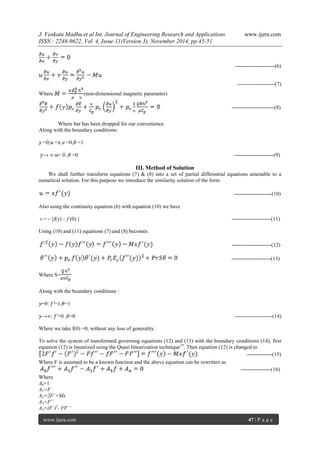
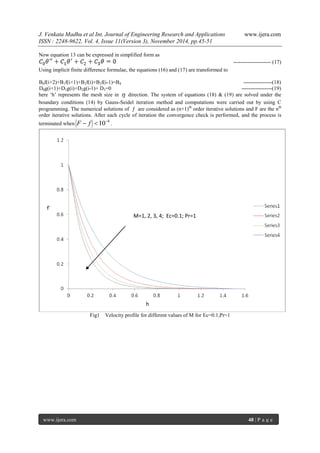
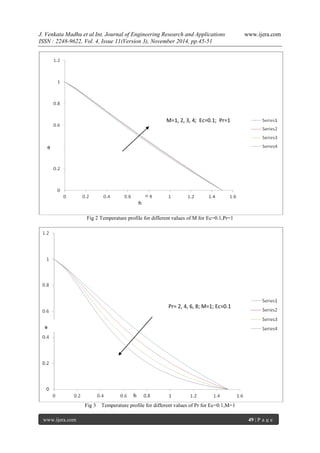
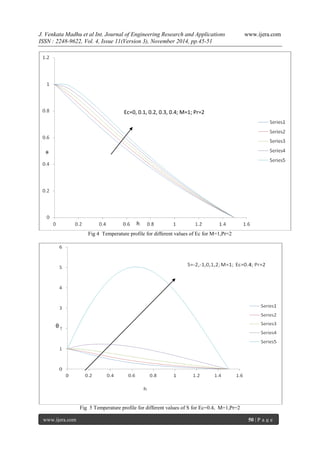
Velocity profiles presented for various values of magnetic parameter M and given Pr are shown in fig.1. It is observed from the figure that the velocity decreases as magnetic field increases. It clearly indicates that the rate of transport is considerably reduced with the increase of M. And we note that the Prandtl number Pr has no influence on the velocity of fluid flow. Temperature distributions presented for various values of Magnetic field parameter M, Prandtl number Pr and Eckert number Ec are shown in figures 2 to 4. The influence of Magnetic parameter M on temperature profiles for the fixed values of Pr and Ec is presented in fig. 2. It is evident from the figure that the temperature increases as the magnetic parameter increases. And this increase is very small. Figure 3 shows the effect of Prandtl number Pr on the temperature profiles when M and Ec are constants. It is obvious from the figure that increase in the prandtl number decreases the temperature profiles which shows that the temperature in the boundary layer flow decreases. Figure 4 reveals the effect of viscous dissipation on the temperature distribution while the M and Pr are fixed. It is seen from the figure that the temperature in the boundary layer flow increases with the increase in the Eckert number Ec. Figure 5 reveals the effect of source term on the temperature distribution while the M, Ec and Pr are fixed. It is seen from the figure that the temperature in the boundary layer flow increases with the increase in the source term S. REFERENCES
[1] Crane, L., 1970. Flow past a stretching plate. Z. Angew. Math. Ph ys., 21: 645-647.
[2] Gupta, P.S. and A.S. Gupta, 1977. Heat and Mass transfer on a stretching sheet with suction or blowing. Can. J. Chem. Eng., 55: 744-746.
[3] B.C. Sakiadis (1961): Boundary-layer behavior on continues solid surfaces: II. The boundary-layer on continuous flat surface, AIChE J.vol. 7, pp. 221-225.
[4] E. Magyari and B. Keller (1999): Heat and mass transfer in the boundary layers on an exponentially stretching continuous surface. J. Phys. D: Appl. Phys. 32: 577-585.
[5] Sakiadis, B.C, Boundary-layer behavior on continuous solid surfaces: I.Boundary-layer equations for two-dimensional and axisymmetric flow, AIChE J, 7,26-28,1961
[6] Bujurke N.M., Biradar S.N.,Hiremath P.S.: Second order fluid flow past a stretching sheet with heat transfer. Z. Angew. Math. Phys.38(1987) 653-657.
[7] Datta B.K., Roy P. and Gupta A.S.; Temperature field in a flow over a stretching that within uniform heat flux. Int. Comm. Heat transfer.12 (1985) 89.
[8] Abel M.S. and Veena P.; Visco-elastic fluid flow and heat transfer in a porous medium over a stretching sheet (1998). Int. J. non- linear Mechanics Vol. 33, 531-540
[9] Dandapat, B.S, and A. Gupta. 1989. Flow and heat transfer in a viscoelastic fluid over a stretching sheet.Int J Non-linear Mech.; 24(3): 215-219.
[10] Rollins, D. and K. Vajravelu. 1991. Heat transfer in a second order fluid over a continuous stretching surface. Acta Mech. 89: 167-178.
[11] Lawrence, P.S, and B.N. Rao. 1992. Heat transfer in the flow of viscoelastic fluid over a stretching sheet.Acta Mech.; 93: 53-61.
[12] Char, M.I. 1994. Heat and mass transfer in a hydromagnetic flow of viscoelastic fluid over a stretching sheet, J of Math Anal Appl.;186: 674-689.
[13] Khan, S.K, Emmanuel Sanjayanand. 2004. Viscoelastic boundary layer MHD flow through a porous medium over a porous quadratic stretching sheet, Archives of Mechanics.; 56(3): 191-204.
[14] Elbashbeshy, E.M.A. 2001. Heat transfers over an exponentially stretching continuous surface with suction.Arch Mech. 53(6): 643- 651.
[15] 15. B. Gebhart, Effect of Viscous Dissipation in Natural Convection, J Fluid Mech 14(1962) 225-232.
[16] Kishan. N. and Shashidar Reddy. B., 2012. Mhd flow and heat transfer of a non- Newtonian power-law fluid past a stretching sheet with suction/injection and viscous dissipation. International Journal of Applied Mathematical Research, 1(4), 681-705.
[17] Kishan. N. and Kavitha. P., 2013. Quasilinearization approach to MHD heat transfer to non-Newtonian power-law fluids flowing over a wedge with heat source/sink in the presence of viscous dissipation. International Journal of mathematics and computer applications Research, 3 (5), 15- 28.
[18] Anuj Kumar Jhankal, Manoj kumar 2013. MHD boundary layer flow past a stretching plate with heat transfer. The Int. J. of Engg and Sciences: 2 (3): 9-13.
[19] K. Inouye, A. Tate, Finite-difference version quasi-linearization applied to boundary layer equations. AIAA J 12(1974) 558-560.](https://image.slidesharecdn.com/f0411034551-141212221243-conversion-gate02/85/MHD-Effects-And-Heat-Transfer-On-A-Boundary-Layer-Flow-Past-A-Stretching-Plate-With-Heat-Source-Sink-In-The-Presence-Of-Viscous-Dissipation-7-320.jpg)

This study examines the boundary layer flow of an electrically conducting fluid past a stretching plate, incorporating magnetic field effects and viscous dissipation. It employs numerical methods to solve the transformed boundary value problem derived from non-linear differential equations related to momentum and heat transfer. Results indicate the significant influences of magnetic field parameter, Prandtl number, and Eckert number on fluid velocity and temperature distribution.


