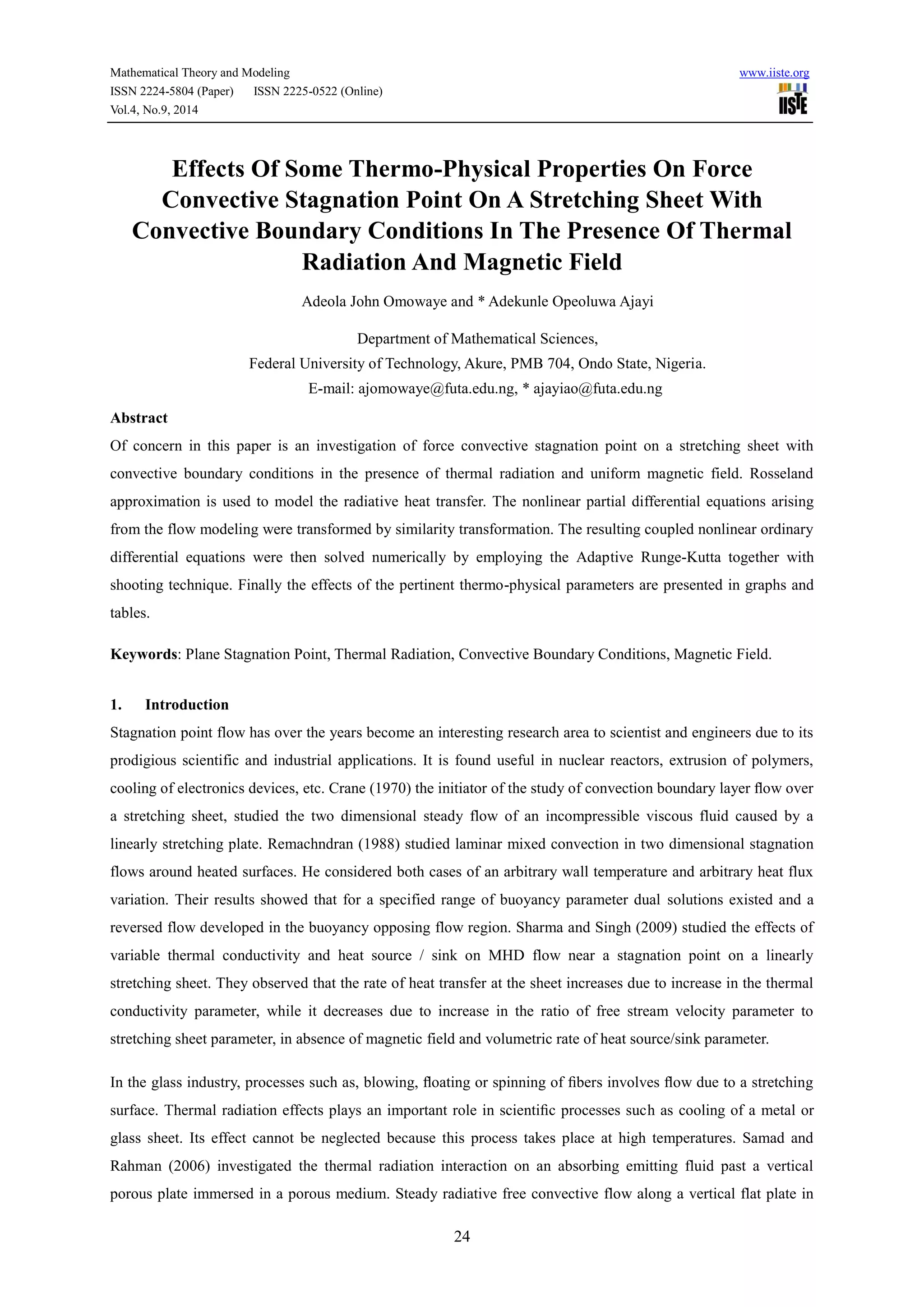
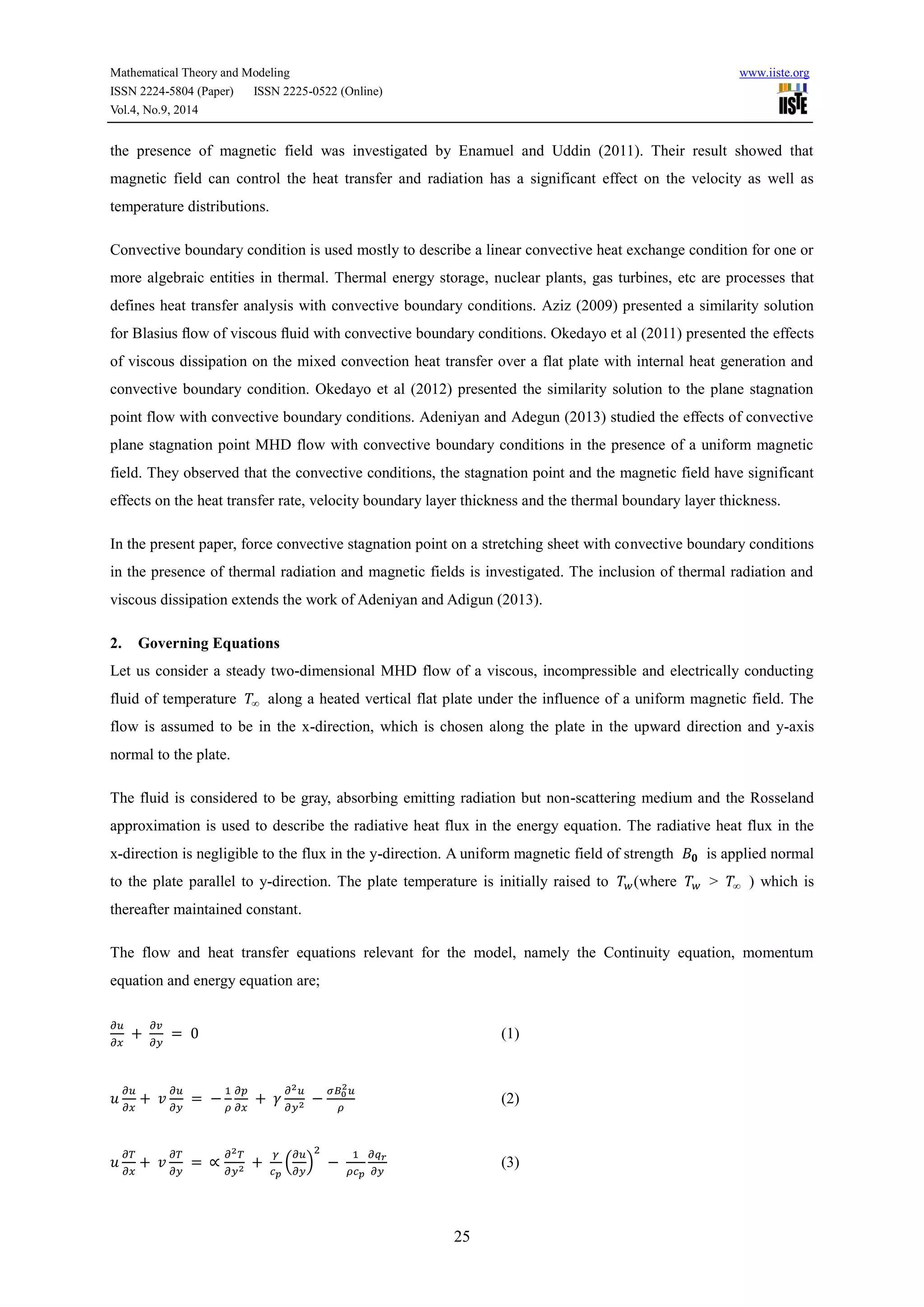
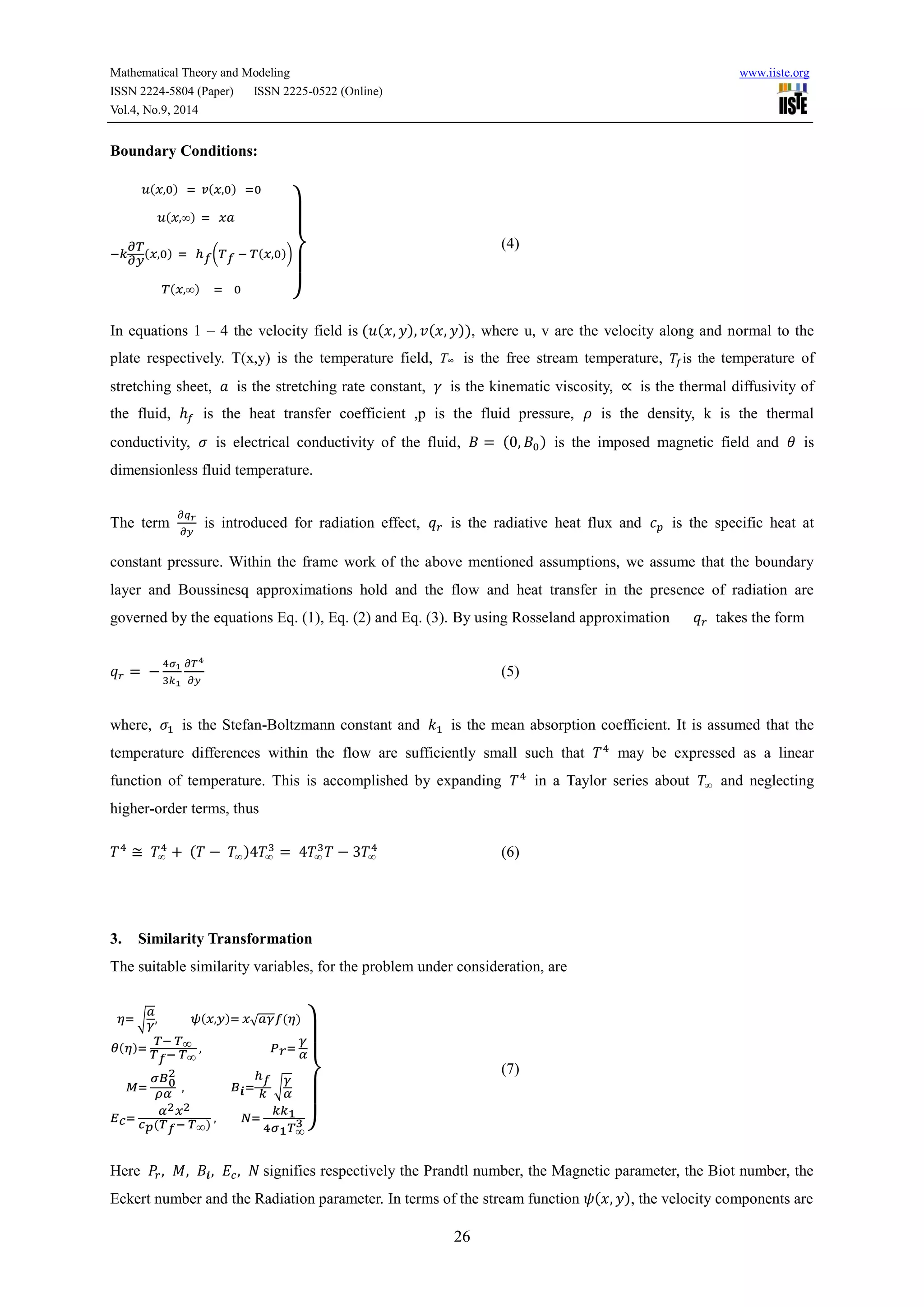
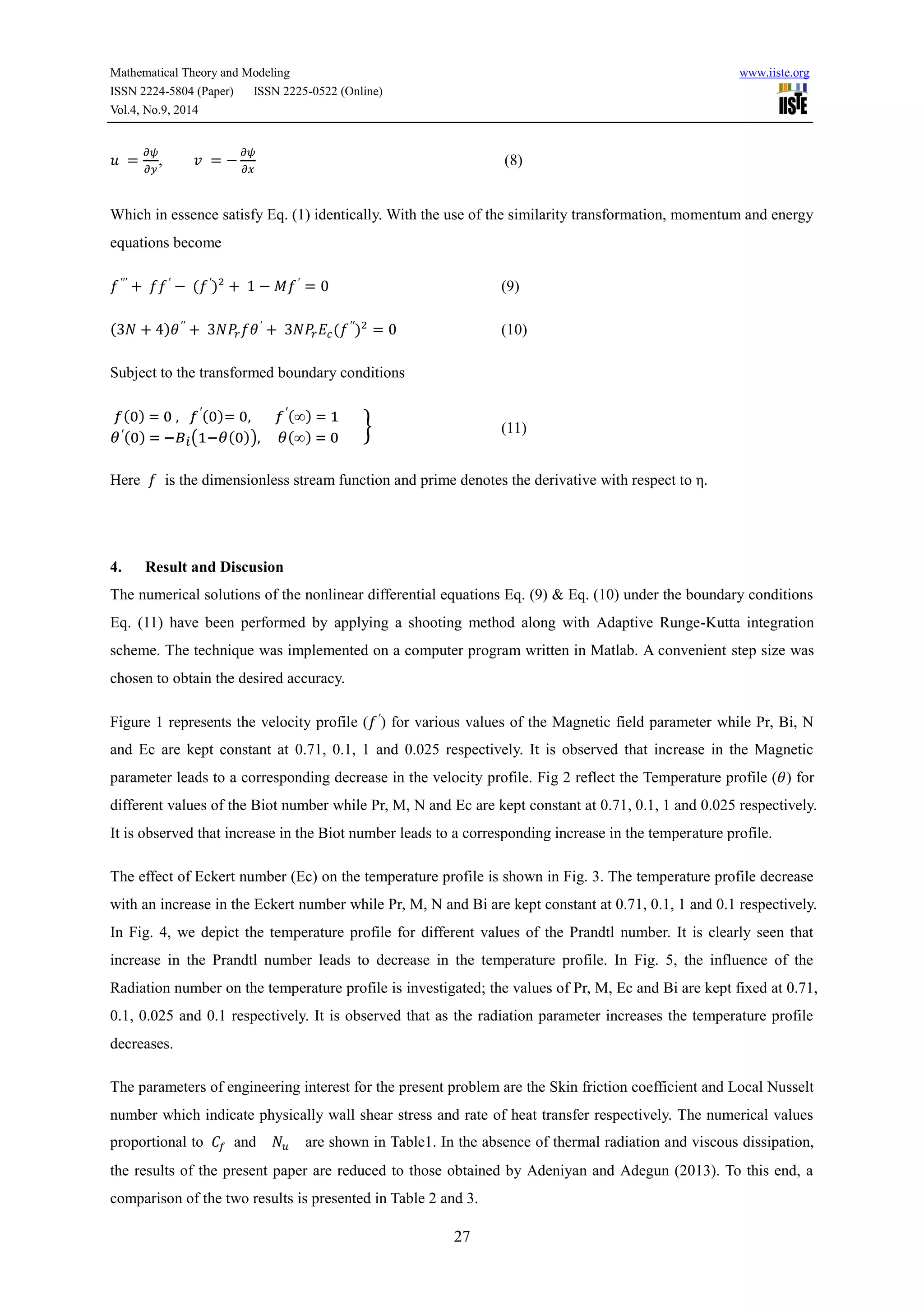
Mathematical Theory and Modeling www.iiste.org 
ISSN 2224-5804 (Paper) ISSN 2225-0522 (Online) 
Vol.4, No.9, 2014 
Effects Of Some Thermo-Physical Properties On Force 
Convective Stagnation Point On A Stretching Sheet With 
Convective Boundary Conditions In The Presence Of Thermal 
Radiation And Magnetic Field 
Adeola John Omowaye and * Adekunle Opeoluwa Ajayi 
Department of Mathematical Sciences, 
Federal University of Technology, Akure, PMB 704, Ondo State, Nigeria. 
E-mail: ajomowaye@futa.edu.ng, * ajayiao@futa.edu.ng 
Abstract 
Of concern in this paper is an investigation of force convective stagnation point on a stretching sheet with 
convective boundary conditions in the presence of thermal radiation and uniform magnetic field. Rosseland 
approximation is used to model the radiative heat transfer. The nonlinear partial differential equations arising 
from the flow modeling were transformed by similarity transformation. The resulting coupled nonlinear ordinary 
differential equations were then solved numerically by employing the Adaptive Runge-Kutta together with 
shooting technique. Finally the effects of the pertinent thermo-physical parameters are presented in graphs and 
tables. 
Keywords: Plane Stagnation Point, Thermal Radiation, Convective Boundary Conditions, Magnetic Field. 
1. Introduction 
Stagnation point flow has over the years become an interesting research area to scientist and engineers due to its 
prodigious scientific and industrial applications. It is found useful in nuclear reactors, extrusion of polymers, 
cooling of electronics devices, etc. Crane (1970) the initiator of the study of convection boundary layer flow over 
a stretching sheet, studied the two dimensional steady flow of an incompressible viscous fluid caused by a 
linearly stretching plate. Remachndran (1988) studied laminar mixed convection in two dimensional stagnation 
flows around heated surfaces. He considered both cases of an arbitrary wall temperature and arbitrary heat flux 
variation. Their results showed that for a specified range of buoyancy parameter dual solutions existed and a 
reversed flow developed in the buoyancy opposing flow region. Sharma and Singh (2009) studied the effects of 
variable thermal conductivity and heat source / sink on MHD flow near a stagnation point on a linearly 
stretching sheet. They observed that the rate of heat transfer at the sheet increases due to increase in the thermal 
conductivity parameter, while it decreases due to increase in the ratio of free stream velocity parameter to 
stretching sheet parameter, in absence of magnetic field and volumetric rate of heat source/sink parameter. 
In the glass industry, processes such as, blowing, floating or spinning of fibers involves flow due to a stretching 
surface. Thermal radiation effects plays an important role in scientific processes such as cooling of a metal or 
glass sheet. Its effect cannot be neglected because this process takes place at high temperatures. Samad and 
Rahman (2006) investigated the thermal radiation interaction on an absorbing emitting fluid past a vertical 
porous plate immersed in a porous medium. Steady radiative free convective flow along a vertical flat plate in 
24
Mathematical Theory and Modeling www.iiste.org 
ISSN 2224-5804 (Paper) ISSN 2225-0522 (Online) 
Vol.4, No.9, 2014 
the presence of magnetic field was investigated by Enamuel and Uddin (2011). Their result showed that 
magnetic field can control the heat transfer and radiation has a significant effect on the velocity as well as 
temperature distributions. 
Convective boundary condition is used mostly to describe a linear convective heat exchange condition for one or 
more algebraic entities in thermal. Thermal energy storage, nuclear plants, gas turbines, etc are processes that 
defines heat transfer analysis with convective boundary conditions. Aziz (2009) presented a similarity solution 
for Blasius flow of viscous fluid with convective boundary conditions. Okedayo et al (2011) presented the effects 
of viscous dissipation on the mixed convection heat transfer over a flat plate with internal heat generation and 
convective boundary condition. Okedayo et al (2012) presented the similarity solution to the plane stagnation 
point flow with convective boundary conditions. Adeniyan and Adegun (2013) studied the effects of convective 
plane stagnation point MHD flow with convective boundary conditions in the presence of a uniform magnetic 
field. They observed that the convective conditions, the stagnation point and the magnetic field have significant 
effects on the heat transfer rate, velocity boundary layer thickness and the thermal boundary layer thickness. 
In the present paper, force convective stagnation point on a stretching sheet with convective boundary conditions 
in the presence of thermal radiation and magnetic fields is investigated. The inclusion of thermal radiation and 
viscous dissipation extends the work of Adeniyan and Adigun (2013). 
2. Governing Equations 
Let us consider a steady two-dimensional MHD flow of a viscous, incompressible and electrically conducting 
fluid of temperature 푇∞ along a heated vertical flat plate under the influence of a uniform magnetic field. The 
flow is assumed to be in the x-direction, which is chosen along the plate in the upward direction and y-axis 
normal to the plate. 
The fluid is considered to be gray, absorbing emitting radiation but non-scattering medium and the Rosseland 
approximation is used to describe the radiative heat flux in the energy equation. The radiative heat flux in the 
x-direction is negligible to the flux in the y-direction. A uniform magnetic field of strength 퐵ퟎ is applied normal 
to the plate parallel to y-direction. The plate temperature is initially raised to 푇푤(where 푇푤 > 푇∞ ) which is 
thereafter maintained constant. 
The flow and heat transfer equations relevant for the model, namely the Continuity equation, momentum 
equation and energy equation are; 
25 
휕푢 
휕푥 
+ 
휕푣 
휕푦 
= 0 (1) 
푢 
휕푢 
휕푥 
+ 푣 
휕푢 
휕푦 
= − 
1 
휌 
휕푝 
휕푥 
+ 훾 
휕2푢 
휕푦2 − 
2푢 
휌 
휎퐵0 
(2) 
푢 
휕푇 
휕푥 
+ 푣 
휕푇 
휕푦 
= ∝ 
휕2푇 
휕푦2 + 
훾 
푐푝 
( 
휕푢 
휕푦 
) 
2 
− 
1 
휌푐푝 
휕푞푟 
휕푦 
(3)
Mathematical Theory and Modeling www.iiste.org 
ISSN 2224-5804 (Paper) ISSN 2225-0522 (Online) 
Vol.4, No.9, 2014 
26 
Boundary Conditions: 
푢(푥,0) = 푣(푥,0) =0 
푢(푥,∞) = 푥푎 
휕푇 
휕푦 
−푘 
(푥,0) = ℎ푓(푇푓 − 푇(푥,0)) 
푇(푥,∞) = 0 } 
(4) 
In equations 1 – 4 the velocity field is (푢(푥, 푦), 푣(푥, 푦)), where u, v are the velocity along and normal to the 
plate respectively. T(x,y) is the temperature field, T∞ is the free stream temperature, 푇 is the temperature of 
stretching sheet, 푎 is the stretching rate constant, 훾 is the kinematic viscosity, ∝ is the thermal diffusivity of 
the fluid, ℎ is the heat transfer coefficient ,p is the fluid pressure, 휌 is the density, k is the thermal 
conductivity, 휎 is electrical conductivity of the fluid, 퐵 = (0, 퐵0 ) is the imposed magnetic field and 휃 is 
dimensionless fluid temperature. 
The term 
휕푞푟 
휕푦 
is introduced for radiation effect, 푞푟 is the radiative heat flux and 푐푝 is the specific heat at 
constant pressure. Within the frame work of the above mentioned assumptions, we assume that the boundary 
layer and Boussinesq approximations hold and the flow and heat transfer in the presence of radiation are 
governed by the equations Eq. (1), Eq. (2) and Eq. (3). By using Rosseland approximation 푞푟 takes the form 
푞푟 = − 
4휎1 
3푘1 
휕푇4 
휕푦 
(5) 
where, 휎1 is the Stefan-Boltzmann constant and 푘1 is the mean absorption coefficient. It is assumed that the 
temperature differences within the flow are sufficiently small such that 푇4 may be expressed as a linear 
function of temperature. This is accomplished by expanding 푇4 in a Taylor series about 푇∞ and neglecting 
higher-order terms, thus 
푇4 ≅ 푇∞ 
4 + (푇 − 푇∞)4푇∞ 
3 = 4푇∞ 
3푇 − 3푇∞ 
4 (6) 
3. Similarity Transformation 
The suitable similarity variables, for the problem under consideration, are 
푎 
훾 
휂= √ 
, 휓(푥,푦)= 푥√푎훾푓(휂) 
휃(휂)= 
푇− 푇∞ 
푇푓− 푇∞ 
, 푃푟= 
훾 
훼 
푀= 
휎퐵0 2 
휌훼 
ℎ푓 
푘 
, 퐵풊= 
훾 
훼 
√ 
퐸푐= 
훼2푥2 
푐푝(푇푓− 푇∞) 
, 푁= 
푘푘1 
4휎1푇∞ 3 
} 
(7) 
Here 푃푟 , 푀, 퐵풊, 퐸푐 , 푁 signifies respectively the Prandtl number, the Magnetic parameter, the Biot number, the 
Eckert number and the Radiation parameter. In terms of the stream function 휓(푥, 푦), the velocity components are
Mathematical Theory and Modeling www.iiste.org 
ISSN 2224-5804 (Paper) ISSN 2225-0522 (Online) 
Vol.4, No.9, 2014 
27 
푢 = 
휕휓 
휕푦 
, 푣 = − 
휕휓 
휕푥 
(8) 
Which in essence satisfy Eq. (1) identically. With the use of the similarity transformation, momentum and energy 
equations become 
푓′′′ + 푓푓′ − (푓′)2 + 1 − 푀푓′ = 0 (9) 
(3푁 + 4)휃′′ + 3푁푃푟푓휃′ + 3푁푃푟퐸푐 (푓′′)2 = 0 (10) 
Subject to the transformed boundary conditions 
(0) = 0 , ′(0)= 0, ′(∞) = 1 
휃′(0) = −퐵푖(1−휃(0)), 휃(∞) = 0 
} (11) 
Here 푓 is the dimensionless stream function and prime denotes the derivative with respect to η. 
4. Result and Discusion 
The numerical solutions of the nonlinear differential equations Eq. (9) & Eq. (10) under the boundary conditions 
Eq. (11) have been performed by applying a shooting method along with Adaptive Runge-Kutta integration 
scheme. The technique was implemented on a computer program written in Matlab. A convenient step size was 
chosen to obtain the desired accuracy. 
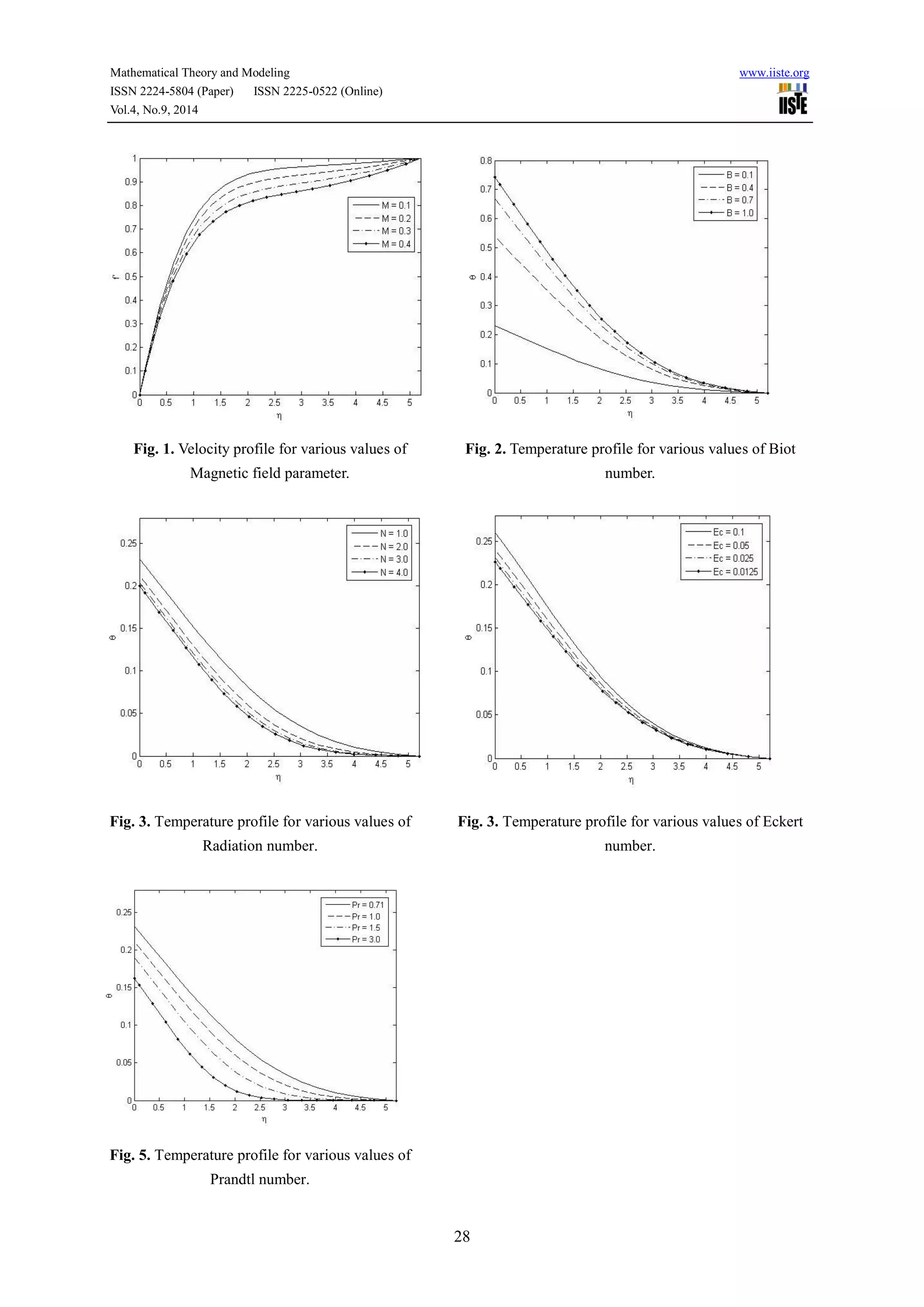
Figure 1 represents the velocity profile (푓′) for various values of the Magnetic field parameter while Pr, Bi, N 
and Ec are kept constant at 0.71, 0.1, 1 and 0.025 respectively. It is observed that increase in the Magnetic 
parameter leads to a corresponding decrease in the velocity profile. Fig 2 reflect the Temperature profile (휃) for 
different values of the Biot number while Pr, M, N and Ec are kept constant at 0.71, 0.1, 1 and 0.025 respectively. 
It is observed that increase in the Biot number leads to a corresponding increase in the temperature profile. 
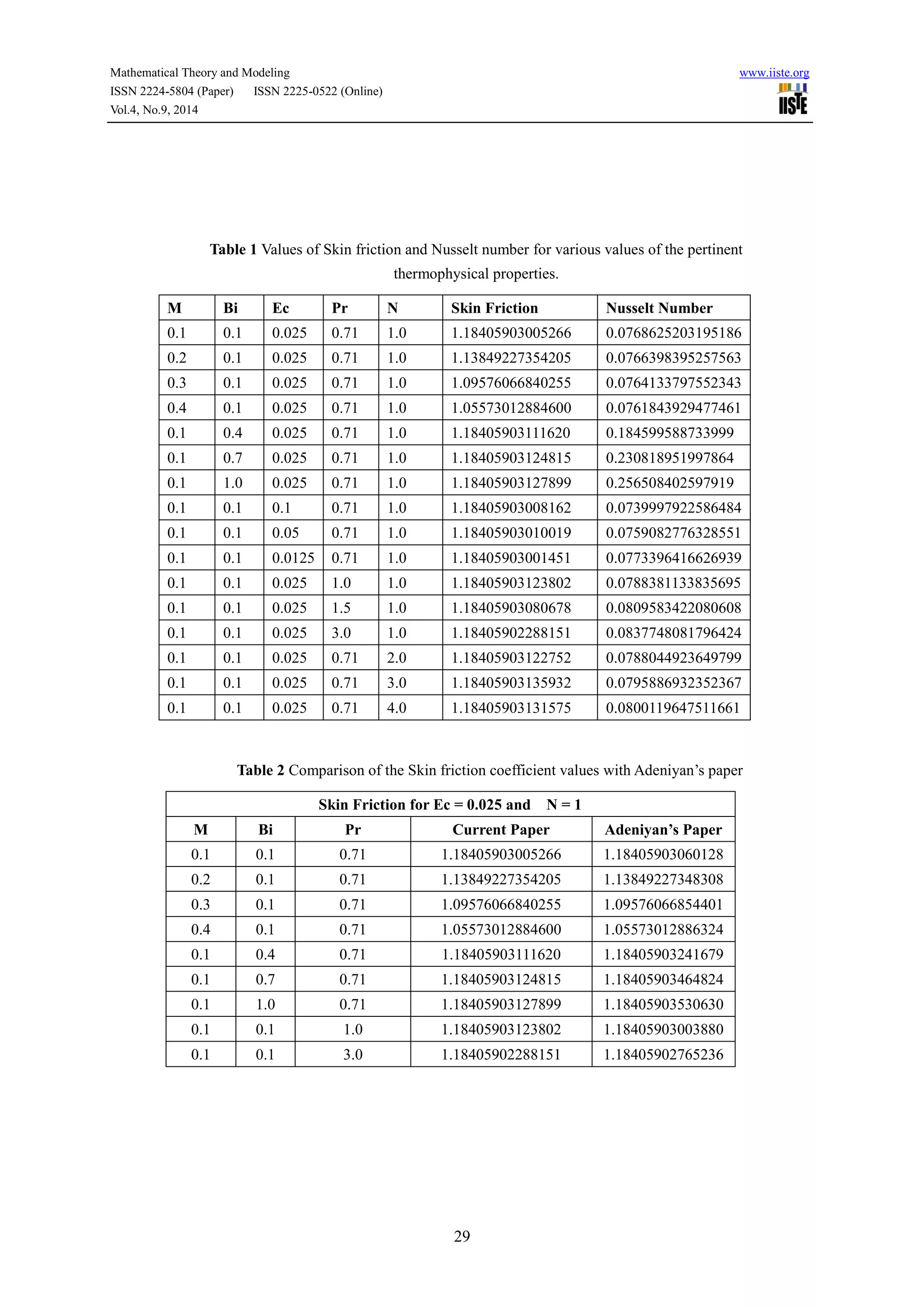
The effect of Eckert number (Ec) on the temperature profile is shown in Fig. 3. The temperature profile decrease 
with an increase in the Eckert number while Pr, M, N and Bi are kept constant at 0.71, 0.1, 1 and 0.1 respectively. 
In Fig. 4, we depict the temperature profile for different values of the Prandtl number. It is clearly seen that 
increase in the Prandtl number leads to decrease in the temperature profile. In Fig. 5, the influence of the 
Radiation number on the temperature profile is investigated; the values of Pr, M, Ec and Bi are kept fixed at 0.71, 
0.1, 0.025 and 0.1 respectively. It is observed that as the radiation parameter increases the temperature profile 
decreases. 
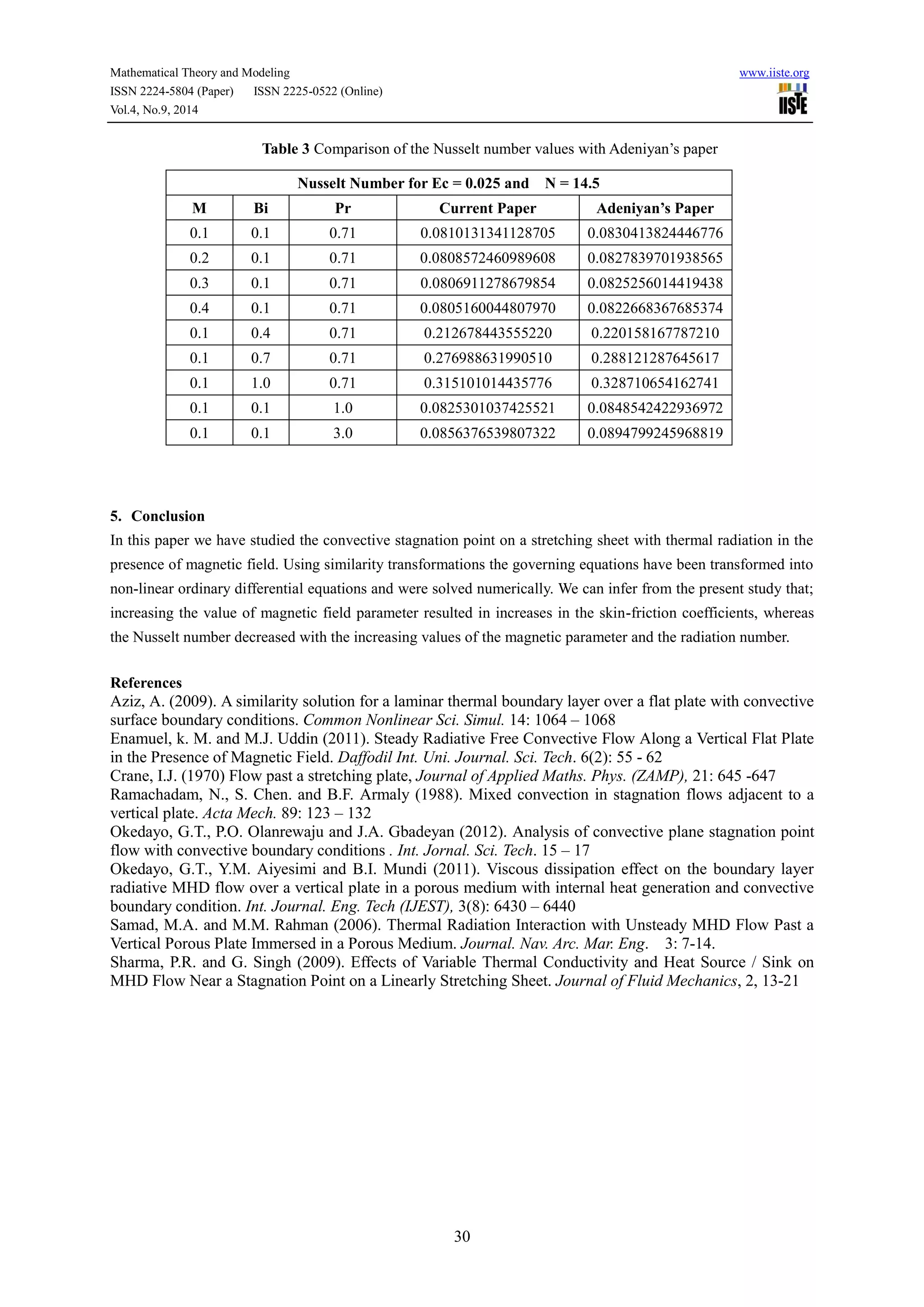
The parameters of engineering interest for the present problem are the Skin friction coefficient and Local Nusselt 
number which indicate physically wall shear stress and rate of heat transfer respectively. The numerical values 
proportional to 퐶 and 푁푢 are shown in Table1. In the absence of thermal radiation and viscous dissipation, 
the results of the present paper are reduced to those obtained by Adeniyan and Adegun (2013). To this end, a 
comparison of the two results is presented in Table 2 and 3.
Mathematical Theory and Modeling www.iiste.org 
ISSN 2224-5804 (Paper) ISSN 2225-0522 (Online) 
Vol.4, No.9, 2014 
28 
Fig. 1. Velocity profile for various values of 
Magnetic field parameter. 
Fig. 2. Temperature profile for various values of Biot 
number. 
Fig. 3. Temperature profile for various values of 
Radiation number. 
Fig. 3. Temperature profile for various values of Eckert 
number. 
Fig. 5. Temperature profile for various values of 
Prandtl number.
Mathematical Theory and Modeling www.iiste.org 
ISSN 2224-5804 (Paper) ISSN 2225-0522 (Online) 
Vol.4, No.9, 2014 
Table 1 Values of Skin friction and Nusselt number for various values of the pertinent 
thermophysical properties. 
M Bi Ec Pr N Skin Friction Nusselt Number 
0.1 0.1 0.025 0.71 1.0 1.18405903005266 0.0768625203195186 
0.2 0.1 0.025 0.71 1.0 1.13849227354205 0.0766398395257563 
0.3 0.1 0.025 0.71 1.0 1.09576066840255 0.0764133797552343 
0.4 0.1 0.025 0.71 1.0 1.05573012884600 0.0761843929477461 
0.1 0.4 0.025 0.71 1.0 1.18405903111620 0.184599588733999 
0.1 0.7 0.025 0.71 1.0 1.18405903124815 0.230818951997864 
0.1 1.0 0.025 0.71 1.0 1.18405903127899 0.256508402597919 
0.1 0.1 0.1 0.71 1.0 1.18405903008162 0.0739997922586484 
0.1 0.1 0.05 0.71 1.0 1.18405903010019 0.0759082776328551 
0.1 0.1 0.0125 0.71 1.0 1.18405903001451 0.0773396416626939 
0.1 0.1 0.025 1.0 1.0 1.18405903123802 0.0788381133835695 
0.1 0.1 0.025 1.5 1.0 1.18405903080678 0.0809583422080608 
0.1 0.1 0.025 3.0 1.0 1.18405902288151 0.0837748081796424 
0.1 0.1 0.025 0.71 2.0 1.18405903122752 0.0788044923649799 
0.1 0.1 0.025 0.71 3.0 1.18405903135932 0.0795886932352367 
0.1 0.1 0.025 0.71 4.0 1.18405903131575 0.0800119647511661 
Table 2 Comparison of the Skin friction coefficient values with Adeniyan’s paper 
Skin Friction for Ec = 0.025 and N = 1 
M Bi Pr Current Paper Adeniyan’s Paper 
0.1 0.1 0.71 1.18405903005266 1.18405903060128 
0.2 0.1 0.71 1.13849227354205 1.13849227348308 
0.3 0.1 0.71 1.09576066840255 1.09576066854401 
0.4 0.1 0.71 1.05573012884600 1.05573012886324 
0.1 0.4 0.71 1.18405903111620 1.18405903241679 
0.1 0.7 0.71 1.18405903124815 1.18405903464824 
0.1 1.0 0.71 1.18405903127899 1.18405903530630 
0.1 0.1 1.0 1.18405903123802 1.18405903003880 
0.1 0.1 3.0 1.18405902288151 1.18405902765236 
29
Mathematical Theory and Modeling www.iiste.org 
ISSN 2224-5804 (Paper) ISSN 2225-0522 (Online) 
Vol.4, No.9, 2014 
Table 3 Comparison of the Nusselt number values with Adeniyan’s paper 
Nusselt Number for Ec = 0.025 and N = 14.5 
M Bi Pr Current Paper Adeniyan’s Paper 
0.1 0.1 0.71 0.0810131341128705 0.0830413824446776 
0.2 0.1 0.71 0.0808572460989608 0.0827839701938565 
0.3 0.1 0.71 0.0806911278679854 0.0825256014419438 
0.4 0.1 0.71 0.0805160044807970 0.0822668367685374 
0.1 0.4 0.71 0.212678443555220 0.220158167787210 
0.1 0.7 0.71 0.276988631990510 0.288121287645617 
0.1 1.0 0.71 0.315101014435776 0.328710654162741 
0.1 0.1 1.0 0.0825301037425521 0.0848542422936972 
0.1 0.1 3.0 0.0856376539807322 0.0894799245968819 
5. Conclusion 
In this paper we have studied the convective stagnation point on a stretching sheet with thermal radiation in the 
presence of magnetic field. Using similarity transformations the governing equations have been transformed into 
non-linear ordinary differential equations and were solved numerically. We can infer from the present study that; 
increasing the value of magnetic field parameter resulted in increases in the skin-friction coefficients, whereas 
the Nusselt number decreased with the increasing values of the magnetic parameter and the radiation number. 
References 
Aziz, A. (2009). A similarity solution for a laminar thermal boundary layer over a flat plate with convective 
surface boundary conditions. Common Nonlinear Sci. Simul. 14: 1064 – 1068 
Enamuel, k. M. and M.J. Uddin (2011). Steady Radiative Free Convective Flow Along a Vertical Flat Plate 
in the Presence of Magnetic Field. Daffodil Int. Uni. Journal. Sci. Tech. 6(2): 55 - 62 
Crane, I.J. (1970) Flow past a stretching plate, Journal of Applied Maths. Phys. (ZAMP), 21: 645 -647 
Ramachadam, N., S. Chen. and B.F. Armaly (1988). Mixed convection in stagnation flows adjacent to a 
vertical plate. Acta Mech. 89: 123 – 132 
Okedayo, G.T., P.O. Olanrewaju and J.A. Gbadeyan (2012). Analysis of convective plane stagnation point 
flow with convective boundary conditions . Int. Jornal. Sci. Tech. 15 – 17 
Okedayo, G.T., Y.M. Aiyesimi and B.I. Mundi (2011). Viscous dissipation effect on the boundary layer 
radiative MHD flow over a vertical plate in a porous medium with internal heat generation and convective 
boundary condition. Int. Journal. Eng. Tech (IJEST), 3(8): 6430 – 6440 
Samad, M.A. and M.M. Rahman (2006). Thermal Radiation Interaction with Unsteady MHD Flow Past a 
Vertical Porous Plate Immersed in a Porous Medium. Journal. Nav. Arc. Mar. Eng. 3: 7-14. 
Sharma, P.R. and G. Singh (2009). Effects of Variable Thermal Conductivity and Heat Source / Sink on 
MHD Flow Near a Stagnation Point on a Linearly Stretching Sheet. Journal of Fluid Mechanics, 2, 13-21 
30
The IISTE is a pioneer in the Open-Access hosting service and academic event 
management. The aim of the firm is Accelerating Global Knowledge Sharing. 
More information about the firm can be found on the homepage: 
http://www.iiste.org 
CALL FOR JOURNAL PAPERS 
There are more than 30 peer-reviewed academic journals hosted under the hosting 
platform. 
Prospective authors of journals can find the submission instruction on the 
following page: http://www.iiste.org/journals/ All the journals articles are available 
online to the readers all over the world without financial, legal, or technical barriers 
other than those inseparable from gaining access to the internet itself. Paper version 
of the journals is also available upon request of readers and authors. 
MORE RESOURCES 
Book publication information: http://www.iiste.org/book/ 
IISTE Knowledge Sharing Partners 
EBSCO, Index Copernicus, Ulrich's Periodicals Directory, JournalTOCS, PKP Open 
Archives Harvester, Bielefeld Academic Search Engine, Elektronische 
Zeitschriftenbibliothek EZB, Open J-Gate, OCLC WorldCat, Universe Digtial 
Library , NewJour, Google Scholar

Effects of some thermo physical properties on force

  • 1.
    Mathematical Theory andModeling www.iiste.org ISSN 2224-5804 (Paper) ISSN 2225-0522 (Online) Vol.4, No.9, 2014 Effects Of Some Thermo-Physical Properties On Force Convective Stagnation Point On A Stretching Sheet With Convective Boundary Conditions In The Presence Of Thermal Radiation And Magnetic Field Adeola John Omowaye and * Adekunle Opeoluwa Ajayi Department of Mathematical Sciences, Federal University of Technology, Akure, PMB 704, Ondo State, Nigeria. E-mail: ajomowaye@futa.edu.ng, * ajayiao@futa.edu.ng Abstract Of concern in this paper is an investigation of force convective stagnation point on a stretching sheet with convective boundary conditions in the presence of thermal radiation and uniform magnetic field. Rosseland approximation is used to model the radiative heat transfer. The nonlinear partial differential equations arising from the flow modeling were transformed by similarity transformation. The resulting coupled nonlinear ordinary differential equations were then solved numerically by employing the Adaptive Runge-Kutta together with shooting technique. Finally the effects of the pertinent thermo-physical parameters are presented in graphs and tables. Keywords: Plane Stagnation Point, Thermal Radiation, Convective Boundary Conditions, Magnetic Field. 1. Introduction Stagnation point flow has over the years become an interesting research area to scientist and engineers due to its prodigious scientific and industrial applications. It is found useful in nuclear reactors, extrusion of polymers, cooling of electronics devices, etc. Crane (1970) the initiator of the study of convection boundary layer flow over a stretching sheet, studied the two dimensional steady flow of an incompressible viscous fluid caused by a linearly stretching plate. Remachndran (1988) studied laminar mixed convection in two dimensional stagnation flows around heated surfaces. He considered both cases of an arbitrary wall temperature and arbitrary heat flux variation. Their results showed that for a specified range of buoyancy parameter dual solutions existed and a reversed flow developed in the buoyancy opposing flow region. Sharma and Singh (2009) studied the effects of variable thermal conductivity and heat source / sink on MHD flow near a stagnation point on a linearly stretching sheet. They observed that the rate of heat transfer at the sheet increases due to increase in the thermal conductivity parameter, while it decreases due to increase in the ratio of free stream velocity parameter to stretching sheet parameter, in absence of magnetic field and volumetric rate of heat source/sink parameter. In the glass industry, processes such as, blowing, floating or spinning of fibers involves flow due to a stretching surface. Thermal radiation effects plays an important role in scientific processes such as cooling of a metal or glass sheet. Its effect cannot be neglected because this process takes place at high temperatures. Samad and Rahman (2006) investigated the thermal radiation interaction on an absorbing emitting fluid past a vertical porous plate immersed in a porous medium. Steady radiative free convective flow along a vertical flat plate in 24
  • 2.
    Mathematical Theory andModeling www.iiste.org ISSN 2224-5804 (Paper) ISSN 2225-0522 (Online) Vol.4, No.9, 2014 the presence of magnetic field was investigated by Enamuel and Uddin (2011). Their result showed that magnetic field can control the heat transfer and radiation has a significant effect on the velocity as well as temperature distributions. Convective boundary condition is used mostly to describe a linear convective heat exchange condition for one or more algebraic entities in thermal. Thermal energy storage, nuclear plants, gas turbines, etc are processes that defines heat transfer analysis with convective boundary conditions. Aziz (2009) presented a similarity solution for Blasius flow of viscous fluid with convective boundary conditions. Okedayo et al (2011) presented the effects of viscous dissipation on the mixed convection heat transfer over a flat plate with internal heat generation and convective boundary condition. Okedayo et al (2012) presented the similarity solution to the plane stagnation point flow with convective boundary conditions. Adeniyan and Adegun (2013) studied the effects of convective plane stagnation point MHD flow with convective boundary conditions in the presence of a uniform magnetic field. They observed that the convective conditions, the stagnation point and the magnetic field have significant effects on the heat transfer rate, velocity boundary layer thickness and the thermal boundary layer thickness. In the present paper, force convective stagnation point on a stretching sheet with convective boundary conditions in the presence of thermal radiation and magnetic fields is investigated. The inclusion of thermal radiation and viscous dissipation extends the work of Adeniyan and Adigun (2013). 2. Governing Equations Let us consider a steady two-dimensional MHD flow of a viscous, incompressible and electrically conducting fluid of temperature 푇∞ along a heated vertical flat plate under the influence of a uniform magnetic field. The flow is assumed to be in the x-direction, which is chosen along the plate in the upward direction and y-axis normal to the plate. The fluid is considered to be gray, absorbing emitting radiation but non-scattering medium and the Rosseland approximation is used to describe the radiative heat flux in the energy equation. The radiative heat flux in the x-direction is negligible to the flux in the y-direction. A uniform magnetic field of strength 퐵ퟎ is applied normal to the plate parallel to y-direction. The plate temperature is initially raised to 푇푤(where 푇푤 > 푇∞ ) which is thereafter maintained constant. The flow and heat transfer equations relevant for the model, namely the Continuity equation, momentum equation and energy equation are; 25 휕푢 휕푥 + 휕푣 휕푦 = 0 (1) 푢 휕푢 휕푥 + 푣 휕푢 휕푦 = − 1 휌 휕푝 휕푥 + 훾 휕2푢 휕푦2 − 2푢 휌 휎퐵0 (2) 푢 휕푇 휕푥 + 푣 휕푇 휕푦 = ∝ 휕2푇 휕푦2 + 훾 푐푝 ( 휕푢 휕푦 ) 2 − 1 휌푐푝 휕푞푟 휕푦 (3)
  • 3.
    Mathematical Theory andModeling www.iiste.org ISSN 2224-5804 (Paper) ISSN 2225-0522 (Online) Vol.4, No.9, 2014 26 Boundary Conditions: 푢(푥,0) = 푣(푥,0) =0 푢(푥,∞) = 푥푎 휕푇 휕푦 −푘 (푥,0) = ℎ푓(푇푓 − 푇(푥,0)) 푇(푥,∞) = 0 } (4) In equations 1 – 4 the velocity field is (푢(푥, 푦), 푣(푥, 푦)), where u, v are the velocity along and normal to the plate respectively. T(x,y) is the temperature field, T∞ is the free stream temperature, 푇 is the temperature of stretching sheet, 푎 is the stretching rate constant, 훾 is the kinematic viscosity, ∝ is the thermal diffusivity of the fluid, ℎ is the heat transfer coefficient ,p is the fluid pressure, 휌 is the density, k is the thermal conductivity, 휎 is electrical conductivity of the fluid, 퐵 = (0, 퐵0 ) is the imposed magnetic field and 휃 is dimensionless fluid temperature. The term 휕푞푟 휕푦 is introduced for radiation effect, 푞푟 is the radiative heat flux and 푐푝 is the specific heat at constant pressure. Within the frame work of the above mentioned assumptions, we assume that the boundary layer and Boussinesq approximations hold and the flow and heat transfer in the presence of radiation are governed by the equations Eq. (1), Eq. (2) and Eq. (3). By using Rosseland approximation 푞푟 takes the form 푞푟 = − 4휎1 3푘1 휕푇4 휕푦 (5) where, 휎1 is the Stefan-Boltzmann constant and 푘1 is the mean absorption coefficient. It is assumed that the temperature differences within the flow are sufficiently small such that 푇4 may be expressed as a linear function of temperature. This is accomplished by expanding 푇4 in a Taylor series about 푇∞ and neglecting higher-order terms, thus 푇4 ≅ 푇∞ 4 + (푇 − 푇∞)4푇∞ 3 = 4푇∞ 3푇 − 3푇∞ 4 (6) 3. Similarity Transformation The suitable similarity variables, for the problem under consideration, are 푎 훾 휂= √ , 휓(푥,푦)= 푥√푎훾푓(휂) 휃(휂)= 푇− 푇∞ 푇푓− 푇∞ , 푃푟= 훾 훼 푀= 휎퐵0 2 휌훼 ℎ푓 푘 , 퐵풊= 훾 훼 √ 퐸푐= 훼2푥2 푐푝(푇푓− 푇∞) , 푁= 푘푘1 4휎1푇∞ 3 } (7) Here 푃푟 , 푀, 퐵풊, 퐸푐 , 푁 signifies respectively the Prandtl number, the Magnetic parameter, the Biot number, the Eckert number and the Radiation parameter. In terms of the stream function 휓(푥, 푦), the velocity components are
  • 4.
    Mathematical Theory andModeling www.iiste.org ISSN 2224-5804 (Paper) ISSN 2225-0522 (Online) Vol.4, No.9, 2014 27 푢 = 휕휓 휕푦 , 푣 = − 휕휓 휕푥 (8) Which in essence satisfy Eq. (1) identically. With the use of the similarity transformation, momentum and energy equations become 푓′′′ + 푓푓′ − (푓′)2 + 1 − 푀푓′ = 0 (9) (3푁 + 4)휃′′ + 3푁푃푟푓휃′ + 3푁푃푟퐸푐 (푓′′)2 = 0 (10) Subject to the transformed boundary conditions (0) = 0 , ′(0)= 0, ′(∞) = 1 휃′(0) = −퐵푖(1−휃(0)), 휃(∞) = 0 } (11) Here 푓 is the dimensionless stream function and prime denotes the derivative with respect to η. 4. Result and Discusion The numerical solutions of the nonlinear differential equations Eq. (9) & Eq. (10) under the boundary conditions Eq. (11) have been performed by applying a shooting method along with Adaptive Runge-Kutta integration scheme. The technique was implemented on a computer program written in Matlab. A convenient step size was chosen to obtain the desired accuracy. Figure 1 represents the velocity profile (푓′) for various values of the Magnetic field parameter while Pr, Bi, N and Ec are kept constant at 0.71, 0.1, 1 and 0.025 respectively. It is observed that increase in the Magnetic parameter leads to a corresponding decrease in the velocity profile. Fig 2 reflect the Temperature profile (휃) for different values of the Biot number while Pr, M, N and Ec are kept constant at 0.71, 0.1, 1 and 0.025 respectively. It is observed that increase in the Biot number leads to a corresponding increase in the temperature profile. The effect of Eckert number (Ec) on the temperature profile is shown in Fig. 3. The temperature profile decrease with an increase in the Eckert number while Pr, M, N and Bi are kept constant at 0.71, 0.1, 1 and 0.1 respectively. In Fig. 4, we depict the temperature profile for different values of the Prandtl number. It is clearly seen that increase in the Prandtl number leads to decrease in the temperature profile. In Fig. 5, the influence of the Radiation number on the temperature profile is investigated; the values of Pr, M, Ec and Bi are kept fixed at 0.71, 0.1, 0.025 and 0.1 respectively. It is observed that as the radiation parameter increases the temperature profile decreases. The parameters of engineering interest for the present problem are the Skin friction coefficient and Local Nusselt number which indicate physically wall shear stress and rate of heat transfer respectively. The numerical values proportional to 퐶 and 푁푢 are shown in Table1. In the absence of thermal radiation and viscous dissipation, the results of the present paper are reduced to those obtained by Adeniyan and Adegun (2013). To this end, a comparison of the two results is presented in Table 2 and 3.
  • 5.
    Mathematical Theory andModeling www.iiste.org ISSN 2224-5804 (Paper) ISSN 2225-0522 (Online) Vol.4, No.9, 2014 28 Fig. 1. Velocity profile for various values of Magnetic field parameter. Fig. 2. Temperature profile for various values of Biot number. Fig. 3. Temperature profile for various values of Radiation number. Fig. 3. Temperature profile for various values of Eckert number. Fig. 5. Temperature profile for various values of Prandtl number.
  • 6.
    Mathematical Theory andModeling www.iiste.org ISSN 2224-5804 (Paper) ISSN 2225-0522 (Online) Vol.4, No.9, 2014 Table 1 Values of Skin friction and Nusselt number for various values of the pertinent thermophysical properties. M Bi Ec Pr N Skin Friction Nusselt Number 0.1 0.1 0.025 0.71 1.0 1.18405903005266 0.0768625203195186 0.2 0.1 0.025 0.71 1.0 1.13849227354205 0.0766398395257563 0.3 0.1 0.025 0.71 1.0 1.09576066840255 0.0764133797552343 0.4 0.1 0.025 0.71 1.0 1.05573012884600 0.0761843929477461 0.1 0.4 0.025 0.71 1.0 1.18405903111620 0.184599588733999 0.1 0.7 0.025 0.71 1.0 1.18405903124815 0.230818951997864 0.1 1.0 0.025 0.71 1.0 1.18405903127899 0.256508402597919 0.1 0.1 0.1 0.71 1.0 1.18405903008162 0.0739997922586484 0.1 0.1 0.05 0.71 1.0 1.18405903010019 0.0759082776328551 0.1 0.1 0.0125 0.71 1.0 1.18405903001451 0.0773396416626939 0.1 0.1 0.025 1.0 1.0 1.18405903123802 0.0788381133835695 0.1 0.1 0.025 1.5 1.0 1.18405903080678 0.0809583422080608 0.1 0.1 0.025 3.0 1.0 1.18405902288151 0.0837748081796424 0.1 0.1 0.025 0.71 2.0 1.18405903122752 0.0788044923649799 0.1 0.1 0.025 0.71 3.0 1.18405903135932 0.0795886932352367 0.1 0.1 0.025 0.71 4.0 1.18405903131575 0.0800119647511661 Table 2 Comparison of the Skin friction coefficient values with Adeniyan’s paper Skin Friction for Ec = 0.025 and N = 1 M Bi Pr Current Paper Adeniyan’s Paper 0.1 0.1 0.71 1.18405903005266 1.18405903060128 0.2 0.1 0.71 1.13849227354205 1.13849227348308 0.3 0.1 0.71 1.09576066840255 1.09576066854401 0.4 0.1 0.71 1.05573012884600 1.05573012886324 0.1 0.4 0.71 1.18405903111620 1.18405903241679 0.1 0.7 0.71 1.18405903124815 1.18405903464824 0.1 1.0 0.71 1.18405903127899 1.18405903530630 0.1 0.1 1.0 1.18405903123802 1.18405903003880 0.1 0.1 3.0 1.18405902288151 1.18405902765236 29
  • 7.
    Mathematical Theory andModeling www.iiste.org ISSN 2224-5804 (Paper) ISSN 2225-0522 (Online) Vol.4, No.9, 2014 Table 3 Comparison of the Nusselt number values with Adeniyan’s paper Nusselt Number for Ec = 0.025 and N = 14.5 M Bi Pr Current Paper Adeniyan’s Paper 0.1 0.1 0.71 0.0810131341128705 0.0830413824446776 0.2 0.1 0.71 0.0808572460989608 0.0827839701938565 0.3 0.1 0.71 0.0806911278679854 0.0825256014419438 0.4 0.1 0.71 0.0805160044807970 0.0822668367685374 0.1 0.4 0.71 0.212678443555220 0.220158167787210 0.1 0.7 0.71 0.276988631990510 0.288121287645617 0.1 1.0 0.71 0.315101014435776 0.328710654162741 0.1 0.1 1.0 0.0825301037425521 0.0848542422936972 0.1 0.1 3.0 0.0856376539807322 0.0894799245968819 5. Conclusion In this paper we have studied the convective stagnation point on a stretching sheet with thermal radiation in the presence of magnetic field. Using similarity transformations the governing equations have been transformed into non-linear ordinary differential equations and were solved numerically. We can infer from the present study that; increasing the value of magnetic field parameter resulted in increases in the skin-friction coefficients, whereas the Nusselt number decreased with the increasing values of the magnetic parameter and the radiation number. References Aziz, A. (2009). A similarity solution for a laminar thermal boundary layer over a flat plate with convective surface boundary conditions. Common Nonlinear Sci. Simul. 14: 1064 – 1068 Enamuel, k. M. and M.J. Uddin (2011). Steady Radiative Free Convective Flow Along a Vertical Flat Plate in the Presence of Magnetic Field. Daffodil Int. Uni. Journal. Sci. Tech. 6(2): 55 - 62 Crane, I.J. (1970) Flow past a stretching plate, Journal of Applied Maths. Phys. (ZAMP), 21: 645 -647 Ramachadam, N., S. Chen. and B.F. Armaly (1988). Mixed convection in stagnation flows adjacent to a vertical plate. Acta Mech. 89: 123 – 132 Okedayo, G.T., P.O. Olanrewaju and J.A. Gbadeyan (2012). Analysis of convective plane stagnation point flow with convective boundary conditions . Int. Jornal. Sci. Tech. 15 – 17 Okedayo, G.T., Y.M. Aiyesimi and B.I. Mundi (2011). Viscous dissipation effect on the boundary layer radiative MHD flow over a vertical plate in a porous medium with internal heat generation and convective boundary condition. Int. Journal. Eng. Tech (IJEST), 3(8): 6430 – 6440 Samad, M.A. and M.M. Rahman (2006). Thermal Radiation Interaction with Unsteady MHD Flow Past a Vertical Porous Plate Immersed in a Porous Medium. Journal. Nav. Arc. Mar. Eng. 3: 7-14. Sharma, P.R. and G. Singh (2009). Effects of Variable Thermal Conductivity and Heat Source / Sink on MHD Flow Near a Stagnation Point on a Linearly Stretching Sheet. Journal of Fluid Mechanics, 2, 13-21 30
  • 8.
    The IISTE isa pioneer in the Open-Access hosting service and academic event management. The aim of the firm is Accelerating Global Knowledge Sharing. More information about the firm can be found on the homepage: http://www.iiste.org CALL FOR JOURNAL PAPERS There are more than 30 peer-reviewed academic journals hosted under the hosting platform. Prospective authors of journals can find the submission instruction on the following page: http://www.iiste.org/journals/ All the journals articles are available online to the readers all over the world without financial, legal, or technical barriers other than those inseparable from gaining access to the internet itself. Paper version of the journals is also available upon request of readers and authors. MORE RESOURCES Book publication information: http://www.iiste.org/book/ IISTE Knowledge Sharing Partners EBSCO, Index Copernicus, Ulrich's Periodicals Directory, JournalTOCS, PKP Open Archives Harvester, Bielefeld Academic Search Engine, Elektronische Zeitschriftenbibliothek EZB, Open J-Gate, OCLC WorldCat, Universe Digtial Library , NewJour, Google Scholar