IOSR Journal of Mathematics (IOSR-JM)
e-ISSN: 2278-5728, p-ISSN: 2319-765X. Volume 11, Issue 6 Ver. II (Nov. - Dec. 2015), PP 01-06
www.iosrjournals.org
DOI: 10.9790/5728-11620106 www.iosrjournals.org 1 | Page
Similarity Solution of an Unsteady Heat and Mass Transfer
Boundary Layer Flow over a continuous Surface in a Porous
Medium with Hydromagnetic Field
Md.Jashim Uddin
Department of Electrical & Electronic Engineering,
International Islamic University Chittagong,Bangladesh
Abstract: The unsteady hydromagnetic boundary layer flow of an incompressible and electrically conducting
fluid through a porous medium bounded by a moving surface has been considered. It is assumed that the moving
surface has a velocity profile with respect to time and fluid flow is taken under the influence of a transverse
magnetic field. The similarity solution is used to transform the system of partial differential equations,
describing the problem under consideration, into a boundary value problem of coupled ordinary differential
equations and an efficient numerical technique is implemented to solve the reduced system. The effects of the
parameters such as Magnetic parameter, Prandtl number and Eckert number are discussed graphically on
velocity and temperature distributions.
Keywords: Boundary layer, Heat and Mass transfer, Hydromagnetic Field, Similarity solution, Unsteady
I. Introduction
The study of boundary layer flow of an electrically conducting fluid has many applications in
manufacturing and natural process which include cooling of electronic devices by fans, cooling of nuclear
reactors during emergency shutdown, cooling of an infinite metallic plate in a cooling bath, textile and paper
industries, glass-fiber production, manufacture of plastic and rubber sheets, the utilization of geothermal energy,
the boundary layer control in the field of aerodynamics, food processing, plasma studies and in the flow of
biological fluids.
The porous media heat transfer problems have numerous thermal engineering applications such as
geothermal energy recovery, crude oil extraction, thermal insulation, ground water pollution, oil
extraction, thermal energy storage, thermal insulations and flow through filtering devices. Excellent reviews on
this topic are provided in the literature by Nield and Bejan [1], Vafai [2], Ingham and Pop [3] and Vadasz [4].
Recently, Cheng and Lin [5] examined the melting effect on mixed convective heat transfer from a permeable
over a continuous Surface embedded in a liquid saturated porous medium with aiding and opposing external
flows. The unsteady boundary layer flow over a stretching sheet has been studied by Devi et al. [6], Elbashbeshy
and Bazid [7], Tsai et al. [8] and Ishak [9]. Fluid heating and cooling are important in many industries such as
power, manufacturing, transportation, and electronics. Johnson and Cheng [10] examined the necessary and
sufficient condition under which similarity solution exist for free convection boundary layer flow over a
continuous surface in porous media. Williams et al., [11] studied the unsteady free convection flow over a
vertical flat plate under the assumption of variations of the wall temperature with time and distance. They found
possible semi-similar solutions for a verity of classes of wall temperature distributions. Kumari et al., [12]
observed that the unsteadiness in the flow field was caused by the time dependent velocity of the moving sheet.
The constant temperature and the constant heat flux conditions were consideration in their investigation. An
excellent summary of applications is given by Huges and Young [13] Raptis [14] studied mathematically the
case of time varying two dimensional natural convective flow of an incompressible, electrically conducting fluid
along an infinite vertical porous plate embedded in a porous medium. Helmy[15] analyzed MHD unsteady free
convection flow past a vertical plate embedded in a porous medium. Elabashbeshy [16] studied heat and mass
transfer along a vertical plate in the presence of magnetic field. Chamkha and Khaled[17] investigated the
problem of coupled heat and mass transfer by magnetohydrodynamic free convection from an inclined plate in
the presence of internal heat generation or absorption. Transport processes through porous media play important
roles in diverse applications, such as in geothermal operations, petroleum industries, thermal insulation, design
of solid-matrix heat exchangers, chemical catalytic reactors, and many others. Bejan and Khair[18] reported on
the natural convection boundary layer flow in a saturated porous medium with combined heat and mass transfer.
Raptis A. et al [19] have discussed the importance of inertia effects for flows in porous media. Elbashbeshy and
Bazid [20] presented an exact similarity solution for momentum and heat transfer in an unsteady flow whose
motion is caused solely by the linear stretching of a horizontal continuous surface. Ali and Magyari [21]
presented the problem of unsteady fluid and heat flow induced by a submerged continuous surface while its
Similarity Solution of an Unsteady Heat and Mass Transfer Boundary Layer Flow over a…
DOI: 10.9790/5728-11620106 www.iosrjournals.org 2 | Page
steady motion is slowed down gradually. It will be demonstrated that the system of time-dependent governing
equations can be reduced by introducing a suitable transformation variables. Accurate numerical solutions are
generated by employing shooting method. A comprehensive parametric study is conducted and a representative
set of graphical results for the velocity and temperature profiles are reported and discussed. Computed
numerical results are plotted and the characteristics of the flow and heat transfer are analyzed in detail. Pertinent
results are displayed graphically and discussed quantitatively.
II. Mathematical Analysis
Let us consider the unsteady heat and mass transfer boundary layer flow of a viscous and
incompressible fluid through a porous medium bounded by a continuously moving surface with uniform
velocity U in the presence of uniform transverse magnetic field of strength B0. The magnetic Reynolds number
is assumed to be small so that the induced magnetic field can be neglected. Using boundary layer
approximation, the governing equations of continuity, momentum and energy under unsteady condition for the
flow and the temperature are written in usual notation as:
∂u
∂x
+
∂v
∂y
= 0 (1)
∂u
∂t
+ u
∂u
∂x
+ v
∂v
∂y
=
1
ρ
∂
∂y
(μ
∂u
∂y
) −
σe B0
2
ρ
u (2)
∂T
∂t
+ u
∂T
∂x
+ v
∂T
∂y
=
k
ρcp
∂2T
∂y2 +
μ
ρcp
(
∂u
∂y
)2
+
σe B0
2
u2
ρcp
(3)
Where ρis the density, μ be the coefficient of viscosity, σe the electrical conductivity, k thermal conductivity of
the fluid and cp the specific heat at constant pressure. The other symbols have their usual meanings.
The corresponding boundary conditions are:
u = U, v = 0 ; T = Tw at y = 0 (4)
and u = 0, T = T∞ at y = ∞; (5)
The continuity equation (1) is satisfied by introducing the stream function (x, y),
such that u =
∂ψ
∂y
, v = −
∂ψ
∂x
The momentum and energy equations (2)and (3) can be transformed to the corresponding ordinary differential
equations by introducing the following similarity transformations:
ψ = Uxν∞t f(η)
η = y
U
ν∞ xt
, θ η =
T−T∞
Tw −T∞
(6)
where  is a reference kinematic viscosity.
It will be assumed that the temperature difference between the moving surface and the free stream varies as
Cxτ
.that is, Tw − T∞ = Cxτ
(7)
Where C is a constant, τ is exponent, and x is measured from the leading edge of the surface.
If U = u = ax, x = ξ, t = δ then the momentum and energy equations (2) – (3) after some simplifications,
reduce to the following forms:
f′′′
+ A1Prff′′
+ AηPrf′′
− AA1Mpf′
= 0 (8)
where Pr =
ρν∞
2μ
(Prandtl number) and Mp =
ν∞σe B0
2
μ
(Magnetic Parameter),
A1 = δ Unsteadiness parameter and A =
1
a
θ′′
+ A1Pr ηθ′
+ Afθ′
Ec + Pr AA1Mpf′
+ Af′′2
= 0 (9)
where Ec =
2μcp ξ
k
(Eckert number)
Similarity Solution of an Unsteady Heat and Mass Transfer Boundary Layer Flow over a…
DOI: 10.9790/5728-11620106 www.iosrjournals.org 3 | Page
The corresponding boundary conditions are:
f = 0; f′
= 1; θ = 1 as η = 0
f′
= 0; θ = 0 as η = ∞ (10)
Where the prime (′) denotes differentiation with respect to η
It is important to note that for liquids (Pr > 1.0) and for gases (Pr < 1.0).
III. Methodology And Solution Of The Problem:
We have applied free parameter method to solve governing partial differential equations to find
similarity solution. The free parameter method is the way of finding “Similarity Solution” of PDE by assuming
that the dependent variables in the equations are to express in terms “similarity parameters” known as similarity
variables, finally a single variable. Similarity variables must be constructed in such way that the number of
independent variables that occur in the equations reduced by one (at least) from the total number of the
independent variables. The governing boundary layer equations (2) - (3) subject to boundary conditions (4) and
(5) are solved numerically by using shooting method. First of all higher order non-linear differential equations
(2) -(3) are converted into simultaneous linear differential equations of first order and they are further
transformed into initial value problem by applying the shooting technique with the Runge-kutta Gill method.
The corresponding velocity and temperature profiles are shown in figures.
IV. Result And Discussion
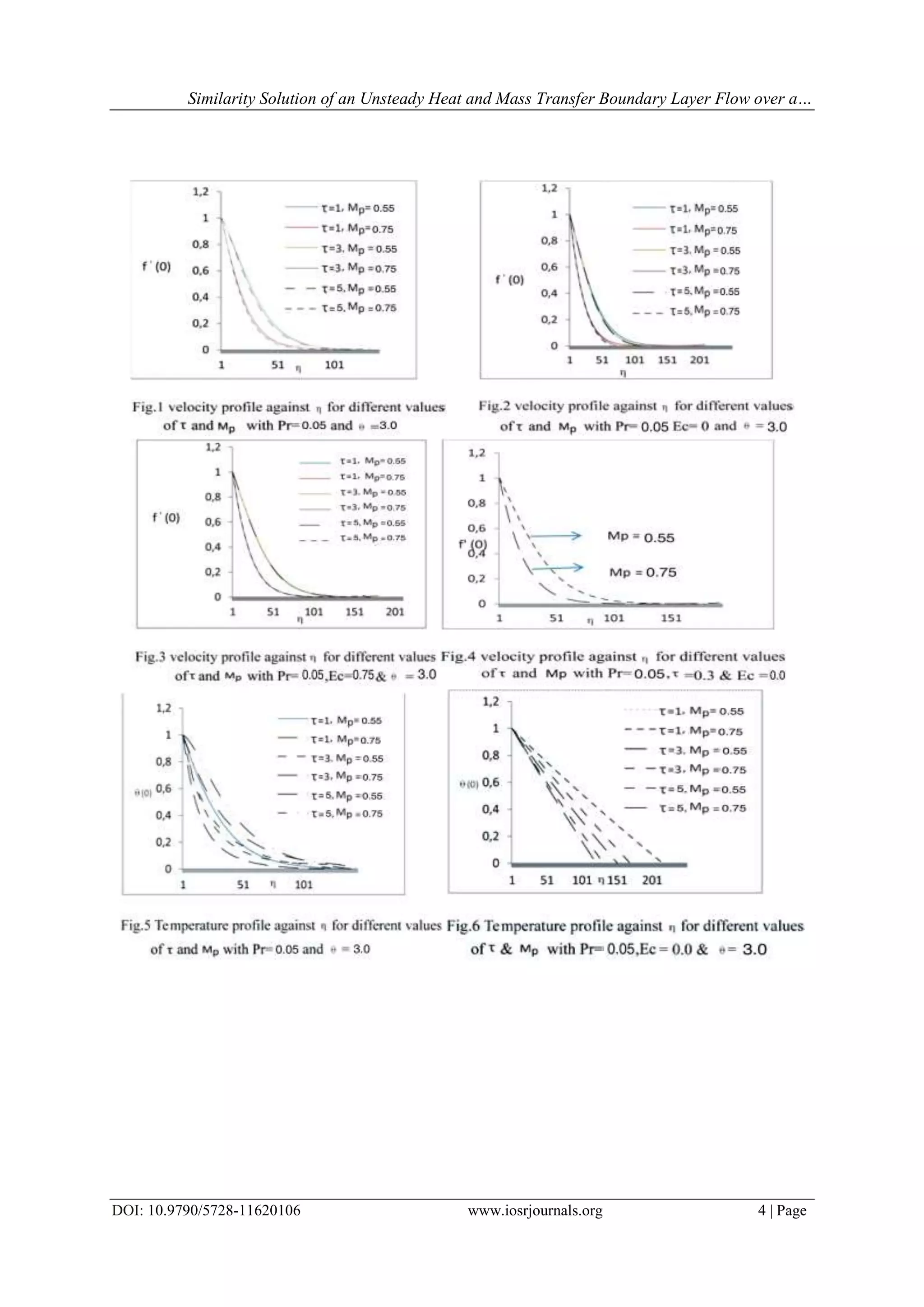
In order to get a physical insight into the problem, a representative set of numerical results is shown
graphically in Figs.1-10, to illustrate the influence of physical parameters viz., magnetic parameterMp , Prandtl
number Pr Eckert number Ec ,Unsteadiness parameter and variation (exponent) τ on the velocity f′
and
temperature θ. The profiles for velocity and temperature are shown in fig.1 to fig. 10.
Effect for velocity profile:
4.1 Effect of the Prandtl number:
From the fig.1 it is observed that the velocity f′
(0) decreases as the power-law index of the surface temperature
variation (exponent) τ and the magnetic parameter(Mp) increases with Prandtl number Pr = 0.05
4.2 Effect of the viscosity Parameter:.
It is seen from fig.1 that the velocity decreases as the power-law index of the surface temperature variation τ and
the magnetic parameter (Mp) increases with the variable viscosity parameter θ = 3.0
4.3 Effect of the Eckert number:
From the fig.2-3, it is observed that the velocity profiles are almost identical for different values of temperature
variation τ and the magnetic parameter (Mp) with Eckert number Ec = 0.0 andEc = 0.75
4.4 Effect of the Magnetic Parameter:
In fig.4 it is observed that the velocity decreases as magnetic parameter (Mp) increases.
Effect for temperature profile:
4.5 Effect of variation (exponent):
From the fig.5 it is observed that as variation (exponent) τ increases the temperature decreases for fixed value of
magnetic parameter (Mp).
4.6 Effect of the Magnetic Parameter:
It is seen from fig.6-7 that the temperature decreases as magnetic parameter Mp increases.
4.7 Effect of the Prandtl and Eckert number:
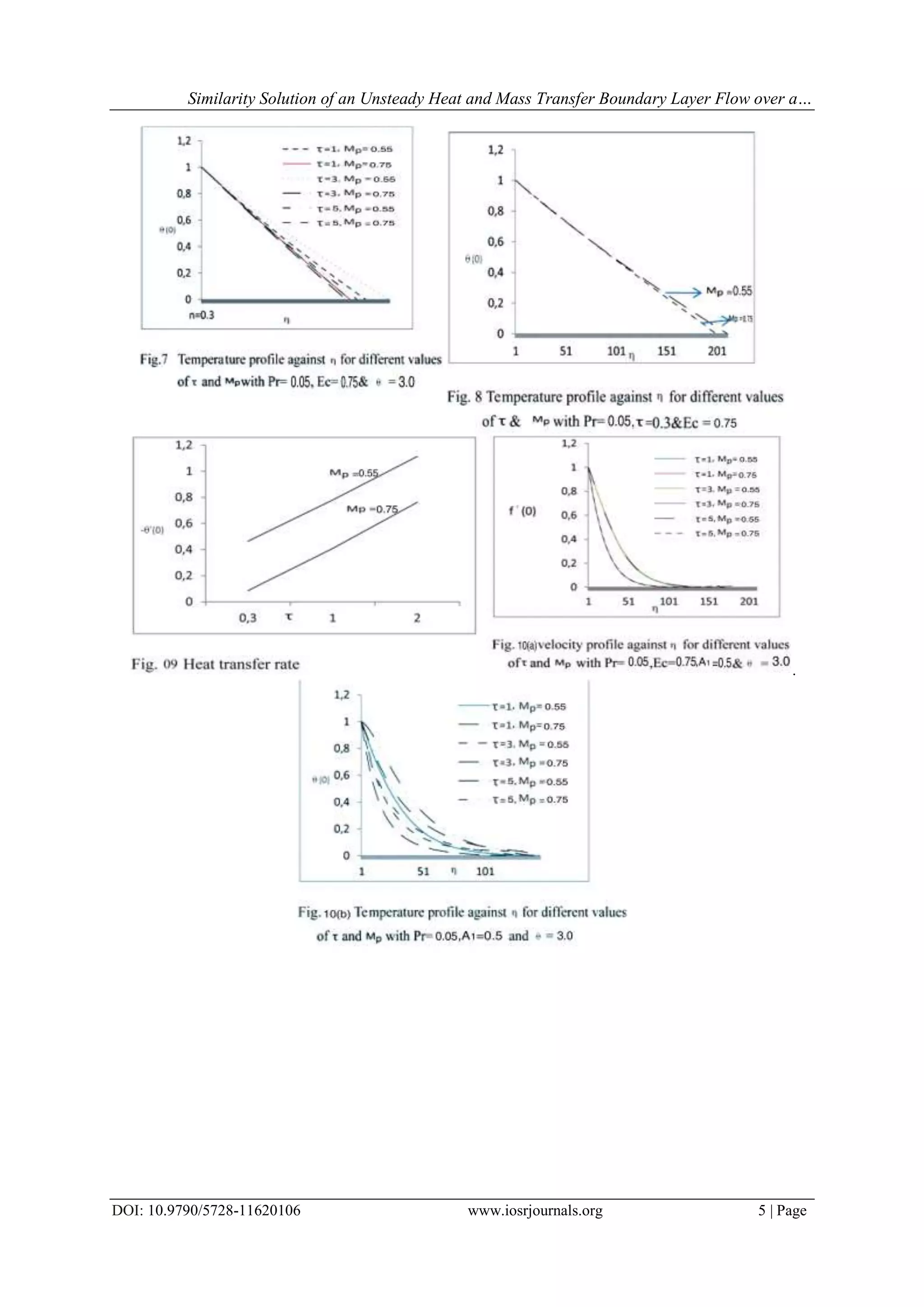
From the fig.8 it is observed that the temperature decreases as the magnetic parameter increases with Pr=0.05,
τ = 0.3 and Ec = 0.75
4.8 Effect of Heat transfer:
It is seen from fig.9 that as Mp increases the heat transfer rate - θ′
(0), decreases but as τ increases the heat
transfer rate increases.That is why, the parameters τ and Mp have considerable influence on the heat transfer rate
- θ′
(0).
4.9 Effect of the Unsteadiness Parameter:
In the fig.10(a), it is observed that the velocity profiles are approximately symmetrical for different values of
unsteadiness parameter𝐴1, temperature variation τ and the magnetic parameter (Mp) with Pr = 0.05, Eckert
number Ec = 0.75,𝐴1 = 0.5.
It is seen from fig.10(b) that as variation (exponent) τ increases the temperature decreases for fixed value of
magnetic parameter (Mp) and unsteadiness parameter𝐴1with Pr = 0.05, 𝐴1 = 0.5 and θ = 3.0
ESULTS AND DISC
Similarity Solution of an Unsteady Heat and Mass Transfer Boundary Layer Flow over a…
DOI: 10.9790/5728-11620106 www.iosrjournals.org 4 | Page
Similarity Solution of an Unsteady Heat and Mass Transfer Boundary Layer Flow over a…
DOI: 10.9790/5728-11620106 www.iosrjournals.org 5 | Page
.
Similarity Solution of an Unsteady Heat and Mass Transfer Boundary Layer Flow over a…
DOI: 10.9790/5728-11620106 www.iosrjournals.org 6 | Page
V. Conclusion
An analysis is here made of unsteady laminar boundary Layer flow for heat and mass transfer over a
continuous surface for magnetic field under which similarity solution are possible. The effects of power law
index of the surface temperature variation (exponent), magnetic parameter and variable parameter on a
hydromagnetic flow and heat transfer on a continuously moving surface have been studied numerically using the
the shooting technique. The magnetic field stabilizes the flow which in turn delays the boundary layer separation
from the continuous surface in a porous medium. The effect of the Eckert number Ec , variation (exponent) τ,
unsteadiness parameter A1 and Prandtl number Pr on the heat transfer were studied. From the present numerical
investigations the following majors conclusions may be drawn:
i. Velocity and temperature in the unsteady case is observed to be lesser than those of the steady case.
ii. It is observed that an increment in unsteadiness parameter increases the Prandtl number and decreases the
Eckert number
iii. The velocity decreases with the increase of power law index of the surface temperature variation
(exponent) and the magnetic parameter.
iv. The temperature decreases with the increase of the power law index of the surface temperature variation
(exponent) and the magnetic parameter .
v. The heat transfer rate increases rapidly with the increase of power law index of the surface temperature
variation (exponent) whereas when the magnetic parameter increases the heat transfer rate decreases.
vi. Temperature decreases with an increasing in the value of unsteadiness parameter A1.
vii. Increasing the Prandtl number leads to a decrease in the surface temperature.
References
[1]. Nield, D.A. and A. Bejan, 2006. Convection in Porous Media (3rd Edn.). Springer, New York.
[2]. Vafai, K. 2005. Handbook of Porous Media (2nd
Edn.). Taylor & Francis, New York.
[3]. Ingham, D.B. and I. Pop, 2005. Transport Phenomena in Porous Media III. Elsevier, Oxford.
[4]. Vadasz, P., 2008. Emerging Topics in Heat and Mass Transfer in Porous Media. Springer, New York.
[5]. Cheng, W.T. and C.H. Lin, 2007. Melting effect on mixed convective heat transfer with aiding and opposing external flows from
the vertical plate in a liquidsaturated porous medium. Int. J. Heat MassTransfer 50: 3026-3034.
[6]. C. D. S. Devi, H. S. Takhar, G. Nath, “Unsteady mixed convection flow in stagnation region adjacent to a vertical surface,” Heat
Mass Transfer, 26(1991) 71-79.
[7]. E. M. A. Elbashbeshy, M. A. A. Bazid, “Heat transfer over an unsteady stretching surface,” Heat Mass Transfer, 41(2004) 1-4.
[8]. R. Tsai, K. H. Huang, J. S. Huang, “Flow and heat transfer over an unsteady stretching surface with non-uniform heat source,” Int.
Commun. Heat Mass Transfer, 35(2008) 1340-1343.
[9]. A. Ishak, Unsteady, “MHD flow and heat transfer over a stretching plate,” J. Appied Sci. 10(18)(2010) 2127-2131.
[10]. Johnson C. H. and Cheng P. 1978. Possible similarity solutions for free convection boundary Layers adjacent to flat plates in porous
media. Int. J. Heat Mass Transfer. 21: 709-718.
[11]. Williams J. C., Mulligan J. C. and Rhyne T. B. 1987. Semi-similar solutions for unsteady free convection boundary Layer flow on a
vertical flat plate. 175: 309-332.
[12]. Kumari M., Slaouti A., Nakamura S., Takhar H. S. and Nath G. 1986. Unsteady free convection flow over a continuous moving
vertical surface. Acta Mechanica. 116: 75-82.
[13]. Huges W.F. and Young F.J. The Electro-Magneto Dynamics of fluids, John Wiley and Sons, New York, (1996).
[14]. Raptis A. Flow through a porous medium in the presence of magnetic field, Int. J. Energy Res., Vol.10, (1986)
[15]. Helmy K.A.. MHD unsteady free convection flow past a vertical porous plate, ZAMM, Vol.78, (1998).
[16]. Elabashbeshy E.M.A.. Heat and mass transfer along a vertical plate with variable temperature and concentration in the presence of
magnetic filed, Int. J. Eng. Sci., Vol. 34, (1997).
[17]. Chamkha A.J. and Khaled A.R.A.. Similarity solutions for hydromagnetic simultaneous heat and mass transfer by natural
convection from an inclined plate with internal heat generation or absorption, Heat Mass Transfer, Vol. 37, (2001).
[18]. Bejan A. and Khair K.R.. Heat and mass transfer by natural convection in a porous medium, Int.Commun. Heat Mass Transfer, Vol.
28, (1985).
[19]. Raptis A., Tzivanidis G. and Kafousias N. Free convection and mass transfer flow through a porous medium bounded by an infinite
vertical limiting surface with constant suction, Letter Heat Mass Transfer, Vol. 8, (1981).
[20]. E.M.A. Elbashbeshy, M.A.A. Bazid, Heat transfer over an unsteady continuous surface, Heat Mass Transfer 41 (2004) 1–4.
[21]. M.E. Ali, E. Magyari, Unsteady fluid and heat flow induced by a submerged continuous surface while its steady motion is slow
down gradually, Int. J. Heat Mass Transfer 50 (2007) 188–195.

Similarity Solution of an Unsteady Heat and Mass Transfer Boundary Layer Flow over a continuous Surface in a Porous Medium with Hydromagnetic Field

  • 1.
    IOSR Journal ofMathematics (IOSR-JM) e-ISSN: 2278-5728, p-ISSN: 2319-765X. Volume 11, Issue 6 Ver. II (Nov. - Dec. 2015), PP 01-06 www.iosrjournals.org DOI: 10.9790/5728-11620106 www.iosrjournals.org 1 | Page Similarity Solution of an Unsteady Heat and Mass Transfer Boundary Layer Flow over a continuous Surface in a Porous Medium with Hydromagnetic Field Md.Jashim Uddin Department of Electrical & Electronic Engineering, International Islamic University Chittagong,Bangladesh Abstract: The unsteady hydromagnetic boundary layer flow of an incompressible and electrically conducting fluid through a porous medium bounded by a moving surface has been considered. It is assumed that the moving surface has a velocity profile with respect to time and fluid flow is taken under the influence of a transverse magnetic field. The similarity solution is used to transform the system of partial differential equations, describing the problem under consideration, into a boundary value problem of coupled ordinary differential equations and an efficient numerical technique is implemented to solve the reduced system. The effects of the parameters such as Magnetic parameter, Prandtl number and Eckert number are discussed graphically on velocity and temperature distributions. Keywords: Boundary layer, Heat and Mass transfer, Hydromagnetic Field, Similarity solution, Unsteady I. Introduction The study of boundary layer flow of an electrically conducting fluid has many applications in manufacturing and natural process which include cooling of electronic devices by fans, cooling of nuclear reactors during emergency shutdown, cooling of an infinite metallic plate in a cooling bath, textile and paper industries, glass-fiber production, manufacture of plastic and rubber sheets, the utilization of geothermal energy, the boundary layer control in the field of aerodynamics, food processing, plasma studies and in the flow of biological fluids. The porous media heat transfer problems have numerous thermal engineering applications such as geothermal energy recovery, crude oil extraction, thermal insulation, ground water pollution, oil extraction, thermal energy storage, thermal insulations and flow through filtering devices. Excellent reviews on this topic are provided in the literature by Nield and Bejan [1], Vafai [2], Ingham and Pop [3] and Vadasz [4]. Recently, Cheng and Lin [5] examined the melting effect on mixed convective heat transfer from a permeable over a continuous Surface embedded in a liquid saturated porous medium with aiding and opposing external flows. The unsteady boundary layer flow over a stretching sheet has been studied by Devi et al. [6], Elbashbeshy and Bazid [7], Tsai et al. [8] and Ishak [9]. Fluid heating and cooling are important in many industries such as power, manufacturing, transportation, and electronics. Johnson and Cheng [10] examined the necessary and sufficient condition under which similarity solution exist for free convection boundary layer flow over a continuous surface in porous media. Williams et al., [11] studied the unsteady free convection flow over a vertical flat plate under the assumption of variations of the wall temperature with time and distance. They found possible semi-similar solutions for a verity of classes of wall temperature distributions. Kumari et al., [12] observed that the unsteadiness in the flow field was caused by the time dependent velocity of the moving sheet. The constant temperature and the constant heat flux conditions were consideration in their investigation. An excellent summary of applications is given by Huges and Young [13] Raptis [14] studied mathematically the case of time varying two dimensional natural convective flow of an incompressible, electrically conducting fluid along an infinite vertical porous plate embedded in a porous medium. Helmy[15] analyzed MHD unsteady free convection flow past a vertical plate embedded in a porous medium. Elabashbeshy [16] studied heat and mass transfer along a vertical plate in the presence of magnetic field. Chamkha and Khaled[17] investigated the problem of coupled heat and mass transfer by magnetohydrodynamic free convection from an inclined plate in the presence of internal heat generation or absorption. Transport processes through porous media play important roles in diverse applications, such as in geothermal operations, petroleum industries, thermal insulation, design of solid-matrix heat exchangers, chemical catalytic reactors, and many others. Bejan and Khair[18] reported on the natural convection boundary layer flow in a saturated porous medium with combined heat and mass transfer. Raptis A. et al [19] have discussed the importance of inertia effects for flows in porous media. Elbashbeshy and Bazid [20] presented an exact similarity solution for momentum and heat transfer in an unsteady flow whose motion is caused solely by the linear stretching of a horizontal continuous surface. Ali and Magyari [21] presented the problem of unsteady fluid and heat flow induced by a submerged continuous surface while its
  • 2.
    Similarity Solution ofan Unsteady Heat and Mass Transfer Boundary Layer Flow over a… DOI: 10.9790/5728-11620106 www.iosrjournals.org 2 | Page steady motion is slowed down gradually. It will be demonstrated that the system of time-dependent governing equations can be reduced by introducing a suitable transformation variables. Accurate numerical solutions are generated by employing shooting method. A comprehensive parametric study is conducted and a representative set of graphical results for the velocity and temperature profiles are reported and discussed. Computed numerical results are plotted and the characteristics of the flow and heat transfer are analyzed in detail. Pertinent results are displayed graphically and discussed quantitatively. II. Mathematical Analysis Let us consider the unsteady heat and mass transfer boundary layer flow of a viscous and incompressible fluid through a porous medium bounded by a continuously moving surface with uniform velocity U in the presence of uniform transverse magnetic field of strength B0. The magnetic Reynolds number is assumed to be small so that the induced magnetic field can be neglected. Using boundary layer approximation, the governing equations of continuity, momentum and energy under unsteady condition for the flow and the temperature are written in usual notation as: ∂u ∂x + ∂v ∂y = 0 (1) ∂u ∂t + u ∂u ∂x + v ∂v ∂y = 1 ρ ∂ ∂y (μ ∂u ∂y ) − σe B0 2 ρ u (2) ∂T ∂t + u ∂T ∂x + v ∂T ∂y = k ρcp ∂2T ∂y2 + μ ρcp ( ∂u ∂y )2 + σe B0 2 u2 ρcp (3) Where ρis the density, μ be the coefficient of viscosity, σe the electrical conductivity, k thermal conductivity of the fluid and cp the specific heat at constant pressure. The other symbols have their usual meanings. The corresponding boundary conditions are: u = U, v = 0 ; T = Tw at y = 0 (4) and u = 0, T = T∞ at y = ∞; (5) The continuity equation (1) is satisfied by introducing the stream function (x, y), such that u = ∂ψ ∂y , v = − ∂ψ ∂x The momentum and energy equations (2)and (3) can be transformed to the corresponding ordinary differential equations by introducing the following similarity transformations: ψ = Uxν∞t f(η) η = y U ν∞ xt , θ η = T−T∞ Tw −T∞ (6) where  is a reference kinematic viscosity. It will be assumed that the temperature difference between the moving surface and the free stream varies as Cxτ .that is, Tw − T∞ = Cxτ (7) Where C is a constant, τ is exponent, and x is measured from the leading edge of the surface. If U = u = ax, x = ξ, t = δ then the momentum and energy equations (2) – (3) after some simplifications, reduce to the following forms: f′′′ + A1Prff′′ + AηPrf′′ − AA1Mpf′ = 0 (8) where Pr = ρν∞ 2μ (Prandtl number) and Mp = ν∞σe B0 2 μ (Magnetic Parameter), A1 = δ Unsteadiness parameter and A = 1 a θ′′ + A1Pr ηθ′ + Afθ′ Ec + Pr AA1Mpf′ + Af′′2 = 0 (9) where Ec = 2μcp ξ k (Eckert number)
  • 3.
    Similarity Solution ofan Unsteady Heat and Mass Transfer Boundary Layer Flow over a… DOI: 10.9790/5728-11620106 www.iosrjournals.org 3 | Page The corresponding boundary conditions are: f = 0; f′ = 1; θ = 1 as η = 0 f′ = 0; θ = 0 as η = ∞ (10) Where the prime (′) denotes differentiation with respect to η It is important to note that for liquids (Pr > 1.0) and for gases (Pr < 1.0). III. Methodology And Solution Of The Problem: We have applied free parameter method to solve governing partial differential equations to find similarity solution. The free parameter method is the way of finding “Similarity Solution” of PDE by assuming that the dependent variables in the equations are to express in terms “similarity parameters” known as similarity variables, finally a single variable. Similarity variables must be constructed in such way that the number of independent variables that occur in the equations reduced by one (at least) from the total number of the independent variables. The governing boundary layer equations (2) - (3) subject to boundary conditions (4) and (5) are solved numerically by using shooting method. First of all higher order non-linear differential equations (2) -(3) are converted into simultaneous linear differential equations of first order and they are further transformed into initial value problem by applying the shooting technique with the Runge-kutta Gill method. The corresponding velocity and temperature profiles are shown in figures. IV. Result And Discussion In order to get a physical insight into the problem, a representative set of numerical results is shown graphically in Figs.1-10, to illustrate the influence of physical parameters viz., magnetic parameterMp , Prandtl number Pr Eckert number Ec ,Unsteadiness parameter and variation (exponent) τ on the velocity f′ and temperature θ. The profiles for velocity and temperature are shown in fig.1 to fig. 10. Effect for velocity profile: 4.1 Effect of the Prandtl number: From the fig.1 it is observed that the velocity f′ (0) decreases as the power-law index of the surface temperature variation (exponent) τ and the magnetic parameter(Mp) increases with Prandtl number Pr = 0.05 4.2 Effect of the viscosity Parameter:. It is seen from fig.1 that the velocity decreases as the power-law index of the surface temperature variation τ and the magnetic parameter (Mp) increases with the variable viscosity parameter θ = 3.0 4.3 Effect of the Eckert number: From the fig.2-3, it is observed that the velocity profiles are almost identical for different values of temperature variation τ and the magnetic parameter (Mp) with Eckert number Ec = 0.0 andEc = 0.75 4.4 Effect of the Magnetic Parameter: In fig.4 it is observed that the velocity decreases as magnetic parameter (Mp) increases. Effect for temperature profile: 4.5 Effect of variation (exponent): From the fig.5 it is observed that as variation (exponent) τ increases the temperature decreases for fixed value of magnetic parameter (Mp). 4.6 Effect of the Magnetic Parameter: It is seen from fig.6-7 that the temperature decreases as magnetic parameter Mp increases. 4.7 Effect of the Prandtl and Eckert number: From the fig.8 it is observed that the temperature decreases as the magnetic parameter increases with Pr=0.05, τ = 0.3 and Ec = 0.75 4.8 Effect of Heat transfer: It is seen from fig.9 that as Mp increases the heat transfer rate - θ′ (0), decreases but as τ increases the heat transfer rate increases.That is why, the parameters τ and Mp have considerable influence on the heat transfer rate - θ′ (0). 4.9 Effect of the Unsteadiness Parameter: In the fig.10(a), it is observed that the velocity profiles are approximately symmetrical for different values of unsteadiness parameter𝐴1, temperature variation τ and the magnetic parameter (Mp) with Pr = 0.05, Eckert number Ec = 0.75,𝐴1 = 0.5. It is seen from fig.10(b) that as variation (exponent) τ increases the temperature decreases for fixed value of magnetic parameter (Mp) and unsteadiness parameter𝐴1with Pr = 0.05, 𝐴1 = 0.5 and θ = 3.0 ESULTS AND DISC
  • 4.
    Similarity Solution ofan Unsteady Heat and Mass Transfer Boundary Layer Flow over a… DOI: 10.9790/5728-11620106 www.iosrjournals.org 4 | Page
  • 5.
    Similarity Solution ofan Unsteady Heat and Mass Transfer Boundary Layer Flow over a… DOI: 10.9790/5728-11620106 www.iosrjournals.org 5 | Page .
  • 6.
    Similarity Solution ofan Unsteady Heat and Mass Transfer Boundary Layer Flow over a… DOI: 10.9790/5728-11620106 www.iosrjournals.org 6 | Page V. Conclusion An analysis is here made of unsteady laminar boundary Layer flow for heat and mass transfer over a continuous surface for magnetic field under which similarity solution are possible. The effects of power law index of the surface temperature variation (exponent), magnetic parameter and variable parameter on a hydromagnetic flow and heat transfer on a continuously moving surface have been studied numerically using the the shooting technique. The magnetic field stabilizes the flow which in turn delays the boundary layer separation from the continuous surface in a porous medium. The effect of the Eckert number Ec , variation (exponent) τ, unsteadiness parameter A1 and Prandtl number Pr on the heat transfer were studied. From the present numerical investigations the following majors conclusions may be drawn: i. Velocity and temperature in the unsteady case is observed to be lesser than those of the steady case. ii. It is observed that an increment in unsteadiness parameter increases the Prandtl number and decreases the Eckert number iii. The velocity decreases with the increase of power law index of the surface temperature variation (exponent) and the magnetic parameter. iv. The temperature decreases with the increase of the power law index of the surface temperature variation (exponent) and the magnetic parameter . v. The heat transfer rate increases rapidly with the increase of power law index of the surface temperature variation (exponent) whereas when the magnetic parameter increases the heat transfer rate decreases. vi. Temperature decreases with an increasing in the value of unsteadiness parameter A1. vii. Increasing the Prandtl number leads to a decrease in the surface temperature. References [1]. Nield, D.A. and A. Bejan, 2006. Convection in Porous Media (3rd Edn.). Springer, New York. [2]. Vafai, K. 2005. Handbook of Porous Media (2nd Edn.). Taylor & Francis, New York. [3]. Ingham, D.B. and I. Pop, 2005. Transport Phenomena in Porous Media III. Elsevier, Oxford. [4]. Vadasz, P., 2008. Emerging Topics in Heat and Mass Transfer in Porous Media. Springer, New York. [5]. Cheng, W.T. and C.H. Lin, 2007. Melting effect on mixed convective heat transfer with aiding and opposing external flows from the vertical plate in a liquidsaturated porous medium. Int. J. Heat MassTransfer 50: 3026-3034. [6]. C. D. S. Devi, H. S. Takhar, G. Nath, “Unsteady mixed convection flow in stagnation region adjacent to a vertical surface,” Heat Mass Transfer, 26(1991) 71-79. [7]. E. M. A. Elbashbeshy, M. A. A. Bazid, “Heat transfer over an unsteady stretching surface,” Heat Mass Transfer, 41(2004) 1-4. [8]. R. Tsai, K. H. Huang, J. S. Huang, “Flow and heat transfer over an unsteady stretching surface with non-uniform heat source,” Int. Commun. Heat Mass Transfer, 35(2008) 1340-1343. [9]. A. Ishak, Unsteady, “MHD flow and heat transfer over a stretching plate,” J. Appied Sci. 10(18)(2010) 2127-2131. [10]. Johnson C. H. and Cheng P. 1978. Possible similarity solutions for free convection boundary Layers adjacent to flat plates in porous media. Int. J. Heat Mass Transfer. 21: 709-718. [11]. Williams J. C., Mulligan J. C. and Rhyne T. B. 1987. Semi-similar solutions for unsteady free convection boundary Layer flow on a vertical flat plate. 175: 309-332. [12]. Kumari M., Slaouti A., Nakamura S., Takhar H. S. and Nath G. 1986. Unsteady free convection flow over a continuous moving vertical surface. Acta Mechanica. 116: 75-82. [13]. Huges W.F. and Young F.J. The Electro-Magneto Dynamics of fluids, John Wiley and Sons, New York, (1996). [14]. Raptis A. Flow through a porous medium in the presence of magnetic field, Int. J. Energy Res., Vol.10, (1986) [15]. Helmy K.A.. MHD unsteady free convection flow past a vertical porous plate, ZAMM, Vol.78, (1998). [16]. Elabashbeshy E.M.A.. Heat and mass transfer along a vertical plate with variable temperature and concentration in the presence of magnetic filed, Int. J. Eng. Sci., Vol. 34, (1997). [17]. Chamkha A.J. and Khaled A.R.A.. Similarity solutions for hydromagnetic simultaneous heat and mass transfer by natural convection from an inclined plate with internal heat generation or absorption, Heat Mass Transfer, Vol. 37, (2001). [18]. Bejan A. and Khair K.R.. Heat and mass transfer by natural convection in a porous medium, Int.Commun. Heat Mass Transfer, Vol. 28, (1985). [19]. Raptis A., Tzivanidis G. and Kafousias N. Free convection and mass transfer flow through a porous medium bounded by an infinite vertical limiting surface with constant suction, Letter Heat Mass Transfer, Vol. 8, (1981). [20]. E.M.A. Elbashbeshy, M.A.A. Bazid, Heat transfer over an unsteady continuous surface, Heat Mass Transfer 41 (2004) 1–4. [21]. M.E. Ali, E. Magyari, Unsteady fluid and heat flow induced by a submerged continuous surface while its steady motion is slow down gradually, Int. J. Heat Mass Transfer 50 (2007) 188–195.