Dr. S. Jothimani Int. Journal of Engineering Research and Applications www.ijera.com 
ISSN : 2248-9622, Vol. 4, Issue 8( Version 6), August 2014, pp.05-13 
www.ijera.com 5|P a g e 
Non-NewtonianFluid Flow and Heat Transfer over a Non- 
Linearly Stretching Surface Along With Porous Plate in Porous 
Medium 
S.Jothimani*and T.Vidhya** 
*(Department of Mathematics, L.R.G Govt.Arts college for women, Tirupur-641 604) 
**(Department of Mathematics, Park college of Engineering and Technology, Coimbatore-641 659) 
ABSTRACT 
This paper investigates the MHD flow and heat transfer of an electrically conducting non-newtonian power-law 
fluid over a non-linearly stretching surface along with porous plate in porous medium. The governing equations 
are reduced to non-linear ordinary differential equations by means of similarity transformations. These 
equations are then solved numerically with the help ofRunge – Kutta shooting method. The effect of various 
flow parameters in the form of dimensionless quantities on the flow field are discussed and presented 
graphically. 
Keywords :Heat Source /Sink Parameter;MHD flow;Power-law Fluid; Stretching sheet; porous medium. 
I. Introduction : 
The study of non-newtonian fluid flows hasthe 
gained considerable interest for their numerous 
engineering applications. Details of the behavior of 
non-newtonian fluid for both steady and unsteady 
flow situations along with mathematical models can 
be found in the books by Astarita and 
Marrucci[1].Over recent years, applications of non-newtonian 
fluids in many industrial processes have 
been increasing. Many particulate slurries, 
multiphase mixtures, pharmaceutical 
formulations,cosmetics and 
toiletries,paints,biological fluids and food items are 
examples of non- Newtonian fluids.The study of 
hydrodynamics flow and heat transfer over a 
stretching sheet may find its applications in polymer 
technology related to the stretching of plastic 
sheets.T.Sarpakaya[2]studied flow on non-newtonian 
fluids in a magnetic field. K.B.Pavolov[3]examined 
the Magneto-Hydrodynamic flow of an 
Incompressible viscous fluid caused by deformation 
of a plan surface.H.I.Andersson,K.H.Bech and 
B.S.Dandapat[4]described Magneto-Hydrodynamic 
flow of a power-law fluid over a stretching 
sheet.R.Cortell[5]described a note on MHD flow of a 
power-law fluid over a stretching 
sheet.A.A.Mutlag,Md.Jasminuddin,A.I.Md.Ismail 
and M.A.A.Hamad[6]described Scaling group 
Transformation under the effect of Thermal radiation 
Heat Transfer of a non-newtonian power-law fluid 
over a vertical stretching sheet with momentum slip 
boundary condition. The problem of dissipation 
effects on MHD non-linear flow and heat transfer 
past a porous surface with prescribed heat flux have 
been studied by S.P.Anjalidevi and B.Ganga[7]. The 
effect of viscous and joules dissipation on MHD flow 
, heat and mass transfer past stretching porous surface 
embedded in porous medium was studied by 
S.P.Anjalidevi and B.Ganga[8]. P.K.Singh and Jai 
singh[9] examined the MHD flow with viscous 
dissipation and chemical reaction over a stretching 
porous plate in porous medium. R.Cortell[10] 
described viscous flow and heat transfer over a non-linearly 
stretching sheet. More 
recently,KerehalliVinayaka Prasad, 
SeetharamanRajeswarisanthi and 
PampannaSomannaDatti[11]examined the effect of 
variable thermal conductivity on the power-law fluid 
flow and heat transfer over a non-linearly stretching 
sheet in the presence of a transverse magnetic field. 
Motivated by these analyses and practical 
applications, the main concern of the present paper is 
to study the effect of variable thermal conductivity on 
the power-law fluid flow and heat transfer over a 
non-linearly stretching sheet along with porous plate 
in porous medium in the presence of a transverse 
magnetic field. This extends the work in [11]. The 
obtain similarity equations were solved numerically 
to show the effects of the governing parameters. 
II. Nomenclature 
A- constant 
0 B - uniform magnetic field 
b - stretching rate, positive constant 
f C - skin friction 
f - dimensionless stream function 
h(x) - heat transfer co-efficient 
k - thermal conductivity 
K - consistency co-efficient 
RESEARCH ARTICLE OPEN ACCESS
Dr. S. Jothimani Int. Journal of Engineering Research and Applications www.ijera.com 
ISSN : 2248-9622, Vol. 4, Issue 8( Version 6), August 2014, pp.05-13 
www.ijera.com 6|P a g e 
m - velocity exponent parameter 
Mn - magnetic parameter 
n - power-law index 
x Nu -Nusselt number 
Npr - modified Prandtl number 
x Npe - Peclet number 
w q - local heat flux at the sheet 
p -pressure 
Rex -local Reynolds number 
r -temperature exponent parameter 
T -fluid temperature 
  w T x -temperature of the stretching sheet 
T - ambient temperature 
u -velocity in x direction 
v - velocity in y direction 
U x - velocity of the stretching sheet 
s Q -temperature-dependent volumetric rate of heat 
source 
p c - specific heat at constant pressure 
 -thermal diffusivity 
 -heat source/sink parameter 
cv -kinematic viscosity 
 -permeability parameter 
 - similarity variable 
0  -magnetic permeability 
 -Stream function 
 - density 
 - electrical conductivity 
 - dimensionless temperature 
III. Mathematical Formulation 
Let us consider the case of a steady two-dimensional 
flow and heat transfer of a non-newtonian 
power –law fluid over a non -linear 
stretching sheet. We consider the effect of porous 
plate in porous medium. Further a Cartesian co-ordinate 
system( x , y ) is used where x and y are 
co-ordinates measured along and normal to the 
surface, respectively. The continuous stretching sheet 
is assumed to have a non-linear velocity and 
prescribed temperature of the form ( ) m U x  bx and 
r T Ax   respectively, where b is the stretching 
constant, x is the distance from the slot; A is a 
constant whose value depends upon the properties of 
the fluid. Here m and r are the velocity and 
temperature exponents,respectively. Here we neglect 
the induced magnetic field, which is small in 
comparison with the applied magnetic field. Further 
the external electrical field is assumed to be zero. 
Under these assumptions the basic equations 
governing the flow and heat transfer in usual 
notations are 
0 
u v 
x y 
  
  
  
(3.1) 
1 2 
0 
n 
u v u B 
u v u u 
x y y y K 
  
 
 
 
      
       
      
(3.2) 
  
2 
2 
S 
P 
T T T Q 
u v T T 
x y y c 
 
  
   
    
   
(3.3) 
Where u and v are the flow velocity components 
along the x and y -axes respectively,  is the 
kinematic viscosity of the fluid,  -consistency of 
the fluid, n is the power-law index,  is the fluid 
density and P c is the specific heat at constants 
pressure. 
The first term in the right hand side of the 
equation (3.2) is the shear rate  u  
x 
 
 
has been 
assumed to be negative throughout the boundary 
layer since the stream wise velocity component u 
decreases monotonically with the distance y from 
the moving surface(for continuous stretching 
surface). The flow is driven solely by the stretching 
surface, which moves with a prescribed velocity 
U x . T is the temperature of the fluid and  is 
the thermal diffusivity of the fluid. The last term 
containing S Q in equation (3.3) represents the 
temperature dependent volumetric rate of heat source 
when 0 S Q  and heat sink when 0 S Q  . Thus the 
appropriate boundary conditions are 
ux,0 Ux, (3.4) 
vx,0  0, (3.5) 
 ,0   w T x  T x , (3.6) 
ux, y 0,T x, y T   as y   (3.7) 
Here, boundary condition (3.4) assures no slip at the 
surface and equation (3.5) signifies the importance of 
impermeability of the stretching surface. Equation 
(3.6) is the variable prescribed surface temperature at 
the wall whereas the equation (3.7) means that the 
stream velocity and the temperature vanish outside 
the boundary layer. In order to obtain the similarity 
solutions of equations (3.1) - (3.7), we assume that 
the variable magnetic field   0 B x is of the form
Dr. S. Jothimani Int. Journal of Engineering Research and Applications www.ijera.com 
ISSN : 2248-9622, Vol. 4, Issue 8( Version 6), August 2014, pp.05-13 
www.ijera.com 7|P a g e 
  0 B x = 
 1 
2 
0 
m 
B x 
 
. The momentum and energy 
equations can be transformed to the corresponding 
ordinary differential equations by the following 
transformations ([11]) 
    
1 
Re n 1 , 
x 
w 
y T T 
x T T 
     
 
 
  
 
(3.8) 
      
1 
, Re n 1 , 
x  x y Ux f  
 
  (3.9) 
Where  is the similarity variable,  x, y is the 
stream function f and  are the dimensionless 
similarity function and temperature, respectively. 
The velocity components u and v given by 
u 
y 
 
 
 
, v 
x 
 
  
 
(3.10) 
The local Reynolds number is defined by 
2 
Re 
n n 
x 
U x 
 
 
 (3.11) 
The mass conservation equation (3.1) is 
automatically satisfied by equation (3.10). By 
assuming the similarity function f  to depend on 
the similarity variable , the momentum 
equation(3.2) and the heat equation (3.3) transform 
into the coupled non-linear ordinary differential 
equation of the form 
    1 2 1 2 1 
'' ''' ' '' ' 0 
1 
n mn m 
n f f mf ff Mn f 
n 
 
      
        
   
(3.12) 
  '' ' ' 2 1 
0 
1 
mn m 
Npr f Npr rf 
n 
    
    
      
   
(3.13) 
The boundary conditions(3.4) – (3.7) now becomes 
      ' f   0, f  1,  1,at  0 (3.14) 
    ' f  0,  0as (3.15) 
Where 
2 
0 Mn  B b is the magnetic parameter, 
  Kb  is the permeability parameter, 
  
2 
Re n 1 
x x Npr  Npe  is the modified Prandtl 
number for power – law fluids, x p Npe  c Ux  
is the convectional Peclet number[11], 
s p   Q c b is the heat source/sink parameter. 
Here primes denote the differentiation with 
respective to . 
The physical quantities of interest are the 
skin-friction coefficient f C and the local Nusselt 
number x Nu , which are defined as 
2 
2 w 
f C 
U 
 
 
 , 
  
w 
x 
w 
xq 
Nu 
k T T 
 
 
(3.16) 
respectively, where the wall shear stress w  and heat 
transfer from the sheet w q are given by 
0 
0 
w 
aty 
u 
y 
  
 
   
   
   0 
, w 
aty 
T 
q 
y 
 
 
   
    
   
(3.17) 
with 0  and  being the dynamic viscosity and 
thermal conductivity, respectively. Using the non-dimensional 
variable (2.7), we obtain 
  
    
1 
'' 
1 
2 
0 
2 
2 0 Re 
xy n 
n 
f x 
y 
C f 
bx 
 
 
 
 
 
   
        
  
(3.18) 
    
1 
' 
Re n 1 0 
x x Nu  
 
   ,where xy  is the shear 
stress and Rex is the local Reynolds number. 
IV. Results and Discussion 
The ordinary differential equations(3.12)-(3.13) 
with the boundary conditions(3.14)-(3.15)have been 
solved by Runge-kutta shooting method. Numerical 
results are obtained to study the effect of the various 
non-dimensional parameters namely, the magnetic 
parameters Mn permeability parameter  , the 
velocity exponent parameter m and the temperature 
exponent parameter r ,the modified Prandtl number 
Npr and the heat source/sink parameter  on the 
flow and heat transfer are shown graphically in the 
Figures 1-9. 
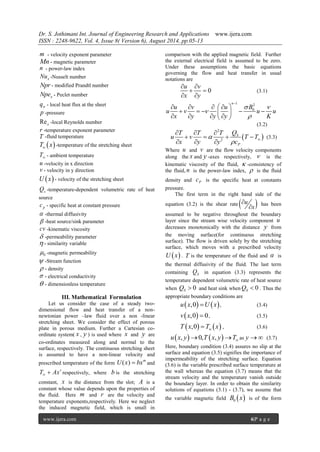
Figures (1(a)-(c)) respectively, depict the effect 
of shear thinning n 1 , newtonian n 1 and 
shear thickening n 1 fluids on the horizontal 
velocity profiles f ' with  ,for different values of 
velocity exponent parameter m and magnetic 
parameter Mn and constant permeability parameter 
 . The effect of flattering of horizontal velocity as a 
consequence of increasing the strength of the 
magnetic field is observed for all values of velocity 
exponent parameterm . The effect of increasing 
values of the velocity exponent parameter m is to
Dr. S. Jothimani Int. Journal of Engineering Research and Applications www.ijera.com 
ISSN : 2248-9622, Vol. 4, Issue 8( Version 6), August 2014, pp.05-13 
www.ijera.com 8|P a g e 
reduce the momentum boundary layer thickness, 
which tends to zero as the space variable  increases 
from the boundary surface. Physically, m  0 
implies that the surface is decelerated from the slot, 
m  0 the continuous movement of a flat surface, 
and m  0 implies the surface is accelerated from 
the extruded slit. 
Horizontal velocity profiles f ' decreases and 
disclosing the fact that the effect of stretching of the 
exponent parameter m from negative values to 
positive values is to decelerate the velocity and hence 
reduces the momentum boundary layer thickness. 
Further it is observed from these,Figures ((1(a)-1(c)) 
that the horizontal velocity profiles f ' decrease with 
increasing values of power-law index n . 
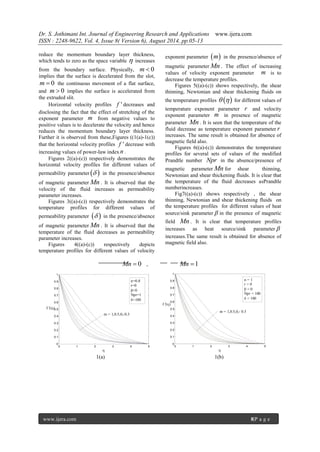
Figures 2((a)-(c)) respectively demonstrates the 
horizontal velocity profiles for different values of 
permeability parameter   in the presence/absence 
of magnetic parameter Mn . It is observed that the 
velocity of the fluid increases as permeability 
parameter increases. 
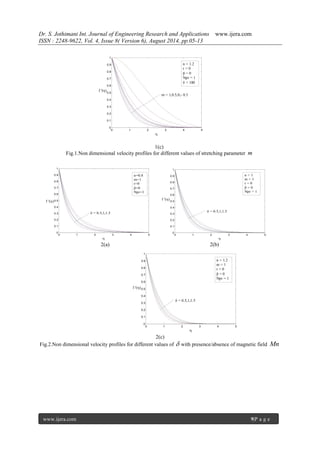
Figures 3((a)-(c)) respectively demonstrates the 
temperature profiles for different values of 
permeability parameter   in the presence/absence 
of magnetic parameter Mn . It is observed that the 
temperature of the fluid decreases as permeability 
parameter increases. 
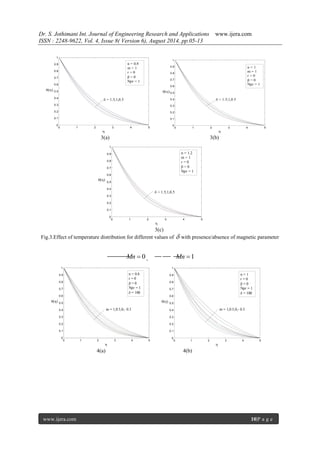
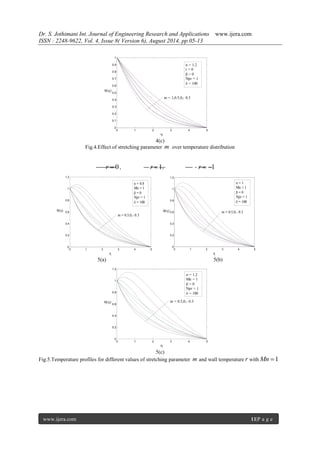
Figures 4((a)-(c)) respectively depicts 
temperature profiles for different values of velocity 
exponent parameter m in the presence/absence of 
magnetic parameter Mn . The effect of increasing 
values of velocity exponent parameter m is to 
decrease the temperature profiles. 
Figures 5((a)-(c)) shows respectively, the shear 
thinning, Newtonian and shear thickening fluids on 
the temperature profiles    for different values of 
temperature exponent parameter r and velocity 
exponent parameter m in presence of magnetic 
parameter Mn . It is seen that the temperature of the 
fluid decrease as temperature exponent parameter r 
increases. The same result is obtained for absence of 
magnetic field also. 
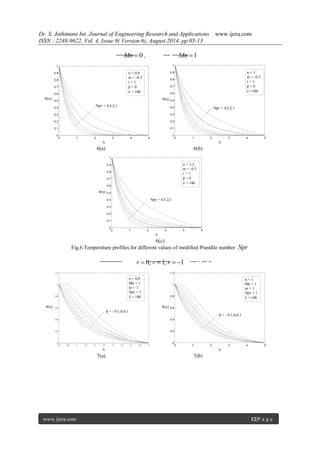
Figures 6((a)-(c)) demonstrates the temperature 
profiles for several sets of values of the modified 
Prandtle number Npr in the absence/presence of 
magnetic parameter Mn for shear thinning, 
Newtonian and shear thickening fluids. It is clear that 
the temperature of the fluid decreases asPrandtle 
numberincreases. 
Fig7((a)-(c)) shows respectively , the shear 
thinning, Newtonian and shear thickening fluids on 
the temperature profiles for different values of heat 
source/sink parameter  in the presence of magnetic 
field Mn . It is clear that temperature profiles 
increases as heat source/sink parameter  
increases.The same result is obtained for absence of 
magnetic field also. 
Mn  0 , Mn 1 
1(a) 1(b) 
0 1 2 3 4 5 
0 
0.1 
0.2 
0.3 
0.4 
0.5 
0.6 
0.7 
0.8 
0.9 
1 
 
f '() 
n=0.8 
r=0 
=0 
Npr=1 
=100 
m = 1,0.5,0,-0.3 
0 1 2 3 4 5 
0 
0.1 
0.2 
0.3 
0.4 
0.5 
0.6 
0.7 
0.8 
0.9 
1 
 
f '() 
m = 1,0.5,0,- 0.3 
n = 1 
r = 0 
 = 0 
Npr = 100 
 = 100
Dr. S. Jothimani Int. Journal of Engineering Research and Applications www.ijera.com 
ISSN : 2248-9622, Vol. 4, Issue 8( Version 6), August 2014, pp.05-13 
www.ijera.com 9|P a g e 
1(c) 
Fig.1.Non dimensional velocity profiles for different values of stretching parameter m 
2(a) 2(b) 
2(c) 
Fig.2.Non dimensional velocity profiles for different values of  with presence/absence of magnetic field Mn 
0 1 2 3 4 5 
0 
0.1 
0.2 
0.3 
0.4 
0.5 
0.6 
0.7 
0.8 
0.9 
1 
 
f '() 
n=0.8 
m=1 
r=0 
=0 
Npr=1 
 = 0.5,1,1.5 
0 1 2 3 4 5 
0 
0.1 
0.2 
0.3 
0.4 
0.5 
0.6 
0.7 
0.8 
0.9 
1 
 
f '() 
 = 0.5,1,1.5 
n = 1 
m = 1 
r = 0 
 = 0 
Npr = 1 
0 1 2 3 4 5 
0 
0.1 
0.2 
0.3 
0.4 
0.5 
0.6 
0.7 
0.8 
0.9 
1 
 
f '() 
 = 0.5,1,1.5 
n = 1.2 
m = 1 
r = 0 
 = 0 
Npr = 1 
0 1 2 3 4 5 
0 
0.1 
0.2 
0.3 
0.4 
0.5 
0.6 
0.7 
0.8 
0.9 
1 
 
f '() 
m = 1,0.5,0,- 0.3 
n = 1.2 
r = 0 
 = 0 
Npr = 1 
 = 100
Dr. S. Jothimani Int. Journal of Engineering Research and Applications www.ijera.com 
ISSN : 2248-9622, Vol. 4, Issue 8( Version 6), August 2014, pp.05-13 
www.ijera.com 10|P a g e 
3(a) 3(b) 
3(c) 
Fig.3.Effect of temperature distribution for different values of  with presence/absence of magnetic parameter 
Mn  0 , Mn 1 
4(a) 4(b) 
0 1 2 3 4 5 
0 
0.1 
0.2 
0.3 
0.4 
0.5 
0.6 
0.7 
0.8 
0.9 
1 
 
() 
 = 1.5,1,0.5 
n = 0.8 
m = 1 
r = 0 
 = 0 
Npr = 1 
0 1 2 3 4 5 
0 
0.1 
0.2 
0.3 
0.4 
0.5 
0.6 
0.7 
0.8 
0.9 
1 
 
() 
n = 1 
m = 1 
r = 0 
 = 0 
Npr = 1 
 = 1.5,1,0.5 
0 1 2 3 4 5 
0 
0.1 
0.2 
0.3 
0.4 
0.5 
0.6 
0.7 
0.8 
0.9 
1 
 
() 
n = 1.2 
m = 1 
r = 0 
 = 0 
Npr = 1 
 = 1.5,1,0.5 
0 1 2 3 4 5 
0 
0.1 
0.2 
0.3 
0.4 
0.5 
0.6 
0.7 
0.8 
0.9 
1 
 
() 
m = 1,0.5,0,- 0.3 
n = 0.8 
r = 0 
 = 0 
Npr = 1 
 = 100 
0 1 2 3 4 5 
0 
0.1 
0.2 
0.3 
0.4 
0.5 
0.6 
0.7 
0.8 
0.9 
1 
 
() 
m = 1,0.5,0,- 0.3 
n = 1 
r = 0 
 = 0 
Npr = 1 
 = 100
Dr. S. Jothimani Int. Journal of Engineering Research and Applications www.ijera.com 
ISSN : 2248-9622, Vol. 4, Issue 8( Version 6), August 2014, pp.05-13 
www.ijera.com 11|P a g e 
4(c) 
Fig.4.Effect of stretching parameter m over temperature distribution 
r  0 , r 1, r  1 
5(a) 5(b) 
5(c) 
Fig.5.Temperature profiles for different values of stretching parameter m and wall temperature r withMn 1 
0 1 2 3 4 5 
0 
0.1 
0.2 
0.3 
0.4 
0.5 
0.6 
0.7 
0.8 
0.9 
1 
 
() 
m = 1,0.5,0,- 0.3 
n = 1.2 
r = 0 
 = 0 
Npr = 1 
 = 100 
0 1 2 3 4 5 
0 
0.2 
0.4 
0.6 
0.8 
1 
1.2 
 
() 
m = 0.5,0,- 0.3 
n = 0.8 
Mn = 1 
 = 0 
Npr = 1 
 = 100 
0 1 2 3 4 5 
0 
0.2 
0.4 
0.6 
0.8 
1 
1.2 
 
() m = 0.5,0,- 0.3 
n = 1 
Mn = 1 
 = 0 
Npr = 1 
 = 100 
0 1 2 3 4 5 
0 
0.2 
0.4 
0.6 
0.8 
1 
1.2 
 
() m = 0.5,0,- 0.3 
n = 1.2 
Mn = 1 
 = 0 
Npr = 1 
 = 100
Dr. S. Jothimani Int. Journal of Engineering Research and Applications www.ijera.com 
ISSN : 2248-9622, Vol. 4, Issue 8( Version 6), August 2014, pp.05-13 
www.ijera.com 12|P a g e 
Mn  0 , Mn 1 
6(a) 6(b) 
6(c) 
Fig.6.Temperature profiles for different values of modified Prandtle number Npr 
r  0, r  1, r  1 
7(a) 7(b) 
0 1 2 3 4 5 
0 
0.1 
0.2 
0.3 
0.4 
0.5 
0.6 
0.7 
0.8 
0.9 
1 
 
() 
n = 0.8 
m = -0.3 
r = 1 
 = 0 
 = 100 
Npr = 4,3,2,1 
0 1 2 3 4 5 
0 
0.1 
0.2 
0.3 
0.4 
0.5 
0.6 
0.7 
0.8 
0.9 
1 
 
() 
n = 1 
m = -0.3 
r = 1 
 = 0 
 =100 
Npr = 4,3,2,1 
0 1 2 3 4 5 
0 
0.1 
0.2 
0.3 
0.4 
0.5 
0.6 
0.7 
0.8 
0.9 
1 
 
() 
n = 1.2 
m = -0.3 
r = 1 
 = 0 
 = 100 
Npr = 4,3,2,1 
0 0.5 1 1.5 2 2.5 3 3.5 4 4.5 5 
0 
0.2 
0.4 
0.6 
0.8 
1 
1.2 
 
() 
 = - 0.1,0,0.1 
n = 0.8 
Mn = 1 
m = 1 
Npr = 1 
 = 100 
0 1 2 3 4 5 
0 
0.2 
0.4 
0.6 
0.8 
1 
1.2 
 
() 
 = - 0.1,0,0.1 
n = 1 
Mn = 1 
m = 1 
Npr = 1 
 = 100
Dr. S. Jothimani Int. Journal of Engineering Research and Applications www.ijera.com 
ISSN : 2248-9622, Vol. 4, Issue 8( Version 6), August 2014, pp.05-13 
www.ijera.com 13|P a g e 
7(c) 
Fig.7.Temperature profiles for different values of  and wall temperature parameter ( r ) with Mn 1 
V. Conclusions: 
 The effect of increasing values of velocity 
exponent parameter m is to reduce the 
horizontal velocity. 
 The increasing values of magnetic parameter 
Mn results in flattering the horizontal velocity 
profiles and increase the temperature profiles. 
 The effectsofPermeability parameter is to 
increase the velocity profiles and decrease the 
temperature profiles. 
 The effect of modified Prandtl number Npr is to 
decrease the wall temperature gradient. 
 The internal heat source/sink parameter  
increases the temperature profiles. 
References 
[1] G. Astarita, G. Marrucci, Principles of Non- 
Newtonian Fluid Mechanics( McGraw-Hill, 
New York1974). 
[2] T.Sarpakaya,Flow on non-newtonian fluids 
in a magnetic field, AIChE Journal, 7,1961, 
26-28. 
[3] K.B.Pavolov,Magneto-Hydrodynamic flow 
of an Incompressible viscous fluid caused by 
deformation of a plan surface, 
MagninayaGidrodinamika(USSR), 4, 1974, 
146-147. 
[4] H.I.Andersson,K.H.Bech and B.S.Dandapat, 
Magneto-Hydrodynamic flow of a power-law 
fluid over a stretching 
sheet,International Journal of Non-Linear 
Mechanics, 27(6), 1992, 929-936. 
[5] R.Cortell, A note on MHD flow of a power-law 
fluid over a stretching sheet,Applied 
Mathematics and computation, 168(1), 
2005, 557-566. 
[6] A.A.Mutlag,Md.Jasminuddin,A.I.Md.Ismail 
and M.A.A.Hamad, Scaling group 
Transformation under the effect of Thermal 
radiation Heat Transfer of a non-newtonian 
power-law fluid over a vertical stretching 
sheet with momentum slip boundary 
condition,Applied Mathematical science, 
6(121), 2012, 6035-6052. 
[7] S.P.Anjalidevi and B.Ganga, Dissipation 
effects on MHD non-linear flow and heat 
transfer past a porous surface with 
prescribed heat flux,Journal of applied 
Fluid Mechanics, 3 , 2010,1-6. 
[8] S.P.Anjalidevi and B.Ganga, The effect of 
Viscous and Joules dissipation on MHD 
flow , heat and mass transfer past stretching 
porous surface embedded in porous medium, 
Nonlinear Analysis: Modelling and Control , 
14(3), 2009, 303-314 
[9] P.K.Singh and Jai singh,MHD flow with 
viscous dissipation and chemical reaction 
over a stretching porous plate in porous 
medium, International Journal of 
Engineering Research and 
Application,2(2),2012,1556-1564. 
[10] R.Cortell, Viscous Flow and Heat Transfer 
over a Non-Linearly Stretching Sheet, 
Applied Mathematics andComputation, 
184(2), 2007, 864-873. 
[11] KerehalliVinayaka Prasad, 
SeetharamanRajeswarisanthi and 
PampannaSomannaDatti,Non-Newtonian 
Power-Law Fluid Flow and Heat Transfer 
over a Non-Linearly Stretching 
Surface,AppliedMathematics,3, 2012, 425- 
435. 
0 1 2 3 4 5 
0 
0.2 
0.4 
0.6 
0.8 
1 
1.2 
 
() 
 = - 0.1,0,0.1 
n = 1.2 
Mn = 1 
m = 1 
Npr = 1 
 = 100

Non-NewtonianFluid Flow and Heat Transfer over a Non- Linearly Stretching Surface Along With Porous Plate in Porous Medium

  • 1.
    Dr. S. JothimaniInt. Journal of Engineering Research and Applications www.ijera.com ISSN : 2248-9622, Vol. 4, Issue 8( Version 6), August 2014, pp.05-13 www.ijera.com 5|P a g e Non-NewtonianFluid Flow and Heat Transfer over a Non- Linearly Stretching Surface Along With Porous Plate in Porous Medium S.Jothimani*and T.Vidhya** *(Department of Mathematics, L.R.G Govt.Arts college for women, Tirupur-641 604) **(Department of Mathematics, Park college of Engineering and Technology, Coimbatore-641 659) ABSTRACT This paper investigates the MHD flow and heat transfer of an electrically conducting non-newtonian power-law fluid over a non-linearly stretching surface along with porous plate in porous medium. The governing equations are reduced to non-linear ordinary differential equations by means of similarity transformations. These equations are then solved numerically with the help ofRunge – Kutta shooting method. The effect of various flow parameters in the form of dimensionless quantities on the flow field are discussed and presented graphically. Keywords :Heat Source /Sink Parameter;MHD flow;Power-law Fluid; Stretching sheet; porous medium. I. Introduction : The study of non-newtonian fluid flows hasthe gained considerable interest for their numerous engineering applications. Details of the behavior of non-newtonian fluid for both steady and unsteady flow situations along with mathematical models can be found in the books by Astarita and Marrucci[1].Over recent years, applications of non-newtonian fluids in many industrial processes have been increasing. Many particulate slurries, multiphase mixtures, pharmaceutical formulations,cosmetics and toiletries,paints,biological fluids and food items are examples of non- Newtonian fluids.The study of hydrodynamics flow and heat transfer over a stretching sheet may find its applications in polymer technology related to the stretching of plastic sheets.T.Sarpakaya[2]studied flow on non-newtonian fluids in a magnetic field. K.B.Pavolov[3]examined the Magneto-Hydrodynamic flow of an Incompressible viscous fluid caused by deformation of a plan surface.H.I.Andersson,K.H.Bech and B.S.Dandapat[4]described Magneto-Hydrodynamic flow of a power-law fluid over a stretching sheet.R.Cortell[5]described a note on MHD flow of a power-law fluid over a stretching sheet.A.A.Mutlag,Md.Jasminuddin,A.I.Md.Ismail and M.A.A.Hamad[6]described Scaling group Transformation under the effect of Thermal radiation Heat Transfer of a non-newtonian power-law fluid over a vertical stretching sheet with momentum slip boundary condition. The problem of dissipation effects on MHD non-linear flow and heat transfer past a porous surface with prescribed heat flux have been studied by S.P.Anjalidevi and B.Ganga[7]. The effect of viscous and joules dissipation on MHD flow , heat and mass transfer past stretching porous surface embedded in porous medium was studied by S.P.Anjalidevi and B.Ganga[8]. P.K.Singh and Jai singh[9] examined the MHD flow with viscous dissipation and chemical reaction over a stretching porous plate in porous medium. R.Cortell[10] described viscous flow and heat transfer over a non-linearly stretching sheet. More recently,KerehalliVinayaka Prasad, SeetharamanRajeswarisanthi and PampannaSomannaDatti[11]examined the effect of variable thermal conductivity on the power-law fluid flow and heat transfer over a non-linearly stretching sheet in the presence of a transverse magnetic field. Motivated by these analyses and practical applications, the main concern of the present paper is to study the effect of variable thermal conductivity on the power-law fluid flow and heat transfer over a non-linearly stretching sheet along with porous plate in porous medium in the presence of a transverse magnetic field. This extends the work in [11]. The obtain similarity equations were solved numerically to show the effects of the governing parameters. II. Nomenclature A- constant 0 B - uniform magnetic field b - stretching rate, positive constant f C - skin friction f - dimensionless stream function h(x) - heat transfer co-efficient k - thermal conductivity K - consistency co-efficient RESEARCH ARTICLE OPEN ACCESS
  • 2.
    Dr. S. JothimaniInt. Journal of Engineering Research and Applications www.ijera.com ISSN : 2248-9622, Vol. 4, Issue 8( Version 6), August 2014, pp.05-13 www.ijera.com 6|P a g e m - velocity exponent parameter Mn - magnetic parameter n - power-law index x Nu -Nusselt number Npr - modified Prandtl number x Npe - Peclet number w q - local heat flux at the sheet p -pressure Rex -local Reynolds number r -temperature exponent parameter T -fluid temperature   w T x -temperature of the stretching sheet T - ambient temperature u -velocity in x direction v - velocity in y direction U x - velocity of the stretching sheet s Q -temperature-dependent volumetric rate of heat source p c - specific heat at constant pressure  -thermal diffusivity  -heat source/sink parameter cv -kinematic viscosity  -permeability parameter  - similarity variable 0  -magnetic permeability  -Stream function  - density  - electrical conductivity  - dimensionless temperature III. Mathematical Formulation Let us consider the case of a steady two-dimensional flow and heat transfer of a non-newtonian power –law fluid over a non -linear stretching sheet. We consider the effect of porous plate in porous medium. Further a Cartesian co-ordinate system( x , y ) is used where x and y are co-ordinates measured along and normal to the surface, respectively. The continuous stretching sheet is assumed to have a non-linear velocity and prescribed temperature of the form ( ) m U x  bx and r T Ax   respectively, where b is the stretching constant, x is the distance from the slot; A is a constant whose value depends upon the properties of the fluid. Here m and r are the velocity and temperature exponents,respectively. Here we neglect the induced magnetic field, which is small in comparison with the applied magnetic field. Further the external electrical field is assumed to be zero. Under these assumptions the basic equations governing the flow and heat transfer in usual notations are 0 u v x y       (3.1) 1 2 0 n u v u B u v u u x y y y K                         (3.2)   2 2 S P T T T Q u v T T x y y c              (3.3) Where u and v are the flow velocity components along the x and y -axes respectively,  is the kinematic viscosity of the fluid,  -consistency of the fluid, n is the power-law index,  is the fluid density and P c is the specific heat at constants pressure. The first term in the right hand side of the equation (3.2) is the shear rate  u  x   has been assumed to be negative throughout the boundary layer since the stream wise velocity component u decreases monotonically with the distance y from the moving surface(for continuous stretching surface). The flow is driven solely by the stretching surface, which moves with a prescribed velocity U x . T is the temperature of the fluid and  is the thermal diffusivity of the fluid. The last term containing S Q in equation (3.3) represents the temperature dependent volumetric rate of heat source when 0 S Q  and heat sink when 0 S Q  . Thus the appropriate boundary conditions are ux,0 Ux, (3.4) vx,0  0, (3.5)  ,0   w T x  T x , (3.6) ux, y 0,T x, y T   as y   (3.7) Here, boundary condition (3.4) assures no slip at the surface and equation (3.5) signifies the importance of impermeability of the stretching surface. Equation (3.6) is the variable prescribed surface temperature at the wall whereas the equation (3.7) means that the stream velocity and the temperature vanish outside the boundary layer. In order to obtain the similarity solutions of equations (3.1) - (3.7), we assume that the variable magnetic field   0 B x is of the form
  • 3.
    Dr. S. JothimaniInt. Journal of Engineering Research and Applications www.ijera.com ISSN : 2248-9622, Vol. 4, Issue 8( Version 6), August 2014, pp.05-13 www.ijera.com 7|P a g e   0 B x =  1 2 0 m B x  . The momentum and energy equations can be transformed to the corresponding ordinary differential equations by the following transformations ([11])     1 Re n 1 , x w y T T x T T           (3.8)       1 , Re n 1 , x  x y Ux f     (3.9) Where  is the similarity variable,  x, y is the stream function f and  are the dimensionless similarity function and temperature, respectively. The velocity components u and v given by u y    , v x     (3.10) The local Reynolds number is defined by 2 Re n n x U x    (3.11) The mass conservation equation (3.1) is automatically satisfied by equation (3.10). By assuming the similarity function f  to depend on the similarity variable , the momentum equation(3.2) and the heat equation (3.3) transform into the coupled non-linear ordinary differential equation of the form     1 2 1 2 1 '' ''' ' '' ' 0 1 n mn m n f f mf ff Mn f n                   (3.12)   '' ' ' 2 1 0 1 mn m Npr f Npr rf n                  (3.13) The boundary conditions(3.4) – (3.7) now becomes       ' f   0, f  1,  1,at  0 (3.14)     ' f  0,  0as (3.15) Where 2 0 Mn  B b is the magnetic parameter,   Kb  is the permeability parameter,   2 Re n 1 x x Npr  Npe  is the modified Prandtl number for power – law fluids, x p Npe  c Ux  is the convectional Peclet number[11], s p   Q c b is the heat source/sink parameter. Here primes denote the differentiation with respective to . The physical quantities of interest are the skin-friction coefficient f C and the local Nusselt number x Nu , which are defined as 2 2 w f C U    ,   w x w xq Nu k T T   (3.16) respectively, where the wall shear stress w  and heat transfer from the sheet w q are given by 0 0 w aty u y             0 , w aty T q y             (3.17) with 0  and  being the dynamic viscosity and thermal conductivity, respectively. Using the non-dimensional variable (2.7), we obtain       1 '' 1 2 0 2 2 0 Re xy n n f x y C f bx                   (3.18)     1 ' Re n 1 0 x x Nu      ,where xy  is the shear stress and Rex is the local Reynolds number. IV. Results and Discussion The ordinary differential equations(3.12)-(3.13) with the boundary conditions(3.14)-(3.15)have been solved by Runge-kutta shooting method. Numerical results are obtained to study the effect of the various non-dimensional parameters namely, the magnetic parameters Mn permeability parameter  , the velocity exponent parameter m and the temperature exponent parameter r ,the modified Prandtl number Npr and the heat source/sink parameter  on the flow and heat transfer are shown graphically in the Figures 1-9. Figures (1(a)-(c)) respectively, depict the effect of shear thinning n 1 , newtonian n 1 and shear thickening n 1 fluids on the horizontal velocity profiles f ' with  ,for different values of velocity exponent parameter m and magnetic parameter Mn and constant permeability parameter  . The effect of flattering of horizontal velocity as a consequence of increasing the strength of the magnetic field is observed for all values of velocity exponent parameterm . The effect of increasing values of the velocity exponent parameter m is to
  • 4.
    Dr. S. JothimaniInt. Journal of Engineering Research and Applications www.ijera.com ISSN : 2248-9622, Vol. 4, Issue 8( Version 6), August 2014, pp.05-13 www.ijera.com 8|P a g e reduce the momentum boundary layer thickness, which tends to zero as the space variable  increases from the boundary surface. Physically, m  0 implies that the surface is decelerated from the slot, m  0 the continuous movement of a flat surface, and m  0 implies the surface is accelerated from the extruded slit. Horizontal velocity profiles f ' decreases and disclosing the fact that the effect of stretching of the exponent parameter m from negative values to positive values is to decelerate the velocity and hence reduces the momentum boundary layer thickness. Further it is observed from these,Figures ((1(a)-1(c)) that the horizontal velocity profiles f ' decrease with increasing values of power-law index n . Figures 2((a)-(c)) respectively demonstrates the horizontal velocity profiles for different values of permeability parameter   in the presence/absence of magnetic parameter Mn . It is observed that the velocity of the fluid increases as permeability parameter increases. Figures 3((a)-(c)) respectively demonstrates the temperature profiles for different values of permeability parameter   in the presence/absence of magnetic parameter Mn . It is observed that the temperature of the fluid decreases as permeability parameter increases. Figures 4((a)-(c)) respectively depicts temperature profiles for different values of velocity exponent parameter m in the presence/absence of magnetic parameter Mn . The effect of increasing values of velocity exponent parameter m is to decrease the temperature profiles. Figures 5((a)-(c)) shows respectively, the shear thinning, Newtonian and shear thickening fluids on the temperature profiles    for different values of temperature exponent parameter r and velocity exponent parameter m in presence of magnetic parameter Mn . It is seen that the temperature of the fluid decrease as temperature exponent parameter r increases. The same result is obtained for absence of magnetic field also. Figures 6((a)-(c)) demonstrates the temperature profiles for several sets of values of the modified Prandtle number Npr in the absence/presence of magnetic parameter Mn for shear thinning, Newtonian and shear thickening fluids. It is clear that the temperature of the fluid decreases asPrandtle numberincreases. Fig7((a)-(c)) shows respectively , the shear thinning, Newtonian and shear thickening fluids on the temperature profiles for different values of heat source/sink parameter  in the presence of magnetic field Mn . It is clear that temperature profiles increases as heat source/sink parameter  increases.The same result is obtained for absence of magnetic field also. Mn  0 , Mn 1 1(a) 1(b) 0 1 2 3 4 5 0 0.1 0.2 0.3 0.4 0.5 0.6 0.7 0.8 0.9 1  f '() n=0.8 r=0 =0 Npr=1 =100 m = 1,0.5,0,-0.3 0 1 2 3 4 5 0 0.1 0.2 0.3 0.4 0.5 0.6 0.7 0.8 0.9 1  f '() m = 1,0.5,0,- 0.3 n = 1 r = 0  = 0 Npr = 100  = 100
  • 5.
    Dr. S. JothimaniInt. Journal of Engineering Research and Applications www.ijera.com ISSN : 2248-9622, Vol. 4, Issue 8( Version 6), August 2014, pp.05-13 www.ijera.com 9|P a g e 1(c) Fig.1.Non dimensional velocity profiles for different values of stretching parameter m 2(a) 2(b) 2(c) Fig.2.Non dimensional velocity profiles for different values of  with presence/absence of magnetic field Mn 0 1 2 3 4 5 0 0.1 0.2 0.3 0.4 0.5 0.6 0.7 0.8 0.9 1  f '() n=0.8 m=1 r=0 =0 Npr=1  = 0.5,1,1.5 0 1 2 3 4 5 0 0.1 0.2 0.3 0.4 0.5 0.6 0.7 0.8 0.9 1  f '()  = 0.5,1,1.5 n = 1 m = 1 r = 0  = 0 Npr = 1 0 1 2 3 4 5 0 0.1 0.2 0.3 0.4 0.5 0.6 0.7 0.8 0.9 1  f '()  = 0.5,1,1.5 n = 1.2 m = 1 r = 0  = 0 Npr = 1 0 1 2 3 4 5 0 0.1 0.2 0.3 0.4 0.5 0.6 0.7 0.8 0.9 1  f '() m = 1,0.5,0,- 0.3 n = 1.2 r = 0  = 0 Npr = 1  = 100
  • 6.
    Dr. S. JothimaniInt. Journal of Engineering Research and Applications www.ijera.com ISSN : 2248-9622, Vol. 4, Issue 8( Version 6), August 2014, pp.05-13 www.ijera.com 10|P a g e 3(a) 3(b) 3(c) Fig.3.Effect of temperature distribution for different values of  with presence/absence of magnetic parameter Mn  0 , Mn 1 4(a) 4(b) 0 1 2 3 4 5 0 0.1 0.2 0.3 0.4 0.5 0.6 0.7 0.8 0.9 1  ()  = 1.5,1,0.5 n = 0.8 m = 1 r = 0  = 0 Npr = 1 0 1 2 3 4 5 0 0.1 0.2 0.3 0.4 0.5 0.6 0.7 0.8 0.9 1  () n = 1 m = 1 r = 0  = 0 Npr = 1  = 1.5,1,0.5 0 1 2 3 4 5 0 0.1 0.2 0.3 0.4 0.5 0.6 0.7 0.8 0.9 1  () n = 1.2 m = 1 r = 0  = 0 Npr = 1  = 1.5,1,0.5 0 1 2 3 4 5 0 0.1 0.2 0.3 0.4 0.5 0.6 0.7 0.8 0.9 1  () m = 1,0.5,0,- 0.3 n = 0.8 r = 0  = 0 Npr = 1  = 100 0 1 2 3 4 5 0 0.1 0.2 0.3 0.4 0.5 0.6 0.7 0.8 0.9 1  () m = 1,0.5,0,- 0.3 n = 1 r = 0  = 0 Npr = 1  = 100
  • 7.
    Dr. S. JothimaniInt. Journal of Engineering Research and Applications www.ijera.com ISSN : 2248-9622, Vol. 4, Issue 8( Version 6), August 2014, pp.05-13 www.ijera.com 11|P a g e 4(c) Fig.4.Effect of stretching parameter m over temperature distribution r  0 , r 1, r  1 5(a) 5(b) 5(c) Fig.5.Temperature profiles for different values of stretching parameter m and wall temperature r withMn 1 0 1 2 3 4 5 0 0.1 0.2 0.3 0.4 0.5 0.6 0.7 0.8 0.9 1  () m = 1,0.5,0,- 0.3 n = 1.2 r = 0  = 0 Npr = 1  = 100 0 1 2 3 4 5 0 0.2 0.4 0.6 0.8 1 1.2  () m = 0.5,0,- 0.3 n = 0.8 Mn = 1  = 0 Npr = 1  = 100 0 1 2 3 4 5 0 0.2 0.4 0.6 0.8 1 1.2  () m = 0.5,0,- 0.3 n = 1 Mn = 1  = 0 Npr = 1  = 100 0 1 2 3 4 5 0 0.2 0.4 0.6 0.8 1 1.2  () m = 0.5,0,- 0.3 n = 1.2 Mn = 1  = 0 Npr = 1  = 100
  • 8.
    Dr. S. JothimaniInt. Journal of Engineering Research and Applications www.ijera.com ISSN : 2248-9622, Vol. 4, Issue 8( Version 6), August 2014, pp.05-13 www.ijera.com 12|P a g e Mn  0 , Mn 1 6(a) 6(b) 6(c) Fig.6.Temperature profiles for different values of modified Prandtle number Npr r  0, r  1, r  1 7(a) 7(b) 0 1 2 3 4 5 0 0.1 0.2 0.3 0.4 0.5 0.6 0.7 0.8 0.9 1  () n = 0.8 m = -0.3 r = 1  = 0  = 100 Npr = 4,3,2,1 0 1 2 3 4 5 0 0.1 0.2 0.3 0.4 0.5 0.6 0.7 0.8 0.9 1  () n = 1 m = -0.3 r = 1  = 0  =100 Npr = 4,3,2,1 0 1 2 3 4 5 0 0.1 0.2 0.3 0.4 0.5 0.6 0.7 0.8 0.9 1  () n = 1.2 m = -0.3 r = 1  = 0  = 100 Npr = 4,3,2,1 0 0.5 1 1.5 2 2.5 3 3.5 4 4.5 5 0 0.2 0.4 0.6 0.8 1 1.2  ()  = - 0.1,0,0.1 n = 0.8 Mn = 1 m = 1 Npr = 1  = 100 0 1 2 3 4 5 0 0.2 0.4 0.6 0.8 1 1.2  ()  = - 0.1,0,0.1 n = 1 Mn = 1 m = 1 Npr = 1  = 100
  • 9.
    Dr. S. JothimaniInt. Journal of Engineering Research and Applications www.ijera.com ISSN : 2248-9622, Vol. 4, Issue 8( Version 6), August 2014, pp.05-13 www.ijera.com 13|P a g e 7(c) Fig.7.Temperature profiles for different values of  and wall temperature parameter ( r ) with Mn 1 V. Conclusions:  The effect of increasing values of velocity exponent parameter m is to reduce the horizontal velocity.  The increasing values of magnetic parameter Mn results in flattering the horizontal velocity profiles and increase the temperature profiles.  The effectsofPermeability parameter is to increase the velocity profiles and decrease the temperature profiles.  The effect of modified Prandtl number Npr is to decrease the wall temperature gradient.  The internal heat source/sink parameter  increases the temperature profiles. References [1] G. Astarita, G. Marrucci, Principles of Non- Newtonian Fluid Mechanics( McGraw-Hill, New York1974). [2] T.Sarpakaya,Flow on non-newtonian fluids in a magnetic field, AIChE Journal, 7,1961, 26-28. [3] K.B.Pavolov,Magneto-Hydrodynamic flow of an Incompressible viscous fluid caused by deformation of a plan surface, MagninayaGidrodinamika(USSR), 4, 1974, 146-147. [4] H.I.Andersson,K.H.Bech and B.S.Dandapat, Magneto-Hydrodynamic flow of a power-law fluid over a stretching sheet,International Journal of Non-Linear Mechanics, 27(6), 1992, 929-936. [5] R.Cortell, A note on MHD flow of a power-law fluid over a stretching sheet,Applied Mathematics and computation, 168(1), 2005, 557-566. [6] A.A.Mutlag,Md.Jasminuddin,A.I.Md.Ismail and M.A.A.Hamad, Scaling group Transformation under the effect of Thermal radiation Heat Transfer of a non-newtonian power-law fluid over a vertical stretching sheet with momentum slip boundary condition,Applied Mathematical science, 6(121), 2012, 6035-6052. [7] S.P.Anjalidevi and B.Ganga, Dissipation effects on MHD non-linear flow and heat transfer past a porous surface with prescribed heat flux,Journal of applied Fluid Mechanics, 3 , 2010,1-6. [8] S.P.Anjalidevi and B.Ganga, The effect of Viscous and Joules dissipation on MHD flow , heat and mass transfer past stretching porous surface embedded in porous medium, Nonlinear Analysis: Modelling and Control , 14(3), 2009, 303-314 [9] P.K.Singh and Jai singh,MHD flow with viscous dissipation and chemical reaction over a stretching porous plate in porous medium, International Journal of Engineering Research and Application,2(2),2012,1556-1564. [10] R.Cortell, Viscous Flow and Heat Transfer over a Non-Linearly Stretching Sheet, Applied Mathematics andComputation, 184(2), 2007, 864-873. [11] KerehalliVinayaka Prasad, SeetharamanRajeswarisanthi and PampannaSomannaDatti,Non-Newtonian Power-Law Fluid Flow and Heat Transfer over a Non-Linearly Stretching Surface,AppliedMathematics,3, 2012, 425- 435. 0 1 2 3 4 5 0 0.2 0.4 0.6 0.8 1 1.2  ()  = - 0.1,0,0.1 n = 1.2 Mn = 1 m = 1 Npr = 1  = 100