Ezkare
Presentation
Viruses are much smaller than bacteria. They were not visible until the
invention of the electron microscope. A virus has a simple structure. It
has no internal cellular structure, no cell wall or cell membrane, just
the protein coat that holds the string of nucleic acid.
WWW.EZKARE.COM Education About Virus
Definition of Virus
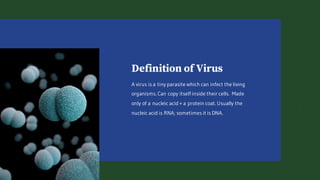
A virus is a tiny parasite which can infect the living
organisms. Can copy itself inside their cells. Made
only of a nucleic acid + a protein coat. Usually the
nucleic acid is RNA; sometimes it is DNA.
WWW.EZKARE.COM
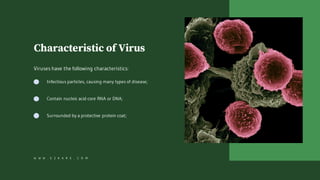
Characteristic of Virus
Infectious particles, causing many types of disease;
Contain nucleic acid core RNA or DNA;
Surrounded by a protective protein coat;
Viruses have the following characteristics:
W W W . E Z K A R E . C O M
Genom
There are a many genomic structures in viruses. As a group they have more structural genomic
diversity than plants, animals, archaea, or bacteria. There are millions of different types of
viruses, but only about 5,000 of them have been described in detail.
WWW.EZKARE.COM
Replication Cycle
Viral populationsdo not grow through cell division, because they do
not have cells. Instead, they use the machinery and metabolism of a
host cell to produce many copies of themselves, and they assemble
(put together) in the cell.
Genetic Materials and Replication
W W W . E Z K A R E . C O M
Attachment is a specific binding between viral capsid proteins and
specific receptors on the host cellular surface.
Penetration follows attachment: Virions (single virus particles) enter the
host cell through receptor-mediated endocytosis or membrane fusion.
Uncoating is a process in which the viral capsid is removed: Thismay be by
degradation by viral enzymes or host enzymes or by simple dissociation.
Replication of viruses involves multiplication of the genome.
Following the structure-mediated self-assembly of the virus particles, some
modification of the proteins often occurs.
Viruses can be released from the host cell by lysis, a process that kills the
cell by bursting its membrane and cell wall.
6 Basic Stages
in The Life
Cycle of Virus
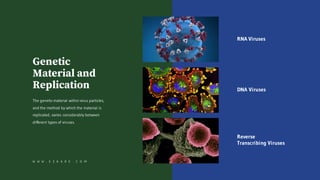
RNA Viruses
DNA Viruses
Reverse
Transcribing Viruses
Genetic
Material and
Replication
The genetic material within virus particles,
and the method by which the material is
replicated, varies considerably between
different types of viruses.
W W W . E Z K A R E . C O M
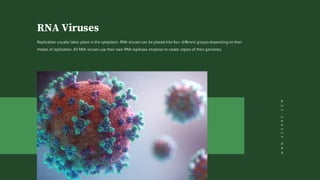
RNA Viruses
Replication usually takes place in the cytoplasm. RNA viruses can be placed into four different groupsdepending on their
modes of replication. All RNA viruses use their own RNA replicase enzymes to create copies of their genomes.
WWW.EZKARE.COM
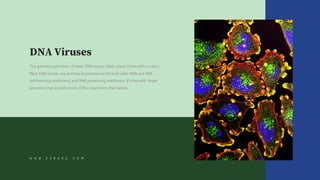
DNA Viruses
The genome replication of most DNA viruses takes place in the cell's nucleus.
Most DNA viruses are entirely dependent on the host cell's DNA and RNA
synthesising machinery, and RNA processing machinery. Viruseswith larger
genomes may encode much of this machinery themselves.
W W W . E Z K A R E . C O M
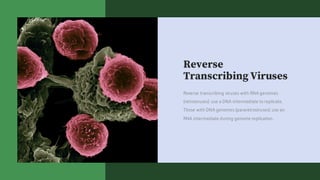
Reverse
Transcribing Viruses
Reverse transcribing viruses with RNA genomes
(retroviruses) use a DNA intermediate to replicate.
Those with DNA genomes (pararetroviruses) use an
RNA intermediate during genome replication.
Innate Immune System Adaptive Immune System Evading Immune System
HostDefence
Mechanisms
W W W . E Z K A R E . C O M
Innate Immune System
The body's first line of defence against viruses is the innate immune system. This has cells and other mechanisms which defend the host

from any infection. The cells of the innate system recognise, and respond to, pathogensin a general way.
Adaptive
Immune System
Vertebrates have a second, more specific,
immune system. It is called the adaptive
immune system. When it meets a virus, it
produces specific antibodies that bind to
the virus and render it non-infectious. Two
types of antibodies are important.
Evading
Immune System
Not all virus infections produce a protective immune to the
response. These persistent viruses evade immune control by
sequestration (hiding away); blocking antigen presentation;
cytokine resistance; evading natural killer cell activity; escape

from apoptosis (cell death), and antigenic shift (changing
surface proteins).
Evolution
Viruses donot belong to any of the six kingdoms. They do not meet all the
requirements for being classified as a living organism because they are not
active until the point of infection. However, that is just a verbal point. The
origins of viruses in the evolutionary history of life are unclear: some may
have evolved from plasmids – piecesof DNA that can move between cells –
while others may have evolved from bacteria.
Break
Time!
Break for 30 minutes
WWW.EZKARE.COM
Recent Discoveries
A recent project discovered nearly 1500 new RNA viruses
by sampling over the 200 invertebrate species. "The
research team... extracted their RNA and, using next
generation sequencing, deciphered the sequence of a
staggering 6 trillion letters present in
the invertebrate RNA libraries".
W W W . E Z K A R E . C O M
LargestViruses
Pithovirus
Megavirus
Pandoravirus
Mimivirus
WWW.EZKARE.COM
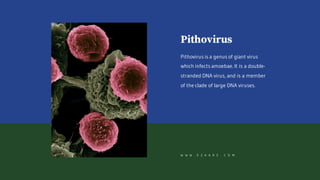
Pithovirus
Pithovirus is a genus of giant virus
which infects amoebae. It is a double-
stranded DNA virus, and is a member
of the clade of large DNA viruses.
W W W . E Z K A R E . C O M
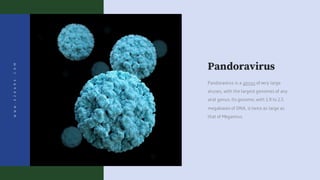
Pandoravirus
Pandoravirus is a genus of very large
viruses, with the largest genomes of any
viral genus. Its genome, with 1.9 to 2.5
megabases of DNA, is twice as large as
that of Megavirus.
WWW.EZKARE.COM
Megavirus
Megavirus is a virus with a single identif
species, Megavirus chilensis (MGVC). It was
is phylogenetically related to or the name
Mimivirus (APMV).
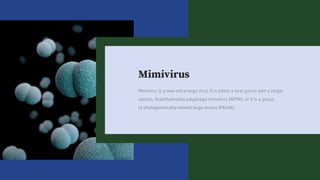
Mimivirus
Mimivirus is a new extra-large virus. It is either a viral genus with a single
species, Acanthamoeba polyphaga mimivirus (APMV), or it is a group
of phylogenetically-related large viruses (MimiN).
Uses of Virus
Viruses are used widely in cell biology. Geneticists often use viruses as vectors to introduce
genes into cells that they are studying. This is useful for making the cell produce a foreign
substance, or to study the effect of introducing a new gene into the genome.


W W W . E Z K A R E . C O M
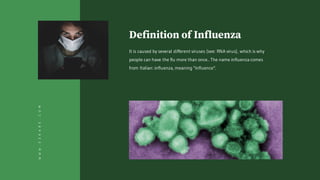
Definition of Influenza
It is caused by several different viruses (see: RNA virus), which is why
people can have the flu more than once.. The name influenza comes
from Italian: influenza, meaning "influence".
WWW.EZKARE.COM
Flu Transmissions
and Symptoms
Symptoms include cough, sore throat, muscle aches and pains, fever,
headache, and rarely vomiting and diarrhoea. Influenza can also lead to
other diseases, such as pneumonia. This makes it especially dangerous
to young children and elderly people.
Human Influenza can pass from one person to another very easily. It is
most commonly spread by the microscopic droplets of mucus and fluid
that are sent intothe air when the sick person coughsor sneezes.
Changes in the Influenza Virus
Small changes that happen as flu is passed from one person to another is the most common way flu
viruses change. This is the main reason that people can catch the flu every year. Another way that the flu
can change is when a person or animal catches two different flu viruses. The two viruses can exchange
some of their genetic information, which can create a brand new flu that nobody has ever caught before.
Fever and chills
Symptoms
Cough
Nasal Congestion
Runny Nose
Sneezing
Sore Throat
Hoarseness
Ear Pressure
Earache
Muscle Aches
Treatment
People with the flu are advised to get plentyof rest,
drink plentyof liquids, avoid using alcohol and
tobacco and, if necessary, take medications such as
acetaminophen (paracetamol) to relieve the fever
and muscle aches associated with the flu. Children
and teenagers with flu symptoms (particularly
fever) should avoid taking aspirin during an
influenza infection (especially influenza type B),
because doing so can lead to Reye's syndrome, a
rare but potentially fatal disease of the liver.
GalleryImageSlide
ThanksFor Watching
W W W . E Z K A R E . C O M
Ezkare Presentation : Dark Color Version

Ezkare Presentation : Dark Color Version

  • 1.
    Ezkare Presentation Viruses are muchsmaller than bacteria. They were not visible until the invention of the electron microscope. A virus has a simple structure. It has no internal cellular structure, no cell wall or cell membrane, just the protein coat that holds the string of nucleic acid. WWW.EZKARE.COM Education About Virus
  • 2.
    Definition of Virus Avirus is a tiny parasite which can infect the living organisms. Can copy itself inside their cells. Made only of a nucleic acid + a protein coat. Usually the nucleic acid is RNA; sometimes it is DNA. WWW.EZKARE.COM
  • 3.
    Characteristic of Virus Infectiousparticles, causing many types of disease; Contain nucleic acid core RNA or DNA; Surrounded by a protective protein coat; Viruses have the following characteristics: W W W . E Z K A R E . C O M
  • 4.
    Genom There are amany genomic structures in viruses. As a group they have more structural genomic diversity than plants, animals, archaea, or bacteria. There are millions of different types of viruses, but only about 5,000 of them have been described in detail. WWW.EZKARE.COM
  • 5.
    Replication Cycle Viral populationsdonot grow through cell division, because they do not have cells. Instead, they use the machinery and metabolism of a host cell to produce many copies of themselves, and they assemble (put together) in the cell. Genetic Materials and Replication W W W . E Z K A R E . C O M
  • 6.
    Attachment is aspecific binding between viral capsid proteins and specific receptors on the host cellular surface. Penetration follows attachment: Virions (single virus particles) enter the host cell through receptor-mediated endocytosis or membrane fusion. Uncoating is a process in which the viral capsid is removed: Thismay be by degradation by viral enzymes or host enzymes or by simple dissociation. Replication of viruses involves multiplication of the genome. Following the structure-mediated self-assembly of the virus particles, some modification of the proteins often occurs. Viruses can be released from the host cell by lysis, a process that kills the cell by bursting its membrane and cell wall. 6 Basic Stages in The Life Cycle of Virus
  • 7.
    RNA Viruses DNA Viruses Reverse TranscribingViruses Genetic Material and Replication The genetic material within virus particles, and the method by which the material is replicated, varies considerably between different types of viruses. W W W . E Z K A R E . C O M
  • 8.
    RNA Viruses Replication usuallytakes place in the cytoplasm. RNA viruses can be placed into four different groupsdepending on their modes of replication. All RNA viruses use their own RNA replicase enzymes to create copies of their genomes. WWW.EZKARE.COM
  • 9.
    DNA Viruses The genomereplication of most DNA viruses takes place in the cell's nucleus. Most DNA viruses are entirely dependent on the host cell's DNA and RNA synthesising machinery, and RNA processing machinery. Viruseswith larger genomes may encode much of this machinery themselves. W W W . E Z K A R E . C O M
  • 10.
    Reverse Transcribing Viruses Reverse transcribingviruses with RNA genomes (retroviruses) use a DNA intermediate to replicate. Those with DNA genomes (pararetroviruses) use an RNA intermediate during genome replication.
  • 11.
    Innate Immune SystemAdaptive Immune System Evading Immune System HostDefence Mechanisms W W W . E Z K A R E . C O M
  • 12.
    Innate Immune System Thebody's first line of defence against viruses is the innate immune system. This has cells and other mechanisms which defend the host from any infection. The cells of the innate system recognise, and respond to, pathogensin a general way.
  • 13.
    Adaptive Immune System Vertebrates havea second, more specific, immune system. It is called the adaptive immune system. When it meets a virus, it produces specific antibodies that bind to the virus and render it non-infectious. Two types of antibodies are important.
  • 14.
    Evading Immune System Not allvirus infections produce a protective immune to the response. These persistent viruses evade immune control by sequestration (hiding away); blocking antigen presentation; cytokine resistance; evading natural killer cell activity; escape from apoptosis (cell death), and antigenic shift (changing surface proteins).
  • 15.
    Evolution Viruses donot belongto any of the six kingdoms. They do not meet all the requirements for being classified as a living organism because they are not active until the point of infection. However, that is just a verbal point. The origins of viruses in the evolutionary history of life are unclear: some may have evolved from plasmids – piecesof DNA that can move between cells – while others may have evolved from bacteria.
  • 16.
    Break Time! Break for 30minutes WWW.EZKARE.COM
  • 17.
    Recent Discoveries A recentproject discovered nearly 1500 new RNA viruses by sampling over the 200 invertebrate species. "The research team... extracted their RNA and, using next generation sequencing, deciphered the sequence of a staggering 6 trillion letters present in the invertebrate RNA libraries". W W W . E Z K A R E . C O M
  • 18.
  • 19.
    Pithovirus Pithovirus is agenus of giant virus which infects amoebae. It is a double- stranded DNA virus, and is a member of the clade of large DNA viruses. W W W . E Z K A R E . C O M
  • 20.
    Pandoravirus Pandoravirus is agenus of very large viruses, with the largest genomes of any viral genus. Its genome, with 1.9 to 2.5 megabases of DNA, is twice as large as that of Megavirus. WWW.EZKARE.COM
  • 21.
    Megavirus Megavirus is avirus with a single identif species, Megavirus chilensis (MGVC). It was is phylogenetically related to or the name Mimivirus (APMV).
  • 22.
    Mimivirus Mimivirus is anew extra-large virus. It is either a viral genus with a single species, Acanthamoeba polyphaga mimivirus (APMV), or it is a group of phylogenetically-related large viruses (MimiN).
  • 23.
    Uses of Virus Virusesare used widely in cell biology. Geneticists often use viruses as vectors to introduce genes into cells that they are studying. This is useful for making the cell produce a foreign substance, or to study the effect of introducing a new gene into the genome. W W W . E Z K A R E . C O M
  • 24.
    Definition of Influenza Itis caused by several different viruses (see: RNA virus), which is why people can have the flu more than once.. The name influenza comes from Italian: influenza, meaning "influence". WWW.EZKARE.COM
  • 25.
    Flu Transmissions and Symptoms Symptomsinclude cough, sore throat, muscle aches and pains, fever, headache, and rarely vomiting and diarrhoea. Influenza can also lead to other diseases, such as pneumonia. This makes it especially dangerous to young children and elderly people. Human Influenza can pass from one person to another very easily. It is most commonly spread by the microscopic droplets of mucus and fluid that are sent intothe air when the sick person coughsor sneezes.
  • 26.
    Changes in theInfluenza Virus Small changes that happen as flu is passed from one person to another is the most common way flu viruses change. This is the main reason that people can catch the flu every year. Another way that the flu can change is when a person or animal catches two different flu viruses. The two viruses can exchange some of their genetic information, which can create a brand new flu that nobody has ever caught before.
  • 27.
    Fever and chills Symptoms Cough NasalCongestion Runny Nose Sneezing Sore Throat Hoarseness Ear Pressure Earache Muscle Aches
  • 28.
    Treatment People with theflu are advised to get plentyof rest, drink plentyof liquids, avoid using alcohol and tobacco and, if necessary, take medications such as acetaminophen (paracetamol) to relieve the fever and muscle aches associated with the flu. Children and teenagers with flu symptoms (particularly fever) should avoid taking aspirin during an influenza infection (especially influenza type B), because doing so can lead to Reye's syndrome, a rare but potentially fatal disease of the liver.
  • 29.
  • 30.
    ThanksFor Watching W WW . E Z K A R E . C O M