Social media
New game, new rules, new winners
Contents
Social media: New game, new rules, new winners                 1
New game: Social media is the next competitive battle ground   2
New rules: Successful social brands act differently            6
New winners: Adapting to the ‘new game’                        14
Social media
New game, new rules, new winners
The speed at which social media has taken off has been unprecedented in the history of
technological change. It has taken just seven years for Facebook to reach 750 million
users worldwide and this is not the only social media site to have attracted large numbers
of users in a very short space of time. This massive take-up is having a profound effect on
the way in which customers seek information and make purchase decisions. So how can
companies take advantage of the opportunities presented by social media to make their
mark on this vast audience? And what drives customers to actively engage and follow
some brands on social media sites and not others?
In Q2 2011, Ernst & Young conducted quantitative and qualitative research on 36 UK and
international flagship brands with the aim of addressing these questions. Through the
research, we have identified five key characteristics of ‘socially adaptable’ and successful
brands, which we believe all organisations can adapt and learn:
► Facilitate open dialogue
► Engage proactively
► Connect beyond product
► Deliver integrated experiences
► Collaborate and co-develop
Our research also shows that companies need to make organisational changes in order
to fully embrace the ‘new game’ of social media. From our work with clients, we have
identified the three critical areas companies need to focus on to support a coherent and
sustainable social media strategy:
► Spotting the ‘golden nuggets’ of data and generating value from them coordinating
  social and traditional channels
► Coordinate social and traditional channels
► Empowering employees to engage with communities
These areas could make the difference between being a winner or a loser in the
‘new game’ of social media.


Social media: New game, new rules, new winners                                                 1
New game
    Social media, the next competitive battle ground
    Social media is here to stay
    When compared to previous technological advances which have had a profound and
    lasting effect on society and commerce, the speed of adoption experienced by social
    media is unparalleled. While it took radio 38 years and the Internet seven years to reach
    an audience of 50 million, Facebook achieved the same milestone in its third year.
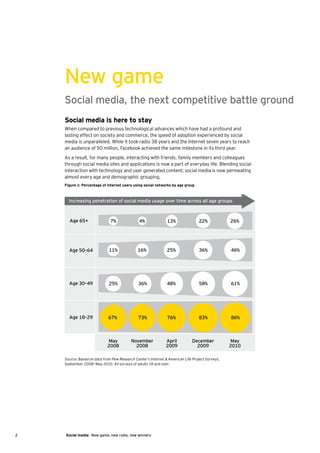
    As a result, for many people, interacting with friends, family members and colleagues
    through social media sites and applications is now a part of everyday life. Blending social
    interaction with technology and user generated content; social media is now permeating
    almost every age and demographic grouping.
    Figure 1: Percentage of internet users using social networks by age group


      Increasing penetration of social media usage over time across all age groups


      Age 65+                 7%               4%              13%                22%            26%


      Age 50–64              11%              16%              25%                36%            46%


      Age 30–49              25%              36%              48%                58%            61%


      Age 18–29              67%              73%              76%                83%            86%


                            May           November            April           December           May
                            2008            2008              2009              2009             2010

    Source: Based on data from Pew Research Center’s Internet & American Life Project Surveys,
    September 2008—May 2010. All surveys of adults 18 and over.


2   Social media: New game, new rules, new winners
Meet your new customer
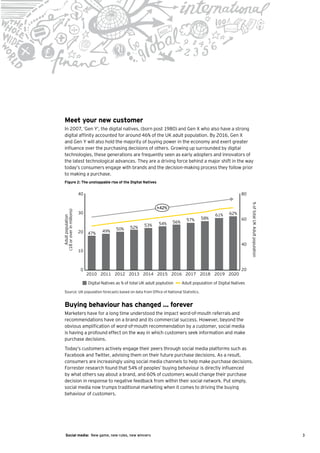
   In 2007, ‘Gen Y’, the digital natives, (born post 1980) and Gen X who also have a strong
   digital affinity accounted for around 46% of the UK adult population. By 2016, Gen X
   and Gen Y will also hold the majority of buying power in the economy and exert greater
   influence over the purchasing decisions of others. Growing up surrounded by digital
   technologies, these generations are frequently seen as early adopters and innovators of
   the latest technological advances. They are a driving force behind a major shift in the way
   today’s consumers engage with brands and the decision-making process they follow prior
   to making a purchase.
   Figure 2: The unstoppable rise of the Digital Natives


                           40                                                                                         80


                                                                                                                           % of total UK Adult population
                                                                      +42%
(18 or over in millions)


                           30                                                                                  62%
                                                                                                       61%
   Adult population


                                                                                       57%     58%                    60
                                                                       54%     56%
                                                               53%
                                               50%     52%
                           20           49%
                                47%

                                                                                                                      40
                           10


                           0                                                                                          20
                                2010 2011 2012 2013 2014 2015 2016 2017 2018 2019 2020

                                Digital Natives as % of total UK adult poplution     Adult population of Digital Natives

   Source: UK population forecasts based on data from Office of National Statistics.


   Buying behaviour has changed … forever
   Marketers have for a long time understood the impact word-of-mouth referrals and
   recommendations have on a brand and its commercial success. However, beyond the
   obvious amplification of word-of-mouth recommendation by a customer, social media
   is having a profound effect on the way in which customers seek information and make
   purchase decisions.
   Today’s customers actively engage their peers through social media platforms such as
   Facebook and Twitter, advising them on their future purchase decisions. As a result,
   consumers are increasingly using social media channels to help make purchase decisions.
   Forrester research found that 54% of peoples’ buying behaviour is directly influenced
   by what others say about a brand, and 60% of customers would change their purchase
   decision in response to negative feedback from within their social network. Put simply,
   social media now trumps traditional marketing when it comes to driving the buying
   behaviour of customers.


     Social media: New game, new rules, new winners                                                                                                         3
Research in the Harvard Business Review (December 2010) goes one step further,
       suggesting that the traditionally accepted deductive decision making ‘funnel’, whereby
       the customer begins with a wide choice of potential brands to fulfil their needs, and then
       reduces the number of options at each stage of the buying process until a decision is
       made, no longer applies in a socially driven world. Rather than narrowing their choice
       of brand/product from an initially larger group, today’s socially engaged consumers
       undertake an iterative buying approach whereby they start with a narrow set of brands
       based on their own knowledge and experience of a category or sector, then through their
       networks, seek additional recommendations and solutions, widening the decision making
       funnel. Based on the strength of these recommendations, the customer then refines the
       number of options under consideration until a purchase decision is made. Post purchase,
       customers use their networks to seek reassurance on their purchase decision which then
       drives future buying intentions.


       The battle has only just started
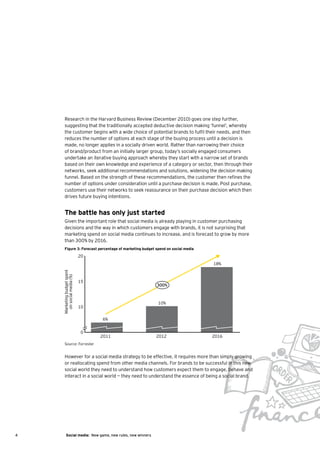
       Given the important role that social media is already playing in customer purchasing
       decisions and the way in which customers engage with brands, it is not surprising that
       marketing spend on social media continues to increase, and is forecast to grow by more
       than 300% by 2016.
       Figure 3: Forecast percentage of marketing budget spend on social media
                             20
                                                                                 18%
    Marketing budget spent
      on social media (%)


                             15
                                                           300%


                                                           10%
                             10

                                  6%


                             0
                                  2011                     2012                  2016
       Source: Forrester


       However for a social media strategy to be effective, it requires more than simply growing
       or reallocating spend from other media channels. For brands to be successful in this new
       social world they need to understand how customers expect them to engage, behave and
       interact in a social world — they need to understand the essence of being a social brand.


4         Social media: New game, new rules, new winners
5
New rules
         Successful social brands act differently
         Some brands are more ‘sociable’ than others
         Why is it that some brands appear to be more ‘sociable’ on networking sites like Facebook,
         Twitter and YouTube? What drives customers to actively engage and follow some brands
         and not others? What characteristics do leading, ‘socially adaptable’ brands exhibit, and can
         these characteristics be adopted by those brands that are currently seen by customers as
         ‘socially disengaged’?
         In Q2 2011, Ernst & Young conducted quantitative and qualitative research on 36 UK and
         international flagship brands with the aim of addressing these questions. Key analytics were
         taken from social media sites Facebook, Twitter and YouTube to determine the characteristics
         of socially adaptable brands versus those brands which appeared socially disengaged.
         The research showed that in general, there are large differences between sectors, with
         consumer product brands often commanding huge followings, whereas utilities brands
         tend to have a much more limited social media presence. More interestingly, we found that
         within sectors, there were large variations as well. There are already clear ‘leaders’ and
         ‘laggards’ when it comes to using social platforms to drive engagement between a brand and
         its customers. Through the research, we identified that socially adaptable and successful
         brands exhibited five key characteristics, and that these characteristic transcend sectors
         and geographies. Finally, through the work we have undertaken with our clients, we believe
         that all brands can adapt and learn these five characteristics, improving their ability to
         meaningfully connect and deepen relationships with their customers.
         Figure 4: The level of social engagement between brand and customer on social media site by sector¹


                                           51,600
                                                                           51,523
    Number of customers socially engaged


                                            8,200
                                                    8,143
             with brand (000s)


                                            8,000


                                                             x300                    x725


                                             200


                                                                 26                   71
                                                                                                  2             0
                                               0                                                                    x100
                                                        Retail             Consumer products          Utility

                                                                      Leader    Laggard

         1. By the level of social engagement, we mean here how many users follow or ‘like’ a brand on one of the three social
         media sites.


6            Social media: New game, new rules, new winners
Socially adaptable brands exhibit five characteristics
   Figure 5: The five characteristics of socially adaptable brands

                    Harness the power of
                                                                             Relinquish control and
                    collaborative development.
                                                                             allow your community
                    Make your next product                                   freedom of expression.
                    their product.

                                         5. Collaborate         1. Facilitate
                                         and co-develop        open dialogue


                                                       Winning
                                      4. Deliver        in the
       Let customers                                                                   Build relationships
                                     integrated      ‘new game’       2. Engage
       choose how they                                                proactively      with individual
                                    experiences
       wish to engage                                                                  members and the
       and be                                                                          wider community.
       consistent in
       your interactions                               3. Connect
       with them.                                    beyond product


                                             Be relevant and facilitate
                                             deeper shared experiences.


   1. Facilitate open dialogue
   While over 60% of brands researched had an official presence on Facebook, Twitter
   and YouTube, a great majority were heavily controlling the content on these channels.
   On Facebook, for example, only slightly over half of the brands allowed users to initiate a
   discussion. An example of the benefits of an open dialogue is Twitter, where brands which
   retweeted user comments had 264% more followers than those which didn’t. Despite this,
   only 30% of researched brands retweeted messages on their page.
   Figure 6: Open dialogue on Twitter generates stronger customer following
                            80

                            70
Average number of Twitter


                            60
     followers (000s)


                                                                                      Twitter pages which
                            50                                            +264%       include tweets from both
                            40                                                        the brand and customer
                                                                                      have a greater number
                            30                                                        of followers.
                            20

                            10

                            0
                                 Brand           Customer   Customer/Brand


     Social media: New game, new rules, new winners                                                              7
This goes to the heart of why winning in the ‘new game’ is fundamentally different.
    Unlike traditional communication channels, such as in-store, the website or TV
    advertising, where the brand owns or pays to use a channel, providing the ‘right’ to control
    the message, in a social world, it is the community as a whole, and not the brand that
    owns the channel. Put simply, the brand is one of many participants in the community.
    Obviously, it is an influential and important member of that community, but that does not
    give it the right to control and censor the views of other community members.
    The area of complaints management is a case in point, where brands have traditionally
    had the luxury of being able to keep their mistakes between themselves and their
    customer. For most organisations, there is no imperative to publicly highlight where they
    may have got it wrong. Social media is already bringing an end to this era of complaint
    privacy, and will continue to do so. Customers are no longer willing to complain through
    discrete and private channels such as letter correspondence — they are already starting
    to post their dissatisfaction publicly on social sites, expecting organisations to be able
    to identify and action the complaint quickly and effectively. For organisations who can
    operationally adapt to the new game, this represents a commercial opportunity to publicly
    demonstrate their brands’ empathetic, responsive and nurturing attributes, not only to
    the customer, but to the customer’s friends, family and work colleagues in real time via
    a social platform.
    Our research also highlighted many instances of brands removing negative customer
    comments and feedback from their sites. Clearly, brands with no defined capability to
    properly manage this feedback felt threatened and unable to respond effectively, instead
    decided to delete the feedback. However this is the last thing any brand should do. Few
    would believe it would be acceptable to ignore a customer’s complaint if it had been
    written in a formal letter, so why should feedback be considered inferior when provided
    via a social media site? We found that deletion of customer feedback merely fuels more
    feedback from the customer. Critically these negative interactions are being played out
    publicly in front of customer’s friends and family members.
    An example of the dangers of censoring customer feedback was evidenced on the
    Facebook page of a major UK mobile telecommunications provider, who had deleted
    a negative comment about their service by a user. The user in question responded by
    posting at least one negative comment per day on the brand’s Facebook page (and
    continues to do so), visible to the over forty thousand community members.


8   Social media: New game, new rules, new winners
2. Engage proactively
   We consistently found a positive relationship between the ability of brands to be proactive
   and engage with their customers, and the size and strength of the customer following.
   Exhibit 7: The relationship with proactive brands and the size of their customer following
                            40
                                                      +1,063%
Average number of Twitter


                            30
     followers (000s)


                                                                                   Brands that respond
                                                                                   directly to customer
                            20                                                     tweets also have a
                                                                                   greater number
                                                                                   of followers.
                            10


                            0
                                 Brands that don’t respond   Brands that respond
                                    to customer tweets       to customer tweets


   Currently some social media platforms, such as Twitter, lend themselves to a higher
   frequency of interaction between the brand and the community, whereas other platforms,
   such as YouTube, where the investment cost (time, money etc.) in creating new content
   is generally much higher, the frequency of interaction is typically lower. However, the
   quality of interaction was more important than the quantity, with strong engaging content
   generating the highest number of likes, followers or uploads. It’s not so much a matter of
   how much a brand engages, it’s a matter of how well it engages.
   Leading brands exhibiting the ‘proactive’ characteristic went further than creating
   and sharing engaging high quality content, they also invested time to engage with
   individuals. With around 75% of Twitter content generated by just 5% of users, leading
   brands can identify key ‘network influencers’ in their communities and build and manage
   those relationships carefully. Moreover, every interaction with community members
   is an opportunity to demonstrate a brand’s true values to the customer and the wider
   community. A flower company which has recently been monitoring Twitter identified
   key influencers and then offered to send them free flowers if they were having a bad
   day. Given that these tweeters were happy to share their negative feelings across social
   networks, it is no surprise that they also shared their delight and surprise at being cheered
   up by this gesture.


     Social media: New game, new rules, new winners                                                       9
During our research we came across our own memorable example of engaging
     proactively. A colleague posted genuine feedback on a high street fashion retailer’s
     Facebook site that she was unhappy with a garment recently purchased from their online
     store. Within an hour, the retailer contacted her by phone to find out how they could
     rectify the situation. This single example is now likely to be her personal benchmark for
     how leading social brands (regardless of sector) proactively engage with her.


     3. Connect beyond product
     Brands that connect with their customers with content that is not directly linked to their
     products generate stronger and broader engagement. These brands successfully utilise
     social media to create value for the community as a whole and not just for themselves.
     Our research highlighted that in general, consumer product brands are leading the
     way in generating relevant and engaging social content, despite their brands typically
     having to manage many of the complexities highlighted above. For example a tea
     brand allows customers to interact directly with its farmers in Africa, while a global
     food brand with over 20 million fans, makes its Facebook site accessible with different
     language options and consistently runs interactive content such as the ‘World’s Fan of
     the Week’ competition, where the lucky winner has their photo showcased in the brand’s
     profile picture.
     When customers engage with a brand through a social network, they do so very publicly
     in front of their friends and family members. They are very much associating themselves
     with that brand and its values, and are implicitly advocating the brand across their
     network. These customers are typically more emotionally engaged with the brand and are
     seeking a deeper social and shared experience through the brand with like-minded people.
     For example, a leading automotive company has created a unique social experience for
     its community members by encouraging members to share the positive emotions they
     associate with their vehicles through their social media site. The brand’s social media site
     replicates an owner’s club atmosphere, where customers proudly share their ownership
     experiences, uploading photos and videos of their cars at memorable moments in their
     lives such as on holidays or bringing their newborn baby home from hospital in their car.
     The result of this type of deeper shared experience is that the brand becomes more than
     just a functional product in the minds of its customers, something which is especially
     important for emotional products.


     4. Deliver integrated experiences
     Customers increasingly expect the freedom to move seamlessly across channels, being
     able to interact with a brand in the manner that suits their situation and objective at
     a given point in time. Customers also expect the organisation to be consistent in its
     interaction. They expect to achieve the same outcome whatever channel they choose
     to use for the interaction, and, importantly, they feel the same about that outcome
     regardless of the channel. Our research highlighted that even within social media
     channels, brands which are integrated and allow the customers to choose and move
     across social platforms demonstrated stronger engagement.


10   Social media: New game, new rules, new winners
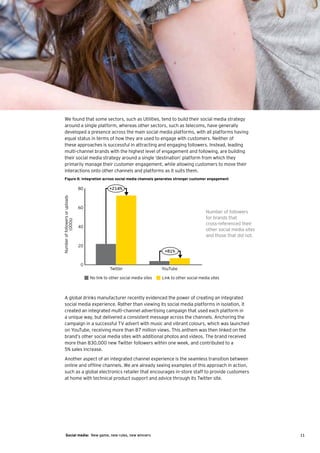
We found that some sectors, such as Utilities, tend to build their social media strategy
    around a single platform, whereas other sectors, such as telecoms, have generally
    developed a presence across the main social media platforms, with all platforms having
    equal status in terms of how they are used to engage with customers. Neither of
    these approaches is successful in attracting and engaging followers. Instead, leading
    multi-channel brands with the highest level of engagement and following, are building
    their social media strategy around a single ‘destination’ platform from which they
    primarily manage their customer engagement, while allowing customers to move their
    interactions onto other channels and platforms as it suits them.
    Figure 8: Integration across social media channels generates stronger customer engagement

                                  80             +214%
Number of followers or �uploads


                                  60
                                                                                                     Number of followers
                                                                                                     for brands that
           (000s)


                                                                                                     cross-referenced their
                                  40
                                                                                                     other social media sites
                                                                                                     and those that did not.

                                  20
                                                                              +81%


                                  0
                                                  Twitter                    YouTube

                                       No link to other social media sites   Link to other social media sites


    A global drinks manufacturer recently evidenced the power of creating an integrated
    social media experience. Rather than viewing its social media platforms in isolation, it
    created an integrated multi-channel advertising campaign that used each platform in
    a unique way, but delivered a consistent message across the channels. Anchoring the
    campaign in a successful TV advert with music and vibrant colours, which was launched
    on YouTube, receiving more than 87 million views. This anthem was then linked on the
    brand’s other social media sites with additional photos and videos. The brand received
    more than 830,000 new Twitter followers within one week, and contributed to a
    5% sales increase.
    Another aspect of an integrated channel experience is the seamless transition between
    online and offline channels. We are already seeing examples of this approach in action,
    such as a global electronics retailer that encourages in-store staff to provide customers
    at home with technical product support and advice through its Twitter site.


       Social media: New game, new rules, new winners                                                                           11
5. Collaborate and co-develop
     We found evidence of significant customer engagement and user generated content on
     social sites when brands actively engaged their community in the review and development
     of products and services. Brand advocates often show an interest in being involved in a
     product or service beyond its consumption and use, and co-development provides this
     opportunity for them, along with the possibility of being publicly recognised in some
     way for their contribution. When executed well, collaboration and co-development has
     the advantage of strengthening the relationship with the customers and attracting free
     development resources.
     For users to invest their time in co-development, the collaboration must be transparent,
     and requires the brand to exhibit many of the social characteristics already discussed,
     such as proactively responding to suggestions and input, and managing negative feedback
     in a positive and empathetic manner.
     A leading global PC manufacturer we work with uses analysis from socially engaged users
     and non-users in its product and service development. The community co-develops ideas
     and suggestions, providing critical input to help shape the product early in its design
     phase. It also allows commercial managers to assess the likely appetite for a product,
     thereby helping allocate scarce R&D resource to those products which are likely to achieve
     the greatest commercial success.
     Another example that the research found is how a clothing retailer used social platforms
     to preview its new season fashion lines, creating a sense of excitement across the
     community members, who were getting a ‘sneak preview’ of what would be hitting the
     shops in the coming weeks and months. As importantly, the community feedback acts as
     a gauge which can be used by internal purchasing teams as to the popularity of certain
     product lines, providing an early, pre-sales view of which lines are likely to be most
     commercially successful in different regions and geographies.


12   Social media: New game, new rules, new winners
Social media: New game, new rules, new winners   13
New winners
     Adapting to the ‘new game’
     The capability to succeed
     Many companies want to take advantage of the huge opportunities presented by social
     media, but do not yet have the organisational structure or the capabilities they need
     to support their brands effectively in a social world. This is where Ernst & Young can
     help. We understand how to derive commercial value from social media and quantify it.
     Through our work with clients, we have identified the following three areas, critical to
     supporting a coherent and sustainable social media strategy.


     Spotting the ‘golden nuggets’ of data and generating value from them
     Many organisations are facing an explosion in the quantity of data that is now available
     to them as customers, products and channels proliferate. Social commerce simply adds
     to this challenge, especially as the frequency of interaction between brands and social
     communities of customers and followers increases. So the challenge for organisations is
     to identify which bits of data in those millions of social interactions are relevant to them,
     and which are just ‘noise’. In other words, how can companies spot the ‘golden nuggets’
     of data that they can act on to improve their business?
     To address this challenge, a publisher and retailer of language programmes decided
     to invest in software to analyse the text and sentiment of web-based user comments.
     By tracking user movements throughout its site, and user comments on social media sites,
     the company was able to understand how online consumers viewed it, and how they saw
     competitors. This feedback fed directly into new and improved marketing campaigns as
     well as a redesign of its web layout and method of interacting with customers on digital
     platforms. Two years on, the brand has experienced a 4% rise in online order value, and
     a 13% rise in revenue per web visitor, both of which are directly attributable to its social
     media data analysis.
     To add to this challenge, customers are becoming more aware of the potential value
     of their data to organisations, and are therefore less willing to provide it freely without
     seeing a return for their ‘loss of privacy’. To demonstrate this return, social commerce
     will further drive brands down the road of ‘mass personalisation’, as customers demand
     products and services that are better tailored to their situation, location and need.
     Delivering this requires a capability to provide the latest most relevant data and insight
     on a member or customer to the touchpoint or channel that is interacting with them,
     requiring data to flow freely across organisational functional domains.


14   Social media: New game, new rules, new winners
Coordinating social and traditional channels
Until now, organisations have managed channels as separate entities, so that if a customer
contacts a call centre, any follow-up to that query will be kept within the telephony channel.
However, around 66% of online consumers now engage in some form of cross-channel
shopping. Multi-channel experiences also increase customer engagement. For example,
customers who watched the Football world cup on more than one platform were engaged for
an additional three hours a day. Companies leading in digital have reacted to these consumer
expectations. For example, global clothing brand have applied QR codes to their items so that
you can ‘like’ a product on Facebook by scanning a QR code in store.
Organisations which continue to adopt traditional functional domains to manage their
customer interaction will be left paralysed, unable to follow and respond to the thread
of multi-channel interactions with the customer. New organisational models and ways of
working will be required to support a brand’s relationship with its customers, such as allowing
employees to follow and move across channels with their customers.
Furthermore, customers will expect communication and interaction in near real-time.
Generous service level agreements which provide organisations with a ‘cushion’ to balance
their available resource with customer demand are either a thing of the past, or where they
continue to exist, will be measured in seconds not days. Global brands will also face the
added complexity of managing language and cultural difference across their social media
platforms, requiring the effective routing of customer interactions through social networks to
employees who can handle the query.

Empowering employees to engage with communities
Communicating in a social world poses a whole new set of challenges to organisations and
their brands. Communications on social media sites are often to multiple members, are
visible by many more, by their nature are in writing and can be retrieved in the future. If
an employee makes a comment on a company’s Facebook page, that comment can then
be read and retrieved by anyone, at any time. The challenge is to balance the need for
communications to fit in with a company’s ‘tone of voice’ guidelines, with the need to respond
quickly to user comments.
Organisations currently try to satisfy these competing requirements in different ways.
Tailored messaging to many customers, as typified by public and media relations, undergoes
multiple levels of internal reviews and sign-offs before being released. This restricts its
responsiveness. The alternative, pre-approved scripted responses, although timely, lack
authenticity in a social world.
We believe that leading organisations allow employees to interact with customers with a
high degree of freedom underpinned by guidelines and values consistent with the brand
promise and positioning in the market. Employees will assess the context, situation and
profile along with previous interactions with the customer, and respond in a manner they
feel appropriate. Brands will continuously monitor the social interactions through ‘light
touch’ quality control processes. Employees will receive feedback and coaching from these
quality reviews to improve consistency across the brand. Some brands that operate in highly
regulated industries, such as financial services, will require more stringent controls to ensure
compliance, which could include restrictions around the nature of interaction their employees
are allowed to have with customers through social media platforms.


Social media: New game, new rules, new winners                                                     15
The new game favours the brave
     Social media is changing the world, and there is no going back. Technological and
     demographic trends are likely to further accelerate the impacts of social commerce on
     organisations and their brands in coming years.
     Leading brands across sectors and geographies are positively embracing this change.
     Recognising that the old rules no longer apply, they are seeking to exploit the opportunity
     presented by social media to build direct, deeper and more relevant relationships
     with their customers and users. They use these relationships to generate insight from
     their social interactions with customers, and rigorously apply this insight to their
     commercial advantage.
     Our research suggests that many brands have not yet adapted to social commerce;
     some will catch up, others won’t. The last time organisations and brands faced such
     a fundamental change in how their customers engaged and make purchase decisions
     was during the ecommerce revolution a decade ago. Some brands led the ecommerce
     revolution, some successfully adapted to it, there were however a number of
     high-profile casualties.
     The new game therefore favours the brave. The winners will be those organisations and
     brands that seek out the commercial opportunities presented by social commerce and
     embrace the changes required to adapt to the changing ‘norm’ around them.


16   Social media: New game, new rules, new winners
Social media: New game, new rules, new winners   17
How is Ernst & Young positioned to help?
Please contact Richard Ingleton (ringleton@uk.ey.com,
Yunus Ozler (yozler@uk.ey.com), Mark Bennett
(mbennett1@uk.ey.com or Daniel Birke (dbirke@uk.ey.com)
at Ernst & Young if you are interested in further exploring
our social media or digital offerings. We would be happy
to assist your organisation in identifying social media and
digital opportunities across customers, suppliers, investors,
leadership and employees.


 Sources
 ‘Older Adults and Social Media’, Pew Research, August 2010.
 ‘UK population projections from 2008 to 2083’, Office for National Statistics 2008. Available at:
 www.statistics.gov.uk/nationalprojections/flash_pyramid/default.htm.
 David Edelman, ‘Branding in a digital age’ Harvard Business Review, December 2010.
 ‘The CMO Highlights and Insights’, www.CMOSurvey.org, February 2011,
 www.pewinternet.org/Reports/2010/Older-Adults-and-Sociat-Media.aspx.
 Joe Fernandez, Coca Cola sees boost in sales from World Cup, Marketing Week, 2010. Available
 at: www.marketingweek.co.uk/sectors/food-and-drink/soft-drinks/coca-cola-sees-boost-in-sales-
 from-world-cup/3016158.article.
 Forrester. Shopper’s Show Cross-Channel Eagerness, But Satisfaction Levels Slump. 2009.
 Available at: http://www.retailtouchpoints.com/cross-channel-strategies/201-forrester-
 shoppers-show-cross-channel-eagerness-but-satisfaction-levels-slump-.html.


18                        Social media: New game, new rules, new winners
For more information about our views on Digital and to see more, please
contact your local Ernst & Young office or visit www.ey.com


 The digitisation                  Digital data     A different way of
 of everything                     opportunities    doing business
 How organisations must adapt to                    Digital in utilities
 changing consumer behaviour


The digitisation                   Digital data    Digital in utilities
of everything                      opportunities
Ernst & Young LLP

Assurance | Tax | Transactions | Advisory


About Ernst & Young
Ernst & Young is a global leader in assurance, tax, transaction and advisory
services. Worldwide, our 152,000 people are united by our shared values
and an unwavering commitment to quality. We make a difference by helping
our people, our clients and our wider communities achieve their potential.

Ernst & Young refers to the global organization of member firms of
Ernst & Young Global Limited, each of which is a separate legal entity.
Ernst & Young Global Limited, a UK company limited by guarantee, does not
provide services to clients. For more information about our organization,
please visit www.ey.com
The UK firm Ernst & Young LLP is a limited liability partnership registered in England and Wales with
registered number OC300001 and is a member firm of Ernst & Young Global Limited.

Ernst & Young LLP, 1 More London Place, London, SE1 2AF.

© Ernst & Young LLP 2011. Published in the UK.
All Rights Reserved.

           In line with Ernst & Young’s commitment to minimise
           its impact on the environment, this document has been
           printed on paper with a high recycled content.

Information in this publication is intended to provide only a general outline of the subjects covered.
It should neither be regarded as comprehensive nor sufficient for making decisions, nor should it be
used in place of professional advice. Ernst & Young LLP accepts no responsibility for any loss arising
from any action taken or not taken by anyone using this material.

www.ey.com/uk
1138492.indd (UK) 08/11. Creative Services Group.

Ernst and Young pdf on social media

  • 1.
    Social media New game,new rules, new winners
  • 3.
    Contents Social media: Newgame, new rules, new winners 1 New game: Social media is the next competitive battle ground 2 New rules: Successful social brands act differently 6 New winners: Adapting to the ‘new game’ 14
  • 5.
    Social media New game,new rules, new winners The speed at which social media has taken off has been unprecedented in the history of technological change. It has taken just seven years for Facebook to reach 750 million users worldwide and this is not the only social media site to have attracted large numbers of users in a very short space of time. This massive take-up is having a profound effect on the way in which customers seek information and make purchase decisions. So how can companies take advantage of the opportunities presented by social media to make their mark on this vast audience? And what drives customers to actively engage and follow some brands on social media sites and not others? In Q2 2011, Ernst & Young conducted quantitative and qualitative research on 36 UK and international flagship brands with the aim of addressing these questions. Through the research, we have identified five key characteristics of ‘socially adaptable’ and successful brands, which we believe all organisations can adapt and learn: ► Facilitate open dialogue ► Engage proactively ► Connect beyond product ► Deliver integrated experiences ► Collaborate and co-develop Our research also shows that companies need to make organisational changes in order to fully embrace the ‘new game’ of social media. From our work with clients, we have identified the three critical areas companies need to focus on to support a coherent and sustainable social media strategy: ► Spotting the ‘golden nuggets’ of data and generating value from them coordinating social and traditional channels ► Coordinate social and traditional channels ► Empowering employees to engage with communities These areas could make the difference between being a winner or a loser in the ‘new game’ of social media. Social media: New game, new rules, new winners 1
  • 6.
    New game Social media, the next competitive battle ground Social media is here to stay When compared to previous technological advances which have had a profound and lasting effect on society and commerce, the speed of adoption experienced by social media is unparalleled. While it took radio 38 years and the Internet seven years to reach an audience of 50 million, Facebook achieved the same milestone in its third year. As a result, for many people, interacting with friends, family members and colleagues through social media sites and applications is now a part of everyday life. Blending social interaction with technology and user generated content; social media is now permeating almost every age and demographic grouping. Figure 1: Percentage of internet users using social networks by age group Increasing penetration of social media usage over time across all age groups Age 65+ 7% 4% 13% 22% 26% Age 50–64 11% 16% 25% 36% 46% Age 30–49 25% 36% 48% 58% 61% Age 18–29 67% 73% 76% 83% 86% May November April December May 2008 2008 2009 2009 2010 Source: Based on data from Pew Research Center’s Internet & American Life Project Surveys, September 2008—May 2010. All surveys of adults 18 and over. 2 Social media: New game, new rules, new winners
  • 7.
    Meet your newcustomer In 2007, ‘Gen Y’, the digital natives, (born post 1980) and Gen X who also have a strong digital affinity accounted for around 46% of the UK adult population. By 2016, Gen X and Gen Y will also hold the majority of buying power in the economy and exert greater influence over the purchasing decisions of others. Growing up surrounded by digital technologies, these generations are frequently seen as early adopters and innovators of the latest technological advances. They are a driving force behind a major shift in the way today’s consumers engage with brands and the decision-making process they follow prior to making a purchase. Figure 2: The unstoppable rise of the Digital Natives 40 80 % of total UK Adult population +42% (18 or over in millions) 30 62% 61% Adult population 57% 58% 60 54% 56% 53% 50% 52% 20 49% 47% 40 10 0 20 2010 2011 2012 2013 2014 2015 2016 2017 2018 2019 2020 Digital Natives as % of total UK adult poplution Adult population of Digital Natives Source: UK population forecasts based on data from Office of National Statistics. Buying behaviour has changed … forever Marketers have for a long time understood the impact word-of-mouth referrals and recommendations have on a brand and its commercial success. However, beyond the obvious amplification of word-of-mouth recommendation by a customer, social media is having a profound effect on the way in which customers seek information and make purchase decisions. Today’s customers actively engage their peers through social media platforms such as Facebook and Twitter, advising them on their future purchase decisions. As a result, consumers are increasingly using social media channels to help make purchase decisions. Forrester research found that 54% of peoples’ buying behaviour is directly influenced by what others say about a brand, and 60% of customers would change their purchase decision in response to negative feedback from within their social network. Put simply, social media now trumps traditional marketing when it comes to driving the buying behaviour of customers. Social media: New game, new rules, new winners 3
  • 8.
    Research in theHarvard Business Review (December 2010) goes one step further, suggesting that the traditionally accepted deductive decision making ‘funnel’, whereby the customer begins with a wide choice of potential brands to fulfil their needs, and then reduces the number of options at each stage of the buying process until a decision is made, no longer applies in a socially driven world. Rather than narrowing their choice of brand/product from an initially larger group, today’s socially engaged consumers undertake an iterative buying approach whereby they start with a narrow set of brands based on their own knowledge and experience of a category or sector, then through their networks, seek additional recommendations and solutions, widening the decision making funnel. Based on the strength of these recommendations, the customer then refines the number of options under consideration until a purchase decision is made. Post purchase, customers use their networks to seek reassurance on their purchase decision which then drives future buying intentions. The battle has only just started Given the important role that social media is already playing in customer purchasing decisions and the way in which customers engage with brands, it is not surprising that marketing spend on social media continues to increase, and is forecast to grow by more than 300% by 2016. Figure 3: Forecast percentage of marketing budget spend on social media 20 18% Marketing budget spent on social media (%) 15 300% 10% 10 6% 0 2011 2012 2016 Source: Forrester However for a social media strategy to be effective, it requires more than simply growing or reallocating spend from other media channels. For brands to be successful in this new social world they need to understand how customers expect them to engage, behave and interact in a social world — they need to understand the essence of being a social brand. 4 Social media: New game, new rules, new winners
  • 9.
  • 10.
    New rules Successful social brands act differently Some brands are more ‘sociable’ than others Why is it that some brands appear to be more ‘sociable’ on networking sites like Facebook, Twitter and YouTube? What drives customers to actively engage and follow some brands and not others? What characteristics do leading, ‘socially adaptable’ brands exhibit, and can these characteristics be adopted by those brands that are currently seen by customers as ‘socially disengaged’? In Q2 2011, Ernst & Young conducted quantitative and qualitative research on 36 UK and international flagship brands with the aim of addressing these questions. Key analytics were taken from social media sites Facebook, Twitter and YouTube to determine the characteristics of socially adaptable brands versus those brands which appeared socially disengaged. The research showed that in general, there are large differences between sectors, with consumer product brands often commanding huge followings, whereas utilities brands tend to have a much more limited social media presence. More interestingly, we found that within sectors, there were large variations as well. There are already clear ‘leaders’ and ‘laggards’ when it comes to using social platforms to drive engagement between a brand and its customers. Through the research, we identified that socially adaptable and successful brands exhibited five key characteristics, and that these characteristic transcend sectors and geographies. Finally, through the work we have undertaken with our clients, we believe that all brands can adapt and learn these five characteristics, improving their ability to meaningfully connect and deepen relationships with their customers. Figure 4: The level of social engagement between brand and customer on social media site by sector¹ 51,600 51,523 Number of customers socially engaged 8,200 8,143 with brand (000s) 8,000 x300 x725 200 26 71 2 0 0 x100 Retail Consumer products Utility Leader Laggard 1. By the level of social engagement, we mean here how many users follow or ‘like’ a brand on one of the three social media sites. 6 Social media: New game, new rules, new winners
  • 11.
    Socially adaptable brandsexhibit five characteristics Figure 5: The five characteristics of socially adaptable brands Harness the power of Relinquish control and collaborative development. allow your community Make your next product freedom of expression. their product. 5. Collaborate 1. Facilitate and co-develop open dialogue Winning 4. Deliver in the Let customers Build relationships integrated ‘new game’ 2. Engage choose how they proactively with individual experiences wish to engage members and the and be wider community. consistent in your interactions 3. Connect with them. beyond product Be relevant and facilitate deeper shared experiences. 1. Facilitate open dialogue While over 60% of brands researched had an official presence on Facebook, Twitter and YouTube, a great majority were heavily controlling the content on these channels. On Facebook, for example, only slightly over half of the brands allowed users to initiate a discussion. An example of the benefits of an open dialogue is Twitter, where brands which retweeted user comments had 264% more followers than those which didn’t. Despite this, only 30% of researched brands retweeted messages on their page. Figure 6: Open dialogue on Twitter generates stronger customer following 80 70 Average number of Twitter 60 followers (000s) Twitter pages which 50 +264% include tweets from both 40 the brand and customer have a greater number 30 of followers. 20 10 0 Brand Customer Customer/Brand Social media: New game, new rules, new winners 7
  • 12.
    This goes tothe heart of why winning in the ‘new game’ is fundamentally different. Unlike traditional communication channels, such as in-store, the website or TV advertising, where the brand owns or pays to use a channel, providing the ‘right’ to control the message, in a social world, it is the community as a whole, and not the brand that owns the channel. Put simply, the brand is one of many participants in the community. Obviously, it is an influential and important member of that community, but that does not give it the right to control and censor the views of other community members. The area of complaints management is a case in point, where brands have traditionally had the luxury of being able to keep their mistakes between themselves and their customer. For most organisations, there is no imperative to publicly highlight where they may have got it wrong. Social media is already bringing an end to this era of complaint privacy, and will continue to do so. Customers are no longer willing to complain through discrete and private channels such as letter correspondence — they are already starting to post their dissatisfaction publicly on social sites, expecting organisations to be able to identify and action the complaint quickly and effectively. For organisations who can operationally adapt to the new game, this represents a commercial opportunity to publicly demonstrate their brands’ empathetic, responsive and nurturing attributes, not only to the customer, but to the customer’s friends, family and work colleagues in real time via a social platform. Our research also highlighted many instances of brands removing negative customer comments and feedback from their sites. Clearly, brands with no defined capability to properly manage this feedback felt threatened and unable to respond effectively, instead decided to delete the feedback. However this is the last thing any brand should do. Few would believe it would be acceptable to ignore a customer’s complaint if it had been written in a formal letter, so why should feedback be considered inferior when provided via a social media site? We found that deletion of customer feedback merely fuels more feedback from the customer. Critically these negative interactions are being played out publicly in front of customer’s friends and family members. An example of the dangers of censoring customer feedback was evidenced on the Facebook page of a major UK mobile telecommunications provider, who had deleted a negative comment about their service by a user. The user in question responded by posting at least one negative comment per day on the brand’s Facebook page (and continues to do so), visible to the over forty thousand community members. 8 Social media: New game, new rules, new winners
  • 13.
    2. Engage proactively We consistently found a positive relationship between the ability of brands to be proactive and engage with their customers, and the size and strength of the customer following. Exhibit 7: The relationship with proactive brands and the size of their customer following 40 +1,063% Average number of Twitter 30 followers (000s) Brands that respond directly to customer 20 tweets also have a greater number of followers. 10 0 Brands that don’t respond Brands that respond to customer tweets to customer tweets Currently some social media platforms, such as Twitter, lend themselves to a higher frequency of interaction between the brand and the community, whereas other platforms, such as YouTube, where the investment cost (time, money etc.) in creating new content is generally much higher, the frequency of interaction is typically lower. However, the quality of interaction was more important than the quantity, with strong engaging content generating the highest number of likes, followers or uploads. It’s not so much a matter of how much a brand engages, it’s a matter of how well it engages. Leading brands exhibiting the ‘proactive’ characteristic went further than creating and sharing engaging high quality content, they also invested time to engage with individuals. With around 75% of Twitter content generated by just 5% of users, leading brands can identify key ‘network influencers’ in their communities and build and manage those relationships carefully. Moreover, every interaction with community members is an opportunity to demonstrate a brand’s true values to the customer and the wider community. A flower company which has recently been monitoring Twitter identified key influencers and then offered to send them free flowers if they were having a bad day. Given that these tweeters were happy to share their negative feelings across social networks, it is no surprise that they also shared their delight and surprise at being cheered up by this gesture. Social media: New game, new rules, new winners 9
  • 14.
    During our researchwe came across our own memorable example of engaging proactively. A colleague posted genuine feedback on a high street fashion retailer’s Facebook site that she was unhappy with a garment recently purchased from their online store. Within an hour, the retailer contacted her by phone to find out how they could rectify the situation. This single example is now likely to be her personal benchmark for how leading social brands (regardless of sector) proactively engage with her. 3. Connect beyond product Brands that connect with their customers with content that is not directly linked to their products generate stronger and broader engagement. These brands successfully utilise social media to create value for the community as a whole and not just for themselves. Our research highlighted that in general, consumer product brands are leading the way in generating relevant and engaging social content, despite their brands typically having to manage many of the complexities highlighted above. For example a tea brand allows customers to interact directly with its farmers in Africa, while a global food brand with over 20 million fans, makes its Facebook site accessible with different language options and consistently runs interactive content such as the ‘World’s Fan of the Week’ competition, where the lucky winner has their photo showcased in the brand’s profile picture. When customers engage with a brand through a social network, they do so very publicly in front of their friends and family members. They are very much associating themselves with that brand and its values, and are implicitly advocating the brand across their network. These customers are typically more emotionally engaged with the brand and are seeking a deeper social and shared experience through the brand with like-minded people. For example, a leading automotive company has created a unique social experience for its community members by encouraging members to share the positive emotions they associate with their vehicles through their social media site. The brand’s social media site replicates an owner’s club atmosphere, where customers proudly share their ownership experiences, uploading photos and videos of their cars at memorable moments in their lives such as on holidays or bringing their newborn baby home from hospital in their car. The result of this type of deeper shared experience is that the brand becomes more than just a functional product in the minds of its customers, something which is especially important for emotional products. 4. Deliver integrated experiences Customers increasingly expect the freedom to move seamlessly across channels, being able to interact with a brand in the manner that suits their situation and objective at a given point in time. Customers also expect the organisation to be consistent in its interaction. They expect to achieve the same outcome whatever channel they choose to use for the interaction, and, importantly, they feel the same about that outcome regardless of the channel. Our research highlighted that even within social media channels, brands which are integrated and allow the customers to choose and move across social platforms demonstrated stronger engagement. 10 Social media: New game, new rules, new winners
  • 15.
    We found thatsome sectors, such as Utilities, tend to build their social media strategy around a single platform, whereas other sectors, such as telecoms, have generally developed a presence across the main social media platforms, with all platforms having equal status in terms of how they are used to engage with customers. Neither of these approaches is successful in attracting and engaging followers. Instead, leading multi-channel brands with the highest level of engagement and following, are building their social media strategy around a single ‘destination’ platform from which they primarily manage their customer engagement, while allowing customers to move their interactions onto other channels and platforms as it suits them. Figure 8: Integration across social media channels generates stronger customer engagement 80 +214% Number of followers or �uploads 60 Number of followers for brands that (000s) cross-referenced their 40 other social media sites and those that did not. 20 +81% 0 Twitter YouTube No link to other social media sites Link to other social media sites A global drinks manufacturer recently evidenced the power of creating an integrated social media experience. Rather than viewing its social media platforms in isolation, it created an integrated multi-channel advertising campaign that used each platform in a unique way, but delivered a consistent message across the channels. Anchoring the campaign in a successful TV advert with music and vibrant colours, which was launched on YouTube, receiving more than 87 million views. This anthem was then linked on the brand’s other social media sites with additional photos and videos. The brand received more than 830,000 new Twitter followers within one week, and contributed to a 5% sales increase. Another aspect of an integrated channel experience is the seamless transition between online and offline channels. We are already seeing examples of this approach in action, such as a global electronics retailer that encourages in-store staff to provide customers at home with technical product support and advice through its Twitter site. Social media: New game, new rules, new winners 11
  • 16.
    5. Collaborate andco-develop We found evidence of significant customer engagement and user generated content on social sites when brands actively engaged their community in the review and development of products and services. Brand advocates often show an interest in being involved in a product or service beyond its consumption and use, and co-development provides this opportunity for them, along with the possibility of being publicly recognised in some way for their contribution. When executed well, collaboration and co-development has the advantage of strengthening the relationship with the customers and attracting free development resources. For users to invest their time in co-development, the collaboration must be transparent, and requires the brand to exhibit many of the social characteristics already discussed, such as proactively responding to suggestions and input, and managing negative feedback in a positive and empathetic manner. A leading global PC manufacturer we work with uses analysis from socially engaged users and non-users in its product and service development. The community co-develops ideas and suggestions, providing critical input to help shape the product early in its design phase. It also allows commercial managers to assess the likely appetite for a product, thereby helping allocate scarce R&D resource to those products which are likely to achieve the greatest commercial success. Another example that the research found is how a clothing retailer used social platforms to preview its new season fashion lines, creating a sense of excitement across the community members, who were getting a ‘sneak preview’ of what would be hitting the shops in the coming weeks and months. As importantly, the community feedback acts as a gauge which can be used by internal purchasing teams as to the popularity of certain product lines, providing an early, pre-sales view of which lines are likely to be most commercially successful in different regions and geographies. 12 Social media: New game, new rules, new winners
  • 17.
    Social media: Newgame, new rules, new winners 13
  • 18.
    New winners Adapting to the ‘new game’ The capability to succeed Many companies want to take advantage of the huge opportunities presented by social media, but do not yet have the organisational structure or the capabilities they need to support their brands effectively in a social world. This is where Ernst & Young can help. We understand how to derive commercial value from social media and quantify it. Through our work with clients, we have identified the following three areas, critical to supporting a coherent and sustainable social media strategy. Spotting the ‘golden nuggets’ of data and generating value from them Many organisations are facing an explosion in the quantity of data that is now available to them as customers, products and channels proliferate. Social commerce simply adds to this challenge, especially as the frequency of interaction between brands and social communities of customers and followers increases. So the challenge for organisations is to identify which bits of data in those millions of social interactions are relevant to them, and which are just ‘noise’. In other words, how can companies spot the ‘golden nuggets’ of data that they can act on to improve their business? To address this challenge, a publisher and retailer of language programmes decided to invest in software to analyse the text and sentiment of web-based user comments. By tracking user movements throughout its site, and user comments on social media sites, the company was able to understand how online consumers viewed it, and how they saw competitors. This feedback fed directly into new and improved marketing campaigns as well as a redesign of its web layout and method of interacting with customers on digital platforms. Two years on, the brand has experienced a 4% rise in online order value, and a 13% rise in revenue per web visitor, both of which are directly attributable to its social media data analysis. To add to this challenge, customers are becoming more aware of the potential value of their data to organisations, and are therefore less willing to provide it freely without seeing a return for their ‘loss of privacy’. To demonstrate this return, social commerce will further drive brands down the road of ‘mass personalisation’, as customers demand products and services that are better tailored to their situation, location and need. Delivering this requires a capability to provide the latest most relevant data and insight on a member or customer to the touchpoint or channel that is interacting with them, requiring data to flow freely across organisational functional domains. 14 Social media: New game, new rules, new winners
  • 19.
    Coordinating social andtraditional channels Until now, organisations have managed channels as separate entities, so that if a customer contacts a call centre, any follow-up to that query will be kept within the telephony channel. However, around 66% of online consumers now engage in some form of cross-channel shopping. Multi-channel experiences also increase customer engagement. For example, customers who watched the Football world cup on more than one platform were engaged for an additional three hours a day. Companies leading in digital have reacted to these consumer expectations. For example, global clothing brand have applied QR codes to their items so that you can ‘like’ a product on Facebook by scanning a QR code in store. Organisations which continue to adopt traditional functional domains to manage their customer interaction will be left paralysed, unable to follow and respond to the thread of multi-channel interactions with the customer. New organisational models and ways of working will be required to support a brand’s relationship with its customers, such as allowing employees to follow and move across channels with their customers. Furthermore, customers will expect communication and interaction in near real-time. Generous service level agreements which provide organisations with a ‘cushion’ to balance their available resource with customer demand are either a thing of the past, or where they continue to exist, will be measured in seconds not days. Global brands will also face the added complexity of managing language and cultural difference across their social media platforms, requiring the effective routing of customer interactions through social networks to employees who can handle the query. Empowering employees to engage with communities Communicating in a social world poses a whole new set of challenges to organisations and their brands. Communications on social media sites are often to multiple members, are visible by many more, by their nature are in writing and can be retrieved in the future. If an employee makes a comment on a company’s Facebook page, that comment can then be read and retrieved by anyone, at any time. The challenge is to balance the need for communications to fit in with a company’s ‘tone of voice’ guidelines, with the need to respond quickly to user comments. Organisations currently try to satisfy these competing requirements in different ways. Tailored messaging to many customers, as typified by public and media relations, undergoes multiple levels of internal reviews and sign-offs before being released. This restricts its responsiveness. The alternative, pre-approved scripted responses, although timely, lack authenticity in a social world. We believe that leading organisations allow employees to interact with customers with a high degree of freedom underpinned by guidelines and values consistent with the brand promise and positioning in the market. Employees will assess the context, situation and profile along with previous interactions with the customer, and respond in a manner they feel appropriate. Brands will continuously monitor the social interactions through ‘light touch’ quality control processes. Employees will receive feedback and coaching from these quality reviews to improve consistency across the brand. Some brands that operate in highly regulated industries, such as financial services, will require more stringent controls to ensure compliance, which could include restrictions around the nature of interaction their employees are allowed to have with customers through social media platforms. Social media: New game, new rules, new winners 15
  • 20.
    The new gamefavours the brave Social media is changing the world, and there is no going back. Technological and demographic trends are likely to further accelerate the impacts of social commerce on organisations and their brands in coming years. Leading brands across sectors and geographies are positively embracing this change. Recognising that the old rules no longer apply, they are seeking to exploit the opportunity presented by social media to build direct, deeper and more relevant relationships with their customers and users. They use these relationships to generate insight from their social interactions with customers, and rigorously apply this insight to their commercial advantage. Our research suggests that many brands have not yet adapted to social commerce; some will catch up, others won’t. The last time organisations and brands faced such a fundamental change in how their customers engaged and make purchase decisions was during the ecommerce revolution a decade ago. Some brands led the ecommerce revolution, some successfully adapted to it, there were however a number of high-profile casualties. The new game therefore favours the brave. The winners will be those organisations and brands that seek out the commercial opportunities presented by social commerce and embrace the changes required to adapt to the changing ‘norm’ around them. 16 Social media: New game, new rules, new winners
  • 21.
    Social media: Newgame, new rules, new winners 17
  • 22.
    How is Ernst& Young positioned to help? Please contact Richard Ingleton (ringleton@uk.ey.com, Yunus Ozler (yozler@uk.ey.com), Mark Bennett (mbennett1@uk.ey.com or Daniel Birke (dbirke@uk.ey.com) at Ernst & Young if you are interested in further exploring our social media or digital offerings. We would be happy to assist your organisation in identifying social media and digital opportunities across customers, suppliers, investors, leadership and employees. Sources ‘Older Adults and Social Media’, Pew Research, August 2010. ‘UK population projections from 2008 to 2083’, Office for National Statistics 2008. Available at: www.statistics.gov.uk/nationalprojections/flash_pyramid/default.htm. David Edelman, ‘Branding in a digital age’ Harvard Business Review, December 2010. ‘The CMO Highlights and Insights’, www.CMOSurvey.org, February 2011, www.pewinternet.org/Reports/2010/Older-Adults-and-Sociat-Media.aspx. Joe Fernandez, Coca Cola sees boost in sales from World Cup, Marketing Week, 2010. Available at: www.marketingweek.co.uk/sectors/food-and-drink/soft-drinks/coca-cola-sees-boost-in-sales- from-world-cup/3016158.article. Forrester. Shopper’s Show Cross-Channel Eagerness, But Satisfaction Levels Slump. 2009. Available at: http://www.retailtouchpoints.com/cross-channel-strategies/201-forrester- shoppers-show-cross-channel-eagerness-but-satisfaction-levels-slump-.html. 18 Social media: New game, new rules, new winners
  • 23.
    For more informationabout our views on Digital and to see more, please contact your local Ernst & Young office or visit www.ey.com The digitisation Digital data A different way of of everything opportunities doing business How organisations must adapt to Digital in utilities changing consumer behaviour The digitisation Digital data Digital in utilities of everything opportunities
  • 24.
    Ernst & YoungLLP Assurance | Tax | Transactions | Advisory About Ernst & Young Ernst & Young is a global leader in assurance, tax, transaction and advisory services. Worldwide, our 152,000 people are united by our shared values and an unwavering commitment to quality. We make a difference by helping our people, our clients and our wider communities achieve their potential. Ernst & Young refers to the global organization of member firms of Ernst & Young Global Limited, each of which is a separate legal entity. Ernst & Young Global Limited, a UK company limited by guarantee, does not provide services to clients. For more information about our organization, please visit www.ey.com The UK firm Ernst & Young LLP is a limited liability partnership registered in England and Wales with registered number OC300001 and is a member firm of Ernst & Young Global Limited. Ernst & Young LLP, 1 More London Place, London, SE1 2AF. © Ernst & Young LLP 2011. Published in the UK. All Rights Reserved. In line with Ernst & Young’s commitment to minimise its impact on the environment, this document has been printed on paper with a high recycled content. Information in this publication is intended to provide only a general outline of the subjects covered. It should neither be regarded as comprehensive nor sufficient for making decisions, nor should it be used in place of professional advice. Ernst & Young LLP accepts no responsibility for any loss arising from any action taken or not taken by anyone using this material. www.ey.com/uk 1138492.indd (UK) 08/11. Creative Services Group.