The Future
A REPORT BY WUNDERMAN THOMPSON INTELLIGENCE
Trends and change to watch in 2021
THE FUTURE 100 2
Emma Chiu
Global Director, Wunderman Thompson Intelligence
intelligence.wundermanthompson.com
Introduction
Cautious optimism sets the pace for 2021 as the world reflects on the
challenges of 2020 and enters a hopeful year of economic rebound and
societal healing. Big change is already in motion. The United Kingdom exits
the European Union, a Biden-Harris administration assumes leadership, and
multiple promising COVID-19 vaccines roll out around the world—offering
a glimpse of a post-pandemic era.
The need for brands to plan ahead, understand consumer behaviors that
will stick, and employ creative innovation is more important than ever. “The
Future 100: 2021” previews 100 bitesize trends and changes to track this year.
Tech’s influence on culture and economies accelerates. Conferences,
festivals and brand launches turn to gaming as the chosen third space to reach
existing and new audiences (New gaming frontiers, page 9). Retailers merge
entertainment and ecommerce into engaging live digital experiences (Live
commerce, page 145). But amid the opportunities, new cautions arise, as
issues such as data sustainability (page 37) and deepfakes (page 42) dominate
conversations around how to create a safe and durable digital ecosystem.
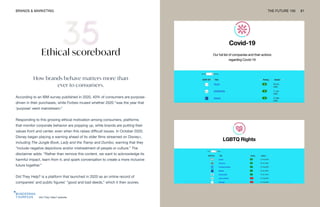
Brand purpose goes mainstream, driven by ethical consumers who continue
to turn to businesses that reflect their values. This is being propelled by
companies like Did They Help? keeping tabs on brands’ efforts—or failure—to
do good (Ethical scoreboard, page 81). Businesses are also looking at the
bigger picture, choosing to collaborate to tackle social and environmental
challenges (Branding together, page 73).
Health is elevated and now extends into every business. Expect to see
brands designing business plans and marketing around public health, and the
appointment of chief health officers (page 164) to the C-suite leadership team.
The report also includes 21 predictions from industry experts, weighing in on
their one big projection for 2021.
The road to recovery begins this year. Brands, leaders and individuals are
guiding us towards a hopeful journey that requires collaboration and resilience
in order to achieve restoration and betterment.
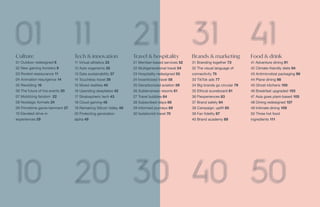
Culture
01 Outdoor redesigned 6
02 New gaming frontiers 9
03 Rooted reassurance 11
04 Animation resurgence 14
05 Rewilding 16
06 The future of live events 20
07 Mobilizing fandom 22
08 Nostalgic formats 24
09 Primetime game-tainment 27
10 Elevated drive-in
experiences 29
Tech & innovation
11 Virtual athletics 33
12 Auto organisms 35
13 Data sustainability 37
14 Touchless travel 39
15 Mixed realities 40
16 Upending deepfakes 42
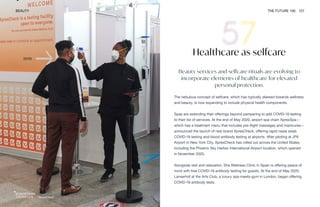
17 Stratospheric tech 43
18 Cloud gaming 46
19 Remaking Silicon Valley 48
20 Protecting generation
alpha 49
Travel & hospitality
21 Member-based services 52
22 Multigenerational travel 54
23 Hospitality redesigned 55
24 Incentivized travel 58
25 Decarbonized aviation 59
26 Subterranean resorts 61
27 Travel bubbles 64
28 Subscribed stays 66
29 Informed journeys 69
30 Isolationist travel 70
Brands & marketing
31 Branding together 73
32 The visual language of
connectivity 75
33 TikTok ads 77
34 Big brands go circular 79
35 Ethical scoreboard 81
36 Flexperiences 83
37 Brand safety 84
38 Campaign: uplift 85
39 Fan fidelity 87
40 Brand academy 89
Food & drink
41 Adventure dining 91
42 Climate-friendly diets 94
43 Antimicrobial packaging 96
44 Plane dining 98
45 Ghost kitchens 100
46 Breakfast upgraded 103
47 Asia goes plant-based 105
48 Dining redesigned 107
49 Intimate dining 109
50 Three hot food
ingredients 111
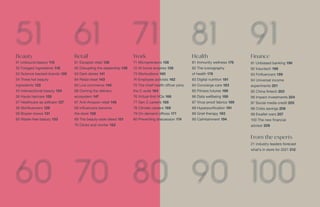
Beauty
51 Unbound beauty 115
52 Foraged ingredients 118
53 Science-backed brands 120
54 Three hot beauty
ingredients 122
55 Intersectional beauty 124
56 Haute haircare 126
57 Healthcare as selfcare 127
58 Skinfluencers 129
59 Brazen brows 131
60 Waste-free beauty 133
Retail
61 Escapist retail 136
62 Disrupting the dealership 139
63 Dark stores 141
64 Retail reset 143
65 Live commerce 145
66 Owning the delivery
ecosystem 147
67 Anti-Amazon retail 148
68 Influencers become
the store 150
69 The beauty-aisle bleed 151
70 Clicks and mortar 153
Work
71 Micropreneurs 156
72 At-home empires 158
73 Workcations 160
74 Employee activists 162
75 The chief health officer joins
the C-suite 164
76 Virtual-first HQs 166
77 Gen Z careers 168
78 Climate careers 169
79 On-demand offices 171
80 Preventing shecession 174
Health
81 Immunity wellness 176
82 The iconography
of health 178
83 Digital nutrition 181
84 Concierge care 183
85 Fitness futures 186
86 Data wellbeing 188
87 Virus-proof fabrics 189
88 Hyperpurification 191
89 Grief therapy 193
90 Calmtainment 194
Finance
91 Unbiased banking 196
92 Insurtech 198
93 Finfluencers 199
94 Universal income
experiments 201
95 China fintech 203
96 Impact investments 204
97 Social media credit 205
98 Crisis savings 206
99 Ewallet wars 207
100 The new financial
advisor 209
From the experts
21 industry leaders forecast
what’s in store for 2021 212
Culture
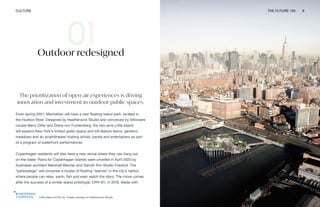
Little Island at Pier 55. Image courtesy of Heatherwick Studio
CULTURE THE FUTURE 100 6
Outdoor redesigned
The prioritization of open-air experiences is driving
innovation and investment in outdoor public spaces.
From spring 2021, Manhattan will have a new floating island park, located in
the Hudson River. Designed by Heatherwick Studio and conceived by billionaire
couple Barry Diller and Diane von Furstenberg, the two-acre Little Island
will expand New York’s limited green space and will feature lawns, gardens,
meadows and an amphitheater hosting artists, bands and entertainers as part
of a program of waterfront performances.
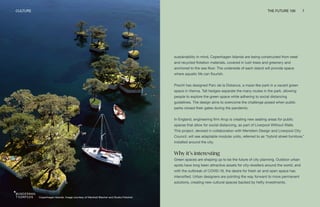
Copenhagen residents will also have a new venue where they can hang out
on the water. Plans for Copenhagen Islands were unveiled in April 2020 by
Australian architect Marshall Blecher and Danish firm Studio Fokstrot. The
“parkipelago” will comprise a cluster of floating “islands” in the city’s harbor
where people can relax, swim, fish and even watch the stars. The move comes
after the success of a similar island prototype, CPH-Ø1, in 2018. Made with
Copenhagen Islands. Image courtesy of Marshall Blecher and Studio Fokstrot
CULTURE THE FUTURE 100 7
sustainability in mind, Copenhagen Islands are being constructed from steel
and recycled flotation materials, covered in lush trees and greenery and
anchored to the sea floor. The underside of each island will provide space
where aquatic life can flourish.
Precht has designed Parc de la Distance, a maze-like park in a vacant green
space in Vienna. Tall hedges separate the many routes in the park, allowing
people to explore the green space while adhering to social distancing
guidelines. The design aims to overcome the challenge posed when public
parks closed their gates during the pandemic.
In England, engineering firm Arup is creating new seating areas for public
spaces that allow for social distancing, as part of Liverpool Without Walls.
This project, devised in collaboration with Meristem Design and Liverpool City
Council, will see adaptable modular units, referred to as “hybrid street furniture,”
installed around the city.
Why it’s interesting
Green spaces are shaping up to be the future of city planning. Outdoor urban
spots have long been attractive assets for city-dwellers around the world, and
with the outbreak of COVID-19, the desire for fresh air and open space has
intensified. Urban designers are pointing the way forward to more permanent
solutions, creating new cultural spaces backed by hefty investments.
Parc de la Distance. Image courtesy of Precht
CULTURE THE FUTURE 100 8
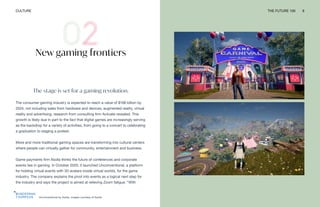
Unconventional by Xsolla. Images courtesy of Xsolla
CULTURE THE FUTURE 100 9
New gaming frontiers
The stage is set for a gaming revolution.
The consumer gaming industry is expected to reach a value of $198 billion by
2024, not including sales from hardware and devices, augmented reality, virtual
reality and advertising, research from consulting firm Activate revealed. This
growth is likely due in part to the fact that digital games are increasingly serving
as the backdrop for a variety of activities, from going to a concert to celebrating
a graduation to staging a protest.
More and more traditional gaming spaces are transforming into cultural centers
where people can virtually gather for community, entertainment and business.
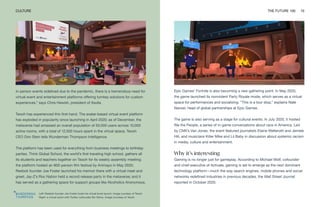
Game payments firm Xsolla thinks the future of conferences and corporate
events lies in gaming. In October 2020, it launched Unconventional, a platform
for holding virtual events with 3D avatars inside virtual worlds, for the game
industry. The company explains the pivot into events as a logical next step for
the industry and says the project is aimed at relieving Zoom fatigue. “With
Left: Reebok founder Joe Foster hosts his virtual book launch. Image courtesy of Teooh
Right: a virtual event with Twitter cofounder Biz Stone. Image courtesy of Teooh
CULTURE THE FUTURE 100 10
in-person events sidelined due to the pandemic, there is a tremendous need for
virtual event and entertainment platforms offering turnkey solutions for custom
experiences,” says Chris Hewish, president of Xsolla.
Teooh has experienced this first-hand. The avatar-based virtual event platform
has exploded in popularity since launching in April 2020; as of December, the
metaverse had amassed an overall population of 50,000 users across 10,000
active rooms, with a total of 12,500 hours spent in the virtual space, Teooh
CEO Don Stein tells Wunderman Thompson Intelligence.
The platform has been used for everything from business meetings to birthday
parties. Think Global School, the world’s first traveling high school, gathers all
its students and teachers together on Teooh for its weekly assembly meeting;
the platform hosted an 800-person film festival by Animayo in May 2020;
Reebok founder Joe Foster launched his memoir there with a virtual meet and
greet; Jay-Z’s Roc Nation held a record release party in the metaverse; and it
has served as a gathering space for support groups like Alcoholics Anonymous.
Epic Games’ Fortnite is also becoming a new gathering point. In May 2020,
the game launched its nonviolent Party Royale mode, which serves as a virtual
space for performances and socializing. “This is a tour stop,” explains Nate
Nanzer, head of global partnerships at Epic Games.
The game is also serving as a stage for cultural events. In July 2020, it hosted
We the People, a series of in-game conversations about race in America. Led
by CNN’s Van Jones, the event featured journalists Elaine Welteroth and Jemele
Hill, and musicians Killer Mike and Lil Baby in discussion about systemic racism
in media, culture and entertainment.
Why it’s interesting
Gaming is no longer just for gameplay. According to Michael Wolf, cofounder
and chief executive of Activate, gaming is set to emerge as the next dominant
technology platform—much the way search engines, mobile phones and social
networks redefined industries in previous decades, the Wall Street Journal
reported in October 2020.
Shutterstock's color predictions for 2021 include Set Sail Champagne. Image courtesy
of Dirk Ercken and Shutterstock
CULTURE THE FUTURE 100 11
Rooted reassurance
People are turning to nature-inspired design to create
a sense of comfort and stability.
Feeling unsettled during a period of unprecedented health threats, social unrest
and political turmoil, people are hunkering down and searching out steadying
elements that offer a feeling of grounding and security.
In particularly stressful times, the practice of nature immersion—an emerging
treatment prescribed by doctors for patients suffering from anxiety, depression
and high blood pressure—is carrying over into interior spaces, which are being
cocooned in warm, earthy tones to evoke a connection to nature in a calming,
soothing environment.
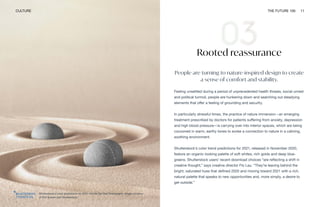
Shutterstock’s color trend predictions for 2021, released in November 2020,
feature an organic-looking palette of soft whites, rich golds and deep blue-
greens. Shutterstock users’ recent download choices “are reflecting a shift in
creative thought,” says creative director Flo Lau. “They’re leaving behind the
bright, saturated hues that defined 2020 and moving toward 2021 with a rich,
natural palette that speaks to new opportunities and, more simply, a desire to
get outside.”
Shutterstock's color predictions for 2021 include Tidewater Green.
Image courtesy of About Life and Shutterstock
CULTURE THE FUTURE 100 12
PPG 2021 Palette of the Year
CULTURE THE FUTURE 100 13
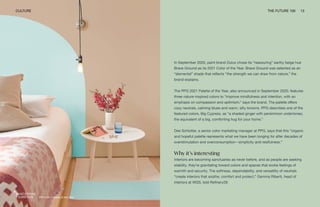
In September 2020, paint brand Dulux chose its “reassuring” earthy beige hue
Brave Ground as its 2021 Color of the Year. Brave Ground was selected as an
“elemental” shade that reflects “the strength we can draw from nature,” the
brand explains.
The PPG 2021 Palette of the Year, also announced in September 2020, features
three nature-inspired colors to “improve mindfulness and intention, with an
emphasis on compassion and optimism,” says the brand. The palette offers
cozy neutrals, calming blues and warm, silty browns. PPG describes one of the
featured colors, Big Cypress, as “a shaded ginger with persimmon undertones;
the equivalent of a big, comforting hug for your home.”
Dee Schlotter, a senior color marketing manager at PPG, says that this “organic
and hopeful palette represents what we have been longing for after decades of
overstimulation and overconsumption—simplicity and restfulness.”
Why it’s interesting
Interiors are becoming sanctuaries as never before, and as people are seeking
stability, they’re gravitating toward colors and spaces that evoke feelings of
warmth and security. The softness, dependability, and versatility of neutrals
“create interiors that soothe, comfort and protect,” Gemma Riberti, head of
interiors at WGS, told Refinery29.
Star Trek: Lower Decks. Images courtesy of CBS
CULTURE THE FUTURE 100 14
Animation resurgence
The entertainment industry is propelling animation
into the go-to format for storytelling.
The demand for animated TV shows for adults is on the rise as a result of
quarantine grinding live-action filming to a halt. This has provided much-needed
time in which animators have been able to flourish and, even as filming
resumes, the medium’s renaissance continues.
From CBS’s Tooning Out the News to Hulu’s Solar Opposites, 2020 was a ripe
year for debuting animated shows aimed at grown-ups. Even live-action
programs Black-ish and One Day at a Time introduced animated episodes.
One of animation’s attractions is the appearance of provocative guests. Black-
ish’s animated episode, which aired in October 2020, features Stacey Abrams,
founder of voting rights advocacy group Fair Fight. Tooning Out the News
includes Alan Dershowitz, the Harvard Law School professor and lawyer who
was part of Jeffrey Epstein’s defense team.
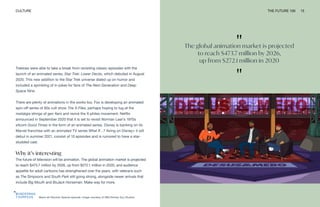
"
The global animation market is projected
to reach $473.7 million by 2026,
up from $272.1 million in 2020
"
Black-ish Election Special episode. Image courtesy of ABC/Smiley Guy Studios
CULTURE THE FUTURE 100 15
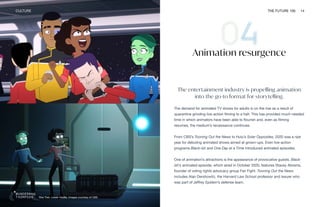
Trekkies were able to take a break from revisiting classic episodes with the
launch of an animated series, Star Trek: Lower Decks, which debuted in August
2020. This new addition to the Star Trek universe dialed up on humor and
included a sprinkling of in-jokes for fans of The Next Generation and Deep
Space Nine.
There are plenty of animations in the works too. Fox is developing an animated
spin-off series of 90s cult show The X-Files, perhaps hoping to tug at the
nostalgia strings of gen Xers and revive the X-philes movement. Netflix
announced in September 2020 that it is set to revisit Norman Lear’s 1970s
sitcom Good Times in the form of an animated series. Disney is banking on its
Marvel franchise with an animated TV series What If…? Airing on Disney+ it will
debut in summer 2021, consist of 10 episodes and is rumored to have a star-
studded cast.
Why it’s interesting
The future of television will be animation. The global animation market is projected
to reach $473.7 million by 2026, up from $272.1 million in 2020, and audience
appetite for adult cartoons has strengthened over the years, with veterans such
as The Simpsons and South Park still going strong, alongside newer arrivals that
include Big Mouth and BoJack Horseman. Make way for more.
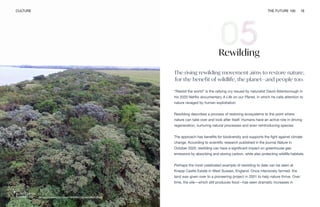
Image courtesy of Durrell Wildlife Conservation Trust
CULTURE THE FUTURE 100 16
Rewilding
The rising rewilding movement aims to restore nature,
for the benefit of wildlife, the planet—and people too.
“Rewild the world” is the rallying cry issued by naturalist David Attenborough in
his 2020 Netflix documentary A Life on our Planet, in which he calls attention to
nature ravaged by human exploitation.
Rewilding describes a process of restoring ecosystems to the point where
nature can take over and look after itself. Humans have an active role in driving
regeneration, nurturing natural processes and even reintroducing species.
The approach has benefits for biodiversity and supports the fight against climate
change. According to scientific research published in the journal Nature in
October 2020, rewilding can have a significant impact on greenhouse gas
emissions by absorbing and storing carbon, while also protecting wildlife habitats.
Perhaps the most celebrated example of rewilding to date can be seen at
Knepp Castle Estate in West Sussex, England. Once intensively farmed, the
land was given over to a pioneering project in 2001 to help nature thrive. Over
time, the site—which still produces food—has seen dramatic increases in
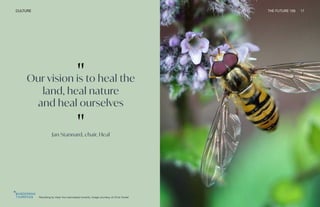
"
Our vision is to heal the
land, heal nature
and heal ourselves
"
Jan Stannard, chair, Heal
Rewilding by Heal: the marmalade hoverfly. Image courtesy of Chris Towler
CULTURE THE FUTURE 100 17
Top: Trees for Life Dundreggan Rewilding Centre
Bottom: Image courtesy of Trevor Dines and Plantlife
CULTURE THE FUTURE 100 18
wildlife, including the return of rare species such as the peregrine falcon and the
purple emperor butterfly.
Thus far, many early rewilding initiatives, like Knepp, have been on private land.
Launched in 2020, Heal is a UK-based charity that hopes to use crowdfunding
to convert ecologically depleted land, including former farms and green belt
areas. The aim is for these sites to become sanctuaries not just for wildlife, but
also for people. Speaking to the Guardian, Heal’s chair Jan Stannard said, “Our
vision is to heal the land, heal nature and heal ourselves.’’
Foundation Conservation Carpathia is taking a different approach, buying up
parcels of privately owned land to combat illegal logging and create a protected
wilderness in Romania, which in 2020 saw the reintroduction of grazing bison.
Urban rewilding projects aim to bring benefits to cities too. Trinity College
Dublin replaced its closely mowed lawns with wildflower meadows. Wildlife
charity Plantlife wants to transform Britain’s roadside verges into wildlife
corridors, having completed a successful pilot in Dorset in 2020.
Why it’s interesting
There are growing opportunities for brands that want to tackle climate change
to partner with rewilding initiatives. Volvo Cars UK is supporting some of the
Durrell Wildlife Conservation Trust’s restoration projects, including Recover the
Atlantic Forest, which will see 17,000 trees planted in the Brazilian rainforest.
Luxury watchmaker Audemars Piguet has helped to fund the world’s first
rewilding center, under construction for Scottish charity Trees for Life in the
Highlands and due to open in 2022. Wunderman Thompson Data finds that
58% say they value the outdoors and the environment more as a result of the
pandemic crisis.
Image courtesy of Durrell Wildlife Conservation Trust
CULTURE THE FUTURE 100 19
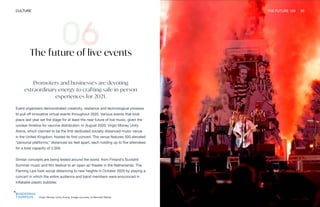
Virgin Money Unity Arena. Image courtesy of Bennett Media
CULTURE THE FUTURE 100 20
The future of live events
Promoters and businesses are devoting
extraordinary energy to crafting safe in-person
experiences for 2021.
Event organizers demonstrated creativity, resilience and technological prowess
to pull off innovative virtual events throughout 2020. Various events that took
place last year set the stage for at least the near future of live music, given the
unclear timeline for vaccine distribution. In August 2020, Virgin Money Unity
Arena, which claimed to be the first dedicated socially distanced music venue
in the United Kingdom, hosted its first concert. The venue features 500 elevated
“personal platforms,” distanced six feet apart, each holding up to five attendees
for a total capacity of 2,500.
Similar concepts are being tested around the world, from Finland’s Suvilahti
Summer music and film festival to an open-air theater in the Netherlands. The
Flaming Lips took social distancing to new heights in October 2020 by playing a
concert in which the entire audience and band members were ensconced in
inflatable plastic bubbles.
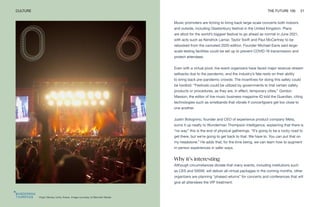
Virgin Money Unity Arena. Image courtesy of Bennett Media
CULTURE THE FUTURE 100 21
Music promoters are itching to bring back large-scale concerts both indoors
and outside, including Glastonbury festival in the United Kingdom. Plans
are afoot for the world’s biggest festival to go ahead as normal in June 2021,
with acts such as Kendrick Lamar, Taylor Swift and Paul McCartney to be
rebooked from the canceled 2020 edition. Founder Michael Eavis said large-
scale testing facilities could be set up to prevent COVID-19 transmission and
protect attendees.
Even with a virtual pivot, live event organizers have faced major revenue-stream
setbacks due to the pandemic, and the industry’s fate rests on their ability
to bring back pre-pandemic crowds. The incentives for doing this safely could
be twofold. “Festivals could be utilized by governments to trial certain safety
products or procedures, as they are, in effect, temporary cities,” Gordon
Masson, the editor of live music business magazine IQ told the Guardian, citing
technologies such as wristbands that vibrate if concertgoers get too close to
one another.
Justin Bolognino, founder and CEO of experience product company Meta,
sums it up neatly to Wunderman Thompson Intelligence, explaining that there is
“no way” this is the end of physical gatherings. “It’s going to be a rocky road to
get there, but we’re going to get back to that. We have to. You can put that on
my headstone.” He adds that, for the time being, we can learn how to augment
in-person experiences in safer ways.
Why it’s interesting
Although circumstances dictate that many events, including institutions such
as CES and SXSW, will deliver all-virtual packages in the coming months, other
organizers are planning “phased returns” for concerts and conferences that will
give all attendees the VIP treatment.
BTS fans. Images courtesy of MTV and YouTube
CULTURE THE FUTURE 100 22
Mobilizing fandom
Fandoms are taking on a life of their own.
Members are moving on from simply consuming pop culture to becoming
amplifiers and content creators for their idols, online and en masse.
Around the world, social media has connected the fans of hit TV series,
movies, books and musicians to the objects of their adoration and, crucially,
to each other. In the United States, Taylor Swift has her Swifties, Beyoncé
has the Beyhive and Lady Gaga the Little Monsters. With a single social media
post, these fans can rise as a group to boost music sales, defend their heroes
against detractors and, increasingly, throw their weight behind social and
political causes.
The South Korean pop industry has applied new technology to fan engagement
to a degree not seen elsewhere.
There are special content channels, personalized messaging platforms,
and, during the pandemic, streamed concerts enhanced with augmented and
virtual reality. Fans identify as a community and will buy and stream songs
continuously on multiple devices to push them up the charts, as well as creating
and sharing fan fiction, artwork and compilation videos.
"
Social media has
overturned the rules of
the music industry
and elevated the power
of the fan
"
Eun-Young Jeong, reporter,
Wall Street Journal
BTS on The Tonight Show Starring Jimmy Fallon. Image courtesy of YouTube
CULTURE THE FUTURE 100 23
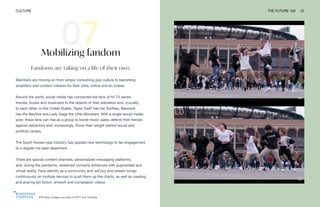
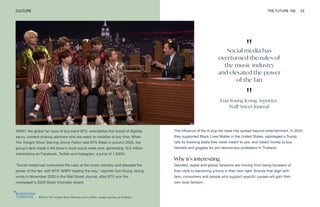
ARMY, the global fan base of boy band BTS, exemplifies this breed of digitally
savvy, content-sharing admirers who are ready to mobilize at any time. When
The Tonight Show Starring Jimmy Fallon held BTS Week in autumn 2020, the
group’s fans made it the show’s most social week ever, generating 10.5 million
interactions on Facebook, Twitter and Instagram, a jump of 1,300%.
“Social media has overturned the rules of the music industry and elevated the
power of the fan, with BTS’ ARMY leading the way,” reporter Eun-Young Jeong
wrote in November 2020 in the Wall Street Journal, after BTS won the
newspaper’s 2020 Music Innovator award.
The influence of the K-pop fan base has spread beyond entertainment. In 2020,
they supported Black Lives Matter in the United States, sabotaged a Trump
rally by booking seats they never meant to use, and raised money to buy
helmets and goggles for pro-democracy protesters in Thailand.
Why it’s interesting
Devoted, digital and global, fandoms are moving from being boosters of
their idols to becoming a force in their own right. Brands that align with
fans, consumers and people who support specific causes will gain their
own loyal fandom.
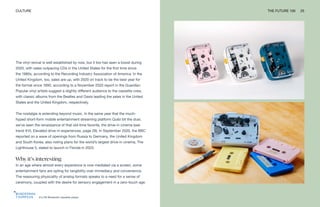
It’s OK Bluetooth cassette player
CULTURE THE FUTURE 100 24
Nostalgic formats
Consumers are seeking comfort in throwback
entertainment formats, especially now that
portability and on-the-go access aren’t top priorities.
The humble audio cassette, much maligned for poor audio quality, continues
the unlikely revival we first noted in “The Future 100 2020” trend Analog
Renaissance. UK cassette sales doubled in the first half of 2020 compared
to 2019, according to the Official Charts Company, hitting a 15-year high. Pop
acts such as 5 Seconds of Summer, Lady Gaga and Dua Lipa dominate sales,
pointing to a new, young audience for the format. K-pop legend BTS is also a
convert; the group’s US web store sold out of its last two singles “Dynamite”
and “Life Goes On” in both cassette and vinyl formats.
Industry experts have theorized that the cassette comeback is driven purely
by the memorabilia market, yet we’re also seeing compatible audio devices hit
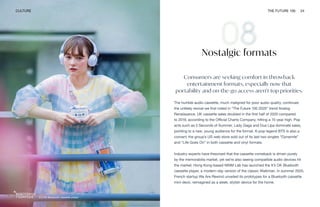
the market. Hong Kong-based NINM Lab has launched the It’s OK Bluetooth
cassette player, a modern-day version of the classic Walkman. In summer 2020,
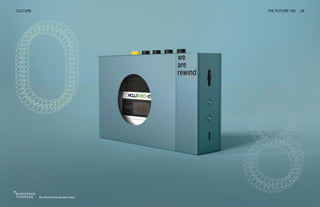
French startup We Are Rewind unveiled its prototypes for a Bluetooth cassette
mini-deck, reimagined as a sleek, stylish device for the home.
It’s OK Bluetooth cassette player
CULTURE THE FUTURE 100 25
The vinyl revival is well established by now, but it too has seen a boost during
2020, with sales outpacing CDs in the United States for the first time since
the 1980s, according to the Recording Industry Association of America. In the
United Kingdom, too, sales are up, with 2020 on track to be the best year for
the format since 1990, according to a November 2020 report in the Guardian.
Popular vinyl artists suggest a slightly different audience to the cassette crew,
with classic albums from the Beatles and Oasis leading the sales in the United
States and the United Kingdom, respectively.
The nostalgia is extending beyond music. In the same year that the much-
hyped short-form mobile entertainment streaming platform Quibi bit the dust,
we’ve seen the renaissance of that old-time favorite, the drive-in cinema (see
trend #10, Elevated drive-in experiences, page 29). In September 2020, the BBC
reported on a wave of openings from Russia to Germany, the United Kingdom
and South Korea, also noting plans for the world’s largest drive-in cinema, The
Lighthouse 5, slated to launch in Florida in 2023.
Why it’s interesting
In an age where almost every experience is now mediated via a screen, some
entertainment fans are opting for tangibility over immediacy and convenience.
The reassuring physicality of analog formats speaks to a need for a sense of
ceremony, coupled with the desire for sensory engagement in a zero-touch age.
We Are Rewind cassette deck
CULTURE THE FUTURE 100 26
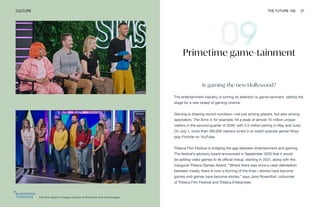
The Sims Spark'd. Images courtesy of Electronic Arts and ELeague
CULTURE THE FUTURE 100 27
Primetime game-tainment
Is gaming the new Hollywood?
The entertainment industry is turning its attention to game-tainment, setting the
stage for a new breed of gaming cinema.
Gaming is drawing record numbers—not just among players, but also among
spectators. The Sims 4, for example, hit a peak of almost 10 million unique
visitors in the second quarter of 2020, with 2.5 million joining in May and June.
On July 1, more than 160,000 viewers tuned in to watch popular gamer Ninja
play Fortnite on YouTube.
Tribeca Film Festival is bridging the gap between entertainment and gaming.
The festival’s advisory board announced in September 2020 that it would
be adding video games to its official lineup, starting in 2021, along with the
inaugural Tribeca Games Award. “Where there was once a clear delineation
between media, there is now a blurring of the lines—stories have become
games and games have become stories,” says Jane Rosenthal, cofounder
of Tribeca Film Festival and Tribeca Enterprises.
"
Where there was once a
clear delineation between
media, there is now a
blurring of the lines—stories
have become
games and games have
become stories
"
Jane Rosenthal, cofounder, Tribeca Film Festival
and Tribeca Enterprises
CULTURE THE FUTURE 100 28
Other leaders in entertainment agree. In July 2020, Sony announced a massive
investment in Epic Games, the creator of Fortnite. The $250 million investment
gives the entertainment kingpin a 1.4% stake in the gaming company—and
foretells a growing crossover between the silver screen and the computer
screen. “Sony and Epic have both built businesses at the intersection of
creativity and technology, and we share a vision of real-time 3D social
experiences leading to a convergence of gaming, film and music,” says Tim
Sweeney, founder and CEO of Epic Games. Bringing this vision to life, Sony and
Epic jointly announced a new “immersive reality” concert experience at CES
2021, debuting on PlayStation VR and Oculus VR later this year.
Cable channel TBS is tapping into game-tainment with its new Sims reality
television show, The Sims Spark’d, presented by ELeague, the gaming arm of
Turner. “While competitive esports have long been broadcast around the globe,
Spark’d is poised to become the first mainstream reality show based on an
electronic game,” the New York Times observed. The four-episode miniseries,
which debuted on July 17, 2020, features 12 contestants competing in timed
challenges to create the most unique characters, worlds and storylines within
the popular life simulation game, in a format echoing that of Project Runway
and the Great British Bake Off. The show is a collaboration between Sims
creator Electronic Arts, WarnerMedia subsidiary Turner Sports, and Buzzfeed’s
gaming channel Multiplayer.
Why it’s interesting
Gaming has been steadily growing in popularity and influence over the past few
years, with far-reaching impact: it has spurred a new league of gamefluencers,
informed luxury retail, served as an outlet for wanderlust and wellness, and
even as a platform for activism. Now, with playership skyrocketing, big brand
investments are elevating game-tainment to a primetime attraction.
Rogue Routes drive-in series by Nissan and Atlas Obscura
CULTURE THE FUTURE 100 29
Elevated drive-in experiences
From raves and art shows to performances and
gourmet dinners, the drive-in is getting a
modern-day makeover to offer an eclectic mix
of live entertainment.
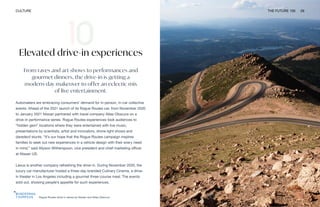
Automakers are embracing consumers’ demand for in-person, in-car collective
events. Ahead of the 2021 launch of its Rogue Routes car, from November 2020
to January 2021 Nissan partnered with travel company Atlas Obscura on a
drive-in performance series. Rogue Routes experiences took audiences to
“hidden gem” locations where they were entertained with live music,
presentations by scientists, artist and innovators, drone light shows and
daredevil stunts. “It’s our hope that the Rogue Routes campaign inspires
families to seek out new experiences in a vehicle design with their every need
in mind,” said Allyson Witherspoon, vice president and chief marketing officer
at Nissan US.
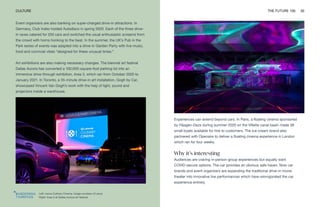
Lexus is another company refreshing the drive-in. During November 2020, the
luxury car manufacturer hosted a three-day branded Culinary Cinema, a drive-
in theater in Los Angeles including a gourmet three-course meal. The events
sold out, showing people’s appetite for such experiences.
Left: Lexus Culinary Cinema. Image courtesy of Lexus
Right: Area 3 at Dallas Aurora art festival
CULTURE THE FUTURE 100 30
Event organizers are also banking on super-charged drive-in attractions. In
Germany, Club Index hosted Autodisco in spring 2020. Each of the three drive-
in raves catered for 250 cars and switched the usual enthusiastic screams from
the crowd with horns honking to the beat. In the summer, the UK’s Pub in the
Park series of events was adapted into a drive-in Garden Party with live music,
food and convivial vibes “designed for these unusual times.”
Art exhibitions are also making necessary changes. The biennial art festival
Dallas Aurora has converted a 100,000-square-foot parking lot into an
immersive drive-through exhibition, Area 3, which ran from October 2020 to
January 2021. In Toronto, a 35-minute drive-in art installation, Gogh by Car,
showcased Vincent Van Gogh’s work with the help of light, sound and
projectors inside a warehouse.
Experiences can extend beyond cars. In Paris, a floating cinema sponsored
by Häagen-Dazs during summer 2020 on the Villette canal basin made 38
small boats available for hire to customers. The ice-cream brand also
partnered with Openaire to deliver a floating cinema experience in London
which ran for four weeks.
Why it’s interesting
Audiences are craving in-person group experiences but equally want
COVID-secure options. The car provides an obvious safe haven. Now car
brands and event organizers are expanding the traditional drive-in movie
theater into innovative live performances which have reinvigorated the car
experience entirely.
Gogh by Car
CULTURE THE FUTURE 100 31
Tech & Innovation
TECH & INNOVATION THE FUTURE 100 33
Aston Martin AMR-C01 racing simulator
Virtual athletics
Traditional sports and esports are converging, with
at-home amateur athletes now able to compete
against top-level professionals.
The unprecedented shutdown of live sports in 2020 has driven rapid innovation
throughout the sector, giving rise to a growing crossover between virtual sports
and esports. “Suddenly many began to discover esports can be as entertaining
as traditional sports,” Robert Rippee, director of the Hospitality Lab and
Esports Lab at the University of Nevada Las Vegas’s International Gaming
Institute, tells Wunderman Thompson Intelligence. “The pandemic accelerated
the convergence of the two.”
Motor sport, where pro athletes already use racing simulators for training,
is seeing new brands enter the market to provide tech for virtual racing
enthusiasts. Targeting the luxury esports player, Aston Martin announced its
AMR-C01 racing simulator in September 2020. Retailing for around $76,300,
the simulator takes its design cues from Aston Martin’s classic aesthetic, with
sleek lines and seat positioning that reflect the brand’s racing vehicles. For
those who can afford the hefty price tag, the AMR-C01 offers an experience
as close to a real Aston Martin hypercar as possible.
TECH & INNOVATION THE FUTURE 100 34
Left: Zwift Virtual Tour de France
Right: Adidas GMR smart insole
Amateurs have long enjoyed competing as their favorite players in the virtual
realm. Now, with the pros themselves hitting the online world, competition has
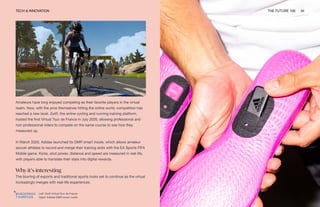
reached a new level. Zwift, the online cycling and running training platform,
hosted the first Virtual Tour de France in July 2020, allowing professional and
non-professional riders to compete on the same course to see how they
measured up.
In March 2020, Adidas launched its GMR smart insole, which allows amateur
soccer athletes to record and merge their training skills with the EA Sports FIFA
Mobile game. Kicks, shot power, distance and speed are measured in real life,
with players able to translate their stats into digital rewards.
Why it’s interesting
The blurring of esports and traditional sports looks set to continue as the virtual
increasingly merges with real-life experiences.
TECH & INNOVATION THE FUTURE 100 35
Mercedes-Benz Vision AVTR
Auto organisms
Automotive design gets a biophilic makeover.
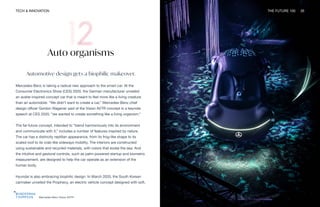
Mercedes-Benz is taking a radical new approach to the smart car. At the
Consumer Electronics Show (CES) 2020, the German manufacturer unveiled
an avatar-inspired concept car that is meant to feel more like a living creature
than an automobile. “We didn’t want to create a car,” Mercedes-Benz chief
design officer Gordon Wagener said of the Vision AVTR concept in a keynote
speech at CES 2020, “we wanted to create something like a living organism.”
The far-future concept, intended to “blend harmoniously into its environment
and communicate with it,” includes a number of features inspired by nature.
The car has a distinctly reptilian appearance, from its frog-like shape to its
scaled roof to its crab-like sideways mobility. The interiors are constructed
using sustainable and recycled materials, with colors that evoke the sea. And
the intuitive and gestural controls, such as palm-powered startup and biometric
measurement, are designed to help the car operate as an extension of the
human body.
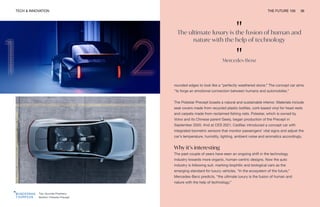
Hyundai is also embracing biophilic design. In March 2020, the South Korean
carmaker unveiled the Prophecy, an electric vehicle concept designed with soft,
TECH & INNOVATION THE FUTURE 100 36
Top: Hyundai Prophecy
Bottom: Polestar Precept
rounded edges to look like a “perfectly weathered stone.” The concept car aims
“to forge an emotional connection between humans and automobiles.”
The Polestar Precept boasts a natural and sustainable interior. Materials include
seat covers made from recycled plastic bottles, cork-based vinyl for head rests
and carpets made from reclaimed fishing nets. Polestar, which is owned by
Volvo and its Chinese parent Geely, began production of the Precept in
September 2020. And at CES 2021, Cadillac introduced a concept car with
integrated biometric sensors that monitor passengers’ vital signs and adjust the
car’s temperature, humidity, lighting, ambient noise and aromatics accordingly.
Why it’s interesting
The past couple of years have seen an ongoing shift in the technology
industry towards more organic, human-centric designs. Now the auto
industry is following suit, marking biophilic and biological cars as the
emerging standard for luxury vehicles. “In the ecosystem of the future,”
Mercedes-Benz predicts, “the ultimate luxury is the fusion of human and
nature with the help of technology.”
"
The ultimate luxury is the fusion of human and
nature with the help of technology
"
Mercedes-Benz
TECH & INNOVATION THE FUTURE 100 37
Xbox Series S
Data sustainability
There’s growing recognition of the impact of humans’
digital footprint on the environment.
Climate-change conversations tend to fixate on physical waste, but digital
activities also have a significant effect. The volume of digital information
stored at data centers is swelling, accounting for 2% of global electricity
consumption, and that figure could quadruple to 8% by 2030, according to
figures cited by Bloomberg.
Every email sent and every Google search performed, whether on a computer
or on a mobile phone, has an environmental cost. In an increasingly online
world, that burden mounts up like waste in landfill. According to a March 2019
report by the Shift Project think tank, digital technologies are responsible for
3.7% of global greenhouse gas emissions—a similar amount to those generated
by the airline industry (see trend #25, Decarbonized aviation, page 59). Console
waste is a related issue, due to the minerals used in the manufacture of gaming
systems and the difficulties around safe and eco-friendly disposal.
TECH & INNOVATION THE FUTURE 100 38
Cloud computing and content streaming are poised to further transform the
way consumers work and play, with the arrival of 5G. Tech giants and gaming
platforms are increasingly faced with concerns about the infrastructure required
to support these technologies at remote data centers processing vast quantities
of information. A 2020 study by researchers at Lancaster University in the
United Kingdom forecast that a large-scale switch to streaming games rather
than using consoles could prompt a 30% increase in carbon emissions caused
by gaming by 2030.
Microsoft and Google are addressing this issue, both claiming their data
centers are carbon neutral. Microsoft is working towards renewable
energy solutions in its Azure data centers, citing a 2018 in-house study that
showed cloud computing “can be up to 98% more carbon efficient than on-
premises solutions.”
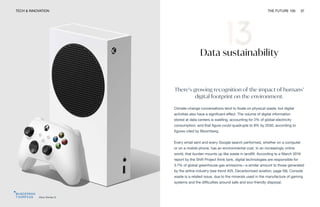
Sony has added an improved energy-saving low-power mode to its PlayStation
5, and the new Xbox Series S and X models offer a similar feature.
Why it’s interesting
Digital is accelerating to accommodate remote work, online shopping and an
expanding gaming landscape, which means the environmental implications of
data usage are more urgent than ever for brands. Expect data sustainability to
be a major keystone in companies’ climate-change goals over the next decade.
"
Expect data sustainability
to be a major keystone in
companies’ climate-change
goals over the next decade
"
TECH & INNOVATION THE FUTURE 100 39
Lufthansa contactless tech
Touchless travel
Airlines and airports are working to minimize
contact and maximize hygiene standards across
the travel experience.
From check-in and baggage drop to bathrooms and in-flight entertainment
systems, all aspects of air travel are being reimagined in an effort to rebuild
consumer confidence in a sector greatly affected by COVID-19.
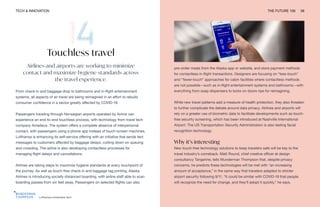
Passengers traveling through Norwegian airports operated by Avinor can
experience an end-to-end touchless process, with technology from travel tech
company Amadeus. The system offers a complete absence of interpersonal
contact, with passengers using a phone app instead of touch-screen machines.
Lufthansa is enhancing its self-service offering with an initiative that sends text
messages to customers affected by baggage delays, cutting down on queuing
and crowding. The airline is also developing contactless processes for
managing flight delays and cancellations.
Airlines are taking steps to maximize hygiene standards at every touchpoint of
the journey. As well as touch-free check-in and baggage tag printing, Alaska
Airlines is introducing socially distanced boarding, with airline staff able to scan
boarding passes from six feet away. Passengers on selected flights can also
pre-order meals from the Alaska app or website, and store payment methods
for contactless in-flight transactions. Designers are focusing on “less-touch”
and “fewer-touch” approaches for cabin facilities where contactless methods
are not possible—such as in-flight entertainment systems and bathrooms—with
everything from soap dispensers to locks on doors ripe for reimagining.
While new travel patterns add a measure of health protection, they also threaten
to further complicate the debate around data privacy. Airlines and airports will
rely on a greater use of biometric data to facilitate developments such as touch-
free security screening, which has been introduced at Nashville International
Airport. The US Transportation Security Administration is also testing facial
recognition technology.
Why it’s interesting
New touch-free technology solutions to keep travelers safe will be key to the
travel industry’s comeback. Matt Round, chief creative officer at design
consultancy Tangerine, tells Wunderman Thompson that, despite privacy
concerns, he predicts these technologies will be met with “an increasing
amount of acceptance,” in the same way that travelers adapted to stricter
airport security following 9/11. “It could be similar with COVID-19 that people
will recognize the need for change, and they’ll adopt it quickly,” he says.
TECH & INNOVATION THE FUTURE 100 40
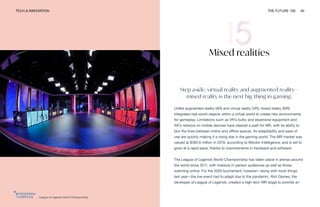
League of Legends World Championship
Mixed realities
Step aside, virtual reality and augmented reality—
mixed reality is the next big thing in gaming.
Unlike augmented reality (AR) and virtual reality (VR), mixed reality (MR)
integrates real-world objects within a virtual world to create new environments
for gameplay. Limitations such as VR’s bulky and expensive equipment and
AR’s reliance on mobile devices have cleared a path for MR, with its ability to
blur the lines between online and offline spaces. Its adaptability and ease of
use are quickly making it a rising star in the gaming world. The MR market was
valued at $382.6 million in 2019, according to Mordor Intelligence, and is set to
grow at a rapid pace, thanks to improvements in hardware and software.
The League of Legends World Championship has taken place in arenas around
the world since 2011, with massive in-person audiences as well as those
watching online. For the 2020 tournament, however—along with most things
last year—the live event had to adapt due to the pandemic. Riot Games, the
developer of League of Legends, created a high-tech MR stage to provide an
TECH & INNOVATION THE FUTURE 100 41
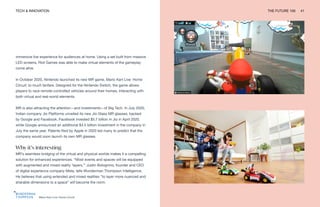
Mario Kart Live: Home Circuit
immersive live experience for audiences at home. Using a set built from massive
LED screens, Riot Games was able to make virtual elements of the gameplay
come alive.
In October 2020, Nintendo launched its new MR game, Mario Kart Live: Home
Circuit, to much fanfare. Designed for the Nintendo Switch, the game allows
players to race remote-controlled vehicles around their homes, interacting with
both virtual and real-world elements.
MR is also attracting the attention—and investments—of Big Tech. In July 2020,
Indian company Jio Platforms unveiled its new Jio Glass MR glasses, backed
by Google and Facebook. Facebook invested $5.7 billion in Jio in April 2020,
while Google announced an additional $4.5 billion investment in the company in
July the same year. Patents filed by Apple in 2020 led many to predict that the
company would soon launch its own MR glasses.
Why it’s interesting
MR’s seamless bridging of the virtual and physical worlds makes it a compelling
solution for enhanced experiences. “Most events and spaces will be equipped
with augmented and mixed reality ‘layers,’” Justin Bolognino, founder and CEO
of digital experience company Meta, tells Wunderman Thompson Intelligence.
He believes that using extended and mixed realities “to layer more nuanced and
sharable dimensions to a space” will become the norm.
TECH & INNOVATION THE FUTURE 100 42
Upending deepfakes
Artificial intelligence is increasingly being deployed to
fight back against deepfake images and videos.
Whether they’re disseminated by pranksters and trolls or political operatives
and propagandists, deepfakes can be confusing to the public and corrosive to
the social fabric. These tools of disinformation are a downside of today’s highly
sophisticated applications of artificial intelligence (AI), but AI itself is the main
weapon being used to disable them.
When it comes to deepfakes of famous people, AI technology can “learn”
a person’s typical movements and gestures, and compare these with the
suspected deepfake to identify inconsistencies. In September 2020, Microsoft
launched Microsoft Video Authenticator, a new AI-powered tool that scans an
image or video and gives the viewer a percentage estimate of how likely it is
that the content is a deepfake. The technology identifies signs of deepfakery
that may not be discernible to the viewer, detecting grayscale elements or
blurred boundaries between two images that have been blended.
Authentication tools are also becoming prevalent. Microsoft’s Azure now allows
content creators to embed certificates and hashes within content, which can
then be read and authenticated. Blockchain timestamps are another emerging
application. These act as “digital fingerprints,” allowing users to trace and verify
the origin of the content and any subsequent modifications.
However, Facebook’s June 2020 Deepfake Detection Challenge, a
competition that invited participants to test their models against real-world
examples, suggests AI still leaves much to be desired when it comes to
accurately picking out deepfakes. The winning algorithm managed an
accuracy rate of just over 65%.
South Park creators Trey Parker and Matt Stone struck their own blow against
deepfakes by satirizing the genre. Their YouTube “Sassy Justice” series,
released in October 2020, uses manipulated images of Donald Trump, Ivanka
Trump, Jared Kushner, Michael Caine and Mark Zuckerberg to tell a story about
a local news reporter (with Donald Trump’s face) investigating—you guessed
it—deepfakes. “We just wanted to make fun of it because it makes it less scary,”
Stone told the New York Times.
Why it’s interesting
Misinformation surrounding COVID-19 and the 2020 US presidential election
has heightened the need for robust solutions around maintaining a trustworthy
digital ecosystem. However, dealing with synthetic media raises new questions
and challenges around the appropriate boundaries between free expression
and censorship.
TECH & INNOVATION THE FUTURE 100 43
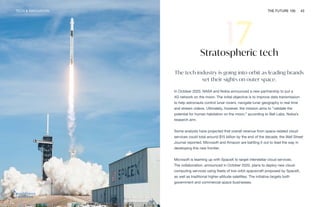
NASA
Stratospheric tech
The tech industry is going into orbit as leading brands
set their sights on outer space.
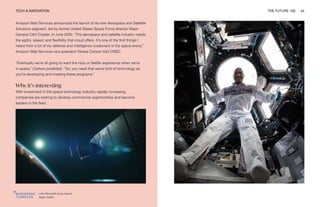
In October 2020, NASA and Nokia announced a new partnership to put a
4G network on the moon. The initial objective is to improve data transmission
to help astronauts control lunar rovers, navigate lunar geography in real time
and stream videos. Ultimately, however, the mission aims to “validate the
potential for human habitation on the moon,” according to Bell Labs, Nokia’s
research arm.
Some analysts have projected that overall revenue from space-related cloud
services could total around $15 billion by the end of the decade, the Wall Street
Journal reported. Microsoft and Amazon are battling it out to lead the way in
developing this new frontier.
Microsoft is teaming up with SpaceX to target interstellar cloud services.
The collaboration, announced in October 2020, plans to deploy new cloud-
computing services using fleets of low-orbit spacecraft proposed by SpaceX,
as well as traditional higher-altitude satellites. The initiative targets both
government and commercial space businesses.
TECH & INNOVATION THE FUTURE 100 44
Left: Microsoft Azure Space
Right: NASA
Amazon Web Services announced the launch of its new Aerospace and Satellite
Solutions segment, led by former United States Space Force director Major
General Clint Crosier, in June 2020. “The aerospace and satellite industry needs
the agility, speed, and flexibility that cloud offers. It’s one of the first things I
heard from a lot of my defense and intelligence customers in the space arena,”
Amazon Web Services vice president Teresa Carlson told CNBC.
“Eventually we’re all going to want the Hulu or Netflix experience when we’re
in space,” Carlson predicted. “So, you need that same kind of technology as
you’re developing and creating these programs.”
Why it’s interesting
With investment in the space technology industry rapidly increasing,
companies are looking to develop commercial opportunities and become
leaders in the field.
TECH & INNOVATION THE FUTURE 100 45
NASA
TECH & INNOVATION THE FUTURE 100 46
Facebook Gaming. Images courtesy of Facebook
Cloud gaming
Big Tech battles it out in the cloud gaming arena.
Game on.
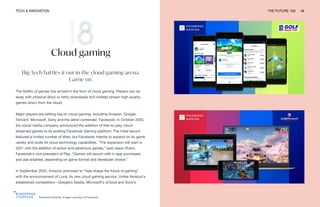
The Netflix of games has arrived in the form of cloud gaming. Players can do
away with physical discs or hefty downloads and instead stream high-quality
games direct from the cloud.
Major players are betting big on cloud gaming, including Amazon, Google,
Tencent, Microsoft, Sony and the latest contender, Facebook. In October 2020,
the social media company announced the addition of free-to-play cloud-
streamed games to its existing Facebook Gaming platform. The initial launch
featured a limited number of titles, but Facebook intends to expand on its game
variety and scale its cloud technology capabilities. “The expansion will start in
2021 with the addition of action and adventure games,” said Jason Rubin,
Facebook’s vice president of Play. “Games will launch with in-app purchases
and ads enabled, depending on game format and developer choice.”
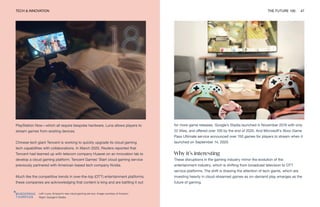
In September 2020, Amazon promised to “help shape the future of gaming”
with the announcement of Luna, its new cloud gaming service. Unlike Amazon’s
established competitors—Google’s Stadia, Microsoft’s xCloud and Sony’s
TECH & INNOVATION THE FUTURE 100 47
Left: Luna, Amazon’s new cloud gaming service. Image courtesy of Amazon
Right: Google’s Stadia
for more game releases. Google’s Stadia launched in November 2019 with only
22 titles, and offered over 100 by the end of 2020. And Microsoft’s Xbox Game
Pass Ultimate service announced over 150 games for players to stream when it
launched on September 14, 2020.
Why it’s interesting
These disruptions in the gaming industry mirror the evolution of the
entertainment industry, which is shifting from broadcast television to OTT
service platforms. The shift is drawing the attention of tech giants, which are
investing heavily in cloud-streamed games as on-demand play emerges as the
future of gaming.
PlayStation Now—which all require bespoke hardware, Luna allows players to
stream games from existing devices.
Chinese tech giant Tencent is working to quickly upgrade its cloud gaming
tech capabilities with collaborations. In March 2020, Reuters reported that
Tencent had teamed up with telecom company Huawei on an innovation lab to
develop a cloud gaming platform. Tencent Games’ Start cloud gaming service
previously partnered with American-based tech company Nvidia.
Much like the competitive trends in over-the-top (OTT) entertainment platforms,
these companies are acknowledging that content is king and are battling it out
TECH & INNOVATION THE FUTURE 100 48
Remaking Silicon Valley
Next-generation startups are striving to reimagine
entrepreneurial tech as a force for good.
An increasingly disillusioned and suspicious public attitude toward Big Tech
is emerging. The New York Times pointed out in October 2020 that the United
States could be “on the cusp of a new era of trustbusting,” with the US Justice
Department having filed a lawsuit against Google, accusing it of “holding an
illegal monopoly over internet search and search advertising.” Facebook and
Amazon were also under investigation by federal and state officials. The
newspaper noted that the “common thread in these investigations is a concern
that big companies have become so powerful that they’re bad for the country.”
In step with this mood, young entrepreneurs are taking a more altruistic,
ethical and inclusive approach to the products and brands they conceive.
Gen Z Mafia calls itself “a community of young builders” who create apps
and games in line with its young members’ values. These include MegaBlock,
which lets the user “block a bad tweet, its author, and every single person
who liked it—in one click,” and Vibes.fyi, a platform that allows users to
“share the good that happened to you today,” and is billed as a “gentle
reminder of our human connection.”
In June 2020, young employees at a swath of Big Tech companies generated
buzz around the “eye mouth eye” emojis. Styled as a startup, it was in fact a
vehicle to donate to organizations supporting criminal justice reform and mental
health services for the Black and trans communities. While the method used
did garner some criticism, the group said in a statement on its site: “We’re
a diverse, ragtag group of young technologists tired of the status quo tech
industry, and thought that we could make the industry think a bit more about
its actions,” adding that “most of the industry still stays obsessed with exclusive
social apps that regularly ignore—or even silence—real needs faced by
marginalized people all over the world, and exclude these folks from the
building process. As an industry, we need to do better.”
In the climate tech field, Peter Reinhardt, who sold data company Segment.io
for $3.2 billion in late 2020, has created the Charm Industrial startup, which
converts waste biomass (plant and animal material) into bio-oil. The bio-oil is
then either injected deep underground as negative emissions, or reformed into
green hydrogen that can be used as a fuel or an industrial chemical (see trend
#25, Decarbonizing aviation, page 59).
In stories charting Silicon Valley interest in climate tech, Quartz notes that
startup accelerator Y Combinator put a callout for carbon removal technology
startups, and that there was a fresh wave of interest towards the end of 2020.
Why it’s interesting
The unfettered growth of Big Tech is no longer so readily tolerated by
governments or people. According to research by Accountable Tech, published
in July 2020, 85% of Americans believe Big Tech has too much power. But a
new generation are still inspired by tech’s promise of shaping the future, and
are now seeking to do this through a more altruistic lens.
TECH & INNOVATION THE FUTURE 100 49
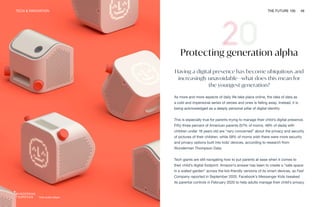
Yoto audio player
Protecting generation alpha
Having a digital presence has become ubiquitous and
increasingly unavoidable—what does this mean for
the youngest generation?
As more and more aspects of daily life take place online, the idea of data as
a cold and impersonal series of zeroes and ones is falling away. Instead, it is
being acknowledged as a deeply personal pillar of digital identity.
This is especially true for parents trying to manage their child’s digital presence.
Fifty-three percent of American parents (57% of moms, 48% of dads) with
children under 18 years old are “very concerned” about the privacy and security
of pictures of their children, while 58% of moms wish there were more security
and privacy options built into kids’ devices, according to research from
Wunderman Thompson Data.
Tech giants are still navigating how to put parents at ease when it comes to
their child’s digital footprint. Amazon’s answer has been to create a “safe space
in a walled garden” across the kid-friendly versions of its smart devices, as Fast
Company reported in September 2020. Facebook’s Messenger Kids tweaked
its parental controls in February 2020 to help adults manage their child’s privacy
TECH & INNOVATION THE FUTURE 100 50
Yoto audio player
on the app more easily, and updated its privacy policy to include more kid-
friendly language and illustrations.
Other companies have built their entire concepts around privacy-first services.
In November 2020, Rego Payments introduced Mazoola, a new digital wallet
app that is compliant with COPPA (Children’s Online Privacy Protection Act)
rules. As well as teaching financial literacy, the app allows children to make
purchases from parent-approved retailers and deliver peer-to-peer payments,
while protecting their identity.
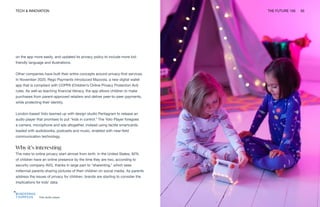
London-based Yoto teamed up with design studio Pentagram to release an
audio player that promises to put “kids in control.” The Yoto Player foregoes
a camera, microphone and ads altogether, instead using tactile smartcards,
loaded with audiobooks, podcasts and music, enabled with near-field
communication technology.
Why it’s interesting
The risks to online privacy start almost from birth. In the United States, 92%
of children have an online presence by the time they are two, according to
security company AVG, thanks in large part to “sharenting,” which sees
millennial parents sharing pictures of their children on social media. As parents
address the issues of privacy for children, brands are starting to consider the
implications for kids’ data.
Travel & Hospitality
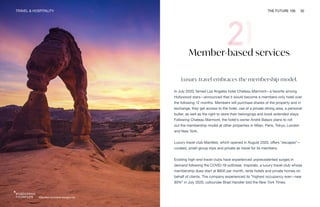
Manifest exclusive escape trip
TRAVEL & HOSPITALITY THE FUTURE 100 52
Member-based services
Luxury travel embraces the membership model.
In July 2020, famed Los Angeles hotel Chateau Marmont—a favorite among
Hollywood stars—announced that it would become a members-only hotel over
the following 12 months. Members will purchase shares of the property and in
exchange, they get access to the hotel, use of a private dining area, a personal
butler, as well as the right to store their belongings and book extended stays.
Following Chateau Marmont, the hotel’s owner André Balazs plans to roll
out the membership model at other properties in Milan, Paris, Tokyo, London
and New York.
Luxury travel club Manifest, which opened in August 2020, offers “escapes”—
curated, small-group trips and private air travel for its members.
Existing high-end travel clubs have experienced unprecedented surges in
demand following the COVID-19 outbreak. Inspirato, a luxury travel club whose
membership dues start at $600 per month, rents hotels and private homes on
behalf of clients. The company experienced its “highest occupancy ever—near
90%” in July 2020, cofounder Brad Handler told the New York Times.
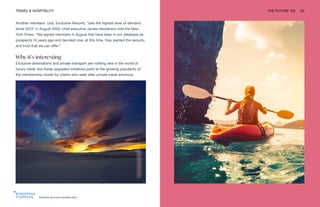
Manifest exclusive escape trips
TRAVEL & HOSPITALITY THE FUTURE 100 53
Another members’ club, Exclusive Resorts, “saw the highest level of demand
since 2013” in August 2020, chief executive James Henderson told the New
York Times. “We signed members in August that have been in our database as
prospects 10 years ago and decided now, at this time, they wanted the security
and trust that we can offer.”
Why it’s interesting
Exclusive destinations and private transport are nothing new in the world of
luxury travel, but these upgraded initiatives point to the growing popularity of
the membership model for clients who seek elite, private travel solutions.
TRAVEL & HOSPITALITY 54
Multigenerational travel
After months of separation, extended families are
now opting to holiday together.
As households have reduced their social circles due to COVID-19 and
some travel restrictions ease, a multigenerational holiday with children and
grandparents has become a viable, less risky option for many families,
Christie Hudson, senior public relations manager at Expedia, told USA Today.
As a result, private vacation home rentals—popular with large groups—are
rebounding more quickly than other types of accommodation.
“While some are only socializing with their own household or immediate
family, others—myself included—have expanded that circle to include the
grandparents,” Hudson said. “The natural extension is to take it on the road
and travel together as well.”
A survey of 440 North American travel advisors, conducted between August
24 and September 8, 2020, by MMGY Myriad and Travel Market Report, found
that 40% of client queries were for domestic destinations and only 20% for
international. Around four in 10 clients were extremely or very interested in
multigenerational travel, about the same proportion as for nuclear family travel.
Arlene Rowe, a law librarian in Washington DC, told Condé Nast Traveler that
she and her husband had initially dreamed of an international trip for their first
family holiday with their infant son. In the light of the pandemic, however, their
plans inevitably changed and instead they ended up organizing an extended
family gathering with her parents and in-laws at a rental in Lake Anna, Virginia.
After family members undertook virus testing and self-quarantined, the group
was able to meet and celebrate two wedding anniversaries, and the
grandparents could hug the baby for the first time in many months.
“It was really just about taking the time to be with each other because that time
is so precious,” Rowe said. “We basically needed to cram a year’s worth of
holidays into one vacation.”
Why it’s interesting
In Asia, the trend of traveling with kids and grandparents has been apparent in
recent years, often as an alternative to Lunar New Year reunions in hometowns.
Now, as international travel remains constrained and family time takes priority,
travel brands beyond Asia may also do well to tap into multigenerational groups.
"
A multigenerational holiday with children and
grandparents has become a viable, less risky
option for many families
"
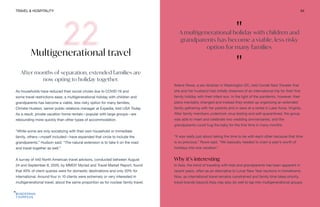
Birch hotel. Image courtesy of Adam Firman
TRAVEL & HOSPITALITY THE FUTURE 100 55
Hospitality redesigned
With consumers looking for safe, socially distanced
stays while also yearning for connection, many hotels
are rethinking their offerings.
Cocooning, self-contained pods, venues that make the most of outside spaces,
and expansive yet welcoming shared public areas are among the features that
could characterize hotel and hospitality design in the COVID-19 era.
Integrated architecture, design, planning, and consulting firm Gensler
stated in a September 2020 website article that “historically, the symbiotic
relationship between cities, architecture and epidemics has always been
complicated; diseases have prompted our cities to morph and progress.” It
noted that “COVID-19 has accelerated the need for a morphological change.
The hospitality industry is among the most affected segments impacted by
this pandemic.”
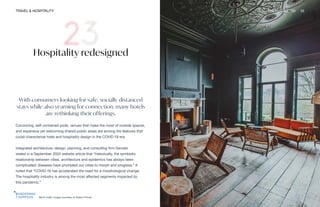
Birch hotel. Image courtesy of Fergus Coyle
TRAVEL & HOSPITALITY THE FUTURE 100 56
One change that Gensler called out is the need for spaces such as guestrooms
and common areas to be multipurpose. “Guestrooms need to be flexible
enough to allow people to realize multiple activities within the same space—
from working to resting, eating, exercising, or gathering with friends and family.
Common spaces will also need to transform to mitigate risks but still bring
people together.”
Jerry Tate, a partner at London architecture practice Tate Harmer, pointed
out to Sleeper magazine in June 2020 that the company’s hospitality
projects frequently featured “self-sufficient accommodation.” He cited Tate
Harmer’s Upland Park project, in the United Kingdom’s South Downs National
Park, that will create self-catering eco lodges to replace a “large, unsightly”
hotel. “The key trend here is that guests now expect to be able to do more
than just make a cup of tea in their room,” said Tate. “The more facilities you
can create in a space to allow them to be reasonably self-sufficient, the more
choice you can give them about whether or not they will join in with the busier
areas of the hotel.”
"
Guestrooms need to be flexible enough
to allow people to realize multiple activities
within the same space
"
Gensler
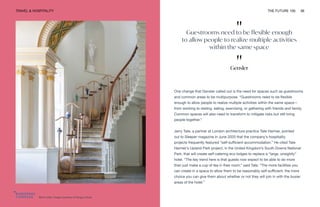
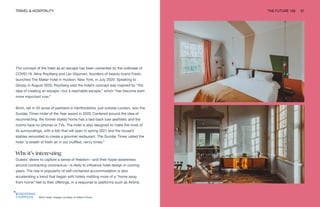
Birch hotel. Images courtesy of Adam Firman
TRAVEL & HOSPITALITY THE FUTURE 100 57
The concept of the hotel as an escape has been cemented by the outbreak of
COVID-19. Alina Roytberg and Lev Glazman, founders of beauty brand Fresh,
launched The Maker hotel in Hudson, New York, in July 2020. Speaking to
Glossy in August 2020, Roytberg said the hotel’s concept was inspired by “the
idea of creating an escape—but a reachable escape,” which “has become even
more important now.”
Birch, set in 55 acres of parkland in Hertfordshire, just outside London, won the
Sunday Times Hotel of the Year award in 2020. Centered around the idea of
reconnecting, the former stately home has a laid-back luxe aesthetic and the
rooms have no phones or TVs. The hotel is also designed to make the most of
its surroundings, with a lido that will open in spring 2021 and the house’s
stables renovated to create a gourmet restaurant. The Sunday Times called the
hotel “a breath of fresh air in our muffled, nervy times.”
Why it’s interesting
Guests’ desire to capture a sense of freedom—and their hyper-awareness
around contracting coronavirus—is likely to influence hotel design in coming
years. The rise in popularity of self-contained accommodation is also
accelerating a trend that began with hotels instilling more of a “home away
from home” feel to their offerings, in a response to platforms such as Airbnb.
Images courtesy of Visit Sicily
TRAVEL & HOSPITALITY THE FUTURE 100 58
Incentivized travel
Eager to reignite the tourism industry, some countries
are now paying travelers to take a break.
The Italian government is banking on national tourism to stimulate the
country’s economy, designating €2.4 billion for its “holiday bonus” scheme
that launched in June 2020. The initiative offers low-income households up to
€500 to holiday in Italy, rather than go abroad. Sicily hopes to attract tourists
with the See Sicily voucher, which can be redeemed at the island’s hotels and
attractions, with the program currently due to be extended until December
2021. The Japanese government launched the Go To Travel campaign in July
2020, offering citizens up to 50% off across transport, accommodation,
attractions, retailers and restaurants.
A loyalty program has been set up by Maldives Immigration, the Ministry of
Tourism Maldives, Maldives Marketing & Public Relations Corporation and
Maldives Airports to reward frequent travelers to the country. The Maldives
Border Miles program was launched in December 2020 and has three tiers.
Visitors earn points based on the number of visits they make and the duration
of their stay to access exclusive benefits, services and rewards.
Destinations are also offering pandemic insurance coverage as an incentive.
In early August 2020, the Canary Islands’ Department of Tourism, Industry and
Commerce partnered with French insurer Axa to give visitors free insurance
covering coronavirus-related incidents. Airlines are using free COVID-19
insurance as a perk to encourage travelers to take to the skies again. On July
23, 2020, Emirates became the first airline to cover COVID-19 expenses and
quarantine costs. Others have quickly followed suit, with Air Canada and
WestJet also launching free COVID-19 travel insurance. WestJet will provide
this coverage until August 31, 2021. Virgin Atlantic is offering complimentary
COVID-19 global insurance cover for all customers until March 31, 2021.
Why it’s interesting
From country loyalty programs and subsidized travel perks to free pandemic
insurance coverage, the travel industry is reinvigorating tourism with new
initiatives aimed at both domestic and international travelers.
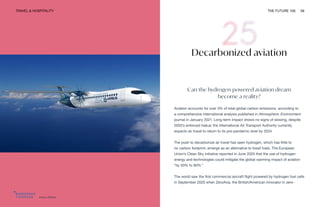
Airbus ZEROe
TRAVEL & HOSPITALITY THE FUTURE 100 59
Decarbonized aviation
Can the hydrogen-powered aviation dream
become a reality?
Aviation accounts for over 3% of total global carbon emissions, according to
a comprehensive international analysis published in Atmospheric Environment
journal in January 2021. Long-term impact shows no signs of slowing, despite
2020’s enforced hiatus; the International Air Transport Authority currently
expects air travel to return to its pre-pandemic level by 2024.
The push to decarbonize air travel has seen hydrogen, which has little to
no carbon footprint, emerge as an alternative to fossil fuels. The European
Union’s Clean Sky initiative reported in June 2020 that the use of hydrogen
energy and technologies could mitigate the global warming impact of aviation
“by 50% to 90%.”
The world saw the first commercial aircraft flight powered by hydrogen fuel cells
in September 2020 when ZeroAvia, the British/American innovator in zero-
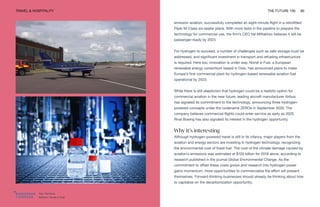
Top: ZeroAvia
Bottom: Norsk e-Fuel
TRAVEL & HOSPITALITY THE FUTURE 100 60
emission aviation, successfully completed an eight-minute flight in a retrofitted
Piper M-Class six-seater plane. With more tests in the pipeline to prepare the
technology for commercial use, the firm’s CEO Val Miftakhov believes it will be
passenger-ready by 2023.
For hydrogen to succeed, a number of challenges such as safe storage must be
addressed, and significant investment in transport and refueling infrastructure
is required. Here too, innovation is under way. Norsk e-Fuel, a European
renewable energy consortium based in Oslo, has announced plans to make
Europe’s first commercial plant for hydrogen-based renewable aviation fuel
operational by 2023.
While there is still skepticism that hydrogen could be a realistic option for
commercial aviation in the near future, leading aircraft manufacturer Airbus
has signaled its commitment to the technology, announcing three hydrogen-
powered concepts under the codename ZEROe in September 2020. The
company believes commercial flights could enter service as early as 2025.
Rival Boeing has also signaled its interest in the hydrogen opportunity.
Why it’s interesting
Although hydrogen-powered travel is still in its infancy, major players from the
aviation and energy sectors are investing in hydrogen technology, recognizing
the environmental cost of fossil fuel. The cost of the climate damage caused by
aviation’s emissions was estimated at $100 billion for 2018 alone, according to
research published in the journal Global Environmental Change. As the
commitment to offset these costs grows and research into hydrogen power
gains momentum, more opportunities to commercialize the effort will present
themselves. Forward-thinking businesses should already be thinking about how
to capitalize on the decarbonization opportunity.
Casa na Terra design by Manuel Aires Mateus for Silent Living.
Photography by Nelson Garrido. Images courtesy of Silent Living
TRAVEL & HOSPITALITY THE FUTURE 100 61
Subterranean resorts
Hotels are being designed to seamlessly integrate into
the landscape, maintaining the natural beauty and
tranquility of their surroundings.
This increasingly popular hospitality experience centers on respecting a
location’s surroundings and helping guests feel more connected to nature.
Casa na Terra, meaning house in the land, is a small building embedded in the
ground in Portugal’s Monsaraz area. Part of boutique hotel group Silent Living,
the property was designed by architect Manuel Aires Mateus and includes
three en-suite rooms and a grand patio overlooking Alqueva lake. “The house
is located in an area where construction is not allowed,” Aires Mateus told
Wallpaper. “Our ecological responsibility was also to make the house disappear
into the landscape.”
Sharaan is a subterranean concept hotel by French architect Jean Nouvel, due
to be completed by 2024. Designs were unveiled in October 2020 for the 40-
room resort, which will be built into sandstone cliffs in Saudi Arabia’s AlUla
desert without compromising its history, heritage and landscape. “Our project
should not jeopardize what humanity and time have consecrated,” says Nouvel.
Left: Sharaan by Jean Nouvel
Right: Under A Rock promotion by Hotels.com
TRAVEL & HOSPITALITY THE FUTURE 100 62
In the United States, those looking to get away from it all could literally live
under a rock. In late 2020, Hotels.com gave travelers the opportunity to stay
in a rustic, man-made cave in New Mexico, 50 feet below ground. This unique
experience was exclusively offered by the booking site as an off-grid, long-
weekend stay during the November 2020 US presidential elections, for those
wanting to alleviate “election stress disorder.”
Why it’s interesting
Travel experiences are increasingly centering on protecting and preserving
the environment. Architects are designing hotels that blend into the
landscape, offering guests the chance to enjoy beautiful and unspoiled
natural surroundings.
Casa na Terra design by Manuel Aires Mateus for Silent Living.
Photography by Nelson Garrido. Images courtesy of Silent Living
TRAVEL & HOSPITALITY
Airbnb
TRAVEL & HOSPITALITY THE FUTURE 100 64
Travel bubbles
Would-be travelers are staying closer to home,
driving local revivals.
Travelers are looking local as the tourism industry constricts. Various countries
have selectively opened up their borders to admit regional travelers from
neighboring areas. Australia and New Zealand were among the first to publicize
plans for a “corona corridor,” although the corridor didn’t open until October
2020. Even then, it was only one way, with Australia admitting New Zealanders,
but Australians not allowed to enter New Zealand.
Airbnb reported an increase in local holidays as the COVID-19 pandemic
continued. The percentage of Airbnb bookings within 200 miles of renters’
homes shot up from a third in February 2020 to over 50% in May, and local US
listings had more bookings between May 17 and June 3 than the same period
in 2019, without the company injecting any marketing support. The company
reported a similar increase in domestic bookings in Germany, Portugal, South
Korea and New Zealand.
"
Travelers are rediscovering
destinations in their
own backyards in place
of exotic trips to
far-flung locales
"
Airbnb
TRAVEL & HOSPITALITY THE FUTURE 100 65
Vacations “will probably look more like they did in the 1970s, before
deregulation made air travel more affordable,” the New York Times predicted in
June 2020. “Think of highways with cars packed full of gear and children in the
back asking, ‘Are we there yet?’”
Why it’s interesting
As travel in a pandemic world shifts “from airplane to car, big city to small
location, hotel to home,” as Airbnb CEO Brian Chesky noted in a June 2020
interview on CNBC, travelers are rediscovering destinations in their own
backyards in place of exotic trips to far-flung locales.
Inspirato Club
TRAVEL & HOSPITALITY THE FUTURE 100 66
Subscribed stays
Hotels are reimagining the subscription model
to attract customers and appeal to a growing
clientele of digital nomads.
Luxury US hospitality brand Inspirato charges a flat fee of $2,500 per month
for its Inspirato Pass subscription, which allows members to book unlimited
stays at its selection of homes and hotels with no nightly charges, taxes or fees.
The $600 per month Inspirato Club subscription offers access to Inspirato’s
accommodation portfolio, with nightly rates for members as they travel. The
company says its subscription model “encourages you to vacation more,”
and founder and CEO Brent Handler told Bloomberg that Inspirato enables
its partner hotels to fill unbooked rooms without publicly discounting and
damaging their brand. “We’re buying inventory from the hotel, and we’re paying
for it, and the consumer is never seeing the price,” Handler said.
Selina, based in Panama, is a global hospitality platform offering
accommodation for extended stays and coworking. In October 2020, the
company acquired the Remote Year brand, which organizes work and travel
abroad programs. Travel industry intelligence platform Skift reported that the
deal offers Selina “a new path to a promising segment of demand for its hotels
Oasis Passport
TRAVEL & HOSPITALITY THE FUTURE 100 67
and hostels.” In August 2020, Selina also launched subscription passes that
allow members to buy travel credits for lower rates, or stay in a property for
one, three or six months, with coworking facilities included. “The rise of digital
nomads is going to be one of the biggest movements hospitality has ever
seen,” Selina cofounder and CEO Rafael Museri told Skift.
Travel company Oasis is also tapping into remote workers’ desire to explore and
stay in destinations for long periods, now that they might not be tethered to an
office. In October 2020, it launched the Oasis Passport, which allows users to
pay a monthly fee to stay in different residences around the world over a three-
to six-month period. A three-month pass for Latin America starts at $1,625 per
month, while passes for Europe start at $2,150 per month. The company says,
“why stay in NYC year-round if you can spend three to six months between
Barcelona, Paris and Buenos Aires?”
Why it’s interesting
The events of 2020 have both accelerated the trend in remote working and
stymied international travel. Travel subscriptions are a way for both hotels
and residences to attract much-needed custom, and for these businesses to
pivot to offer accommodation that’s targeted to remote workers, rather than
traditional vacationers. This trend could be poised to cement itself after the
pandemic if, as the results of a May 2020 Upwork survey predict, one-fifth of
the US workforce could be entirely remote after COVID-19.
Inspirato Club
TRAVEL & HOSPITALITY THE FUTURE 100 68
"
One-fifth of the US workforce could be entirely
remote after COVID-19
"
Google Maps COVID layer
TRAVEL & HOSPITALITY THE FUTURE 100 69
Informed journeys
Transportation apps are giving users information
on making their journeys as safe and
sustainable as possible.
Transportation apps have long been a staple on smartphones, and now they
are going beyond simply giving directions. Using newly added functionality, they
are advising people on how to make the smartest choices for physical and
planetary health.
Looking to help commuters travel in healthier, safer ways, Google Maps
introduced information on COVID-19 cases in September 2020. Available via
the layers function within the Maps app, the data shows as an overlay with the
seven-day average number of confirmed cases of COVID-19 in each area.
Transport for London included health-focused capabilities in its Go app, which
launched in August 2020. The app includes information to help people avoid
packed trains to prevent virus spread, and offers walking and cycling options.
Launched in 2019, the Float mobility app allows users in cities across the
United States and in Singapore to find the most cost-effective, safe and
sustainable ways to travel. In October 2020, the platform announced a
partnership with health and safety-focused Yellow Cab of San Francisco,
to allow Californians to choose safer, convenient travel options.
Why it’s interesting
As conscious consumers grow more aware of the impact of their transportation
choices not only on their own health but also on that of the planet, they will
expect mobility brands to help them make informed decisions.
Tentrr
TRAVEL & HOSPITALITY THE FUTURE 100 70
Isolationist travel
For 2021, think remote destinations, private lands,
and no other tourists in sight.
Travel hotspots in 2021 will be less about dense big cities and more about
spacious immersions in the great outdoors.
“Even once a vaccine is available, the allure of the outdoors is evergreen, and a
year of being pent up will make the desire to be in nature even greater,” Gareth
Chisholm, creative director at Tentrr, tells Wunderman Thompson Intelligence.
Tentrr is the Airbnb of campsites, working with private landowners across the
United States to provide unique glamping retreats. The company was growing
rapidly prior to the pandemic, according to Chisholm, and has introduced
stringent COVID-19 precautions.
Tentrr lists more than 800 glampsites. Examples include an abandoned zoo
in New York’s Catskill Mountains, with access to miles of hiking trails, and
Tentrr
TRAVEL & HOSPITALITY THE FUTURE 100 71
a furnished site in the rugged Steinaker State Park in Utah, with water activities
in a nearby reservoir. Chisholm notes that people are looking for secluded
destinations with a “wow factor”—this could range from on-site waterfalls to
epic vistas from forested mountains. “People are not only looking for a getaway,
they are also looking for some adventure.”
Interest in campsite bookings and equipment has spiked too. The United
Kingdom’s Cool Camping booking agency saw a five-fold increase in bookings
when the lifting of lockdown restrictions was announced in May 2020. British
retailers John Lewis & Partners, Asda and Halfords all reported an uptick in
camping equipment sales over summer 2020.
Pitching up in the wilderness has also led to a surge in overlanding—off-road
camping on grounds less trodden. In the United States, Google searches for
overlanding have approximately doubled in the past year, peaking during the
summer as restless adventurers took to Jeeps, caravans and RVs to experience
new territories accessible by road.
More thoughtful and conscious escapes are part of isolationist travel. As
Chisholm observes, “While we all do enjoy distant and exotic lands, there has
been a greater awareness regarding the impact of air travel, or giant cruises.
Some of that thinking will definitely filter down to the more mindful traveler, and
they’ll consider local or more drivable destinations.”
Why it’s interesting
As the travel industry starts to pick up, preference for destinations that include
nature, adventure and solitude will rise for those who desire a mindful, truly
socially distant escape.
Brands & Marketing
Pfizer and BioNTech COVID-19 vaccine
BRANDS & MARKETING THE FUTURE 100 73
Branding together
A new class of leadership means that brands are
putting aside competition and instead collaborating
to tackle social and environmental challenges.
Generation Z are setting a new standard for brand purpose. In an October
2020 survey by Wunderman Thompson Data, 80% of US gen Zers say that
brands should help make people’s lives better and 82% believe brands
should leave aside their differences and work together for the greater good.
Brands are listening.
In response to the climate crisis, Microsoft launched the Transform to
Net Zero initiative in July and teamed up with eight corporations including Nike,
Mercedes-Benz, Unilever and Danone to become carbon-negative businesses
by 2030. In late 2019, Gucci’s CEO Marco Bizzarri debuted the CEO Carbon
Neutral Challenge urging companies to join him in reducing their greenhouse
gas emissions. Those joining Bizzarri include the RealReal, Lavazza and
software company SAP.
Banding together in the face of the pandemic made for swifter research and
innovation. In April 2020, British pharmaceutical multinational GSK and the
French drugmaker Sanofi joined forces to develop a COVID-19 vaccine.
Adidas tweet to Nike. Image courtesy of Twitter
BRANDS & MARKETING THE FUTURE 100 74
Similarly, American pharmaceutical company Pfizer collaborated with German
biotechnology company BioNTech for a vaccine which has shown swift
success, with the United Kingdom being the first country to approve the
vaccine for use in early December 2020.
In the United States, the death of George Floyd on May 25, 2020 under police
arrest set off global protests and anger concerning systemic racism. Many
brands were quick to respond. Nike released a tweet on May 29 saying “Let’s
all be part of the change” along with a video standing against racism with the
message “For once, Don’t Do It.” The next day Adidas replied with “Together
is how we move forward. Together is how we make change,” in solidarity with
Nike’s messaging.
Tackling unemployment among those who are under-represented in jobs, 27
firms including JPMorgan Chase, Amazon and IBM banded together to create
the New York Jobs CEO Council in August 2020. The Council aims to hire
100,000 people from low-income Black, Latino and Asian communities by 2030.
Why it’s interesting
The cultural shift from “me” to “we” is extending to brands, demonstrating that
change requires collaborative effort.
"
82% of US gen Zers believe brands should leave
aside their differences and work together
for the greater good
"
Go Near campaign by Airbnb. Image courtesy of Airbnb
BRANDS & MARKETING THE FUTURE 100 75
The visual language
of connectivity
How can advertisers and brands convey togetherness
without seeming irresponsible?
Scenes of clustered crowds and large gatherings will continue to appear
inappropriate as 2021 unfolds. So how are advertisers and brands
visualizing togetherness?
“Showing 360-degree life in the home is the dominant approach because it can
convey safe social distancing practices, and a wide variety of lifestyles and
activities,” Brenda Milis, principal of creative and consumer insights at Adobe
Stock, tells Wunderman Thompson Intelligence. Milis explains that brands are
dialing up key themes as a result of the pandemic: connection, support and
wellbeing. They are using visuals of families, partners and quarantine pods
spending time together in different scenarios to express these themes.
Airbnb has community at the heart of its messaging. In June 2020, the company
launched its “Go Near” campaign supporting local travel and economic growth.
The imagery selected for the campaign shows small intimate groups on
vacation, portrayed informally.
Left: The Show Must Go On commercial by Amazon
Right: Go Near campaign by Airbnb. Image courtesy of Airbnb
BRANDS & MARKETING THE FUTURE 100 76
Amazon’s “The Show Must Go On” campaign launched in November 2020
and tells the story of a young dancer who conquers the setbacks of 2020 by
performing for her family, friends and neighbors. “Our TV ad is inspired by, and
pays tribute to, the unbeatable human spirit and the power of community that
we have witnessed so often this year,” says Simon Morris, vice president of
global creative at Amazon.
Forget the compilation of faces via a Zoom call depicting togetherness
(so 2020)—brands and advertisers are opting for smaller group settings and
capturing intimate moments to convey a feeling of community in 2021.
Why it’s interesting
The message of community is being reframed, as Milis notes: “I’ve been
extremely happy to see a scaling focus on building a sense of community
through compassion as well as a growing understanding that we don’t have to
occupy the same physical space to build community, to support one another.”
TikTok and Shopify
BRANDS & MARKETING THE FUTURE 100 77
TikTok ads
The promise of the gen Z market is changing the
face of advertising campaigns and brand messaging,
and TikTok is well-poised to capitalize on this
in a major way in 2021.
The favorite gen Z platform is the main driver of an uptick in short-form video
advertising, but fellow social video app Triller is also entering the fray (the two
companies happen to be engaged in a legal dispute about a patent). In October
2020, Triller announced a partnership with digital advertising platform
Consumable to insert ads between Triller’s video content.
TikTok is also drawing on lessons from its Chinese sister app Douyin. The
platform helps users to monetize content, rather than focusing on big-brand
advertising in the vein of Instagram and Facebook. “In China last year they
helped 22 million creators make over $7 billion,” Fabian Ouwehand, founder
and growth director at Uplab, tells Wunderman Thompson Intelligence.
TikTok and Shopify
BRANDS & MARKETING THE FUTURE 100 78
The platform also launched TikTok for Business in June 2020, essentially
an in-house marketing agency following the example of Douyin. A Shopify
integration was announced in October to bring e-commerce into the
app’s offerings.
The result of these developments is an ecosystem that is friendly to brands,
but places the creator very much at the center. “The most important asset of
TikTok is their own creators,” Ouwehand says. “So they always try to leverage
the creator, because if you look at all the trends which have come out of TikTok
and how they got very popular, it’s thanks to its creators.”
Why it’s interesting
By building these advertising and ecommerce functionalities, TikTok is clearing
a path that will see the platform mature into a powerful social commerce tool as
well as an epoch-defining creative hub. Having a rival like Triller snapping at its
heels is not a bad thing either.
"
TikTok is clearing a path that
will see the platform
mature into a powerful
social commerce tool as
well as an epoch-defining
creative hub
"
The RealReal and Gucci’s Circular Economy partnership.
Image courtesy of the RealReal
BRANDS & MARKETING THE FUTURE 100 79
Big brands go circular
From Gucci to Uniqlo, fashion brands are getting into
the second-hand business.
The trend is driven by sustainability concerns and by the fact that wallets
are slimmer in a global recession. For luxury brands, it’s also a way to
police knock-offs.
Gucci announced a partnership with Nasdaq-listed luxury consignment store
the RealReal in October 2020, following in the footsteps of Stella McCartney
and Burberry. The Gucci x TRR eshop stocks items from consigners as well
as products directly from the Italian fashion house. This came soon after Gucci
launched its first circular collection, Gucci Off the Grid—a unisex capsule
collection using fabrics that are organic, recycled or biobased.
“One garbage truck’s worth of textiles is landfilled or burned every second,”
Julie Wainwright, the RealReal’s founder and CEO, told Vogue. “Fashion can’t
continue being disposable—we have to buy things that are well made and resell
[them] when we’re done with them. Partnering and collaborating directly with
brands, as we are with Gucci, is a meaningful way for us to harness their
"
The resale market grew
25 times faster
than the overall retail
market in 2019
"
The RealReal and Gucci’s Circular Economy partnership.
Image courtesy of the RealReal
BRANDS & MARKETING THE FUTURE 100 80
influence to increase exposure to the importance of circular fashion.”
The second-hand clothing market is forecast to grow from $28 billion today to
$64 billion in 2024, according to San Francisco-based ThredUp, which calls
itself “the world’s largest online thrift store.” The resale market grew 25 times
faster than the overall retail market in 2019, powered by 64 million shoppers,
ThredUp said in its annual report.
Uniqlo is recycling its own used down jackets into new down jackets under
its Re.Uniqlo initiative. The project started in Japan in 2019 and launched in
Singapore in October 2020, with plans to expand the idea to 27 markets. Uniqlo
has been collecting used clothes since 2006 and sorting and donating items to
people who need them through the United Nations Refugee Agency and other
organizations. In Japan, the fast-fashion retailer also turns clothing that cannot
be donated into fuel or soundproofing material.
Why it’s interesting
Brands are acknowledging that the second-hand market is becoming a key
cog in the circular economy. Playing an active role in the fashion recycling
business is also a way for brands to weed out fakes and keep resale values
buoyant, which in turn shores up first-sale prices.
Did They Help? website
BRANDS & MARKETING THE FUTURE 100 81
Ethical scoreboard
How brands behave matters more than
ever to consumers.
According to an IBM survey published in 2020, 40% of consumers are purpose-
driven in their purchases, while Forbes mused whether 2020 “was the year that
‘purpose’ went mainstream.”
Responding to this growing ethical motivation among consumers, platforms
that monitor corporate behavior are popping up, while brands are putting their
values front and center, even when this raises difficult issues. In October 2020,
Disney began placing a warning ahead of its older films streamed on Disney+,
including The Jungle Book, Lady and the Tramp and Dumbo, warning that they
“include negative depictions and/or mistreatment of people or culture.” The
disclaimer adds: “Rather than remove this content, we want to acknowledge its
harmful impact, learn from it, and spark conversation to create a more inclusive
future together.”
Did They Help? is a platform that launched in 2020 as an online record of
companies’ and public figures’ “good and bad deeds,” which it then scores.
"
While brands may not
have had a moral or ethical
responsibility in the past,
they absolutely do now
"
Pooj Morjaria, founder, Did They Help?
BRANDS & MARKETING THE FUTURE 100 82
Visitors to the site can look up those that performed well or badly in response
to events such as COVID-19 and Black Lives Matter. As founder Pooj Morjaria
tells Wunderman Thompson Intelligence, “While brands may not have had a
moral or ethical responsibility in the past, they absolutely do now.”
And to help companies avoid their ads appearing next to content that doesn’t
align with their values—a potential pitfall of automated, programmatic ad
buying—Nandini Jammi and Claire Atkin founded brand safety consultancy
Check My Ads in 2020. “If you juxtapose your media buy with one of your
values and it’s not aligned, then that’s a problem. It’s a message that you’re
sending to your entire universe of stakeholders when you either choose to
uphold your values or to undermine them through your advertising budget,”
Jammi explains to Wunderman Thompson Intelligence.
Against this values-driven backdrop, brands are proactively highlighting their
ethics. Riccardo Bellini, CEO of luxury fashion house Chloé, said in November
2020 that the house is placing purpose at its core, with initiatives such as a
social profit and loss account, establishing a fund dedicated to girls’ education,
and incorporating social entrepreneurs into its supply chain. “What a brand
stands for, its beliefs and values, will become as relevant as products and
aesthetics,” Bellini said in WWD.
Why it’s interesting
Amid the COVID-19 crisis, the Black Lives Matter movement and a fraught
political atmosphere, a sense of collective social responsibility has been
pushed to the top of the agenda in 2020. Consumers are taking strong
stances in terms of their values, and are demanding that brands do the same.
Brands themselves and independent platforms are now making a company’s
ethics ever-more transparent.
Vilnius airport
BRANDS & MARKETING THE FUTURE 100 83
Flexperiences
Innovative companies are finding new ways to
repurpose empty venues and assets, creating hybrid
and adaptable experiences.
Thai Airways repurposed its airplane seats and first-class menus for grounded
customers. At a pop-up restaurant at its company headquarters in Bangkok
in September 2020, guests were served in-flight meals by cabin crew. The
restaurant was kitted out with unused airplane seats and furniture made from
recycled plane parts. (See trend #44, Plane dining, on page 98 for more on
aviation-themed eating.)
In April 2020, the pandemic not only halted the airline industry, but the leisure
industry too, as movie theaters closed across much of the world. Lithuania’s
Vilnius airport teamed up with the organizers of the Vilnius International Film
Festival to transform the airport runway into a drive-in-style movie theater
called the Aerocinema.
In China, a cinema changed its function entirely, opening as a fresh food market
in attempt to survive economically. A video circulated online of the cinema in
Beijing’s Chaoyang district, showing queues of people waiting to get in, the
Global Times reported.
Why it’s interesting
Not only do these examples show how brands and businesses can spark joy in
tough times, they also highlight the powerful role agility and collaboration can
play in adjusting to change. These creative responses point the way forward to
a new genre of experiences that champion adaptive spaces.
Check My Ads
BRANDS & MARKETING THE FUTURE 100 84
Brand safety
Brand safety is the latest consideration when
communicating brand values—and context is king.
What is brand safety? Broadly speaking, it’s the protection of a brand’s
reputation. Practically speaking, that translates into monitoring the environment
in which a brand’s content or advertising appears. Increasingly this is a critical
consideration for brands to appeal to a rising class of vigilant consumers.
“Customers just aren’t responding to advertising the way they used to,” Nandini
Jammi, cofounder of brand safety consultancy Check My Ads, tells Wunderman
Thompson Intelligence. Modern consumers are looking beyond messaging,
diving into a brand’s ethics, actions and values—and, most recently, are looking
at where ads appear as an indication of those values.
Jammi and cofounder Claire Atkin launched their brand safety consultancy in
June 2020 to address a flaw they observed in brand strategy amid the shifting
consumer landscape: while a brand’s messaging may align with its values, the
places where its advertising appears can damage it.
“We’re at a time where, in advertising, the environment in which you advertise
is as important as the message itself. Where you advertise actually sometimes
matters more than the brand’s message—it either reinforces your brand
message or it undermines it,” Jammi says.
Popular social media platforms are ramping up their brand safety protections,
giving companies more control over the context in which their ads appear.
TikTok partnered with brand safety platform OpenSlate in October 2020 to
ensure that businesses advertising on TikTok won’t have their ads and branded
content placed alongside material that is deemed questionable. “Content and
context have never mattered more,” says Mike Henry, CEO of OpenSlate.
In the same month, YouTube named Zefr as a brand safety reporting partner,
with plans to develop and roll out brand safety measures in 2021.
Why it’s interesting
“Brands are starting to wake up to the realization that in order to be brand safe,
they must do good by their communities,” Jammi says. The communication of
a brand’s values goes far beyond its products; it includes everything from brand
actions to treatment of employees to the context in which its ads appear.
A Little Brighter Inside campaign by TikTok. Images courtesy of TikTok
BRANDS & MARKETING THE FUTURE 100 85
Campaign: uplift
In a year of sickness, poverty and hardship,
brands and marketers are trying to uplift people,
particularly around major holidays.
During Ramadan 2020 in Indonesia, Telkomsel’s “Continue Doing Good”
campaign showed subscribers video calling relatives and friends to stay
in touch. The country’s biggest mobile service provider also reminded
consumers they could transfer unused phone minutes and data to those
who needed it, donate money, and stream religious content—in short,
doing good while staying home.
In the United Kingdom, TikTok ran its first TV ad in May 2020, showing how
people stuck at home were using its short-video platform to stay upbeat. It
featured girl band Little Mix, rapper Tinie Tempah and chef Gordon Ramsay as
well as members of the public (and their cats), and was part of a wider digital
campaign, “A Little Brighter Inside,” showing celebrities and creators sharing
their lockdown routines on TikTok.
Also in the United Kingdom, John Lewis & Partners and Waitrose & Partners
produced a feelgood Christmas 2020 campaign. The group’s much-anticipated
Christmas ad is known for tugging heartstrings each year, and the 2020 creation
"
The message is
that everyone has
a role in keeping
everyone else safe
"
BRANDS & MARKETING THE FUTURE 100 86
was especially poignant. In “Give A Little Love,” eight artists created vignettes
connected by everyday acts of kindness, showing how a chain of good deeds
can lift the spirits of those around us. Through the Christmas ad, the John
Lewis & Partners and Waitrose & Partners group aimed to raise £4 million ($5.3
million) for charity.
Boots, the UK drugstore chain, also created a Christmas 2020 ad around
kindness. With a series of singing bars of soap, loofahs and bubbles, and a
soaring rendition of the song “What the world needs now is love sweet love,”
the ad solicited donations for soap and other hygiene products for those in
need. At the end of the ad Boots announced it was donating £1 million ($1.3
million) to the Hygiene Bank charity.
In India, in November 2020 mosquito repellent brand Goodknight
commemorated World Children’s Day with an ad that looked almost like
normal times. A boy feeds his toddler brother, pretending the approaching
spoon is an airplane. A young girl pulls her father’s sleeve away from the
flame of the prayer candle he’s lighting. A daughter reminds her father to
apply mosquito repellent before leaving the house. The face mask he dons
is the only clue to the pandemic.
The message is that everyone has a role in keeping everyone else safe, even
the little ones, says Rishabh Parikh, Mumbai-based Wunderman Thompson
planning director.
Why it’s interesting
With the development of several promising COVID-19 vaccines, there could now
be light at the end of the pandemic tunnel. But many still need help and the
campaigns highlight how in uplifting others, we are ourselves uplifted.
Barça TV+
BRANDS & MARKETING THE FUTURE 100 87
Fan fidelity
Sports are laying the groundwork for enhanced digital
consumer engagement.
The pandemic-induced hiatus in the public attending live sports has given rights
holders a renewed appreciation for the value of engaging fans digitally. Moving
forward, digital fan engagement will become indispensable—and could offer a
roadmap for up-leveling brand loyalty.
Even before the pandemic, digital innovation for sports fans was ripe for
development. Blockchain-based company Chiliz, for example, launched
Socios.com in November 2019 as a fan engagement app. At the time, Chiliz
CEO Alexandre Drefus noted that “99% of sports fans are not in the stadium,”
pointing out that sport had become a global phenomenon, propelled “by social
media, global TV rights, and the attraction of superstar players.” Socios.com
addresses this by giving fans the opportunity to earn rewards and incentives
for engaging with their favorite club. By hunting, buying or earning fan tokens,
supporters get to influence club matters by voting in polls and surveys. Tokens
act as a virtual membership, entitling the holder to rewards, merchandise and
one-of-a-kind experiences.
Barca TV+
BRANDS & MARKETING THE FUTURE 100 88
The COVID-19 outbreak has seen the trend reach new heights. In September
2020, the Mumbai Indians cricket club launched a number of virtual innovations
to unite and engage its army of fans, known as the Paltan. Among them is
Paltan Play, launched in association with Samsung. The second-screen
experience for matchdays allows fans to compete against one another by
predicting events in the game, such as runs scored or wickets per over.
La Liga North America is taking an exclusive approach, tapping the growing
trend of watch parties to deliver a VIP experience for a group of Spanish soccer
superfans. It is hosting a series of five exclusive watch parties on the LiveLike
platform, presented by legends of La Liga such as Samuel Eto’o and Diego
Forlán, and featuring streaming Q&As with the players and a live chat room
throughout the game.
Alongside fun digital matchday experiences like these, fans want 24/7 content
that gets them closer to the athletes and the action. That’s why legendary
soccer club FC Barcelona is now building a pedigree in entertainment. In
summer 2020, the organization launched its dedicated streaming platform
Barça TV+, a treasure trove of content for fans, featuring more than 1,000 hours
of content from live matches and replays, behind the scenes exclusives and
gems from the archive. The club also boasts its own production house that is
creating content for the platform, including original documentaries and series,
and even a soccer-based original drama.
The Barça TV+ launch is linked to the Culers premium membership program.
An evolution of an existing membership scheme, it offers full access to all digital
fan services alongside eligibility for a range of discounts, special offers and
prize-draw opportunities.
Why it’s interesting
A rich new era of fan engagement that prioritizes experience and immersion
across multiple digital touchpoints offers brands a new playbook for consumer
engagement—and could hold the key to long-term loyalty. As Stephanie
McMahon, chief brand officer for WWE, said in a CES 2021 panel about the
future fan experience: “Where the intersection of tech [and sports] really
becomes successful is when it creates an emotional experience, an emotional
connection for the audience.”
"
Digital fan engagement will become
indispensable—and could offer a roadmap for
up-leveling brand loyalty
"
Beyond Meat x EVERFI
BRANDS & MARKETING THE FUTURE 100 89
Brand academy
Are cobranded diplomas the future of education?
With education systems in a time of transition, brands are stepping in. In 2020,
lockdowns forced 1.5 billion students around the world home from school,
as UNESCO reported. This created devastating barriers to learning for many
education systems—and an opportunity for brands to come to the aid of
teachers and students.
In November 2020, HSBC UK announced a partnership with financial education
charity Young Money to launch Money Heroes, a financial literacy platform for
children aged 3 to 11. Its program includes resources for parents and teachers,
and covers everything from managing a budget to preventing fraud.
Facebook has been providing help for students and teachers around a variety
of topics not traditionally covered in the classroom. In August 2020, it launched
the Educator Hub, which includes courses for students on anti-racism, digital
literacy and wellbeing, as well as resources for teachers, such as courses on
supervising online learning.
Looking to help children learn more about environmentally friendly living,
Beyond Meat teamed up with social education platform EVERFI to make
sustainability education freely available to students and teachers in the United
States. The online courses launched for the 2020-2021 school year, covering
topics such as climate change and biodiversity, and new activities will be added
throughout 2021 to reinforce the curriculum.
Why it’s interesting
The concept of branded education is not new—McDonald’s established its
Hamburger University in 1961. However, companies are now looking to get
involved in deeper, more impactful ways, training not just their current or future
employees, but future generations.
Food & Drink
Les Bains hotel swimming pool, now drained and repurposed
FOOD & DRINK THE FUTURE 100 91
Adventure dining
Diners are seeking out unforgettable gourmet
experiences in a new era of social distancing.
Restaurateurs are bringing high-end, socially distanced dining to unique locales
for customers in search of a one-of-a-kind meal.
In Budapest, Michelin-starred eatery Costes is taking fine dining to new
heights. On October 17, 2020, the restaurant served a four-course dinner on
the Budapest Eye Ferris wheel, which offered guests stunning views of the city
from the four-person cabins. A decline in visitor numbers due to COVID-19
travel restrictions gave Costes owner Karoly Gerendai the opportunity to
implement his vision of creating a restaurant at the attraction. Tickets for the
$155 meal sold out in days, Reuters reported, and, following the success of the
event, Gerendai announced plans to repeat the event in spring 2021.
Luxury Parisian hotel Les Bains drained and repurposed its underground
swimming pool—which dates back to 1885 when the hotel was originally built
as a bathhouse—to create a unique private dining room in September 2020.
Little Palm Island
FOOD & DRINK THE FUTURE 100 92
It is part of the Les Bains Confidentiels series, showcasing exclusive and
unusual spaces at the hotel. Options also include a private table in the hotel’s
iconic nightclub, which has hosted figures such as Mick Jagger, Naomi
Campbell and Kate Moss.
At Little Palm Island Resort and Spa, restaurant reservation times are set by the
tides. Located on Little Torch Key in Florida, the resort’s Dinner on the Sandbar
is a five-course meal for two, served at a private table in shallow water in the
ocean. Introduced in September 2020, the gourmet experience costs $1,000.
Why it’s interesting
The ritual of eating out is evolving. High-end dining destinations are getting
creative, offering exclusivity and unparalleled experiences in an effort to comply
with social distancing measures without compromising on ambience.
Les Bains hotel swimming pool, now drained and repurposed
FOOD & DRINK THE FUTURE 100 93
Panera
FOOD & DRINK THE FUTURE 100 94
Climate-friendly diets
Healthy eating takes on a whole new meaning
for “climatarian” diners.
A quarter of global carbon emissions are related to food production—and
consumers are taking action. One in five millennials are changing their diet to
reduce their impact on the environment, according to January 2020 findings
from YouGov. To cater to consumers eating for planetary health, brands and
platforms are introducing new offerings to help consumers better understand
the impact that their food choices have on the environment.
In October 2020, Panera Bread introduced carbon footprint labeling on its
menus. The bakery-café chain worked with the World Resources Institute to
determine which of its meals qualify as low carbon and to identify its most
climate-friendly options.
“Understanding the impact of what we eat on the environment is one way we
can all take a small step toward combating climate change,” said Panera CEO
Niren Chaudhary. “So as a food company, we feel a strong responsibility to
share this information and empower our guests to help make a difference.”
In the same month, Chipotle launched a sustainability impact tracker to help
customers analyze the sustainability of their lunch. The Real Foodprint tracker
Top: Just Salad
Bottom: Chipotle
FOOD & DRINK THE FUTURE 100 95
analyzes Chipotle’s ingredients on key metrics like carbon emissions and
gallons of water saved. The company teamed up with millennial favorite Bill Nye
the Science Guy to demonstrate how Real Foodprint works with a TikTok video.
Just Salad anticipates that health-conscious diners will calculate carbon
footprints the same way they count calories. The salad chain’s new carbon
labeling program, implemented in September 2020, lists the carbon emissions
of each menu item.
These new programs are “contributing to a social shift where people do really
start thinking about budgeting their carbon in the way they think about
budgeting calories, money, steps on their iPhone,” said Sandra Noonan,
Just Salad’s chief sustainability officer.
In November 2020, an alliance of health professionals in the United Kingdom
called for a climate tax to be imposed on food with a heavy environmental
impact by 2025, and issued a report with a series of suggestions for reorienting
the food industry towards climate action. “We can’t reach our goals without
addressing our food system,” said Kristin Bash, who leads the Faculty of Public
Health’s food group and is a coauthor of the report.
Why it’s interesting
The concept of healthy eating is expanding to encompass foods that
nourish the planet alongside the consumer. “The message is clear,” Marco
Springmann, a researcher at the University of Oxford who specializes in the
health, environmental, and economic dimensions of global food systems, told
the Guardian. “Without drastic reduction in the production and consumption
of meat and dairy, there is little chance of avoiding dangerous levels of
climate change.”
Matter by Designsake Studio
FOOD & DRINK THE FUTURE 100 96
Antimicrobial packaging
Packaging companies and brands are responding to
consumers’ heightened focus on cleanliness with
solutions that foster a sense of hygiene security.
In October 2020, San Francisco strategic agency Designsake Studio unveiled
Matter, an antimicrobial protective coating that can be used on materials
including paper, card, glass, metal and textiles. Matter was created using
advanced silver technology, as the metal disrupts a virus’s reproduction. It has
been certified in the United States by the Food and Drug Administration and
Environmental Protection Agency as an antimicrobial technology that provides
protection against 99.9% of microbes. Danielle McWaters, founder and CEO
of the studio, says that the packaging proves that “you don’t have to sacrifice
aesthetics for safety or recyclability. We hope Matter can bring joy back to the
unboxing experience and create the next evolution of safe and sustainable
packaging solutions.”
Catering to the large number of consumers who are now cooking at home more
often, Rubbermaid launched EasyFindLids in October 2020. The range of food
storage containers features SilverShield antimicrobial technology to inhibit the
EasyFindLids by Rubbermaid featuring SilverShield technology
FOOD & DRINK THE FUTURE 100 97
growth of odor-causing bacteria. “At a time when consumers are cooking
more at home, we are pleased to offer a new storage solution that not only
helps reduce clutter but also keeps food storage containers free of odors,” says
Kris Malkoski, CEO of the Food Business Unit at Newell Brands, Rubbermaid’s
parent company. Researchers at the Verschuren Centre at Canada’s Cape
Breton University are working on creating antiviral packaging and coatings that
could kill the coronavirus on contact, CBC News reported.
The antiviral coatings market is forecast to grow at a compound annual growth
rate of 13.3% between 2020 and 2027, to a value of $1.3 billion, according to a
report by Allied Market Research. The company noted that increased demand
during the COVID-19 outbreak was driving growth, and that “the current
pandemic offered opportunity for new product developments.”
Why it’s interesting
As consumers are hyperaware of a virus’s ability to survive on surfaces,
expect antibacterial and antiviral packaging to become more important in
purchasing decisions.
"
The antiviral coatings market is forecast to grow
at a CAGR of 13.3% between 2020 and 2027,
to a value of $1.3 billion
"
Taste of Finnair
FOOD & DRINK THE FUTURE 100 98
Plane dining
Elevated onboard eating captures would-be
travelers’ appetites.
Airplane food—once considered a low point of air travel—has become a draw
for grounded patrons looking to recreate the travel experience.
In October 2020, Finnair began selling Taste of Finnair, a ready-made line of its
business-class meals, in a grocery store in Finland. The menu, which rotates
offerings every two weeks, is a fusion of contemporary Nordic and Japanese
cuisines. The launch kicked off with an appetizer of roasted carrot and blue
cheese mousse, and two entrees: smoked char and chanterelle risotto, and
beef with teriyaki-radish sauce, spring onions and rice.
Earlier in the same month, Singapore Airlines hosted a pop-up restaurant on
board two Airbus A380s parked at Changi Airport. Demand was so high that
the two planned dinners sold out 30 minutes after reservations opened, which
Left: Taste of Finnair
Right: Singapore Airlines
FOOD & DRINK THE FUTURE 100 99
prompted the airline to host two additional meals. Like a flight itself, tickets were
tiered by cabin class. The four dining options—first class, business class,
premium economy and economy—ranged from a $474 five-course meal served
in a private suite to a more affordable $40 option.
For frequent flyers looking for collectibles alongside their meals, Qantas has put
catering carts from its recently retired Boeing 747 fleet up for sale. Qantas
loyalists were quick to snap up the carts; Business Insider reported that 1,000
carts sold in just two hours. They were stocked with mini bottles of wine and
champagne, snacks, candy, business-class amenity kits, throw blankets and
first-class pajamas.
Why it’s interesting
Plane food is plain no longer; gone are the days of bland microwaved meals.
While these endeavors may have been conceived as a stopgap solution for
faltering airline business, they point to a continuing evolution in airline dining.
In-flight meals are evolving into gourmet offerings that diners choose to eat—
even when they’re grounded.
Zuul. Photography by Nico Shinco
FOOD & DRINK THE FUTURE 100 100
Ghost kitchens
A new model for the restaurant industry optimizes
operations and prioritizes off-premises dining.
The growing popularity of delivery-first dining, which proliferated during
lockdowns, is opening the door to a new restaurant concept: the ghost kitchen.
Rather than renting and staffing full cooking and dining spaces, ghost kitchens
allow restaurants to rent workspace in shared kitchens where cooking is done
expressly for delivery and takeout.
Euromonitor estimates that ghost kitchens could be a $1 trillion business by
2030—and a wave of big players in the food and drink space is kickstarting the
market. In November 2020, Chipotle introduced its take on the ghost kitchen
with the launch of Chipotle Digital Kitchen. The digital-only prototype café
operates solely for pick-up and delivery, with no dine-in options.
Midwestern grocery chain Kroger announced a partnership with ClusterTruck,
a delivery-only restaurant startup, in October 2020. Through the partnership,
Kroger will provide ClusterTruck with on-premises ghost kitchens to produce a
variety of freshly prepared on-demand meals, with no service or delivery fees.
Kroger vice president Dan De La Rosa says the partnership is “an innovation
that streamlines ordering, preparation and delivery.”
Top: Kitch
Bottom: Nextbite
FOOD & DRINK THE FUTURE 100 101
DoorDash announced its Reopen for Delivery program on October 26, 2020,
helping restaurants forced to close as a result of the pandemic to reopen as
virtual eateries, operating out of ghost kitchens.
Investors are getting in on the game, too. In July 2020, ghost kitchen company
Zuul—which counts popular salad chain Sweetgreen among its clients—raised
$9 million to expand in New York City after opening its first Manhattan location
in September 2019. The Wall Street Journal reported in October 2020 that
Travis Kalanick, founder and former CEO of Uber, has invested $130 million
in real estate for his ghost kitchen startup CloudKitchens. The same month,
SoftBank’s Vision Fund invested $120 million in Nextbite, which CEO Alex
Canter describes as “a portfolio of delivery-only restaurant brands that exist
only on Uber Eats, DoorDash and Postmates.”
NYC startup Kitch, launched in January 2020, hopes to create the Airbnb of
ghost kitchens. Calling itself a “kitchen matchmaker,” the startup connects local
eateries with hotel operators, restaurateurs, and other food businesses renting
out their kitchens during off-peak times.
Why it’s interesting
Prioritizing restaurant space for cooking, rather than dining, follows the path set
by the delivery boom, which saw global foodservice delivery sales more than
double from 2014 to 2019, according to Euromonitor. “In the same way that,
in the last five years, third-party delivery has helped to define the restaurant
industry, the next stage of that evolution over the next five years is going to
be ghost kitchens and other forms of distributed production,” Euromonitor’s
global head of beverages and foodservice research Michael Schaefer tells
Wunderman Thompson Intelligence.
Zuul. Photography by Nico Shinco
FOOD & DRINK THE FUTURE 100 102
Whole Foods Market
FOOD & DRINK THE FUTURE 100 103
Breakfast upgraded
More time at home means that breakfast is
transforming from a rushed necessity to a ritual that
people are increasingly investing in.
In a British study looking at the 12 weeks to June 14, 2020, a Kantar survey
showed that consumers ate eggs for breakfast on 68% more occasions than
in the same period the previous year, with bacon consumption up 21% and
pastries up 25%, as reported in the Grocer. And in an October 2020 article
for Business Wire, US supermarket chain Wholefoods called out an “epic
breakfast every day, not just for weekends,” as one of its top 10 anticipated
food trends for 2021.
“For many people, working from home has meant having the time to slow down
and savor breakfast—rather than scoffing a croissant on the commute,” says
Shokofeh Hejazi, senior editor at British consultancy The Food People. “What’s
more, ‘breakfast’ is no longer confined to first thing in the morning. We are
FOOD & DRINK THE FUTURE 100 104
seeing traditional breakfast items, like filled croissants or breakfast burritos,
being enjoyed throughout the day.” Hejazi notes the influence of global cuisine
on Western breakfasts, with the popularity of dishes such as Japanese egg
sandos, Malaysian kaya toast, and Mexican breakfast tacos on the rise,
alongside “toast 2.0—plain white toast swapped out for homemade sourdough,
artisan butter and seasonal jam.”
Bianca Bridges, author of Breakfast London: Where Real Londoners Eat, says
that, alongside the impact of global lockdowns, “breakfast in general is a meal
that has been growing in popularity, due to people prioritizing socializing to start
their day instead of end with it, as well as a love of breakfast food items.” She
explains that an increased number of restaurants and cafés releasing breakfast
and brunch-themed cookbooks has also led more people to create more
elaborate breakfasts at home. “Lockdown has provided people with the time
to do this,” she says.
Illustrating the breakfast boom in London, Bridges points to innovative
bakeries offering new takes on pastries, such as rosemary and sea salt twists
at Popham’s bakery in London, and salted caramel apple or poached pear
and praline custard Danishes from east London bakery Jolene.
Why it’s interesting
With people spending more time at home and COVID-19 restrictions
leading many to socialize earlier in the day, breakfast is enjoying a renewed
appreciation. “Breakfast is becoming more and more of an event,” says
Bridges. “After restrictions ease, people will be craving experiences. I expect
we’ll see a rise in notable and experiential dining—whether it’s brunch events,
dramatic breakfast platters for the table to share, or restaurants creating other-
worldly environments, transporting their guests for the duration of their meal.”
"
Breakfast is becoming more
and more of an event
"
Bianca Bridges, author of Breakfast London:
Where Real Londoners Eat
Beyond Meat
FOOD & DRINK THE FUTURE 100 105
Asia goes plant-based
Food brands are creating plant-based and
cultured-meat alternatives to target health-conscious
Asian consumers.
In mid-2020, Los Angeles-based Beyond Meat, which produces plant-based
meat alternatives, launched its Beyond Burgers in China’s Freshippo
supermarkets (also known as Hema). Asian startups are also introducing plant-
based or lab-cultivated food products as ingredients in alternative versions of
comfort food—such as bao buns, siu mai dumplings or hot pots—that can fit
easily into local cooking styles.
In recent years, with Asia’s rising per capita income, meat consumption has
gone up, but so has demand for meat alternatives. Across Asia Pacific, the
market for meat substitutes was $15.3 billion in 2019, up 4.75% from the
previous year, according to Euromonitor International.
Singapore-based startup Karana sources organic jackfruit from smallholder
farms in Sri Lanka to create its meat-like alternative to pork. Karana raised
$1.7 million in seed funding from investors including Tyson Foods and Big Idea
Ventures, with a focus on increasing commercial production and developing a
line of ready-to-cook products.
Beyond Meat
FOOD & DRINK THE FUTURE 100 106
Beijing-based startup Zhenmeat has launched a range of plant-based products
tailored to Chinese cuisine such as hot pot and dim sum. Made from plant
proteins including pea, soy and brown rice, and fungus-based proteins sourced
from mushrooms, the product range includes sausages, steaks, mooncakes
and meatballs.
In Singapore, Shiok Meats is researching lab-cultivated seafood, in part to solve
the problem of giant shrimp farms, which destroy mangrove forests and can
breed disease. By July 2020, it had raised $7.6 million from investors such as
US accelerator Y Combinator and expects its products to be available within
a few years.
Young people in particular say they are rethinking what they put in their bodies,
for the benefit of their own health and that of the planet. In a 2019 Wunderman
Thompson Intelligence survey of teens and young adults in nine Asian markets,
56% of respondents say they are trying to eat less meat. COVID-19 has
provided a further catalyst for health-conscious, meat-free eating.
Why it’s interesting
The end result could be more choices for all. Elaine Siu, managing director of the
Good Food Institute’s APAC chapter, sees a future where the meat aisle will include
a choice of plant-based alternatives, as well as new foods that blend animal and
plant origins, making “our food choices more customizable and diverse.”
Plex'eat. Image courtesy of Christophe Gernigon Studio
FOOD & DRINK THE FUTURE 100 107
Dining redesigned
Cutlery and tableware are being reimagined to reflect
evolving dining etiquettes.
Designers are turning their attention to the table in an effort to elevate the
distanced dining experience. Design studio March Gut introduced a new
serving format in October 2020. The Alma Tray, created for the Biohotel
Schwanen in Bizau, Austria, makes serving at a distance easier. Measuring
1.2 meters long—just over Austria’s one-meter physical distance requirement—
the sleek tray means waitstaff don’t need to lean across diners to serve and
remove dishes.
Studio Boir is rethinking tabletop design with its New Normal collection.
Unveiled in October 2020, the range of high-design tableware accommodates
new ways of sharing and serving food, with sculptural pieces including divided
serving platters and elongated spoons.
“Our conceptual tableware retains that important social and cultural dimension
of dining—sharing,” studio founder Ivan Zidar explained. “Boir’s tableware
bridges the gap between intimacy and distance.”
Christophe Gernigon Studio is also working to preserve an element of intimacy
while dining out. In May 2020, the French designer revealed the Plex’eat
concept. Translucent lampshade-like hoods cover each individual diner and
their place setting, or an entire table for two, so diners don’t feel isolated when
eating out. Gernigon describes the plexiglass hoods as “elegant alternatives
that guarantee the rules of social distancing.”
Why it’s interesting
In “The Future 100: 2.0.20” we charted how restaurants were redesigning
their spaces to protect diners and adhere to social distancing measures
without diminishing the dining experience. Now, designers are focusing on
the details of dining, innovating how it looks to serve and share food. These
latest projects point to a more sophisticated and nuanced future of physically
distanced dining.
Plex'eat. Image courtesy of Christophe Gernigon Studio
FOOD & DRINK THE FUTURE 100 108
Apt. Photography by Justin De Souza
FOOD & DRINK THE FUTURE 100 109
Intimate dining
High-end restaurants and culinary start-ups
are positioning private dining as the latest luxury
when eating out.
In June 2020, the United Kingdom saw the launch of Apt, an intimate dining
experience for diners and those in their social bubbles. When the pandemic
left the hospitality industry in decline, some of London’s top high-profile chefs
grouped together to create a new way of bringing gourmets and food together
again. As regulations permit, guests can make a booking for a group of up to 10
people and select a chef from Apt’s roster, who will create a bespoke menu for
the occasion. Events take place in an apartment in east London’s Town Hall
Hotel, or at the client’s home.
Michelin-starred chef Pichaya Utharntharm, also known as Chef Pam, offers a
private dining service in Bangkok; The Table by Chef Pam is located in her own
home. Parties of four to 16 people can book an exclusive meal experience of up
to 12 courses.
Ecuadorian-American chef Jose Garces’ seafood restaurant The Olde Bar is
shaking up the restaurant scene in Philadelphia. In October 2020, the restaurant
"
2020 dining points the way to a future
of culinary experiences where privacy
and personalization are paramount
"
Bord för En
FOOD & DRINK THE FUTURE 100 110
revealed interior renovations that allow guests to enjoy their meal sitting in
one of 14 library-themed dining nooks, which lend the feel of a private
dining experience.
Bord för En (“table for one”) in Sweden catered to those seeking a unique and
truly isolated private dining experience. The pop-up restaurant launched in May
2020 and was designed to let single diners enjoy a different kind of meal out.
Situated in the middle of a Swedish summer meadow, 200 miles from
Stockholm, it offered entirely no-contact service. Guests dined alone at a single
chair and table, helping themselves to a three-course gourmet meal that arrived
in a traditional picnic basket delivered via a cable connected to the kitchen.
Why it’s interesting
These dining experiences are reviving the excitement of eating out that was lost
throughout 2020. They point the way to a future of culinary experiences where
privacy and personalization are paramount.
Fly By Jing Sichuan chili sauce
FOOD & DRINK THE FUTURE 100 111
Three hot food ingredients
Three hot new ingredients to watch in
the food category.
The Sichuan peppercorn
Having defined the cuisine of an entire Chinese province, the Sichuan
peppercorn is now setting mouths afire across the world. In recent years, the
swift expansion outside China of hot-pot restaurant chains such as Haidilao and
Yang Guo Fu, serving up simmering soups of peppery meat and vegetables,
has helped spread the peppercorn’s numbing charms to the United Kingdom,
Japan, Australia and Southeast Asia.
The Sichuan peppercorn is also making inroads as a condiment. In 2019, the
US-based chef and food writer Jing Gao ran a successful Kickstarter campaign
to launch Sichuan Chili Crisp, billed as the “first and only 100% all-natural chili
sauce,” for export to the United States. The sauce’s ingredients include Sichuan
pepper and fermented black beans, and it has since topped everything from
fried eggs to dumplings to, memorably, vanilla ice cream from the Wanderlust
Creamery in Los Angeles.
New Zealand Gardener magazine
FOOD & DRINK THE FUTURE 100 112
Home-grown herbs for teas
Home gardeners are cultivating herbs with calming and immunity-boosting
properties for steeping into teas, to use as natural remedies. In New Zealand
there’s been a growing interest in rongoā, traditional Māori medicinal
practices that feature herb teas. Examples include kawakawa, whose
heart-shaped leaves steep into a digestive tonic, and manuka, which has
anti-bacterial properties.
In May 2020, during New Zealand’s national lockdown, Auckland-based
New Zealand Gardener magazine ran an article recommending herbs for
“emotional resilience.” They included lavender, passionflower, ashwagandha
and chamomile for relieving stress and anxiety, and lemon balm to combat
insomnia. The magazine’s retail sales held steady during the pandemic,
according to Roy Morgan, New Zealand's largest independent market research
company, making it a rare bright spot in publishing at a time when several major
lifestyle publications in the country closed down.
“You see a surge of interest in gardening following every global recession, like
clockwork,” Jo McCarroll, editor of NZ Gardener, tells Wunderman Thompson
Intelligence. “You saw it after the 80s financial crisis, after the 90s dot-com
bubble. People think: ‘I need to have something in my life that’s more real and
more manageable.’ You’re seeing that now.”
Prime Roots
FOOD & DRINK THE FUTURE 100 113
Koji
Koji, the Aspergillus oryzae mold, has long been prized in Japan for its qualities
as a fermentation agent used to make sake, mirin and soy sauce, among other
products. Koji is so highly prized for its umami flavor that it is celebrated
annually on October 12, Japan’s National Fungus Day. Now it is showing up as
a prime ingredient in plant-based meat alternatives on western grocery shelves.
For Thanksgiving 2020, Prime Roots, a Californian provider of plant-based meat
alternatives, introduced a koji-based “turkey” roast with a meaty taste and
texture. The faux turkey’s other ingredients include rice, pea protein, pea fiber
and vinegar. The koji “turkey” came after the 2020 launch of Prime Roots’ meat-
free frozen meals at Whole Foods, including koji-based “bacon” mac and
cheese and Hawaiian Shoyu “Chicken.”
Renowned chefs around the world have spoken highly of the Japanese fungus,
including David Chang of Momofuku in New York and René Redzepi of Noma
in Copenhagen.
Beauty
Byredo makeup collection. Photography by Bohman Sjöstrand
BEAUTY THE FUTURE 100 115
Unbound beauty
A new wellness movement is setting the palette for
unconventional beauty.
Prolonged at-home comforts may have given a moment to makeup-free beauty
and reduced skincare rituals, but as time moves on people are surfacing from
their duvets and dusting off cosmetics to reinvent who they will be as 2021
beckons—and they’re going all out.
Music artist Halsey’s beauty brand About-Face, launched in January 2021, aims
to celebrate “the many facets and forms of expression that live in each person.”
Byredo makeup debuted in October 2020, exciting beauty enthusiasts with
its non-conformist styles, versatile palette and unique packaging. This is the
fragrance brand’s first cosmetics collection, created in collaboration with avant-
garde makeup artist Isamaya Ffrench. “We wanted to create a universal product
that could be worn in many ways. I do not want to tell people how to wear
cosmetics, but to inspire them,” explained Ffrench.
Left: About Face by Halsey
Right: Byredo Makeup. Photography by Daniel Sannwald. Image courtesy of Byredo
BEAUTY THE FUTURE 100 116
Dazed Beauty Club. Photography by Till Janz, styling by Georgia Pendlebury,
hair by Jose Quijano, makeup by Georgina Graham
BEAUTY THE FUTURE 100 117
Haus Laboratories captures founder Lady Gaga’s eccentric looks with its eye-
catching collections, meshing matte and gloss with glitters and bold liners. The
brand dropped a collection of four-way shadow palettes in November, selecting
queer artist ChrisSoFly22 and beauty influencer Biddy to explore intriguing
looks. Beauty content is also getting more experimental. Dazed Digital, known
for covering fringe subcultures, launched Dazed Beauty Club in June 2020,
providing exclusive access to a “topsy-turvy world of alternative beauty.”
What is provoking this amped-up experimentation? Experts are connecting it
to wellness. “Wearing makeup can be a form of self-care,” Dr Patricia Celan, a
psychiatrist at Dalhousie University, Canada, said in a July 2020 Dazed Beauty
article. For some, lockdown applied a renewed lens to makeup. In an April 2020
article, Vogue’s senior fashion writer Janelle Okwodu described her newfound
beauty experience: “The makeup was a confidence boost, but why stop at
feeling good when you can go for great?” And so began her journey of “high-
drama beauty” and “outlandish transformations.”
Why it’s interesting
Wellbeing has never looked so imaginative, personalized and refreshing. A year
of restraint has unleashed a burst of creativity, as experimental beauty takes
over the home and social media, inspiring beauty brands to add versatility to
their offerings.
"
Wellbeing has never looked so imaginative,
personalized and refreshing
"
Wild Beauty
BEAUTY THE FUTURE 100 118
Foraged ingredients
Skincare label or locavore dinner menu? New beauty
brands packed with foraged and wild-harvested
ingredients make it hard to tell the difference.
Alpyn Beauty, which launched at Sephora in February 2020, features
ingredients such as mountain-grown huckleberry and chokecherry in its masks
and moisturizers. When founder Kendra Kolb Butler moved to Wyoming after a
20-year stint in New York City working for skincare brands including Clarins and
Dr Dennis Gross, she was inspired by the resilience of the mountain wildlife.
“I was sitting in my backyard one day, which backed up to the Grand Teton
National Park, and I was looking at these flowers and they were all Jurassic
Park-sized,” Butler told the Financial Times. “I thought, ‘How have these plants
found a way to flourish in a climate that makes my skin feel like it’s going to fall
off my face?’”
The observation is an astute one. Citing research by Urban Ecosystems, the
Financial Times added that plants which are wild-grown, rather than farmed,
have had to adapt to their environment, making them more resilient and
Wild Beauty
BEAUTY THE FUTURE 100 119
nutrient-dense—and therefore also making them more potent and effective as
skincare ingredients.
Launched in 2020, North Wales-based Wild Beauty forages ingredients such
as nettle leaf and herb robert from founder Lord Newborough’s personal estate.
“For a number of years, we supplied wild herbs picked by Richard, our forager,
to chefs,” Lord Newborough told the Financial Times. “I had been intrigued
through many conversations with him about the beneficial properties these
plants and herbs could have for the skin.”
Furtuna Skin makes its skincare products using ingredients foraged from a
private, organic-certified estate in Sicily that hasn’t been cultivated in over 400
years. The volcanic soil, which is fed by mineral-rich waters, enriches plants
for a nutrient-dense product. The brand saw 10% growth month over month in
2020, WWD reported, and plans to launch an eye cream in March 2021.
Foraging at scale takes patience, though, as production is on nature’s schedule.
“Before the flower petals are ready to fall, we gather them. Before the seeds
are ready to die, we take them; it’s an accordion as the seasons change and as
different parts of plants are ready to be foraged,” Furtuna Skin cofounder Kim
Walls told Allure.
Why it’s interesting
Appetite for foraged and wild-harvested ingredients is expanding beyond the
culinary industry. Beauty brands are bottling these hardy and powerful plants to
deliver potent results for skincare enthusiasts—while reminding consumers that
nature knows best. “These plants have withstood the test of time,” said Walls.
Atolla
BEAUTY THE FUTURE 100 120
Science-backed brands
Demand for science-backed beauty products
is on the rise.
Findings from Pew Research Center show that 89% of Americans have
confidence in medical scientists to act in the best interest of the public,
and beauty companies are increasingly enlisting medical professionals and
spotlighting the scientific credentials of their products.
In July 2020, skincare line Atolla, whose founders include two former MIT
students, closed a $2.5 million round of seed funding. The science-led
company experienced an uptick in customers during the coronavirus pandemic,
WWD reported, citing Atolla cofounder Ranella Hirsch, who shared that the
brand had “5x’ed monthly revenue” in the first half of 2020.
In May 2020, skincare industry darling Augustinus Bader—named for the stem
cell and biomedical scientist behind the product formulas—released a hand
cream created with proprietary molecules to help counteract dryness caused
by over washing. The brand’s patented TFC8 technology is made of amino
acids, vitamins, and “synthesized versions of molecules found naturally in skin.”
Left: Atolla
Right: Noble Panacea
BEAUTY THE FUTURE 100 121
This follows a wave of “skintellectualism” in the beauty industry, which
has seen skincare devotees turning to experts in scientific fields—
including Fraser Stoddart, who was awarded a Nobel Prize in chemistry
and went on to develop a range of anti-aging products—to deliver technical,
precise products.
“Consumers want proven performance benefits, and certainly post-pandemic,
we will be seeing an increase in clinical, science-backed brands that can
evidence claims,” Jenni Middleton, director of beauty at trend forecaster
WGSN, told Vogue. “Consumers have gotten used to hearing from, and trusting
the opinions of, medical experts during this crisis.”
Why it’s interesting
A heightened focus on health is changing consumers’ priorities, and they are
now looking for scientific credentials when buying beauty products. Expect to
see a continued emphasis on science-backed products.
Circumference
BEAUTY THE FUTURE 100 122
Three hot beauty ingredients
Three hot new ingredients to watch
in the beauty category.
Grapes
The grape seeds, skins and leaves that are discarded after winemaking contain
some of the most powerful antioxidants in the world—and they’re being
harnessed for skincare products, thanks to a growing class of vintner-inspired
ranges. In October 2020, sustainable skincare brand Circumference launched
its first moisturizer, made from grape leaves. The company partnered with
family-owned vineyard and winery Bedell Cellars which provides grape leaves
that are usually thrown out during the winemaking process.
Cult favorite Vintner’s Daughter—started by April Gargiulo, the daughter of
vineyard owners in California—was ahead of the curve when it released its
second product, its Active Treatment Essence, in 2019, after launching its now-
famous grapeseed-based face oil in 2014. When making her products, Gargiulo
turns to “the fine winemaking principles of craftsmanship and quality,” she told
the Financial Times.
Dr Zenovia
BEAUTY THE FUTURE 100 123
Bakuchiol
This all-natural, vegan alternative to retinol is making its way onto beauty
shelves. With antioxidant, anti-inflammatory and antibacterial properties,
bakuchiol is an increasingly popular option for those with sensitive skin.
Dr Zenovia, a hormonal skincare line whose range includes a bakuchiol
hydrating cleanser, launched at Sephora in October 2020. Beauty brand
PSA, available from ASOS and other outlets, launched in November and
includes a bakuchiol and rosehip facial oil.
Anchusa azurea
This bright violet wild flower has been thrust into the spotlight thanks to Furtuna
Skin. The purple powerhouse is rich in vitamins C and E and fatty acids, and is
loaded with antioxidants, making it a potent pick. “Its potential for skin healing
is off the charts,” Furtuna cofounder Kim Walls told WSJ magazine. And,
because it’s wild-harvested (see trend #52, Foraged ingredients, page 118),
it’s supercharged with nutrients from the mineral-rich soil in which it grows.
Geenie
BEAUTY THE FUTURE 100 124
Intersectional beauty
Women-led brands are increasingly demonstrating
that the beauty industry must and can do better
in terms of diversity, inclusivity and
intersectional feminism.
Dialogue around the importance of these has infiltrated multiple sectors,
from tech to fashion and now beauty. Independent brands are leading the way
when it comes to championing intersectional beauty. Geenie, a “culture-first”
beauty marketplace founded by Chana Ginelle Ewing, focuses its curation on
underrepresented business owners from diverse backgrounds, and on
inclusive offerings.
“I consider myself a cultural entrepreneur, and my mission is to think about
what an intersectional world looks like, and how to create space for that,” Ewing
tells Wunderman Thompson Intelligence. Brands that Geenie holds include
LGBTQ+ advocate We Are Fluide and indigenous-owned Prados Beauty.
“I don’t think intersectional beauty is a trend,” says Ewing. “The desire for
authenticity, which has been used by the marketing industry for a long time,
is actually now going to be true.”
Jeln wellness products, founded by Crystal Rowe, sold on Yard & Parish
BEAUTY THE FUTURE 100 125
Toronto-based Yard & Parish is a Black-owned and female-founded online
collective promoting independent lifestyle brands for women of color. Founded
in 2019, the site stocks beauty, fashion and homeware, and dubs itself “the
destination for eco-luxe Black-owned brands.”
Demanding transparency and fed up with Black underrepresentation
in the workplace, Uoma Beauty founder Sharon Chuter launched the
#PullUpOrShutUp campaign on June 3, 2020. It challenged beauty brands
to “pull up” and reveal within 72 hours the percentages of Black employees
in their organizations. Within 24 hours a number of brands turned in their
results, with many admitting they had to do better. This campaign now
captures a larger movement fighting for economic opportunities for Black
people around the world.
Retailers Nordstrom and Sephora have announced they are dedicating more
shelf space to inclusive beauty. Teen Vogue has introduced a monthly column
dedicated to Black-owned beauty brands, called “Black is Beautiful.” Those
featured include Shontay Lundy, founder of Black Girl Sunscreen, and Trinity
Mouzon Wofford of Golde.
Why it’s interesting
Politicized consumers and the intersectional feminism movement are
highlighting underrepresentation and calling beauty brands out publicly. It is
imperative for brands, retailers and publishers to address intersectionality to
remain relevant. “I think that consumer activism will continue to accelerate,”
says Ewing, “and that people will continue to leverage their economic power
to put pressure on industries and companies.”
Left: Scalp Serum by Dr Barbara Sturm
Right: Super Garden by R&Co
BEAUTY THE FUTURE 100 126
Haute haircare
For a growing number of consumers, a workaday
shampoo will no longer do.
Customers are increasingly opting for prestige haircare products featuring
nuanced formulas that target the health of the scalp and locks with skincare-
inspired ingredients.
The prestige haircare market is on the up. According to research from NPD
Group, prestige haircare grew by 13% during the first quarter of 2020, making
it one of the fastest growing categories in the beauty sector, WWD noted. While
NPD Group figures showed an overall 10% decline in the market in the tough
second quarter of 2020, sales of hair masks and treatments specifically rose
30%, Happi reported.
Several prestige skincare brands are driving interest by diving into this category.
Cult skincare favorite Drunk Elephant launched its haircare line in spring 2020.
It includes products such as TLC Happi Scalp Scrub, formulated with plant
oils and a blend of alpha hydroxy acids to break down and dissolve dead skin
cells and product build-up on the scalp, which the brand says keeps the scalp
nourished and balanced. Also in spring 2020, Dr Barbara Sturm launched her
brand’s Scalp Serum, with hyaluronic acid and purslane to improve scalp health
and, in turn, the hair’s condition. Even cannabidiol (CBD), which has filtered into
the beauty market in recent years, is finding a place in prestige haircare. In
March 2020 R&Co launched Super Garden, its CBD shampoo and conditioner,
with the brand saying that the hemp-derived CBD soothes and calms irritation
on the scalp.
“Over the years people started spending lots of money on skincare,” Howard
McLaren, R&Co cofounder, told Glossy, yet, he pointed out, they were still
washing their hair with the equivalent of dish soap. “Millennials have become
more transparent with brands about what they want and have dug deeper into
the ingredients in their haircare and skincare. It has simply been a progress of
education,” he said.
Why it’s interesting
Care for the hair is becoming as important as skincare. Now that consumers
have experienced some of the beneficial effects of prestige haircare ingredients,
this category could be poised to grow further post COVID-19. Grand View
Research reports that the luxury haircare market was valued at $19.95 billion
in 2019 and is forecast to grow at a compound annual growth rate of 5.9%
between 2020 and 2027.
XpresCheck
BEAUTY THE FUTURE 100 127
Healthcare as selfcare
Beauty services and selfcare rituals are evolving to
incorporate elements of healthcare for elevated
personal protection.
The nebulous concept of selfcare, which has typically skewed towards wellness
and beauty, is now expanding to include physical health components.
Spas are extending their offerings beyond pampering to add COVID-19 testing
to their list of services. At the end of May 2020, airport spa chain XpresSpa—
which has a treatment menu that includes pre-flight massages and manicures—
announced the launch of new brand XpresCheck, offering rapid nasal swab
COVID-19 testing and blood antibody testing at airports. After piloting at JFK
Airport in New York City, XpresCheck has rolled out across the United States,
including the Phoenix Sky Harbor International Airport location, which opened
in November 2020.
Alongside rest and relaxation, Sha Wellness Clinic in Spain is offering peace of
mind with free COVID-19 antibody testing for guests. At the end of May 2020,
Lanserhof at the Arts Club, a luxury spa-meets-gym in London, began offering
COVID-19 antibody tests.
Noble Isle
BEAUTY THE FUTURE 100 128
High-end beauty brands are adding aromatherapy-inspired hand sanitizers to
their product portfolios in an effort to ritualize the act of sanitization. After first
releasing its hand sanitizer in May 2020, indie beauty brand Curie launched
at Nordstrom the following November with sanitizer scents such as grapefruit
cassis, white tea and orange neroli. Upscale bath and body brand Noble Isle,
whose products are stocked at luxury department stores Selfridges and
Fortnum & Mason, released it first two hand sanitizers in August 2020. One
is enriched with wild samphire and sea oak, and smells of thyme, lemon and
juniper, and the other is fragranced with rhubarb, juniper berry and rosemary.
In April 2020, luxury perfume house DS & Durga launched a hand sanitizer
based on its popular scent Big Sur after Rain, with notes of young green
shoots, wood and eucalyptus.
Why it’s interesting
Selfcare is being redefined. Expect to see more crossover between the beauty,
wellness and medical categories as sanitization and protection from COVID-19
are increasingly considered key aspects of selfcare practices.
"
Selfcare is being redefined. Expect to
see more crossover between beauty, wellness
and medical categories
"
@skincarebyhyram. Image courtesy of Hyram Yarbro and TikTok
BEAUTY THE FUTURE 100 129
Skinfluencers
A new generation of influencers are seeking to refresh
the skincare experience.
Interest in skincare products is soaring, partially driven by the recommendations
and tutorials of fresh-faced “skinfluencers” on TikTok and YouTube. “Gen Z is
turning to TikTok skinfluencers for product advice because they value authentic
voices,” Liz Flora, a senior beauty and wellness reporter at Glossy, tells
Wunderman Thompson Intelligence. “Skinfluencers such as Hyram Yarbro
are equally known for recommending their favorite products and sharing blunt
opinions on what they don’t like. This honesty gives them authority in a highly
pay-to-play influencer landscape, especially as gen Z has a strong radar for
sponcon [sponsored content].”
With its short, snappy video format, irreverent creative aesthetic and large
gen Z audience, TikTok is the perfect vehicle for skinfluencers such as Yarbro,
whose Skincare by Hyram TikTok account grew from 100,000 followers at the
onset of the pandemic to over 6 million in September 2020. A profile of the
24-year-old in the New York Times that month carried the headline “The
Content Creator Who Can Make Or Break A Skincare Brand.” Yarbro holds
Left: @katyaniomi. Images courtesy of Katya-Niomi Henry and TikTok
Right: @yayayayoung. Images courtesy of Young-Seok Yuh and TikTok
BEAUTY THE FUTURE 100 130
It’s paying off for the skincare companies that lean in and even collaborate
with young customers who are removing the veil from the beauty industry.
Traackr reported that skincare brand CeraVe enjoyed a significant bump
in sales following a 67% rise in influencer mentions in 2020, according to
the Guardian.
Why it’s interesting
Whether they’re heritage companies or up-and-coming new entrants, cosmetics
brands are tasked with wooing savvier, more discerning shoppers in the gen Z
cohort who are turning to short videos for more than just entertainment—they
want no-nonsense education.
big-name brands to uncompromising standards in his product reviews, and he’s
not afraid to slay sacred cows.
Yarbro isn’t alone in his approach. Katya-Niomi Henry (@katyaniomi) is a rising
17-year-old skinfluencer based in Ontario, Canada, with 140,000 followers
on TikTok. Henry helps her fans avoid paying too much for miracle serums,
instead unpacking the ingredient list of popular brands available at retailers
such as Costco and Walmart. Former beauty sales rep Young-Seok Yuh has
amassed more than a million followers on TikTok for his frank, humor-filled
take on skincare education and product effectiveness, telling his readers,
“I have no filter.”
Tanya Compas. Image courtesy of Instagram
BEAUTY THE FUTURE 100 131
Brazen brows
With many countries now recommending or requiring
face masks to be worn, makeup artists and beauty
influencers are focusing on the eyes as the face’s
focal point, with brows specifically in the spotlight.
According to research from the NPD Group, sales of prestige eyebrow products
in the United States rose by 8% during May and June 2020, fueled by
“widespread mask usage,” the firm said.
Promoting its Hydro Silk Touch-Up razor in October 2020, Schick tapped
actress Madison Bailey to appear in an Instagram campaign highlighting how
to express oneself via the eyes when wearing a mask. “Many women now are
looking for eye and eyebrow products to help accentuate their face above their
mask,” Melissa Rossi, brand manager at Hydro Silk, told Adweek. “Brows are
really the new lips.”
This trend has also played out on the runways. During the spring/summer
2021 collections, famed makeup artist Pat McGrath created brows at Miu Miu
that appeared to have lines shaved into them, while Peter Philips created
defined, ’90s-esque brows at Acne Studios. Artist Inge Grognard was
behind several statement brows of the season; she daubed orange pigment
Left: Tanya Compas. Image courtesy of Instagram
Right: Backstage at Miu Miu SS21. Image courtesy of Instagram via Pat McGrath
BEAUTY THE FUTURE 100 132
over eyes and brows at Dries Van Noten, and did brushed-out, ultra-natural
brows at Blumarine.
Celebrities and influencers are experimenting with brows, too. Actor, director
and producer Michaela Coel sported pink brows that matched her cropped hair
when she gave a talk for the GQ Heroes series in London. Tanya Compas, the
London-based youth worker and LGBT rights activist, wears her brows in tones
that span pink, green and silver. As Jared Bailey, global brow expert for Benefit
Cosmetics, told the Guardian in May 2020, “filling in your brows is the quickest
and easiest way to instantly make you look more polished and put together.
Brow products are now replacing lipsticks in that way.”
Why it’s interesting
Brows are the new lips. Statement brows are being championed by makeup
artists and influencers whose looks for the season ahead are shaped by a focus
on the eyes.
UpCircle Beauty
BEAUTY THE FUTURE 100 133
Waste-free beauty
One person’s trash is another person’s … face wash?
It’s no surprise that the beauty industry is taking action for the environment.
Data reported by Zero Waste Week in 2018—and still referenced today—
revealed that more than 120 billion units of cosmetics packaging are produced
globally each year, most of which are not recyclable. Niche beauty brands have
arisen since then that adopt a more sustainable approach to their products and
packaging, and now we are seeing a greater push to rethink the industry, with
bigger brands getting involved too.
Creating noise in the United Kingdom is UpCircle Beauty, a leading voice
in sustainable beauty. The company repurposes waste and uses it as key
ingredients in products. UpCircle’s body scrub, one of its most famous items,
uses coffee grounds from London cafés which are combined with other
ingredients to form an exfoliator. In September 2020 the brand released a
body cream that reuses discarded date seeds, crushed into a powder, which
help reduce inflammation and keep skin smooth.
In Australia, The Body Shop is also making the most of wasted food products.
In October 2020, the company introduced a new range made from lumpy
lemons and wonky cucumbers deemed too “ugly” to be sold in supermarkets.
Stores in the United Kingdom introduced a similar range in 2019, made from
Left: Unilever and Beauty Kitchen
Right: The Body Shop
BEAUTY THE FUTURE 100 134
unwanted carrots, and in October 2019 took the step to axe face wipes to
reduce the impact on the environment.
Beauty Kitchen is on a mission to create a more circular model for purchasing
beauty and personal care products. In October 2020, the brand partnered with
Unilever to launch three Return, Refill, Repeat stations at an Asda supermarket
in Leeds, England. Unilever products including Radox shower gel, Simple liquid
handwash and Alberto Balsam shampoo can be purchased in reusable
aluminum or stainless steel bottles and refilled. Beauty Kitchen says that it
will be introducing more refill stations in 2021.
Why it’s interesting
The waste-free movement is extending beyond packaging into product
formulations as sustainability remains an important issue for beauty consumers.
Retail
The Fabricant
RETAIL THE FUTURE 100 136
Escapist retail
Virtual wardrobes and fantastical backdrops
are engaging shoppers’ imaginations—and dissolving
retail boundaries.
Digital fashion and virtual spaces are getting dreamy, transporting shoppers to
utopic destinations for otherworldly escapes. “It’s a rebellion against minimal,
clean Airbnb-chic and a return to craftsmanship with an escapist and silly
edge,” Kate Machtiger, founder of Extra Terrestrial Studio, tells Wunderman
Thompson Intelligence.
In March 2020, Shanghai-based digital platform Xcommons partnered with
retailer ICY to showcase a virtual runway show. The immersive 3D showcase for
emerging designers transported viewers to a parallel universe of cavernous pink
rooms and winding sage-green paths.
Virtual fashion house The Fabricant produces one-of-a-kind designs that only
exist digitally. Using 3D modeling software, it meticulously creates outfits for
customers’ avatars to wear in digital environments such as social media or
gaming. The brand presents its creations against dream-like settings such as
pink sand deserts and intergalactic terrains, which reflect its level of visionary
craftsmanship. The company has seen a spike in interest during the pandemic.
"
These utopian and fictional spaces feed into
people’s imaginations and appetite for a change
of scenery, be it completely possible or not
"
Charlotte Taylor, digital designer
Reisinger Studio
RETAIL THE FUTURE 100 137
“I’ve never dressed so many people in my life,” cofounder Amber Jae Slooten
told Dezeen in October 2020.
As well as being used by fashion houses to present their collections, fantasy
digital renderings are also seeing a rise in popularity in interior design—pointing
to a future format for all-encompassing digital stores.
Digital designer Charlotte Taylor collaborates with a roster of 3D artists to
realize her soft, utopian virtual spaces, including villas featuring minimalist
furniture and homeware objects. Reisinger Studio created a whimsical, open
air structure bathed in lilac, with a metallic pillow-like creation and modern
acrylic chaise, as part of its Terrace North project. For House by the Cliff,
multidisciplinary designer Stefano Giacomello envisioned a structural living
room outfitted with tubular furniture and built into a jagged rockface. Loftgarten
creative director Paul Milinski designed a series of otherworldly virtual spaces in
his Dreamscape series, including Work Party, a light, airy room complete with
sunken salmon-pink couch and a cage filled with oversized balls.
These spaces “are designed to transport you along pathways that illustrate
inspiration for a potential future and offer a chance to wonder and escape,”
Milinski told Designboom.
Why it’s interesting
“The desire for escapism is at an all-time high,” Taylor told Dezeen. “These
utopian and fictional spaces feed into people’s imaginations and appetite for
a change of scenery, be it completely impossible or not.” This desire has further
evolved the rise of immersive spaces and experiential stores in bricks-and-
mortar retail over the past couple of years, translating them for digital
application. Whether IRL or URL, a store is no longer just a vessel for retail but
also an experience in its own right, offering fantasy, imagination and escape.
Left: Borders. Image courtesy of Loftgarten and Paul Milinski
Right: Work Party. Image courtesy of Loftgarten and Paul Milinski
RETAIL THE FUTURE 100 138
Volkswagen
RETAIL THE FUTURE 100 139
Disrupting the dealership
The automotive industry has seen a wave of
disruption as dealerships pivot to meet the evolving
needs of consumers.
With car dealerships around the world seeing declining footfall throughout 2020,
innovative companies are upending the buying process.
In October 2020, Volkswagen Australia introduced its Volkswagen Smallest
Dealership to help more customers purchase and customize vehicles online.
After seeing online sales increase throughout the year, the company created
a unique AR experience, which it launched with a 28cm-high miniature
reproduction of a dealership. The model complemented the main virtual
showroom, which allows the customer to see what a vehicle would look like
in a variety of settings, open and close the doors, interact with the interiors,
and even buy online—all from their phone.
Ford is bringing the dealership to buyers’ driveways. In the United States, in
August 2020 the company launched the Driveway Dealership AR experience for
its 2021 F-150 truck. Users can explore the interior and exterior of the vehicle,
and see how it would look parked in front of their homes.
Left: Volkswagen
Right: Kia
RETAIL THE FUTURE 100 140
Part of the benefit of going to a dealership is the ability to ask questions on the
spot. Kia is now offering this service digitally with its Live Stream Showroom,
launched in July 2020 for the Middle Eastern and African markets. Personalized
virtual viewings and on-demand demonstrations are being rolled out across
Qatar, Saudi Arabia, Pakistan, Kuwait, Bahrain and South Africa.
Looking to eschew the idea of a traditional dealership altogether, Lynk & Co’s
first venue opening, The Amsterdam Club, is more members’ club than car
showroom—and proposes a new model for car ownership. Lynk & Co was
formed through a partnership between Geely and Volvo, and its first connected
car is the 01 compact SUV hybrid or plug-in hybrid, which will hit the market in
2021. Members of the club can choose either full ownership or shared
renting schemes, offering a more sustainable approach to driving. The
rental process is simple for both sides, with handover processed via an
app or the in-car console.
Why it’s interesting
As with many industries, the car buying category has seen the shift towards
interactive and engaging digital experiences accelerate as a result of the
pandemic. With consumers expecting more seamless purchasing processes
and flexible renting models, car dealerships are overhauling the traditional
buying experience.
Whole Foods Market
RETAIL THE FUTURE 100 141
Dark stores
A new format is emerging for bricks-and-mortar
retail—stores with no shoppers.
Throughout 2020, retailers saw their sales migrate online. In May 2020, internet
sales made up 32.8% of all UK retail sales, compared to 19% in February the
same year, the British Office for National Statistics reported. In the United
States, ecommerce sales rose by 31.9% in the second quarter of 2020,
compared to the first quarter, to a value of $211.5 billion, and rose by 44.5%
compared to the same period a year ago, according to November 2020
estimates from the Census Bureau.
In response, retailers are adopting the dark store format, which caters to online
order fulfillment. In September 2020, Whole Foods Market opened a store in
New York City that is closed to the public. The company’s first online-only store
is designed expressly for order fulfillment and pick-up. Gone are the make-your-
own salad bars, coffee stations and eye-catching displays. In their place are
longer aisles, bigger freezers, and refrigerated coolers for fresh produce.
"
Twenty years ago it was
about more, more, more
stores. That’s left a terrible
legacy for those
companies today
"
George Wallace, chief executive, MHE Retail
RETAIL THE FUTURE 100 142
The Amazon-owned grocer subsequently turned its San Francisco store into a
semi-dark location that is closed to the public in the afternoon. Other grocery
chains such as Kroger and Giant Eagle are also experimenting with pick-up only
formats, while Macy’s converted two of its department stores into dark stores
for the 2020 Christmas holiday season, to help meet ecommerce demand.
Walmart is repurposing four of its stores in the United States as ecommerce
“laboratories,” to test various digital solutions. In November 2020, the retailer
announced that it would transform 42 of its regional distribution centers, which
normally supply its stores, into pop-up ecommerce distribution centers, to fulfil
online orders for the holidays.
George Wallace, chief executive of retail consultancy MHE Retail, says that
retailers are “right to explore some of these solutions. If you can reallocate
some of your store space as a mini-warehouse for click and collect or to
facilitate returns, that can allow you to lever up your online business.”
He cautions, however, that many legacy retailers will find these solutions offer
only a “temporary fix” to the problem of a surfeit of physical stores due to
dwindling in-person traffic. “Twenty years ago, it was about more, more, more
stores. That’s left a terrible legacy for those companies today,” says Wallace.
“COVID-19 has accelerated their problems, but those problems were already
there. Stores should be fewer, a bit more special, and smaller—that’s not really
going to change.”
Why it’s interesting
Inventory and fulfillment are being thrust into the spotlight as retailers pivot to
accommodate the ecommerce boom, transforming physical stores to foster a
more symbiotic relationship with their ecommerce offer.
Project Earth by Selfridges. Image courtesy of Selfridges
RETAIL THE FUTURE 100 143
Retail reset
How will the pandemic shape the evolution
of retail experiences?
Despite the hope that 2021 will bring looser COVID-19 restrictions and a return
to social life, consumers and retailers will continue to be mindful of minimizing
touch and close contact with others. For stores looking to entice customers
to shop in person rather than online, a demand for IRL experiences that place
hygiene high on the agenda has dovetailed with the ongoing trend for creating
physical spaces with impact.
“Online avenues can only provide so much,” says Kate Machtiger, founder
of Extra Terrestrial, a studio that designs and creates “‘deep space’—surreal
places that build connection through exploration and play.” She explains that
the experience of interacting with product in person is irreplaceable for many
people. “As remote work continues, ‘third spaces’ that filled the time between
work and home will become ‘second spaces’—places for escape from the
blurred boundaries and monotony of work/home.”
Project Earth by Selfridges. Image courtesy of Selfridges
RETAIL THE FUTURE 100 144
Launched in September 2020, the new MAC Innovation Lab cosmetics concept
store incorporates myriad touch-free elements. Plans for the store, which
opened at New York’s Queens Center, had already been made before the
pandemic hit. Its physical-meets-digital ethos offers stations where consumers
can virtually try on products or looks created by local makeup artists, while
those looking for the perfect foundation can use an infrared touchscreen to
shade-match their skin tone.
In response to the pandemic, Selfridges in London announced a five-year
sustainability initiative called Project Earth in August 2020. This will encompass
working with sustainable materials, prioritizing circularity in consumption—for
example, repairing, reselling and renting goods—and putting longevity at the
core of its business. “Out of the global pandemic has come an understanding
of how fragile and complex our systems are, but also how our planet and
people can benefit if we act collectively with a shared purpose,” says Alannah
Weston, Selfridges group chairman.
Machtiger notes that when it comes to future store design, “even if we can’t
physically touch the walls of a store, we can create spaces with gravity and
substance that generate strong feelings—whether they excite us or calm us.”
This new retail experience will make greater use of sight, sound and smell,
she explains. Materials will be used to convey tactility; sound will create
opportunities both for escape and to be present; while smell can be used
as a strong reminder of place. “I think relying on crowds to create a dynamic
experience was a crutch and I’m excited to see brands focus on the individual
moment rather than on creating hype. Whether through escape pods or
immersive visual moments, the best experiences will have power alone.”
Why it’s interesting
While COVID-19 dealt a hard blow to physical retail, it has also brought into sharp
relief the power of an IRL retail experience. Whether through more individualized
experiences, digital elements, or inspiring, unique design, retailers will strive to
make physical retail experiences truly stand out, while keeping customers safe.
Instagram Live Shopping
RETAIL THE FUTURE 100 145
Live commerce
Retail-tainment moves online with engaging, tailored
shopping experiences for digital-first consumers.
Combining the ease of ecommerce with the theater of infomercials, live
commerce features a host or influencer live video streaming as they
demonstrate products available for purchase and interact with their audience
in real time. The format has been popular in Asian markets for several years
and is now experiencing a global boom.
The market leader is China, where the 2020 Singles’ Day shopping event
featured 30 livestreaming channels on the Taobao Live platform, with each one
generating more than $15.3 million in gross merchandise value. In May 2020,
during the five-day national Labor Day holiday, sales via live streaming
platforms increased by 400%. Chinese influencers and brands are selling
everything from doorbells to clothing to makeup via the new format.
Live commerce has already hit the mainstream in China, and it is starting to
gain momentum in the West. In June 2020, the Canadian ecommerce video
Livescale
RETAIL THE FUTURE 100 146
streaming platform Livescale announced the launch of a partnership with
Shopify, the ecommerce platform of choice for many small businesses, in North
America. Livescale had seen a fivefold increase in business requests since
March 2020, as reported by Glossy in July 2020, with many big-name beauty
brands turning to the platform. Urban Decay’s US site, NYX Professional
Makeup, Kiehl’s, It Cosmetics, and cult skincare brand Shani Darden all hosted
their first livestreamed shopping events through Livescale in 2020.
“For industries like makeup and color, livestreaming is just going to grow
and grow,” Crisanta German, senior director of marketing at Shani Darden,
told Glossy. “Watching someone do a makeup tutorial live and being able to
interact with them and ask questions is something that you can’t do on a static
YouTube video.”
Social media sites are also looking to expand their retail offerings by
integrating livestreamed shopping. Facebook launched Facebook Shop
and Instagram Shop in May 2020, adding live shopping capabilities over
the summer in the United States.
Why it’s interesting
Live commerce is competing with bricks-and-mortar retail, and its rise in
popularity shows that customers are still eager to engage with the combination
of entertainment and shopping that in-store experiences offer. Access to brand
ambassadors and influencers provides a new level of brand engagement that
consumers crave—and can’t find in a physical store.
Brightdrop EV600 by General Motors
RETAIL THE FUTURE 100 147
Owning the
delivery ecosystem
From food to vaccines, delivery services have
graduated from nice-to-have to essential, and
companies are expecting continued growth.
The rapid rise of ecommerce in the past year has spotlighted an understated
but essential part of the retail chain—delivery. According to a study by the
World Economic Forum, rising demand in ecommerce will lead to 36% more
delivery vehicles in the world’s top 100 cities by 2030, with last-mile delivery
expected to grow by 78%.
The Consumer Electronics Show (CES) 2021 became a launchpad for new
delivery initiatives. Verizon-owned Skyward and UPS Flight Forward announced
connected drone delivery, and Cenntro Automotive Group unveiled the
CityPorter electric vehicle, designed for last-mile urban deliveries. General
Motors went all out with the launch of its new electric delivery business unit,
BrightDrop. The brand aims to make commercial delivery services sustainable
with its all-new electric vehicles. FedEx Express has already test-driven
BrightDrop’s delivery system and is slated to be its first customer when the
vehicles officially launch later this year.
In General Motors’ announcement at CES, Richard Smith, executive president
at FedEx Express, said that the pandemic has greatly accelerated ecommerce
and door-to-door delivery. Smith predicted that these sectors will continue to
grow, with US residential deliveries expected to reach 100 million packages a
day by 2023 (a projection that was originally set for 2026.)
Other players in the electric vehicle marketplace are also fueling investment in
the delivery space. Amazon showed off its first electric delivery van, built by
Californian startup Rivian, in October 2020. The vans are scheduled to begin
commercial deliveries in mid 2021. UK-based Arrival received an order for
10,000 electric vehicles from UPS in January 2020 and hopes to use an $85
million investment from Hyundai to ramp up production. In December 2020, US
company Canoo unveiled plans for a “fully electric multipurpose delivery
vehicle,” with commercial release expected in 2023.
Why it’s interesting
As commercial delivery booms, competition heats up with companies planning
for a delivery ecosystem future that is sustainable, efficient and safe.
DMS ShopHERE
RETAIL THE FUTURE 100 148
Anti-Amazon retail
Growing backlash to Amazon’s monopoly of online
shopping carts is driving small businesses to seek
alternative solutions.
The shift to ecommerce has accelerated by five years thanks to the pandemic,
according to IBM. One of the prime beneficiaries of this shift has been Amazon,
whose sales increased by 40% in the second quarter of 2020 compared to
2019. At the same time, small businesses with limited online presence have
suffered greatly as footfall to bricks-and-mortar stores has dropped.
There has been a growing consumer backlash to Amazon’s dominance in the
ecommerce arena, with hashtags such as #boycottamazon trending on
Instagram and Twitter. Seizing an opportunity to lure disenchanted consumers
away from Amazon, small and medium-sized enterprises (SMEs) with limited
online presence are looking to new ecommerce partners to sell their products
to new customers.
"
Online retail is diversifying
to better accommodate
small businesses
"
RETAIL THE FUTURE 100 149
Shopify, the Canadian-based international ecommerce platform, saw new users
increase by 71% in the second quarter of 2020 compared to the first. Shopify
provides retailers of all sizes with the infrastructure to create their own online
store, handling transactions, gift-card options, and deliveries if required. In
exchange, it takes a monthly fee and a percentage of each transaction. Shopify,
which has partnered with Visa, offers free trials to startups, entrepreneurs and
SMES, and offers expert advice for online selling to small business owners.
Seeing the devastation of local retailers, Toronto launched DMS ShopHERE
in May 2020. The program helps artists and small businesses develop their
online presence in collaboration with various partners, including Shopify,
Mastercard, Facebook, Google and the Toronto Association of Business
Improvement Areas.
Indian ecommerce site Flipkart launched a program this year to help local
kiranas (small shops) fulfill online orders. As of September 2020, Flipkart had
onboarded over 50,000 grocery and general stores in 850 cities across India.
Why it’s interesting
Online retail is diversifying to better accommodate small businesses. Although
ecommerce giants such as Amazon are undoubtedly benefiting from the shift to
online retail, SMEs and the companies supporting them are innovating in the
face of change and reaping the benefits of going digital. As small businesses
integrate into the ecommerce world, consumers will have more options if they
wish to go beyond the big retailers and buy local.
RETAIL THE FUTURE 100 150
Influencers become the store
Influencers are moving into live commerce, selling as
they go—and taking a cut.
TyLynn Nguyen, a lingerie designer based in Los Angeles, had over 136,000
social media followers at the beginning of January 2021. When one of them
likes a trench coat or a pair of jeans the influencer is wearing on her Instagram
feed, they can click on the garment and make a purchase.
“Influencers are like the new catalogue,” Nguyen told Vogue in October 2020.
“When you have that database of inspiration, it is so much easier than walking
into a store with a whole bunch of stuff on the shelves, and you don’t know how
to style it.”
Live commerce—where influencers sell products in a live stream, taking a cut
of sales—is taking off in the United States, and the trend is only going to get
bigger. Amazon Live launched in July 2020, and Instagram and Facebook
introduced live commerce platforms the following August.
In China, where top influencers can earn millions each year from livestream
product sales, the definition of the influencer is already undergoing a
democratizing transition. A handful of Chinese mega-influencers have huge
fanbases and drive massive sales in mere minutes. Brands have to compete
to partner with them by offering them the best deals, which can lead to a
discounting spiral and brand devaluation.
As a result, some brands are shifting to nurturing peer-to-peer selling networks,
particularly with generation Z and millennials, who compete to earn points on
sales that can go towards their own purchases. KFC Pocket Stores on China’s
WeChat, for example, turn thousands of users’ social accounts into franchised
stores for KFC, with customized menus and décor—essentially making every
user an influencer.
Why it’s interesting
Boundaries are blurring between influencers and retailers—between inspiration
and point of purchase. The definition of who’s an influencer is also blurring,
with extreme examples of mega-influencers at one end of the spectrum and
individual social media users at the other. But it all speaks to a broader shift.
As fashion news writer Emily Farra observed in Vogue: “We want to hear from
people, not corporations.”
Touchland
RETAIL THE FUTURE 100 151
The beauty-aisle bleed
Category lines are being redrawn as back-aisle
products make their way onto the beauty counter.
Sephora and Blume believe that period care products belong on beauty
shelves. In September 2020, Sephora began stocking period products for the
first time, adding generation Z beauty and period care brand Blume’s menstrual
pads and tampons to its website, available to Canadian shoppers.
Beauty counters are also making space for hand sanitizers. Touchland, a
European hand sanitizer brand, sold out of 20,000 units in less than 24 hours
when it launched at Ulta in summer 2020, and French hand sanitizer brand
Merci Handy launched at Nordstrom and Ulta in November.
Likewise, beauty brands are adding elevated takes on the sterilizing product
to their portfolios. Eco-friendly personal care brand By Humankind sold out of
its new moisturizing hand sanitizer 24 hours after launching in April 2020 and
vegan skincare brand Herbivore Botanicals released a hand sanitizer the
following month.
Left: Merci Handy
Right: Herbivore Botanicals
RETAIL THE FUTURE 100 152
Home goods, too, are being stocked in the beauty department. Beauty textile
brand Resorè launched in October 2020 with a medically graded antibacterial
beauty towel that kills acne-causing bacteria.
Slip’s silk pillowcases, which are marketed as a skincare product, launched at
Ulta in 2020. “We have always thought of Slip as a beauty product, and it was
our goal to be in the beauty department—not the bedding,” said Slip’s founder
Fiona Stewart. Ulta also sells Kitsch’s “hydrating, anti-aging” pillowcases—sales
of which grew 240% in 2020, according to the brand’s founder and CEO
Cassandra Thurswell.
Why it’s interesting
As the beauty industry continues to expand, increasingly overlapping with the
health and wellness categories, the beauty aisle is expanding with it. Expect to
see continued crossover as retailers jump aisles to offer antimicrobial beauty,
period skincare and beauty textiles.
Burberry
RETAIL THE FUTURE 100 153
Clicks and mortar
People still want physical stores, but with digital
bells and whistles.
In July 2020, Burberry opened its first “social retail store” in Shenzhen, China’s
vibrant technology hub. It did so in partnership with Tencent, which owns
WeChat, the social media and messaging app with more than a billion users.
A WeChat mini-program allows shoppers to book appointments, reserve fitting
rooms and book tables at the café (and unlock special menu items), all the while
accruing social currency. Shoppers also get a Bambi-like avatar that evolves as
they use it. In the store, each item has a QR code which offers product
information when scanned.
The store “marks a shift in how we engage with our customers,” Burberry chief
executive Marco Gobbetti told the BBC. “When it comes to innovating around
social and retail, China was the obvious place to go as home to some of the
most digitally savvy luxury customers.” Burberry plans to roll out the concept to
other stores across China.
Burberry
RETAIL THE FUTURE 100 154
MAC Cosmetics was a pioneer in this field when it opened a “new retail” store
in Shanghai in 2019, created by Wunderman Thompson. The MAC store also
uses a WeChat mini-program that connects a consumer’s physical experiences
with their social media. A virtual makeup mirror allows customers to try MAC
lipstick colors, an infrared touchscreen matches foundation shades with the
customer’s skin tone, and there are influencer-created eyeshadow palettes to
choose from. The store’s second floor hosts influencers’ events.
Why it’s interesting
The debate over online versus physical in retail is over. Stores of the future will
blend both and more, from social media to augmented reality features that go
beyond—way beyond—sharing a selfie in the fitting room.
Work
Tūla & Tye, founded by Krisha Kotak
WORK THE FUTURE 100 156
Micropreneurs
Budding entrepreneurs are creatively kick-starting new
businesses—and the economy.
A startup boom is in the making, fueled by the pandemic and financial recession.
Krisha Kotak felt the time was ripe to set up her own sustainable fashion brand,
Tūla & Tye, in the thick of the pandemic, after being made redundant from her
full-time job in travel PR. Kotak, who is based in the United Kingdom, spotted
a demand for loungewear, as the uptick in work from home went hand-in-hand
with comfort attire. “I’ve had many business ideas over the years, but never had
enough hours in the day alongside a full-time job to act upon any of them,” Kotak
tells Wunderman Thompson Intelligence. “I think the key is that so many of us
were suddenly given the gift of time and the opportunity to slow down and
assess what we value.”
Kotak is not alone in new entrepreneurial pursuits. On September 12, 2020,
Madison Schneider opened the doors of her Kansas bakery. She told the
Wall Street Journal that launching Lela’s Bakery and Coffeehouse during the
pandemic “just felt like the right thing to do.” In Florida, brothers Nic and Greg
Bryon created Pasta Packs, a local meal-kit delivery service, after Nic Bryon lost
his job as a chef. In Rio de Janeiro, Valcineia Machado transformed her green
Pasta Packs by Nic and Greg Byron. Image courtesy of Pasta Packs
WORK THE FUTURE 100 157
1969 Volkswagen Beetle into a flower shop after her previous business
collapsed during the pandemic, Reuters reported.
With staggering unemployment numbers around the world, many are turning to
entrepreneurship as their next career move. In America, for the week ending
October 3, 2020, new business applications were up 40% compared to the
same period in 2019, according to the US Census Bureau. Experts predict this
uptick will continue.
Why it’s interesting
Side hustles and embryonic ideas have transformed into full-fledged businesses
during lockdown. “It’s incredible how many kitchens have turned into tie-dye
factories, candle-making labs, art studios, cake shops and so much more,”
Kotak observes. The key to economic recovery may be in these small
businesses blooming.
Jak Studio
WORK THE FUTURE 100 158
At-home empires
The home is now flexing to encompass entire worlds,
from the living room to the office and
everything in between.
As the work-from-home model, historically a rare luxury in more traditional
companies, becomes the norm for many, home design is adapting for
flexible functionality.
“What was our home has to become an office or a schoolroom,” Ivy Ross, vice
president of hardware design at Google, told Fast Company. “So how do we
build in the most flexibility into our environments so they can accommodate
different modes of being?”
Some designers are proposing creative convertible solutions to answer this
question. In July 2020, London-based design and architecture firm Jak Studio
developed a sofa concept that can be reassembled into a work pod—ideal for
small spaces that need to function for productivity as well as relaxation.
Left: Boano Prišmontas
Right: Studypod by Livit
WORK THE FUTURE 100 159
“Where, in the past, homes have been designed to have more open, communal
spaces, individuals are now struggling to create working areas to boost
productivity,” the studio told Dezeen. “What has become apparent is that
homes and furniture need to adapt, providing flexibility and daily changes
of use so that we can embrace a new era of working from home.”
Other designers are creating more permanent solutions. Boano Prišmontas
launched its prefabricated home office in September 2020, which the London
studio says can be put together in a day and is “easier to assemble than
Ikea furniture.” Norwegian firm Livit’s Studypod, released in July 2020, is a
standalone unit that can be installed in backyards or garages. The pod comes
with a detachable desk, so it can serve as a yoga studio or lounge area, for
example, when it’s not being used as an office.
This echoes Google’s approach. Speaking to Fast Company, Ross explained
that the brand is not just looking at furniture but also at how a wide range of
items can be multiused: “Can you do with less things that do more?”
Why it’s interesting
Living spaces are quickly evolving to encapsulate everything from the
boardroom to the bedroom, marking an important shift in home design
and space functionality.
Four Seasons Resort Nevis
WORK THE FUTURE 100 160
Workcations
Introducing the workcation—a new kind of travel
that blends work and play.
The swift normalization of flexible remote working is affording employees a
newfound freedom to work from anywhere—and popular holiday destinations
are hoping to attract this freshly minted class of wanderlust workers with novel
long-term visas and extended-stay offerings.
Dubai is promoting itself as a semi-permanent destination for foreign workers
looking for some sand and sun. The Emirati city announced a new remote
work visa program in October 2020 which allows visitors to live in the city for
up to one year.
“The global pandemic has changed how we live and work. As multinationals
and leading startups across the world accelerate their rates of digital adoption,
the need to be physically present to fulfill professional responsibilities has been
redefined,” says Helal Saeed Almarri, director general of Dubai’s Department of
Tourism and Commerce Marketing.
Four Seasons Resort Nevis
WORK THE FUTURE 100 161
Dubai joins a growing list of destinations offering similar programs. Barbados
was one of the first countries, with the introduction of its 12-month Welcome
Stamp in July 2020, and Georgia announced its Remotely from Georgia
initiative in the same month. Estonia and Croatia’s digital nomad visas both
became available in August 2020, as did Bermuda’s Residency Certificate
Policy. Iceland launched its long-term work visa in November 2020.
Resorts, too, are offering longer-stay options to attract worn-out workers.
The Four Seasons Resort Nevis in the Caribbean unveiled a new package in
November 2020 with extended workcation and schoolcation programs, letting
parents work in peace from their room or suite while their children attend virtual
schooling followed by after-school activities—including sports, swimming
lessons, and even marine biology classes.
At the Inns of Aurora in New York’s Finger Lakes region, the average length of
stay at the resort has increased 112% since it reopened in May 2020, while the
number of extended-stay guests at the Vakkaru Maldives has jumped 30%
since it started to welcome visitors again in August 2020.
Why it’s interesting
As work continues to transition to remote formats, employees are no longer
tied to a particular place. Tourist destinations and avid travelers alike are taking
advantage of this newly liberated workstyle, advancing digital nomadism—
originally charted in “The Future 100: 2018”—from a niche to mainstream
practice. As the lines between home, office and getaway continue to blur,
brands and businesses have a unique opportunity to redefine how the new
luxury vacation looks, catering for both work and relaxation.
"
As the lines between home, office and getaway
continue to blur, brands and businesses
have a unique opportunity to redefine how the
new luxury vacation looks
"
Facebook CEO Mark Zuckerberg
WORK THE FUTURE 100 162
Employee activists
Employees are holding their employers accountable,
demanding they honor company values.
No longer are people simply using spending power to hold companies to
account. Now, they are also bringing the expectation for brands to uphold
values into the workplace. Emboldened by waning tolerance of inequality
and the waxing momentum for protests on social media, employees in many
businesses are raising their voices and demanding more socially conscious
and equitable conduct.
In January 2021, Donald Trump’s Facebook account was suspended
“indefinitely.” In June 2020, the platform suffered a massive backlash from
employees after executives refused to remove Trump’s provocative posts
relating to Black Lives Matter protests. Employees felt the posts condoned
racially charged violence, while the company deemed them informative and
therefore not against Facebook policy. As staff members were working from
home, hundreds channeled their anger into a virtual protest, calling on CEO
Mark Zuckerberg to take action, as CNBC reported. They set up automated
messages saying that they were out of office and refused to work for the day.
Pinterest employees
WORK THE FUTURE 100 163
In August 2020, Pinterest employees also staged a virtual walkout while
working from home. The protest erupted after three high-profile women at the
company accused the company of racial and gender discrimination, as the
Verge reported. In response, on August 13, employees took collective action,
replacing their Slack profile images with a photo of the three women, sharing
a petition link demanding an end to all forms of discrimination on multiple
corporate Slack channels, and then signing off for the afternoon.
Similarly, former employees of the US apparel company Everlane called
for a boycott of its products in June 2020, in the wake of allegations of
racial discrimination in the workplace, Buzzfeed reported. Taking action
on Instagram via an account called the Ex-Wives Club, they shared their
experiences using the hashtag #BoycottEverlane. Other posts on the page
criticize the apologetic statements the company has made, deeming them
inauthentic and lacking action. One post even redirects followers to alternative
ethical brands and retailers.
Why it’s interesting
In a survey carried out for the December 2020 Wunderman Thompson
“Generation Z: Building a Better Normal” report, 74% of young people say they
refuse to work for a company that goes against their values. With this cohort
already entering the workforce, brands and businesses could face grave
consequences if they fail to establish and uphold clear values.
Viking cruises has hired retired vice admiral Raquel C Bono MD as its chief health officer
WORK THE FUTURE 100 164
The chief health officer
joins the C-suite
The pandemic has forced a diverse range
of businesses to create new
chief health officer positions.
When COVID-19 hit, businesses from cinemas to theme parks to malls to
restaurants were forced to make swift business decisions, with little public
health experience in the C-suite to guide them. That is swiftly changing.
In June 2020, Tyson Foods announced it had created a chief medical officer
position and planned to hire nearly 200 nurses and other personnel as part
of its COVID-19 monitoring efforts. A month later, Royal Caribbean Group
announced its first global health and chief medical officer, to oversee health
protocols aimed at protecting its guests, crews and others. Luxury ecommerce
brand Farfetch began recruiting for a head of wellbeing at the end of 2020.
Before this, such high-profile roles tended to exist only in organizations such as
hospitals, insurance companies and pharmaceutical companies. When Morgan
"
Will chief health officer be
the new leadership position
de rigueur?
"
WORK THE FUTURE 100 165
Stanley hired its first chief medical officer in 2018, it was considered an unusual
move, aimed at controlling the investment bank’s staff healthcare costs.
Due to COVID-19, these types of roles are being considered by a wider range of
businesses, and would transcend areas covered by human resources—such as
health insurance—as well as by health and safety officers, who tend to work at
a local and regional level.
In a June 2020 virtual forum by the Harvard School of Public Health, Richard
Edelman, chief executive of the PR firm Edelman, called on companies to hire
chief public health officers, who would, he said, have the “rock star status” of
chief technology officers.
The role is even more important as businesses reopen around the world.
In November 2020, cruise operator Viking hired Raquel C Bono, who led
Washington State’s medical and healthcare response to COVID-19, and has a
distinguished military career, as chief health officer. She is developing protocols
as its ships head out again. Viking said it is installing polymerase chain reaction
(PCR) testing labs on board its ocean liners and developing shoreside labs for
its river ships.
Why it’s interesting
For businesses, the pandemic has rammed home the fact that public health
and financial considerations cannot exist in silos. Will chief health officer be the
new leadership position de rigueur?
Top: WeTransfer. Designed by Luke Vink
WORK THE FUTURE 100 166
Virtual-first offices point to a future of
decentralized work.
Around the world, working from home is quickly becoming the norm. In Europe,
some countries are even introducing legislation to protect home workers’ rights.
In September 2020, Germany proposed a law that would make working from
home a legal right where possible and regulate the number of hours worked.
This follows similar regulations which have been passed in Spain and are being
considered in Ireland.
“We cannot stop the changes in the world of work, nor do we want to,”
German employment minister Hubertus Heil told the Financial Times. “The
question is how we can turn technological progress, new business models and
higher productivity into progress not only for a few, but for many.”
Tech companies are leading the charge with inventive, digitally driven
solutions—turning temporary mandates into permanent models and paving
the way for a flexible and virtual future of work.
Virtual-first HQs
Top: WeTransfer. Designed by Luke Vink
WORK THE FUTURE 100 167
Most notable is Dropbox, which is dramatically rethinking its working structure.
On October 13, 2020, the tech company announced that it would henceforth
be a “virtual-first” company, converting all of its global campuses into Dropbox
Studios—spaces for collaboration and community-building, not just solo
working. This is a drastic pivot for a company which in 2017 signed the biggest
lease in San Francisco’s history. Much of its four-building headquarters
complex, spanning 730,000 square feet, will now be available to rent.
Other companies are taking a creative approach, programing virtual replicas
of offices where employees can gather to socialize and work. WeTransfer
opened a virtual office in May 2020, a digital version of its Dutch headquarters
where employees can create avatars to roam around, attend meetings, and
join happy hours.
In April 2020, Sine Wave Entertainment launched Breakroom, a virtual-world
product for remote workforces, which provides 3D offices to companies
including Virgin Group and Torque Esports. Italian energy company Enel has
been working with Spatial Systems over the past year to assemble workers as
avatars in virtual meeting rooms, using a combination of augmented and virtual
reality technology.
Why it’s interesting
“The tech companies are leading the way on this. I think big offices are
finished,” predicted Kara Swisher, host of New York Magazine’s Pivot podcast.
In their place comes the rise of the virtual-first office. As employees disperse
and workstreams go digital, workplaces are blurring virtual and physical
worlds—opening the door to a new formula for collaboration and a future of
distributed work.
"
31% of US gen Zers are more likely to consider
STEM subjects as a result of COVID-19
"
WORK THE FUTURE 100 168
The pandemic has wreaked havoc on gen Z’s
ambitions as economies falter, family finances shrink,
and job listings reflect a stark new reality.
Young people are rethinking their motivations and drivers—their passions,
interests, freedom, and need to make money—in terms of how these match
with job security and service to society. Early signs indicate that they have an
interest in working in the civil service, health or science sectors, ecommerce or
other digital services, and logistics. Amazon alone hired 427,300 people globally
between January and October 2020, the New York Times reported.
In the United States, research carried out exclusively for Wunderman Thompson
Intelligence by Civis Analytics in June 2020 found that 39% of those currently
enrolled at a college or trade school say the pandemic has affected their choice
of a future career, while 28% say it has changed their major or course of study.
Asked to consider the impact of COVID-19 on the economy, 31% say they are
now more likely to consider science, technology, engineering and math (STEM)
subjects; only 21% say they are more likely to consider social sciences and
Gen Z careers
18% liberal arts. A few (13%) say they are more likely to consider vocational or
trade school to rethink ambitions and motivations.
The quest to match unemployed young people with the needs of society has
led to calls for new national programs for youth service. Scott Galloway, a
marketing professor at New York University, suggests setting up a Corona
Corps—a Peace Corps for our times. In an article for the Washington Post, he
explained that this new organization would soak up the 18-24-year-olds who
can’t find work, and employ them for a basic wage as contact tracers, giving
them valuable skills in epidemiology, social work and operational management.
Why it’s interesting
The pandemic is sharply re-adjusting gen Z’s expectations of the world in
which they will come of age, a world with different demands and opportunities
than before, and one where the value of a college degree is increasingly being
questioned. It’s also blunted the stigma of unemployment, with young
Americans taking to TikTok to creatively document their job hunts and to try
to grab the attention of employers.
Greenpoint Library and Environmental Education Center. Image courtesy of Scape and
Ty Cole
WORK THE FUTURE 100 169
Climate change is making its way onto
curriculums, setting the stage for a rising generation
of climate professionals.
In September 2020, Italy became the first country to add mandated climate
change lessons to public school curriculums. Students in every grade are now
required to study climate change and environmental sustainability for 33 hours
per year, reports the New York Times.
Universities, too, are adapting their course offerings to address climate
change. By 2025, all students at Sheffield University in the United Kingdom—
regardless of their field of study—will be required to take a sustainability course.
The initiative challenges each department at the university to reimagine their
curriculums so that students learn to view a range of subjects through a
sustainability lens.
Opened in October 2020, the Greenpoint Library and Environmental Education
Center in New York City also points to a climate-literate future. The library and
education center is designed to be “a place for patrons to get their hands dirty
Climate careers
"
Gen Zers already make
up a quarter of the
world’s workforce
and are bringing their
ideals on climate action
with them to the office
"
Greenpoint Library and Environmental Education Center. Images courtesy of Scape and
Ty Cole
WORK THE FUTURE 100 170
and understand the less tangible aspects of our fragile earth systems,” said
Gena Wirth, design principal at landscape architecture firm Scape, which
helped create the building, in a Fast Company article.
As education shifts, so do graduates’ qualifications and specialties. Research
from the US Census Bureau shows that environmental science is a rising field
of study. The number of natural resources and conservation graduates in the
workforce grew at a rate of 4.59% from 2017 to 2018. Over the next decade,
this growth is expected to transform the job market. According to the US
Bureau of Labor Statistics, the employment of environmental scientists and
specialists is projected to grow 8% from 2019 to 2029, much faster than the
average for all occupations combined.
Why it’s interesting
Gen Z lists climate change as a top global concern—four in 10 gen Zers from
around the globe said climate change is one of the most important issues
facing the world, according to a survey by Amnesty International. Gen Zers
already make up a quarter of the world’s workforce and are bringing their ideals
on climate action with them to the office—transforming corporate structures in
the years to come.
Wythe Hotel. Image courtesy of Industrious
WORK THE FUTURE 100 171
The travel and hospitality industries are shifting
gears to accommodate a new type of visitor:
the 9-to-5 worker.
In the absence of their traditional clientele, hotels and restaurants are
repurposing their spaces as rentable offices.
From boutique accommodation to chains, hotels are redesigning their rooms as
semi-permanent offices and offering new daytime rates geared towards remote
workers. In July 2020, the Wythe Hotel in Brooklyn partnered with coworking
company Industrious to transform one floor of guest rooms into rentable
spaces. Bedroom furniture was replaced with office desks, chairs and lamps
in each of the 13 rooms, and the $200 daily rate includes wifi, unlimited digital
access to the New York Times, and complimentary coffee and pastries. In
September 2020, Industrious partnered with Proper Hospitality to bring the
on-demand office concept to Proper hotels in Austin, San Francisco and Santa
Monica with daily, weekly or monthly booking options.
In October 2020, the Hilton chain launched WorkSpaces by Hilton across North
America and the United Kingdom. At its Conrad hotel in Manhattan, day rates
On-demand offices
Top: Conrad hotel. Image courtesy of Hilton
Bottom: Starbucks
WORK THE FUTURE 100 172
start at $300 and include amenities such as room service delivery for breakfast,
lunch and cocktails, plus a Zen Box and discounts on treatments from a nearby
Clean Market wellness store.
Marriott Bonvoy is also betting on the personal office business. Its Work
Anywhere program, which also started in October 2020, allows loyalty members
to check in and out between 6am and 6pm, with no overnight stay.
“The long-term trend of how we fill hotels will likely shift,” said Peggy Fang Roe,
global officer of customer experience at Marriott. “We’re seeing increasing
leisure travelers, but it’s not 365 days and it’s not going to fill all of our hotels.”
Cafés are also adapting. In July 2020, Starbucks unveiled a new Tokyo store
designed expressly for remote workers. Created in partnership with Think Lab,
the second floor of the café is effectively a business center, with enclosed solo
working areas and a larger space for collaborative meetings. Customers can
reserve the solo workspaces in 15-minute increments, using an app to book,
pay and unlock the space.
Why it’s interesting
The pandemic has fast-tracked growth in the short-term office rental market,
giving rise to on-demand workspaces and pointing to a future where the
function of places such as restaurants and hotels is much more flexible.
“Spaces that can accommodate that more variable use are particularly
important,” Wythe Hotel owner Peter Lawrence told Fast Company. “I don’t
think this is true just during COVID—I think this is a fundamental shift that’s
going to be durable, allowing employees to work from anywhere.”
Proper hotel. Photography by Alina Tyulyu, courtesy of Industrious
WORK THE FUTURE 100 173
100 for 100 program by American Express
WORK THE FUTURE 100 174
Women are bearing the brunt of the recession,
but new initiatives are attempting to establish
gender equality in the workplace.
Women are losing out on jobs and businesses at a higher rate than men,
according to the US Bureau for Economic Research.
“We should go ahead and call this a ‘shecession,’” C Nicole Mason, president
and CEO of the Institute for Women’s Policy Research, told the New York Times,
acknowledging that women are disproportionately affected by the 2020
recession. Globally, women’s jobs are 1.8 times more prone to be lost than
men’s, reported a study by McKinsey. In the United States, women accounted
for 55% of the 20.5 million job losses in April 2020, according to the Bureau of
Labor Statistics.
Companies are finding ways to support women at this time. American Express
partnered with IFundWomen of Color for its 100 for 100 program in November
2020, offering 100 Black female entrepreneurs $25,000 and 100 days of free
access to business resources. Amazon and UPS have opted to use their
platforms to highlight female founders of businesses. In the United States, the
Women’s Business Enterprise National Council is promoting the Women Owned
initiative, which helps to raise awareness for female-owned businesses.
Preventing shecession
While opportunities to support women-owned businesses are available through
various programs, there is still a lack of attention given to female employees. In
the United States, three times more promotions have been given to men than
women during the pandemic, according to a survey in August 2020 by software
company Qualtrics and online marketplace the Boardlist.
Why it’s interesting
The “shecession” could undo a lot of the progress that has been made by
women in the workplace. According to Anita Bhatia, deputy executive director
of UN Women, the downturn could be to the detriment of the economy. “This is
not just a question of right, it’s a question of what makes economic sense,” she
told the BBC in November 2020. “And it makes economic sense that women
participate fully in the economy.”
Health
Six Senses New York
HEALTH THE FUTURE 100 176
Wellness offerings are expanding to incorporate
immunity strengthening elements for consumers
who want to boost their defenses against viruses.
Around the world, “immunity” is becoming a buzzword in the wellness category,
with Google searches for the term hitting a five-year high in March 2020—and
healthcare brands are adjusting their offerings accordingly.
At the new Six Senses New York, the brand’s first North American location,
which will open in Manhattan in 2021, wellness offerings will spotlight immunity.
The spa will incorporate practices that aficionados have come to expect, such
as Ayurvedic treatments and Chinese medicine, and the focus will be on
boosting immunity and medical wellness. Services will include diet and
lifestyle advice for pre-emptively fighting illnesses and a biohacking program
to help guests optimize their fitness. Six Senses pivoted after the pandemic
hit and adjusted its portfolio to address a growing desire for treatments that
strengthen immunity.
Immunity wellness
"
The wellness industry is
expanding to incorporate
immune-strengthening
components, which have
traditionally been part of
the medical realm
"
HEALTH THE FUTURE 100 177
In October 2020, luxury members’ club Spring Place in Manhattan hosted
Immunity Morning, an outdoor health session. It was led by Dria Murphy,
cofounder of the boutique fitness studio The Ness. All elements of the event—
the fitness class, food and drinks served, and products used—were selected
for their immunity-boosting properties.
Other companies are also shifting focus. In December 2020, nutrigenomics
brand Caligenix launched Immunotype, a supplement based on DNA data
research that addresses the human immune system at the level of the genome,
marking the company’s first foray into the nutritional supplement space.
Wellness shots company So Good So You secured $14.5 million in funding in
November, which it plans to put toward developing new immunity-focused
varieties to meet increased consumer demand. And in October, functional
wellness label Remedy Organics launched Berry Immunity, an immune-
boosting plant-based protein beverage.
Why it’s interesting
The wellness industry is expanding to incorporate immune-strengthening
components, which have traditionally been part of the medical realm. Expect
to see more wellness products and services incorporating immune system
boosters and therapies.
Way Forward Signage Co. Photography by Daniel Meigs
HEALTH THE FUTURE 100 178
The visual language of health is being redesigned to
communicate new etiquette.
As health considerations continue to change the way we inhabit and move
through public spaces, companies are enlisting designers to help encourage
safe behavior. Leading the charge is design company Base, which launched
the Way Forward Signage Co in July 2020, following a request from Hastings
Architecture for appropriately designed signs. The streamlined notices function
as the modern equivalent of traffic signs for indoor spaces, codifying mobility
patterns and cueing best-practice behavior.
The objectives were to create a clear, concise and universally recognizable
visual language for appropriate behavior during the pandemic and for the
messaging not to convey fear. “We made a conscious decision to not only
make the visual language and the iconography very simple and universal, but
to be optimistic and uplifting,” Geoff Cook, a partner at Base, tells Wunderman
Thompson Intelligence.
The iconography of health
Way Forward Signage Co. Photography by Daniel Meigs
HEALTH THE FUTURE 100 179
Way Forward Signage Co. Photography by Daniel Meigs
HEALTH THE FUTURE 100 180
The initiative is jumpstarting the market for consistent corporate design in the
era of COVID-19. As offices and public spaces reopen, “the demand for these
types of systems will only increase,” Cook says.
Beyond architecture, designers are envisioning a hyper-hygienic future. Create
Cures, a project initiated by Chinese designers Frank Chou and Chen Min in
March 2020, was featured at the Design China Beijing show in September. The
project invited designers from all around the world to share solutions for public
health problems.
And London-based design studio Bompas & Parr launched a competition
in early March 2020 asking designers to encourage handwashing by rethinking
sanitizer pumps as well as envisioning “more creative hygiene solutions.”
The Fountain of Hygiene initiative challenged designers to explore new
forms and functions to improve behavioral norms when it comes to the
simple act of handwashing.
Why it’s interesting
Design thinking is being applied to encourage and enforce healthy behavior.
“Design has an important role in helping to solve many of the challenges that
we face in daily life,” said Tim Marlow, chief executive and director of the Design
Museum. As pandemic etiquette becomes cemented in culture, expect to see
brands and designers continuing to evolve the visual language of health.
AeBeZe Labs
HEALTH THE FUTURE 100 181
Social media use and digital content consumption
have been linked to depression, anxiety
and isolation. But what if digital content could
make you feel better, not worse?
“Digital nutrition is the new sixth pillar of human prosperity,” Michael Moskowitz,
founder and CEO of AeBeZe Labs and a “digital nutritionist,” tells Wunderman
Thompson Intelligence. He believes that digital content—when administered
properly—has the power to boost emotional resilience, combat cognitive drift
and maximize human health, potential and happiness. “Content is not story,” he
explains. “Content is actually chemistry, packaged through the prism of
narrative, with tremendous curative potential.”
Digital nutrition
"
Digital nutrition is the new sixth pillar
of human prosperity
"
Michael Moskowitz, founder and CEO, AeBeZe Labs
AeBeZe Labs
HEALTH THE FUTURE 100 182
AeBeZe Labs has created a number of tools—including a digital nutrition table
of elements, digital nutrition labels and personalized digital nutrition plans—to
help people create balanced and nourishing digital diets and build “stronger
behavioral and emotional health when consuming media.” And, as Business
Insider reported in February 2020, the company is testing this at scale with
“digital pharmaceuticals” developed for the US military.
The company also plans to debut two new products, a neurotransmitter
analytics tool and a digital nutrition tracking platform, in January 2021,
Moskowitz tells Wunderman Thompson Intelligence.
AeBeZe Labs’ tools address two key elements alongside digital nutrition: digital
hygiene and digital literacy. “People need to know what’s in the materials they
consume,” Moskowitz explains. “They need to understand the risks and
rewards of specific digital behavior, and the impact of specific visual or audio
assets and experiences. And they need to know when or why to abstain from
specific types of digital material to maximize emotional self-reliance.”
Why it’s interesting
Digital content is being reassessed for its nutritive value. Expect to see more
“techceuticals” administering targeted treatments via screens and products that
encourage healthy digital diets.
Lanserhof at the Arts Club
HEALTH THE FUTURE 100 183
Everyday care is being elevated, merging hospitality-
grade service and design-led comfort and aesthetics.
Medical providers are shifting their focus to quality time, not waiting time. The
Lanby is a new primary care members’ club in New York City, slated for launch
in autumn 2021, which combines medical care with an experience lifted from
the luxury hospitality playbook. Members pay an annual fee of $3,500, which
entitles them to unlimited visits to a club facility that is “inspired by your favorite
New York hotels and restaurants.”
Also included in the fee is 24/7 access to remote care and next-day
appointment scheduling via an app. Patients will be assigned a care team
comprising a lead physician and a nutrition and wellness advisor, as well as a
concierge manager to oversee their personal wellness plan. Beyond medical
care, the club will offer regular talks, debates and guest panels alongside a
complimentary café.
In London, the “world’s first medical gym” celebrated its first anniversary in
August 2020. Lanserhof at the Arts Club combines the wellness credentials of
the legendary German medical spa with the glamour of one of London’s most
Concierge care
"
Pioneering healthcare
providers are taking
service and design cues
from upscale hospitality
to deliver next-level
care experiences
"
The Soke. Image courtesy of Covet & Noir
HEALTH THE FUTURE 100 184
much more than pure aesthetics though, being designed to deliver a sense of
wellbeing, in contrast to clinical settings which patients often associate with
illness, not wellness.
Why it’s interesting
Pioneering healthcare providers are taking service and design cues from
upscale hospitality to deliver next-level care experiences. There is potential for
this service-led approach to go mainstream, as evidenced by the growth of
OneMedical Group, which offers concierge care for an annual fee of just $200.
Regardless of category, brands must now focus on delivering inspirational
customer experiences and service.
exclusive private members’ clubs. Over six floors, Lanserhof at the Arts Club
offers a blend of preventive and regenerative medical services alongside state-
of-the-art wellness and training facilities. For an annual fee of £6,500 ($8,645),
members can enjoy medical screening and consultation services, a bespoke
personal training plan and access to the members’ lounge. There is even a
butler service for washing and storing workout gear.
The Soke, which opened in London’s South Kensington in October 2020, is
a new service-led concept dedicated to private mental health and wellness,
counseling and coaching services. Founder Maryam Meddin deliberately chose
a residential location to set the Soke apart. The calm, stylish space is about
OneMedical Group
HEALTH THE FUTURE 100 185
Beat Saber
HEALTH THE FUTURE 100 186
Immersive and enhanced technologies herald a new
era of gamified fitness.
Gaming, once a predominantly sedentary activity, is getting an activity boost
with new virtual reality (VR) games and systems. In April 2020, Oculus and VR
studio Within released a new fitness app called Supernatural. The subscription-
based app provides players with personalized workouts and coaching, all within
stunning VR landscapes.
The Beat Saber workout, launched in 2019, sees players use controllers as
lightsabers to slash color blocks flying at them in a virtual environment.
Throughout 2020, new expansion packs were released with updated song
tracks, including one called Fitbeat that encourages exercise.
Going beyond the headset, Virtuix will begin shipping its VR treadmill, Virtuix
Omni One, in 2021. The system is self-contained and will launch with around 30
Fitness futures
Left: Virtuix Omni One
Right: Within
HEALTH THE FUTURE 100 187
games. Players wear a headset, which is provided, and are attached to the
treadmill with a harness. They will be able to run, jump and kneel on the
platform, making this one of the most active and immersive systems yet.
Why it’s interesting
The immersive nature of these new games and apps can help people forget
that they are working out rather than just having fun. With interactive exercise
games, regular push-ups and sit-ups may be consigned to the analog age.
Tactical Tech
HEALTH THE FUTURE 100 188
Managing personal data is draining. New selfcare
solutions hope to help ease the emotional strain.
People may not think of privacy breaches as a factor in emotional wellbeing, but
consumer experience proves that it is. Pew Research Center findings indicate
that Americans feel concerned, confused and vulnerable about data privacy,
and research from Wunderman Thompson Data reveals that, after being notified
of a security issue with their personal information or data, 55% of Americans
report feeling disoriented, 48% violated and 37% frightened.
These visceral reactions are driving a rise in data anxiety. “Privacy is one of
those issues that’s constantly humming in the back of people’s minds—which,
over time, can be just as, if not more, damaging to their psyche as major
spikes in anxiety,” Joe Toscano, founder and chief vision officer of the Better
Ethics and Consumer Outcomes Network (Beacon), tells Wunderman
Thompson Intelligence.
With data security weighing on people’s emotional wellbeing, companies and
organizations are designing products and platforms to facilitate digital selfcare
and pave a healthier path forward through the data landscape.
Data wellbeing
In July 2020, Facebook partnered with the Central Board of Secondary
Education in India to launch a certified curriculum on digital safety and online
wellbeing. Earlier in the year, Mozilla and Tactical Tech presented the Data
Detox Kit, which suggests techniques to enhance digital wellbeing, such as
how to find clarity among confusing designs, carry out app cleanses, “lock your
digital door” and protect virtual valuables. With soothing illustrations of natural
landscapes, the Data Detox Kit’s vernacular aligns data privacy with modern
lifestyle platforms, and positions digital security as a pillar of holistic wellbeing.
Why it’s interesting
When confronted with a data security issue, people don’t think—they feel.
“The impact of privacy issues isn’t clearly defined but is, instead, learned
through pain and fear,” Toscano says. As the data privacy debate matures,
expect to see more digital sanctuaries, data cleanses and privacy products
offering peace of mind.
Full Metal Jacket. Image courtesy of Vollebak and Sun Lee
HEALTH THE FUTURE 100 189
Clothing is on a path to being truly functional. It’s
becoming the armor we wear to combat disease,
optimize our health, maximize our capabilities, and
even guard us against the impacts of climate change.
The Full Metal Jacket is a disease-resistant garment launched by British tech-
driven fashion startup Vollebak, which is dedicated to imagining the clothing
of the future. The jacket debuted in May 2020 and is made of 65% copper—a
material that naturally provides antimicrobial properties to kill off bacteria and
viruses. The jacket is intended as proof of the value of metal in garments,
illustrating its potential as a building block for future clothing innovation.
Swiss textile company HeiQ partnered with Pakistan-based Artistic Denim Mills
in June 2020 to launch “the world’s first antiviral jeans.” The jeans are treated
with HeiQ’s Viroblock technology, a process that coats fabric with an invisible
antiviral film that is effective against viruses within 30 minutes. The technology
Virus-proof fabrics
"
What you wear is going to
enhance your strength. It will become
a medicine-delivery system
"
Steve Tidball, cofounder, Vollebak
Artistic Denim Mills
HEALTH THE FUTURE 100 190
guarantees at least 30 wash cycles at 60°C and was certified effective against
SARS-COV2—the virus causing COVID-19—following laboratory testing in May
2020. Diesel also launched a pair of antiviral jeans in July 2020, in collaboration
with Swedish chemical company Polygiene.
During 2020 we became hyperaware of our vulnerability. As we head into an
unpredictable future where the extremes of climate change and the potential
for future pandemics could make our environment increasingly challenging,
clothing designers are on a mission to make people invincible.
Why it’s interesting
Designers are evolving the very fabric of fashion to include materials that are
smart, intuitive and protective. “Clothing and technology are going to merge,”
explained Vollebak cofounder Steve Tidball in an interview with the Guardian.
“What you wear is going to enhance your strength. It will become a medicine-
delivery system.”
Pura-Case
HEALTH THE FUTURE 100 191
Purification standards are getting an upgrade—and
are increasingly informing living and public spaces.
Hotels are upping their sanitation practices to reassure guests. Marriott’s
“Commitment to Clean” campaign, launched in April 2020, included the
formation of the Marriott Global Cleanliness Council, which redrafted the chain’s
best practices with contributions from experts in food microbiology, public
health and epidemiology. The hotel group also implemented a new cleaning
protocol, which includes the use of UV and leaf-blower-like devices that spray
sanitizer. “Suddenly, safety became sexy. Clean was cool,” Scott McCoy,
Marriott’s vice president of operations and guest experience for the Americas,
told Conde Nast Traveler in September 2020.
Hilton partnered with the British manufacturer of Lysol to revamp cleaning
protocols, and consulted with the Mayo Clinic to improve staff training.
Four Seasons established a COVID-19 advisory board in May 2020,
recruiting specialists from Johns Hopkins Medicine International to update
its sanitation practices.
Samsung’s AirDresser wardrobe made its stateside debut in July 2020. It was
initially released in Europe in 2018 as an at-home dry cleaner but is now being
Hyperpurification
Left: Pura-Case
Right: Samsung AirDresser
HEALTH THE FUTURE 100 192
promoted as a hygienic wardrobe. Samsung claims that the device eliminates
99.9% of bacteria in all types of clothing and fabrics.
Italian designer Carlo Ratti believes that clothing disinfectants will continue to
play an important role even when COVID-19 restrictions ease and social life
resumes. His eponymous design studio, Carlo Ratti Associati, unveiled its Pura-
Case decontaminating wardrobe design in April 2020 and began developing a
prototype the following July, with plans to launch a Kickstarter campaign. The
device will use ozone to sanitize fabric in an hour-long purification process.
Why it’s interesting
Cleanliness credentials are becoming a key selling point as decontamination
remains a key issue. Purification protocols will likely remain a leading factor in
consumer decisions in the months and years ahead.
HealHaus
HEALTH THE FUTURE 100 193
To address a deluge of cultural traumas, wellness
practices are incorporating grief management as a
component of overall healthcare.
The pangs of loss have hit especially hard during the pandemic, as restrictions
have limited physical interaction and social engagement. Whether it’s the loss of
a job or a loved one, or the indirect losses people experience from the media’s
coverage of social injustice and inequalities, addressing intense sadness is
a weight many are not equipped to carry on their own, let alone in confined
quarters. In response, forward-thinking wellness practitioners are taking a fresh
approach to grief management.
In July 2020, inclusive wellness studio HealHaus held a Breathwork for Grief
workshop, explaining that “we are deep in a time of collective trauma and
also collective grief.” Yoga teacher and intuitive healer Michelle Johnson
incorporated grief work into her online June 2020 retreat, Healing in Community:
A Space for Collective Grief and Liberation. The retreat was intended “to offer
a place to honor grief” and examine how “unprocessed grief leads to more
suffering,” she explains.
Grief therapy
Online wellness platforms including Goop and Well & Good have invited grief
therapists to write about navigating uncertainty and loss. Therapist Claire
Bidwell Smith told Goop that the way grief is expressed is changing. “The
suffering is everywhere, so I think we won’t have the same urge to put on our
armor to face the world, because the whole world is hurting,” she said. “And
that is another way that we will see one another through this.”
Why it’s interesting
Practitioners focused on wellness and healing are providing grief therapy
offerings that are culturally aware. Creating safe spaces for expression or
promoting mindful physical activity is good business. A new era of grief
therapy is here, and it’s a wellness boon for all.
HEALTH THE FUTURE 100 194
Entertainment platforms are transporting viewers
into a world of calm.
Content creators are taking a new approach to entertainment by encouraging
audiences to practice meditation, mindfulness and selfcare.
Netflix is presenting an antidote to binge-watching. On January 1, 2021, the
streaming giant premiered Headspace Guide to Meditation, a new animated
series that offers guided meditations and mindfulness techniques, and
teaches viewers about the benefits of daily practice. “There’s opportunity to
be mindful in any part of our day,” Andy Puddicombe, cofounder of meditation
app Headspace, told Vulture. “So our hope is by presenting this series in this
way, it’s more than just meditation; it’s, ‘How do we be mindful in every area
of our life?’”
The show is the latest in a slate of mindful consumption offerings sweeping
the entertainment industry. In October 2020, HBO Max and mindfulness app
Calm partnered to launch A World of Calm, which the platform describes as “a
timely antidote for our modern lives.” The 30-minute episodes feature relaxing
Calmtainment
tales narrated by celebrities, including Mahershala Ali, Idris Elba, Keanu
Reeves, Nicole Kidman and Kate Winslet, and are “designed to transform
your feelings through enchanting music, scientifically engineered narratives,
and astounding footage.”
Disney also wants to help audiences find calm. In May 2020, the company
launched Zenimation on Disney+. The series takes clips from classic Disney
animations, such as Aladdin, Peter Pan, The Little Mermaid and Frozen, and
overlays them with calming audio for “for a moment of mindfulness,” the brand
says. The “animated soundscape experience” includes the noise of ocean
waves and soft rushing air to help “unplug, relax and refresh your senses.”
HBO is encouraging audiences to build selfcare habits. In November 2020,
the network released its His Dark Materials: My Daemon app, ahead of the
second season of fantasy show His Dark Materials. Users create a personal
daemon—described as an animalistic manifestation of one’s soul—via the app’s
personality test, which determines the animal type and character. The daemon
then encourages the user to practice selfcare techniques, such as going for a
walk or run, reaching out to a friend, or taking time for themselves.
Why it’s interesting
The business of mindfulness has skyrocketed during the pandemic. Calm’s
valuation hit $2 billion in December 2020 after its latest round of funding,
and Headspace raised an additional $100 million in 2020. As the demand for
mindfulness resources rises, the entertainment industry is enhancing the
practice of selfcare with unique, immersive experiences.
Finance
Greenwood. Photography by Cam Kirk
FINANCE THE FUTURE 100 196
Finance is getting an inclusive upgrade.
A rise in neobanks, which operate exclusively online without bricks-and-mortar
branches, is addressing the frequently overlooked needs of minority groups.
American rapper Michael Render (Killer Mike) joined forces with former mayor
of Atlanta Andrew Young and US network Bounce TV founder Ryan Glover in
October 2020 to launch a banking service called Greenwood. Prioritizing Black
and Latino consumers, the digital financing app focuses on entrepreneurs who
have typically struggled to secure loans from traditional banks.
Simba, a new bank that serves the needs of non-US citizens who have migrated
to the country, launched in the United States in summer 2020. “Built for, with
and by immigrants,” unlike other banks, Simba does not require applicants to
have a social security or tax number; only a valid passport and a US address
are requested to open an account. Simba, which has no sign-up fees and offers
Unbiased banking
Daylight
FINANCE THE FUTURE 100 197
low transfer costs abroad, wants to support families to achieve good financial
health and even provides funding for financial education programs and
community organizations.
Those who identify as LGBTQ+ are getting dedicated new financial offerings
too. Daylight launched in November 2020 as part of Visa’s Fintech Fast Track
Program. It aims to educate and support LGBTQ+ customers throughout every
stage of their lives. Financial advisors are trained to address community-
specific financial decisions, including transitioning surgeries. The service allows
users to display their preferred name on bank cards, without the legal and
expensive paperwork that comes with an official name change. Citi has also
recognized a need for this, releasing its True Name feature with Mastercard in
the same month.
Why it’s interesting
Thinking more carefully about the unique needs of different communities
is a growing necessity across service industries. Finance is the next sector
broadening its offering and becoming more inclusive. Providing more support
than their conventional counterparts, these niche alternatives should attract
more demand as awareness grows. Going forward, we may see a wave of new
banking apps and services that target marginalized communities.
Laka
FINANCE THE FUTURE 100 198
Insurtech is the new fintech.
“Insurtech” refers to insurance that employs data, analytics and artificial
intelligence to sharpen a market which, traditionally, has been dominated by
all-encompassing, broad instruments to pool risk. The result is a raft of new
niche products, including those that cover specific activities such as adventures
sports, cycling—and possibly driving a Tesla.
Globally, sales of health and life insurance policies increased during the
pandemic. At the same time, startups and companies outside of traditional
insurance are getting into the game.
Elon Musk said in July 2020 that Tesla will launch “a major insurance company”
using data from its electric cars to produce more accurate analysis of risks and
ultimately offer cheaper coverage for safer drivers.
A pioneer of bicycle insurance in the United Kingdom, startup Laka focuses on
products for cyclists that cover accidents and injury as well as damage to, or
loss of, bicycles. Organized as a collective rather than a for-profit company,
Laka doesn’t charge upfront premiums, but customers share the cost of claims
in any one year, with a cap for each member based on the value of the
equipment insured. Laka earns a fee for settling claims.
Insurtech
The model echoes the money-for-value ethos of US startup Lemonade, which
also takes a flat fee and pays claims, then gives what’s left over to a charity of
a member’s choice. Both Laka and Lemonade make it easy to settle claims.
In Hong Kong, the country’s first online-only insurance company Bowtie takes
the same approach with young, digitally savvy consumers. One ad shows a
customer with a leg and two arms in a cast, sitting in a wheelchair, tapping out
his claim on a laptop with one toe, with the refrain: “Easy to claim!”
Why it’s interesting
Just as fintech is shaking up the previously staid banking sector,
insurtech is offering a raft of niche and not-so-niche products, often at
lower prices. Leveraging technology, these entrants offer simpler and
quicker claims processes.
@humphreytalks. Image courtesy of Humphrey Yang and TikTok
FINANCE THE FUTURE 100 199
Finance influencers, aka finfluencers, are making
finance cool for younger generations.
Gen Zers aren’t just turning to influencers for guidance on what skincare
products to buy, they’re using TikTok and YouTube as a way to learn about
personal finance, looking to a rising class of financial influencers.
Their popularity is exploding: finfluencers including Humphrey Yang, Tori Dunlap
and Ryan Francis all have follower counts in the hundreds of thousands—Yang
has over a million on TikTok. They offer advice on credit, taxes and budgeting,
and field questions such as how to invest as a young person and whether it’s
smarter to buy or lease a car.
The pandemic is increasing this trajectory. Ryan Scribner, a financial YouTuber
with 680,000 subscribers as of January 2021, told WWD in April 2020 that his
Fin-fluencers
Top: @humphreytalks. Images courtesy of Humphrey Yang and TikTok
Bottom: @herfirst100k. Images courtesy of Tory Dunlap and TikTok
FINANCE THE FUTURE 100 200
viewership increased fourfold for his videos covering coronavirus-related topics.
Jamie Fankhauser, a recent business management graduate, started her
finance TikTok account in May 2020 and by December had over 30,000
followers and nearly 115,000 likes. Her videos cover topics from the stock
market and savings to entrepreneurship.
In April 2020, Haley Sacks—the Instagram influencer known as Mrs Dow
Jones—announced a new eight-week program to help gen Zers navigate and
manage their finances during the pandemic. Weekly themes included jobs,
personal finance, healthcare and taxes. “There’s so much interest for financial
information from people who normally ignore it,” she said. “There’s so many
questions about the future of people’s careers, and how they will make money,
and how to manage the money they have now.”
Why it’s interesting
Job losses have skyrocketed. In the United States, unemployment rose to
14.7% in April 2020, the highest rate in the period covered (1948-2020).
The recession is hitting young people the hardest: in spring 2020, the
unemployment rate for Americans under 25 was 24.4%, compared to
11.3% for workers over 25. Unemployment among people aged 18-29 in
the United Kingdom is predicted to reach 17%, the same rate as during the
economic crisis of 1984, according to an October 2020 report by the
Resolution Foundation think tank. Gen Z audiences are educating themselves
to be more financially resilient—and are crowning a new league of finfluencers
in the process.
Compton Pledge
FINANCE THE FUTURE 100 201
Governments are reconsidering the concept of
universal basic income schemes.
Proposals for some form of universal basic income (UBI) have been thrown
out from both the political left and right for decades. Now the societal and
economic fallout from COVID-19 has prompted governments to respond to
calls for radical state intervention.
In Compton, California, mayor Aja Brown announced the Compton Pledge in
October 2020. This experimental two-year plan guarantees a minimum income,
undetermined as yet, to selected local residents in the form of monthly cash
payments. “People in our community are going through tough times,” says
Brown, “and I know that guaranteed income could give people a moment to
navigate their situation and have some breathing room to go back to school,
explore a new career path, spend time with their children, or improve their
mental and emotional wellbeing.”
Looking past the pandemic, growing social inequality and the potential for
artificial intelligence and automation to create mass redundancies is also
accelerating action on UBI. Local and national governments in a variety of
countries are trialing UBI programs that will likely be scaled up if the promise of
early results bears out. According to findings from one Finnish trial that ran in
Universal income experiments
"
In the wake of 2020’s
economic woes and the
spike in unemployment,
a new perspective on
universal income may point
the way to recovery
"
FINANCE THE FUTURE 100 202
2017-18, those who participated reported a 37% drop in depression and a 22%
increase in confidence about the future.
In Europe, Spain launched a €3 billion program to ensure a monthly national
minimum income of €462; payments can be made in full or top up earned
income below that level. The plan initially covers 2.5 million citizens who qualify
as “vulnerable” under the requirements of the plan—one of the biggest such
experiments on record.
South Korean lawmakers have discussed a variety of UBI-type proposals, with
one provincial governor advocating extending a pandemic aid plan that saw
residents receive a monthly stipend in the form of a “regional” currency, valid for
a maximum of three months.
As debates about government-led initiatives continue around the globe, a
new US-based app, still in the works, promises an online community approach
to guaranteed income. The platform, called Comingle, enlists members to
contribute 7% of their weekly earnings to a general fund, which is then
distributed among members via a weekly payout.
Why it’s interesting
A Pew Research Center survey conducted in August 2020 showed a narrow
majority (54%) of Americans oppose a $1,000 monthly UBI for all adult citizens.
However, enthusiasm for UBI is strong among certain demographics, including
18-29-year-olds, Democrat voters and people on lower incomes. Similar
debates are engaging Canadian politicians and citizens, with the country’s
parliamentary budget office publishing estimates in summer 2020 for a range
of potential minimum income guarantees. In the wake of 2020’s economic woes
and the spike in unemployment, a new perspective on universal income may
point the way to recovery.
FINANCE THE FUTURE 100 203
China’s online platforms are seeking a share of the
growing demand for investment advice.
Chinese ecommerce, messaging and social media platforms are constantly
rolling out new services. Now they’re moving into investment advice.
Tencent Holdings began offering fund advisory services in August 2020 via its
fund distribution platform Teng An Fund and will extend the service to the users
of its WeChat messaging service, who number over a billion. This comes after
Ant Group—which has one billion users of its Alipay mobile payment app—
began offering customized investment advice in a joint venture with US-based
Vanguard back in December 2019. Ant is the fintech affiliate of Tencent rival
Alibaba and was gearing up for an initial public offering in 2020, until new
lending regulations delayed the listing.
The moves are in line with the tech giants’ relentless search for ways to
monetize their huge user traffic, says Vey-Sern Ling, a senior analyst with
Bloomberg Intelligence who covers Asian internet businesses. “The most
China fintech
traditional ways are to get users to play games, show them ads or get them
to shop,” Ling tells Wunderman Thompson Intelligence. “Traffic redirection, or
referrals, are another way to make money off them. I think all the finance-related
businesses for these internet companies can be classified into this bucket,
whether it’s fund advisory, money market funds, wealth management products,
brokerage or even online banks.”
The tech companies have deep data and analytics capabilities to target fintech
users. What’s more, the pandemic has boosted digital and social media
marketing by fund managers. During China’s COVID-19 lockdown, live-streamed
investment seminars attracted hundreds of thousands of viewers.
Why it’s interesting
China may be playing catch-up in fund management compared to Western
markets, but growth will likely be swift and exponential. Ant Group’s current
regulatory troubles notwithstanding, investing and banking online “will be a
structural trend for years to come,” says Ling. In future, fintech companies
should ultimately face the same regulatory constraints as traditional banks.
FINANCE THE FUTURE 100 204
Make way for values-based banking.
“Investing in social good is finally becoming profitable,” the New York Times
proclaimed in an August 2020 article, citing research from RBC Capital Markets
that showed impact investments—which aim to promote environmental or social
good—have outperformed traditional investments during the pandemic. Building
on this momentum, investors and financial institutions are making it easier for
people to invest in companies with ethical environmental and social policies.
Robo-investor Betterment is helping people invest for climate and social
impact. In October 2020, it introduced new portfolios for socially responsible
investments (SRIs), allowing its clients to identify and invest in companies with,
for example, the lowest carbon footprint, or strong diversity policies as
determined by the NAACP.
The same month, JPMorgan announced a new deal with Italian energy
company Enel that “highlights finance’s green shift,” the Wall Street Journal
reported. The terms of the deal are based on sustainability practices for both
companies, with interest rates rising if either side doesn’t reach its agreed
environmental goals.
Impact investments
In September 2020, the UN Global Compact CFO Taskforce, a coalition of chief
financial officers, put together a framework for impact investing at corporate
level. It called on other executives to make investment decisions to help achieve
the UN’s sustainable development goals, which range from ending poverty to
taking action on climate change. The group, whose members include senior
finance executives from more than 30 companies in a range of industries across
the globe, said it is planning to issue guidance, case studies and research on
sustainable corporate finance.
In June 2020, investment firm Robasciotti & Philipson made its “racial justice
exclusion list” freely available for public use. The list includes all the companies
excluded from the firm’s portfolios based on unethical practices. Later that
month, the Rockefeller Brothers Fund announced that it would begin actively
investing in more firms owned by minorities and would publish the diversity of
its investment portfolio, starting in 2020. “The lever for change is the capital
itself,” Stephen B Heintz, president and chief executive of the Rockefeller
Brothers Fund, told the New York Times.
“Energy and urgency around values-driven investment continue to grow,” says
Boris Khentov, senior vice president at Betterment. “Investors shouldn’t have to
guess whether their investments are maximizing the impact they value most,
and they shouldn’t have to choose between social good and lower costs.”
Why it’s interesting
Finance is the latest industry to restructure around consumer values.
Responding to the growing conscious consumerism movement, banks
and financial advisors are shifting their services to make it easy for
investors to put their money to good use—and incentivizing companies
to operate responsibly.
Karat Black Card
FINANCE THE FUTURE 100 205
Social media ratings will soon
enable credit score boosts.
The business of content creation on platforms such as YouTube, Instagram and
Twitch is being taken very seriously by Karat, a startup pioneered by Eric Wei
and Will Kim, former Instagram and Goldman Sachs employees respectively.
The duo want to reward individuals with credit ratings based on their social
media stats and revenue streams.
Challenging the traditional banking model, which is slow to account the
credibility of influencers as a stable business, Karat aims to create a new
market stream. “The traditional banking system is messed up,” cofounder Kim
told Wired. “It’s overlooking these vast swaths of underserved groups. That’s
where we thought, ‘Wait. This is a massive opportunity.’”
The Karat Black Card is the first credit card released by the company and is
currently being piloted by a small group of creators. The card, launched in
collaboration with payment company Stripe, does not charge fees or interest for
now. The aim is to get the card into as many wallets as possible before scaling
up and extending into other financial services such as mortgages.
Social media credit
Why it’s interesting
The Instagram influencer market alone reached $5.24 billion in 2019, with over
three million posts tagged as “sponsored,” according to analytics platform
HypeAuditor, which is powered by artificial intelligence. As more content
creators, brands and marketers turn to social media as a core business, a new
metric system is in the making to help offer financial support where traditional
banks are not yet venturing.
FINANCE THE FUTURE 100 206
Spending and saving habits are shifting in
the face of an uncertain financial future.
With rising unemployment rates, a volatile stock market, and a recession with
no end in sight, consumers are tightening their belts. More than two-thirds of
Americans said the pandemic helped them find new ways to cut back on
spending, according to a TD Ameritrade survey at the end of May 2020. Most
reported a spike in grocery spending, but had saved money on not eating out,
going on trips or buying clothes.
As the TD Ameritrade report showed, most people are being more cautious
with their money, tracking spending carefully and sustaining an emergency
fund. In a September 2020 survey of more than 2,000 adults conducted by
the Harris Poll on behalf of CIT bank, 53% of Americans reported saving more
than they typically do between June and September 2020—including 41% of
Crisis savings
those who identified as unemployed—and 76% planned to continue saving
more each month.
Savings rates confirm this. Prior to the pandemic, the savings rate—the portion
of monthly income that households are saving—was 7.5%, according to the US
Bureau of Economic Analysis. In April 2020, the savings rate reached a record
33.7%, hovering around 20% in the following months, a study from
Northwestern Mutual revealed.
Younger consumers, too, are watching their wallets; 70% of gen Zers say
that their spending habits have changed as a result of COVID-19, according
to October 2020 Wunderman Thompson Data research for Wunderman
Thompson Intelligence. Numbers from Wells Fargo show that over 16% of
gen Z and 18% of millennials have started saving more for retirement since
the pandemic began.
Their attitudes indicate that this is not a fleeting shift. Research by Wunderman
Thompson shows that 65% of gen Zers consider themselves savers rather than
spenders, 80% agree that spending wisely is more important than earning a lot
of money, and 77% make sure to save some money every time they earn or
receive it. Financial habits learned during the pandemic are shaping gen Z’s
identity and will likely inform a lifetime of financial behaviors, perhaps making
younger people more financially responsible than older generations.
Why it’s interesting
64% of Americans said their spending will be permanently changed because
of the pandemic, according to TD Ameritrade’s findings. Brands will need to
prepare, adjusting their language and approach for the next phase of
conservative consumption.
GrabPay by Grab, Singapore
FINANCE THE FUTURE 100 207
Looking for alternatives to cash, people around the
world are bypassing credit cards and going straight
to epayments and ewallets.
The options are numerous. Ewallets are owned by entities ranging from
ehailing companies (Singapore’s Grab has GrabPay and Indonesia’s Gojek has
GoPay) to mobile telcos (India’s Jio Platforms has JioMoney) to online grocers
(India’s Flipkart owns PhonePe) to ecommerce marketplaces (Singapore’s
Shopee has ShopeePay). Malaysia’s Touch ‘n Go, which started as a smart card
for paying highway tolls and parking, now has Touch ‘n Go eWallet.
The stakes are high, since partnerships with ewallets are key to directing
consumer traffic to vendors and marketplaces through deals and discounts—
and are key to retaining custom, too. People tend to be loyal to their ewallet
in the same way they are loyal to their bank.
For an idea of how fragmented markets are, look to Indonesia, where market
leader ShopeePay has a penetration of 48%, followed by OVO (46%), GoPay
Ewallet wars
Touch 'n Go eWallet
FINANCE THE FUTURE 100 208
(35%), Dana (26%) and LinkAja (16%), according to an October 2020 survey by
Ipsos. Across Southeast Asia, the use of cash for payments fell from 48% of
transactions to 37% in 2020, according to Bain & Co. Ewallet transactions rose
from 18% to 25%.
If that’s not crowded enough, big Chinese and Western tech companies are
swooping in. Facebook and Google both have stakes in India’s Jio, while
WeChat Pay entered Indonesia in 2020 and Alipay was hoping to formalize
its entry into the country in partnership with Bank Mandiri and Bank Rakyat
Indonesia at the time of writing. Unlike the early forays of Alipay and WeChat
Pay around the world, which were chiefly to cater to Chinese tourists, these
latest moves are targeted at local markets.
Why it’s interesting
The pandemic has accelerated the move to digital payments, even as
governments are encouraging the march to cashless societies. But in some
countries, the number of ewallets may be close to saturation point.
"
People tend to be loyal to their ewallet in the
same way they are loyal to their bank
"
FINANCE THE FUTURE 100 209
Financial management can be daunting. A new breed
of armchair advisor is changing that.
The economic shockwaves of the COVID-19 pandemic are being felt around
the world—and are leading to a rise in financial anxiety. At least half of all
households in the four largest US cities report facing serious financial
problems—Chicago (50%), New York (53%), Los Angeles (56%) and Houston
(63%)—according to September 2020 findings from NPR. Nearly one-third (31%)
of US adults say financial anxiety causes them to feel depressed at least once a
month, according to October 2020 findings from Northwestern Mutual.
“It’s understandable why people are feeling anxious,” says Christian Mitchell,
executive vice president and chief customer officer at Northwestern Mutual.
But, he notes, it’s not just the stress that’s problematic. Anxiety is also caused
by not knowing how to take control of your finances. “Stress can be paralyzing,
especially if it’s coupled with uncertainty about what action steps can be taken.
The key is to gain control, get perspective, and take action.”
The new financial advisor
In search of guidance, people are turning to their peers for advice.
Ale Cuadrado began posting finance videos on TikTok in July 2020 to share
her frustrations about job hunting during a pandemic, and was startled by the
attention her content received. One of her clips, about her financial habits living
unemployed in New York City, gained more than 340,000 views. The appeal,
she thinks, is in the candidness. Unlike formal financial education avenues,
peer-to-peer learning affords an honest and approachable entry into the topic.
“It’s extremely relatable, especially for the younger generation,” Cuadrado told
i-D. “Most of us are experiencing unemployment or job insecurity right now, so
it is nice to know that we are not alone.”
Dr Bryan T Whitlow, a fellow in pain medicine at the University of Kentucky, has
a similar view. “When you hear it from someone who’s in the same situation,”
he told the New York Times, “I think it’s more impactful because you know they
just came from where you were.”
FINANCE THE FUTURE 100 210
He is one of a growing group of financial mentees—people turning to their
friends and colleagues for fiscal coaching.
Dr Ty L Bullard, an anesthesiologist, created a program on personal finance
for medical residents at the University of North Carolina, the New York Times
reported in July 2020. The program encourages residents to start thinking
about retirement—and planning for it—early in their careers, with lectures and
panels where doctors discuss investing and share some of their financial
decisions and mistakes.
Alannah NicPhaidin, a consultant in international trade compliance who lives
in Colorado, has become an “accidental advisor” to her friends. She makes
it personal, discussing her own budgeting strategies over wine or chocolates
before diving into spreadsheets. If you’re excited about providing friends with
their financial security “and you’re able to show how you needed it and what it
could do for them in the future, then they get pretty excited too,” NicPhaidin told
the New York Times. “And it doesn’t just have to be some boring thing of some
old guy telling you, ‘You have to budget better.’”
Why it’s interesting
In a time of widespread economic anxiety, the financial advisor role is
being democratized. People want to feel in control of their finances and are
turning to those they trust to guide them—giving rise to a new practice of
financial mentorship.
"
In a time of widespread
economic anxiety, the
financial advisor role is
being democratized
"
From the experts
What are industry leaders forecasting for 2021? We asked 21 experts across a
range of sectors to share their one big prediction for the coming year.
From travel and tech to marketing and beauty, major themes include the
expansion of the content multiverse; a continued momentum in consumer
activism and higher accountability from brands; technological proliferation and
the rise of blended realities; a redoubled appreciation for nature; and the
premiumization of at-home dining.
“I see resilience as the major theme driving brands’
choices in imagery next year. While 2020 has
been exhausting for everyone in so many ways,
our individual and collective determination to move
through these challenges has created a widespread
consumer focus on nurturing resilience,
both locally and globally.”
Brenda Milis, principal of creative and consumer
insights, Adobe Stock
“The events of 2020 have made consumers more plugged
into current events, more willing to be vocal, and more
willing to antagonize brands they view
as being antithetical to their views or beliefs.
In 2021, brands that are caught saying one thing and doing
another will face crises that are more ferocious than ever.
Brands will need to be able to take a stance—and have a
plan for responding to social media users about social,
economic, and racial justice issues within minutes.”
Nandini Jammi, cofounder, Check My Ads
FROM THE EXPERTS THE FUTURE 100 212
Brands & marketing “People want more accountability. There is a
renewed sense of purpose. We have all had time to
sit and take stock of what truly matters to us. By the
end of 2021, brand accountability will be as important
to sales as marketing.”
Pooj Morjaria, founder, Did They Help?
“There is going to be a lot of focus on content
creators, and there’s going to be a very big need for
them. That’s something I’m seeing now. Innovative
marketing agencies are hiring creators—and it doesn’t
matter if they’re in high school. They’re going to
educate them to be active in different industries
because everybody will need a content creator.”
Fabian Ouwehand, founder and growth director, Uplab
“The impact of coronavirus and the events of 2020
have taken their toll on everyone. Health will be a big
focus, and as science allows restrictions to be lifted,
priority will be given to our mental and physical
health. Communities, people and purpose will take
precedence in boardroom, as organizations across
the world redefine what wellbeing means at home
and in the workplace.”
Mark Read, CEO, WPP
Tech & innovation “The future won’t see the rise of one ‘reality’ (AR, VR,
XR, IRL, URL, etc.) or another, rather than the grand
integration of the realities into undefined territory.
Coachella will come back, as will the other major
festivals, but they will take place alongside virtualized
options. Burning Man will double down on the
groundbreaking Multiverse it launched this year
for those who can’t make it to the playa in person.
Eventually it will be indistinguishable which reality is in
play, as many will be seamlessly integrated together.
The future isn’t one thing or the other; the future is
both, and to what degree.”
Justin Bolognino, founder and CEO, Meta
“With the rise of gamification, digital conferences,
and streaming services – I anticipate the explosion of
interactive digital content platforms to continue in
2021. VR, AR, mixed reality and voice activation have
been given a second wind, and I expect to see B2C
businesses such as Apple and Amazon to launch
mass-market VR and AR sets to reflect the demand.”
Nelly Gocheva, Global Head of Content,
Soho House Group
“Even without new releases from Hollywood
in January, the content multiverse will continue
to expand at a blistering clip. And it’s not just
speeding up—it’s diversifying. In addition to film,
scripted TV, reality programming, sports, music,
podcasting, gaming, and the rest of the rogue fare,
there are new and emerging forms of storytelling
and participatory entertainment.”
Michael Moskowitz, CEO and founder,
AeBeZe Labs
“Virtual reality is going to be key for taking [remote
gatherings] to the next level. When Facebook first
came out, they got a ton of traction on the internet
and desktops. And then the iPhone came out, and
Facebook did a great job of porting over to the
mobile phone. I think we’re going to have the same
transition from phone to headset. The biggest trend
that we can ride over the next five years is the
emergence of the headset.”
Don Stein, CEO and founder, Teooh
FROM THE EXPERTS THE FUTURE 100 213
Travel & hospitality
“As over-tourism, climate change and COVID
converge, they’ll become catalysts for deeper
reflection on the purpose, value and risks of travel.
Meta-travel—travel that teaches you to travel
smarter—will come into its own. Expect a greater
focus on travel as a therapeutic tool, with travel
advisors going beyond the product and a quick sell to
share insights in new realms like wellbeing, happiness,
flow, creativity, play and transformation.”
Philippe Brown, consultant and author of Revisit:
The New Art of Luxury Travel
“There will be a small but growing awareness of slow,
meaningful travel and experiences, particularly
in areas and communities where an influx can
disrupt why people went there in the first place.
We’ve seen this with photographers turning off their
geolocation, so we don’t have hordes of people
trampling through ecosystems that are not prepared
for large volumes of visitors.”
Gareth Chisholm, creative director, Tentrr
Health
Finance
“I predict that we will see in 2021 more integration
of the science and the technology world, and tech
companies will bring assistive health care goals into
their businesses and missions. The traditional
physician model is going to change and will
incorporate sensors and direct feedback using digital
technology so that healthcare extends from the clinic
into the home and the workplace.”
Sebastain Kunz, medical director at Lanserhof
“Fintech continues to become more personalized as
consumers and businesses seek out products
specifically designed for them. Think banking built for
freelancers or immigrants or dropshipping
entrepreneurs or landlords rather than one generic
banking product built for everyone.”
Eric Wei, cofounder, Karat
FROM THE EXPERTS THE FUTURE 100 214
Food & drink
“Breakfast is becoming more and more of an event.
After restrictions ease, people will be craving
experiences. I expect we’ll see a rise in notable
and experiential dining.”
Bianca Bridges, founder, Breakfast London and author
of Breakfast London: Where Real Londoners Eat
“We predict a very imminent trend of baking beyond
the void. Jelly, with its luxurious texture, glistening
surface and comedic wobble, has a role to play. After
working with the medium for the last 13 years we are
finally predicting a new golden age of jellying.”
Sam Bompas, cofounder, Bompas & Parr
“We may see a continued process where we will
eat fewer meals in restaurants, but we will eat more
food that is prepared for us by others. And I think
that’s really the biggest shift that I would point to
over the next five years. If the 20th century was all
about putting packaged food within, let’s say, a
10-minute drive of every consumer, I think the 21st
is going to be all about putting prepared food within
a click of every consumer.”
Michael Schaefer, global head of beverages and
foodservice research, Euromonitor
“People are eating more meals at home, but that
doesn’t mean they don’t still want the restaurant/bar/
café experience—so we are going to see lots of
innovation in respect of at-home solutions for food
and drink that is traditionally enjoyed out-of-home.”
Shokofeh Hejazi, senior editor, The Food People
FROM THE EXPERTS THE FUTURE 100 215
Beauty
“Sustainability will remain a large concern and
priority for many beauty brands. Sustainability is
no longer a niche mission; it’s the future of beauty
and personal care.”
Priscilla Tsai, CEO and founder, Cocokind
“We witnessed race take center stage in mass culture
in ways we hadn’t seen before, but that had been
years in the making—with the #BuyBlack movement
steadily gaining ground over the last 10 years, the
beauty industry was primed for the inclusive
conversation. Consumers and employees will
continue to drive on the work started in 2020, and
use their voices in 2021 to call out (and in) businesses
that create untenable atmospheres and perpetuate
systemic racism through their practices.”
Chana Ginelle Ewing, CEO and founder, Geenie
Retail
“[I expect to see] the rise of retailers catered to
providing convenience. Some will be like Nordstrom’s
Nordstrom Local concept, focused on allowing
customers to pick up and drop off online orders,
get alterations, etc.”
Jill Manoff, editor-in-chief, Glossy
“The importance of online is increasingly
pronounced. For 2021, businesses will break away
from ‘blanding’ (a term we coined) and focus more on
how to accurately represent their brands in the digital
space in increasingly compelling ways—focusing as
much on emotional engagement as sell-throughs.”
Geoff Cook, partner, Base Design
FROM THE EXPERTS THE FUTURE 100 216
About Wunderman Thompson Intelligence
Wunderman Thompson Intelligence is Wunderman Thompson’s futurism,
research and innovation unit. It charts emerging and future global trends,
consumer change, and innovation patterns—translating these into insight for
brands. It offers a suite of consultancy services, including bespoke research,
presentations, cobranded reports and workshops. It is also active in innovation,
partnering with brands to activate future trends within their framework and
execute new products and concepts. It is led by Emma Chiu and Marie
Stafford, Global Directors of Wunderman Thompson Intelligence.
For more information visit:
intelligence.wundermanthompson.com
About The Future 100
Wunderman Thompson Intelligence’s annual forecast presents a snapshot of
the year ahead and identifies the most compelling trends to keep on the radar.
The report charts 100 trends across 10 sectors, spanning culture, tech and
innovation, travel and hospitality, brands and marketing, food and drink, beauty,
retail, work, health and finance.
©2021 Wunderman Thompson Intelligence. All rights reserved. The
contents of this report cannot be replicated, extracted or hosted without
consent. Sharing of this report is permitted only via link to the original
report download page on intelligence.wundermanthompson.com, unless
explicit consent is otherwise granted.
Contact
Emma Chiu
Global Director of Wunderman Thompson Intelligence
emma.chiu@wundermanthompson.com
Editor-in-chief
Emma Chiu
Editor
Emily Safian-Demers
Writers
Chen May Yee, Marie Stafford, Elizabeth Cherian, Sarah Tilley,
Maeve Prendergast, Nina Jones, Jessica Rapp
Sub editors
Hester Lacey, Katie Myers
Creative director
Shazia Chaudhry
Cover image
Paul Milinski. Image courtesy of Loftgarten

Future 100 2021 by WUNDERMAN THOMPSON INTELLIGENCE

  • 1.
    The Future A REPORTBY WUNDERMAN THOMPSON INTELLIGENCE Trends and change to watch in 2021
  • 2.
    THE FUTURE 1002 Emma Chiu Global Director, Wunderman Thompson Intelligence intelligence.wundermanthompson.com Introduction Cautious optimism sets the pace for 2021 as the world reflects on the challenges of 2020 and enters a hopeful year of economic rebound and societal healing. Big change is already in motion. The United Kingdom exits the European Union, a Biden-Harris administration assumes leadership, and multiple promising COVID-19 vaccines roll out around the world—offering a glimpse of a post-pandemic era. The need for brands to plan ahead, understand consumer behaviors that will stick, and employ creative innovation is more important than ever. “The Future 100: 2021” previews 100 bitesize trends and changes to track this year. Tech’s influence on culture and economies accelerates. Conferences, festivals and brand launches turn to gaming as the chosen third space to reach existing and new audiences (New gaming frontiers, page 9). Retailers merge entertainment and ecommerce into engaging live digital experiences (Live commerce, page 145). But amid the opportunities, new cautions arise, as issues such as data sustainability (page 37) and deepfakes (page 42) dominate conversations around how to create a safe and durable digital ecosystem. Brand purpose goes mainstream, driven by ethical consumers who continue to turn to businesses that reflect their values. This is being propelled by companies like Did They Help? keeping tabs on brands’ efforts—or failure—to do good (Ethical scoreboard, page 81). Businesses are also looking at the bigger picture, choosing to collaborate to tackle social and environmental challenges (Branding together, page 73). Health is elevated and now extends into every business. Expect to see brands designing business plans and marketing around public health, and the appointment of chief health officers (page 164) to the C-suite leadership team. The report also includes 21 predictions from industry experts, weighing in on their one big projection for 2021. The road to recovery begins this year. Brands, leaders and individuals are guiding us towards a hopeful journey that requires collaboration and resilience in order to achieve restoration and betterment.
  • 3.
    Culture 01 Outdoor redesigned6 02 New gaming frontiers 9 03 Rooted reassurance 11 04 Animation resurgence 14 05 Rewilding 16 06 The future of live events 20 07 Mobilizing fandom 22 08 Nostalgic formats 24 09 Primetime game-tainment 27 10 Elevated drive-in experiences 29 Tech & innovation 11 Virtual athletics 33 12 Auto organisms 35 13 Data sustainability 37 14 Touchless travel 39 15 Mixed realities 40 16 Upending deepfakes 42 17 Stratospheric tech 43 18 Cloud gaming 46 19 Remaking Silicon Valley 48 20 Protecting generation alpha 49 Travel & hospitality 21 Member-based services 52 22 Multigenerational travel 54 23 Hospitality redesigned 55 24 Incentivized travel 58 25 Decarbonized aviation 59 26 Subterranean resorts 61 27 Travel bubbles 64 28 Subscribed stays 66 29 Informed journeys 69 30 Isolationist travel 70 Brands & marketing 31 Branding together 73 32 The visual language of connectivity 75 33 TikTok ads 77 34 Big brands go circular 79 35 Ethical scoreboard 81 36 Flexperiences 83 37 Brand safety 84 38 Campaign: uplift 85 39 Fan fidelity 87 40 Brand academy 89 Food & drink 41 Adventure dining 91 42 Climate-friendly diets 94 43 Antimicrobial packaging 96 44 Plane dining 98 45 Ghost kitchens 100 46 Breakfast upgraded 103 47 Asia goes plant-based 105 48 Dining redesigned 107 49 Intimate dining 109 50 Three hot food ingredients 111
  • 4.
    Beauty 51 Unbound beauty115 52 Foraged ingredients 118 53 Science-backed brands 120 54 Three hot beauty ingredients 122 55 Intersectional beauty 124 56 Haute haircare 126 57 Healthcare as selfcare 127 58 Skinfluencers 129 59 Brazen brows 131 60 Waste-free beauty 133 Retail 61 Escapist retail 136 62 Disrupting the dealership 139 63 Dark stores 141 64 Retail reset 143 65 Live commerce 145 66 Owning the delivery ecosystem 147 67 Anti-Amazon retail 148 68 Influencers become the store 150 69 The beauty-aisle bleed 151 70 Clicks and mortar 153 Work 71 Micropreneurs 156 72 At-home empires 158 73 Workcations 160 74 Employee activists 162 75 The chief health officer joins the C-suite 164 76 Virtual-first HQs 166 77 Gen Z careers 168 78 Climate careers 169 79 On-demand offices 171 80 Preventing shecession 174 Health 81 Immunity wellness 176 82 The iconography of health 178 83 Digital nutrition 181 84 Concierge care 183 85 Fitness futures 186 86 Data wellbeing 188 87 Virus-proof fabrics 189 88 Hyperpurification 191 89 Grief therapy 193 90 Calmtainment 194 Finance 91 Unbiased banking 196 92 Insurtech 198 93 Finfluencers 199 94 Universal income experiments 201 95 China fintech 203 96 Impact investments 204 97 Social media credit 205 98 Crisis savings 206 99 Ewallet wars 207 100 The new financial advisor 209 From the experts 21 industry leaders forecast what’s in store for 2021 212
  • 5.
  • 6.
    Little Island atPier 55. Image courtesy of Heatherwick Studio CULTURE THE FUTURE 100 6 Outdoor redesigned The prioritization of open-air experiences is driving innovation and investment in outdoor public spaces. From spring 2021, Manhattan will have a new floating island park, located in the Hudson River. Designed by Heatherwick Studio and conceived by billionaire couple Barry Diller and Diane von Furstenberg, the two-acre Little Island will expand New York’s limited green space and will feature lawns, gardens, meadows and an amphitheater hosting artists, bands and entertainers as part of a program of waterfront performances. Copenhagen residents will also have a new venue where they can hang out on the water. Plans for Copenhagen Islands were unveiled in April 2020 by Australian architect Marshall Blecher and Danish firm Studio Fokstrot. The “parkipelago” will comprise a cluster of floating “islands” in the city’s harbor where people can relax, swim, fish and even watch the stars. The move comes after the success of a similar island prototype, CPH-Ø1, in 2018. Made with
  • 7.
    Copenhagen Islands. Imagecourtesy of Marshall Blecher and Studio Fokstrot CULTURE THE FUTURE 100 7 sustainability in mind, Copenhagen Islands are being constructed from steel and recycled flotation materials, covered in lush trees and greenery and anchored to the sea floor. The underside of each island will provide space where aquatic life can flourish. Precht has designed Parc de la Distance, a maze-like park in a vacant green space in Vienna. Tall hedges separate the many routes in the park, allowing people to explore the green space while adhering to social distancing guidelines. The design aims to overcome the challenge posed when public parks closed their gates during the pandemic. In England, engineering firm Arup is creating new seating areas for public spaces that allow for social distancing, as part of Liverpool Without Walls. This project, devised in collaboration with Meristem Design and Liverpool City Council, will see adaptable modular units, referred to as “hybrid street furniture,” installed around the city. Why it’s interesting Green spaces are shaping up to be the future of city planning. Outdoor urban spots have long been attractive assets for city-dwellers around the world, and with the outbreak of COVID-19, the desire for fresh air and open space has intensified. Urban designers are pointing the way forward to more permanent solutions, creating new cultural spaces backed by hefty investments.
  • 8.
    Parc de laDistance. Image courtesy of Precht CULTURE THE FUTURE 100 8
  • 9.
    Unconventional by Xsolla.Images courtesy of Xsolla CULTURE THE FUTURE 100 9 New gaming frontiers The stage is set for a gaming revolution. The consumer gaming industry is expected to reach a value of $198 billion by 2024, not including sales from hardware and devices, augmented reality, virtual reality and advertising, research from consulting firm Activate revealed. This growth is likely due in part to the fact that digital games are increasingly serving as the backdrop for a variety of activities, from going to a concert to celebrating a graduation to staging a protest. More and more traditional gaming spaces are transforming into cultural centers where people can virtually gather for community, entertainment and business. Game payments firm Xsolla thinks the future of conferences and corporate events lies in gaming. In October 2020, it launched Unconventional, a platform for holding virtual events with 3D avatars inside virtual worlds, for the game industry. The company explains the pivot into events as a logical next step for the industry and says the project is aimed at relieving Zoom fatigue. “With
  • 10.
    Left: Reebok founderJoe Foster hosts his virtual book launch. Image courtesy of Teooh Right: a virtual event with Twitter cofounder Biz Stone. Image courtesy of Teooh CULTURE THE FUTURE 100 10 in-person events sidelined due to the pandemic, there is a tremendous need for virtual event and entertainment platforms offering turnkey solutions for custom experiences,” says Chris Hewish, president of Xsolla. Teooh has experienced this first-hand. The avatar-based virtual event platform has exploded in popularity since launching in April 2020; as of December, the metaverse had amassed an overall population of 50,000 users across 10,000 active rooms, with a total of 12,500 hours spent in the virtual space, Teooh CEO Don Stein tells Wunderman Thompson Intelligence. The platform has been used for everything from business meetings to birthday parties. Think Global School, the world’s first traveling high school, gathers all its students and teachers together on Teooh for its weekly assembly meeting; the platform hosted an 800-person film festival by Animayo in May 2020; Reebok founder Joe Foster launched his memoir there with a virtual meet and greet; Jay-Z’s Roc Nation held a record release party in the metaverse; and it has served as a gathering space for support groups like Alcoholics Anonymous. Epic Games’ Fortnite is also becoming a new gathering point. In May 2020, the game launched its nonviolent Party Royale mode, which serves as a virtual space for performances and socializing. “This is a tour stop,” explains Nate Nanzer, head of global partnerships at Epic Games. The game is also serving as a stage for cultural events. In July 2020, it hosted We the People, a series of in-game conversations about race in America. Led by CNN’s Van Jones, the event featured journalists Elaine Welteroth and Jemele Hill, and musicians Killer Mike and Lil Baby in discussion about systemic racism in media, culture and entertainment. Why it’s interesting Gaming is no longer just for gameplay. According to Michael Wolf, cofounder and chief executive of Activate, gaming is set to emerge as the next dominant technology platform—much the way search engines, mobile phones and social networks redefined industries in previous decades, the Wall Street Journal reported in October 2020.
  • 11.
    Shutterstock's color predictionsfor 2021 include Set Sail Champagne. Image courtesy of Dirk Ercken and Shutterstock CULTURE THE FUTURE 100 11 Rooted reassurance People are turning to nature-inspired design to create a sense of comfort and stability. Feeling unsettled during a period of unprecedented health threats, social unrest and political turmoil, people are hunkering down and searching out steadying elements that offer a feeling of grounding and security. In particularly stressful times, the practice of nature immersion—an emerging treatment prescribed by doctors for patients suffering from anxiety, depression and high blood pressure—is carrying over into interior spaces, which are being cocooned in warm, earthy tones to evoke a connection to nature in a calming, soothing environment. Shutterstock’s color trend predictions for 2021, released in November 2020, feature an organic-looking palette of soft whites, rich golds and deep blue- greens. Shutterstock users’ recent download choices “are reflecting a shift in creative thought,” says creative director Flo Lau. “They’re leaving behind the bright, saturated hues that defined 2020 and moving toward 2021 with a rich, natural palette that speaks to new opportunities and, more simply, a desire to get outside.”
  • 12.
    Shutterstock's color predictionsfor 2021 include Tidewater Green. Image courtesy of About Life and Shutterstock CULTURE THE FUTURE 100 12
  • 13.
    PPG 2021 Paletteof the Year CULTURE THE FUTURE 100 13 In September 2020, paint brand Dulux chose its “reassuring” earthy beige hue Brave Ground as its 2021 Color of the Year. Brave Ground was selected as an “elemental” shade that reflects “the strength we can draw from nature,” the brand explains. The PPG 2021 Palette of the Year, also announced in September 2020, features three nature-inspired colors to “improve mindfulness and intention, with an emphasis on compassion and optimism,” says the brand. The palette offers cozy neutrals, calming blues and warm, silty browns. PPG describes one of the featured colors, Big Cypress, as “a shaded ginger with persimmon undertones; the equivalent of a big, comforting hug for your home.” Dee Schlotter, a senior color marketing manager at PPG, says that this “organic and hopeful palette represents what we have been longing for after decades of overstimulation and overconsumption—simplicity and restfulness.” Why it’s interesting Interiors are becoming sanctuaries as never before, and as people are seeking stability, they’re gravitating toward colors and spaces that evoke feelings of warmth and security. The softness, dependability, and versatility of neutrals “create interiors that soothe, comfort and protect,” Gemma Riberti, head of interiors at WGS, told Refinery29.
  • 14.
    Star Trek: LowerDecks. Images courtesy of CBS CULTURE THE FUTURE 100 14 Animation resurgence The entertainment industry is propelling animation into the go-to format for storytelling. The demand for animated TV shows for adults is on the rise as a result of quarantine grinding live-action filming to a halt. This has provided much-needed time in which animators have been able to flourish and, even as filming resumes, the medium’s renaissance continues. From CBS’s Tooning Out the News to Hulu’s Solar Opposites, 2020 was a ripe year for debuting animated shows aimed at grown-ups. Even live-action programs Black-ish and One Day at a Time introduced animated episodes. One of animation’s attractions is the appearance of provocative guests. Black- ish’s animated episode, which aired in October 2020, features Stacey Abrams, founder of voting rights advocacy group Fair Fight. Tooning Out the News includes Alan Dershowitz, the Harvard Law School professor and lawyer who was part of Jeffrey Epstein’s defense team.
  • 15.
    " The global animationmarket is projected to reach $473.7 million by 2026, up from $272.1 million in 2020 " Black-ish Election Special episode. Image courtesy of ABC/Smiley Guy Studios CULTURE THE FUTURE 100 15 Trekkies were able to take a break from revisiting classic episodes with the launch of an animated series, Star Trek: Lower Decks, which debuted in August 2020. This new addition to the Star Trek universe dialed up on humor and included a sprinkling of in-jokes for fans of The Next Generation and Deep Space Nine. There are plenty of animations in the works too. Fox is developing an animated spin-off series of 90s cult show The X-Files, perhaps hoping to tug at the nostalgia strings of gen Xers and revive the X-philes movement. Netflix announced in September 2020 that it is set to revisit Norman Lear’s 1970s sitcom Good Times in the form of an animated series. Disney is banking on its Marvel franchise with an animated TV series What If…? Airing on Disney+ it will debut in summer 2021, consist of 10 episodes and is rumored to have a star- studded cast. Why it’s interesting The future of television will be animation. The global animation market is projected to reach $473.7 million by 2026, up from $272.1 million in 2020, and audience appetite for adult cartoons has strengthened over the years, with veterans such as The Simpsons and South Park still going strong, alongside newer arrivals that include Big Mouth and BoJack Horseman. Make way for more.
  • 16.
    Image courtesy ofDurrell Wildlife Conservation Trust CULTURE THE FUTURE 100 16 Rewilding The rising rewilding movement aims to restore nature, for the benefit of wildlife, the planet—and people too. “Rewild the world” is the rallying cry issued by naturalist David Attenborough in his 2020 Netflix documentary A Life on our Planet, in which he calls attention to nature ravaged by human exploitation. Rewilding describes a process of restoring ecosystems to the point where nature can take over and look after itself. Humans have an active role in driving regeneration, nurturing natural processes and even reintroducing species. The approach has benefits for biodiversity and supports the fight against climate change. According to scientific research published in the journal Nature in October 2020, rewilding can have a significant impact on greenhouse gas emissions by absorbing and storing carbon, while also protecting wildlife habitats. Perhaps the most celebrated example of rewilding to date can be seen at Knepp Castle Estate in West Sussex, England. Once intensively farmed, the land was given over to a pioneering project in 2001 to help nature thrive. Over time, the site—which still produces food—has seen dramatic increases in
  • 17.
    " Our vision isto heal the land, heal nature and heal ourselves " Jan Stannard, chair, Heal Rewilding by Heal: the marmalade hoverfly. Image courtesy of Chris Towler CULTURE THE FUTURE 100 17
  • 18.
    Top: Trees forLife Dundreggan Rewilding Centre Bottom: Image courtesy of Trevor Dines and Plantlife CULTURE THE FUTURE 100 18 wildlife, including the return of rare species such as the peregrine falcon and the purple emperor butterfly. Thus far, many early rewilding initiatives, like Knepp, have been on private land. Launched in 2020, Heal is a UK-based charity that hopes to use crowdfunding to convert ecologically depleted land, including former farms and green belt areas. The aim is for these sites to become sanctuaries not just for wildlife, but also for people. Speaking to the Guardian, Heal’s chair Jan Stannard said, “Our vision is to heal the land, heal nature and heal ourselves.’’ Foundation Conservation Carpathia is taking a different approach, buying up parcels of privately owned land to combat illegal logging and create a protected wilderness in Romania, which in 2020 saw the reintroduction of grazing bison. Urban rewilding projects aim to bring benefits to cities too. Trinity College Dublin replaced its closely mowed lawns with wildflower meadows. Wildlife charity Plantlife wants to transform Britain’s roadside verges into wildlife corridors, having completed a successful pilot in Dorset in 2020. Why it’s interesting There are growing opportunities for brands that want to tackle climate change to partner with rewilding initiatives. Volvo Cars UK is supporting some of the Durrell Wildlife Conservation Trust’s restoration projects, including Recover the Atlantic Forest, which will see 17,000 trees planted in the Brazilian rainforest. Luxury watchmaker Audemars Piguet has helped to fund the world’s first rewilding center, under construction for Scottish charity Trees for Life in the Highlands and due to open in 2022. Wunderman Thompson Data finds that 58% say they value the outdoors and the environment more as a result of the pandemic crisis.
  • 19.
    Image courtesy ofDurrell Wildlife Conservation Trust CULTURE THE FUTURE 100 19
  • 20.
    Virgin Money UnityArena. Image courtesy of Bennett Media CULTURE THE FUTURE 100 20 The future of live events Promoters and businesses are devoting extraordinary energy to crafting safe in-person experiences for 2021. Event organizers demonstrated creativity, resilience and technological prowess to pull off innovative virtual events throughout 2020. Various events that took place last year set the stage for at least the near future of live music, given the unclear timeline for vaccine distribution. In August 2020, Virgin Money Unity Arena, which claimed to be the first dedicated socially distanced music venue in the United Kingdom, hosted its first concert. The venue features 500 elevated “personal platforms,” distanced six feet apart, each holding up to five attendees for a total capacity of 2,500. Similar concepts are being tested around the world, from Finland’s Suvilahti Summer music and film festival to an open-air theater in the Netherlands. The Flaming Lips took social distancing to new heights in October 2020 by playing a concert in which the entire audience and band members were ensconced in inflatable plastic bubbles.
  • 21.
    Virgin Money UnityArena. Image courtesy of Bennett Media CULTURE THE FUTURE 100 21 Music promoters are itching to bring back large-scale concerts both indoors and outside, including Glastonbury festival in the United Kingdom. Plans are afoot for the world’s biggest festival to go ahead as normal in June 2021, with acts such as Kendrick Lamar, Taylor Swift and Paul McCartney to be rebooked from the canceled 2020 edition. Founder Michael Eavis said large- scale testing facilities could be set up to prevent COVID-19 transmission and protect attendees. Even with a virtual pivot, live event organizers have faced major revenue-stream setbacks due to the pandemic, and the industry’s fate rests on their ability to bring back pre-pandemic crowds. The incentives for doing this safely could be twofold. “Festivals could be utilized by governments to trial certain safety products or procedures, as they are, in effect, temporary cities,” Gordon Masson, the editor of live music business magazine IQ told the Guardian, citing technologies such as wristbands that vibrate if concertgoers get too close to one another. Justin Bolognino, founder and CEO of experience product company Meta, sums it up neatly to Wunderman Thompson Intelligence, explaining that there is “no way” this is the end of physical gatherings. “It’s going to be a rocky road to get there, but we’re going to get back to that. We have to. You can put that on my headstone.” He adds that, for the time being, we can learn how to augment in-person experiences in safer ways. Why it’s interesting Although circumstances dictate that many events, including institutions such as CES and SXSW, will deliver all-virtual packages in the coming months, other organizers are planning “phased returns” for concerts and conferences that will give all attendees the VIP treatment.
  • 22.
    BTS fans. Imagescourtesy of MTV and YouTube CULTURE THE FUTURE 100 22 Mobilizing fandom Fandoms are taking on a life of their own. Members are moving on from simply consuming pop culture to becoming amplifiers and content creators for their idols, online and en masse. Around the world, social media has connected the fans of hit TV series, movies, books and musicians to the objects of their adoration and, crucially, to each other. In the United States, Taylor Swift has her Swifties, Beyoncé has the Beyhive and Lady Gaga the Little Monsters. With a single social media post, these fans can rise as a group to boost music sales, defend their heroes against detractors and, increasingly, throw their weight behind social and political causes. The South Korean pop industry has applied new technology to fan engagement to a degree not seen elsewhere. There are special content channels, personalized messaging platforms, and, during the pandemic, streamed concerts enhanced with augmented and virtual reality. Fans identify as a community and will buy and stream songs continuously on multiple devices to push them up the charts, as well as creating and sharing fan fiction, artwork and compilation videos.
  • 23.
    " Social media has overturnedthe rules of the music industry and elevated the power of the fan " Eun-Young Jeong, reporter, Wall Street Journal BTS on The Tonight Show Starring Jimmy Fallon. Image courtesy of YouTube CULTURE THE FUTURE 100 23 ARMY, the global fan base of boy band BTS, exemplifies this breed of digitally savvy, content-sharing admirers who are ready to mobilize at any time. When The Tonight Show Starring Jimmy Fallon held BTS Week in autumn 2020, the group’s fans made it the show’s most social week ever, generating 10.5 million interactions on Facebook, Twitter and Instagram, a jump of 1,300%. “Social media has overturned the rules of the music industry and elevated the power of the fan, with BTS’ ARMY leading the way,” reporter Eun-Young Jeong wrote in November 2020 in the Wall Street Journal, after BTS won the newspaper’s 2020 Music Innovator award. The influence of the K-pop fan base has spread beyond entertainment. In 2020, they supported Black Lives Matter in the United States, sabotaged a Trump rally by booking seats they never meant to use, and raised money to buy helmets and goggles for pro-democracy protesters in Thailand. Why it’s interesting Devoted, digital and global, fandoms are moving from being boosters of their idols to becoming a force in their own right. Brands that align with fans, consumers and people who support specific causes will gain their own loyal fandom.
  • 24.
    It’s OK Bluetoothcassette player CULTURE THE FUTURE 100 24 Nostalgic formats Consumers are seeking comfort in throwback entertainment formats, especially now that portability and on-the-go access aren’t top priorities. The humble audio cassette, much maligned for poor audio quality, continues the unlikely revival we first noted in “The Future 100 2020” trend Analog Renaissance. UK cassette sales doubled in the first half of 2020 compared to 2019, according to the Official Charts Company, hitting a 15-year high. Pop acts such as 5 Seconds of Summer, Lady Gaga and Dua Lipa dominate sales, pointing to a new, young audience for the format. K-pop legend BTS is also a convert; the group’s US web store sold out of its last two singles “Dynamite” and “Life Goes On” in both cassette and vinyl formats. Industry experts have theorized that the cassette comeback is driven purely by the memorabilia market, yet we’re also seeing compatible audio devices hit the market. Hong Kong-based NINM Lab has launched the It’s OK Bluetooth cassette player, a modern-day version of the classic Walkman. In summer 2020, French startup We Are Rewind unveiled its prototypes for a Bluetooth cassette mini-deck, reimagined as a sleek, stylish device for the home.
  • 25.
    It’s OK Bluetoothcassette player CULTURE THE FUTURE 100 25 The vinyl revival is well established by now, but it too has seen a boost during 2020, with sales outpacing CDs in the United States for the first time since the 1980s, according to the Recording Industry Association of America. In the United Kingdom, too, sales are up, with 2020 on track to be the best year for the format since 1990, according to a November 2020 report in the Guardian. Popular vinyl artists suggest a slightly different audience to the cassette crew, with classic albums from the Beatles and Oasis leading the sales in the United States and the United Kingdom, respectively. The nostalgia is extending beyond music. In the same year that the much- hyped short-form mobile entertainment streaming platform Quibi bit the dust, we’ve seen the renaissance of that old-time favorite, the drive-in cinema (see trend #10, Elevated drive-in experiences, page 29). In September 2020, the BBC reported on a wave of openings from Russia to Germany, the United Kingdom and South Korea, also noting plans for the world’s largest drive-in cinema, The Lighthouse 5, slated to launch in Florida in 2023. Why it’s interesting In an age where almost every experience is now mediated via a screen, some entertainment fans are opting for tangibility over immediacy and convenience. The reassuring physicality of analog formats speaks to a need for a sense of ceremony, coupled with the desire for sensory engagement in a zero-touch age.
  • 26.
    We Are Rewindcassette deck CULTURE THE FUTURE 100 26
  • 27.
    The Sims Spark'd.Images courtesy of Electronic Arts and ELeague CULTURE THE FUTURE 100 27 Primetime game-tainment Is gaming the new Hollywood? The entertainment industry is turning its attention to game-tainment, setting the stage for a new breed of gaming cinema. Gaming is drawing record numbers—not just among players, but also among spectators. The Sims 4, for example, hit a peak of almost 10 million unique visitors in the second quarter of 2020, with 2.5 million joining in May and June. On July 1, more than 160,000 viewers tuned in to watch popular gamer Ninja play Fortnite on YouTube. Tribeca Film Festival is bridging the gap between entertainment and gaming. The festival’s advisory board announced in September 2020 that it would be adding video games to its official lineup, starting in 2021, along with the inaugural Tribeca Games Award. “Where there was once a clear delineation between media, there is now a blurring of the lines—stories have become games and games have become stories,” says Jane Rosenthal, cofounder of Tribeca Film Festival and Tribeca Enterprises.
  • 28.
    " Where there wasonce a clear delineation between media, there is now a blurring of the lines—stories have become games and games have become stories " Jane Rosenthal, cofounder, Tribeca Film Festival and Tribeca Enterprises CULTURE THE FUTURE 100 28 Other leaders in entertainment agree. In July 2020, Sony announced a massive investment in Epic Games, the creator of Fortnite. The $250 million investment gives the entertainment kingpin a 1.4% stake in the gaming company—and foretells a growing crossover between the silver screen and the computer screen. “Sony and Epic have both built businesses at the intersection of creativity and technology, and we share a vision of real-time 3D social experiences leading to a convergence of gaming, film and music,” says Tim Sweeney, founder and CEO of Epic Games. Bringing this vision to life, Sony and Epic jointly announced a new “immersive reality” concert experience at CES 2021, debuting on PlayStation VR and Oculus VR later this year. Cable channel TBS is tapping into game-tainment with its new Sims reality television show, The Sims Spark’d, presented by ELeague, the gaming arm of Turner. “While competitive esports have long been broadcast around the globe, Spark’d is poised to become the first mainstream reality show based on an electronic game,” the New York Times observed. The four-episode miniseries, which debuted on July 17, 2020, features 12 contestants competing in timed challenges to create the most unique characters, worlds and storylines within the popular life simulation game, in a format echoing that of Project Runway and the Great British Bake Off. The show is a collaboration between Sims creator Electronic Arts, WarnerMedia subsidiary Turner Sports, and Buzzfeed’s gaming channel Multiplayer. Why it’s interesting Gaming has been steadily growing in popularity and influence over the past few years, with far-reaching impact: it has spurred a new league of gamefluencers, informed luxury retail, served as an outlet for wanderlust and wellness, and even as a platform for activism. Now, with playership skyrocketing, big brand investments are elevating game-tainment to a primetime attraction.
  • 29.
    Rogue Routes drive-inseries by Nissan and Atlas Obscura CULTURE THE FUTURE 100 29 Elevated drive-in experiences From raves and art shows to performances and gourmet dinners, the drive-in is getting a modern-day makeover to offer an eclectic mix of live entertainment. Automakers are embracing consumers’ demand for in-person, in-car collective events. Ahead of the 2021 launch of its Rogue Routes car, from November 2020 to January 2021 Nissan partnered with travel company Atlas Obscura on a drive-in performance series. Rogue Routes experiences took audiences to “hidden gem” locations where they were entertained with live music, presentations by scientists, artist and innovators, drone light shows and daredevil stunts. “It’s our hope that the Rogue Routes campaign inspires families to seek out new experiences in a vehicle design with their every need in mind,” said Allyson Witherspoon, vice president and chief marketing officer at Nissan US. Lexus is another company refreshing the drive-in. During November 2020, the luxury car manufacturer hosted a three-day branded Culinary Cinema, a drive- in theater in Los Angeles including a gourmet three-course meal. The events sold out, showing people’s appetite for such experiences.
  • 30.
    Left: Lexus CulinaryCinema. Image courtesy of Lexus Right: Area 3 at Dallas Aurora art festival CULTURE THE FUTURE 100 30 Event organizers are also banking on super-charged drive-in attractions. In Germany, Club Index hosted Autodisco in spring 2020. Each of the three drive- in raves catered for 250 cars and switched the usual enthusiastic screams from the crowd with horns honking to the beat. In the summer, the UK’s Pub in the Park series of events was adapted into a drive-in Garden Party with live music, food and convivial vibes “designed for these unusual times.” Art exhibitions are also making necessary changes. The biennial art festival Dallas Aurora has converted a 100,000-square-foot parking lot into an immersive drive-through exhibition, Area 3, which ran from October 2020 to January 2021. In Toronto, a 35-minute drive-in art installation, Gogh by Car, showcased Vincent Van Gogh’s work with the help of light, sound and projectors inside a warehouse. Experiences can extend beyond cars. In Paris, a floating cinema sponsored by Häagen-Dazs during summer 2020 on the Villette canal basin made 38 small boats available for hire to customers. The ice-cream brand also partnered with Openaire to deliver a floating cinema experience in London which ran for four weeks. Why it’s interesting Audiences are craving in-person group experiences but equally want COVID-secure options. The car provides an obvious safe haven. Now car brands and event organizers are expanding the traditional drive-in movie theater into innovative live performances which have reinvigorated the car experience entirely.
  • 31.
    Gogh by Car CULTURETHE FUTURE 100 31
  • 32.
  • 33.
    TECH & INNOVATIONTHE FUTURE 100 33 Aston Martin AMR-C01 racing simulator Virtual athletics Traditional sports and esports are converging, with at-home amateur athletes now able to compete against top-level professionals. The unprecedented shutdown of live sports in 2020 has driven rapid innovation throughout the sector, giving rise to a growing crossover between virtual sports and esports. “Suddenly many began to discover esports can be as entertaining as traditional sports,” Robert Rippee, director of the Hospitality Lab and Esports Lab at the University of Nevada Las Vegas’s International Gaming Institute, tells Wunderman Thompson Intelligence. “The pandemic accelerated the convergence of the two.” Motor sport, where pro athletes already use racing simulators for training, is seeing new brands enter the market to provide tech for virtual racing enthusiasts. Targeting the luxury esports player, Aston Martin announced its AMR-C01 racing simulator in September 2020. Retailing for around $76,300, the simulator takes its design cues from Aston Martin’s classic aesthetic, with sleek lines and seat positioning that reflect the brand’s racing vehicles. For those who can afford the hefty price tag, the AMR-C01 offers an experience as close to a real Aston Martin hypercar as possible.
  • 34.
    TECH & INNOVATIONTHE FUTURE 100 34 Left: Zwift Virtual Tour de France Right: Adidas GMR smart insole Amateurs have long enjoyed competing as their favorite players in the virtual realm. Now, with the pros themselves hitting the online world, competition has reached a new level. Zwift, the online cycling and running training platform, hosted the first Virtual Tour de France in July 2020, allowing professional and non-professional riders to compete on the same course to see how they measured up. In March 2020, Adidas launched its GMR smart insole, which allows amateur soccer athletes to record and merge their training skills with the EA Sports FIFA Mobile game. Kicks, shot power, distance and speed are measured in real life, with players able to translate their stats into digital rewards. Why it’s interesting The blurring of esports and traditional sports looks set to continue as the virtual increasingly merges with real-life experiences.
  • 35.
    TECH & INNOVATIONTHE FUTURE 100 35 Mercedes-Benz Vision AVTR Auto organisms Automotive design gets a biophilic makeover. Mercedes-Benz is taking a radical new approach to the smart car. At the Consumer Electronics Show (CES) 2020, the German manufacturer unveiled an avatar-inspired concept car that is meant to feel more like a living creature than an automobile. “We didn’t want to create a car,” Mercedes-Benz chief design officer Gordon Wagener said of the Vision AVTR concept in a keynote speech at CES 2020, “we wanted to create something like a living organism.” The far-future concept, intended to “blend harmoniously into its environment and communicate with it,” includes a number of features inspired by nature. The car has a distinctly reptilian appearance, from its frog-like shape to its scaled roof to its crab-like sideways mobility. The interiors are constructed using sustainable and recycled materials, with colors that evoke the sea. And the intuitive and gestural controls, such as palm-powered startup and biometric measurement, are designed to help the car operate as an extension of the human body. Hyundai is also embracing biophilic design. In March 2020, the South Korean carmaker unveiled the Prophecy, an electric vehicle concept designed with soft,
  • 36.
    TECH & INNOVATIONTHE FUTURE 100 36 Top: Hyundai Prophecy Bottom: Polestar Precept rounded edges to look like a “perfectly weathered stone.” The concept car aims “to forge an emotional connection between humans and automobiles.” The Polestar Precept boasts a natural and sustainable interior. Materials include seat covers made from recycled plastic bottles, cork-based vinyl for head rests and carpets made from reclaimed fishing nets. Polestar, which is owned by Volvo and its Chinese parent Geely, began production of the Precept in September 2020. And at CES 2021, Cadillac introduced a concept car with integrated biometric sensors that monitor passengers’ vital signs and adjust the car’s temperature, humidity, lighting, ambient noise and aromatics accordingly. Why it’s interesting The past couple of years have seen an ongoing shift in the technology industry towards more organic, human-centric designs. Now the auto industry is following suit, marking biophilic and biological cars as the emerging standard for luxury vehicles. “In the ecosystem of the future,” Mercedes-Benz predicts, “the ultimate luxury is the fusion of human and nature with the help of technology.” " The ultimate luxury is the fusion of human and nature with the help of technology " Mercedes-Benz
  • 37.
    TECH & INNOVATIONTHE FUTURE 100 37 Xbox Series S Data sustainability There’s growing recognition of the impact of humans’ digital footprint on the environment. Climate-change conversations tend to fixate on physical waste, but digital activities also have a significant effect. The volume of digital information stored at data centers is swelling, accounting for 2% of global electricity consumption, and that figure could quadruple to 8% by 2030, according to figures cited by Bloomberg. Every email sent and every Google search performed, whether on a computer or on a mobile phone, has an environmental cost. In an increasingly online world, that burden mounts up like waste in landfill. According to a March 2019 report by the Shift Project think tank, digital technologies are responsible for 3.7% of global greenhouse gas emissions—a similar amount to those generated by the airline industry (see trend #25, Decarbonized aviation, page 59). Console waste is a related issue, due to the minerals used in the manufacture of gaming systems and the difficulties around safe and eco-friendly disposal.
  • 38.
    TECH & INNOVATIONTHE FUTURE 100 38 Cloud computing and content streaming are poised to further transform the way consumers work and play, with the arrival of 5G. Tech giants and gaming platforms are increasingly faced with concerns about the infrastructure required to support these technologies at remote data centers processing vast quantities of information. A 2020 study by researchers at Lancaster University in the United Kingdom forecast that a large-scale switch to streaming games rather than using consoles could prompt a 30% increase in carbon emissions caused by gaming by 2030. Microsoft and Google are addressing this issue, both claiming their data centers are carbon neutral. Microsoft is working towards renewable energy solutions in its Azure data centers, citing a 2018 in-house study that showed cloud computing “can be up to 98% more carbon efficient than on- premises solutions.” Sony has added an improved energy-saving low-power mode to its PlayStation 5, and the new Xbox Series S and X models offer a similar feature. Why it’s interesting Digital is accelerating to accommodate remote work, online shopping and an expanding gaming landscape, which means the environmental implications of data usage are more urgent than ever for brands. Expect data sustainability to be a major keystone in companies’ climate-change goals over the next decade. " Expect data sustainability to be a major keystone in companies’ climate-change goals over the next decade "
  • 39.
    TECH & INNOVATIONTHE FUTURE 100 39 Lufthansa contactless tech Touchless travel Airlines and airports are working to minimize contact and maximize hygiene standards across the travel experience. From check-in and baggage drop to bathrooms and in-flight entertainment systems, all aspects of air travel are being reimagined in an effort to rebuild consumer confidence in a sector greatly affected by COVID-19. Passengers traveling through Norwegian airports operated by Avinor can experience an end-to-end touchless process, with technology from travel tech company Amadeus. The system offers a complete absence of interpersonal contact, with passengers using a phone app instead of touch-screen machines. Lufthansa is enhancing its self-service offering with an initiative that sends text messages to customers affected by baggage delays, cutting down on queuing and crowding. The airline is also developing contactless processes for managing flight delays and cancellations. Airlines are taking steps to maximize hygiene standards at every touchpoint of the journey. As well as touch-free check-in and baggage tag printing, Alaska Airlines is introducing socially distanced boarding, with airline staff able to scan boarding passes from six feet away. Passengers on selected flights can also pre-order meals from the Alaska app or website, and store payment methods for contactless in-flight transactions. Designers are focusing on “less-touch” and “fewer-touch” approaches for cabin facilities where contactless methods are not possible—such as in-flight entertainment systems and bathrooms—with everything from soap dispensers to locks on doors ripe for reimagining. While new travel patterns add a measure of health protection, they also threaten to further complicate the debate around data privacy. Airlines and airports will rely on a greater use of biometric data to facilitate developments such as touch- free security screening, which has been introduced at Nashville International Airport. The US Transportation Security Administration is also testing facial recognition technology. Why it’s interesting New touch-free technology solutions to keep travelers safe will be key to the travel industry’s comeback. Matt Round, chief creative officer at design consultancy Tangerine, tells Wunderman Thompson that, despite privacy concerns, he predicts these technologies will be met with “an increasing amount of acceptance,” in the same way that travelers adapted to stricter airport security following 9/11. “It could be similar with COVID-19 that people will recognize the need for change, and they’ll adopt it quickly,” he says.
  • 40.
    TECH & INNOVATIONTHE FUTURE 100 40 League of Legends World Championship Mixed realities Step aside, virtual reality and augmented reality— mixed reality is the next big thing in gaming. Unlike augmented reality (AR) and virtual reality (VR), mixed reality (MR) integrates real-world objects within a virtual world to create new environments for gameplay. Limitations such as VR’s bulky and expensive equipment and AR’s reliance on mobile devices have cleared a path for MR, with its ability to blur the lines between online and offline spaces. Its adaptability and ease of use are quickly making it a rising star in the gaming world. The MR market was valued at $382.6 million in 2019, according to Mordor Intelligence, and is set to grow at a rapid pace, thanks to improvements in hardware and software. The League of Legends World Championship has taken place in arenas around the world since 2011, with massive in-person audiences as well as those watching online. For the 2020 tournament, however—along with most things last year—the live event had to adapt due to the pandemic. Riot Games, the developer of League of Legends, created a high-tech MR stage to provide an
  • 41.
    TECH & INNOVATIONTHE FUTURE 100 41 Mario Kart Live: Home Circuit immersive live experience for audiences at home. Using a set built from massive LED screens, Riot Games was able to make virtual elements of the gameplay come alive. In October 2020, Nintendo launched its new MR game, Mario Kart Live: Home Circuit, to much fanfare. Designed for the Nintendo Switch, the game allows players to race remote-controlled vehicles around their homes, interacting with both virtual and real-world elements. MR is also attracting the attention—and investments—of Big Tech. In July 2020, Indian company Jio Platforms unveiled its new Jio Glass MR glasses, backed by Google and Facebook. Facebook invested $5.7 billion in Jio in April 2020, while Google announced an additional $4.5 billion investment in the company in July the same year. Patents filed by Apple in 2020 led many to predict that the company would soon launch its own MR glasses. Why it’s interesting MR’s seamless bridging of the virtual and physical worlds makes it a compelling solution for enhanced experiences. “Most events and spaces will be equipped with augmented and mixed reality ‘layers,’” Justin Bolognino, founder and CEO of digital experience company Meta, tells Wunderman Thompson Intelligence. He believes that using extended and mixed realities “to layer more nuanced and sharable dimensions to a space” will become the norm.
  • 42.
    TECH & INNOVATIONTHE FUTURE 100 42 Upending deepfakes Artificial intelligence is increasingly being deployed to fight back against deepfake images and videos. Whether they’re disseminated by pranksters and trolls or political operatives and propagandists, deepfakes can be confusing to the public and corrosive to the social fabric. These tools of disinformation are a downside of today’s highly sophisticated applications of artificial intelligence (AI), but AI itself is the main weapon being used to disable them. When it comes to deepfakes of famous people, AI technology can “learn” a person’s typical movements and gestures, and compare these with the suspected deepfake to identify inconsistencies. In September 2020, Microsoft launched Microsoft Video Authenticator, a new AI-powered tool that scans an image or video and gives the viewer a percentage estimate of how likely it is that the content is a deepfake. The technology identifies signs of deepfakery that may not be discernible to the viewer, detecting grayscale elements or blurred boundaries between two images that have been blended. Authentication tools are also becoming prevalent. Microsoft’s Azure now allows content creators to embed certificates and hashes within content, which can then be read and authenticated. Blockchain timestamps are another emerging application. These act as “digital fingerprints,” allowing users to trace and verify the origin of the content and any subsequent modifications. However, Facebook’s June 2020 Deepfake Detection Challenge, a competition that invited participants to test their models against real-world examples, suggests AI still leaves much to be desired when it comes to accurately picking out deepfakes. The winning algorithm managed an accuracy rate of just over 65%. South Park creators Trey Parker and Matt Stone struck their own blow against deepfakes by satirizing the genre. Their YouTube “Sassy Justice” series, released in October 2020, uses manipulated images of Donald Trump, Ivanka Trump, Jared Kushner, Michael Caine and Mark Zuckerberg to tell a story about a local news reporter (with Donald Trump’s face) investigating—you guessed it—deepfakes. “We just wanted to make fun of it because it makes it less scary,” Stone told the New York Times. Why it’s interesting Misinformation surrounding COVID-19 and the 2020 US presidential election has heightened the need for robust solutions around maintaining a trustworthy digital ecosystem. However, dealing with synthetic media raises new questions and challenges around the appropriate boundaries between free expression and censorship.
  • 43.
    TECH & INNOVATIONTHE FUTURE 100 43 NASA Stratospheric tech The tech industry is going into orbit as leading brands set their sights on outer space. In October 2020, NASA and Nokia announced a new partnership to put a 4G network on the moon. The initial objective is to improve data transmission to help astronauts control lunar rovers, navigate lunar geography in real time and stream videos. Ultimately, however, the mission aims to “validate the potential for human habitation on the moon,” according to Bell Labs, Nokia’s research arm. Some analysts have projected that overall revenue from space-related cloud services could total around $15 billion by the end of the decade, the Wall Street Journal reported. Microsoft and Amazon are battling it out to lead the way in developing this new frontier. Microsoft is teaming up with SpaceX to target interstellar cloud services. The collaboration, announced in October 2020, plans to deploy new cloud- computing services using fleets of low-orbit spacecraft proposed by SpaceX, as well as traditional higher-altitude satellites. The initiative targets both government and commercial space businesses.
  • 44.
    TECH & INNOVATIONTHE FUTURE 100 44 Left: Microsoft Azure Space Right: NASA Amazon Web Services announced the launch of its new Aerospace and Satellite Solutions segment, led by former United States Space Force director Major General Clint Crosier, in June 2020. “The aerospace and satellite industry needs the agility, speed, and flexibility that cloud offers. It’s one of the first things I heard from a lot of my defense and intelligence customers in the space arena,” Amazon Web Services vice president Teresa Carlson told CNBC. “Eventually we’re all going to want the Hulu or Netflix experience when we’re in space,” Carlson predicted. “So, you need that same kind of technology as you’re developing and creating these programs.” Why it’s interesting With investment in the space technology industry rapidly increasing, companies are looking to develop commercial opportunities and become leaders in the field.
  • 45.
    TECH & INNOVATIONTHE FUTURE 100 45 NASA
  • 46.
    TECH & INNOVATIONTHE FUTURE 100 46 Facebook Gaming. Images courtesy of Facebook Cloud gaming Big Tech battles it out in the cloud gaming arena. Game on. The Netflix of games has arrived in the form of cloud gaming. Players can do away with physical discs or hefty downloads and instead stream high-quality games direct from the cloud. Major players are betting big on cloud gaming, including Amazon, Google, Tencent, Microsoft, Sony and the latest contender, Facebook. In October 2020, the social media company announced the addition of free-to-play cloud- streamed games to its existing Facebook Gaming platform. The initial launch featured a limited number of titles, but Facebook intends to expand on its game variety and scale its cloud technology capabilities. “The expansion will start in 2021 with the addition of action and adventure games,” said Jason Rubin, Facebook’s vice president of Play. “Games will launch with in-app purchases and ads enabled, depending on game format and developer choice.” In September 2020, Amazon promised to “help shape the future of gaming” with the announcement of Luna, its new cloud gaming service. Unlike Amazon’s established competitors—Google’s Stadia, Microsoft’s xCloud and Sony’s
  • 47.
    TECH & INNOVATIONTHE FUTURE 100 47 Left: Luna, Amazon’s new cloud gaming service. Image courtesy of Amazon Right: Google’s Stadia for more game releases. Google’s Stadia launched in November 2019 with only 22 titles, and offered over 100 by the end of 2020. And Microsoft’s Xbox Game Pass Ultimate service announced over 150 games for players to stream when it launched on September 14, 2020. Why it’s interesting These disruptions in the gaming industry mirror the evolution of the entertainment industry, which is shifting from broadcast television to OTT service platforms. The shift is drawing the attention of tech giants, which are investing heavily in cloud-streamed games as on-demand play emerges as the future of gaming. PlayStation Now—which all require bespoke hardware, Luna allows players to stream games from existing devices. Chinese tech giant Tencent is working to quickly upgrade its cloud gaming tech capabilities with collaborations. In March 2020, Reuters reported that Tencent had teamed up with telecom company Huawei on an innovation lab to develop a cloud gaming platform. Tencent Games’ Start cloud gaming service previously partnered with American-based tech company Nvidia. Much like the competitive trends in over-the-top (OTT) entertainment platforms, these companies are acknowledging that content is king and are battling it out
  • 48.
    TECH & INNOVATIONTHE FUTURE 100 48 Remaking Silicon Valley Next-generation startups are striving to reimagine entrepreneurial tech as a force for good. An increasingly disillusioned and suspicious public attitude toward Big Tech is emerging. The New York Times pointed out in October 2020 that the United States could be “on the cusp of a new era of trustbusting,” with the US Justice Department having filed a lawsuit against Google, accusing it of “holding an illegal monopoly over internet search and search advertising.” Facebook and Amazon were also under investigation by federal and state officials. The newspaper noted that the “common thread in these investigations is a concern that big companies have become so powerful that they’re bad for the country.” In step with this mood, young entrepreneurs are taking a more altruistic, ethical and inclusive approach to the products and brands they conceive. Gen Z Mafia calls itself “a community of young builders” who create apps and games in line with its young members’ values. These include MegaBlock, which lets the user “block a bad tweet, its author, and every single person who liked it—in one click,” and Vibes.fyi, a platform that allows users to “share the good that happened to you today,” and is billed as a “gentle reminder of our human connection.” In June 2020, young employees at a swath of Big Tech companies generated buzz around the “eye mouth eye” emojis. Styled as a startup, it was in fact a vehicle to donate to organizations supporting criminal justice reform and mental health services for the Black and trans communities. While the method used did garner some criticism, the group said in a statement on its site: “We’re a diverse, ragtag group of young technologists tired of the status quo tech industry, and thought that we could make the industry think a bit more about its actions,” adding that “most of the industry still stays obsessed with exclusive social apps that regularly ignore—or even silence—real needs faced by marginalized people all over the world, and exclude these folks from the building process. As an industry, we need to do better.” In the climate tech field, Peter Reinhardt, who sold data company Segment.io for $3.2 billion in late 2020, has created the Charm Industrial startup, which converts waste biomass (plant and animal material) into bio-oil. The bio-oil is then either injected deep underground as negative emissions, or reformed into green hydrogen that can be used as a fuel or an industrial chemical (see trend #25, Decarbonizing aviation, page 59). In stories charting Silicon Valley interest in climate tech, Quartz notes that startup accelerator Y Combinator put a callout for carbon removal technology startups, and that there was a fresh wave of interest towards the end of 2020. Why it’s interesting The unfettered growth of Big Tech is no longer so readily tolerated by governments or people. According to research by Accountable Tech, published in July 2020, 85% of Americans believe Big Tech has too much power. But a new generation are still inspired by tech’s promise of shaping the future, and are now seeking to do this through a more altruistic lens.
  • 49.
    TECH & INNOVATIONTHE FUTURE 100 49 Yoto audio player Protecting generation alpha Having a digital presence has become ubiquitous and increasingly unavoidable—what does this mean for the youngest generation? As more and more aspects of daily life take place online, the idea of data as a cold and impersonal series of zeroes and ones is falling away. Instead, it is being acknowledged as a deeply personal pillar of digital identity. This is especially true for parents trying to manage their child’s digital presence. Fifty-three percent of American parents (57% of moms, 48% of dads) with children under 18 years old are “very concerned” about the privacy and security of pictures of their children, while 58% of moms wish there were more security and privacy options built into kids’ devices, according to research from Wunderman Thompson Data. Tech giants are still navigating how to put parents at ease when it comes to their child’s digital footprint. Amazon’s answer has been to create a “safe space in a walled garden” across the kid-friendly versions of its smart devices, as Fast Company reported in September 2020. Facebook’s Messenger Kids tweaked its parental controls in February 2020 to help adults manage their child’s privacy
  • 50.
    TECH & INNOVATIONTHE FUTURE 100 50 Yoto audio player on the app more easily, and updated its privacy policy to include more kid- friendly language and illustrations. Other companies have built their entire concepts around privacy-first services. In November 2020, Rego Payments introduced Mazoola, a new digital wallet app that is compliant with COPPA (Children’s Online Privacy Protection Act) rules. As well as teaching financial literacy, the app allows children to make purchases from parent-approved retailers and deliver peer-to-peer payments, while protecting their identity. London-based Yoto teamed up with design studio Pentagram to release an audio player that promises to put “kids in control.” The Yoto Player foregoes a camera, microphone and ads altogether, instead using tactile smartcards, loaded with audiobooks, podcasts and music, enabled with near-field communication technology. Why it’s interesting The risks to online privacy start almost from birth. In the United States, 92% of children have an online presence by the time they are two, according to security company AVG, thanks in large part to “sharenting,” which sees millennial parents sharing pictures of their children on social media. As parents address the issues of privacy for children, brands are starting to consider the implications for kids’ data.
  • 51.
  • 52.
    Manifest exclusive escapetrip TRAVEL & HOSPITALITY THE FUTURE 100 52 Member-based services Luxury travel embraces the membership model. In July 2020, famed Los Angeles hotel Chateau Marmont—a favorite among Hollywood stars—announced that it would become a members-only hotel over the following 12 months. Members will purchase shares of the property and in exchange, they get access to the hotel, use of a private dining area, a personal butler, as well as the right to store their belongings and book extended stays. Following Chateau Marmont, the hotel’s owner André Balazs plans to roll out the membership model at other properties in Milan, Paris, Tokyo, London and New York. Luxury travel club Manifest, which opened in August 2020, offers “escapes”— curated, small-group trips and private air travel for its members. Existing high-end travel clubs have experienced unprecedented surges in demand following the COVID-19 outbreak. Inspirato, a luxury travel club whose membership dues start at $600 per month, rents hotels and private homes on behalf of clients. The company experienced its “highest occupancy ever—near 90%” in July 2020, cofounder Brad Handler told the New York Times.
  • 53.
    Manifest exclusive escapetrips TRAVEL & HOSPITALITY THE FUTURE 100 53 Another members’ club, Exclusive Resorts, “saw the highest level of demand since 2013” in August 2020, chief executive James Henderson told the New York Times. “We signed members in August that have been in our database as prospects 10 years ago and decided now, at this time, they wanted the security and trust that we can offer.” Why it’s interesting Exclusive destinations and private transport are nothing new in the world of luxury travel, but these upgraded initiatives point to the growing popularity of the membership model for clients who seek elite, private travel solutions.
  • 54.
    TRAVEL & HOSPITALITY54 Multigenerational travel After months of separation, extended families are now opting to holiday together. As households have reduced their social circles due to COVID-19 and some travel restrictions ease, a multigenerational holiday with children and grandparents has become a viable, less risky option for many families, Christie Hudson, senior public relations manager at Expedia, told USA Today. As a result, private vacation home rentals—popular with large groups—are rebounding more quickly than other types of accommodation. “While some are only socializing with their own household or immediate family, others—myself included—have expanded that circle to include the grandparents,” Hudson said. “The natural extension is to take it on the road and travel together as well.” A survey of 440 North American travel advisors, conducted between August 24 and September 8, 2020, by MMGY Myriad and Travel Market Report, found that 40% of client queries were for domestic destinations and only 20% for international. Around four in 10 clients were extremely or very interested in multigenerational travel, about the same proportion as for nuclear family travel. Arlene Rowe, a law librarian in Washington DC, told Condé Nast Traveler that she and her husband had initially dreamed of an international trip for their first family holiday with their infant son. In the light of the pandemic, however, their plans inevitably changed and instead they ended up organizing an extended family gathering with her parents and in-laws at a rental in Lake Anna, Virginia. After family members undertook virus testing and self-quarantined, the group was able to meet and celebrate two wedding anniversaries, and the grandparents could hug the baby for the first time in many months. “It was really just about taking the time to be with each other because that time is so precious,” Rowe said. “We basically needed to cram a year’s worth of holidays into one vacation.” Why it’s interesting In Asia, the trend of traveling with kids and grandparents has been apparent in recent years, often as an alternative to Lunar New Year reunions in hometowns. Now, as international travel remains constrained and family time takes priority, travel brands beyond Asia may also do well to tap into multigenerational groups. " A multigenerational holiday with children and grandparents has become a viable, less risky option for many families "
  • 55.
    Birch hotel. Imagecourtesy of Adam Firman TRAVEL & HOSPITALITY THE FUTURE 100 55 Hospitality redesigned With consumers looking for safe, socially distanced stays while also yearning for connection, many hotels are rethinking their offerings. Cocooning, self-contained pods, venues that make the most of outside spaces, and expansive yet welcoming shared public areas are among the features that could characterize hotel and hospitality design in the COVID-19 era. Integrated architecture, design, planning, and consulting firm Gensler stated in a September 2020 website article that “historically, the symbiotic relationship between cities, architecture and epidemics has always been complicated; diseases have prompted our cities to morph and progress.” It noted that “COVID-19 has accelerated the need for a morphological change. The hospitality industry is among the most affected segments impacted by this pandemic.”
  • 56.
    Birch hotel. Imagecourtesy of Fergus Coyle TRAVEL & HOSPITALITY THE FUTURE 100 56 One change that Gensler called out is the need for spaces such as guestrooms and common areas to be multipurpose. “Guestrooms need to be flexible enough to allow people to realize multiple activities within the same space— from working to resting, eating, exercising, or gathering with friends and family. Common spaces will also need to transform to mitigate risks but still bring people together.” Jerry Tate, a partner at London architecture practice Tate Harmer, pointed out to Sleeper magazine in June 2020 that the company’s hospitality projects frequently featured “self-sufficient accommodation.” He cited Tate Harmer’s Upland Park project, in the United Kingdom’s South Downs National Park, that will create self-catering eco lodges to replace a “large, unsightly” hotel. “The key trend here is that guests now expect to be able to do more than just make a cup of tea in their room,” said Tate. “The more facilities you can create in a space to allow them to be reasonably self-sufficient, the more choice you can give them about whether or not they will join in with the busier areas of the hotel.” " Guestrooms need to be flexible enough to allow people to realize multiple activities within the same space " Gensler
  • 57.
    Birch hotel. Imagescourtesy of Adam Firman TRAVEL & HOSPITALITY THE FUTURE 100 57 The concept of the hotel as an escape has been cemented by the outbreak of COVID-19. Alina Roytberg and Lev Glazman, founders of beauty brand Fresh, launched The Maker hotel in Hudson, New York, in July 2020. Speaking to Glossy in August 2020, Roytberg said the hotel’s concept was inspired by “the idea of creating an escape—but a reachable escape,” which “has become even more important now.” Birch, set in 55 acres of parkland in Hertfordshire, just outside London, won the Sunday Times Hotel of the Year award in 2020. Centered around the idea of reconnecting, the former stately home has a laid-back luxe aesthetic and the rooms have no phones or TVs. The hotel is also designed to make the most of its surroundings, with a lido that will open in spring 2021 and the house’s stables renovated to create a gourmet restaurant. The Sunday Times called the hotel “a breath of fresh air in our muffled, nervy times.” Why it’s interesting Guests’ desire to capture a sense of freedom—and their hyper-awareness around contracting coronavirus—is likely to influence hotel design in coming years. The rise in popularity of self-contained accommodation is also accelerating a trend that began with hotels instilling more of a “home away from home” feel to their offerings, in a response to platforms such as Airbnb.
  • 58.
    Images courtesy ofVisit Sicily TRAVEL & HOSPITALITY THE FUTURE 100 58 Incentivized travel Eager to reignite the tourism industry, some countries are now paying travelers to take a break. The Italian government is banking on national tourism to stimulate the country’s economy, designating €2.4 billion for its “holiday bonus” scheme that launched in June 2020. The initiative offers low-income households up to €500 to holiday in Italy, rather than go abroad. Sicily hopes to attract tourists with the See Sicily voucher, which can be redeemed at the island’s hotels and attractions, with the program currently due to be extended until December 2021. The Japanese government launched the Go To Travel campaign in July 2020, offering citizens up to 50% off across transport, accommodation, attractions, retailers and restaurants. A loyalty program has been set up by Maldives Immigration, the Ministry of Tourism Maldives, Maldives Marketing & Public Relations Corporation and Maldives Airports to reward frequent travelers to the country. The Maldives Border Miles program was launched in December 2020 and has three tiers. Visitors earn points based on the number of visits they make and the duration of their stay to access exclusive benefits, services and rewards. Destinations are also offering pandemic insurance coverage as an incentive. In early August 2020, the Canary Islands’ Department of Tourism, Industry and Commerce partnered with French insurer Axa to give visitors free insurance covering coronavirus-related incidents. Airlines are using free COVID-19 insurance as a perk to encourage travelers to take to the skies again. On July 23, 2020, Emirates became the first airline to cover COVID-19 expenses and quarantine costs. Others have quickly followed suit, with Air Canada and WestJet also launching free COVID-19 travel insurance. WestJet will provide this coverage until August 31, 2021. Virgin Atlantic is offering complimentary COVID-19 global insurance cover for all customers until March 31, 2021. Why it’s interesting From country loyalty programs and subsidized travel perks to free pandemic insurance coverage, the travel industry is reinvigorating tourism with new initiatives aimed at both domestic and international travelers.
  • 59.
    Airbus ZEROe TRAVEL &HOSPITALITY THE FUTURE 100 59 Decarbonized aviation Can the hydrogen-powered aviation dream become a reality? Aviation accounts for over 3% of total global carbon emissions, according to a comprehensive international analysis published in Atmospheric Environment journal in January 2021. Long-term impact shows no signs of slowing, despite 2020’s enforced hiatus; the International Air Transport Authority currently expects air travel to return to its pre-pandemic level by 2024. The push to decarbonize air travel has seen hydrogen, which has little to no carbon footprint, emerge as an alternative to fossil fuels. The European Union’s Clean Sky initiative reported in June 2020 that the use of hydrogen energy and technologies could mitigate the global warming impact of aviation “by 50% to 90%.” The world saw the first commercial aircraft flight powered by hydrogen fuel cells in September 2020 when ZeroAvia, the British/American innovator in zero-
  • 60.
    Top: ZeroAvia Bottom: Norske-Fuel TRAVEL & HOSPITALITY THE FUTURE 100 60 emission aviation, successfully completed an eight-minute flight in a retrofitted Piper M-Class six-seater plane. With more tests in the pipeline to prepare the technology for commercial use, the firm’s CEO Val Miftakhov believes it will be passenger-ready by 2023. For hydrogen to succeed, a number of challenges such as safe storage must be addressed, and significant investment in transport and refueling infrastructure is required. Here too, innovation is under way. Norsk e-Fuel, a European renewable energy consortium based in Oslo, has announced plans to make Europe’s first commercial plant for hydrogen-based renewable aviation fuel operational by 2023. While there is still skepticism that hydrogen could be a realistic option for commercial aviation in the near future, leading aircraft manufacturer Airbus has signaled its commitment to the technology, announcing three hydrogen- powered concepts under the codename ZEROe in September 2020. The company believes commercial flights could enter service as early as 2025. Rival Boeing has also signaled its interest in the hydrogen opportunity. Why it’s interesting Although hydrogen-powered travel is still in its infancy, major players from the aviation and energy sectors are investing in hydrogen technology, recognizing the environmental cost of fossil fuel. The cost of the climate damage caused by aviation’s emissions was estimated at $100 billion for 2018 alone, according to research published in the journal Global Environmental Change. As the commitment to offset these costs grows and research into hydrogen power gains momentum, more opportunities to commercialize the effort will present themselves. Forward-thinking businesses should already be thinking about how to capitalize on the decarbonization opportunity.
  • 61.
    Casa na Terradesign by Manuel Aires Mateus for Silent Living. Photography by Nelson Garrido. Images courtesy of Silent Living TRAVEL & HOSPITALITY THE FUTURE 100 61 Subterranean resorts Hotels are being designed to seamlessly integrate into the landscape, maintaining the natural beauty and tranquility of their surroundings. This increasingly popular hospitality experience centers on respecting a location’s surroundings and helping guests feel more connected to nature. Casa na Terra, meaning house in the land, is a small building embedded in the ground in Portugal’s Monsaraz area. Part of boutique hotel group Silent Living, the property was designed by architect Manuel Aires Mateus and includes three en-suite rooms and a grand patio overlooking Alqueva lake. “The house is located in an area where construction is not allowed,” Aires Mateus told Wallpaper. “Our ecological responsibility was also to make the house disappear into the landscape.” Sharaan is a subterranean concept hotel by French architect Jean Nouvel, due to be completed by 2024. Designs were unveiled in October 2020 for the 40- room resort, which will be built into sandstone cliffs in Saudi Arabia’s AlUla desert without compromising its history, heritage and landscape. “Our project should not jeopardize what humanity and time have consecrated,” says Nouvel.
  • 62.
    Left: Sharaan byJean Nouvel Right: Under A Rock promotion by Hotels.com TRAVEL & HOSPITALITY THE FUTURE 100 62 In the United States, those looking to get away from it all could literally live under a rock. In late 2020, Hotels.com gave travelers the opportunity to stay in a rustic, man-made cave in New Mexico, 50 feet below ground. This unique experience was exclusively offered by the booking site as an off-grid, long- weekend stay during the November 2020 US presidential elections, for those wanting to alleviate “election stress disorder.” Why it’s interesting Travel experiences are increasingly centering on protecting and preserving the environment. Architects are designing hotels that blend into the landscape, offering guests the chance to enjoy beautiful and unspoiled natural surroundings.
  • 63.
    Casa na Terradesign by Manuel Aires Mateus for Silent Living. Photography by Nelson Garrido. Images courtesy of Silent Living TRAVEL & HOSPITALITY
  • 64.
    Airbnb TRAVEL & HOSPITALITYTHE FUTURE 100 64 Travel bubbles Would-be travelers are staying closer to home, driving local revivals. Travelers are looking local as the tourism industry constricts. Various countries have selectively opened up their borders to admit regional travelers from neighboring areas. Australia and New Zealand were among the first to publicize plans for a “corona corridor,” although the corridor didn’t open until October 2020. Even then, it was only one way, with Australia admitting New Zealanders, but Australians not allowed to enter New Zealand. Airbnb reported an increase in local holidays as the COVID-19 pandemic continued. The percentage of Airbnb bookings within 200 miles of renters’ homes shot up from a third in February 2020 to over 50% in May, and local US listings had more bookings between May 17 and June 3 than the same period in 2019, without the company injecting any marketing support. The company reported a similar increase in domestic bookings in Germany, Portugal, South Korea and New Zealand.
  • 65.
    " Travelers are rediscovering destinationsin their own backyards in place of exotic trips to far-flung locales " Airbnb TRAVEL & HOSPITALITY THE FUTURE 100 65 Vacations “will probably look more like they did in the 1970s, before deregulation made air travel more affordable,” the New York Times predicted in June 2020. “Think of highways with cars packed full of gear and children in the back asking, ‘Are we there yet?’” Why it’s interesting As travel in a pandemic world shifts “from airplane to car, big city to small location, hotel to home,” as Airbnb CEO Brian Chesky noted in a June 2020 interview on CNBC, travelers are rediscovering destinations in their own backyards in place of exotic trips to far-flung locales.
  • 66.
    Inspirato Club TRAVEL &HOSPITALITY THE FUTURE 100 66 Subscribed stays Hotels are reimagining the subscription model to attract customers and appeal to a growing clientele of digital nomads. Luxury US hospitality brand Inspirato charges a flat fee of $2,500 per month for its Inspirato Pass subscription, which allows members to book unlimited stays at its selection of homes and hotels with no nightly charges, taxes or fees. The $600 per month Inspirato Club subscription offers access to Inspirato’s accommodation portfolio, with nightly rates for members as they travel. The company says its subscription model “encourages you to vacation more,” and founder and CEO Brent Handler told Bloomberg that Inspirato enables its partner hotels to fill unbooked rooms without publicly discounting and damaging their brand. “We’re buying inventory from the hotel, and we’re paying for it, and the consumer is never seeing the price,” Handler said. Selina, based in Panama, is a global hospitality platform offering accommodation for extended stays and coworking. In October 2020, the company acquired the Remote Year brand, which organizes work and travel abroad programs. Travel industry intelligence platform Skift reported that the deal offers Selina “a new path to a promising segment of demand for its hotels
  • 67.
    Oasis Passport TRAVEL &HOSPITALITY THE FUTURE 100 67 and hostels.” In August 2020, Selina also launched subscription passes that allow members to buy travel credits for lower rates, or stay in a property for one, three or six months, with coworking facilities included. “The rise of digital nomads is going to be one of the biggest movements hospitality has ever seen,” Selina cofounder and CEO Rafael Museri told Skift. Travel company Oasis is also tapping into remote workers’ desire to explore and stay in destinations for long periods, now that they might not be tethered to an office. In October 2020, it launched the Oasis Passport, which allows users to pay a monthly fee to stay in different residences around the world over a three- to six-month period. A three-month pass for Latin America starts at $1,625 per month, while passes for Europe start at $2,150 per month. The company says, “why stay in NYC year-round if you can spend three to six months between Barcelona, Paris and Buenos Aires?” Why it’s interesting The events of 2020 have both accelerated the trend in remote working and stymied international travel. Travel subscriptions are a way for both hotels and residences to attract much-needed custom, and for these businesses to pivot to offer accommodation that’s targeted to remote workers, rather than traditional vacationers. This trend could be poised to cement itself after the pandemic if, as the results of a May 2020 Upwork survey predict, one-fifth of the US workforce could be entirely remote after COVID-19.
  • 68.
    Inspirato Club TRAVEL &HOSPITALITY THE FUTURE 100 68 " One-fifth of the US workforce could be entirely remote after COVID-19 "
  • 69.
    Google Maps COVIDlayer TRAVEL & HOSPITALITY THE FUTURE 100 69 Informed journeys Transportation apps are giving users information on making their journeys as safe and sustainable as possible. Transportation apps have long been a staple on smartphones, and now they are going beyond simply giving directions. Using newly added functionality, they are advising people on how to make the smartest choices for physical and planetary health. Looking to help commuters travel in healthier, safer ways, Google Maps introduced information on COVID-19 cases in September 2020. Available via the layers function within the Maps app, the data shows as an overlay with the seven-day average number of confirmed cases of COVID-19 in each area. Transport for London included health-focused capabilities in its Go app, which launched in August 2020. The app includes information to help people avoid packed trains to prevent virus spread, and offers walking and cycling options. Launched in 2019, the Float mobility app allows users in cities across the United States and in Singapore to find the most cost-effective, safe and sustainable ways to travel. In October 2020, the platform announced a partnership with health and safety-focused Yellow Cab of San Francisco, to allow Californians to choose safer, convenient travel options. Why it’s interesting As conscious consumers grow more aware of the impact of their transportation choices not only on their own health but also on that of the planet, they will expect mobility brands to help them make informed decisions.
  • 70.
    Tentrr TRAVEL & HOSPITALITYTHE FUTURE 100 70 Isolationist travel For 2021, think remote destinations, private lands, and no other tourists in sight. Travel hotspots in 2021 will be less about dense big cities and more about spacious immersions in the great outdoors. “Even once a vaccine is available, the allure of the outdoors is evergreen, and a year of being pent up will make the desire to be in nature even greater,” Gareth Chisholm, creative director at Tentrr, tells Wunderman Thompson Intelligence. Tentrr is the Airbnb of campsites, working with private landowners across the United States to provide unique glamping retreats. The company was growing rapidly prior to the pandemic, according to Chisholm, and has introduced stringent COVID-19 precautions. Tentrr lists more than 800 glampsites. Examples include an abandoned zoo in New York’s Catskill Mountains, with access to miles of hiking trails, and
  • 71.
    Tentrr TRAVEL & HOSPITALITYTHE FUTURE 100 71 a furnished site in the rugged Steinaker State Park in Utah, with water activities in a nearby reservoir. Chisholm notes that people are looking for secluded destinations with a “wow factor”—this could range from on-site waterfalls to epic vistas from forested mountains. “People are not only looking for a getaway, they are also looking for some adventure.” Interest in campsite bookings and equipment has spiked too. The United Kingdom’s Cool Camping booking agency saw a five-fold increase in bookings when the lifting of lockdown restrictions was announced in May 2020. British retailers John Lewis & Partners, Asda and Halfords all reported an uptick in camping equipment sales over summer 2020. Pitching up in the wilderness has also led to a surge in overlanding—off-road camping on grounds less trodden. In the United States, Google searches for overlanding have approximately doubled in the past year, peaking during the summer as restless adventurers took to Jeeps, caravans and RVs to experience new territories accessible by road. More thoughtful and conscious escapes are part of isolationist travel. As Chisholm observes, “While we all do enjoy distant and exotic lands, there has been a greater awareness regarding the impact of air travel, or giant cruises. Some of that thinking will definitely filter down to the more mindful traveler, and they’ll consider local or more drivable destinations.” Why it’s interesting As the travel industry starts to pick up, preference for destinations that include nature, adventure and solitude will rise for those who desire a mindful, truly socially distant escape.
  • 72.
  • 73.
    Pfizer and BioNTechCOVID-19 vaccine BRANDS & MARKETING THE FUTURE 100 73 Branding together A new class of leadership means that brands are putting aside competition and instead collaborating to tackle social and environmental challenges. Generation Z are setting a new standard for brand purpose. In an October 2020 survey by Wunderman Thompson Data, 80% of US gen Zers say that brands should help make people’s lives better and 82% believe brands should leave aside their differences and work together for the greater good. Brands are listening. In response to the climate crisis, Microsoft launched the Transform to Net Zero initiative in July and teamed up with eight corporations including Nike, Mercedes-Benz, Unilever and Danone to become carbon-negative businesses by 2030. In late 2019, Gucci’s CEO Marco Bizzarri debuted the CEO Carbon Neutral Challenge urging companies to join him in reducing their greenhouse gas emissions. Those joining Bizzarri include the RealReal, Lavazza and software company SAP. Banding together in the face of the pandemic made for swifter research and innovation. In April 2020, British pharmaceutical multinational GSK and the French drugmaker Sanofi joined forces to develop a COVID-19 vaccine.
  • 74.
    Adidas tweet toNike. Image courtesy of Twitter BRANDS & MARKETING THE FUTURE 100 74 Similarly, American pharmaceutical company Pfizer collaborated with German biotechnology company BioNTech for a vaccine which has shown swift success, with the United Kingdom being the first country to approve the vaccine for use in early December 2020. In the United States, the death of George Floyd on May 25, 2020 under police arrest set off global protests and anger concerning systemic racism. Many brands were quick to respond. Nike released a tweet on May 29 saying “Let’s all be part of the change” along with a video standing against racism with the message “For once, Don’t Do It.” The next day Adidas replied with “Together is how we move forward. Together is how we make change,” in solidarity with Nike’s messaging. Tackling unemployment among those who are under-represented in jobs, 27 firms including JPMorgan Chase, Amazon and IBM banded together to create the New York Jobs CEO Council in August 2020. The Council aims to hire 100,000 people from low-income Black, Latino and Asian communities by 2030. Why it’s interesting The cultural shift from “me” to “we” is extending to brands, demonstrating that change requires collaborative effort. " 82% of US gen Zers believe brands should leave aside their differences and work together for the greater good "
  • 75.
    Go Near campaignby Airbnb. Image courtesy of Airbnb BRANDS & MARKETING THE FUTURE 100 75 The visual language of connectivity How can advertisers and brands convey togetherness without seeming irresponsible? Scenes of clustered crowds and large gatherings will continue to appear inappropriate as 2021 unfolds. So how are advertisers and brands visualizing togetherness? “Showing 360-degree life in the home is the dominant approach because it can convey safe social distancing practices, and a wide variety of lifestyles and activities,” Brenda Milis, principal of creative and consumer insights at Adobe Stock, tells Wunderman Thompson Intelligence. Milis explains that brands are dialing up key themes as a result of the pandemic: connection, support and wellbeing. They are using visuals of families, partners and quarantine pods spending time together in different scenarios to express these themes. Airbnb has community at the heart of its messaging. In June 2020, the company launched its “Go Near” campaign supporting local travel and economic growth. The imagery selected for the campaign shows small intimate groups on vacation, portrayed informally.
  • 76.
    Left: The ShowMust Go On commercial by Amazon Right: Go Near campaign by Airbnb. Image courtesy of Airbnb BRANDS & MARKETING THE FUTURE 100 76 Amazon’s “The Show Must Go On” campaign launched in November 2020 and tells the story of a young dancer who conquers the setbacks of 2020 by performing for her family, friends and neighbors. “Our TV ad is inspired by, and pays tribute to, the unbeatable human spirit and the power of community that we have witnessed so often this year,” says Simon Morris, vice president of global creative at Amazon. Forget the compilation of faces via a Zoom call depicting togetherness (so 2020)—brands and advertisers are opting for smaller group settings and capturing intimate moments to convey a feeling of community in 2021. Why it’s interesting The message of community is being reframed, as Milis notes: “I’ve been extremely happy to see a scaling focus on building a sense of community through compassion as well as a growing understanding that we don’t have to occupy the same physical space to build community, to support one another.”
  • 77.
    TikTok and Shopify BRANDS& MARKETING THE FUTURE 100 77 TikTok ads The promise of the gen Z market is changing the face of advertising campaigns and brand messaging, and TikTok is well-poised to capitalize on this in a major way in 2021. The favorite gen Z platform is the main driver of an uptick in short-form video advertising, but fellow social video app Triller is also entering the fray (the two companies happen to be engaged in a legal dispute about a patent). In October 2020, Triller announced a partnership with digital advertising platform Consumable to insert ads between Triller’s video content. TikTok is also drawing on lessons from its Chinese sister app Douyin. The platform helps users to monetize content, rather than focusing on big-brand advertising in the vein of Instagram and Facebook. “In China last year they helped 22 million creators make over $7 billion,” Fabian Ouwehand, founder and growth director at Uplab, tells Wunderman Thompson Intelligence.
  • 78.
    TikTok and Shopify BRANDS& MARKETING THE FUTURE 100 78 The platform also launched TikTok for Business in June 2020, essentially an in-house marketing agency following the example of Douyin. A Shopify integration was announced in October to bring e-commerce into the app’s offerings. The result of these developments is an ecosystem that is friendly to brands, but places the creator very much at the center. “The most important asset of TikTok is their own creators,” Ouwehand says. “So they always try to leverage the creator, because if you look at all the trends which have come out of TikTok and how they got very popular, it’s thanks to its creators.” Why it’s interesting By building these advertising and ecommerce functionalities, TikTok is clearing a path that will see the platform mature into a powerful social commerce tool as well as an epoch-defining creative hub. Having a rival like Triller snapping at its heels is not a bad thing either. " TikTok is clearing a path that will see the platform mature into a powerful social commerce tool as well as an epoch-defining creative hub "
  • 79.
    The RealReal andGucci’s Circular Economy partnership. Image courtesy of the RealReal BRANDS & MARKETING THE FUTURE 100 79 Big brands go circular From Gucci to Uniqlo, fashion brands are getting into the second-hand business. The trend is driven by sustainability concerns and by the fact that wallets are slimmer in a global recession. For luxury brands, it’s also a way to police knock-offs. Gucci announced a partnership with Nasdaq-listed luxury consignment store the RealReal in October 2020, following in the footsteps of Stella McCartney and Burberry. The Gucci x TRR eshop stocks items from consigners as well as products directly from the Italian fashion house. This came soon after Gucci launched its first circular collection, Gucci Off the Grid—a unisex capsule collection using fabrics that are organic, recycled or biobased. “One garbage truck’s worth of textiles is landfilled or burned every second,” Julie Wainwright, the RealReal’s founder and CEO, told Vogue. “Fashion can’t continue being disposable—we have to buy things that are well made and resell [them] when we’re done with them. Partnering and collaborating directly with brands, as we are with Gucci, is a meaningful way for us to harness their
  • 80.
    " The resale marketgrew 25 times faster than the overall retail market in 2019 " The RealReal and Gucci’s Circular Economy partnership. Image courtesy of the RealReal BRANDS & MARKETING THE FUTURE 100 80 influence to increase exposure to the importance of circular fashion.” The second-hand clothing market is forecast to grow from $28 billion today to $64 billion in 2024, according to San Francisco-based ThredUp, which calls itself “the world’s largest online thrift store.” The resale market grew 25 times faster than the overall retail market in 2019, powered by 64 million shoppers, ThredUp said in its annual report. Uniqlo is recycling its own used down jackets into new down jackets under its Re.Uniqlo initiative. The project started in Japan in 2019 and launched in Singapore in October 2020, with plans to expand the idea to 27 markets. Uniqlo has been collecting used clothes since 2006 and sorting and donating items to people who need them through the United Nations Refugee Agency and other organizations. In Japan, the fast-fashion retailer also turns clothing that cannot be donated into fuel or soundproofing material. Why it’s interesting Brands are acknowledging that the second-hand market is becoming a key cog in the circular economy. Playing an active role in the fashion recycling business is also a way for brands to weed out fakes and keep resale values buoyant, which in turn shores up first-sale prices.
  • 81.
    Did They Help?website BRANDS & MARKETING THE FUTURE 100 81 Ethical scoreboard How brands behave matters more than ever to consumers. According to an IBM survey published in 2020, 40% of consumers are purpose- driven in their purchases, while Forbes mused whether 2020 “was the year that ‘purpose’ went mainstream.” Responding to this growing ethical motivation among consumers, platforms that monitor corporate behavior are popping up, while brands are putting their values front and center, even when this raises difficult issues. In October 2020, Disney began placing a warning ahead of its older films streamed on Disney+, including The Jungle Book, Lady and the Tramp and Dumbo, warning that they “include negative depictions and/or mistreatment of people or culture.” The disclaimer adds: “Rather than remove this content, we want to acknowledge its harmful impact, learn from it, and spark conversation to create a more inclusive future together.” Did They Help? is a platform that launched in 2020 as an online record of companies’ and public figures’ “good and bad deeds,” which it then scores.
  • 82.
    " While brands maynot have had a moral or ethical responsibility in the past, they absolutely do now " Pooj Morjaria, founder, Did They Help? BRANDS & MARKETING THE FUTURE 100 82 Visitors to the site can look up those that performed well or badly in response to events such as COVID-19 and Black Lives Matter. As founder Pooj Morjaria tells Wunderman Thompson Intelligence, “While brands may not have had a moral or ethical responsibility in the past, they absolutely do now.” And to help companies avoid their ads appearing next to content that doesn’t align with their values—a potential pitfall of automated, programmatic ad buying—Nandini Jammi and Claire Atkin founded brand safety consultancy Check My Ads in 2020. “If you juxtapose your media buy with one of your values and it’s not aligned, then that’s a problem. It’s a message that you’re sending to your entire universe of stakeholders when you either choose to uphold your values or to undermine them through your advertising budget,” Jammi explains to Wunderman Thompson Intelligence. Against this values-driven backdrop, brands are proactively highlighting their ethics. Riccardo Bellini, CEO of luxury fashion house Chloé, said in November 2020 that the house is placing purpose at its core, with initiatives such as a social profit and loss account, establishing a fund dedicated to girls’ education, and incorporating social entrepreneurs into its supply chain. “What a brand stands for, its beliefs and values, will become as relevant as products and aesthetics,” Bellini said in WWD. Why it’s interesting Amid the COVID-19 crisis, the Black Lives Matter movement and a fraught political atmosphere, a sense of collective social responsibility has been pushed to the top of the agenda in 2020. Consumers are taking strong stances in terms of their values, and are demanding that brands do the same. Brands themselves and independent platforms are now making a company’s ethics ever-more transparent.
  • 83.
    Vilnius airport BRANDS &MARKETING THE FUTURE 100 83 Flexperiences Innovative companies are finding new ways to repurpose empty venues and assets, creating hybrid and adaptable experiences. Thai Airways repurposed its airplane seats and first-class menus for grounded customers. At a pop-up restaurant at its company headquarters in Bangkok in September 2020, guests were served in-flight meals by cabin crew. The restaurant was kitted out with unused airplane seats and furniture made from recycled plane parts. (See trend #44, Plane dining, on page 98 for more on aviation-themed eating.) In April 2020, the pandemic not only halted the airline industry, but the leisure industry too, as movie theaters closed across much of the world. Lithuania’s Vilnius airport teamed up with the organizers of the Vilnius International Film Festival to transform the airport runway into a drive-in-style movie theater called the Aerocinema. In China, a cinema changed its function entirely, opening as a fresh food market in attempt to survive economically. A video circulated online of the cinema in Beijing’s Chaoyang district, showing queues of people waiting to get in, the Global Times reported. Why it’s interesting Not only do these examples show how brands and businesses can spark joy in tough times, they also highlight the powerful role agility and collaboration can play in adjusting to change. These creative responses point the way forward to a new genre of experiences that champion adaptive spaces.
  • 84.
    Check My Ads BRANDS& MARKETING THE FUTURE 100 84 Brand safety Brand safety is the latest consideration when communicating brand values—and context is king. What is brand safety? Broadly speaking, it’s the protection of a brand’s reputation. Practically speaking, that translates into monitoring the environment in which a brand’s content or advertising appears. Increasingly this is a critical consideration for brands to appeal to a rising class of vigilant consumers. “Customers just aren’t responding to advertising the way they used to,” Nandini Jammi, cofounder of brand safety consultancy Check My Ads, tells Wunderman Thompson Intelligence. Modern consumers are looking beyond messaging, diving into a brand’s ethics, actions and values—and, most recently, are looking at where ads appear as an indication of those values. Jammi and cofounder Claire Atkin launched their brand safety consultancy in June 2020 to address a flaw they observed in brand strategy amid the shifting consumer landscape: while a brand’s messaging may align with its values, the places where its advertising appears can damage it. “We’re at a time where, in advertising, the environment in which you advertise is as important as the message itself. Where you advertise actually sometimes matters more than the brand’s message—it either reinforces your brand message or it undermines it,” Jammi says. Popular social media platforms are ramping up their brand safety protections, giving companies more control over the context in which their ads appear. TikTok partnered with brand safety platform OpenSlate in October 2020 to ensure that businesses advertising on TikTok won’t have their ads and branded content placed alongside material that is deemed questionable. “Content and context have never mattered more,” says Mike Henry, CEO of OpenSlate. In the same month, YouTube named Zefr as a brand safety reporting partner, with plans to develop and roll out brand safety measures in 2021. Why it’s interesting “Brands are starting to wake up to the realization that in order to be brand safe, they must do good by their communities,” Jammi says. The communication of a brand’s values goes far beyond its products; it includes everything from brand actions to treatment of employees to the context in which its ads appear.
  • 85.
    A Little BrighterInside campaign by TikTok. Images courtesy of TikTok BRANDS & MARKETING THE FUTURE 100 85 Campaign: uplift In a year of sickness, poverty and hardship, brands and marketers are trying to uplift people, particularly around major holidays. During Ramadan 2020 in Indonesia, Telkomsel’s “Continue Doing Good” campaign showed subscribers video calling relatives and friends to stay in touch. The country’s biggest mobile service provider also reminded consumers they could transfer unused phone minutes and data to those who needed it, donate money, and stream religious content—in short, doing good while staying home. In the United Kingdom, TikTok ran its first TV ad in May 2020, showing how people stuck at home were using its short-video platform to stay upbeat. It featured girl band Little Mix, rapper Tinie Tempah and chef Gordon Ramsay as well as members of the public (and their cats), and was part of a wider digital campaign, “A Little Brighter Inside,” showing celebrities and creators sharing their lockdown routines on TikTok. Also in the United Kingdom, John Lewis & Partners and Waitrose & Partners produced a feelgood Christmas 2020 campaign. The group’s much-anticipated Christmas ad is known for tugging heartstrings each year, and the 2020 creation
  • 86.
    " The message is thateveryone has a role in keeping everyone else safe " BRANDS & MARKETING THE FUTURE 100 86 was especially poignant. In “Give A Little Love,” eight artists created vignettes connected by everyday acts of kindness, showing how a chain of good deeds can lift the spirits of those around us. Through the Christmas ad, the John Lewis & Partners and Waitrose & Partners group aimed to raise £4 million ($5.3 million) for charity. Boots, the UK drugstore chain, also created a Christmas 2020 ad around kindness. With a series of singing bars of soap, loofahs and bubbles, and a soaring rendition of the song “What the world needs now is love sweet love,” the ad solicited donations for soap and other hygiene products for those in need. At the end of the ad Boots announced it was donating £1 million ($1.3 million) to the Hygiene Bank charity. In India, in November 2020 mosquito repellent brand Goodknight commemorated World Children’s Day with an ad that looked almost like normal times. A boy feeds his toddler brother, pretending the approaching spoon is an airplane. A young girl pulls her father’s sleeve away from the flame of the prayer candle he’s lighting. A daughter reminds her father to apply mosquito repellent before leaving the house. The face mask he dons is the only clue to the pandemic. The message is that everyone has a role in keeping everyone else safe, even the little ones, says Rishabh Parikh, Mumbai-based Wunderman Thompson planning director. Why it’s interesting With the development of several promising COVID-19 vaccines, there could now be light at the end of the pandemic tunnel. But many still need help and the campaigns highlight how in uplifting others, we are ourselves uplifted.
  • 87.
    Barça TV+ BRANDS &MARKETING THE FUTURE 100 87 Fan fidelity Sports are laying the groundwork for enhanced digital consumer engagement. The pandemic-induced hiatus in the public attending live sports has given rights holders a renewed appreciation for the value of engaging fans digitally. Moving forward, digital fan engagement will become indispensable—and could offer a roadmap for up-leveling brand loyalty. Even before the pandemic, digital innovation for sports fans was ripe for development. Blockchain-based company Chiliz, for example, launched Socios.com in November 2019 as a fan engagement app. At the time, Chiliz CEO Alexandre Drefus noted that “99% of sports fans are not in the stadium,” pointing out that sport had become a global phenomenon, propelled “by social media, global TV rights, and the attraction of superstar players.” Socios.com addresses this by giving fans the opportunity to earn rewards and incentives for engaging with their favorite club. By hunting, buying or earning fan tokens, supporters get to influence club matters by voting in polls and surveys. Tokens act as a virtual membership, entitling the holder to rewards, merchandise and one-of-a-kind experiences.
  • 88.
    Barca TV+ BRANDS &MARKETING THE FUTURE 100 88 The COVID-19 outbreak has seen the trend reach new heights. In September 2020, the Mumbai Indians cricket club launched a number of virtual innovations to unite and engage its army of fans, known as the Paltan. Among them is Paltan Play, launched in association with Samsung. The second-screen experience for matchdays allows fans to compete against one another by predicting events in the game, such as runs scored or wickets per over. La Liga North America is taking an exclusive approach, tapping the growing trend of watch parties to deliver a VIP experience for a group of Spanish soccer superfans. It is hosting a series of five exclusive watch parties on the LiveLike platform, presented by legends of La Liga such as Samuel Eto’o and Diego Forlán, and featuring streaming Q&As with the players and a live chat room throughout the game. Alongside fun digital matchday experiences like these, fans want 24/7 content that gets them closer to the athletes and the action. That’s why legendary soccer club FC Barcelona is now building a pedigree in entertainment. In summer 2020, the organization launched its dedicated streaming platform Barça TV+, a treasure trove of content for fans, featuring more than 1,000 hours of content from live matches and replays, behind the scenes exclusives and gems from the archive. The club also boasts its own production house that is creating content for the platform, including original documentaries and series, and even a soccer-based original drama. The Barça TV+ launch is linked to the Culers premium membership program. An evolution of an existing membership scheme, it offers full access to all digital fan services alongside eligibility for a range of discounts, special offers and prize-draw opportunities. Why it’s interesting A rich new era of fan engagement that prioritizes experience and immersion across multiple digital touchpoints offers brands a new playbook for consumer engagement—and could hold the key to long-term loyalty. As Stephanie McMahon, chief brand officer for WWE, said in a CES 2021 panel about the future fan experience: “Where the intersection of tech [and sports] really becomes successful is when it creates an emotional experience, an emotional connection for the audience.” " Digital fan engagement will become indispensable—and could offer a roadmap for up-leveling brand loyalty "
  • 89.
    Beyond Meat xEVERFI BRANDS & MARKETING THE FUTURE 100 89 Brand academy Are cobranded diplomas the future of education? With education systems in a time of transition, brands are stepping in. In 2020, lockdowns forced 1.5 billion students around the world home from school, as UNESCO reported. This created devastating barriers to learning for many education systems—and an opportunity for brands to come to the aid of teachers and students. In November 2020, HSBC UK announced a partnership with financial education charity Young Money to launch Money Heroes, a financial literacy platform for children aged 3 to 11. Its program includes resources for parents and teachers, and covers everything from managing a budget to preventing fraud. Facebook has been providing help for students and teachers around a variety of topics not traditionally covered in the classroom. In August 2020, it launched the Educator Hub, which includes courses for students on anti-racism, digital literacy and wellbeing, as well as resources for teachers, such as courses on supervising online learning. Looking to help children learn more about environmentally friendly living, Beyond Meat teamed up with social education platform EVERFI to make sustainability education freely available to students and teachers in the United States. The online courses launched for the 2020-2021 school year, covering topics such as climate change and biodiversity, and new activities will be added throughout 2021 to reinforce the curriculum. Why it’s interesting The concept of branded education is not new—McDonald’s established its Hamburger University in 1961. However, companies are now looking to get involved in deeper, more impactful ways, training not just their current or future employees, but future generations.
  • 90.
  • 91.
    Les Bains hotelswimming pool, now drained and repurposed FOOD & DRINK THE FUTURE 100 91 Adventure dining Diners are seeking out unforgettable gourmet experiences in a new era of social distancing. Restaurateurs are bringing high-end, socially distanced dining to unique locales for customers in search of a one-of-a-kind meal. In Budapest, Michelin-starred eatery Costes is taking fine dining to new heights. On October 17, 2020, the restaurant served a four-course dinner on the Budapest Eye Ferris wheel, which offered guests stunning views of the city from the four-person cabins. A decline in visitor numbers due to COVID-19 travel restrictions gave Costes owner Karoly Gerendai the opportunity to implement his vision of creating a restaurant at the attraction. Tickets for the $155 meal sold out in days, Reuters reported, and, following the success of the event, Gerendai announced plans to repeat the event in spring 2021. Luxury Parisian hotel Les Bains drained and repurposed its underground swimming pool—which dates back to 1885 when the hotel was originally built as a bathhouse—to create a unique private dining room in September 2020.
  • 92.
    Little Palm Island FOOD& DRINK THE FUTURE 100 92 It is part of the Les Bains Confidentiels series, showcasing exclusive and unusual spaces at the hotel. Options also include a private table in the hotel’s iconic nightclub, which has hosted figures such as Mick Jagger, Naomi Campbell and Kate Moss. At Little Palm Island Resort and Spa, restaurant reservation times are set by the tides. Located on Little Torch Key in Florida, the resort’s Dinner on the Sandbar is a five-course meal for two, served at a private table in shallow water in the ocean. Introduced in September 2020, the gourmet experience costs $1,000. Why it’s interesting The ritual of eating out is evolving. High-end dining destinations are getting creative, offering exclusivity and unparalleled experiences in an effort to comply with social distancing measures without compromising on ambience.
  • 93.
    Les Bains hotelswimming pool, now drained and repurposed FOOD & DRINK THE FUTURE 100 93
  • 94.
    Panera FOOD & DRINKTHE FUTURE 100 94 Climate-friendly diets Healthy eating takes on a whole new meaning for “climatarian” diners. A quarter of global carbon emissions are related to food production—and consumers are taking action. One in five millennials are changing their diet to reduce their impact on the environment, according to January 2020 findings from YouGov. To cater to consumers eating for planetary health, brands and platforms are introducing new offerings to help consumers better understand the impact that their food choices have on the environment. In October 2020, Panera Bread introduced carbon footprint labeling on its menus. The bakery-café chain worked with the World Resources Institute to determine which of its meals qualify as low carbon and to identify its most climate-friendly options. “Understanding the impact of what we eat on the environment is one way we can all take a small step toward combating climate change,” said Panera CEO Niren Chaudhary. “So as a food company, we feel a strong responsibility to share this information and empower our guests to help make a difference.” In the same month, Chipotle launched a sustainability impact tracker to help customers analyze the sustainability of their lunch. The Real Foodprint tracker
  • 95.
    Top: Just Salad Bottom:Chipotle FOOD & DRINK THE FUTURE 100 95 analyzes Chipotle’s ingredients on key metrics like carbon emissions and gallons of water saved. The company teamed up with millennial favorite Bill Nye the Science Guy to demonstrate how Real Foodprint works with a TikTok video. Just Salad anticipates that health-conscious diners will calculate carbon footprints the same way they count calories. The salad chain’s new carbon labeling program, implemented in September 2020, lists the carbon emissions of each menu item. These new programs are “contributing to a social shift where people do really start thinking about budgeting their carbon in the way they think about budgeting calories, money, steps on their iPhone,” said Sandra Noonan, Just Salad’s chief sustainability officer. In November 2020, an alliance of health professionals in the United Kingdom called for a climate tax to be imposed on food with a heavy environmental impact by 2025, and issued a report with a series of suggestions for reorienting the food industry towards climate action. “We can’t reach our goals without addressing our food system,” said Kristin Bash, who leads the Faculty of Public Health’s food group and is a coauthor of the report. Why it’s interesting The concept of healthy eating is expanding to encompass foods that nourish the planet alongside the consumer. “The message is clear,” Marco Springmann, a researcher at the University of Oxford who specializes in the health, environmental, and economic dimensions of global food systems, told the Guardian. “Without drastic reduction in the production and consumption of meat and dairy, there is little chance of avoiding dangerous levels of climate change.”
  • 96.
    Matter by DesignsakeStudio FOOD & DRINK THE FUTURE 100 96 Antimicrobial packaging Packaging companies and brands are responding to consumers’ heightened focus on cleanliness with solutions that foster a sense of hygiene security. In October 2020, San Francisco strategic agency Designsake Studio unveiled Matter, an antimicrobial protective coating that can be used on materials including paper, card, glass, metal and textiles. Matter was created using advanced silver technology, as the metal disrupts a virus’s reproduction. It has been certified in the United States by the Food and Drug Administration and Environmental Protection Agency as an antimicrobial technology that provides protection against 99.9% of microbes. Danielle McWaters, founder and CEO of the studio, says that the packaging proves that “you don’t have to sacrifice aesthetics for safety or recyclability. We hope Matter can bring joy back to the unboxing experience and create the next evolution of safe and sustainable packaging solutions.” Catering to the large number of consumers who are now cooking at home more often, Rubbermaid launched EasyFindLids in October 2020. The range of food storage containers features SilverShield antimicrobial technology to inhibit the
  • 97.
    EasyFindLids by Rubbermaidfeaturing SilverShield technology FOOD & DRINK THE FUTURE 100 97 growth of odor-causing bacteria. “At a time when consumers are cooking more at home, we are pleased to offer a new storage solution that not only helps reduce clutter but also keeps food storage containers free of odors,” says Kris Malkoski, CEO of the Food Business Unit at Newell Brands, Rubbermaid’s parent company. Researchers at the Verschuren Centre at Canada’s Cape Breton University are working on creating antiviral packaging and coatings that could kill the coronavirus on contact, CBC News reported. The antiviral coatings market is forecast to grow at a compound annual growth rate of 13.3% between 2020 and 2027, to a value of $1.3 billion, according to a report by Allied Market Research. The company noted that increased demand during the COVID-19 outbreak was driving growth, and that “the current pandemic offered opportunity for new product developments.” Why it’s interesting As consumers are hyperaware of a virus’s ability to survive on surfaces, expect antibacterial and antiviral packaging to become more important in purchasing decisions. " The antiviral coatings market is forecast to grow at a CAGR of 13.3% between 2020 and 2027, to a value of $1.3 billion "
  • 98.
    Taste of Finnair FOOD& DRINK THE FUTURE 100 98 Plane dining Elevated onboard eating captures would-be travelers’ appetites. Airplane food—once considered a low point of air travel—has become a draw for grounded patrons looking to recreate the travel experience. In October 2020, Finnair began selling Taste of Finnair, a ready-made line of its business-class meals, in a grocery store in Finland. The menu, which rotates offerings every two weeks, is a fusion of contemporary Nordic and Japanese cuisines. The launch kicked off with an appetizer of roasted carrot and blue cheese mousse, and two entrees: smoked char and chanterelle risotto, and beef with teriyaki-radish sauce, spring onions and rice. Earlier in the same month, Singapore Airlines hosted a pop-up restaurant on board two Airbus A380s parked at Changi Airport. Demand was so high that the two planned dinners sold out 30 minutes after reservations opened, which
  • 99.
    Left: Taste ofFinnair Right: Singapore Airlines FOOD & DRINK THE FUTURE 100 99 prompted the airline to host two additional meals. Like a flight itself, tickets were tiered by cabin class. The four dining options—first class, business class, premium economy and economy—ranged from a $474 five-course meal served in a private suite to a more affordable $40 option. For frequent flyers looking for collectibles alongside their meals, Qantas has put catering carts from its recently retired Boeing 747 fleet up for sale. Qantas loyalists were quick to snap up the carts; Business Insider reported that 1,000 carts sold in just two hours. They were stocked with mini bottles of wine and champagne, snacks, candy, business-class amenity kits, throw blankets and first-class pajamas. Why it’s interesting Plane food is plain no longer; gone are the days of bland microwaved meals. While these endeavors may have been conceived as a stopgap solution for faltering airline business, they point to a continuing evolution in airline dining. In-flight meals are evolving into gourmet offerings that diners choose to eat— even when they’re grounded.
  • 100.
    Zuul. Photography byNico Shinco FOOD & DRINK THE FUTURE 100 100 Ghost kitchens A new model for the restaurant industry optimizes operations and prioritizes off-premises dining. The growing popularity of delivery-first dining, which proliferated during lockdowns, is opening the door to a new restaurant concept: the ghost kitchen. Rather than renting and staffing full cooking and dining spaces, ghost kitchens allow restaurants to rent workspace in shared kitchens where cooking is done expressly for delivery and takeout. Euromonitor estimates that ghost kitchens could be a $1 trillion business by 2030—and a wave of big players in the food and drink space is kickstarting the market. In November 2020, Chipotle introduced its take on the ghost kitchen with the launch of Chipotle Digital Kitchen. The digital-only prototype café operates solely for pick-up and delivery, with no dine-in options. Midwestern grocery chain Kroger announced a partnership with ClusterTruck, a delivery-only restaurant startup, in October 2020. Through the partnership, Kroger will provide ClusterTruck with on-premises ghost kitchens to produce a variety of freshly prepared on-demand meals, with no service or delivery fees. Kroger vice president Dan De La Rosa says the partnership is “an innovation that streamlines ordering, preparation and delivery.”
  • 101.
    Top: Kitch Bottom: Nextbite FOOD& DRINK THE FUTURE 100 101 DoorDash announced its Reopen for Delivery program on October 26, 2020, helping restaurants forced to close as a result of the pandemic to reopen as virtual eateries, operating out of ghost kitchens. Investors are getting in on the game, too. In July 2020, ghost kitchen company Zuul—which counts popular salad chain Sweetgreen among its clients—raised $9 million to expand in New York City after opening its first Manhattan location in September 2019. The Wall Street Journal reported in October 2020 that Travis Kalanick, founder and former CEO of Uber, has invested $130 million in real estate for his ghost kitchen startup CloudKitchens. The same month, SoftBank’s Vision Fund invested $120 million in Nextbite, which CEO Alex Canter describes as “a portfolio of delivery-only restaurant brands that exist only on Uber Eats, DoorDash and Postmates.” NYC startup Kitch, launched in January 2020, hopes to create the Airbnb of ghost kitchens. Calling itself a “kitchen matchmaker,” the startup connects local eateries with hotel operators, restaurateurs, and other food businesses renting out their kitchens during off-peak times. Why it’s interesting Prioritizing restaurant space for cooking, rather than dining, follows the path set by the delivery boom, which saw global foodservice delivery sales more than double from 2014 to 2019, according to Euromonitor. “In the same way that, in the last five years, third-party delivery has helped to define the restaurant industry, the next stage of that evolution over the next five years is going to be ghost kitchens and other forms of distributed production,” Euromonitor’s global head of beverages and foodservice research Michael Schaefer tells Wunderman Thompson Intelligence.
  • 102.
    Zuul. Photography byNico Shinco FOOD & DRINK THE FUTURE 100 102
  • 103.
    Whole Foods Market FOOD& DRINK THE FUTURE 100 103 Breakfast upgraded More time at home means that breakfast is transforming from a rushed necessity to a ritual that people are increasingly investing in. In a British study looking at the 12 weeks to June 14, 2020, a Kantar survey showed that consumers ate eggs for breakfast on 68% more occasions than in the same period the previous year, with bacon consumption up 21% and pastries up 25%, as reported in the Grocer. And in an October 2020 article for Business Wire, US supermarket chain Wholefoods called out an “epic breakfast every day, not just for weekends,” as one of its top 10 anticipated food trends for 2021. “For many people, working from home has meant having the time to slow down and savor breakfast—rather than scoffing a croissant on the commute,” says Shokofeh Hejazi, senior editor at British consultancy The Food People. “What’s more, ‘breakfast’ is no longer confined to first thing in the morning. We are
  • 104.
    FOOD & DRINKTHE FUTURE 100 104 seeing traditional breakfast items, like filled croissants or breakfast burritos, being enjoyed throughout the day.” Hejazi notes the influence of global cuisine on Western breakfasts, with the popularity of dishes such as Japanese egg sandos, Malaysian kaya toast, and Mexican breakfast tacos on the rise, alongside “toast 2.0—plain white toast swapped out for homemade sourdough, artisan butter and seasonal jam.” Bianca Bridges, author of Breakfast London: Where Real Londoners Eat, says that, alongside the impact of global lockdowns, “breakfast in general is a meal that has been growing in popularity, due to people prioritizing socializing to start their day instead of end with it, as well as a love of breakfast food items.” She explains that an increased number of restaurants and cafés releasing breakfast and brunch-themed cookbooks has also led more people to create more elaborate breakfasts at home. “Lockdown has provided people with the time to do this,” she says. Illustrating the breakfast boom in London, Bridges points to innovative bakeries offering new takes on pastries, such as rosemary and sea salt twists at Popham’s bakery in London, and salted caramel apple or poached pear and praline custard Danishes from east London bakery Jolene. Why it’s interesting With people spending more time at home and COVID-19 restrictions leading many to socialize earlier in the day, breakfast is enjoying a renewed appreciation. “Breakfast is becoming more and more of an event,” says Bridges. “After restrictions ease, people will be craving experiences. I expect we’ll see a rise in notable and experiential dining—whether it’s brunch events, dramatic breakfast platters for the table to share, or restaurants creating other- worldly environments, transporting their guests for the duration of their meal.” " Breakfast is becoming more and more of an event " Bianca Bridges, author of Breakfast London: Where Real Londoners Eat
  • 105.
    Beyond Meat FOOD &DRINK THE FUTURE 100 105 Asia goes plant-based Food brands are creating plant-based and cultured-meat alternatives to target health-conscious Asian consumers. In mid-2020, Los Angeles-based Beyond Meat, which produces plant-based meat alternatives, launched its Beyond Burgers in China’s Freshippo supermarkets (also known as Hema). Asian startups are also introducing plant- based or lab-cultivated food products as ingredients in alternative versions of comfort food—such as bao buns, siu mai dumplings or hot pots—that can fit easily into local cooking styles. In recent years, with Asia’s rising per capita income, meat consumption has gone up, but so has demand for meat alternatives. Across Asia Pacific, the market for meat substitutes was $15.3 billion in 2019, up 4.75% from the previous year, according to Euromonitor International. Singapore-based startup Karana sources organic jackfruit from smallholder farms in Sri Lanka to create its meat-like alternative to pork. Karana raised $1.7 million in seed funding from investors including Tyson Foods and Big Idea Ventures, with a focus on increasing commercial production and developing a line of ready-to-cook products.
  • 106.
    Beyond Meat FOOD &DRINK THE FUTURE 100 106 Beijing-based startup Zhenmeat has launched a range of plant-based products tailored to Chinese cuisine such as hot pot and dim sum. Made from plant proteins including pea, soy and brown rice, and fungus-based proteins sourced from mushrooms, the product range includes sausages, steaks, mooncakes and meatballs. In Singapore, Shiok Meats is researching lab-cultivated seafood, in part to solve the problem of giant shrimp farms, which destroy mangrove forests and can breed disease. By July 2020, it had raised $7.6 million from investors such as US accelerator Y Combinator and expects its products to be available within a few years. Young people in particular say they are rethinking what they put in their bodies, for the benefit of their own health and that of the planet. In a 2019 Wunderman Thompson Intelligence survey of teens and young adults in nine Asian markets, 56% of respondents say they are trying to eat less meat. COVID-19 has provided a further catalyst for health-conscious, meat-free eating. Why it’s interesting The end result could be more choices for all. Elaine Siu, managing director of the Good Food Institute’s APAC chapter, sees a future where the meat aisle will include a choice of plant-based alternatives, as well as new foods that blend animal and plant origins, making “our food choices more customizable and diverse.”
  • 107.
    Plex'eat. Image courtesyof Christophe Gernigon Studio FOOD & DRINK THE FUTURE 100 107 Dining redesigned Cutlery and tableware are being reimagined to reflect evolving dining etiquettes. Designers are turning their attention to the table in an effort to elevate the distanced dining experience. Design studio March Gut introduced a new serving format in October 2020. The Alma Tray, created for the Biohotel Schwanen in Bizau, Austria, makes serving at a distance easier. Measuring 1.2 meters long—just over Austria’s one-meter physical distance requirement— the sleek tray means waitstaff don’t need to lean across diners to serve and remove dishes. Studio Boir is rethinking tabletop design with its New Normal collection. Unveiled in October 2020, the range of high-design tableware accommodates new ways of sharing and serving food, with sculptural pieces including divided serving platters and elongated spoons. “Our conceptual tableware retains that important social and cultural dimension of dining—sharing,” studio founder Ivan Zidar explained. “Boir’s tableware bridges the gap between intimacy and distance.” Christophe Gernigon Studio is also working to preserve an element of intimacy while dining out. In May 2020, the French designer revealed the Plex’eat concept. Translucent lampshade-like hoods cover each individual diner and their place setting, or an entire table for two, so diners don’t feel isolated when eating out. Gernigon describes the plexiglass hoods as “elegant alternatives that guarantee the rules of social distancing.” Why it’s interesting In “The Future 100: 2.0.20” we charted how restaurants were redesigning their spaces to protect diners and adhere to social distancing measures without diminishing the dining experience. Now, designers are focusing on the details of dining, innovating how it looks to serve and share food. These latest projects point to a more sophisticated and nuanced future of physically distanced dining.
  • 108.
    Plex'eat. Image courtesyof Christophe Gernigon Studio FOOD & DRINK THE FUTURE 100 108
  • 109.
    Apt. Photography byJustin De Souza FOOD & DRINK THE FUTURE 100 109 Intimate dining High-end restaurants and culinary start-ups are positioning private dining as the latest luxury when eating out. In June 2020, the United Kingdom saw the launch of Apt, an intimate dining experience for diners and those in their social bubbles. When the pandemic left the hospitality industry in decline, some of London’s top high-profile chefs grouped together to create a new way of bringing gourmets and food together again. As regulations permit, guests can make a booking for a group of up to 10 people and select a chef from Apt’s roster, who will create a bespoke menu for the occasion. Events take place in an apartment in east London’s Town Hall Hotel, or at the client’s home. Michelin-starred chef Pichaya Utharntharm, also known as Chef Pam, offers a private dining service in Bangkok; The Table by Chef Pam is located in her own home. Parties of four to 16 people can book an exclusive meal experience of up to 12 courses. Ecuadorian-American chef Jose Garces’ seafood restaurant The Olde Bar is shaking up the restaurant scene in Philadelphia. In October 2020, the restaurant
  • 110.
    " 2020 dining pointsthe way to a future of culinary experiences where privacy and personalization are paramount " Bord för En FOOD & DRINK THE FUTURE 100 110 revealed interior renovations that allow guests to enjoy their meal sitting in one of 14 library-themed dining nooks, which lend the feel of a private dining experience. Bord för En (“table for one”) in Sweden catered to those seeking a unique and truly isolated private dining experience. The pop-up restaurant launched in May 2020 and was designed to let single diners enjoy a different kind of meal out. Situated in the middle of a Swedish summer meadow, 200 miles from Stockholm, it offered entirely no-contact service. Guests dined alone at a single chair and table, helping themselves to a three-course gourmet meal that arrived in a traditional picnic basket delivered via a cable connected to the kitchen. Why it’s interesting These dining experiences are reviving the excitement of eating out that was lost throughout 2020. They point the way to a future of culinary experiences where privacy and personalization are paramount.
  • 111.
    Fly By JingSichuan chili sauce FOOD & DRINK THE FUTURE 100 111 Three hot food ingredients Three hot new ingredients to watch in the food category. The Sichuan peppercorn Having defined the cuisine of an entire Chinese province, the Sichuan peppercorn is now setting mouths afire across the world. In recent years, the swift expansion outside China of hot-pot restaurant chains such as Haidilao and Yang Guo Fu, serving up simmering soups of peppery meat and vegetables, has helped spread the peppercorn’s numbing charms to the United Kingdom, Japan, Australia and Southeast Asia. The Sichuan peppercorn is also making inroads as a condiment. In 2019, the US-based chef and food writer Jing Gao ran a successful Kickstarter campaign to launch Sichuan Chili Crisp, billed as the “first and only 100% all-natural chili sauce,” for export to the United States. The sauce’s ingredients include Sichuan pepper and fermented black beans, and it has since topped everything from fried eggs to dumplings to, memorably, vanilla ice cream from the Wanderlust Creamery in Los Angeles.
  • 112.
    New Zealand Gardenermagazine FOOD & DRINK THE FUTURE 100 112 Home-grown herbs for teas Home gardeners are cultivating herbs with calming and immunity-boosting properties for steeping into teas, to use as natural remedies. In New Zealand there’s been a growing interest in rongoā, traditional Māori medicinal practices that feature herb teas. Examples include kawakawa, whose heart-shaped leaves steep into a digestive tonic, and manuka, which has anti-bacterial properties. In May 2020, during New Zealand’s national lockdown, Auckland-based New Zealand Gardener magazine ran an article recommending herbs for “emotional resilience.” They included lavender, passionflower, ashwagandha and chamomile for relieving stress and anxiety, and lemon balm to combat insomnia. The magazine’s retail sales held steady during the pandemic, according to Roy Morgan, New Zealand's largest independent market research company, making it a rare bright spot in publishing at a time when several major lifestyle publications in the country closed down. “You see a surge of interest in gardening following every global recession, like clockwork,” Jo McCarroll, editor of NZ Gardener, tells Wunderman Thompson Intelligence. “You saw it after the 80s financial crisis, after the 90s dot-com bubble. People think: ‘I need to have something in my life that’s more real and more manageable.’ You’re seeing that now.”
  • 113.
    Prime Roots FOOD &DRINK THE FUTURE 100 113 Koji Koji, the Aspergillus oryzae mold, has long been prized in Japan for its qualities as a fermentation agent used to make sake, mirin and soy sauce, among other products. Koji is so highly prized for its umami flavor that it is celebrated annually on October 12, Japan’s National Fungus Day. Now it is showing up as a prime ingredient in plant-based meat alternatives on western grocery shelves. For Thanksgiving 2020, Prime Roots, a Californian provider of plant-based meat alternatives, introduced a koji-based “turkey” roast with a meaty taste and texture. The faux turkey’s other ingredients include rice, pea protein, pea fiber and vinegar. The koji “turkey” came after the 2020 launch of Prime Roots’ meat- free frozen meals at Whole Foods, including koji-based “bacon” mac and cheese and Hawaiian Shoyu “Chicken.” Renowned chefs around the world have spoken highly of the Japanese fungus, including David Chang of Momofuku in New York and René Redzepi of Noma in Copenhagen.
  • 114.
  • 115.
    Byredo makeup collection.Photography by Bohman Sjöstrand BEAUTY THE FUTURE 100 115 Unbound beauty A new wellness movement is setting the palette for unconventional beauty. Prolonged at-home comforts may have given a moment to makeup-free beauty and reduced skincare rituals, but as time moves on people are surfacing from their duvets and dusting off cosmetics to reinvent who they will be as 2021 beckons—and they’re going all out. Music artist Halsey’s beauty brand About-Face, launched in January 2021, aims to celebrate “the many facets and forms of expression that live in each person.” Byredo makeup debuted in October 2020, exciting beauty enthusiasts with its non-conformist styles, versatile palette and unique packaging. This is the fragrance brand’s first cosmetics collection, created in collaboration with avant- garde makeup artist Isamaya Ffrench. “We wanted to create a universal product that could be worn in many ways. I do not want to tell people how to wear cosmetics, but to inspire them,” explained Ffrench.
  • 116.
    Left: About Faceby Halsey Right: Byredo Makeup. Photography by Daniel Sannwald. Image courtesy of Byredo BEAUTY THE FUTURE 100 116
  • 117.
    Dazed Beauty Club.Photography by Till Janz, styling by Georgia Pendlebury, hair by Jose Quijano, makeup by Georgina Graham BEAUTY THE FUTURE 100 117 Haus Laboratories captures founder Lady Gaga’s eccentric looks with its eye- catching collections, meshing matte and gloss with glitters and bold liners. The brand dropped a collection of four-way shadow palettes in November, selecting queer artist ChrisSoFly22 and beauty influencer Biddy to explore intriguing looks. Beauty content is also getting more experimental. Dazed Digital, known for covering fringe subcultures, launched Dazed Beauty Club in June 2020, providing exclusive access to a “topsy-turvy world of alternative beauty.” What is provoking this amped-up experimentation? Experts are connecting it to wellness. “Wearing makeup can be a form of self-care,” Dr Patricia Celan, a psychiatrist at Dalhousie University, Canada, said in a July 2020 Dazed Beauty article. For some, lockdown applied a renewed lens to makeup. In an April 2020 article, Vogue’s senior fashion writer Janelle Okwodu described her newfound beauty experience: “The makeup was a confidence boost, but why stop at feeling good when you can go for great?” And so began her journey of “high- drama beauty” and “outlandish transformations.” Why it’s interesting Wellbeing has never looked so imaginative, personalized and refreshing. A year of restraint has unleashed a burst of creativity, as experimental beauty takes over the home and social media, inspiring beauty brands to add versatility to their offerings. " Wellbeing has never looked so imaginative, personalized and refreshing "
  • 118.
    Wild Beauty BEAUTY THEFUTURE 100 118 Foraged ingredients Skincare label or locavore dinner menu? New beauty brands packed with foraged and wild-harvested ingredients make it hard to tell the difference. Alpyn Beauty, which launched at Sephora in February 2020, features ingredients such as mountain-grown huckleberry and chokecherry in its masks and moisturizers. When founder Kendra Kolb Butler moved to Wyoming after a 20-year stint in New York City working for skincare brands including Clarins and Dr Dennis Gross, she was inspired by the resilience of the mountain wildlife. “I was sitting in my backyard one day, which backed up to the Grand Teton National Park, and I was looking at these flowers and they were all Jurassic Park-sized,” Butler told the Financial Times. “I thought, ‘How have these plants found a way to flourish in a climate that makes my skin feel like it’s going to fall off my face?’” The observation is an astute one. Citing research by Urban Ecosystems, the Financial Times added that plants which are wild-grown, rather than farmed, have had to adapt to their environment, making them more resilient and
  • 119.
    Wild Beauty BEAUTY THEFUTURE 100 119 nutrient-dense—and therefore also making them more potent and effective as skincare ingredients. Launched in 2020, North Wales-based Wild Beauty forages ingredients such as nettle leaf and herb robert from founder Lord Newborough’s personal estate. “For a number of years, we supplied wild herbs picked by Richard, our forager, to chefs,” Lord Newborough told the Financial Times. “I had been intrigued through many conversations with him about the beneficial properties these plants and herbs could have for the skin.” Furtuna Skin makes its skincare products using ingredients foraged from a private, organic-certified estate in Sicily that hasn’t been cultivated in over 400 years. The volcanic soil, which is fed by mineral-rich waters, enriches plants for a nutrient-dense product. The brand saw 10% growth month over month in 2020, WWD reported, and plans to launch an eye cream in March 2021. Foraging at scale takes patience, though, as production is on nature’s schedule. “Before the flower petals are ready to fall, we gather them. Before the seeds are ready to die, we take them; it’s an accordion as the seasons change and as different parts of plants are ready to be foraged,” Furtuna Skin cofounder Kim Walls told Allure. Why it’s interesting Appetite for foraged and wild-harvested ingredients is expanding beyond the culinary industry. Beauty brands are bottling these hardy and powerful plants to deliver potent results for skincare enthusiasts—while reminding consumers that nature knows best. “These plants have withstood the test of time,” said Walls.
  • 120.
    Atolla BEAUTY THE FUTURE100 120 Science-backed brands Demand for science-backed beauty products is on the rise. Findings from Pew Research Center show that 89% of Americans have confidence in medical scientists to act in the best interest of the public, and beauty companies are increasingly enlisting medical professionals and spotlighting the scientific credentials of their products. In July 2020, skincare line Atolla, whose founders include two former MIT students, closed a $2.5 million round of seed funding. The science-led company experienced an uptick in customers during the coronavirus pandemic, WWD reported, citing Atolla cofounder Ranella Hirsch, who shared that the brand had “5x’ed monthly revenue” in the first half of 2020. In May 2020, skincare industry darling Augustinus Bader—named for the stem cell and biomedical scientist behind the product formulas—released a hand cream created with proprietary molecules to help counteract dryness caused by over washing. The brand’s patented TFC8 technology is made of amino acids, vitamins, and “synthesized versions of molecules found naturally in skin.”
  • 121.
    Left: Atolla Right: NoblePanacea BEAUTY THE FUTURE 100 121 This follows a wave of “skintellectualism” in the beauty industry, which has seen skincare devotees turning to experts in scientific fields— including Fraser Stoddart, who was awarded a Nobel Prize in chemistry and went on to develop a range of anti-aging products—to deliver technical, precise products. “Consumers want proven performance benefits, and certainly post-pandemic, we will be seeing an increase in clinical, science-backed brands that can evidence claims,” Jenni Middleton, director of beauty at trend forecaster WGSN, told Vogue. “Consumers have gotten used to hearing from, and trusting the opinions of, medical experts during this crisis.” Why it’s interesting A heightened focus on health is changing consumers’ priorities, and they are now looking for scientific credentials when buying beauty products. Expect to see a continued emphasis on science-backed products.
  • 122.
    Circumference BEAUTY THE FUTURE100 122 Three hot beauty ingredients Three hot new ingredients to watch in the beauty category. Grapes The grape seeds, skins and leaves that are discarded after winemaking contain some of the most powerful antioxidants in the world—and they’re being harnessed for skincare products, thanks to a growing class of vintner-inspired ranges. In October 2020, sustainable skincare brand Circumference launched its first moisturizer, made from grape leaves. The company partnered with family-owned vineyard and winery Bedell Cellars which provides grape leaves that are usually thrown out during the winemaking process. Cult favorite Vintner’s Daughter—started by April Gargiulo, the daughter of vineyard owners in California—was ahead of the curve when it released its second product, its Active Treatment Essence, in 2019, after launching its now- famous grapeseed-based face oil in 2014. When making her products, Gargiulo turns to “the fine winemaking principles of craftsmanship and quality,” she told the Financial Times.
  • 123.
    Dr Zenovia BEAUTY THEFUTURE 100 123 Bakuchiol This all-natural, vegan alternative to retinol is making its way onto beauty shelves. With antioxidant, anti-inflammatory and antibacterial properties, bakuchiol is an increasingly popular option for those with sensitive skin. Dr Zenovia, a hormonal skincare line whose range includes a bakuchiol hydrating cleanser, launched at Sephora in October 2020. Beauty brand PSA, available from ASOS and other outlets, launched in November and includes a bakuchiol and rosehip facial oil. Anchusa azurea This bright violet wild flower has been thrust into the spotlight thanks to Furtuna Skin. The purple powerhouse is rich in vitamins C and E and fatty acids, and is loaded with antioxidants, making it a potent pick. “Its potential for skin healing is off the charts,” Furtuna cofounder Kim Walls told WSJ magazine. And, because it’s wild-harvested (see trend #52, Foraged ingredients, page 118), it’s supercharged with nutrients from the mineral-rich soil in which it grows.
  • 124.
    Geenie BEAUTY THE FUTURE100 124 Intersectional beauty Women-led brands are increasingly demonstrating that the beauty industry must and can do better in terms of diversity, inclusivity and intersectional feminism. Dialogue around the importance of these has infiltrated multiple sectors, from tech to fashion and now beauty. Independent brands are leading the way when it comes to championing intersectional beauty. Geenie, a “culture-first” beauty marketplace founded by Chana Ginelle Ewing, focuses its curation on underrepresented business owners from diverse backgrounds, and on inclusive offerings. “I consider myself a cultural entrepreneur, and my mission is to think about what an intersectional world looks like, and how to create space for that,” Ewing tells Wunderman Thompson Intelligence. Brands that Geenie holds include LGBTQ+ advocate We Are Fluide and indigenous-owned Prados Beauty. “I don’t think intersectional beauty is a trend,” says Ewing. “The desire for authenticity, which has been used by the marketing industry for a long time, is actually now going to be true.”
  • 125.
    Jeln wellness products,founded by Crystal Rowe, sold on Yard & Parish BEAUTY THE FUTURE 100 125 Toronto-based Yard & Parish is a Black-owned and female-founded online collective promoting independent lifestyle brands for women of color. Founded in 2019, the site stocks beauty, fashion and homeware, and dubs itself “the destination for eco-luxe Black-owned brands.” Demanding transparency and fed up with Black underrepresentation in the workplace, Uoma Beauty founder Sharon Chuter launched the #PullUpOrShutUp campaign on June 3, 2020. It challenged beauty brands to “pull up” and reveal within 72 hours the percentages of Black employees in their organizations. Within 24 hours a number of brands turned in their results, with many admitting they had to do better. This campaign now captures a larger movement fighting for economic opportunities for Black people around the world. Retailers Nordstrom and Sephora have announced they are dedicating more shelf space to inclusive beauty. Teen Vogue has introduced a monthly column dedicated to Black-owned beauty brands, called “Black is Beautiful.” Those featured include Shontay Lundy, founder of Black Girl Sunscreen, and Trinity Mouzon Wofford of Golde. Why it’s interesting Politicized consumers and the intersectional feminism movement are highlighting underrepresentation and calling beauty brands out publicly. It is imperative for brands, retailers and publishers to address intersectionality to remain relevant. “I think that consumer activism will continue to accelerate,” says Ewing, “and that people will continue to leverage their economic power to put pressure on industries and companies.”
  • 126.
    Left: Scalp Serumby Dr Barbara Sturm Right: Super Garden by R&Co BEAUTY THE FUTURE 100 126 Haute haircare For a growing number of consumers, a workaday shampoo will no longer do. Customers are increasingly opting for prestige haircare products featuring nuanced formulas that target the health of the scalp and locks with skincare- inspired ingredients. The prestige haircare market is on the up. According to research from NPD Group, prestige haircare grew by 13% during the first quarter of 2020, making it one of the fastest growing categories in the beauty sector, WWD noted. While NPD Group figures showed an overall 10% decline in the market in the tough second quarter of 2020, sales of hair masks and treatments specifically rose 30%, Happi reported. Several prestige skincare brands are driving interest by diving into this category. Cult skincare favorite Drunk Elephant launched its haircare line in spring 2020. It includes products such as TLC Happi Scalp Scrub, formulated with plant oils and a blend of alpha hydroxy acids to break down and dissolve dead skin cells and product build-up on the scalp, which the brand says keeps the scalp nourished and balanced. Also in spring 2020, Dr Barbara Sturm launched her brand’s Scalp Serum, with hyaluronic acid and purslane to improve scalp health and, in turn, the hair’s condition. Even cannabidiol (CBD), which has filtered into the beauty market in recent years, is finding a place in prestige haircare. In March 2020 R&Co launched Super Garden, its CBD shampoo and conditioner, with the brand saying that the hemp-derived CBD soothes and calms irritation on the scalp. “Over the years people started spending lots of money on skincare,” Howard McLaren, R&Co cofounder, told Glossy, yet, he pointed out, they were still washing their hair with the equivalent of dish soap. “Millennials have become more transparent with brands about what they want and have dug deeper into the ingredients in their haircare and skincare. It has simply been a progress of education,” he said. Why it’s interesting Care for the hair is becoming as important as skincare. Now that consumers have experienced some of the beneficial effects of prestige haircare ingredients, this category could be poised to grow further post COVID-19. Grand View Research reports that the luxury haircare market was valued at $19.95 billion in 2019 and is forecast to grow at a compound annual growth rate of 5.9% between 2020 and 2027.
  • 127.
    XpresCheck BEAUTY THE FUTURE100 127 Healthcare as selfcare Beauty services and selfcare rituals are evolving to incorporate elements of healthcare for elevated personal protection. The nebulous concept of selfcare, which has typically skewed towards wellness and beauty, is now expanding to include physical health components. Spas are extending their offerings beyond pampering to add COVID-19 testing to their list of services. At the end of May 2020, airport spa chain XpresSpa— which has a treatment menu that includes pre-flight massages and manicures— announced the launch of new brand XpresCheck, offering rapid nasal swab COVID-19 testing and blood antibody testing at airports. After piloting at JFK Airport in New York City, XpresCheck has rolled out across the United States, including the Phoenix Sky Harbor International Airport location, which opened in November 2020. Alongside rest and relaxation, Sha Wellness Clinic in Spain is offering peace of mind with free COVID-19 antibody testing for guests. At the end of May 2020, Lanserhof at the Arts Club, a luxury spa-meets-gym in London, began offering COVID-19 antibody tests.
  • 128.
    Noble Isle BEAUTY THEFUTURE 100 128 High-end beauty brands are adding aromatherapy-inspired hand sanitizers to their product portfolios in an effort to ritualize the act of sanitization. After first releasing its hand sanitizer in May 2020, indie beauty brand Curie launched at Nordstrom the following November with sanitizer scents such as grapefruit cassis, white tea and orange neroli. Upscale bath and body brand Noble Isle, whose products are stocked at luxury department stores Selfridges and Fortnum & Mason, released it first two hand sanitizers in August 2020. One is enriched with wild samphire and sea oak, and smells of thyme, lemon and juniper, and the other is fragranced with rhubarb, juniper berry and rosemary. In April 2020, luxury perfume house DS & Durga launched a hand sanitizer based on its popular scent Big Sur after Rain, with notes of young green shoots, wood and eucalyptus. Why it’s interesting Selfcare is being redefined. Expect to see more crossover between the beauty, wellness and medical categories as sanitization and protection from COVID-19 are increasingly considered key aspects of selfcare practices. " Selfcare is being redefined. Expect to see more crossover between beauty, wellness and medical categories "
  • 129.
    @skincarebyhyram. Image courtesyof Hyram Yarbro and TikTok BEAUTY THE FUTURE 100 129 Skinfluencers A new generation of influencers are seeking to refresh the skincare experience. Interest in skincare products is soaring, partially driven by the recommendations and tutorials of fresh-faced “skinfluencers” on TikTok and YouTube. “Gen Z is turning to TikTok skinfluencers for product advice because they value authentic voices,” Liz Flora, a senior beauty and wellness reporter at Glossy, tells Wunderman Thompson Intelligence. “Skinfluencers such as Hyram Yarbro are equally known for recommending their favorite products and sharing blunt opinions on what they don’t like. This honesty gives them authority in a highly pay-to-play influencer landscape, especially as gen Z has a strong radar for sponcon [sponsored content].” With its short, snappy video format, irreverent creative aesthetic and large gen Z audience, TikTok is the perfect vehicle for skinfluencers such as Yarbro, whose Skincare by Hyram TikTok account grew from 100,000 followers at the onset of the pandemic to over 6 million in September 2020. A profile of the 24-year-old in the New York Times that month carried the headline “The Content Creator Who Can Make Or Break A Skincare Brand.” Yarbro holds
  • 130.
    Left: @katyaniomi. Imagescourtesy of Katya-Niomi Henry and TikTok Right: @yayayayoung. Images courtesy of Young-Seok Yuh and TikTok BEAUTY THE FUTURE 100 130 It’s paying off for the skincare companies that lean in and even collaborate with young customers who are removing the veil from the beauty industry. Traackr reported that skincare brand CeraVe enjoyed a significant bump in sales following a 67% rise in influencer mentions in 2020, according to the Guardian. Why it’s interesting Whether they’re heritage companies or up-and-coming new entrants, cosmetics brands are tasked with wooing savvier, more discerning shoppers in the gen Z cohort who are turning to short videos for more than just entertainment—they want no-nonsense education. big-name brands to uncompromising standards in his product reviews, and he’s not afraid to slay sacred cows. Yarbro isn’t alone in his approach. Katya-Niomi Henry (@katyaniomi) is a rising 17-year-old skinfluencer based in Ontario, Canada, with 140,000 followers on TikTok. Henry helps her fans avoid paying too much for miracle serums, instead unpacking the ingredient list of popular brands available at retailers such as Costco and Walmart. Former beauty sales rep Young-Seok Yuh has amassed more than a million followers on TikTok for his frank, humor-filled take on skincare education and product effectiveness, telling his readers, “I have no filter.”
  • 131.
    Tanya Compas. Imagecourtesy of Instagram BEAUTY THE FUTURE 100 131 Brazen brows With many countries now recommending or requiring face masks to be worn, makeup artists and beauty influencers are focusing on the eyes as the face’s focal point, with brows specifically in the spotlight. According to research from the NPD Group, sales of prestige eyebrow products in the United States rose by 8% during May and June 2020, fueled by “widespread mask usage,” the firm said. Promoting its Hydro Silk Touch-Up razor in October 2020, Schick tapped actress Madison Bailey to appear in an Instagram campaign highlighting how to express oneself via the eyes when wearing a mask. “Many women now are looking for eye and eyebrow products to help accentuate their face above their mask,” Melissa Rossi, brand manager at Hydro Silk, told Adweek. “Brows are really the new lips.” This trend has also played out on the runways. During the spring/summer 2021 collections, famed makeup artist Pat McGrath created brows at Miu Miu that appeared to have lines shaved into them, while Peter Philips created defined, ’90s-esque brows at Acne Studios. Artist Inge Grognard was behind several statement brows of the season; she daubed orange pigment
  • 132.
    Left: Tanya Compas.Image courtesy of Instagram Right: Backstage at Miu Miu SS21. Image courtesy of Instagram via Pat McGrath BEAUTY THE FUTURE 100 132 over eyes and brows at Dries Van Noten, and did brushed-out, ultra-natural brows at Blumarine. Celebrities and influencers are experimenting with brows, too. Actor, director and producer Michaela Coel sported pink brows that matched her cropped hair when she gave a talk for the GQ Heroes series in London. Tanya Compas, the London-based youth worker and LGBT rights activist, wears her brows in tones that span pink, green and silver. As Jared Bailey, global brow expert for Benefit Cosmetics, told the Guardian in May 2020, “filling in your brows is the quickest and easiest way to instantly make you look more polished and put together. Brow products are now replacing lipsticks in that way.” Why it’s interesting Brows are the new lips. Statement brows are being championed by makeup artists and influencers whose looks for the season ahead are shaped by a focus on the eyes.
  • 133.
    UpCircle Beauty BEAUTY THEFUTURE 100 133 Waste-free beauty One person’s trash is another person’s … face wash? It’s no surprise that the beauty industry is taking action for the environment. Data reported by Zero Waste Week in 2018—and still referenced today— revealed that more than 120 billion units of cosmetics packaging are produced globally each year, most of which are not recyclable. Niche beauty brands have arisen since then that adopt a more sustainable approach to their products and packaging, and now we are seeing a greater push to rethink the industry, with bigger brands getting involved too. Creating noise in the United Kingdom is UpCircle Beauty, a leading voice in sustainable beauty. The company repurposes waste and uses it as key ingredients in products. UpCircle’s body scrub, one of its most famous items, uses coffee grounds from London cafés which are combined with other ingredients to form an exfoliator. In September 2020 the brand released a body cream that reuses discarded date seeds, crushed into a powder, which help reduce inflammation and keep skin smooth. In Australia, The Body Shop is also making the most of wasted food products. In October 2020, the company introduced a new range made from lumpy lemons and wonky cucumbers deemed too “ugly” to be sold in supermarkets. Stores in the United Kingdom introduced a similar range in 2019, made from
  • 134.
    Left: Unilever andBeauty Kitchen Right: The Body Shop BEAUTY THE FUTURE 100 134 unwanted carrots, and in October 2019 took the step to axe face wipes to reduce the impact on the environment. Beauty Kitchen is on a mission to create a more circular model for purchasing beauty and personal care products. In October 2020, the brand partnered with Unilever to launch three Return, Refill, Repeat stations at an Asda supermarket in Leeds, England. Unilever products including Radox shower gel, Simple liquid handwash and Alberto Balsam shampoo can be purchased in reusable aluminum or stainless steel bottles and refilled. Beauty Kitchen says that it will be introducing more refill stations in 2021. Why it’s interesting The waste-free movement is extending beyond packaging into product formulations as sustainability remains an important issue for beauty consumers.
  • 135.
  • 136.
    The Fabricant RETAIL THEFUTURE 100 136 Escapist retail Virtual wardrobes and fantastical backdrops are engaging shoppers’ imaginations—and dissolving retail boundaries. Digital fashion and virtual spaces are getting dreamy, transporting shoppers to utopic destinations for otherworldly escapes. “It’s a rebellion against minimal, clean Airbnb-chic and a return to craftsmanship with an escapist and silly edge,” Kate Machtiger, founder of Extra Terrestrial Studio, tells Wunderman Thompson Intelligence. In March 2020, Shanghai-based digital platform Xcommons partnered with retailer ICY to showcase a virtual runway show. The immersive 3D showcase for emerging designers transported viewers to a parallel universe of cavernous pink rooms and winding sage-green paths. Virtual fashion house The Fabricant produces one-of-a-kind designs that only exist digitally. Using 3D modeling software, it meticulously creates outfits for customers’ avatars to wear in digital environments such as social media or gaming. The brand presents its creations against dream-like settings such as pink sand deserts and intergalactic terrains, which reflect its level of visionary craftsmanship. The company has seen a spike in interest during the pandemic.
  • 137.
    " These utopian andfictional spaces feed into people’s imaginations and appetite for a change of scenery, be it completely possible or not " Charlotte Taylor, digital designer Reisinger Studio RETAIL THE FUTURE 100 137 “I’ve never dressed so many people in my life,” cofounder Amber Jae Slooten told Dezeen in October 2020. As well as being used by fashion houses to present their collections, fantasy digital renderings are also seeing a rise in popularity in interior design—pointing to a future format for all-encompassing digital stores. Digital designer Charlotte Taylor collaborates with a roster of 3D artists to realize her soft, utopian virtual spaces, including villas featuring minimalist furniture and homeware objects. Reisinger Studio created a whimsical, open air structure bathed in lilac, with a metallic pillow-like creation and modern acrylic chaise, as part of its Terrace North project. For House by the Cliff, multidisciplinary designer Stefano Giacomello envisioned a structural living room outfitted with tubular furniture and built into a jagged rockface. Loftgarten creative director Paul Milinski designed a series of otherworldly virtual spaces in his Dreamscape series, including Work Party, a light, airy room complete with sunken salmon-pink couch and a cage filled with oversized balls. These spaces “are designed to transport you along pathways that illustrate inspiration for a potential future and offer a chance to wonder and escape,” Milinski told Designboom. Why it’s interesting “The desire for escapism is at an all-time high,” Taylor told Dezeen. “These utopian and fictional spaces feed into people’s imaginations and appetite for a change of scenery, be it completely impossible or not.” This desire has further evolved the rise of immersive spaces and experiential stores in bricks-and- mortar retail over the past couple of years, translating them for digital application. Whether IRL or URL, a store is no longer just a vessel for retail but also an experience in its own right, offering fantasy, imagination and escape.
  • 138.
    Left: Borders. Imagecourtesy of Loftgarten and Paul Milinski Right: Work Party. Image courtesy of Loftgarten and Paul Milinski RETAIL THE FUTURE 100 138
  • 139.
    Volkswagen RETAIL THE FUTURE100 139 Disrupting the dealership The automotive industry has seen a wave of disruption as dealerships pivot to meet the evolving needs of consumers. With car dealerships around the world seeing declining footfall throughout 2020, innovative companies are upending the buying process. In October 2020, Volkswagen Australia introduced its Volkswagen Smallest Dealership to help more customers purchase and customize vehicles online. After seeing online sales increase throughout the year, the company created a unique AR experience, which it launched with a 28cm-high miniature reproduction of a dealership. The model complemented the main virtual showroom, which allows the customer to see what a vehicle would look like in a variety of settings, open and close the doors, interact with the interiors, and even buy online—all from their phone. Ford is bringing the dealership to buyers’ driveways. In the United States, in August 2020 the company launched the Driveway Dealership AR experience for its 2021 F-150 truck. Users can explore the interior and exterior of the vehicle, and see how it would look parked in front of their homes.
  • 140.
    Left: Volkswagen Right: Kia RETAILTHE FUTURE 100 140 Part of the benefit of going to a dealership is the ability to ask questions on the spot. Kia is now offering this service digitally with its Live Stream Showroom, launched in July 2020 for the Middle Eastern and African markets. Personalized virtual viewings and on-demand demonstrations are being rolled out across Qatar, Saudi Arabia, Pakistan, Kuwait, Bahrain and South Africa. Looking to eschew the idea of a traditional dealership altogether, Lynk & Co’s first venue opening, The Amsterdam Club, is more members’ club than car showroom—and proposes a new model for car ownership. Lynk & Co was formed through a partnership between Geely and Volvo, and its first connected car is the 01 compact SUV hybrid or plug-in hybrid, which will hit the market in 2021. Members of the club can choose either full ownership or shared renting schemes, offering a more sustainable approach to driving. The rental process is simple for both sides, with handover processed via an app or the in-car console. Why it’s interesting As with many industries, the car buying category has seen the shift towards interactive and engaging digital experiences accelerate as a result of the pandemic. With consumers expecting more seamless purchasing processes and flexible renting models, car dealerships are overhauling the traditional buying experience.
  • 141.
    Whole Foods Market RETAILTHE FUTURE 100 141 Dark stores A new format is emerging for bricks-and-mortar retail—stores with no shoppers. Throughout 2020, retailers saw their sales migrate online. In May 2020, internet sales made up 32.8% of all UK retail sales, compared to 19% in February the same year, the British Office for National Statistics reported. In the United States, ecommerce sales rose by 31.9% in the second quarter of 2020, compared to the first quarter, to a value of $211.5 billion, and rose by 44.5% compared to the same period a year ago, according to November 2020 estimates from the Census Bureau. In response, retailers are adopting the dark store format, which caters to online order fulfillment. In September 2020, Whole Foods Market opened a store in New York City that is closed to the public. The company’s first online-only store is designed expressly for order fulfillment and pick-up. Gone are the make-your- own salad bars, coffee stations and eye-catching displays. In their place are longer aisles, bigger freezers, and refrigerated coolers for fresh produce.
  • 142.
    " Twenty years agoit was about more, more, more stores. That’s left a terrible legacy for those companies today " George Wallace, chief executive, MHE Retail RETAIL THE FUTURE 100 142 The Amazon-owned grocer subsequently turned its San Francisco store into a semi-dark location that is closed to the public in the afternoon. Other grocery chains such as Kroger and Giant Eagle are also experimenting with pick-up only formats, while Macy’s converted two of its department stores into dark stores for the 2020 Christmas holiday season, to help meet ecommerce demand. Walmart is repurposing four of its stores in the United States as ecommerce “laboratories,” to test various digital solutions. In November 2020, the retailer announced that it would transform 42 of its regional distribution centers, which normally supply its stores, into pop-up ecommerce distribution centers, to fulfil online orders for the holidays. George Wallace, chief executive of retail consultancy MHE Retail, says that retailers are “right to explore some of these solutions. If you can reallocate some of your store space as a mini-warehouse for click and collect or to facilitate returns, that can allow you to lever up your online business.” He cautions, however, that many legacy retailers will find these solutions offer only a “temporary fix” to the problem of a surfeit of physical stores due to dwindling in-person traffic. “Twenty years ago, it was about more, more, more stores. That’s left a terrible legacy for those companies today,” says Wallace. “COVID-19 has accelerated their problems, but those problems were already there. Stores should be fewer, a bit more special, and smaller—that’s not really going to change.” Why it’s interesting Inventory and fulfillment are being thrust into the spotlight as retailers pivot to accommodate the ecommerce boom, transforming physical stores to foster a more symbiotic relationship with their ecommerce offer.
  • 143.
    Project Earth bySelfridges. Image courtesy of Selfridges RETAIL THE FUTURE 100 143 Retail reset How will the pandemic shape the evolution of retail experiences? Despite the hope that 2021 will bring looser COVID-19 restrictions and a return to social life, consumers and retailers will continue to be mindful of minimizing touch and close contact with others. For stores looking to entice customers to shop in person rather than online, a demand for IRL experiences that place hygiene high on the agenda has dovetailed with the ongoing trend for creating physical spaces with impact. “Online avenues can only provide so much,” says Kate Machtiger, founder of Extra Terrestrial, a studio that designs and creates “‘deep space’—surreal places that build connection through exploration and play.” She explains that the experience of interacting with product in person is irreplaceable for many people. “As remote work continues, ‘third spaces’ that filled the time between work and home will become ‘second spaces’—places for escape from the blurred boundaries and monotony of work/home.”
  • 144.
    Project Earth bySelfridges. Image courtesy of Selfridges RETAIL THE FUTURE 100 144 Launched in September 2020, the new MAC Innovation Lab cosmetics concept store incorporates myriad touch-free elements. Plans for the store, which opened at New York’s Queens Center, had already been made before the pandemic hit. Its physical-meets-digital ethos offers stations where consumers can virtually try on products or looks created by local makeup artists, while those looking for the perfect foundation can use an infrared touchscreen to shade-match their skin tone. In response to the pandemic, Selfridges in London announced a five-year sustainability initiative called Project Earth in August 2020. This will encompass working with sustainable materials, prioritizing circularity in consumption—for example, repairing, reselling and renting goods—and putting longevity at the core of its business. “Out of the global pandemic has come an understanding of how fragile and complex our systems are, but also how our planet and people can benefit if we act collectively with a shared purpose,” says Alannah Weston, Selfridges group chairman. Machtiger notes that when it comes to future store design, “even if we can’t physically touch the walls of a store, we can create spaces with gravity and substance that generate strong feelings—whether they excite us or calm us.” This new retail experience will make greater use of sight, sound and smell, she explains. Materials will be used to convey tactility; sound will create opportunities both for escape and to be present; while smell can be used as a strong reminder of place. “I think relying on crowds to create a dynamic experience was a crutch and I’m excited to see brands focus on the individual moment rather than on creating hype. Whether through escape pods or immersive visual moments, the best experiences will have power alone.” Why it’s interesting While COVID-19 dealt a hard blow to physical retail, it has also brought into sharp relief the power of an IRL retail experience. Whether through more individualized experiences, digital elements, or inspiring, unique design, retailers will strive to make physical retail experiences truly stand out, while keeping customers safe.
  • 145.
    Instagram Live Shopping RETAILTHE FUTURE 100 145 Live commerce Retail-tainment moves online with engaging, tailored shopping experiences for digital-first consumers. Combining the ease of ecommerce with the theater of infomercials, live commerce features a host or influencer live video streaming as they demonstrate products available for purchase and interact with their audience in real time. The format has been popular in Asian markets for several years and is now experiencing a global boom. The market leader is China, where the 2020 Singles’ Day shopping event featured 30 livestreaming channels on the Taobao Live platform, with each one generating more than $15.3 million in gross merchandise value. In May 2020, during the five-day national Labor Day holiday, sales via live streaming platforms increased by 400%. Chinese influencers and brands are selling everything from doorbells to clothing to makeup via the new format. Live commerce has already hit the mainstream in China, and it is starting to gain momentum in the West. In June 2020, the Canadian ecommerce video
  • 146.
    Livescale RETAIL THE FUTURE100 146 streaming platform Livescale announced the launch of a partnership with Shopify, the ecommerce platform of choice for many small businesses, in North America. Livescale had seen a fivefold increase in business requests since March 2020, as reported by Glossy in July 2020, with many big-name beauty brands turning to the platform. Urban Decay’s US site, NYX Professional Makeup, Kiehl’s, It Cosmetics, and cult skincare brand Shani Darden all hosted their first livestreamed shopping events through Livescale in 2020. “For industries like makeup and color, livestreaming is just going to grow and grow,” Crisanta German, senior director of marketing at Shani Darden, told Glossy. “Watching someone do a makeup tutorial live and being able to interact with them and ask questions is something that you can’t do on a static YouTube video.” Social media sites are also looking to expand their retail offerings by integrating livestreamed shopping. Facebook launched Facebook Shop and Instagram Shop in May 2020, adding live shopping capabilities over the summer in the United States. Why it’s interesting Live commerce is competing with bricks-and-mortar retail, and its rise in popularity shows that customers are still eager to engage with the combination of entertainment and shopping that in-store experiences offer. Access to brand ambassadors and influencers provides a new level of brand engagement that consumers crave—and can’t find in a physical store.
  • 147.
    Brightdrop EV600 byGeneral Motors RETAIL THE FUTURE 100 147 Owning the delivery ecosystem From food to vaccines, delivery services have graduated from nice-to-have to essential, and companies are expecting continued growth. The rapid rise of ecommerce in the past year has spotlighted an understated but essential part of the retail chain—delivery. According to a study by the World Economic Forum, rising demand in ecommerce will lead to 36% more delivery vehicles in the world’s top 100 cities by 2030, with last-mile delivery expected to grow by 78%. The Consumer Electronics Show (CES) 2021 became a launchpad for new delivery initiatives. Verizon-owned Skyward and UPS Flight Forward announced connected drone delivery, and Cenntro Automotive Group unveiled the CityPorter electric vehicle, designed for last-mile urban deliveries. General Motors went all out with the launch of its new electric delivery business unit, BrightDrop. The brand aims to make commercial delivery services sustainable with its all-new electric vehicles. FedEx Express has already test-driven BrightDrop’s delivery system and is slated to be its first customer when the vehicles officially launch later this year. In General Motors’ announcement at CES, Richard Smith, executive president at FedEx Express, said that the pandemic has greatly accelerated ecommerce and door-to-door delivery. Smith predicted that these sectors will continue to grow, with US residential deliveries expected to reach 100 million packages a day by 2023 (a projection that was originally set for 2026.) Other players in the electric vehicle marketplace are also fueling investment in the delivery space. Amazon showed off its first electric delivery van, built by Californian startup Rivian, in October 2020. The vans are scheduled to begin commercial deliveries in mid 2021. UK-based Arrival received an order for 10,000 electric vehicles from UPS in January 2020 and hopes to use an $85 million investment from Hyundai to ramp up production. In December 2020, US company Canoo unveiled plans for a “fully electric multipurpose delivery vehicle,” with commercial release expected in 2023. Why it’s interesting As commercial delivery booms, competition heats up with companies planning for a delivery ecosystem future that is sustainable, efficient and safe.
  • 148.
    DMS ShopHERE RETAIL THEFUTURE 100 148 Anti-Amazon retail Growing backlash to Amazon’s monopoly of online shopping carts is driving small businesses to seek alternative solutions. The shift to ecommerce has accelerated by five years thanks to the pandemic, according to IBM. One of the prime beneficiaries of this shift has been Amazon, whose sales increased by 40% in the second quarter of 2020 compared to 2019. At the same time, small businesses with limited online presence have suffered greatly as footfall to bricks-and-mortar stores has dropped. There has been a growing consumer backlash to Amazon’s dominance in the ecommerce arena, with hashtags such as #boycottamazon trending on Instagram and Twitter. Seizing an opportunity to lure disenchanted consumers away from Amazon, small and medium-sized enterprises (SMEs) with limited online presence are looking to new ecommerce partners to sell their products to new customers.
  • 149.
    " Online retail isdiversifying to better accommodate small businesses " RETAIL THE FUTURE 100 149 Shopify, the Canadian-based international ecommerce platform, saw new users increase by 71% in the second quarter of 2020 compared to the first. Shopify provides retailers of all sizes with the infrastructure to create their own online store, handling transactions, gift-card options, and deliveries if required. In exchange, it takes a monthly fee and a percentage of each transaction. Shopify, which has partnered with Visa, offers free trials to startups, entrepreneurs and SMES, and offers expert advice for online selling to small business owners. Seeing the devastation of local retailers, Toronto launched DMS ShopHERE in May 2020. The program helps artists and small businesses develop their online presence in collaboration with various partners, including Shopify, Mastercard, Facebook, Google and the Toronto Association of Business Improvement Areas. Indian ecommerce site Flipkart launched a program this year to help local kiranas (small shops) fulfill online orders. As of September 2020, Flipkart had onboarded over 50,000 grocery and general stores in 850 cities across India. Why it’s interesting Online retail is diversifying to better accommodate small businesses. Although ecommerce giants such as Amazon are undoubtedly benefiting from the shift to online retail, SMEs and the companies supporting them are innovating in the face of change and reaping the benefits of going digital. As small businesses integrate into the ecommerce world, consumers will have more options if they wish to go beyond the big retailers and buy local.
  • 150.
    RETAIL THE FUTURE100 150 Influencers become the store Influencers are moving into live commerce, selling as they go—and taking a cut. TyLynn Nguyen, a lingerie designer based in Los Angeles, had over 136,000 social media followers at the beginning of January 2021. When one of them likes a trench coat or a pair of jeans the influencer is wearing on her Instagram feed, they can click on the garment and make a purchase. “Influencers are like the new catalogue,” Nguyen told Vogue in October 2020. “When you have that database of inspiration, it is so much easier than walking into a store with a whole bunch of stuff on the shelves, and you don’t know how to style it.” Live commerce—where influencers sell products in a live stream, taking a cut of sales—is taking off in the United States, and the trend is only going to get bigger. Amazon Live launched in July 2020, and Instagram and Facebook introduced live commerce platforms the following August. In China, where top influencers can earn millions each year from livestream product sales, the definition of the influencer is already undergoing a democratizing transition. A handful of Chinese mega-influencers have huge fanbases and drive massive sales in mere minutes. Brands have to compete to partner with them by offering them the best deals, which can lead to a discounting spiral and brand devaluation. As a result, some brands are shifting to nurturing peer-to-peer selling networks, particularly with generation Z and millennials, who compete to earn points on sales that can go towards their own purchases. KFC Pocket Stores on China’s WeChat, for example, turn thousands of users’ social accounts into franchised stores for KFC, with customized menus and décor—essentially making every user an influencer. Why it’s interesting Boundaries are blurring between influencers and retailers—between inspiration and point of purchase. The definition of who’s an influencer is also blurring, with extreme examples of mega-influencers at one end of the spectrum and individual social media users at the other. But it all speaks to a broader shift. As fashion news writer Emily Farra observed in Vogue: “We want to hear from people, not corporations.”
  • 151.
    Touchland RETAIL THE FUTURE100 151 The beauty-aisle bleed Category lines are being redrawn as back-aisle products make their way onto the beauty counter. Sephora and Blume believe that period care products belong on beauty shelves. In September 2020, Sephora began stocking period products for the first time, adding generation Z beauty and period care brand Blume’s menstrual pads and tampons to its website, available to Canadian shoppers. Beauty counters are also making space for hand sanitizers. Touchland, a European hand sanitizer brand, sold out of 20,000 units in less than 24 hours when it launched at Ulta in summer 2020, and French hand sanitizer brand Merci Handy launched at Nordstrom and Ulta in November. Likewise, beauty brands are adding elevated takes on the sterilizing product to their portfolios. Eco-friendly personal care brand By Humankind sold out of its new moisturizing hand sanitizer 24 hours after launching in April 2020 and vegan skincare brand Herbivore Botanicals released a hand sanitizer the following month.
  • 152.
    Left: Merci Handy Right:Herbivore Botanicals RETAIL THE FUTURE 100 152 Home goods, too, are being stocked in the beauty department. Beauty textile brand Resorè launched in October 2020 with a medically graded antibacterial beauty towel that kills acne-causing bacteria. Slip’s silk pillowcases, which are marketed as a skincare product, launched at Ulta in 2020. “We have always thought of Slip as a beauty product, and it was our goal to be in the beauty department—not the bedding,” said Slip’s founder Fiona Stewart. Ulta also sells Kitsch’s “hydrating, anti-aging” pillowcases—sales of which grew 240% in 2020, according to the brand’s founder and CEO Cassandra Thurswell. Why it’s interesting As the beauty industry continues to expand, increasingly overlapping with the health and wellness categories, the beauty aisle is expanding with it. Expect to see continued crossover as retailers jump aisles to offer antimicrobial beauty, period skincare and beauty textiles.
  • 153.
    Burberry RETAIL THE FUTURE100 153 Clicks and mortar People still want physical stores, but with digital bells and whistles. In July 2020, Burberry opened its first “social retail store” in Shenzhen, China’s vibrant technology hub. It did so in partnership with Tencent, which owns WeChat, the social media and messaging app with more than a billion users. A WeChat mini-program allows shoppers to book appointments, reserve fitting rooms and book tables at the café (and unlock special menu items), all the while accruing social currency. Shoppers also get a Bambi-like avatar that evolves as they use it. In the store, each item has a QR code which offers product information when scanned. The store “marks a shift in how we engage with our customers,” Burberry chief executive Marco Gobbetti told the BBC. “When it comes to innovating around social and retail, China was the obvious place to go as home to some of the most digitally savvy luxury customers.” Burberry plans to roll out the concept to other stores across China.
  • 154.
    Burberry RETAIL THE FUTURE100 154 MAC Cosmetics was a pioneer in this field when it opened a “new retail” store in Shanghai in 2019, created by Wunderman Thompson. The MAC store also uses a WeChat mini-program that connects a consumer’s physical experiences with their social media. A virtual makeup mirror allows customers to try MAC lipstick colors, an infrared touchscreen matches foundation shades with the customer’s skin tone, and there are influencer-created eyeshadow palettes to choose from. The store’s second floor hosts influencers’ events. Why it’s interesting The debate over online versus physical in retail is over. Stores of the future will blend both and more, from social media to augmented reality features that go beyond—way beyond—sharing a selfie in the fitting room.
  • 155.
  • 156.
    Tūla & Tye,founded by Krisha Kotak WORK THE FUTURE 100 156 Micropreneurs Budding entrepreneurs are creatively kick-starting new businesses—and the economy. A startup boom is in the making, fueled by the pandemic and financial recession. Krisha Kotak felt the time was ripe to set up her own sustainable fashion brand, Tūla & Tye, in the thick of the pandemic, after being made redundant from her full-time job in travel PR. Kotak, who is based in the United Kingdom, spotted a demand for loungewear, as the uptick in work from home went hand-in-hand with comfort attire. “I’ve had many business ideas over the years, but never had enough hours in the day alongside a full-time job to act upon any of them,” Kotak tells Wunderman Thompson Intelligence. “I think the key is that so many of us were suddenly given the gift of time and the opportunity to slow down and assess what we value.” Kotak is not alone in new entrepreneurial pursuits. On September 12, 2020, Madison Schneider opened the doors of her Kansas bakery. She told the Wall Street Journal that launching Lela’s Bakery and Coffeehouse during the pandemic “just felt like the right thing to do.” In Florida, brothers Nic and Greg Bryon created Pasta Packs, a local meal-kit delivery service, after Nic Bryon lost his job as a chef. In Rio de Janeiro, Valcineia Machado transformed her green
  • 157.
    Pasta Packs byNic and Greg Byron. Image courtesy of Pasta Packs WORK THE FUTURE 100 157 1969 Volkswagen Beetle into a flower shop after her previous business collapsed during the pandemic, Reuters reported. With staggering unemployment numbers around the world, many are turning to entrepreneurship as their next career move. In America, for the week ending October 3, 2020, new business applications were up 40% compared to the same period in 2019, according to the US Census Bureau. Experts predict this uptick will continue. Why it’s interesting Side hustles and embryonic ideas have transformed into full-fledged businesses during lockdown. “It’s incredible how many kitchens have turned into tie-dye factories, candle-making labs, art studios, cake shops and so much more,” Kotak observes. The key to economic recovery may be in these small businesses blooming.
  • 158.
    Jak Studio WORK THEFUTURE 100 158 At-home empires The home is now flexing to encompass entire worlds, from the living room to the office and everything in between. As the work-from-home model, historically a rare luxury in more traditional companies, becomes the norm for many, home design is adapting for flexible functionality. “What was our home has to become an office or a schoolroom,” Ivy Ross, vice president of hardware design at Google, told Fast Company. “So how do we build in the most flexibility into our environments so they can accommodate different modes of being?” Some designers are proposing creative convertible solutions to answer this question. In July 2020, London-based design and architecture firm Jak Studio developed a sofa concept that can be reassembled into a work pod—ideal for small spaces that need to function for productivity as well as relaxation.
  • 159.
    Left: Boano Prišmontas Right:Studypod by Livit WORK THE FUTURE 100 159 “Where, in the past, homes have been designed to have more open, communal spaces, individuals are now struggling to create working areas to boost productivity,” the studio told Dezeen. “What has become apparent is that homes and furniture need to adapt, providing flexibility and daily changes of use so that we can embrace a new era of working from home.” Other designers are creating more permanent solutions. Boano Prišmontas launched its prefabricated home office in September 2020, which the London studio says can be put together in a day and is “easier to assemble than Ikea furniture.” Norwegian firm Livit’s Studypod, released in July 2020, is a standalone unit that can be installed in backyards or garages. The pod comes with a detachable desk, so it can serve as a yoga studio or lounge area, for example, when it’s not being used as an office. This echoes Google’s approach. Speaking to Fast Company, Ross explained that the brand is not just looking at furniture but also at how a wide range of items can be multiused: “Can you do with less things that do more?” Why it’s interesting Living spaces are quickly evolving to encapsulate everything from the boardroom to the bedroom, marking an important shift in home design and space functionality.
  • 160.
    Four Seasons ResortNevis WORK THE FUTURE 100 160 Workcations Introducing the workcation—a new kind of travel that blends work and play. The swift normalization of flexible remote working is affording employees a newfound freedom to work from anywhere—and popular holiday destinations are hoping to attract this freshly minted class of wanderlust workers with novel long-term visas and extended-stay offerings. Dubai is promoting itself as a semi-permanent destination for foreign workers looking for some sand and sun. The Emirati city announced a new remote work visa program in October 2020 which allows visitors to live in the city for up to one year. “The global pandemic has changed how we live and work. As multinationals and leading startups across the world accelerate their rates of digital adoption, the need to be physically present to fulfill professional responsibilities has been redefined,” says Helal Saeed Almarri, director general of Dubai’s Department of Tourism and Commerce Marketing.
  • 161.
    Four Seasons ResortNevis WORK THE FUTURE 100 161 Dubai joins a growing list of destinations offering similar programs. Barbados was one of the first countries, with the introduction of its 12-month Welcome Stamp in July 2020, and Georgia announced its Remotely from Georgia initiative in the same month. Estonia and Croatia’s digital nomad visas both became available in August 2020, as did Bermuda’s Residency Certificate Policy. Iceland launched its long-term work visa in November 2020. Resorts, too, are offering longer-stay options to attract worn-out workers. The Four Seasons Resort Nevis in the Caribbean unveiled a new package in November 2020 with extended workcation and schoolcation programs, letting parents work in peace from their room or suite while their children attend virtual schooling followed by after-school activities—including sports, swimming lessons, and even marine biology classes. At the Inns of Aurora in New York’s Finger Lakes region, the average length of stay at the resort has increased 112% since it reopened in May 2020, while the number of extended-stay guests at the Vakkaru Maldives has jumped 30% since it started to welcome visitors again in August 2020. Why it’s interesting As work continues to transition to remote formats, employees are no longer tied to a particular place. Tourist destinations and avid travelers alike are taking advantage of this newly liberated workstyle, advancing digital nomadism— originally charted in “The Future 100: 2018”—from a niche to mainstream practice. As the lines between home, office and getaway continue to blur, brands and businesses have a unique opportunity to redefine how the new luxury vacation looks, catering for both work and relaxation. " As the lines between home, office and getaway continue to blur, brands and businesses have a unique opportunity to redefine how the new luxury vacation looks "
  • 162.
    Facebook CEO MarkZuckerberg WORK THE FUTURE 100 162 Employee activists Employees are holding their employers accountable, demanding they honor company values. No longer are people simply using spending power to hold companies to account. Now, they are also bringing the expectation for brands to uphold values into the workplace. Emboldened by waning tolerance of inequality and the waxing momentum for protests on social media, employees in many businesses are raising their voices and demanding more socially conscious and equitable conduct. In January 2021, Donald Trump’s Facebook account was suspended “indefinitely.” In June 2020, the platform suffered a massive backlash from employees after executives refused to remove Trump’s provocative posts relating to Black Lives Matter protests. Employees felt the posts condoned racially charged violence, while the company deemed them informative and therefore not against Facebook policy. As staff members were working from home, hundreds channeled their anger into a virtual protest, calling on CEO Mark Zuckerberg to take action, as CNBC reported. They set up automated messages saying that they were out of office and refused to work for the day.
  • 163.
    Pinterest employees WORK THEFUTURE 100 163 In August 2020, Pinterest employees also staged a virtual walkout while working from home. The protest erupted after three high-profile women at the company accused the company of racial and gender discrimination, as the Verge reported. In response, on August 13, employees took collective action, replacing their Slack profile images with a photo of the three women, sharing a petition link demanding an end to all forms of discrimination on multiple corporate Slack channels, and then signing off for the afternoon. Similarly, former employees of the US apparel company Everlane called for a boycott of its products in June 2020, in the wake of allegations of racial discrimination in the workplace, Buzzfeed reported. Taking action on Instagram via an account called the Ex-Wives Club, they shared their experiences using the hashtag #BoycottEverlane. Other posts on the page criticize the apologetic statements the company has made, deeming them inauthentic and lacking action. One post even redirects followers to alternative ethical brands and retailers. Why it’s interesting In a survey carried out for the December 2020 Wunderman Thompson “Generation Z: Building a Better Normal” report, 74% of young people say they refuse to work for a company that goes against their values. With this cohort already entering the workforce, brands and businesses could face grave consequences if they fail to establish and uphold clear values.
  • 164.
    Viking cruises hashired retired vice admiral Raquel C Bono MD as its chief health officer WORK THE FUTURE 100 164 The chief health officer joins the C-suite The pandemic has forced a diverse range of businesses to create new chief health officer positions. When COVID-19 hit, businesses from cinemas to theme parks to malls to restaurants were forced to make swift business decisions, with little public health experience in the C-suite to guide them. That is swiftly changing. In June 2020, Tyson Foods announced it had created a chief medical officer position and planned to hire nearly 200 nurses and other personnel as part of its COVID-19 monitoring efforts. A month later, Royal Caribbean Group announced its first global health and chief medical officer, to oversee health protocols aimed at protecting its guests, crews and others. Luxury ecommerce brand Farfetch began recruiting for a head of wellbeing at the end of 2020. Before this, such high-profile roles tended to exist only in organizations such as hospitals, insurance companies and pharmaceutical companies. When Morgan
  • 165.
    " Will chief healthofficer be the new leadership position de rigueur? " WORK THE FUTURE 100 165 Stanley hired its first chief medical officer in 2018, it was considered an unusual move, aimed at controlling the investment bank’s staff healthcare costs. Due to COVID-19, these types of roles are being considered by a wider range of businesses, and would transcend areas covered by human resources—such as health insurance—as well as by health and safety officers, who tend to work at a local and regional level. In a June 2020 virtual forum by the Harvard School of Public Health, Richard Edelman, chief executive of the PR firm Edelman, called on companies to hire chief public health officers, who would, he said, have the “rock star status” of chief technology officers. The role is even more important as businesses reopen around the world. In November 2020, cruise operator Viking hired Raquel C Bono, who led Washington State’s medical and healthcare response to COVID-19, and has a distinguished military career, as chief health officer. She is developing protocols as its ships head out again. Viking said it is installing polymerase chain reaction (PCR) testing labs on board its ocean liners and developing shoreside labs for its river ships. Why it’s interesting For businesses, the pandemic has rammed home the fact that public health and financial considerations cannot exist in silos. Will chief health officer be the new leadership position de rigueur?
  • 166.
    Top: WeTransfer. Designedby Luke Vink WORK THE FUTURE 100 166 Virtual-first offices point to a future of decentralized work. Around the world, working from home is quickly becoming the norm. In Europe, some countries are even introducing legislation to protect home workers’ rights. In September 2020, Germany proposed a law that would make working from home a legal right where possible and regulate the number of hours worked. This follows similar regulations which have been passed in Spain and are being considered in Ireland. “We cannot stop the changes in the world of work, nor do we want to,” German employment minister Hubertus Heil told the Financial Times. “The question is how we can turn technological progress, new business models and higher productivity into progress not only for a few, but for many.” Tech companies are leading the charge with inventive, digitally driven solutions—turning temporary mandates into permanent models and paving the way for a flexible and virtual future of work. Virtual-first HQs
  • 167.
    Top: WeTransfer. Designedby Luke Vink WORK THE FUTURE 100 167 Most notable is Dropbox, which is dramatically rethinking its working structure. On October 13, 2020, the tech company announced that it would henceforth be a “virtual-first” company, converting all of its global campuses into Dropbox Studios—spaces for collaboration and community-building, not just solo working. This is a drastic pivot for a company which in 2017 signed the biggest lease in San Francisco’s history. Much of its four-building headquarters complex, spanning 730,000 square feet, will now be available to rent. Other companies are taking a creative approach, programing virtual replicas of offices where employees can gather to socialize and work. WeTransfer opened a virtual office in May 2020, a digital version of its Dutch headquarters where employees can create avatars to roam around, attend meetings, and join happy hours. In April 2020, Sine Wave Entertainment launched Breakroom, a virtual-world product for remote workforces, which provides 3D offices to companies including Virgin Group and Torque Esports. Italian energy company Enel has been working with Spatial Systems over the past year to assemble workers as avatars in virtual meeting rooms, using a combination of augmented and virtual reality technology. Why it’s interesting “The tech companies are leading the way on this. I think big offices are finished,” predicted Kara Swisher, host of New York Magazine’s Pivot podcast. In their place comes the rise of the virtual-first office. As employees disperse and workstreams go digital, workplaces are blurring virtual and physical worlds—opening the door to a new formula for collaboration and a future of distributed work.
  • 168.
    " 31% of USgen Zers are more likely to consider STEM subjects as a result of COVID-19 " WORK THE FUTURE 100 168 The pandemic has wreaked havoc on gen Z’s ambitions as economies falter, family finances shrink, and job listings reflect a stark new reality. Young people are rethinking their motivations and drivers—their passions, interests, freedom, and need to make money—in terms of how these match with job security and service to society. Early signs indicate that they have an interest in working in the civil service, health or science sectors, ecommerce or other digital services, and logistics. Amazon alone hired 427,300 people globally between January and October 2020, the New York Times reported. In the United States, research carried out exclusively for Wunderman Thompson Intelligence by Civis Analytics in June 2020 found that 39% of those currently enrolled at a college or trade school say the pandemic has affected their choice of a future career, while 28% say it has changed their major or course of study. Asked to consider the impact of COVID-19 on the economy, 31% say they are now more likely to consider science, technology, engineering and math (STEM) subjects; only 21% say they are more likely to consider social sciences and Gen Z careers 18% liberal arts. A few (13%) say they are more likely to consider vocational or trade school to rethink ambitions and motivations. The quest to match unemployed young people with the needs of society has led to calls for new national programs for youth service. Scott Galloway, a marketing professor at New York University, suggests setting up a Corona Corps—a Peace Corps for our times. In an article for the Washington Post, he explained that this new organization would soak up the 18-24-year-olds who can’t find work, and employ them for a basic wage as contact tracers, giving them valuable skills in epidemiology, social work and operational management. Why it’s interesting The pandemic is sharply re-adjusting gen Z’s expectations of the world in which they will come of age, a world with different demands and opportunities than before, and one where the value of a college degree is increasingly being questioned. It’s also blunted the stigma of unemployment, with young Americans taking to TikTok to creatively document their job hunts and to try to grab the attention of employers.
  • 169.
    Greenpoint Library andEnvironmental Education Center. Image courtesy of Scape and Ty Cole WORK THE FUTURE 100 169 Climate change is making its way onto curriculums, setting the stage for a rising generation of climate professionals. In September 2020, Italy became the first country to add mandated climate change lessons to public school curriculums. Students in every grade are now required to study climate change and environmental sustainability for 33 hours per year, reports the New York Times. Universities, too, are adapting their course offerings to address climate change. By 2025, all students at Sheffield University in the United Kingdom— regardless of their field of study—will be required to take a sustainability course. The initiative challenges each department at the university to reimagine their curriculums so that students learn to view a range of subjects through a sustainability lens. Opened in October 2020, the Greenpoint Library and Environmental Education Center in New York City also points to a climate-literate future. The library and education center is designed to be “a place for patrons to get their hands dirty Climate careers
  • 170.
    " Gen Zers alreadymake up a quarter of the world’s workforce and are bringing their ideals on climate action with them to the office " Greenpoint Library and Environmental Education Center. Images courtesy of Scape and Ty Cole WORK THE FUTURE 100 170 and understand the less tangible aspects of our fragile earth systems,” said Gena Wirth, design principal at landscape architecture firm Scape, which helped create the building, in a Fast Company article. As education shifts, so do graduates’ qualifications and specialties. Research from the US Census Bureau shows that environmental science is a rising field of study. The number of natural resources and conservation graduates in the workforce grew at a rate of 4.59% from 2017 to 2018. Over the next decade, this growth is expected to transform the job market. According to the US Bureau of Labor Statistics, the employment of environmental scientists and specialists is projected to grow 8% from 2019 to 2029, much faster than the average for all occupations combined. Why it’s interesting Gen Z lists climate change as a top global concern—four in 10 gen Zers from around the globe said climate change is one of the most important issues facing the world, according to a survey by Amnesty International. Gen Zers already make up a quarter of the world’s workforce and are bringing their ideals on climate action with them to the office—transforming corporate structures in the years to come.
  • 171.
    Wythe Hotel. Imagecourtesy of Industrious WORK THE FUTURE 100 171 The travel and hospitality industries are shifting gears to accommodate a new type of visitor: the 9-to-5 worker. In the absence of their traditional clientele, hotels and restaurants are repurposing their spaces as rentable offices. From boutique accommodation to chains, hotels are redesigning their rooms as semi-permanent offices and offering new daytime rates geared towards remote workers. In July 2020, the Wythe Hotel in Brooklyn partnered with coworking company Industrious to transform one floor of guest rooms into rentable spaces. Bedroom furniture was replaced with office desks, chairs and lamps in each of the 13 rooms, and the $200 daily rate includes wifi, unlimited digital access to the New York Times, and complimentary coffee and pastries. In September 2020, Industrious partnered with Proper Hospitality to bring the on-demand office concept to Proper hotels in Austin, San Francisco and Santa Monica with daily, weekly or monthly booking options. In October 2020, the Hilton chain launched WorkSpaces by Hilton across North America and the United Kingdom. At its Conrad hotel in Manhattan, day rates On-demand offices
  • 172.
    Top: Conrad hotel.Image courtesy of Hilton Bottom: Starbucks WORK THE FUTURE 100 172 start at $300 and include amenities such as room service delivery for breakfast, lunch and cocktails, plus a Zen Box and discounts on treatments from a nearby Clean Market wellness store. Marriott Bonvoy is also betting on the personal office business. Its Work Anywhere program, which also started in October 2020, allows loyalty members to check in and out between 6am and 6pm, with no overnight stay. “The long-term trend of how we fill hotels will likely shift,” said Peggy Fang Roe, global officer of customer experience at Marriott. “We’re seeing increasing leisure travelers, but it’s not 365 days and it’s not going to fill all of our hotels.” Cafés are also adapting. In July 2020, Starbucks unveiled a new Tokyo store designed expressly for remote workers. Created in partnership with Think Lab, the second floor of the café is effectively a business center, with enclosed solo working areas and a larger space for collaborative meetings. Customers can reserve the solo workspaces in 15-minute increments, using an app to book, pay and unlock the space. Why it’s interesting The pandemic has fast-tracked growth in the short-term office rental market, giving rise to on-demand workspaces and pointing to a future where the function of places such as restaurants and hotels is much more flexible. “Spaces that can accommodate that more variable use are particularly important,” Wythe Hotel owner Peter Lawrence told Fast Company. “I don’t think this is true just during COVID—I think this is a fundamental shift that’s going to be durable, allowing employees to work from anywhere.”
  • 173.
    Proper hotel. Photographyby Alina Tyulyu, courtesy of Industrious WORK THE FUTURE 100 173
  • 174.
    100 for 100program by American Express WORK THE FUTURE 100 174 Women are bearing the brunt of the recession, but new initiatives are attempting to establish gender equality in the workplace. Women are losing out on jobs and businesses at a higher rate than men, according to the US Bureau for Economic Research. “We should go ahead and call this a ‘shecession,’” C Nicole Mason, president and CEO of the Institute for Women’s Policy Research, told the New York Times, acknowledging that women are disproportionately affected by the 2020 recession. Globally, women’s jobs are 1.8 times more prone to be lost than men’s, reported a study by McKinsey. In the United States, women accounted for 55% of the 20.5 million job losses in April 2020, according to the Bureau of Labor Statistics. Companies are finding ways to support women at this time. American Express partnered with IFundWomen of Color for its 100 for 100 program in November 2020, offering 100 Black female entrepreneurs $25,000 and 100 days of free access to business resources. Amazon and UPS have opted to use their platforms to highlight female founders of businesses. In the United States, the Women’s Business Enterprise National Council is promoting the Women Owned initiative, which helps to raise awareness for female-owned businesses. Preventing shecession While opportunities to support women-owned businesses are available through various programs, there is still a lack of attention given to female employees. In the United States, three times more promotions have been given to men than women during the pandemic, according to a survey in August 2020 by software company Qualtrics and online marketplace the Boardlist. Why it’s interesting The “shecession” could undo a lot of the progress that has been made by women in the workplace. According to Anita Bhatia, deputy executive director of UN Women, the downturn could be to the detriment of the economy. “This is not just a question of right, it’s a question of what makes economic sense,” she told the BBC in November 2020. “And it makes economic sense that women participate fully in the economy.”
  • 175.
  • 176.
    Six Senses NewYork HEALTH THE FUTURE 100 176 Wellness offerings are expanding to incorporate immunity strengthening elements for consumers who want to boost their defenses against viruses. Around the world, “immunity” is becoming a buzzword in the wellness category, with Google searches for the term hitting a five-year high in March 2020—and healthcare brands are adjusting their offerings accordingly. At the new Six Senses New York, the brand’s first North American location, which will open in Manhattan in 2021, wellness offerings will spotlight immunity. The spa will incorporate practices that aficionados have come to expect, such as Ayurvedic treatments and Chinese medicine, and the focus will be on boosting immunity and medical wellness. Services will include diet and lifestyle advice for pre-emptively fighting illnesses and a biohacking program to help guests optimize their fitness. Six Senses pivoted after the pandemic hit and adjusted its portfolio to address a growing desire for treatments that strengthen immunity. Immunity wellness
  • 177.
    " The wellness industryis expanding to incorporate immune-strengthening components, which have traditionally been part of the medical realm " HEALTH THE FUTURE 100 177 In October 2020, luxury members’ club Spring Place in Manhattan hosted Immunity Morning, an outdoor health session. It was led by Dria Murphy, cofounder of the boutique fitness studio The Ness. All elements of the event— the fitness class, food and drinks served, and products used—were selected for their immunity-boosting properties. Other companies are also shifting focus. In December 2020, nutrigenomics brand Caligenix launched Immunotype, a supplement based on DNA data research that addresses the human immune system at the level of the genome, marking the company’s first foray into the nutritional supplement space. Wellness shots company So Good So You secured $14.5 million in funding in November, which it plans to put toward developing new immunity-focused varieties to meet increased consumer demand. And in October, functional wellness label Remedy Organics launched Berry Immunity, an immune- boosting plant-based protein beverage. Why it’s interesting The wellness industry is expanding to incorporate immune-strengthening components, which have traditionally been part of the medical realm. Expect to see more wellness products and services incorporating immune system boosters and therapies.
  • 178.
    Way Forward SignageCo. Photography by Daniel Meigs HEALTH THE FUTURE 100 178 The visual language of health is being redesigned to communicate new etiquette. As health considerations continue to change the way we inhabit and move through public spaces, companies are enlisting designers to help encourage safe behavior. Leading the charge is design company Base, which launched the Way Forward Signage Co in July 2020, following a request from Hastings Architecture for appropriately designed signs. The streamlined notices function as the modern equivalent of traffic signs for indoor spaces, codifying mobility patterns and cueing best-practice behavior. The objectives were to create a clear, concise and universally recognizable visual language for appropriate behavior during the pandemic and for the messaging not to convey fear. “We made a conscious decision to not only make the visual language and the iconography very simple and universal, but to be optimistic and uplifting,” Geoff Cook, a partner at Base, tells Wunderman Thompson Intelligence. The iconography of health
  • 179.
    Way Forward SignageCo. Photography by Daniel Meigs HEALTH THE FUTURE 100 179
  • 180.
    Way Forward SignageCo. Photography by Daniel Meigs HEALTH THE FUTURE 100 180 The initiative is jumpstarting the market for consistent corporate design in the era of COVID-19. As offices and public spaces reopen, “the demand for these types of systems will only increase,” Cook says. Beyond architecture, designers are envisioning a hyper-hygienic future. Create Cures, a project initiated by Chinese designers Frank Chou and Chen Min in March 2020, was featured at the Design China Beijing show in September. The project invited designers from all around the world to share solutions for public health problems. And London-based design studio Bompas & Parr launched a competition in early March 2020 asking designers to encourage handwashing by rethinking sanitizer pumps as well as envisioning “more creative hygiene solutions.” The Fountain of Hygiene initiative challenged designers to explore new forms and functions to improve behavioral norms when it comes to the simple act of handwashing. Why it’s interesting Design thinking is being applied to encourage and enforce healthy behavior. “Design has an important role in helping to solve many of the challenges that we face in daily life,” said Tim Marlow, chief executive and director of the Design Museum. As pandemic etiquette becomes cemented in culture, expect to see brands and designers continuing to evolve the visual language of health.
  • 181.
    AeBeZe Labs HEALTH THEFUTURE 100 181 Social media use and digital content consumption have been linked to depression, anxiety and isolation. But what if digital content could make you feel better, not worse? “Digital nutrition is the new sixth pillar of human prosperity,” Michael Moskowitz, founder and CEO of AeBeZe Labs and a “digital nutritionist,” tells Wunderman Thompson Intelligence. He believes that digital content—when administered properly—has the power to boost emotional resilience, combat cognitive drift and maximize human health, potential and happiness. “Content is not story,” he explains. “Content is actually chemistry, packaged through the prism of narrative, with tremendous curative potential.” Digital nutrition
  • 182.
    " Digital nutrition isthe new sixth pillar of human prosperity " Michael Moskowitz, founder and CEO, AeBeZe Labs AeBeZe Labs HEALTH THE FUTURE 100 182 AeBeZe Labs has created a number of tools—including a digital nutrition table of elements, digital nutrition labels and personalized digital nutrition plans—to help people create balanced and nourishing digital diets and build “stronger behavioral and emotional health when consuming media.” And, as Business Insider reported in February 2020, the company is testing this at scale with “digital pharmaceuticals” developed for the US military. The company also plans to debut two new products, a neurotransmitter analytics tool and a digital nutrition tracking platform, in January 2021, Moskowitz tells Wunderman Thompson Intelligence. AeBeZe Labs’ tools address two key elements alongside digital nutrition: digital hygiene and digital literacy. “People need to know what’s in the materials they consume,” Moskowitz explains. “They need to understand the risks and rewards of specific digital behavior, and the impact of specific visual or audio assets and experiences. And they need to know when or why to abstain from specific types of digital material to maximize emotional self-reliance.” Why it’s interesting Digital content is being reassessed for its nutritive value. Expect to see more “techceuticals” administering targeted treatments via screens and products that encourage healthy digital diets.
  • 183.
    Lanserhof at theArts Club HEALTH THE FUTURE 100 183 Everyday care is being elevated, merging hospitality- grade service and design-led comfort and aesthetics. Medical providers are shifting their focus to quality time, not waiting time. The Lanby is a new primary care members’ club in New York City, slated for launch in autumn 2021, which combines medical care with an experience lifted from the luxury hospitality playbook. Members pay an annual fee of $3,500, which entitles them to unlimited visits to a club facility that is “inspired by your favorite New York hotels and restaurants.” Also included in the fee is 24/7 access to remote care and next-day appointment scheduling via an app. Patients will be assigned a care team comprising a lead physician and a nutrition and wellness advisor, as well as a concierge manager to oversee their personal wellness plan. Beyond medical care, the club will offer regular talks, debates and guest panels alongside a complimentary café. In London, the “world’s first medical gym” celebrated its first anniversary in August 2020. Lanserhof at the Arts Club combines the wellness credentials of the legendary German medical spa with the glamour of one of London’s most Concierge care
  • 184.
    " Pioneering healthcare providers aretaking service and design cues from upscale hospitality to deliver next-level care experiences " The Soke. Image courtesy of Covet & Noir HEALTH THE FUTURE 100 184 much more than pure aesthetics though, being designed to deliver a sense of wellbeing, in contrast to clinical settings which patients often associate with illness, not wellness. Why it’s interesting Pioneering healthcare providers are taking service and design cues from upscale hospitality to deliver next-level care experiences. There is potential for this service-led approach to go mainstream, as evidenced by the growth of OneMedical Group, which offers concierge care for an annual fee of just $200. Regardless of category, brands must now focus on delivering inspirational customer experiences and service. exclusive private members’ clubs. Over six floors, Lanserhof at the Arts Club offers a blend of preventive and regenerative medical services alongside state- of-the-art wellness and training facilities. For an annual fee of £6,500 ($8,645), members can enjoy medical screening and consultation services, a bespoke personal training plan and access to the members’ lounge. There is even a butler service for washing and storing workout gear. The Soke, which opened in London’s South Kensington in October 2020, is a new service-led concept dedicated to private mental health and wellness, counseling and coaching services. Founder Maryam Meddin deliberately chose a residential location to set the Soke apart. The calm, stylish space is about
  • 185.
  • 186.
    Beat Saber HEALTH THEFUTURE 100 186 Immersive and enhanced technologies herald a new era of gamified fitness. Gaming, once a predominantly sedentary activity, is getting an activity boost with new virtual reality (VR) games and systems. In April 2020, Oculus and VR studio Within released a new fitness app called Supernatural. The subscription- based app provides players with personalized workouts and coaching, all within stunning VR landscapes. The Beat Saber workout, launched in 2019, sees players use controllers as lightsabers to slash color blocks flying at them in a virtual environment. Throughout 2020, new expansion packs were released with updated song tracks, including one called Fitbeat that encourages exercise. Going beyond the headset, Virtuix will begin shipping its VR treadmill, Virtuix Omni One, in 2021. The system is self-contained and will launch with around 30 Fitness futures
  • 187.
    Left: Virtuix OmniOne Right: Within HEALTH THE FUTURE 100 187 games. Players wear a headset, which is provided, and are attached to the treadmill with a harness. They will be able to run, jump and kneel on the platform, making this one of the most active and immersive systems yet. Why it’s interesting The immersive nature of these new games and apps can help people forget that they are working out rather than just having fun. With interactive exercise games, regular push-ups and sit-ups may be consigned to the analog age.
  • 188.
    Tactical Tech HEALTH THEFUTURE 100 188 Managing personal data is draining. New selfcare solutions hope to help ease the emotional strain. People may not think of privacy breaches as a factor in emotional wellbeing, but consumer experience proves that it is. Pew Research Center findings indicate that Americans feel concerned, confused and vulnerable about data privacy, and research from Wunderman Thompson Data reveals that, after being notified of a security issue with their personal information or data, 55% of Americans report feeling disoriented, 48% violated and 37% frightened. These visceral reactions are driving a rise in data anxiety. “Privacy is one of those issues that’s constantly humming in the back of people’s minds—which, over time, can be just as, if not more, damaging to their psyche as major spikes in anxiety,” Joe Toscano, founder and chief vision officer of the Better Ethics and Consumer Outcomes Network (Beacon), tells Wunderman Thompson Intelligence. With data security weighing on people’s emotional wellbeing, companies and organizations are designing products and platforms to facilitate digital selfcare and pave a healthier path forward through the data landscape. Data wellbeing In July 2020, Facebook partnered with the Central Board of Secondary Education in India to launch a certified curriculum on digital safety and online wellbeing. Earlier in the year, Mozilla and Tactical Tech presented the Data Detox Kit, which suggests techniques to enhance digital wellbeing, such as how to find clarity among confusing designs, carry out app cleanses, “lock your digital door” and protect virtual valuables. With soothing illustrations of natural landscapes, the Data Detox Kit’s vernacular aligns data privacy with modern lifestyle platforms, and positions digital security as a pillar of holistic wellbeing. Why it’s interesting When confronted with a data security issue, people don’t think—they feel. “The impact of privacy issues isn’t clearly defined but is, instead, learned through pain and fear,” Toscano says. As the data privacy debate matures, expect to see more digital sanctuaries, data cleanses and privacy products offering peace of mind.
  • 189.
    Full Metal Jacket.Image courtesy of Vollebak and Sun Lee HEALTH THE FUTURE 100 189 Clothing is on a path to being truly functional. It’s becoming the armor we wear to combat disease, optimize our health, maximize our capabilities, and even guard us against the impacts of climate change. The Full Metal Jacket is a disease-resistant garment launched by British tech- driven fashion startup Vollebak, which is dedicated to imagining the clothing of the future. The jacket debuted in May 2020 and is made of 65% copper—a material that naturally provides antimicrobial properties to kill off bacteria and viruses. The jacket is intended as proof of the value of metal in garments, illustrating its potential as a building block for future clothing innovation. Swiss textile company HeiQ partnered with Pakistan-based Artistic Denim Mills in June 2020 to launch “the world’s first antiviral jeans.” The jeans are treated with HeiQ’s Viroblock technology, a process that coats fabric with an invisible antiviral film that is effective against viruses within 30 minutes. The technology Virus-proof fabrics
  • 190.
    " What you wearis going to enhance your strength. It will become a medicine-delivery system " Steve Tidball, cofounder, Vollebak Artistic Denim Mills HEALTH THE FUTURE 100 190 guarantees at least 30 wash cycles at 60°C and was certified effective against SARS-COV2—the virus causing COVID-19—following laboratory testing in May 2020. Diesel also launched a pair of antiviral jeans in July 2020, in collaboration with Swedish chemical company Polygiene. During 2020 we became hyperaware of our vulnerability. As we head into an unpredictable future where the extremes of climate change and the potential for future pandemics could make our environment increasingly challenging, clothing designers are on a mission to make people invincible. Why it’s interesting Designers are evolving the very fabric of fashion to include materials that are smart, intuitive and protective. “Clothing and technology are going to merge,” explained Vollebak cofounder Steve Tidball in an interview with the Guardian. “What you wear is going to enhance your strength. It will become a medicine- delivery system.”
  • 191.
    Pura-Case HEALTH THE FUTURE100 191 Purification standards are getting an upgrade—and are increasingly informing living and public spaces. Hotels are upping their sanitation practices to reassure guests. Marriott’s “Commitment to Clean” campaign, launched in April 2020, included the formation of the Marriott Global Cleanliness Council, which redrafted the chain’s best practices with contributions from experts in food microbiology, public health and epidemiology. The hotel group also implemented a new cleaning protocol, which includes the use of UV and leaf-blower-like devices that spray sanitizer. “Suddenly, safety became sexy. Clean was cool,” Scott McCoy, Marriott’s vice president of operations and guest experience for the Americas, told Conde Nast Traveler in September 2020. Hilton partnered with the British manufacturer of Lysol to revamp cleaning protocols, and consulted with the Mayo Clinic to improve staff training. Four Seasons established a COVID-19 advisory board in May 2020, recruiting specialists from Johns Hopkins Medicine International to update its sanitation practices. Samsung’s AirDresser wardrobe made its stateside debut in July 2020. It was initially released in Europe in 2018 as an at-home dry cleaner but is now being Hyperpurification
  • 192.
    Left: Pura-Case Right: SamsungAirDresser HEALTH THE FUTURE 100 192 promoted as a hygienic wardrobe. Samsung claims that the device eliminates 99.9% of bacteria in all types of clothing and fabrics. Italian designer Carlo Ratti believes that clothing disinfectants will continue to play an important role even when COVID-19 restrictions ease and social life resumes. His eponymous design studio, Carlo Ratti Associati, unveiled its Pura- Case decontaminating wardrobe design in April 2020 and began developing a prototype the following July, with plans to launch a Kickstarter campaign. The device will use ozone to sanitize fabric in an hour-long purification process. Why it’s interesting Cleanliness credentials are becoming a key selling point as decontamination remains a key issue. Purification protocols will likely remain a leading factor in consumer decisions in the months and years ahead.
  • 193.
    HealHaus HEALTH THE FUTURE100 193 To address a deluge of cultural traumas, wellness practices are incorporating grief management as a component of overall healthcare. The pangs of loss have hit especially hard during the pandemic, as restrictions have limited physical interaction and social engagement. Whether it’s the loss of a job or a loved one, or the indirect losses people experience from the media’s coverage of social injustice and inequalities, addressing intense sadness is a weight many are not equipped to carry on their own, let alone in confined quarters. In response, forward-thinking wellness practitioners are taking a fresh approach to grief management. In July 2020, inclusive wellness studio HealHaus held a Breathwork for Grief workshop, explaining that “we are deep in a time of collective trauma and also collective grief.” Yoga teacher and intuitive healer Michelle Johnson incorporated grief work into her online June 2020 retreat, Healing in Community: A Space for Collective Grief and Liberation. The retreat was intended “to offer a place to honor grief” and examine how “unprocessed grief leads to more suffering,” she explains. Grief therapy Online wellness platforms including Goop and Well & Good have invited grief therapists to write about navigating uncertainty and loss. Therapist Claire Bidwell Smith told Goop that the way grief is expressed is changing. “The suffering is everywhere, so I think we won’t have the same urge to put on our armor to face the world, because the whole world is hurting,” she said. “And that is another way that we will see one another through this.” Why it’s interesting Practitioners focused on wellness and healing are providing grief therapy offerings that are culturally aware. Creating safe spaces for expression or promoting mindful physical activity is good business. A new era of grief therapy is here, and it’s a wellness boon for all.
  • 194.
    HEALTH THE FUTURE100 194 Entertainment platforms are transporting viewers into a world of calm. Content creators are taking a new approach to entertainment by encouraging audiences to practice meditation, mindfulness and selfcare. Netflix is presenting an antidote to binge-watching. On January 1, 2021, the streaming giant premiered Headspace Guide to Meditation, a new animated series that offers guided meditations and mindfulness techniques, and teaches viewers about the benefits of daily practice. “There’s opportunity to be mindful in any part of our day,” Andy Puddicombe, cofounder of meditation app Headspace, told Vulture. “So our hope is by presenting this series in this way, it’s more than just meditation; it’s, ‘How do we be mindful in every area of our life?’” The show is the latest in a slate of mindful consumption offerings sweeping the entertainment industry. In October 2020, HBO Max and mindfulness app Calm partnered to launch A World of Calm, which the platform describes as “a timely antidote for our modern lives.” The 30-minute episodes feature relaxing Calmtainment tales narrated by celebrities, including Mahershala Ali, Idris Elba, Keanu Reeves, Nicole Kidman and Kate Winslet, and are “designed to transform your feelings through enchanting music, scientifically engineered narratives, and astounding footage.” Disney also wants to help audiences find calm. In May 2020, the company launched Zenimation on Disney+. The series takes clips from classic Disney animations, such as Aladdin, Peter Pan, The Little Mermaid and Frozen, and overlays them with calming audio for “for a moment of mindfulness,” the brand says. The “animated soundscape experience” includes the noise of ocean waves and soft rushing air to help “unplug, relax and refresh your senses.” HBO is encouraging audiences to build selfcare habits. In November 2020, the network released its His Dark Materials: My Daemon app, ahead of the second season of fantasy show His Dark Materials. Users create a personal daemon—described as an animalistic manifestation of one’s soul—via the app’s personality test, which determines the animal type and character. The daemon then encourages the user to practice selfcare techniques, such as going for a walk or run, reaching out to a friend, or taking time for themselves. Why it’s interesting The business of mindfulness has skyrocketed during the pandemic. Calm’s valuation hit $2 billion in December 2020 after its latest round of funding, and Headspace raised an additional $100 million in 2020. As the demand for mindfulness resources rises, the entertainment industry is enhancing the practice of selfcare with unique, immersive experiences.
  • 195.
  • 196.
    Greenwood. Photography byCam Kirk FINANCE THE FUTURE 100 196 Finance is getting an inclusive upgrade. A rise in neobanks, which operate exclusively online without bricks-and-mortar branches, is addressing the frequently overlooked needs of minority groups. American rapper Michael Render (Killer Mike) joined forces with former mayor of Atlanta Andrew Young and US network Bounce TV founder Ryan Glover in October 2020 to launch a banking service called Greenwood. Prioritizing Black and Latino consumers, the digital financing app focuses on entrepreneurs who have typically struggled to secure loans from traditional banks. Simba, a new bank that serves the needs of non-US citizens who have migrated to the country, launched in the United States in summer 2020. “Built for, with and by immigrants,” unlike other banks, Simba does not require applicants to have a social security or tax number; only a valid passport and a US address are requested to open an account. Simba, which has no sign-up fees and offers Unbiased banking
  • 197.
    Daylight FINANCE THE FUTURE100 197 low transfer costs abroad, wants to support families to achieve good financial health and even provides funding for financial education programs and community organizations. Those who identify as LGBTQ+ are getting dedicated new financial offerings too. Daylight launched in November 2020 as part of Visa’s Fintech Fast Track Program. It aims to educate and support LGBTQ+ customers throughout every stage of their lives. Financial advisors are trained to address community- specific financial decisions, including transitioning surgeries. The service allows users to display their preferred name on bank cards, without the legal and expensive paperwork that comes with an official name change. Citi has also recognized a need for this, releasing its True Name feature with Mastercard in the same month. Why it’s interesting Thinking more carefully about the unique needs of different communities is a growing necessity across service industries. Finance is the next sector broadening its offering and becoming more inclusive. Providing more support than their conventional counterparts, these niche alternatives should attract more demand as awareness grows. Going forward, we may see a wave of new banking apps and services that target marginalized communities.
  • 198.
    Laka FINANCE THE FUTURE100 198 Insurtech is the new fintech. “Insurtech” refers to insurance that employs data, analytics and artificial intelligence to sharpen a market which, traditionally, has been dominated by all-encompassing, broad instruments to pool risk. The result is a raft of new niche products, including those that cover specific activities such as adventures sports, cycling—and possibly driving a Tesla. Globally, sales of health and life insurance policies increased during the pandemic. At the same time, startups and companies outside of traditional insurance are getting into the game. Elon Musk said in July 2020 that Tesla will launch “a major insurance company” using data from its electric cars to produce more accurate analysis of risks and ultimately offer cheaper coverage for safer drivers. A pioneer of bicycle insurance in the United Kingdom, startup Laka focuses on products for cyclists that cover accidents and injury as well as damage to, or loss of, bicycles. Organized as a collective rather than a for-profit company, Laka doesn’t charge upfront premiums, but customers share the cost of claims in any one year, with a cap for each member based on the value of the equipment insured. Laka earns a fee for settling claims. Insurtech The model echoes the money-for-value ethos of US startup Lemonade, which also takes a flat fee and pays claims, then gives what’s left over to a charity of a member’s choice. Both Laka and Lemonade make it easy to settle claims. In Hong Kong, the country’s first online-only insurance company Bowtie takes the same approach with young, digitally savvy consumers. One ad shows a customer with a leg and two arms in a cast, sitting in a wheelchair, tapping out his claim on a laptop with one toe, with the refrain: “Easy to claim!” Why it’s interesting Just as fintech is shaking up the previously staid banking sector, insurtech is offering a raft of niche and not-so-niche products, often at lower prices. Leveraging technology, these entrants offer simpler and quicker claims processes.
  • 199.
    @humphreytalks. Image courtesyof Humphrey Yang and TikTok FINANCE THE FUTURE 100 199 Finance influencers, aka finfluencers, are making finance cool for younger generations. Gen Zers aren’t just turning to influencers for guidance on what skincare products to buy, they’re using TikTok and YouTube as a way to learn about personal finance, looking to a rising class of financial influencers. Their popularity is exploding: finfluencers including Humphrey Yang, Tori Dunlap and Ryan Francis all have follower counts in the hundreds of thousands—Yang has over a million on TikTok. They offer advice on credit, taxes and budgeting, and field questions such as how to invest as a young person and whether it’s smarter to buy or lease a car. The pandemic is increasing this trajectory. Ryan Scribner, a financial YouTuber with 680,000 subscribers as of January 2021, told WWD in April 2020 that his Fin-fluencers
  • 200.
    Top: @humphreytalks. Imagescourtesy of Humphrey Yang and TikTok Bottom: @herfirst100k. Images courtesy of Tory Dunlap and TikTok FINANCE THE FUTURE 100 200 viewership increased fourfold for his videos covering coronavirus-related topics. Jamie Fankhauser, a recent business management graduate, started her finance TikTok account in May 2020 and by December had over 30,000 followers and nearly 115,000 likes. Her videos cover topics from the stock market and savings to entrepreneurship. In April 2020, Haley Sacks—the Instagram influencer known as Mrs Dow Jones—announced a new eight-week program to help gen Zers navigate and manage their finances during the pandemic. Weekly themes included jobs, personal finance, healthcare and taxes. “There’s so much interest for financial information from people who normally ignore it,” she said. “There’s so many questions about the future of people’s careers, and how they will make money, and how to manage the money they have now.” Why it’s interesting Job losses have skyrocketed. In the United States, unemployment rose to 14.7% in April 2020, the highest rate in the period covered (1948-2020). The recession is hitting young people the hardest: in spring 2020, the unemployment rate for Americans under 25 was 24.4%, compared to 11.3% for workers over 25. Unemployment among people aged 18-29 in the United Kingdom is predicted to reach 17%, the same rate as during the economic crisis of 1984, according to an October 2020 report by the Resolution Foundation think tank. Gen Z audiences are educating themselves to be more financially resilient—and are crowning a new league of finfluencers in the process.
  • 201.
    Compton Pledge FINANCE THEFUTURE 100 201 Governments are reconsidering the concept of universal basic income schemes. Proposals for some form of universal basic income (UBI) have been thrown out from both the political left and right for decades. Now the societal and economic fallout from COVID-19 has prompted governments to respond to calls for radical state intervention. In Compton, California, mayor Aja Brown announced the Compton Pledge in October 2020. This experimental two-year plan guarantees a minimum income, undetermined as yet, to selected local residents in the form of monthly cash payments. “People in our community are going through tough times,” says Brown, “and I know that guaranteed income could give people a moment to navigate their situation and have some breathing room to go back to school, explore a new career path, spend time with their children, or improve their mental and emotional wellbeing.” Looking past the pandemic, growing social inequality and the potential for artificial intelligence and automation to create mass redundancies is also accelerating action on UBI. Local and national governments in a variety of countries are trialing UBI programs that will likely be scaled up if the promise of early results bears out. According to findings from one Finnish trial that ran in Universal income experiments
  • 202.
    " In the wakeof 2020’s economic woes and the spike in unemployment, a new perspective on universal income may point the way to recovery " FINANCE THE FUTURE 100 202 2017-18, those who participated reported a 37% drop in depression and a 22% increase in confidence about the future. In Europe, Spain launched a €3 billion program to ensure a monthly national minimum income of €462; payments can be made in full or top up earned income below that level. The plan initially covers 2.5 million citizens who qualify as “vulnerable” under the requirements of the plan—one of the biggest such experiments on record. South Korean lawmakers have discussed a variety of UBI-type proposals, with one provincial governor advocating extending a pandemic aid plan that saw residents receive a monthly stipend in the form of a “regional” currency, valid for a maximum of three months. As debates about government-led initiatives continue around the globe, a new US-based app, still in the works, promises an online community approach to guaranteed income. The platform, called Comingle, enlists members to contribute 7% of their weekly earnings to a general fund, which is then distributed among members via a weekly payout. Why it’s interesting A Pew Research Center survey conducted in August 2020 showed a narrow majority (54%) of Americans oppose a $1,000 monthly UBI for all adult citizens. However, enthusiasm for UBI is strong among certain demographics, including 18-29-year-olds, Democrat voters and people on lower incomes. Similar debates are engaging Canadian politicians and citizens, with the country’s parliamentary budget office publishing estimates in summer 2020 for a range of potential minimum income guarantees. In the wake of 2020’s economic woes and the spike in unemployment, a new perspective on universal income may point the way to recovery.
  • 203.
    FINANCE THE FUTURE100 203 China’s online platforms are seeking a share of the growing demand for investment advice. Chinese ecommerce, messaging and social media platforms are constantly rolling out new services. Now they’re moving into investment advice. Tencent Holdings began offering fund advisory services in August 2020 via its fund distribution platform Teng An Fund and will extend the service to the users of its WeChat messaging service, who number over a billion. This comes after Ant Group—which has one billion users of its Alipay mobile payment app— began offering customized investment advice in a joint venture with US-based Vanguard back in December 2019. Ant is the fintech affiliate of Tencent rival Alibaba and was gearing up for an initial public offering in 2020, until new lending regulations delayed the listing. The moves are in line with the tech giants’ relentless search for ways to monetize their huge user traffic, says Vey-Sern Ling, a senior analyst with Bloomberg Intelligence who covers Asian internet businesses. “The most China fintech traditional ways are to get users to play games, show them ads or get them to shop,” Ling tells Wunderman Thompson Intelligence. “Traffic redirection, or referrals, are another way to make money off them. I think all the finance-related businesses for these internet companies can be classified into this bucket, whether it’s fund advisory, money market funds, wealth management products, brokerage or even online banks.” The tech companies have deep data and analytics capabilities to target fintech users. What’s more, the pandemic has boosted digital and social media marketing by fund managers. During China’s COVID-19 lockdown, live-streamed investment seminars attracted hundreds of thousands of viewers. Why it’s interesting China may be playing catch-up in fund management compared to Western markets, but growth will likely be swift and exponential. Ant Group’s current regulatory troubles notwithstanding, investing and banking online “will be a structural trend for years to come,” says Ling. In future, fintech companies should ultimately face the same regulatory constraints as traditional banks.
  • 204.
    FINANCE THE FUTURE100 204 Make way for values-based banking. “Investing in social good is finally becoming profitable,” the New York Times proclaimed in an August 2020 article, citing research from RBC Capital Markets that showed impact investments—which aim to promote environmental or social good—have outperformed traditional investments during the pandemic. Building on this momentum, investors and financial institutions are making it easier for people to invest in companies with ethical environmental and social policies. Robo-investor Betterment is helping people invest for climate and social impact. In October 2020, it introduced new portfolios for socially responsible investments (SRIs), allowing its clients to identify and invest in companies with, for example, the lowest carbon footprint, or strong diversity policies as determined by the NAACP. The same month, JPMorgan announced a new deal with Italian energy company Enel that “highlights finance’s green shift,” the Wall Street Journal reported. The terms of the deal are based on sustainability practices for both companies, with interest rates rising if either side doesn’t reach its agreed environmental goals. Impact investments In September 2020, the UN Global Compact CFO Taskforce, a coalition of chief financial officers, put together a framework for impact investing at corporate level. It called on other executives to make investment decisions to help achieve the UN’s sustainable development goals, which range from ending poverty to taking action on climate change. The group, whose members include senior finance executives from more than 30 companies in a range of industries across the globe, said it is planning to issue guidance, case studies and research on sustainable corporate finance. In June 2020, investment firm Robasciotti & Philipson made its “racial justice exclusion list” freely available for public use. The list includes all the companies excluded from the firm’s portfolios based on unethical practices. Later that month, the Rockefeller Brothers Fund announced that it would begin actively investing in more firms owned by minorities and would publish the diversity of its investment portfolio, starting in 2020. “The lever for change is the capital itself,” Stephen B Heintz, president and chief executive of the Rockefeller Brothers Fund, told the New York Times. “Energy and urgency around values-driven investment continue to grow,” says Boris Khentov, senior vice president at Betterment. “Investors shouldn’t have to guess whether their investments are maximizing the impact they value most, and they shouldn’t have to choose between social good and lower costs.” Why it’s interesting Finance is the latest industry to restructure around consumer values. Responding to the growing conscious consumerism movement, banks and financial advisors are shifting their services to make it easy for investors to put their money to good use—and incentivizing companies to operate responsibly.
  • 205.
    Karat Black Card FINANCETHE FUTURE 100 205 Social media ratings will soon enable credit score boosts. The business of content creation on platforms such as YouTube, Instagram and Twitch is being taken very seriously by Karat, a startup pioneered by Eric Wei and Will Kim, former Instagram and Goldman Sachs employees respectively. The duo want to reward individuals with credit ratings based on their social media stats and revenue streams. Challenging the traditional banking model, which is slow to account the credibility of influencers as a stable business, Karat aims to create a new market stream. “The traditional banking system is messed up,” cofounder Kim told Wired. “It’s overlooking these vast swaths of underserved groups. That’s where we thought, ‘Wait. This is a massive opportunity.’” The Karat Black Card is the first credit card released by the company and is currently being piloted by a small group of creators. The card, launched in collaboration with payment company Stripe, does not charge fees or interest for now. The aim is to get the card into as many wallets as possible before scaling up and extending into other financial services such as mortgages. Social media credit Why it’s interesting The Instagram influencer market alone reached $5.24 billion in 2019, with over three million posts tagged as “sponsored,” according to analytics platform HypeAuditor, which is powered by artificial intelligence. As more content creators, brands and marketers turn to social media as a core business, a new metric system is in the making to help offer financial support where traditional banks are not yet venturing.
  • 206.
    FINANCE THE FUTURE100 206 Spending and saving habits are shifting in the face of an uncertain financial future. With rising unemployment rates, a volatile stock market, and a recession with no end in sight, consumers are tightening their belts. More than two-thirds of Americans said the pandemic helped them find new ways to cut back on spending, according to a TD Ameritrade survey at the end of May 2020. Most reported a spike in grocery spending, but had saved money on not eating out, going on trips or buying clothes. As the TD Ameritrade report showed, most people are being more cautious with their money, tracking spending carefully and sustaining an emergency fund. In a September 2020 survey of more than 2,000 adults conducted by the Harris Poll on behalf of CIT bank, 53% of Americans reported saving more than they typically do between June and September 2020—including 41% of Crisis savings those who identified as unemployed—and 76% planned to continue saving more each month. Savings rates confirm this. Prior to the pandemic, the savings rate—the portion of monthly income that households are saving—was 7.5%, according to the US Bureau of Economic Analysis. In April 2020, the savings rate reached a record 33.7%, hovering around 20% in the following months, a study from Northwestern Mutual revealed. Younger consumers, too, are watching their wallets; 70% of gen Zers say that their spending habits have changed as a result of COVID-19, according to October 2020 Wunderman Thompson Data research for Wunderman Thompson Intelligence. Numbers from Wells Fargo show that over 16% of gen Z and 18% of millennials have started saving more for retirement since the pandemic began. Their attitudes indicate that this is not a fleeting shift. Research by Wunderman Thompson shows that 65% of gen Zers consider themselves savers rather than spenders, 80% agree that spending wisely is more important than earning a lot of money, and 77% make sure to save some money every time they earn or receive it. Financial habits learned during the pandemic are shaping gen Z’s identity and will likely inform a lifetime of financial behaviors, perhaps making younger people more financially responsible than older generations. Why it’s interesting 64% of Americans said their spending will be permanently changed because of the pandemic, according to TD Ameritrade’s findings. Brands will need to prepare, adjusting their language and approach for the next phase of conservative consumption.
  • 207.
    GrabPay by Grab,Singapore FINANCE THE FUTURE 100 207 Looking for alternatives to cash, people around the world are bypassing credit cards and going straight to epayments and ewallets. The options are numerous. Ewallets are owned by entities ranging from ehailing companies (Singapore’s Grab has GrabPay and Indonesia’s Gojek has GoPay) to mobile telcos (India’s Jio Platforms has JioMoney) to online grocers (India’s Flipkart owns PhonePe) to ecommerce marketplaces (Singapore’s Shopee has ShopeePay). Malaysia’s Touch ‘n Go, which started as a smart card for paying highway tolls and parking, now has Touch ‘n Go eWallet. The stakes are high, since partnerships with ewallets are key to directing consumer traffic to vendors and marketplaces through deals and discounts— and are key to retaining custom, too. People tend to be loyal to their ewallet in the same way they are loyal to their bank. For an idea of how fragmented markets are, look to Indonesia, where market leader ShopeePay has a penetration of 48%, followed by OVO (46%), GoPay Ewallet wars
  • 208.
    Touch 'n GoeWallet FINANCE THE FUTURE 100 208 (35%), Dana (26%) and LinkAja (16%), according to an October 2020 survey by Ipsos. Across Southeast Asia, the use of cash for payments fell from 48% of transactions to 37% in 2020, according to Bain & Co. Ewallet transactions rose from 18% to 25%. If that’s not crowded enough, big Chinese and Western tech companies are swooping in. Facebook and Google both have stakes in India’s Jio, while WeChat Pay entered Indonesia in 2020 and Alipay was hoping to formalize its entry into the country in partnership with Bank Mandiri and Bank Rakyat Indonesia at the time of writing. Unlike the early forays of Alipay and WeChat Pay around the world, which were chiefly to cater to Chinese tourists, these latest moves are targeted at local markets. Why it’s interesting The pandemic has accelerated the move to digital payments, even as governments are encouraging the march to cashless societies. But in some countries, the number of ewallets may be close to saturation point. " People tend to be loyal to their ewallet in the same way they are loyal to their bank "
  • 209.
    FINANCE THE FUTURE100 209 Financial management can be daunting. A new breed of armchair advisor is changing that. The economic shockwaves of the COVID-19 pandemic are being felt around the world—and are leading to a rise in financial anxiety. At least half of all households in the four largest US cities report facing serious financial problems—Chicago (50%), New York (53%), Los Angeles (56%) and Houston (63%)—according to September 2020 findings from NPR. Nearly one-third (31%) of US adults say financial anxiety causes them to feel depressed at least once a month, according to October 2020 findings from Northwestern Mutual. “It’s understandable why people are feeling anxious,” says Christian Mitchell, executive vice president and chief customer officer at Northwestern Mutual. But, he notes, it’s not just the stress that’s problematic. Anxiety is also caused by not knowing how to take control of your finances. “Stress can be paralyzing, especially if it’s coupled with uncertainty about what action steps can be taken. The key is to gain control, get perspective, and take action.” The new financial advisor In search of guidance, people are turning to their peers for advice. Ale Cuadrado began posting finance videos on TikTok in July 2020 to share her frustrations about job hunting during a pandemic, and was startled by the attention her content received. One of her clips, about her financial habits living unemployed in New York City, gained more than 340,000 views. The appeal, she thinks, is in the candidness. Unlike formal financial education avenues, peer-to-peer learning affords an honest and approachable entry into the topic. “It’s extremely relatable, especially for the younger generation,” Cuadrado told i-D. “Most of us are experiencing unemployment or job insecurity right now, so it is nice to know that we are not alone.” Dr Bryan T Whitlow, a fellow in pain medicine at the University of Kentucky, has a similar view. “When you hear it from someone who’s in the same situation,” he told the New York Times, “I think it’s more impactful because you know they just came from where you were.”
  • 210.
    FINANCE THE FUTURE100 210 He is one of a growing group of financial mentees—people turning to their friends and colleagues for fiscal coaching. Dr Ty L Bullard, an anesthesiologist, created a program on personal finance for medical residents at the University of North Carolina, the New York Times reported in July 2020. The program encourages residents to start thinking about retirement—and planning for it—early in their careers, with lectures and panels where doctors discuss investing and share some of their financial decisions and mistakes. Alannah NicPhaidin, a consultant in international trade compliance who lives in Colorado, has become an “accidental advisor” to her friends. She makes it personal, discussing her own budgeting strategies over wine or chocolates before diving into spreadsheets. If you’re excited about providing friends with their financial security “and you’re able to show how you needed it and what it could do for them in the future, then they get pretty excited too,” NicPhaidin told the New York Times. “And it doesn’t just have to be some boring thing of some old guy telling you, ‘You have to budget better.’” Why it’s interesting In a time of widespread economic anxiety, the financial advisor role is being democratized. People want to feel in control of their finances and are turning to those they trust to guide them—giving rise to a new practice of financial mentorship. " In a time of widespread economic anxiety, the financial advisor role is being democratized "
  • 211.
    From the experts Whatare industry leaders forecasting for 2021? We asked 21 experts across a range of sectors to share their one big prediction for the coming year. From travel and tech to marketing and beauty, major themes include the expansion of the content multiverse; a continued momentum in consumer activism and higher accountability from brands; technological proliferation and the rise of blended realities; a redoubled appreciation for nature; and the premiumization of at-home dining.
  • 212.
    “I see resilienceas the major theme driving brands’ choices in imagery next year. While 2020 has been exhausting for everyone in so many ways, our individual and collective determination to move through these challenges has created a widespread consumer focus on nurturing resilience, both locally and globally.” Brenda Milis, principal of creative and consumer insights, Adobe Stock “The events of 2020 have made consumers more plugged into current events, more willing to be vocal, and more willing to antagonize brands they view as being antithetical to their views or beliefs. In 2021, brands that are caught saying one thing and doing another will face crises that are more ferocious than ever. Brands will need to be able to take a stance—and have a plan for responding to social media users about social, economic, and racial justice issues within minutes.” Nandini Jammi, cofounder, Check My Ads FROM THE EXPERTS THE FUTURE 100 212 Brands & marketing “People want more accountability. There is a renewed sense of purpose. We have all had time to sit and take stock of what truly matters to us. By the end of 2021, brand accountability will be as important to sales as marketing.” Pooj Morjaria, founder, Did They Help? “There is going to be a lot of focus on content creators, and there’s going to be a very big need for them. That’s something I’m seeing now. Innovative marketing agencies are hiring creators—and it doesn’t matter if they’re in high school. They’re going to educate them to be active in different industries because everybody will need a content creator.” Fabian Ouwehand, founder and growth director, Uplab “The impact of coronavirus and the events of 2020 have taken their toll on everyone. Health will be a big focus, and as science allows restrictions to be lifted, priority will be given to our mental and physical health. Communities, people and purpose will take precedence in boardroom, as organizations across the world redefine what wellbeing means at home and in the workplace.” Mark Read, CEO, WPP
  • 213.
    Tech & innovation“The future won’t see the rise of one ‘reality’ (AR, VR, XR, IRL, URL, etc.) or another, rather than the grand integration of the realities into undefined territory. Coachella will come back, as will the other major festivals, but they will take place alongside virtualized options. Burning Man will double down on the groundbreaking Multiverse it launched this year for those who can’t make it to the playa in person. Eventually it will be indistinguishable which reality is in play, as many will be seamlessly integrated together. The future isn’t one thing or the other; the future is both, and to what degree.” Justin Bolognino, founder and CEO, Meta “With the rise of gamification, digital conferences, and streaming services – I anticipate the explosion of interactive digital content platforms to continue in 2021. VR, AR, mixed reality and voice activation have been given a second wind, and I expect to see B2C businesses such as Apple and Amazon to launch mass-market VR and AR sets to reflect the demand.” Nelly Gocheva, Global Head of Content, Soho House Group “Even without new releases from Hollywood in January, the content multiverse will continue to expand at a blistering clip. And it’s not just speeding up—it’s diversifying. In addition to film, scripted TV, reality programming, sports, music, podcasting, gaming, and the rest of the rogue fare, there are new and emerging forms of storytelling and participatory entertainment.” Michael Moskowitz, CEO and founder, AeBeZe Labs “Virtual reality is going to be key for taking [remote gatherings] to the next level. When Facebook first came out, they got a ton of traction on the internet and desktops. And then the iPhone came out, and Facebook did a great job of porting over to the mobile phone. I think we’re going to have the same transition from phone to headset. The biggest trend that we can ride over the next five years is the emergence of the headset.” Don Stein, CEO and founder, Teooh FROM THE EXPERTS THE FUTURE 100 213
  • 214.
    Travel & hospitality “Asover-tourism, climate change and COVID converge, they’ll become catalysts for deeper reflection on the purpose, value and risks of travel. Meta-travel—travel that teaches you to travel smarter—will come into its own. Expect a greater focus on travel as a therapeutic tool, with travel advisors going beyond the product and a quick sell to share insights in new realms like wellbeing, happiness, flow, creativity, play and transformation.” Philippe Brown, consultant and author of Revisit: The New Art of Luxury Travel “There will be a small but growing awareness of slow, meaningful travel and experiences, particularly in areas and communities where an influx can disrupt why people went there in the first place. We’ve seen this with photographers turning off their geolocation, so we don’t have hordes of people trampling through ecosystems that are not prepared for large volumes of visitors.” Gareth Chisholm, creative director, Tentrr Health Finance “I predict that we will see in 2021 more integration of the science and the technology world, and tech companies will bring assistive health care goals into their businesses and missions. The traditional physician model is going to change and will incorporate sensors and direct feedback using digital technology so that healthcare extends from the clinic into the home and the workplace.” Sebastain Kunz, medical director at Lanserhof “Fintech continues to become more personalized as consumers and businesses seek out products specifically designed for them. Think banking built for freelancers or immigrants or dropshipping entrepreneurs or landlords rather than one generic banking product built for everyone.” Eric Wei, cofounder, Karat FROM THE EXPERTS THE FUTURE 100 214
  • 215.
    Food & drink “Breakfastis becoming more and more of an event. After restrictions ease, people will be craving experiences. I expect we’ll see a rise in notable and experiential dining.” Bianca Bridges, founder, Breakfast London and author of Breakfast London: Where Real Londoners Eat “We predict a very imminent trend of baking beyond the void. Jelly, with its luxurious texture, glistening surface and comedic wobble, has a role to play. After working with the medium for the last 13 years we are finally predicting a new golden age of jellying.” Sam Bompas, cofounder, Bompas & Parr “We may see a continued process where we will eat fewer meals in restaurants, but we will eat more food that is prepared for us by others. And I think that’s really the biggest shift that I would point to over the next five years. If the 20th century was all about putting packaged food within, let’s say, a 10-minute drive of every consumer, I think the 21st is going to be all about putting prepared food within a click of every consumer.” Michael Schaefer, global head of beverages and foodservice research, Euromonitor “People are eating more meals at home, but that doesn’t mean they don’t still want the restaurant/bar/ café experience—so we are going to see lots of innovation in respect of at-home solutions for food and drink that is traditionally enjoyed out-of-home.” Shokofeh Hejazi, senior editor, The Food People FROM THE EXPERTS THE FUTURE 100 215
  • 216.
    Beauty “Sustainability will remaina large concern and priority for many beauty brands. Sustainability is no longer a niche mission; it’s the future of beauty and personal care.” Priscilla Tsai, CEO and founder, Cocokind “We witnessed race take center stage in mass culture in ways we hadn’t seen before, but that had been years in the making—with the #BuyBlack movement steadily gaining ground over the last 10 years, the beauty industry was primed for the inclusive conversation. Consumers and employees will continue to drive on the work started in 2020, and use their voices in 2021 to call out (and in) businesses that create untenable atmospheres and perpetuate systemic racism through their practices.” Chana Ginelle Ewing, CEO and founder, Geenie Retail “[I expect to see] the rise of retailers catered to providing convenience. Some will be like Nordstrom’s Nordstrom Local concept, focused on allowing customers to pick up and drop off online orders, get alterations, etc.” Jill Manoff, editor-in-chief, Glossy “The importance of online is increasingly pronounced. For 2021, businesses will break away from ‘blanding’ (a term we coined) and focus more on how to accurately represent their brands in the digital space in increasingly compelling ways—focusing as much on emotional engagement as sell-throughs.” Geoff Cook, partner, Base Design FROM THE EXPERTS THE FUTURE 100 216
  • 217.
    About Wunderman ThompsonIntelligence Wunderman Thompson Intelligence is Wunderman Thompson’s futurism, research and innovation unit. It charts emerging and future global trends, consumer change, and innovation patterns—translating these into insight for brands. It offers a suite of consultancy services, including bespoke research, presentations, cobranded reports and workshops. It is also active in innovation, partnering with brands to activate future trends within their framework and execute new products and concepts. It is led by Emma Chiu and Marie Stafford, Global Directors of Wunderman Thompson Intelligence. For more information visit: intelligence.wundermanthompson.com About The Future 100 Wunderman Thompson Intelligence’s annual forecast presents a snapshot of the year ahead and identifies the most compelling trends to keep on the radar. The report charts 100 trends across 10 sectors, spanning culture, tech and innovation, travel and hospitality, brands and marketing, food and drink, beauty, retail, work, health and finance. ©2021 Wunderman Thompson Intelligence. All rights reserved. The contents of this report cannot be replicated, extracted or hosted without consent. Sharing of this report is permitted only via link to the original report download page on intelligence.wundermanthompson.com, unless explicit consent is otherwise granted. Contact Emma Chiu Global Director of Wunderman Thompson Intelligence emma.chiu@wundermanthompson.com Editor-in-chief Emma Chiu Editor Emily Safian-Demers Writers Chen May Yee, Marie Stafford, Elizabeth Cherian, Sarah Tilley, Maeve Prendergast, Nina Jones, Jessica Rapp Sub editors Hester Lacey, Katie Myers Creative director Shazia Chaudhry Cover image Paul Milinski. Image courtesy of Loftgarten