LECTURE FOUR (4)
Extension Teaching Methods
THURSDAY 20/02/2014
2:00PM to 4:00PM At the Auditorium
ARG 102: Introduction to Agricultural
extension
Lecturer
Hudu Zakaria
Department of Agric. Ext., Rural Development and Gender Studies
Faculty of Agribusiness and Communication Science
UDS, Nyankpala Campus
Post Office TL 1882, Tamale
Phone No: 0242980581
Email: azakariahudu@gmail.com or zakariahudu75@yahoo.com
Office Location: FACS Administration Block
Wednesday, August 24, 2022
Extension Teaching Method Defined
 Extension teaching methods may be defined as:
 devices used to create situations in which new
information can pass freely between the
extension worker and the rural communities
 the tools and techniques used to create
situations in which communication can take
place between the rural people and the
extension workers
Extension Teaching Methods Defined Cont.
are the methods of extending new
knowledge and skills to the rural
people by :
 drawing their attention towards
them,
 arousing their interest and
 helping them to have a successful
experience of the new practice
Conditions For Effective Use Of Teaching
Methods
Four conditions are necessary for
effective use of teaching methods:
learning situation,
 learning objectives,
learning experiences and
 use of a variety of teaching
methods
LEARNING SITUATION
An effective learning situation requires the
following essential elements:
An instructor (an extension worker)
Learners (the farmers).
 Subject-matter (Research Recommendation)
 Teaching material, such as a flannel-board, a
black-board, charts, models, samples, slides,
film strips, etc.
 Physical facilities, such as sitting
accommodation, good visibility, etc.
LEARNING OBJECTIVES
Any purposeful teaching has specific
objectives which must contain four
basic elements
people to be taught,
behaviour changes to be made,
subject matter to be taught and
life situation in which action is to
take place
LEARNING EXPERIENCE
A learning experience is defined as
the mental or physical reaction
one makes in a learning situation
through
 seeing,
hearing or
performing activities
during a learning process
USE VARIETIES OF TEACHING METHODS
provision should be made for the
opportunity to use a variety of
extension methods.
 Cater for people who learn
differently
 To reinforce learning
 To make learning more lasting
 to make learning more effective
CLASSIFICAION OF EXTENSION METHODS
Extension teaching methods can
be classified on the basis of:
Outreach: Number of people it
design to reach
Form or nature of teaching
method.
Classification based on Outreach
Extension methods may be classified in
three groups on the basis of the
number of people they are designed to
reach:
these are:
• Individual method
• Group methods and
• Mass Method
Individual Methods
Individual methods include :
farm and home visits
 office calls
 telephone calls
personal letters
informal contacts
result demonstrations
Farm and Home Visits
Farm and home visits are essential
elements of extension education.
They provide a means of:
personal
communication
discuss matters of
common interest in
privacy
Avenue for addressing
problems of the
marginalized in society
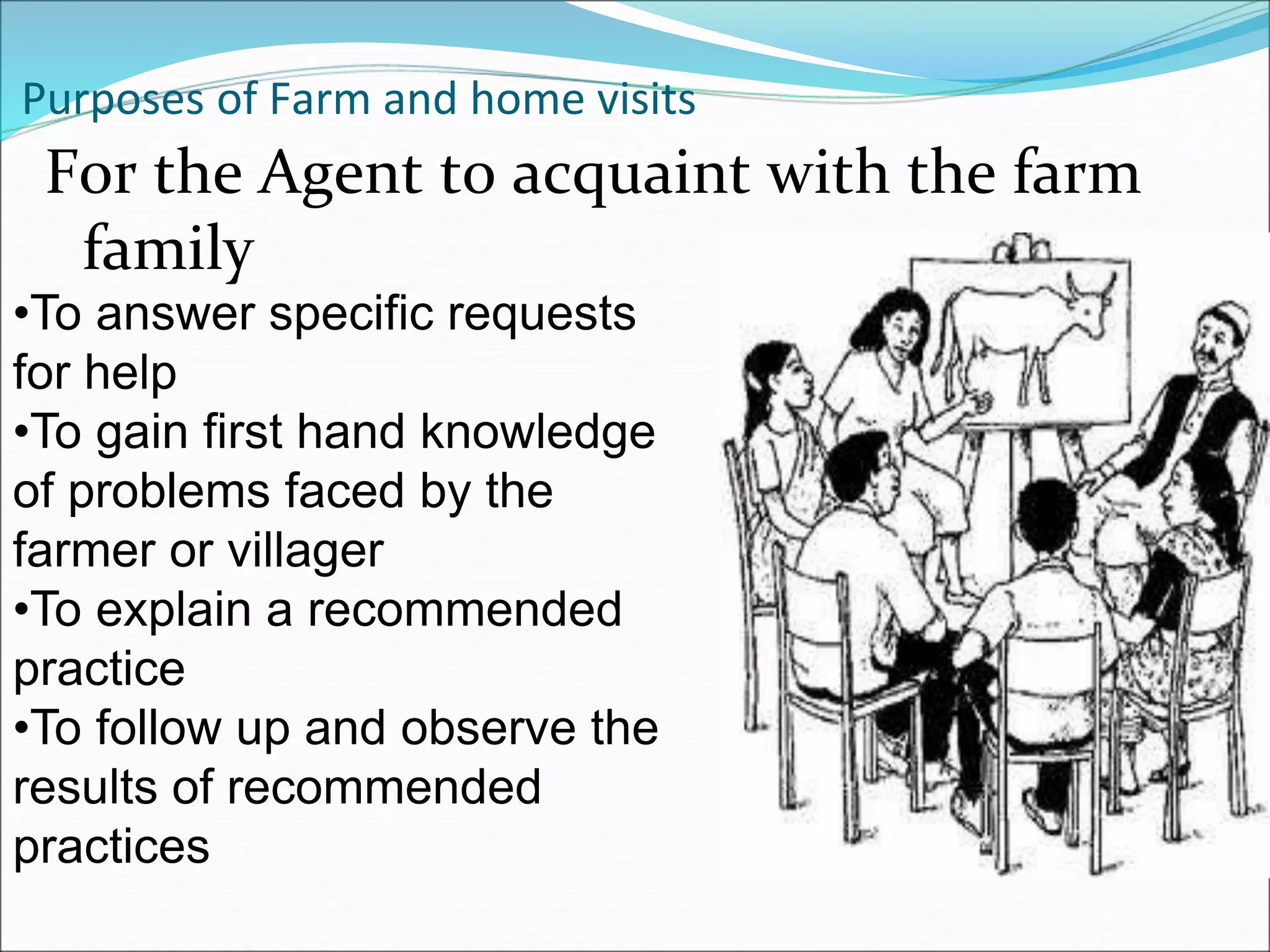
Purposes of Farm and home visits
For the Agent to acquaint with the farm
family
•To answer specific requests
for help
•To gain first hand knowledge
of problems faced by the
farmer or villager
•To explain a recommended
practice
•To follow up and observe the
results of recommended
practices
Purposes of Farm and home visits cont.
To plan an activity such as
demonstration, or a meeting
To invite the farmer or villager to
participate in a planned activity
To discuss policies and
programmes
To recruit, train or encourage a
local volunteer leader
Office calls
Office calls are made by the farmer
for the purpose of:
 satisfying a felt need.
expression of interest by the farmer
 providing the extension worker with
knowledge of the needs of the
farming community
Result demonstration
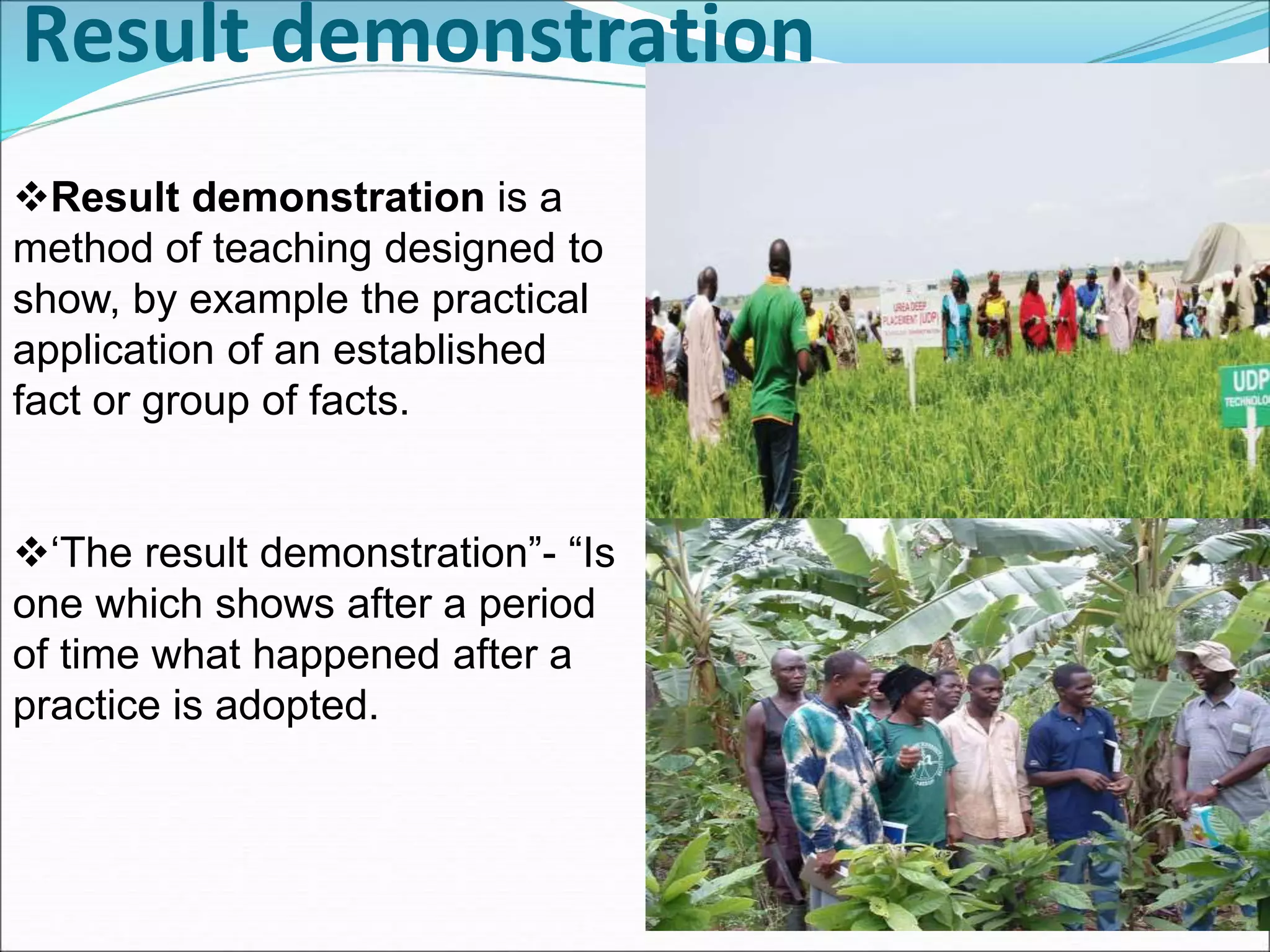
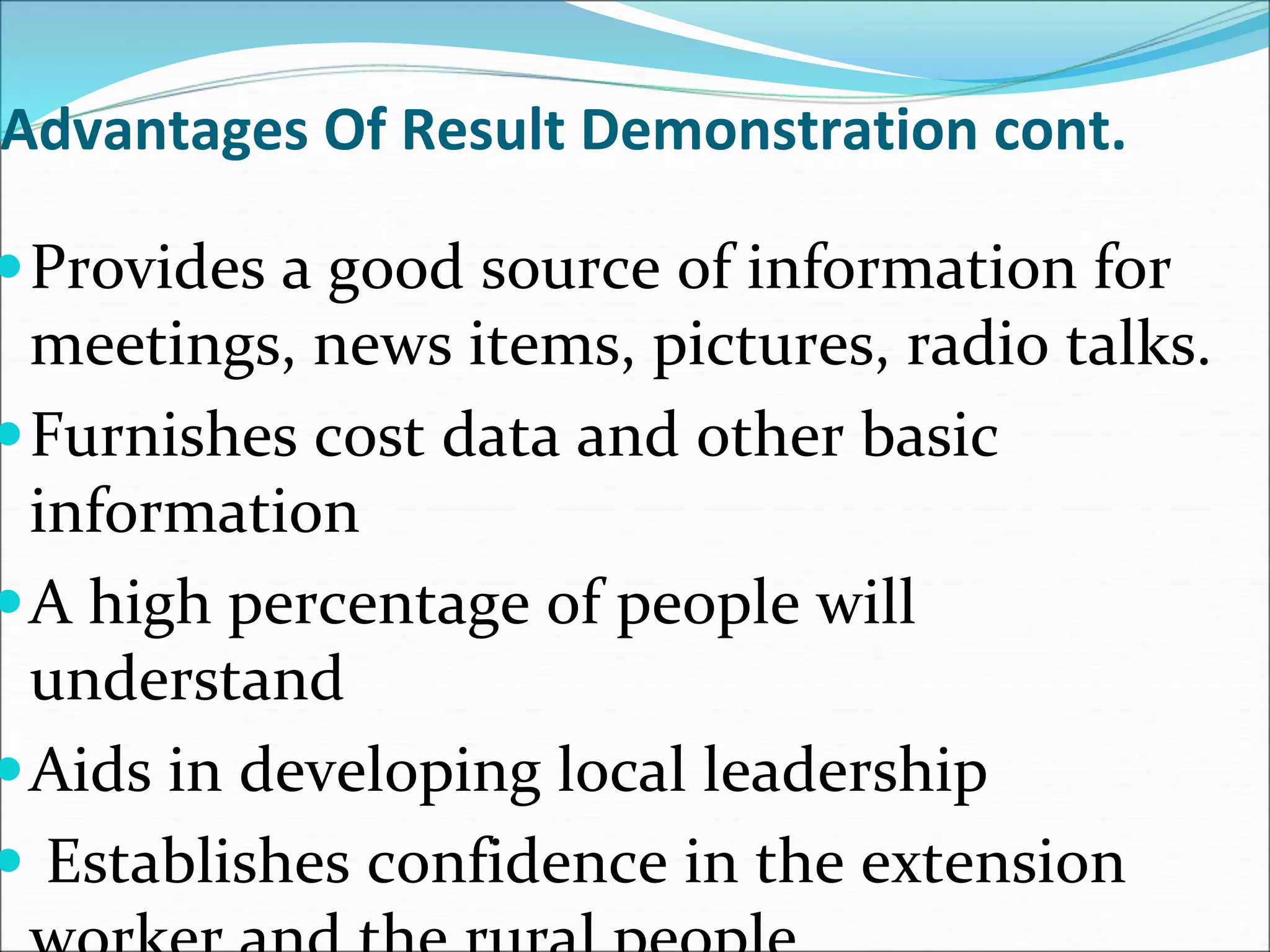
Result demonstration is a
method of teaching designed to
show, by example the practical
application of an established
fact or group of facts.
‘The result demonstration”- “Is
one which shows after a period
of time what happened after a
practice is adopted.
Advantages Of Result Demonstration
Furnishes local proof of the
desirability of adopting a
recommended practice
Is an efficient method for
introducing a new subject
 Appeals to the eye and reaches the
“show me” individual
Advantages Of Result Demonstration cont.
Provides a good source of information for
meetings, news items, pictures, radio talks.
Furnishes cost data and other basic
information
A high percentage of people will
understand
Aids in developing local leadership
 Establishes confidence in the extension
Limitations of Results Demonstration
Result demonstration requires a large
amount of extension workers time
The cost is high per practice changed
Good demonstrations are hard to find
Few people see the demonstration at a
not-convincing stage
The teaching value is frequently destroyed
by unfavorable weather.
Group Teaching Methods
Group methods take
into account:
• the inclination of
the individual to
respond to;
• pressures and
•opinions of
groups
Group Teaching Methods
Group method include
general meetings,
 group discussion,
exhibits,
tours and field trips,
Method Demonstration
 extension schools and farmer
training centre.
General meetings
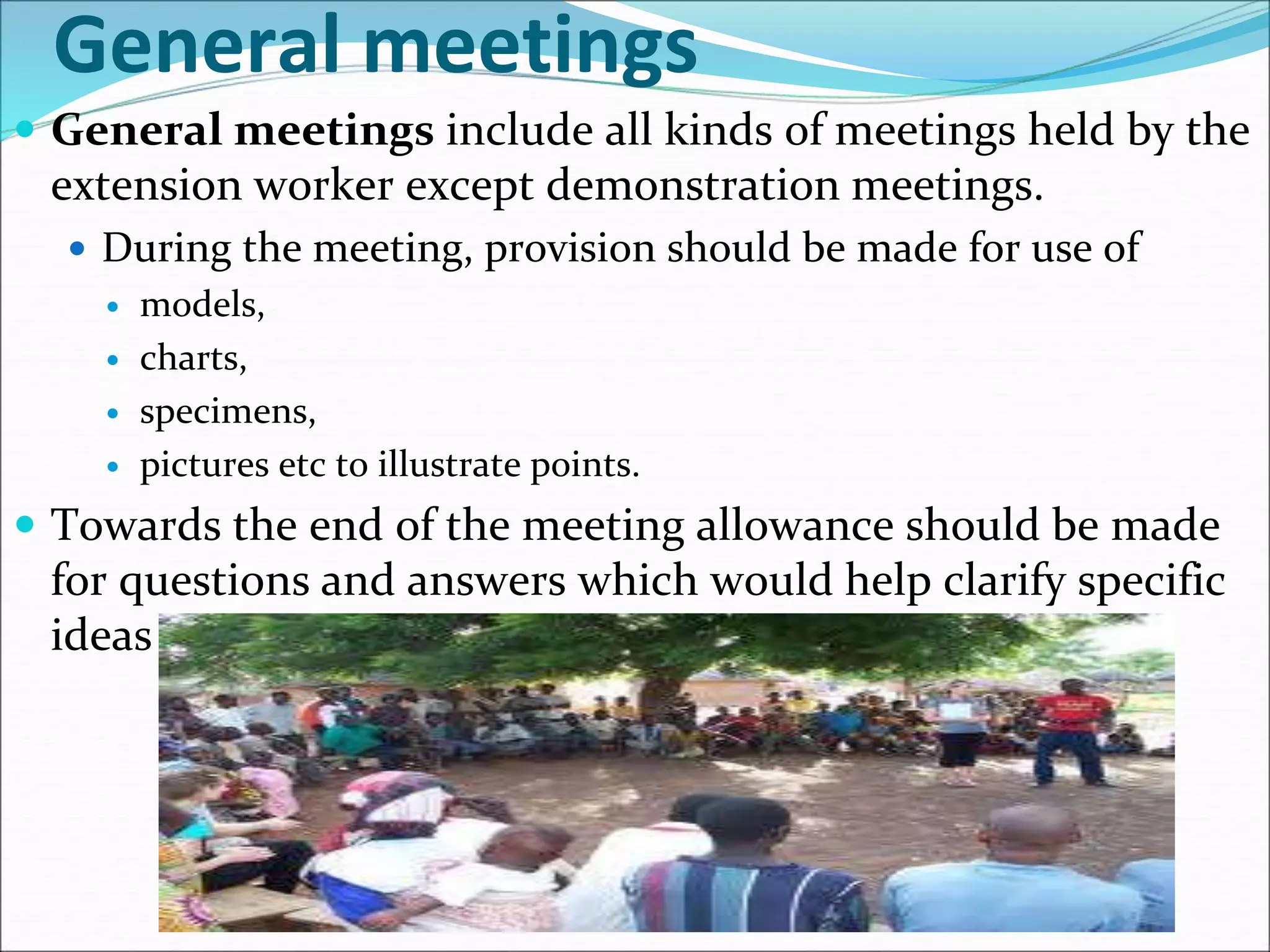
 General meetings include all kinds of meetings held by the
extension worker except demonstration meetings.
 During the meeting, provision should be made for use of
 models,
 charts,
 specimens,
 pictures etc to illustrate points.
 Towards the end of the meeting allowance should be made
for questions and answers which would help clarify specific
ideas
the extension worker should enlist the help of
local leaders to:
agree on the purpose of the meeting and to
draw up tentative programme;
 decide on and secure speakers;
arrange for social and recreational aspects
of the meeting;
agree on the place and time of the meeting;
select the chairman and advertise the
meeting.
Group Discussion
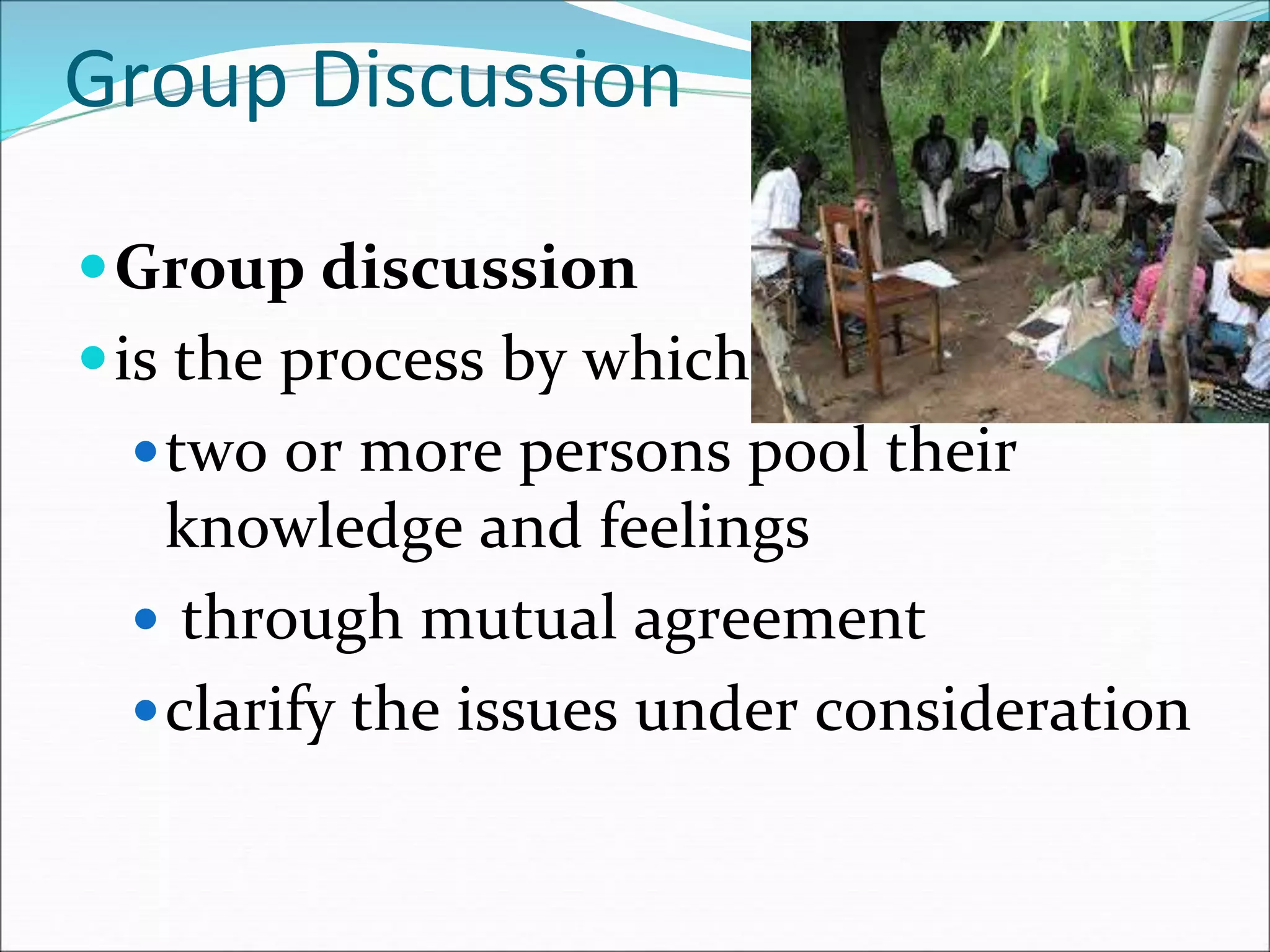
Group discussion
is the process by which
two or more persons pool their
knowledge and feelings
 through mutual agreement
clarify the issues under consideration
Exhibits
 Exhibits are systematic
 displays of specimens,
 models,
 charts,
 posters, etc.
 Their main purpose is to develop the interest of those who
see them,
 influence their attitude,
 increase their knowledge and
 stimulate them to action
Tour and Field Strips
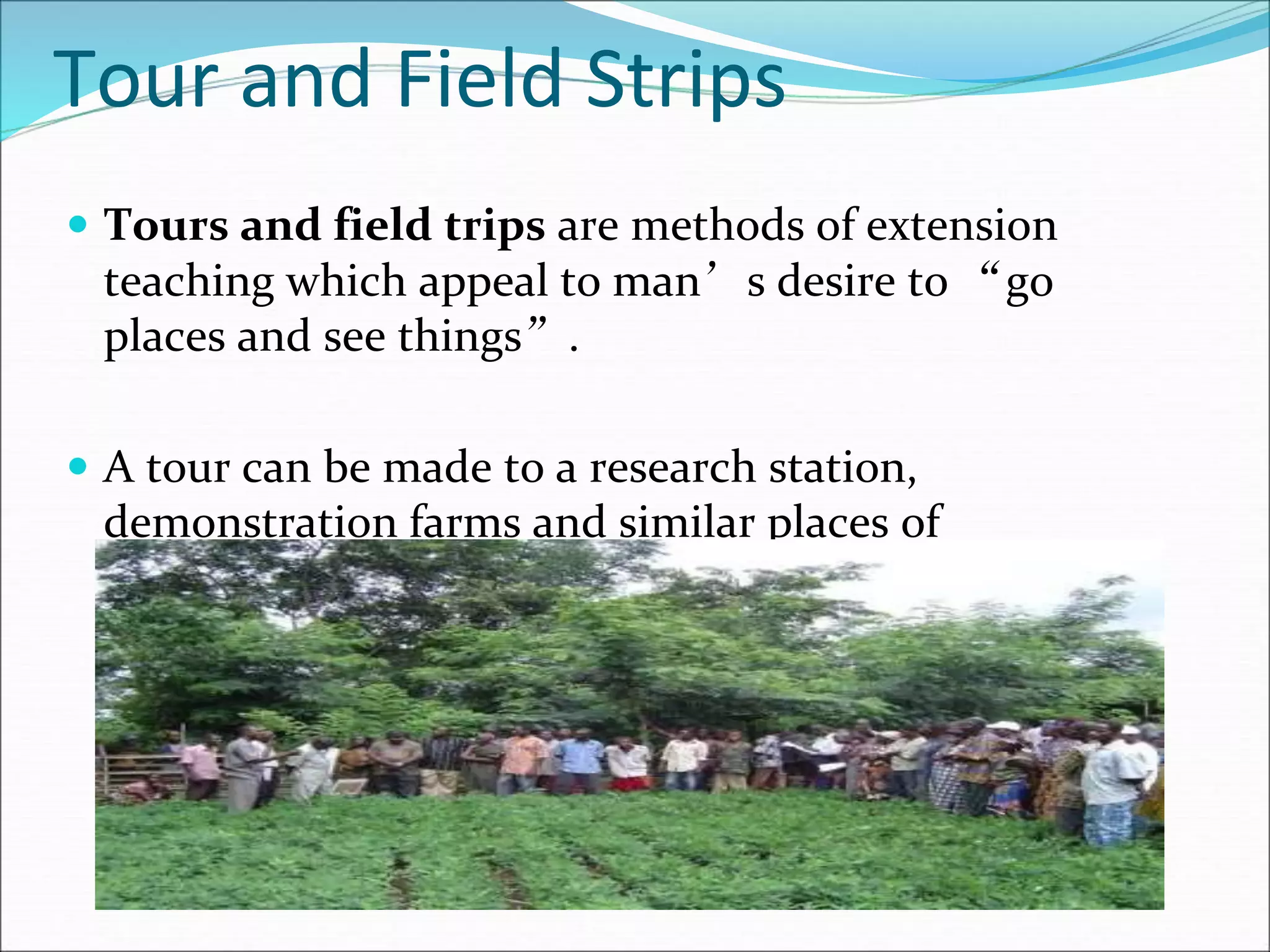
 Tours and field trips are methods of extension
teaching which appeal to man’s desire to “go
places and see things”.
 A tour can be made to a research station,
demonstration farms and similar places of
educational interest.
How to organize Field Strips
1. Decide exactly what you wish to
accomplish
2. Work out a detailed plan for the tour
well in advance
3. Go through a rehearsal or “dry run”
of the entire programme well in advance
4. On the day of the tour, keep the party
together and keep them moving briskly
from point to point.
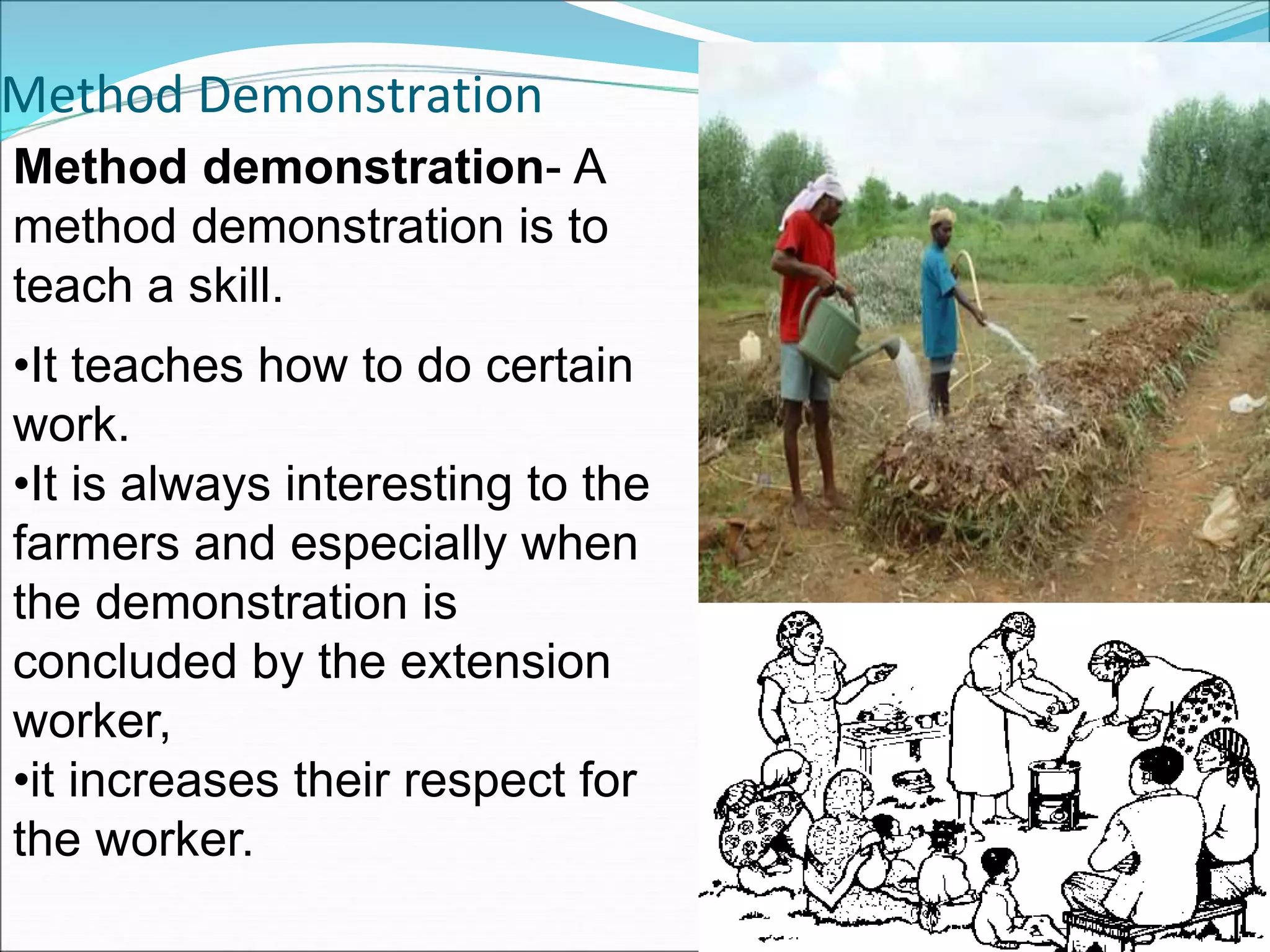
Method Demonstration
•It teaches how to do certain
work.
•It is always interesting to the
farmers and especially when
the demonstration is
concluded by the extension
worker,
•it increases their respect for
the worker.
Method demonstration- A
method demonstration is to
teach a skill.
Step in method demonstration
1. Outline operations in logical
steps
2. Identify key points
3. Carefully select materials and
tools
4. Arrange for diagrams or other
teaching aids
5. Rehearse demonstration until
Step in method demonstration
cont.
6.Make sure all the audience can see and hear him
7. Explain purpose and show application to local
problem
8. Show each operation slowly, step by step
9. Emphasize key points
10. Invite members of audience to repeat demonstration
Advantages of Method
Demonstration
1. It teaches needed skill to many
people at one time
2. Seeing, hearing, discussing and
participating stimulate action.
3. It builds confidence in extension
worker if demonstration is
skillfully performed
Advantages of Method
Demonstration cont.
4. Local leaders easily learn simple demonstrations and
can repeat them with other groups.
5. It promotes personal acquaintance
between the demonstrators and the
farmers
6. It influences changes in practice with
many people at a single meeting.
Limitations
1. It is frequently difficult to ensure that all members of
the group can see clearly
2. With certain demonstrations considerable equipment
must be transported to the meeting places
3. Requires a certain amount of showmanship not
possessed by all extension workers.
Mass Methods
 Mass methods
 radio,
 television,
 cinema vans and
 public address systems,
 newspapers,
 posters and other printed materials are used to reach
large numbers of people quickly.
Advantage of Radio and Television
1. Radio programmes are especially fitted
to handle emergency information
2. Reach people who cannot read
3. Reach people who cannot attend
extension meetings
4. Build interest in other extension
activities
Limitations
1. Broadcasting facilities are not everywhere available
2. Active involvement of the audience in the teaching
process is impossible
3. Frequently extension programmes are given poor time for
farm listeners
4. Direct and immediate feedback from the audience to the
teacher is not possible
5. Frequently extension programmes loose out in
competition with entertainment
6. Specific local needs cannot be given adequate attention
and there is often cultural gap (e.g. language, dialect)
between the speaker and the audience.
Classification Based on Form
Extension-teaching methods are
also classified according to their
forms, such as
written,
spoken and
audio-visual
under each of these 3 categories
are:
 Written Spoken visual
 Bulletins meeting Result Demonstration
 Leaflets Home visit Demonstration posters
 Articles Office calls Motion-picture
 Personal letters Radio slides/filmstrips model exhibits

Emerging Technologies in Information Dissemination
 Multimedia Technologies
 Mobile telephoning Technol
ogy
 Participatory extension vide
o documentaries
 Internet
Wednesday, August 24, 2022
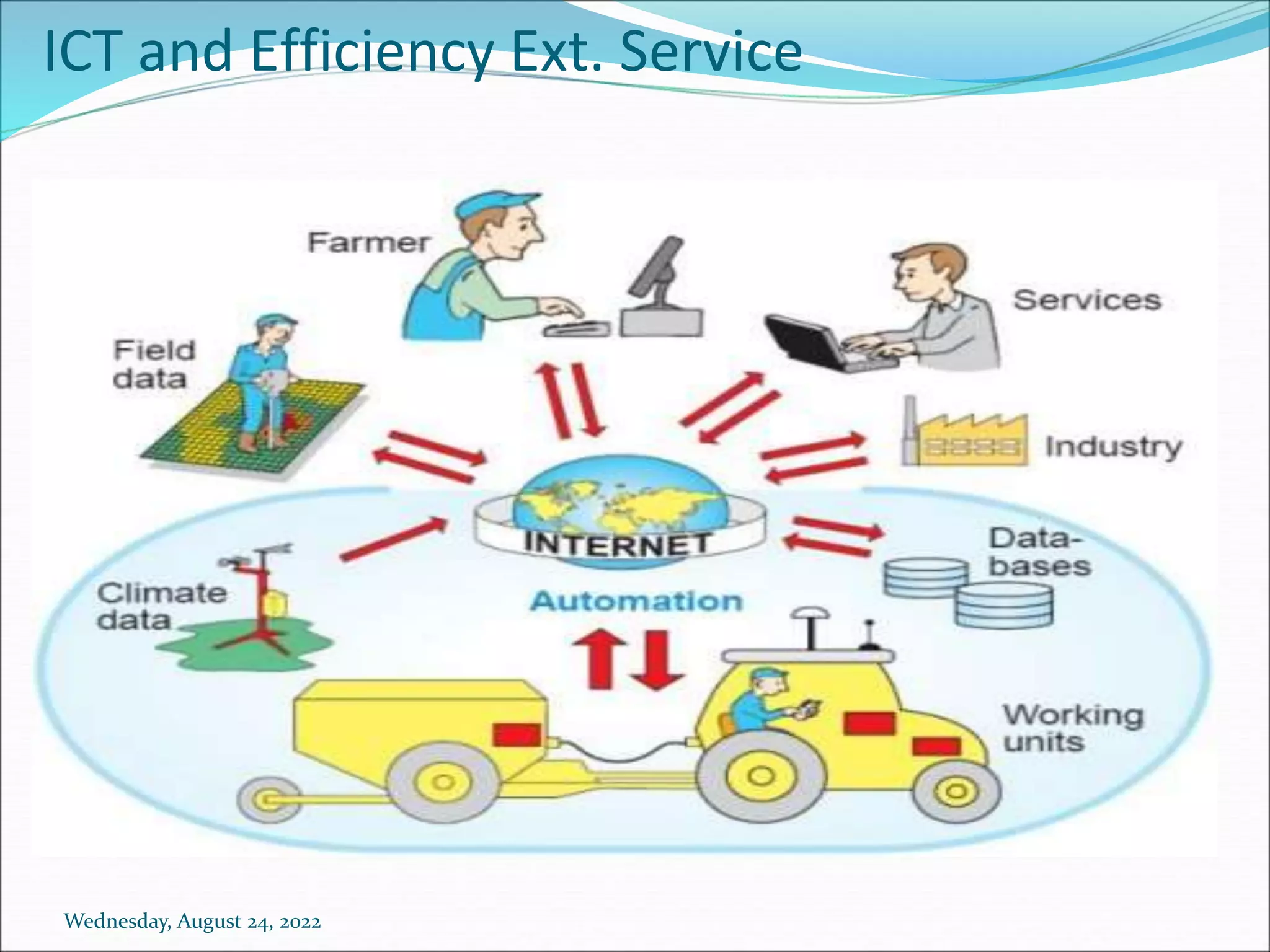
ICT and Efficiency Ext. Service
Wednesday, August 24, 2022
END OF
PRESENTATION

EXTENSION_TEACHING_METHODS_(1)[1].ppt

  • 1.
    LECTURE FOUR (4) ExtensionTeaching Methods THURSDAY 20/02/2014 2:00PM to 4:00PM At the Auditorium ARG 102: Introduction to Agricultural extension Lecturer Hudu Zakaria Department of Agric. Ext., Rural Development and Gender Studies Faculty of Agribusiness and Communication Science UDS, Nyankpala Campus Post Office TL 1882, Tamale Phone No: 0242980581 Email: azakariahudu@gmail.com or zakariahudu75@yahoo.com Office Location: FACS Administration Block Wednesday, August 24, 2022
  • 2.
    Extension Teaching MethodDefined  Extension teaching methods may be defined as:  devices used to create situations in which new information can pass freely between the extension worker and the rural communities  the tools and techniques used to create situations in which communication can take place between the rural people and the extension workers
  • 3.
    Extension Teaching MethodsDefined Cont. are the methods of extending new knowledge and skills to the rural people by :  drawing their attention towards them,  arousing their interest and  helping them to have a successful experience of the new practice
  • 4.
    Conditions For EffectiveUse Of Teaching Methods Four conditions are necessary for effective use of teaching methods: learning situation,  learning objectives, learning experiences and  use of a variety of teaching methods
  • 5.
    LEARNING SITUATION An effectivelearning situation requires the following essential elements: An instructor (an extension worker) Learners (the farmers).  Subject-matter (Research Recommendation)  Teaching material, such as a flannel-board, a black-board, charts, models, samples, slides, film strips, etc.  Physical facilities, such as sitting accommodation, good visibility, etc.
  • 6.
    LEARNING OBJECTIVES Any purposefulteaching has specific objectives which must contain four basic elements people to be taught, behaviour changes to be made, subject matter to be taught and life situation in which action is to take place
  • 7.
    LEARNING EXPERIENCE A learningexperience is defined as the mental or physical reaction one makes in a learning situation through  seeing, hearing or performing activities during a learning process
  • 8.
    USE VARIETIES OFTEACHING METHODS provision should be made for the opportunity to use a variety of extension methods.  Cater for people who learn differently  To reinforce learning  To make learning more lasting  to make learning more effective
  • 9.
    CLASSIFICAION OF EXTENSIONMETHODS Extension teaching methods can be classified on the basis of: Outreach: Number of people it design to reach Form or nature of teaching method.
  • 10.
    Classification based onOutreach Extension methods may be classified in three groups on the basis of the number of people they are designed to reach: these are: • Individual method • Group methods and • Mass Method
  • 11.
    Individual Methods Individual methodsinclude : farm and home visits  office calls  telephone calls personal letters informal contacts result demonstrations
  • 12.
    Farm and HomeVisits Farm and home visits are essential elements of extension education. They provide a means of: personal communication discuss matters of common interest in privacy Avenue for addressing problems of the marginalized in society
  • 13.
    Purposes of Farmand home visits For the Agent to acquaint with the farm family •To answer specific requests for help •To gain first hand knowledge of problems faced by the farmer or villager •To explain a recommended practice •To follow up and observe the results of recommended practices
  • 14.
    Purposes of Farmand home visits cont. To plan an activity such as demonstration, or a meeting To invite the farmer or villager to participate in a planned activity To discuss policies and programmes To recruit, train or encourage a local volunteer leader
  • 15.
    Office calls Office callsare made by the farmer for the purpose of:  satisfying a felt need. expression of interest by the farmer  providing the extension worker with knowledge of the needs of the farming community
  • 16.
    Result demonstration Result demonstrationis a method of teaching designed to show, by example the practical application of an established fact or group of facts. ‘The result demonstration”- “Is one which shows after a period of time what happened after a practice is adopted.
  • 17.
    Advantages Of ResultDemonstration Furnishes local proof of the desirability of adopting a recommended practice Is an efficient method for introducing a new subject  Appeals to the eye and reaches the “show me” individual
  • 18.
    Advantages Of ResultDemonstration cont. Provides a good source of information for meetings, news items, pictures, radio talks. Furnishes cost data and other basic information A high percentage of people will understand Aids in developing local leadership  Establishes confidence in the extension
  • 19.
    Limitations of ResultsDemonstration Result demonstration requires a large amount of extension workers time The cost is high per practice changed Good demonstrations are hard to find Few people see the demonstration at a not-convincing stage The teaching value is frequently destroyed by unfavorable weather.
  • 20.
    Group Teaching Methods Groupmethods take into account: • the inclination of the individual to respond to; • pressures and •opinions of groups
  • 21.
    Group Teaching Methods Groupmethod include general meetings,  group discussion, exhibits, tours and field trips, Method Demonstration  extension schools and farmer training centre.
  • 22.
    General meetings  Generalmeetings include all kinds of meetings held by the extension worker except demonstration meetings.  During the meeting, provision should be made for use of  models,  charts,  specimens,  pictures etc to illustrate points.  Towards the end of the meeting allowance should be made for questions and answers which would help clarify specific ideas
  • 23.
    the extension workershould enlist the help of local leaders to: agree on the purpose of the meeting and to draw up tentative programme;  decide on and secure speakers; arrange for social and recreational aspects of the meeting; agree on the place and time of the meeting; select the chairman and advertise the meeting.
  • 24.
    Group Discussion Group discussion isthe process by which two or more persons pool their knowledge and feelings  through mutual agreement clarify the issues under consideration
  • 25.
    Exhibits  Exhibits aresystematic  displays of specimens,  models,  charts,  posters, etc.  Their main purpose is to develop the interest of those who see them,  influence their attitude,  increase their knowledge and  stimulate them to action
  • 26.
    Tour and FieldStrips  Tours and field trips are methods of extension teaching which appeal to man’s desire to “go places and see things”.  A tour can be made to a research station, demonstration farms and similar places of educational interest.
  • 27.
    How to organizeField Strips 1. Decide exactly what you wish to accomplish 2. Work out a detailed plan for the tour well in advance 3. Go through a rehearsal or “dry run” of the entire programme well in advance 4. On the day of the tour, keep the party together and keep them moving briskly from point to point.
  • 28.
    Method Demonstration •It teacheshow to do certain work. •It is always interesting to the farmers and especially when the demonstration is concluded by the extension worker, •it increases their respect for the worker. Method demonstration- A method demonstration is to teach a skill.
  • 29.
    Step in methoddemonstration 1. Outline operations in logical steps 2. Identify key points 3. Carefully select materials and tools 4. Arrange for diagrams or other teaching aids 5. Rehearse demonstration until
  • 30.
    Step in methoddemonstration cont. 6.Make sure all the audience can see and hear him 7. Explain purpose and show application to local problem 8. Show each operation slowly, step by step 9. Emphasize key points 10. Invite members of audience to repeat demonstration
  • 31.
    Advantages of Method Demonstration 1.It teaches needed skill to many people at one time 2. Seeing, hearing, discussing and participating stimulate action. 3. It builds confidence in extension worker if demonstration is skillfully performed
  • 32.
    Advantages of Method Demonstrationcont. 4. Local leaders easily learn simple demonstrations and can repeat them with other groups. 5. It promotes personal acquaintance between the demonstrators and the farmers 6. It influences changes in practice with many people at a single meeting.
  • 33.
    Limitations 1. It isfrequently difficult to ensure that all members of the group can see clearly 2. With certain demonstrations considerable equipment must be transported to the meeting places 3. Requires a certain amount of showmanship not possessed by all extension workers.
  • 34.
    Mass Methods  Massmethods  radio,  television,  cinema vans and  public address systems,  newspapers,  posters and other printed materials are used to reach large numbers of people quickly.
  • 35.
    Advantage of Radioand Television 1. Radio programmes are especially fitted to handle emergency information 2. Reach people who cannot read 3. Reach people who cannot attend extension meetings 4. Build interest in other extension activities
  • 36.
    Limitations 1. Broadcasting facilitiesare not everywhere available 2. Active involvement of the audience in the teaching process is impossible 3. Frequently extension programmes are given poor time for farm listeners 4. Direct and immediate feedback from the audience to the teacher is not possible 5. Frequently extension programmes loose out in competition with entertainment 6. Specific local needs cannot be given adequate attention and there is often cultural gap (e.g. language, dialect) between the speaker and the audience.
  • 37.
    Classification Based onForm Extension-teaching methods are also classified according to their forms, such as written, spoken and audio-visual
  • 38.
    under each ofthese 3 categories are:  Written Spoken visual  Bulletins meeting Result Demonstration  Leaflets Home visit Demonstration posters  Articles Office calls Motion-picture  Personal letters Radio slides/filmstrips model exhibits 
  • 39.
    Emerging Technologies inInformation Dissemination  Multimedia Technologies  Mobile telephoning Technol ogy  Participatory extension vide o documentaries  Internet Wednesday, August 24, 2022
  • 40.
    ICT and EfficiencyExt. Service Wednesday, August 24, 2022
  • 41.
    Wednesday, August 24,2022 END OF PRESENTATION