COMMUNICATION AND EXTENSION-
APPROACHES FOR DEVELOPMENT: ADVANTAGES- INDIVIDUALS
AND GROUP AND MASS APPROACHES
M.Manjuladevi
II m.sc Home Science
HOME SCIENCE EXTENSION
 When this concept of extension is applied to home
science, it is called as Home Science Extension, which
aims at further developing the capacities of girls and
women who are mainly involved in farm and home-
making activities.
 Thus, the term home science extension means the type of
education which is extended beyond the four walls of
classroom to those who have been deprived of formal
education in home making activities.
HOME SCIENCE EXTENSION (CONT..)
 Through Home Science Extension activities, rural
women will have opportunities to discuss their problems
and seek solutions to their problems.
 They will be helped to utilize, to the best of advantage,
the products of their labour in agricultural production
through improving their nutritional status, health and
standard of living.
HISTORY
 Chandra (1987)
 Dey Lakshmi (1987)
 Desai and Jhansi Rani (1987)
 Seth (1987) has described three important
components of home science extension:
a. Extension education
b. Extension service
c. Extension work
COMMUNICATION
 The selection of suitable teaching aid should be done carefully
on the basis of the specific socio-culturai and economic
situations.
 Some are excellent for the individualized approach, and some
for the group approach while still others are to cater to the mass
approach effectively.
 Modern efforts for mass communication require use of new
communication technologies such as motion pictures, vide
films and television telecasts, which can provide enormous
range and type of visual resources to the teacher. Furthermore,
they help to overcome the problem of abstractness and barriers
of time.
COMMUNICATION (CONT..)
 Channels of mass media such as radio and television provide the
latest news and help people to keep in pace with the knowledge
explosion.
 They also help to raise the availability and quality of human
resources.
 An important function of several extension methods is to
communicate any message.
 Communication is the process of transformation of ideas and
attitudes from one person to another accurately and satisfactorily.
 In other words, it is the sharing of ideas and attitudes between two or
more per tics such as their educational background, social and
cultural background, likes and dislikes, needs and interests, values,
age, caste, religion and so on .
COMMUNICATION (CONT..)
 These wide varieties in the nature of the groups demand
various extension approaches like individual approach,
group approach and mass approach.
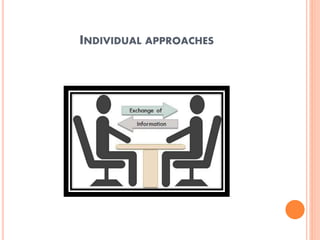
INDIVIDUAL APPROACHES
 In the individual approach, an individual is contacted keeping in mind
the factors which can motivate him to take a specific action.
 Farm and home visits have been observed to be the most widely
used method for individual approach (Chandra, 1989).
Advantage:
 Unclear messages that have not been fully understood can easily be
clarified
 The extension officer is able to secure co-operation and inspire the
confidence of the family through personal
 contact
 It facilitates immediate feedback on the effectiveness of the
measures discussed
 It may be the best way to ensure that everyone in the family
participates in decision making.
INDIVIDUAL APPROACHES
GROUP APPROACHES
 The group approach is used for two or more people.
 The group is formed with the individuals who have some
common interest.
Advantage:
 It is generally cheaper than the individual approach
 More people are reached within a given period of time
 There is an exchange of ideas and experiences among the
group
 It is easy to monitor.
GROUP APPROACHES
MASS APPROACHES
 He/she has to use an approach through which masses can
be reached in the shortest time. Through the mass
approach information concerning the masses can be
conveyed from a single source.
Advantage:
 These methods can increase the impact of extension staff
through rapid spread of information
 Many people can be reached within a short time, even in
remote areas.
MASS APPROACHES
Extension education and communication

Extension education and communication

  • 1.
    COMMUNICATION AND EXTENSION- APPROACHESFOR DEVELOPMENT: ADVANTAGES- INDIVIDUALS AND GROUP AND MASS APPROACHES M.Manjuladevi II m.sc Home Science
  • 2.
    HOME SCIENCE EXTENSION When this concept of extension is applied to home science, it is called as Home Science Extension, which aims at further developing the capacities of girls and women who are mainly involved in farm and home- making activities.  Thus, the term home science extension means the type of education which is extended beyond the four walls of classroom to those who have been deprived of formal education in home making activities.
  • 3.
    HOME SCIENCE EXTENSION(CONT..)  Through Home Science Extension activities, rural women will have opportunities to discuss their problems and seek solutions to their problems.  They will be helped to utilize, to the best of advantage, the products of their labour in agricultural production through improving their nutritional status, health and standard of living.
  • 4.
    HISTORY  Chandra (1987) Dey Lakshmi (1987)  Desai and Jhansi Rani (1987)  Seth (1987) has described three important components of home science extension: a. Extension education b. Extension service c. Extension work
  • 5.
    COMMUNICATION  The selectionof suitable teaching aid should be done carefully on the basis of the specific socio-culturai and economic situations.  Some are excellent for the individualized approach, and some for the group approach while still others are to cater to the mass approach effectively.  Modern efforts for mass communication require use of new communication technologies such as motion pictures, vide films and television telecasts, which can provide enormous range and type of visual resources to the teacher. Furthermore, they help to overcome the problem of abstractness and barriers of time.
  • 6.
    COMMUNICATION (CONT..)  Channelsof mass media such as radio and television provide the latest news and help people to keep in pace with the knowledge explosion.  They also help to raise the availability and quality of human resources.  An important function of several extension methods is to communicate any message.  Communication is the process of transformation of ideas and attitudes from one person to another accurately and satisfactorily.  In other words, it is the sharing of ideas and attitudes between two or more per tics such as their educational background, social and cultural background, likes and dislikes, needs and interests, values, age, caste, religion and so on .
  • 7.
    COMMUNICATION (CONT..)  Thesewide varieties in the nature of the groups demand various extension approaches like individual approach, group approach and mass approach.
  • 8.
    INDIVIDUAL APPROACHES  Inthe individual approach, an individual is contacted keeping in mind the factors which can motivate him to take a specific action.  Farm and home visits have been observed to be the most widely used method for individual approach (Chandra, 1989). Advantage:  Unclear messages that have not been fully understood can easily be clarified  The extension officer is able to secure co-operation and inspire the confidence of the family through personal  contact  It facilitates immediate feedback on the effectiveness of the measures discussed  It may be the best way to ensure that everyone in the family participates in decision making.
  • 9.
  • 10.
    GROUP APPROACHES  Thegroup approach is used for two or more people.  The group is formed with the individuals who have some common interest. Advantage:  It is generally cheaper than the individual approach  More people are reached within a given period of time  There is an exchange of ideas and experiences among the group  It is easy to monitor.
  • 11.
  • 12.
    MASS APPROACHES  He/shehas to use an approach through which masses can be reached in the shortest time. Through the mass approach information concerning the masses can be conveyed from a single source. Advantage:  These methods can increase the impact of extension staff through rapid spread of information  Many people can be reached within a short time, even in remote areas.
  • 13.