BY
Shefi Varghese
Homescience
COMMUNICATION
What is
COMMUNICATION……?
Imparting or exchanging of information by speaking, writing, or
using some other medium.
OR
Communication is simply the act of transferring information from
one place, person or group to another. Every communication
involves (at least) one sender, a message and a recipient.
METHODS OF COMMUNICATION
There are several different ways individuals communicate with each other.
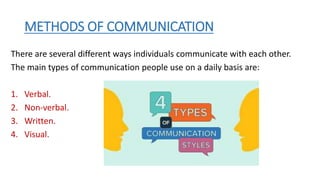
The main types of communication people use on a daily basis are:
1. Verbal.
2. Non-verbal.
3. Written.
4. Visual.
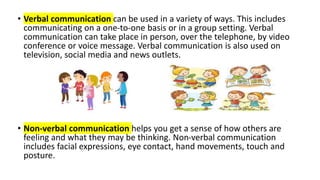
• Verbal communication can be used in a variety of ways. This includes
communicating on a one-to-one basis or in a group setting. Verbal
communication can take place in person, over the telephone, by video
conference or voice message. Verbal communication is also used on
television, social media and news outlets.
• Non-verbal communication helps you get a sense of how others are
feeling and what they may be thinking. Non-verbal communication
includes facial expressions, eye contact, hand movements, touch and
posture.
• Written communication might be a letter, email, a report, or a message on
social media. Written communication should aim to get your message across in
a clear and concise manner.
• Visual communication can take place with the help of visual aids.
This can include things like:
• Drawing.
• Graphic design.
• Illustration.
• Colour.
• Typography.
• Signs.
• Other electronic resources.
CLASSIFICATION
• Classification according to form and use:-
Method of communication
Medium of communication
METHOD OF COMMUNICATION
A. Individual method
B. Group method
C. Mass method
MEDIUM OF COMMUNICATION
A. Audio
B. Visuals
C. Combination of audio and
visual
ADVANTAGES AND
DISADVANTAGES
INDIVIDUAL METHOD
Merits
1. Helps extension educator to
become familiar with the
community members and their
families
2. Becomes familiar with the
geographic area and the
problems faced by the
community members
3. Individual contact can stimulate
their interest and increase their
involvement in extension
activities
Demerits
1. Requires a lot of time,constant
follow up and recording
2. Efforts are spend on a very few
people
3. Extension educator may not be
able to respond to each and
every person
4. Comparatively expensive
GROUP METHOD
Merits
1. Offers the possibility of greater
coverage in terms of geogeaphy
and number of people covered
during extension programmes.
2. More reflective and interacting
learning environment
3. Helps extension learners to
listen,discuss issues and increase
their involvement in extension
activity.
4. Increase self confidence by joining
others to discuss new ideas and
try out new practices
Demerits
1. Takes a long time to find a
conclusion
2. People may not agree with isues
and implementation of extension
work
3. Chances of people with greater
ability to communicate
influencing the group and their
ideas and opinions may get
promoted
4. Individual problems may not get
addressed
MASS METHOD
Merits
1. A large number of people can
be covered in short period
2. Suitable in creating general
awareness
3. In times of emergency people
can be reaches quickly
4. Less expensive and reached in
large number of people
Demerits
1. Personal interaction is not
possible
2. Depth discussion of a topic is
not possible
3. Hnadling of a topic isdifficult
because of the mixed
composition of the audience
4. Requires equipments that is
not available
AUDIO
Merits
1. Most frequently used means of
communication
2. Provides immediate feedback
3. Very economical ,both in terms of
time and money
4. Adoption and improvements can
be made on the spot
5. Able to hold the attention of the
speaker
6. Repetition is possible
Demerits
1. Only hearing is stimulated
2. Learner may not be able to
concentrate on what the
educator is saying
3. Chances of misunderstandings
4. Listener may not have
equipment to receive the audio
message
VISUAL AIDS
Merits
1. Complex information ,data and
figures can be explained
2. Can communicate with illiterate
people
3. Save time because quick learning
and understanding
4. Allows for repetition helps in
practice,tutorials,stimulation,basi
c problem solving and evaluation
activities
Demerits
1. Expensive
2. Equipments required
3. Time consuming in preparing them
4. Physical limitations ,limited
computer skills
AUDIO VISUAL AIDS
1. Increasing and sustaining the
attention of the learner
2. Application of new knowledge to
realistic situations
3. Incraese motivation levels if the
learner by stimulating interest
4. Used as one way communication
and two way communication
5. Oppurtunity to handle the audio
visual equipments for the
community members,this helps in
building technical ,social and
personal skills
1. Expensive and time consuming
2. euipments may not be available
3. Constrained space both to display
and to store bulky
4. Sometimes it makes the learner
feel outside the learning
atmospere
THANKYOU

COMMUNICATION

  • 1.
  • 2.
    What is COMMUNICATION……? Imparting orexchanging of information by speaking, writing, or using some other medium. OR Communication is simply the act of transferring information from one place, person or group to another. Every communication involves (at least) one sender, a message and a recipient.
  • 3.
    METHODS OF COMMUNICATION Thereare several different ways individuals communicate with each other. The main types of communication people use on a daily basis are: 1. Verbal. 2. Non-verbal. 3. Written. 4. Visual.
  • 4.
    • Verbal communicationcan be used in a variety of ways. This includes communicating on a one-to-one basis or in a group setting. Verbal communication can take place in person, over the telephone, by video conference or voice message. Verbal communication is also used on television, social media and news outlets. • Non-verbal communication helps you get a sense of how others are feeling and what they may be thinking. Non-verbal communication includes facial expressions, eye contact, hand movements, touch and posture.
  • 5.
    • Written communicationmight be a letter, email, a report, or a message on social media. Written communication should aim to get your message across in a clear and concise manner. • Visual communication can take place with the help of visual aids. This can include things like: • Drawing. • Graphic design. • Illustration. • Colour. • Typography. • Signs. • Other electronic resources.
  • 6.
    CLASSIFICATION • Classification accordingto form and use:- Method of communication Medium of communication
  • 7.
    METHOD OF COMMUNICATION A.Individual method B. Group method C. Mass method MEDIUM OF COMMUNICATION A. Audio B. Visuals C. Combination of audio and visual
  • 8.
  • 9.
    INDIVIDUAL METHOD Merits 1. Helpsextension educator to become familiar with the community members and their families 2. Becomes familiar with the geographic area and the problems faced by the community members 3. Individual contact can stimulate their interest and increase their involvement in extension activities Demerits 1. Requires a lot of time,constant follow up and recording 2. Efforts are spend on a very few people 3. Extension educator may not be able to respond to each and every person 4. Comparatively expensive
  • 10.
    GROUP METHOD Merits 1. Offersthe possibility of greater coverage in terms of geogeaphy and number of people covered during extension programmes. 2. More reflective and interacting learning environment 3. Helps extension learners to listen,discuss issues and increase their involvement in extension activity. 4. Increase self confidence by joining others to discuss new ideas and try out new practices Demerits 1. Takes a long time to find a conclusion 2. People may not agree with isues and implementation of extension work 3. Chances of people with greater ability to communicate influencing the group and their ideas and opinions may get promoted 4. Individual problems may not get addressed
  • 11.
    MASS METHOD Merits 1. Alarge number of people can be covered in short period 2. Suitable in creating general awareness 3. In times of emergency people can be reaches quickly 4. Less expensive and reached in large number of people Demerits 1. Personal interaction is not possible 2. Depth discussion of a topic is not possible 3. Hnadling of a topic isdifficult because of the mixed composition of the audience 4. Requires equipments that is not available
  • 12.
    AUDIO Merits 1. Most frequentlyused means of communication 2. Provides immediate feedback 3. Very economical ,both in terms of time and money 4. Adoption and improvements can be made on the spot 5. Able to hold the attention of the speaker 6. Repetition is possible Demerits 1. Only hearing is stimulated 2. Learner may not be able to concentrate on what the educator is saying 3. Chances of misunderstandings 4. Listener may not have equipment to receive the audio message
  • 13.
    VISUAL AIDS Merits 1. Complexinformation ,data and figures can be explained 2. Can communicate with illiterate people 3. Save time because quick learning and understanding 4. Allows for repetition helps in practice,tutorials,stimulation,basi c problem solving and evaluation activities Demerits 1. Expensive 2. Equipments required 3. Time consuming in preparing them 4. Physical limitations ,limited computer skills
  • 14.
    AUDIO VISUAL AIDS 1.Increasing and sustaining the attention of the learner 2. Application of new knowledge to realistic situations 3. Incraese motivation levels if the learner by stimulating interest 4. Used as one way communication and two way communication 5. Oppurtunity to handle the audio visual equipments for the community members,this helps in building technical ,social and personal skills 1. Expensive and time consuming 2. euipments may not be available 3. Constrained space both to display and to store bulky 4. Sometimes it makes the learner feel outside the learning atmospere
  • 15.