EXTENSION
METHODS
Rona N. Mostar
MSA Ag. Ed. 212 Agricultural Communication and Extension
“What a man hears, he may doubt.
What he sees he may possible doubt.
But what he does himself he cannot doubt.”-Seaman Knapp
•What is an
Agricultural
Extension
Method?
 Agricultural extension is the application of
scientific research and new knowledge
to agricultural practices through farmer education.
The field of 'extension' now encompasses a wider
range of communication and learning activities
organized for rural people by educators from
different disciplines, including agriculture,
agricultural marketing, health and business
studies.
 Extension methods comprise the communication
techniques between extension workers and target
groups.
To facilitate farmers' decisions whether or not
and how to adopt farming.
EXTENSION
METHODS
Source : Agroforestry Extension
Manual in Kenya
The individual/household
approach
The group approach:
meetings, field days,
demonstrations, support
to groups
The school approach
Mass extension methods.
The choice of
method depends
on various factors
such as;
The tenure
system in the
area
Community
organization
Resources
available for
extension
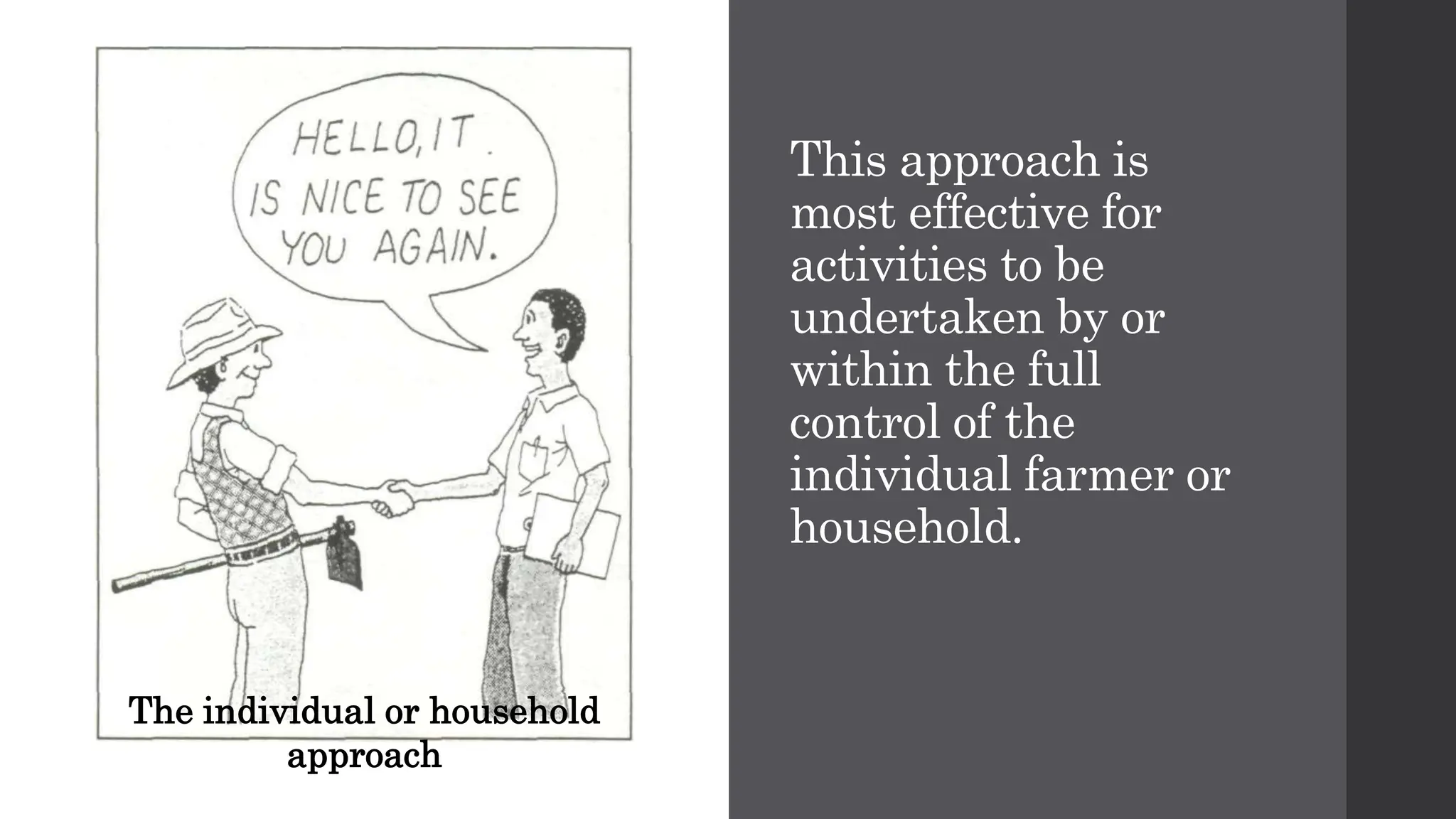
This approach is
most effective for
activities to be
undertaken by or
within the full
control of the
individual farmer or
household.
The individual or household
approach
The group approach
 The group approach involves working with
groups or the community at large.
 Suitable when discussing matters related to the
whole community (e.g. post-harvest grazing,
protection and management of indigenous
forests), and when there are activities to be
undertaken by a group, e.g. group nurseries.
 Suitable when there is a need to address
individual matters but more cheaply than can
be done with the individual approach. The
direct target group may be a women's group, a
church organization, a co-operative society or
the community in general.
The school approach
 The extension work
can be in the form
of lectures, support
for 4K Clubs, or
discussions held
during parents'
days.
 Demonstration
plots
 Large numbers of
people within a
short time at
minimal costs.
Mass extension
methods involve the
use of the mass media,
e.g. radio, posters,
drama, television,
newspapers, films,
slide shows, to inform
the public. Mass media
are mainly used to
create awareness.
Mass extension methods
e
feasi
ble
than
an
indi v
idual
appr
oach
.
Figu
re
12.4
Loca
l
lead
ers
play
a
vital
role
In
the
spre
ad of
exte
nsio
n
activ
ities
If an
orga
nizat
ion
carr
ying
out
exte
nsio
n is
rich
in
reso
urce
s, a
mor
e
costl
y
appr
oach
can
be
chos
en
than
if the
orga
nizat
ion
is
reso
urce
poor
. It
is,
how
ever
, just
as
imp
orta
nt
for a
reso
urce
-rich
orga
nizat
ion
to
care
full y
cons
ider
whi c
h
met
hod
is
best
for
the
area
, and
how
the
exte
nsio
n
wor
k
shou
ld be
orga
nize
d in
orde
r to
prev
ent
wast
e of
reso
urce
s.
Cost
-
effec
tiven
ess
shou
ld
alwa
ys
be
born
e in
mi n
d,
and
past
expe
rien
ce
indic
ates,
for
exa
mpl
e,
that
issui
ng
free
seed
lings
is
rarel
y a
sust
aina
ble
appr
oach
sinc
e it
crea
tes
depe
nden
cy
and
disc
oura
ges
pri v
ate
com
mer
cial
initia
tives
in
tree-
seed
ling
prod
uctio
n.
An
exce
ssi v
e
level
of
mat
erial
supp
ort
gene
rall y
crea
tes
depe
nden
ce,
and
often
prov
es to
be
coun
ter
prod
ucti v
e in
the
long
run.
The
indiv
idual
/hou
seho
ld
appr
oach
This
appr
oach
is
mos
t
effec
tive
for
acti v
ities
to be
unde
rtak
en
by
or
withi
n the
full
cont
rol
of
the
indi v
idual
far m
er or
hous
ehol
d.
Matt
ers
relat
ed to
the
indi v
idual
far m
shou
ld,
as
muc
h as
poss
ible,
be
disc
usse
d
with
the
whol
e
fami
ly. If
the
whol
e
fami
ly i s
invol
ved,
mor
e
prob
lem
s
are
highl
ighte
d
and
mor
e
expe
rien
ce is
brou
ght
to
the
disc
ussi
on.
Adv
anta
ges
of
the
indi v
idual
met
hods
are:
• Un
clea
r
mes
sage
s
that
have
not
been
fully
unde
rsto
od
can
easil
y be
clari
fied
•The
exte
nsio
n
offic
er is
able
to
secu
re
co-
oper
ation
and
inspi
re
the
confi
denc
e of
the
fami
ly
thro
ugh
pers
onal
cont
act
•It
facili
tates
imm
ediat
e
feed
back
on
the
effec
tiven
ess
of
the
mea
sure
s
disc
usse
d
•It
may
be
the
best
way
to
ensu
re
that
ever
yone
in
the
fami
ly
parti
cipat
es in
deci
sion
mak
ing.
Figu
re
12.5
The
indiv
idual
appr
oach
Disa
dvan
tage
s of
the
indi v
idual
met
hod:
•It is
expe
nsiv
e in
term
s of
time
and
tran
spor
t
•Onl
y a
few
farm
ers
may
be
visit
ed,
and
som
etim
es
they
may
e
feasi
ble
than
an
indi v
idual
appr
oach
.
Figu
re
12.4
Loca
l
lead
ers
play
a
vital
role
In
the
spre
ad of
exte
nsio
n
activ
ities
If an
orga
nizat
ion
carr
ying
out
exte
nsio
n is
rich
in
reso
urce
s, a
mor
e
costl
y
appr
oach
can
be
chos
en
than
if the
orga
nizat
ion
is
reso
urce
poor
. It
is,
how
ever
, just
as
imp
orta
nt
for a
reso
urce
-rich
orga
nizat
ion
to
care
full y
cons
ider
whi c
h
met
hod
is
best
for
the
area
, and
how
the
exte
nsio
n
wor
k
shou
ld be
orga
nize
d in
orde
r to
prev
ent
wast
e of
reso
urce
s.
Cost
-
effec
tiven
ess
shou
ld
alwa
ys
be
born
e in
mi n
d,
and
past
expe
rien
ce
indic
ates,
for
exa
mpl
e,
that
issui
ng
free
seed
lings
is
rarel
y a
sust
aina
ble
appr
oach
sinc
e it
crea
tes
depe
nden
cy
and
disc
oura
ges
pri v
ate
com
mer
cial
initia
tives
in
tree-
seed
ling
prod
uctio
n.
An
exce
ssi v
e
level
of
mat
erial
supp
ort
gene
rall y
crea
tes
depe
nden
ce,
and
often
prov
es to
be
coun
ter
prod
ucti v
e in
the
long
run.
The
indiv
idual
/hou
seho
ld
appr
oach
This
appr
oach
is
mos
t
effec
tive
for
acti v
ities
to be
unde
rtak
en
by
or
withi
n the
full
cont
rol
of
the
indi v
idual
far m
er or
hous
ehol
d.
Matt
ers
relat
ed to
the
indi v
idual
far m
shou
ld,
as
muc
h as
poss
ible,
be
disc
usse
d
with
the
whol
e
fami
ly. If
the
whol
e
fami
ly i s
invol
ved,
mor
e
prob
lem
s
are
highl
ighte
d
and
mor
e
expe
rien
ce is
brou
ght
to
the
disc
ussi
on.
Adv
anta
ges
of
the
indi v
idual
met
hods
are:
• Un
clea
r
mes
sage
s
that
have
not
been
fully
unde
rsto
od
can
easil
y be
clari
fied
•The
exte
nsio
n
offic
er is
able
to
secu
re
co-
oper
ation
and
inspi
re
the
confi
denc
e of
the
fami
ly
thro
ugh
pers
onal
cont
act
•It
facili
tates
imm
ediat
e
feed
back
on
the
effec
tiven
ess
of
the
mea
sure
s
disc
usse
d
•It
may
be
the
best
way
to
ensu
re
that
ever
yone
in
the
fami
ly
parti
cipat
es in
deci
sion
mak
ing.
Figu
re
12.5
The
indiv
idual
appr
oach
Disa
dvan
tage
s of
the
indi v
idual
met
hod:
•It is
expe
nsiv
e in
term
s of
time
and
tran
spor
t
•Onl
y a
few
farm
ers
may
be
visit
ed,
and
som
etim
es
they
may
EXTENSION
METHODS
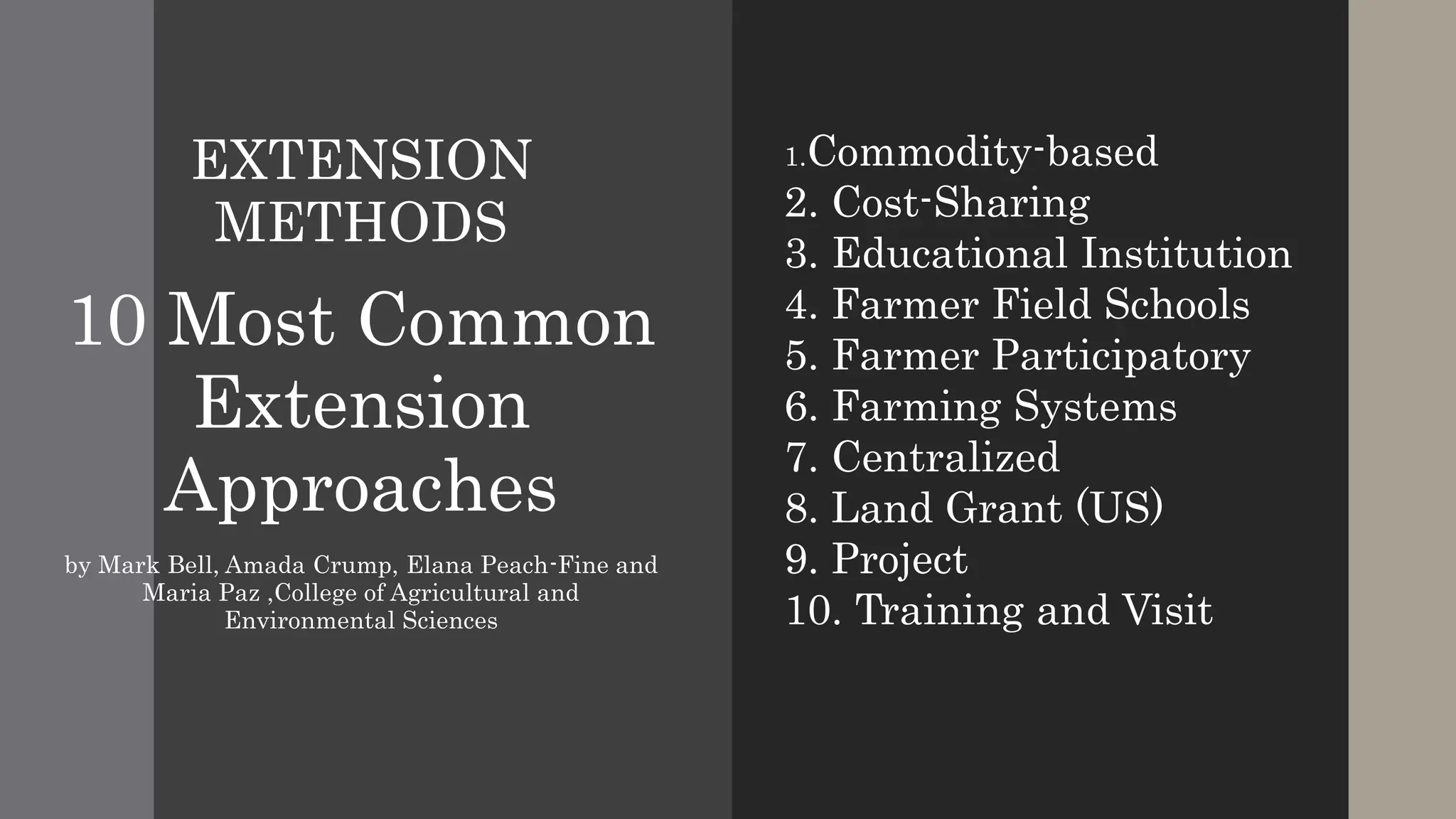
10 Most Common
Extension
Approaches
by Mark Bell, Amada Crump, Elana Peach-Fine and
Maria Paz ,College of Agricultural and
Environmental Sciences
1.Commodity-based
2. Cost-Sharing
3. Educational Institution
4. Farmer Field Schools
5. Farmer Participatory
6. Farming Systems
7. Centralized
8. Land Grant (US)
9. Project
10. Training and Visit
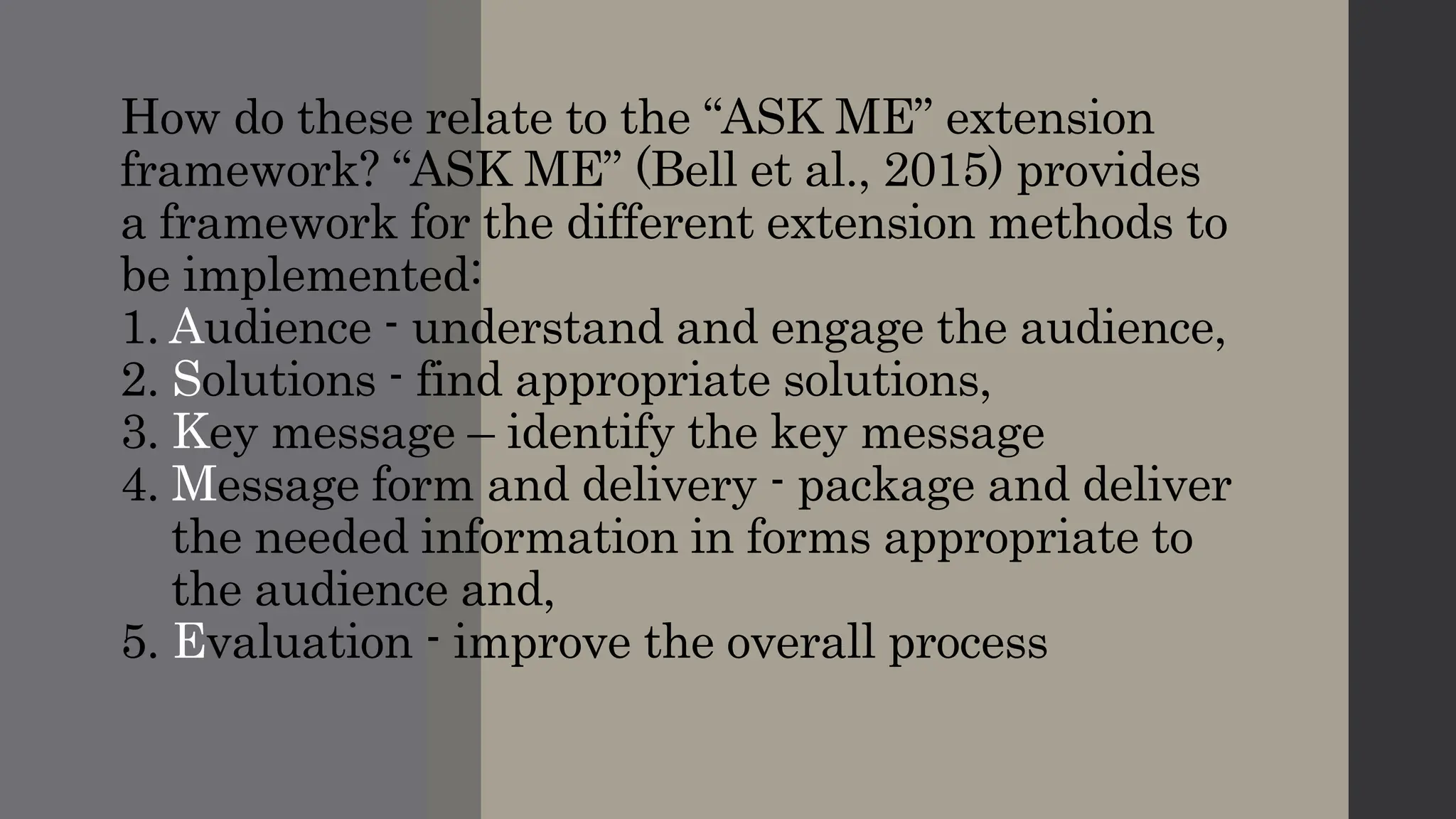
How do these relate to the “ASK ME” extension
framework? “ASK ME” (Bell et al., 2015) provides
a framework for the different extension methods to
be implemented:
1. Audience - understand and engage the audience,
2. Solutions - find appropriate solutions,
3. Key message – identify the key message
4. Message form and delivery - package and deliver
the needed information in forms appropriate to
the audience and,
5. Evaluation - improve the overall process
The Commodity-Based Approach
focuses on a single crop or on only one aspect of farming.
the approach generally addresses everything from
extension and research to input supply, marketing and
prices to increase production in the selected crop.
Possible issues. Planning is often controlled by a
commodity organization whose interests might not match
others and the approach typically does not provide support
on other aspects of farming.
The Cost-Sharing Approach
assumes that cost-sharing with local people (who do
not have the means to pay the full cost) will more
likely result in a program that can 1) better meet
local situations and 2) be more accountable to local
interests. Possible issues: Success is dependent on
farmer willingness to pay.
Possible issues: Success is dependent on farmer
willingness to pay. Financial management and other
aspects of administration tend to be complex and
difficult.
The Educational Institution
Approach
relies on educational institutions with the
technical knowledge and research ability to meet
extension service demands.
Possible issues. The effectiveness of
implementation is often dependent on those who
determine overall school curricula and thus
determine the extent of the focus on extension.
Funding directions and issues of staff promotion
and institutional mandates can often push people to
do work that does not focus on farmers’ needs.
The Farmer Field Schools Approach
Is a form of participatory research that uses a
season long group-based learning process. The
method initially focused primarily on Integrated
Pest Management (IPM).
Possible issues. High costs and high time
requirements can affect sustainability of the
system.
The Farmer Participatory Approach
involves active participation of farmers in
planning and execution of the various research-
extension activities.
Program planning is typically controlled and
implemented locally by farmers’ associations and
community organizations.
Implementation is often decentralized and flexible.
Possible issues: High time, participatory skills
and cost required.
The Farming Systems Development
Approach
focuses on bringing appropriate technology to small-scale
farmers with farmers engaged in the technology development
and delivery process.
a key characteristic of the approach is the farm being viewed
as a system using a holistic approach at the local level.
the approach requires close ties between research, extension
and farmers with technology developed locally through an
iterative process.
Possible issues. Expensive and time consuming (given
the broad range of issues to consider).
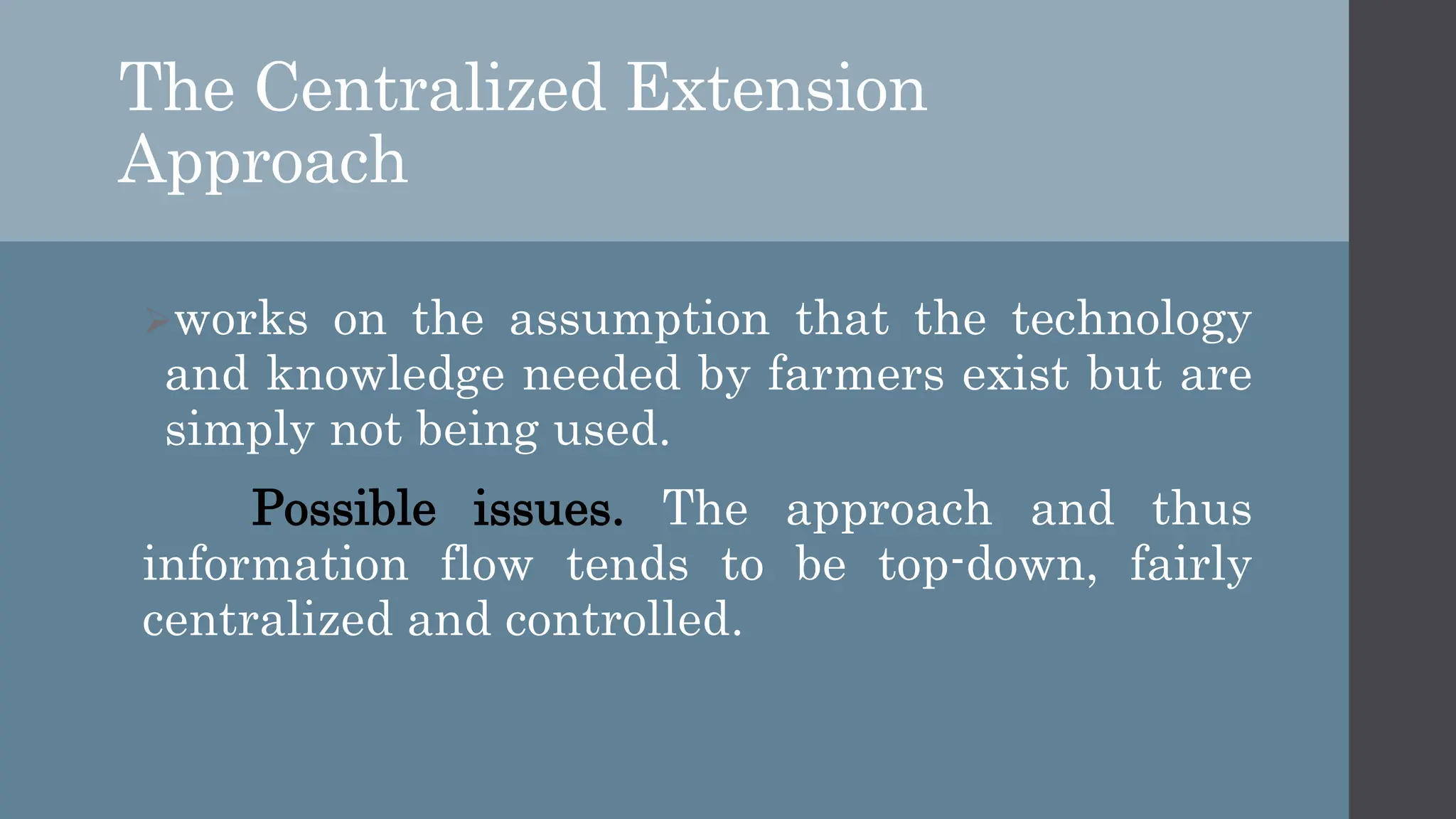
The Centralized Extension
Approach
works on the assumption that the technology
and knowledge needed by farmers exist but are
simply not being used.
Possible issues. The approach and thus
information flow tends to be top-down, fairly
centralized and controlled.
The Land Grant Extension
Approach
implemented in the United States involves strong
links between specialists on university campuses
with county advisors and farmers.
The system has grown to bring in industry and
other community groups. The system is highly
effective.
Possible issues: Requires highly trained
personnel (costly) associated with a clear
The Project Approach
concentrates efforts on a particular location, for a
specific time period,and is usually supported by
outside resources. Part of its purpose is to demonstrate
techniques and methods to farmers with the
expectation that adoption will continue farmer to
farmer after the project ends.
Possible issues. Project targets can add pressure
to make non-relevant changes in the short term and
there can be issues of sustainability once a project
withdraws.
The Training and Visit Approach
is fairly centralized and involves a series of
tightly planned visits to farmers.
the system results in greater farmer contact
and entails better trained extension agents.
Possible issues. The system is quite costly
and somewhat inflexible in its timing of
scheduled visits. As a result at times it can be
more procedural than message oriented.
References. 1. Axinn, G.H. (2008). Guide on alternative extension approaches. Handbook. FAO;
2. Bell, M et al (2015).ASK ME. http://www.meas-extension.org/tip-sheets/ask-me Nagel, U.J..
1998. Alternative approaches to organizing extension. Chapter 2 in Improving agricultural
extension. FAO; 3. Ponniah, et al. (2008). Concepts and practices in agricultural extension in
developing countries: A source book. Ethiopia: ILRI, IPMS Ethiopia.
https://epakag.ucdavis.edu/vocational_training/factsheets/fs-ext-methods-comparison.pdf

EXTENSION METHODS- report.pptx

  • 1.
    EXTENSION METHODS Rona N. Mostar MSAAg. Ed. 212 Agricultural Communication and Extension
  • 2.
    “What a manhears, he may doubt. What he sees he may possible doubt. But what he does himself he cannot doubt.”-Seaman Knapp
  • 3.
  • 4.
     Agricultural extensionis the application of scientific research and new knowledge to agricultural practices through farmer education. The field of 'extension' now encompasses a wider range of communication and learning activities organized for rural people by educators from different disciplines, including agriculture, agricultural marketing, health and business studies.
  • 5.
     Extension methodscomprise the communication techniques between extension workers and target groups. To facilitate farmers' decisions whether or not and how to adopt farming.
  • 6.
    EXTENSION METHODS Source : AgroforestryExtension Manual in Kenya The individual/household approach The group approach: meetings, field days, demonstrations, support to groups The school approach Mass extension methods.
  • 7.
    The choice of methoddepends on various factors such as; The tenure system in the area Community organization Resources available for extension
  • 8.
    This approach is mosteffective for activities to be undertaken by or within the full control of the individual farmer or household. The individual or household approach
  • 9.
    The group approach The group approach involves working with groups or the community at large.  Suitable when discussing matters related to the whole community (e.g. post-harvest grazing, protection and management of indigenous forests), and when there are activities to be undertaken by a group, e.g. group nurseries.  Suitable when there is a need to address individual matters but more cheaply than can be done with the individual approach. The direct target group may be a women's group, a church organization, a co-operative society or the community in general.
  • 10.
    The school approach The extension work can be in the form of lectures, support for 4K Clubs, or discussions held during parents' days.  Demonstration plots  Large numbers of people within a short time at minimal costs.
  • 11.
    Mass extension methods involvethe use of the mass media, e.g. radio, posters, drama, television, newspapers, films, slide shows, to inform the public. Mass media are mainly used to create awareness. Mass extension methods e feasi ble than an indi v idual appr oach . Figu re 12.4 Loca l lead ers play a vital role In the spre ad of exte nsio n activ ities If an orga nizat ion carr ying out exte nsio n is rich in reso urce s, a mor e costl y appr oach can be chos en than if the orga nizat ion is reso urce poor . It is, how ever , just as imp orta nt for a reso urce -rich orga nizat ion to care full y cons ider whi c h met hod is best for the area , and how the exte nsio n wor k shou ld be orga nize d in orde r to prev ent wast e of reso urce s. Cost - effec tiven ess shou ld alwa ys be born e in mi n d, and past expe rien ce indic ates, for exa mpl e, that issui ng free seed lings is rarel y a sust aina ble appr oach sinc e it crea tes depe nden cy and disc oura ges pri v ate com mer cial initia tives in tree- seed ling prod uctio n. An exce ssi v e level of mat erial supp ort gene rall y crea tes depe nden ce, and often prov es to be coun ter prod ucti v e in the long run. The indiv idual /hou seho ld appr oach This appr oach is mos t effec tive for acti v ities to be unde rtak en by or withi n the full cont rol of the indi v idual far m er or hous ehol d. Matt ers relat ed to the indi v idual far m shou ld, as muc h as poss ible, be disc usse d with the whol e fami ly. If the whol e fami ly i s invol ved, mor e prob lem s are highl ighte d and mor e expe rien ce is brou ght to the disc ussi on. Adv anta ges of the indi v idual met hods are: • Un clea r mes sage s that have not been fully unde rsto od can easil y be clari fied •The exte nsio n offic er is able to secu re co- oper ation and inspi re the confi denc e of the fami ly thro ugh pers onal cont act •It facili tates imm ediat e feed back on the effec tiven ess of the mea sure s disc usse d •It may be the best way to ensu re that ever yone in the fami ly parti cipat es in deci sion mak ing. Figu re 12.5 The indiv idual appr oach Disa dvan tage s of the indi v idual met hod: •It is expe nsiv e in term s of time and tran spor t •Onl y a few farm ers may be visit ed, and som etim es they may e feasi ble than an indi v idual appr oach . Figu re 12.4 Loca l lead ers play a vital role In the spre ad of exte nsio n activ ities If an orga nizat ion carr ying out exte nsio n is rich in reso urce s, a mor e costl y appr oach can be chos en than if the orga nizat ion is reso urce poor . It is, how ever , just as imp orta nt for a reso urce -rich orga nizat ion to care full y cons ider whi c h met hod is best for the area , and how the exte nsio n wor k shou ld be orga nize d in orde r to prev ent wast e of reso urce s. Cost - effec tiven ess shou ld alwa ys be born e in mi n d, and past expe rien ce indic ates, for exa mpl e, that issui ng free seed lings is rarel y a sust aina ble appr oach sinc e it crea tes depe nden cy and disc oura ges pri v ate com mer cial initia tives in tree- seed ling prod uctio n. An exce ssi v e level of mat erial supp ort gene rall y crea tes depe nden ce, and often prov es to be coun ter prod ucti v e in the long run. The indiv idual /hou seho ld appr oach This appr oach is mos t effec tive for acti v ities to be unde rtak en by or withi n the full cont rol of the indi v idual far m er or hous ehol d. Matt ers relat ed to the indi v idual far m shou ld, as muc h as poss ible, be disc usse d with the whol e fami ly. If the whol e fami ly i s invol ved, mor e prob lem s are highl ighte d and mor e expe rien ce is brou ght to the disc ussi on. Adv anta ges of the indi v idual met hods are: • Un clea r mes sage s that have not been fully unde rsto od can easil y be clari fied •The exte nsio n offic er is able to secu re co- oper ation and inspi re the confi denc e of the fami ly thro ugh pers onal cont act •It facili tates imm ediat e feed back on the effec tiven ess of the mea sure s disc usse d •It may be the best way to ensu re that ever yone in the fami ly parti cipat es in deci sion mak ing. Figu re 12.5 The indiv idual appr oach Disa dvan tage s of the indi v idual met hod: •It is expe nsiv e in term s of time and tran spor t •Onl y a few farm ers may be visit ed, and som etim es they may
  • 12.
    EXTENSION METHODS 10 Most Common Extension Approaches byMark Bell, Amada Crump, Elana Peach-Fine and Maria Paz ,College of Agricultural and Environmental Sciences 1.Commodity-based 2. Cost-Sharing 3. Educational Institution 4. Farmer Field Schools 5. Farmer Participatory 6. Farming Systems 7. Centralized 8. Land Grant (US) 9. Project 10. Training and Visit
  • 13.
    How do theserelate to the “ASK ME” extension framework? “ASK ME” (Bell et al., 2015) provides a framework for the different extension methods to be implemented: 1. Audience - understand and engage the audience, 2. Solutions - find appropriate solutions, 3. Key message – identify the key message 4. Message form and delivery - package and deliver the needed information in forms appropriate to the audience and, 5. Evaluation - improve the overall process
  • 14.
    The Commodity-Based Approach focuseson a single crop or on only one aspect of farming. the approach generally addresses everything from extension and research to input supply, marketing and prices to increase production in the selected crop. Possible issues. Planning is often controlled by a commodity organization whose interests might not match others and the approach typically does not provide support on other aspects of farming.
  • 15.
    The Cost-Sharing Approach assumesthat cost-sharing with local people (who do not have the means to pay the full cost) will more likely result in a program that can 1) better meet local situations and 2) be more accountable to local interests. Possible issues: Success is dependent on farmer willingness to pay. Possible issues: Success is dependent on farmer willingness to pay. Financial management and other aspects of administration tend to be complex and difficult.
  • 16.
    The Educational Institution Approach relieson educational institutions with the technical knowledge and research ability to meet extension service demands. Possible issues. The effectiveness of implementation is often dependent on those who determine overall school curricula and thus determine the extent of the focus on extension. Funding directions and issues of staff promotion and institutional mandates can often push people to do work that does not focus on farmers’ needs.
  • 17.
    The Farmer FieldSchools Approach Is a form of participatory research that uses a season long group-based learning process. The method initially focused primarily on Integrated Pest Management (IPM). Possible issues. High costs and high time requirements can affect sustainability of the system.
  • 18.
    The Farmer ParticipatoryApproach involves active participation of farmers in planning and execution of the various research- extension activities. Program planning is typically controlled and implemented locally by farmers’ associations and community organizations. Implementation is often decentralized and flexible. Possible issues: High time, participatory skills and cost required.
  • 19.
    The Farming SystemsDevelopment Approach focuses on bringing appropriate technology to small-scale farmers with farmers engaged in the technology development and delivery process. a key characteristic of the approach is the farm being viewed as a system using a holistic approach at the local level. the approach requires close ties between research, extension and farmers with technology developed locally through an iterative process. Possible issues. Expensive and time consuming (given the broad range of issues to consider).
  • 20.
    The Centralized Extension Approach workson the assumption that the technology and knowledge needed by farmers exist but are simply not being used. Possible issues. The approach and thus information flow tends to be top-down, fairly centralized and controlled.
  • 21.
    The Land GrantExtension Approach implemented in the United States involves strong links between specialists on university campuses with county advisors and farmers. The system has grown to bring in industry and other community groups. The system is highly effective. Possible issues: Requires highly trained personnel (costly) associated with a clear
  • 22.
    The Project Approach concentratesefforts on a particular location, for a specific time period,and is usually supported by outside resources. Part of its purpose is to demonstrate techniques and methods to farmers with the expectation that adoption will continue farmer to farmer after the project ends. Possible issues. Project targets can add pressure to make non-relevant changes in the short term and there can be issues of sustainability once a project withdraws.
  • 23.
    The Training andVisit Approach is fairly centralized and involves a series of tightly planned visits to farmers. the system results in greater farmer contact and entails better trained extension agents. Possible issues. The system is quite costly and somewhat inflexible in its timing of scheduled visits. As a result at times it can be more procedural than message oriented.
  • 24.
    References. 1. Axinn,G.H. (2008). Guide on alternative extension approaches. Handbook. FAO; 2. Bell, M et al (2015).ASK ME. http://www.meas-extension.org/tip-sheets/ask-me Nagel, U.J.. 1998. Alternative approaches to organizing extension. Chapter 2 in Improving agricultural extension. FAO; 3. Ponniah, et al. (2008). Concepts and practices in agricultural extension in developing countries: A source book. Ethiopia: ILRI, IPMS Ethiopia. https://epakag.ucdavis.edu/vocational_training/factsheets/fs-ext-methods-comparison.pdf