EXPOSITORY TEXT
TRESNA NUR ANDINI, M.PD
DEFINITION OF EXPOSITORY TEXT
• An expository text explains or informs about a topic in a clear and
concise manner.
• It provides facts, explanations, or descriptions, rather than opinions or
narratives.
• Common examples: textbooks, articles, how-to guides (procedure
text)
PURPOSE OF EXPOSITORY TEXT
1.To inform readers about a specific topic.
2.To explain concepts or processes clearly.
3.To analyze and present evidence-based information.
• Why is it Important?
• Helps develop critical reading skills.
• Enhances the ability to explain ideas logically.
• Prepares students for academic and professional writing.
FEATURES OF EXPOSITORY TEXT
1.Clear Structure
1. Introduction, Body, Conclusion.
2.Objective Language
1. Avoids personal opinions.
3.Evidence-Based
1. Relies on facts, data, and examples.
4.Uses Transitional Words
1. Examples: "therefore," "for example," "however."
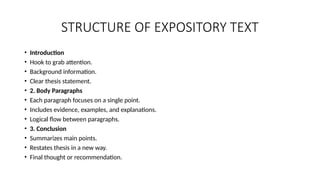
STRUCTURE OF EXPOSITORY TEXT
• Introduction
• Hook to grab attention.
• Background information.
• Clear thesis statement.
• 2. Body Paragraphs
• Each paragraph focuses on a single point.
• Includes evidence, examples, and explanations.
• Logical flow between paragraphs.
• 3. Conclusion
• Summarizes main points.
• Restates thesis in a new way.
• Final thought or recommendation.
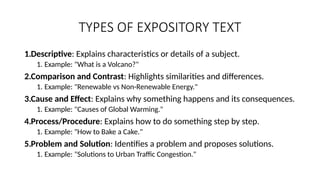
TYPES OF EXPOSITORY TEXT
1.Descriptive: Explains characteristics or details of a subject.
1. Example: "What is a Volcano?"
2.Comparison and Contrast: Highlights similarities and differences.
1. Example: "Renewable vs Non-Renewable Energy."
3.Cause and Effect: Explains why something happens and its consequences.
1. Example: "Causes of Global Warming."
4.Process/Procedure: Explains how to do something step by step.
1. Example: "How to Bake a Cake."
5.Problem and Solution: Identifies a problem and proposes solutions.
1. Example: "Solutions to Urban Traffic Congestion."
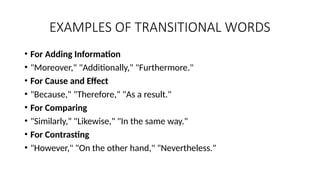
EXAMPLES OF TRANSITIONAL WORDS
• For Adding Information
• "Moreover," "Additionally," "Furthermore."
• For Cause and Effect
• "Because," "Therefore," "As a result."
• For Comparing
• "Similarly," "Likewise," "In the same way."
• For Contrasting
• "However," "On the other hand," "Nevertheless."
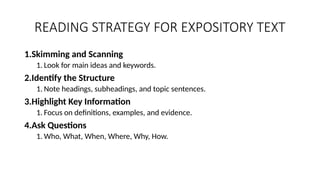
READING STRATEGY FOR EXPOSITORY TEXT
1.Skimming and Scanning
1. Look for main ideas and keywords.
2.Identify the Structure
1. Note headings, subheadings, and topic sentences.
3.Highlight Key Information
1. Focus on definitions, examples, and evidence.
4.Ask Questions
1. Who, What, When, Where, Why, How.
WRITING EXPOSITORY TEXT
• Steps to Follow
1.Choose a Topic
1. Ensure it is clear and specific.
2.Research
1. Gather reliable facts and data.
3.Create an Outline
1. Organize ideas into sections.
4.Write
1. Follow the structure: Introduction, Body, Conclusion.
5.Revise and Edit
1. Check for clarity, coherence, and grammar.

EXPOSITORY TEXT Dalam Bahasa Inggris.pptx

  • 1.
  • 2.
    DEFINITION OF EXPOSITORYTEXT • An expository text explains or informs about a topic in a clear and concise manner. • It provides facts, explanations, or descriptions, rather than opinions or narratives. • Common examples: textbooks, articles, how-to guides (procedure text)
  • 3.
    PURPOSE OF EXPOSITORYTEXT 1.To inform readers about a specific topic. 2.To explain concepts or processes clearly. 3.To analyze and present evidence-based information. • Why is it Important? • Helps develop critical reading skills. • Enhances the ability to explain ideas logically. • Prepares students for academic and professional writing.
  • 4.
    FEATURES OF EXPOSITORYTEXT 1.Clear Structure 1. Introduction, Body, Conclusion. 2.Objective Language 1. Avoids personal opinions. 3.Evidence-Based 1. Relies on facts, data, and examples. 4.Uses Transitional Words 1. Examples: "therefore," "for example," "however."
  • 5.
    STRUCTURE OF EXPOSITORYTEXT • Introduction • Hook to grab attention. • Background information. • Clear thesis statement. • 2. Body Paragraphs • Each paragraph focuses on a single point. • Includes evidence, examples, and explanations. • Logical flow between paragraphs. • 3. Conclusion • Summarizes main points. • Restates thesis in a new way. • Final thought or recommendation.
  • 6.
    TYPES OF EXPOSITORYTEXT 1.Descriptive: Explains characteristics or details of a subject. 1. Example: "What is a Volcano?" 2.Comparison and Contrast: Highlights similarities and differences. 1. Example: "Renewable vs Non-Renewable Energy." 3.Cause and Effect: Explains why something happens and its consequences. 1. Example: "Causes of Global Warming." 4.Process/Procedure: Explains how to do something step by step. 1. Example: "How to Bake a Cake." 5.Problem and Solution: Identifies a problem and proposes solutions. 1. Example: "Solutions to Urban Traffic Congestion."
  • 7.
    EXAMPLES OF TRANSITIONALWORDS • For Adding Information • "Moreover," "Additionally," "Furthermore." • For Cause and Effect • "Because," "Therefore," "As a result." • For Comparing • "Similarly," "Likewise," "In the same way." • For Contrasting • "However," "On the other hand," "Nevertheless."
  • 8.
    READING STRATEGY FOREXPOSITORY TEXT 1.Skimming and Scanning 1. Look for main ideas and keywords. 2.Identify the Structure 1. Note headings, subheadings, and topic sentences. 3.Highlight Key Information 1. Focus on definitions, examples, and evidence. 4.Ask Questions 1. Who, What, When, Where, Why, How.
  • 9.
    WRITING EXPOSITORY TEXT •Steps to Follow 1.Choose a Topic 1. Ensure it is clear and specific. 2.Research 1. Gather reliable facts and data. 3.Create an Outline 1. Organize ideas into sections. 4.Write 1. Follow the structure: Introduction, Body, Conclusion. 5.Revise and Edit 1. Check for clarity, coherence, and grammar.