Basic Guide to Writing
an Essay
an Essay
What is an Essay?
What is an Essay?
 An essay can have many purposes, but the basic structure is
the same no matter what. You may be writing an essay to
argue for a particular point of view or to explain the steps
necessary to complete a task. Either way, your essay will have
the same basic format. If you follow a few simple steps, you
will find that the essay almost writes itself. You will be
responsible only for supplying ideas, which are the important
part of the essay anyway.
Don't let the thought of putting pen to paper daunt
you. Get started!
Essay Format
Essay Format
These simple steps will guide you through the essay writing
process:
 Decide on your topic.
 Prepare an outline or diagram of your ideas.
 Write your thesis statement.
 Write the body.
 Write the main points.
 Write the subpoints.
 Elaborate on the subpoints.
 Write the introduction.
 Write the conclusion.
 Add the finishing touches.
Choosing a Topic
Choosing a Topic
You may have no choice as to your topic. If this is the case, you still may not be
ready to jump to the next step. Think about the type of paper you are expected to
produce. Should it be a general overview, or a specific analysis of the topic? If it
should be an overview, then you are probably ready to move to the next step. If it
should be a specific analysis, make sure your topic is fairly specific. If it is too
general, you must choose a narrower subtopic to discuss.
For example, the topic "KENYA" is a general one. If your objective is to write an
overview, this topic is suitable. If your objective is to write a specific analysis, this
topic is too general. You must narrow it to something like "Politics in Kenya" or
"Kenya's Culture.“
Once you have determined that your topic will be suitable, you can move on.
Organize Your Ideas
Organize Your Ideas
The purpose of an outline or diagram is to put your ideas about the
topic on paper, in a moderately organized format. The structure you
create here may still change before the essay is complete, so don't
agonize over this. Decide whether you prefer the cut-and-dried
structure of an outline or a more flowing structure. If you start one
or the other and decide it isn't working for you, you can always
switch later.
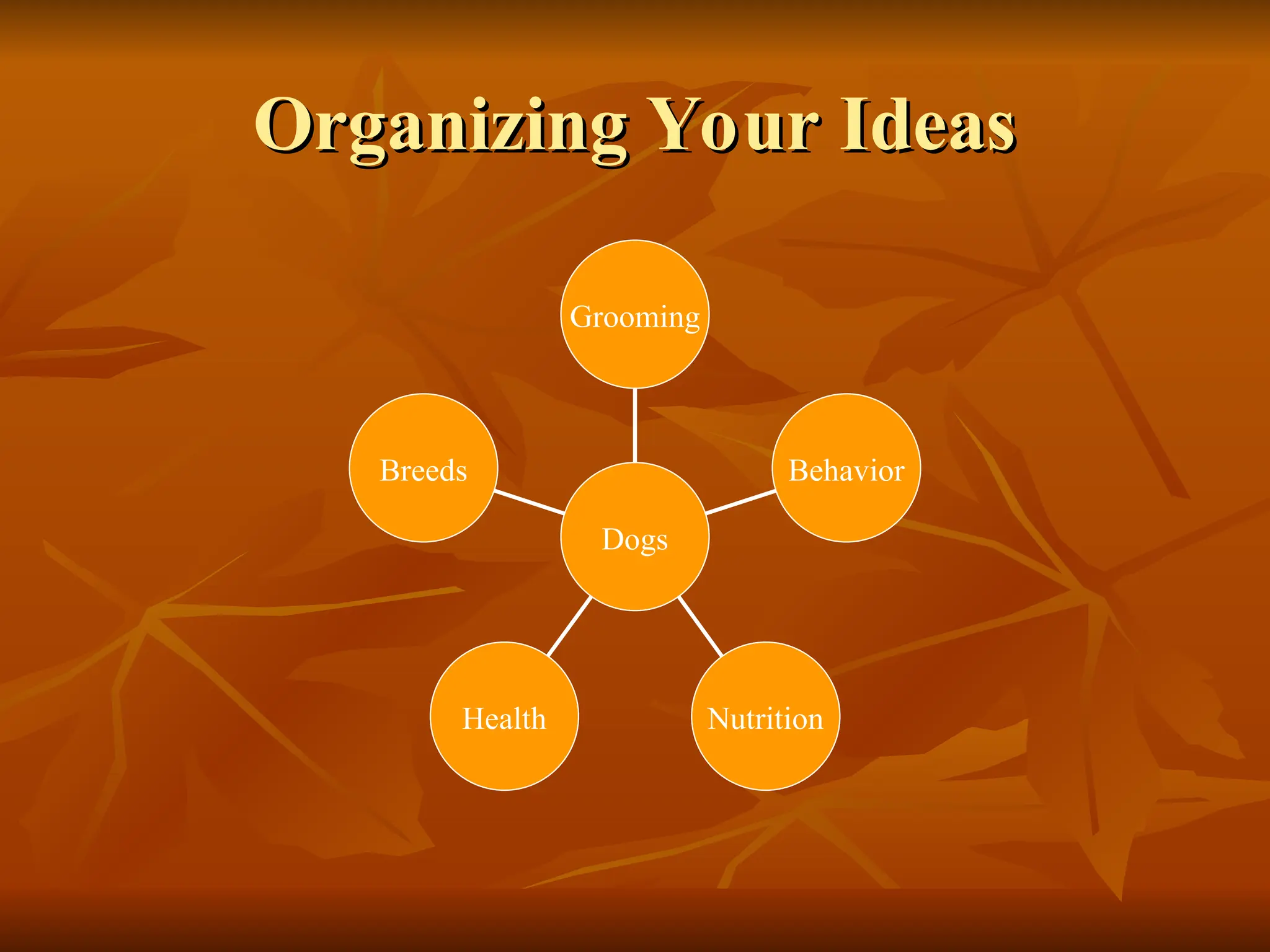
Organizing Your Ideas
Breeds
Health Nutrition
Behavior
Grooming
Dogs
Writing Your Outline
 Begin your outline by writing your topic at the top of the page.
 Next, write the Roman numerals I, II, and III, spread apart down the left side of
the page.
 Next to each Roman numeral, write the main ideas that you have about your
topic, or the main points that you want to make.
 If you are trying to persuade, you want to write your best arguments.
 If you are trying to explain a process, you want to write the steps that
should be followed. You will probably need to group these into
categories. If you have trouble grouping the steps into categories, try
using Beginning, Middle, and End.
 If you are trying to inform, you want to write the major categories into
which your information can be divided.
 Under each Roman numeral, write A, B, and C down the left side of the page.
 Next to each letter, write the facts or information that support that main idea.
 When you have finished, you have the basic structure for your essay and are
ready to continue.
Composing a Thesis Statement
 Now that you have decided, at least tentatively, what
information you plan to present in your essay, you are
ready to write your thesis statement.
 The thesis statement tells the reader what the essay
will be about, and what point you, the author, will be
making.
 You know what the essay will be about. That was
your topic. Now you must look at your outline or
diagram and decide what point you will be making.
What do the main ideas and supporting ideas that you
listed say about your topic?
Thesis Statements
Thesis Statements
 Your thesis statement will have two parts.
 The first part states the topic.
 Kenya's Culture
 Building a Model Train Set
 Public Transportation
 The second part states the point of the essay.
 has a rich and varied history
 takes time and patience
 can solve some of our city's most persistent and pressing problems
 Once you have formulated a thesis statement that fits
this pattern and with which you are comfortable, you
are ready to continue.
Writing the Body Paragraphs
 In the body of the essay, all the preparation up to this point
comes to fruition. The topic you have chosen must now be
explained, described, or argued. Each main idea that you wrote
down in your diagram or outline will become one of the body
paragraphs. If you had three or four main ideas, you will have
three or four body paragraphs. Each body paragraph will have
the same basic structure.
 Start by writing down one of your main ideas, in sentence
form. Next, write down each of your supporting points for
that main idea, but leave four or five lines in between each
point.
 In the space under each point, write down some elaboration
for that point. Elaboration can be further description or
explanation or discussion.
 Once you have fleshed out each of your body paragraphs, one
for each main point, you are ready to continue.
Example
Example
 If your main idea is "reduces freeway congestion," you
might say this:
 Public transportation reduces freeway congestion.
 Supporting Point:
 Commuters appreciate the cost savings of taking public
transportation rather than driving.
 Elaboration
 Less driving time means less maintenance expense, such as oil
changes.
 Of course, less driving time means savings on gasoline as well.
 In many cases, these savings amount to more than the cost of
riding public transportation.
Write the Introduction and
Conclusion
Your essay lacks only two paragraphs now:
the introduction and the conclusion. These
paragraphs will give the reader a point of
entry to and a point of exit from your essay.
Introduction
Introduction
 The introduction should be designed to attract the reader's attention and give her an idea
of the essay's focus. Begin with an attention grabber. The attention grabber you use is up
to you, but here are some ideas:
 Startling information. This information must be true and verifiable, and it doesn't
need to be totally new to your readers. It could simply be a pertinent fact that
explicitly illustrates the point you wish to make. If you use a piece of startling
information, follow it with a sentence or two of elaboration.
 Anecdote. An anecdote is a story that illustrates a point. Be sure your anecdote is
short, to the point, and relevant to your topic. This can be a very effective opener
for your essay, but use it carefully.
 Dialogue. An appropriate dialogue does not have to identify the speakers, but the
reader must understand the point you are trying to convey. Use only two or three
exchanges between speakers to make your point. Follow dialogue with a sentence
or two of elaboration.
 Summary Information. A few sentences explaining your topic in general terms
can lead the reader gently to your thesis. Each sentence should become gradually
more specific, until you reach your thesis.
 If the attention grabber was only a sentence or two, add one or two more sentences that
will lead the reader from your opening to your thesis statement.
 Finish the paragraph with your thesis statement.
Conclusion
Conclusion
 The conclusion brings closure to the reader, summing
up your points or providing a final perspective on
your topic. All the conclusion needs is three or four
strong sentences which do not need to follow any set
formula. Simply review the main points (being
careful not to restate them exactly) or briefly describe
your feelings about the topic. Even an anecdote can
end your essay in a useful way. The introduction and
conclusion complete the paragraphs of your essay.
Don't stop just yet! One more step remains before
your essay is truly finished.
Add the Finishing Touches
 You have now completed all of the paragraphs
of your essay. Before you can consider this a
finished product, however, you must give
some thought to the formatting of your paper.
 Check the order of your paragraphs.
 Check the instructions for the assignment.
 Check your writing.
Once you have checked your work and
perfected your formatting,
your essay is finished.
Congratulations!
Why Education Is Important
Introduction
Education is very important for everyone. It does not only
provide knowledge but also builds character. There are several
reasons why education is crucial. Education enables people to
have a good career. It also encourages independence and self-
growth.
Body
Firstly, people can have a good career with good education.
Education gives people knowledge and skills which can help
them succeed in a work environment. Having an expertise also
helps people progress and expand their career. Therefore, good
education helps people reach their career goals.
Education is also important because it
encourages independence. Being independent
means you can rely on yourself. People who are
educated can have a good and secure job.
Educated people also have a better
understanding of the world. Thus, people who
have good education can rely on themselves and
do not always seek others’ support. It is why
people who are educated can be independent.
Lastly, a good education can enable you to grow
as an individual. People who are well-educated
are usually not only knowledgeable but also
have a good character. Good education imparts
moral values and culture. With education, people
can grow to become more mature, open-minded,
and have moral integrity.
Conclusion
Conclusion
 In conclusion, education is very crucial for
In conclusion, education is very crucial for
everyone. It has many benefits such as a good
career, self-reliance, and personal growth.
Because of the importance of education,
everyone should have access to good
education. That way, everyone can fulfil their
potential.
potential.
Assignment
Assignment
 Please make one essay about electric vehicle
Please make one essay about electric vehicle
 Include advantage and disadvantage
Include advantage and disadvantage

Minimum 3 Paragraph
Minimum 3 Paragraph

Basic Guide to Writing an Essay for your scientific paper

  • 1.
    Basic Guide toWriting Basic Guide to Writing an Essay an Essay
  • 2.
    What is anEssay? What is an Essay?  An essay can have many purposes, but the basic structure is the same no matter what. You may be writing an essay to argue for a particular point of view or to explain the steps necessary to complete a task. Either way, your essay will have the same basic format. If you follow a few simple steps, you will find that the essay almost writes itself. You will be responsible only for supplying ideas, which are the important part of the essay anyway. Don't let the thought of putting pen to paper daunt you. Get started!
  • 3.
    Essay Format Essay Format Thesesimple steps will guide you through the essay writing process:  Decide on your topic.  Prepare an outline or diagram of your ideas.  Write your thesis statement.  Write the body.  Write the main points.  Write the subpoints.  Elaborate on the subpoints.  Write the introduction.  Write the conclusion.  Add the finishing touches.
  • 4.
    Choosing a Topic Choosinga Topic You may have no choice as to your topic. If this is the case, you still may not be ready to jump to the next step. Think about the type of paper you are expected to produce. Should it be a general overview, or a specific analysis of the topic? If it should be an overview, then you are probably ready to move to the next step. If it should be a specific analysis, make sure your topic is fairly specific. If it is too general, you must choose a narrower subtopic to discuss. For example, the topic "KENYA" is a general one. If your objective is to write an overview, this topic is suitable. If your objective is to write a specific analysis, this topic is too general. You must narrow it to something like "Politics in Kenya" or "Kenya's Culture.“ Once you have determined that your topic will be suitable, you can move on.
  • 5.
    Organize Your Ideas OrganizeYour Ideas The purpose of an outline or diagram is to put your ideas about the topic on paper, in a moderately organized format. The structure you create here may still change before the essay is complete, so don't agonize over this. Decide whether you prefer the cut-and-dried structure of an outline or a more flowing structure. If you start one or the other and decide it isn't working for you, you can always switch later.
  • 6.
    Organizing Your Ideas OrganizingYour Ideas Breeds Health Nutrition Behavior Grooming Dogs
  • 7.
    Writing Your Outline WritingYour Outline  Begin your outline by writing your topic at the top of the page.  Next, write the Roman numerals I, II, and III, spread apart down the left side of the page.  Next to each Roman numeral, write the main ideas that you have about your topic, or the main points that you want to make.  If you are trying to persuade, you want to write your best arguments.  If you are trying to explain a process, you want to write the steps that should be followed. You will probably need to group these into categories. If you have trouble grouping the steps into categories, try using Beginning, Middle, and End.  If you are trying to inform, you want to write the major categories into which your information can be divided.  Under each Roman numeral, write A, B, and C down the left side of the page.  Next to each letter, write the facts or information that support that main idea.  When you have finished, you have the basic structure for your essay and are ready to continue.
  • 8.
    Composing a ThesisStatement Composing a Thesis Statement  Now that you have decided, at least tentatively, what information you plan to present in your essay, you are ready to write your thesis statement.  The thesis statement tells the reader what the essay will be about, and what point you, the author, will be making.  You know what the essay will be about. That was your topic. Now you must look at your outline or diagram and decide what point you will be making. What do the main ideas and supporting ideas that you listed say about your topic?
  • 9.
    Thesis Statements Thesis Statements Your thesis statement will have two parts.  The first part states the topic.  Kenya's Culture  Building a Model Train Set  Public Transportation  The second part states the point of the essay.  has a rich and varied history  takes time and patience  can solve some of our city's most persistent and pressing problems  Once you have formulated a thesis statement that fits this pattern and with which you are comfortable, you are ready to continue.
  • 10.
    Writing the BodyParagraphs Writing the Body Paragraphs  In the body of the essay, all the preparation up to this point comes to fruition. The topic you have chosen must now be explained, described, or argued. Each main idea that you wrote down in your diagram or outline will become one of the body paragraphs. If you had three or four main ideas, you will have three or four body paragraphs. Each body paragraph will have the same basic structure.  Start by writing down one of your main ideas, in sentence form. Next, write down each of your supporting points for that main idea, but leave four or five lines in between each point.  In the space under each point, write down some elaboration for that point. Elaboration can be further description or explanation or discussion.  Once you have fleshed out each of your body paragraphs, one for each main point, you are ready to continue.
  • 11.
    Example Example  If yourmain idea is "reduces freeway congestion," you might say this:  Public transportation reduces freeway congestion.  Supporting Point:  Commuters appreciate the cost savings of taking public transportation rather than driving.  Elaboration  Less driving time means less maintenance expense, such as oil changes.  Of course, less driving time means savings on gasoline as well.  In many cases, these savings amount to more than the cost of riding public transportation.
  • 12.
    Write the Introductionand Conclusion Your essay lacks only two paragraphs now: the introduction and the conclusion. These paragraphs will give the reader a point of entry to and a point of exit from your essay.
  • 13.
    Introduction Introduction  The introductionshould be designed to attract the reader's attention and give her an idea of the essay's focus. Begin with an attention grabber. The attention grabber you use is up to you, but here are some ideas:  Startling information. This information must be true and verifiable, and it doesn't need to be totally new to your readers. It could simply be a pertinent fact that explicitly illustrates the point you wish to make. If you use a piece of startling information, follow it with a sentence or two of elaboration.  Anecdote. An anecdote is a story that illustrates a point. Be sure your anecdote is short, to the point, and relevant to your topic. This can be a very effective opener for your essay, but use it carefully.  Dialogue. An appropriate dialogue does not have to identify the speakers, but the reader must understand the point you are trying to convey. Use only two or three exchanges between speakers to make your point. Follow dialogue with a sentence or two of elaboration.  Summary Information. A few sentences explaining your topic in general terms can lead the reader gently to your thesis. Each sentence should become gradually more specific, until you reach your thesis.  If the attention grabber was only a sentence or two, add one or two more sentences that will lead the reader from your opening to your thesis statement.  Finish the paragraph with your thesis statement.
  • 14.
    Conclusion Conclusion  The conclusionbrings closure to the reader, summing up your points or providing a final perspective on your topic. All the conclusion needs is three or four strong sentences which do not need to follow any set formula. Simply review the main points (being careful not to restate them exactly) or briefly describe your feelings about the topic. Even an anecdote can end your essay in a useful way. The introduction and conclusion complete the paragraphs of your essay. Don't stop just yet! One more step remains before your essay is truly finished.
  • 15.
    Add the FinishingTouches  You have now completed all of the paragraphs of your essay. Before you can consider this a finished product, however, you must give some thought to the formatting of your paper.  Check the order of your paragraphs.  Check the instructions for the assignment.  Check your writing.
  • 16.
    Once you havechecked your work and perfected your formatting, your essay is finished. Congratulations!
  • 17.
    Why Education IsImportant Introduction Education is very important for everyone. It does not only provide knowledge but also builds character. There are several reasons why education is crucial. Education enables people to have a good career. It also encourages independence and self- growth. Body Firstly, people can have a good career with good education. Education gives people knowledge and skills which can help them succeed in a work environment. Having an expertise also helps people progress and expand their career. Therefore, good education helps people reach their career goals.
  • 18.
    Education is alsoimportant because it Education is also important because it encourages independence. Being independent encourages independence. Being independent means you can rely on yourself. People who are means you can rely on yourself. People who are educated can have a good and secure job. educated can have a good and secure job. Educated people also have a better Educated people also have a better understanding of the world. Thus, people who understanding of the world. Thus, people who have good education can rely on themselves and have good education can rely on themselves and do not always seek others’ support. It is why do not always seek others’ support. It is why people who are educated can be independent. people who are educated can be independent.
  • 19.
    Lastly, a goodeducation can enable you to grow Lastly, a good education can enable you to grow as an individual. People who are well-educated as an individual. People who are well-educated are usually not only knowledgeable but also are usually not only knowledgeable but also have a good character. Good education imparts have a good character. Good education imparts moral values and culture. With education, people moral values and culture. With education, people can grow to become more mature, open-minded, can grow to become more mature, open-minded, and have moral integrity. and have moral integrity.
  • 20.
    Conclusion Conclusion  In conclusion,education is very crucial for In conclusion, education is very crucial for everyone. It has many benefits such as a good everyone. It has many benefits such as a good career, self-reliance, and personal growth. career, self-reliance, and personal growth. Because of the importance of education, Because of the importance of education, everyone should have access to good everyone should have access to good education. That way, everyone can fulfil their education. That way, everyone can fulfil their potential. potential.
  • 21.
    Assignment Assignment  Please makeone essay about electric vehicle Please make one essay about electric vehicle  Include advantage and disadvantage Include advantage and disadvantage  Minimum 3 Paragraph Minimum 3 Paragraph