Unit I: Introduction to
Expository Writing
By Tanveer Hussain
1. Understanding expository writing
(definition, types, purpose, and
applications).
What is Expository Writing?
Exposition is a type of oral or written discourse that is
used to explain, describe, give information or inform.
The expository essay is a genre of essay that requires the
student to investigate an idea, evaluate evidence, expound
on the idea, and set forth an argument concerning that idea
in a clear and concise manner.
What is Expository Writing?
 The creator of an expository text can not assume that the reader or
listener has prior knowledge or prior understanding of the topic that
is being discussed.
 One important point to keep in mind for the author is to try to use
words that clearly show what they are talking about rather then
blatantly telling the reader what is being discussed
What is Expository Writing?
Expository writing is defined as presenting reasons,
explanations, or steps in a process
Informational writing
An expository essay should follow a logical sequence and
have three different main points
Logic and coherence is the main focus of an expository
essay
How is it different ?
Expository writing does not tell a story
Expository writing does not persuade a reader but only
gives facts and reasons
Expository writing can also give the steps of a process
Expository Writing
Introduction of an expository should include the main idea
and what the essay is about
The three main reasons supporting this main idea should
also be included in the introduction
Expository writing contd.
Paragraph two should introduce the first reason and give
details to support the first reason
Paragraph three should introduce the second reason and
give details to support the second reason
Paragraph four should introduce the third reason and give
details to support the third reason
The conclusion should re-state all the reasons
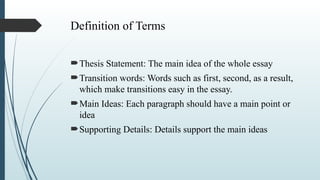
Definition of Terms
Thesis Statement: The main idea of the whole essay
Transition words: Words such as first, second, as a result,
which make transitions easy in the essay.
Main Ideas: Each paragraph should have a main point or
idea
Supporting Details: Details support the main ideas
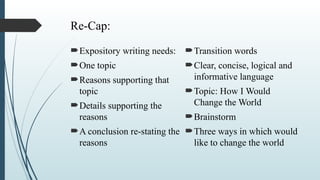
Re-Cap:
Expository writing needs:
One topic
Reasons supporting that
topic
Details supporting the
reasons
A conclusion re-stating the
reasons
Transition words
Clear, concise, logical and
informative language
Topic: How I Would
Change the World
Brainstorm
Three ways in which would
like to change the world
Details
Can be descriptive
Can be factual
Can be from personal experience
Can be anecdotes
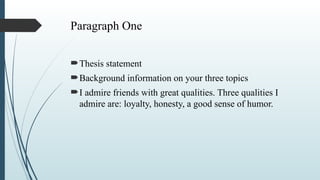
Paragraph One
Thesis statement
Background information on your three topics
I admire friends with great qualities. Three qualities I
admire are: loyalty, honesty, a good sense of humor.
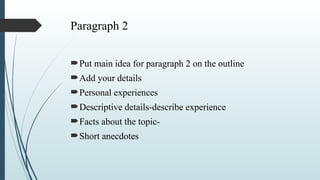
Paragraph 2
Put main idea for paragraph 2 on the outline
Add your details
Personal experiences
Descriptive details-describe experience
Facts about the topic-
Short anecdotes
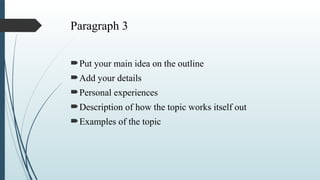
Paragraph 3
Put your main idea on the outline
Add your details
Personal experiences
Description of how the topic works itself out
Examples of the topic
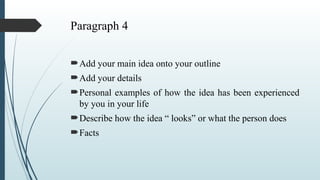
Paragraph 4
Add your main idea onto your outline
Add your details
Personal examples of how the idea has been experienced
by you in your life
Describe how the idea “ looks” or what the person does
Facts
Conclusion
Re-state all of your ideas in your conclusion
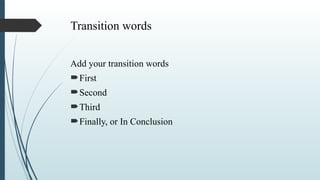
Transition words
Add your transition words
First
Second
Third
Finally, or In Conclusion
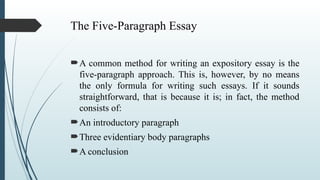
The Five-Paragraph Essay
A common method for writing an expository essay is the
five-paragraph approach. This is, however, by no means
the only formula for writing such essays. If it sounds
straightforward, that is because it is; in fact, the method
consists of:
An introductory paragraph
Three evidentiary body paragraphs
A conclusion
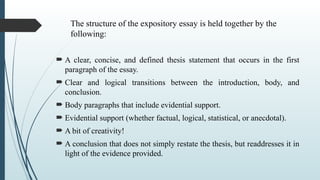
The structure of the expository essay is held together by the
following:
 A clear, concise, and defined thesis statement that occurs in the first
paragraph of the essay.
 Clear and logical transitions between the introduction, body, and
conclusion.
 Body paragraphs that include evidential support.
 Evidential support (whether factual, logical, statistical, or anecdotal).
 A bit of creativity!
 A conclusion that does not simply restate the thesis, but readdresses it in
light of the evidence provided.
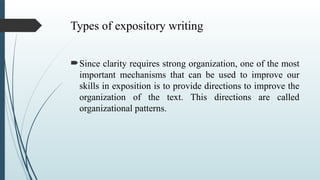
Types of expository writing
Since clarity requires strong organization, one of the most
important mechanisms that can be used to improve our
skills in exposition is to provide directions to improve the
organization of the text. This directions are called
organizational patterns.
Types of expository writing
Description
Sequence
Comparison & Contrast
Cause and Effect
Problem and Solution
Classification
Anecdotal Evidence
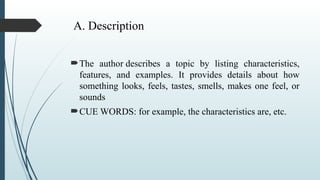
A. Description
The author describes a topic by listing characteristics,
features, and examples. It provides details about how
something looks, feels, tastes, smells, makes one feel, or
sounds
CUE WORDS: for example, the characteristics are, etc.
GRAPHIC ORGANIZER:
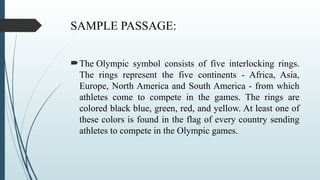
SAMPLE PASSAGE:
The Olympic symbol consists of five interlocking rings.
The rings represent the five continents - Africa, Asia,
Europe, North America and South America - from which
athletes come to compete in the games. The rings are
colored black blue, green, red, and yellow. At least one of
these colors is found in the flag of every country sending
athletes to compete in the Olympic games.
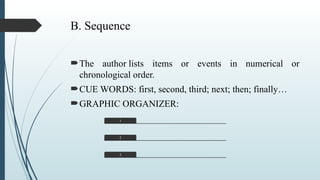
B. Sequence
The author lists items or events in numerical or
chronological order.
CUE WORDS: first, second, third; next; then; finally…
GRAPHIC ORGANIZER:
1
2
3
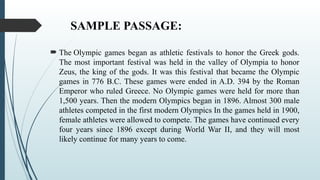
SAMPLE PASSAGE:
 The Olympic games began as athletic festivals to honor the Greek gods.
The most important festival was held in the valley of Olympia to honor
Zeus, the king of the gods. It was this festival that became the Olympic
games in 776 B.C. These games were ended in A.D. 394 by the Roman
Emperor who ruled Greece. No Olympic games were held for more than
1,500 years. Then the modern Olympics began in 1896. Almost 300 male
athletes competed in the first modern Olympics In the games held in 1900,
female athletes were allowed to compete. The games have continued every
four years since 1896 except during World War II, and they will most
likely continue for many years to come.
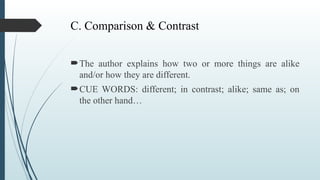
C. Comparison & Contrast
The author explains how two or more things are alike
and/or how they are different.
CUE WORDS: different; in contrast; alike; same as; on
the other hand…
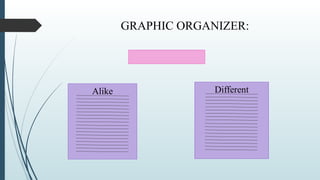
Alike Different
GRAPHIC ORGANIZER:
SAMPLE PASSAGE:
 The modern Olympics is very unlike the ancient Olympic games.
Individual events are different. While there were no swimming races
in the ancient games, for example, there were chariot races. There
were no female contestants and all athletes competed in the nude.
Of course, the ancient and modern Olympics are also alike in many
ways. Some events, such as the javelin and discus throws, are the
same. Some people say that cheating, professionalism, and
nationalism in the modern games are a disgrace to the Olympic
tradition. But according to the ancient Greek writers, there were
many cases of cheating, nationalism, and professionalism in their
Olympics too.
D. Cause and Effect
The author lists one or more causes and the resulting effect
or effects.
CUE WORDS: reasons why; if...then; as a result;
therefore; because…
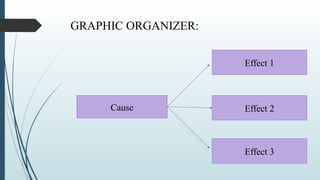
Cause
Effect 1
Effect 2
Effect 3
GRAPHIC ORGANIZER:
SAMPLE PASSAGE:
 There are several reasons why so many people attend the Olympic
games or watch them on television. One reason is tradition. The
name Olympics and the torch and flame remind people of the
ancient games. People can escape the ordinariness of daily life by
attending or watching the Olympics. They like to identify with
someone else's individual sacrifice and accomplishment. National
pride is another reason, and an athlete's or a team's hard earned
victory becomes a nation's victory. There are national medal counts
and people keep track of how many medals their country's athletes
have won.
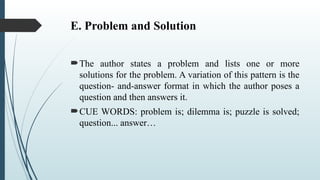
E. Problem and Solution
The author states a problem and lists one or more
solutions for the problem. A variation of this pattern is the
question- and-answer format in which the author poses a
question and then answers it.
CUE WORDS: problem is; dilemma is; puzzle is solved;
question... answer…
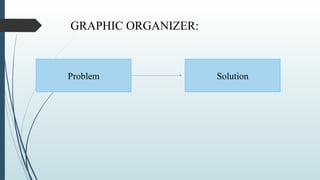
Problem Solution
GRAPHIC ORGANIZER:
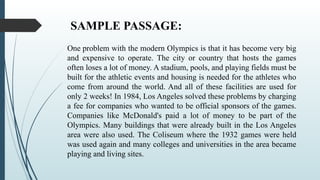
SAMPLE PASSAGE:
One problem with the modern Olympics is that it has become very big
and expensive to operate. The city or country that hosts the games
often loses a lot of money. A stadium, pools, and playing fields must be
built for the athletic events and housing is needed for the athletes who
come from around the world. And all of these facilities are used for
only 2 weeks! In 1984, Los Angeles solved these problems by charging
a fee for companies who wanted to be official sponsors of the games.
Companies like McDonald's paid a lot of money to be part of the
Olympics. Many buildings that were already built in the Los Angeles
area were also used. The Coliseum where the 1932 games were held
was used again and many colleges and universities in the area became
playing and living sites.
F. Classification
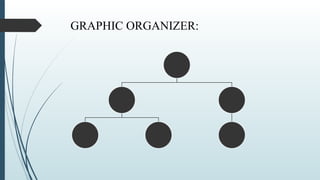
The writer puts information into groups and sub-groups
that support the main topic.
CUE WORDS: the first kind, the second kind, third
type….
GRAPHIC ORGANIZER:
Example:
In a classification essay on movie genres, you might
categorize films into different genres based on their
themes, styles, and audience appeal. Each category would
have its defining characteristics, such as plot elements,
tone, and typical audience demographics.
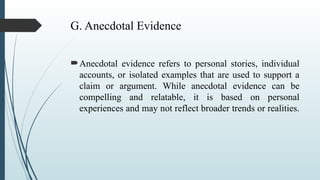
G. Anecdotal Evidence
Anecdotal evidence refers to personal stories, individual
accounts, or isolated examples that are used to support a
claim or argument. While anecdotal evidence can be
compelling and relatable, it is based on personal
experiences and may not reflect broader trends or realities.
Example
 A person might claim that a particular dietary supplement
drastically improved their energy levels and overall health. They
may share a personal story of their experience with the supplement,
detailing how it transformed their life.
 While this anecdotal evidence is persuasive on an individual level, it
does not provide scientific or statistically significant proof of the
supplement's effectiveness for everyone.
 For that, one would need to rely on controlled studies with a larger
sample size and scientific methodologies.
Purpose expository writing
The main purpose of expository writing is
To present information in a balanced, detailed, and
objective way.
It should inform the reader about many different
perspectives on a topic as well as give ample evidence to
support the topic.
Purpose expository writing
To explain or clarify a concept, process, or phenomenon
using evidence, examples, and logical reasoning. Unlike
persuasive or argumentative essays,
The purpose of an expository essay is not to convince the
reader of a particular viewpoint or opinion, but rather to
provide clear and concise information.
Purpose expository writing
Informing: expository writing aims to educate and provide
readers with new or valuable information. It seeks to convey
facts, details, concepts, or ideas about a topic in a
straightforward and concise manner.
Explaining: expository writing helps readers grasp complex
subjects by breaking them down into simpler terms. It aims
to clarify abstract concepts, processes, or phenomena,
making them more accessible and understandable.
Purpose expository writing
 Instructing: Expository writing provides step-by-step instructions or
guidelines on how to perform a task, accomplish a goal, or understand
a process. It offers a clear sequence of actions or explanations to
ensure readers can follow and replicate the instructions.
 Presenting an analysis: Expository writing often involves analyzing
and evaluating information, data, or evidence related to a particular
subject. It may include comparing and contrasting different
viewpoints, examining cause-and-effect relationships, or offering an
objective evaluation of a situation.
What are the examples of expository writing?
Expository writing is a type of writing that is used to
explain, describe, and give information and uses evidence,
details, and facts to support the topic.
An example of expository writing is found in many news
articles where the writer is presenting information without
taking a side or giving their opinion
Application of Expository Writing
An expository essay is a good choice when the goal is to
inform, explain, describe, or instruct. You may be assigned
an expository essay as part of an in-class exam or
coursework assignment. Here are some common situations in
which writing an expository essay would be appropriate:
Application of Expository Writing
Academic Assignments: Expository essays are frequently
assigned in educational settings. Teachers often use this
type of essay to assess students’ understanding of a
particular subject or to teach them how to research and
present information effectively. They are common in
subjects such as English, history, science, social studies, or
any discipline that requires a clear explanation or analysis
of a topic.
Application of Expository Writing
 Instructional or How-to Writing: When you want to provide step-by-
step instructions or guidance on how to perform a task, solve a
problem, or achieve a specific outcome, an expository essay can be an
appropriate format. This type of writing is commonly used in manuals,
guidebooks, tutorials, or any instructional material.
 Journalism or News Writing: Expository writing is prevalent in
journalism, where the goal is to inform readers about current events,
news stories, or investigative reports. Journalists strive to present
objective information, provide background details, and explain
complex issues clearly to their audience.
Application of Expository Writing
Professional or Technical Writing: In various
professional fields, such as business, healthcare,
engineering, or law, expository writing is utilized to
convey information to colleagues, clients, or the general
public. This includes writing reports, memos, manuals,
research papers, or any form of communication that
requires clear and factual presentation of information.
lec 2 Expository writing def, types, purpose, application.pptx

lec 2 Expository writing def, types, purpose, application.pptx

  • 2.
    Unit I: Introductionto Expository Writing By Tanveer Hussain
  • 3.
    1. Understanding expositorywriting (definition, types, purpose, and applications).
  • 4.
    What is ExpositoryWriting? Exposition is a type of oral or written discourse that is used to explain, describe, give information or inform. The expository essay is a genre of essay that requires the student to investigate an idea, evaluate evidence, expound on the idea, and set forth an argument concerning that idea in a clear and concise manner.
  • 5.
    What is ExpositoryWriting?  The creator of an expository text can not assume that the reader or listener has prior knowledge or prior understanding of the topic that is being discussed.  One important point to keep in mind for the author is to try to use words that clearly show what they are talking about rather then blatantly telling the reader what is being discussed
  • 6.
    What is ExpositoryWriting? Expository writing is defined as presenting reasons, explanations, or steps in a process Informational writing An expository essay should follow a logical sequence and have three different main points Logic and coherence is the main focus of an expository essay
  • 7.
    How is itdifferent ? Expository writing does not tell a story Expository writing does not persuade a reader but only gives facts and reasons Expository writing can also give the steps of a process
  • 8.
    Expository Writing Introduction ofan expository should include the main idea and what the essay is about The three main reasons supporting this main idea should also be included in the introduction
  • 9.
    Expository writing contd. Paragraphtwo should introduce the first reason and give details to support the first reason Paragraph three should introduce the second reason and give details to support the second reason Paragraph four should introduce the third reason and give details to support the third reason The conclusion should re-state all the reasons
  • 10.
    Definition of Terms ThesisStatement: The main idea of the whole essay Transition words: Words such as first, second, as a result, which make transitions easy in the essay. Main Ideas: Each paragraph should have a main point or idea Supporting Details: Details support the main ideas
  • 11.
    Re-Cap: Expository writing needs: Onetopic Reasons supporting that topic Details supporting the reasons A conclusion re-stating the reasons Transition words Clear, concise, logical and informative language Topic: How I Would Change the World Brainstorm Three ways in which would like to change the world
  • 12.
    Details Can be descriptive Canbe factual Can be from personal experience Can be anecdotes
  • 13.
    Paragraph One Thesis statement Backgroundinformation on your three topics I admire friends with great qualities. Three qualities I admire are: loyalty, honesty, a good sense of humor.
  • 14.
    Paragraph 2 Put mainidea for paragraph 2 on the outline Add your details Personal experiences Descriptive details-describe experience Facts about the topic- Short anecdotes
  • 15.
    Paragraph 3 Put yourmain idea on the outline Add your details Personal experiences Description of how the topic works itself out Examples of the topic
  • 16.
    Paragraph 4 Add yourmain idea onto your outline Add your details Personal examples of how the idea has been experienced by you in your life Describe how the idea “ looks” or what the person does Facts
  • 17.
    Conclusion Re-state all ofyour ideas in your conclusion
  • 18.
    Transition words Add yourtransition words First Second Third Finally, or In Conclusion
  • 19.
    The Five-Paragraph Essay Acommon method for writing an expository essay is the five-paragraph approach. This is, however, by no means the only formula for writing such essays. If it sounds straightforward, that is because it is; in fact, the method consists of: An introductory paragraph Three evidentiary body paragraphs A conclusion
  • 20.
    The structure ofthe expository essay is held together by the following:  A clear, concise, and defined thesis statement that occurs in the first paragraph of the essay.  Clear and logical transitions between the introduction, body, and conclusion.  Body paragraphs that include evidential support.  Evidential support (whether factual, logical, statistical, or anecdotal).  A bit of creativity!  A conclusion that does not simply restate the thesis, but readdresses it in light of the evidence provided.
  • 21.
    Types of expositorywriting Since clarity requires strong organization, one of the most important mechanisms that can be used to improve our skills in exposition is to provide directions to improve the organization of the text. This directions are called organizational patterns.
  • 22.
    Types of expositorywriting Description Sequence Comparison & Contrast Cause and Effect Problem and Solution Classification Anecdotal Evidence
  • 23.
    A. Description The authordescribes a topic by listing characteristics, features, and examples. It provides details about how something looks, feels, tastes, smells, makes one feel, or sounds CUE WORDS: for example, the characteristics are, etc.
  • 24.
  • 25.
    SAMPLE PASSAGE: The Olympicsymbol consists of five interlocking rings. The rings represent the five continents - Africa, Asia, Europe, North America and South America - from which athletes come to compete in the games. The rings are colored black blue, green, red, and yellow. At least one of these colors is found in the flag of every country sending athletes to compete in the Olympic games.
  • 26.
    B. Sequence The authorlists items or events in numerical or chronological order. CUE WORDS: first, second, third; next; then; finally… GRAPHIC ORGANIZER: 1 2 3
  • 27.
    SAMPLE PASSAGE:  TheOlympic games began as athletic festivals to honor the Greek gods. The most important festival was held in the valley of Olympia to honor Zeus, the king of the gods. It was this festival that became the Olympic games in 776 B.C. These games were ended in A.D. 394 by the Roman Emperor who ruled Greece. No Olympic games were held for more than 1,500 years. Then the modern Olympics began in 1896. Almost 300 male athletes competed in the first modern Olympics In the games held in 1900, female athletes were allowed to compete. The games have continued every four years since 1896 except during World War II, and they will most likely continue for many years to come.
  • 28.
    C. Comparison &Contrast The author explains how two or more things are alike and/or how they are different. CUE WORDS: different; in contrast; alike; same as; on the other hand…
  • 29.
  • 30.
    SAMPLE PASSAGE:  Themodern Olympics is very unlike the ancient Olympic games. Individual events are different. While there were no swimming races in the ancient games, for example, there were chariot races. There were no female contestants and all athletes competed in the nude. Of course, the ancient and modern Olympics are also alike in many ways. Some events, such as the javelin and discus throws, are the same. Some people say that cheating, professionalism, and nationalism in the modern games are a disgrace to the Olympic tradition. But according to the ancient Greek writers, there were many cases of cheating, nationalism, and professionalism in their Olympics too.
  • 31.
    D. Cause andEffect The author lists one or more causes and the resulting effect or effects. CUE WORDS: reasons why; if...then; as a result; therefore; because…
  • 32.
    Cause Effect 1 Effect 2 Effect3 GRAPHIC ORGANIZER:
  • 33.
    SAMPLE PASSAGE:  Thereare several reasons why so many people attend the Olympic games or watch them on television. One reason is tradition. The name Olympics and the torch and flame remind people of the ancient games. People can escape the ordinariness of daily life by attending or watching the Olympics. They like to identify with someone else's individual sacrifice and accomplishment. National pride is another reason, and an athlete's or a team's hard earned victory becomes a nation's victory. There are national medal counts and people keep track of how many medals their country's athletes have won.
  • 34.
    E. Problem andSolution The author states a problem and lists one or more solutions for the problem. A variation of this pattern is the question- and-answer format in which the author poses a question and then answers it. CUE WORDS: problem is; dilemma is; puzzle is solved; question... answer…
  • 35.
  • 36.
    SAMPLE PASSAGE: One problemwith the modern Olympics is that it has become very big and expensive to operate. The city or country that hosts the games often loses a lot of money. A stadium, pools, and playing fields must be built for the athletic events and housing is needed for the athletes who come from around the world. And all of these facilities are used for only 2 weeks! In 1984, Los Angeles solved these problems by charging a fee for companies who wanted to be official sponsors of the games. Companies like McDonald's paid a lot of money to be part of the Olympics. Many buildings that were already built in the Los Angeles area were also used. The Coliseum where the 1932 games were held was used again and many colleges and universities in the area became playing and living sites.
  • 37.
    F. Classification The writerputs information into groups and sub-groups that support the main topic. CUE WORDS: the first kind, the second kind, third type….
  • 38.
  • 39.
    Example: In a classificationessay on movie genres, you might categorize films into different genres based on their themes, styles, and audience appeal. Each category would have its defining characteristics, such as plot elements, tone, and typical audience demographics.
  • 40.
    G. Anecdotal Evidence Anecdotalevidence refers to personal stories, individual accounts, or isolated examples that are used to support a claim or argument. While anecdotal evidence can be compelling and relatable, it is based on personal experiences and may not reflect broader trends or realities.
  • 41.
    Example  A personmight claim that a particular dietary supplement drastically improved their energy levels and overall health. They may share a personal story of their experience with the supplement, detailing how it transformed their life.  While this anecdotal evidence is persuasive on an individual level, it does not provide scientific or statistically significant proof of the supplement's effectiveness for everyone.  For that, one would need to rely on controlled studies with a larger sample size and scientific methodologies.
  • 42.
    Purpose expository writing Themain purpose of expository writing is To present information in a balanced, detailed, and objective way. It should inform the reader about many different perspectives on a topic as well as give ample evidence to support the topic.
  • 43.
    Purpose expository writing Toexplain or clarify a concept, process, or phenomenon using evidence, examples, and logical reasoning. Unlike persuasive or argumentative essays, The purpose of an expository essay is not to convince the reader of a particular viewpoint or opinion, but rather to provide clear and concise information.
  • 44.
    Purpose expository writing Informing:expository writing aims to educate and provide readers with new or valuable information. It seeks to convey facts, details, concepts, or ideas about a topic in a straightforward and concise manner. Explaining: expository writing helps readers grasp complex subjects by breaking them down into simpler terms. It aims to clarify abstract concepts, processes, or phenomena, making them more accessible and understandable.
  • 45.
    Purpose expository writing Instructing: Expository writing provides step-by-step instructions or guidelines on how to perform a task, accomplish a goal, or understand a process. It offers a clear sequence of actions or explanations to ensure readers can follow and replicate the instructions.  Presenting an analysis: Expository writing often involves analyzing and evaluating information, data, or evidence related to a particular subject. It may include comparing and contrasting different viewpoints, examining cause-and-effect relationships, or offering an objective evaluation of a situation.
  • 46.
    What are theexamples of expository writing? Expository writing is a type of writing that is used to explain, describe, and give information and uses evidence, details, and facts to support the topic. An example of expository writing is found in many news articles where the writer is presenting information without taking a side or giving their opinion
  • 47.
    Application of ExpositoryWriting An expository essay is a good choice when the goal is to inform, explain, describe, or instruct. You may be assigned an expository essay as part of an in-class exam or coursework assignment. Here are some common situations in which writing an expository essay would be appropriate:
  • 48.
    Application of ExpositoryWriting Academic Assignments: Expository essays are frequently assigned in educational settings. Teachers often use this type of essay to assess students’ understanding of a particular subject or to teach them how to research and present information effectively. They are common in subjects such as English, history, science, social studies, or any discipline that requires a clear explanation or analysis of a topic.
  • 49.
    Application of ExpositoryWriting  Instructional or How-to Writing: When you want to provide step-by- step instructions or guidance on how to perform a task, solve a problem, or achieve a specific outcome, an expository essay can be an appropriate format. This type of writing is commonly used in manuals, guidebooks, tutorials, or any instructional material.  Journalism or News Writing: Expository writing is prevalent in journalism, where the goal is to inform readers about current events, news stories, or investigative reports. Journalists strive to present objective information, provide background details, and explain complex issues clearly to their audience.
  • 50.
    Application of ExpositoryWriting Professional or Technical Writing: In various professional fields, such as business, healthcare, engineering, or law, expository writing is utilized to convey information to colleagues, clients, or the general public. This includes writing reports, memos, manuals, research papers, or any form of communication that requires clear and factual presentation of information.