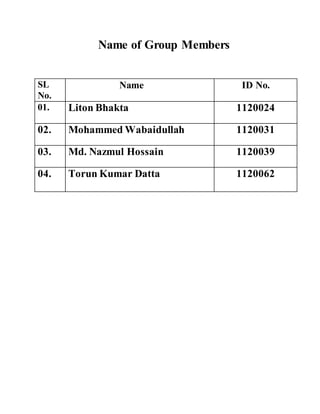
Name of Group Members
SL
No.
Name ID No.
01. Liton Bhakta 1120024
02. Mohammed Wabaidullah 1120031
03. Md. Nazmul Hossain 1120039
04. Torun Kumar Datta 1120062
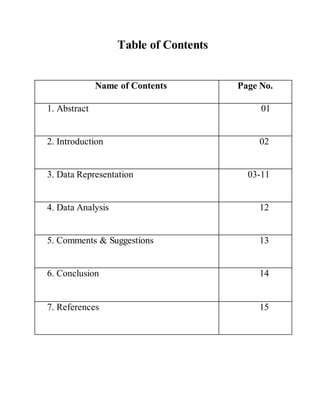
Table of Contents
Name of Contents Page No.
1. Abstract 01
2. Introduction 02
3. Data Representation 03-11
4. Data Analysis 12
5. Comments & Suggestions 13
6. Conclusion 14
7. References 15
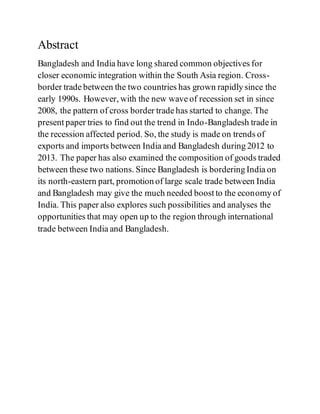
Abstract
Bangladesh and India have long shared common objectives for
closer economic integration within the South Asia region. Cross-
border trade between the two countries has grown rapidly since the
early 1990s. However, with the new wave of recession set in since
2008, the pattern of cross border trade has started to change. The
present paper tries to find out the trend in Indo-Bangladesh trade in
the recession affected period. So, the study is made on trends of
exports and imports between India and Bangladesh during 2012 to
2013. The paper has also examined the composition of goods traded
between these two nations. Since Bangladesh is bordering India on
its north-eastern part, promotion of large scale trade between India
and Bangladesh may give the much needed boost to the economy of
India. This paper also explores such possibilities and analyses the
opportunities that may open up to the region through international
trade between India and Bangladesh.
Introduction
The cross-border trade between India and Bangladesh began in post
independence era itself. But there was no significant improvement in the
trade between the two countries at the initial stage. Following adoption
of new economic reforms by India in 1991, the trade relations between
India and Bangladesh witnessed a significant improvement, and it has
been growing gradually. In 2012-13, two-way trade crossed the $
551500000 mark as a result of a significant increase in Bangladesh's
exports to India (68 percent over the previous year) and India's exports
to Bangladesh (43 percent over the previous year). Bangladesh's exports
to India in 2012-13 was $.10250000,and India's exports to Bangladesh
in the same period was $.91730000.India is the largest export
destination for Bangladesh outside the Western world comprising USA
and Europe. Bangladesh is surrounded by four-north-eastern states
which all together share a 1,880 km border with Bangladesh with 1,434
km on land and 446 km riverine [I].North-east India may serve a gate-
way for Bangladesh’s access to Indian markets and in the course of time
may act as a game changer in the Bangladesh-India trade relations.
Bangladesh is one of the largest export markets for Indian trade. The
bilateral trade between the two nations is carried out as per guidelines
given in the Bangladesh Trade Agreement with India [II], which
provides beneficial arrangement for the use of waterways, railways and
roadways passage of goods between two places in one country through
the territory of the other. There are factors contributing to the growth of
trade between India and Bangladesh. These factors jointly point to the
locational advantages, i.e proximity between the two countries and
coordination between the two governments at the political level. In
2008, global recession has struck worldwide. It has changed the global
trade. The impact of the financial crisis is felt by the developing
economies as well. Growth is slowing down in all these countries.
India’s growth rate in 2008-09 was 6.7 per cent as compared to 9 per
cent in the previous year (Economic Survey 2009-2010).In this context,
this paper has tried to find the trend in India-Bangladesh trade from
2012 to 2013.
Data Representation
Trade of Bangladesh & India
Normally it is found that Bangladesh is a trade deficit country after its
independence in 1971. In the first two decades it showed tender situation
in its trade balance but it has been improving the situation since 1990s
when trade liberalization was achieved. It has shown trade surplus in last
July.
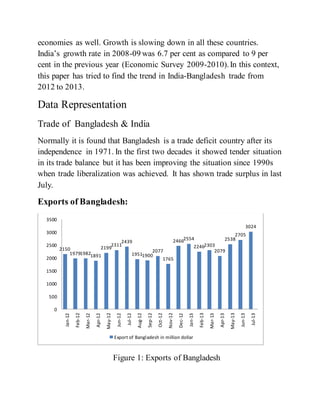
Exports of Bangladesh:
Figure 1: Exports of Bangladesh
2150
197919821891
2199
2311
2439
19511900
2077
1765
24662554
22462303
2079
2538
2705
3024
0
500
1000
1500
2000
2500
3000
3500
Jan-12
Feb-12
Mar-12
Apr-12
May-12
Jun-12
Jul-12
Aug-12
Sep-12
Oct-12
Nov-12
Dec-12
Jan-13
Feb-13
Mar-13
Apr-13
May-13
Jun-13
Jul-13
Export of Bangladesh in million dollar
According to Bangladesh Bank, Exports in Bangladesh were 3024.30
USD Million in July of 2013 increased from 2705.50 USD Million in
June of 2013. From 1995 until 2013, Bangladesh Exports averaged
3267.3 USD Million reaching an all time high of 15565.2 USD Million
in June of 2009 and a record low of 1024.0 USD Million in October of
2009. Bangladesh exports mainly ready made garments (75% of exports
revenue), frozen fish, jute goods, leather goods, ship and tea. Major
exports partners of Bangladesh are United States (23% of total),
Germany, United Kingdom, France, Japan and India. Here we are seeing
that export of Bangladesh is regular as their previous trend in 2013.
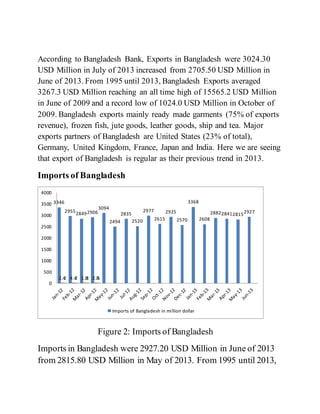
Imports of Bangladesh
Figure 2: Imports of Bangladesh
Imports in Bangladesh were 2927.20 USD Million in June of 2013
from 2815.80 USD Million in May of 2013. From 1995 until 2013,
3346
295528492906
3094
2494
2835
2520
2977
2615
2925
2570
3368
2608
2882284128152927
2.4 4.4 1.8 2.82 2 3 5
0
500
1000
1500
2000
2500
3000
3500
4000
Imports of Bangladesh in million dollar
Bangladesh Imports averaged 4407.9 USD Million reaching an all
time high of 20291.4 USD Million in June of 2009 and a record low
of 1424.2 USD Million in August of 2009. Bangladesh imports
mostly machinery and equipment, chemicals, iron and steel, textile
raw materials, foodstuffs, petroleumproducts and cement. Major
import partners of Bangladesh in 2008 are China: 15.8%, India:
15.7%, Kuwait: 8.1%, Singapore: 7.6%, Japan: 4.4%. In 2013 China
contributes 17% and India is also the second exporter to this
country. Bangladesh imports raw cotton and intermediate inputs
from India. Most of the products Bangladesh imports from India are
price sensitive and the country doesn’t get its proper duties. Critical
concerns on the Bangladesh side include the massive trade deficit
with India and the large volumes of informal imports from India
across the land border which avoid Bangladesh import duties
(Pursell & Sattar, 2006). Bangladesh import is lower or slightly
higher than export which is enough to recognize it as moderate.
India is also a trade deficit country. Recently it has faced the lowest
price of rupee in the history due to account deficit which created
6.1% inflation rate, the highest of last six months. But India thinks
that it is temporary and the rumor is exaggerated. They reduced their
imports and FDI 100% form 400%.
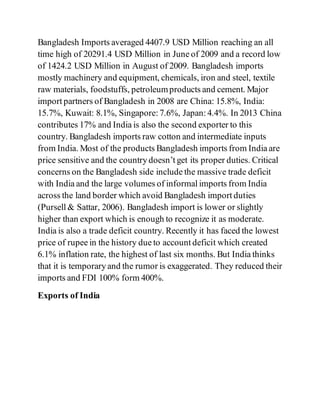
Exports of India
Figure 3: Exports of India
According to Ministry of Commerce and Industry, India exports of
India were 1764.62 INR Billion in September of 2013 from 1652.02
INR Billion in August of 2013. Exports in India is reported by the.
India Exports averaged 257.34 INR Billion from 1978 until 2013,
reaching an all time high of 1764.62 INR Billion in September of
2013 and a record low of 3.75 INR Billion in May of 1978. India’s
main exports are engineering goods (19 percent of total exports),
gems and jewelry (15 percent), chemicals (13 percent), agricultural
products (9 percent) and textiles (9 percent). India is also one of
Asia’s largest refined product exporters with petroleum accounting
for around 18 percent of total exports. India’s main export partners
are United Arab Emirates (12 percent of total exports) and United
States (11 percent), China, Singapore, Hong Kong and Netherlands.
Exports of India are increasing rapidly. It is most probably a cause
of depreciation of rupee. For the depreciation of rupee they are
13031239
1451
1231
135012961284
1215
1360
12151192
133913481398
1653
13141318
1389
1544
1652
1764
2.4 4.4 1.8 2.82 2 3 5
Jan-12
Feb-12
Mar-12
Apr-12
May-12
Jun-12
Jul-12
Aug-12
Sep-12
Oct-12
Nov-12
Dec-12
Jan-13
Feb-13
Mar-13
Apr-13
May-13
Jun-13
Jul-13
Aug-13
Sep-13
Exports of India
Export of India in Billion Rupee
becoming more competitive in the global market as they can reduce
their cost of production than the neighboring competitors. It is an
indicator that their all time highest export revenue came in
September of 2013.
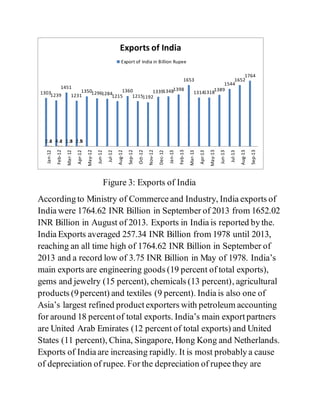
Imports of India:
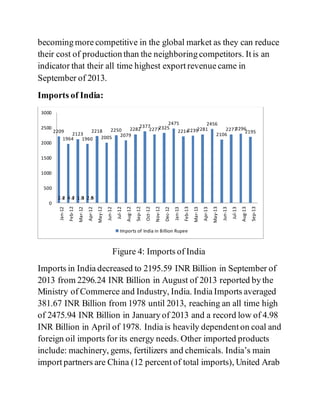
Figure 4: Imports of India
Imports in India decreased to 2195.59 INR Billion in September of
2013 from 2296.24 INR Billion in August of 2013 reported by the
Ministry of Commerce and Industry, India. India Imports averaged
381.67 INR Billion from 1978 until 2013, reaching an all time high
of 2475.94 INR Billion in January of 2013 and a record low of 4.98
INR Billion in April of 1978. India is heavily dependent on coal and
foreign oil imports for its energy needs. Other imported products
include: machinery, gems, fertilizers and chemicals. India’s main
import partners are China (12 percent of total imports), United Arab
2209
1964
2123
1960
2218
2005
2250
2079
2282
2377
22772325
2475
221422392281
2456
2106
22772296
2195
2.4 4.4 1.8 2.82 2 3 5
0
500
1000
1500
2000
2500
3000
Jan-12
Feb-12
Mar-12
Apr-12
May-12
Jun-12
Jul-12
Aug-12
Sep-12
Oct-12
Nov-12
Dec-12
Jan-13
Feb-13
Mar-13
Apr-13
May-13
Jun-13
Jul-13
Aug-13
Sep-13
Imports of India in Billion Rupee
Emirates, Switzerland, Saudi Arabia, United States, Iraq and
Kuwait. India has purchased their highest foreign products in
January 2013. It can be a cause for the drastic depreciation of rupee.
But Indian government is regulating the market and foreign direct
investment so that they could reduce their import as more rupees can
be gone outside. The data above show that India is facing a huge
trade deficit economy.
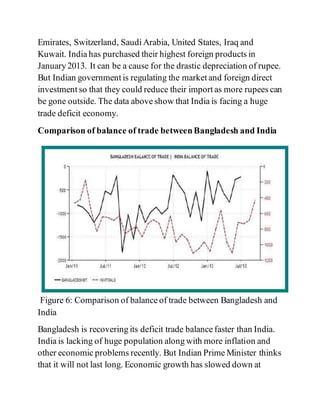
Comparison of balance of trade betweenBangladesh and India
Figure 6: Comparison of balance of trade between Bangladesh and
India
Bangladesh is recovering its deficit trade balance faster than India.
India is lacking of huge population along with more inflation and
other economic problems recently. But Indian Prime Minister thinks
that it will not last long. Economic growth has slowed down at
present and we are working hard to remedy the situation (Singh,
2013). For the falling of exchange rate of rupee overseas funds have
pulled out nearly 12 billion from India’s stock and debt markets. It
is found that India was facing a lot of deficit in the balance of trade
as they were importing more. But after the regulation of their policy
recently they are becoming strong now in the balance of trade. In
other hand, balance of trade of Bangladesh is normal and it is
prosperous.
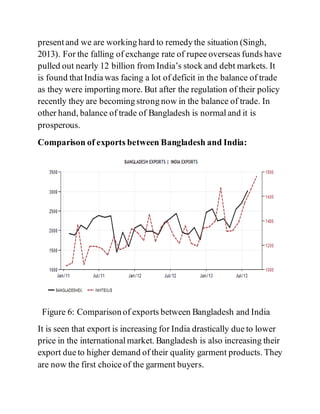
Comparison of exports between Bangladesh and India:
Figure 6: Comparison of exports between Bangladesh and India
It is seen that export is increasing for India drastically due to lower
price in the international market. Bangladesh is also increasing their
export due to higher demand of their quality garment products. They
are now the first choice of the garment buyers.
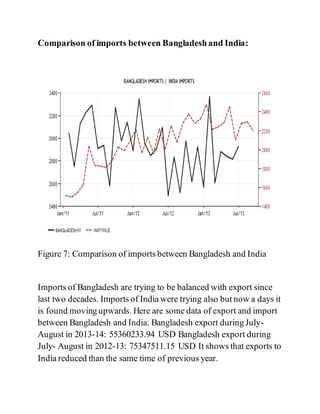
Comparison of imports between Bangladeshand India:
Figure 7: Comparison of imports between Bangladesh and India
Imports of Bangladesh are trying to be balanced with export since
last two decades. Imports of India were trying also but now a days it
is found moving upwards. Here are some data of export and import
between Bangladesh and India: Bangladesh export during July-
August in 2013-14: 55360233.94 USD Bangladesh export during
July- August in 2012-13: 75347511.15 USD It shows that exports to
India reduced than the same time of previous year.
Data Analysis
We have found that the country India has current account
deficiency. As a result they are facing the falling exchange rate of
their currency. Now they can export more today as they are more
competitive in the world market. For the worst performance of their
currencies they are importing less. They are achieving trade balance.
In macro sense it creates inflation inside the country. Price hike of
the price sensitive products will diminish its economy in micro
level. Investment will be decreased. They will not be able to save
their money and standard of livelihood will be eroding in the near
future. If rupee continues to decrease its value it can be a matter of
damage for the neighboring competitors. As the export sector of
Bangladesh is same it will be less competitive in the world market
as India will provide the goods in a cheaper rate. The products,
Bangladesh imports from India are highly price sensitive.
Bangladesh will import more and India will try to reduce its import
cost more. SAFTA will fall in a threat. The countries enlisted in
SAARC will not be able to achieve their target. Ultimately the
whole region will be hampered. So fall of rupee will not convey any
good news for the economy of Bangladesh rather it will create
obstacles if it continues. But, the result is not so much imminent.
And a matter of hope that rupee is gaining its rate again.
Comments and Suggestions
Both the countries should be aware about the future impact of their
bilateral and international trade. As Bangladesh has a fast growing
economy it will not feel the result rapidly. But if the situation
continues Bangladesh have to take necessary steps for maintaining
its trade smoothly. As the result will not be appeared recently the
country will get time for taking or modifying its policy. As the
bilateral trade is negative with India it must look over the import
obviously but reducing import can not be a permanent solution.
Bilateral trade policy should be improved. Trade is a positive sum
game.
Conclusions
It is widely believed that due to geographical proximity, strategic
position, close cultural and historical bond and above all economic
complementarities, there are huge prospects and potentials for
promoting trade and investment between Bangladesh and India. This
would result in sustainable growth and development of the two
economies and improving the fate and lot of the teeming millions of
the region as a whole. India is endowed with huge resources like
minerals, quarry, forestry, horticulture, crops, plantation and others.
Despite rich in natural resources, this landlocked region is not well
connected with the rest of India. A narrow Siliguri corridor of 22 km
stretch connects the region with the rest of India. The seven state
capitals are at a distance varying from 1080 km to 1680 km from
their nearest mainland port city of Kolkata. On the contrary the
distance of those cities from Dhaka and Chittagong is much shorter
than that of Kolkata. Moreover due to undulating topography and
innate difficulties, this region is underdeveloped with poor
infrastructure, transportation system and other logistic facilities. As
a result, transportation cost of goods to and from this region to rest
of India and within the region is exorbitantly higher than that of any
strategic parts of Bangladesh. This fact postulates the efficacy of
developing a good trade and investment relation between the India
and Bangladesh.
References
www.google.com
Bangladesh Bank, Central Bank of Bangladesh.
Available: www.tradingeconomics.com
Bangladesh Trade, Exports and Imports Available:
http://www.economywatch.com/world_economy/bangladesh/export
-import.html
Export Promotion Bureau, Bangladesh.
Ministry of Commerce.
FBCCI (Federation of Bangladesh Chambers of Commerce &
Industry).

Export & import between Bangladesh & India

  • 1.
    Name of GroupMembers SL No. Name ID No. 01. Liton Bhakta 1120024 02. Mohammed Wabaidullah 1120031 03. Md. Nazmul Hossain 1120039 04. Torun Kumar Datta 1120062
  • 2.
    Table of Contents Nameof Contents Page No. 1. Abstract 01 2. Introduction 02 3. Data Representation 03-11 4. Data Analysis 12 5. Comments & Suggestions 13 6. Conclusion 14 7. References 15
  • 3.
    Abstract Bangladesh and Indiahave long shared common objectives for closer economic integration within the South Asia region. Cross- border trade between the two countries has grown rapidly since the early 1990s. However, with the new wave of recession set in since 2008, the pattern of cross border trade has started to change. The present paper tries to find out the trend in Indo-Bangladesh trade in the recession affected period. So, the study is made on trends of exports and imports between India and Bangladesh during 2012 to 2013. The paper has also examined the composition of goods traded between these two nations. Since Bangladesh is bordering India on its north-eastern part, promotion of large scale trade between India and Bangladesh may give the much needed boost to the economy of India. This paper also explores such possibilities and analyses the opportunities that may open up to the region through international trade between India and Bangladesh.
  • 4.
    Introduction The cross-border tradebetween India and Bangladesh began in post independence era itself. But there was no significant improvement in the trade between the two countries at the initial stage. Following adoption of new economic reforms by India in 1991, the trade relations between India and Bangladesh witnessed a significant improvement, and it has been growing gradually. In 2012-13, two-way trade crossed the $ 551500000 mark as a result of a significant increase in Bangladesh's exports to India (68 percent over the previous year) and India's exports to Bangladesh (43 percent over the previous year). Bangladesh's exports to India in 2012-13 was $.10250000,and India's exports to Bangladesh in the same period was $.91730000.India is the largest export destination for Bangladesh outside the Western world comprising USA and Europe. Bangladesh is surrounded by four-north-eastern states which all together share a 1,880 km border with Bangladesh with 1,434 km on land and 446 km riverine [I].North-east India may serve a gate- way for Bangladesh’s access to Indian markets and in the course of time may act as a game changer in the Bangladesh-India trade relations. Bangladesh is one of the largest export markets for Indian trade. The bilateral trade between the two nations is carried out as per guidelines given in the Bangladesh Trade Agreement with India [II], which provides beneficial arrangement for the use of waterways, railways and roadways passage of goods between two places in one country through the territory of the other. There are factors contributing to the growth of trade between India and Bangladesh. These factors jointly point to the locational advantages, i.e proximity between the two countries and coordination between the two governments at the political level. In 2008, global recession has struck worldwide. It has changed the global trade. The impact of the financial crisis is felt by the developing
  • 5.
    economies as well.Growth is slowing down in all these countries. India’s growth rate in 2008-09 was 6.7 per cent as compared to 9 per cent in the previous year (Economic Survey 2009-2010).In this context, this paper has tried to find the trend in India-Bangladesh trade from 2012 to 2013. Data Representation Trade of Bangladesh & India Normally it is found that Bangladesh is a trade deficit country after its independence in 1971. In the first two decades it showed tender situation in its trade balance but it has been improving the situation since 1990s when trade liberalization was achieved. It has shown trade surplus in last July. Exports of Bangladesh: Figure 1: Exports of Bangladesh 2150 197919821891 2199 2311 2439 19511900 2077 1765 24662554 22462303 2079 2538 2705 3024 0 500 1000 1500 2000 2500 3000 3500 Jan-12 Feb-12 Mar-12 Apr-12 May-12 Jun-12 Jul-12 Aug-12 Sep-12 Oct-12 Nov-12 Dec-12 Jan-13 Feb-13 Mar-13 Apr-13 May-13 Jun-13 Jul-13 Export of Bangladesh in million dollar
  • 6.
    According to BangladeshBank, Exports in Bangladesh were 3024.30 USD Million in July of 2013 increased from 2705.50 USD Million in June of 2013. From 1995 until 2013, Bangladesh Exports averaged 3267.3 USD Million reaching an all time high of 15565.2 USD Million in June of 2009 and a record low of 1024.0 USD Million in October of 2009. Bangladesh exports mainly ready made garments (75% of exports revenue), frozen fish, jute goods, leather goods, ship and tea. Major exports partners of Bangladesh are United States (23% of total), Germany, United Kingdom, France, Japan and India. Here we are seeing that export of Bangladesh is regular as their previous trend in 2013. Imports of Bangladesh Figure 2: Imports of Bangladesh Imports in Bangladesh were 2927.20 USD Million in June of 2013 from 2815.80 USD Million in May of 2013. From 1995 until 2013, 3346 295528492906 3094 2494 2835 2520 2977 2615 2925 2570 3368 2608 2882284128152927 2.4 4.4 1.8 2.82 2 3 5 0 500 1000 1500 2000 2500 3000 3500 4000 Imports of Bangladesh in million dollar
  • 7.
    Bangladesh Imports averaged4407.9 USD Million reaching an all time high of 20291.4 USD Million in June of 2009 and a record low of 1424.2 USD Million in August of 2009. Bangladesh imports mostly machinery and equipment, chemicals, iron and steel, textile raw materials, foodstuffs, petroleumproducts and cement. Major import partners of Bangladesh in 2008 are China: 15.8%, India: 15.7%, Kuwait: 8.1%, Singapore: 7.6%, Japan: 4.4%. In 2013 China contributes 17% and India is also the second exporter to this country. Bangladesh imports raw cotton and intermediate inputs from India. Most of the products Bangladesh imports from India are price sensitive and the country doesn’t get its proper duties. Critical concerns on the Bangladesh side include the massive trade deficit with India and the large volumes of informal imports from India across the land border which avoid Bangladesh import duties (Pursell & Sattar, 2006). Bangladesh import is lower or slightly higher than export which is enough to recognize it as moderate. India is also a trade deficit country. Recently it has faced the lowest price of rupee in the history due to account deficit which created 6.1% inflation rate, the highest of last six months. But India thinks that it is temporary and the rumor is exaggerated. They reduced their imports and FDI 100% form 400%. Exports of India
  • 8.
    Figure 3: Exportsof India According to Ministry of Commerce and Industry, India exports of India were 1764.62 INR Billion in September of 2013 from 1652.02 INR Billion in August of 2013. Exports in India is reported by the. India Exports averaged 257.34 INR Billion from 1978 until 2013, reaching an all time high of 1764.62 INR Billion in September of 2013 and a record low of 3.75 INR Billion in May of 1978. India’s main exports are engineering goods (19 percent of total exports), gems and jewelry (15 percent), chemicals (13 percent), agricultural products (9 percent) and textiles (9 percent). India is also one of Asia’s largest refined product exporters with petroleum accounting for around 18 percent of total exports. India’s main export partners are United Arab Emirates (12 percent of total exports) and United States (11 percent), China, Singapore, Hong Kong and Netherlands. Exports of India are increasing rapidly. It is most probably a cause of depreciation of rupee. For the depreciation of rupee they are 13031239 1451 1231 135012961284 1215 1360 12151192 133913481398 1653 13141318 1389 1544 1652 1764 2.4 4.4 1.8 2.82 2 3 5 Jan-12 Feb-12 Mar-12 Apr-12 May-12 Jun-12 Jul-12 Aug-12 Sep-12 Oct-12 Nov-12 Dec-12 Jan-13 Feb-13 Mar-13 Apr-13 May-13 Jun-13 Jul-13 Aug-13 Sep-13 Exports of India Export of India in Billion Rupee
  • 9.
    becoming more competitivein the global market as they can reduce their cost of production than the neighboring competitors. It is an indicator that their all time highest export revenue came in September of 2013. Imports of India: Figure 4: Imports of India Imports in India decreased to 2195.59 INR Billion in September of 2013 from 2296.24 INR Billion in August of 2013 reported by the Ministry of Commerce and Industry, India. India Imports averaged 381.67 INR Billion from 1978 until 2013, reaching an all time high of 2475.94 INR Billion in January of 2013 and a record low of 4.98 INR Billion in April of 1978. India is heavily dependent on coal and foreign oil imports for its energy needs. Other imported products include: machinery, gems, fertilizers and chemicals. India’s main import partners are China (12 percent of total imports), United Arab 2209 1964 2123 1960 2218 2005 2250 2079 2282 2377 22772325 2475 221422392281 2456 2106 22772296 2195 2.4 4.4 1.8 2.82 2 3 5 0 500 1000 1500 2000 2500 3000 Jan-12 Feb-12 Mar-12 Apr-12 May-12 Jun-12 Jul-12 Aug-12 Sep-12 Oct-12 Nov-12 Dec-12 Jan-13 Feb-13 Mar-13 Apr-13 May-13 Jun-13 Jul-13 Aug-13 Sep-13 Imports of India in Billion Rupee
  • 10.
    Emirates, Switzerland, SaudiArabia, United States, Iraq and Kuwait. India has purchased their highest foreign products in January 2013. It can be a cause for the drastic depreciation of rupee. But Indian government is regulating the market and foreign direct investment so that they could reduce their import as more rupees can be gone outside. The data above show that India is facing a huge trade deficit economy. Comparison of balance of trade betweenBangladesh and India Figure 6: Comparison of balance of trade between Bangladesh and India Bangladesh is recovering its deficit trade balance faster than India. India is lacking of huge population along with more inflation and other economic problems recently. But Indian Prime Minister thinks that it will not last long. Economic growth has slowed down at
  • 11.
    present and weare working hard to remedy the situation (Singh, 2013). For the falling of exchange rate of rupee overseas funds have pulled out nearly 12 billion from India’s stock and debt markets. It is found that India was facing a lot of deficit in the balance of trade as they were importing more. But after the regulation of their policy recently they are becoming strong now in the balance of trade. In other hand, balance of trade of Bangladesh is normal and it is prosperous. Comparison of exports between Bangladesh and India: Figure 6: Comparison of exports between Bangladesh and India It is seen that export is increasing for India drastically due to lower price in the international market. Bangladesh is also increasing their export due to higher demand of their quality garment products. They are now the first choice of the garment buyers.
  • 12.
    Comparison of importsbetween Bangladeshand India: Figure 7: Comparison of imports between Bangladesh and India Imports of Bangladesh are trying to be balanced with export since last two decades. Imports of India were trying also but now a days it is found moving upwards. Here are some data of export and import between Bangladesh and India: Bangladesh export during July- August in 2013-14: 55360233.94 USD Bangladesh export during July- August in 2012-13: 75347511.15 USD It shows that exports to India reduced than the same time of previous year.
  • 13.
    Data Analysis We havefound that the country India has current account deficiency. As a result they are facing the falling exchange rate of their currency. Now they can export more today as they are more competitive in the world market. For the worst performance of their currencies they are importing less. They are achieving trade balance. In macro sense it creates inflation inside the country. Price hike of the price sensitive products will diminish its economy in micro level. Investment will be decreased. They will not be able to save their money and standard of livelihood will be eroding in the near future. If rupee continues to decrease its value it can be a matter of damage for the neighboring competitors. As the export sector of Bangladesh is same it will be less competitive in the world market as India will provide the goods in a cheaper rate. The products, Bangladesh imports from India are highly price sensitive. Bangladesh will import more and India will try to reduce its import cost more. SAFTA will fall in a threat. The countries enlisted in SAARC will not be able to achieve their target. Ultimately the whole region will be hampered. So fall of rupee will not convey any good news for the economy of Bangladesh rather it will create obstacles if it continues. But, the result is not so much imminent. And a matter of hope that rupee is gaining its rate again.
  • 14.
    Comments and Suggestions Boththe countries should be aware about the future impact of their bilateral and international trade. As Bangladesh has a fast growing economy it will not feel the result rapidly. But if the situation continues Bangladesh have to take necessary steps for maintaining its trade smoothly. As the result will not be appeared recently the country will get time for taking or modifying its policy. As the bilateral trade is negative with India it must look over the import obviously but reducing import can not be a permanent solution. Bilateral trade policy should be improved. Trade is a positive sum game.
  • 15.
    Conclusions It is widelybelieved that due to geographical proximity, strategic position, close cultural and historical bond and above all economic complementarities, there are huge prospects and potentials for promoting trade and investment between Bangladesh and India. This would result in sustainable growth and development of the two economies and improving the fate and lot of the teeming millions of the region as a whole. India is endowed with huge resources like minerals, quarry, forestry, horticulture, crops, plantation and others. Despite rich in natural resources, this landlocked region is not well connected with the rest of India. A narrow Siliguri corridor of 22 km stretch connects the region with the rest of India. The seven state capitals are at a distance varying from 1080 km to 1680 km from their nearest mainland port city of Kolkata. On the contrary the distance of those cities from Dhaka and Chittagong is much shorter than that of Kolkata. Moreover due to undulating topography and innate difficulties, this region is underdeveloped with poor infrastructure, transportation system and other logistic facilities. As a result, transportation cost of goods to and from this region to rest of India and within the region is exorbitantly higher than that of any strategic parts of Bangladesh. This fact postulates the efficacy of developing a good trade and investment relation between the India and Bangladesh.
  • 16.
    References www.google.com Bangladesh Bank, CentralBank of Bangladesh. Available: www.tradingeconomics.com Bangladesh Trade, Exports and Imports Available: http://www.economywatch.com/world_economy/bangladesh/export -import.html Export Promotion Bureau, Bangladesh. Ministry of Commerce. FBCCI (Federation of Bangladesh Chambers of Commerce & Industry).