A Presentation on Trade Relations Between India & The Trade Agreement & Various Trade Barriers. Presented To: Mr. Ashok Sharma Presented By Ramneek S Sandhey(46) Marketing & Sales Section E
Contents Introduction India – U.S. trade relations Bilateral and multinational trade relations World trade organization and other multilateral relations Bilateral merchandise trade Indo-U.S. trade in services Major component of the bilateral trade Direct investment Indo-us trade barriers Current trade situation Conclusion Recommendation
  Research Methodology and Design: Exploratory Research:  an initial research which analysis the data & explores the possibility of obtaining ideas & insight. A  literature survey  is used for this purpose and secondary sources i.e.   available information/literature, magazines, internet websites, books are useful for findings and to develop new hypothesis. It is the most economical and quickest way to find possible hypothesis.   Project rationale This report provides a summary of India’s key economic and trade issues between India and the United States. It analyses Indian and US markets and understands the area of International Business and various factors that influence the trade between them. It also talks about India’s foreign trade policies especially with the US with respect to the trade agreements and trade barriers.   Project Limitations The project is based on the past trend and data of previous years The research is literature based  Availability of recent information is missing The practical approach may vary from the stated
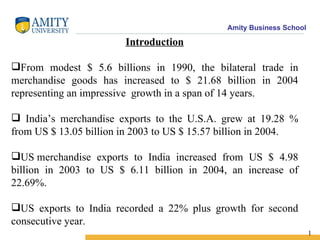
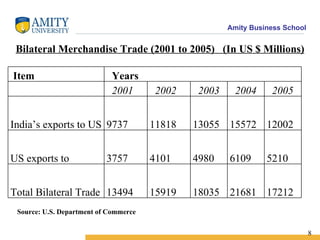
Introduction From modest $ 5.6 billions in 1990, the bilateral trade in merchandise goods has increased to $ 21.68 billion in 2004 representing an impressive  growth in a span of 14 years. India’s merchandise exports to the U.S.A. grew at 19.28 % from US $ 13.05 billion in 2003 to US $ 15.57 billion in 2004. US merchandise exports to India increased from US $ 4.98 billion in 2003 to US $ 6.11 billion in 2004, an increase of 22.69%.  US exports to India recorded a 22% plus growth for second consecutive year.   1
Economic and trade relations between the United States and India Number of ups and downs since India’s independence in 1947. During much of the 1950s, the United States was a leading trading partner for India  2
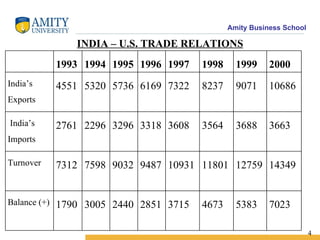
INDIA – U.S. TRADE RELATIONS 4 1993 1994 1995 1996 1997 1998 1999 2000 India’s Exports 4551 5320 5736 6169 7322 8237 9071 10686 India’s Imports 2761 2296 3296 3318 3608 3564 3688 3663 Turnover 7312 7598 9032 9487 10931 11801 12759 14349 Balance (+) 1790 3005 2440 2851 3715 4673 5383 7023
INDIA’S SHARE IN US TRADE In 1991,U.S identified India as one of the 10 major emerging markets. India-US bilateral trade also started to grow.  US is the destination of one-fifth of India’s exports. India's percentage share in US imports has remained more or less stable over the last few years. 5
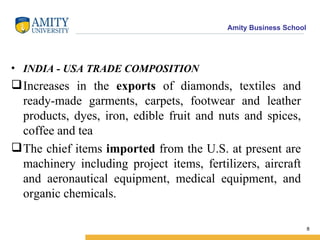
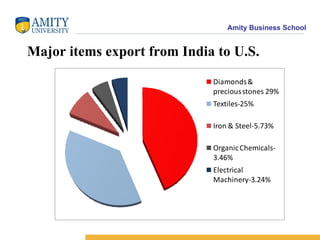
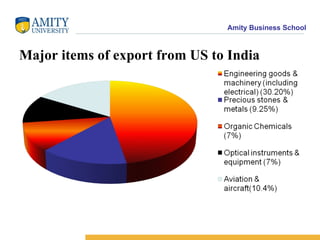
INDIA - USA TRADE COMPOSITION  Increases in the  exports  of diamonds, textiles and ready-made garments, carpets, footwear and leather products, dyes, iron, edible fruit and nuts and spices, coffee and tea  The chief items  imported  from the U.S. at present are machinery including project items, fertilizers, aircraft and aeronautical equipment, medical equipment, and organic chemicals.
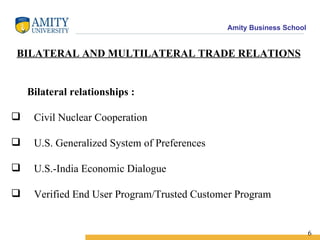
BILATERAL AND MULTILATERAL TRADE RELATIONS Bilateral relationships :  Civil Nuclear Cooperation U.S. Generalized System of Preferences U.S.-India Economic Dialogue Verified End User Program/Trusted Customer Program  6
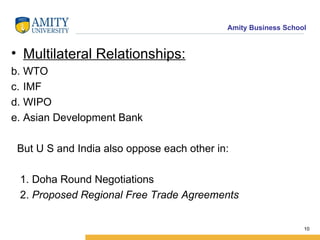
Multilateral Relationships: WTO  IMF WIPO  Asian Development Bank  But U S and India also oppose each other in: 1. Doha Round Negotiations 2.   Proposed Regional Free Trade Agreements
Bilateral Merchandise Trade (2001 to 2005)   (In US $ Millions) Source: U.S. Department of Commerce          8   Item    Years        2001     2002     2003     2004     2005     India’s exports to US     9737     11818     13055     15572     12002     US exports to     3757     4101     4980     6109     5210     Total Bilateral Trade     13494     15919     18035     21681     17212
Major items export from India to U.S.
Major items of export from US to India
Insurance sector in India is opened up for up to 26% FDI, proposals to hike this limit to 49%. Emergence of Business Process Outsourcing. -  American Express, Citicorp, Microsoft, Dell, Hewlett-Packard, HSBC, Standard Chartered and Convergys etc are taking advantage of the opportunities offered by India's IT Sector. Telecom industry-  Amongst major US companies that have entered the Indian market are AT&T and Qualcomm.
India has also made progress in expanding their investment base in the United States of America.  e.g. - Dr. Reddy's Laboratories and Ranbaxy have bought pharmaceutical manufacturing units in the US. According to some surveys conducted in the US, Indians living there contribute a lot to US economy and are among the most highly educated class in America.
INDO-US TRADE BARRIERS
US EXPORT RESTRICTIONS ON INDIAN COMPANIES 1.Bureau of Export Administration (BXA)  in the US Department of Commerce imposed restrictions on exports to four Indian organizations Bharat Electronics Ltd Bhaba Atomic Research Center (BARC) Indira Gandhi Center for Atomic Research Indian Rare Earths Ltd
2. Export licensing became stricter with the US imposition of sanctions in May 1998, after our nuclear tests. According to a BXA notification issued in June 1998: BXA will deny all export and re-export applications to India under the Export Administration Regulations (EAR). BXA will publish a list of Indian Government and Private entities involved in nuclear and missile activities.
3.GENERALIZED SYSTEM OF PREFERENCES (GSP)  Under the Generalized System of Preferences (GSP), Indian exports worth about US $ 1.1  billion enjoy duty free access or reduced duty access to the U.S. market. In 1992, the US removed GSP benefits for a large number of products from India, mainly agricultural chemicals and pharmaceuticals.
INDO –US CONTROVERSIES
..
1. INTELLECTUAL PROPERTY RIGHTS In April 1991, India was designated as a Priority Country under  Special 301  for alleged inadequate protection of intellectual property rights. After several rounds of consultations, differences between the two sides on the issues of Copyright, Trademarks and Access for Motion Pictures were largely resolved to have market access to US motion pictures.   India agreed to move some amendments to its Copyright and Trademark laws take steps for better enforcement and substantially improve market access for U.S. motion pictures. In its April 1996 determination, the USTR  (United States Trade Representative)  indicated that USA would take up the case in the WTO against India. Due to failure in pharmaceutical and agricultural chemical products, as required under the TRIPS Agreement.
2.ANTIDUMPING (AD) & EXCESSIVE CUSTOM  DUTY(ECD) CASES AGAINST INDIAN PRODUCTS  Rise in the number of AD/ECD cases against Indian companies. In1998, 3 AD & 1ECD cases were initiated against Indian products while 21 cases from other countries. preserved mushrooms stainless steel round wire elastic rubber tape
CURRENT TRADE SITUATION India has recently agreed to lower tariffs for pharmaceutical products from the United States. India has recently eliminated tariffs for soft drinks from the United States. Current Indian law allows for up to 51 percent of its retail sector to have support from foreign investors. United States and India have recently agreed to establish exchange programs between small businesses in each country. Trade in food and other agricultural products has increased between the United States and India.
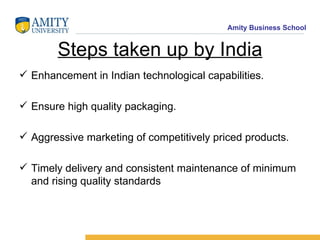
Steps taken up by India Enhancement in Indian technological capabilities. Ensure high quality packaging. Aggressive marketing of competitively priced products. Timely delivery and consistent maintenance of minimum and rising quality standards
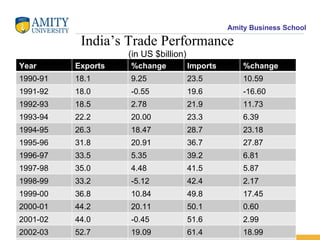
India’s Trade Performance (in US $billion) Year Exports %change Imports %change 1990-91 18.1 9.25 23.5 10.59 1991-92 18.0 -0.55 19.6 -16.60 1992-93 18.5 2.78 21.9 11.73 1993-94 22.2 20.00 23.3 6.39 1994-95 26.3 18.47 28.7 23.18 1995-96 31.8 20.91 36.7 27.87 1996-97 33.5 5.35 39.2 6.81 1997-98 35.0 4.48 41.5 5.87 1998-99 33.2 -5.12 42.4 2.17 1999-00 36.8 10.84 49.8 17.45 2000-01 44.2 20.11 50.1 0.60 2001-02 44.0 -0.45 51.6 2.99 2002-03 52.7 19.09 61.4 18.99 2003-2004 63.5 20.49 77.0 25.42 2004-2005 80.0 25.98 106.0 37.66
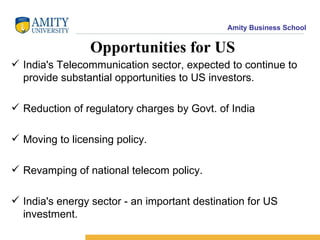
Opportunities for US India's Telecommunication sector, expected to continue to provide substantial opportunities to US investors. Reduction of regulatory charges by Govt. of India Moving to licensing policy. Revamping of national telecom policy. India's energy sector - an important destination for US investment.
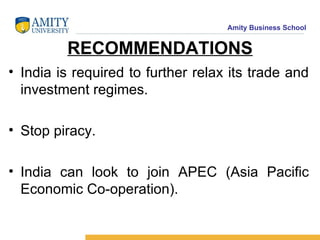
RECOMMENDATIONS India is required to further relax its trade and investment regimes. Stop piracy. India can look to join APEC (Asia Pacific Economic Co-operation).

Indo-US trade relations

  • 1.
    A Presentation onTrade Relations Between India & The Trade Agreement & Various Trade Barriers. Presented To: Mr. Ashok Sharma Presented By Ramneek S Sandhey(46) Marketing & Sales Section E
  • 2.
    Contents Introduction India– U.S. trade relations Bilateral and multinational trade relations World trade organization and other multilateral relations Bilateral merchandise trade Indo-U.S. trade in services Major component of the bilateral trade Direct investment Indo-us trade barriers Current trade situation Conclusion Recommendation
  • 3.
      Research Methodologyand Design: Exploratory Research: an initial research which analysis the data & explores the possibility of obtaining ideas & insight. A literature survey is used for this purpose and secondary sources i.e. available information/literature, magazines, internet websites, books are useful for findings and to develop new hypothesis. It is the most economical and quickest way to find possible hypothesis.   Project rationale This report provides a summary of India’s key economic and trade issues between India and the United States. It analyses Indian and US markets and understands the area of International Business and various factors that influence the trade between them. It also talks about India’s foreign trade policies especially with the US with respect to the trade agreements and trade barriers.   Project Limitations The project is based on the past trend and data of previous years The research is literature based Availability of recent information is missing The practical approach may vary from the stated
  • 4.
    Introduction From modest$ 5.6 billions in 1990, the bilateral trade in merchandise goods has increased to $ 21.68 billion in 2004 representing an impressive growth in a span of 14 years. India’s merchandise exports to the U.S.A. grew at 19.28 % from US $ 13.05 billion in 2003 to US $ 15.57 billion in 2004. US merchandise exports to India increased from US $ 4.98 billion in 2003 to US $ 6.11 billion in 2004, an increase of 22.69%. US exports to India recorded a 22% plus growth for second consecutive year.   1
  • 5.
    Economic and traderelations between the United States and India Number of ups and downs since India’s independence in 1947. During much of the 1950s, the United States was a leading trading partner for India 2
  • 6.
    INDIA – U.S.TRADE RELATIONS 4 1993 1994 1995 1996 1997 1998 1999 2000 India’s Exports 4551 5320 5736 6169 7322 8237 9071 10686 India’s Imports 2761 2296 3296 3318 3608 3564 3688 3663 Turnover 7312 7598 9032 9487 10931 11801 12759 14349 Balance (+) 1790 3005 2440 2851 3715 4673 5383 7023
  • 7.
    INDIA’S SHARE INUS TRADE In 1991,U.S identified India as one of the 10 major emerging markets. India-US bilateral trade also started to grow. US is the destination of one-fifth of India’s exports. India's percentage share in US imports has remained more or less stable over the last few years. 5
  • 8.
    INDIA - USATRADE COMPOSITION Increases in the exports of diamonds, textiles and ready-made garments, carpets, footwear and leather products, dyes, iron, edible fruit and nuts and spices, coffee and tea The chief items imported from the U.S. at present are machinery including project items, fertilizers, aircraft and aeronautical equipment, medical equipment, and organic chemicals.
  • 9.
    BILATERAL AND MULTILATERALTRADE RELATIONS Bilateral relationships : Civil Nuclear Cooperation U.S. Generalized System of Preferences U.S.-India Economic Dialogue Verified End User Program/Trusted Customer Program 6
  • 10.
    Multilateral Relationships: WTO IMF WIPO Asian Development Bank But U S and India also oppose each other in: 1. Doha Round Negotiations 2. Proposed Regional Free Trade Agreements
  • 11.
    Bilateral Merchandise Trade(2001 to 2005)   (In US $ Millions) Source: U.S. Department of Commerce        8   Item   Years     2001   2002   2003   2004   2005   India’s exports to US   9737   11818   13055   15572   12002   US exports to   3757   4101   4980   6109   5210   Total Bilateral Trade   13494   15919   18035   21681   17212
  • 12.
    Major items exportfrom India to U.S.
  • 13.
    Major items ofexport from US to India
  • 14.
    Insurance sector inIndia is opened up for up to 26% FDI, proposals to hike this limit to 49%. Emergence of Business Process Outsourcing. - American Express, Citicorp, Microsoft, Dell, Hewlett-Packard, HSBC, Standard Chartered and Convergys etc are taking advantage of the opportunities offered by India's IT Sector. Telecom industry- Amongst major US companies that have entered the Indian market are AT&T and Qualcomm.
  • 15.
    India has alsomade progress in expanding their investment base in the United States of America. e.g. - Dr. Reddy's Laboratories and Ranbaxy have bought pharmaceutical manufacturing units in the US. According to some surveys conducted in the US, Indians living there contribute a lot to US economy and are among the most highly educated class in America.
  • 16.
  • 17.
    US EXPORT RESTRICTIONSON INDIAN COMPANIES 1.Bureau of Export Administration (BXA) in the US Department of Commerce imposed restrictions on exports to four Indian organizations Bharat Electronics Ltd Bhaba Atomic Research Center (BARC) Indira Gandhi Center for Atomic Research Indian Rare Earths Ltd
  • 18.
    2. Export licensingbecame stricter with the US imposition of sanctions in May 1998, after our nuclear tests. According to a BXA notification issued in June 1998: BXA will deny all export and re-export applications to India under the Export Administration Regulations (EAR). BXA will publish a list of Indian Government and Private entities involved in nuclear and missile activities.
  • 19.
    3.GENERALIZED SYSTEM OFPREFERENCES (GSP) Under the Generalized System of Preferences (GSP), Indian exports worth about US $ 1.1 billion enjoy duty free access or reduced duty access to the U.S. market. In 1992, the US removed GSP benefits for a large number of products from India, mainly agricultural chemicals and pharmaceuticals.
  • 20.
  • 21.
    1. INTELLECTUAL PROPERTYRIGHTS In April 1991, India was designated as a Priority Country under Special 301 for alleged inadequate protection of intellectual property rights. After several rounds of consultations, differences between the two sides on the issues of Copyright, Trademarks and Access for Motion Pictures were largely resolved to have market access to US motion pictures. India agreed to move some amendments to its Copyright and Trademark laws take steps for better enforcement and substantially improve market access for U.S. motion pictures. In its April 1996 determination, the USTR (United States Trade Representative) indicated that USA would take up the case in the WTO against India. Due to failure in pharmaceutical and agricultural chemical products, as required under the TRIPS Agreement.
  • 22.
    2.ANTIDUMPING (AD) &EXCESSIVE CUSTOM DUTY(ECD) CASES AGAINST INDIAN PRODUCTS Rise in the number of AD/ECD cases against Indian companies. In1998, 3 AD & 1ECD cases were initiated against Indian products while 21 cases from other countries. preserved mushrooms stainless steel round wire elastic rubber tape
  • 23.
    CURRENT TRADE SITUATIONIndia has recently agreed to lower tariffs for pharmaceutical products from the United States. India has recently eliminated tariffs for soft drinks from the United States. Current Indian law allows for up to 51 percent of its retail sector to have support from foreign investors. United States and India have recently agreed to establish exchange programs between small businesses in each country. Trade in food and other agricultural products has increased between the United States and India.
  • 24.
    Steps taken upby India Enhancement in Indian technological capabilities. Ensure high quality packaging. Aggressive marketing of competitively priced products. Timely delivery and consistent maintenance of minimum and rising quality standards
  • 25.
    India’s Trade Performance(in US $billion) Year Exports %change Imports %change 1990-91 18.1 9.25 23.5 10.59 1991-92 18.0 -0.55 19.6 -16.60 1992-93 18.5 2.78 21.9 11.73 1993-94 22.2 20.00 23.3 6.39 1994-95 26.3 18.47 28.7 23.18 1995-96 31.8 20.91 36.7 27.87 1996-97 33.5 5.35 39.2 6.81 1997-98 35.0 4.48 41.5 5.87 1998-99 33.2 -5.12 42.4 2.17 1999-00 36.8 10.84 49.8 17.45 2000-01 44.2 20.11 50.1 0.60 2001-02 44.0 -0.45 51.6 2.99 2002-03 52.7 19.09 61.4 18.99 2003-2004 63.5 20.49 77.0 25.42 2004-2005 80.0 25.98 106.0 37.66
  • 26.
    Opportunities for USIndia's Telecommunication sector, expected to continue to provide substantial opportunities to US investors. Reduction of regulatory charges by Govt. of India Moving to licensing policy. Revamping of national telecom policy. India's energy sector - an important destination for US investment.
  • 27.
    RECOMMENDATIONS India isrequired to further relax its trade and investment regimes. Stop piracy. India can look to join APEC (Asia Pacific Economic Co-operation).