Presentation by
Santhosh Kumar K
FROM 2ND YEAR BBM
Few Information about Bangladesh
 President: Abdul Hamid (2013)
 Prime Minister: Sheikh Hasina (2009)
 Land area: 51,703 sq mi (133,911 sq km);
 Total area: 55,598 sq mi (144,000 sq km)
 Population (2014 est.): 166,280,712 (growth rate:
1.6%); birth rate: 21.61/1000; infant mortality rate:
45.67/1000; life expectancy: 70.65
 Capital and largest city (2011 est.) Dhaka, 15.391
million
 Other large cities: Chittagong, 5.239 million; Khulna,
1.781 million; Rajshahi 932,000
 Monetary unit: Taka
FEW FACTS ABOUT BANGLADESH
 Official name : People’s Republic of Bangladesh
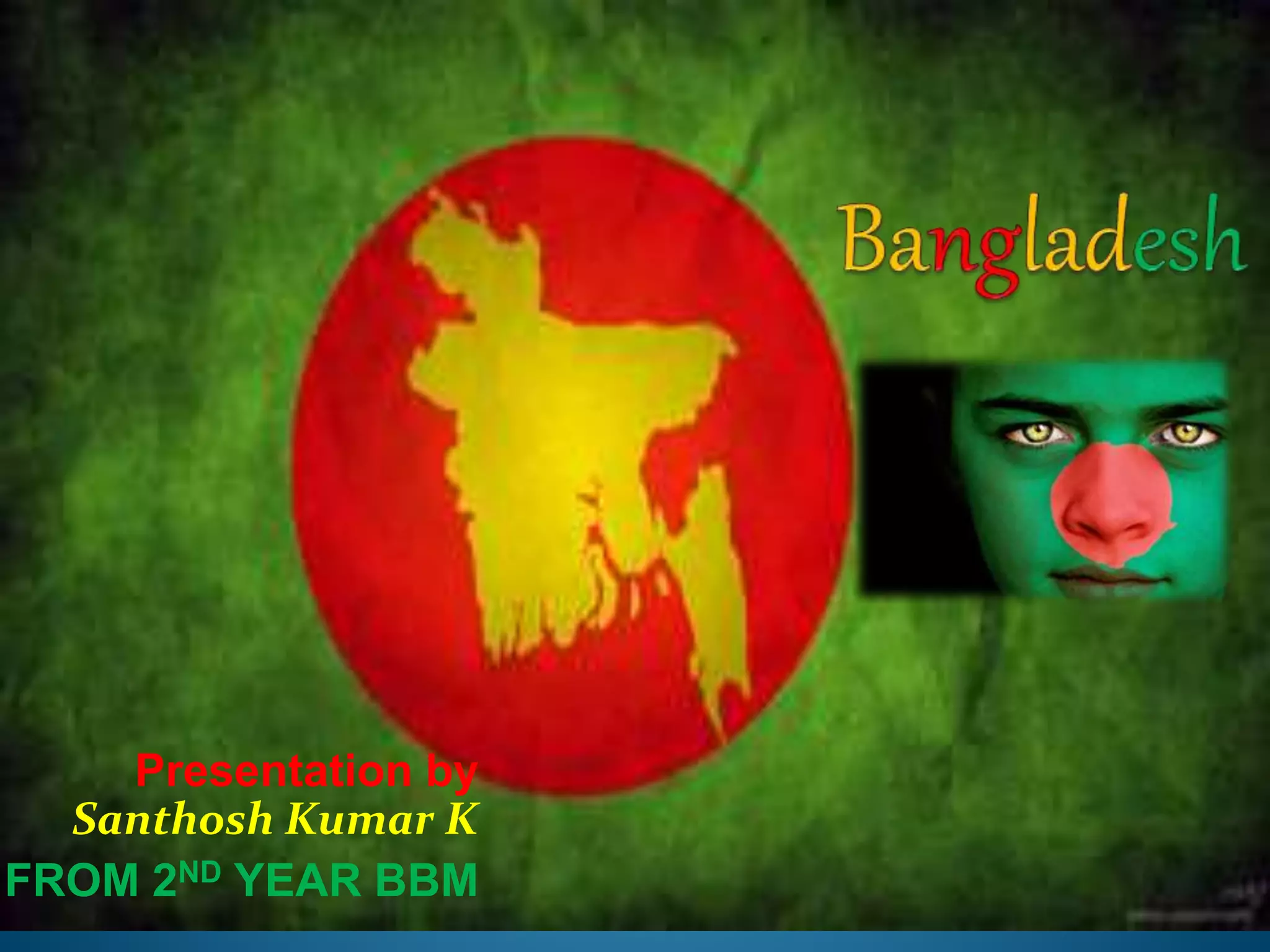
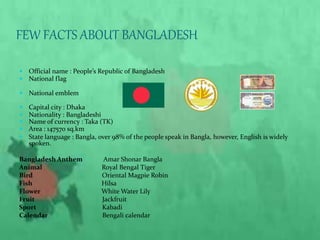
 National flag
 National emblem
 Capital city : Dhaka
 Nationality : Bangladeshi
 Name of currency : Taka (TK)
 Area : 147570 sq.km
 State language : Bangla, over 98% of the people speak in Bangla, however, English is widely
spoken.
Bangladesh Anthem Amar Shonar Bangla
Animal Royal Bengal Tiger
Bird Oriental Magpie Robin
Fish Hilsa
Flower White Water Lily
Fruit Jackfruit
Sport Kabadi
Calendar Bengali calendar
DEMOGRAPHY
 ETHNICITY
The vast majority (about 98.5%) of Bangladeshis are of the Bengali ethno-
linguistic group. Bengalis (বাঙালি Bangali) are an Indo-Aryan ethnic group native
to the region of Bengal. They speak the Bengali language
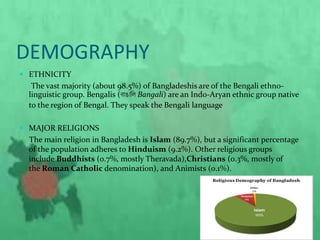
 MAJOR RELIGIONS
The main religion in Bangladesh is Islam (89.7%), but a significant percentage
of the population adheres to Hinduism (9.2%). Other religious groups
include Buddhists (0.7%, mostly Theravada),Christians (0.3%, mostly of
the Roman Catholic denomination), and Animists (0.1%).
DEMOGRAPHY
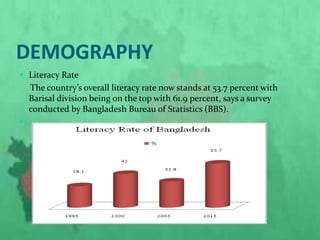
 Literacy Rate
The country’s overall literacy rate now stands at 53.7 percent with
Barisal division being on the top with 61.9 percent, says a survey
conducted by Bangladesh Bureau of Statistics (BBS).

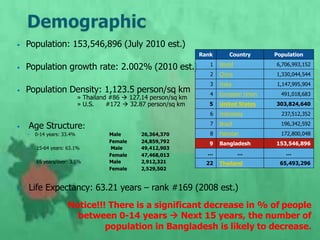
• Population: 153,546,896 (July 2010 est.)
• Population growth rate: 2.002% (2010 est.)
• Population Density: 1,123.5 person/sq km
» Thailand #86  127.14 person/sq km
» U.S. #172  32.87 person/sq km
• Age Structure:
– 0-14 years: 33.4% Male 26,364,370
 Female 24,859,792
– 15-64 years: 63.1% Male 49,412,903
 Female 47,468,013
– 65 years/over: 3.5% Male 2,912,321
 Female 2,529,502
• Life Expectancy: 63.21 years – rank #169 (2008 est.)
Rank Country Population
1 World 6,706,993,152
2 China 1,330,044,544
3 India 1,147,995,904
4 European Union 491,018,683
5 United States 303,824,640
6 Indonesia 237,512,352
7 Brazil 196,342,592
8 Pakistan 172,800,048
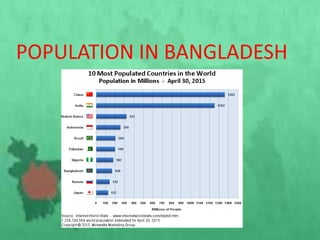
9 Bangladesh 153,546,896
… … …
22 Thailand 65,493,296
Notice!!! There is a significant decrease in % of people
between 0-14 years  Next 15 years, the number of
population in Bangladesh is likely to decrease.
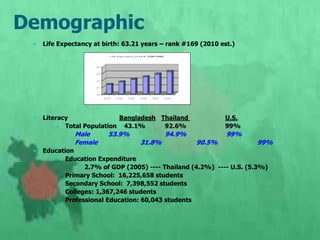
 Life Expectancy at birth: 63.21 years – rank #169 (2010 est.)
 Literacy Bangladesh Thailand U.S.
 Total Population 43.1% 92.6% 99%
- Male 53.9% 94.9% 99%
- Female 31.8% 90.5% 99%
 Education
 Education Expenditure
- 2.7% of GDP (2005) ---- Thailand (4.2%) ---- U.S. (5.3%)
 Primary School: 16,225,658 students
 Secondary School: 7,398,552 students
 Colleges: 1,367,246 students
 Professional Education: 60,043 students
Demographic
6 1 .3 3
6 1 .7 1
6 2 .0 8
6 2 .4 6
6 2 .8 4
6 3 .2 1
6 0
6 1
6 2
6 3
6 4
2 0 0 3 2 0 0 4 2 0 0 5 2 0 0 6 2 0 0 7 2 0 0 8
L if e E x p e c ta n c y a t b ir th (2003-2008)
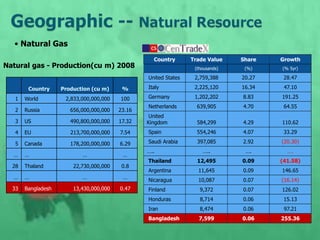
• Natural Gas
Country Trade Value Share Growth
(thousands) (%) (% 5yr)
United States 2,759,388 20.27 28.47
Italy 2,225,120 16.34 47.10
Germany 1,202,202 8.83 191.25
Netherlands 639,905 4.70 64.55
United
Kingdom 584,299 4.29 110.62
Spain 554,246 4.07 33.29
Saudi Arabia 397,085 2.92 (20.30)
….. ….. …. ….
Thailand 12,495 0.09 (41.58)
Argentina 11,645 0.09 146.65
Nicaragua 10,087 0.07 (16.14)
Finland 9,372 0.07 126.02
Honduras 8,714 0.06 15.13
Iran 8,474 0.06 97.21
Bangladesh 7,599 0.06 255.36
Natural gas - Production(cu m) 2008
Country Production (cu m) %
1 World 2,833,000,000,000 100
2 Russia 656,000,000,000 23.16
3 US 490,800,000,000 17.32
4 EU 213,700,000,000 7.54
5 Canada 178,200,000,000 6.29
… … … …
28 Thaland 22,730,000,000 0.8
… … … …
33 Bangladesh 13,430,000,000 0.47
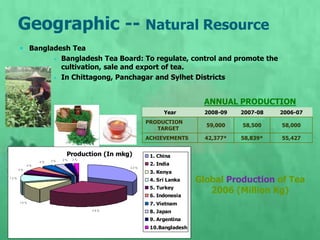
 Bangladesh Tea
 Bangladesh Tea Board: To regulate, control and promote the
cultivation, sale and export of tea.
 In Chittagong, Panchagar and Sylhet Districts
Geographic -- Natural Resource
ANNUAL PRODUCTION
Year 2008-09 2007-08 2006-07
PRODUCTION
TARGET
59,000 58,500 58,000
ACHIEVEMENTS 42,377* 58,839* 55,427
Global Production of Tea
2006 (Million Kg)
Production (In mkg)
3 2 %
2 9 %
1 0 %
1 0 %
4 %
4 %
4 % 3 % 2 % 2 %
1. China
2. India
3. Kenya
4. Sri Lanka
5. Turkey
6. Indonesia
7. Vietnam
8. Japan
9. Argentina
10.Bangladesh
t
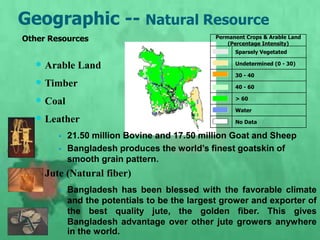
 Arable Land
 Timber
 Coal
 Leather
 21.50 million Bovine and 17.50 million Goat and Sheep
 Bangladesh produces the world’s finest goatskin of
smooth grain pattern.
 Jute (Natural fiber)
 Bangladesh has been blessed with the favorable climate
and the potentials to be the largest grower and exporter of
the best quality jute, the golden fiber. This gives
Bangladesh advantage over other jute growers anywhere
in the world.
Geographic -- Natural Resource
No Data
Water
> 60
40 - 60
30 - 40
Undetermined (0 - 30)
Sparsely Vegetated
Permanent Crops & Arable Land
(Percentage Intensity)
Other Resources
Major Political parties
Bangladesh is ruled by a multi-party parliament system or
parliamentary democracy form of government. The
President (currently ABDUL HAMID) acts as head of state,
whilst the Prime Minister (currently Sheikh Hasina) takes on
the role of head of government and holds the real
power. Bangladesh's government often receives much
criticism and sometimes violent opposition by other political
parties. This has been the situation no matter which political
party in Bangladesh has been in power.
Few political parties of Bangladesh
Bangladesh Democratic Party
Bangladesh Freedom Party
Bangladesh Nationalist Party
Bangladesh Jamaat-e-Islam
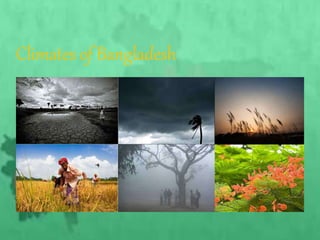
Climate of bangladesh
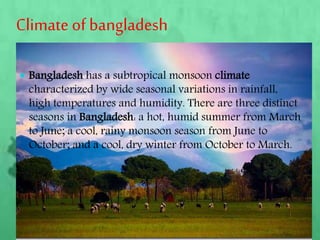
 Bangladesh has a subtropical monsoon climate
characterized by wide seasonal variations in rainfall,
high temperatures and humidity. There are three distinct
seasons in Bangladesh: a hot, humid summer from March
to June; a cool, rainy monsoon season from June to
October; and a cool, dry winter from October to March.
Climates of Bangladesh
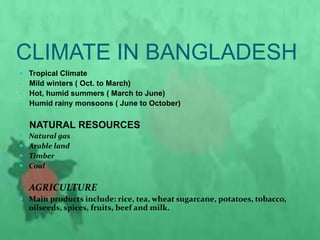
CLIMATE IN BANGLADESH
 Tropical Climate
- Mild winters ( Oct. to March)
- Hot, humid summers ( March to June)
- Humid rainy monsoons ( June to October)
- NATURAL RESOURCES
 Natural gas
 Arable land
 Timber
 Coal
AGRICULTURE
 Main products include: rice, tea, wheat sugarcane, potatoes, tobacco,
oilseeds, spices, fruits, beef and milk.
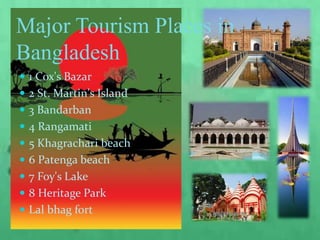
Major Tourism Places in
Bangladesh
 1 Cox's Bazar
 2 St. Martin's Island
 3 Bandarban
 4 Rangamati
 5 Khagrachari beach
 6 Patenga beach
 7 Foy's Lake
 8 Heritage Park
 Lal bhag fort
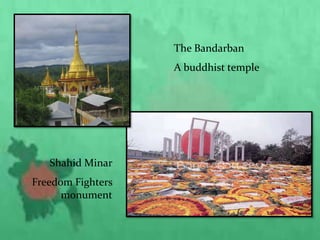
Shahid Minar
Freedom Fighters
monument
The Bandarban
A buddhist temple
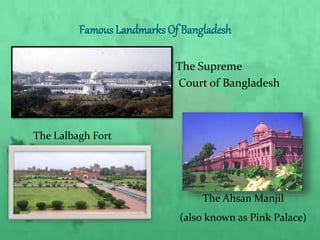
Famous Landmarks Of Bangladesh
The Supreme
Court of Bangladesh
The Lalbagh Fort
The Ahsan Manjil
(also known as Pink Palace)
Culture
 The Culture of Bangladesh: refers to the way of life of the people
of Bangladesh It has evolved over the centuries and encompasses the
cultural diversity of several social groups of Bangladesh. The Bengal
Renaissance of the 19th and early 20th centuries, noted Bengali writers
saints, authors scientists, researchers, thinkers, music composers
painters, and film-makers have played a significant role in the
development of Bengali culture The Bengal Renaissance contained the
seeds of a nascent political Indian nationalism and was the precursor in
many ways to modern Indian artistic and cultural expression. The
culture of Bangladesh is composite and over the centuries has
assimilated influences of Islam Hinduism Buddhism and Christianity
It is manifested in various forms, including music, dance
and drama; art and craft; folklore and folktale; languages and
literature philosophy and religion; festivals and celebrations; as well as
in a distinct cuisine and culinary tradition.
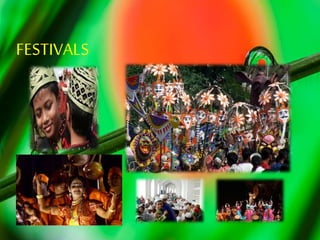
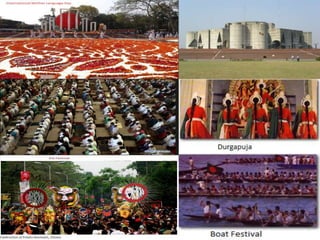
FESTIVALS
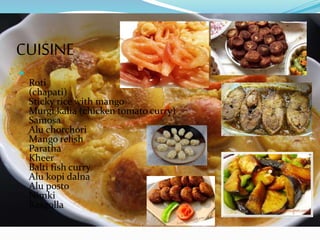
CUISINE

Roti
(chapati)
Sticky rice with mango
Murgi kalia (chicken tomato curry)
Samosa
Alu chorchori
Mango relish
Paratha
Kheer
Balti fish curry
Alu kopi dalna
Alu posto
Nimki
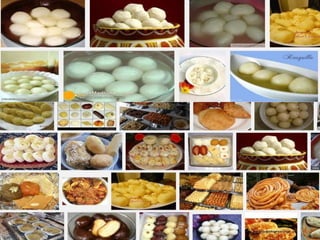
Rasgolla
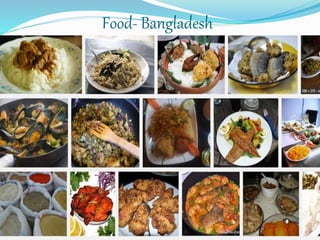
Food- Bangladesh
TRADITION IN
BANGLADESH

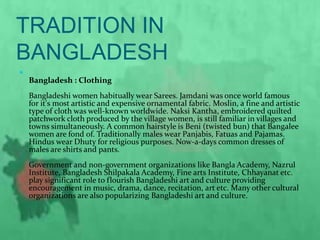
Bangladesh : Clothing
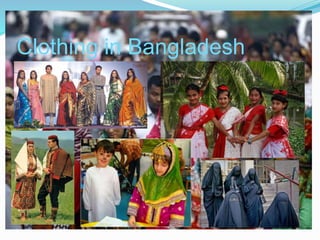
Bangladeshi women habitually wear Sarees. Jamdani was once world famous
for it's most artistic and expensive ornamental fabric. Moslin, a fine and artistic
type of cloth was well-known worldwide. Naksi Kantha, embroidered quilted
patchwork cloth produced by the village women, is still familiar in villages and
towns simultaneously. A common hairstyle is Beni (twisted bun) that Bangalee
women are fond of. Traditionally males wear Panjabis, Fatuas and Pajamas.
Hindus wear Dhuty for religious purposes. Now-a-days common dresses of
males are shirts and pants.
Government and non-government organizations like Bangla Academy, Nazrul
Institute, Bangladesh Shilpakala Academy, Fine arts Institute, Chhayanat etc.
play significant role to flourish Bangladeshi art and culture providing
encouragement in music, drama, dance, recitation, art etc. Many other cultural
organizations are also popularizing Bangladeshi art and culture.
29
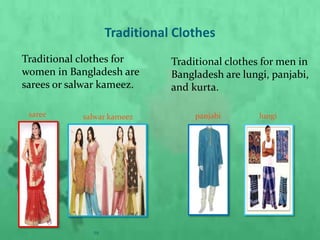
Traditional Clothes
Traditional clothes for
women in Bangladesh are
sarees or salwar kameez.
Traditional clothes for men in
Bangladesh are lungi, panjabi,
and kurta.
saree salwar kameez panjabi lungi
Clothing in Bangladesh
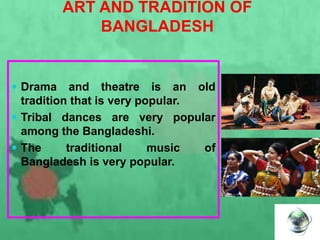
ART AND TRADITION OF
BANGLADESH
 Drama and theatre is an old
tradition that is very popular.
 Tribal dances are very popular
among the Bangladeshi.
 The traditional music of
Bangladesh is very popular.
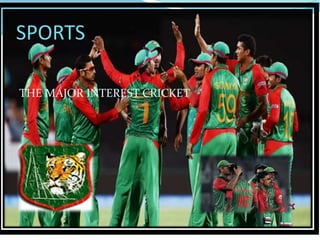
SPORTS
THE MAJOR INTEREST CRICKET
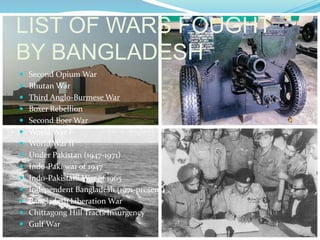
LIST OF WARS FOUGHT
BY BANGLADESH
 Second Opium War
 Bhutan War
 Third Anglo-Burmese War
 Boxer Rebellion
 Second Boer War
 World War I
 World War II
 Under Pakistan (1947-1971)
 Indo-Paki war of 1947
 Indo-Pakistani War of 1965
 Independent Bangladesh (1971-present)
 Bangladesh Liberation War
 Chittagong Hill Tracts Insurgency
 Gulf War
HISTORY OF
BANGLADESH
 ANCIENT AND MEDIVAL
Many of archeological excavations in Bangladesh revealed evidences of the Northern Black Polished
Ware culture (abbreviated NBPW or NBP) of the Indian Subcontinent (c. 700–200 BC) which was
an Iron Age culture developed beginning around 700 BC and peaked from c. 500–300 BC, coinciding
with the emergence of 16 great states or mahajana padas in Northern India, and the subsequent rise
of the Mauryan EmpireThe eastern part of ancient India, covering much of current days Bangladesh
was part of one of such mahajana padas the ancient kingdom of Anga which flourished in the 6th
century BCE.
 MODERN
Islam is the largest religion of Bangladesh, the Muslim population is approximately 148.6 million,
which is the fourth largest Muslim population in the world (after Indonesia Pakistan and India),
constituting 90.4% of the total population as of 2010.[ Religion has always been a strong part of
identity, but this has varied at different times. A survey in late 2003 confirmed that religion is the first
choice by a citizen for self-identification atheism is extremely rare.[4]Bangladesh is a secular state,
however the United Nations has recognised the country as mainly moderate Muslim
democratic country.
Independence
 Previously known as East Pakistan, the war for independence in
1971 brought about the establishment of People’s Republic of
Bangladesh with the help of India.
 Problems after Independence: famines, natural disasters,
prevailing poverty (later tackled with Education and Population
policies), political turmoil, and military coups.
 Restoration of democracy in 1991.
 Constitution was given in 1992.
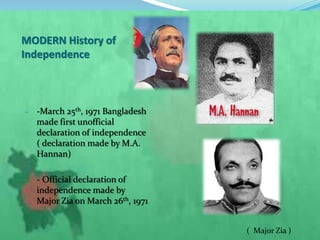
- -March 25th, 1971 Bangladesh
made first unofficial
declaration of independence
( declaration made by M.A.
Hannan)
- - Official declaration of
independence made by
Major Zia on March 26th, 1971
MODERN History of
Independence
( Major Zia )
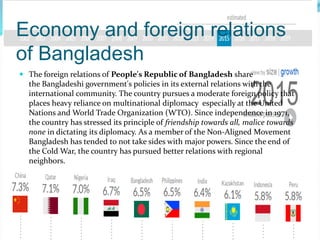
Economy and foreign relations
of Bangladesh
 The foreign relations of People's Republic of Bangladesh share
the Bangladeshi government's policies in its external relations with the
international community. The country pursues a moderate foreign policy that
places heavy reliance on multinational diplomacy especially at the United
Nations and World Trade Organization (WTO). Since independence in 1971,
the country has stressed its principle of friendship towards all, malice towards
none in dictating its diplomacy. As a member of the Non-Aligned Movement
Bangladesh has tended to not take sides with major powers. Since the end of
the Cold War, the country has pursued better relations with regional
neighbors.
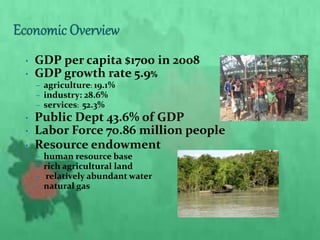
• GDP per capita $1700 in 2008
• GDP growth rate 5.9%
– agriculture: 19.1%
– industry: 28.6%
– services: 52.3%
• Public Dept 43.6% of GDP
• Labor Force 70.86 million people
• Resource endowment
– human resource base
– rich agricultural land
– relatively abundant water
– natural gas
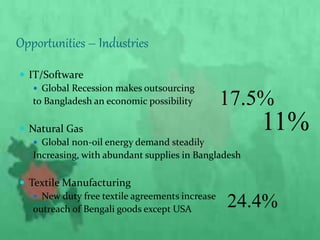
 IT/Software
 Global Recession makes outsourcing
to Bangladesh an economic possibility
 Natural Gas
 Global non-oil energy demand steadily
Increasing, with abundant supplies in Bangladesh
 Textile Manufacturing
 New duty free textile agreements increase
outreach of Bengali goods except USA
Opportunities – Industries
17.5%
11%
24.4%
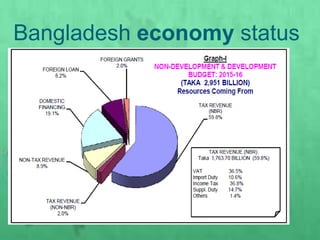
Bangladesh economy status
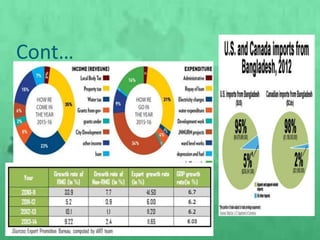
Cont…
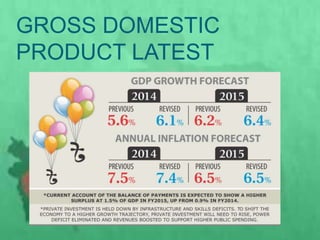
GROSS DOMESTIC
PRODUCT LATEST
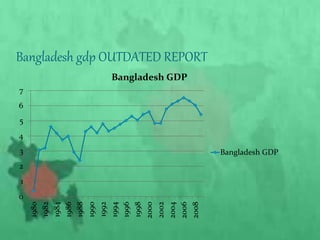
Bangladesh gdp OUTDATED REPORT
0
1
2
3
4
5
6
7
1980
1982
1984
1986
1988
1990
1992
1994
1996
1998
2000
2002
2004
2006
2008
Bangladesh GDP
Bangladesh GDP
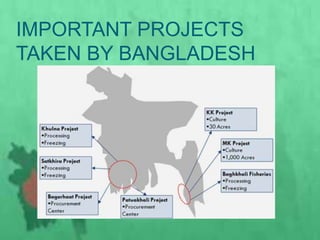
IMPORTANT PROJECTS
TAKEN BY BANGLADESH
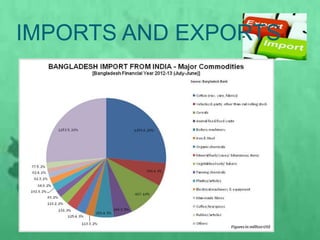
IMPORTS AND EXPORTS
Imports/Exports: AS PER 2010
 Exports:
$13.97 billion
 Exports - commodities:
garments, jute and jute goods, leather, frozen fish and seafood
 Exports - partners:
US 23%, Germany 13%, UK 9.1%, France 5.5%, Belgium 4%
 Imports:
$20.17 billion
 Imports - commodities:
machinery and equipment, chemicals, iron and steel, textiles,
foodstuffs, petroleum products, cement
 Imports - partners:
China 15%, India 14.3%, Kuwait 8.3%, Singapore 6.2%, Hong Kong
4.2%
Bangladesh final ppt

Bangladesh final ppt

  • 1.
    Presentation by Santhosh KumarK FROM 2ND YEAR BBM
  • 4.
    Few Information aboutBangladesh  President: Abdul Hamid (2013)  Prime Minister: Sheikh Hasina (2009)  Land area: 51,703 sq mi (133,911 sq km);  Total area: 55,598 sq mi (144,000 sq km)  Population (2014 est.): 166,280,712 (growth rate: 1.6%); birth rate: 21.61/1000; infant mortality rate: 45.67/1000; life expectancy: 70.65  Capital and largest city (2011 est.) Dhaka, 15.391 million  Other large cities: Chittagong, 5.239 million; Khulna, 1.781 million; Rajshahi 932,000  Monetary unit: Taka
  • 5.
    FEW FACTS ABOUTBANGLADESH  Official name : People’s Republic of Bangladesh  National flag  National emblem  Capital city : Dhaka  Nationality : Bangladeshi  Name of currency : Taka (TK)  Area : 147570 sq.km  State language : Bangla, over 98% of the people speak in Bangla, however, English is widely spoken. Bangladesh Anthem Amar Shonar Bangla Animal Royal Bengal Tiger Bird Oriental Magpie Robin Fish Hilsa Flower White Water Lily Fruit Jackfruit Sport Kabadi Calendar Bengali calendar
  • 6.
    DEMOGRAPHY  ETHNICITY The vastmajority (about 98.5%) of Bangladeshis are of the Bengali ethno- linguistic group. Bengalis (বাঙালি Bangali) are an Indo-Aryan ethnic group native to the region of Bengal. They speak the Bengali language  MAJOR RELIGIONS The main religion in Bangladesh is Islam (89.7%), but a significant percentage of the population adheres to Hinduism (9.2%). Other religious groups include Buddhists (0.7%, mostly Theravada),Christians (0.3%, mostly of the Roman Catholic denomination), and Animists (0.1%).
  • 7.
    DEMOGRAPHY  Literacy Rate Thecountry’s overall literacy rate now stands at 53.7 percent with Barisal division being on the top with 61.9 percent, says a survey conducted by Bangladesh Bureau of Statistics (BBS). 
  • 8.
    • Population: 153,546,896(July 2010 est.) • Population growth rate: 2.002% (2010 est.) • Population Density: 1,123.5 person/sq km » Thailand #86  127.14 person/sq km » U.S. #172  32.87 person/sq km • Age Structure: – 0-14 years: 33.4% Male 26,364,370  Female 24,859,792 – 15-64 years: 63.1% Male 49,412,903  Female 47,468,013 – 65 years/over: 3.5% Male 2,912,321  Female 2,529,502 • Life Expectancy: 63.21 years – rank #169 (2008 est.) Rank Country Population 1 World 6,706,993,152 2 China 1,330,044,544 3 India 1,147,995,904 4 European Union 491,018,683 5 United States 303,824,640 6 Indonesia 237,512,352 7 Brazil 196,342,592 8 Pakistan 172,800,048 9 Bangladesh 153,546,896 … … … 22 Thailand 65,493,296 Notice!!! There is a significant decrease in % of people between 0-14 years  Next 15 years, the number of population in Bangladesh is likely to decrease.
  • 9.
     Life Expectancyat birth: 63.21 years – rank #169 (2010 est.)  Literacy Bangladesh Thailand U.S.  Total Population 43.1% 92.6% 99% - Male 53.9% 94.9% 99% - Female 31.8% 90.5% 99%  Education  Education Expenditure - 2.7% of GDP (2005) ---- Thailand (4.2%) ---- U.S. (5.3%)  Primary School: 16,225,658 students  Secondary School: 7,398,552 students  Colleges: 1,367,246 students  Professional Education: 60,043 students Demographic 6 1 .3 3 6 1 .7 1 6 2 .0 8 6 2 .4 6 6 2 .8 4 6 3 .2 1 6 0 6 1 6 2 6 3 6 4 2 0 0 3 2 0 0 4 2 0 0 5 2 0 0 6 2 0 0 7 2 0 0 8 L if e E x p e c ta n c y a t b ir th (2003-2008)
  • 11.
    • Natural Gas CountryTrade Value Share Growth (thousands) (%) (% 5yr) United States 2,759,388 20.27 28.47 Italy 2,225,120 16.34 47.10 Germany 1,202,202 8.83 191.25 Netherlands 639,905 4.70 64.55 United Kingdom 584,299 4.29 110.62 Spain 554,246 4.07 33.29 Saudi Arabia 397,085 2.92 (20.30) ….. ….. …. …. Thailand 12,495 0.09 (41.58) Argentina 11,645 0.09 146.65 Nicaragua 10,087 0.07 (16.14) Finland 9,372 0.07 126.02 Honduras 8,714 0.06 15.13 Iran 8,474 0.06 97.21 Bangladesh 7,599 0.06 255.36 Natural gas - Production(cu m) 2008 Country Production (cu m) % 1 World 2,833,000,000,000 100 2 Russia 656,000,000,000 23.16 3 US 490,800,000,000 17.32 4 EU 213,700,000,000 7.54 5 Canada 178,200,000,000 6.29 … … … … 28 Thaland 22,730,000,000 0.8 … … … … 33 Bangladesh 13,430,000,000 0.47
  • 12.
     Bangladesh Tea Bangladesh Tea Board: To regulate, control and promote the cultivation, sale and export of tea.  In Chittagong, Panchagar and Sylhet Districts Geographic -- Natural Resource ANNUAL PRODUCTION Year 2008-09 2007-08 2006-07 PRODUCTION TARGET 59,000 58,500 58,000 ACHIEVEMENTS 42,377* 58,839* 55,427 Global Production of Tea 2006 (Million Kg) Production (In mkg) 3 2 % 2 9 % 1 0 % 1 0 % 4 % 4 % 4 % 3 % 2 % 2 % 1. China 2. India 3. Kenya 4. Sri Lanka 5. Turkey 6. Indonesia 7. Vietnam 8. Japan 9. Argentina 10.Bangladesh t
  • 13.
     Arable Land Timber  Coal  Leather  21.50 million Bovine and 17.50 million Goat and Sheep  Bangladesh produces the world’s finest goatskin of smooth grain pattern.  Jute (Natural fiber)  Bangladesh has been blessed with the favorable climate and the potentials to be the largest grower and exporter of the best quality jute, the golden fiber. This gives Bangladesh advantage over other jute growers anywhere in the world. Geographic -- Natural Resource No Data Water > 60 40 - 60 30 - 40 Undetermined (0 - 30) Sparsely Vegetated Permanent Crops & Arable Land (Percentage Intensity) Other Resources
  • 14.
    Major Political parties Bangladeshis ruled by a multi-party parliament system or parliamentary democracy form of government. The President (currently ABDUL HAMID) acts as head of state, whilst the Prime Minister (currently Sheikh Hasina) takes on the role of head of government and holds the real power. Bangladesh's government often receives much criticism and sometimes violent opposition by other political parties. This has been the situation no matter which political party in Bangladesh has been in power. Few political parties of Bangladesh Bangladesh Democratic Party Bangladesh Freedom Party Bangladesh Nationalist Party Bangladesh Jamaat-e-Islam
  • 15.
    Climate of bangladesh Bangladesh has a subtropical monsoon climate characterized by wide seasonal variations in rainfall, high temperatures and humidity. There are three distinct seasons in Bangladesh: a hot, humid summer from March to June; a cool, rainy monsoon season from June to October; and a cool, dry winter from October to March.
  • 16.
  • 17.
    CLIMATE IN BANGLADESH Tropical Climate - Mild winters ( Oct. to March) - Hot, humid summers ( March to June) - Humid rainy monsoons ( June to October) - NATURAL RESOURCES  Natural gas  Arable land  Timber  Coal AGRICULTURE  Main products include: rice, tea, wheat sugarcane, potatoes, tobacco, oilseeds, spices, fruits, beef and milk.
  • 18.
    Major Tourism Placesin Bangladesh  1 Cox's Bazar  2 St. Martin's Island  3 Bandarban  4 Rangamati  5 Khagrachari beach  6 Patenga beach  7 Foy's Lake  8 Heritage Park  Lal bhag fort
  • 19.
    Shahid Minar Freedom Fighters monument TheBandarban A buddhist temple
  • 20.
    Famous Landmarks OfBangladesh The Supreme Court of Bangladesh The Lalbagh Fort The Ahsan Manjil (also known as Pink Palace)
  • 22.
    Culture  The Cultureof Bangladesh: refers to the way of life of the people of Bangladesh It has evolved over the centuries and encompasses the cultural diversity of several social groups of Bangladesh. The Bengal Renaissance of the 19th and early 20th centuries, noted Bengali writers saints, authors scientists, researchers, thinkers, music composers painters, and film-makers have played a significant role in the development of Bengali culture The Bengal Renaissance contained the seeds of a nascent political Indian nationalism and was the precursor in many ways to modern Indian artistic and cultural expression. The culture of Bangladesh is composite and over the centuries has assimilated influences of Islam Hinduism Buddhism and Christianity It is manifested in various forms, including music, dance and drama; art and craft; folklore and folktale; languages and literature philosophy and religion; festivals and celebrations; as well as in a distinct cuisine and culinary tradition.
  • 23.
  • 25.
    CUISINE  Roti (chapati) Sticky rice withmango Murgi kalia (chicken tomato curry) Samosa Alu chorchori Mango relish Paratha Kheer Balti fish curry Alu kopi dalna Alu posto Nimki Rasgolla
  • 26.
  • 28.
    TRADITION IN BANGLADESH  Bangladesh :Clothing Bangladeshi women habitually wear Sarees. Jamdani was once world famous for it's most artistic and expensive ornamental fabric. Moslin, a fine and artistic type of cloth was well-known worldwide. Naksi Kantha, embroidered quilted patchwork cloth produced by the village women, is still familiar in villages and towns simultaneously. A common hairstyle is Beni (twisted bun) that Bangalee women are fond of. Traditionally males wear Panjabis, Fatuas and Pajamas. Hindus wear Dhuty for religious purposes. Now-a-days common dresses of males are shirts and pants. Government and non-government organizations like Bangla Academy, Nazrul Institute, Bangladesh Shilpakala Academy, Fine arts Institute, Chhayanat etc. play significant role to flourish Bangladeshi art and culture providing encouragement in music, drama, dance, recitation, art etc. Many other cultural organizations are also popularizing Bangladeshi art and culture.
  • 29.
    29 Traditional Clothes Traditional clothesfor women in Bangladesh are sarees or salwar kameez. Traditional clothes for men in Bangladesh are lungi, panjabi, and kurta. saree salwar kameez panjabi lungi
  • 30.
  • 31.
    ART AND TRADITIONOF BANGLADESH  Drama and theatre is an old tradition that is very popular.  Tribal dances are very popular among the Bangladeshi.  The traditional music of Bangladesh is very popular.
  • 32.
  • 33.
    LIST OF WARSFOUGHT BY BANGLADESH  Second Opium War  Bhutan War  Third Anglo-Burmese War  Boxer Rebellion  Second Boer War  World War I  World War II  Under Pakistan (1947-1971)  Indo-Paki war of 1947  Indo-Pakistani War of 1965  Independent Bangladesh (1971-present)  Bangladesh Liberation War  Chittagong Hill Tracts Insurgency  Gulf War
  • 34.
    HISTORY OF BANGLADESH  ANCIENTAND MEDIVAL Many of archeological excavations in Bangladesh revealed evidences of the Northern Black Polished Ware culture (abbreviated NBPW or NBP) of the Indian Subcontinent (c. 700–200 BC) which was an Iron Age culture developed beginning around 700 BC and peaked from c. 500–300 BC, coinciding with the emergence of 16 great states or mahajana padas in Northern India, and the subsequent rise of the Mauryan EmpireThe eastern part of ancient India, covering much of current days Bangladesh was part of one of such mahajana padas the ancient kingdom of Anga which flourished in the 6th century BCE.  MODERN Islam is the largest religion of Bangladesh, the Muslim population is approximately 148.6 million, which is the fourth largest Muslim population in the world (after Indonesia Pakistan and India), constituting 90.4% of the total population as of 2010.[ Religion has always been a strong part of identity, but this has varied at different times. A survey in late 2003 confirmed that religion is the first choice by a citizen for self-identification atheism is extremely rare.[4]Bangladesh is a secular state, however the United Nations has recognised the country as mainly moderate Muslim democratic country.
  • 35.
    Independence  Previously knownas East Pakistan, the war for independence in 1971 brought about the establishment of People’s Republic of Bangladesh with the help of India.  Problems after Independence: famines, natural disasters, prevailing poverty (later tackled with Education and Population policies), political turmoil, and military coups.  Restoration of democracy in 1991.  Constitution was given in 1992.
  • 36.
    - -March 25th,1971 Bangladesh made first unofficial declaration of independence ( declaration made by M.A. Hannan) - - Official declaration of independence made by Major Zia on March 26th, 1971 MODERN History of Independence ( Major Zia )
  • 37.
    Economy and foreignrelations of Bangladesh  The foreign relations of People's Republic of Bangladesh share the Bangladeshi government's policies in its external relations with the international community. The country pursues a moderate foreign policy that places heavy reliance on multinational diplomacy especially at the United Nations and World Trade Organization (WTO). Since independence in 1971, the country has stressed its principle of friendship towards all, malice towards none in dictating its diplomacy. As a member of the Non-Aligned Movement Bangladesh has tended to not take sides with major powers. Since the end of the Cold War, the country has pursued better relations with regional neighbors.
  • 38.
    • GDP percapita $1700 in 2008 • GDP growth rate 5.9% – agriculture: 19.1% – industry: 28.6% – services: 52.3% • Public Dept 43.6% of GDP • Labor Force 70.86 million people • Resource endowment – human resource base – rich agricultural land – relatively abundant water – natural gas
  • 39.
     IT/Software  GlobalRecession makes outsourcing to Bangladesh an economic possibility  Natural Gas  Global non-oil energy demand steadily Increasing, with abundant supplies in Bangladesh  Textile Manufacturing  New duty free textile agreements increase outreach of Bengali goods except USA Opportunities – Industries 17.5% 11% 24.4%
  • 40.
  • 41.
  • 42.
  • 43.
    Bangladesh gdp OUTDATEDREPORT 0 1 2 3 4 5 6 7 1980 1982 1984 1986 1988 1990 1992 1994 1996 1998 2000 2002 2004 2006 2008 Bangladesh GDP Bangladesh GDP
  • 44.
  • 45.
  • 46.
    Imports/Exports: AS PER2010  Exports: $13.97 billion  Exports - commodities: garments, jute and jute goods, leather, frozen fish and seafood  Exports - partners: US 23%, Germany 13%, UK 9.1%, France 5.5%, Belgium 4%  Imports: $20.17 billion  Imports - commodities: machinery and equipment, chemicals, iron and steel, textiles, foodstuffs, petroleum products, cement  Imports - partners: China 15%, India 14.3%, Kuwait 8.3%, Singapore 6.2%, Hong Kong 4.2%

Editor's Notes

  • #37 - Declaration was a result of an attack by the Pakistani armed forces on EPR Headquarters in Dhaka