Research Methodology
Introduction
Prof. Dr. Satya
What is Research?
• The Word Research is composed of two syllables –
Re and Search.
• Research is a scientific and systematic search for
pertinent information on a specific topic.
• It is a careful investigation or enquiry specially
through search for knowledge.
• It is the movement from known to unknown.
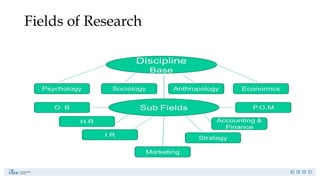
Fields of Research
Nature of Research
• Involves:
• Academics
• Policy Makers
• Practitioners
• Trans-Disciplinarily
• Related to Context (not easily replicated)
• More emphasis on dissemination & exploitation
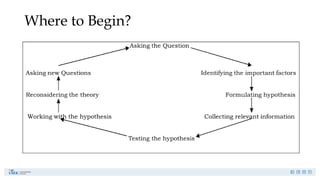
Where to Begin?
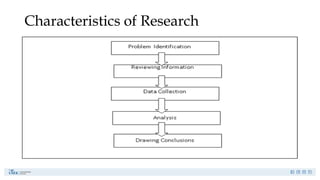
Characteristics of Research
1. Originates with a question or problem.
2. Requires a clear articulation of a goal.
3. Follows a specific plan of procedure.
4. Usually divides the principal problem into more
manageable sub-problems.
5. Is guided by the specific research problem, question,
or hypothesis.
6. Accepts certain critical assumptions.
7. Requires the collection and interpretation of data in
attempting to resolve the problem that initiated the
research.
Purpose of Research
The principal objective or purpose of research in any field
of inquiry is to add to what is known about the
phenomenon under the investigation through the
application of scientific methods.
The purpose of research is the following:
1. Exploration
2. Description
3. Causal Explanation
4. Prediction
Purpose of Research
Exploration: Exploration is finding out about some
previously unexamined phenomenon. It is
particularly useful when researchers lack a clear
idea of the problems they will meet during the
course of the study.
Description: Description refers to the data based
information-gathering activities. The situations and
events which are described through studies are
referred to as descriptive studies. Descriptive
studies try to discover answers to the questions
who, what, when, where and sometimes how.
Purpose of Research
Causal Exploration: An explanatory study goes
beyond description and attempts to establish
cause-and-effect relationship between variables. It
explains the reason for the phenomenon that
describes study observed.
Prediction: Prediction seeks to answer when and in
what situations the event will occur, if it can be
provided plausible explanation for the vent in
question. In addition to being able to explain an
event after it has occurred, it will be able to predict
when the event will occur.
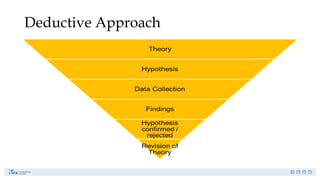
Deductive Approach
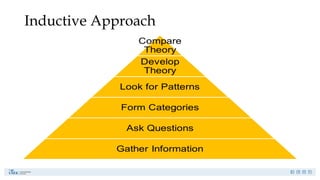
Inductive Approach
Research Methods
1. Quantitative
Inferential
Experimental
Simulation
2. Qualitative
Group Discussions
Projective Techniques
Interviews
Quantitative Method
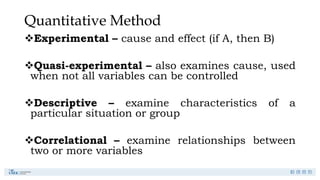
Experimental – cause and effect (if A, then B)
Quasi-experimental – also examines cause, used
when not all variables can be controlled
Descriptive – examine characteristics of a
particular situation or group
Correlational – examine relationships between
two or more variables
Qualitative Method
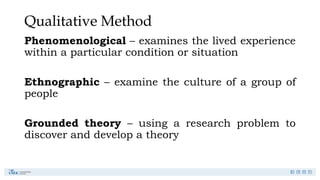
Phenomenological – examines the lived experience
within a particular condition or situation
Ethnographic – examine the culture of a group of
people
Grounded theory – using a research problem to
discover and develop a theory
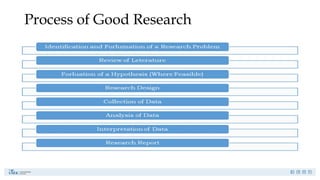
Process of Good Research
Thanking You

Introduction.pptx

  • 2.
  • 3.
    What is Research? •The Word Research is composed of two syllables – Re and Search. • Research is a scientific and systematic search for pertinent information on a specific topic. • It is a careful investigation or enquiry specially through search for knowledge. • It is the movement from known to unknown.
  • 4.
  • 5.
    Nature of Research •Involves: • Academics • Policy Makers • Practitioners • Trans-Disciplinarily • Related to Context (not easily replicated) • More emphasis on dissemination & exploitation
  • 6.
  • 7.
  • 8.
    Characteristics of Research 1.Originates with a question or problem. 2. Requires a clear articulation of a goal. 3. Follows a specific plan of procedure. 4. Usually divides the principal problem into more manageable sub-problems. 5. Is guided by the specific research problem, question, or hypothesis. 6. Accepts certain critical assumptions. 7. Requires the collection and interpretation of data in attempting to resolve the problem that initiated the research.
  • 9.
    Purpose of Research Theprincipal objective or purpose of research in any field of inquiry is to add to what is known about the phenomenon under the investigation through the application of scientific methods. The purpose of research is the following: 1. Exploration 2. Description 3. Causal Explanation 4. Prediction
  • 10.
    Purpose of Research Exploration:Exploration is finding out about some previously unexamined phenomenon. It is particularly useful when researchers lack a clear idea of the problems they will meet during the course of the study. Description: Description refers to the data based information-gathering activities. The situations and events which are described through studies are referred to as descriptive studies. Descriptive studies try to discover answers to the questions who, what, when, where and sometimes how.
  • 11.
    Purpose of Research CausalExploration: An explanatory study goes beyond description and attempts to establish cause-and-effect relationship between variables. It explains the reason for the phenomenon that describes study observed. Prediction: Prediction seeks to answer when and in what situations the event will occur, if it can be provided plausible explanation for the vent in question. In addition to being able to explain an event after it has occurred, it will be able to predict when the event will occur.
  • 12.
  • 13.
  • 14.
    Research Methods 1. Quantitative Inferential Experimental Simulation 2.Qualitative Group Discussions Projective Techniques Interviews
  • 15.
    Quantitative Method Experimental –cause and effect (if A, then B) Quasi-experimental – also examines cause, used when not all variables can be controlled Descriptive – examine characteristics of a particular situation or group Correlational – examine relationships between two or more variables
  • 16.
    Qualitative Method Phenomenological –examines the lived experience within a particular condition or situation Ethnographic – examine the culture of a group of people Grounded theory – using a research problem to discover and develop a theory
  • 17.
  • 18.