LEARNING NEW CLIMATE SCIENCE BY
OPENING THE
MACHINE LEARNING BLACK BOX
@ZLabe
Zachary M. Labe
with Elizabeth A. Barnes
in the Department of Atmospheric Science
10 September 2021
Cognitive Brown Bag Series
CSU Department of Psychology
Machine Learning
is not new!
But…
Machine Learning
is not new!
Artificial Intelligence
Machine Learning
Deep Learning
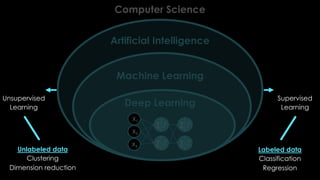
Computer Science
Computer Science
Artificial Intelligence
Machine Learning
Deep Learning
Supervised
Learning
Unsupervised
Learning
Labeled data
Classification
Regression
Unlabeled data
Clustering
Dimension reduction
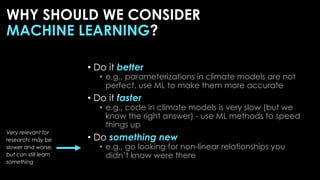
• Do it better
• e.g., parameterizations in climate models are not
perfect, use ML to make them more accurate
• Do it faster
• e.g., code in climate models is very slow (but we
know the right answer) - use ML methods to speed
things up
• Do something new
• e.g., go looking for non-linear relationships you
didn’t know were there
Very relevant for
research: may be
slower and worse,
but can still learn
something
WHY SHOULD WE CONSIDER
MACHINE LEARNING?
GROWING DATA
Adapted from: Kotamarthi, R., Hayhoe, K., Mearns, L., Wuebbles, D., Jacobs, J., & Jurado, J.
(2021). Global Climate Models. In Downscaling Techniques for High-Resolution Climate
Projections: From Global Change to Local Impacts (pp. 19-39). Cambridge: Cambridge University
Press. doi:10.1017/9781108601269.003
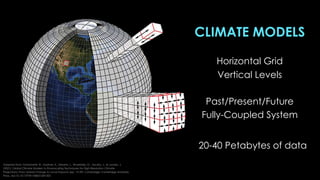
CLIMATE MODELS
Horizontal Grid
Vertical Levels
Past/Present/Future
Fully-Coupled System
20-40 Petabytes of data
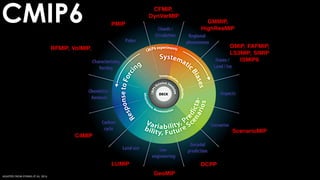
ADAPTED FROM EYRING ET AL. 2016
CMIP6
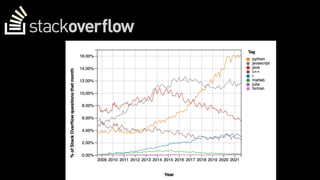
GROWING TOOLS
Python tools for machine learning
Today’s weather or climate
scientist is far more likely to be
debugging code written in
Python… than to be poring over
satellite images or releasing
radiosondes.
“
D. Irving| Bulletin of the American Meteorological Society| 2016
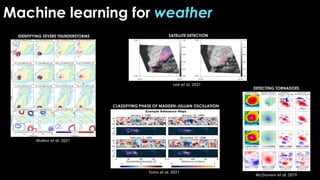
Machine learning for weather
IDENTIFYING SEVERE THUNDERSTORMS
Molina et al. 2021
Toms et al. 2021
CLASSIFYING PHASE OF MADDEN-JULLIAN OSCILLATION
SATELLITE DETECTION
Lee et al. 2021
DETECTING TORNADOES
McGovern et al. 2019
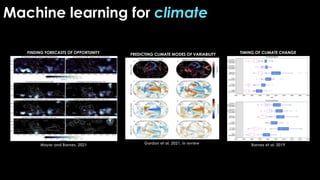
Machine learning for climate
FINDING FORECASTS OF OPPORTUNITY
Mayer and Barnes, 2021
PREDICTING CLIMATE MODES OF VARIABILITY
Gordon et al. 2021, in review
TIMING OF CLIMATE CHANGE
Barnes et al. 2019
INPUT
[DATA]
PREDICTION
Machine
Learning
INPUT
[DATA]
PREDICTION
Machine
Learning
NSF AI Institute for Research
on Trustworthy AI in Weather,
Climate, and Coastal
Oceanography (AI2ES)
https://www.ai2es.org/
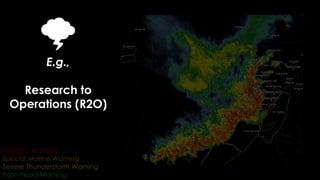
E.g.,
Research to
Operations (R2O)
Tornado Warning
Special Marine Warning
Severe Thunderstorm Warning
Flash Flood Warning
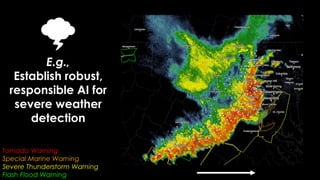
E.g.,
Establish robust,
responsible AI for
severe weather
detection
Tornado Warning
Special Marine Warning
Severe Thunderstorm Warning
Flash Flood Warning
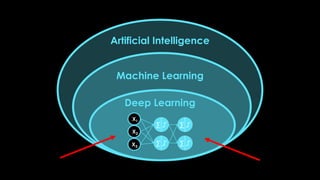
Artificial Intelligence
Machine Learning
Deep Learning
X1
X2
INPUTS
Artificial Neural Networks [ANN]
Linear regression!
Artificial Neural Networks [ANN]
X1
X2
W1
W2
∑ = X1W1+ X2W2 + b
INPUTS
NODE
Artificial Neural Networks [ANN]
X1
X2
W1
W2
∑
INPUTS
NODE
Linear regression with non-linear
mapping by an “activation function”
Training of the network is merely
determining the weights “w” and
bias/offset “b"
= factivation(X1W1+ X2W2 + b)
X1
X2
∑
inputs
HIDDEN LAYERS
X3
∑
∑
∑
OUTPUT
= predictions
Artificial Neural Networks [ANN]
: : ::
INPUTS
Complexity and nonlinearities of the ANN allow it to learn many
different pathways of predictable behavior
Once trained, you have an array of weights and biases which can be
used for prediction on new data
INPUT
[DATA]
PREDICTION
Artificial Neural Networks [ANN]
----ANN----
2 Hidden Layers
10 Nodes each
Ridge Regularization
Early Stopping
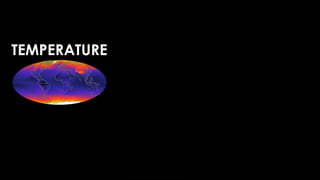
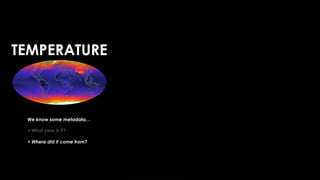
TEMPERATURE
----ANN----
2 Hidden Layers
10 Nodes each
Ridge Regularization
Early Stopping
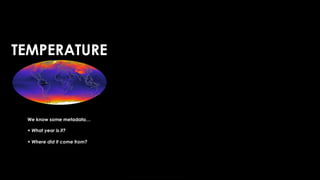
TEMPERATURE
We know some metadata…
+ What year is it?
+ Where did it come from?
----ANN----
2 Hidden Layers
10 Nodes each
Ridge Regularization
Early Stopping
We know some metadata…
+ What year is it?
+ Where did it come from?
[e.g., Barnes et al. 2019, 2020]
[e.g., Labe and Barnes, 2021]
TIMING OF EMERGENCE
(COMBINED VARIABLES)
RESPONSES TO
EXTERNAL CLIMATE
FORCINGS
PATTERNS OF
CLIMATE INDICATORS
[e.g., Rader et al. 2021, in prep]
Surface Temperature Map Precipitation Map
+
TEMPERATURE
----ANN----
2 Hidden Layers
10 Nodes each
Ridge Regularization
Early Stopping
We know some metadata…
+ What year is it?
+ Where did it come from?
[e.g., Barnes et al. 2019, 2020]
[e.g., Labe and Barnes, 2021]
TIMING OF EMERGENCE
(COMBINED VARIABLES)
RESPONSES TO
EXTERNAL CLIMATE
FORCINGS
PATTERNS OF
CLIMATE INDICATORS
[e.g., Rader et al. 2021, in prep]
Surface Temperature Map Precipitation Map
+
TEMPERATURE
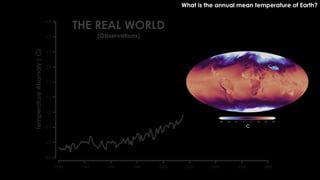
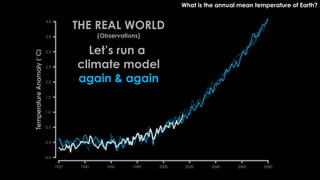
THE REAL WORLD
(Observations)
What is the annual mean temperature of Earth?
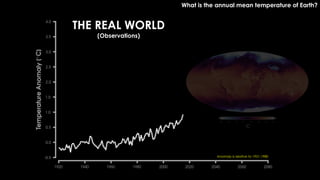
THE REAL WORLD
(Observations)
Anomaly is relative to 1951-1980
What is the annual mean temperature of Earth?
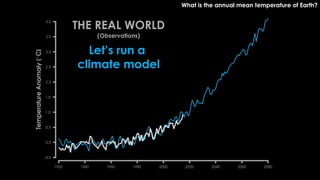
THE REAL WORLD
(Observations)
Let’s run a
climate model
What is the annual mean temperature of Earth?
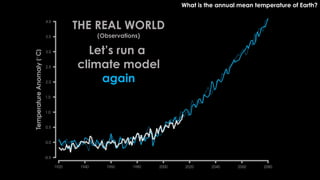
THE REAL WORLD
(Observations)
Let’s run a
climate model
again
What is the annual mean temperature of Earth?
THE REAL WORLD
(Observations)
Let’s run a
climate model
again & again
What is the annual mean temperature of Earth?
THE REAL WORLD
(Observations)
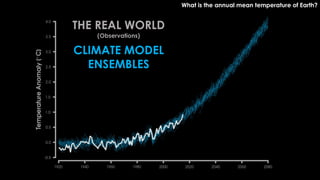
CLIMATE MODEL
ENSEMBLES
What is the annual mean temperature of Earth?
THE REAL WORLD
(Observations)
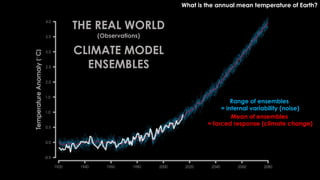
CLIMATE MODEL
ENSEMBLES
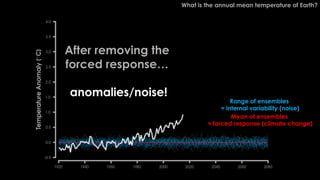
Range of ensembles
= internal variability (noise)
Mean of ensembles
= forced response (climate change)
What is the annual mean temperature of Earth?
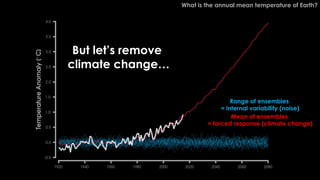
Range of ensembles
= internal variability (noise)
Mean of ensembles
= forced response (climate change)
But let’s remove
climate change…
What is the annual mean temperature of Earth?
Range of ensembles
= internal variability (noise)
Mean of ensembles
= forced response (climate change)
After removing the
forced response…
anomalies/noise!
What is the annual mean temperature of Earth?
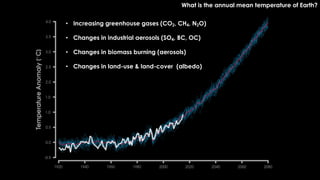
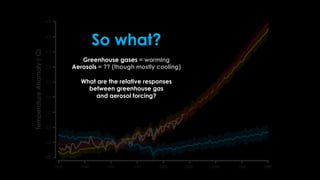
• Increasing greenhouse gases (CO2, CH4, N2O)
• Changes in industrial aerosols (SO4, BC, OC)
• Changes in biomass burning (aerosols)
• Changes in land-use & land-cover (albedo)
What is the annual mean temperature of Earth?
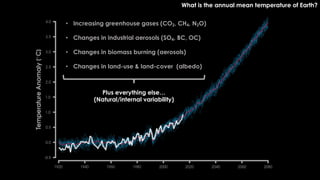
• Increasing greenhouse gases (CO2, CH4, N2O)
• Changes in industrial aerosols (SO4, BC, OC)
• Changes in biomass burning (aerosols)
• Changes in land-use & land-cover (albedo)
Plus everything else…
(Natural/internal variability)
What is the annual mean temperature of Earth?
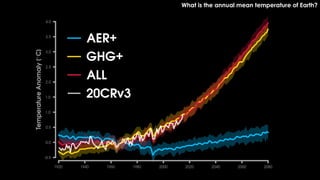
Greenhouse gases fixed to 1920 levels
All forcings (CESM-LE)
Industrial aerosols fixed to 1920 levels
[Deser et al. 2020, JCLI]
Fully-coupled CESM1.1
20 Ensemble Members
Run from 1920-2080
Observations
So what?
Greenhouse gases = warming
Aerosols = ?? (though mostly cooling)
What are the relative responses
between greenhouse gas
and aerosol forcing?
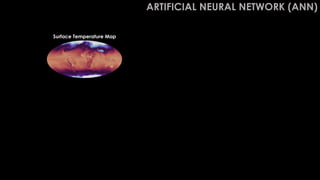
Surface Temperature Map
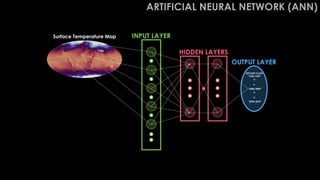
ARTIFICIAL NEURAL NETWORK (ANN)
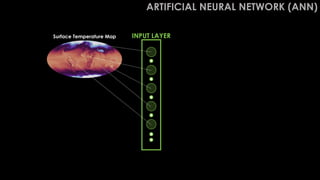
INPUT LAYER
Surface Temperature Map
ARTIFICIAL NEURAL NETWORK (ANN)
INPUT LAYER
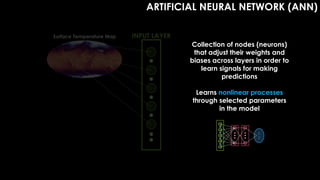
Surface Temperature Map
ARTIFICIAL NEURAL NETWORK (ANN)
Collection of nodes (neurons)
that adjust their weights and
biases across layers in order to
learn signals for making
predictions
Learns nonlinear processes
through selected parameters
in the model
INPUT LAYER
HIDDEN LAYERS
OUTPUT LAYER
Surface Temperature Map
“2000-2009”
DECADE CLASS
“2070-2079”
“1920-1929”
ARTIFICIAL NEURAL NETWORK (ANN)
INPUT LAYER
HIDDEN LAYERS
OUTPUT LAYER
Surface Temperature Map
“2000-2009”
DECADE CLASS
“2070-2079”
“1920-1929”
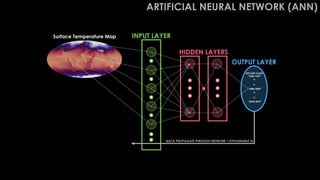
BACK-PROPAGATE THROUGH NETWORK = EXPLAINABLE AI
ARTIFICIAL NEURAL NETWORK (ANN)
INPUT LAYER
HIDDEN LAYERS
OUTPUT LAYER
Layer-wise Relevance Propagation
Surface Temperature Map
“2000-2009”
DECADE CLASS
“2070-2079”
“1920-1929”
BACK-PROPAGATE THROUGH NETWORK = EXPLAINABLE AI
ARTIFICIAL NEURAL NETWORK (ANN)
[Barnes et al. 2020, JAMES]
[Labe and Barnes 2021, JAMES]
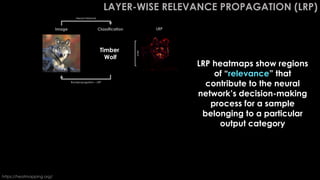
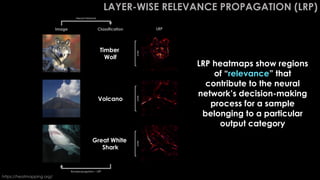
LAYER-WISE RELEVANCE PROPAGATION (LRP)
Volcano
Great White
Shark
Timber
Wolf
Image Classification LRP
https://heatmapping.org/
LRP heatmaps show regions
of “relevance” that
contribute to the neural
network’s decision-making
process for a sample
belonging to a particular
output category
Neural Network
WHY
WHY
WHY
Backpropagation – LRP
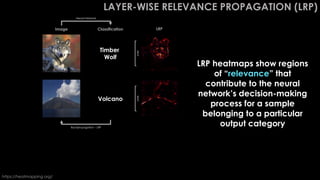
LAYER-WISE RELEVANCE PROPAGATION (LRP)
Volcano
Great White
Shark
Timber
Wolf
Image Classification LRP
https://heatmapping.org/
LRP heatmaps show regions
of “relevance” that
contribute to the neural
network’s decision-making
process for a sample
belonging to a particular
output category
Neural Network
WHY
WHY
WHY
Backpropagation – LRP
LAYER-WISE RELEVANCE PROPAGATION (LRP)
Volcano
Great White
Shark
Timber
Wolf
Image Classification LRP
https://heatmapping.org/
LRP heatmaps show regions
of “relevance” that
contribute to the neural
network’s decision-making
process for a sample
belonging to a particular
output category
Neural Network
Backpropagation – LRP
WHY
WHY
WHY
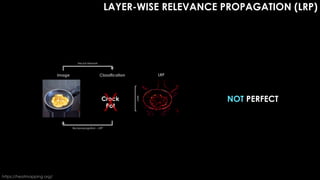
LAYER-WISE RELEVANCE PROPAGATION (LRP)
Image Classification LRP
https://heatmapping.org/
NOT PERFECT
Crock
Pot
Neural Network
Backpropagation – LRP
WHY
[Adapted from Adebayo et al., 2020]
EXPLAINABLE AI IS
NOT PERFECT
THERE ARE MANY
METHODS
[Adapted from Adebayo et al., 2020]
THERE ARE MANY
METHODS
EXPLAINABLE AI IS
NOT PERFECT
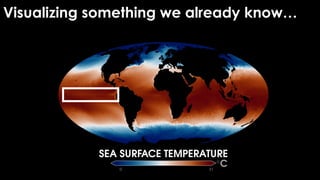
Visualizing something we already know…
Input maps of sea surface
temperatures to identify
El Niño & La Niña
Use ‘LRP’ to see how the
neural network is making
its decision
[Toms et al. 2020, JAMES]
OUTPUT LAYER
Layer-wise Relevance Propagation
“2000-2009”
DECADE CLASS
“2070-2079”
“1920-1929”
BACK-PROPAGATE THROUGH NETWORK = EXPLAINABLE AI
WHY?
= LRP HEAT MAPS
[Labe and Barnes 2021, JAMES]
Layer-wise Relevance Propagation
BACK-PROPAGATE THROUGH NETWORK = EXPLAINABLE AI
WHY?
= LRP HEAT MAPS
Machine Learning
Black Box
[Labe and Barnes 2021, JAMES]
Layer-wise Relevance Propagation
BACK-PROPAGATE THROUGH NETWORK = EXPLAINABLE AI
WHY?
= LRP HEAT MAPS
Find regions of “relevance”
that contribute to the
neural network’s
decision-making process
[Labe and Barnes 2021, JAMES]
1960-1999: ANNUAL MEAN TEMPERATURE TRENDS
Greenhouse gases fixed
to 1920 levels
[AEROSOLS PREVAIL]
Industrial aerosols fixed
to 1920 levels
[GREENHOUSE GASES PREVAIL]
All forcings
[STANDARD CESM-LE]
DATA
1960-1999: ANNUAL MEAN TEMPERATURE TRENDS
Greenhouse gases fixed
to 1920 levels
[AEROSOLS PREVAIL]
Industrial aerosols fixed
to 1920 levels
[GREENHOUSE GASES PREVAIL]
All forcings
[STANDARD CESM-LE]
DATA
1960-1999: ANNUAL MEAN TEMPERATURE TRENDS
Greenhouse gases fixed
to 1920 levels
[AEROSOLS PREVAIL]
Industrial aerosols fixed
to 1920 levels
[GREENHOUSE GASES PREVAIL]
All forcings
[STANDARD CESM-LE]
DATA
1960-1999: ANNUAL MEAN TEMPERATURE TRENDS
Greenhouse gases fixed
to 1920 levels
[AEROSOLS PREVAIL]
Industrial aerosols fixed
to 1920 levels
[GREENHOUSE GASES PREVAIL]
All forcings
[STANDARD CESM-LE]
DATA
CLIMATE MODEL DATA PREDICT THE YEAR FROM MAPS OF TEMPERATURE
AEROSOLS
PREVAIL
GREENHOUSE GASES
PREVAIL
STANDARD
CLIMATE MODEL
[Labe and Barnes 2021, JAMES]
OBSERVATIONS PREDICT THE YEAR FROM MAPS OF TEMPERATURE
AEROSOLS
PREVAIL
GREENHOUSE GASES
PREVAIL
STANDARD
CLIMATE MODEL
[Labe and Barnes 2021, JAMES]
OBSERVATIONS
SLOPES
PREDICT THE YEAR FROM MAPS OF TEMPERATURE
AEROSOLS
PREVAIL
GREENHOUSE GASES
PREVAIL
STANDARD
CLIMATE MODEL
[Labe and Barnes 2021, JAMES]
[Labe
and
Barnes
2021,
JAMES]
ARE THE RESULTS ROBUST?
YES!
COMBINATIONS OF TRAINING/TESTING DATA
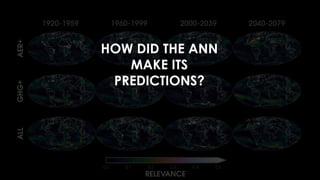
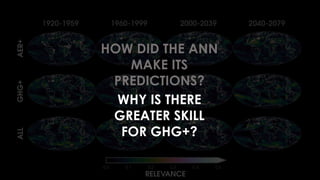
HOW DID THE ANN
MAKE ITS
PREDICTIONS?
HOW DID THE ANN
MAKE ITS
PREDICTIONS?
WHY IS THERE
GREATER SKILL
FOR GHG+?
RESULTS FROM LRP
[Labe and Barnes 2021, JAMES]
RESULTS FROM LRP
[Labe and Barnes 2021, JAMES]
WHAT IS
SIGNIFICANT?
1. Shuffle ensemble member and year
dimensions (bootstrap-like method)
2. Apply true labels (unshuffled years)
3. Apply same ANN architecture and LRP
4. Repeat 500x by using different
combinations of training/testing data and
initialization seeds
5. Compute 95th percentile of the distribution
of LRP at all grid points
Uncertainty in LRP
[Labe and Barnes 2021, JAMES]
Uncertainty in LRP
Ultimately, we are trying to
mask noise in the LRP output
Identify robust climate pattern indicators!
[Labe and Barnes 2021, JAMES]
RESULTS FROM LRP
[Labe and Barnes 2021, JAMES]
RESULTS FROM LRP
[Labe and Barnes 2021, JAMES]
Higher LRP values indicate greater relevance
for the ANN’s prediction
AVERAGED OVER 1960-2039
Aerosol-driven
Greenhouse gas-driven
All forcings
Low High
[Labe and Barnes 2021, JAMES]
Greenhouse gas-driven
Aerosol-driven
All forcings
AVERAGED OVER 1960-2039
[Labe and Barnes 2021, JAMES]
DISTRIBUTIONS OF LRP
AVERAGED OVER 1960-2039
[Labe and Barnes 2021, JAMES]
DISTRIBUTIONS OF LRP
AVERAGED OVER 1960-2039
[Labe and Barnes 2021, JAMES]
----ANN----
2 Hidden Layers
10 Nodes each
Ridge Regularization
Early Stopping
TEMPERATURE
We know some metadata…
+ What year is it?
+ Where did it come from?
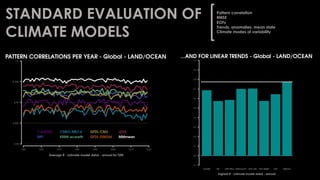
STANDARD EVALUATION OF
CLIMATE MODELS
Pattern correlation
RMSE
EOFs
Trends, anomalies, mean state
Climate modes of variability
----ANN----
2 Hidden Layers
10 Nodes each
Ridge Regularization
Early Stopping
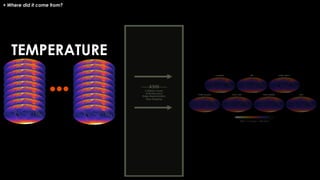
TEMPERATURE
+ Where did it come from?
----ANN----
2 Hidden Layers
10 Nodes each
Ridge Regularization
Early Stopping
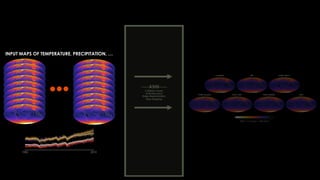
INPUT MAPS OF TEMPERATURE, PRECIPITATION, …
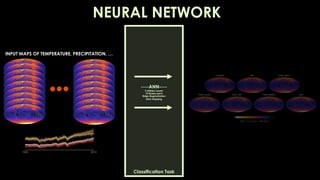
NEURAL NETWORK
----ANN----
2 Hidden Layers
10 Nodes each
Ridge Regularization
Early Stopping
Classification Task
INPUT MAPS OF TEMPERATURE, PRECIPITATION, …
NEURAL NETWORK
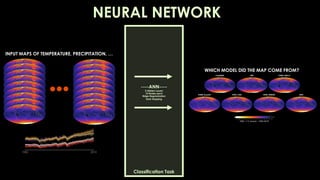
WHICH MODEL DID THE MAP COME FROM?
----ANN----
2 Hidden Layers
10 Nodes each
Ridge Regularization
Early Stopping
Classification Task
INPUT MAPS OF TEMPERATURE, PRECIPITATION, …
NEURAL NETWORK
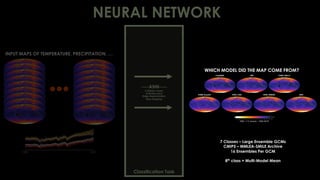
WHICH MODEL DID THE MAP COME FROM?
----ANN----
2 Hidden Layers
10 Nodes each
Ridge Regularization
Early Stopping
Classification Task
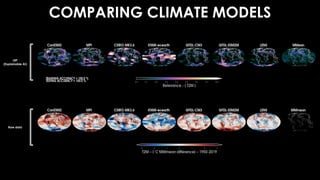
7 Classes – Large Ensemble GCMs
CMIP5 – MMLEA-SMILE Archive
16 Ensembles Per GCM
8th
class = Multi-Model Mean
COMPARING CLIMATE MODELS
LRP
(Explainable AI)
Raw data
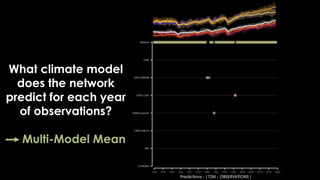
What climate model
does the network
predict for each year
of observations?
Multi-Model Mean
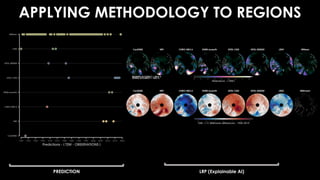
APPLYING METHODOLOGY TO REGIONS
PREDICTION LRP (Explainable AI)
INPUT
[DATA]
PREDICTION
Machine
Learning
Explainable AI
Learn new
science!
MACHINE LEARNING IS JUST
ANOTHER TOOL TO ADD TO OUR
WORKFLOW.
1)
MACHINE LEARNING IS
NO LONGER A BLACK BOX.
2)
WE CAN LEARN NEW SCIENCE
FROM EXPLAINABLE AI.
3)
KEY POINTS
Zachary Labe
zmlabe@rams.colostate.edu
@ZLabe
1. Machine learning is just another tool to add to our scientific workflow
2. We can use explainable AI (XAI) methods to peer into the black box of machine learning
3. We can learn new science by using XAI methods in conjunction with existing statistical tools

Learning new climate science by opening the machine learning black box

  • 1.
    LEARNING NEW CLIMATESCIENCE BY OPENING THE MACHINE LEARNING BLACK BOX @ZLabe Zachary M. Labe with Elizabeth A. Barnes in the Department of Atmospheric Science 10 September 2021 Cognitive Brown Bag Series CSU Department of Psychology
  • 2.
  • 3.
  • 4.
  • 5.
    Computer Science Artificial Intelligence MachineLearning Deep Learning Supervised Learning Unsupervised Learning Labeled data Classification Regression Unlabeled data Clustering Dimension reduction
  • 6.
    • Do itbetter • e.g., parameterizations in climate models are not perfect, use ML to make them more accurate • Do it faster • e.g., code in climate models is very slow (but we know the right answer) - use ML methods to speed things up • Do something new • e.g., go looking for non-linear relationships you didn’t know were there Very relevant for research: may be slower and worse, but can still learn something WHY SHOULD WE CONSIDER MACHINE LEARNING?
  • 7.
  • 9.
    Adapted from: Kotamarthi,R., Hayhoe, K., Mearns, L., Wuebbles, D., Jacobs, J., & Jurado, J. (2021). Global Climate Models. In Downscaling Techniques for High-Resolution Climate Projections: From Global Change to Local Impacts (pp. 19-39). Cambridge: Cambridge University Press. doi:10.1017/9781108601269.003 CLIMATE MODELS Horizontal Grid Vertical Levels Past/Present/Future Fully-Coupled System 20-40 Petabytes of data
  • 10.
    ADAPTED FROM EYRINGET AL. 2016 CMIP6
  • 11.
  • 14.
    Python tools formachine learning
  • 15.
    Today’s weather orclimate scientist is far more likely to be debugging code written in Python… than to be poring over satellite images or releasing radiosondes. “ D. Irving| Bulletin of the American Meteorological Society| 2016
  • 16.
    Machine learning forweather IDENTIFYING SEVERE THUNDERSTORMS Molina et al. 2021 Toms et al. 2021 CLASSIFYING PHASE OF MADDEN-JULLIAN OSCILLATION SATELLITE DETECTION Lee et al. 2021 DETECTING TORNADOES McGovern et al. 2019
  • 17.
    Machine learning forclimate FINDING FORECASTS OF OPPORTUNITY Mayer and Barnes, 2021 PREDICTING CLIMATE MODES OF VARIABILITY Gordon et al. 2021, in review TIMING OF CLIMATE CHANGE Barnes et al. 2019
  • 18.
  • 19.
  • 20.
    NSF AI Institutefor Research on Trustworthy AI in Weather, Climate, and Coastal Oceanography (AI2ES) https://www.ai2es.org/
  • 21.
    E.g., Research to Operations (R2O) TornadoWarning Special Marine Warning Severe Thunderstorm Warning Flash Flood Warning
  • 22.
    E.g., Establish robust, responsible AIfor severe weather detection Tornado Warning Special Marine Warning Severe Thunderstorm Warning Flash Flood Warning
  • 23.
  • 24.
  • 25.
    Linear regression! Artificial NeuralNetworks [ANN] X1 X2 W1 W2 ∑ = X1W1+ X2W2 + b INPUTS NODE
  • 26.
    Artificial Neural Networks[ANN] X1 X2 W1 W2 ∑ INPUTS NODE Linear regression with non-linear mapping by an “activation function” Training of the network is merely determining the weights “w” and bias/offset “b" = factivation(X1W1+ X2W2 + b)
  • 27.
  • 28.
    Complexity and nonlinearitiesof the ANN allow it to learn many different pathways of predictable behavior Once trained, you have an array of weights and biases which can be used for prediction on new data INPUT [DATA] PREDICTION Artificial Neural Networks [ANN]
  • 29.
    ----ANN---- 2 Hidden Layers 10Nodes each Ridge Regularization Early Stopping TEMPERATURE
  • 30.
    ----ANN---- 2 Hidden Layers 10Nodes each Ridge Regularization Early Stopping TEMPERATURE We know some metadata… + What year is it? + Where did it come from?
  • 31.
    ----ANN---- 2 Hidden Layers 10Nodes each Ridge Regularization Early Stopping We know some metadata… + What year is it? + Where did it come from? [e.g., Barnes et al. 2019, 2020] [e.g., Labe and Barnes, 2021] TIMING OF EMERGENCE (COMBINED VARIABLES) RESPONSES TO EXTERNAL CLIMATE FORCINGS PATTERNS OF CLIMATE INDICATORS [e.g., Rader et al. 2021, in prep] Surface Temperature Map Precipitation Map + TEMPERATURE
  • 32.
    ----ANN---- 2 Hidden Layers 10Nodes each Ridge Regularization Early Stopping We know some metadata… + What year is it? + Where did it come from? [e.g., Barnes et al. 2019, 2020] [e.g., Labe and Barnes, 2021] TIMING OF EMERGENCE (COMBINED VARIABLES) RESPONSES TO EXTERNAL CLIMATE FORCINGS PATTERNS OF CLIMATE INDICATORS [e.g., Rader et al. 2021, in prep] Surface Temperature Map Precipitation Map + TEMPERATURE
  • 33.
    THE REAL WORLD (Observations) Whatis the annual mean temperature of Earth?
  • 34.
    What is theannual mean temperature of Earth? THE REAL WORLD (Observations) Anomaly is relative to 1951-1980
  • 35.
    What is theannual mean temperature of Earth? THE REAL WORLD (Observations) Let’s run a climate model
  • 36.
    What is theannual mean temperature of Earth? THE REAL WORLD (Observations) Let’s run a climate model again
  • 37.
    What is theannual mean temperature of Earth? THE REAL WORLD (Observations) Let’s run a climate model again & again
  • 38.
    What is theannual mean temperature of Earth? THE REAL WORLD (Observations) CLIMATE MODEL ENSEMBLES
  • 39.
    What is theannual mean temperature of Earth? THE REAL WORLD (Observations) CLIMATE MODEL ENSEMBLES Range of ensembles = internal variability (noise) Mean of ensembles = forced response (climate change)
  • 40.
    What is theannual mean temperature of Earth? Range of ensembles = internal variability (noise) Mean of ensembles = forced response (climate change) But let’s remove climate change…
  • 41.
    What is theannual mean temperature of Earth? Range of ensembles = internal variability (noise) Mean of ensembles = forced response (climate change) After removing the forced response… anomalies/noise!
  • 42.
    What is theannual mean temperature of Earth? • Increasing greenhouse gases (CO2, CH4, N2O) • Changes in industrial aerosols (SO4, BC, OC) • Changes in biomass burning (aerosols) • Changes in land-use & land-cover (albedo)
  • 43.
    What is theannual mean temperature of Earth? • Increasing greenhouse gases (CO2, CH4, N2O) • Changes in industrial aerosols (SO4, BC, OC) • Changes in biomass burning (aerosols) • Changes in land-use & land-cover (albedo) Plus everything else… (Natural/internal variability)
  • 44.
    What is theannual mean temperature of Earth?
  • 45.
    Greenhouse gases fixedto 1920 levels All forcings (CESM-LE) Industrial aerosols fixed to 1920 levels [Deser et al. 2020, JCLI] Fully-coupled CESM1.1 20 Ensemble Members Run from 1920-2080 Observations
  • 46.
    So what? Greenhouse gases= warming Aerosols = ?? (though mostly cooling) What are the relative responses between greenhouse gas and aerosol forcing?
  • 47.
  • 48.
    INPUT LAYER Surface TemperatureMap ARTIFICIAL NEURAL NETWORK (ANN)
  • 49.
    INPUT LAYER Surface TemperatureMap ARTIFICIAL NEURAL NETWORK (ANN) Collection of nodes (neurons) that adjust their weights and biases across layers in order to learn signals for making predictions Learns nonlinear processes through selected parameters in the model
  • 50.
    INPUT LAYER HIDDEN LAYERS OUTPUTLAYER Surface Temperature Map “2000-2009” DECADE CLASS “2070-2079” “1920-1929” ARTIFICIAL NEURAL NETWORK (ANN)
  • 51.
    INPUT LAYER HIDDEN LAYERS OUTPUTLAYER Surface Temperature Map “2000-2009” DECADE CLASS “2070-2079” “1920-1929” BACK-PROPAGATE THROUGH NETWORK = EXPLAINABLE AI ARTIFICIAL NEURAL NETWORK (ANN)
  • 52.
    INPUT LAYER HIDDEN LAYERS OUTPUTLAYER Layer-wise Relevance Propagation Surface Temperature Map “2000-2009” DECADE CLASS “2070-2079” “1920-1929” BACK-PROPAGATE THROUGH NETWORK = EXPLAINABLE AI ARTIFICIAL NEURAL NETWORK (ANN) [Barnes et al. 2020, JAMES] [Labe and Barnes 2021, JAMES]
  • 53.
    LAYER-WISE RELEVANCE PROPAGATION(LRP) Volcano Great White Shark Timber Wolf Image Classification LRP https://heatmapping.org/ LRP heatmaps show regions of “relevance” that contribute to the neural network’s decision-making process for a sample belonging to a particular output category Neural Network WHY WHY WHY Backpropagation – LRP
  • 54.
    LAYER-WISE RELEVANCE PROPAGATION(LRP) Volcano Great White Shark Timber Wolf Image Classification LRP https://heatmapping.org/ LRP heatmaps show regions of “relevance” that contribute to the neural network’s decision-making process for a sample belonging to a particular output category Neural Network WHY WHY WHY Backpropagation – LRP
  • 55.
    LAYER-WISE RELEVANCE PROPAGATION(LRP) Volcano Great White Shark Timber Wolf Image Classification LRP https://heatmapping.org/ LRP heatmaps show regions of “relevance” that contribute to the neural network’s decision-making process for a sample belonging to a particular output category Neural Network Backpropagation – LRP WHY WHY WHY
  • 56.
    LAYER-WISE RELEVANCE PROPAGATION(LRP) Image Classification LRP https://heatmapping.org/ NOT PERFECT Crock Pot Neural Network Backpropagation – LRP WHY
  • 57.
    [Adapted from Adebayoet al., 2020] EXPLAINABLE AI IS NOT PERFECT THERE ARE MANY METHODS
  • 58.
    [Adapted from Adebayoet al., 2020] THERE ARE MANY METHODS EXPLAINABLE AI IS NOT PERFECT
  • 59.
    Visualizing something wealready know…
  • 60.
    Visualizing something wealready know… Input maps of sea surface temperatures to identify El Niño & La Niña Use ‘LRP’ to see how the neural network is making its decision [Toms et al. 2020, JAMES]
  • 61.
    OUTPUT LAYER Layer-wise RelevancePropagation “2000-2009” DECADE CLASS “2070-2079” “1920-1929” BACK-PROPAGATE THROUGH NETWORK = EXPLAINABLE AI WHY? = LRP HEAT MAPS [Labe and Barnes 2021, JAMES]
  • 62.
    Layer-wise Relevance Propagation BACK-PROPAGATETHROUGH NETWORK = EXPLAINABLE AI WHY? = LRP HEAT MAPS Machine Learning Black Box [Labe and Barnes 2021, JAMES]
  • 63.
    Layer-wise Relevance Propagation BACK-PROPAGATETHROUGH NETWORK = EXPLAINABLE AI WHY? = LRP HEAT MAPS Find regions of “relevance” that contribute to the neural network’s decision-making process [Labe and Barnes 2021, JAMES]
  • 64.
    1960-1999: ANNUAL MEANTEMPERATURE TRENDS Greenhouse gases fixed to 1920 levels [AEROSOLS PREVAIL] Industrial aerosols fixed to 1920 levels [GREENHOUSE GASES PREVAIL] All forcings [STANDARD CESM-LE] DATA
  • 65.
    1960-1999: ANNUAL MEANTEMPERATURE TRENDS Greenhouse gases fixed to 1920 levels [AEROSOLS PREVAIL] Industrial aerosols fixed to 1920 levels [GREENHOUSE GASES PREVAIL] All forcings [STANDARD CESM-LE] DATA
  • 66.
    1960-1999: ANNUAL MEANTEMPERATURE TRENDS Greenhouse gases fixed to 1920 levels [AEROSOLS PREVAIL] Industrial aerosols fixed to 1920 levels [GREENHOUSE GASES PREVAIL] All forcings [STANDARD CESM-LE] DATA
  • 67.
    1960-1999: ANNUAL MEANTEMPERATURE TRENDS Greenhouse gases fixed to 1920 levels [AEROSOLS PREVAIL] Industrial aerosols fixed to 1920 levels [GREENHOUSE GASES PREVAIL] All forcings [STANDARD CESM-LE] DATA
  • 68.
    CLIMATE MODEL DATAPREDICT THE YEAR FROM MAPS OF TEMPERATURE AEROSOLS PREVAIL GREENHOUSE GASES PREVAIL STANDARD CLIMATE MODEL [Labe and Barnes 2021, JAMES]
  • 69.
    OBSERVATIONS PREDICT THEYEAR FROM MAPS OF TEMPERATURE AEROSOLS PREVAIL GREENHOUSE GASES PREVAIL STANDARD CLIMATE MODEL [Labe and Barnes 2021, JAMES]
  • 70.
    OBSERVATIONS SLOPES PREDICT THE YEARFROM MAPS OF TEMPERATURE AEROSOLS PREVAIL GREENHOUSE GASES PREVAIL STANDARD CLIMATE MODEL [Labe and Barnes 2021, JAMES]
  • 71.
    [Labe and Barnes 2021, JAMES] ARE THE RESULTSROBUST? YES! COMBINATIONS OF TRAINING/TESTING DATA
  • 72.
    HOW DID THEANN MAKE ITS PREDICTIONS?
  • 73.
    HOW DID THEANN MAKE ITS PREDICTIONS? WHY IS THERE GREATER SKILL FOR GHG+?
  • 74.
    RESULTS FROM LRP [Labeand Barnes 2021, JAMES]
  • 75.
    RESULTS FROM LRP [Labeand Barnes 2021, JAMES] WHAT IS SIGNIFICANT?
  • 76.
    1. Shuffle ensemblemember and year dimensions (bootstrap-like method) 2. Apply true labels (unshuffled years) 3. Apply same ANN architecture and LRP 4. Repeat 500x by using different combinations of training/testing data and initialization seeds 5. Compute 95th percentile of the distribution of LRP at all grid points Uncertainty in LRP [Labe and Barnes 2021, JAMES]
  • 77.
    Uncertainty in LRP Ultimately,we are trying to mask noise in the LRP output Identify robust climate pattern indicators! [Labe and Barnes 2021, JAMES]
  • 78.
    RESULTS FROM LRP [Labeand Barnes 2021, JAMES]
  • 79.
    RESULTS FROM LRP [Labeand Barnes 2021, JAMES]
  • 80.
    Higher LRP valuesindicate greater relevance for the ANN’s prediction AVERAGED OVER 1960-2039 Aerosol-driven Greenhouse gas-driven All forcings Low High [Labe and Barnes 2021, JAMES]
  • 81.
    Greenhouse gas-driven Aerosol-driven All forcings AVERAGEDOVER 1960-2039 [Labe and Barnes 2021, JAMES]
  • 82.
    DISTRIBUTIONS OF LRP AVERAGEDOVER 1960-2039 [Labe and Barnes 2021, JAMES]
  • 83.
    DISTRIBUTIONS OF LRP AVERAGEDOVER 1960-2039 [Labe and Barnes 2021, JAMES]
  • 84.
    ----ANN---- 2 Hidden Layers 10Nodes each Ridge Regularization Early Stopping TEMPERATURE We know some metadata… + What year is it? + Where did it come from?
  • 85.
    STANDARD EVALUATION OF CLIMATEMODELS Pattern correlation RMSE EOFs Trends, anomalies, mean state Climate modes of variability
  • 86.
    ----ANN---- 2 Hidden Layers 10Nodes each Ridge Regularization Early Stopping TEMPERATURE + Where did it come from?
  • 87.
    ----ANN---- 2 Hidden Layers 10Nodes each Ridge Regularization Early Stopping INPUT MAPS OF TEMPERATURE, PRECIPITATION, …
  • 88.
    INPUT MAPS OFTEMPERATURE, PRECIPITATION, … NEURAL NETWORK ----ANN---- 2 Hidden Layers 10 Nodes each Ridge Regularization Early Stopping Classification Task
  • 89.
    INPUT MAPS OFTEMPERATURE, PRECIPITATION, … NEURAL NETWORK WHICH MODEL DID THE MAP COME FROM? ----ANN---- 2 Hidden Layers 10 Nodes each Ridge Regularization Early Stopping Classification Task
  • 90.
    INPUT MAPS OFTEMPERATURE, PRECIPITATION, … NEURAL NETWORK WHICH MODEL DID THE MAP COME FROM? ----ANN---- 2 Hidden Layers 10 Nodes each Ridge Regularization Early Stopping Classification Task 7 Classes – Large Ensemble GCMs CMIP5 – MMLEA-SMILE Archive 16 Ensembles Per GCM 8th class = Multi-Model Mean
  • 91.
  • 92.
    What climate model doesthe network predict for each year of observations? Multi-Model Mean
  • 93.
    APPLYING METHODOLOGY TOREGIONS PREDICTION LRP (Explainable AI)
  • 94.
  • 95.
    MACHINE LEARNING ISJUST ANOTHER TOOL TO ADD TO OUR WORKFLOW. 1)
  • 96.
    MACHINE LEARNING IS NOLONGER A BLACK BOX. 2)
  • 97.
    WE CAN LEARNNEW SCIENCE FROM EXPLAINABLE AI. 3)
  • 98.
    KEY POINTS Zachary Labe zmlabe@rams.colostate.edu @ZLabe 1.Machine learning is just another tool to add to our scientific workflow 2. We can use explainable AI (XAI) methods to peer into the black box of machine learning 3. We can learn new science by using XAI methods in conjunction with existing statistical tools