EXPERIMENTAL STUDY ON GREY WATER
RECYCLING USING BIOSAND FILTERS FOR
NON POTABLE USE
©
Dr Priy Brat Dwivedi, Ahlam AL Zadzali, Buthaina AL Alawi
Caledonian College of Engineering, Muscat, Oman
Content
• Introduction of Grey water, Biosand filters & research problem
• Objectives of study
• Literature Reviews
• Methodology
• Results
• Discussion
• Conclusion
• Acknowledgement
Aim and objectives of the study
Aim: Recycling waste water from bathrooms and kitchen of a small
family.
Objectives:
– Collecting real time grey water from bathrooms and kitchen.
– Use of coagulants to remove maximum of suspended and dissolv
ed impurities.
– Testing influent water quality in terms of pH, TDS, TSS, DO, CO
D, conductivity.
– Fabrication of biosand filters
– Run the experiment, collect effluent water and test all parameters
– Analyse the result.
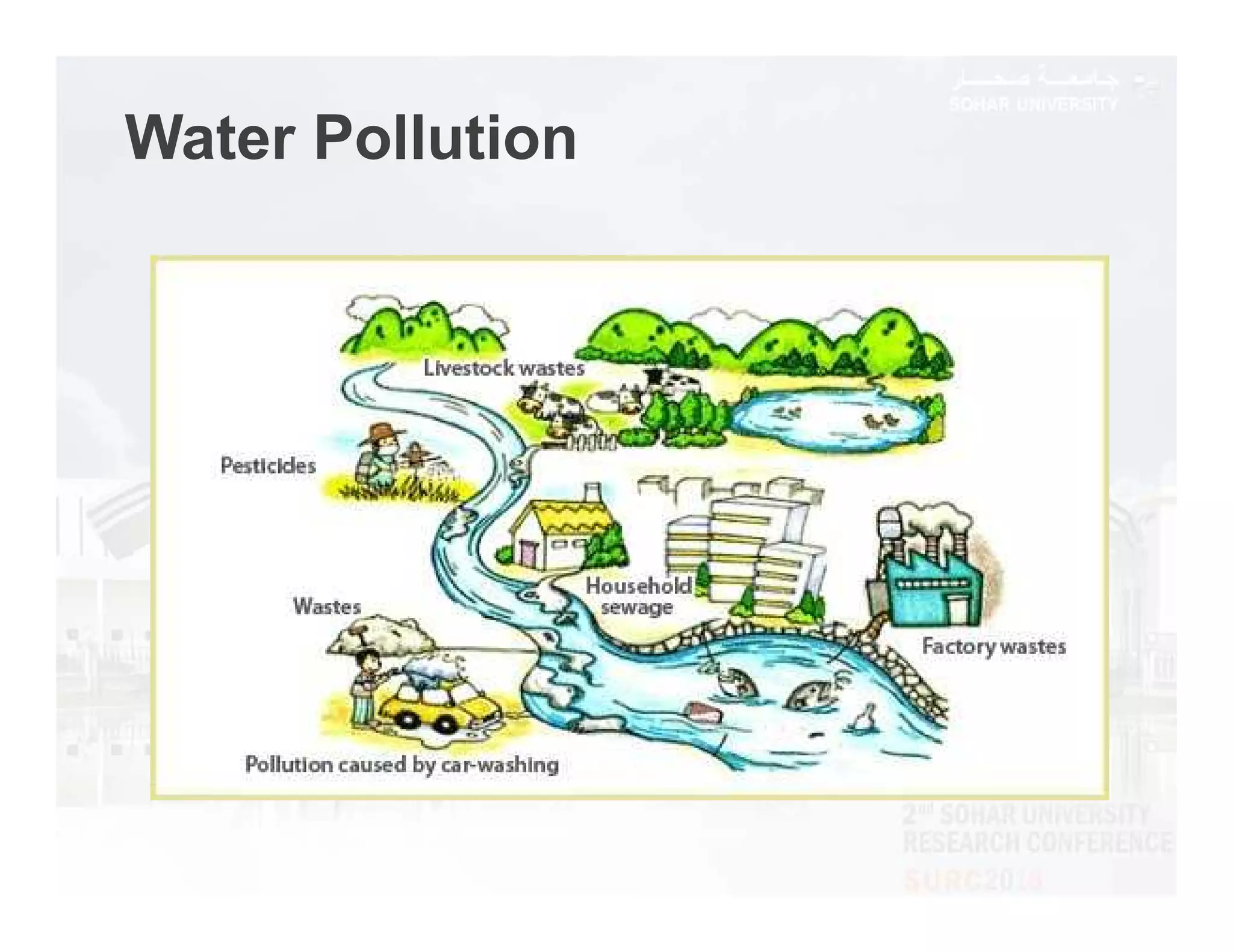
Water Pollution
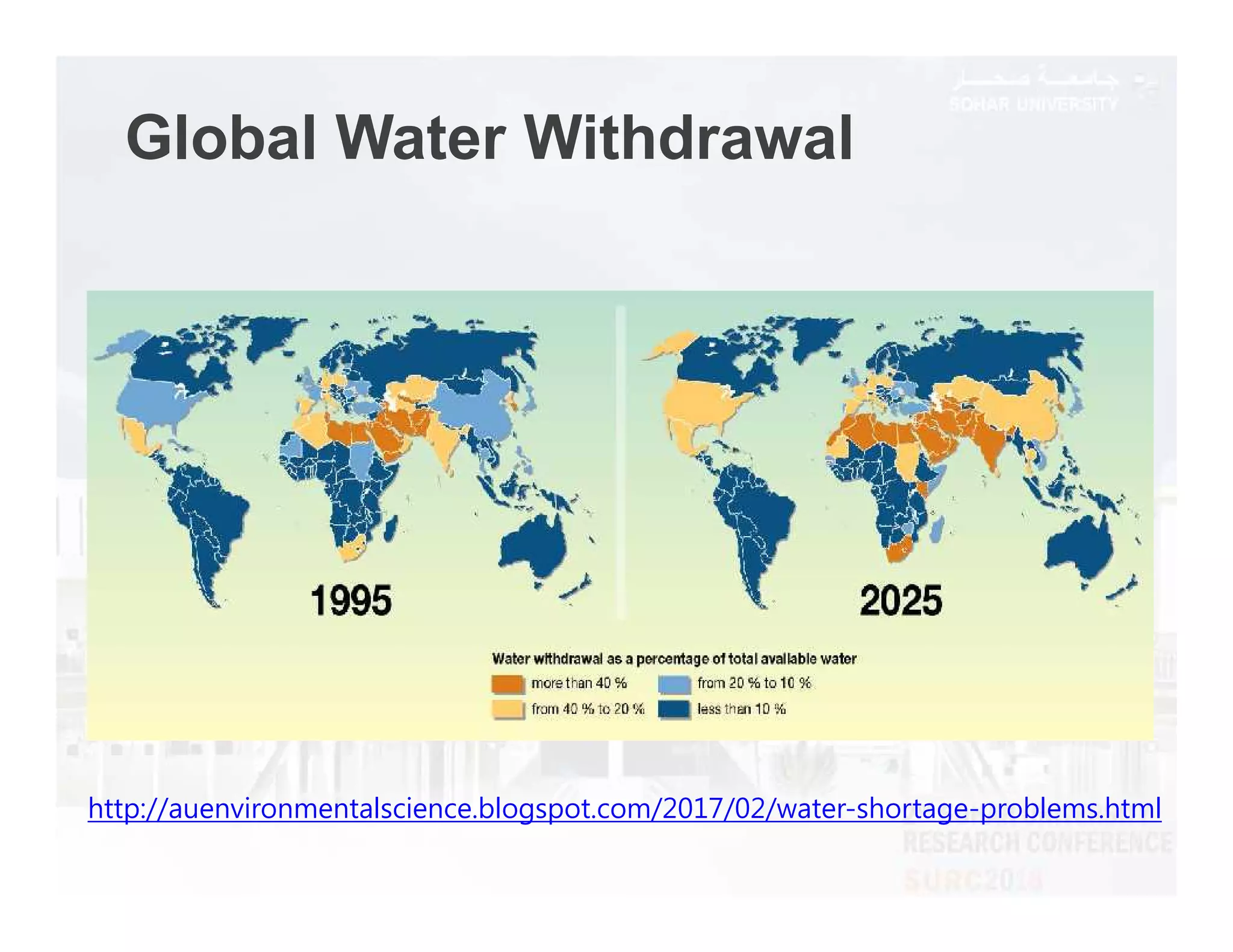
Global Water Withdrawal
http://auenvironmentalscience.blogspot.com/2017/02/water-shortage-problems.html
Global Water Scarcity
http://auenvironmentalscience.blogspot.com/2017/02/water-shortage-problems.html
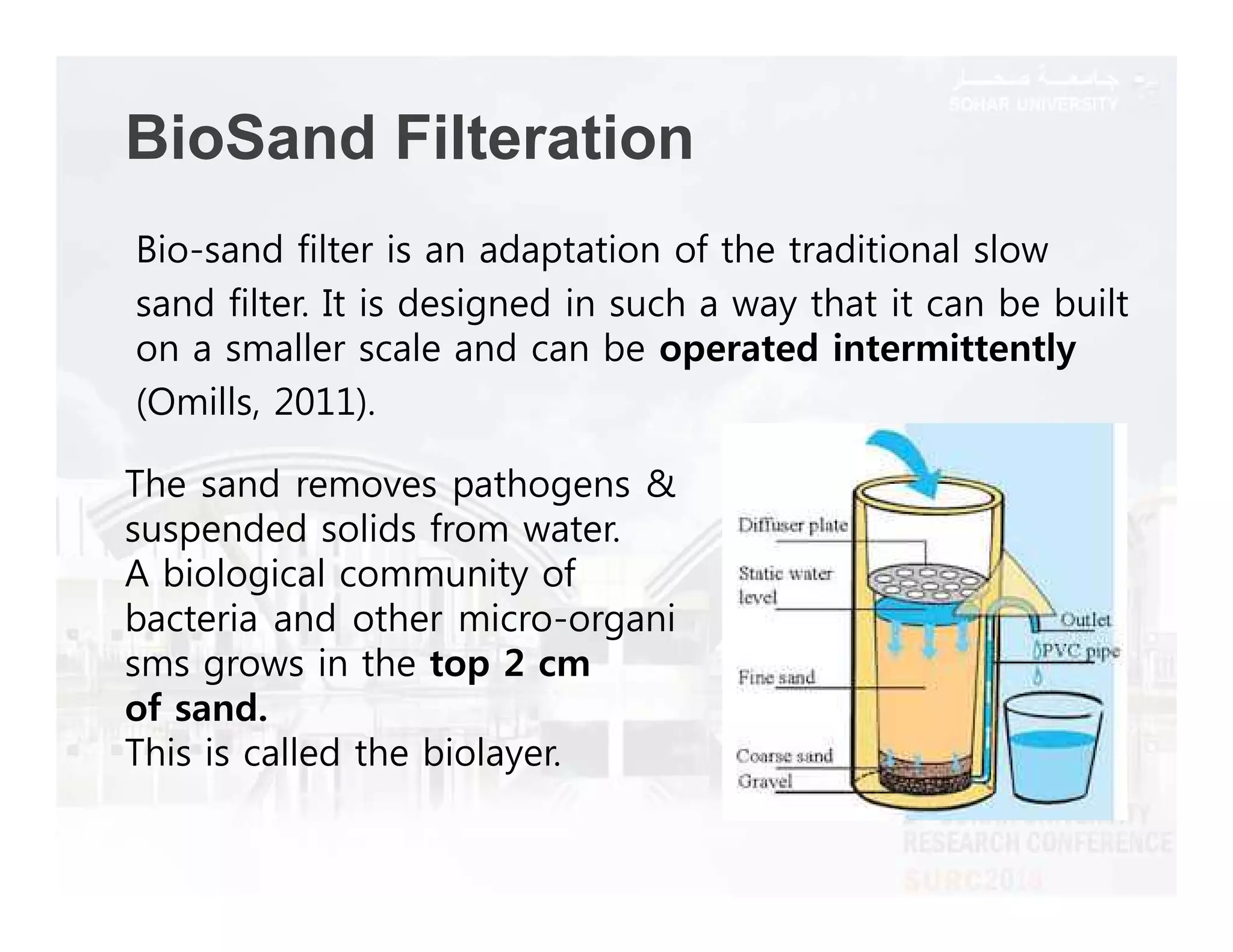
BioSand Filteration
Bio-sand filter is an adaptation of the traditional slow
sand filter. It is designed in such a way that it can be built
on a smaller scale and can be operated intermittently
(Omills, 2011).
The sand removes pathogens &
suspended solids from water.
A biological community of
bacteria and other micro-organi
sms grows in the top 2 cm
of sand.
This is called the biolayer.
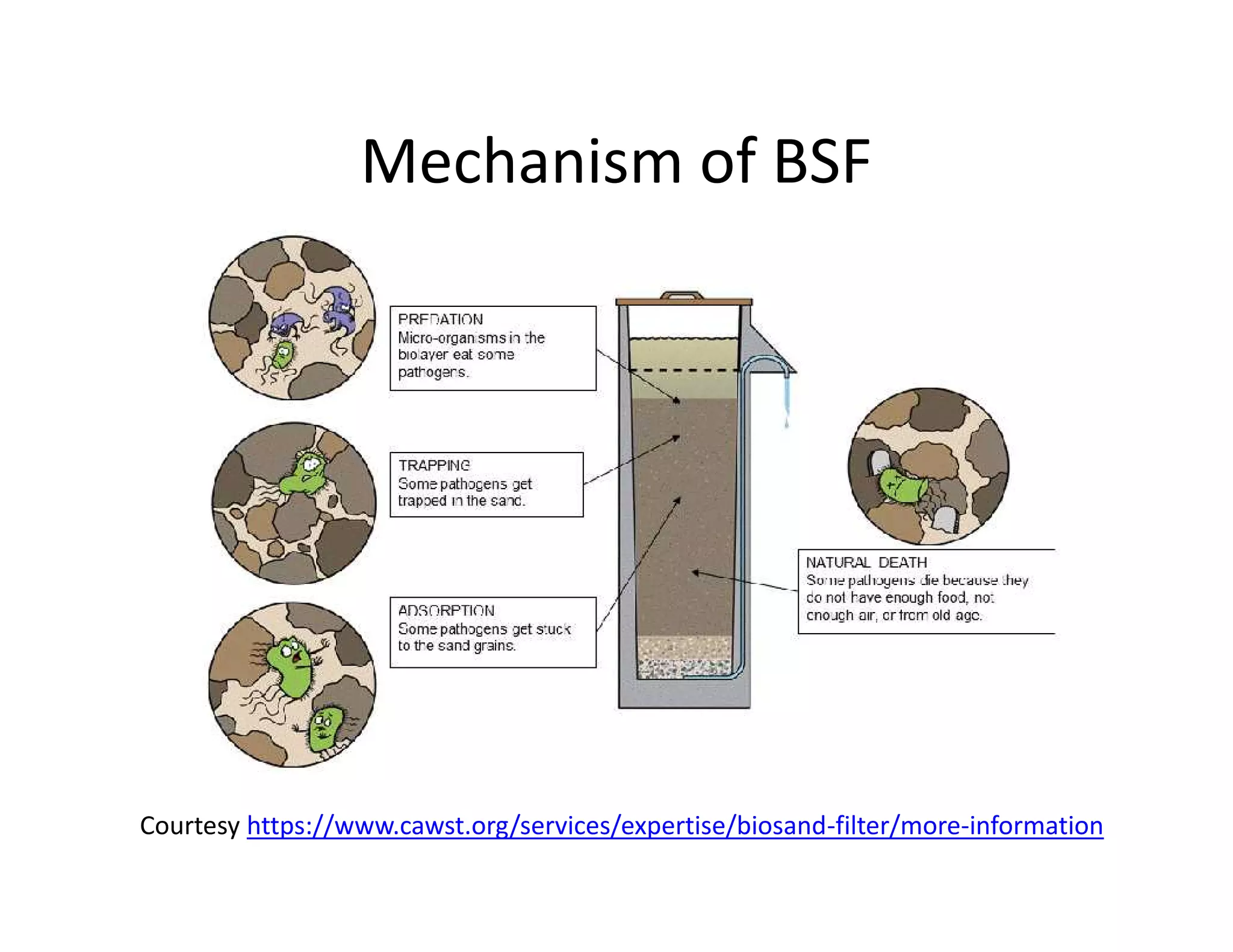
Mechanism of BSF
Courtesy https://www.cawst.org/services/expertise/biosand-filter/more-information
Literature Reviews
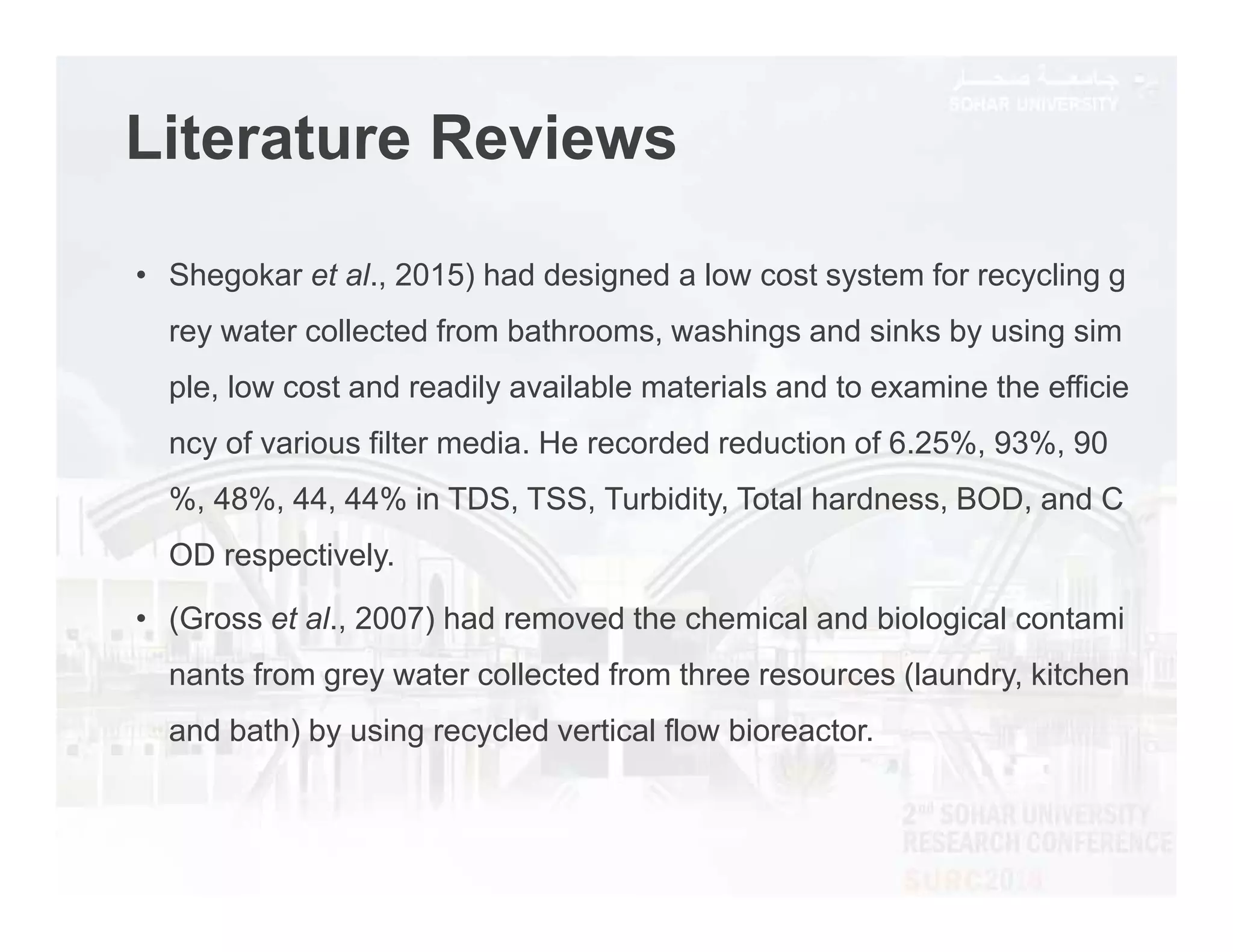
• Shegokar et al., 2015) had designed a low cost system for recycling g
rey water collected from bathrooms, washings and sinks by using sim
ple, low cost and readily available materials and to examine the efficie
ncy of various filter media. He recorded reduction of 6.25%, 93%, 90
%, 48%, 44, 44% in TDS, TSS, Turbidity, Total hardness, BOD, and C
OD respectively.
• (Gross et al., 2007) had removed the chemical and biological contami
nants from grey water collected from three resources (laundry, kitchen
and bath) by using recycled vertical flow bioreactor.
Literature Reviews
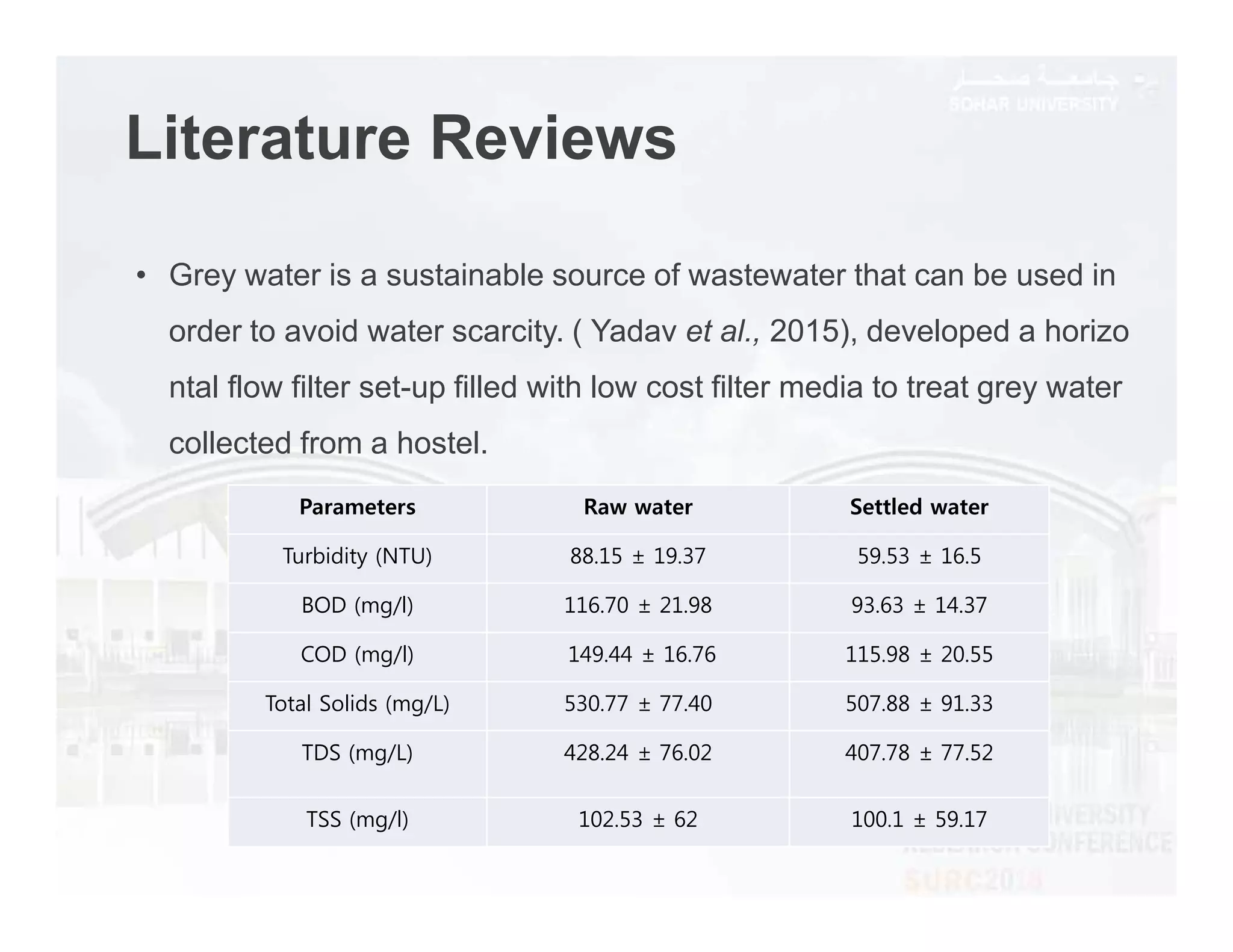
• Grey water is a sustainable source of wastewater that can be used in
order to avoid water scarcity. ( Yadav et al., 2015), developed a horizo
ntal flow filter set-up filled with low cost filter media to treat grey water
collected from a hostel.
Parameters Raw water Settled water
Turbidity (NTU) 88.15 ± 19.37 59.53 ± 16.5
BOD (mg/l) 116.70 ± 21.98 93.63 ± 14.37
COD (mg/l) 149.44 ± 16.76 115.98 ± 20.55
Total Solids (mg/L) 530.77 ± 77.40 507.88 ± 91.33
TDS (mg/L) 428.24 ± 76.02 407.78 ± 77.52
TSS (mg/l) 102.53 ± 62 100.1 ± 59.17
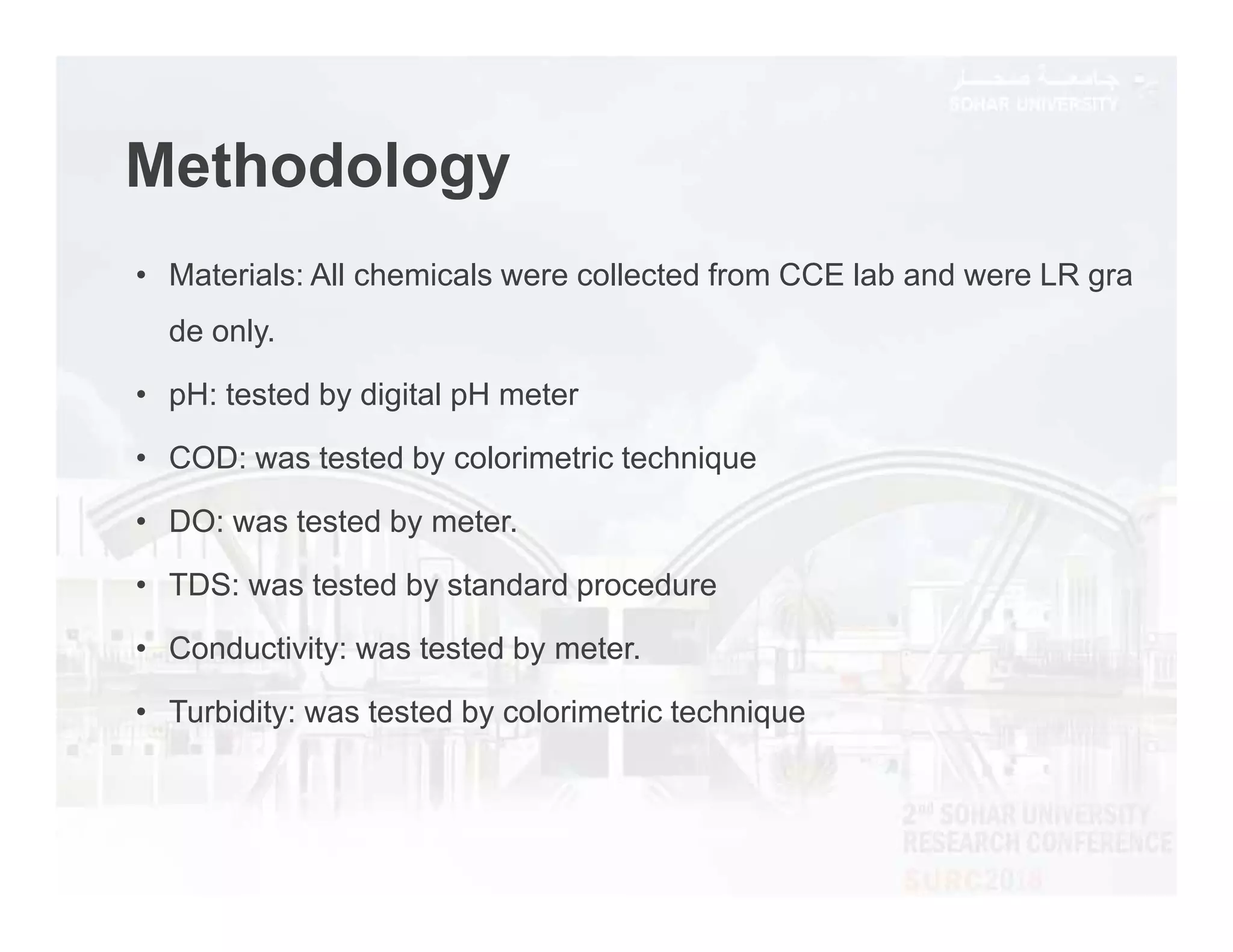
Methodology
• Materials: All chemicals were collected from CCE lab and were LR gra
de only.
• pH: tested by digital pH meter
• COD: was tested by colorimetric technique
• DO: was tested by meter.
• TDS: was tested by standard procedure
• Conductivity: was tested by meter.
• Turbidity: was tested by colorimetric technique
Fabrication of Biosand Filter
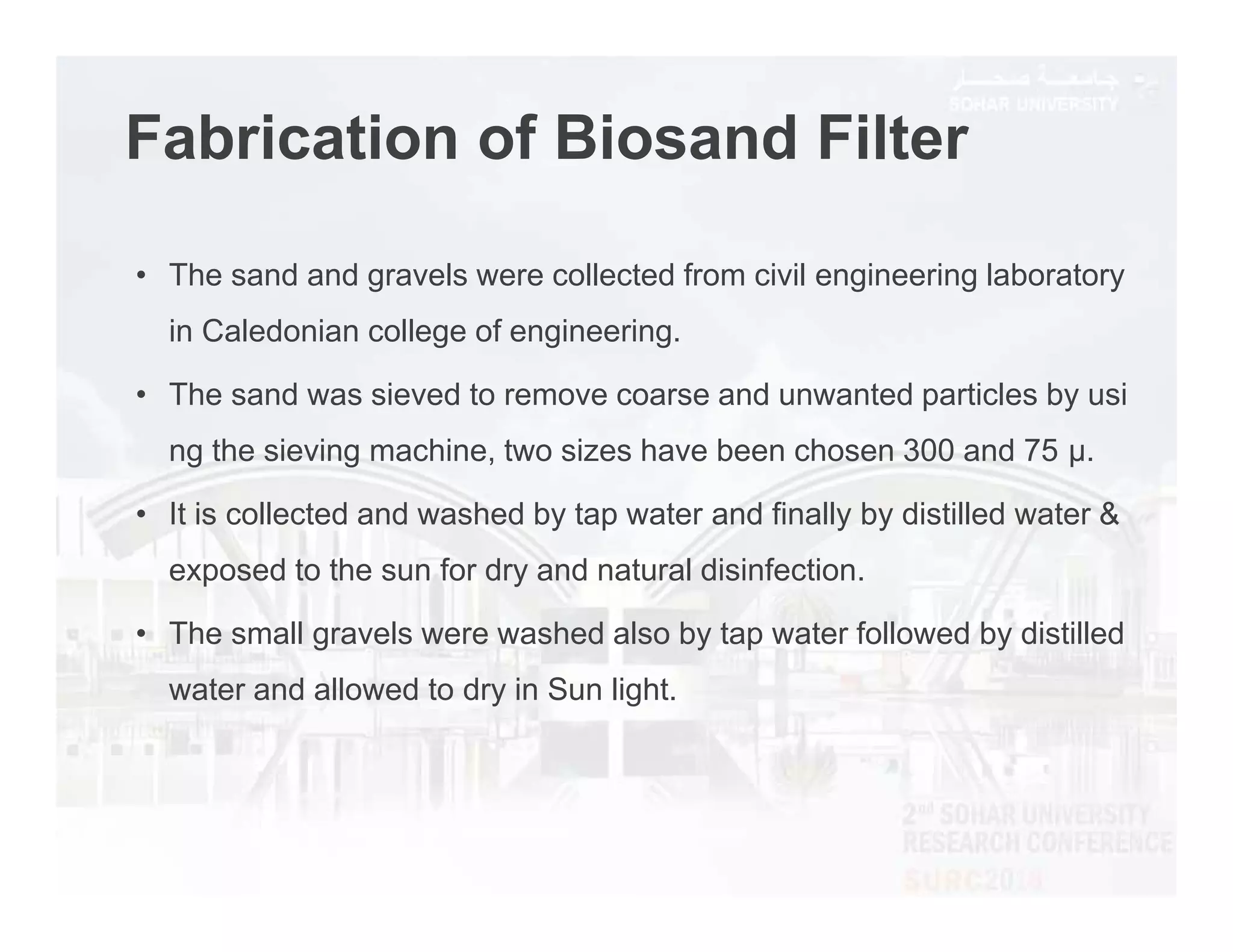
• The sand and gravels were collected from civil engineering laboratory
in Caledonian college of engineering.
• The sand was sieved to remove coarse and unwanted particles by usi
ng the sieving machine, two sizes have been chosen 300 and 75 μ.
• It is collected and washed by tap water and finally by distilled water &
exposed to the sun for dry and natural disinfection.
• The small gravels were washed also by tap water followed by distilled
water and allowed to dry in Sun light.
Fabrication of Biosand Filter
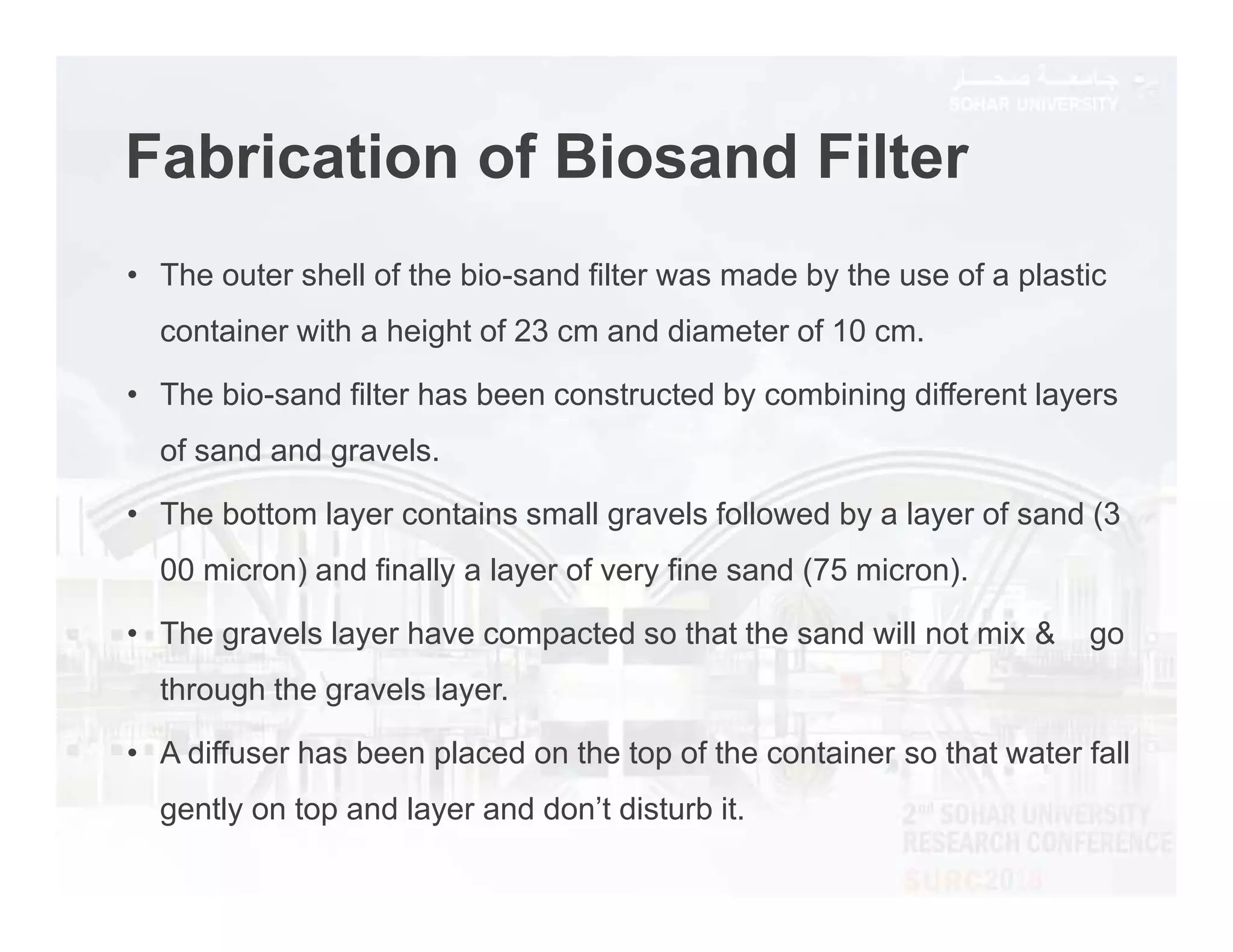
• The outer shell of the bio-sand filter was made by the use of a plastic
container with a height of 23 cm and diameter of 10 cm.
• The bio-sand filter has been constructed by combining different layers
of sand and gravels.
• The bottom layer contains small gravels followed by a layer of sand (3
00 micron) and finally a layer of very fine sand (75 micron).
• The gravels layer have compacted so that the sand will not mix & go
through the gravels layer.
• A diffuser has been placed on the top of the container so that water fall
gently on top and layer and don’t disturb it.
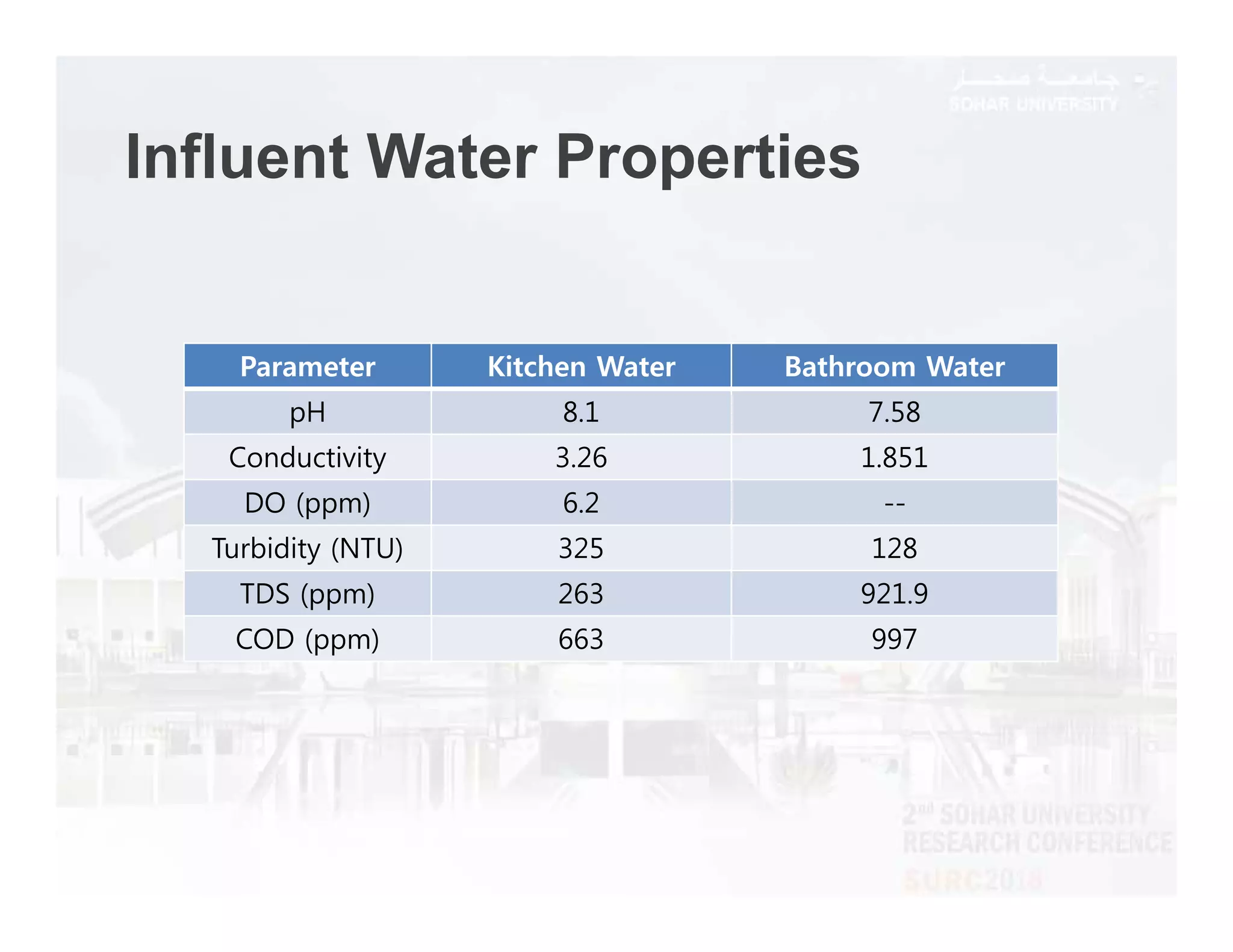
Influent Water Properties
Parameter Kitchen Water Bathroom Water
pH 8.1 7.58
Conductivity 3.26 1.851
DO (ppm) 6.2 --
Turbidity (NTU) 325 128
TDS (ppm) 263 921.9
COD (ppm) 663 997
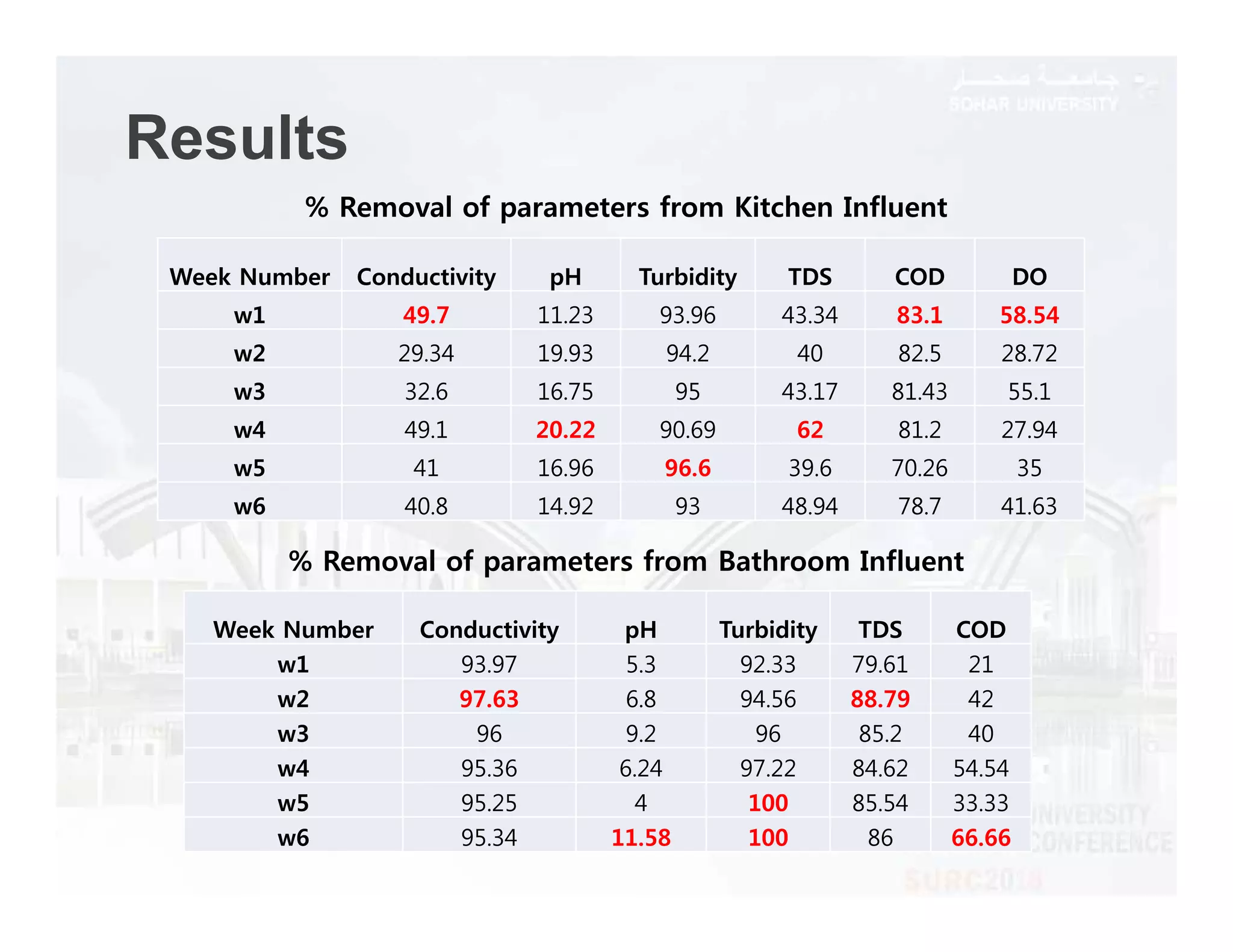
Results
Week Number Conductivity pH Turbidity TDS COD DO
w1 49.7 11.23 93.96 43.34 83.1 58.54
w2 29.34 19.93 94.2 40 82.5 28.72
w3 32.6 16.75 95 43.17 81.43 55.1
w4 49.1 20.22 90.69 62 81.2 27.94
w5 41 16.96 96.6 39.6 70.26 35
w6 40.8 14.92 93 48.94 78.7 41.63
Week Number Conductivity pH Turbidity TDS COD
w1 93.97 5.3 92.33 79.61 21
w2 97.63 6.8 94.56 88.79 42
w3 96 9.2 96 85.2 40
w4 95.36 6.24 97.22 84.62 54.54
w5 95.25 4 100 85.54 33.33
w6 95.34 11.58 100 86 66.66
% Removal of parameters from Kitchen Influent
% Removal of parameters from Bathroom Influent
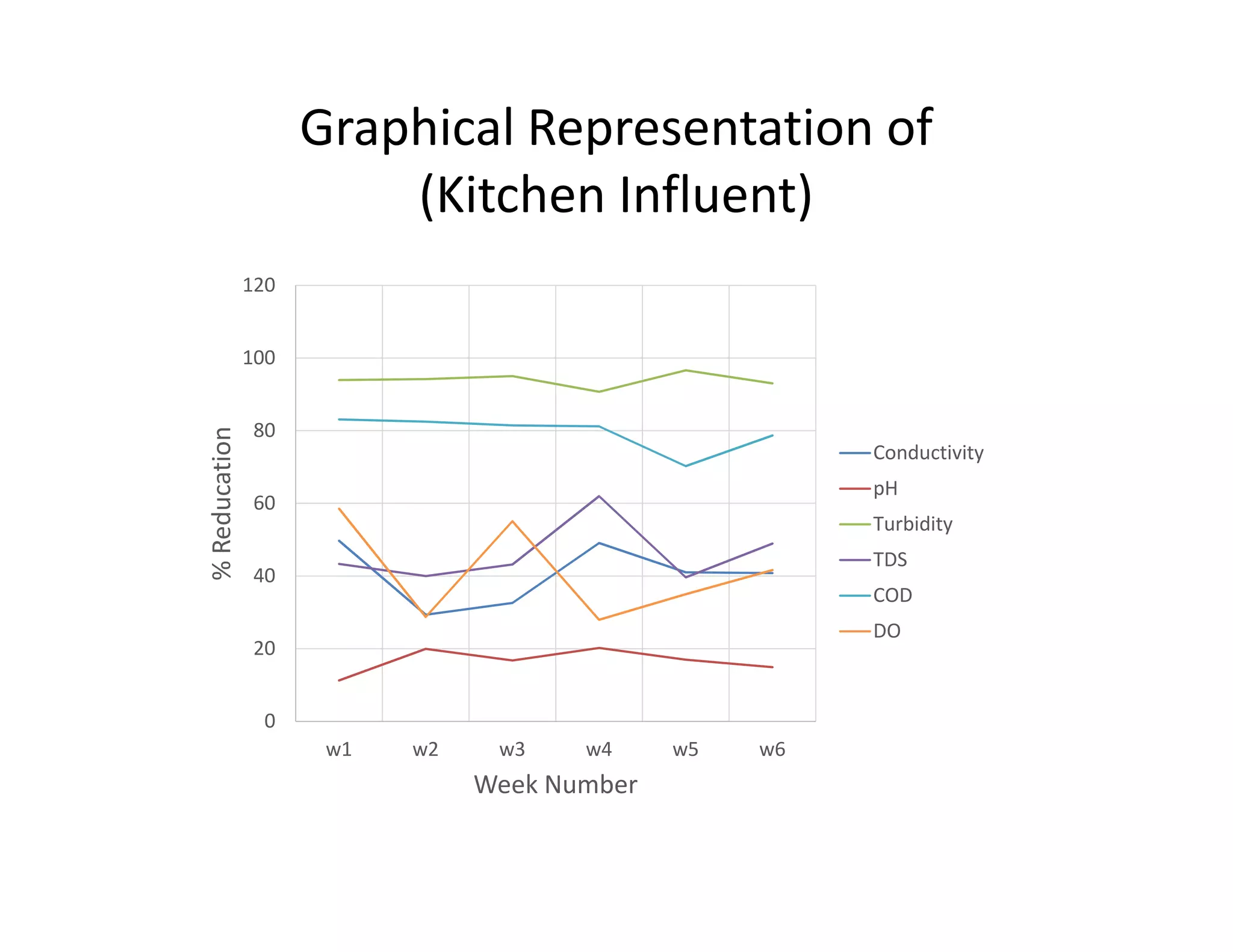
Graphical Representation of
(Kitchen Influent)
0
20
40
60
80
100
120
w1 w2 w3 w4 w5 w6
%Reducation
Week Number
Conductivity
pH
Turbidity
TDS
COD
DO
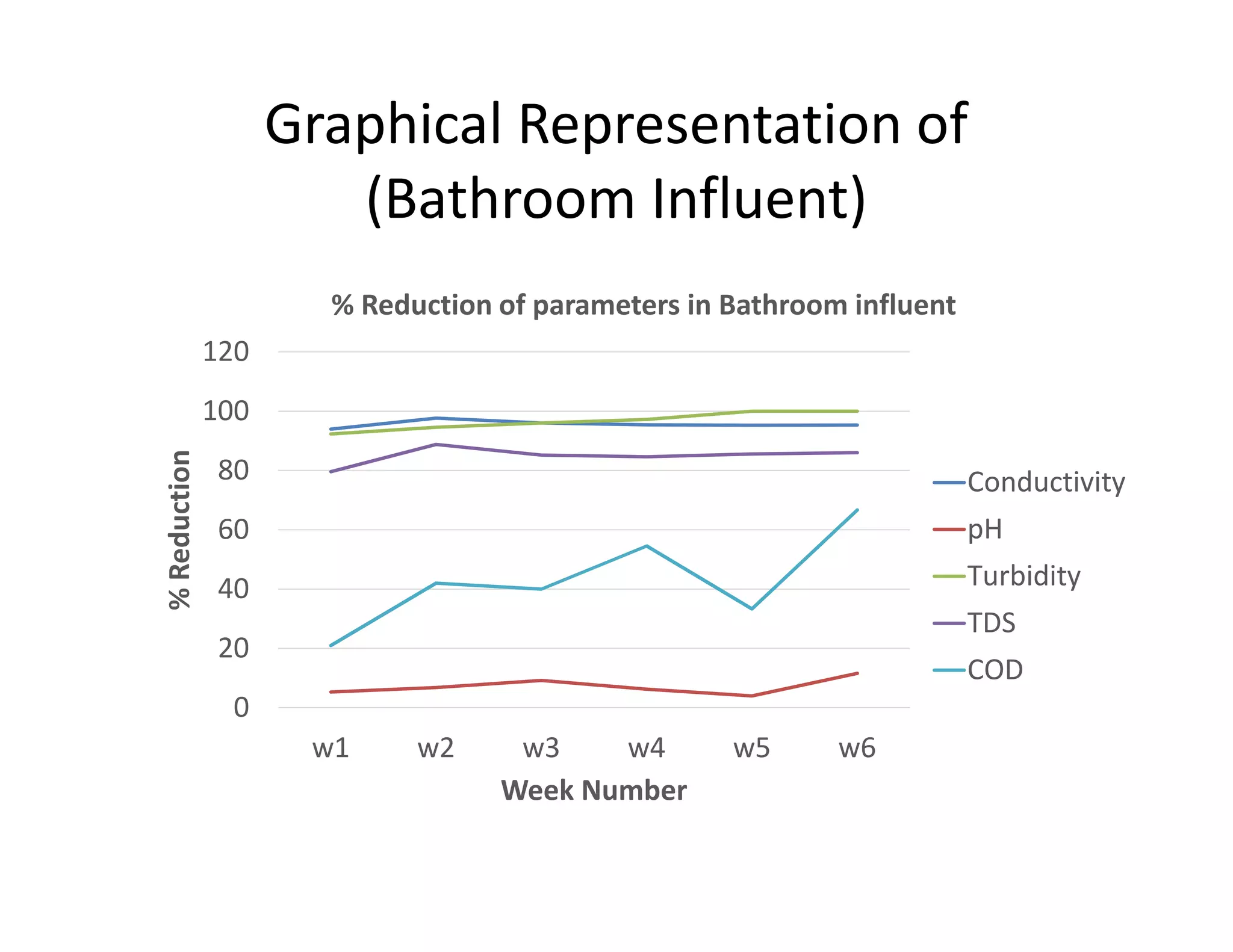
Graphical Representation of
(Bathroom Influent)
0
20
40
60
80
100
120
w1 w2 w3 w4 w5 w6
%Reduction
Week Number
% Reduction of parameters in Bathroom influent
Conductivity
pH
Turbidity
TDS
COD
Statistical Analysis of Results
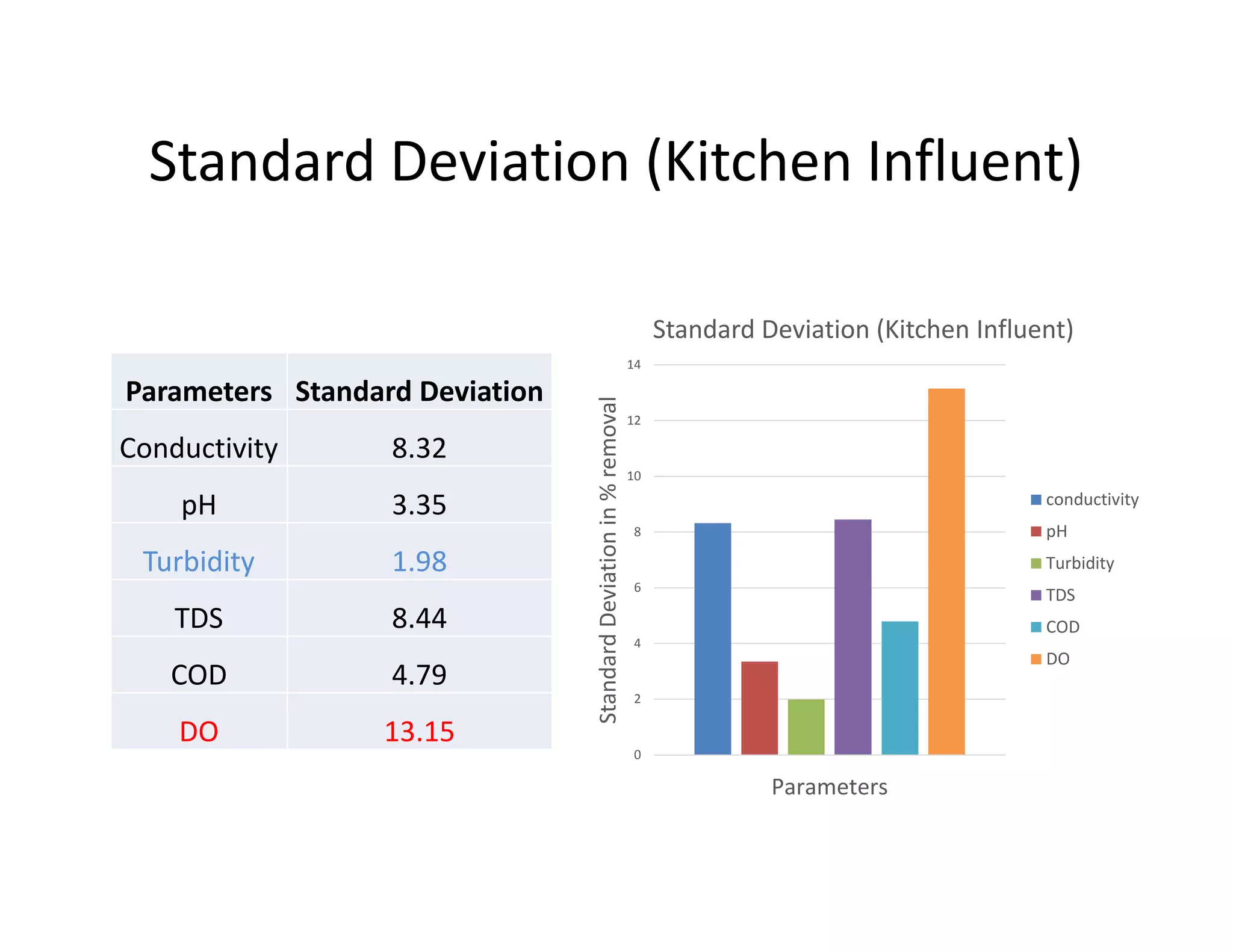
Standard Deviation (Kitchen Influent)
Parameters Standard Deviation
Conductivity 8.32
pH 3.35
Turbidity 1.98
TDS 8.44
COD 4.79
DO 13.15
0
2
4
6
8
10
12
14
Parameters
StandardDeviationin%removal
Standard Deviation (Kitchen Influent)
conductivity
pH
Turbidity
TDS
COD
DO
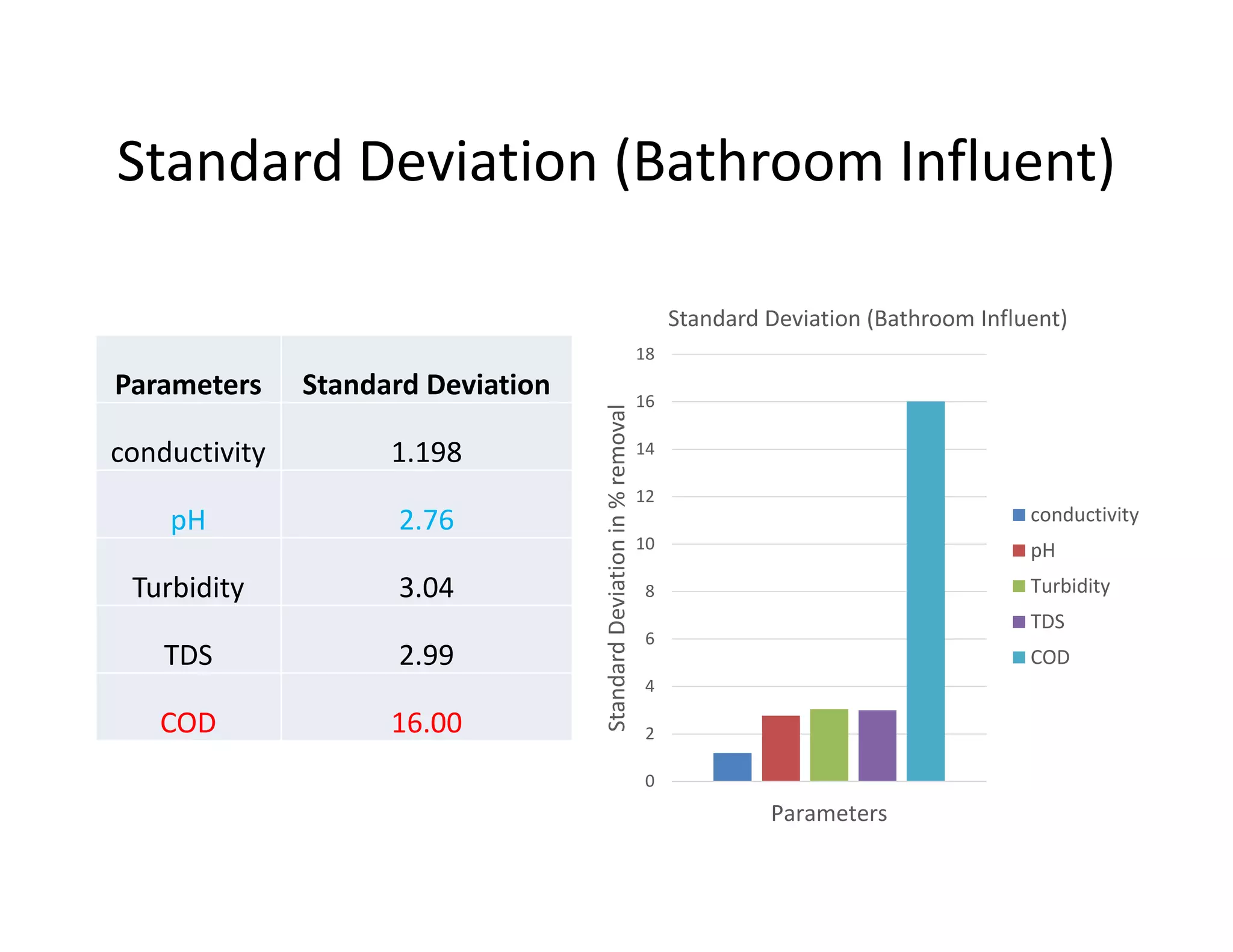
Standard Deviation (Bathroom Influent)
Parameters Standard Deviation
conductivity 1.198
pH 2.76
Turbidity 3.04
TDS 2.99
COD 16.00
0
2
4
6
8
10
12
14
16
18
Parameters
StandardDeviationin%removal
Standard Deviation (Bathroom Influent)
conductivity
pH
Turbidity
TDS
COD
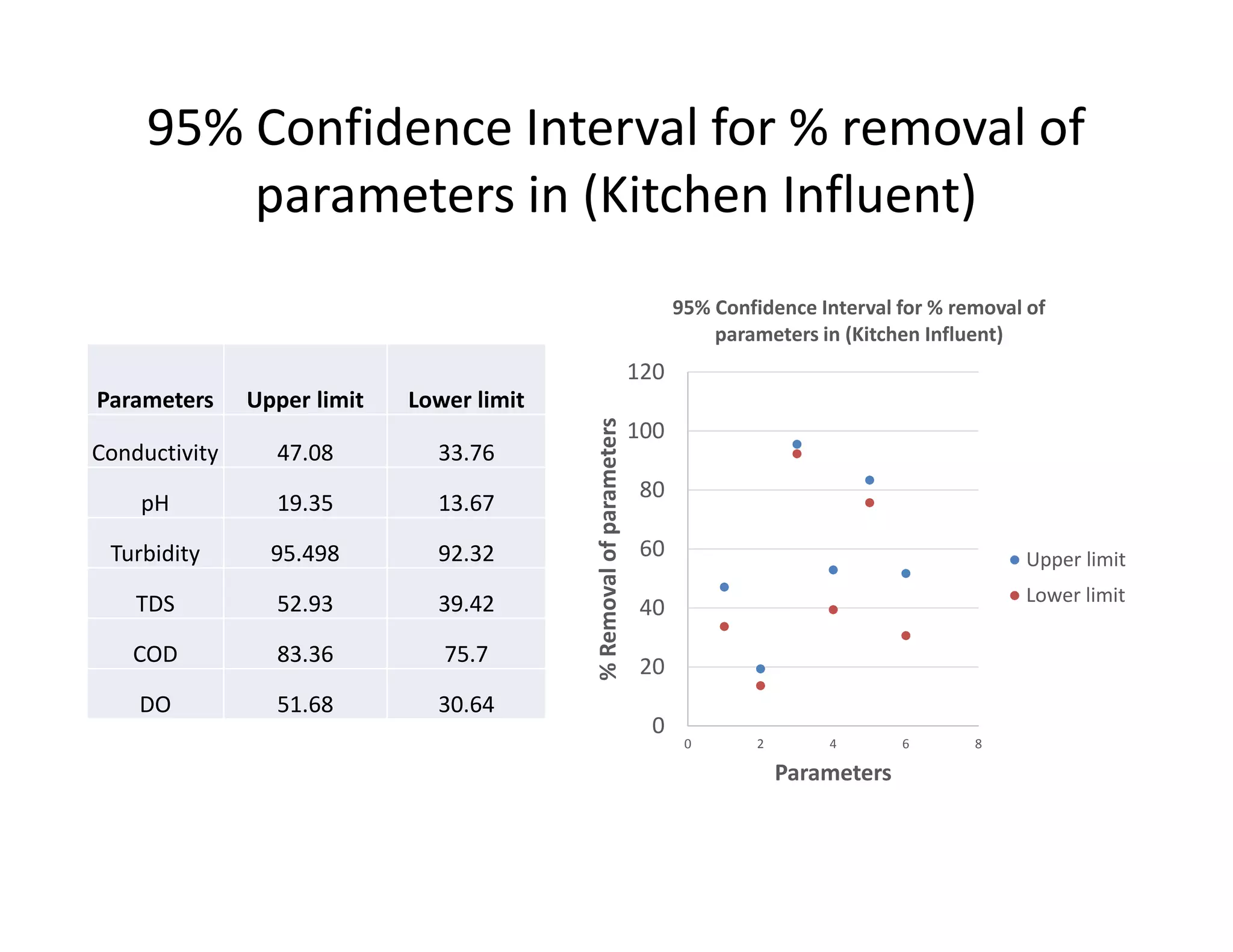
95% Confidence Interval for % removal of
parameters in (Kitchen Influent)
Parameters Upper limit Lower limit
Conductivity 47.08 33.76
pH 19.35 13.67
Turbidity 95.498 92.32
TDS 52.93 39.42
COD 83.36 75.7
DO 51.68 30.64
0
20
40
60
80
100
120
0 2 4 6 8
%Removalofparameters
Parameters
95% Confidence Interval for % removal of
parameters in (Kitchen Influent)
Upper limit
Lower limit
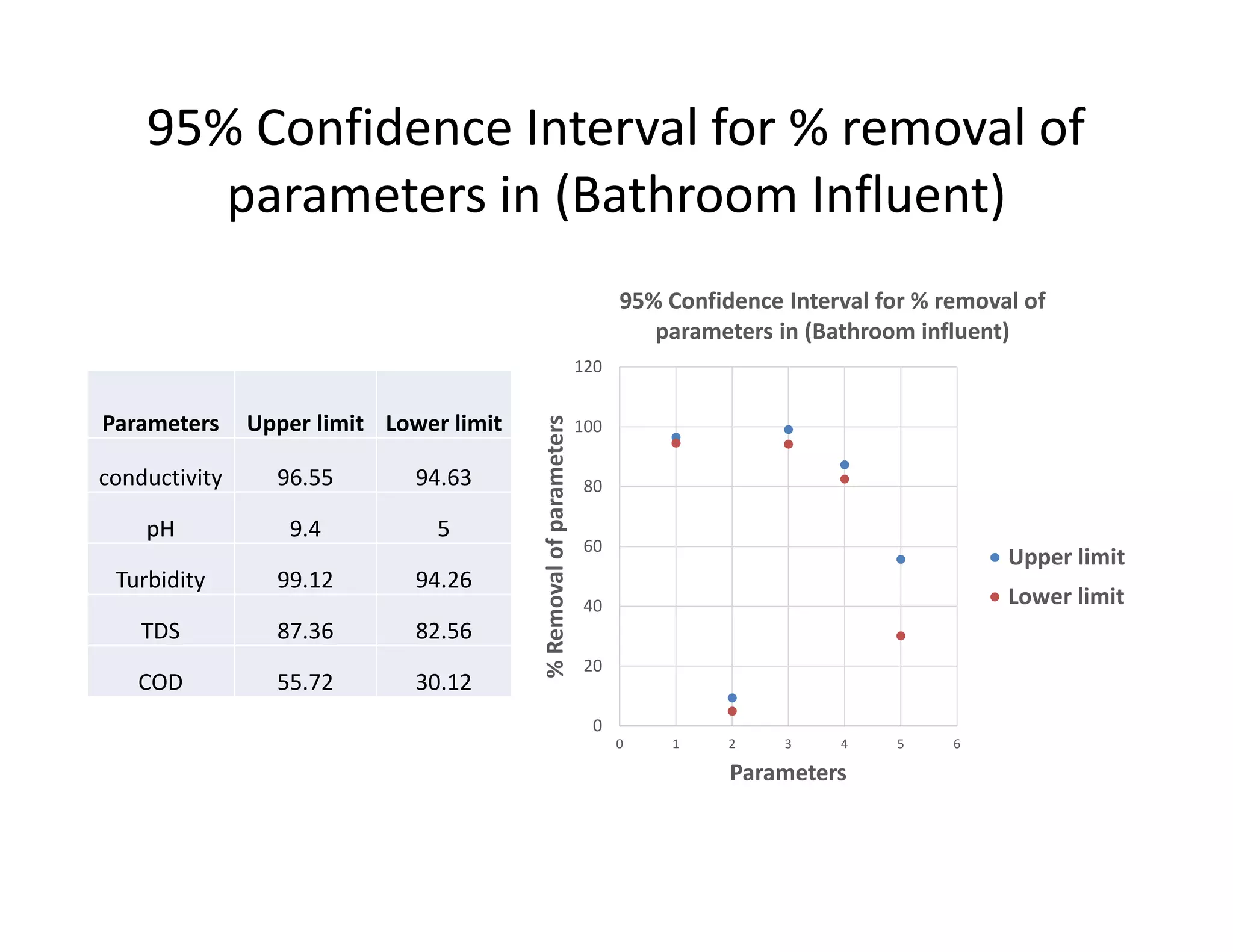
95% Confidence Interval for % removal of
parameters in (Bathroom Influent)
Parameters Upper limit Lower limit
conductivity 96.55 94.63
pH 9.4 5
Turbidity 99.12 94.26
TDS 87.36 82.56
COD 55.72 30.12
0
20
40
60
80
100
120
0 1 2 3 4 5 6
%Removalofparameters
Parameters
95% Confidence Interval for % removal of
parameters in (Bathroom influent)
Upper limit
Lower limit
Analysis and Discussion
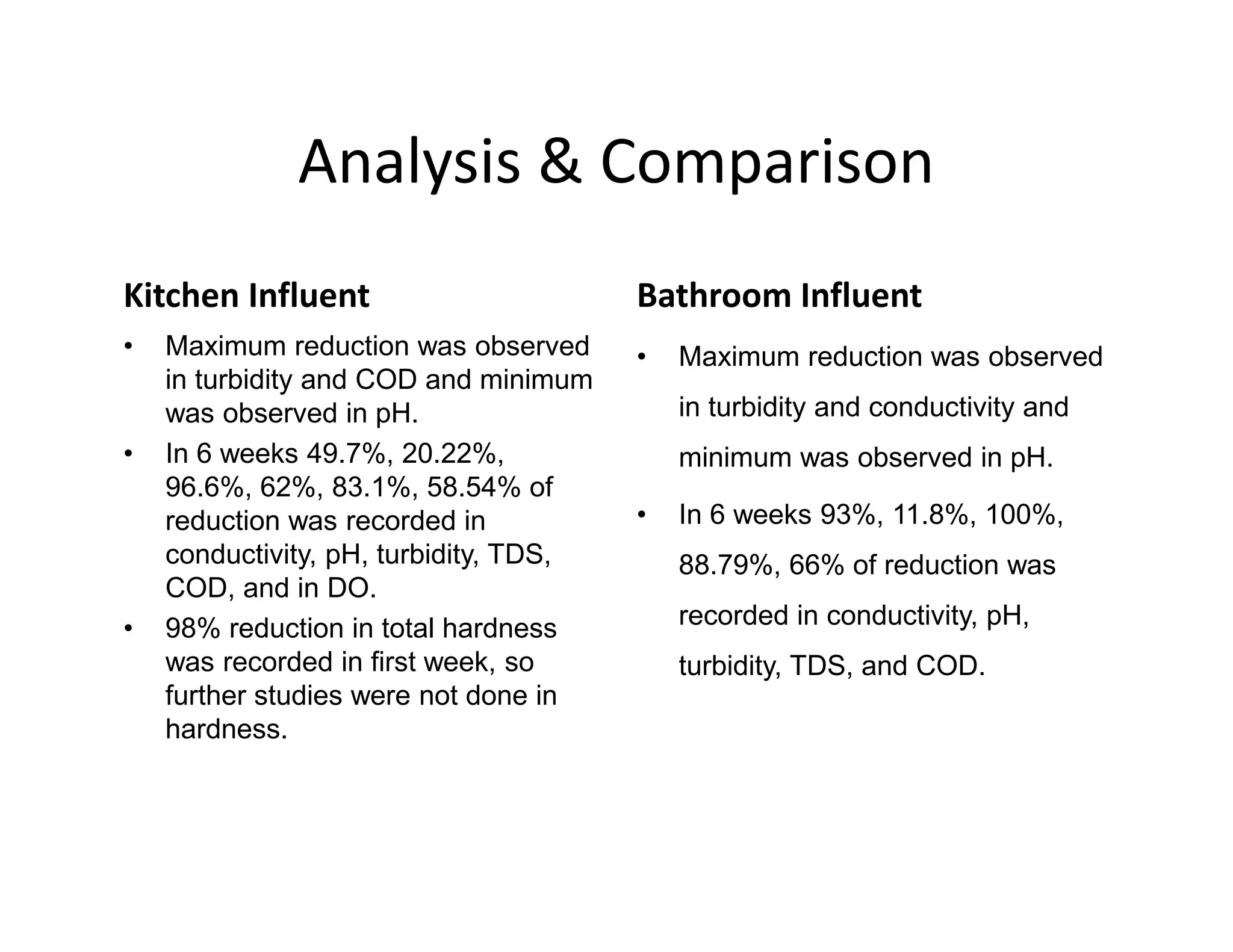
Analysis & Comparison
Kitchen Influent
• Maximum reduction was observed
in turbidity and COD and minimum
was observed in pH.
• In 6 weeks 49.7%, 20.22%,
96.6%, 62%, 83.1%, 58.54% of
reduction was recorded in
conductivity, pH, turbidity, TDS,
COD, and in DO.
• 98% reduction in total hardness
was recorded in first week, so
further studies were not done in
hardness.
Bathroom Influent
• Maximum reduction was observed
in turbidity and conductivity and
minimum was observed in pH.
• In 6 weeks 93%, 11.8%, 100%,
88.79%, 66% of reduction was
recorded in conductivity, pH,
turbidity, TDS, and COD.
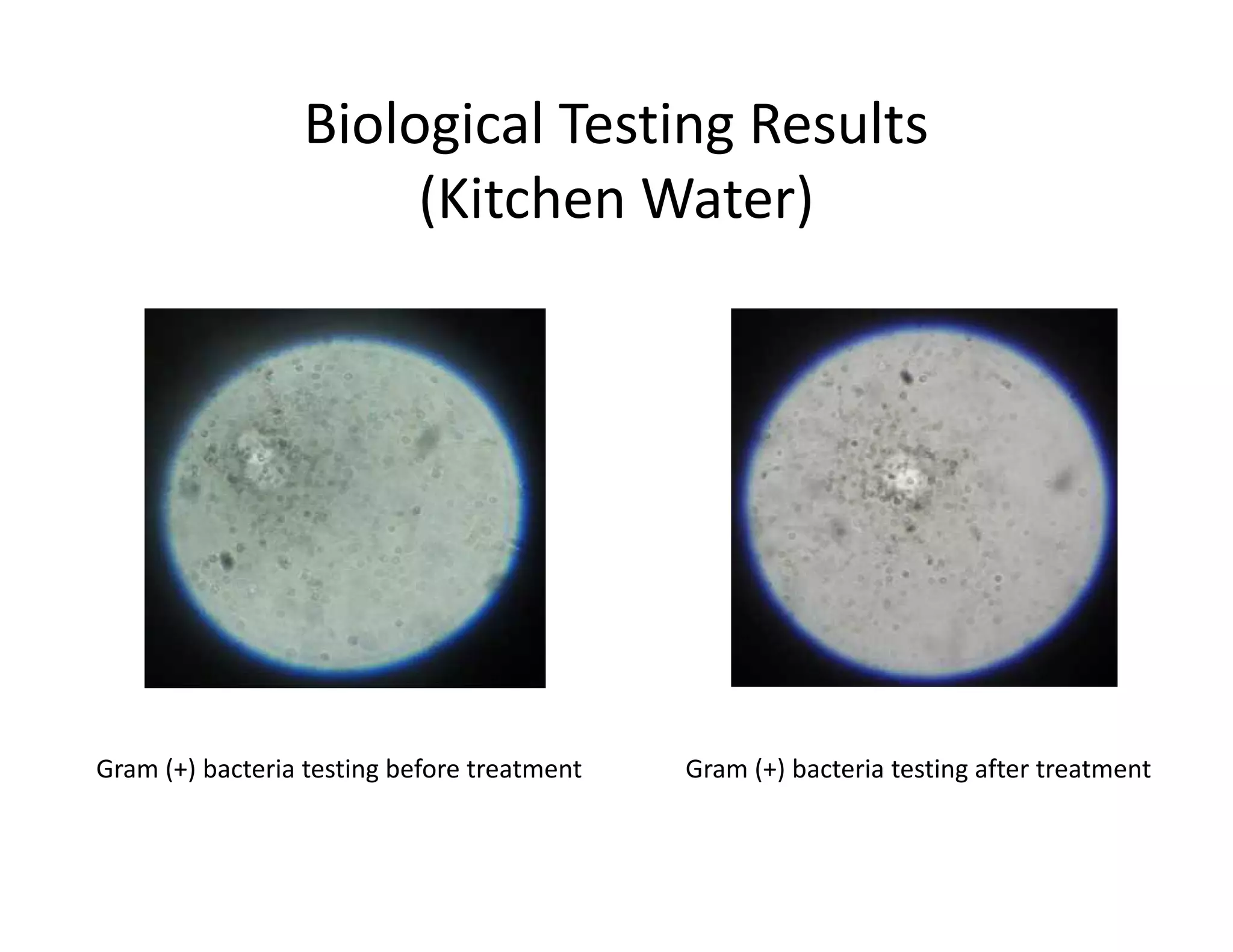
Biological Testing Results
(Kitchen Water)
Gram (+) bacteria testing after treatmentGram (+) bacteria testing before treatment
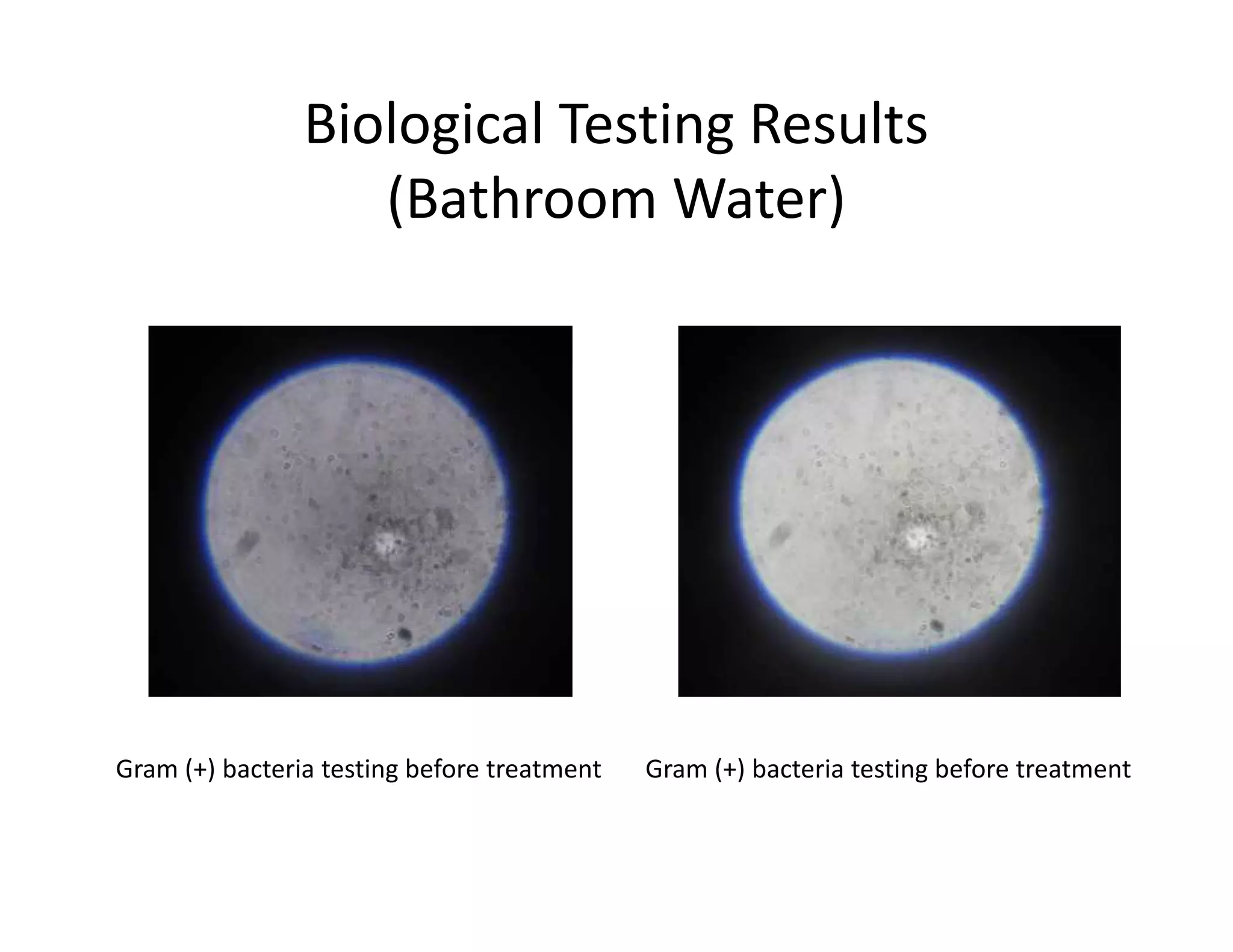
Biological Testing Results
(Bathroom Water)
Gram (+) bacteria testing before treatment Gram (+) bacteria testing before treatment
Limitations
• Duration of study was 6 weeks after it started working. It can be exten
ded.
• Size of biosand filter was small and prepared in 1.5 lit plastic water
bottle. Currently we are working on scaled up model.
• In biological testing, actual counting was required to assess quantitati
ve reduction.
Conclusions
• Bio-sand filter is an efficient technique used to treat wastewater collec
ted from domestic kitchen since it can remove most of the chemical, p
hysical and biological pollutants.
• The constructed system has the ability to remove up to 49.7%, 20.22
%, 96.6%, 62%, 83.1%, 58.54% of conductivity, pH, turbidity, TDS, C
OD, and in DO respectively.
• Clearly seen reduction in biological contaminant level.
Acknowledgement
• Grateful to the Almighty for showering wisdom on us for choosing this
crucial research problem and accomplishing on time.
• Management of Caledonian College of Engineering for providing requi
red chemicals, apparatus and all lab facilities.
• Miss Ahlam and Miss Buthaina expressed their gratitude's towards Mr
Adeeb, for helping them in lab during their experiments and biological
testing.
• Thanks to all who had supported this study directly and indirectly.

Experimental study on grey water recycling using biosand filters for non potable use

  • 1.
    EXPERIMENTAL STUDY ONGREY WATER RECYCLING USING BIOSAND FILTERS FOR NON POTABLE USE © Dr Priy Brat Dwivedi, Ahlam AL Zadzali, Buthaina AL Alawi Caledonian College of Engineering, Muscat, Oman
  • 2.
    Content • Introduction ofGrey water, Biosand filters & research problem • Objectives of study • Literature Reviews • Methodology • Results • Discussion • Conclusion • Acknowledgement
  • 3.
    Aim and objectivesof the study Aim: Recycling waste water from bathrooms and kitchen of a small family. Objectives: – Collecting real time grey water from bathrooms and kitchen. – Use of coagulants to remove maximum of suspended and dissolv ed impurities. – Testing influent water quality in terms of pH, TDS, TSS, DO, CO D, conductivity. – Fabrication of biosand filters – Run the experiment, collect effluent water and test all parameters – Analyse the result.
  • 4.
  • 5.
  • 6.
  • 7.
    BioSand Filteration Bio-sand filteris an adaptation of the traditional slow sand filter. It is designed in such a way that it can be built on a smaller scale and can be operated intermittently (Omills, 2011). The sand removes pathogens & suspended solids from water. A biological community of bacteria and other micro-organi sms grows in the top 2 cm of sand. This is called the biolayer.
  • 8.
    Mechanism of BSF Courtesyhttps://www.cawst.org/services/expertise/biosand-filter/more-information
  • 9.
    Literature Reviews • Shegokaret al., 2015) had designed a low cost system for recycling g rey water collected from bathrooms, washings and sinks by using sim ple, low cost and readily available materials and to examine the efficie ncy of various filter media. He recorded reduction of 6.25%, 93%, 90 %, 48%, 44, 44% in TDS, TSS, Turbidity, Total hardness, BOD, and C OD respectively. • (Gross et al., 2007) had removed the chemical and biological contami nants from grey water collected from three resources (laundry, kitchen and bath) by using recycled vertical flow bioreactor.
  • 10.
    Literature Reviews • Greywater is a sustainable source of wastewater that can be used in order to avoid water scarcity. ( Yadav et al., 2015), developed a horizo ntal flow filter set-up filled with low cost filter media to treat grey water collected from a hostel. Parameters Raw water Settled water Turbidity (NTU) 88.15 ± 19.37 59.53 ± 16.5 BOD (mg/l) 116.70 ± 21.98 93.63 ± 14.37 COD (mg/l) 149.44 ± 16.76 115.98 ± 20.55 Total Solids (mg/L) 530.77 ± 77.40 507.88 ± 91.33 TDS (mg/L) 428.24 ± 76.02 407.78 ± 77.52 TSS (mg/l) 102.53 ± 62 100.1 ± 59.17
  • 11.
    Methodology • Materials: Allchemicals were collected from CCE lab and were LR gra de only. • pH: tested by digital pH meter • COD: was tested by colorimetric technique • DO: was tested by meter. • TDS: was tested by standard procedure • Conductivity: was tested by meter. • Turbidity: was tested by colorimetric technique
  • 12.
    Fabrication of BiosandFilter • The sand and gravels were collected from civil engineering laboratory in Caledonian college of engineering. • The sand was sieved to remove coarse and unwanted particles by usi ng the sieving machine, two sizes have been chosen 300 and 75 μ. • It is collected and washed by tap water and finally by distilled water & exposed to the sun for dry and natural disinfection. • The small gravels were washed also by tap water followed by distilled water and allowed to dry in Sun light.
  • 13.
    Fabrication of BiosandFilter • The outer shell of the bio-sand filter was made by the use of a plastic container with a height of 23 cm and diameter of 10 cm. • The bio-sand filter has been constructed by combining different layers of sand and gravels. • The bottom layer contains small gravels followed by a layer of sand (3 00 micron) and finally a layer of very fine sand (75 micron). • The gravels layer have compacted so that the sand will not mix & go through the gravels layer. • A diffuser has been placed on the top of the container so that water fall gently on top and layer and don’t disturb it.
  • 14.
    Influent Water Properties ParameterKitchen Water Bathroom Water pH 8.1 7.58 Conductivity 3.26 1.851 DO (ppm) 6.2 -- Turbidity (NTU) 325 128 TDS (ppm) 263 921.9 COD (ppm) 663 997
  • 15.
    Results Week Number ConductivitypH Turbidity TDS COD DO w1 49.7 11.23 93.96 43.34 83.1 58.54 w2 29.34 19.93 94.2 40 82.5 28.72 w3 32.6 16.75 95 43.17 81.43 55.1 w4 49.1 20.22 90.69 62 81.2 27.94 w5 41 16.96 96.6 39.6 70.26 35 w6 40.8 14.92 93 48.94 78.7 41.63 Week Number Conductivity pH Turbidity TDS COD w1 93.97 5.3 92.33 79.61 21 w2 97.63 6.8 94.56 88.79 42 w3 96 9.2 96 85.2 40 w4 95.36 6.24 97.22 84.62 54.54 w5 95.25 4 100 85.54 33.33 w6 95.34 11.58 100 86 66.66 % Removal of parameters from Kitchen Influent % Removal of parameters from Bathroom Influent
  • 16.
    Graphical Representation of (KitchenInfluent) 0 20 40 60 80 100 120 w1 w2 w3 w4 w5 w6 %Reducation Week Number Conductivity pH Turbidity TDS COD DO
  • 17.
    Graphical Representation of (BathroomInfluent) 0 20 40 60 80 100 120 w1 w2 w3 w4 w5 w6 %Reduction Week Number % Reduction of parameters in Bathroom influent Conductivity pH Turbidity TDS COD
  • 18.
  • 19.
    Standard Deviation (KitchenInfluent) Parameters Standard Deviation Conductivity 8.32 pH 3.35 Turbidity 1.98 TDS 8.44 COD 4.79 DO 13.15 0 2 4 6 8 10 12 14 Parameters StandardDeviationin%removal Standard Deviation (Kitchen Influent) conductivity pH Turbidity TDS COD DO
  • 20.
    Standard Deviation (BathroomInfluent) Parameters Standard Deviation conductivity 1.198 pH 2.76 Turbidity 3.04 TDS 2.99 COD 16.00 0 2 4 6 8 10 12 14 16 18 Parameters StandardDeviationin%removal Standard Deviation (Bathroom Influent) conductivity pH Turbidity TDS COD
  • 21.
    95% Confidence Intervalfor % removal of parameters in (Kitchen Influent) Parameters Upper limit Lower limit Conductivity 47.08 33.76 pH 19.35 13.67 Turbidity 95.498 92.32 TDS 52.93 39.42 COD 83.36 75.7 DO 51.68 30.64 0 20 40 60 80 100 120 0 2 4 6 8 %Removalofparameters Parameters 95% Confidence Interval for % removal of parameters in (Kitchen Influent) Upper limit Lower limit
  • 22.
    95% Confidence Intervalfor % removal of parameters in (Bathroom Influent) Parameters Upper limit Lower limit conductivity 96.55 94.63 pH 9.4 5 Turbidity 99.12 94.26 TDS 87.36 82.56 COD 55.72 30.12 0 20 40 60 80 100 120 0 1 2 3 4 5 6 %Removalofparameters Parameters 95% Confidence Interval for % removal of parameters in (Bathroom influent) Upper limit Lower limit
  • 23.
  • 24.
    Analysis & Comparison KitchenInfluent • Maximum reduction was observed in turbidity and COD and minimum was observed in pH. • In 6 weeks 49.7%, 20.22%, 96.6%, 62%, 83.1%, 58.54% of reduction was recorded in conductivity, pH, turbidity, TDS, COD, and in DO. • 98% reduction in total hardness was recorded in first week, so further studies were not done in hardness. Bathroom Influent • Maximum reduction was observed in turbidity and conductivity and minimum was observed in pH. • In 6 weeks 93%, 11.8%, 100%, 88.79%, 66% of reduction was recorded in conductivity, pH, turbidity, TDS, and COD.
  • 25.
    Biological Testing Results (KitchenWater) Gram (+) bacteria testing after treatmentGram (+) bacteria testing before treatment
  • 26.
    Biological Testing Results (BathroomWater) Gram (+) bacteria testing before treatment Gram (+) bacteria testing before treatment
  • 27.
    Limitations • Duration ofstudy was 6 weeks after it started working. It can be exten ded. • Size of biosand filter was small and prepared in 1.5 lit plastic water bottle. Currently we are working on scaled up model. • In biological testing, actual counting was required to assess quantitati ve reduction.
  • 28.
    Conclusions • Bio-sand filteris an efficient technique used to treat wastewater collec ted from domestic kitchen since it can remove most of the chemical, p hysical and biological pollutants. • The constructed system has the ability to remove up to 49.7%, 20.22 %, 96.6%, 62%, 83.1%, 58.54% of conductivity, pH, turbidity, TDS, C OD, and in DO respectively. • Clearly seen reduction in biological contaminant level.
  • 29.
    Acknowledgement • Grateful tothe Almighty for showering wisdom on us for choosing this crucial research problem and accomplishing on time. • Management of Caledonian College of Engineering for providing requi red chemicals, apparatus and all lab facilities. • Miss Ahlam and Miss Buthaina expressed their gratitude's towards Mr Adeeb, for helping them in lab during their experiments and biological testing. • Thanks to all who had supported this study directly and indirectly.