International Research Journal of Engineering and Technology (IRJET) e-ISSN: 2395 -0056
p-ISSN: 2395-0072Volume: 04 Issue: 02 | Feb -2017 www.irjet.net
© 2017, IRJET | Impact Factor value: 5.181 | ISO 9001:2008 Certified Journal | Page 202
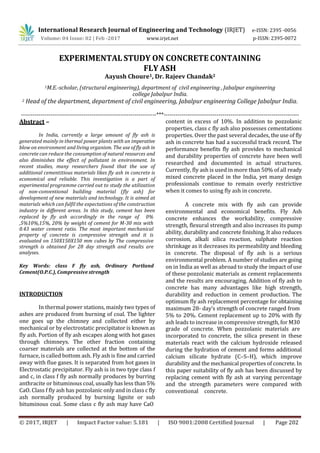
EXPERIMENTAL STUDY ON CONCRETE CONTAINING
FLY ASH
Aayush Choure1, Dr. Rajeev Chandak2
1M.E.-scholar, (structural engineering), department of civil engineering , Jabalpur engineering
college Jabalpur India.
2 Head of the department, department of civil engineering, Jabalpur engineering College Jabalpur India.
---------------------------------------------------------------------***---------------------------------------------------------------------
Abstract –
In India, currently a large amount of fly ash is
generated mainly in thermal power plants with an imperative
blow on environment and living organism. The use of fly ash in
concrete can reduce the consumption of natural resources and
also diminishes the effect of pollutant in environment. In
recent studies, many researchers found that the use of
additional cementitious materials likes fly ash in concrete is
economical and reliable. This investigation is a part of
experimental programme carried out to study the utilization
of non-conventional building material (fly ash) for
development of new materials and technology. It is aimed at
materials which can fulfil the expectations of the construction
industry in different areas. In this study, cement has been
replaced by fly ash accordingly in the range of 0%
,5%10%,15%, 20% by weight of cement for M-30 mix with
0.43 water cement ratio. The most important mechanical
property of concrete is compressive strength and it is
evaluated on 150X150X150 mm cubes by The compressive
strength is obtained for 28 day strength and results are
analyses.
Key Words: class F fly ash, Ordinary Portland
Cement(O.P.C.), Compressive strength
INTRODUCTION
In thermal power stations, mainly two types of
ashes are produced from burning of coal. The lighter
one goes up the chimney and collected either by
mechanical or by electrostatic precipitator is known as
fly ash. Portion of fly ash escapes along with hot gases
through chimneys. The other fraction containing
coarser materials are collected at the bottom of the
furnace, is called bottom ash. Fly ash is fine and carried
away with flue gases. It is separated from hot gases in
Electrostatic precipitator. Fly ash is in two type class f
and c, in class f fly ash normally produces by burring
anthracite or bituminous coal, usually has less than 5%
CaO. Class f fly ash has pozzolanic only and in class c fly
ash normally produced by burning lignite or sub
bituminous coal. Some class c fly ash may have CaO
content in excess of 10%. In addition to pozzolanic
properties, class c fly ash also possesses cementations
properties. Over the past several decades, the use of fly
ash in concrete has had a successful track record. The
performance benefits fly ash provides to mechanical
and durability properties of concrete have been well
researched and documented in actual structures.
Currently, fly ash is used in more than 50% of all ready
mixed concrete placed in the India, yet many design
professionals continue to remain overly restrictive
when it comes to using fly ash in concrete.
A concrete mix with fly ash can provide
environmental and economical benefits. Fly Ash
concrete enhances the workability, compressive
strength, flexural strength and also increases its pump
ability, durability and concrete finishing. It also reduces
corrosion, alkali silica reaction, sulphate reaction
shrinkage as it decreases its permeability and bleeding
in concrete. The disposal of fly ash is a serious
environmental problem. A number of studies are going
on in India as well as abroad to study the impact of use
of these pozzolanic materials as cement replacements
and the results are encouraging. Addition of fly ash to
concrete has many advantages like high strength,
durability and reduction in cement production. The
optimum fly ash replacement percentage for obtaining
maximum 28- day’s strength of concrete ranged from
5% to 20%. Cement replacement up to 20% with fly
ash leads to increase in compressive strength, for M30
grade of concrete. When pozzolanic materials are
incorporated to concrete, the silica present in these
materials react with the calcium hydroxide released
during the hydration of cement and forms additional
calcium silicate hydrate (C–S–H), which improve
durability and the mechanical properties of concrete. In
this paper suitability of fly ash has been discussed by
replacing cement with fly ash at varying percentage
and the strength parameters were compared with
conventional concrete.
International Research Journal of Engineering and Technology (IRJET) e-ISSN: 2395 -0056
p-ISSN: 2395-0072Volume: 04 Issue: 02 | Feb -2017 www.irjet.net
© 2017, IRJET | Impact Factor value: 5.181 | ISO 9001:2008 Certified Journal | Page 203
Literature Review
Someof the earlyresearches have examined the use
of fly ash (FA) in concrete.
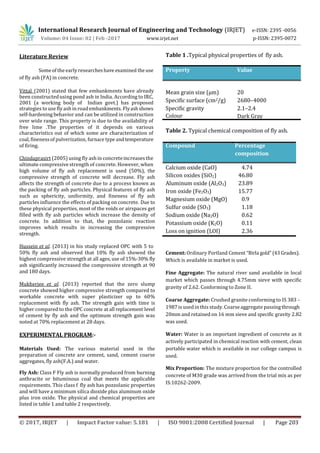
Table 1 .Typical physical properties of fly ash.
Property Value
Vittal (2001) stated that few embankments have already
been constructedusing pond ash in India. According to IRC,
2001 (a working body of Indian govt.) has proposed
strategies to use fly ash in roadembankments. Flyash shows
self-hardening behavior and can be utilized in construction
over wide range. This property is due to the availability of
free lime .The properties of it depends on various
Mean grain size (μm)
Specific surface (cm2/g)
Specific gravity
Colour
20
2680–4000
2.1–2.4
Dark Gray
characteristics out of which some are characterization of
coal,finenessof pulverization, furnace type and temperature
of firing.
Chindaprasirt (2005) using fly ash in concreteincreases the
ultimate compressive strength of concrete. However, when
Table 2. Typical chemical composition of fly ash.
Compound Percentage
composition
high volume of fly ash replacement is used (50%), the
compressive strength of concrete will decrease. Fly ash
affects the strength of concrete due to a process known as
the packing of fly ash particles. Physical features of fly ash
such as sphericity, uniformity, and fineness of fly ash
particles influence the effects of packing on concrete. Due to
these physical properties, most of the voids or airspaces get
filled with fly ash particles which increase the density of
concrete. In addition to that, the pozzolanic reaction
improves which results in increasing the compressive
strength.
Calcium oxide (CaO)
Silicon oxides (SiO2)
Aluminum oxide (Al2O3)
Iron oxide (Fe2O3)
Magnesium oxide (MgO)
Sulfur oxide (SO3)
Sodium oxide (Na2O)
Potassium oxide (K2O)
Loss on ignition (LOI)
4.74
46.80
23.89
15.77
0.9
1.18
0.62
0.11
2.36
Hussein et al. (2013) in his study replaced OPC with 5 to
50% fly ash and observed that 10% fly ash showed the
highest compressive strength at all ages, use of 15%-30% fly
ash significantly increased the compressive strength at 90
and 180 days.
Mukherjee et al. (2013) reported that the zero slump
concrete showed higher compressive strength compared to
workable concrete with super plasticizer up to 60%
replacement with fly ash. The strength gain with time is
higher compared to the OPC concrete at all replacement level
of cement by fly ash and the optimum strength gain was
noted at 70% replacement at 28 days.
EXPERIMENTAL PROGRAM:-
Materials Used: The various material used in the
preparation of concrete are cement, sand, cement coarse
aggregates, fly ash(F.A.) and water.
Fly Ash: Class F Fly ash is normally produced from burning
anthracite or bituminous coal that meets the applicable
requirements. This class f fly ash has pozzolanic properties
and will have a minimum silica dioxide plus aluminum oxide
plus iron oxide. The physical and chemical properties are
listed in table 1 and table 2 respectively.
Cement: Ordinary Portland Cement “Birla gold” (43 Grades).
Which is available in market is used.
Fine Aggregate: The natural river sand available in local
market which passes through 4.75mm sieve with specific
gravity of 2.62. Conforming to Zone II.
Coarse Aggregate: Crushed granite conforming to IS 383 -
1987is usedin this study.Coarseaggregate passingthrough
20mm and retained on 16 mm sieve and specific gravity 2.82
was used.
Water: Water is an important ingredient of concrete as it
actively participated in chemical reaction with cement, clean
portable water which is available in our college campus is
used.
Mix Proportion: The mixture proportion for the controlled
concrete of M30 grade was arrived from the trial mix as per
IS:10262-2009.
International Research Journal of Engineering and Technology (IRJET) e-ISSN: 2395 -0056
p-ISSN: 2395-0072Volume: 04 Issue: 02 | Feb -2017 www.irjet.net
© 2017, IRJET | Impact Factor value: 5.181 | ISO 9001:2008 Certified Journal | Page 204
S.No
.
%
Replace
by fly
ash
Cement
(Kg/m3)
Fly ash
(Kg/m3)
Fine
aggregate
(Kg/m3)
Coarse
aggregate
(Kg/m3)
Water
Kg/m3
w/c
ratio
1. 0 423.25 0 656 1222 182 0.43
2. 5 402.08 21.17 656 1222 182 0.43
3. 10 308.92 42.32 656 1222 182 0.43
4. 15 359.76 63.48 656 1222 182 0.43
5. 20 338.60 84.65 656 1222 182 0.43
S.NO. Name of cube
sample
Fly Ash
(%)
Average Ultimate Compressive
strength(N/mm2)
(7 days) (28 days)
1. F0 0 26.81 40.74
2. F5 5 28.89 41.63
3. F10 10 30.65 42.37
4. F15 15 31.85 43.25
5. F20 20 33.34 44.01
CompressivestrengthN/mm2
26.81
40.74
28.89
41.63
30.65
42.37
31.85
43.25
33.34
44.01
Table 3. Mix proportions
GRAP HICAL REPRESENTAION OF
COMPRESSIVE STRENGTH OF FLY ASH
7 days 28 days
Methodology
Replacementlevels of OPC by FA of 0,5, 10, 15 and
20 % were chosen for this research work. Batching was
carried out by weighing as per calculated amount of each
concrete constituent according to the mix ratio of
1:1.54:2.88 and M-30 grade of concrete was adopted. The
constituents were then mixed thoroughly until a uniform mix
was obtained. Water was then added and the mix was
repeated. The fresh concrete mix was then placed in a mold
of size 150 mm, compacted, and left for 24 h before testing
Compressive specimens were tested at the ages of 7 and 28
days.
RESULT AND DISCUSSION
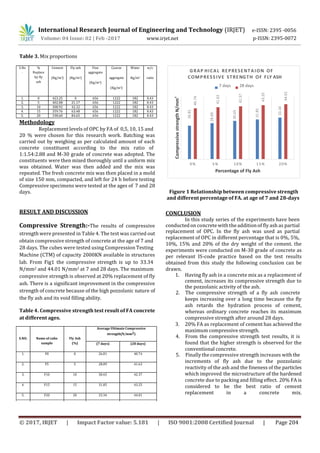
Compressive Strength:-The results of compressive
strength were presented in Table 4. The test was carried out
obtain compressive strength of concrete at the age of 7 and
28 days. The cubes were tested using Compression Testing
Machine (CTM) of capacity 2000KN available in structures
lab. From Fig1 the compressive strength is up to 33.34
N/mm2 and 44.01 N/mm2 at 7 and 28 days. The maximum
compressive strength is observed at 20% replacement of fly
ash. There is a significant improvement in the compressive
strength of concrete because of the high pozzolanic nature of
the fly ash and its void filling ability.
Table 4. Compressive strength test result of FA concrete
at different ages.
0% 5% 10% 15% 20%
Percentage of Fly Ash
Figure 1 Relationship between compressive strength
and different percentage of FA. at age of 7 and 28-days
CONCLUSION
In this study series of the experiments have been
conductedon concrete with the additionof fly ash as partial
replacement of OPC. In the fly ash was used as partial
replacement of OPC in different percentage that is 0%, 5%,
10%, 15% and 20% of the dry weight of the cement. the
experiments were conducted on M-30 grade of concrete as
per relevant IS-code practice based on the test results
obtained from this study the following conclusion can be
drawn.
1. Having fly ash in a concrete mix as a replacement of
cement, increases its compressive strength due to
the pozzolanic activity of the ash.
2. The compressive strength of a fly ash concrete
keeps increasing over a long time because the fly
ash retards the hydration process of cement,
whereas ordinary concrete reaches its maximum
compressive strength after around 28 days.
3. 20% FA as replacement of cement has achieved the
maximum compressive strength.
4. From the compressive strength test results, it is
found that the higher strength is observed for the
conventional concrete.
5. Finallythe compressive strengthincreases with the
increments of fly ash due to the pozzolanic
reactivity of the ash and the fineness of the particles
which improved the microstructure of the hardened
concrete due to packing and filling effect. 20% FA is
considered to be the best ratio of cement
replacement in a concrete mix.
International Research Journal of Engineering and Technology (IRJET) e-ISSN: 2395 -0056
p-ISSN: 2395-0072Volume: 04 Issue: 02 | Feb -2017 www.irjet.net
© 2017, IRJET | Impact Factor value: 5.181 | ISO 9001:2008 Certified Journal | Page 205
REFERENCE
[1]Weerachart Tangchirapat1; Chaiyanunt
Rattanashotinunt2; Rak Buranasing3; and Chai
Jaturapitakkul Influence of Fly Ash on Slump Loss and
Strength of Concrete Fully Incorporating Recycled Concrete
Aggregates Journal of Materials in civil Engineering © Asce /
February 2013
[2]ACI Committee 211 (1993), Guide for Selecting
Proportions for High Strength Concrete with Portland
Cement and Fly ash, ACI Materials Journal, Vol.90, No.3, pp.
272-283.
[3] Bharat Kumar, B. H., Narayanan, R., Raghu Prasad, B. K.,
Ramachandra murthy, D. S. (2001), Mix proportioning of
high performance concrete‖, Cement & Concrete
Composites, Vol.23, pp. 71 – 80.
[4] Gopalan, M. K., Haque, M. N. (1986), ―Strength
development of fly ash concretes‖, Engineering Materials
and Structures, Vol.19, No.1, pp. 33-37.
[5] Mehta, P. K. (1985), ―Influence of Fly Ash Characteristics
on theStrengthof PortlandFlyAsh Mixtures‖, Vol.15, pp.669
– 674.
[6] Xu, A., Sarkar, S.L. (1993), ―Hydration and Properties of
Fly ash Concrete‖, in S.N.Ghosh edited Mineral Admixtures in
Cement and Concrete, Progress in Cement and Concrete
series, Akademia Books International, New Delhi, India, pp.
174 – 225.
[7] Slanicka, S. (1991), ―The Influence of Fly Ash Fineness
on the Strength of Concrete‖, Cement and Concrete
Research, Vol.21, pp. 285 – 296.

Experimental Study on concrete containing Fly ash

  • 1.
    International Research Journalof Engineering and Technology (IRJET) e-ISSN: 2395 -0056 p-ISSN: 2395-0072Volume: 04 Issue: 02 | Feb -2017 www.irjet.net © 2017, IRJET | Impact Factor value: 5.181 | ISO 9001:2008 Certified Journal | Page 202 EXPERIMENTAL STUDY ON CONCRETE CONTAINING FLY ASH Aayush Choure1, Dr. Rajeev Chandak2 1M.E.-scholar, (structural engineering), department of civil engineering , Jabalpur engineering college Jabalpur India. 2 Head of the department, department of civil engineering, Jabalpur engineering College Jabalpur India. ---------------------------------------------------------------------***--------------------------------------------------------------------- Abstract – In India, currently a large amount of fly ash is generated mainly in thermal power plants with an imperative blow on environment and living organism. The use of fly ash in concrete can reduce the consumption of natural resources and also diminishes the effect of pollutant in environment. In recent studies, many researchers found that the use of additional cementitious materials likes fly ash in concrete is economical and reliable. This investigation is a part of experimental programme carried out to study the utilization of non-conventional building material (fly ash) for development of new materials and technology. It is aimed at materials which can fulfil the expectations of the construction industry in different areas. In this study, cement has been replaced by fly ash accordingly in the range of 0% ,5%10%,15%, 20% by weight of cement for M-30 mix with 0.43 water cement ratio. The most important mechanical property of concrete is compressive strength and it is evaluated on 150X150X150 mm cubes by The compressive strength is obtained for 28 day strength and results are analyses. Key Words: class F fly ash, Ordinary Portland Cement(O.P.C.), Compressive strength INTRODUCTION In thermal power stations, mainly two types of ashes are produced from burning of coal. The lighter one goes up the chimney and collected either by mechanical or by electrostatic precipitator is known as fly ash. Portion of fly ash escapes along with hot gases through chimneys. The other fraction containing coarser materials are collected at the bottom of the furnace, is called bottom ash. Fly ash is fine and carried away with flue gases. It is separated from hot gases in Electrostatic precipitator. Fly ash is in two type class f and c, in class f fly ash normally produces by burring anthracite or bituminous coal, usually has less than 5% CaO. Class f fly ash has pozzolanic only and in class c fly ash normally produced by burning lignite or sub bituminous coal. Some class c fly ash may have CaO content in excess of 10%. In addition to pozzolanic properties, class c fly ash also possesses cementations properties. Over the past several decades, the use of fly ash in concrete has had a successful track record. The performance benefits fly ash provides to mechanical and durability properties of concrete have been well researched and documented in actual structures. Currently, fly ash is used in more than 50% of all ready mixed concrete placed in the India, yet many design professionals continue to remain overly restrictive when it comes to using fly ash in concrete. A concrete mix with fly ash can provide environmental and economical benefits. Fly Ash concrete enhances the workability, compressive strength, flexural strength and also increases its pump ability, durability and concrete finishing. It also reduces corrosion, alkali silica reaction, sulphate reaction shrinkage as it decreases its permeability and bleeding in concrete. The disposal of fly ash is a serious environmental problem. A number of studies are going on in India as well as abroad to study the impact of use of these pozzolanic materials as cement replacements and the results are encouraging. Addition of fly ash to concrete has many advantages like high strength, durability and reduction in cement production. The optimum fly ash replacement percentage for obtaining maximum 28- day’s strength of concrete ranged from 5% to 20%. Cement replacement up to 20% with fly ash leads to increase in compressive strength, for M30 grade of concrete. When pozzolanic materials are incorporated to concrete, the silica present in these materials react with the calcium hydroxide released during the hydration of cement and forms additional calcium silicate hydrate (C–S–H), which improve durability and the mechanical properties of concrete. In this paper suitability of fly ash has been discussed by replacing cement with fly ash at varying percentage and the strength parameters were compared with conventional concrete.
  • 2.
    International Research Journalof Engineering and Technology (IRJET) e-ISSN: 2395 -0056 p-ISSN: 2395-0072Volume: 04 Issue: 02 | Feb -2017 www.irjet.net © 2017, IRJET | Impact Factor value: 5.181 | ISO 9001:2008 Certified Journal | Page 203 Literature Review Someof the earlyresearches have examined the use of fly ash (FA) in concrete. Table 1 .Typical physical properties of fly ash. Property Value Vittal (2001) stated that few embankments have already been constructedusing pond ash in India. According to IRC, 2001 (a working body of Indian govt.) has proposed strategies to use fly ash in roadembankments. Flyash shows self-hardening behavior and can be utilized in construction over wide range. This property is due to the availability of free lime .The properties of it depends on various Mean grain size (μm) Specific surface (cm2/g) Specific gravity Colour 20 2680–4000 2.1–2.4 Dark Gray characteristics out of which some are characterization of coal,finenessof pulverization, furnace type and temperature of firing. Chindaprasirt (2005) using fly ash in concreteincreases the ultimate compressive strength of concrete. However, when Table 2. Typical chemical composition of fly ash. Compound Percentage composition high volume of fly ash replacement is used (50%), the compressive strength of concrete will decrease. Fly ash affects the strength of concrete due to a process known as the packing of fly ash particles. Physical features of fly ash such as sphericity, uniformity, and fineness of fly ash particles influence the effects of packing on concrete. Due to these physical properties, most of the voids or airspaces get filled with fly ash particles which increase the density of concrete. In addition to that, the pozzolanic reaction improves which results in increasing the compressive strength. Calcium oxide (CaO) Silicon oxides (SiO2) Aluminum oxide (Al2O3) Iron oxide (Fe2O3) Magnesium oxide (MgO) Sulfur oxide (SO3) Sodium oxide (Na2O) Potassium oxide (K2O) Loss on ignition (LOI) 4.74 46.80 23.89 15.77 0.9 1.18 0.62 0.11 2.36 Hussein et al. (2013) in his study replaced OPC with 5 to 50% fly ash and observed that 10% fly ash showed the highest compressive strength at all ages, use of 15%-30% fly ash significantly increased the compressive strength at 90 and 180 days. Mukherjee et al. (2013) reported that the zero slump concrete showed higher compressive strength compared to workable concrete with super plasticizer up to 60% replacement with fly ash. The strength gain with time is higher compared to the OPC concrete at all replacement level of cement by fly ash and the optimum strength gain was noted at 70% replacement at 28 days. EXPERIMENTAL PROGRAM:- Materials Used: The various material used in the preparation of concrete are cement, sand, cement coarse aggregates, fly ash(F.A.) and water. Fly Ash: Class F Fly ash is normally produced from burning anthracite or bituminous coal that meets the applicable requirements. This class f fly ash has pozzolanic properties and will have a minimum silica dioxide plus aluminum oxide plus iron oxide. The physical and chemical properties are listed in table 1 and table 2 respectively. Cement: Ordinary Portland Cement “Birla gold” (43 Grades). Which is available in market is used. Fine Aggregate: The natural river sand available in local market which passes through 4.75mm sieve with specific gravity of 2.62. Conforming to Zone II. Coarse Aggregate: Crushed granite conforming to IS 383 - 1987is usedin this study.Coarseaggregate passingthrough 20mm and retained on 16 mm sieve and specific gravity 2.82 was used. Water: Water is an important ingredient of concrete as it actively participated in chemical reaction with cement, clean portable water which is available in our college campus is used. Mix Proportion: The mixture proportion for the controlled concrete of M30 grade was arrived from the trial mix as per IS:10262-2009.
  • 3.
    International Research Journalof Engineering and Technology (IRJET) e-ISSN: 2395 -0056 p-ISSN: 2395-0072Volume: 04 Issue: 02 | Feb -2017 www.irjet.net © 2017, IRJET | Impact Factor value: 5.181 | ISO 9001:2008 Certified Journal | Page 204 S.No . % Replace by fly ash Cement (Kg/m3) Fly ash (Kg/m3) Fine aggregate (Kg/m3) Coarse aggregate (Kg/m3) Water Kg/m3 w/c ratio 1. 0 423.25 0 656 1222 182 0.43 2. 5 402.08 21.17 656 1222 182 0.43 3. 10 308.92 42.32 656 1222 182 0.43 4. 15 359.76 63.48 656 1222 182 0.43 5. 20 338.60 84.65 656 1222 182 0.43 S.NO. Name of cube sample Fly Ash (%) Average Ultimate Compressive strength(N/mm2) (7 days) (28 days) 1. F0 0 26.81 40.74 2. F5 5 28.89 41.63 3. F10 10 30.65 42.37 4. F15 15 31.85 43.25 5. F20 20 33.34 44.01 CompressivestrengthN/mm2 26.81 40.74 28.89 41.63 30.65 42.37 31.85 43.25 33.34 44.01 Table 3. Mix proportions GRAP HICAL REPRESENTAION OF COMPRESSIVE STRENGTH OF FLY ASH 7 days 28 days Methodology Replacementlevels of OPC by FA of 0,5, 10, 15 and 20 % were chosen for this research work. Batching was carried out by weighing as per calculated amount of each concrete constituent according to the mix ratio of 1:1.54:2.88 and M-30 grade of concrete was adopted. The constituents were then mixed thoroughly until a uniform mix was obtained. Water was then added and the mix was repeated. The fresh concrete mix was then placed in a mold of size 150 mm, compacted, and left for 24 h before testing Compressive specimens were tested at the ages of 7 and 28 days. RESULT AND DISCUSSION Compressive Strength:-The results of compressive strength were presented in Table 4. The test was carried out obtain compressive strength of concrete at the age of 7 and 28 days. The cubes were tested using Compression Testing Machine (CTM) of capacity 2000KN available in structures lab. From Fig1 the compressive strength is up to 33.34 N/mm2 and 44.01 N/mm2 at 7 and 28 days. The maximum compressive strength is observed at 20% replacement of fly ash. There is a significant improvement in the compressive strength of concrete because of the high pozzolanic nature of the fly ash and its void filling ability. Table 4. Compressive strength test result of FA concrete at different ages. 0% 5% 10% 15% 20% Percentage of Fly Ash Figure 1 Relationship between compressive strength and different percentage of FA. at age of 7 and 28-days CONCLUSION In this study series of the experiments have been conductedon concrete with the additionof fly ash as partial replacement of OPC. In the fly ash was used as partial replacement of OPC in different percentage that is 0%, 5%, 10%, 15% and 20% of the dry weight of the cement. the experiments were conducted on M-30 grade of concrete as per relevant IS-code practice based on the test results obtained from this study the following conclusion can be drawn. 1. Having fly ash in a concrete mix as a replacement of cement, increases its compressive strength due to the pozzolanic activity of the ash. 2. The compressive strength of a fly ash concrete keeps increasing over a long time because the fly ash retards the hydration process of cement, whereas ordinary concrete reaches its maximum compressive strength after around 28 days. 3. 20% FA as replacement of cement has achieved the maximum compressive strength. 4. From the compressive strength test results, it is found that the higher strength is observed for the conventional concrete. 5. Finallythe compressive strengthincreases with the increments of fly ash due to the pozzolanic reactivity of the ash and the fineness of the particles which improved the microstructure of the hardened concrete due to packing and filling effect. 20% FA is considered to be the best ratio of cement replacement in a concrete mix.
  • 4.
    International Research Journalof Engineering and Technology (IRJET) e-ISSN: 2395 -0056 p-ISSN: 2395-0072Volume: 04 Issue: 02 | Feb -2017 www.irjet.net © 2017, IRJET | Impact Factor value: 5.181 | ISO 9001:2008 Certified Journal | Page 205 REFERENCE [1]Weerachart Tangchirapat1; Chaiyanunt Rattanashotinunt2; Rak Buranasing3; and Chai Jaturapitakkul Influence of Fly Ash on Slump Loss and Strength of Concrete Fully Incorporating Recycled Concrete Aggregates Journal of Materials in civil Engineering © Asce / February 2013 [2]ACI Committee 211 (1993), Guide for Selecting Proportions for High Strength Concrete with Portland Cement and Fly ash, ACI Materials Journal, Vol.90, No.3, pp. 272-283. [3] Bharat Kumar, B. H., Narayanan, R., Raghu Prasad, B. K., Ramachandra murthy, D. S. (2001), Mix proportioning of high performance concrete‖, Cement & Concrete Composites, Vol.23, pp. 71 – 80. [4] Gopalan, M. K., Haque, M. N. (1986), ―Strength development of fly ash concretes‖, Engineering Materials and Structures, Vol.19, No.1, pp. 33-37. [5] Mehta, P. K. (1985), ―Influence of Fly Ash Characteristics on theStrengthof PortlandFlyAsh Mixtures‖, Vol.15, pp.669 – 674. [6] Xu, A., Sarkar, S.L. (1993), ―Hydration and Properties of Fly ash Concrete‖, in S.N.Ghosh edited Mineral Admixtures in Cement and Concrete, Progress in Cement and Concrete series, Akademia Books International, New Delhi, India, pp. 174 – 225. [7] Slanicka, S. (1991), ―The Influence of Fly Ash Fineness on the Strength of Concrete‖, Cement and Concrete Research, Vol.21, pp. 285 – 296.