IJRET: International Journal of Research in Engineering and Technology eISSN: 2319-1163 | pISSN: 2321-7308
__________________________________________________________________________________________
IC-RICE Conference Issue | Nov-2013, Available @ http://www.ijret.org 384
PROPERTIES OF FAL-G MASONRY BLOCKS
Jayasudha R K1
, Radhakrishna2
, Niranjan PS3
1
PG Student, 2
Associate Professor, 3
Research Scholar, Dept of Civil Engineering, R V College of Engineering, Mysore
Road, Bangalore, rkjayasudha@gmail.com, chakavelu_rk@yahoo.com
Abstract
Fly ash, Lime and gypsum are industrial wastes generated in millions of tones every year. Utilization of these materials is effective
way of disposing the pollutants. In this research fly ash, lime, and gypsum were used in definite proportion along with quarry dust to
produce FaL-G blocks. These blocks were tested for compressive strength, water absorption, IRA, density, flexure and modulus of
elasticity. Masonry prisms were constructed using FaL-G blocks to determine shear bond strength, flexural bond strength, low rise
masonry shear, modulus of elasticity, compressive strength and masonry efficiency. It was found that FaL-G masonry blocks can
replace conventional masonry units.
Keywords: Fly ash, Lime, Gypsum, FaL-G, Flexure bond strength, Shear bond strength and Masonry.
-------------------------------------------------------------------***-----------------------------------------------------------------------
1. INTRODUCTION
Masonry is one of the oldest forms of construction.
Combination of building units or materials like stone, brick,
tiles, glass etc., with or without mortar forms masonry. Clay
brick is one of the most popularly used masonry material. The
clay available in river basins, water ponds and coastal areas is
plastic in nature and suitable for proper moulding, drying and
burning of bricks. But, soil that is less plastic or expansive,
gritty or sandy cannot be used for brick manufacturing. In
most of the central and south India, good quality soil for
production of burnt clay brick is not available which result in
higher cost of bricks due to transportation from long distances
or use of low quality clay bricks manufactured with sub-
standard clays. In such regions a substitute to burnt clay bricks
is essential.
Chemical and agricultural industries are liberating large
quantities of by-products every year. These materials have
dual problems of disposal and health hazards. For example: fly
ash from thermal power plants and phosphogypsum from
fertilizer industries. With the more and more wastes being
generated, the utilization of fly ash and phosphogypsum is
important to save the environment from quick degradation [1,
2].
To replace conventional bricks and to safely dispose the toxic
industrial wastes FaL-G is one among the best options
available. FaL-G does not stand for any brand name; it only
states the constituents [3, 4, 5, 6].
Current annual production of fly ash is 500 million tons
worldwide. More than 160 million tons of fly ash is produced
in India [7].For every 1 ton production of phosphoric acid 5
tons of phosphogypsum is produced. It has limited scope of
utilization as building material. As per the recent records 280
million tons of phosphogypsum is produced every year [8,
9].Acetylene limes, lime sludge are by products of paper
industry. Lime is also availed from mineral sources [10].
Strength development in lime pozzolanic reaction takes place
in a slow pace in normal temperature conditions. Hence a long
curing duration is required to achieve a meaningful strength.
Thus there is a need to accelerate the reaction in this compact,
which is achieved either by steam curing or by the addition of
gypsum. [ 1, 5, 11,12,13 ].
2. MATERIALS AND METHODS
2.1 Procurement and Characterization of Materials
Fly ash was directly collected from the Raichur Thermal
Power Plant (RTPS), India. Locally available commercial lime
is used in the present investigation to obtain FaL-G
composites. Gypsum was procured from a fertilizer company.
The cement used in this investigation is ordinary Portland
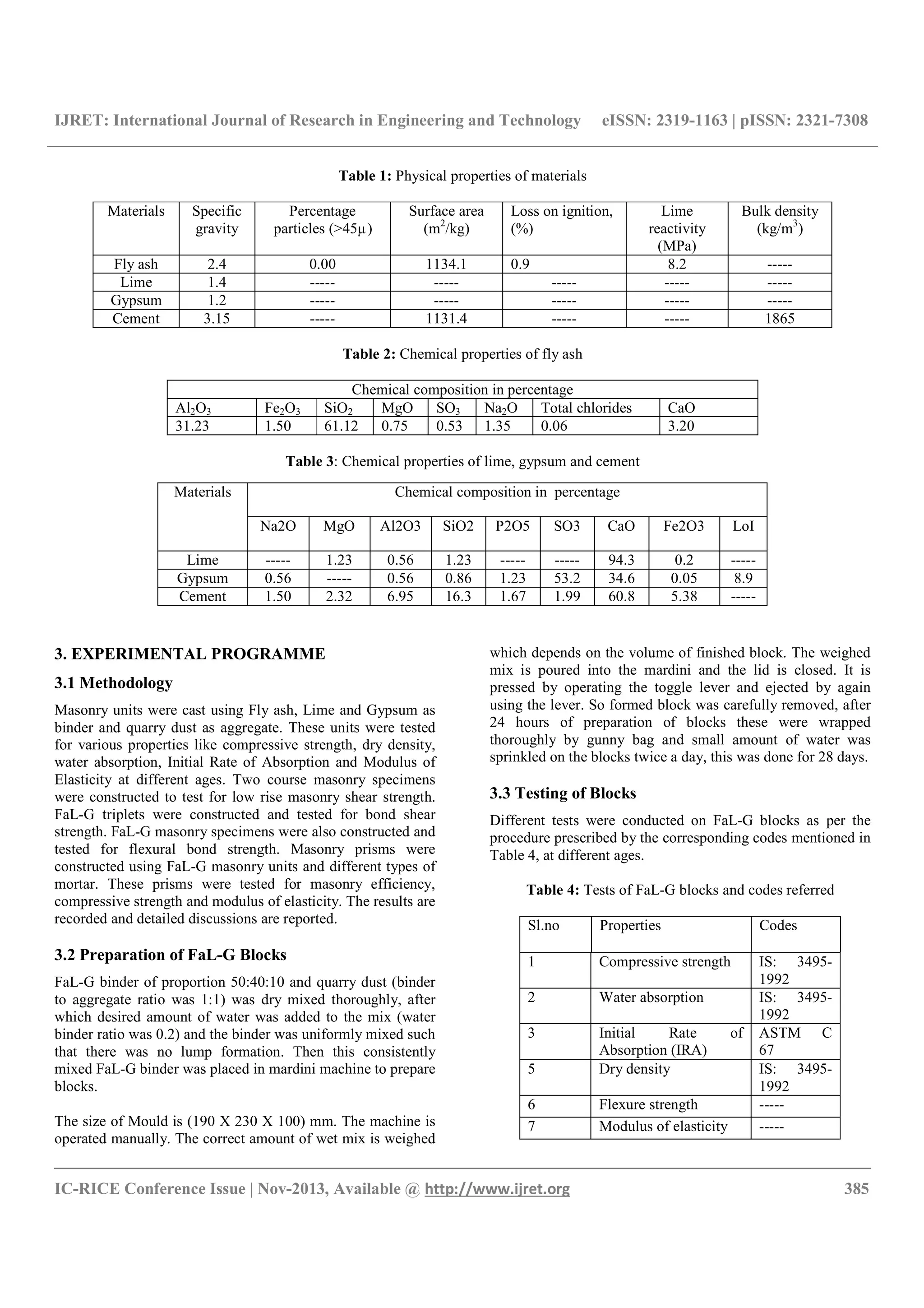
cement (OPC) of 53 grade as per IS 12269: 1987. Table 1 to 3
gives the physical and chemical properties of materials used.
The values in these tables indicate that the fly ash samples
conform to codal requirements as per IS 3812: 1981.
Properties of lime show that it contains more than 90% of
calcium oxide.
IJRET: International Journal of Research in Engineering and Technology eISSN: 2319-1163 | pISSN: 2321-7308
__________________________________________________________________________________________
IC-RICE Conference Issue | Nov-2013, Available @ http://www.ijret.org 385
Table 1: Physical properties of materials
Materials Specific
gravity
Percentage
particles (>45µ)
Surface area
(m2
/kg)
Loss on ignition,
(%)
Lime
reactivity
(MPa)
Bulk density
(kg/m3
)
Fly ash 2.4 0.00 1134.1 0.9 8.2 -----
Lime 1.4 ----- ----- ----- ----- -----
Gypsum 1.2 ----- ----- ----- ----- -----
Cement 3.15 ----- 1131.4 ----- ----- 1865
Table 2: Chemical properties of fly ash
Chemical composition in percentage
Al2O3 Fe2O3 SiO2 MgO SO3 Na2O Total chlorides CaO
31.23 1.50 61.12 0.75 0.53 1.35 0.06 3.20
Table 3: Chemical properties of lime, gypsum and cement
3. EXPERIMENTAL PROGRAMME
3.1 Methodology
Masonry units were cast using Fly ash, Lime and Gypsum as
binder and quarry dust as aggregate. These units were tested
for various properties like compressive strength, dry density,
water absorption, Initial Rate of Absorption and Modulus of
Elasticity at different ages. Two course masonry specimens
were constructed to test for low rise masonry shear strength.
FaL-G triplets were constructed and tested for bond shear
strength. FaL-G masonry specimens were also constructed and
tested for flexural bond strength. Masonry prisms were
constructed using FaL-G masonry units and different types of
mortar. These prisms were tested for masonry efficiency,
compressive strength and modulus of elasticity. The results are
recorded and detailed discussions are reported.
3.2 Preparation of FaL-G Blocks
FaL-G binder of proportion 50:40:10 and quarry dust (binder
to aggregate ratio was 1:1) was dry mixed thoroughly, after
which desired amount of water was added to the mix (water
binder ratio was 0.2) and the binder was uniformly mixed such
that there was no lump formation. Then this consistently
mixed FaL-G binder was placed in mardini machine to prepare
blocks.
The size of Mould is (190 X 230 X 100) mm. The machine is
operated manually. The correct amount of wet mix is weighed
which depends on the volume of finished block. The weighed
mix is poured into the mardini and the lid is closed. It is
pressed by operating the toggle lever and ejected by again
using the lever. So formed block was carefully removed, after
24 hours of preparation of blocks these were wrapped
thoroughly by gunny bag and small amount of water was
sprinkled on the blocks twice a day, this was done for 28 days.
3.3 Testing of Blocks
Different tests were conducted on FaL-G blocks as per the
procedure prescribed by the corresponding codes mentioned in
Table 4, at different ages.
Table 4: Tests of FaL-G blocks and codes referred
Sl.no Properties Codes
1 Compressive strength IS: 3495-
1992
2 Water absorption IS: 3495-
1992
3 Initial Rate of
Absorption (IRA)
ASTM C
67
5 Dry density IS: 3495-
1992
6 Flexure strength -----
7 Modulus of elasticity -----
Materials Chemical composition in percentage
Na2O MgO Al2O3 SiO2 P2O5 SO3 CaO Fe2O3 LoI
Lime ----- 1.23 0.56 1.23 ----- ----- 94.3 0.2 -----
Gypsum 0.56 ----- 0.56 0.86 1.23 53.2 34.6 0.05 8.9
Cement 1.50 2.32 6.95 16.3 1.67 1.99 60.8 5.38 -----
IJRET: International Journal of Research in Engineering and Technology eISSN: 2319-1163 | pISSN: 2321-7308
__________________________________________________________________________________________
IC-RICE Conference Issue | Nov-2013, Available @ http://www.ijret.org 386
3.4 Construction of Prisms
Three types of mortar were used to construct prisms:
1. Cement mortar of binder to aggregate ratio 1:6
2. FaL-G mortar of binder to aggregate ratio 1:1
3. Geopolymer mortar of binder to solution ratio 0.6
Cement mortar was prepared with cement as binder. FaL-G
mix was used get FaL-G mortar. Clay based geopolymer
mortar was also used as masonry mortar in this research. The
preparation of masonry mortar was same in all the three cases
except the ingredients used. Alkaline solution was prepared
using Sodium hydroxide, Sodium silicate and water. Alkaline
solution was added to the clay to get the masonry mortar of
required consistency. The ratio of clay to alkali solution
(molarity 14) was maintained at 0.6.
Details of tests conducted on masonry mortar were
conforming to the codal provisions given in table 5. Masonry
prisms were constructed using masonry mortar.
Table 5: Mortar used to construct prisms and codes referred
Tests Mortars used to construct
prisms
Codes
referred
Bond shear
test
Cement, FaL-G and
geopolymer
------
Flexural bond
test
Cement and geopolymer ASTM C
1072
Low rise
masonry shear
test
Cement and geopolymer ------
Masonry
efficiency,
Modulus of
elasticity,
Compressive
strength
FaL-G and geopolymer IS 1905-
1987
3.5 Testing of Prisms
Prisms were tested for Bond shear, Low rise masonry shear,
Flexural bond test, Masonry efficiency, Modulus of elasticity.
Codes referred to construct and test the prisms are given in
Table 5.
Bond shear test: Shear load was applied to the middle portion
of the masonry triplet and the load at which the bond fails was
noted which gives bond shear strength.
Low rise masonry shear: Horizontal load was applied to the
specimen consisting of two masonry courses. Due to the
application of horizontal load the upper course slides over the
lower course, providing value of the shear strength of the
joint.
Flexural bond test: Prisms of approximate height 100cm were
used to determine flexural bond strength. Frame was fitted to
the topmost block. With the help of pulley and wire
arrangement flexural load was applied gradually and gently to
the prism. Load required for the failure of the mortar joint was
noted and flexural bond strength was calculated [16].
Masonry efficiency: FaL-G masonry prism was placed in
compression testing machine. Compressive force was applied
on the prism. For every predetermined increment in load,
deformation was noted using demec gauge. From the collected
data, stress and strain was calculated and stress v/s strain curve
was plotted. Modulus of elasticity was obtained from the
stress v/s strain curve.
4. RESULTS AND DISCUSSION
FaL-G blocks were tested for different properties on 7th
, 14th
,
28th
and 56th
days of casting. The graphical representation of
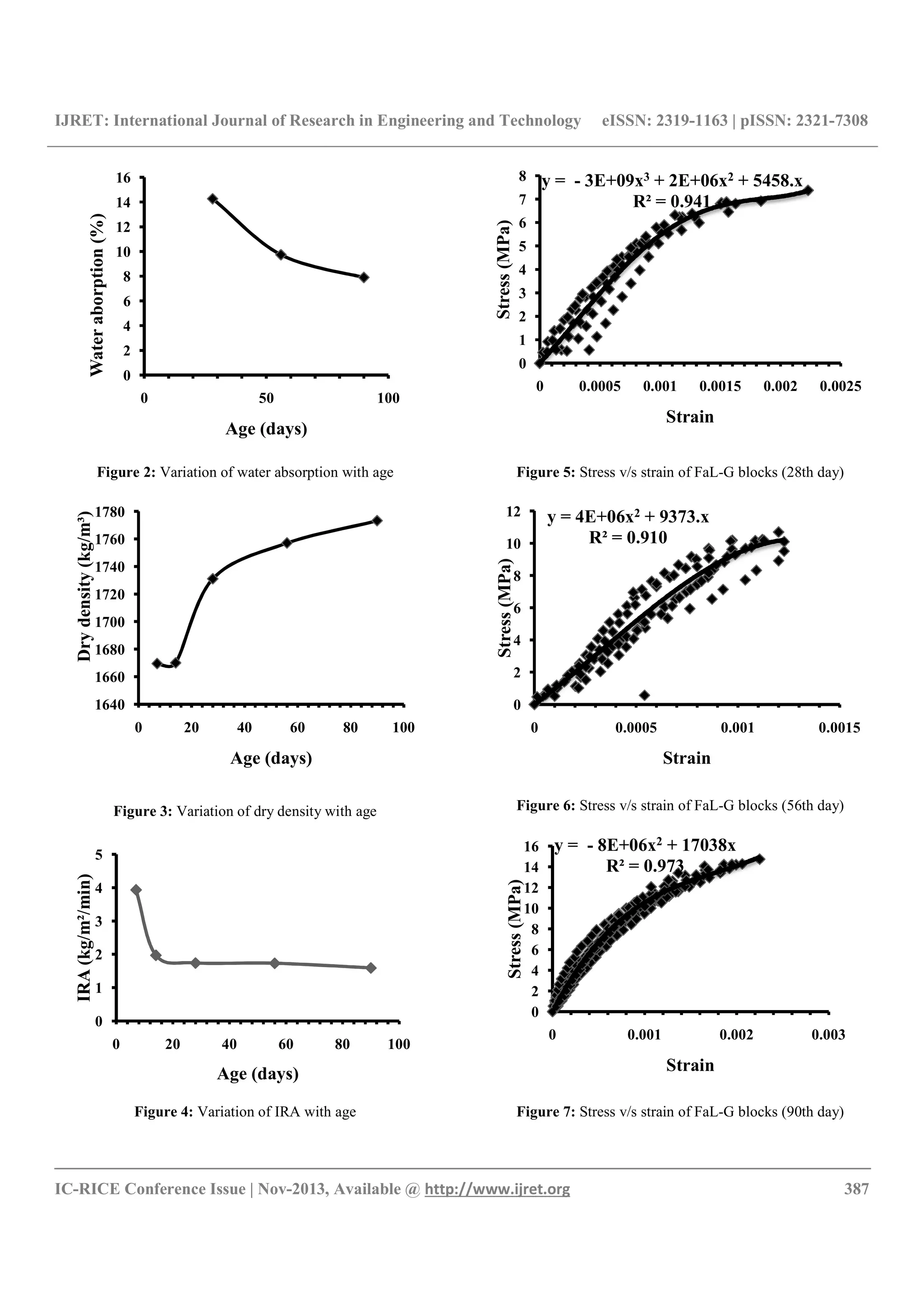
results of each test is given below. Figure 1 and 3 shows that
compressive strength and dry density increases with age. It
can be noticed that increment in compressive strength and dry
density is rapid between 14th
and 90th
days. Figure 2 and 4
shows that IRA and water absorption decreases with age.
Modulus of elasticity of FaL-G blocks was 5458 MPa,
9373MPa and 17038MPa on 28th
(Figure 5), 56th
(Figure 6)
and 90th
days (Figure 7)respectively. Flexural strength of FaL-
G block was 1.58 MPa on 28th
day.The stress-strain behavior
could not be shown at higher stress values due to practical
difficulty in noting down the strain values in the laboratory.
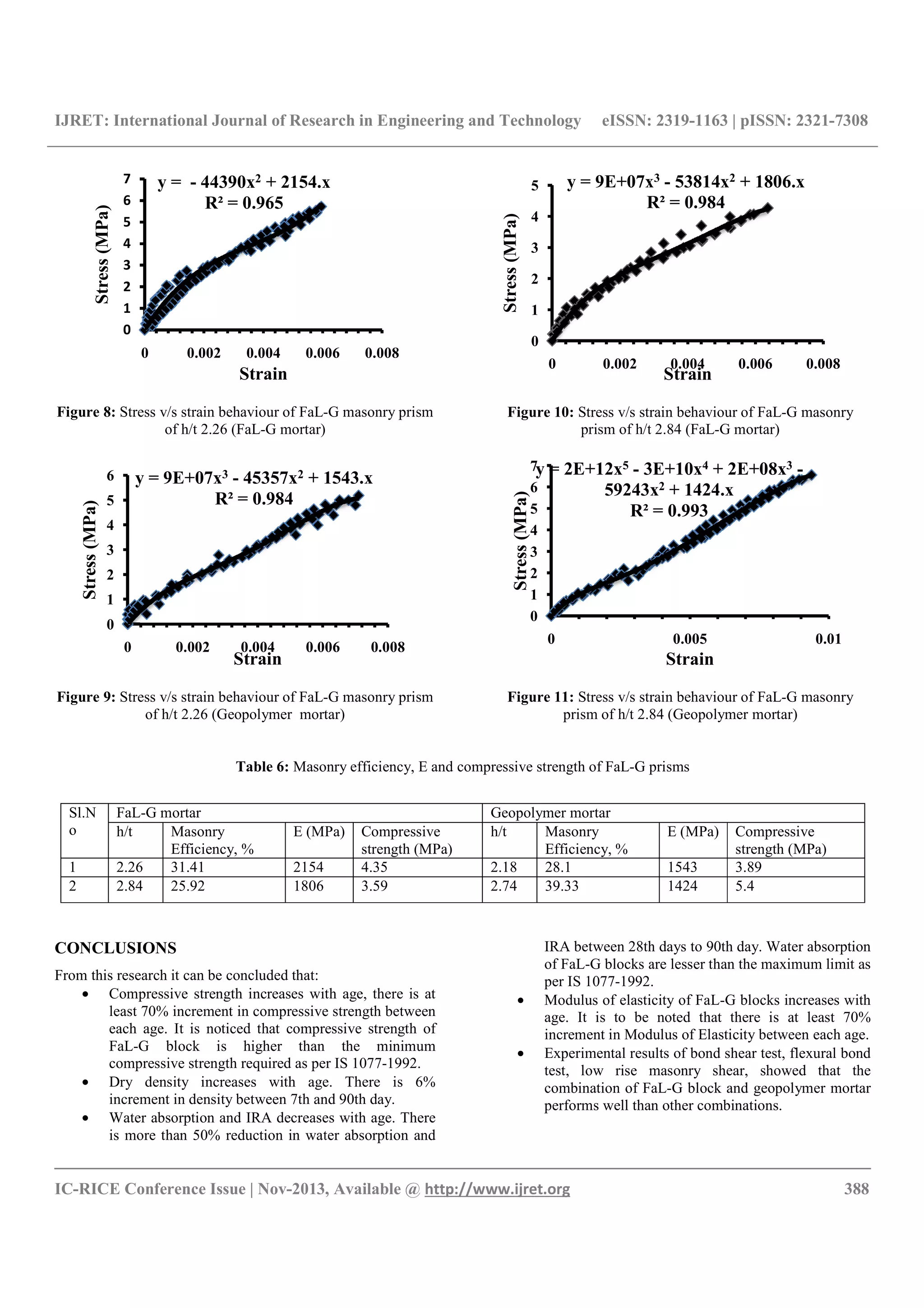
Table 6 gives the masonry efficiency, modulus of elasticity
and compressive strength of FaL-G prisms. Figures 8 to 11
shows stress v/s strain behavior of FaL-G masonry prism.
Bond shear strength of prisms with cement and FaL-G mortar
was 0.0149 MPa and 0.0134 MPa respectively. Low rise
masonry shear strength was 0.019 MPa for geopolymer mortar
and 0.01 MPa for cement mortar. Flexure bond strength for
FaL-G prism with geopolymer mortar was found to be
0.052Mpa
Figure 1: Variation of compressive strength with age
0
2
4
6
8
10
12
14
16
0 20 40 60 80 100
Compressivestrength
(MPa)
Age (days)
IJRET: International Journal of Research in Engineering and Technology
__________________________________________________________________________________________
IC-RICE Conference Issue | Nov-2013, Available @
Figure 2: Variation of water absorption with age
Figure 3: Variation of dry density with
Figure 4: Variation of IRA with age
0
2
4
6
8
10
12
14
16
0 50
Wateraborption(%)
Age (days)
1640
1660
1680
1700
1720
1740
1760
1780
0 20 40 60
Drydensity(kg/m³)
Age (days)
0
1
2
3
4
5
0 20 40 60
IRA(kg/m²/min)
Age (days)
International Journal of Research in Engineering and Technology eISSN: 2319
__________________________________________________________________________________________
2013, Available @ http://www.ijret.org
Variation of water absorption with age
Variation of dry density with age
Variation of IRA with age
Figure 5: Stress v/s strain of FaL
Figure 6: Stress v/s strain of FaL
Figure 7: Stress v/s strain of FaL
100
80 100
80 100
y = - 3E+09x3
R² = 0.941
0
1
2
3
4
5
6
7
8
0 0.0005 0.001
Stress(MPa)
y = 4E+06x2 + 9373.x
R² = 0.910
0
2
4
6
8
10
12
0 0.0005
Stress(MPa)
y = - 8E+06x
R² = 0.973
0
2
4
6
8
10
12
14
16
0 0.001
Stress(MPa)
eISSN: 2319-1163 | pISSN: 2321-7308
__________________________________________________________________________________________
387
Stress v/s strain of FaL-G blocks (28th day)
Stress v/s strain of FaL-G blocks (56th day)
Stress v/s strain of FaL-G blocks (90th day)
+ 2E+06x2 + 5458.x
R² = 0.941
0.001 0.0015 0.002 0.0025
Strain
+ 9373.x
R² = 0.910
0.0005 0.001 0.0015
Strain
8E+06x2 + 17038x
R² = 0.973
0.001 0.002 0.003
Strain
IJRET: International Journal of Research in Engineering and Technology
__________________________________________________________________________________________
IC-RICE Conference Issue | Nov-2013, Available @
Figure 8: Stress v/s strain behaviour of FaL-
of h/t 2.26 (FaL-G mortar)
Figure 9: Stress v/s strain behaviour of FaL-
of h/t 2.26 (Geopolymer mortar)
Table 6: Masonry efficiency, E and compressive strength of FaL
CONCLUSIONS
From this research it can be concluded that:
• Compressive strength increases with age, there is at
least 70% increment in compressive strength between
each age. It is noticed that compressive strength of
FaL-G block is higher than the minimum
compressive strength required as per IS 1077
• Dry density increases with age. There is 6%
increment in density between 7th and 90th day.
• Water absorption and IRA decreases with age.
is more than 50% reduction in water absorption and
y = - 44390x2 + 2154.x
R² = 0.965
0
1
2
3
4
5
6
7
0 0.002 0.004 0.006
Stress(MPa)
Strain
y = 9E+07x3 - 45357x2 + 1543.x
R² = 0.984
0
1
2
3
4
5
6
0 0.002 0.004 0.006
Stress(MPa)
Strain
Sl.N
o
FaL-G mortar
h/t Masonry
Efficiency, %
E (MPa)
1 2.26 31.41 2154
2 2.84 25.92 1806
International Journal of Research in Engineering and Technology eISSN: 2319
__________________________________________________________________________________________
2013, Available @ http://www.ijret.org
-G masonry prism
G mortar)
-G masonry prism
of h/t 2.26 (Geopolymer mortar)
Figure 10: Stress v/s strain behaviour of FaL
prism of h/t 2.84 (
Figure 11: Stress v/s strain behaviour of FaL
prism of h/t 2.84 (Geopolymer mortar
Masonry efficiency, E and compressive strength of FaL-G prisms
Compressive strength increases with age, there is at
least 70% increment in compressive strength between
compressive strength of
G block is higher than the minimum
uired as per IS 1077-1992.
Dry density increases with age. There is 6%
increment in density between 7th and 90th day.
Water absorption and IRA decreases with age. There
is more than 50% reduction in water absorption and
IRA between 28th days to 90th day.
of FaL-G blocks are lesser than the maximum limit as
per IS 1077-1992.
• Modulus of elasticity
age. It is to be noted that there is at least 70%
increment in Modulus of Elasticity between each age.
• Experimental results of bond shear test, flexural bond
test, low rise masonry shear,
combination of FaL
performs well than other combinations.
+ 2154.x
0.006 0.008
+ 1543.x
0.006 0.008
y = 9E+07x
R² = 0.984
0
1
2
3
4
5
0 0.002
Stress(MPa)
y = 2E+12x5 - 3E+10x
59243x
R² = 0.993
0
1
2
3
4
5
6
7
0
Stress(MPa)
Geopolymer mortar
E (MPa) Compressive
strength (MPa)
h/t Masonry
Efficiency, %
4.35 2.18 28.1
3.59 2.74 39.33
eISSN: 2319-1163 | pISSN: 2321-7308
__________________________________________________________________________________________
388
Stress v/s strain behaviour of FaL-G masonry
prism of h/t 2.84 (FaL-G mortar)
Stress v/s strain behaviour of FaL-G masonry
prism of h/t 2.84 (Geopolymer mortar)
G prisms
IRA between 28th days to 90th day. Water absorption
G blocks are lesser than the maximum limit as
1992.
Modulus of elasticity of FaL-G blocks increases with
It is to be noted that there is at least 70%
increment in Modulus of Elasticity between each age.
l results of bond shear test, flexural bond
test, low rise masonry shear, showed that the
combination of FaL-G block and geopolymer mortar
performs well than other combinations.
y = 9E+07x3 - 53814x2 + 1806.x
R² = 0.984
0.004 0.006 0.008
Strain
3E+10x4 + 2E+08x3 -
59243x2 + 1424.x
R² = 0.993
0.005 0.01
Strain
E (MPa) Compressive
strength (MPa)
1543 3.89
1424 5.4
IJRET: International Journal of Research in Engineering and Technology eISSN: 2319-1163 | pISSN: 2321-7308
__________________________________________________________________________________________
IC-RICE Conference Issue | Nov-2013, Available @ http://www.ijret.org 389
• Variation of masonry efficiency with h/t ratio is
found to be around 17% for prisms with FaL-G
mortar and 40% for prisms with geopolymer mortar.
• Hence it can be concluded that FaL-G can effectively
replace burnt clay bricks.Fly ash brick manufacturing
is a potential field of application wherein large-scale
utilization of fly ash is possible.
REFERENCES
[1] Yang Min, QianJueshi and Pang Ying “Activation of
fly ash–lime systems using calcinedphosphogypsum”
Construction and Building Materials., Vol. 22, pp.
1004–1008, 2008.
[2] M.S. Morsy, S.H. Alsayed and Y.A.
Salloum“Development of eco-friendly binder using
metakaolin-fly ash–lime-anhydrous gypsum”
Construction and Building Materials., Vol. 35, pp. 772–
777, 2012.
[3] B. V. Venkatarama Reddy and K. Gourav “Strength of
lime–fly ash compacts using different curing techniques
and gypsum additive” Materials and Structures., Vol.
44, pp. 1793–1808, 2011.
[4] Prof. Sameer Mistry, JayeshPitroda, Dr. L. B. Zala,
Prof. Samip Patel, Prof. J.J. Bhavsar and Dr. F.S.
Umrigar “Fly Ash Bricks Masonry: An Experimental
Study” National Conference on Recent Trends in
Engineering & Technology., pp. 13-14, May 2011.
[5] S. Marinkovic and A. Kostic-Pulek “Examination of
the system fly ash–lime–calcined gypsum–water”
Journal of Physics and Chemistry of Solids., Vol. 68,
pp. 1121–1125, 2007.
[6] WeiguoShen, Mingkai Zhou and Qinglin Zhao “Study
on lime–fly ash–phosphogypsum binder” Construction
and Building Materials., 21 pp. 1480–1485, 2007.
[7] S. Kumar “Fly ash-lime- phosphogypsumcementitious
binder: A new trend in bricks” Materials and
Structures., Vol. 33, pp. 59-64, January-February 2000.
[8] Manjit Singh and MridulGarg “Durability of cementing
binders based on fly ash and other wastes” Construction
and Building Materials., 21, pp. 2012–2016, 2007.
[9] Shiqun Li, Jishan Hu, Lui Biao and Xinguo Li “Study
on the weathering resistance of fly ash–lime compacts”
Cement and Concrete Research., 34, pp. 753–758,
2004.
[10] Sunil Kumar “Fly ash–lime–phosphogypsum hollow
blocks for walls and partitions”Building and
Environmen.,t., 38, pp. 291 – 295, 2003.
[11] Kelly A. Rusch, TingzongGuo and Roger K. Seals
“Stabilization of phosphogypsum using class C fly ash
and lime: assessment of the potential for marine
applications” Journal of Hazardous Materials., B93, pp.
167–186, 2002.
[12] B. V. Venkatarama Reddy and K. Gourav “Strength of
lime–fly ash compacts using different curing techniques
and gypsum additive” Materials and Structures., Vol.
44, pp. 1793–1808, 2011.
[13] Sunil Kumar “A perspective study on fly ash–lime–
gypsum bricks and hollow blocks for low cost housing
development” Construction and Building Materials.,
Vol. 16, pp. 519–525, 2002.
[14] MridulGarg, Manjit Singh and Rakesh Kumar “Some
aspects of the durability of a phosphogypsum-lime-fly
ash binder” Construction and Building Materials., Vol.
IO, No. 4, pp. 273-219.
[15] Luciano Santoro, IgnazioAletta and Gian Lorenzo
Valenti “Hydration of mixtures containing fly-ash, lime
and phosphogypsum” ThermochimicaActa., Vol 98,
pp. 71-80, February 1986.
[16] A Costigan and S Pavía“Compressive, flexural and
bond strength of brick/lime mortar masonry”
Proceedings of PROHITEC 09 – Mazzolani editor,
Taylor and Francis Group, London., pp. 1609-1615,
2009.

Properties of fal g masonry blocks

  • 1.
    IJRET: International Journalof Research in Engineering and Technology eISSN: 2319-1163 | pISSN: 2321-7308 __________________________________________________________________________________________ IC-RICE Conference Issue | Nov-2013, Available @ http://www.ijret.org 384 PROPERTIES OF FAL-G MASONRY BLOCKS Jayasudha R K1 , Radhakrishna2 , Niranjan PS3 1 PG Student, 2 Associate Professor, 3 Research Scholar, Dept of Civil Engineering, R V College of Engineering, Mysore Road, Bangalore, rkjayasudha@gmail.com, chakavelu_rk@yahoo.com Abstract Fly ash, Lime and gypsum are industrial wastes generated in millions of tones every year. Utilization of these materials is effective way of disposing the pollutants. In this research fly ash, lime, and gypsum were used in definite proportion along with quarry dust to produce FaL-G blocks. These blocks were tested for compressive strength, water absorption, IRA, density, flexure and modulus of elasticity. Masonry prisms were constructed using FaL-G blocks to determine shear bond strength, flexural bond strength, low rise masonry shear, modulus of elasticity, compressive strength and masonry efficiency. It was found that FaL-G masonry blocks can replace conventional masonry units. Keywords: Fly ash, Lime, Gypsum, FaL-G, Flexure bond strength, Shear bond strength and Masonry. -------------------------------------------------------------------***----------------------------------------------------------------------- 1. INTRODUCTION Masonry is one of the oldest forms of construction. Combination of building units or materials like stone, brick, tiles, glass etc., with or without mortar forms masonry. Clay brick is one of the most popularly used masonry material. The clay available in river basins, water ponds and coastal areas is plastic in nature and suitable for proper moulding, drying and burning of bricks. But, soil that is less plastic or expansive, gritty or sandy cannot be used for brick manufacturing. In most of the central and south India, good quality soil for production of burnt clay brick is not available which result in higher cost of bricks due to transportation from long distances or use of low quality clay bricks manufactured with sub- standard clays. In such regions a substitute to burnt clay bricks is essential. Chemical and agricultural industries are liberating large quantities of by-products every year. These materials have dual problems of disposal and health hazards. For example: fly ash from thermal power plants and phosphogypsum from fertilizer industries. With the more and more wastes being generated, the utilization of fly ash and phosphogypsum is important to save the environment from quick degradation [1, 2]. To replace conventional bricks and to safely dispose the toxic industrial wastes FaL-G is one among the best options available. FaL-G does not stand for any brand name; it only states the constituents [3, 4, 5, 6]. Current annual production of fly ash is 500 million tons worldwide. More than 160 million tons of fly ash is produced in India [7].For every 1 ton production of phosphoric acid 5 tons of phosphogypsum is produced. It has limited scope of utilization as building material. As per the recent records 280 million tons of phosphogypsum is produced every year [8, 9].Acetylene limes, lime sludge are by products of paper industry. Lime is also availed from mineral sources [10]. Strength development in lime pozzolanic reaction takes place in a slow pace in normal temperature conditions. Hence a long curing duration is required to achieve a meaningful strength. Thus there is a need to accelerate the reaction in this compact, which is achieved either by steam curing or by the addition of gypsum. [ 1, 5, 11,12,13 ]. 2. MATERIALS AND METHODS 2.1 Procurement and Characterization of Materials Fly ash was directly collected from the Raichur Thermal Power Plant (RTPS), India. Locally available commercial lime is used in the present investigation to obtain FaL-G composites. Gypsum was procured from a fertilizer company. The cement used in this investigation is ordinary Portland cement (OPC) of 53 grade as per IS 12269: 1987. Table 1 to 3 gives the physical and chemical properties of materials used. The values in these tables indicate that the fly ash samples conform to codal requirements as per IS 3812: 1981. Properties of lime show that it contains more than 90% of calcium oxide.
  • 2.
    IJRET: International Journalof Research in Engineering and Technology eISSN: 2319-1163 | pISSN: 2321-7308 __________________________________________________________________________________________ IC-RICE Conference Issue | Nov-2013, Available @ http://www.ijret.org 385 Table 1: Physical properties of materials Materials Specific gravity Percentage particles (>45µ) Surface area (m2 /kg) Loss on ignition, (%) Lime reactivity (MPa) Bulk density (kg/m3 ) Fly ash 2.4 0.00 1134.1 0.9 8.2 ----- Lime 1.4 ----- ----- ----- ----- ----- Gypsum 1.2 ----- ----- ----- ----- ----- Cement 3.15 ----- 1131.4 ----- ----- 1865 Table 2: Chemical properties of fly ash Chemical composition in percentage Al2O3 Fe2O3 SiO2 MgO SO3 Na2O Total chlorides CaO 31.23 1.50 61.12 0.75 0.53 1.35 0.06 3.20 Table 3: Chemical properties of lime, gypsum and cement 3. EXPERIMENTAL PROGRAMME 3.1 Methodology Masonry units were cast using Fly ash, Lime and Gypsum as binder and quarry dust as aggregate. These units were tested for various properties like compressive strength, dry density, water absorption, Initial Rate of Absorption and Modulus of Elasticity at different ages. Two course masonry specimens were constructed to test for low rise masonry shear strength. FaL-G triplets were constructed and tested for bond shear strength. FaL-G masonry specimens were also constructed and tested for flexural bond strength. Masonry prisms were constructed using FaL-G masonry units and different types of mortar. These prisms were tested for masonry efficiency, compressive strength and modulus of elasticity. The results are recorded and detailed discussions are reported. 3.2 Preparation of FaL-G Blocks FaL-G binder of proportion 50:40:10 and quarry dust (binder to aggregate ratio was 1:1) was dry mixed thoroughly, after which desired amount of water was added to the mix (water binder ratio was 0.2) and the binder was uniformly mixed such that there was no lump formation. Then this consistently mixed FaL-G binder was placed in mardini machine to prepare blocks. The size of Mould is (190 X 230 X 100) mm. The machine is operated manually. The correct amount of wet mix is weighed which depends on the volume of finished block. The weighed mix is poured into the mardini and the lid is closed. It is pressed by operating the toggle lever and ejected by again using the lever. So formed block was carefully removed, after 24 hours of preparation of blocks these were wrapped thoroughly by gunny bag and small amount of water was sprinkled on the blocks twice a day, this was done for 28 days. 3.3 Testing of Blocks Different tests were conducted on FaL-G blocks as per the procedure prescribed by the corresponding codes mentioned in Table 4, at different ages. Table 4: Tests of FaL-G blocks and codes referred Sl.no Properties Codes 1 Compressive strength IS: 3495- 1992 2 Water absorption IS: 3495- 1992 3 Initial Rate of Absorption (IRA) ASTM C 67 5 Dry density IS: 3495- 1992 6 Flexure strength ----- 7 Modulus of elasticity ----- Materials Chemical composition in percentage Na2O MgO Al2O3 SiO2 P2O5 SO3 CaO Fe2O3 LoI Lime ----- 1.23 0.56 1.23 ----- ----- 94.3 0.2 ----- Gypsum 0.56 ----- 0.56 0.86 1.23 53.2 34.6 0.05 8.9 Cement 1.50 2.32 6.95 16.3 1.67 1.99 60.8 5.38 -----
  • 3.
    IJRET: International Journalof Research in Engineering and Technology eISSN: 2319-1163 | pISSN: 2321-7308 __________________________________________________________________________________________ IC-RICE Conference Issue | Nov-2013, Available @ http://www.ijret.org 386 3.4 Construction of Prisms Three types of mortar were used to construct prisms: 1. Cement mortar of binder to aggregate ratio 1:6 2. FaL-G mortar of binder to aggregate ratio 1:1 3. Geopolymer mortar of binder to solution ratio 0.6 Cement mortar was prepared with cement as binder. FaL-G mix was used get FaL-G mortar. Clay based geopolymer mortar was also used as masonry mortar in this research. The preparation of masonry mortar was same in all the three cases except the ingredients used. Alkaline solution was prepared using Sodium hydroxide, Sodium silicate and water. Alkaline solution was added to the clay to get the masonry mortar of required consistency. The ratio of clay to alkali solution (molarity 14) was maintained at 0.6. Details of tests conducted on masonry mortar were conforming to the codal provisions given in table 5. Masonry prisms were constructed using masonry mortar. Table 5: Mortar used to construct prisms and codes referred Tests Mortars used to construct prisms Codes referred Bond shear test Cement, FaL-G and geopolymer ------ Flexural bond test Cement and geopolymer ASTM C 1072 Low rise masonry shear test Cement and geopolymer ------ Masonry efficiency, Modulus of elasticity, Compressive strength FaL-G and geopolymer IS 1905- 1987 3.5 Testing of Prisms Prisms were tested for Bond shear, Low rise masonry shear, Flexural bond test, Masonry efficiency, Modulus of elasticity. Codes referred to construct and test the prisms are given in Table 5. Bond shear test: Shear load was applied to the middle portion of the masonry triplet and the load at which the bond fails was noted which gives bond shear strength. Low rise masonry shear: Horizontal load was applied to the specimen consisting of two masonry courses. Due to the application of horizontal load the upper course slides over the lower course, providing value of the shear strength of the joint. Flexural bond test: Prisms of approximate height 100cm were used to determine flexural bond strength. Frame was fitted to the topmost block. With the help of pulley and wire arrangement flexural load was applied gradually and gently to the prism. Load required for the failure of the mortar joint was noted and flexural bond strength was calculated [16]. Masonry efficiency: FaL-G masonry prism was placed in compression testing machine. Compressive force was applied on the prism. For every predetermined increment in load, deformation was noted using demec gauge. From the collected data, stress and strain was calculated and stress v/s strain curve was plotted. Modulus of elasticity was obtained from the stress v/s strain curve. 4. RESULTS AND DISCUSSION FaL-G blocks were tested for different properties on 7th , 14th , 28th and 56th days of casting. The graphical representation of results of each test is given below. Figure 1 and 3 shows that compressive strength and dry density increases with age. It can be noticed that increment in compressive strength and dry density is rapid between 14th and 90th days. Figure 2 and 4 shows that IRA and water absorption decreases with age. Modulus of elasticity of FaL-G blocks was 5458 MPa, 9373MPa and 17038MPa on 28th (Figure 5), 56th (Figure 6) and 90th days (Figure 7)respectively. Flexural strength of FaL- G block was 1.58 MPa on 28th day.The stress-strain behavior could not be shown at higher stress values due to practical difficulty in noting down the strain values in the laboratory. Table 6 gives the masonry efficiency, modulus of elasticity and compressive strength of FaL-G prisms. Figures 8 to 11 shows stress v/s strain behavior of FaL-G masonry prism. Bond shear strength of prisms with cement and FaL-G mortar was 0.0149 MPa and 0.0134 MPa respectively. Low rise masonry shear strength was 0.019 MPa for geopolymer mortar and 0.01 MPa for cement mortar. Flexure bond strength for FaL-G prism with geopolymer mortar was found to be 0.052Mpa Figure 1: Variation of compressive strength with age 0 2 4 6 8 10 12 14 16 0 20 40 60 80 100 Compressivestrength (MPa) Age (days)
  • 4.
    IJRET: International Journalof Research in Engineering and Technology __________________________________________________________________________________________ IC-RICE Conference Issue | Nov-2013, Available @ Figure 2: Variation of water absorption with age Figure 3: Variation of dry density with Figure 4: Variation of IRA with age 0 2 4 6 8 10 12 14 16 0 50 Wateraborption(%) Age (days) 1640 1660 1680 1700 1720 1740 1760 1780 0 20 40 60 Drydensity(kg/m³) Age (days) 0 1 2 3 4 5 0 20 40 60 IRA(kg/m²/min) Age (days) International Journal of Research in Engineering and Technology eISSN: 2319 __________________________________________________________________________________________ 2013, Available @ http://www.ijret.org Variation of water absorption with age Variation of dry density with age Variation of IRA with age Figure 5: Stress v/s strain of FaL Figure 6: Stress v/s strain of FaL Figure 7: Stress v/s strain of FaL 100 80 100 80 100 y = - 3E+09x3 R² = 0.941 0 1 2 3 4 5 6 7 8 0 0.0005 0.001 Stress(MPa) y = 4E+06x2 + 9373.x R² = 0.910 0 2 4 6 8 10 12 0 0.0005 Stress(MPa) y = - 8E+06x R² = 0.973 0 2 4 6 8 10 12 14 16 0 0.001 Stress(MPa) eISSN: 2319-1163 | pISSN: 2321-7308 __________________________________________________________________________________________ 387 Stress v/s strain of FaL-G blocks (28th day) Stress v/s strain of FaL-G blocks (56th day) Stress v/s strain of FaL-G blocks (90th day) + 2E+06x2 + 5458.x R² = 0.941 0.001 0.0015 0.002 0.0025 Strain + 9373.x R² = 0.910 0.0005 0.001 0.0015 Strain 8E+06x2 + 17038x R² = 0.973 0.001 0.002 0.003 Strain
  • 5.
    IJRET: International Journalof Research in Engineering and Technology __________________________________________________________________________________________ IC-RICE Conference Issue | Nov-2013, Available @ Figure 8: Stress v/s strain behaviour of FaL- of h/t 2.26 (FaL-G mortar) Figure 9: Stress v/s strain behaviour of FaL- of h/t 2.26 (Geopolymer mortar) Table 6: Masonry efficiency, E and compressive strength of FaL CONCLUSIONS From this research it can be concluded that: • Compressive strength increases with age, there is at least 70% increment in compressive strength between each age. It is noticed that compressive strength of FaL-G block is higher than the minimum compressive strength required as per IS 1077 • Dry density increases with age. There is 6% increment in density between 7th and 90th day. • Water absorption and IRA decreases with age. is more than 50% reduction in water absorption and y = - 44390x2 + 2154.x R² = 0.965 0 1 2 3 4 5 6 7 0 0.002 0.004 0.006 Stress(MPa) Strain y = 9E+07x3 - 45357x2 + 1543.x R² = 0.984 0 1 2 3 4 5 6 0 0.002 0.004 0.006 Stress(MPa) Strain Sl.N o FaL-G mortar h/t Masonry Efficiency, % E (MPa) 1 2.26 31.41 2154 2 2.84 25.92 1806 International Journal of Research in Engineering and Technology eISSN: 2319 __________________________________________________________________________________________ 2013, Available @ http://www.ijret.org -G masonry prism G mortar) -G masonry prism of h/t 2.26 (Geopolymer mortar) Figure 10: Stress v/s strain behaviour of FaL prism of h/t 2.84 ( Figure 11: Stress v/s strain behaviour of FaL prism of h/t 2.84 (Geopolymer mortar Masonry efficiency, E and compressive strength of FaL-G prisms Compressive strength increases with age, there is at least 70% increment in compressive strength between compressive strength of G block is higher than the minimum uired as per IS 1077-1992. Dry density increases with age. There is 6% increment in density between 7th and 90th day. Water absorption and IRA decreases with age. There is more than 50% reduction in water absorption and IRA between 28th days to 90th day. of FaL-G blocks are lesser than the maximum limit as per IS 1077-1992. • Modulus of elasticity age. It is to be noted that there is at least 70% increment in Modulus of Elasticity between each age. • Experimental results of bond shear test, flexural bond test, low rise masonry shear, combination of FaL performs well than other combinations. + 2154.x 0.006 0.008 + 1543.x 0.006 0.008 y = 9E+07x R² = 0.984 0 1 2 3 4 5 0 0.002 Stress(MPa) y = 2E+12x5 - 3E+10x 59243x R² = 0.993 0 1 2 3 4 5 6 7 0 Stress(MPa) Geopolymer mortar E (MPa) Compressive strength (MPa) h/t Masonry Efficiency, % 4.35 2.18 28.1 3.59 2.74 39.33 eISSN: 2319-1163 | pISSN: 2321-7308 __________________________________________________________________________________________ 388 Stress v/s strain behaviour of FaL-G masonry prism of h/t 2.84 (FaL-G mortar) Stress v/s strain behaviour of FaL-G masonry prism of h/t 2.84 (Geopolymer mortar) G prisms IRA between 28th days to 90th day. Water absorption G blocks are lesser than the maximum limit as 1992. Modulus of elasticity of FaL-G blocks increases with It is to be noted that there is at least 70% increment in Modulus of Elasticity between each age. l results of bond shear test, flexural bond test, low rise masonry shear, showed that the combination of FaL-G block and geopolymer mortar performs well than other combinations. y = 9E+07x3 - 53814x2 + 1806.x R² = 0.984 0.004 0.006 0.008 Strain 3E+10x4 + 2E+08x3 - 59243x2 + 1424.x R² = 0.993 0.005 0.01 Strain E (MPa) Compressive strength (MPa) 1543 3.89 1424 5.4
  • 6.
    IJRET: International Journalof Research in Engineering and Technology eISSN: 2319-1163 | pISSN: 2321-7308 __________________________________________________________________________________________ IC-RICE Conference Issue | Nov-2013, Available @ http://www.ijret.org 389 • Variation of masonry efficiency with h/t ratio is found to be around 17% for prisms with FaL-G mortar and 40% for prisms with geopolymer mortar. • Hence it can be concluded that FaL-G can effectively replace burnt clay bricks.Fly ash brick manufacturing is a potential field of application wherein large-scale utilization of fly ash is possible. REFERENCES [1] Yang Min, QianJueshi and Pang Ying “Activation of fly ash–lime systems using calcinedphosphogypsum” Construction and Building Materials., Vol. 22, pp. 1004–1008, 2008. [2] M.S. Morsy, S.H. Alsayed and Y.A. Salloum“Development of eco-friendly binder using metakaolin-fly ash–lime-anhydrous gypsum” Construction and Building Materials., Vol. 35, pp. 772– 777, 2012. [3] B. V. Venkatarama Reddy and K. Gourav “Strength of lime–fly ash compacts using different curing techniques and gypsum additive” Materials and Structures., Vol. 44, pp. 1793–1808, 2011. [4] Prof. Sameer Mistry, JayeshPitroda, Dr. L. B. Zala, Prof. Samip Patel, Prof. J.J. Bhavsar and Dr. F.S. Umrigar “Fly Ash Bricks Masonry: An Experimental Study” National Conference on Recent Trends in Engineering & Technology., pp. 13-14, May 2011. [5] S. Marinkovic and A. Kostic-Pulek “Examination of the system fly ash–lime–calcined gypsum–water” Journal of Physics and Chemistry of Solids., Vol. 68, pp. 1121–1125, 2007. [6] WeiguoShen, Mingkai Zhou and Qinglin Zhao “Study on lime–fly ash–phosphogypsum binder” Construction and Building Materials., 21 pp. 1480–1485, 2007. [7] S. Kumar “Fly ash-lime- phosphogypsumcementitious binder: A new trend in bricks” Materials and Structures., Vol. 33, pp. 59-64, January-February 2000. [8] Manjit Singh and MridulGarg “Durability of cementing binders based on fly ash and other wastes” Construction and Building Materials., 21, pp. 2012–2016, 2007. [9] Shiqun Li, Jishan Hu, Lui Biao and Xinguo Li “Study on the weathering resistance of fly ash–lime compacts” Cement and Concrete Research., 34, pp. 753–758, 2004. [10] Sunil Kumar “Fly ash–lime–phosphogypsum hollow blocks for walls and partitions”Building and Environmen.,t., 38, pp. 291 – 295, 2003. [11] Kelly A. Rusch, TingzongGuo and Roger K. Seals “Stabilization of phosphogypsum using class C fly ash and lime: assessment of the potential for marine applications” Journal of Hazardous Materials., B93, pp. 167–186, 2002. [12] B. V. Venkatarama Reddy and K. Gourav “Strength of lime–fly ash compacts using different curing techniques and gypsum additive” Materials and Structures., Vol. 44, pp. 1793–1808, 2011. [13] Sunil Kumar “A perspective study on fly ash–lime– gypsum bricks and hollow blocks for low cost housing development” Construction and Building Materials., Vol. 16, pp. 519–525, 2002. [14] MridulGarg, Manjit Singh and Rakesh Kumar “Some aspects of the durability of a phosphogypsum-lime-fly ash binder” Construction and Building Materials., Vol. IO, No. 4, pp. 273-219. [15] Luciano Santoro, IgnazioAletta and Gian Lorenzo Valenti “Hydration of mixtures containing fly-ash, lime and phosphogypsum” ThermochimicaActa., Vol 98, pp. 71-80, February 1986. [16] A Costigan and S Pavía“Compressive, flexural and bond strength of brick/lime mortar masonry” Proceedings of PROHITEC 09 – Mazzolani editor, Taylor and Francis Group, London., pp. 1609-1615, 2009.