Experimental design

              Dr Richard Goodey
                     SEMS


4/5/2012         Researcher’s Development Day
What is an experiment?
• A test
      – To find out something about a process
      – More specifically, usually a series of tests
• Something we do all the time in our everyday
  lives
• In this context, most relevant to physical and
  social sciences
• In these fields, most PhD candidates and
  researchers do some sort of experiment
4/5/2012                 Researcher’s Development Day
A simple example
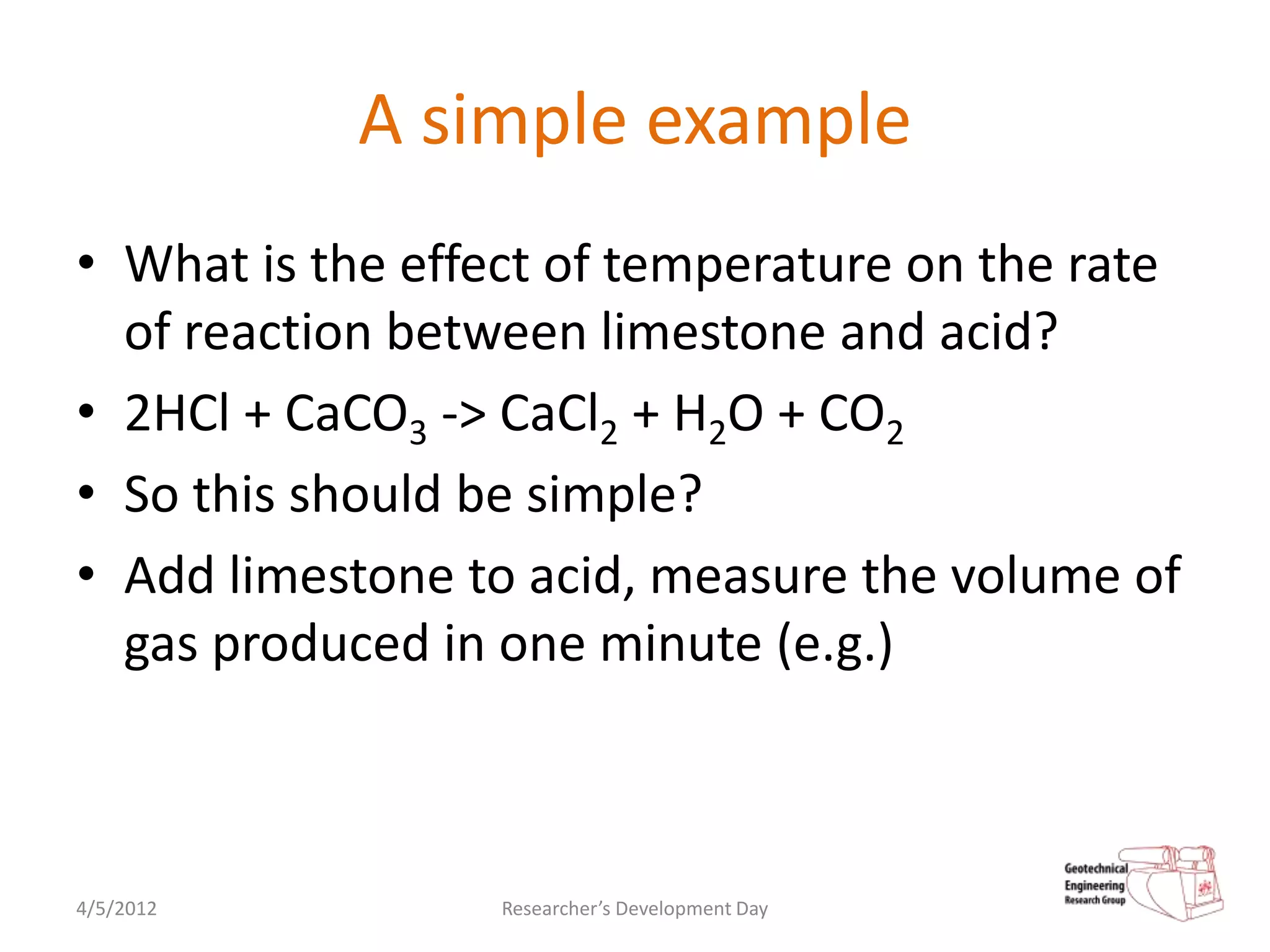
• What is the effect of temperature on the rate
  of reaction between limestone and acid?
• 2HCl + CaCO3 -> CaCl2 + H2O + CO2
• So this should be simple?
• Add limestone to acid, measure the volume of
  gas produced in one minute (e.g.)


4/5/2012          Researcher’s Development Day
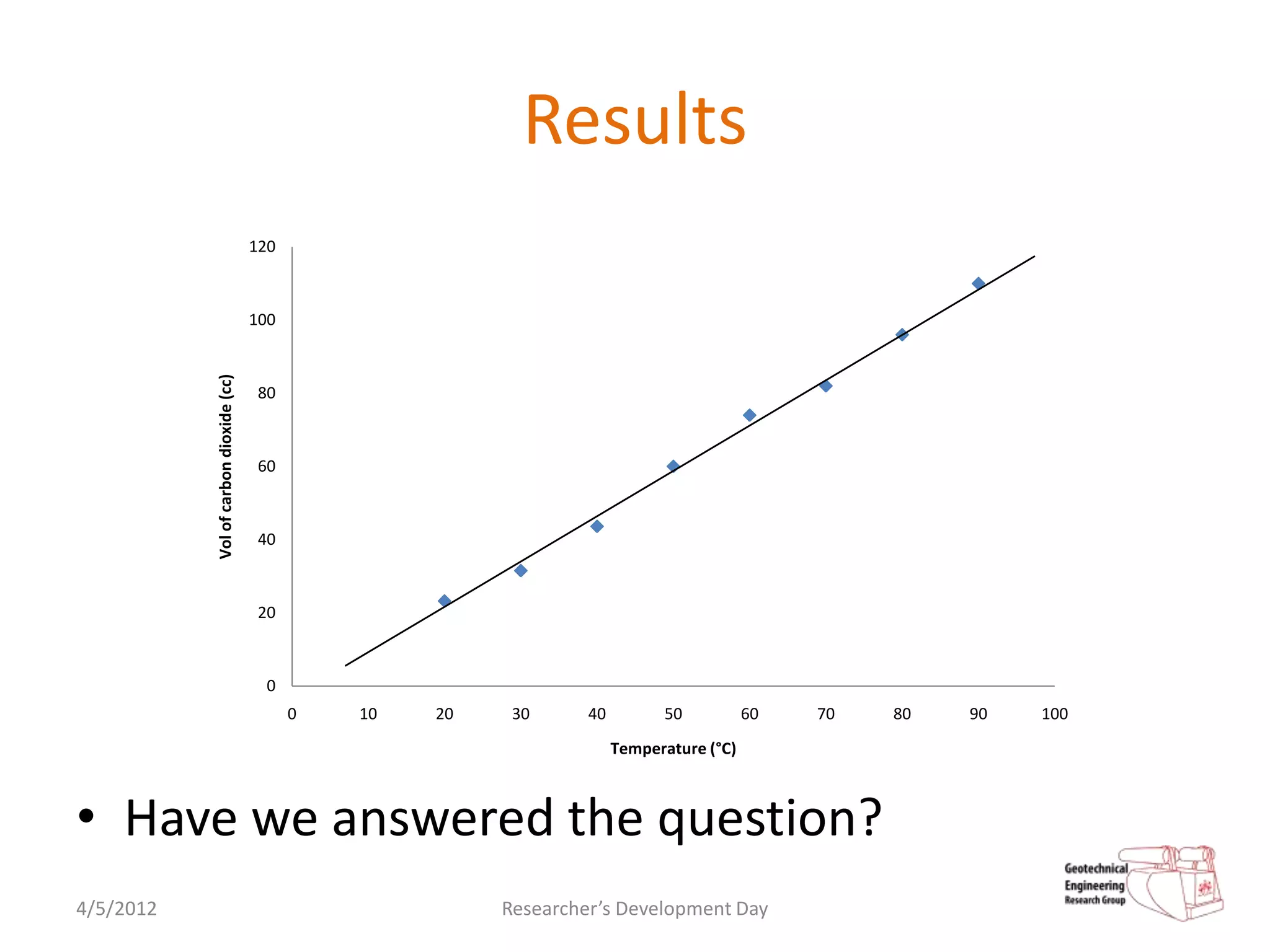
Results
                                        120


                                        100
           Vol of carbon dioxide (cc)


                                         80


                                         60


                                         40


                                         20


                                          0
                                              0   10   20    30      40         50           60   70   80   90   100
                                                                          Temperature (°C)


• Have we answered the question?
4/5/2012                                                    Researcher’s Development Day
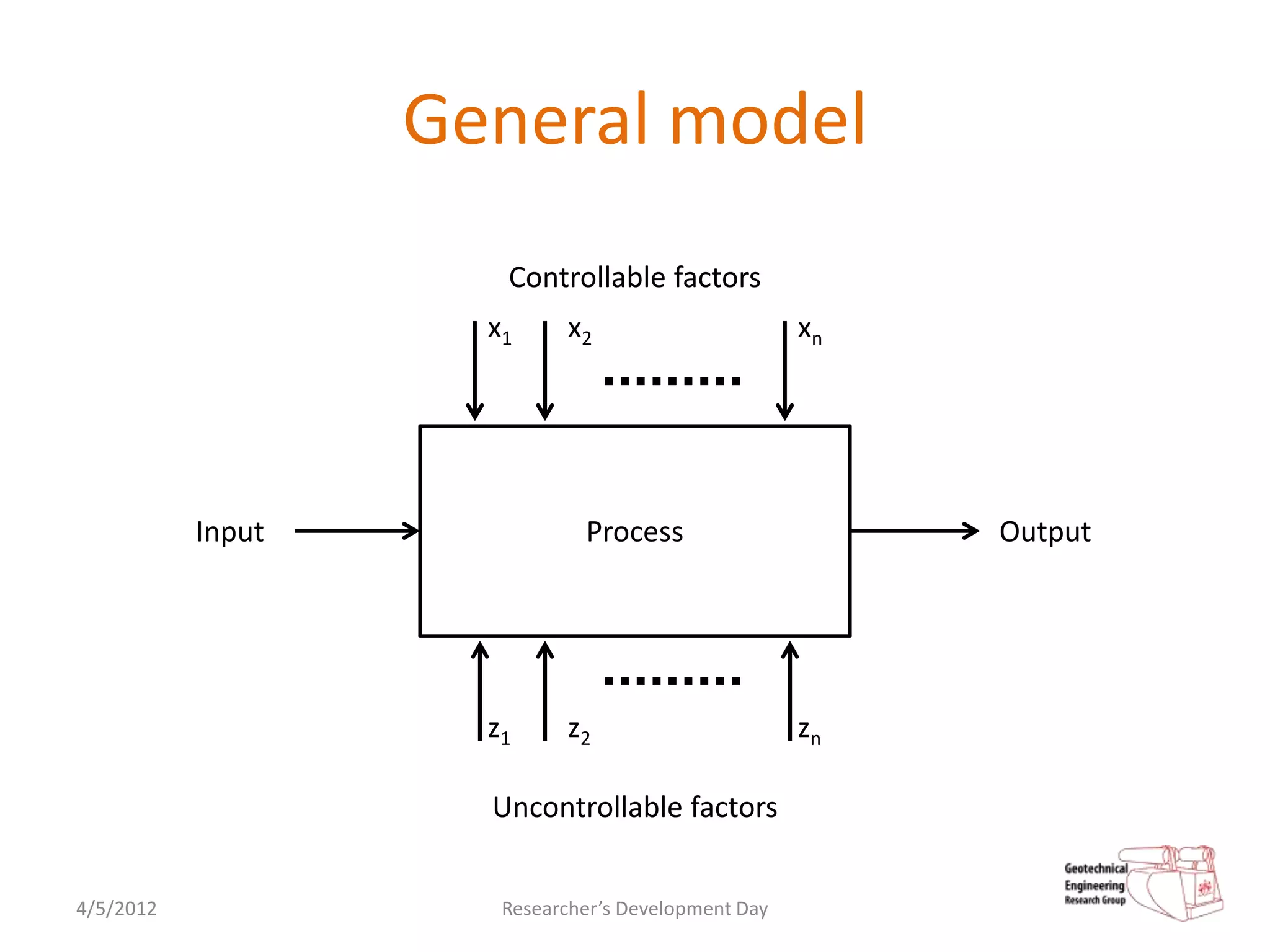
General model
                      Controllable factors
                     x1     x2                       xn


           Input              Process                     Output


                     z1     z2                       zn

                     Uncontrollable factors


4/5/2012              Researcher’s Development Day
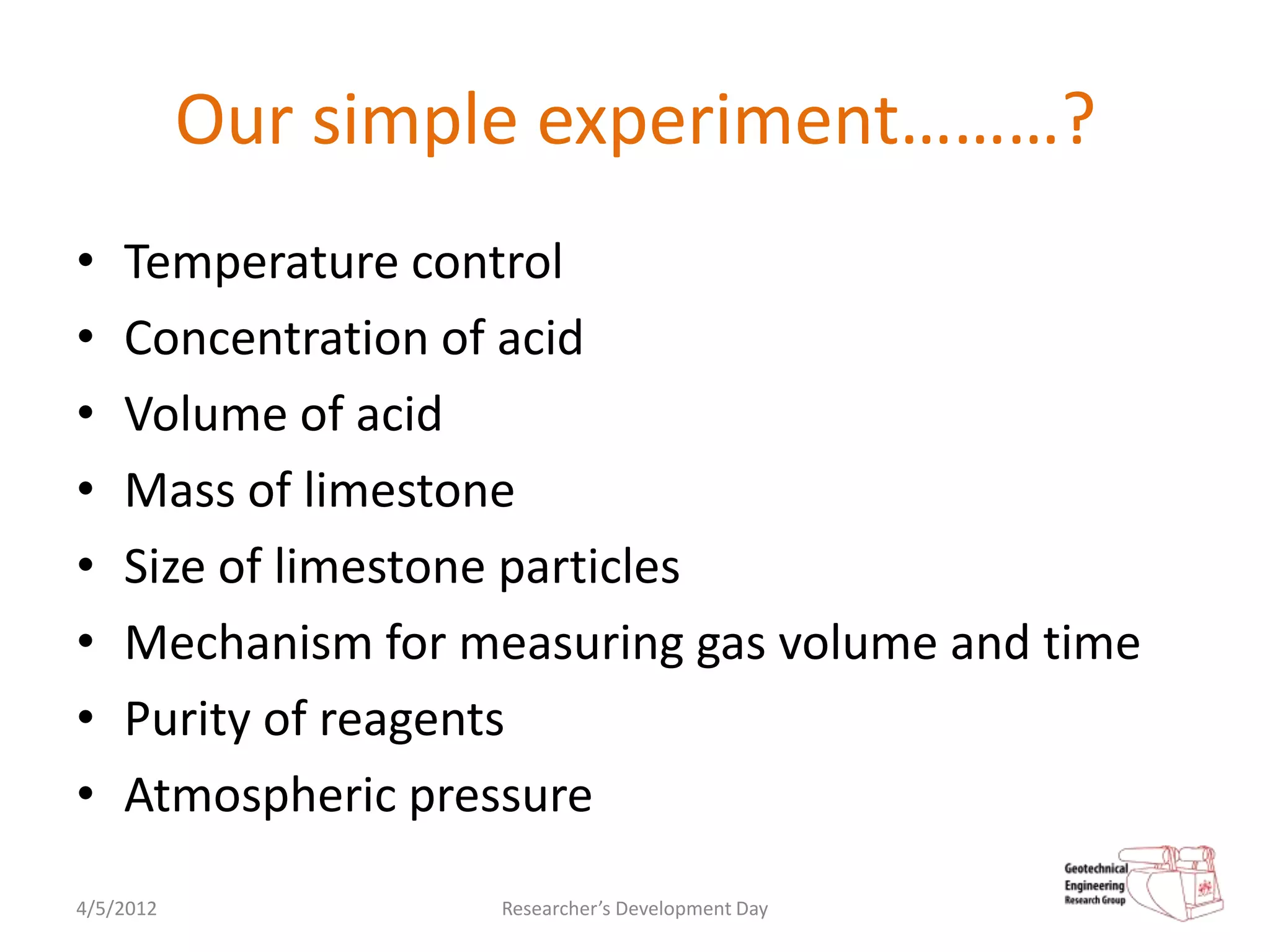
Our simple experiment………?
•   Temperature control
•   Concentration of acid
•   Volume of acid
•   Mass of limestone
•   Size of limestone particles
•   Mechanism for measuring gas volume and time
•   Purity of reagents
•   Atmospheric pressure
4/5/2012           Researcher’s Development Day
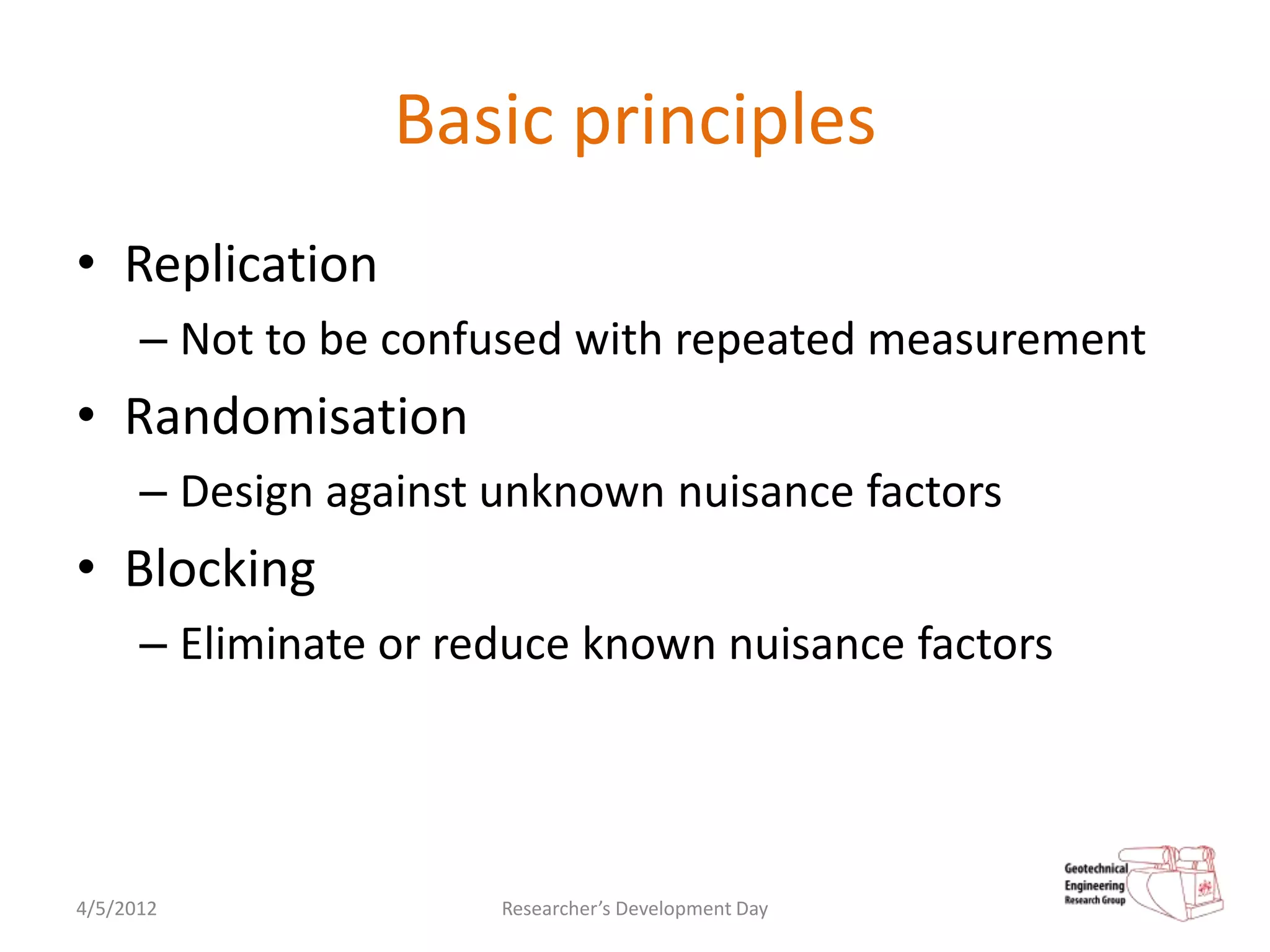
Basic principles
• Replication
      – Not to be confused with repeated measurement
• Randomisation
      – Design against unknown nuisance factors
• Blocking
      – Eliminate or reduce known nuisance factors


4/5/2012               Researcher’s Development Day
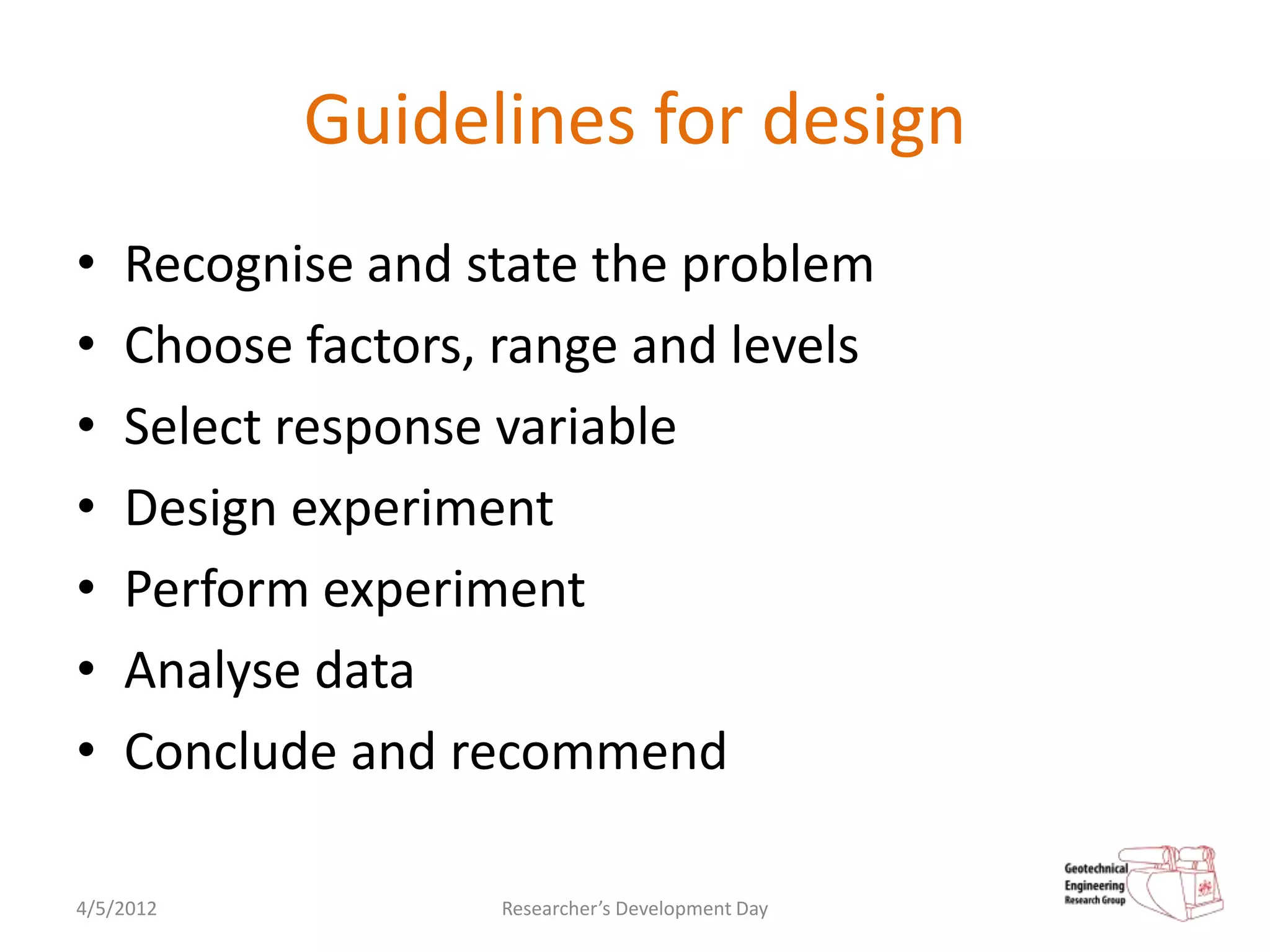
Guidelines for design
•   Recognise and state the problem
•   Choose factors, range and levels
•   Select response variable
•   Design experiment
•   Perform experiment
•   Analyse data
•   Conclude and recommend

4/5/2012            Researcher’s Development Day
Things to note
• Keep the design and analysis as simple as
  possible
• Practical vs statistical significance
• Experiments are iterative and repetitive


4/5/2012          Researcher’s Development Day
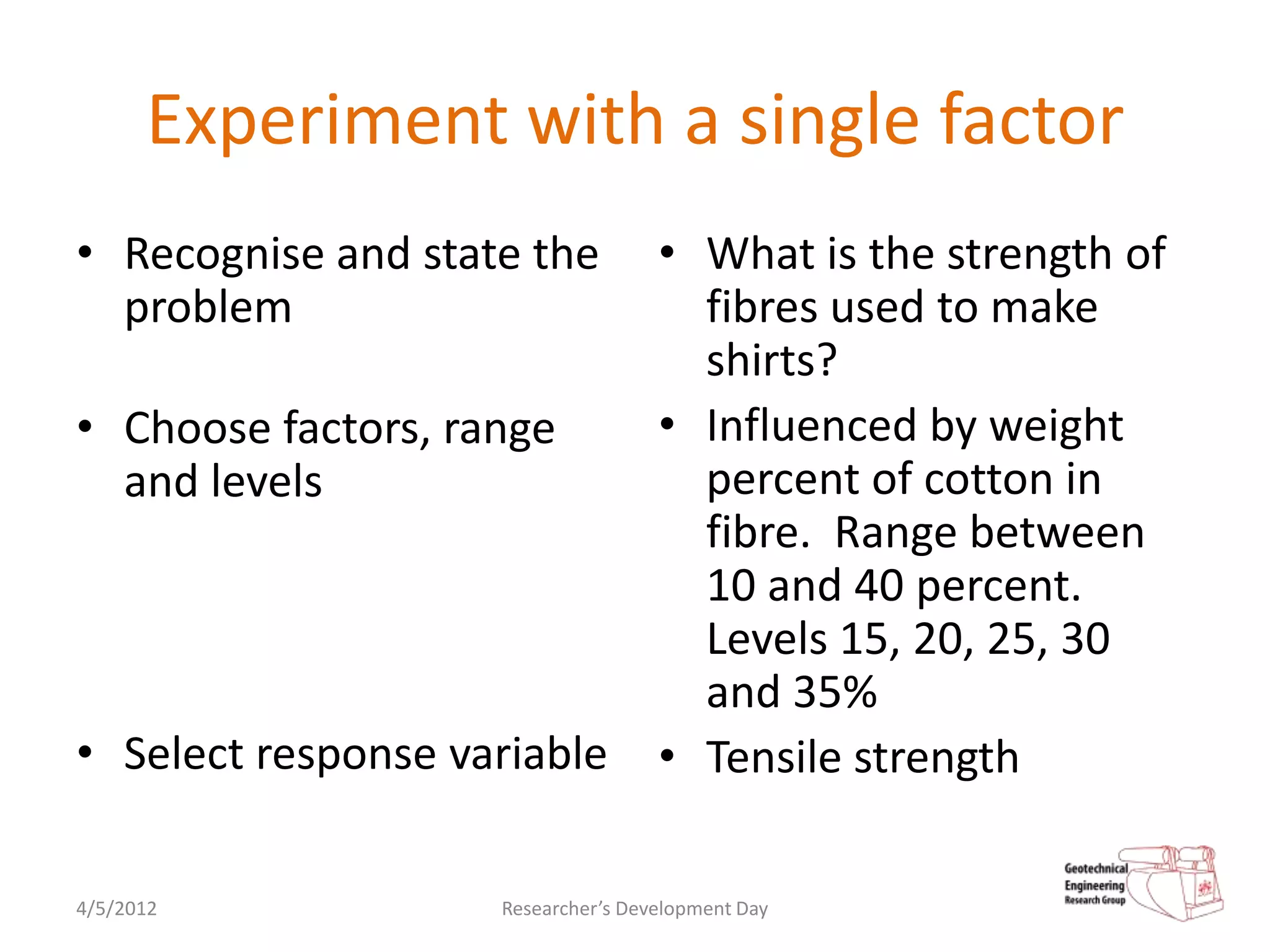
Experiment with a single factor
• Recognise and state the           • What is the strength of
  problem                             fibres used to make
                                      shirts?
• Choose factors, range             • Influenced by weight
  and levels                          percent of cotton in
                                      fibre. Range between
                                      10 and 40 percent.
                                      Levels 15, 20, 25, 30
                                      and 35%
• Select response variable          • Tensile strength

4/5/2012            Researcher’s Development Day
Design experiment
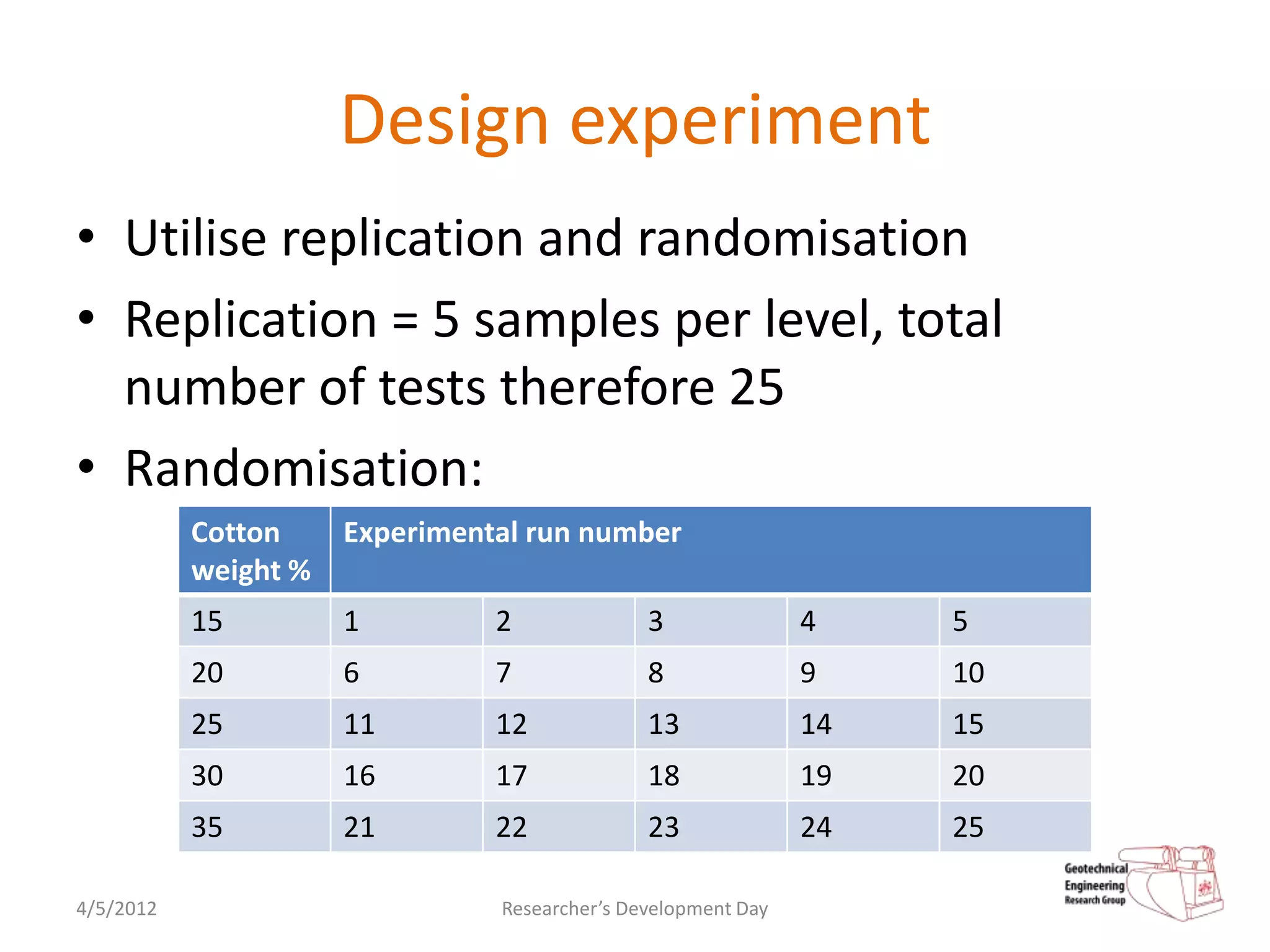
• Utilise replication and randomisation
• Replication = 5 samples per level, total
  number of tests therefore 25
• Randomisation:
           Cotton     Experimental run number
           weight %
           15         1         2              3               4    5
           20         6         7              8               9    10
           25         11        12             13              14   15
           30         16        17             18              19   20
           35         21        22             23              24   25

4/5/2012                        Researcher’s Development Day
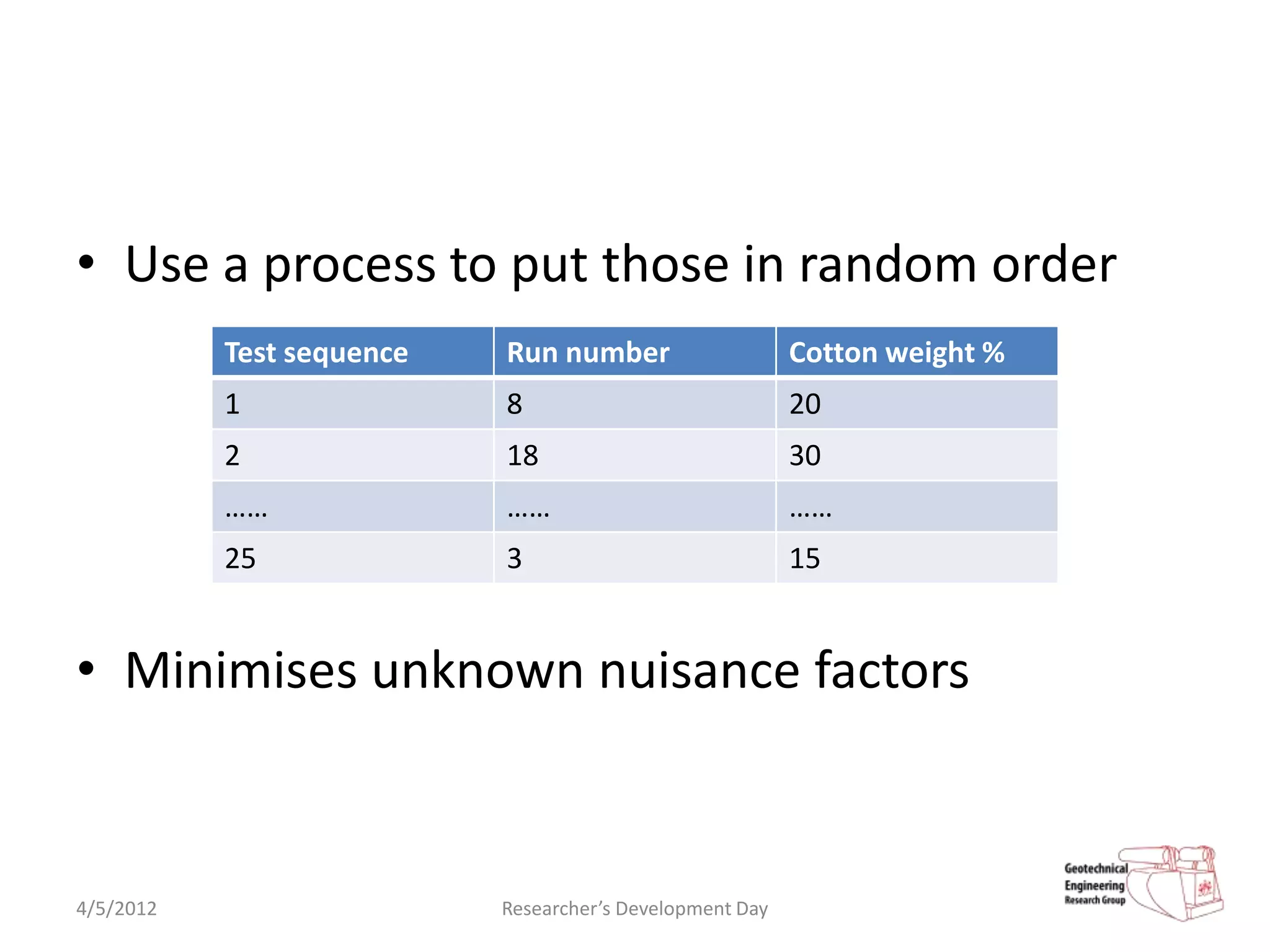
• Use a process to put those in random order
           Test sequence   Run number                     Cotton weight %
           1               8                              20
           2               18                             30
           ……              ……                             ……
           25              3                              15


• Minimises unknown nuisance factors


4/5/2012                   Researcher’s Development Day
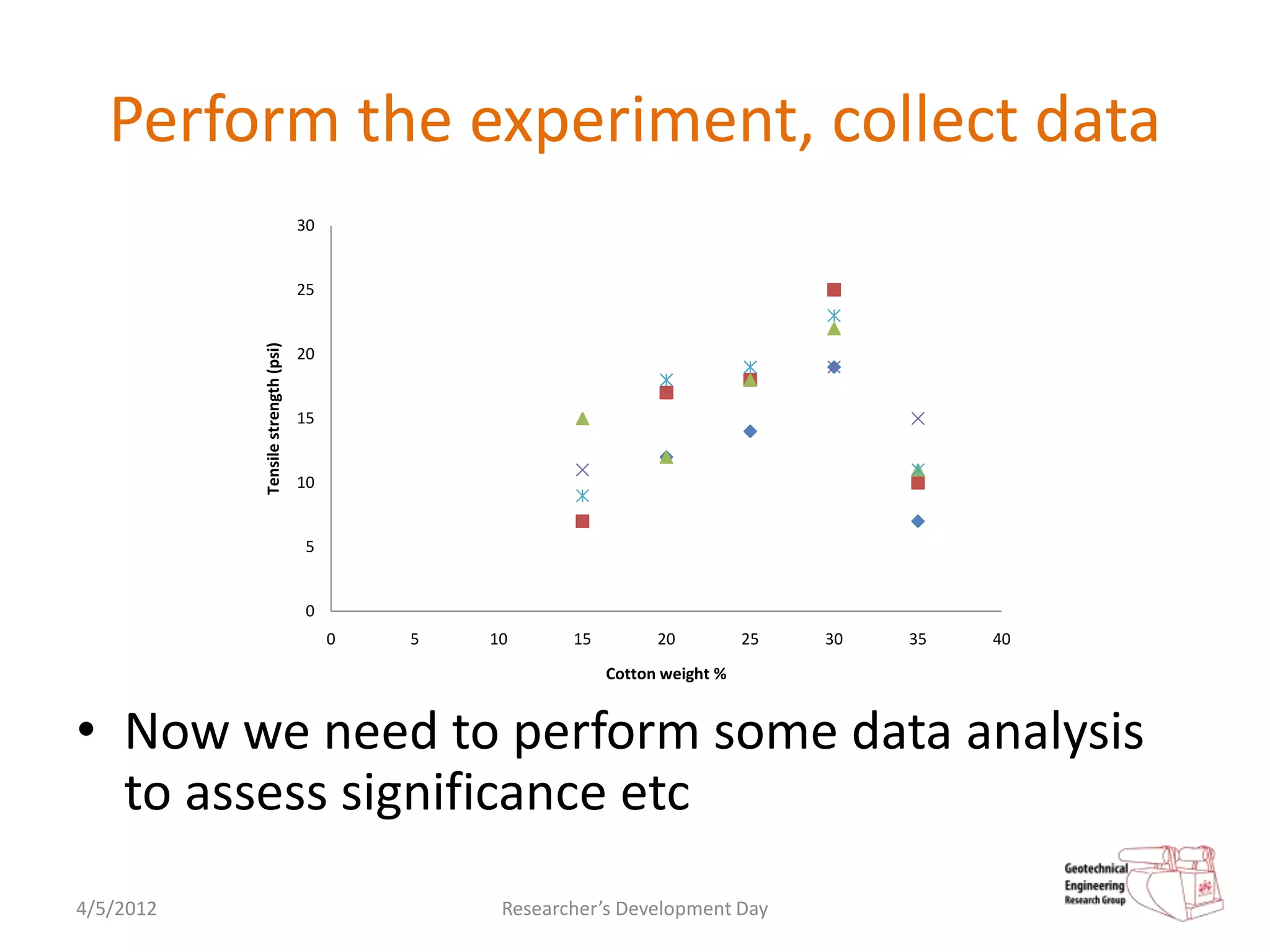
Perform the experiment, collect data
                                    30


                                    25
           Tensile strength (psi)


                                    20


                                    15


                                    10


                                     5


                                     0
                                         0   5   10      15         20          25   30   35   40
                                                              Cotton weight %


• Now we need to perform some data analysis
  to assess significance etc
4/5/2012                                          Researcher’s Development Day
Summary
• Performing an experiment is maybe not so
  straightforward as it seems?
• Careful planning will minimise:
      – Inaccuracy
      – Time wasted
• Some level of statistical analysis will be
  required to prove or disprove your hypothesis


4/5/2012              Researcher’s Development Day

Experimental design

  • 1.
    Experimental design Dr Richard Goodey SEMS 4/5/2012 Researcher’s Development Day
  • 2.
    What is anexperiment? • A test – To find out something about a process – More specifically, usually a series of tests • Something we do all the time in our everyday lives • In this context, most relevant to physical and social sciences • In these fields, most PhD candidates and researchers do some sort of experiment 4/5/2012 Researcher’s Development Day
  • 3.
    A simple example •What is the effect of temperature on the rate of reaction between limestone and acid? • 2HCl + CaCO3 -> CaCl2 + H2O + CO2 • So this should be simple? • Add limestone to acid, measure the volume of gas produced in one minute (e.g.) 4/5/2012 Researcher’s Development Day
  • 4.
    Results 120 100 Vol of carbon dioxide (cc) 80 60 40 20 0 0 10 20 30 40 50 60 70 80 90 100 Temperature (°C) • Have we answered the question? 4/5/2012 Researcher’s Development Day
  • 5.
    General model Controllable factors x1 x2 xn Input Process Output z1 z2 zn Uncontrollable factors 4/5/2012 Researcher’s Development Day
  • 6.
    Our simple experiment………? • Temperature control • Concentration of acid • Volume of acid • Mass of limestone • Size of limestone particles • Mechanism for measuring gas volume and time • Purity of reagents • Atmospheric pressure 4/5/2012 Researcher’s Development Day
  • 7.
    Basic principles • Replication – Not to be confused with repeated measurement • Randomisation – Design against unknown nuisance factors • Blocking – Eliminate or reduce known nuisance factors 4/5/2012 Researcher’s Development Day
  • 8.
    Guidelines for design • Recognise and state the problem • Choose factors, range and levels • Select response variable • Design experiment • Perform experiment • Analyse data • Conclude and recommend 4/5/2012 Researcher’s Development Day
  • 9.
    Things to note •Keep the design and analysis as simple as possible • Practical vs statistical significance • Experiments are iterative and repetitive 4/5/2012 Researcher’s Development Day
  • 10.
    Experiment with asingle factor • Recognise and state the • What is the strength of problem fibres used to make shirts? • Choose factors, range • Influenced by weight and levels percent of cotton in fibre. Range between 10 and 40 percent. Levels 15, 20, 25, 30 and 35% • Select response variable • Tensile strength 4/5/2012 Researcher’s Development Day
  • 11.
    Design experiment • Utilisereplication and randomisation • Replication = 5 samples per level, total number of tests therefore 25 • Randomisation: Cotton Experimental run number weight % 15 1 2 3 4 5 20 6 7 8 9 10 25 11 12 13 14 15 30 16 17 18 19 20 35 21 22 23 24 25 4/5/2012 Researcher’s Development Day
  • 12.
    • Use aprocess to put those in random order Test sequence Run number Cotton weight % 1 8 20 2 18 30 …… …… …… 25 3 15 • Minimises unknown nuisance factors 4/5/2012 Researcher’s Development Day
  • 13.
    Perform the experiment,collect data 30 25 Tensile strength (psi) 20 15 10 5 0 0 5 10 15 20 25 30 35 40 Cotton weight % • Now we need to perform some data analysis to assess significance etc 4/5/2012 Researcher’s Development Day
  • 14.
    Summary • Performing anexperiment is maybe not so straightforward as it seems? • Careful planning will minimise: – Inaccuracy – Time wasted • Some level of statistical analysis will be required to prove or disprove your hypothesis 4/5/2012 Researcher’s Development Day