WELCOME
TO
WORKSHOP
ON
EXPLORING SOCIAL AND GENDER DYNAMICS OF
MIGRATION IN RICE-BASED SYSTEMS IN SOUTH ASIA
Md. Sahed Khan
17-20 June 2019
ISARC, Varanasi
Presentation and discussion
■ Perspectives from Bangladesh
Women in Bangladesh Agriculture
■ Almost 13 million farm families of the country grow rice [Bangladesh Rice Knowledge Bank]
■ Agriculture provides employment to largest share of rural population (54.1%), women
– Constitute 76.7% of farming population (43.9% men) [Quarterly labour force Survey (2015-16) of
BBS]
– Women’s participation has increased & are dominating the sector
■ Doing harvesting, tilling, irrigation and others works outside their homes
■ Besides caring for crop fields, crop sorting and processing, storing, irrigation, harvesting and some other related
works, women are also participating in core cultivation with males
– [https://www.daily-sun.com/printversion/details/277579/Women-make-a-change-in-agri-sector]
– Contribute considerably to household income through farm and homestead production and wage labor
■ A highly patriarchal society with high gender discrimination at all levels
■ Women struggled a lot and mostly failed in demanding and controlling their
deserved rights in family, society and in the state
– due to the domination of their male counterparts in this patriarchal society
Political Ecology Framework
Dimensions Resource Ownership Capacity Building Research & Development
Household •Nature of accessibility by people of
different layers within household i.e.,
oHusband and wife
oYoung and Old-age group
oWidowed member
oOther family interactions
•Increased knowledge and enhanced self-
confidence
•Consciousness orientation
•Able to identify and articulate information and
technology needs
•Enhanced access to services provided by GOs
and NGOs
•Membership (GO & NGO)
•Development of a range of affordable and
appropriate technologies that meet women’s
needs in agricultural production, post-
harvesting & household tasks, reduce
drudgery & save time
Community •Availability, adequacy &
accessibility by people of different
layers like
oMen and women
oRich and poor
oModerate and Extreme poor
oFarmers and Non-farmers
oOther interactions
•Educate community leaders, government officials
and local leaders regarding the importance of
gender responsive and participatory approaches
•Train government and other officials involved in
rural development in gender analysis and gender
mainstreaming
•Development of a gender and sex-
disaggregated database (using inputs from
GOs, NGOs and communities)
•Support to decision-makers by assisting
identification, planning and targeting of
gender-sensitive interventions, including
technology development and delivery
Market •Create and regularly update
organizational directories to improve
knowledge about the roles of actors
in technology development and
delivery
•Agricultural value chain involvement
•Gender-responsive consciousness orientation
•[Gender based] Farmers’ cooperative
•Mechanisms to bring stability on
information accessibility
oPricing policy
oCredit policy
oTrading policy
State •Policies and strategies for attaining
gender equality
•Gender based equal accessibility to
resources
•Equality in resource ownership
•Inter-sectoral partnership
•Policies and strategies for promoting awareness
•Self-worth and self-reliance
•Provide support to stakeholders to develop
appropriate gender-responsive technologies
for agricultural production, processing and
household tasks
•Entrepreneurship for all
4
Agriculture-gender-livelihood nexus
■ Impacts of the Green Revolution package have boomeranged negatively
– a vast majority (more than 60%) as capital-deficit, poor and marginal farmers with
fragmented land holdings
■ For decades, September-October has persisted as the dreaded “Monga”
period (also known as ‘Dead October’)
– a severe food insecurity; distress-sale of livestock, land and household assets.
■ Initiatives slightly facilitated coping during high-stress periods
■ Increased agricultural productivity gains didn’t proceeded to the majorities (65-70%) – the
Landless
■ Gendered dimensions of land ownership are even more debilitating
– Very few women were able to or wanted to exercise this right in their socio-cultural
context
– Owning land implies breaking social ties & bonds - often critical support networks
women
Agriculture and policy distance: A
paradox
■ Steady continued agrarian growth and productivity in Bangladesh is
commendable – but it masks many broken stories and experiences
 Landlessness
 Land fragmentation
 Distress sale of land
 Gendered disparities in land ownership
 Agriculture decision-making and
 Distress pull-out from agriculture of the most vulnerable
■ The “policy distance” persists
– Most peripheral regions presents a paradox of being too far away from
capital city [Dhaka], (nerve centre of policy, decision-making and
politics)
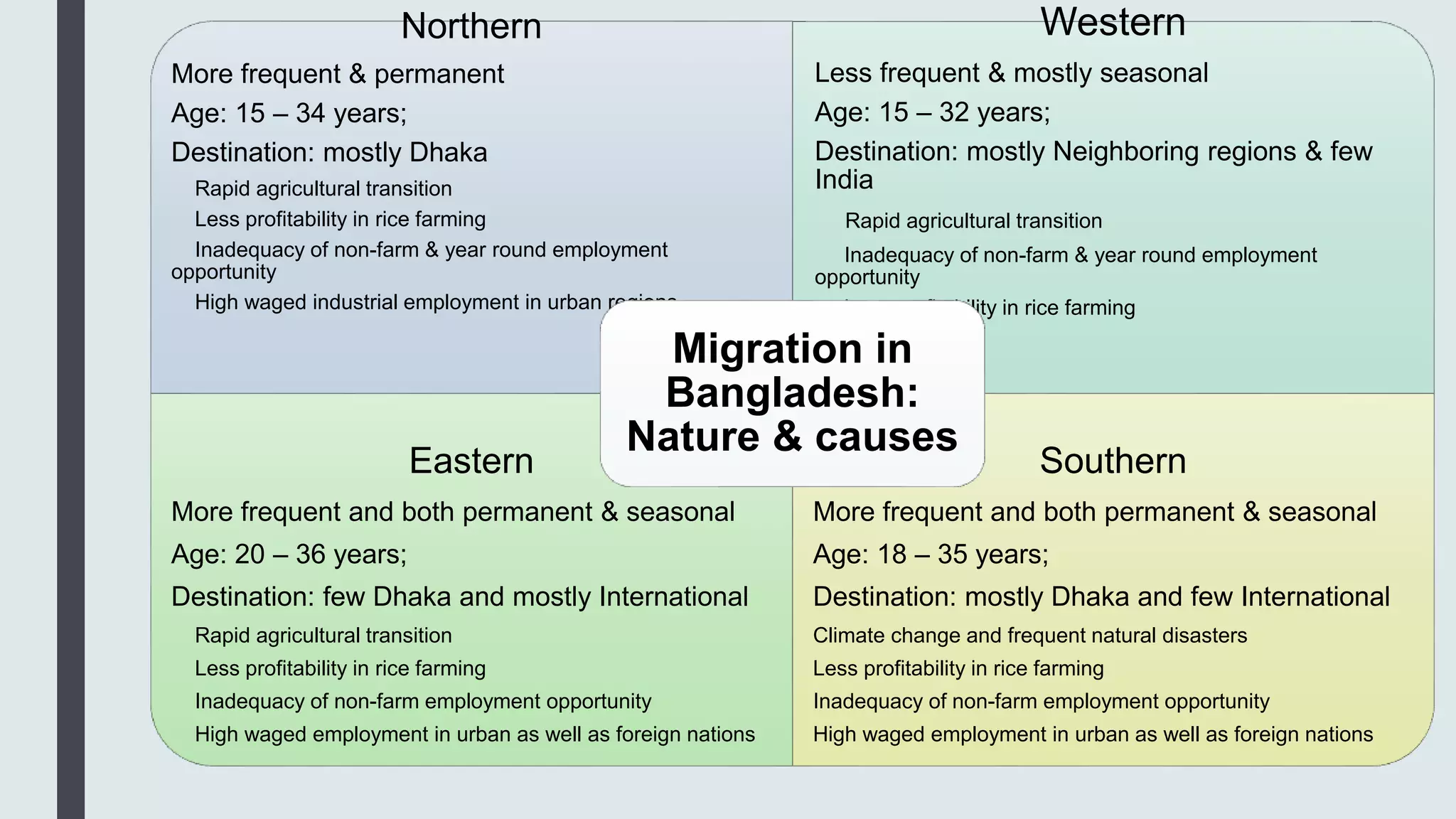
Northern
More frequent & permanent
Age: 15 – 34 years;
Destination: mostly Dhaka
Rapid agricultural transition
Less profitability in rice farming
Inadequacy of non-farm & year round employment
opportunity
High waged industrial employment in urban regions
Western
Less frequent & mostly seasonal
Age: 15 – 32 years;
Destination: mostly Neighboring regions & few
India
Rapid agricultural transition
Inadequacy of non-farm & year round employment
opportunity
Less profitability in rice farming
Eastern
More frequent and both permanent & seasonal
Age: 20 – 36 years;
Destination: few Dhaka and mostly International
Rapid agricultural transition
Less profitability in rice farming
Inadequacy of non-farm employment opportunity
High waged employment in urban as well as foreign nations
Southern
More frequent and both permanent & seasonal
Age: 18 – 35 years;
Destination: mostly Dhaka and few International
Climate change and frequent natural disasters
Less profitability in rice farming
Inadequacy of non-farm employment opportunity
High waged employment in urban as well as foreign nations
Migration in
Bangladesh:
Nature & causes
Profile of migrants to Capital
■ Around 50% migrants in Dhaka city
– Had only one year of schooling
– Were engaged as agricultural workers and landless
– Were extreme poor and destitute
– Settled in slums
– Every three of five got their jobs within one week (Afsar, 1999)
Afsar; Kamala Gurung; Humnath Bhandari; Thelma Paris (2016)
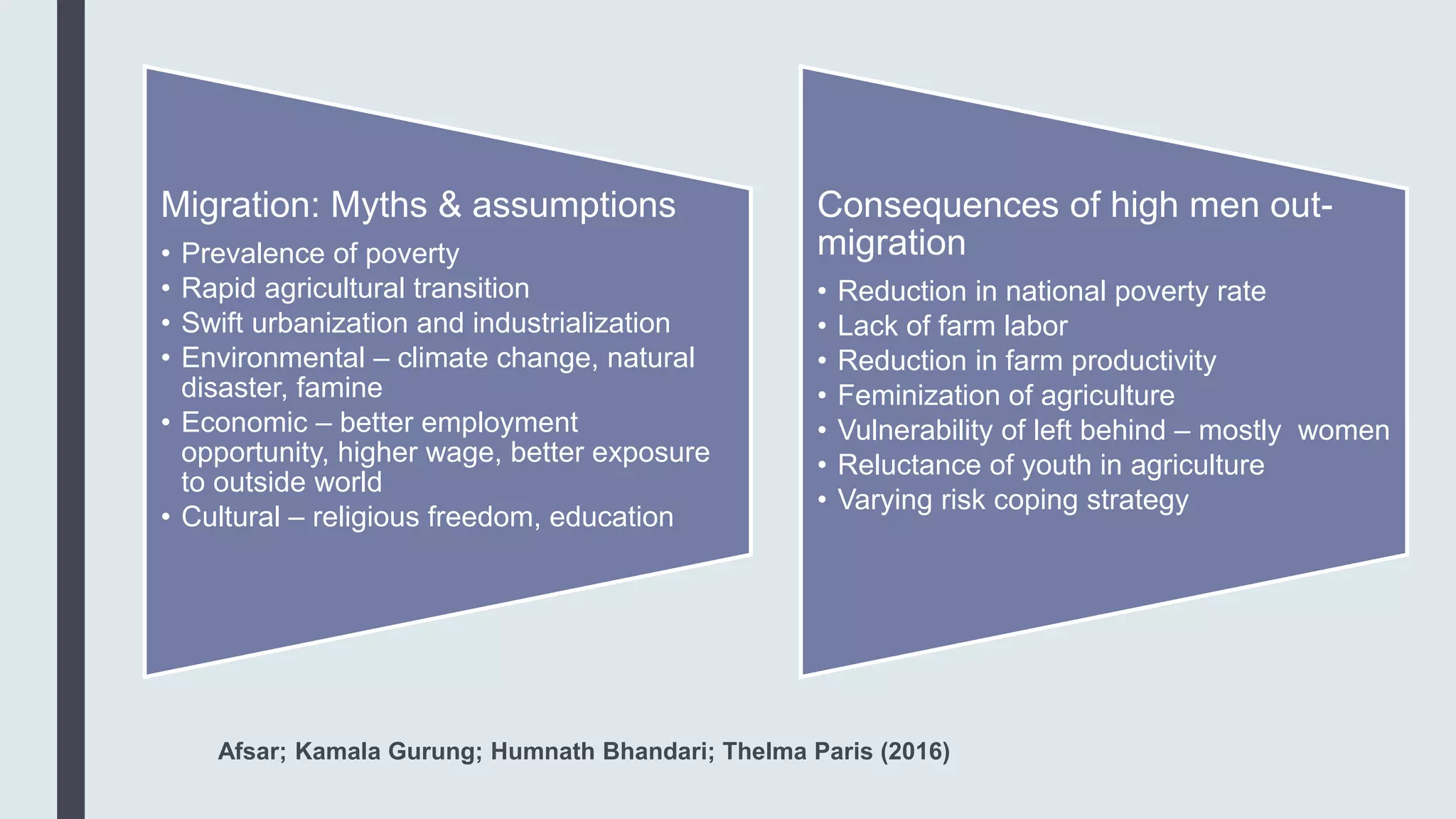
Migration: Myths & assumptions
• Prevalence of poverty
• Rapid agricultural transition
• Swift urbanization and industrialization
• Environmental – climate change, natural
disaster, famine
• Economic – better employment
opportunity, higher wage, better exposure
to outside world
• Cultural – religious freedom, education
Consequences of high men out-
migration
• Reduction in national poverty rate
• Lack of farm labor
• Reduction in farm productivity
• Feminization of agriculture
• Vulnerability of left behind – mostly women
• Reluctance of youth in agriculture
• Varying risk coping strategy
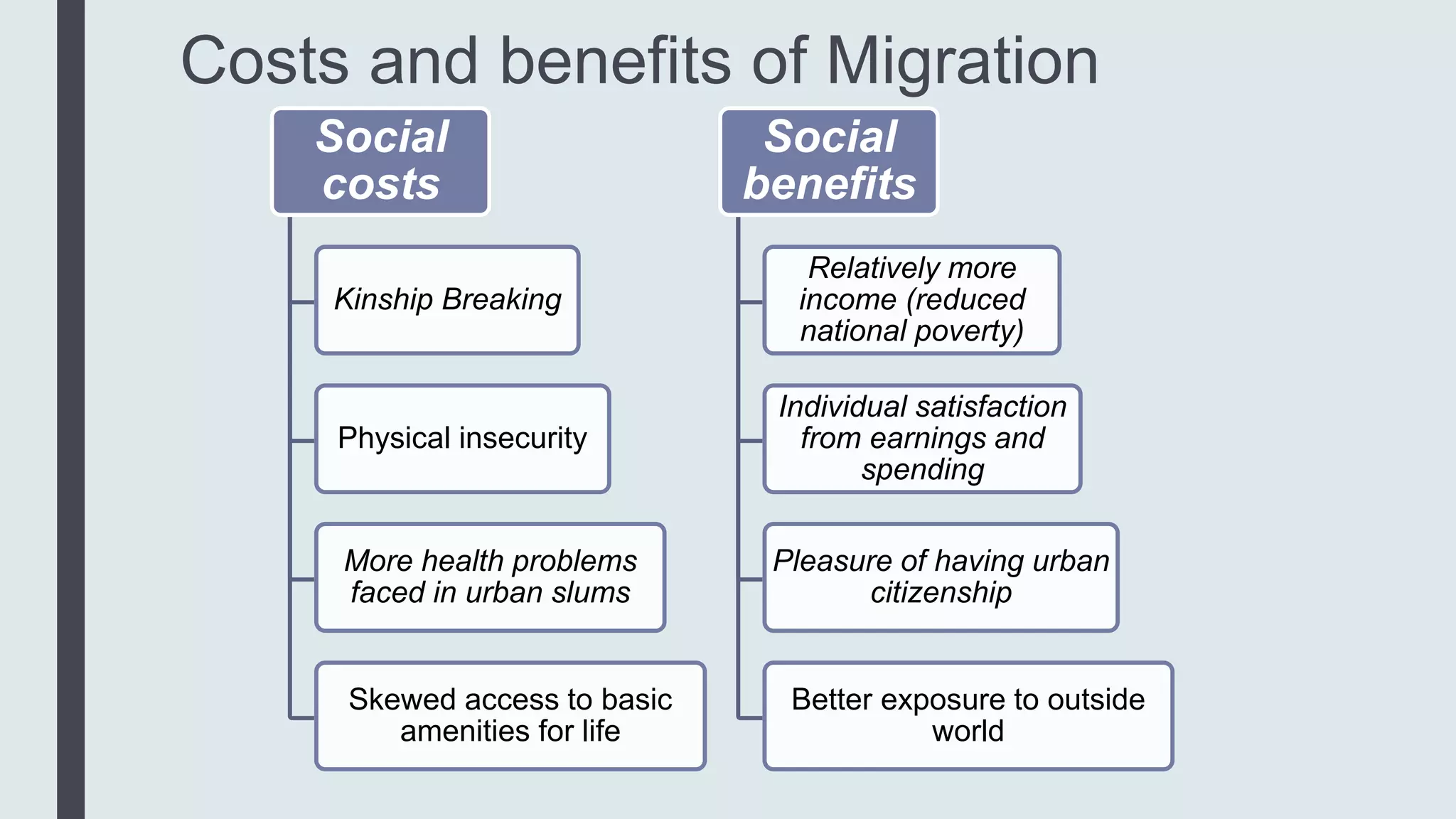
Social
costs
Kinship Breaking
Physical insecurity
More health problems
faced in urban slums
Skewed access to basic
amenities for life
Social
benefits
Relatively more
income (reduced
national poverty)
Individual satisfaction
from earnings and
spending
Pleasure of having urban
citizenship
Better exposure to outside
world
Costs and benefits of Migration
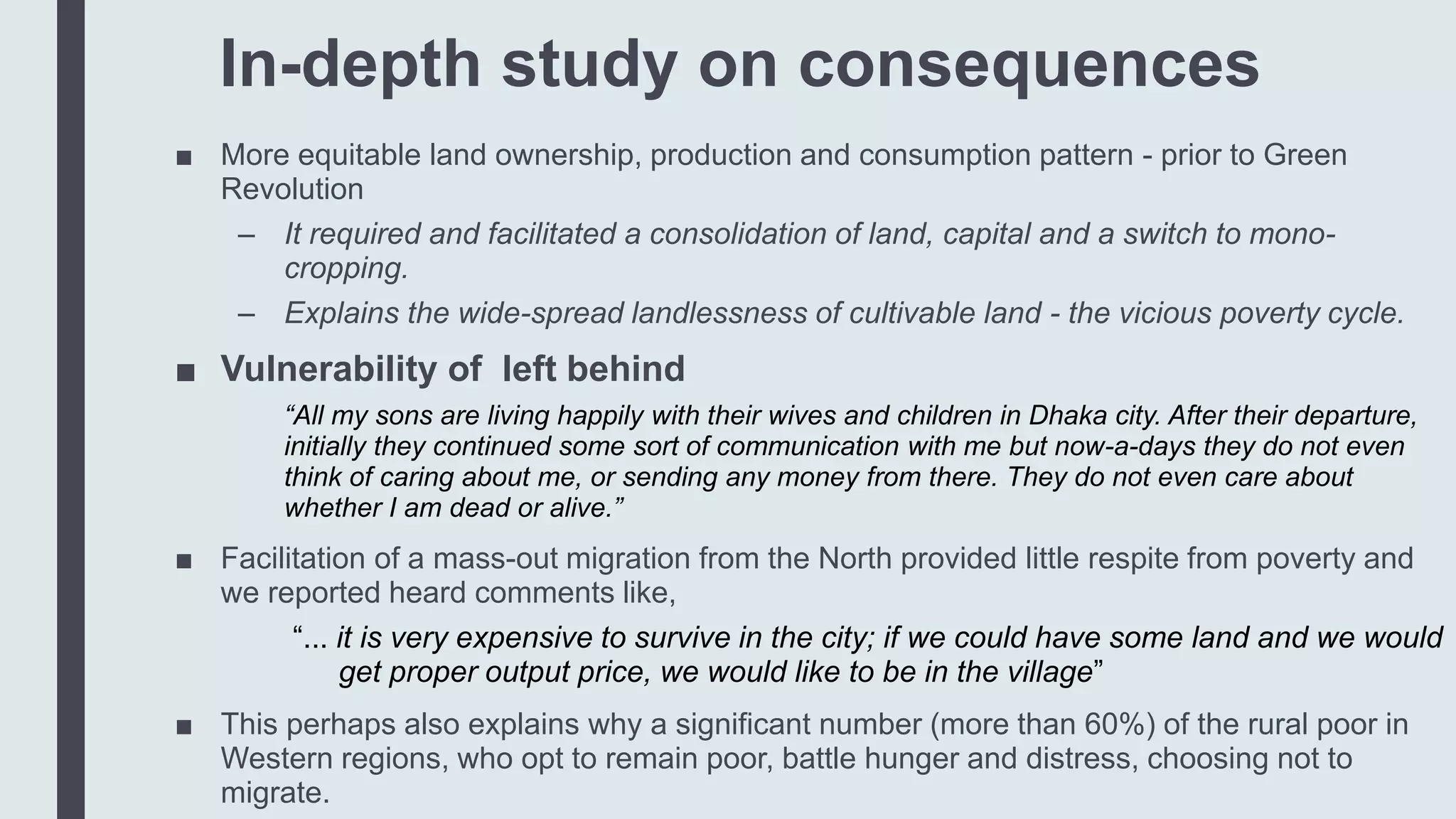
In-depth study on consequences
■ More equitable land ownership, production and consumption pattern - prior to Green
Revolution
– It required and facilitated a consolidation of land, capital and a switch to mono-
cropping.
– Explains the wide-spread landlessness of cultivable land - the vicious poverty cycle.
■ Vulnerability of left behind
“All my sons are living happily with their wives and children in Dhaka city. After their departure,
initially they continued some sort of communication with me but now-a-days they do not even
think of caring about me, or sending any money from there. They do not even care about
whether I am dead or alive.”
■ Facilitation of a mass-out migration from the North provided little respite from poverty and
we reported heard comments like,
“... it is very expensive to survive in the city; if we could have some land and we would
get proper output price, we would like to be in the village”
■ This perhaps also explains why a significant number (more than 60%) of the rural poor in
Western regions, who opt to remain poor, battle hunger and distress, choosing not to
migrate.
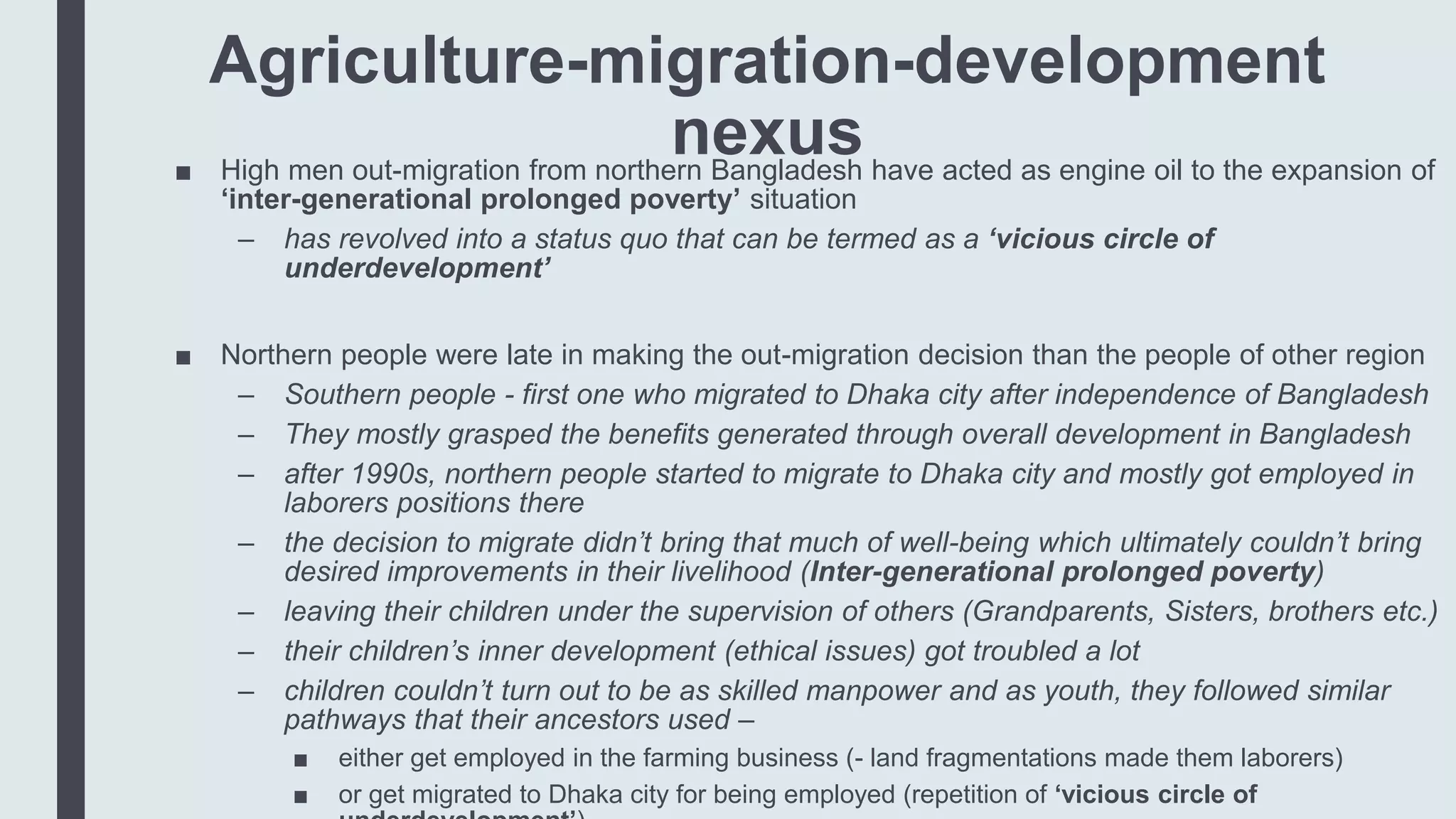
Agriculture-migration-development
nexus■ High men out-migration from northern Bangladesh have acted as engine oil to the expansion of
‘inter-generational prolonged poverty’ situation
– has revolved into a status quo that can be termed as a ‘vicious circle of
underdevelopment’
■ Northern people were late in making the out-migration decision than the people of other region
– Southern people - first one who migrated to Dhaka city after independence of Bangladesh
– They mostly grasped the benefits generated through overall development in Bangladesh
– after 1990s, northern people started to migrate to Dhaka city and mostly got employed in
laborers positions there
– the decision to migrate didn’t bring that much of well-being which ultimately couldn’t bring
desired improvements in their livelihood (Inter-generational prolonged poverty)
– leaving their children under the supervision of others (Grandparents, Sisters, brothers etc.)
– their children’s inner development (ethical issues) got troubled a lot
– children couldn’t turn out to be as skilled manpower and as youth, they followed similar
pathways that their ancestors used –
■ either get employed in the farming business (- land fragmentations made them laborers)
■ or get migrated to Dhaka city for being employed (repetition of ‘vicious circle of
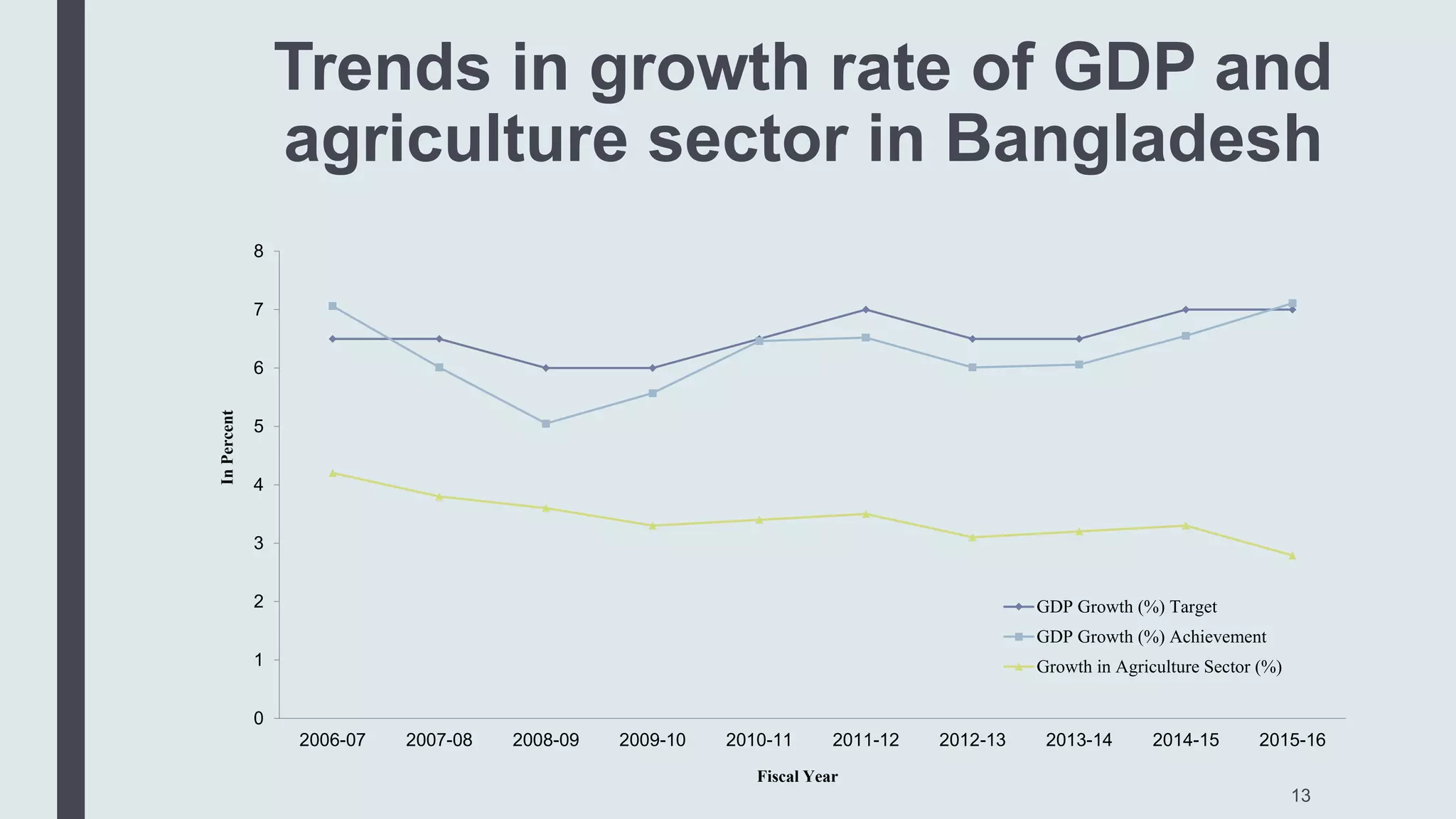
Trends in growth rate of GDP and
agriculture sector in Bangladesh
13
0
1
2
3
4
5
6
7
8
2006-07 2007-08 2008-09 2009-10 2010-11 2011-12 2012-13 2013-14 2014-15 2015-16
InPercent
Fiscal Year
GDP Growth (%) Target
GDP Growth (%) Achievement
Growth in Agriculture Sector (%)
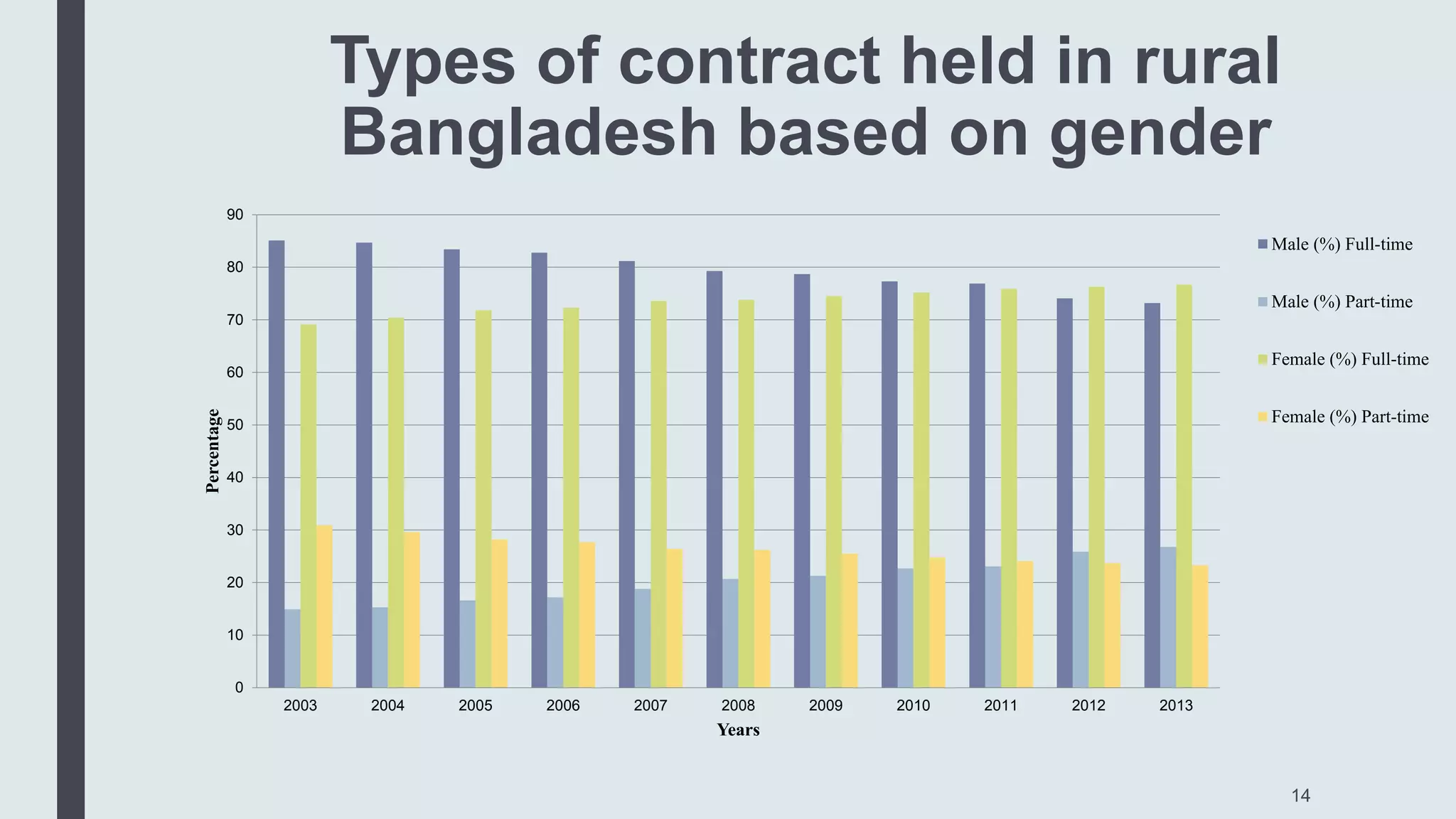
Types of contract held in rural
Bangladesh based on gender
14
0
10
20
30
40
50
60
70
80
90
2003 2004 2005 2006 2007 2008 2009 2010 2011 2012 2013
Percentage
Years
Male (%) Full-time
Male (%) Part-time
Female (%) Full-time
Female (%) Part-time
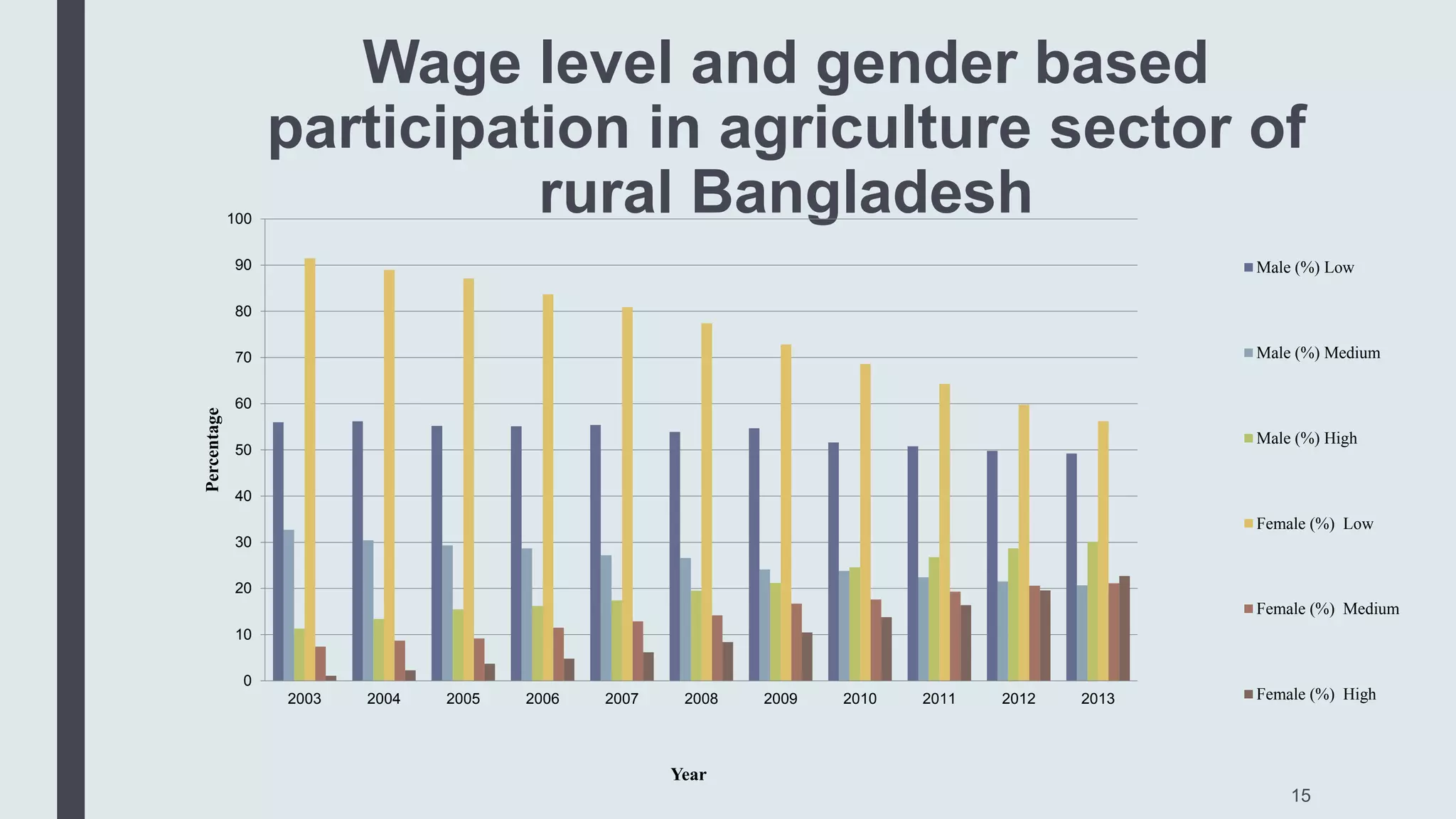
Wage level and gender based
participation in agriculture sector of
rural Bangladesh
15
0
10
20
30
40
50
60
70
80
90
100
2003 2004 2005 2006 2007 2008 2009 2010 2011 2012 2013
Percentage
Year
Male (%) Low
Male (%) Medium
Male (%) High
Female (%) Low
Female (%) Medium
Female (%) High
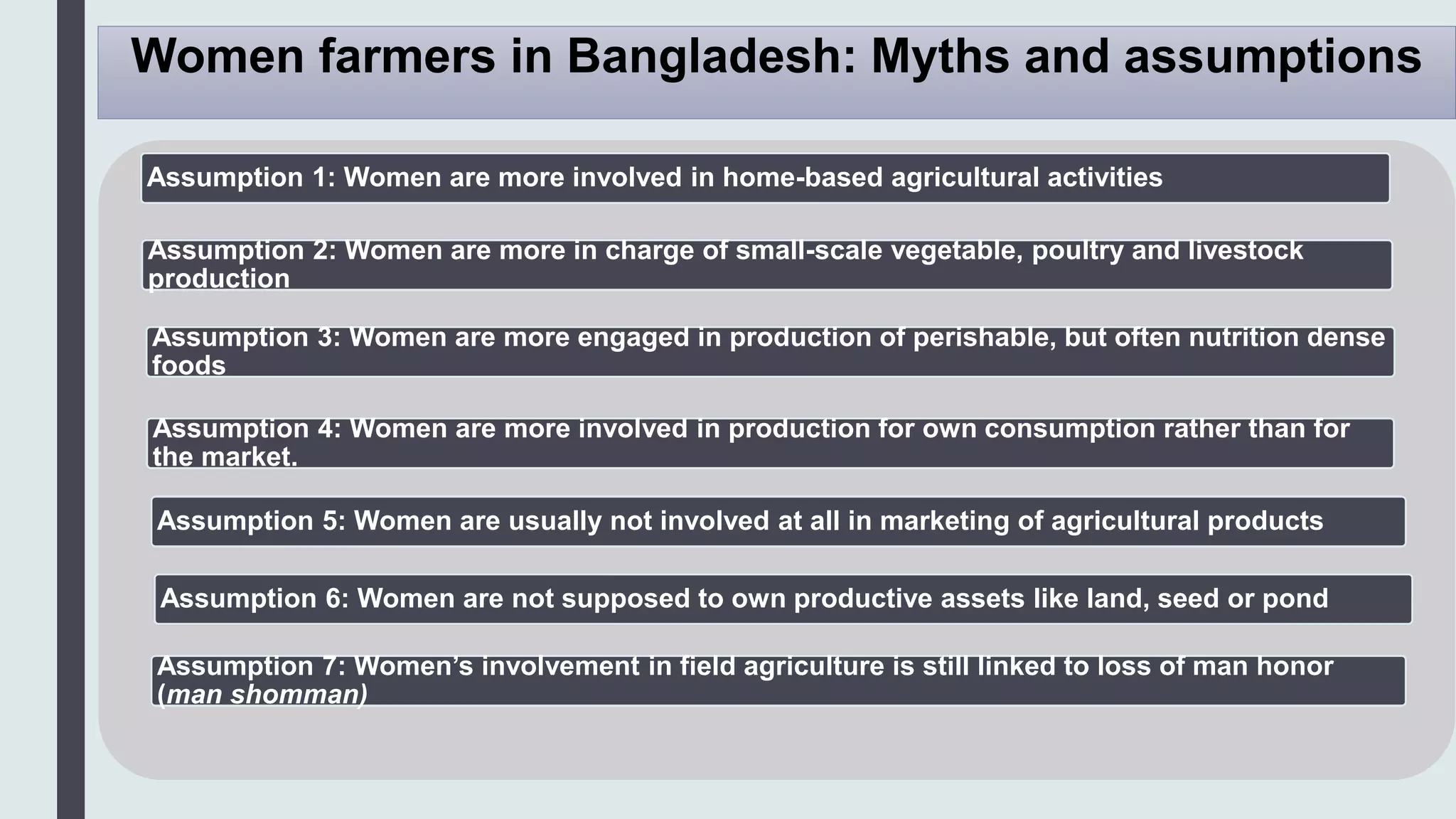
Women farmers in Bangladesh: Myths and assumptions
Assumption 1: Women are more involved in home-based agricultural activities
Assumption 2: Women are more in charge of small-scale vegetable, poultry and livestock
production
Assumption 3: Women are more engaged in production of perishable, but often nutrition dense
foods
Assumption 4: Women are more involved in production for own consumption rather than for
the market.
Assumption 5: Women are usually not involved at all in marketing of agricultural products
Assumption 6: Women are not supposed to own productive assets like land, seed or pond
Assumption 7: Women’s involvement in field agriculture is still linked to loss of man honor
(man shomman)
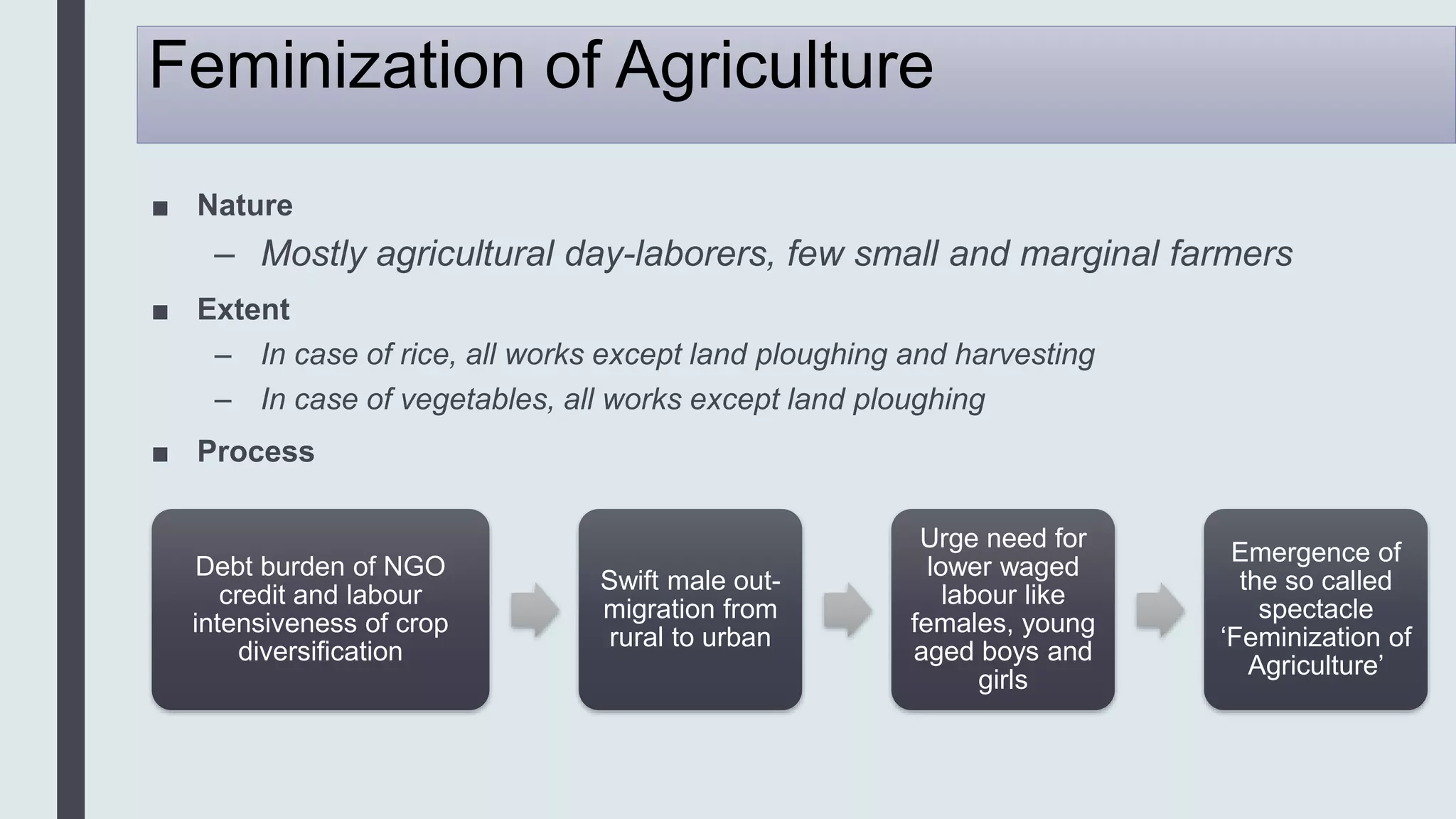
Feminization of Agriculture
■ Nature
– Mostly agricultural day-laborers, few small and marginal farmers
■ Extent
– In case of rice, all works except land ploughing and harvesting
– In case of vegetables, all works except land ploughing
■ Process
Debt burden of NGO
credit and labour
intensiveness of crop
diversification
Swift male out-
migration from
rural to urban
Urge need for
lower waged
labour like
females, young
aged boys and
girls
Emergence of
the so called
spectacle
‘Feminization of
Agriculture’
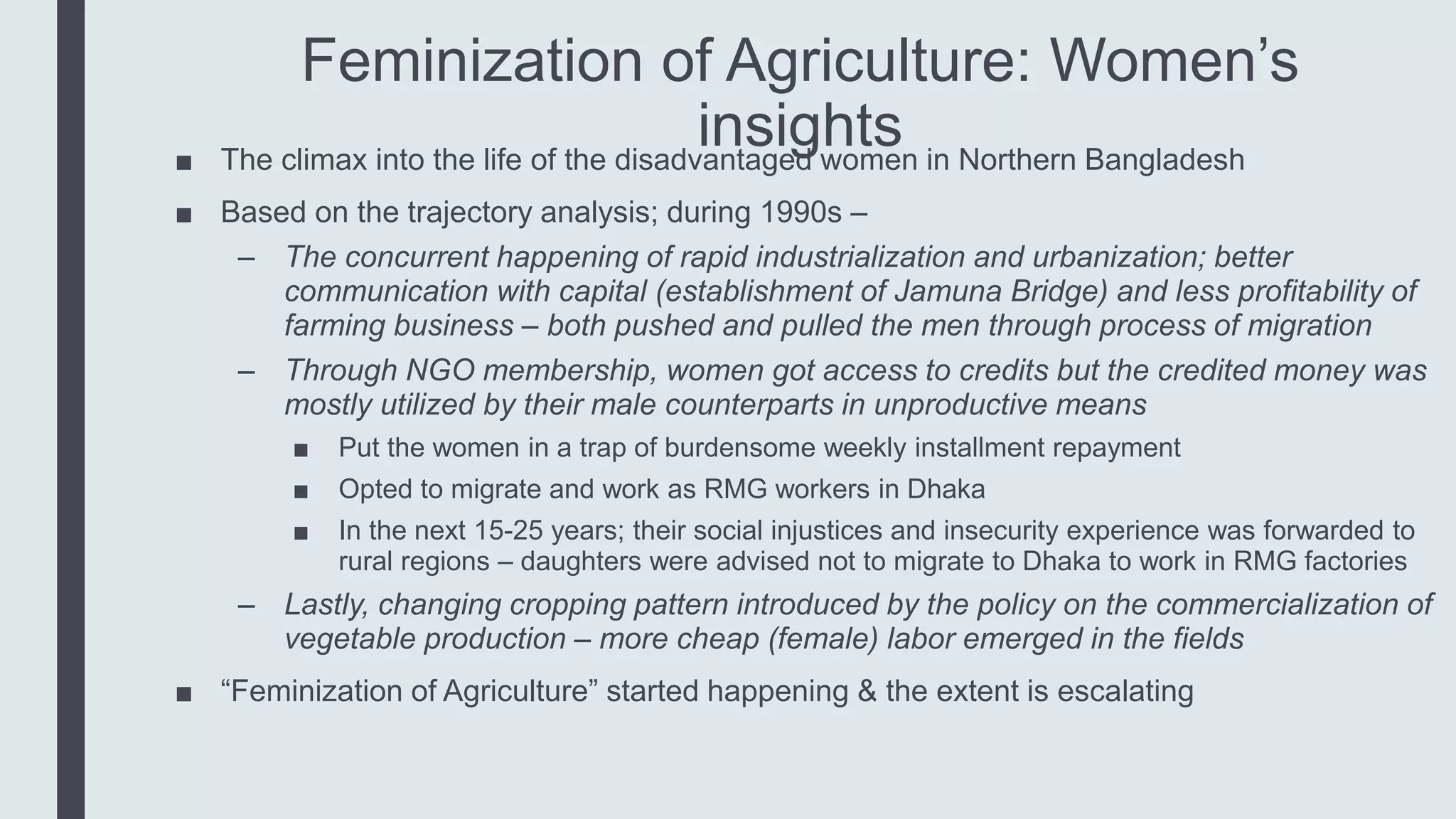
Feminization of Agriculture: Women’s
insights■ The climax into the life of the disadvantaged women in Northern Bangladesh
■ Based on the trajectory analysis; during 1990s –
– The concurrent happening of rapid industrialization and urbanization; better
communication with capital (establishment of Jamuna Bridge) and less profitability of
farming business – both pushed and pulled the men through process of migration
– Through NGO membership, women got access to credits but the credited money was
mostly utilized by their male counterparts in unproductive means
■ Put the women in a trap of burdensome weekly installment repayment
■ Opted to migrate and work as RMG workers in Dhaka
■ In the next 15-25 years; their social injustices and insecurity experience was forwarded to
rural regions – daughters were advised not to migrate to Dhaka to work in RMG factories
– Lastly, changing cropping pattern introduced by the policy on the commercialization of
vegetable production – more cheap (female) labor emerged in the fields
■ “Feminization of Agriculture” started happening & the extent is escalating
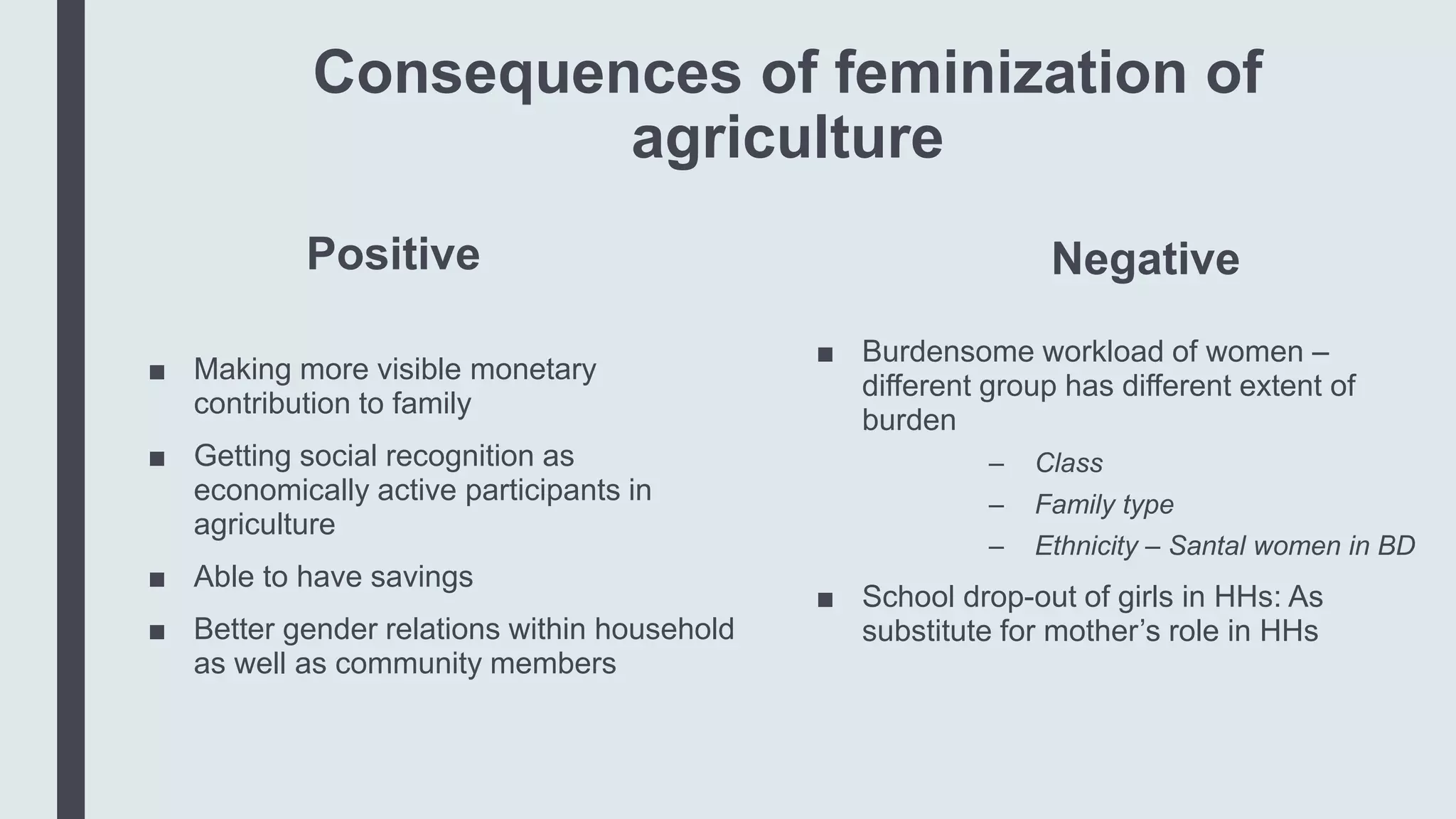
Consequences of feminization of
agriculture
Positive
■ Making more visible monetary
contribution to family
■ Getting social recognition as
economically active participants in
agriculture
■ Able to have savings
■ Better gender relations within household
as well as community members
Negative
■ Burdensome workload of women –
different group has different extent of
burden
– Class
– Family type
– Ethnicity – Santal women in BD
■ School drop-out of girls in HHs: As
substitute for mother’s role in HHs
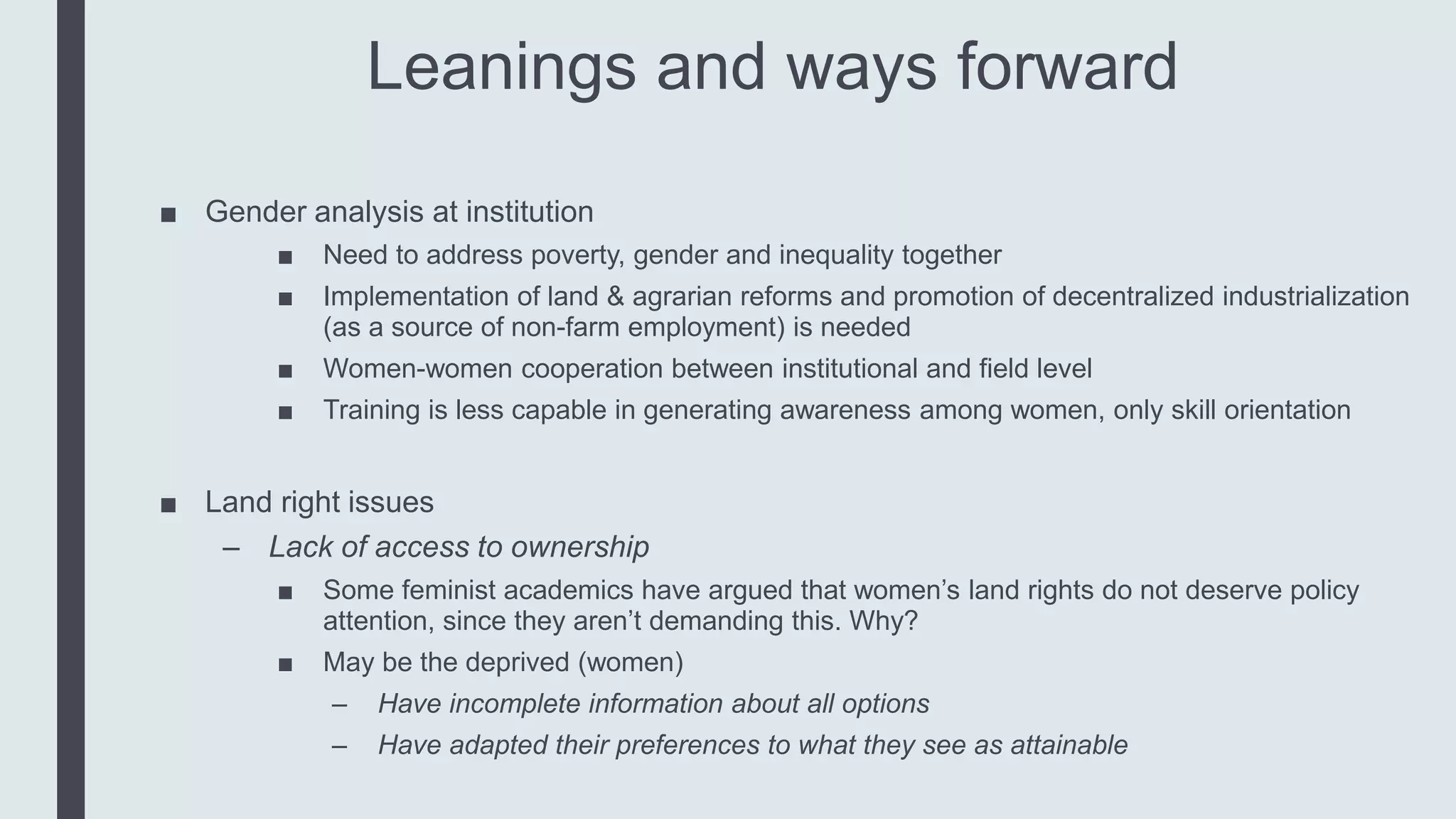
Leanings and ways forward
■ Gender analysis at institution
■ Need to address poverty, gender and inequality together
■ Implementation of land & agrarian reforms and promotion of decentralized industrialization
(as a source of non-farm employment) is needed
■ Women-women cooperation between institutional and field level
■ Training is less capable in generating awareness among women, only skill orientation
■ Land right issues
– Lack of access to ownership
■ Some feminist academics have argued that women’s land rights do not deserve policy
attention, since they aren’t demanding this. Why?
■ May be the deprived (women)
– Have incomplete information about all options
– Have adapted their preferences to what they see as attainable
Scope for further research
■ Literature also affirmed that ‘Feminization of Agriculture’ is happening - the extent is
escalating
– Allowed women to contribute to family in more productive ways and attain better
agency
■ High time to question,
– What impact it had on women’s life?
– What happens to other family members?
– How the experience differ among different agro-ecologies?
– Was that beneficial or burdensome to women?
– After all these, have the women been empowered – as they deserve?
■ If yes, then to what extent?
■ If no, then why not?
■ Need to conduct more in-depth research on
– Understanding the social and gender dynamics of migration in Bangladesh
■ Rice based farming being labour intensive will have slightly different implications when it
comes to migration within state, country or internationally
– Exploring impacts of feminization of agriculture on women’s lives and agency
THANK
YOU
ALL

Experiences in bd migration and rice system sahed khan

  • 1.
    WELCOME TO WORKSHOP ON EXPLORING SOCIAL ANDGENDER DYNAMICS OF MIGRATION IN RICE-BASED SYSTEMS IN SOUTH ASIA Md. Sahed Khan 17-20 June 2019 ISARC, Varanasi
  • 2.
    Presentation and discussion ■Perspectives from Bangladesh
  • 3.
    Women in BangladeshAgriculture ■ Almost 13 million farm families of the country grow rice [Bangladesh Rice Knowledge Bank] ■ Agriculture provides employment to largest share of rural population (54.1%), women – Constitute 76.7% of farming population (43.9% men) [Quarterly labour force Survey (2015-16) of BBS] – Women’s participation has increased & are dominating the sector ■ Doing harvesting, tilling, irrigation and others works outside their homes ■ Besides caring for crop fields, crop sorting and processing, storing, irrigation, harvesting and some other related works, women are also participating in core cultivation with males – [https://www.daily-sun.com/printversion/details/277579/Women-make-a-change-in-agri-sector] – Contribute considerably to household income through farm and homestead production and wage labor ■ A highly patriarchal society with high gender discrimination at all levels ■ Women struggled a lot and mostly failed in demanding and controlling their deserved rights in family, society and in the state – due to the domination of their male counterparts in this patriarchal society
  • 4.
    Political Ecology Framework DimensionsResource Ownership Capacity Building Research & Development Household •Nature of accessibility by people of different layers within household i.e., oHusband and wife oYoung and Old-age group oWidowed member oOther family interactions •Increased knowledge and enhanced self- confidence •Consciousness orientation •Able to identify and articulate information and technology needs •Enhanced access to services provided by GOs and NGOs •Membership (GO & NGO) •Development of a range of affordable and appropriate technologies that meet women’s needs in agricultural production, post- harvesting & household tasks, reduce drudgery & save time Community •Availability, adequacy & accessibility by people of different layers like oMen and women oRich and poor oModerate and Extreme poor oFarmers and Non-farmers oOther interactions •Educate community leaders, government officials and local leaders regarding the importance of gender responsive and participatory approaches •Train government and other officials involved in rural development in gender analysis and gender mainstreaming •Development of a gender and sex- disaggregated database (using inputs from GOs, NGOs and communities) •Support to decision-makers by assisting identification, planning and targeting of gender-sensitive interventions, including technology development and delivery Market •Create and regularly update organizational directories to improve knowledge about the roles of actors in technology development and delivery •Agricultural value chain involvement •Gender-responsive consciousness orientation •[Gender based] Farmers’ cooperative •Mechanisms to bring stability on information accessibility oPricing policy oCredit policy oTrading policy State •Policies and strategies for attaining gender equality •Gender based equal accessibility to resources •Equality in resource ownership •Inter-sectoral partnership •Policies and strategies for promoting awareness •Self-worth and self-reliance •Provide support to stakeholders to develop appropriate gender-responsive technologies for agricultural production, processing and household tasks •Entrepreneurship for all 4
  • 5.
    Agriculture-gender-livelihood nexus ■ Impactsof the Green Revolution package have boomeranged negatively – a vast majority (more than 60%) as capital-deficit, poor and marginal farmers with fragmented land holdings ■ For decades, September-October has persisted as the dreaded “Monga” period (also known as ‘Dead October’) – a severe food insecurity; distress-sale of livestock, land and household assets. ■ Initiatives slightly facilitated coping during high-stress periods ■ Increased agricultural productivity gains didn’t proceeded to the majorities (65-70%) – the Landless ■ Gendered dimensions of land ownership are even more debilitating – Very few women were able to or wanted to exercise this right in their socio-cultural context – Owning land implies breaking social ties & bonds - often critical support networks women
  • 6.
    Agriculture and policydistance: A paradox ■ Steady continued agrarian growth and productivity in Bangladesh is commendable – but it masks many broken stories and experiences  Landlessness  Land fragmentation  Distress sale of land  Gendered disparities in land ownership  Agriculture decision-making and  Distress pull-out from agriculture of the most vulnerable ■ The “policy distance” persists – Most peripheral regions presents a paradox of being too far away from capital city [Dhaka], (nerve centre of policy, decision-making and politics)
  • 7.
    Northern More frequent &permanent Age: 15 – 34 years; Destination: mostly Dhaka Rapid agricultural transition Less profitability in rice farming Inadequacy of non-farm & year round employment opportunity High waged industrial employment in urban regions Western Less frequent & mostly seasonal Age: 15 – 32 years; Destination: mostly Neighboring regions & few India Rapid agricultural transition Inadequacy of non-farm & year round employment opportunity Less profitability in rice farming Eastern More frequent and both permanent & seasonal Age: 20 – 36 years; Destination: few Dhaka and mostly International Rapid agricultural transition Less profitability in rice farming Inadequacy of non-farm employment opportunity High waged employment in urban as well as foreign nations Southern More frequent and both permanent & seasonal Age: 18 – 35 years; Destination: mostly Dhaka and few International Climate change and frequent natural disasters Less profitability in rice farming Inadequacy of non-farm employment opportunity High waged employment in urban as well as foreign nations Migration in Bangladesh: Nature & causes
  • 8.
    Profile of migrantsto Capital ■ Around 50% migrants in Dhaka city – Had only one year of schooling – Were engaged as agricultural workers and landless – Were extreme poor and destitute – Settled in slums – Every three of five got their jobs within one week (Afsar, 1999)
  • 9.
    Afsar; Kamala Gurung;Humnath Bhandari; Thelma Paris (2016) Migration: Myths & assumptions • Prevalence of poverty • Rapid agricultural transition • Swift urbanization and industrialization • Environmental – climate change, natural disaster, famine • Economic – better employment opportunity, higher wage, better exposure to outside world • Cultural – religious freedom, education Consequences of high men out- migration • Reduction in national poverty rate • Lack of farm labor • Reduction in farm productivity • Feminization of agriculture • Vulnerability of left behind – mostly women • Reluctance of youth in agriculture • Varying risk coping strategy
  • 10.
    Social costs Kinship Breaking Physical insecurity Morehealth problems faced in urban slums Skewed access to basic amenities for life Social benefits Relatively more income (reduced national poverty) Individual satisfaction from earnings and spending Pleasure of having urban citizenship Better exposure to outside world Costs and benefits of Migration
  • 11.
    In-depth study onconsequences ■ More equitable land ownership, production and consumption pattern - prior to Green Revolution – It required and facilitated a consolidation of land, capital and a switch to mono- cropping. – Explains the wide-spread landlessness of cultivable land - the vicious poverty cycle. ■ Vulnerability of left behind “All my sons are living happily with their wives and children in Dhaka city. After their departure, initially they continued some sort of communication with me but now-a-days they do not even think of caring about me, or sending any money from there. They do not even care about whether I am dead or alive.” ■ Facilitation of a mass-out migration from the North provided little respite from poverty and we reported heard comments like, “... it is very expensive to survive in the city; if we could have some land and we would get proper output price, we would like to be in the village” ■ This perhaps also explains why a significant number (more than 60%) of the rural poor in Western regions, who opt to remain poor, battle hunger and distress, choosing not to migrate.
  • 12.
    Agriculture-migration-development nexus■ High menout-migration from northern Bangladesh have acted as engine oil to the expansion of ‘inter-generational prolonged poverty’ situation – has revolved into a status quo that can be termed as a ‘vicious circle of underdevelopment’ ■ Northern people were late in making the out-migration decision than the people of other region – Southern people - first one who migrated to Dhaka city after independence of Bangladesh – They mostly grasped the benefits generated through overall development in Bangladesh – after 1990s, northern people started to migrate to Dhaka city and mostly got employed in laborers positions there – the decision to migrate didn’t bring that much of well-being which ultimately couldn’t bring desired improvements in their livelihood (Inter-generational prolonged poverty) – leaving their children under the supervision of others (Grandparents, Sisters, brothers etc.) – their children’s inner development (ethical issues) got troubled a lot – children couldn’t turn out to be as skilled manpower and as youth, they followed similar pathways that their ancestors used – ■ either get employed in the farming business (- land fragmentations made them laborers) ■ or get migrated to Dhaka city for being employed (repetition of ‘vicious circle of
  • 13.
    Trends in growthrate of GDP and agriculture sector in Bangladesh 13 0 1 2 3 4 5 6 7 8 2006-07 2007-08 2008-09 2009-10 2010-11 2011-12 2012-13 2013-14 2014-15 2015-16 InPercent Fiscal Year GDP Growth (%) Target GDP Growth (%) Achievement Growth in Agriculture Sector (%)
  • 14.
    Types of contractheld in rural Bangladesh based on gender 14 0 10 20 30 40 50 60 70 80 90 2003 2004 2005 2006 2007 2008 2009 2010 2011 2012 2013 Percentage Years Male (%) Full-time Male (%) Part-time Female (%) Full-time Female (%) Part-time
  • 15.
    Wage level andgender based participation in agriculture sector of rural Bangladesh 15 0 10 20 30 40 50 60 70 80 90 100 2003 2004 2005 2006 2007 2008 2009 2010 2011 2012 2013 Percentage Year Male (%) Low Male (%) Medium Male (%) High Female (%) Low Female (%) Medium Female (%) High
  • 16.
    Women farmers inBangladesh: Myths and assumptions Assumption 1: Women are more involved in home-based agricultural activities Assumption 2: Women are more in charge of small-scale vegetable, poultry and livestock production Assumption 3: Women are more engaged in production of perishable, but often nutrition dense foods Assumption 4: Women are more involved in production for own consumption rather than for the market. Assumption 5: Women are usually not involved at all in marketing of agricultural products Assumption 6: Women are not supposed to own productive assets like land, seed or pond Assumption 7: Women’s involvement in field agriculture is still linked to loss of man honor (man shomman)
  • 17.
    Feminization of Agriculture ■Nature – Mostly agricultural day-laborers, few small and marginal farmers ■ Extent – In case of rice, all works except land ploughing and harvesting – In case of vegetables, all works except land ploughing ■ Process Debt burden of NGO credit and labour intensiveness of crop diversification Swift male out- migration from rural to urban Urge need for lower waged labour like females, young aged boys and girls Emergence of the so called spectacle ‘Feminization of Agriculture’
  • 18.
    Feminization of Agriculture:Women’s insights■ The climax into the life of the disadvantaged women in Northern Bangladesh ■ Based on the trajectory analysis; during 1990s – – The concurrent happening of rapid industrialization and urbanization; better communication with capital (establishment of Jamuna Bridge) and less profitability of farming business – both pushed and pulled the men through process of migration – Through NGO membership, women got access to credits but the credited money was mostly utilized by their male counterparts in unproductive means ■ Put the women in a trap of burdensome weekly installment repayment ■ Opted to migrate and work as RMG workers in Dhaka ■ In the next 15-25 years; their social injustices and insecurity experience was forwarded to rural regions – daughters were advised not to migrate to Dhaka to work in RMG factories – Lastly, changing cropping pattern introduced by the policy on the commercialization of vegetable production – more cheap (female) labor emerged in the fields ■ “Feminization of Agriculture” started happening & the extent is escalating
  • 19.
    Consequences of feminizationof agriculture Positive ■ Making more visible monetary contribution to family ■ Getting social recognition as economically active participants in agriculture ■ Able to have savings ■ Better gender relations within household as well as community members Negative ■ Burdensome workload of women – different group has different extent of burden – Class – Family type – Ethnicity – Santal women in BD ■ School drop-out of girls in HHs: As substitute for mother’s role in HHs
  • 20.
    Leanings and waysforward ■ Gender analysis at institution ■ Need to address poverty, gender and inequality together ■ Implementation of land & agrarian reforms and promotion of decentralized industrialization (as a source of non-farm employment) is needed ■ Women-women cooperation between institutional and field level ■ Training is less capable in generating awareness among women, only skill orientation ■ Land right issues – Lack of access to ownership ■ Some feminist academics have argued that women’s land rights do not deserve policy attention, since they aren’t demanding this. Why? ■ May be the deprived (women) – Have incomplete information about all options – Have adapted their preferences to what they see as attainable
  • 21.
    Scope for furtherresearch ■ Literature also affirmed that ‘Feminization of Agriculture’ is happening - the extent is escalating – Allowed women to contribute to family in more productive ways and attain better agency ■ High time to question, – What impact it had on women’s life? – What happens to other family members? – How the experience differ among different agro-ecologies? – Was that beneficial or burdensome to women? – After all these, have the women been empowered – as they deserve? ■ If yes, then to what extent? ■ If no, then why not? ■ Need to conduct more in-depth research on – Understanding the social and gender dynamics of migration in Bangladesh ■ Rice based farming being labour intensive will have slightly different implications when it comes to migration within state, country or internationally – Exploring impacts of feminization of agriculture on women’s lives and agency
  • 22.

Editor's Notes

  • #4 Densely populated agrarian economy - women comprise (~) half of its population
  • #5 Focuses on both equity and efficiency in terms of gender-responsive technology development and dissemination
  • #14 Source: (BBS, 2016)
  • #15 Source: FAO, 2013
  • #16 Source: FAO, 2013
  • #17 Gender divide is prominent when men’s and women’s activities are compared and is exercised through enforcement of traditional gender roles