URBAN DEVELOPMENT
IN PAKISTAN
           By :-
           Hafiz Uzair Ahmad Khan
           B.S Final Year
MOEN JO DARO
lasted from early 1st millennium BC to the 11th century AD
Urban development in Pakistan

• Pakistan inherits the riches of the Gandhara civilization
• Pakistan has been under the influence of cultures that
  took pride in creating planned cities
• For instance, the sewerage system in the ruins of Taxila
  demonstrates the engineering genius of the past
  civilizations.
URBAN DEVELOPMENT IN PAKISTAN


KARACHI….. Before   KARACHI….. Now
• The current dilapidated state of large and small towns in
  Pakistan is at complete odds with the rich heritage of
  town planning
• Dumps of waste scattered all over the cities
• open sewers carrying human and other waste
• insufficient supply of potable water
• Haphazard Development patterns that produce chronic
  traffic congestion and noise
• lack of public spaces
• and most important of all, persistent poverty,
  characterize today’s urban Pakistan.
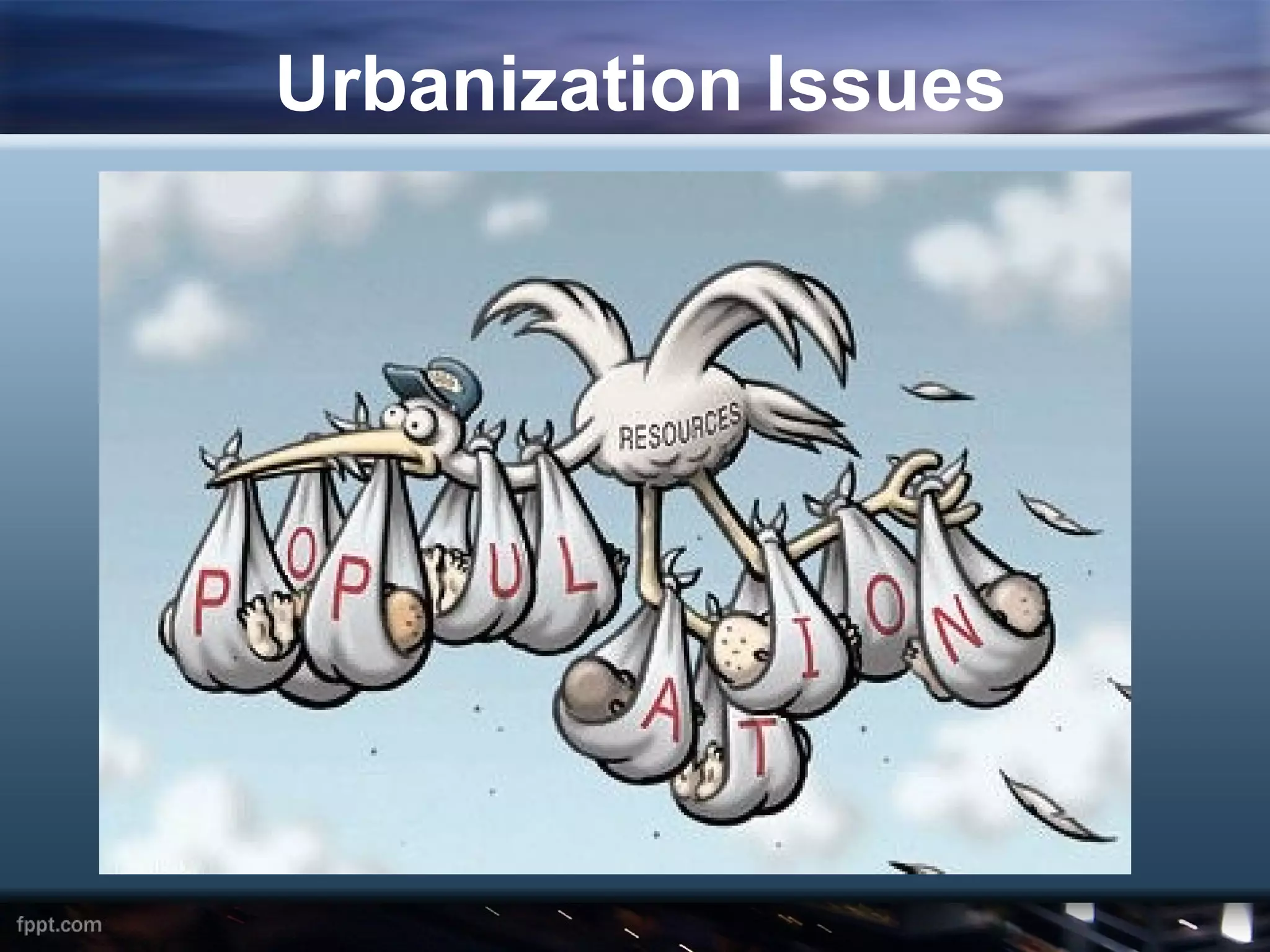
Urbanization Issues
Urbanization Issues
URBAN CHALLENGES

• Housing and land policies
• Infrastructure Deficit
• Urban Poverty & Unemployment
• Incoherent Future Ambitions For Urban
  Pakistan
• Devolution Plan
Housing and land Challenges
• The 1998 decennial census revealed that there were
  19.3 million housing units available for a population of
  130 million. This represented a housing backlog of
  almost 4.3 million units.
• The current estimate of the housing backlog is around
  6.0 million.
• The annual construction of housing units is around
  300,000 units, whereas the requirement is around
  570,000 units.
Housing and land policies
• The development authorities in urban Pakistan have
  been transferring the state-owned land at nominal prices
  to housing schemes, which are often managed by the
  military or civil elite. Such housing schemes develop the
  land and transfer parcels to their members, which in turn
  sell the developed land in open markets where land
  prices are very high.
• The fact remains that housing needs of low- and middle-
  income households, who constitute the bottom of the
  pyramid, have remained largely unmet, resulting in huge
  housing backlogs.
Infrastructure Deficit
• Less than 1% of waste water is treated in Pakistan. The
  rest is dumped into ravines, streams, and rivers
• The metropolitan governments recover fewer than 50%
  of the solid waste generated in the cities. The rest is left
  to rot on the streets.
• The dumped waste pollutes the groundwater and the
  incinerated waste creates air pollution.
Infrastructure Deficit

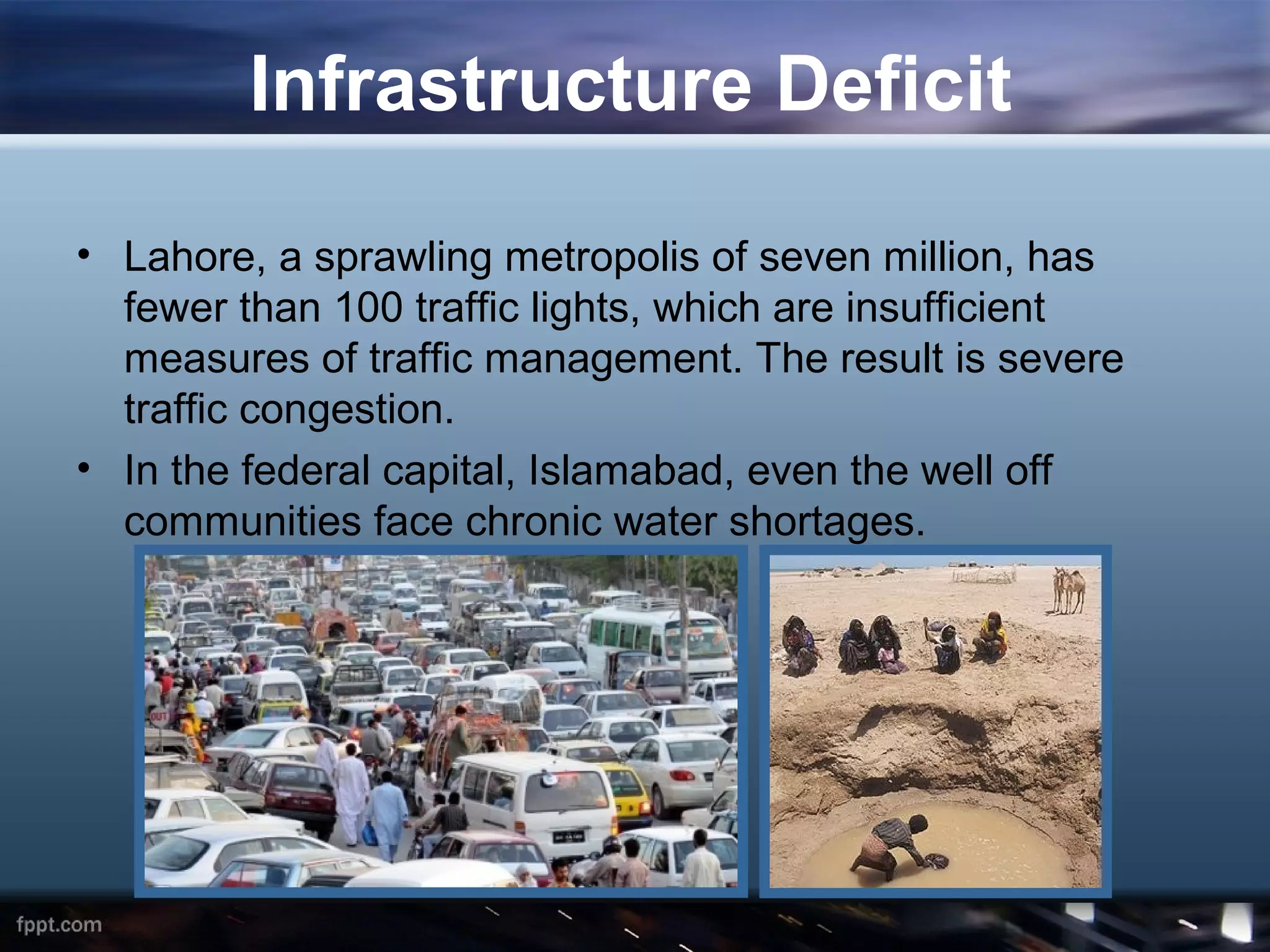
• Lahore, a sprawling metropolis of seven million, has
  fewer than 100 traffic lights, which are insufficient
  measures of traffic management. The result is severe
  traffic congestion.
• In the federal capital, Islamabad, even the well off
  communities face chronic water shortages.
Urban Poverty & Unemployment
• Consider that the largest and the fastest growing cohort
  in Pakistan is between the ages of 15 and 25 years of
  age.
• In urban areas, more often than not, the youth are
  educated. However, gainful employment, even for the
  educated youth, remains elusive.
Urban Poverty & Unemployment
• Add to this the lack of entrepreneurship, and the result is
  an army of unemployed youth, who are readily drafted by
  the mafia or other degenerated groups.
• This may be the reason behind the increase in violent
  crime in the last decade in Pakistan.
• With the coming of age of large number of unemployed,
  educated youth in urban Pakistan, the severity of
  challenges is only likely to increase.
Incoherent Future Ambitions For Urban Pakistan

• Another challenge in urban Pakistan is the intolerance
  towards the diversity of views and virtues for the future of
  urban Pakistan.
• On one hand are the conservatives who would like to
  see the economic growth of cities divorced from the
  cultural evolution and diversity.
• On the other hand are the pragmatists who see cultural
  evolution a natural outcome of the urbanization process.
• The lack of tolerance towards divergent views continues
  to pull urban Pakistan in different directions, which is not
  conducive for growth and development.
Devolution Plan

• Under the devolution plan, a new system of municipal
  governance has been laid out in Pakistan.
• The salient features include :
   – Emancipation of women (more than 25% of the 130,000-odd
     municipal representatives are women)
   – Devolution of power for local decision making
   – The formation of citizen community boards (CCBs) to engage
     the community in the decision making process
These changes, accompanied with
the much-needed municipal financial
  reform, which is yet to occur, are
  likely to bring positive change in
           urban Pakistan….
Urban development in pakistan

Urban development in pakistan

  • 1.
    URBAN DEVELOPMENT IN PAKISTAN By :- Hafiz Uzair Ahmad Khan B.S Final Year
  • 2.
    MOEN JO DARO lastedfrom early 1st millennium BC to the 11th century AD
  • 3.
    Urban development inPakistan • Pakistan inherits the riches of the Gandhara civilization • Pakistan has been under the influence of cultures that took pride in creating planned cities • For instance, the sewerage system in the ruins of Taxila demonstrates the engineering genius of the past civilizations.
  • 5.
    URBAN DEVELOPMENT INPAKISTAN KARACHI….. Before KARACHI….. Now
  • 6.
    • The currentdilapidated state of large and small towns in Pakistan is at complete odds with the rich heritage of town planning • Dumps of waste scattered all over the cities • open sewers carrying human and other waste • insufficient supply of potable water • Haphazard Development patterns that produce chronic traffic congestion and noise • lack of public spaces • and most important of all, persistent poverty, characterize today’s urban Pakistan.
  • 8.
  • 9.
  • 11.
    URBAN CHALLENGES • Housingand land policies • Infrastructure Deficit • Urban Poverty & Unemployment • Incoherent Future Ambitions For Urban Pakistan • Devolution Plan
  • 13.
    Housing and landChallenges • The 1998 decennial census revealed that there were 19.3 million housing units available for a population of 130 million. This represented a housing backlog of almost 4.3 million units. • The current estimate of the housing backlog is around 6.0 million. • The annual construction of housing units is around 300,000 units, whereas the requirement is around 570,000 units.
  • 14.
    Housing and landpolicies • The development authorities in urban Pakistan have been transferring the state-owned land at nominal prices to housing schemes, which are often managed by the military or civil elite. Such housing schemes develop the land and transfer parcels to their members, which in turn sell the developed land in open markets where land prices are very high. • The fact remains that housing needs of low- and middle- income households, who constitute the bottom of the pyramid, have remained largely unmet, resulting in huge housing backlogs.
  • 15.
    Infrastructure Deficit • Lessthan 1% of waste water is treated in Pakistan. The rest is dumped into ravines, streams, and rivers • The metropolitan governments recover fewer than 50% of the solid waste generated in the cities. The rest is left to rot on the streets. • The dumped waste pollutes the groundwater and the incinerated waste creates air pollution.
  • 16.
    Infrastructure Deficit • Lahore,a sprawling metropolis of seven million, has fewer than 100 traffic lights, which are insufficient measures of traffic management. The result is severe traffic congestion. • In the federal capital, Islamabad, even the well off communities face chronic water shortages.
  • 17.
    Urban Poverty &Unemployment • Consider that the largest and the fastest growing cohort in Pakistan is between the ages of 15 and 25 years of age. • In urban areas, more often than not, the youth are educated. However, gainful employment, even for the educated youth, remains elusive.
  • 19.
    Urban Poverty &Unemployment • Add to this the lack of entrepreneurship, and the result is an army of unemployed youth, who are readily drafted by the mafia or other degenerated groups. • This may be the reason behind the increase in violent crime in the last decade in Pakistan. • With the coming of age of large number of unemployed, educated youth in urban Pakistan, the severity of challenges is only likely to increase.
  • 20.
    Incoherent Future AmbitionsFor Urban Pakistan
  • 21.
    Incoherent Future AmbitionsFor Urban Pakistan • Another challenge in urban Pakistan is the intolerance towards the diversity of views and virtues for the future of urban Pakistan. • On one hand are the conservatives who would like to see the economic growth of cities divorced from the cultural evolution and diversity. • On the other hand are the pragmatists who see cultural evolution a natural outcome of the urbanization process. • The lack of tolerance towards divergent views continues to pull urban Pakistan in different directions, which is not conducive for growth and development.
  • 22.
    Devolution Plan • Underthe devolution plan, a new system of municipal governance has been laid out in Pakistan. • The salient features include : – Emancipation of women (more than 25% of the 130,000-odd municipal representatives are women) – Devolution of power for local decision making – The formation of citizen community boards (CCBs) to engage the community in the decision making process
  • 23.
    These changes, accompaniedwith the much-needed municipal financial reform, which is yet to occur, are likely to bring positive change in urban Pakistan….